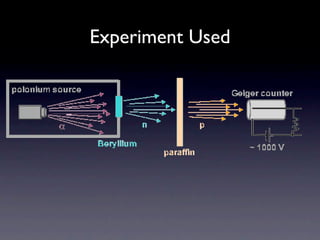
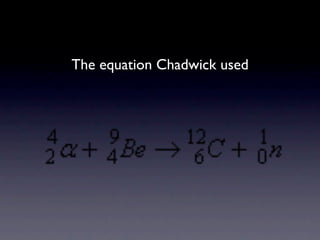
James Chadwick was a British physicist born in England. He studied under Ernest Rutherford and worked with him on experiments involving radioactive substances. This led Chadwick to continue Rutherford's idea that there were neutral particles in the nucleus of an atom. Through his own experiment in 1932, Chadwick was able to prove the existence of the neutron. He called these neutral particles "neutrons" and showed they have about the same mass as a proton but no electric charge. This discovery of the neutron was fundamental to modern physics and earned Chadwick the 1935 Nobel Prize in Physics.



![5G Explained! A High Level Overview [Introduction]](https://cdn.slidesharecdn.com/ss_thumbnails/5gexplainedahighleveloverview-260119165306-cc137a3e-thumbnail.jpg?width=640&height=640&fit=bounds)


