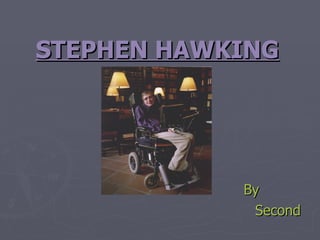
STEPHEN HAWKING By Second  Group
Stephen Hawking Stephen William Hawking, CH, CBE, FRS (born 8 January 1942) is a theoretical physicist. Hawking is the Lucasian Professor of Mathematics at the University of Cambridge, and a Fellow of Gonville and Caius College, Cambridge. He is known for his significant contributions to the field of quantum physics, particularly his theories regarding theoretical cosmology, quantum gravity, black holes, and his popular works in which he discusses his own theories and cosmology in general. These include the runaway popular science bestseller A Brief History of Time, which stayed on the London Sunday Times bestseller list for a record-breaking 237 weeks. Despite enduring severe disability and, of late, being rendered quadriplegic by motor neuron disease (specifically, amyotrophic lateral sclerosis, or, "Lou Gehrig's disease"), he has had a successful career for many years, and has achieved status as an academic celebrity. He is considered by most as one of the greatest scientists of the modern age.
Stephen Hawking - Biography Stephen William Hawking was born on 8 January 1942 (300 years after the death of Galileo) in Oxford, England. His parents' house was in north London, but during the second world war Oxford was considered a safer place to have babies. When he was eight, his family moved to St Albans, a town about 20 miles north of London. At eleven Stephen went to St Albans School, and then on to University College, Oxford, his father's old college. Stephen wanted to do Mathematics, although his father would have preferred medicine. Mathematics was not available at University College, so he did Physics instead. After three years and not very much work he was awarded a first class honours degree in Natural Science.
Stephen Hawking  - Disability In his third year at Oxford, He noticed that he seemed to be getting more clumsy, and he fell over once or twice for no apparent reason. But it was not until he was at Cambridge, in the following year, that his father noticed, and took him to the family doctor. He was referred  to a specialist, and shortly after his 21st birthday, he went into hospital for tests. He was in for two weeks, during which he had a wide variety of tests. He  had motor neurone disease for practically all his adult life. Yet it has not prevented him from having a very attractive family, and being successful in his work. He has been lucky, that his condition has progressed more slowly than is often the case. But it shows that one need not lose hope.
Comments on Global Warming The danger is that global warming may become self-sustaining, if it has not done so already. The melting of the Arctic and Antarctic ice caps reduces the fraction of solar energy reflected back into space, and so increases the temperature further. Climate change may kill off the Amazon and other rain forests, and so eliminate one of the main ways in which carbon dioxide is removed from the atmosphere. The rise in sea temperature may trigger the release of large quantities of carbon dioxide, trapped as hydrides on the ocean floor. Both these phenomena would increase the greenhouse effect, and so further global warming. We have to reverse global warming urgently, if we still can.
His Latest Book Professor Hawking's latest book, 'A Briefer History of Time'. From the book's blurb: "Stephen Hawking's worldwide bestseller, A Brief History of Time, has been a landmark volume in scientific writing. Its author's engaging voice is one reason, and the compelling subjects he addresses is another: the nature of space and time, the role of God in creation, the history and future of the Universe. but it is also true that in the years since its publication, readers have repeatedly told Professor Hawking of their great difficulty in understanding some of the book's most important concepts. "This is the origin of and the reason for A Briefer History of Time: its author's wish to make its content accessible to readers - as well as to bring it up to date with the latest scientific observations and findings."
Stephen Hawking – His Works Antimatter The Big Bang Black Holes   •Do Black Holes Really Exist?   •Can Anything Escape From a Black Hole? Cosmic Background Radiation Cosmic Rays Cosmological Constant Dark Matter    •Hot and Cold Dark Matter     •Machos    •Neutrinos    •Wimps E=mc2 Gravity Hubble’s Law Imaginary Time Nebulae Planetary Motion Quarks Quasars Radioactivity Schrödinger’s Cat Spectroscopy and Red shift Singularity Superstrings The   Uncertainty Principle Wormholes
AWARDS 1975 Eddington Medal  1976 Hughes Medal of the Royal Society  1979 Albert Einstein Medal  1982 Order of the British Empire (Commander)  1985 Gold Medal of the Royal Astronomical Society  1986 Member of the Pontifical Academy of Sciences  1988 Wolf Prize in Physics  1989 Prince of Asturias Awards in Concord  1989 Companion of Honour  1999 [9] Julius Edgar Lilienfeld Prize of the American Physical Society  2003 Michelson Morley Award of Case Western Reserve University  2006 [10] Copley Medal of the Royal Society
Conclusion Stephen Hawking who came from nowhere reached the universe with hardwork and patience. Even though he had disabilities he tried hard to prove things which could not be done by normal humans. He is a perfect role model for the students of the 21 st century.
As students of this great institution, we should be able to prove or find facts and information which has not been proved yet. Let Stephen Hawking be our role model and let us try to be someone great in future.
The End

Stephen Hawking

  • 1.
    STEPHEN HAWKING BySecond Group
  • 2.
    Stephen Hawking StephenWilliam Hawking, CH, CBE, FRS (born 8 January 1942) is a theoretical physicist. Hawking is the Lucasian Professor of Mathematics at the University of Cambridge, and a Fellow of Gonville and Caius College, Cambridge. He is known for his significant contributions to the field of quantum physics, particularly his theories regarding theoretical cosmology, quantum gravity, black holes, and his popular works in which he discusses his own theories and cosmology in general. These include the runaway popular science bestseller A Brief History of Time, which stayed on the London Sunday Times bestseller list for a record-breaking 237 weeks. Despite enduring severe disability and, of late, being rendered quadriplegic by motor neuron disease (specifically, amyotrophic lateral sclerosis, or, "Lou Gehrig's disease"), he has had a successful career for many years, and has achieved status as an academic celebrity. He is considered by most as one of the greatest scientists of the modern age.
  • 3.
    Stephen Hawking -Biography Stephen William Hawking was born on 8 January 1942 (300 years after the death of Galileo) in Oxford, England. His parents' house was in north London, but during the second world war Oxford was considered a safer place to have babies. When he was eight, his family moved to St Albans, a town about 20 miles north of London. At eleven Stephen went to St Albans School, and then on to University College, Oxford, his father's old college. Stephen wanted to do Mathematics, although his father would have preferred medicine. Mathematics was not available at University College, so he did Physics instead. After three years and not very much work he was awarded a first class honours degree in Natural Science.
  • 4.
    Stephen Hawking - Disability In his third year at Oxford, He noticed that he seemed to be getting more clumsy, and he fell over once or twice for no apparent reason. But it was not until he was at Cambridge, in the following year, that his father noticed, and took him to the family doctor. He was referred to a specialist, and shortly after his 21st birthday, he went into hospital for tests. He was in for two weeks, during which he had a wide variety of tests. He had motor neurone disease for practically all his adult life. Yet it has not prevented him from having a very attractive family, and being successful in his work. He has been lucky, that his condition has progressed more slowly than is often the case. But it shows that one need not lose hope.
  • 5.
    Comments on GlobalWarming The danger is that global warming may become self-sustaining, if it has not done so already. The melting of the Arctic and Antarctic ice caps reduces the fraction of solar energy reflected back into space, and so increases the temperature further. Climate change may kill off the Amazon and other rain forests, and so eliminate one of the main ways in which carbon dioxide is removed from the atmosphere. The rise in sea temperature may trigger the release of large quantities of carbon dioxide, trapped as hydrides on the ocean floor. Both these phenomena would increase the greenhouse effect, and so further global warming. We have to reverse global warming urgently, if we still can.
  • 6.
    His Latest BookProfessor Hawking's latest book, 'A Briefer History of Time'. From the book's blurb: "Stephen Hawking's worldwide bestseller, A Brief History of Time, has been a landmark volume in scientific writing. Its author's engaging voice is one reason, and the compelling subjects he addresses is another: the nature of space and time, the role of God in creation, the history and future of the Universe. but it is also true that in the years since its publication, readers have repeatedly told Professor Hawking of their great difficulty in understanding some of the book's most important concepts. "This is the origin of and the reason for A Briefer History of Time: its author's wish to make its content accessible to readers - as well as to bring it up to date with the latest scientific observations and findings."
  • 7.
    Stephen Hawking –His Works Antimatter The Big Bang Black Holes   •Do Black Holes Really Exist?   •Can Anything Escape From a Black Hole? Cosmic Background Radiation Cosmic Rays Cosmological Constant Dark Matter    •Hot and Cold Dark Matter    •Machos    •Neutrinos    •Wimps E=mc2 Gravity Hubble’s Law Imaginary Time Nebulae Planetary Motion Quarks Quasars Radioactivity Schrödinger’s Cat Spectroscopy and Red shift Singularity Superstrings The Uncertainty Principle Wormholes
  • 8.
    AWARDS 1975 EddingtonMedal 1976 Hughes Medal of the Royal Society 1979 Albert Einstein Medal 1982 Order of the British Empire (Commander) 1985 Gold Medal of the Royal Astronomical Society 1986 Member of the Pontifical Academy of Sciences 1988 Wolf Prize in Physics 1989 Prince of Asturias Awards in Concord 1989 Companion of Honour 1999 [9] Julius Edgar Lilienfeld Prize of the American Physical Society 2003 Michelson Morley Award of Case Western Reserve University 2006 [10] Copley Medal of the Royal Society
  • 9.
    Conclusion Stephen Hawkingwho came from nowhere reached the universe with hardwork and patience. Even though he had disabilities he tried hard to prove things which could not be done by normal humans. He is a perfect role model for the students of the 21 st century.
  • 10.
    As students ofthis great institution, we should be able to prove or find facts and information which has not been proved yet. Let Stephen Hawking be our role model and let us try to be someone great in future.
  • 11.