CRYSTAL IMPERFECTIONS
By 21M101
WHY SHOULD WE STUDY CRYSTAL
IMPERFECTIONS?
Technically important properties such as mechanical strength.
Ductility, Crystal growth, conduction in Semiconductors are
greatly affected by relatively minor changes in crystal Structure
caused by DEFECTS/ IMPERFECTIONS.
• Crystal Imperfections are the defects in the regular geometrical
arrangement of the atoms in a Crystalline solid.
• A Perfect Crystal is an idealization; there is no such thing in
nature.
• The defects may be the results of the crystal deformation or
rapid cooling from high temperature or high energy radiation
striking the solid.
• The defects influence the mechanical, electrical, and optical
behavior of the crystal.
• The imperfections may be classified widely as:
• Point Defects
• Line Defects
• Surface Defects
• Volume Defects
Point Defects
• These are the lattice errors at isolated points, takes place due
to the imperfect packing of atoms during crystallization or due to
the vibrations of atoms at high temperatures.
(a)VACANCIES
A simplest point defects
in a crystal. Refers to
missing atom or vacant
atomic site. Arise either
from imperfect packing
during original
crystallization or from
thermal vibrations at
high temperatures.
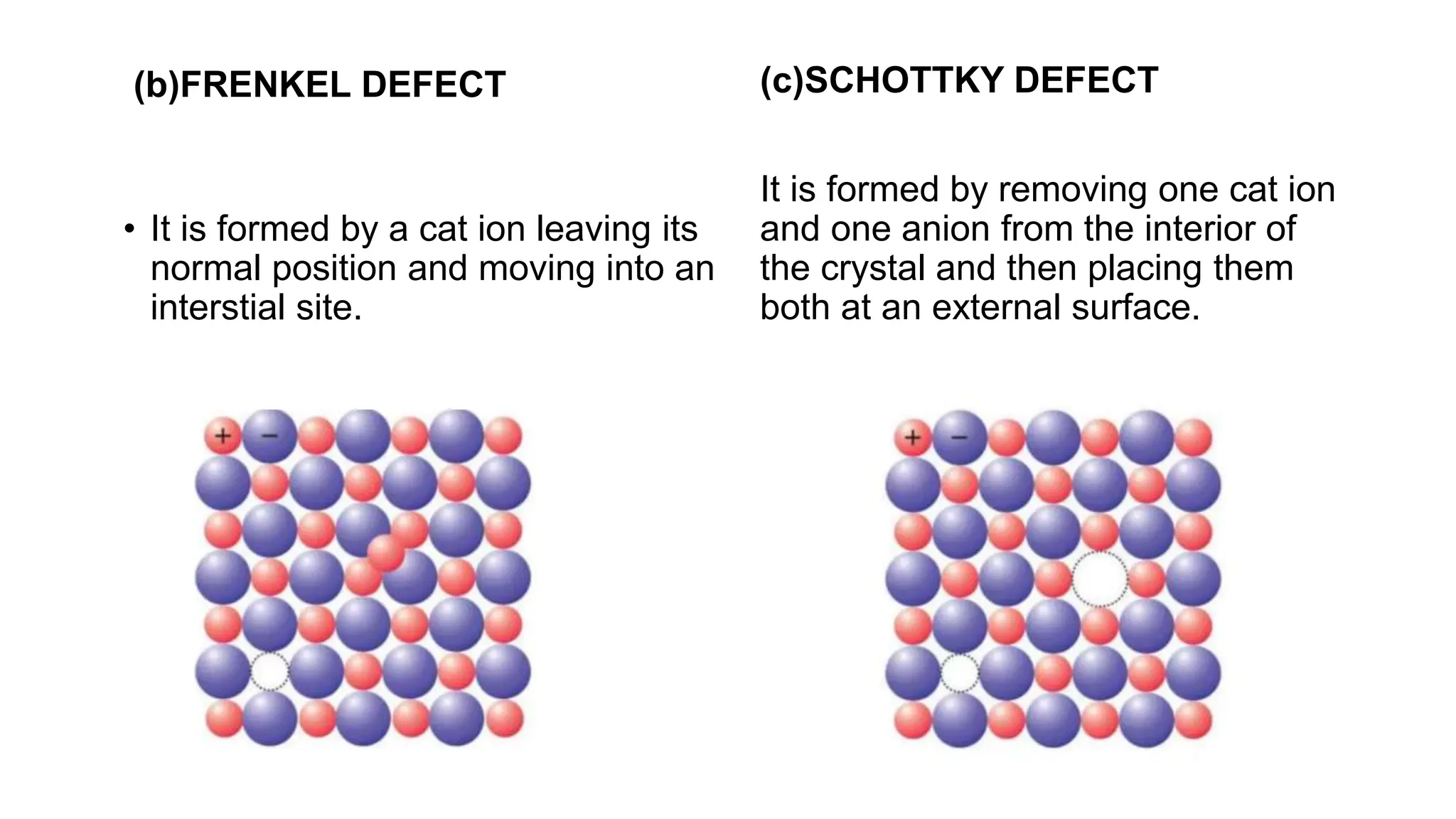
(b)FRENKEL DEFECT
• It is formed by a cat ion leaving its
normal position and moving into an
interstial site.
(c)SCHOTTKY DEFECT
It is formed by removing one cat ion
and one anion from the interior of
the crystal and then placing them
both at an external surface.
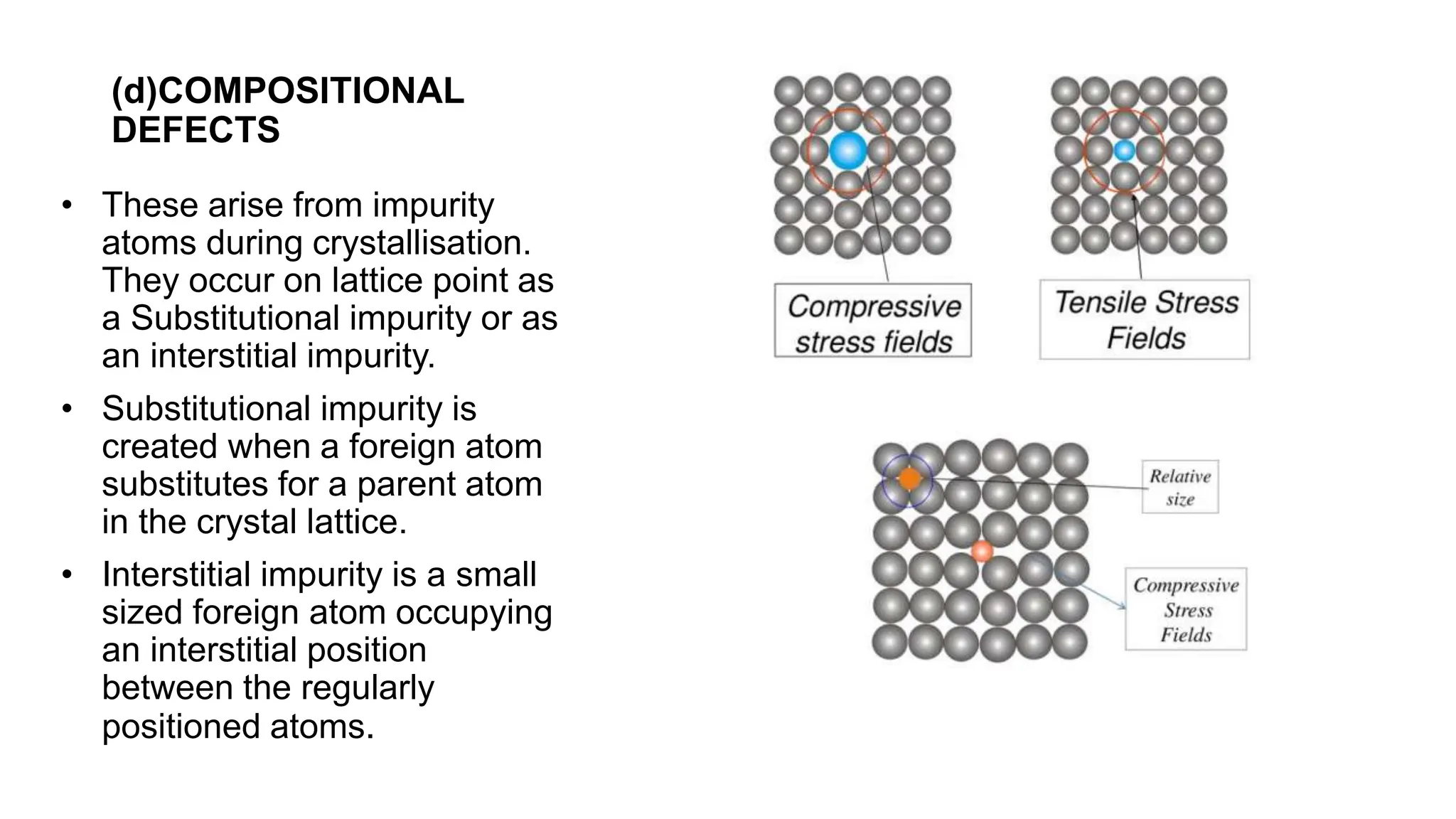
(d)COMPOSITIONAL
DEFECTS
• These arise from impurity
atoms during crystallisation.
They occur on lattice point as
a Substitutional impurity or as
an interstitial impurity.
• Substitutional impurity is
created when a foreign atom
substitutes for a parent atom
in the crystal lattice.
• Interstitial impurity is a small
sized foreign atom occupying
an interstitial position
between the regularly
positioned atoms.
(e) ELECTRONIC
DEFECTS
These are the errors in
charge distribution in
solids. These are primarily
necessary in electrical
conductivity & related
phenomenon
Prominent example is pn
junction formation and
transistor junction
formations.
2. LINE IMPERFECTIONS/ DISLOCATIONS
• 1-D defects around which some of the atoms are misaligned.
• These are responsible for the useful property of ductility in metals,
ceramics and crystalline polymers.
• Types:- Edge Dislocations and Screw Dislocations.
(a)EDGE DISLOCATIONS
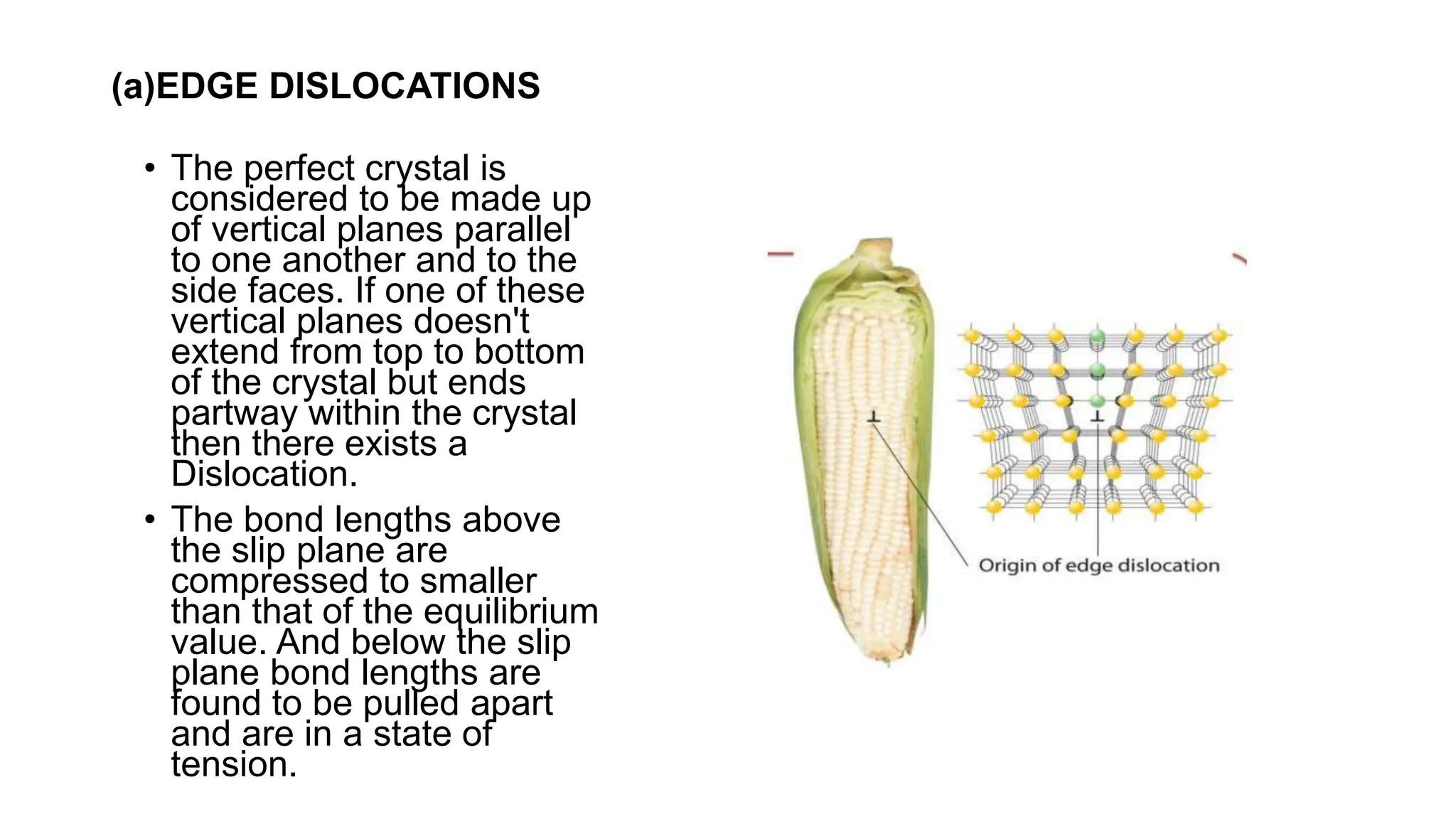
• The perfect crystal is
considered to be made up
of vertical planes parallel
to one another and to the
side faces. If one of these
vertical planes doesn't
extend from top to bottom
of the crystal but ends
partway within the crystal
then there exists a
Dislocation.
• The bond lengths above
the slip plane are
compressed to smaller
than that of the equilibrium
value. And below the slip
plane bond lengths are
found to be pulled apart
and are in a state of
tension.
THANK YOU

CRYSTAL IMPERFECTIONS _ metallurgy .pptx

  • 1.
  • 2.
    WHY SHOULD WESTUDY CRYSTAL IMPERFECTIONS? Technically important properties such as mechanical strength. Ductility, Crystal growth, conduction in Semiconductors are greatly affected by relatively minor changes in crystal Structure caused by DEFECTS/ IMPERFECTIONS.
  • 3.
    • Crystal Imperfectionsare the defects in the regular geometrical arrangement of the atoms in a Crystalline solid. • A Perfect Crystal is an idealization; there is no such thing in nature. • The defects may be the results of the crystal deformation or rapid cooling from high temperature or high energy radiation striking the solid. • The defects influence the mechanical, electrical, and optical behavior of the crystal.
  • 4.
    • The imperfectionsmay be classified widely as: • Point Defects • Line Defects • Surface Defects • Volume Defects
  • 5.
    Point Defects • Theseare the lattice errors at isolated points, takes place due to the imperfect packing of atoms during crystallization or due to the vibrations of atoms at high temperatures.
  • 6.
    (a)VACANCIES A simplest pointdefects in a crystal. Refers to missing atom or vacant atomic site. Arise either from imperfect packing during original crystallization or from thermal vibrations at high temperatures.
  • 7.
    (b)FRENKEL DEFECT • Itis formed by a cat ion leaving its normal position and moving into an interstial site. (c)SCHOTTKY DEFECT It is formed by removing one cat ion and one anion from the interior of the crystal and then placing them both at an external surface.
  • 8.
    (d)COMPOSITIONAL DEFECTS • These arisefrom impurity atoms during crystallisation. They occur on lattice point as a Substitutional impurity or as an interstitial impurity. • Substitutional impurity is created when a foreign atom substitutes for a parent atom in the crystal lattice. • Interstitial impurity is a small sized foreign atom occupying an interstitial position between the regularly positioned atoms.
  • 9.
    (e) ELECTRONIC DEFECTS These arethe errors in charge distribution in solids. These are primarily necessary in electrical conductivity & related phenomenon Prominent example is pn junction formation and transistor junction formations.
  • 10.
    2. LINE IMPERFECTIONS/DISLOCATIONS • 1-D defects around which some of the atoms are misaligned. • These are responsible for the useful property of ductility in metals, ceramics and crystalline polymers. • Types:- Edge Dislocations and Screw Dislocations.
  • 11.
    (a)EDGE DISLOCATIONS • Theperfect crystal is considered to be made up of vertical planes parallel to one another and to the side faces. If one of these vertical planes doesn't extend from top to bottom of the crystal but ends partway within the crystal then there exists a Dislocation. • The bond lengths above the slip plane are compressed to smaller than that of the equilibrium value. And below the slip plane bond lengths are found to be pulled apart and are in a state of tension.
  • 20.