Third Edition
by William Stallings
Lecture slides by Janani
 Message Authentication
 Security Requirements
 Message encryption
 MAC
 Hash Function
 Birthday attacks
 Hash function & MAC Security
 MD 5 Algorithm
 message authentication is concerned with:
 protecting the integrity of a message
 validating identity of originator
 non-repudiation of origin (dispute resolution)
 will consider the security requirements
 then three alternative functions used:
 message encryption
 message authentication code (MAC)
 hash function
 disclosure
 traffic analysis
 masquerade
 content modification
 sequence modification
 timing modification
 source repudiation
 destination repudiation
 message encryption by itself also provides a
measure of authentication
 if symmetric encryption is used then:
 receiver know sender must have created it
 since only sender and receiver now key used
 know content cannot of been altered
 if message has suitable structure, redundancy or
a checksum to detect any changes
 if public-key encryption is used:
 encryption provides no confidence of sender
 since anyone potentially knows public-key
 however if
 sender signs message using their private-key
 then encrypts with recipients public key
 have both secrecy and authentication
 again need to recognize corrupted messages
 but at cost of two public-key uses on message
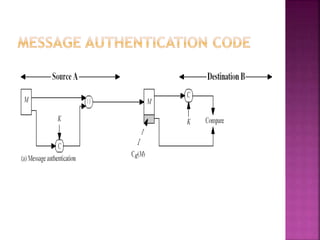
 generated by an algorithm that creates a
small fixed-sized block
 depending on both message and some key
 like encryption though need not be reversible
 appended to message as a signature
 receiver performs same computation on
message and checks it matches the MAC
 provides assurance that message is unaltered
and comes from sender
 as shown the MAC provides confidentiality
 can also use encryption for secrecy
 generally use separate keys for each
 can compute MAC either before or after
encryption
 is generally regarded as better done before
 why use a MAC?
 sometimes only authentication is needed
 sometimes need authentication to persist
longer than the encryption (eg. archival use)
 note that a MAC is not a digital signature
 a MAC is a cryptographic checksum
MAC = CK(M)
 condenses a variable-length message M
 using a secret key K
 to a fixed-sized authenticator
 is a many-to-one function
 potentially many messages have same MAC
 but finding these needs to be very difficult
 taking into account the types of attacks
 need the MAC to satisfy the following:
1. knowing a message and MAC, is infeasible to
find another message with same MAC
2. MACs should be uniformly distributed
3. MAC should depend equally on all bits of the
message
 can use any block cipher chaining mode and
use final block as a MAC
 Data Authentication Algorithm (DAA) is a
widely used MAC based on DES-CBC
 using IV=0 and zero-pad of final block
 encrypt message using DES in CBC mode
 and send just the final block as the MAC
 or the leftmost M bits (16≤M≤64) of final block
 but final MAC is now too small for security
 condenses arbitrary message to fixed size
 usually assume that the hash function is
public and not keyed
 cf. MAC which is keyed
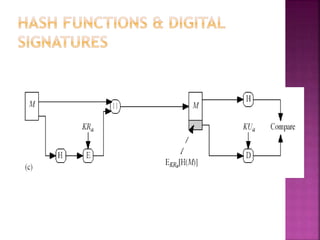
 hash used to detect changes to message
 can use in various ways with message
 most often to create a digital signature
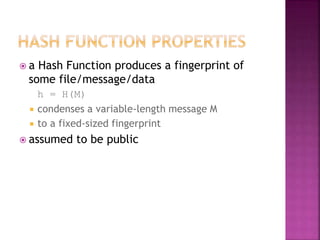
 a Hash Function produces a fingerprint of
some file/message/data
h = H(M)
 condenses a variable-length message M
 to a fixed-sized fingerprint
 assumed to be public
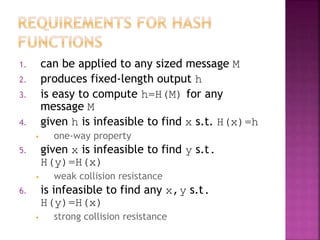
1. can be applied to any sized message M
2. produces fixed-length output h
3. is easy to compute h=H(M) for any
message M
4. given h is infeasible to find x s.t. H(x)=h
• one-way property
5. given x is infeasible to find y s.t.
H(y)=H(x)
• weak collision resistance
6. is infeasible to find any x,y s.t.
H(y)=H(x)
• strong collision resistance
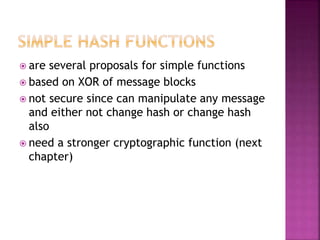
 are several proposals for simple functions
 based on XOR of message blocks
 not secure since can manipulate any message
and either not change hash or change hash
also
 need a stronger cryptographic function (next
chapter)
 might think a 64-bit hash is secure
 birthday attack works thus:
 opponent generates 2
m/2 variations of a valid
message all with essentially the same meaning
 opponent also generates 2
m/2 variations of a
desired fraudulent message
 two sets of messages are compared to find pair
with same hash (probability > 0.5 by birthday
paradox)
 have user sign the valid message, then
substitute the forgery which will have a valid
signature
 conclusion is that need to use larger MACs
 can use block ciphers as hash functions
 using H0=0 and zero-pad of final block
 compute: Hi = EMi
[Hi-1]
 and use final block as the hash value
 similar to CBC but without a key
 resulting hash is too small (64-bit)
 both due to direct birthday attack
 and to “meet-in-the-middle” attack
 other variants also susceptible to attack
 like block ciphers have:
 brute-force attacks exploiting
 strong collision resistance hash have cost 2
m/2
 have proposal for h/w MD5 cracker
 128-bit hash looks vulnerable, 160-bits better
 MACs with known message-MAC pairs
 can either attack keyspace (cf key search) or MAC
 at least 128-bit MAC is needed for security
 cryptanalytic attacks exploit structure
 like block ciphers want brute-force attacks to be
the best alternative
 have a number of analytic attacks on
iterated hash functions
 CVi = f[CVi-1, Mi]; H(M)=CVN
 typically focus on collisions in function f
 like block ciphers is often composed of rounds
 attacks exploit properties of round functions
 MD5 algorithm was developed by Professor
Ronald L. Rivest in 1991.
 MD5 message-digest algorithm takes as input
a message of arbitrary length and produces
as output a 128-bit "fingerprint" or "message
digest" of the input
 The MD5 algorithm is intended for digital
signature applications, where a large file
must be "compressed" in a secure manner
before being encrypted with a private
(secret) key under a public-key cryptosystem
such as RSA.”
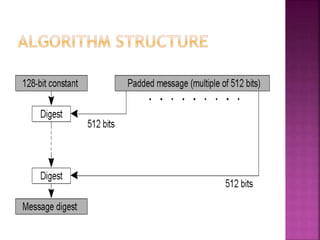
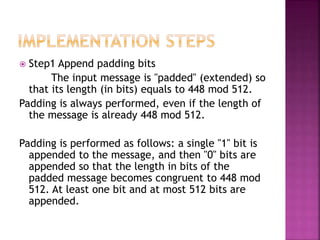
 Step1 Append padding bits
The input message is "padded" (extended) so
that its length (in bits) equals to 448 mod 512.
Padding is always performed, even if the length of
the message is already 448 mod 512.
Padding is performed as follows: a single "1" bit is
appended to the message, and then "0" bits are
appended so that the length in bits of the
padded message becomes congruent to 448 mod
512. At least one bit and at most 512 bits are
appended.
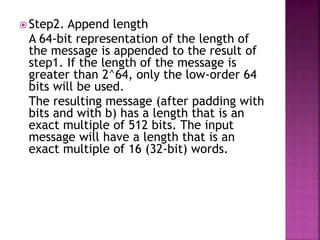
 Step2. Append length
A 64-bit representation of the length of
the message is appended to the result of
step1. If the length of the message is
greater than 2^64, only the low-order 64
bits will be used.
The resulting message (after padding with
bits and with b) has a length that is an
exact multiple of 512 bits. The input
message will have a length that is an
exact multiple of 16 (32-bit) words.
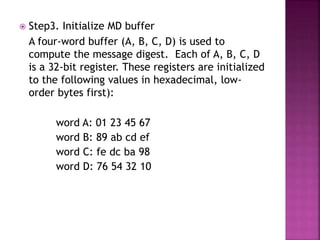
 Step3. Initialize MD buffer
A four-word buffer (A, B, C, D) is used to
compute the message digest. Each of A, B, C, D
is a 32-bit register. These registers are initialized
to the following values in hexadecimal, low-
order bytes first):
word A: 01 23 45 67
word B: 89 ab cd ef
word C: fe dc ba 98
word D: 76 54 32 10
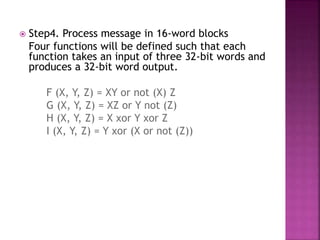
 Step4. Process message in 16-word blocks
Four functions will be defined such that each
function takes an input of three 32-bit words and
produces a 32-bit word output.
F (X, Y, Z) = XY or not (X) Z
G (X, Y, Z) = XZ or Y not (Z)
H (X, Y, Z) = X xor Y xor Z
I (X, Y, Z) = Y xor (X or not (Z))
Round 1.
[abcd k s i] denote the operation a = b + ((a + F
(b, c, d) + X [k] + T [i]) <<< s).
Do the following 16 operations.
[ABCD 0 7 1] [DABC 1 12 2] [CDAB 2 17 3]
[BCDA 3 22 4]
[ABCD 4 7 5] [DABC 5 12 6] [CDAB 6 17 7]
[BCDA 7 22 8]
[ABCD 8 7 9] [DABC 9 12 10] [CDAB 10 17 11]
[BCDA 11 22 12]
[ABCD 12 7 13] [DABC 13 12 14] [CDAB 14 17 15]
[BCDA 15 22 16]
 have considered:
 message authentication using
 message encryption
 MACs
 hash functions
 general approach & security

Cryptography and network_security

  • 1.
    Third Edition by WilliamStallings Lecture slides by Janani
  • 2.
     Message Authentication Security Requirements  Message encryption  MAC  Hash Function  Birthday attacks  Hash function & MAC Security  MD 5 Algorithm
  • 3.
     message authenticationis concerned with:  protecting the integrity of a message  validating identity of originator  non-repudiation of origin (dispute resolution)  will consider the security requirements  then three alternative functions used:  message encryption  message authentication code (MAC)  hash function
  • 4.
     disclosure  trafficanalysis  masquerade  content modification  sequence modification  timing modification  source repudiation  destination repudiation
  • 5.
     message encryptionby itself also provides a measure of authentication  if symmetric encryption is used then:  receiver know sender must have created it  since only sender and receiver now key used  know content cannot of been altered  if message has suitable structure, redundancy or a checksum to detect any changes
  • 6.
     if public-keyencryption is used:  encryption provides no confidence of sender  since anyone potentially knows public-key  however if  sender signs message using their private-key  then encrypts with recipients public key  have both secrecy and authentication  again need to recognize corrupted messages  but at cost of two public-key uses on message
  • 7.
     generated byan algorithm that creates a small fixed-sized block  depending on both message and some key  like encryption though need not be reversible  appended to message as a signature  receiver performs same computation on message and checks it matches the MAC  provides assurance that message is unaltered and comes from sender
  • 9.
     as shownthe MAC provides confidentiality  can also use encryption for secrecy  generally use separate keys for each  can compute MAC either before or after encryption  is generally regarded as better done before  why use a MAC?  sometimes only authentication is needed  sometimes need authentication to persist longer than the encryption (eg. archival use)  note that a MAC is not a digital signature
  • 10.
     a MACis a cryptographic checksum MAC = CK(M)  condenses a variable-length message M  using a secret key K  to a fixed-sized authenticator  is a many-to-one function  potentially many messages have same MAC  but finding these needs to be very difficult
  • 11.
     taking intoaccount the types of attacks  need the MAC to satisfy the following: 1. knowing a message and MAC, is infeasible to find another message with same MAC 2. MACs should be uniformly distributed 3. MAC should depend equally on all bits of the message
  • 12.
     can useany block cipher chaining mode and use final block as a MAC  Data Authentication Algorithm (DAA) is a widely used MAC based on DES-CBC  using IV=0 and zero-pad of final block  encrypt message using DES in CBC mode  and send just the final block as the MAC  or the leftmost M bits (16≤M≤64) of final block  but final MAC is now too small for security
  • 13.
     condenses arbitrarymessage to fixed size  usually assume that the hash function is public and not keyed  cf. MAC which is keyed  hash used to detect changes to message  can use in various ways with message  most often to create a digital signature
  • 15.
     a HashFunction produces a fingerprint of some file/message/data h = H(M)  condenses a variable-length message M  to a fixed-sized fingerprint  assumed to be public
  • 16.
    1. can beapplied to any sized message M 2. produces fixed-length output h 3. is easy to compute h=H(M) for any message M 4. given h is infeasible to find x s.t. H(x)=h • one-way property 5. given x is infeasible to find y s.t. H(y)=H(x) • weak collision resistance 6. is infeasible to find any x,y s.t. H(y)=H(x) • strong collision resistance
  • 17.
     are severalproposals for simple functions  based on XOR of message blocks  not secure since can manipulate any message and either not change hash or change hash also  need a stronger cryptographic function (next chapter)
  • 18.
     might thinka 64-bit hash is secure  birthday attack works thus:  opponent generates 2 m/2 variations of a valid message all with essentially the same meaning  opponent also generates 2 m/2 variations of a desired fraudulent message  two sets of messages are compared to find pair with same hash (probability > 0.5 by birthday paradox)  have user sign the valid message, then substitute the forgery which will have a valid signature  conclusion is that need to use larger MACs
  • 19.
     can useblock ciphers as hash functions  using H0=0 and zero-pad of final block  compute: Hi = EMi [Hi-1]  and use final block as the hash value  similar to CBC but without a key  resulting hash is too small (64-bit)  both due to direct birthday attack  and to “meet-in-the-middle” attack  other variants also susceptible to attack
  • 20.
     like blockciphers have:  brute-force attacks exploiting  strong collision resistance hash have cost 2 m/2  have proposal for h/w MD5 cracker  128-bit hash looks vulnerable, 160-bits better  MACs with known message-MAC pairs  can either attack keyspace (cf key search) or MAC  at least 128-bit MAC is needed for security
  • 21.
     cryptanalytic attacksexploit structure  like block ciphers want brute-force attacks to be the best alternative  have a number of analytic attacks on iterated hash functions  CVi = f[CVi-1, Mi]; H(M)=CVN  typically focus on collisions in function f  like block ciphers is often composed of rounds  attacks exploit properties of round functions
  • 22.
     MD5 algorithmwas developed by Professor Ronald L. Rivest in 1991.  MD5 message-digest algorithm takes as input a message of arbitrary length and produces as output a 128-bit "fingerprint" or "message digest" of the input  The MD5 algorithm is intended for digital signature applications, where a large file must be "compressed" in a secure manner before being encrypted with a private (secret) key under a public-key cryptosystem such as RSA.”
  • 24.
     Step1 Appendpadding bits The input message is "padded" (extended) so that its length (in bits) equals to 448 mod 512. Padding is always performed, even if the length of the message is already 448 mod 512. Padding is performed as follows: a single "1" bit is appended to the message, and then "0" bits are appended so that the length in bits of the padded message becomes congruent to 448 mod 512. At least one bit and at most 512 bits are appended.
  • 25.
     Step2. Appendlength A 64-bit representation of the length of the message is appended to the result of step1. If the length of the message is greater than 2^64, only the low-order 64 bits will be used. The resulting message (after padding with bits and with b) has a length that is an exact multiple of 512 bits. The input message will have a length that is an exact multiple of 16 (32-bit) words.
  • 26.
     Step3. InitializeMD buffer A four-word buffer (A, B, C, D) is used to compute the message digest. Each of A, B, C, D is a 32-bit register. These registers are initialized to the following values in hexadecimal, low- order bytes first): word A: 01 23 45 67 word B: 89 ab cd ef word C: fe dc ba 98 word D: 76 54 32 10
  • 27.
     Step4. Processmessage in 16-word blocks Four functions will be defined such that each function takes an input of three 32-bit words and produces a 32-bit word output. F (X, Y, Z) = XY or not (X) Z G (X, Y, Z) = XZ or Y not (Z) H (X, Y, Z) = X xor Y xor Z I (X, Y, Z) = Y xor (X or not (Z))
  • 28.
    Round 1. [abcd ks i] denote the operation a = b + ((a + F (b, c, d) + X [k] + T [i]) <<< s). Do the following 16 operations. [ABCD 0 7 1] [DABC 1 12 2] [CDAB 2 17 3] [BCDA 3 22 4] [ABCD 4 7 5] [DABC 5 12 6] [CDAB 6 17 7] [BCDA 7 22 8] [ABCD 8 7 9] [DABC 9 12 10] [CDAB 10 17 11] [BCDA 11 22 12] [ABCD 12 7 13] [DABC 13 12 14] [CDAB 14 17 15] [BCDA 15 22 16]
  • 30.
     have considered: message authentication using  message encryption  MACs  hash functions  general approach & security