3.2.2 Digital Signature
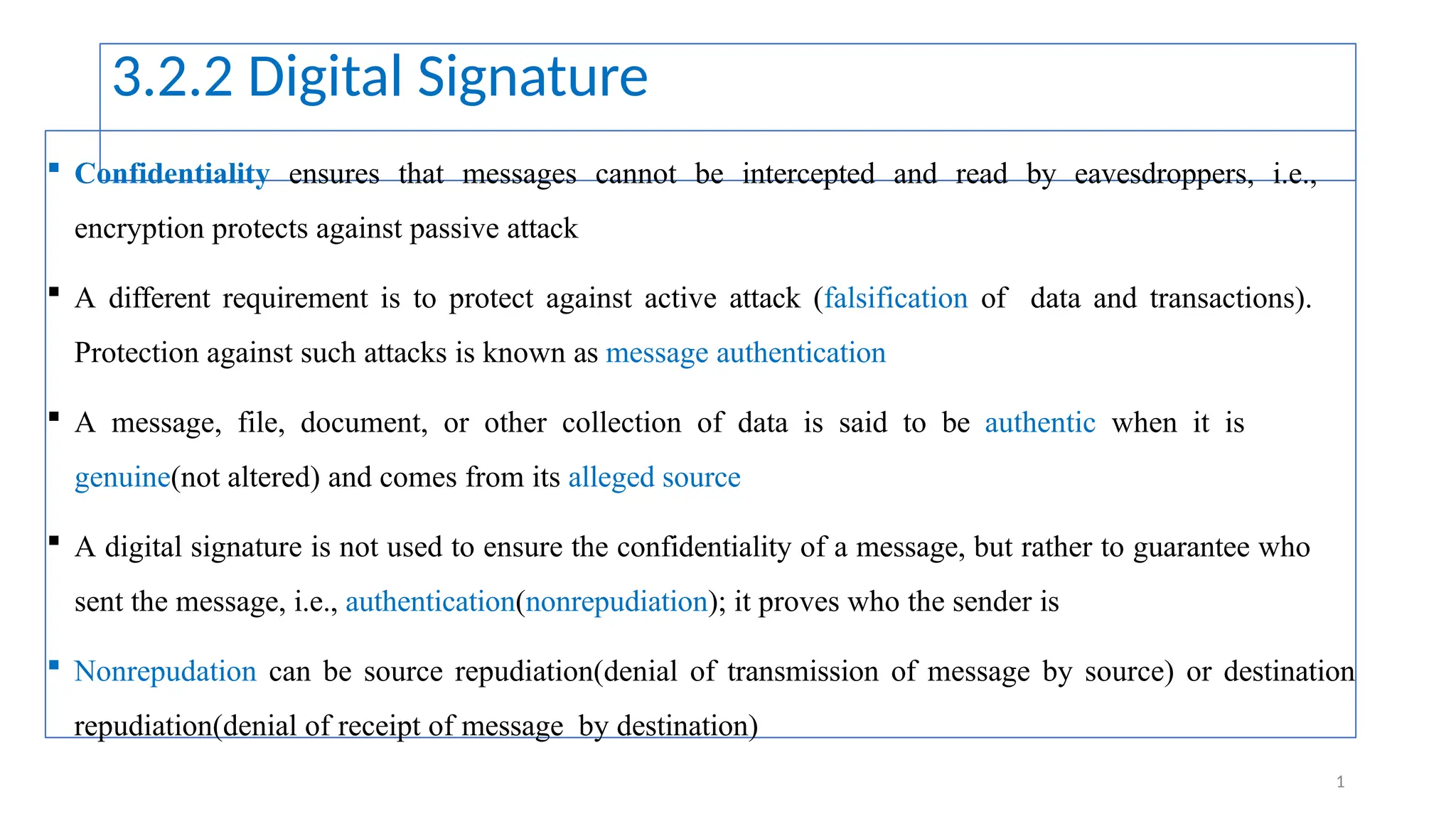
 Confidentiality ensures that messages cannot be intercepted and read by eavesdroppers, i.e.,
encryption protects against passive attack
 A different requirement is to protect against active attack (falsification of data and transactions).
Protection against such attacks is known as message authentication
 A message, file, document, or other collection of data is said to be authentic when it is
genuine(not altered) and comes from its alleged source
 A digital signature is not used to ensure the confidentiality of a message, but rather to guarantee who
sent the message, i.e., authentication(nonrepudiation); it proves who the sender is
 Nonrepudation can be source repudiation(denial of transmission of message by source) or destination
repudiation(denial of receipt of message by destination)
1
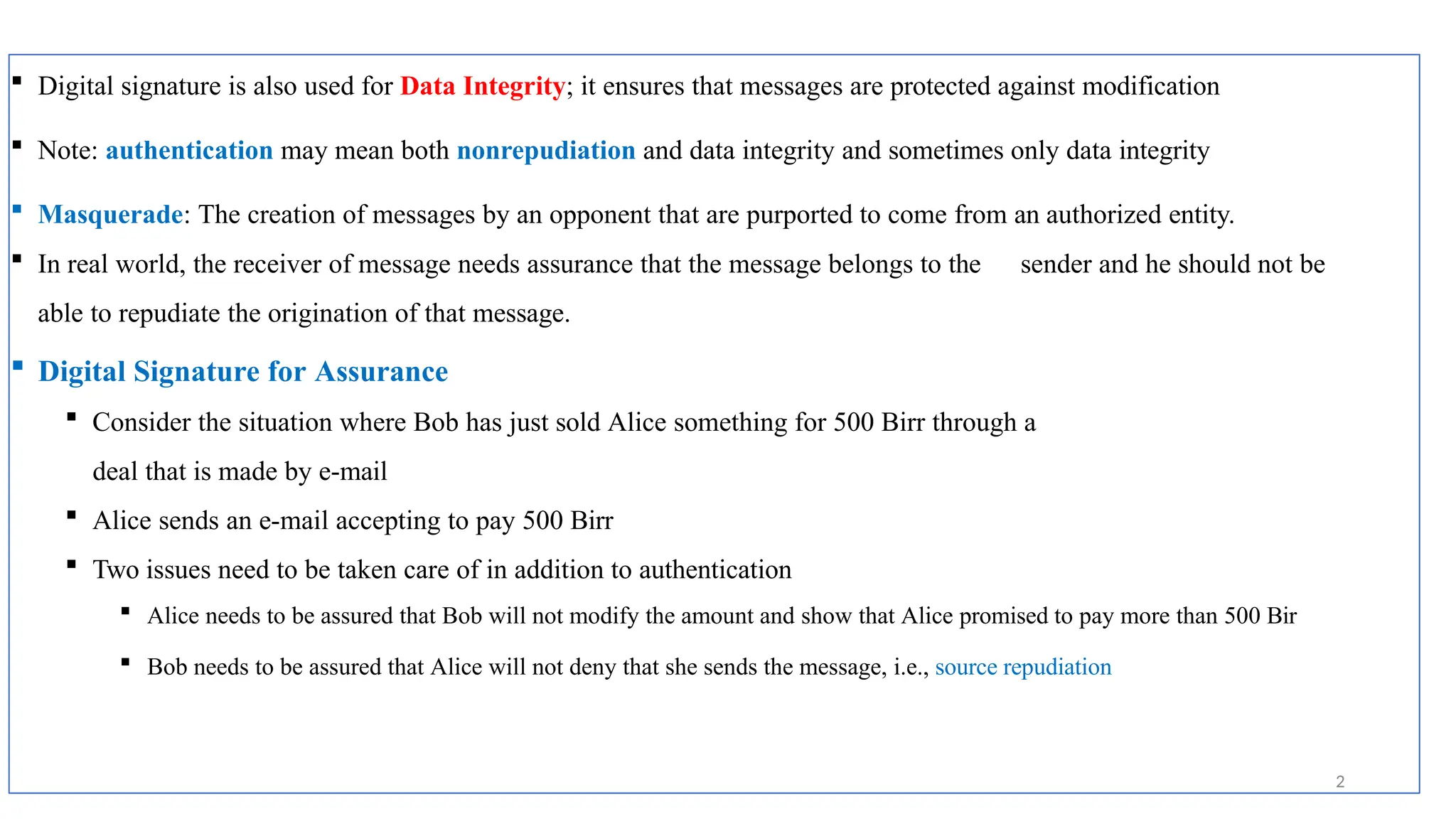
 Digital signature is also used for Data Integrity; it ensures that messages are protected against modification
 Note: authentication may mean both nonrepudiation and data integrity and sometimes only data integrity
 Masquerade: The creation of messages by an opponent that are purported to come from an authorized entity.
 In real world, the receiver of message needs assurance that the message belongs to the sender and he should not be
able to repudiate the origination of that message.
 Digital Signature for Assurance
 Consider the situation where Bob has just sold Alice something for 500 Birr through a
deal that is made by e-mail
 Alice sends an e-mail accepting to pay 500 Birr
 Two issues need to be taken care of in addition to authentication
 Alice needs to be assured that Bob will not modify the amount and show that Alice promised to pay more than 500 Bir
 Bob needs to be assured that Alice will not deny that she sends the message, i.e., source repudiation
2
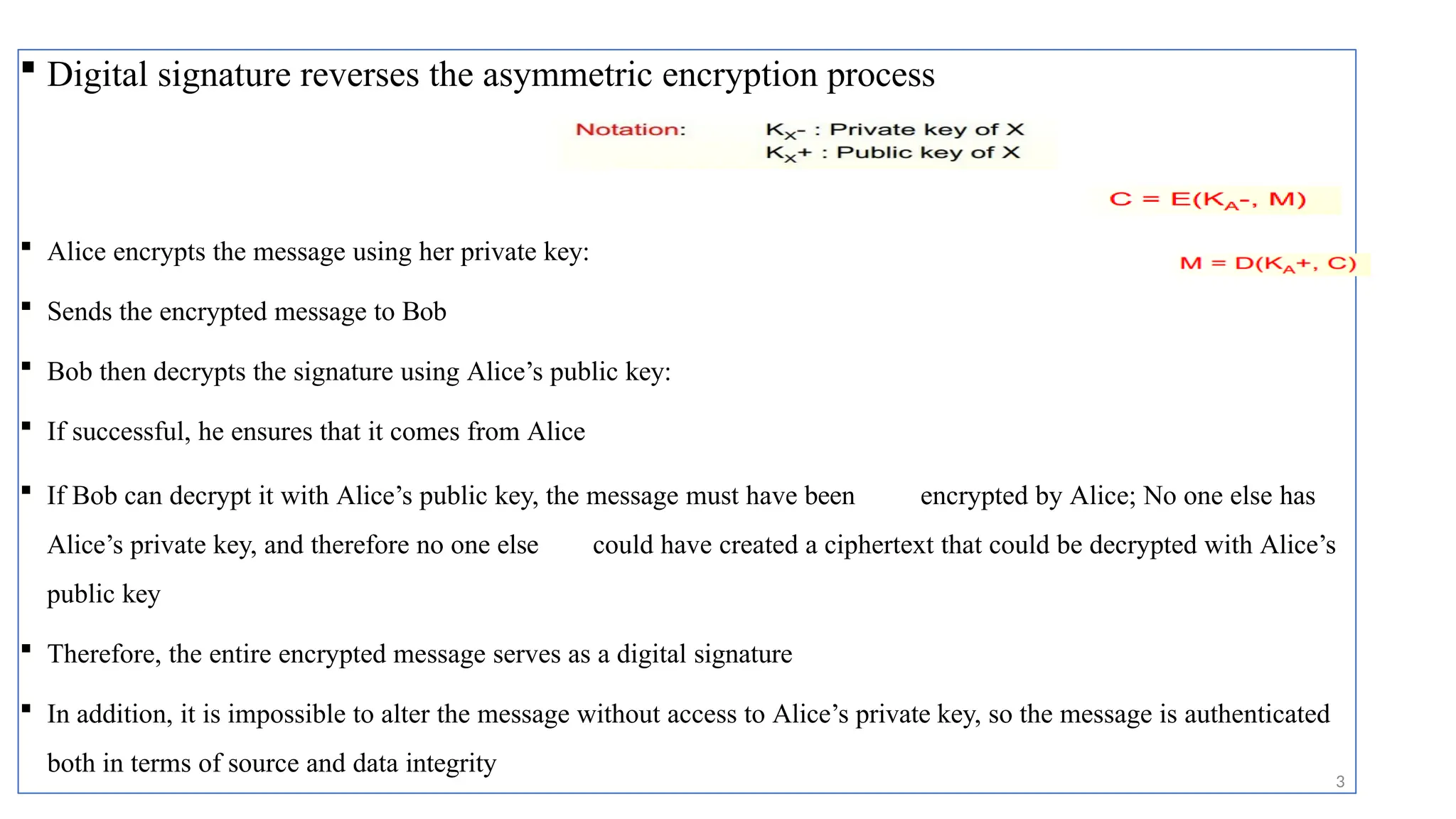
 Digital signature reverses the asymmetric encryption process
 Alice encrypts the message using her private key:
 Sends the encrypted message to Bob
 Bob then decrypts the signature using Alice’s public key:
 If successful, he ensures that it comes from Alice
 If Bob can decrypt it with Alice’s public key, the message must have been encrypted by Alice; No one else has
Alice’s private key, and therefore no one else could have created a ciphertext that could be decrypted with Alice’s
public key
 Therefore, the entire encrypted message serves as a digital signature
 In addition, it is impossible to alter the message without access to Alice’s private key, so the message is authenticated
both in terms of source and data integrity
3
 But anyone can decrypt the message using Alice’s public key if it is not important that the message be kept
secret
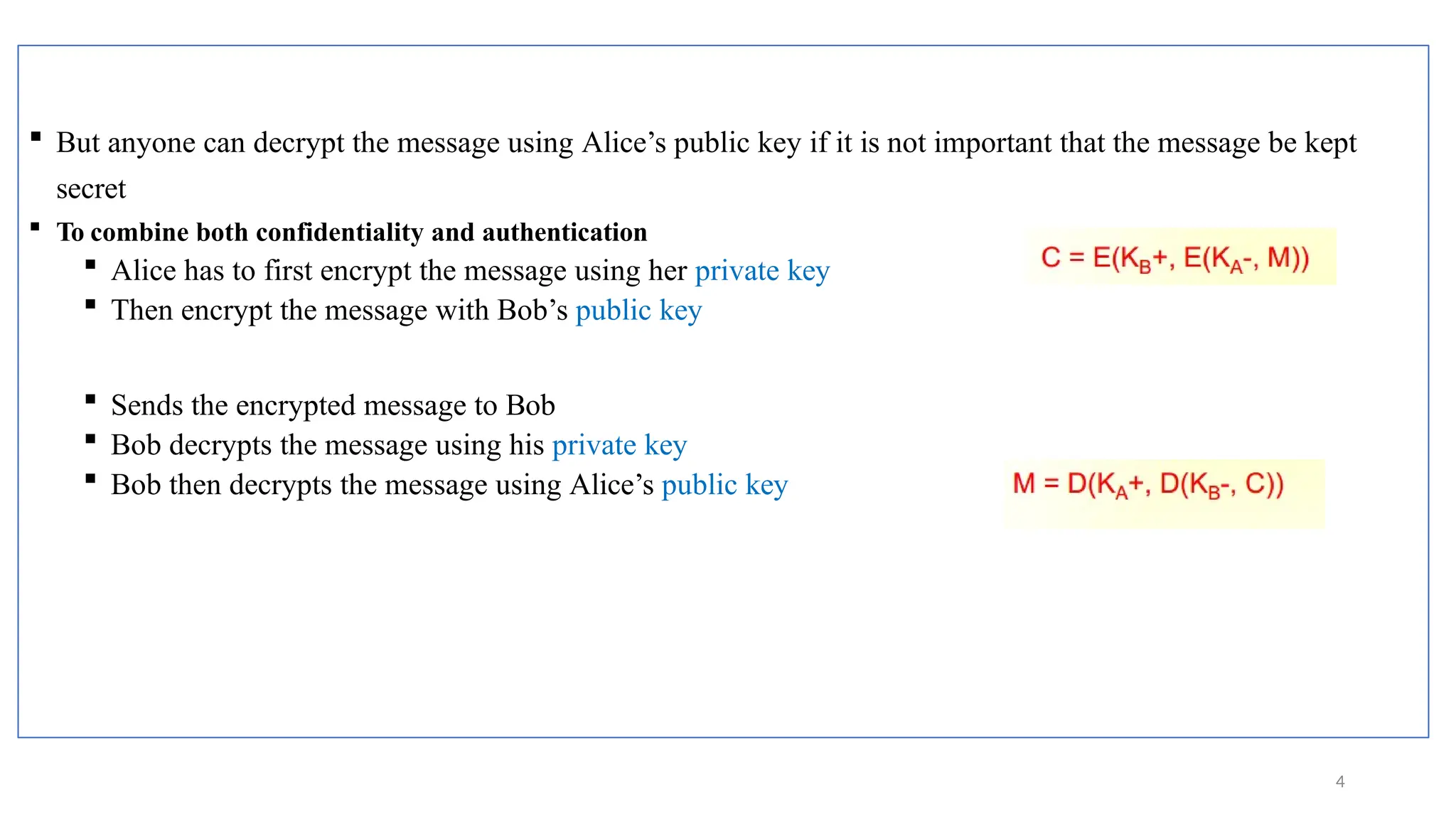
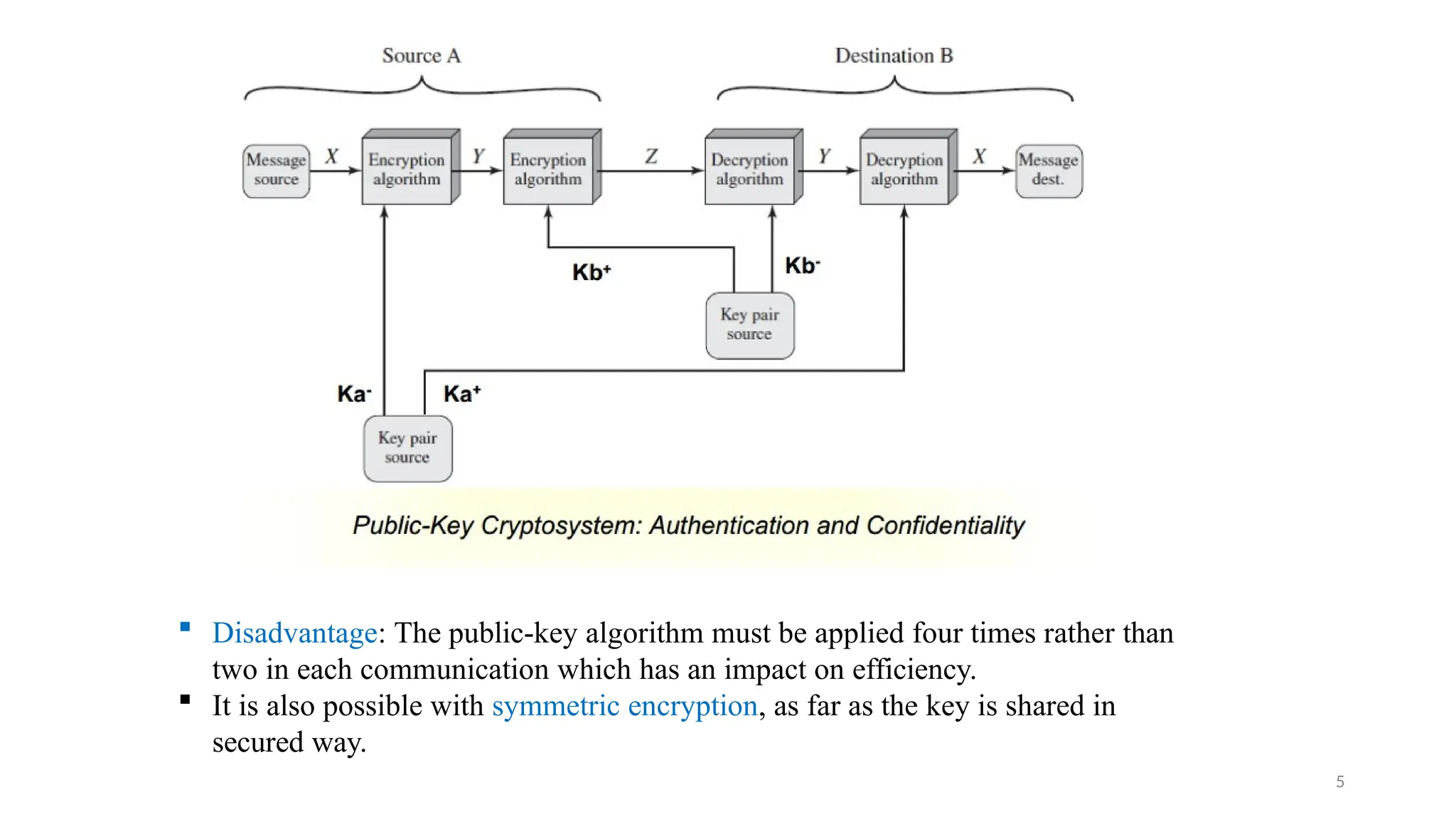
 To combine both confidentiality and authentication
 Alice has to first encrypt the message using her private key
 Then encrypt the message with Bob’s public key
 Sends the encrypted message to Bob
 Bob decrypts the message using his private key
 Bob then decrypts the message using Alice’s public key
4
 Disadvantage: The public-key algorithm must be applied four times rather than
two in each communication which has an impact on efficiency.
 It is also possible with symmetric encryption, as far as the key is shared in
secured way.
5
Digital Signature Using Message Digest
 Problems in Digital Signature
 Alice may claim that her private key has been stolen before the message was sent
 Alice may change her private key; a solution could be to have a central authority that keeps track of
changes in keys and that signed messages be timestamped
 Alice’s entire message is encrypted which may be expensive in terms of processing requirements
 It also requires a great deal of storage. Each document must be kept in plaintext to be used for practical
purposes. A copy also must be stored in ciphertext so that the origin and contents can be verified in case
of a dispute
 A better and cheaper method is to use a message digest
6
 Hash function
 A hash function H takes a message m of arbitrary length and produces a bit string h, h= H(m)
 When the hash value h is sent with the message m, it enables to determine whether m has been modified
or not; the principal objective of a hash function is data integrity.
 It is similar to cyclic-redundancy check(CRC) and Checksum
 When a hash function is used to provide message authentication (integrity), the hash function value is
often referred to as a message digest
 The two most common hashing algorithms are
 MD5(Message Digest version 5) and
 Secure Hash Algorithm or SHA(SHA-1 and later versions like SHA-256) by NIST.
 h = H(m) is sent along m (not encrypted), where H is a cryptographic hash function
7
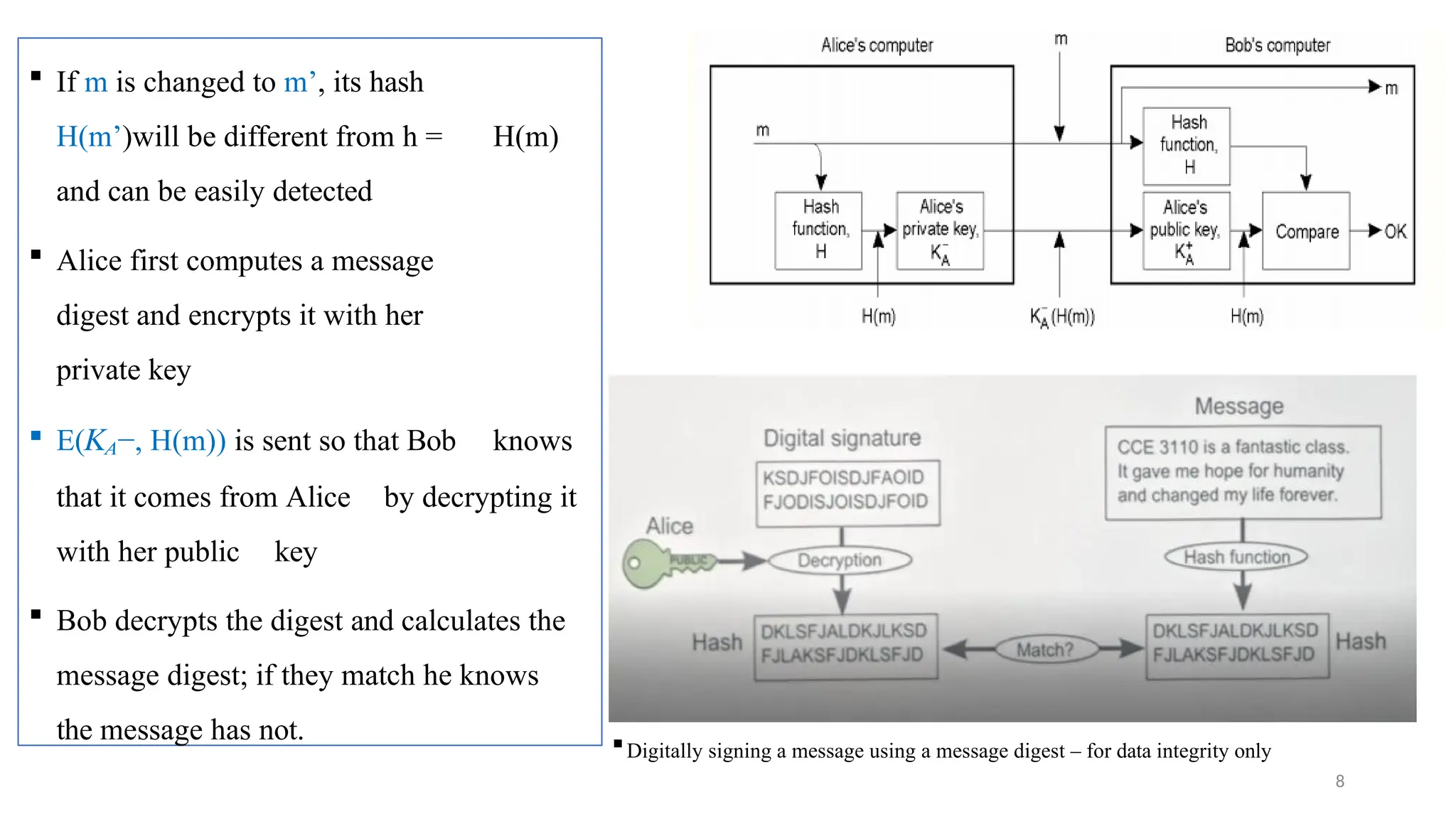
 If m is changed to m’, its hash
H(m’)will be different from h = H(m)
and can be easily detected
 Alice first computes a message
digest and encrypts it with her
private key
 E(𝐾𝐴−, H(m)) is sent so that Bob knows
that it comes from Alice by decrypting it
with her public key
 Bob decrypts the digest and calculates the
message digest; if they match he knows
the message has not.
8
Digitally signing a message using a message digest – for data integrity only
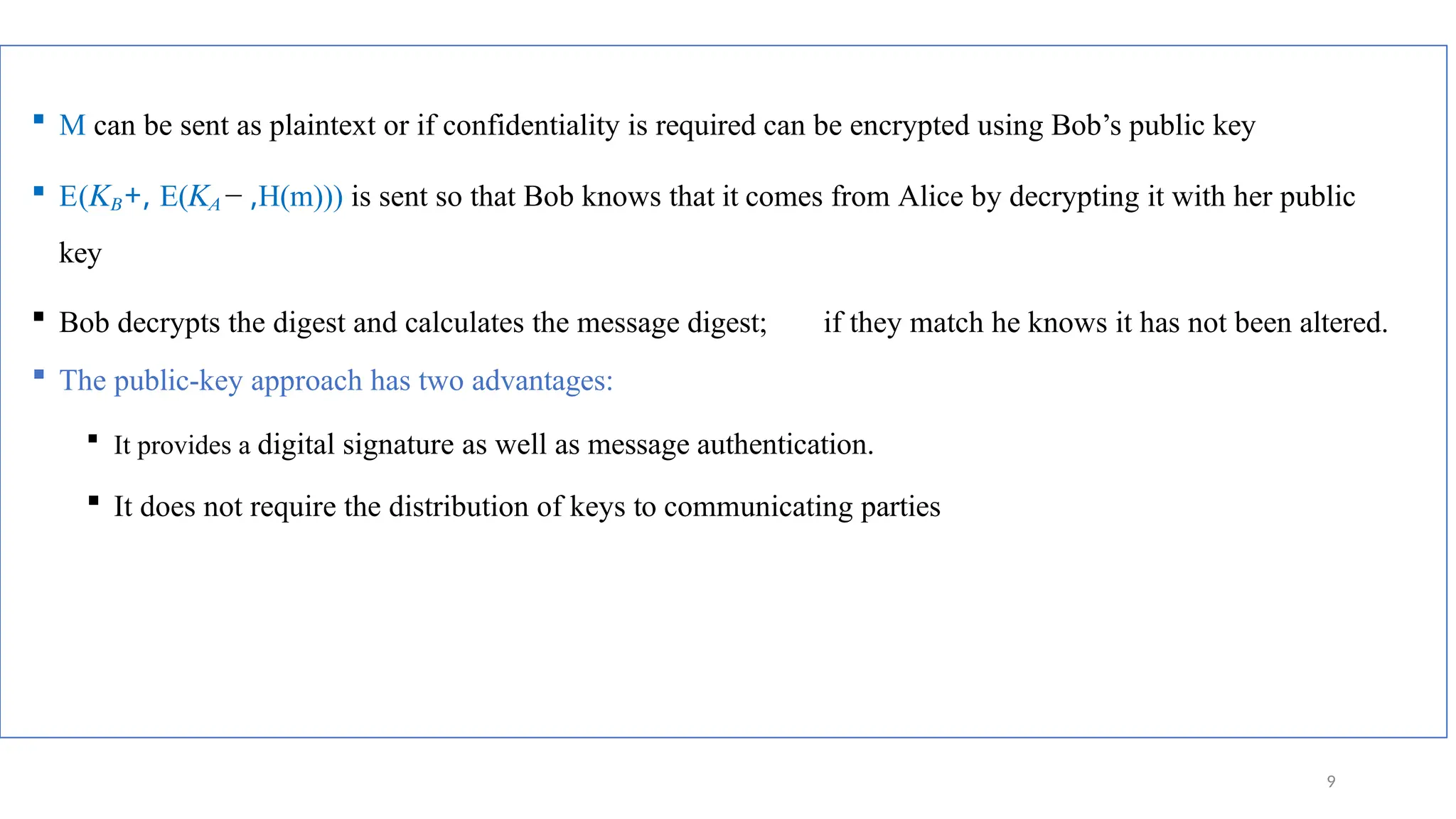
 M can be sent as plaintext or if confidentiality is required can be encrypted using Bob’s public key
 E(𝐾𝐵+, E(𝐾𝐴 − ,H(m))) is sent so that Bob knows that it comes from Alice by decrypting it with her public
key
 Bob decrypts the digest and calculates the message digest; if they match he knows it has not been altered.
 The public-key approach has two advantages:
 It provides a digital signature as well as message authentication.
 It does not require the distribution of keys to communicating parties
9
MD5 Algorithm
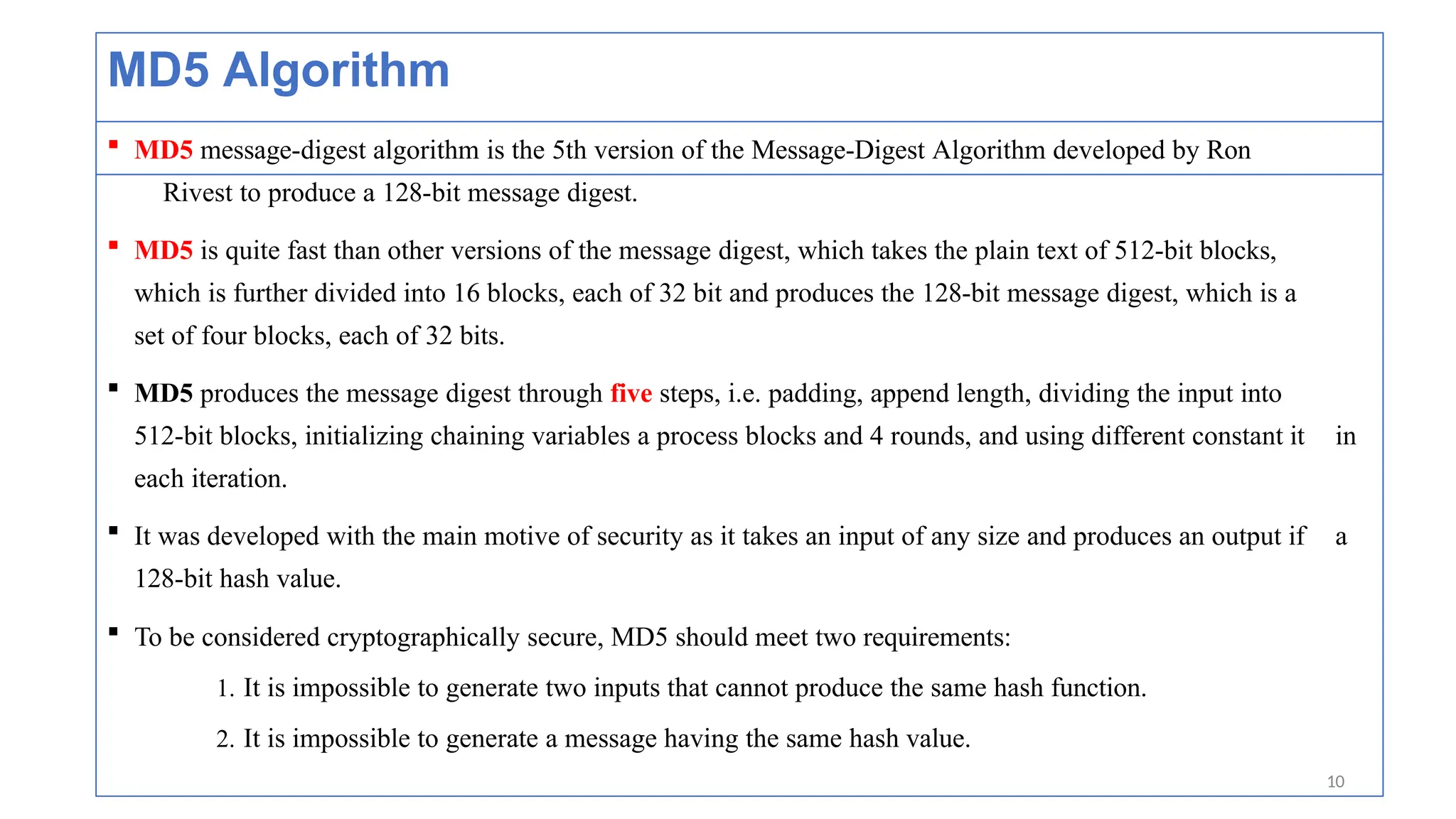
 MD5 message-digest algorithm is the 5th version of the Message-Digest Algorithm developed by Ron
Rivest to produce a 128-bit message digest.
 MD5 is quite fast than other versions of the message digest, which takes the plain text of 512-bit blocks,
which is further divided into 16 blocks, each of 32 bit and produces the 128-bit message digest, which is a
set of four blocks, each of 32 bits.
 MD5 produces the message digest through five steps, i.e. padding, append length, dividing the input into
512-bit blocks, initializing chaining variables a process blocks and 4 rounds, and using different constant it in
each iteration.
 It was developed with the main motive of security as it takes an input of any size and produces an output if a
128-bit hash value.
 To be considered cryptographically secure, MD5 should meet two requirements:
1. It is impossible to generate two inputs that cannot produce the same hash function.
2. It is impossible to generate a message having the same hash value.
10
How do the MD5 Algorithm works?
 As we all know that MD5 produces an output of 128-bit hash value.
 This encryption of input of any size into hash values undergoes 5 steps, and each step has its predefined task.
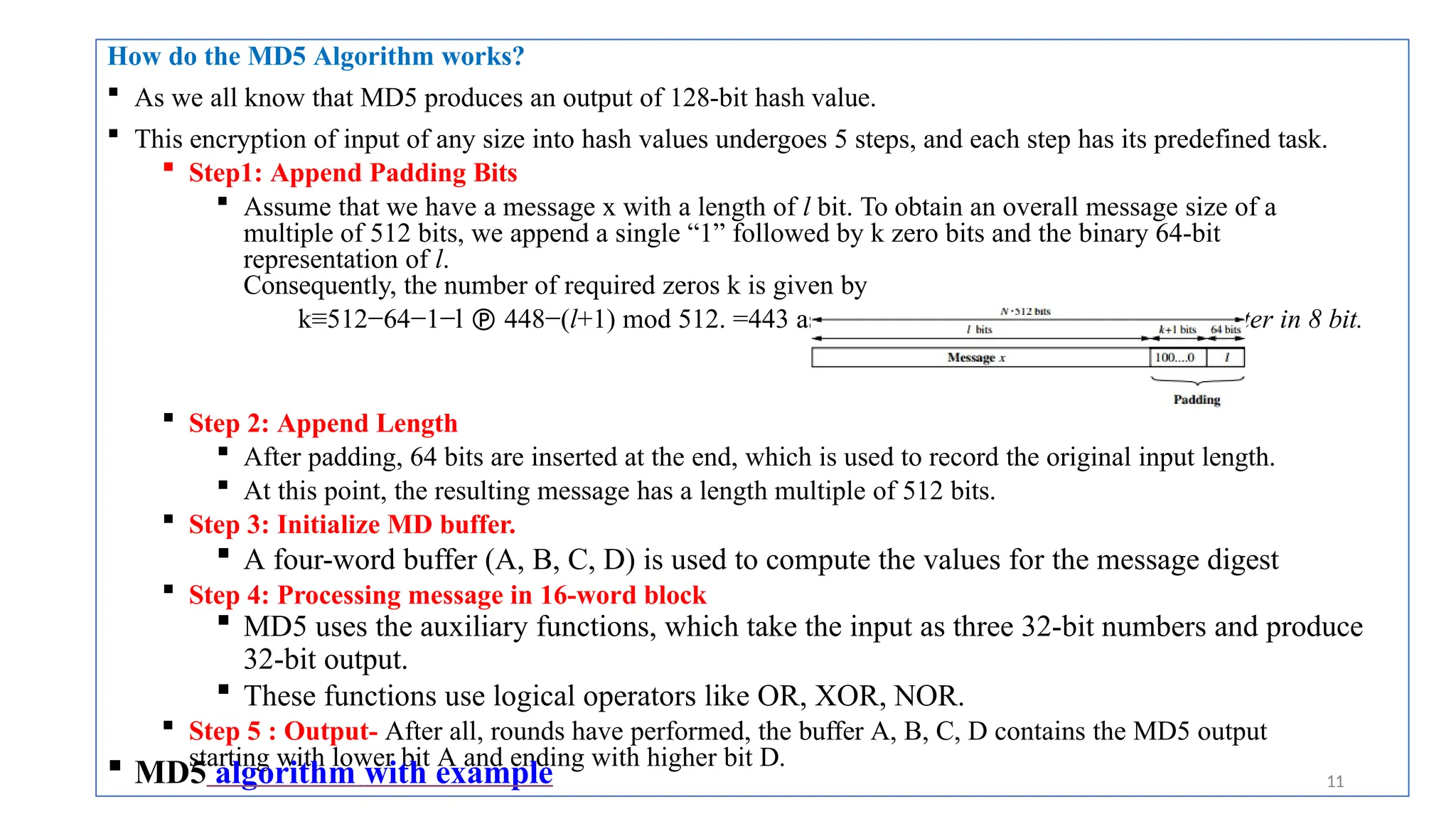
 Step1: Append Padding Bits
 Assume that we have a message x with a length of l bit. To obtain an overall message size of a
multiple of 512 bits, we append a single “1” followed by k zero bits and the binary 64-bit
representation of l.
Consequently, the number of required zeros k is given by
k≡512−64−1−l  448−(l+1) mod 512. =443 assume if =24, representing each character in 8 bit.
 Step 2: Append Length
 After padding, 64 bits are inserted at the end, which is used to record the original input length.
 At this point, the resulting message has a length multiple of 512 bits.
 Step 3: Initialize MD buffer.
 A four-word buffer (A, B, C, D) is used to compute the values for the message digest
 Step 4: Processing message in 16-word block
 MD5 uses the auxiliary functions, which take the input as three 32-bit numbers and produce
32-bit output.
 These functions use logical operators like OR, XOR, NOR.
 Step 5 : Output- After all, rounds have performed, the buffer A, B, C, D contains the MD5 output
starting with lower bit A and ending with higher bit D.
 MD5 algorithm with example 11
SHA Algorithm
 SHA algorithm is Secure Hash algorithm developed by the National Institute of Standards and
Technology along with NSA, previously released as a Federal Information Processing Standard,
later in 1995,
 It was named as SHA algorithm, design to modify the MD4
 In the field of cryptography and crypt analytics, the SHA-1 algorithm is a crypt-formatted hash
function that is used to take a smaller input and produces a string that is 160 bits, also known as 20-
byte hash value long.
 The hash value therefore generated, is known as a message digest which is typically rendered and
produced as a hexadecimal number which is specifically 40 digits long.
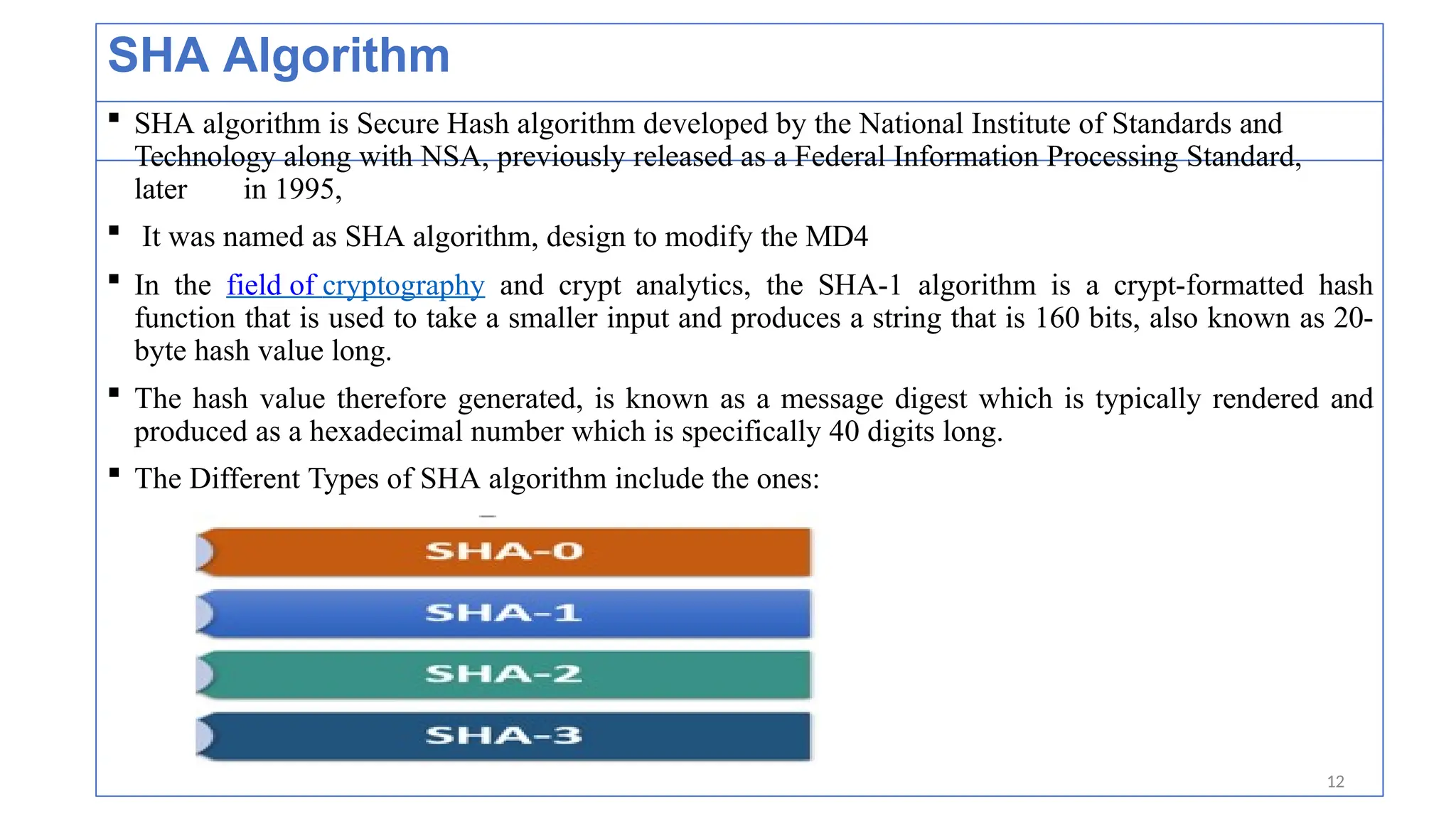
 The Different Types of SHA algorithm include the ones:
12
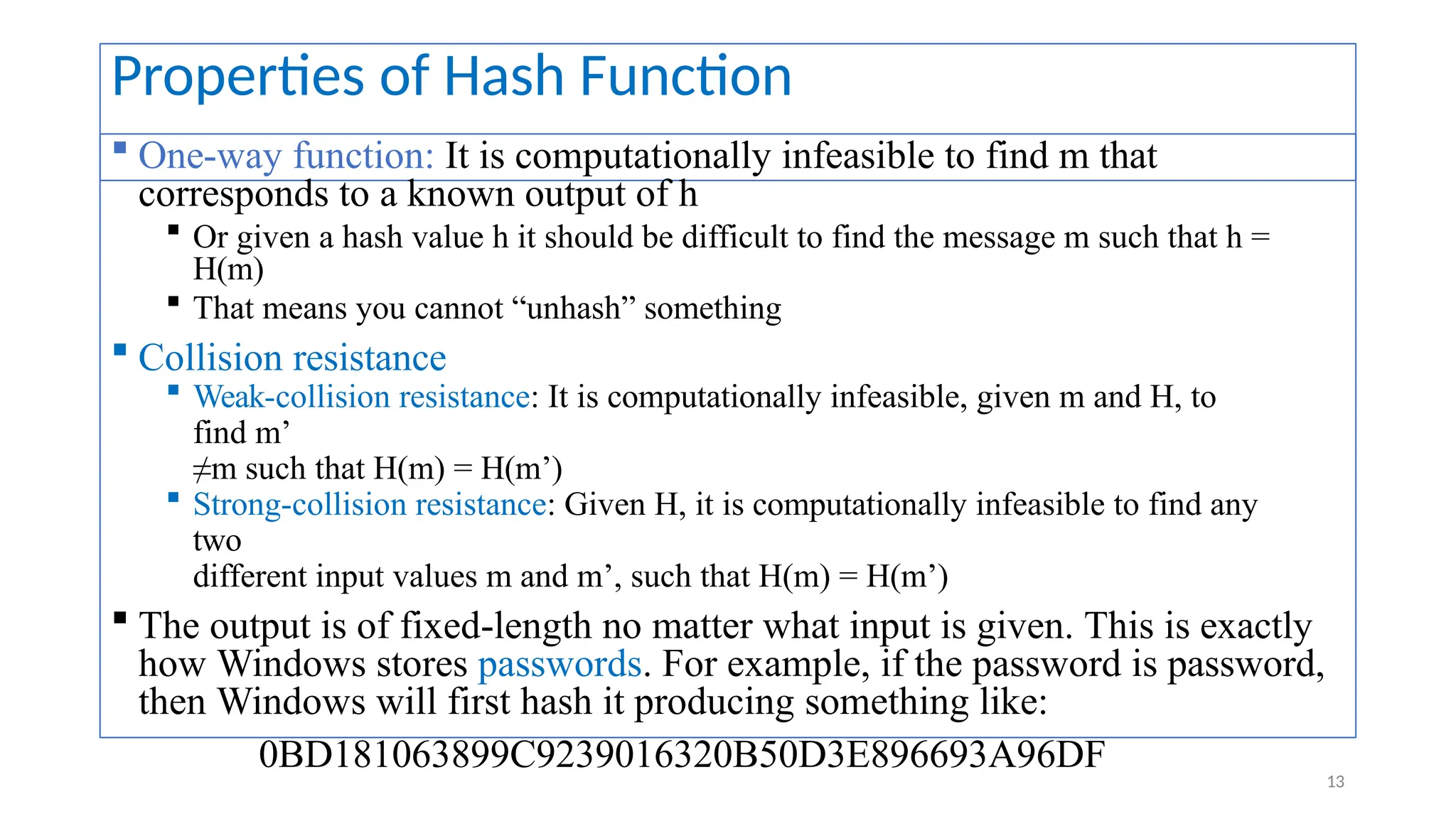
Properties of Hash Function
 One-way function: It is computationally infeasible to find m that
corresponds to a known output of h
 Or given a hash value h it should be difficult to find the message m such that h =
H(m)
 That means you cannot “unhash” something
 Collision resistance
 Weak-collision resistance: It is computationally infeasible, given m and H, to
find m’
≠m such that H(m) = H(m’)
 Strong-collision resistance: Given H, it is computationally infeasible to find any
two
different input values m and m’, such that H(m) = H(m’)
 The output is of fixed-length no matter what input is given. This is exactly
how Windows stores passwords. For example, if the password is password,
then Windows will first hash it producing something like:
0BD181063899C9239016320B50D3E896693A96DF
13
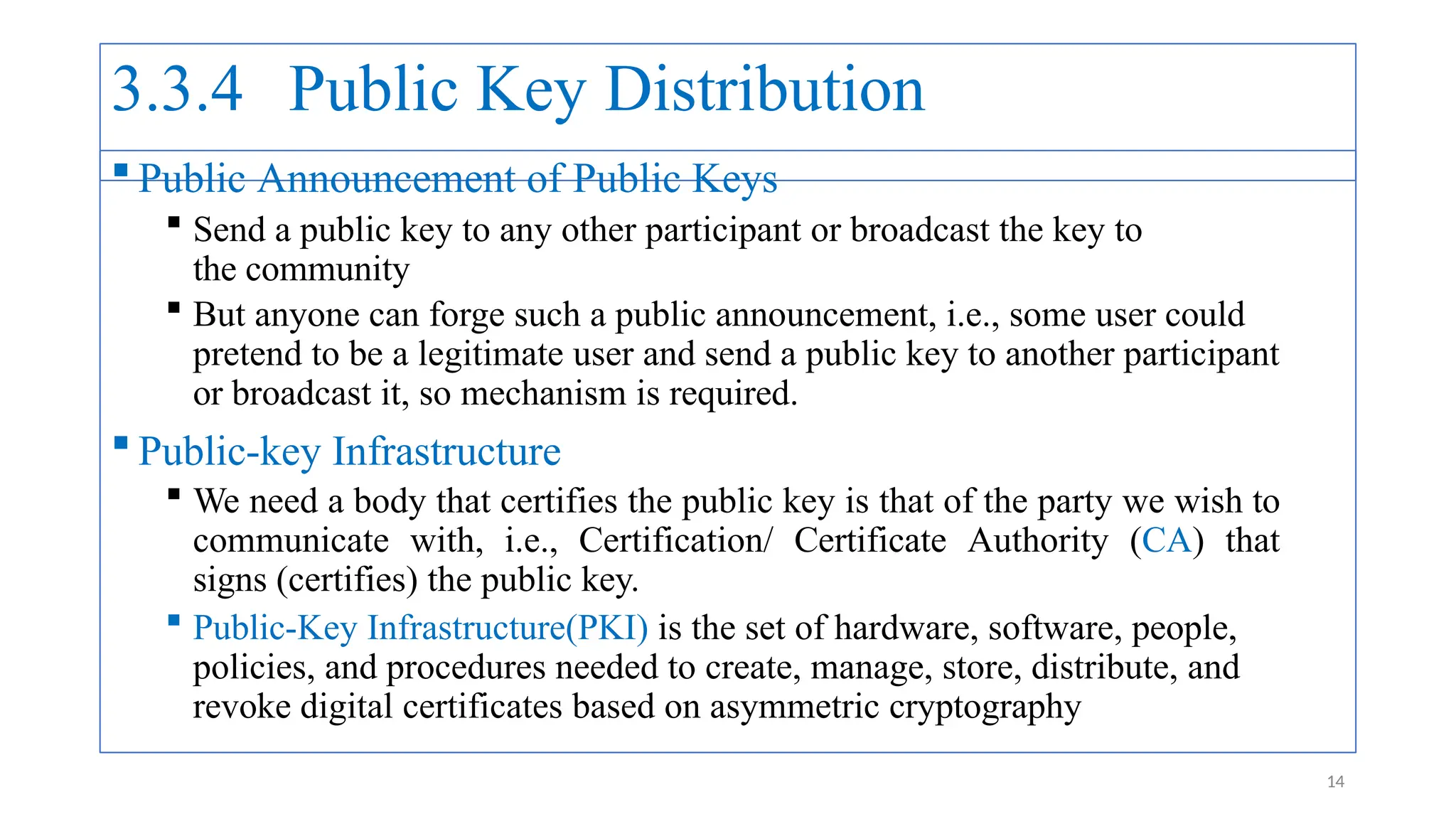
3.3.4 Public Key Distribution
 Public Announcement of Public Keys
 Send a public key to any other participant or broadcast the key to
the community
 But anyone can forge such a public announcement, i.e., some user could
pretend to be a legitimate user and send a public key to another participant
or broadcast it, so mechanism is required.
 Public-key Infrastructure
 We need a body that certifies the public key is that of the party we wish to
communicate with, i.e., Certification/ Certificate Authority (CA) that
signs (certifies) the public key.
 Public-Key Infrastructure(PKI) is the set of hardware, software, people,
policies, and procedures needed to create, manage, store, distribute, and
revoke digital certificates based on asymmetric cryptography
14
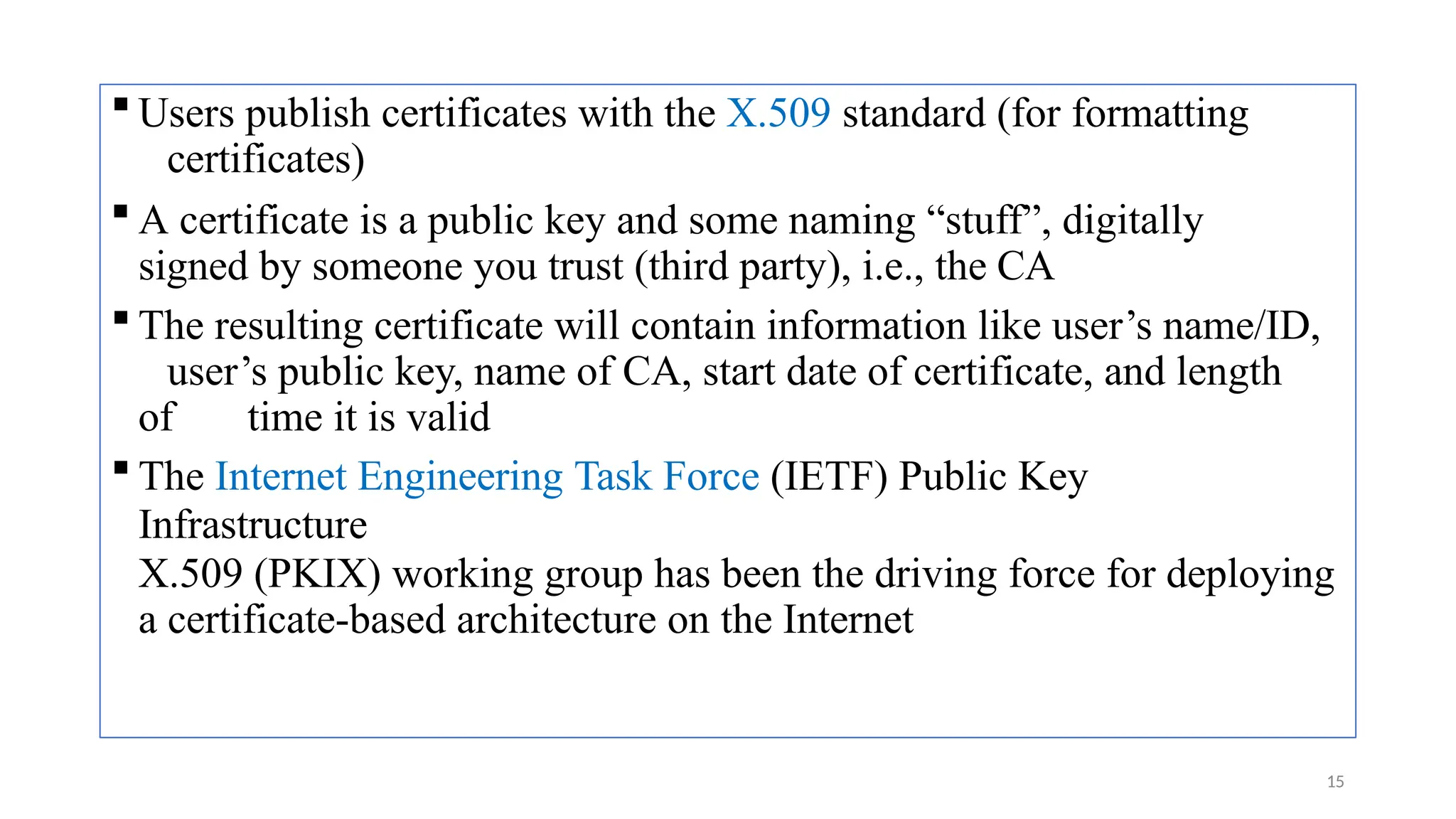
 Users publish certificates with the X.509 standard (for formatting
certificates)
 A certificate is a public key and some naming “stuff”, digitally
signed by someone you trust (third party), i.e., the CA
 The resulting certificate will contain information like user’s name/ID,
user’s public key, name of CA, start date of certificate, and length
of time it is valid
 The Internet Engineering Task Force (IETF) Public Key
Infrastructure
X.509 (PKIX) working group has been the driving force for deploying
a certificate-based architecture on the Internet
15
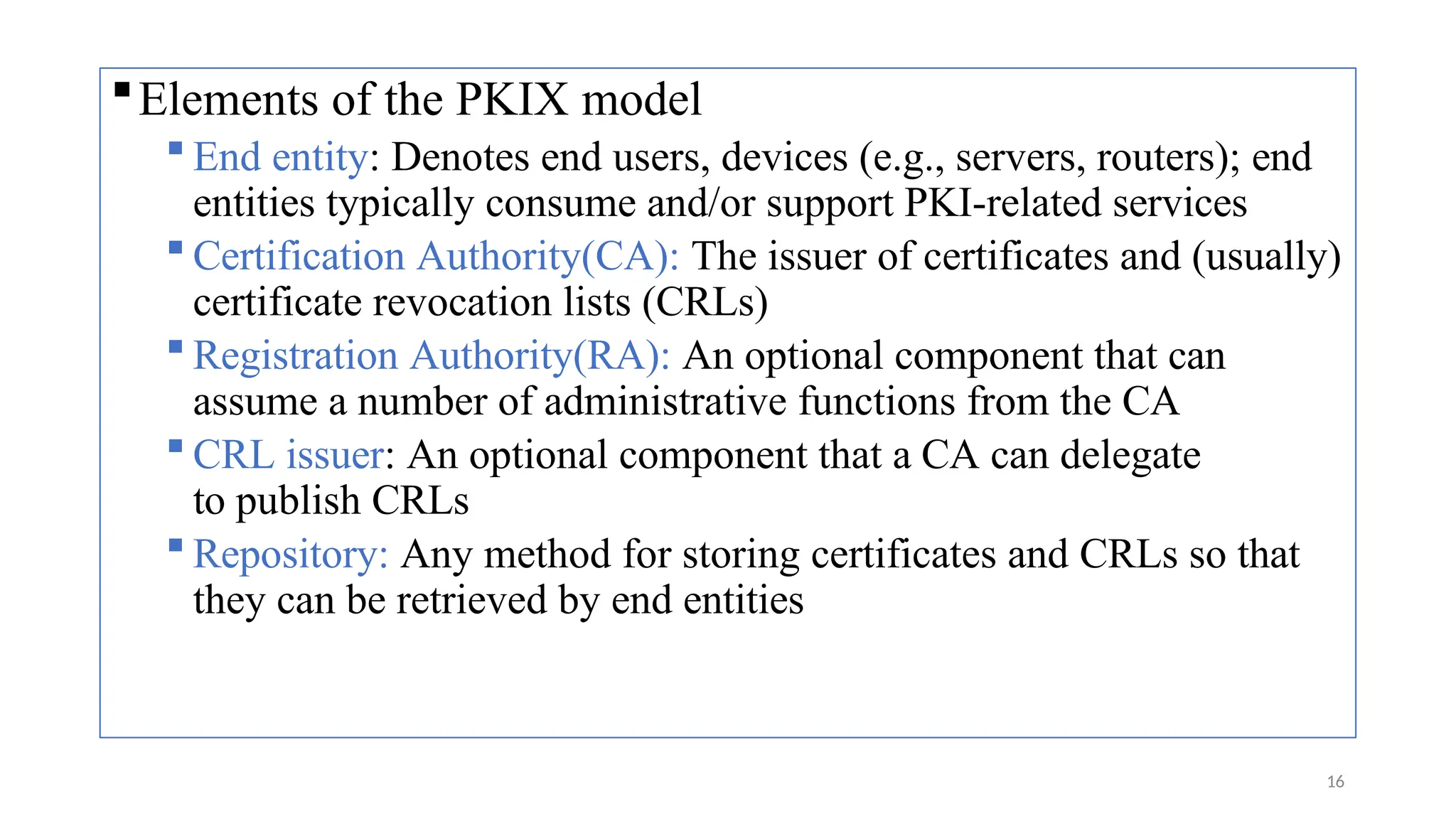
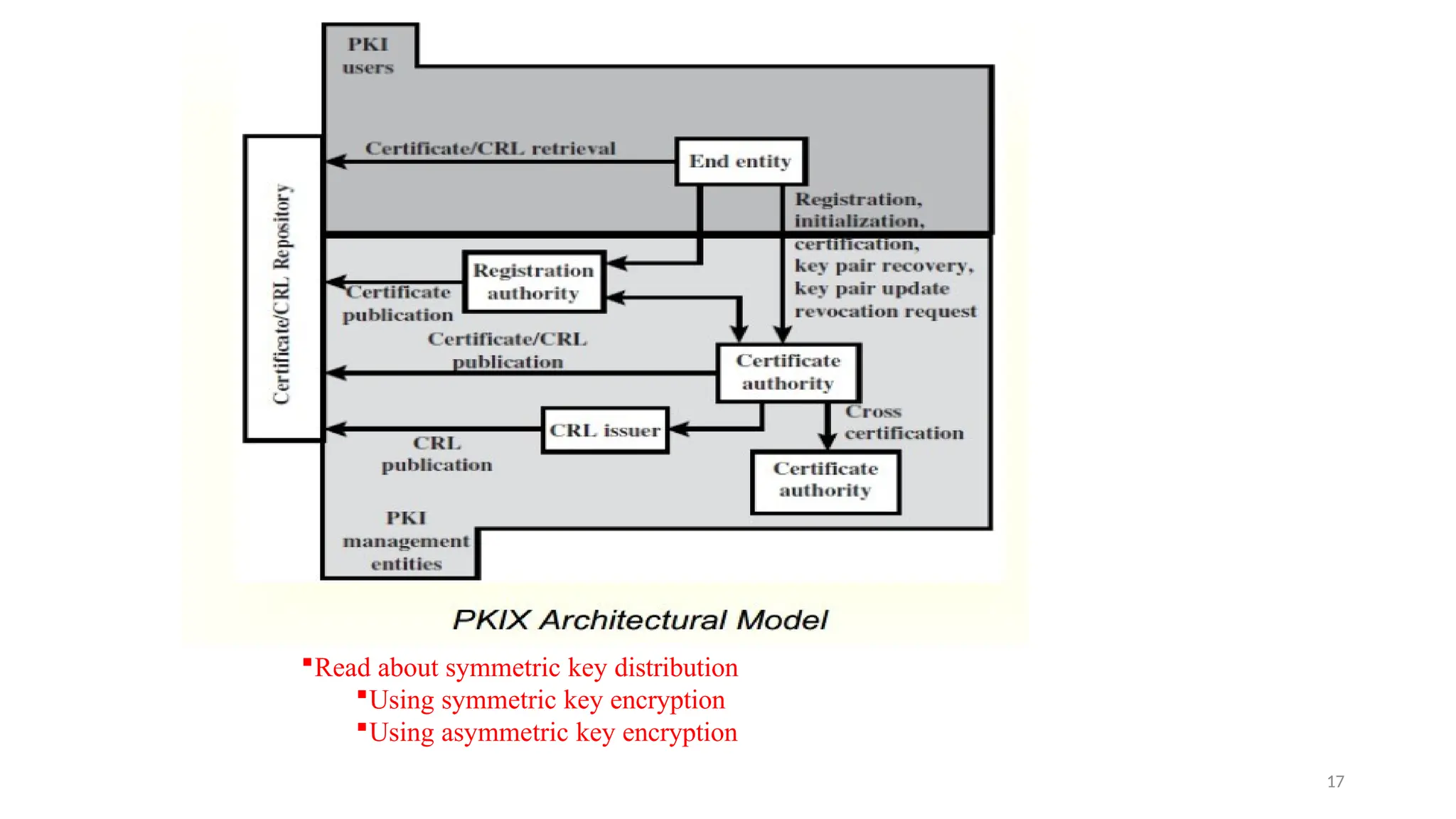
Elements of the PKIX model
 End entity: Denotes end users, devices (e.g., servers, routers); end
entities typically consume and/or support PKI-related services
 Certification Authority(CA): The issuer of certificates and (usually)
certificate revocation lists (CRLs)
 Registration Authority(RA): An optional component that can
assume a number of administrative functions from the CA
 CRL issuer: An optional component that a CA can delegate
to publish CRLs
 Repository: Any method for storing certificates and CRLs so that
they can be retrieved by end entities
16
Read about symmetric key distribution
Using symmetric key encryption
Using asymmetric key encryption
17
Concluding Remarks about Encryption
Advantages and disadvantages
 Advantage of private-key (symmetric/secret-key) cryptography is that it provides
better secrecy but needs prearranged key exchange
 Symmetric key cryptography is impractical for exchanging messages with a large group of
previously unknown correspondents over a public network, e.g., in e-commerce, for a
merchant to conduct transactions securely with millions of customers, each customer would
need a distinct key assigned by that merchant and transmitted over a separate secure
channel
 Advantage of public-key (asymmetric) cryptography is that, it allows for secrecy between
two parties who have not arranged in advance to have a shared key (or trusted some third
party to give it to them) and the disadvantage is overhead and speed
 Therefore, in practice, hybrid systems use public-key to establish session key for private key
18

chapter three 3-part II-1lecture slide.pptx

  • 1.
    3.2.2 Digital Signature Confidentiality ensures that messages cannot be intercepted and read by eavesdroppers, i.e., encryption protects against passive attack  A different requirement is to protect against active attack (falsification of data and transactions). Protection against such attacks is known as message authentication  A message, file, document, or other collection of data is said to be authentic when it is genuine(not altered) and comes from its alleged source  A digital signature is not used to ensure the confidentiality of a message, but rather to guarantee who sent the message, i.e., authentication(nonrepudiation); it proves who the sender is  Nonrepudation can be source repudiation(denial of transmission of message by source) or destination repudiation(denial of receipt of message by destination) 1
  • 2.
     Digital signatureis also used for Data Integrity; it ensures that messages are protected against modification  Note: authentication may mean both nonrepudiation and data integrity and sometimes only data integrity  Masquerade: The creation of messages by an opponent that are purported to come from an authorized entity.  In real world, the receiver of message needs assurance that the message belongs to the sender and he should not be able to repudiate the origination of that message.  Digital Signature for Assurance  Consider the situation where Bob has just sold Alice something for 500 Birr through a deal that is made by e-mail  Alice sends an e-mail accepting to pay 500 Birr  Two issues need to be taken care of in addition to authentication  Alice needs to be assured that Bob will not modify the amount and show that Alice promised to pay more than 500 Bir  Bob needs to be assured that Alice will not deny that she sends the message, i.e., source repudiation 2
  • 3.
     Digital signaturereverses the asymmetric encryption process  Alice encrypts the message using her private key:  Sends the encrypted message to Bob  Bob then decrypts the signature using Alice’s public key:  If successful, he ensures that it comes from Alice  If Bob can decrypt it with Alice’s public key, the message must have been encrypted by Alice; No one else has Alice’s private key, and therefore no one else could have created a ciphertext that could be decrypted with Alice’s public key  Therefore, the entire encrypted message serves as a digital signature  In addition, it is impossible to alter the message without access to Alice’s private key, so the message is authenticated both in terms of source and data integrity 3
  • 4.
     But anyonecan decrypt the message using Alice’s public key if it is not important that the message be kept secret  To combine both confidentiality and authentication  Alice has to first encrypt the message using her private key  Then encrypt the message with Bob’s public key  Sends the encrypted message to Bob  Bob decrypts the message using his private key  Bob then decrypts the message using Alice’s public key 4
  • 5.
     Disadvantage: Thepublic-key algorithm must be applied four times rather than two in each communication which has an impact on efficiency.  It is also possible with symmetric encryption, as far as the key is shared in secured way. 5
  • 6.
    Digital Signature UsingMessage Digest  Problems in Digital Signature  Alice may claim that her private key has been stolen before the message was sent  Alice may change her private key; a solution could be to have a central authority that keeps track of changes in keys and that signed messages be timestamped  Alice’s entire message is encrypted which may be expensive in terms of processing requirements  It also requires a great deal of storage. Each document must be kept in plaintext to be used for practical purposes. A copy also must be stored in ciphertext so that the origin and contents can be verified in case of a dispute  A better and cheaper method is to use a message digest 6
  • 7.
     Hash function A hash function H takes a message m of arbitrary length and produces a bit string h, h= H(m)  When the hash value h is sent with the message m, it enables to determine whether m has been modified or not; the principal objective of a hash function is data integrity.  It is similar to cyclic-redundancy check(CRC) and Checksum  When a hash function is used to provide message authentication (integrity), the hash function value is often referred to as a message digest  The two most common hashing algorithms are  MD5(Message Digest version 5) and  Secure Hash Algorithm or SHA(SHA-1 and later versions like SHA-256) by NIST.  h = H(m) is sent along m (not encrypted), where H is a cryptographic hash function 7
  • 8.
     If mis changed to m’, its hash H(m’)will be different from h = H(m) and can be easily detected  Alice first computes a message digest and encrypts it with her private key  E(𝐾𝐴−, H(m)) is sent so that Bob knows that it comes from Alice by decrypting it with her public key  Bob decrypts the digest and calculates the message digest; if they match he knows the message has not. 8 Digitally signing a message using a message digest – for data integrity only
  • 9.
     M canbe sent as plaintext or if confidentiality is required can be encrypted using Bob’s public key  E(𝐾𝐵+, E(𝐾𝐴 − ,H(m))) is sent so that Bob knows that it comes from Alice by decrypting it with her public key  Bob decrypts the digest and calculates the message digest; if they match he knows it has not been altered.  The public-key approach has two advantages:  It provides a digital signature as well as message authentication.  It does not require the distribution of keys to communicating parties 9
  • 10.
    MD5 Algorithm  MD5message-digest algorithm is the 5th version of the Message-Digest Algorithm developed by Ron Rivest to produce a 128-bit message digest.  MD5 is quite fast than other versions of the message digest, which takes the plain text of 512-bit blocks, which is further divided into 16 blocks, each of 32 bit and produces the 128-bit message digest, which is a set of four blocks, each of 32 bits.  MD5 produces the message digest through five steps, i.e. padding, append length, dividing the input into 512-bit blocks, initializing chaining variables a process blocks and 4 rounds, and using different constant it in each iteration.  It was developed with the main motive of security as it takes an input of any size and produces an output if a 128-bit hash value.  To be considered cryptographically secure, MD5 should meet two requirements: 1. It is impossible to generate two inputs that cannot produce the same hash function. 2. It is impossible to generate a message having the same hash value. 10
  • 11.
    How do theMD5 Algorithm works?  As we all know that MD5 produces an output of 128-bit hash value.  This encryption of input of any size into hash values undergoes 5 steps, and each step has its predefined task.  Step1: Append Padding Bits  Assume that we have a message x with a length of l bit. To obtain an overall message size of a multiple of 512 bits, we append a single “1” followed by k zero bits and the binary 64-bit representation of l. Consequently, the number of required zeros k is given by k≡512−64−1−l  448−(l+1) mod 512. =443 assume if =24, representing each character in 8 bit.  Step 2: Append Length  After padding, 64 bits are inserted at the end, which is used to record the original input length.  At this point, the resulting message has a length multiple of 512 bits.  Step 3: Initialize MD buffer.  A four-word buffer (A, B, C, D) is used to compute the values for the message digest  Step 4: Processing message in 16-word block  MD5 uses the auxiliary functions, which take the input as three 32-bit numbers and produce 32-bit output.  These functions use logical operators like OR, XOR, NOR.  Step 5 : Output- After all, rounds have performed, the buffer A, B, C, D contains the MD5 output starting with lower bit A and ending with higher bit D.  MD5 algorithm with example 11
  • 12.
    SHA Algorithm  SHAalgorithm is Secure Hash algorithm developed by the National Institute of Standards and Technology along with NSA, previously released as a Federal Information Processing Standard, later in 1995,  It was named as SHA algorithm, design to modify the MD4  In the field of cryptography and crypt analytics, the SHA-1 algorithm is a crypt-formatted hash function that is used to take a smaller input and produces a string that is 160 bits, also known as 20- byte hash value long.  The hash value therefore generated, is known as a message digest which is typically rendered and produced as a hexadecimal number which is specifically 40 digits long.  The Different Types of SHA algorithm include the ones: 12
  • 13.
    Properties of HashFunction  One-way function: It is computationally infeasible to find m that corresponds to a known output of h  Or given a hash value h it should be difficult to find the message m such that h = H(m)  That means you cannot “unhash” something  Collision resistance  Weak-collision resistance: It is computationally infeasible, given m and H, to find m’ ≠m such that H(m) = H(m’)  Strong-collision resistance: Given H, it is computationally infeasible to find any two different input values m and m’, such that H(m) = H(m’)  The output is of fixed-length no matter what input is given. This is exactly how Windows stores passwords. For example, if the password is password, then Windows will first hash it producing something like: 0BD181063899C9239016320B50D3E896693A96DF 13
  • 14.
    3.3.4 Public KeyDistribution  Public Announcement of Public Keys  Send a public key to any other participant or broadcast the key to the community  But anyone can forge such a public announcement, i.e., some user could pretend to be a legitimate user and send a public key to another participant or broadcast it, so mechanism is required.  Public-key Infrastructure  We need a body that certifies the public key is that of the party we wish to communicate with, i.e., Certification/ Certificate Authority (CA) that signs (certifies) the public key.  Public-Key Infrastructure(PKI) is the set of hardware, software, people, policies, and procedures needed to create, manage, store, distribute, and revoke digital certificates based on asymmetric cryptography 14
  • 15.
     Users publishcertificates with the X.509 standard (for formatting certificates)  A certificate is a public key and some naming “stuff”, digitally signed by someone you trust (third party), i.e., the CA  The resulting certificate will contain information like user’s name/ID, user’s public key, name of CA, start date of certificate, and length of time it is valid  The Internet Engineering Task Force (IETF) Public Key Infrastructure X.509 (PKIX) working group has been the driving force for deploying a certificate-based architecture on the Internet 15
  • 16.
    Elements of thePKIX model  End entity: Denotes end users, devices (e.g., servers, routers); end entities typically consume and/or support PKI-related services  Certification Authority(CA): The issuer of certificates and (usually) certificate revocation lists (CRLs)  Registration Authority(RA): An optional component that can assume a number of administrative functions from the CA  CRL issuer: An optional component that a CA can delegate to publish CRLs  Repository: Any method for storing certificates and CRLs so that they can be retrieved by end entities 16
  • 17.
    Read about symmetrickey distribution Using symmetric key encryption Using asymmetric key encryption 17
  • 18.
    Concluding Remarks aboutEncryption Advantages and disadvantages  Advantage of private-key (symmetric/secret-key) cryptography is that it provides better secrecy but needs prearranged key exchange  Symmetric key cryptography is impractical for exchanging messages with a large group of previously unknown correspondents over a public network, e.g., in e-commerce, for a merchant to conduct transactions securely with millions of customers, each customer would need a distinct key assigned by that merchant and transmitted over a separate secure channel  Advantage of public-key (asymmetric) cryptography is that, it allows for secrecy between two parties who have not arranged in advance to have a shared key (or trusted some third party to give it to them) and the disadvantage is overhead and speed  Therefore, in practice, hybrid systems use public-key to establish session key for private key 18