Downloaded 27 times
![One-Dimensional array
Array Declaration
• Syntax:
data_type array_name[size];
Example: int x[3];
X[0]
X[1]
X[2]
x](https://image.slidesharecdn.com/unit-5-160818044235/85/Fucntions-Pointers-in-C-56-320.jpg)
![At compile time
• Syntax:
data_type array_name[size]={variables};
Example: int x[3]={5,3,7};
5
3
7
X[0]
X[1]
X[2]
x](https://image.slidesharecdn.com/unit-5-160818044235/85/Fucntions-Pointers-in-C-58-320.jpg)
![At Run time
• Array can also initialize at the run time.
• Example:
while(i<10)
{
if(i<5)
sum[i]=0;
else
sum[i]=sum[i]+i;
}](https://image.slidesharecdn.com/unit-5-160818044235/85/Fucntions-Pointers-in-C-59-320.jpg)
![• Example:
scanf(“%d%d”,&a[0],&a[1]);](https://image.slidesharecdn.com/unit-5-160818044235/85/Fucntions-Pointers-in-C-60-320.jpg)
![Example
#include<stdio.h>
#include<conio.h>
void main()
{
int x[2],i;
printf("nEnter the inputs:");
for(i=0;i<2;i++)
scanf("%d",&x[i]);
for(i=0;i<2;i++)
printf("nThe value in x[%d] is %d",i,x[i]);
getch();
}](https://image.slidesharecdn.com/unit-5-160818044235/85/Fucntions-Pointers-in-C-61-320.jpg)
![Output
Enter the inputs:3
6
The value in x[0] is 3
The value in x[1] is 6](https://image.slidesharecdn.com/unit-5-160818044235/85/Fucntions-Pointers-in-C-62-320.jpg)
![Example
#include<stdio.h>
#include<conio.h>
void main()
{
int i;
char x[5]={'a','b','c','d','e'};
clrscr();
for(i=0;i<5;i++)
printf("nThe value in x[%d] is %c",i,x[i]);
getch();
}](https://image.slidesharecdn.com/unit-5-160818044235/85/Fucntions-Pointers-in-C-63-320.jpg)
![Output
The value in x[0] is a
The value in x[1] is b
The value in x[2] is c
The value in x[3] is d
The value in x[4] is e](https://image.slidesharecdn.com/unit-5-160818044235/85/Fucntions-Pointers-in-C-64-320.jpg)
![Two-Dimensional array
Array Declaration
• Syntax:
data_type array_name[row_size] [col_size];
Example: int x[3][2];
X[0][0]
X[1][0]
X[2][0]
Col 0 Col 1
row 0
row 1
row 2
X[0][1]
X[1][1]
X[2][1]](https://image.slidesharecdn.com/unit-5-160818044235/85/Fucntions-Pointers-in-C-65-320.jpg)
![Array Initialization
• Syntax:
data_type array_name[row_size] [col_size];={variables};
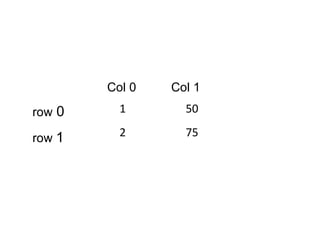
Example: int x[2][2]={1,50,2,75};](https://image.slidesharecdn.com/unit-5-160818044235/85/Fucntions-Pointers-in-C-66-320.jpg)
![int x[2][2]={ {1,50},
{2,75}
};
(or)
int x[ ][2]={ {1,50},
{2,75}
};](https://image.slidesharecdn.com/unit-5-160818044235/85/Fucntions-Pointers-in-C-67-320.jpg)
![Example
#include<stdio.h>
#include<conio.h>
void main()
{
int i,j;
int x[2][2]={ {1,50},
{2,75}
};
clrscr();
for(i=0;i<2;i++)
for(j=0;j<2;j++)
printf("nThe value in x[%d][%d] is %d",i,j,x[i][j]);
getch();
}](https://image.slidesharecdn.com/unit-5-160818044235/85/Fucntions-Pointers-in-C-69-320.jpg)
![Output
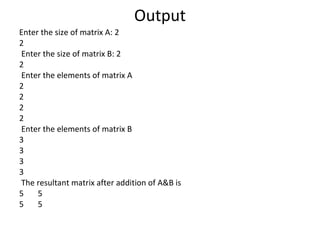
The value in x[0][0] is 1
The value in x[0][1] is 50
The value in x[1][0] is 2
The value in x[1][1] is 75](https://image.slidesharecdn.com/unit-5-160818044235/85/Fucntions-Pointers-in-C-70-320.jpg)
![Example
#include<stdio.h>
#include<conio.h>
void main()
{
int i,j;
int x[][2]={ {1,50},{2,75},{3,65}};
clrscr();
for(i=0;i<=2;i++)
for(j=0;j<2;j++)
printf("nThe value in x[%d][%d] is %d",i,j,x[i][j]);
getch();
}](https://image.slidesharecdn.com/unit-5-160818044235/85/Fucntions-Pointers-in-C-71-320.jpg)
![Output
The value in x[0][0] is 1
The value in x[0][1] is 50
The value in x[1][0] is 2
The value in x[1][1] is 75
The value in x[2][0] is 3
The value in x[2][1] is 65](https://image.slidesharecdn.com/unit-5-160818044235/85/Fucntions-Pointers-in-C-72-320.jpg)
![Matrix Addition
#include<stdio.h>
#include<conio.h>
void main()
{
int i,j,k,r1,r2,c1,c2;
int a[5][5],b[5][5],c[5][5];
clrscr();
step1:
printf("n Enter the size of matrix A:");
scanf("%d%d",&r1,&c1);
printf("n Enter the size of matrix B: ");
scanf("%d%d",&r2,&c2);
if((c1==c2)&&(r1==r2))
goto step2;
else
goto step1;](https://image.slidesharecdn.com/unit-5-160818044235/85/Fucntions-Pointers-in-C-73-320.jpg)
![step2:
printf("n Enter the elements of matrix A n");
for(i=0;i<r1;i++)
{
for(j=0;j<c1;j++)
{
scanf("%d",&a[i][j]);
}
}
printf("n Enter the elements of matrix B n");
for(i=0;i<r2;i++)
{
for(j=0;j<c2;j++)
{
scanf("t%d",&b[i][j]);
}
}](https://image.slidesharecdn.com/unit-5-160818044235/85/Fucntions-Pointers-in-C-74-320.jpg)
![for(i=0;i<r1;i++)
{
for(j=0;j<c1;j++)
{
c[i][j]=0;
c[i][j]=c[i][j]+a[i][j]+b[i][j];
}
}
printf("n The resultant matrix after addition of A & B isn");
for(i=0;i<r1;i++)
{
for(j=0;j<c1;j++)
printf("%dt",c[i][j]);
printf("n");
}
getch();
}](https://image.slidesharecdn.com/unit-5-160818044235/85/Fucntions-Pointers-in-C-75-320.jpg)
![Matrix Multiplication
#include<stdio.h>
#include<conio.h>
void main()
{
int i,j,k,r1,r2,c1,c2;
int a[5][5],b[5][5],c[5][5];
clrscr();
step1:
printf("n Enter the size of matrix A n");
scanf("%d%d",&r1,&c1);
printf("n Enter the size of matrix B n");
scanf("%d%d",&r2,&c2);
if(c1==r2)
goto step2;
else
goto step1;](https://image.slidesharecdn.com/unit-5-160818044235/85/Fucntions-Pointers-in-C-77-320.jpg)
![step2:
printf("n Enter the elements of matrix A n");
for(i=0;i<r1;i++)
{
for(j=0;j<c1;j++)
{
scanf("%d",&a[i][j]);
}
}
printf("n Enter the elements of matrix B n");
for(i=0;i<r2;i++)
{
for(j=0;j<c2;j++)
{
scanf("t%d",&b[i][j]);
}
}](https://image.slidesharecdn.com/unit-5-160818044235/85/Fucntions-Pointers-in-C-78-320.jpg)
![for(i=0;i<r1;i++)
{
for(j=0;j<c2;j++)
{
c[i][j]=0;
for(k=0;k<c1;k++)
{
c[i][j]=c[i][j]+a[i][k]*b[k][j];
}
}
}
for(i=0;i<r1;i++)
{
for(j=0;j<c2;j++)
printf("%dt",c[i][j]);
printf("n");
}
getch();
}](https://image.slidesharecdn.com/unit-5-160818044235/85/Fucntions-Pointers-in-C-79-320.jpg)
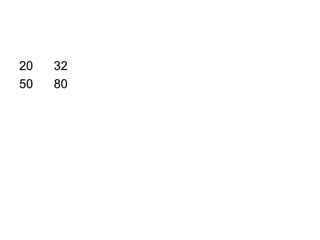
![Passing array to Function
• Here an array is transferred as parameter to a
function.
• void main() void fun(n,b[])
{ {
void fun(int,int); int x,b[5];
int a[5],n; …………..
…………… …………..
fun(n,a);
…………… }
}](https://image.slidesharecdn.com/unit-5-160818044235/85/Fucntions-Pointers-in-C-83-320.jpg)
![Example
#include<stdio.h>
#include<conio.h>
void add(int,int b[]);
void main()
{
int a[5],i,n;
clrscr();
printf("n Enter the Number: ");
scanf("%d",&n);
printf("n Enter the Values: ");
for(i=0;i<n;i++)
scanf("%d",&a[i]);
add(n,a);
}](https://image.slidesharecdn.com/unit-5-160818044235/85/Fucntions-Pointers-in-C-84-320.jpg)
![void add(int x,int b[])
{
int sum=0,i;
for(i=0;i<x;i++)
sum=sum+b[i];
printf("nThe sum is: %d",sum);
}](https://image.slidesharecdn.com/unit-5-160818044235/85/Fucntions-Pointers-in-C-85-320.jpg)
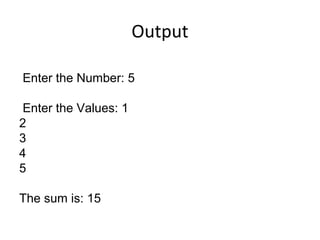
![Array of Characters
• In array the characters are terminated by the
null (‘0’) character.
• Example: char a[]={a,b,c};
a b c 0](https://image.slidesharecdn.com/unit-5-160818044235/85/Fucntions-Pointers-in-C-87-320.jpg)
![Example
#include<stdio.h>
#include<conio.h>
void main()
{
int i=0;
char a[]="abcd";
clrscr();
while(a[i]!='0')
{
printf("t%c",a[i]);
i++;
}
}](https://image.slidesharecdn.com/unit-5-160818044235/85/Fucntions-Pointers-in-C-88-320.jpg)
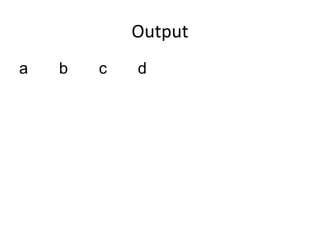
![Multi Dimensional Array
• Syntax
datatype array_name [size1][size2]….[size n]
datatype - type of the data.
array_name -name of the array.
size -size of the array.](https://image.slidesharecdn.com/unit-5-160818044235/85/Fucntions-Pointers-in-C-90-320.jpg)
![Example:
int a[3][3][3];
Col 0 Col 1 Col 2
row 0
row 1
row 2
X[0][0]
X[1][0]
X[2][0]
X[0][1]
X[1][1]
X[2][1]
X[0][2]
X[1][2]
X[2][2]](https://image.slidesharecdn.com/unit-5-160818044235/85/Fucntions-Pointers-in-C-91-320.jpg)
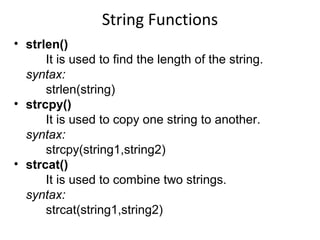
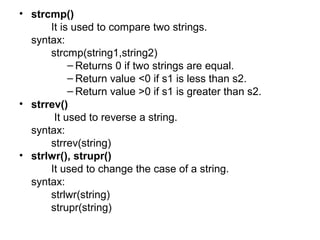
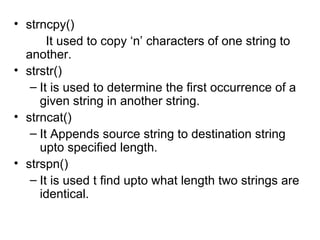
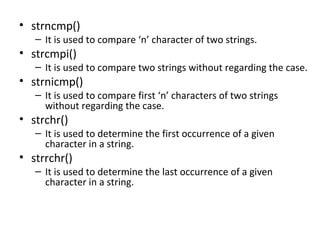
![Example
#include<stdio.h>
#include<conio.h>
#include<string.h>
void main()
{
char a[]="college";
int b;
clrscr();
b=strlen(a);
printf("nThe length of the string is %d",b);
getch();
}
Output:
The length of the string is 7](https://image.slidesharecdn.com/unit-5-160818044235/85/Fucntions-Pointers-in-C-96-320.jpg)
![Example
#include<stdio.h>
#include<conio.h>
#include<string.h>
void main()
{
char a[]="IT";
char b[]="Dept";
clrscr();
strcpy(a,b);
printf("nThe string is %s",a);
getch();
}
Output:
The string is Dept](https://image.slidesharecdn.com/unit-5-160818044235/85/Fucntions-Pointers-in-C-97-320.jpg)
![Example
#include<stdio.h>
#include<conio.h>
#include<string.h>
void main()
{
char a[]="IT";
char b[]="Dept";
clrscr();
strcat(a,b);
printf("nThe string is %s",a);
getch();
}
Output:
The string is ITDept](https://image.slidesharecdn.com/unit-5-160818044235/85/Fucntions-Pointers-in-C-98-320.jpg)
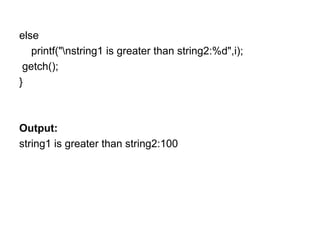
![Example
#include<stdio.h>
#include<conio.h>
#include<string.h>
void main()
{
char a[]="itdept";
char b[]="it";
int i;
clrscr();
i=strcmp(a,b);
if(i==0)
printf("nstrings are equal:%d",i);
else if(i<0)
printf("nstring1 is less than string2:%d",i);](https://image.slidesharecdn.com/unit-5-160818044235/85/Fucntions-Pointers-in-C-99-320.jpg)
![Example
#include<stdio.h>
#include<conio.h>
#include<string.h>
void main()
{
char a[]="itdept";
clrscr();
printf("nThe string is :%s",a);
strupr(a);
printf("nThe string after conversion to uppercase :%s",a);
strlwr(a);
printf("nThe string after conversion to lowercase :%s",a);
getch();
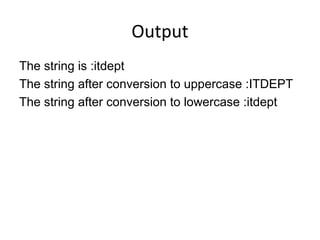
}](https://image.slidesharecdn.com/unit-5-160818044235/85/Fucntions-Pointers-in-C-101-320.jpg)
![Example
#include<stdio.h>
#include<conio.h>
#include<string.h>
void main()
{
char a[]="Dept";
clrscr();
printf("nThe string is %s",strrev(a));
getch();
}
Output:
The string is tpeD](https://image.slidesharecdn.com/unit-5-160818044235/85/Fucntions-Pointers-in-C-103-320.jpg)
![Example
#include<stdio.h>
#include<conio.h>
#include<string.h>
void main()
{
char a[]="itdept";
char b[15];
int i=0;
clrscr();
strncpy(b,a,2);
b[2]='0';
printf("nThe string is :%s",b);
getch();
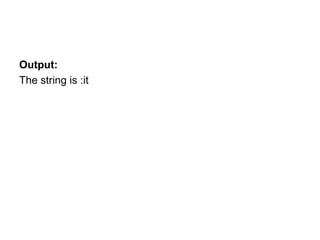
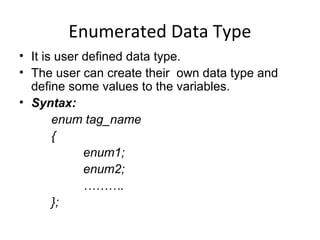
}](https://image.slidesharecdn.com/unit-5-160818044235/85/Fucntions-Pointers-in-C-104-320.jpg)
![String Palindrome
#include<stdio.h>
#include<conio.h>
#include<string.h>
void main()
{
int len,i,j;
char str[15];
clrscr();
printf("n Enter the string:");
scanf("%s",str);
len=strlen(str);](https://image.slidesharecdn.com/unit-5-160818044235/85/Fucntions-Pointers-in-C-106-320.jpg)
![for(i=0,j=len-1;i<len/2;i++,j--)
{
if(str[i]!=str[j])
{
printf("nThe String is not a palindrome");
getch();
exit(0);
}
}
printf("nThe String is a palindrome");
getch();
}
Output:
Enter the string:abcba
The String is a palindrome](https://image.slidesharecdn.com/unit-5-160818044235/85/Fucntions-Pointers-in-C-107-320.jpg)
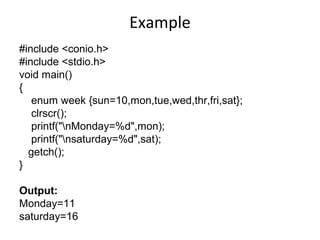
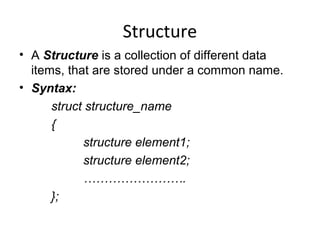
![• Example:
struct stud
{
int sno;
char name[10];
int mark;
};
struct stud s;](https://image.slidesharecdn.com/unit-5-160818044235/85/Fucntions-Pointers-in-C-112-320.jpg)
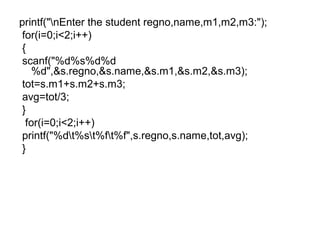
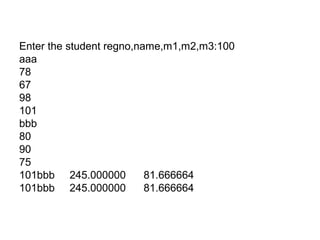
![Example
#include<stdio.h>
#include<conio.h>
struct stud
{
int regno;
char name[10];
int m1;
int m2;
int m3;
};
struct stud s;
void main()
{
float tot,avg;](https://image.slidesharecdn.com/unit-5-160818044235/85/Fucntions-Pointers-in-C-113-320.jpg)
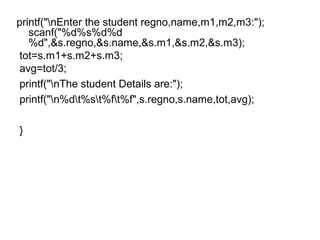
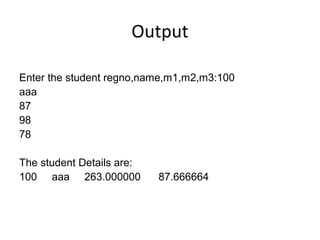
![Example
#include<stdio.h>
#include<conio.h>
struct stud
{
int regno;
char name[10],grade;
int m1,m2,m3;
float avg,tot;
} s[10];
void main()
{
int i,n;
printf("nEnter the no.of students:");
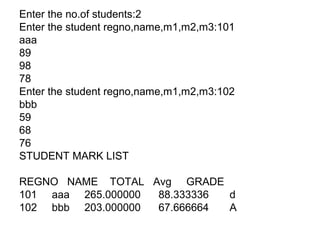
scanf("%d",&n);](https://image.slidesharecdn.com/unit-5-160818044235/85/Fucntions-Pointers-in-C-119-320.jpg)
![for(i=0;i<n;i++)
{
printf("nEnter the student regno,name,m1,m2,m3:");
scanf("%d%s%d%d%d",&s[i].regno,&s[i].name,&s[i].m1,
&s[i].m2,&s[i].m3);
s[i].tot=s[i].m1+s[i].m2+s[i].m3;
s[i].avg=s[i].tot/3;
if(s[i].m1<35||s[i].m2<35||s[i].m3<35)
s[i].grade='f';
else
{
if(s[i].avg>=75)
s[i].grade='d';
else if(s[i].avg>=60)](https://image.slidesharecdn.com/unit-5-160818044235/85/Fucntions-Pointers-in-C-120-320.jpg)
![s[i].grade='A';
else if(s[i].avg>=50)
s[i].grade='B';
else if(s[i].avg>=35)
s[i].grade='C';
}
}
printf("nSTUDENT MARK LISTn");
printf("nREGNOtNAMEtTOTALtAvgtGRADE");
for(i=0;i<n;i++)
printf("n%dt%st%ft%ft
%c",s[i].regno,s[i].name,s[i].tot,s[i].avg,s[i].grade);
getch();
}](https://image.slidesharecdn.com/unit-5-160818044235/85/Fucntions-Pointers-in-C-121-320.jpg)
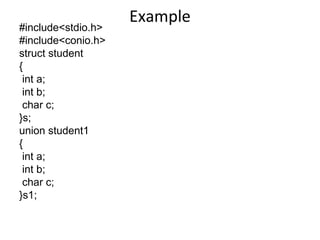
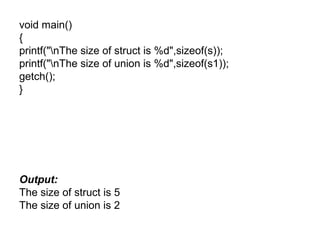
![Example
#include<stdio.h>
#include<conio.h>
union stud
{
int a;
char b[2];
};
void main()
{
union stud c;](https://image.slidesharecdn.com/unit-5-160818044235/85/Fucntions-Pointers-in-C-125-320.jpg)
![c.a=256;
printf("nc.a value is%d",c.a);
printf("nc.b[0] value is%d",c.b[0]);
printf("nc.b[1] value is%d",c.b[1]);
}
Output:
c.a value is256
c.b[0] value is0
c.b[1] value is1](https://image.slidesharecdn.com/unit-5-160818044235/85/Fucntions-Pointers-in-C-126-320.jpg)
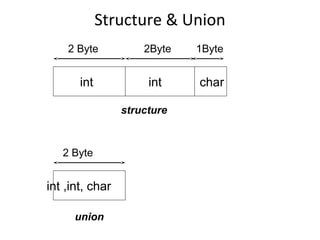
![• 256 = 00000010 00000000
Higher bit Lower bit
00000000 00000010
c.a - 2 Byte
c.b[0] 1 Byte c.b[0] 1 Byte
c.b[0] c.b[1]](https://image.slidesharecdn.com/unit-5-160818044235/85/Fucntions-Pointers-in-C-127-320.jpg)
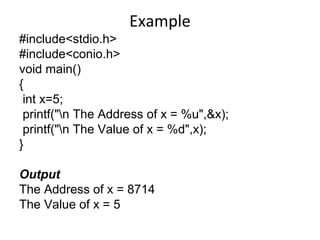
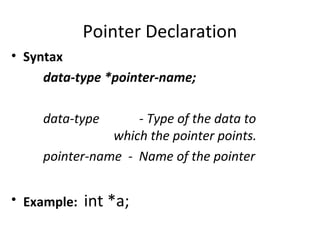
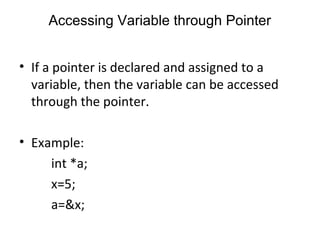
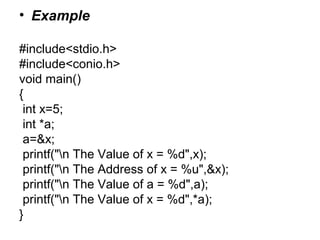
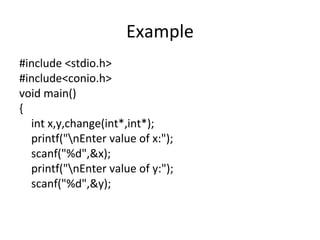
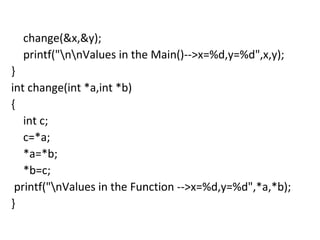
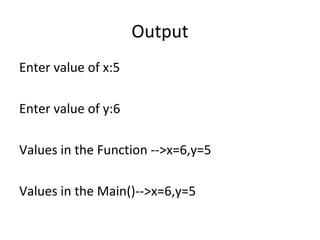
![Pointer to Array
• The elements of the array can also be
accessed through a pointer.
• Example
int a[3]={2,3,7};
int *b;
b=a;](https://image.slidesharecdn.com/unit-5-160818044235/85/Fucntions-Pointers-in-C-173-320.jpg)
![Example:
#include<stdio.h>
#include<conio.h>
void main()
{
int a[3]={2,3,7};
int *b;
b=a;
printf("n The Value of a[0] = %d",a[0]);
printf("n The Address of a[0] = %u",&a[0]);
printf("n The Value of b = %d",b);
}](https://image.slidesharecdn.com/unit-5-160818044235/85/Fucntions-Pointers-in-C-174-320.jpg)
![8744 2
9000
b a[0]
8744
Variable
Value
Address](https://image.slidesharecdn.com/unit-5-160818044235/85/Fucntions-Pointers-in-C-175-320.jpg)
![Output
The Value of a[0] = 2
The Address of a[0] = 8744
The Value of b = 8744](https://image.slidesharecdn.com/unit-5-160818044235/85/Fucntions-Pointers-in-C-176-320.jpg)
![Example
#include<stdio.h>
#include<conio.h>
void main()
{
int a[5]={2,3,7,9,10};
int i;
for(i=0;i<5;i++)
{
printf("n The Value of a[%d] = %d",i,a[i]);
printf("n The Address of a[%d] = %u",i,&a[i]);
}
}](https://image.slidesharecdn.com/unit-5-160818044235/85/Fucntions-Pointers-in-C-177-320.jpg)
![2 3 7 9 10
a[0] a[1] a[2] a[3] a[4]
8724 8726 8728 8730 8732
Array
Value
Address](https://image.slidesharecdn.com/unit-5-160818044235/85/Fucntions-Pointers-in-C-178-320.jpg)
![Output
The Value of a[0] = 2
The Address of a[0] = 8724
The Value of a[1] = 3
The Address of a[1] = 8726
The Value of a[2] = 7
The Address of a[2] = 8728
The Value of a[3] = 9
The Address of a[3] = 8730
The Value of a[4] = 10
The Address of a[4] = 8732](https://image.slidesharecdn.com/unit-5-160818044235/85/Fucntions-Pointers-in-C-179-320.jpg)
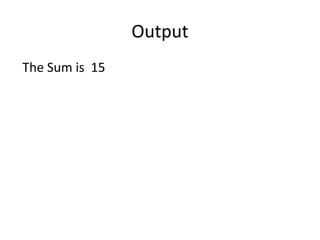
![Example
#include<stdio.h>
#include<conio.h>
void main()
{
int a[5]={1,2,3,4,5};
int i,sum=0;
int *b;
b=a;
for(i=0;i<5;i++)
{
sum=sum + *b;
b++; //b=b+1
}
printf("n The Sum is %d",sum);
}](https://image.slidesharecdn.com/unit-5-160818044235/85/Fucntions-Pointers-in-C-180-320.jpg)
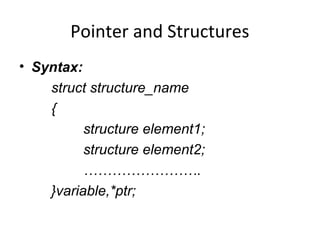
![• Example:
struct stud
{
int sno;
char name[10];
int mark;
};
struct stud *s;](https://image.slidesharecdn.com/unit-5-160818044235/85/Fucntions-Pointers-in-C-183-320.jpg)
![Example
#include<stdio.h>
#include<conio.h>
struct stud
{
int regno;
char name[10];
int m1;
int m2;
int m3;
};
struct stud s;
struct stud *t;](https://image.slidesharecdn.com/unit-5-160818044235/85/Fucntions-Pointers-in-C-184-320.jpg)
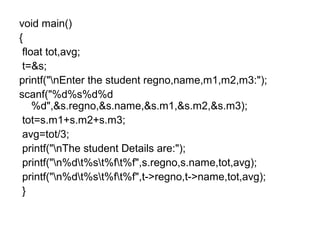
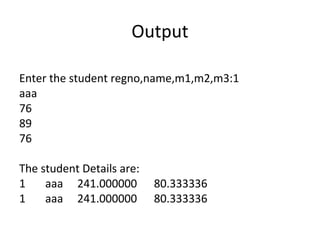
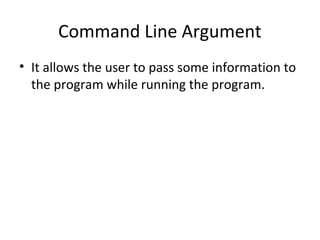
![Example
#include<stdio.h>
#include<conio.h>
void main(int argc,char argv[])
{
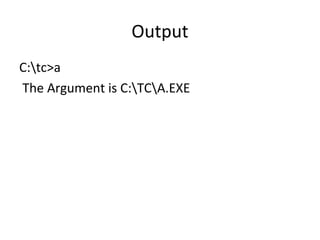
printf("n The Argument is %s",argv[0]);
getch();
}](https://image.slidesharecdn.com/unit-5-160818044235/85/Fucntions-Pointers-in-C-188-320.jpg)
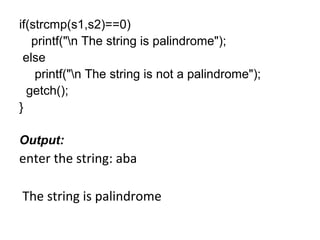
![String Palindrome
#include<stdio.h>
#include<conio.h>
#include<string.h>
void main()
{
char s1[15],s2[15];
printf("nenter the string:");
scanf("%s",s1);
strcpy(s2,s1);
strrev(s1);](https://image.slidesharecdn.com/unit-5-160818044235/85/Fucntions-Pointers-in-C-190-320.jpg)

![Example
#include<stdio.h>
#include<conio.h>
struct stud
{
int regno;
char name[10];
int m1;
int m2;
int m3;
};
struct stud s;
void main()
{
float tot,avg;
int i;](https://image.slidesharecdn.com/unit-5-160818044235/85/Fucntions-Pointers-in-C-199-320.jpg)
![#include <string.h>
#include <stdio.h>
int main(void)
{
char string[15];
char *ptr, c = 'r';
strcpy(string, "This is a string");
ptr = strchr(string, c);
if (ptr)
printf("The character %c is at position: %dn", c, ptr-
string);
else
printf("The character was not foundn");
return 0;
}](https://image.slidesharecdn.com/unit-5-160818044235/85/Fucntions-Pointers-in-C-202-320.jpg)
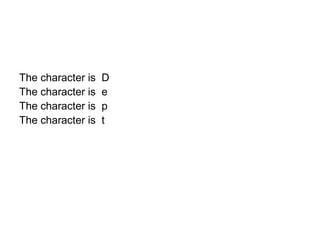
![Example#include<stdio.h>
#include<conio.h>
#include<string.h>
void main()
{
char a[]="Dept";
int i=0;
clrscr();
while(a[i]!='0')
{
printf("nThe character is %c",a[i]);
i++;
}
getch();
}](https://image.slidesharecdn.com/unit-5-160818044235/85/Fucntions-Pointers-in-C-203-320.jpg)
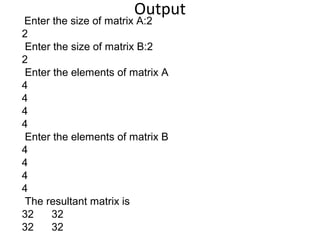
![Matrix Multiplication
#include<stdio.h>
#include<conio.h>
void main()
{
int i,j,k,r1,r2,c1,c2;
int a[5][5],b[5][5],c[5][5];
clrscr();
step1:
printf("n Enter the size of matrix A n");
scanf("%d%d",&r1,&c1);
printf("n Enter the size of matrix B n");
scanf("%d%d",&r2,&c2);
if(c1==r2)
goto step2;
else
goto step1;](https://image.slidesharecdn.com/unit-5-160818044235/85/Fucntions-Pointers-in-C-219-320.jpg)
![step2:
printf("n Enter the elements of matrix A n");
for(i=0;i<r1;i++)
{
for(j=0;j<c1;j++)
{
scanf("%d",&a[i][j]);
}
}
printf("n Enter the elements of matrix B n");
for(i=0;i<r2;i++)
{
for(j=0;j<c2;j++)
{
scanf("t%d",&b[i][j]);
}
}](https://image.slidesharecdn.com/unit-5-160818044235/85/Fucntions-Pointers-in-C-220-320.jpg)
![for(i=0;i<r1;i++)
{
for(j=0;j<c2;j++)
{
c[i][j]=0;
for(k=0;k<c1;k++)
{
c[i][j]=c[i][j]+a[i][k]*b[k][j];
}
}
}
for(i=0;i<r1;i++)
{
for(j=0;j<c2;j++)
printf("%dt",c[i][j]);
printf("n");
}
getch();
}](https://image.slidesharecdn.com/unit-5-160818044235/85/Fucntions-Pointers-in-C-221-320.jpg)
![String Palindrome
#include<stdio.h>
#include<conio.h>
#include<string.h>
void main()
{
int len,i,j;
char str[15];
clrscr();
printf("n Enter the string:");
scanf("%s",str);
len=strlen(str);](https://image.slidesharecdn.com/unit-5-160818044235/85/Fucntions-Pointers-in-C-234-320.jpg)
![for(i=0,j=len-1;i<len/2;i++,j--)
{
if(str[i]!=str[j])
{
printf("nThe String is not a palindrome");
getch();
exit(0);
}
}
printf("nThe String is a palindrome");
getch();
}
Output:
Enter the string:abcba
The String is a palindrome](https://image.slidesharecdn.com/unit-5-160818044235/85/Fucntions-Pointers-in-C-235-320.jpg)

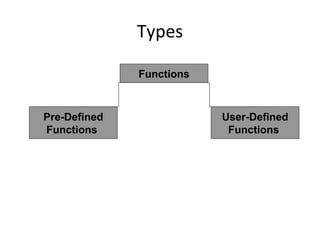
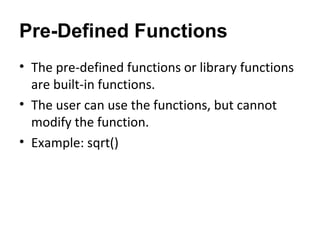
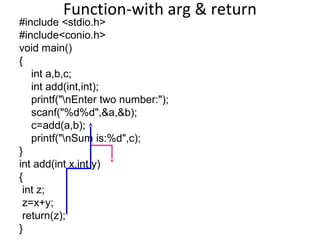
Functions allow programmers to organize code into reusable blocks. There are two types of functions: pre-defined/library functions which are provided for use and user-defined functions which are created by the programmer. User-defined functions help reduce code length and make debugging easier. Functions can receive input parameters, return values, or do both. Arrays allow storing and accessing related data through indexes. One-dimensional arrays store data in a single list while multi-dimensional arrays can represent tables of data through multiple indexes.


