Cryptography and
Network Security
Sixth Edition
by William Stallings
Instructor:
Assoc. Prof.Dr. Sadik Al-Taweel
Dr.sadiq@ust.edu
Sadiq_altaweel@yahoo.com
Chapter 2
Classical Encryption
Techniques
Symmetric Encryption
• Also referred to as conventional encryption or
single-key encryption
• Was the only type of encryption in use prior to
the development of public-key encryption in
the 1970s
• Remains by far the most widely used of the
two types of encryption
Basic Terminology
• Plaintext
• The original message
• Ciphertext
• The coded message
• Enciphering or encryption
• Process of converting from
plaintext to ciphertext
• Deciphering or decryption
• Restoring the plaintext
from the ciphertext
• Cryptography
• Study of encryption
• Cryptographic system or
cipher
• Schemes used for
encryption
• Cryptanalysis
• Techniques used for
deciphering a message
without any knowledge of
the enciphering details
• Cryptology
• Areas of cryptography and
cryptanalysis together
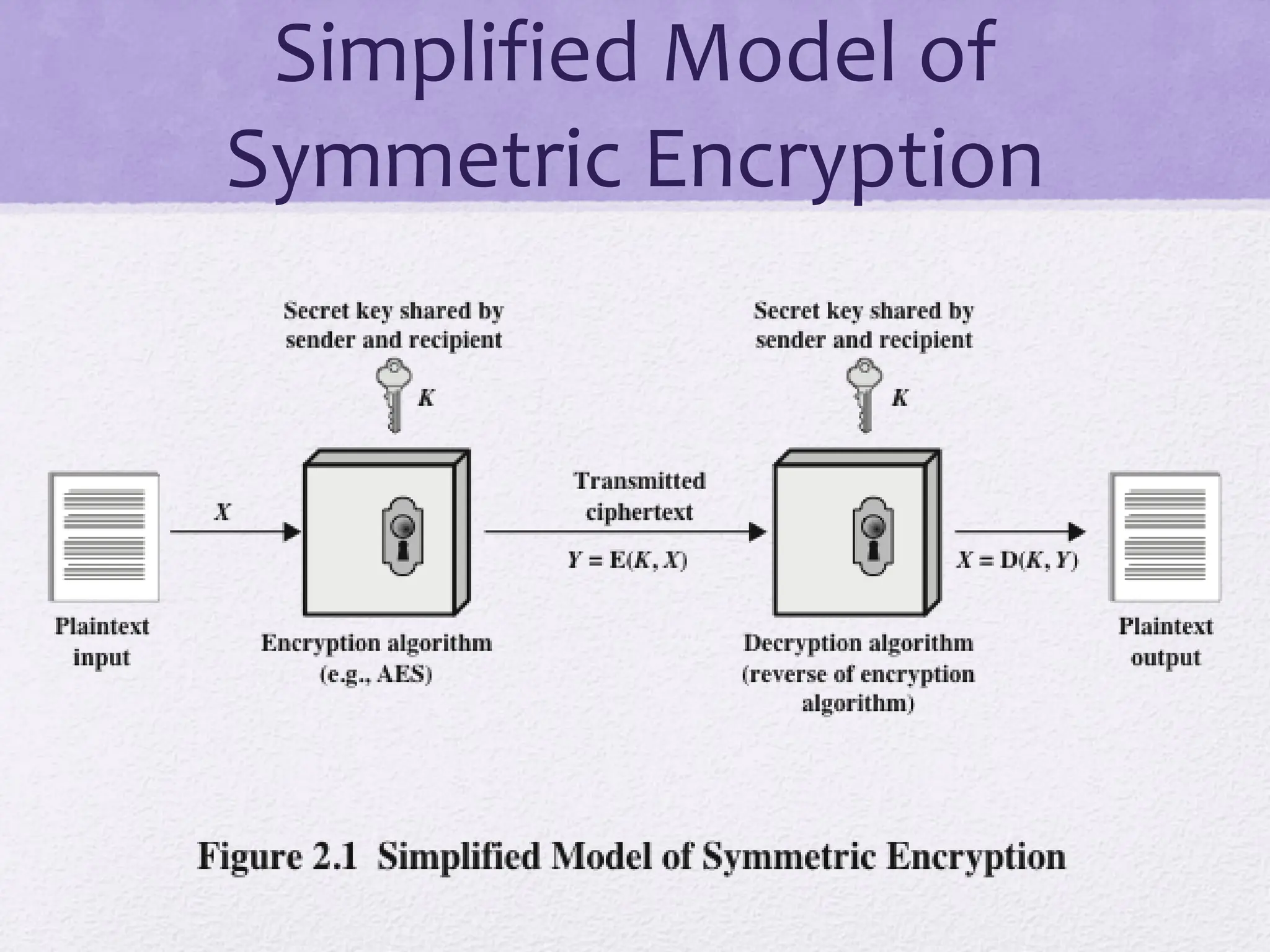
Simplified Model of
Symmetric Encryption
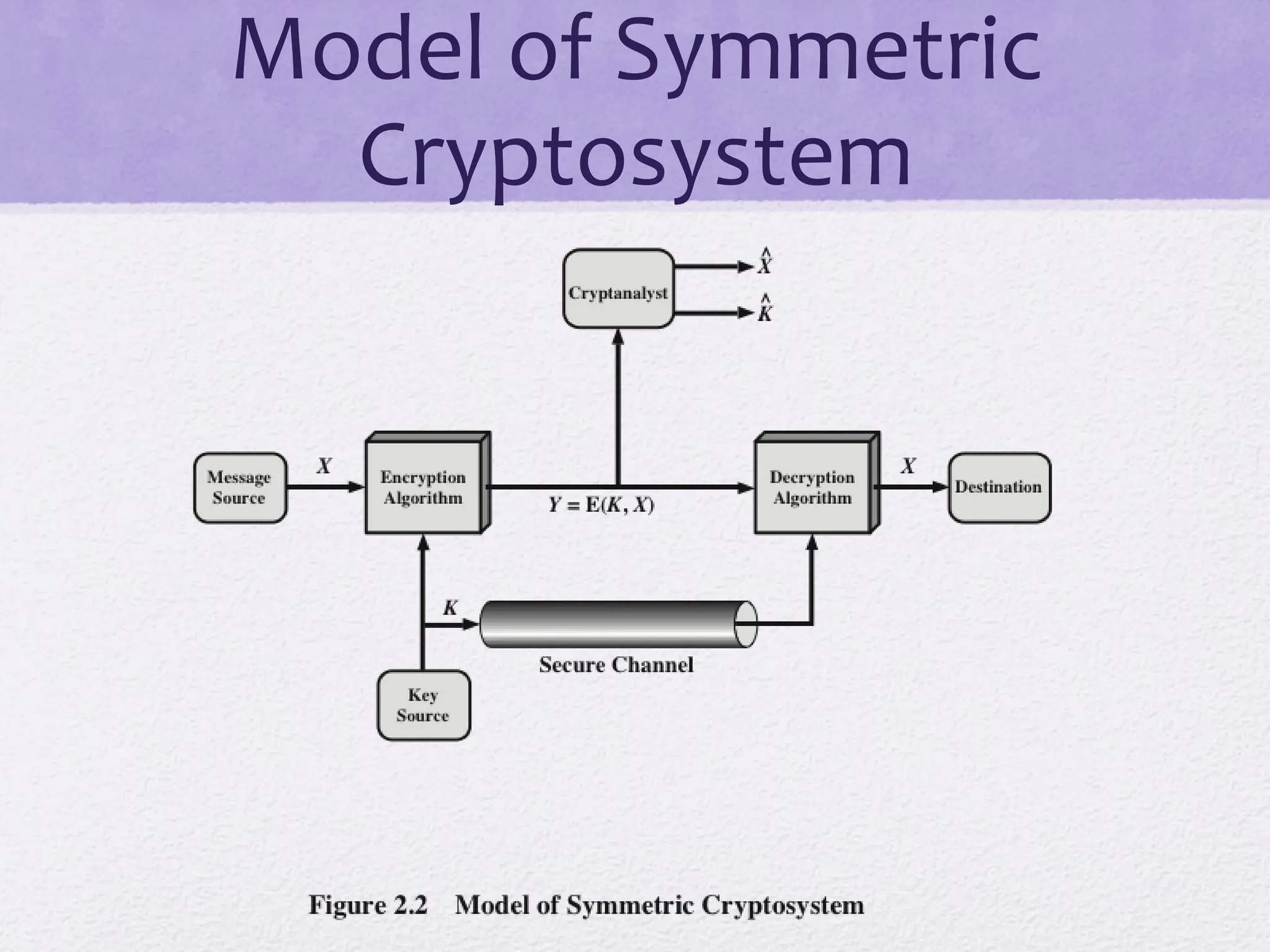
Model of Symmetric
Cryptosystem
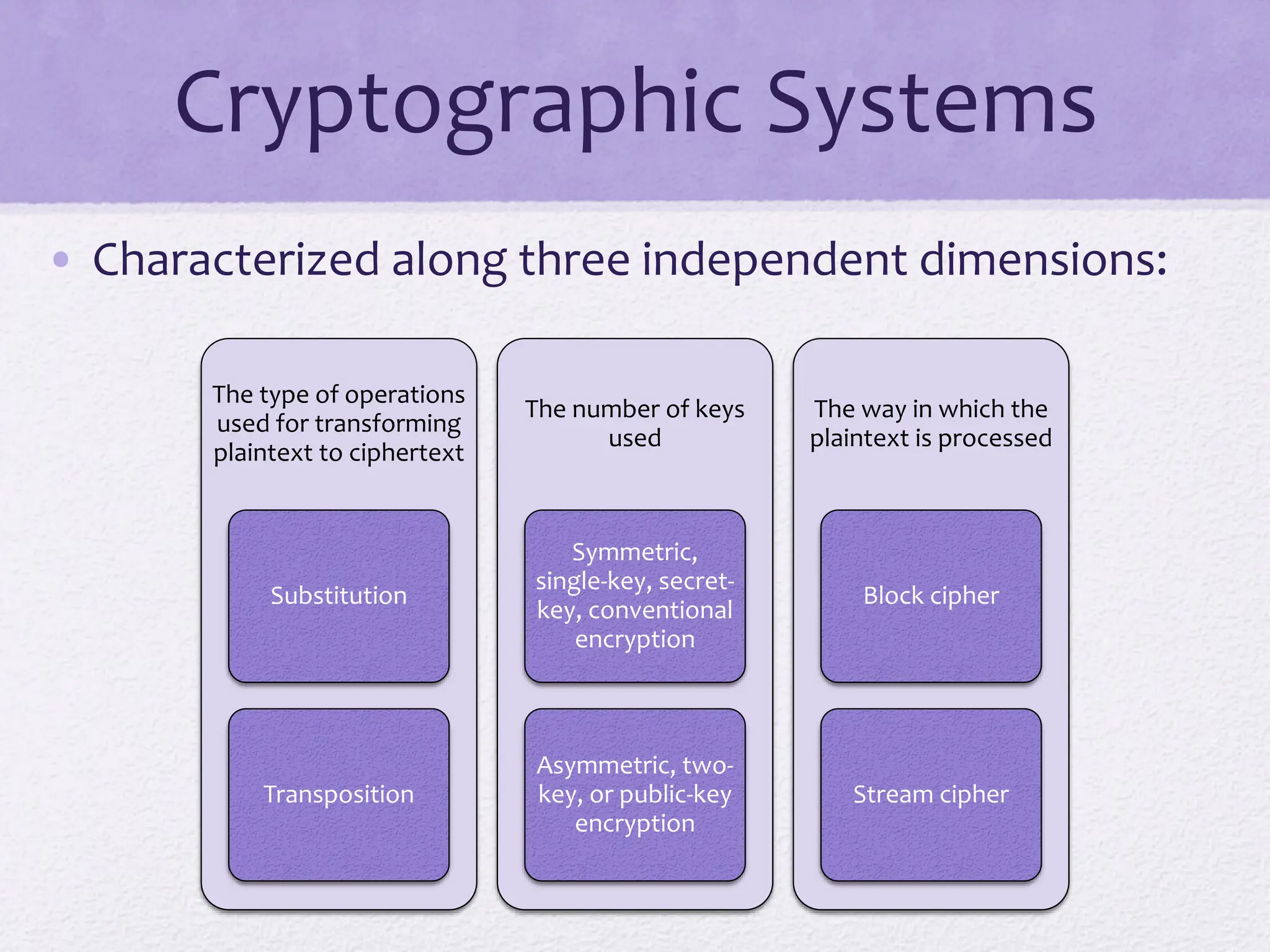
Cryptographic Systems
• Characterized along three independent dimensions:
The type of operations
used for transforming
plaintext to ciphertext
Substitution
Transposition
The number of keys
used
Symmetric,
single-key, secret-
key, conventional
encryption
Asymmetric, two-
key, or public-key
encryption
The way in which the
plaintext is processed
Block cipher
Stream cipher
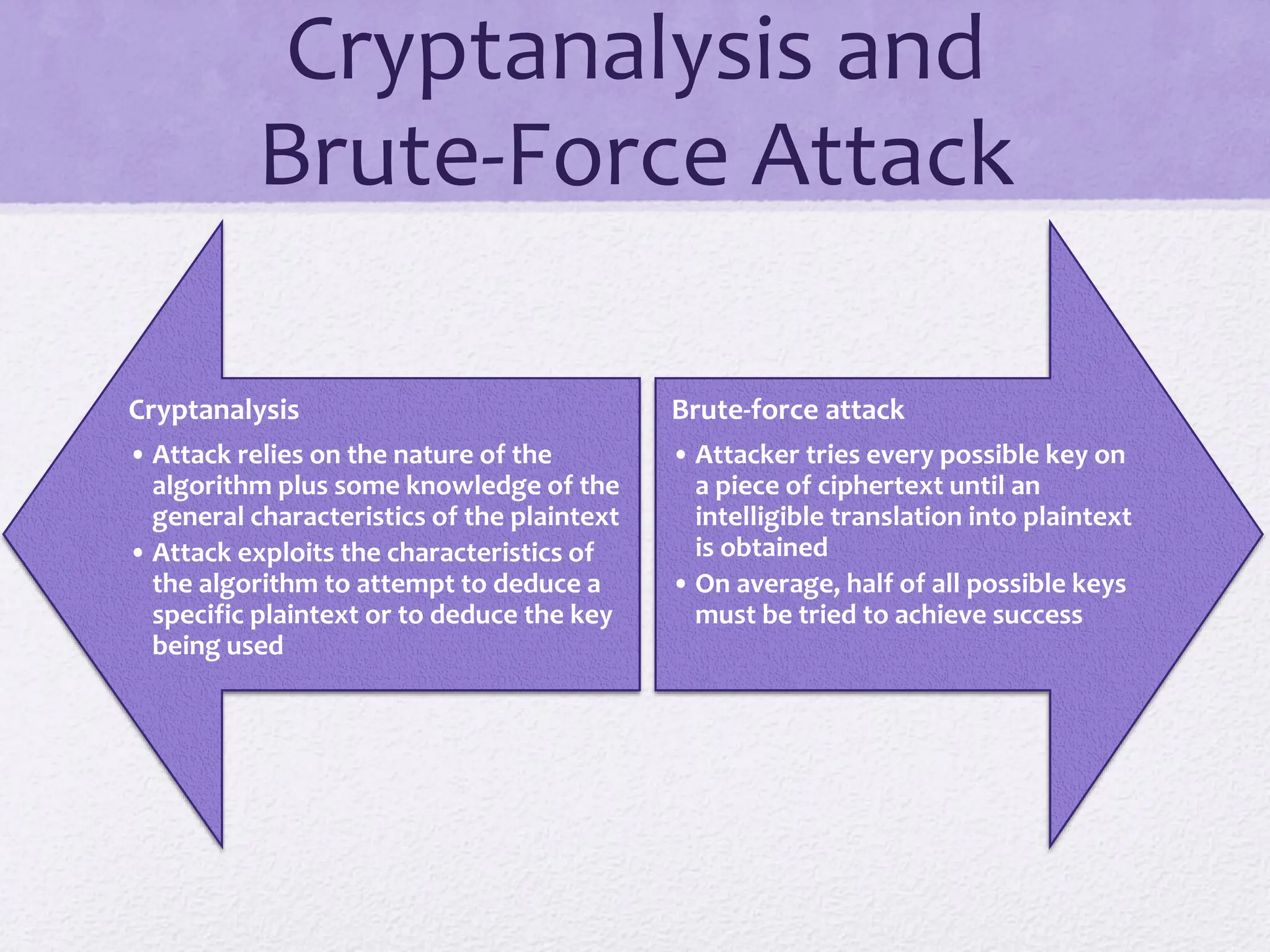
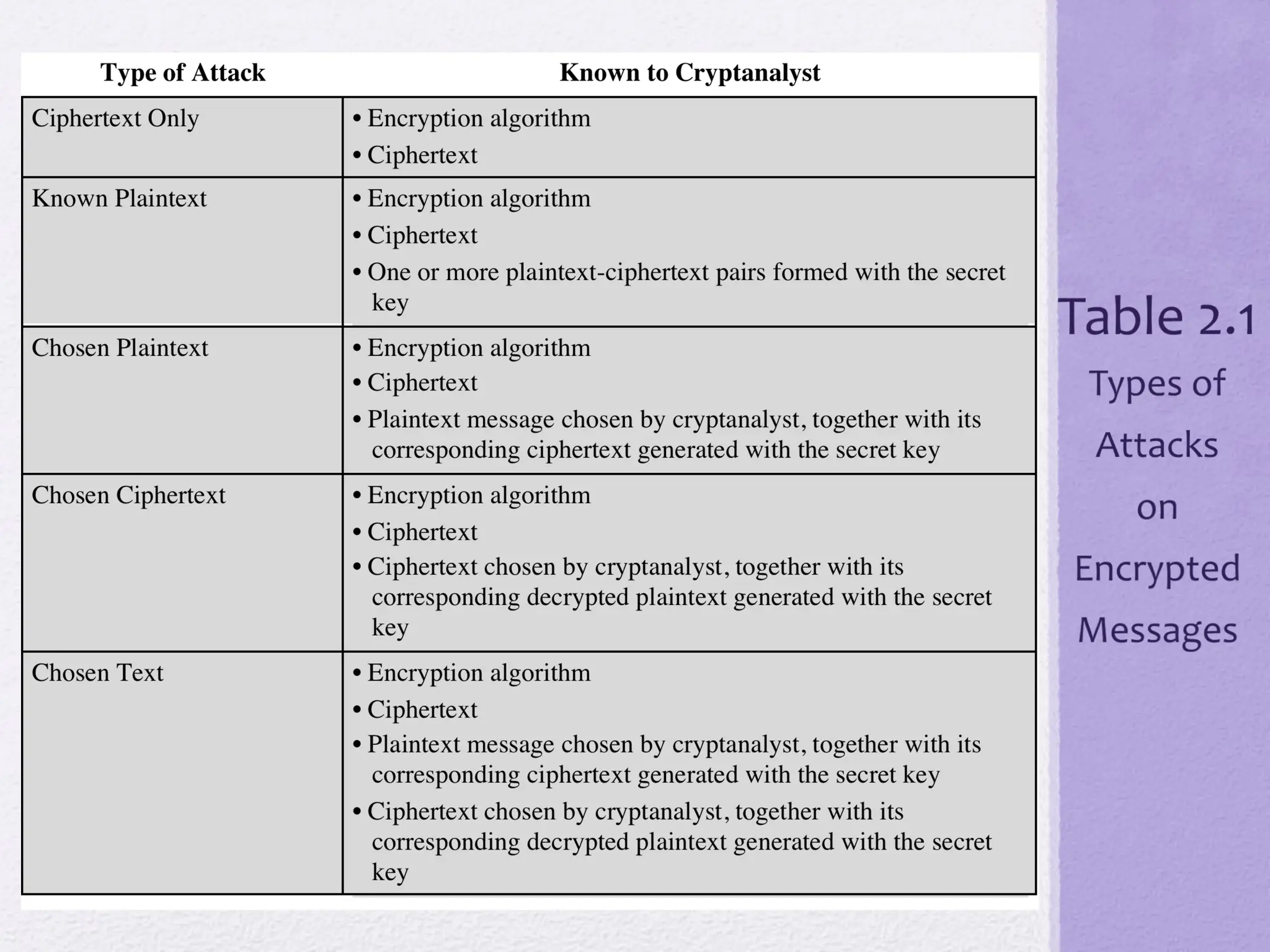
Cryptanalysis and
Brute-Force Attack
Cryptanalysis
• Attack relies on the nature of the
algorithm plus some knowledge of the
general characteristics of the plaintext
• Attack exploits the characteristics of
the algorithm to attempt to deduce a
specific plaintext or to deduce the key
being used
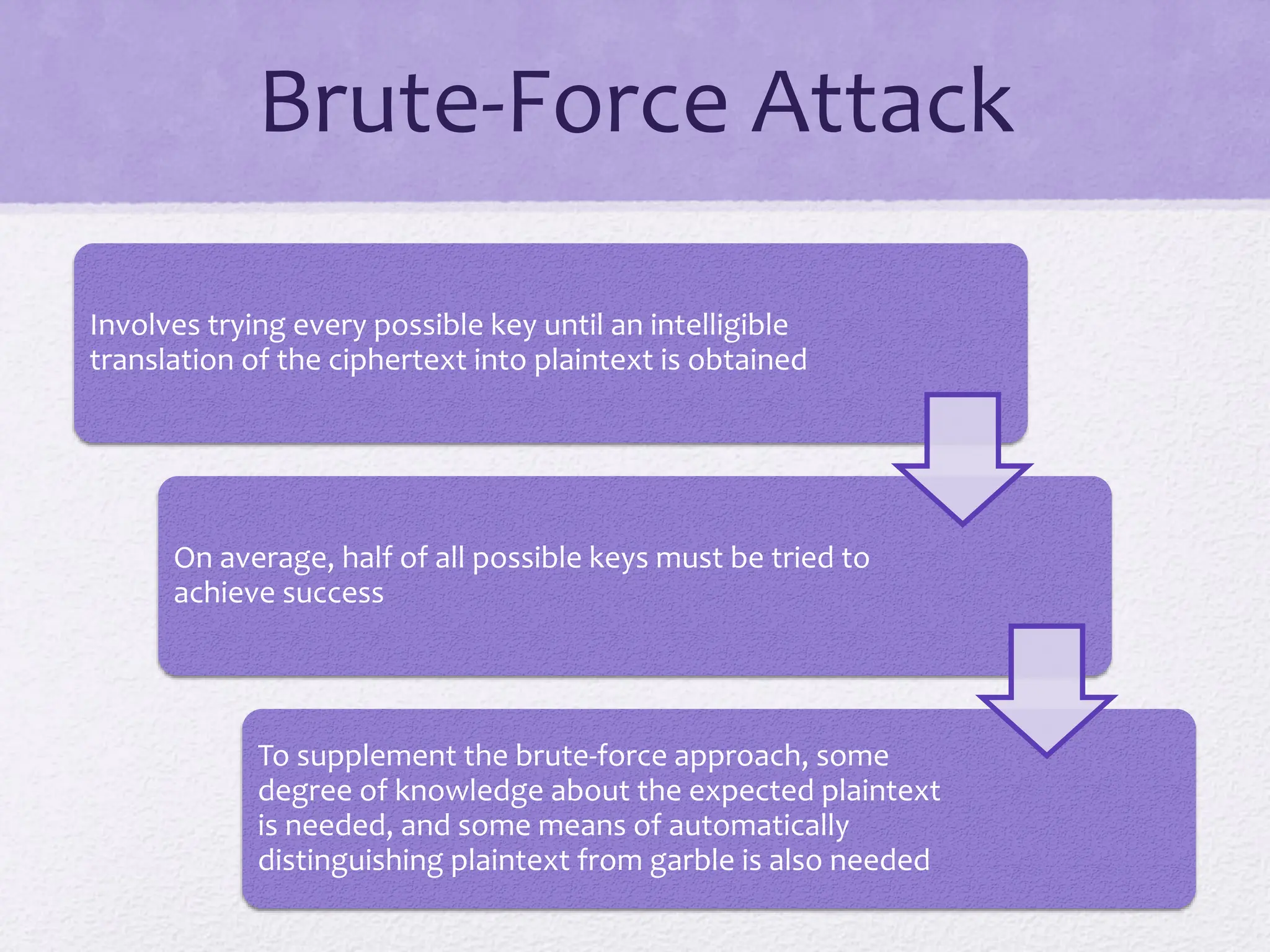
Brute-force attack
• Attacker tries every possible key on
a piece of ciphertext until an
intelligible translation into plaintext
is obtained
• On average, half of all possible keys
must be tried to achieve success
Brute-Force Attack
Involves trying every possible key until an intelligible
translation of the ciphertext into plaintext is obtained
On average, half of all possible keys must be tried to
achieve success
To supplement the brute-force approach, some
degree of knowledge about the expected plaintext
is needed, and some means of automatically
distinguishing plaintext from garble is also needed
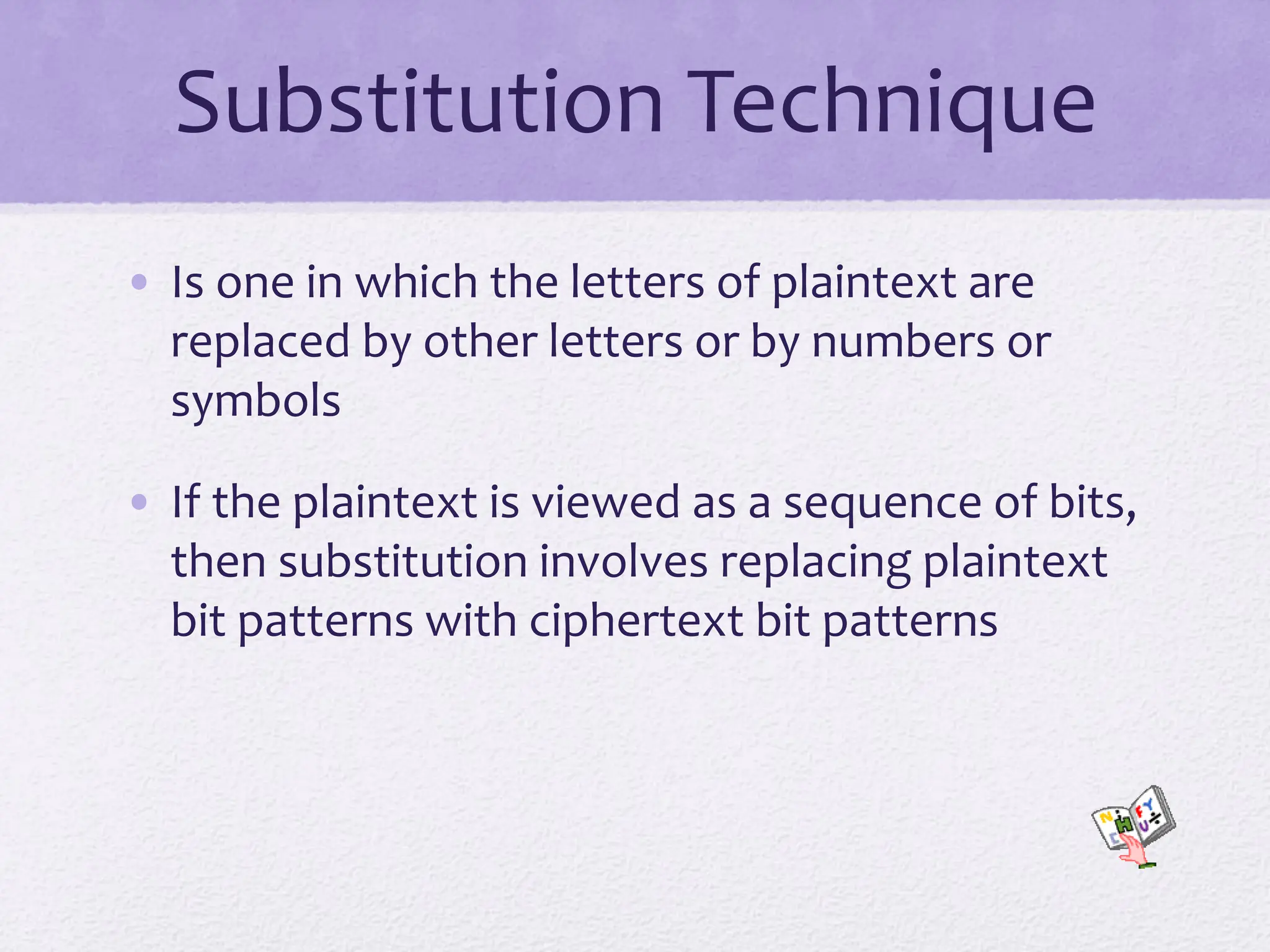
Substitution Technique
• Is one in which the letters of plaintext are
replaced by other letters or by numbers or
symbols
• If the plaintext is viewed as a sequence of bits,
then substitution involves replacing plaintext
bit patterns with ciphertext bit patterns
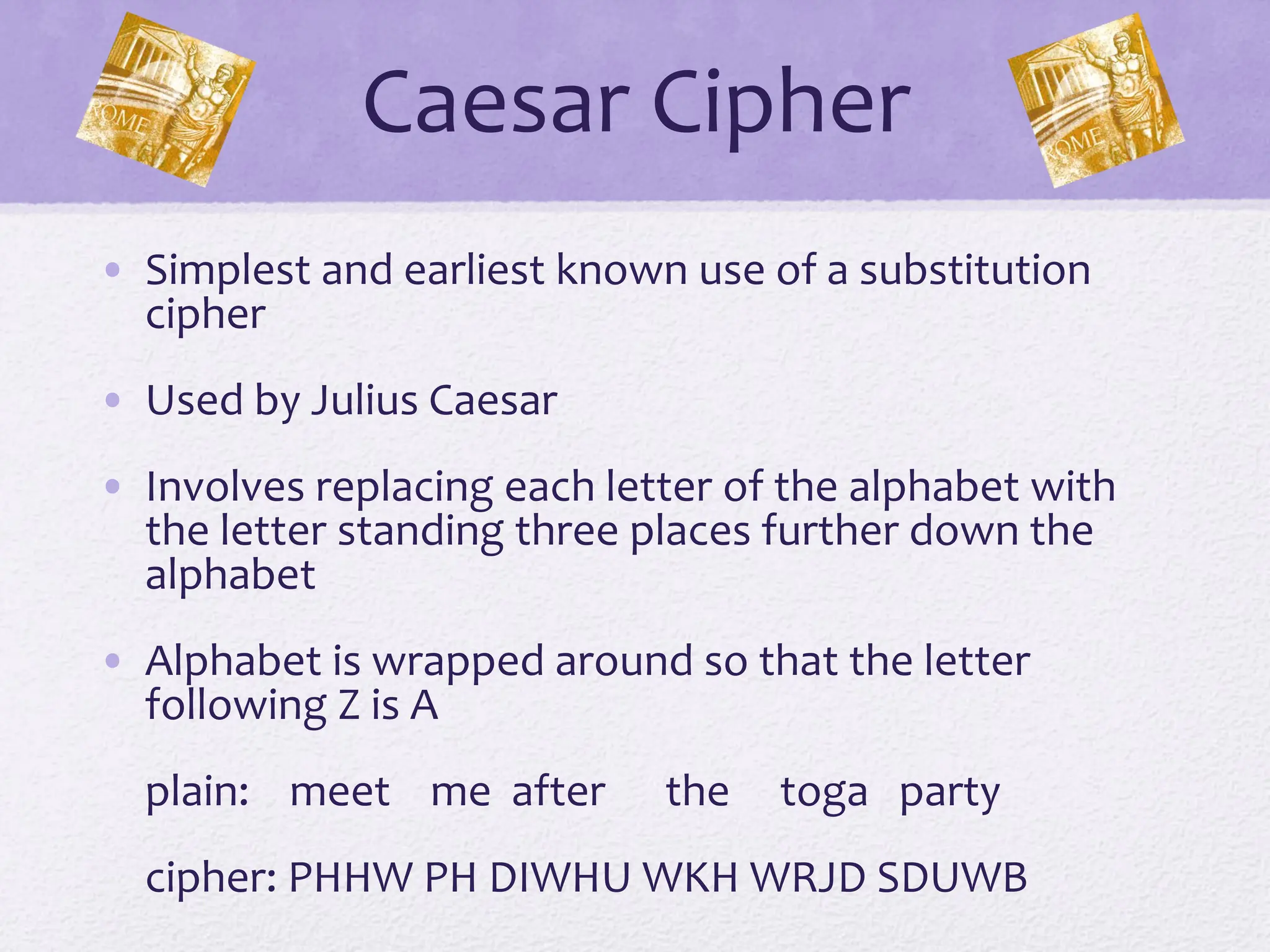
Caesar Cipher
• Simplest and earliest known use of a substitution
cipher
• Used by Julius Caesar
• Involves replacing each letter of the alphabet with
the letter standing three places further down the
alphabet
• Alphabet is wrapped around so that the letter
following Z is A
plain: meet me after the toga party
cipher: PHHW PH DIWHU WKH WRJD SDUWB
Caesar Cipher Algorithm
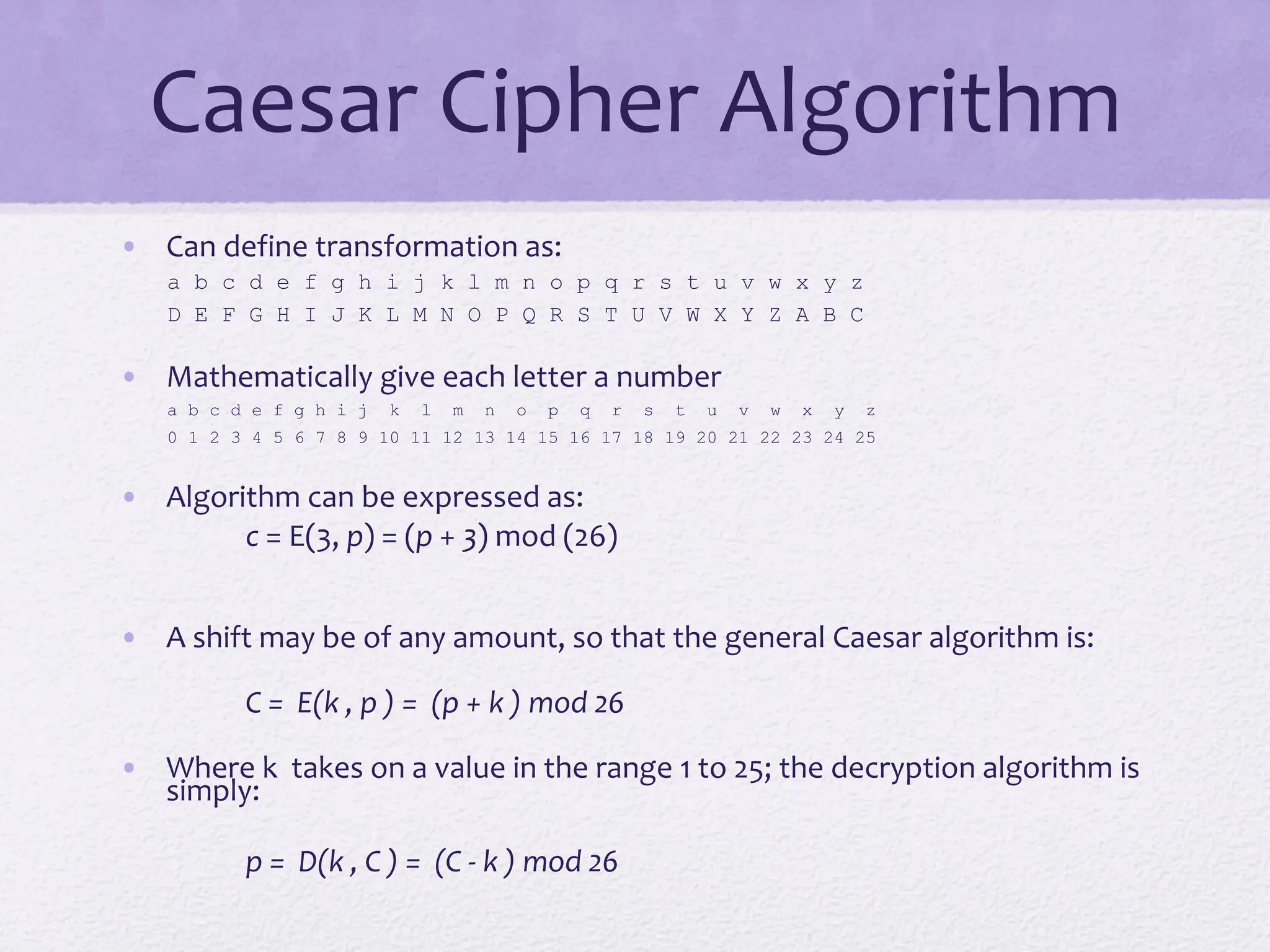
• Can define transformation as:
a b c d e f g h i j k l m n o p q r s t u v w x y z
D E F G H I J K L M N O P Q R S T U V W X Y Z A B C
• Mathematically give each letter a number
a b c d e f g h i j k l m n o p q r s t u v w x y z
0 1 2 3 4 5 6 7 8 9 10 11 12 13 14 15 16 17 18 19 20 21 22 23 24 25
• Algorithm can be expressed as:
c = E(3, p) = (p + 3) mod (26)
• A shift may be of any amount, so that the general Caesar algorithm is:
C = E(k , p ) = (p + k ) mod 26
• Where k takes on a value in the range 1 to 25; the decryption algorithm is
simply:
p = D(k , C ) = (C - k ) mod 26
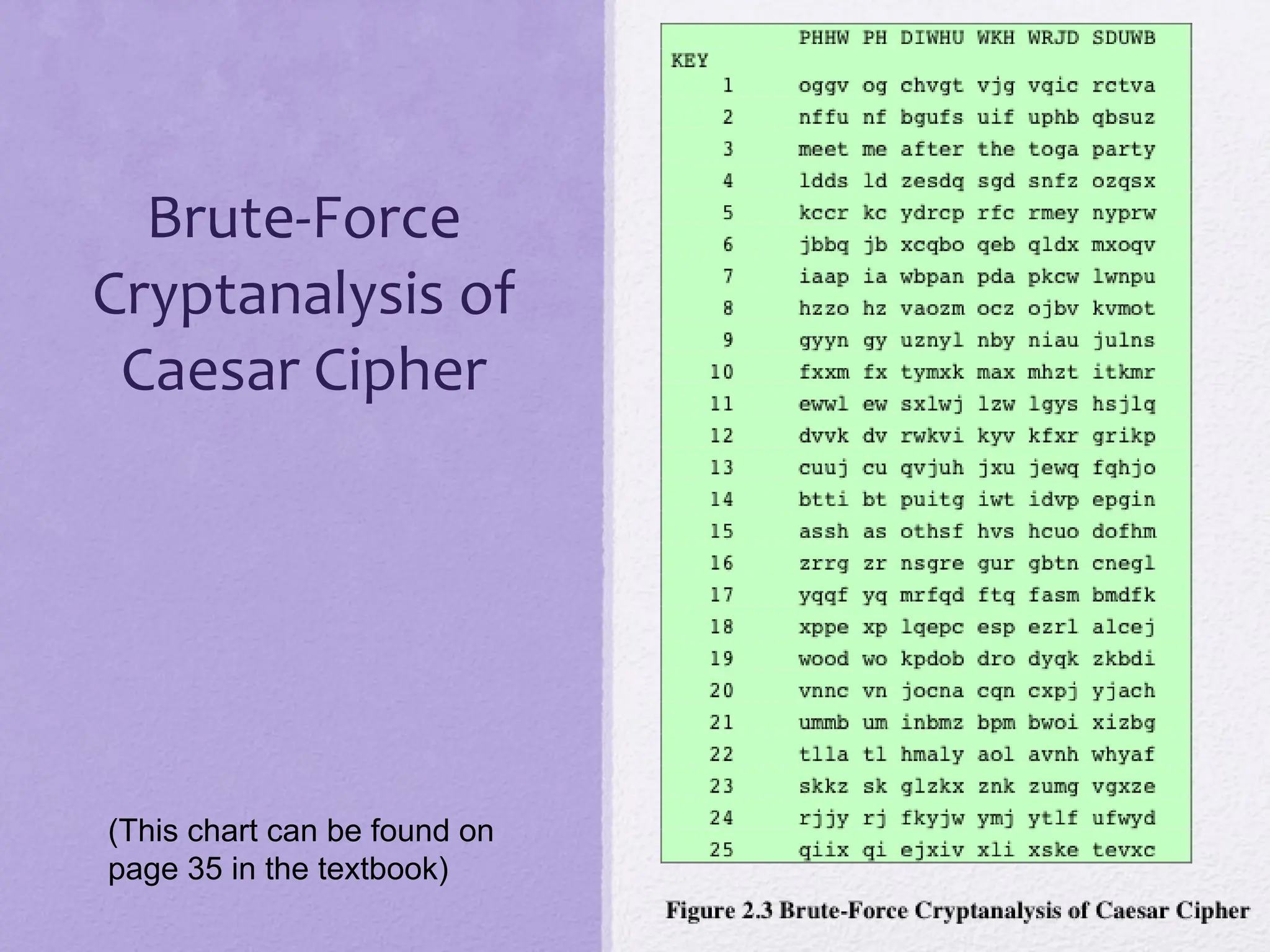
Brute-Force
Cryptanalysis of
Caesar Cipher
(This chart can be found on
page 35 in the textbook)
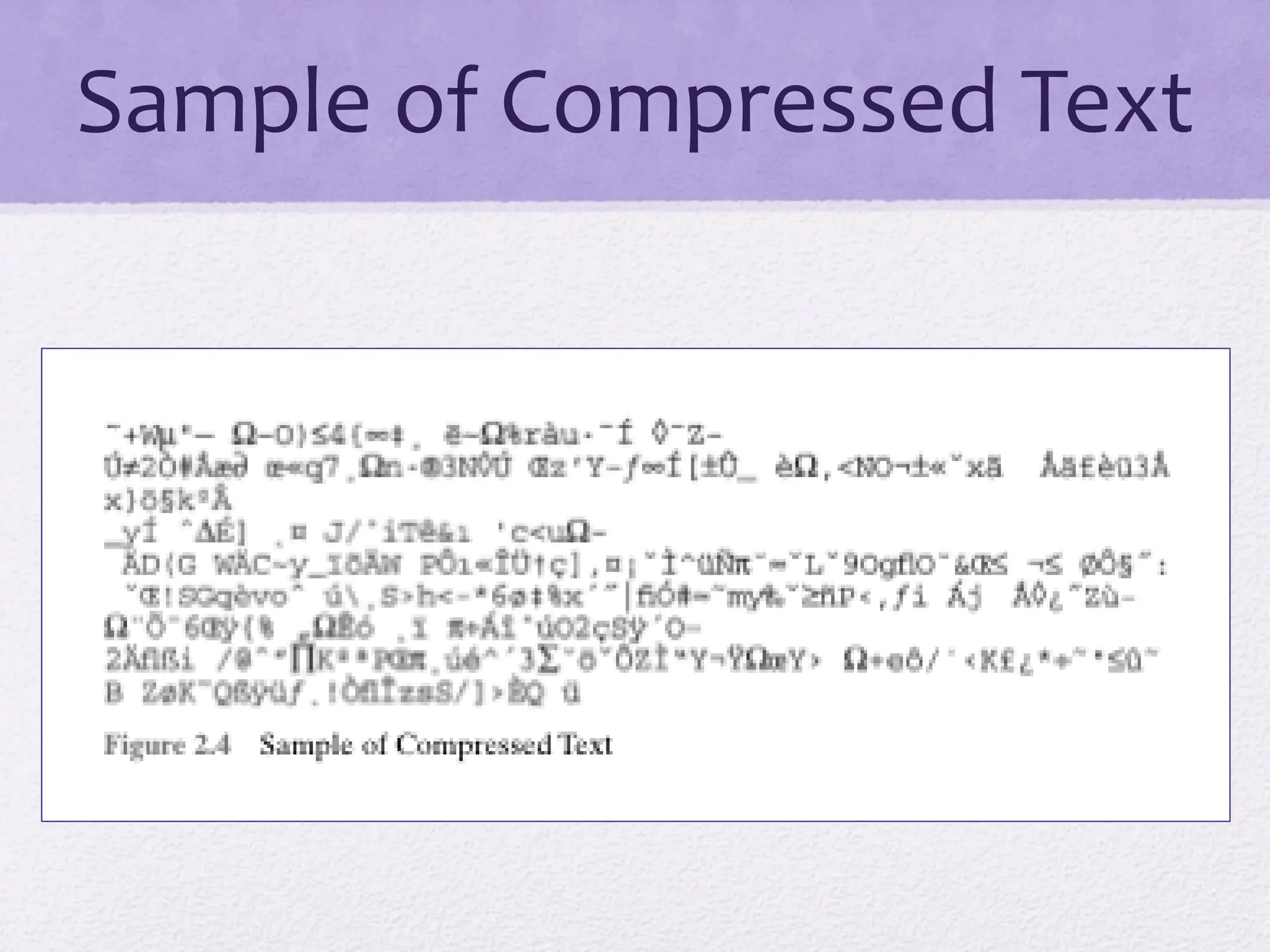
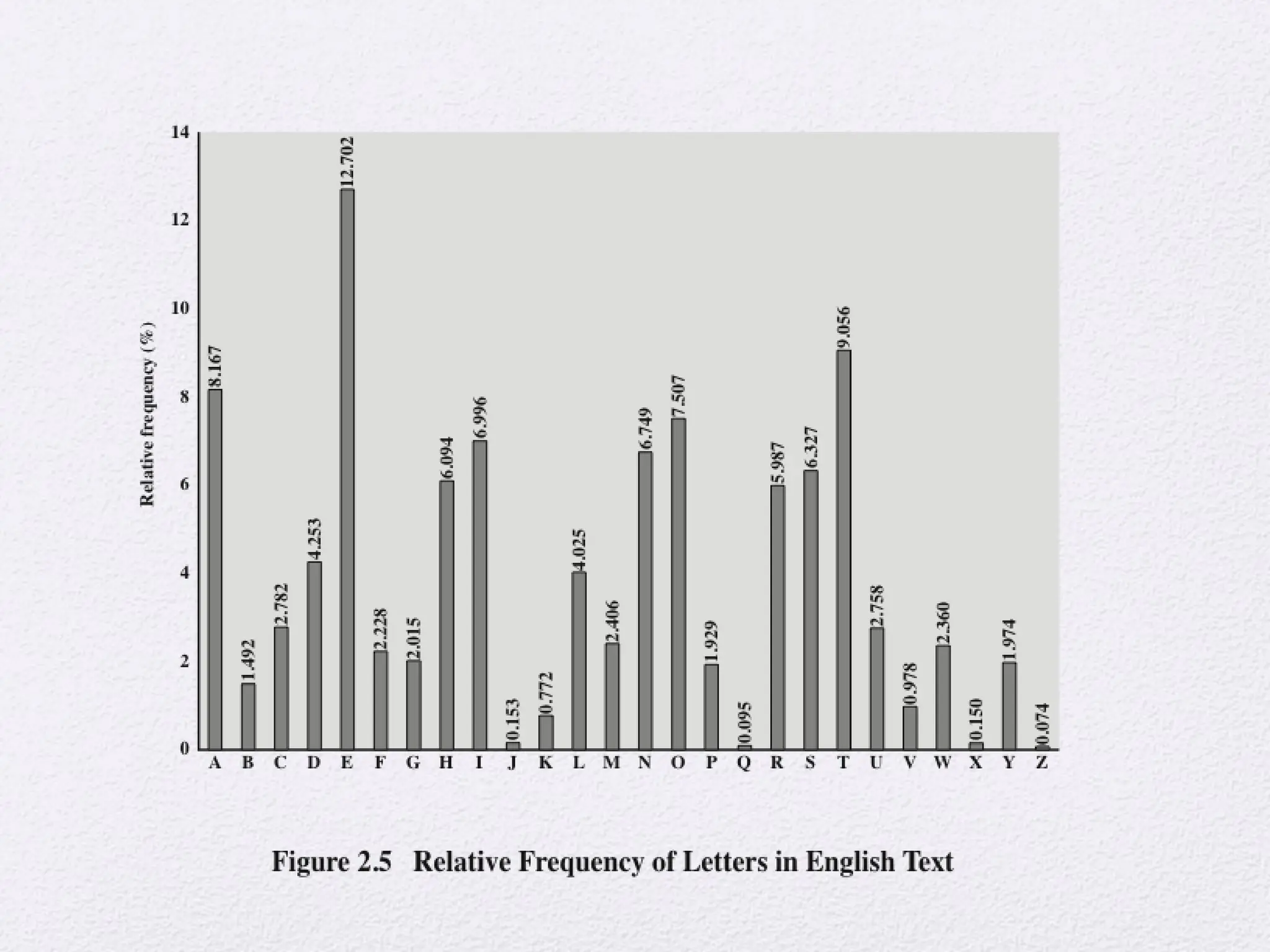
Sample of Compressed Text
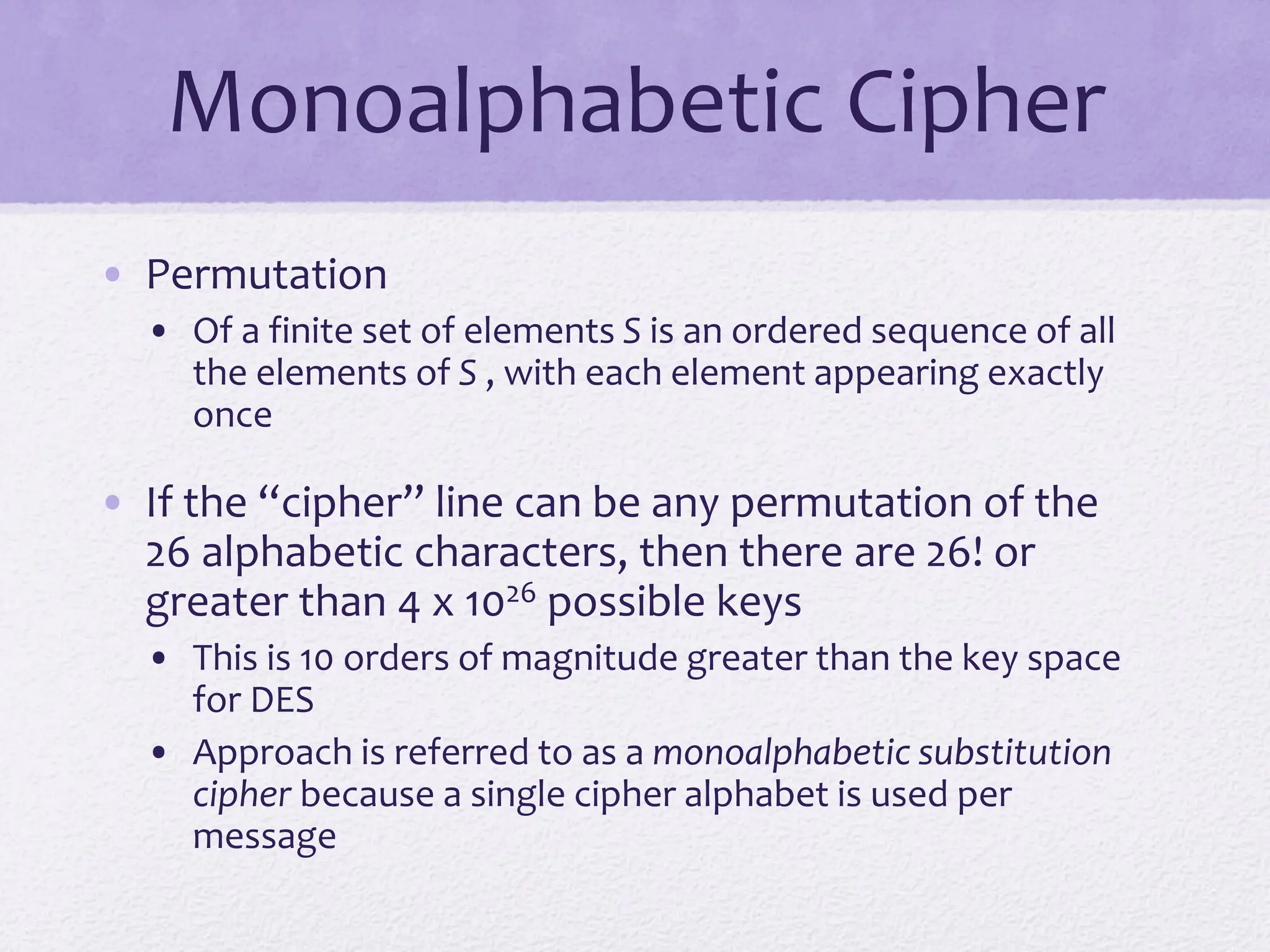
Monoalphabetic Cipher
• Permutation
• Of a finite set of elements S is an ordered sequence of all
the elements of S , with each element appearing exactly
once
• If the “cipher” line can be any permutation of the
26 alphabetic characters, then there are 26! or
greater than 4 x 1026 possible keys
• This is 10 orders of magnitude greater than the key space
for DES
• Approach is referred to as a monoalphabetic substitution
cipher because a single cipher alphabet is used per
message
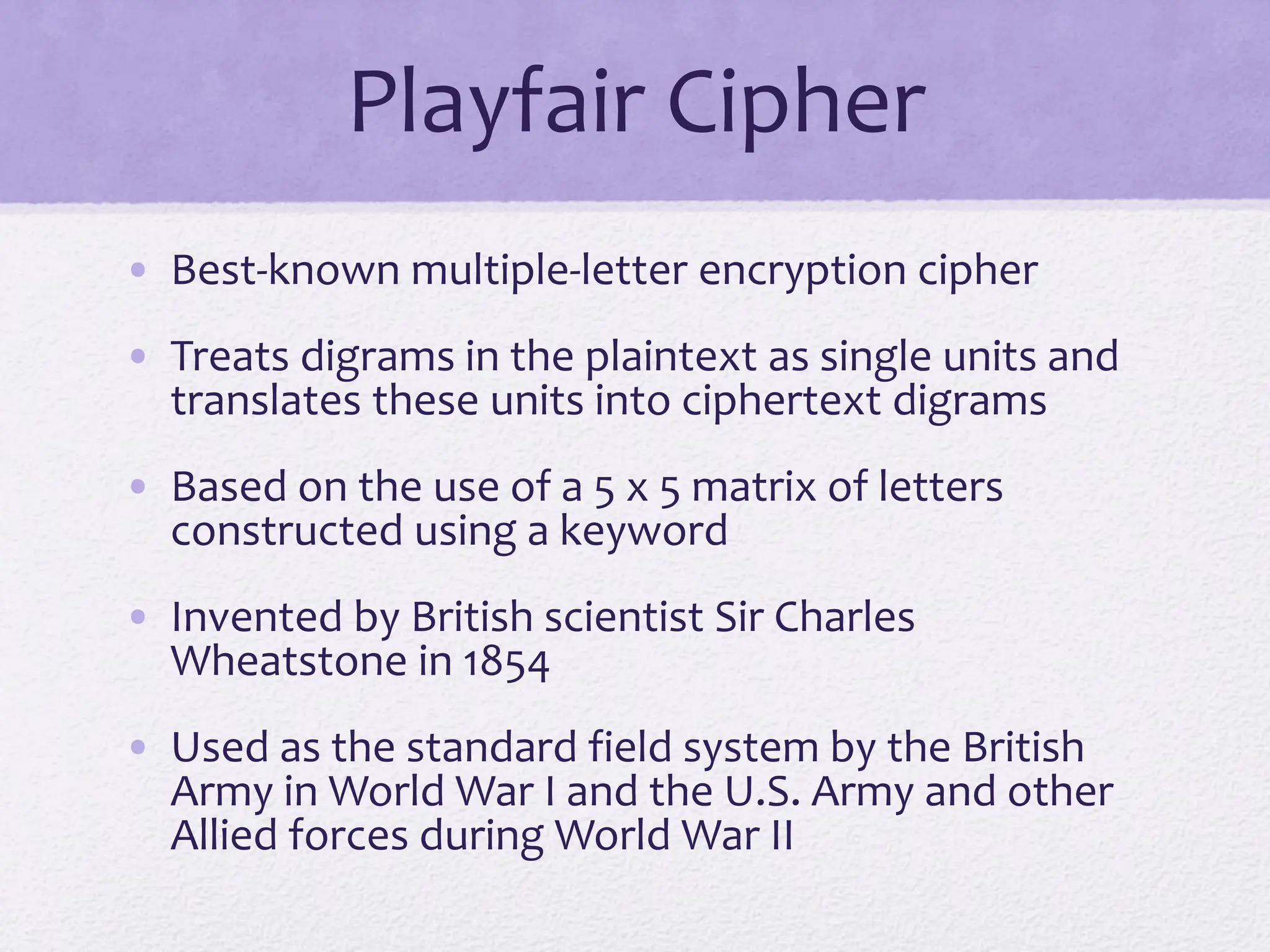
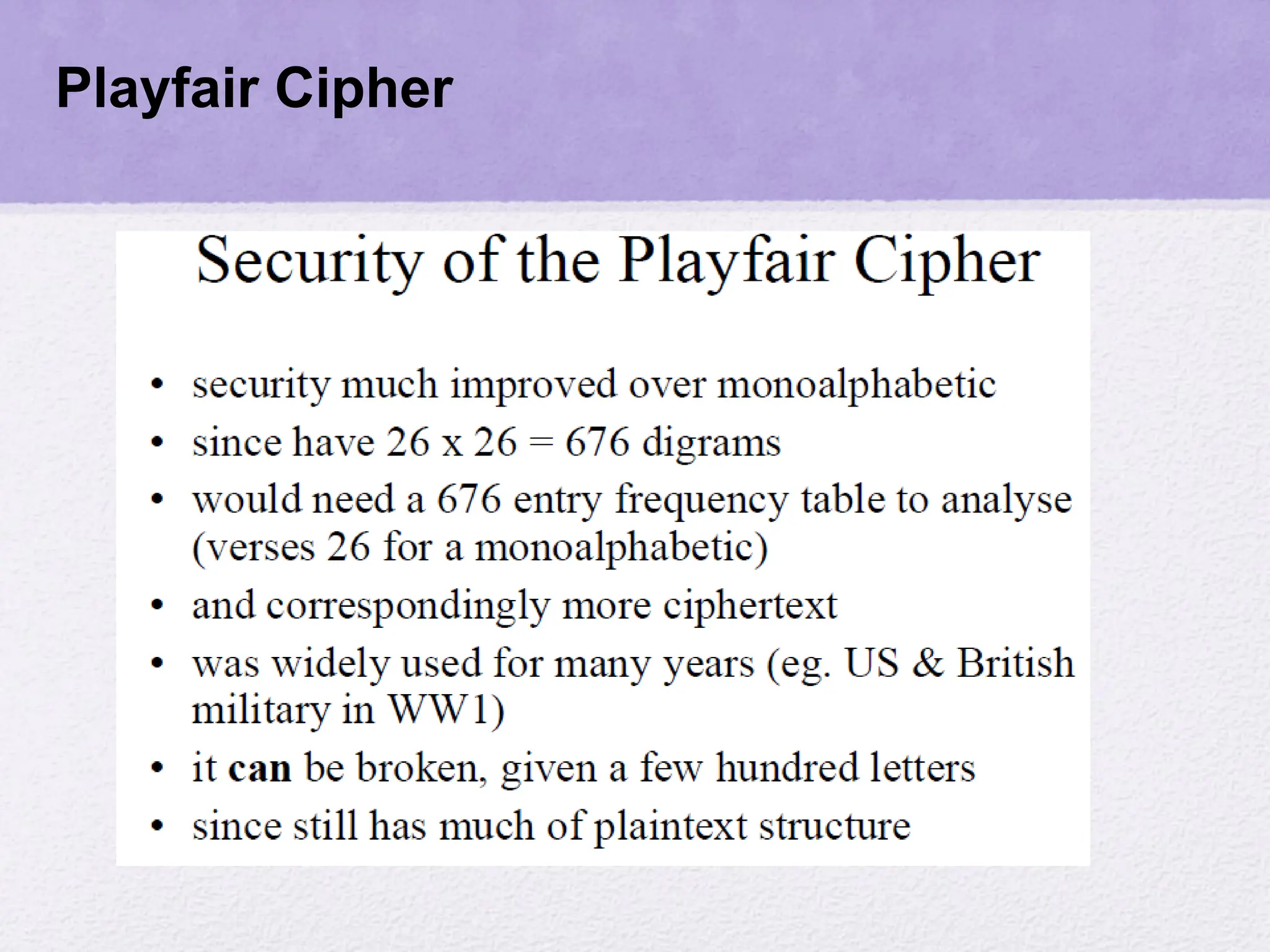
Playfair Cipher
• Best-known multiple-letter encryption cipher
• Treats digrams in the plaintext as single units and
translates these units into ciphertext digrams
• Based on the use of a 5 x 5 matrix of letters
constructed using a keyword
• Invented by British scientist Sir Charles
Wheatstone in 1854
• Used as the standard field system by the British
Army in World War I and the U.S. Army and other
Allied forces during World War II
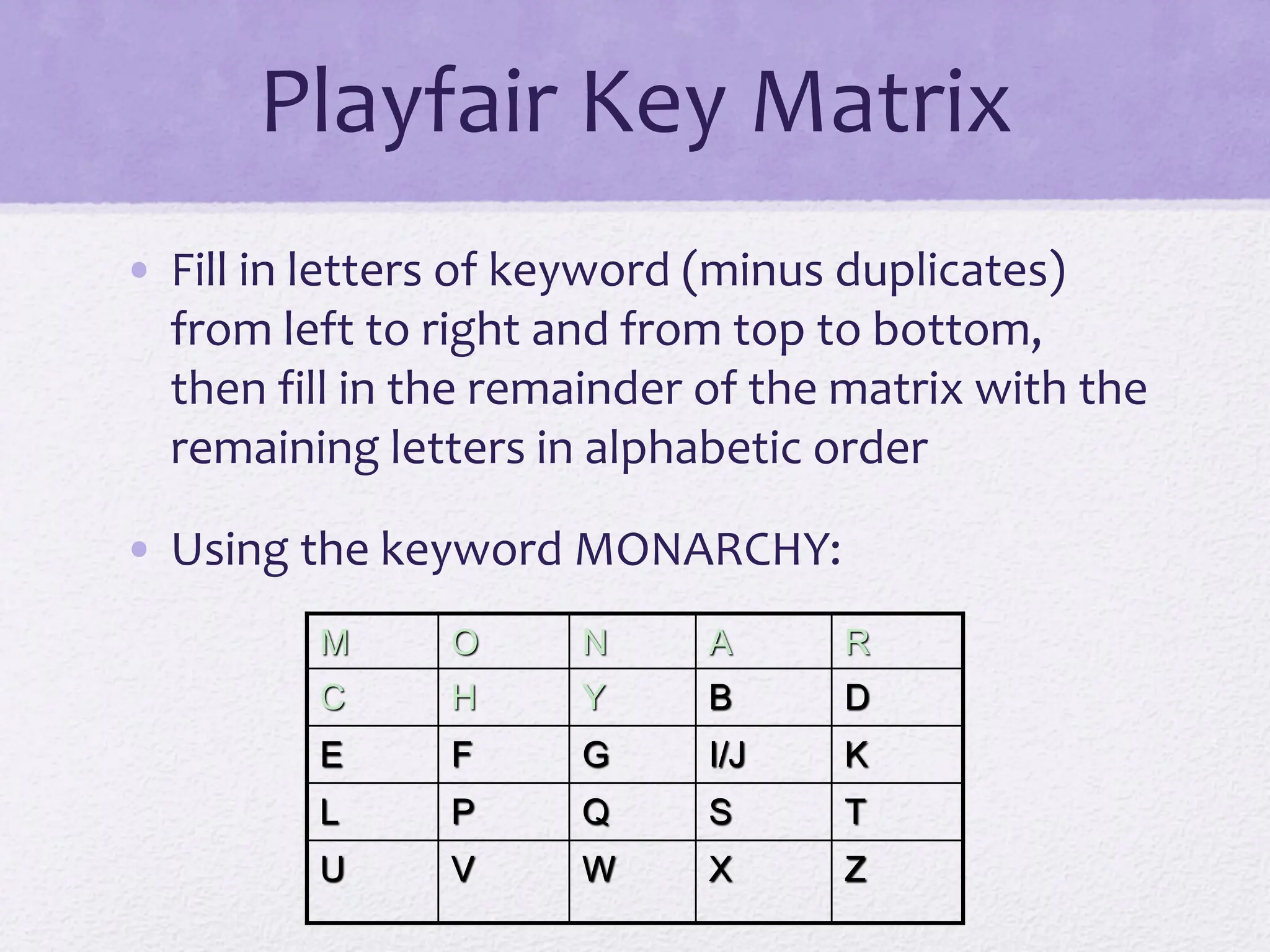
Playfair Key Matrix
• Fill in letters of keyword (minus duplicates)
from left to right and from top to bottom,
then fill in the remainder of the matrix with the
remaining letters in alphabetic order
• Using the keyword MONARCHY:
M O N A R
C H Y B D
E F G I/J K
L P Q S T
U V W X Z
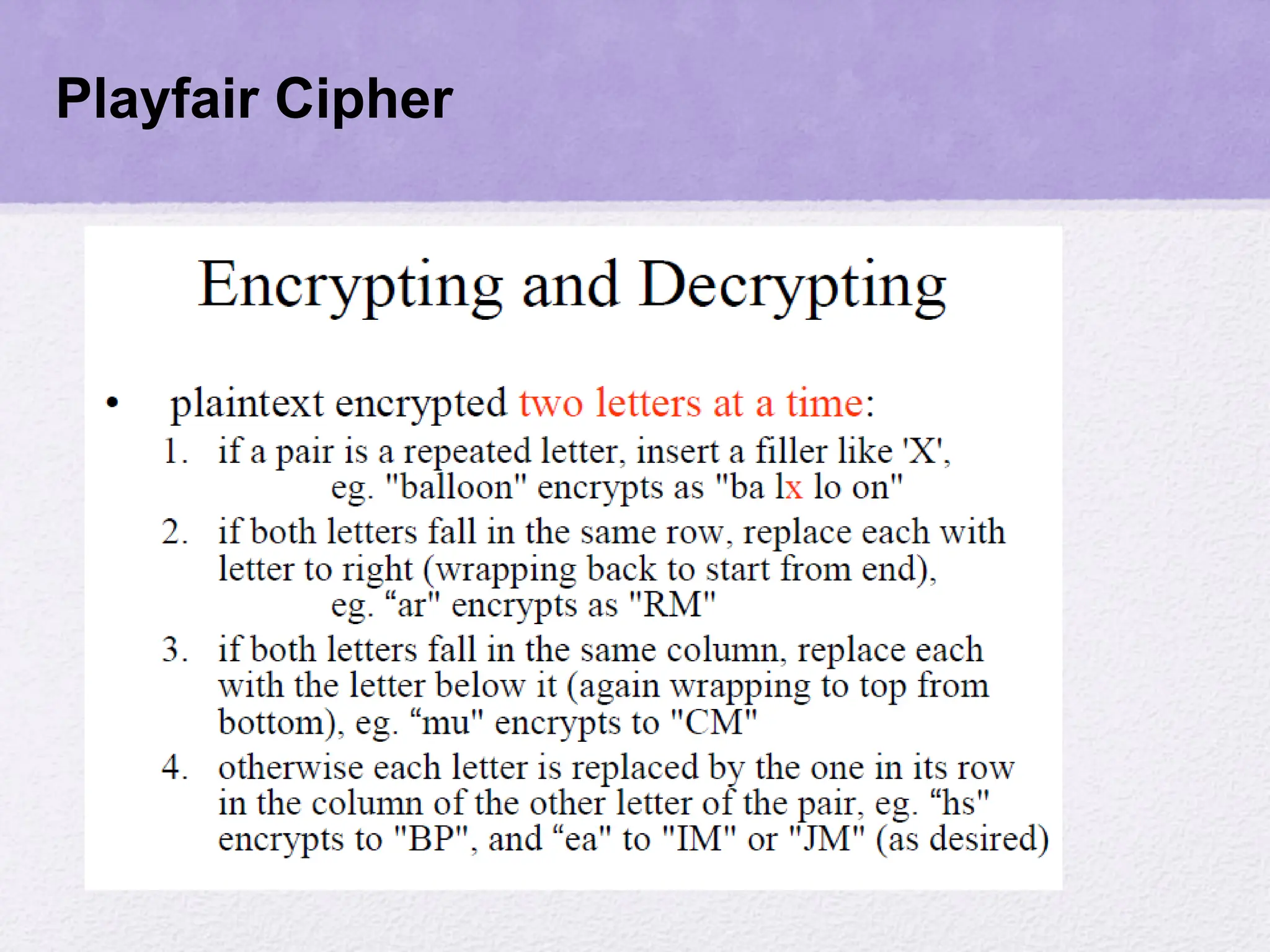
Playfair Cipher
Playfair Cipher
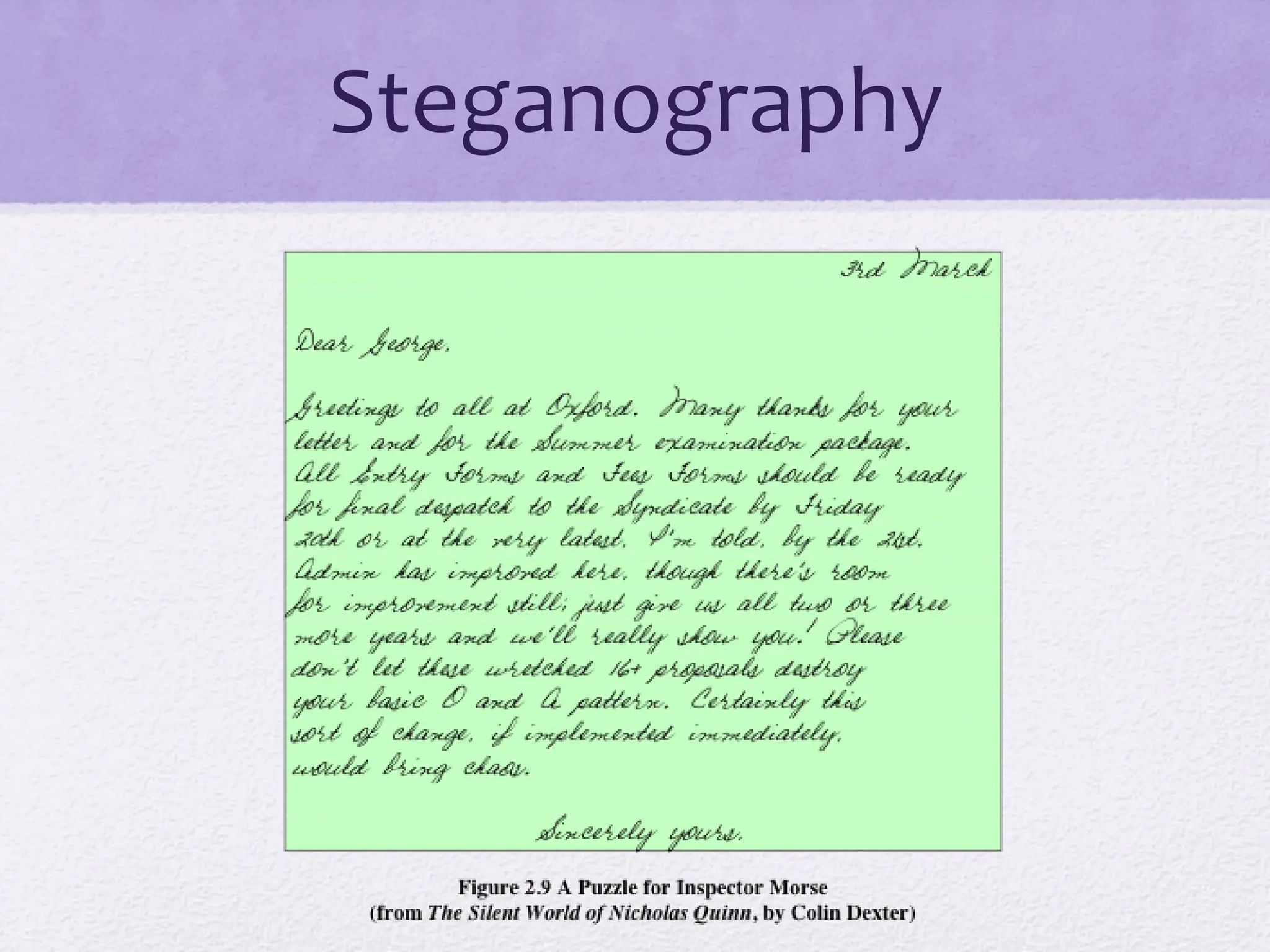
Steganography
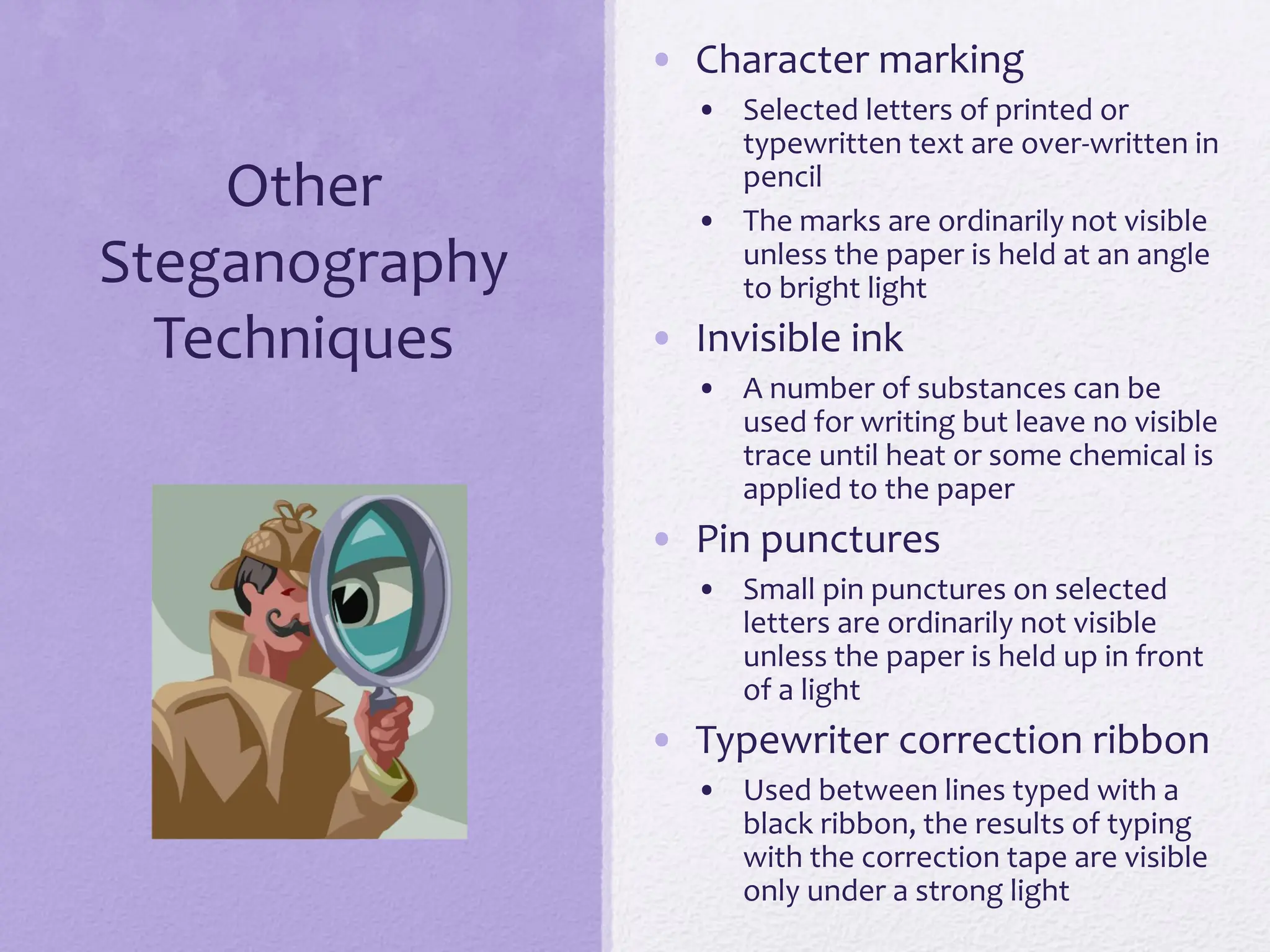
Other
Steganography
Techniques
• Character marking
• Selected letters of printed or
typewritten text are over-written in
pencil
• The marks are ordinarily not visible
unless the paper is held at an angle
to bright light
• Invisible ink
• A number of substances can be
used for writing but leave no visible
trace until heat or some chemical is
applied to the paper
• Pin punctures
• Small pin punctures on selected
letters are ordinarily not visible
unless the paper is held up in front
of a light
• Typewriter correction ribbon
• Used between lines typed with a
black ribbon, the results of typing
with the correction tape are visible
only under a strong light
Summary
• Symmetric Cipher
Model
• Cryptography
• Cryptanalysis and
Brute-Force Attack
• Transposition
techniques
• Rotor machines
• Substitution
techniques
• Caesar cipher
• Monoalphabetic
ciphers
• Playfair cipher
• Hill cipher
• Polyalphabetic ciphers
• One-time pad
• Steganography

algorithms so d6yeudh yedghd eg edej.pdf

  • 1.
    Cryptography and Network Security SixthEdition by William Stallings Instructor: Assoc. Prof.Dr. Sadik Al-Taweel Dr.sadiq@ust.edu Sadiq_altaweel@yahoo.com
  • 2.
  • 3.
    Symmetric Encryption • Alsoreferred to as conventional encryption or single-key encryption • Was the only type of encryption in use prior to the development of public-key encryption in the 1970s • Remains by far the most widely used of the two types of encryption
  • 4.
    Basic Terminology • Plaintext •The original message • Ciphertext • The coded message • Enciphering or encryption • Process of converting from plaintext to ciphertext • Deciphering or decryption • Restoring the plaintext from the ciphertext • Cryptography • Study of encryption • Cryptographic system or cipher • Schemes used for encryption • Cryptanalysis • Techniques used for deciphering a message without any knowledge of the enciphering details • Cryptology • Areas of cryptography and cryptanalysis together
  • 5.
  • 6.
  • 7.
    Cryptographic Systems • Characterizedalong three independent dimensions: The type of operations used for transforming plaintext to ciphertext Substitution Transposition The number of keys used Symmetric, single-key, secret- key, conventional encryption Asymmetric, two- key, or public-key encryption The way in which the plaintext is processed Block cipher Stream cipher
  • 8.
    Cryptanalysis and Brute-Force Attack Cryptanalysis •Attack relies on the nature of the algorithm plus some knowledge of the general characteristics of the plaintext • Attack exploits the characteristics of the algorithm to attempt to deduce a specific plaintext or to deduce the key being used Brute-force attack • Attacker tries every possible key on a piece of ciphertext until an intelligible translation into plaintext is obtained • On average, half of all possible keys must be tried to achieve success
  • 10.
    Brute-Force Attack Involves tryingevery possible key until an intelligible translation of the ciphertext into plaintext is obtained On average, half of all possible keys must be tried to achieve success To supplement the brute-force approach, some degree of knowledge about the expected plaintext is needed, and some means of automatically distinguishing plaintext from garble is also needed
  • 11.
    Substitution Technique • Isone in which the letters of plaintext are replaced by other letters or by numbers or symbols • If the plaintext is viewed as a sequence of bits, then substitution involves replacing plaintext bit patterns with ciphertext bit patterns
  • 12.
    Caesar Cipher • Simplestand earliest known use of a substitution cipher • Used by Julius Caesar • Involves replacing each letter of the alphabet with the letter standing three places further down the alphabet • Alphabet is wrapped around so that the letter following Z is A plain: meet me after the toga party cipher: PHHW PH DIWHU WKH WRJD SDUWB
  • 13.
    Caesar Cipher Algorithm •Can define transformation as: a b c d e f g h i j k l m n o p q r s t u v w x y z D E F G H I J K L M N O P Q R S T U V W X Y Z A B C • Mathematically give each letter a number a b c d e f g h i j k l m n o p q r s t u v w x y z 0 1 2 3 4 5 6 7 8 9 10 11 12 13 14 15 16 17 18 19 20 21 22 23 24 25 • Algorithm can be expressed as: c = E(3, p) = (p + 3) mod (26) • A shift may be of any amount, so that the general Caesar algorithm is: C = E(k , p ) = (p + k ) mod 26 • Where k takes on a value in the range 1 to 25; the decryption algorithm is simply: p = D(k , C ) = (C - k ) mod 26
  • 14.
    Brute-Force Cryptanalysis of Caesar Cipher (Thischart can be found on page 35 in the textbook)
  • 15.
  • 16.
    Monoalphabetic Cipher • Permutation •Of a finite set of elements S is an ordered sequence of all the elements of S , with each element appearing exactly once • If the “cipher” line can be any permutation of the 26 alphabetic characters, then there are 26! or greater than 4 x 1026 possible keys • This is 10 orders of magnitude greater than the key space for DES • Approach is referred to as a monoalphabetic substitution cipher because a single cipher alphabet is used per message
  • 18.
    Playfair Cipher • Best-knownmultiple-letter encryption cipher • Treats digrams in the plaintext as single units and translates these units into ciphertext digrams • Based on the use of a 5 x 5 matrix of letters constructed using a keyword • Invented by British scientist Sir Charles Wheatstone in 1854 • Used as the standard field system by the British Army in World War I and the U.S. Army and other Allied forces during World War II
  • 19.
    Playfair Key Matrix •Fill in letters of keyword (minus duplicates) from left to right and from top to bottom, then fill in the remainder of the matrix with the remaining letters in alphabetic order • Using the keyword MONARCHY: M O N A R C H Y B D E F G I/J K L P Q S T U V W X Z
  • 20.
  • 21.
  • 22.
  • 23.
    Other Steganography Techniques • Character marking •Selected letters of printed or typewritten text are over-written in pencil • The marks are ordinarily not visible unless the paper is held at an angle to bright light • Invisible ink • A number of substances can be used for writing but leave no visible trace until heat or some chemical is applied to the paper • Pin punctures • Small pin punctures on selected letters are ordinarily not visible unless the paper is held up in front of a light • Typewriter correction ribbon • Used between lines typed with a black ribbon, the results of typing with the correction tape are visible only under a strong light
  • 24.
    Summary • Symmetric Cipher Model •Cryptography • Cryptanalysis and Brute-Force Attack • Transposition techniques • Rotor machines • Substitution techniques • Caesar cipher • Monoalphabetic ciphers • Playfair cipher • Hill cipher • Polyalphabetic ciphers • One-time pad • Steganography