Cryptography
S.M. Towhidul Islam
2
Abstract
So before we talk about cryptography, we need to know about data. It’s a
type of storing digital information. When we work with many important
information as data then we need to secure these data. For this we need
digital privacy to prevent unauthorized access. For this cryptography has
the functionality of encrypting data for the authorized user. It’s a very
popular way to send any data securely. The security of sending data is a
big issue nowadays.
3
Introduction
The data security system is all about confidentiality, integrity,
authentication for accessing the important and internal data. The security
reasons are growing day by day for all kind of IT organization. For this
there is a need to save the data. For this we badly need to use
cryptography. Cryptography is a kind of art. The sources of cryptography
were found from Roman and Egyptian Civilization. When the value and
quantity of data increasing, the vulnerability is also increasing at the same
amount. The problems are like unauthorized access, embezzlement,
alteration and destruction.
There are two popular words which are Encryption and Decryption,
hiding data is called encryption and on the other hand when the data
unhidden is called decryption. Here Cipher is used to produce encryption
and decryption. Particularly when a data is covered up is called plaintext,
and after encrypting it is called ciphertext.
To hide any information, two strategies are for the most part utilized one
is Cryptography and Steganography. Here cryptography is a system of
securing information, which gives techniques for changing over
information into scrambled structure, so that valid user can get to the
information. Cryptography is a system of utilizing arithmetic to encrypt
or decrypt data.
4
Terminology of Cryptography
Computers are utilized by huge number of individuals for many reasons.
For example, banking, shopping, military, understudy records and so on.
For this privacy of this individual user is highly needed.
Cryptography is the change of discernible and justifiable information
into a structure which can’t be comprehended so as to verify information.
Cryptography alludes precisely to the philosophy of covering the
substance of message, the word cryptography originates from the Greek
word “Kryptos”, that implies covered up, and “graphikos” which means
composing.
The data that we have to stow away, is called Plaintext, it’s the first
content, it could be in a type of characters, numerical information,
executable projects, pictures, or some other sort of data. The plaintext for
instance is the sending of a message in the sender before encryption, or it
is the content at the collector after decoding.
Cipher is the formula that is utilized to change plaintext to cipher
message, this strategy is called encryption, as such, it’s a component of
changing over intelligible and reasonable information into “nonsensical”
information.
5
Some Types of Cipher
AMSCO (Period times 8-12 lines deep)
AMSCO Encryption comprises recorded as a text in a framework as
indicated by cutting arrangement at that point utilize a permutation key to
switch columns. If there is a key (equivalent to 2,1,3) of length 3, then
/ 1 2 3
D CO D
EA M SC
O
For, the column 2 - COM
The column 1- DEAO
The column 3- DSC
So, the message is- COMDEAODSC
AUTOKEY (40-50 letters)
The autokey principals’ reposes in replacing the key by linking the key
and the message. (key+Message). If the plain text is “meetmeatthecorner”
Then,
plaintext m e e t m e a t t h e c o r n e R
keystream K I N G M E E T M E A T T H E C O
ciphertext W M R Z Y I E M F L E V H Y R G F
So the ciphertext is – “WMRZYIEMFLEVHYRGF”
6
BACONIAN (25-letter plaintext Maximum)
Baconian encryption uses substitution alphabet (based on 2 letter A and
B).
A= AAAAA B= AAAAB
C= AAABA D= AAABB
E= AABAA F= AABAB
G= AABBA H= AABBB
(I=J) = ABAAA K= ABAAB
L= ABABA M= ABABB
N= ABBAA O= ABBAB
P= ABBBA Q= ABBBB
R= BAAAA S= BAAAB
T= BAABA (U=V) = BAABB
W= BABAA X= BABAB
Y= BABBA Z= BABBB
So now if the plain text is DCODE, then-
plaintext D C O D E
ciphertext AAABB AAABA ABBAB AAABB AABAA
So the ciphertext is- “AAABAABBABAAABBAABAA”
BIFID (125-150 letters)
Bifid encryption requires a matrix (or a watchword to create the network)
and (discretionary) a number N which will fill in as a period/square length
(generally take N=1).
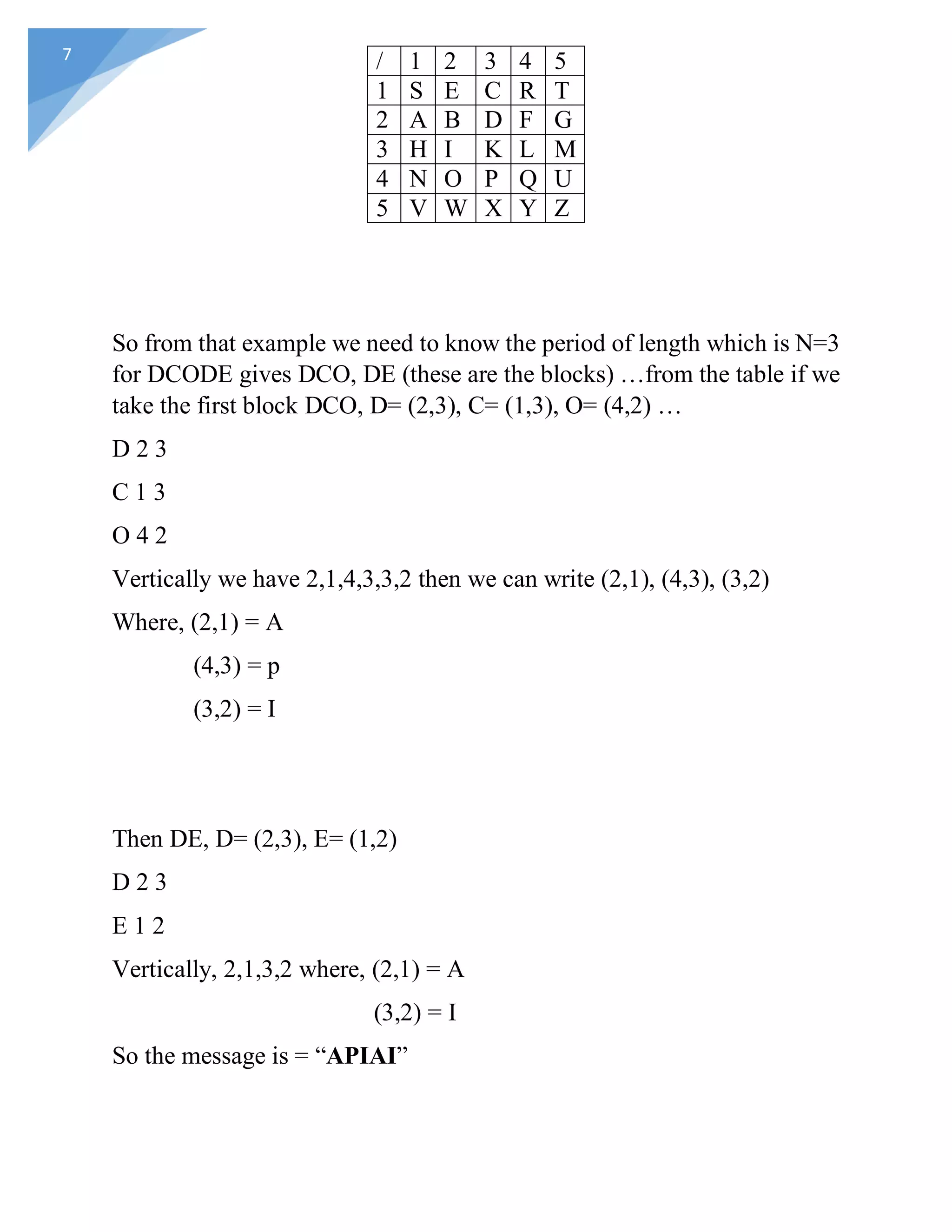
If a plaintext DCODE needs to encrypt with the gird (generated with the
word secret) then,
7
So from that example we need to know the period of length which is N=3
for DCODE gives DCO, DE (these are the blocks) …from the table if we
take the first block DCO, D= (2,3), C= (1,3), O= (4,2) …
D 2 3
C 1 3
O 4 2
Vertically we have 2,1,4,3,3,2 then we can write (2,1), (4,3), (3,2)
Where, (2,1) = A
(4,3) = p
(3,2) = I
Then DE, D= (2,3), E= (1,2)
D 2 3
E 1 2
Vertically, 2,1,3,2 where, (2,1) = A
(3,2) = I
So the message is = “APIAI”
/ 1 2 3 4 5
1 S E C R T
2 A B D F G
3 H I K L M
4 N O P Q U
5 V W X Y Z
8
Cryptography Goals
By utilizing cryptography numerous objectives can be accomplished,
these objectives either all accomplished simultaneously in one
application, or just one of them. The objectives are given below,
Confidentiality
It is the most significant objective, that guarantees that no one can
comprehend the got message with the exception of the person who has the
unravel key.
Authentication
It is the way toward demonstrating the character, that guarantees the
covering substance is the one that it professed to be. This implies the client
or the framework can demonstrate their very own characters to different
gatherings who don’t have individual learning of their personalities.
Integrity
It actually makes sure that the received message is not changed from the
original. And also take care that no unauthorized access has changed the
information.
Non Reputation
It is system used to demonstrate that the sender truly sent this message,
and the message was gotten by the predetermined party, so the beneficiary
can't guarantee that the message was not sent. For instance, when a request
is put electronically, a buyer can't deny the buy request, if non-denial
administration was empowered in this exchange.
Access Control
It is the way toward forestalling an unapproved utilization of information’s.
9
Encryption & Decryption
Encryption
In registering, encryption is the strategy by which plaintext or some other
sort of information is changed over from a decipherable structure to an
encoded rendition that must be decoded by another element in the event
that they approach an unscrambling key. Encryption is one of the most
significant strategies for giving information security, particularly for start
to finish assurance of information transmitted crosswise over systems.
Decryption
Decoding is commonly the switch procedure of encryption. It is the way
toward disentangling the information which has been encoded into a
mystery position. An approved client can just unscramble information
since decoding requires a mystery key or secret word.
10
Simple Encrypt & Decrypt Program in Python
It’s a Simple example,
Output
11
Types of Cryptography
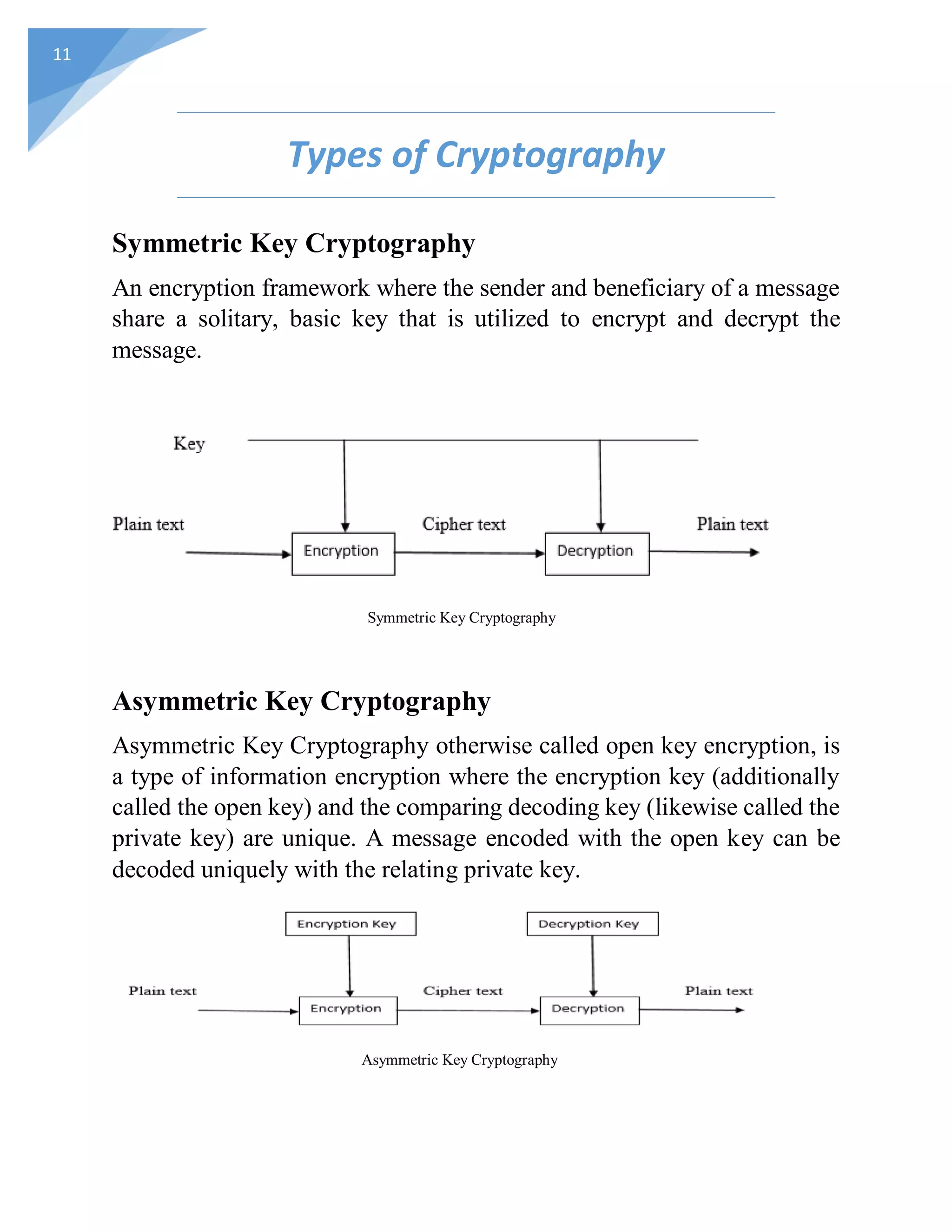
Symmetric Key Cryptography
An encryption framework where the sender and beneficiary of a message
share a solitary, basic key that is utilized to encrypt and decrypt the
message.
Symmetric Key Cryptography
Asymmetric Key Cryptography
Asymmetric Key Cryptography otherwise called open key encryption, is
a type of information encryption where the encryption key (additionally
called the open key) and the comparing decoding key (likewise called the
private key) are unique. A message encoded with the open key can be
decoded uniquely with the relating private key.
Asymmetric Key Cryptography
12
Summary
Cryptography is utilized to guarantee that the substance of a message are
classification transmitted and would not be changed. Secrecy implies no
one can comprehend the got message aside from the one that has the
interpret key, and "information can't be changed" signifies the first data
would not be changed or adjusted.

Cryptography

  • 1.
  • 2.
    2 Abstract So before wetalk about cryptography, we need to know about data. It’s a type of storing digital information. When we work with many important information as data then we need to secure these data. For this we need digital privacy to prevent unauthorized access. For this cryptography has the functionality of encrypting data for the authorized user. It’s a very popular way to send any data securely. The security of sending data is a big issue nowadays.
  • 3.
    3 Introduction The data securitysystem is all about confidentiality, integrity, authentication for accessing the important and internal data. The security reasons are growing day by day for all kind of IT organization. For this there is a need to save the data. For this we badly need to use cryptography. Cryptography is a kind of art. The sources of cryptography were found from Roman and Egyptian Civilization. When the value and quantity of data increasing, the vulnerability is also increasing at the same amount. The problems are like unauthorized access, embezzlement, alteration and destruction. There are two popular words which are Encryption and Decryption, hiding data is called encryption and on the other hand when the data unhidden is called decryption. Here Cipher is used to produce encryption and decryption. Particularly when a data is covered up is called plaintext, and after encrypting it is called ciphertext. To hide any information, two strategies are for the most part utilized one is Cryptography and Steganography. Here cryptography is a system of securing information, which gives techniques for changing over information into scrambled structure, so that valid user can get to the information. Cryptography is a system of utilizing arithmetic to encrypt or decrypt data.
  • 4.
    4 Terminology of Cryptography Computersare utilized by huge number of individuals for many reasons. For example, banking, shopping, military, understudy records and so on. For this privacy of this individual user is highly needed. Cryptography is the change of discernible and justifiable information into a structure which can’t be comprehended so as to verify information. Cryptography alludes precisely to the philosophy of covering the substance of message, the word cryptography originates from the Greek word “Kryptos”, that implies covered up, and “graphikos” which means composing. The data that we have to stow away, is called Plaintext, it’s the first content, it could be in a type of characters, numerical information, executable projects, pictures, or some other sort of data. The plaintext for instance is the sending of a message in the sender before encryption, or it is the content at the collector after decoding. Cipher is the formula that is utilized to change plaintext to cipher message, this strategy is called encryption, as such, it’s a component of changing over intelligible and reasonable information into “nonsensical” information.
  • 5.
    5 Some Types ofCipher AMSCO (Period times 8-12 lines deep) AMSCO Encryption comprises recorded as a text in a framework as indicated by cutting arrangement at that point utilize a permutation key to switch columns. If there is a key (equivalent to 2,1,3) of length 3, then / 1 2 3 D CO D EA M SC O For, the column 2 - COM The column 1- DEAO The column 3- DSC So, the message is- COMDEAODSC AUTOKEY (40-50 letters) The autokey principals’ reposes in replacing the key by linking the key and the message. (key+Message). If the plain text is “meetmeatthecorner” Then, plaintext m e e t m e a t t h e c o r n e R keystream K I N G M E E T M E A T T H E C O ciphertext W M R Z Y I E M F L E V H Y R G F So the ciphertext is – “WMRZYIEMFLEVHYRGF”
  • 6.
    6 BACONIAN (25-letter plaintextMaximum) Baconian encryption uses substitution alphabet (based on 2 letter A and B). A= AAAAA B= AAAAB C= AAABA D= AAABB E= AABAA F= AABAB G= AABBA H= AABBB (I=J) = ABAAA K= ABAAB L= ABABA M= ABABB N= ABBAA O= ABBAB P= ABBBA Q= ABBBB R= BAAAA S= BAAAB T= BAABA (U=V) = BAABB W= BABAA X= BABAB Y= BABBA Z= BABBB So now if the plain text is DCODE, then- plaintext D C O D E ciphertext AAABB AAABA ABBAB AAABB AABAA So the ciphertext is- “AAABAABBABAAABBAABAA” BIFID (125-150 letters) Bifid encryption requires a matrix (or a watchword to create the network) and (discretionary) a number N which will fill in as a period/square length (generally take N=1). If a plaintext DCODE needs to encrypt with the gird (generated with the word secret) then,
  • 7.
    7 So from thatexample we need to know the period of length which is N=3 for DCODE gives DCO, DE (these are the blocks) …from the table if we take the first block DCO, D= (2,3), C= (1,3), O= (4,2) … D 2 3 C 1 3 O 4 2 Vertically we have 2,1,4,3,3,2 then we can write (2,1), (4,3), (3,2) Where, (2,1) = A (4,3) = p (3,2) = I Then DE, D= (2,3), E= (1,2) D 2 3 E 1 2 Vertically, 2,1,3,2 where, (2,1) = A (3,2) = I So the message is = “APIAI” / 1 2 3 4 5 1 S E C R T 2 A B D F G 3 H I K L M 4 N O P Q U 5 V W X Y Z
  • 8.
    8 Cryptography Goals By utilizingcryptography numerous objectives can be accomplished, these objectives either all accomplished simultaneously in one application, or just one of them. The objectives are given below, Confidentiality It is the most significant objective, that guarantees that no one can comprehend the got message with the exception of the person who has the unravel key. Authentication It is the way toward demonstrating the character, that guarantees the covering substance is the one that it professed to be. This implies the client or the framework can demonstrate their very own characters to different gatherings who don’t have individual learning of their personalities. Integrity It actually makes sure that the received message is not changed from the original. And also take care that no unauthorized access has changed the information. Non Reputation It is system used to demonstrate that the sender truly sent this message, and the message was gotten by the predetermined party, so the beneficiary can't guarantee that the message was not sent. For instance, when a request is put electronically, a buyer can't deny the buy request, if non-denial administration was empowered in this exchange. Access Control It is the way toward forestalling an unapproved utilization of information’s.
  • 9.
    9 Encryption & Decryption Encryption Inregistering, encryption is the strategy by which plaintext or some other sort of information is changed over from a decipherable structure to an encoded rendition that must be decoded by another element in the event that they approach an unscrambling key. Encryption is one of the most significant strategies for giving information security, particularly for start to finish assurance of information transmitted crosswise over systems. Decryption Decoding is commonly the switch procedure of encryption. It is the way toward disentangling the information which has been encoded into a mystery position. An approved client can just unscramble information since decoding requires a mystery key or secret word.
  • 10.
    10 Simple Encrypt &Decrypt Program in Python It’s a Simple example, Output
  • 11.
    11 Types of Cryptography SymmetricKey Cryptography An encryption framework where the sender and beneficiary of a message share a solitary, basic key that is utilized to encrypt and decrypt the message. Symmetric Key Cryptography Asymmetric Key Cryptography Asymmetric Key Cryptography otherwise called open key encryption, is a type of information encryption where the encryption key (additionally called the open key) and the comparing decoding key (likewise called the private key) are unique. A message encoded with the open key can be decoded uniquely with the relating private key. Asymmetric Key Cryptography
  • 12.
    12 Summary Cryptography is utilizedto guarantee that the substance of a message are classification transmitted and would not be changed. Secrecy implies no one can comprehend the got message aside from the one that has the interpret key, and "information can't be changed" signifies the first data would not be changed or adjusted.