A
POWER POINT PRESENTATION
ON
PBL TOPIC
STEGANOGRAPHY
Submitted By - Chirag Gupta
Pavan Yadav
Ashish Agarwal
Abstract-
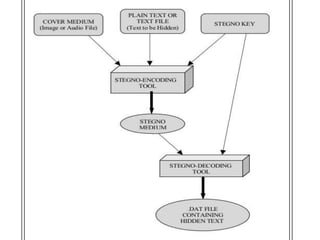
Steganography is the art of hiding the fact that communication is taking
place, by hiding information in other information. Many different carrier
file formats can be used, but digital images are the most popular because
of their frequency on the internet , there exists a large variety of
steganography techniques.Steganography become more important as
more people join the cyberspace revolution. Steganography is the art of
concealing information in ways that prevents the detection of hidden
messages. Stegranography include an array of secret communication
methods that hide the message from being seen or
discovered.Steganography hide the secrete message within the host
data set and presence imperceptible and is to be reliably communicated
to a receiver. The host data set is purposely corrupted, but in a covert
way, designed to be invisible to an information analysis. Information
hiding is an emerging research area, which encompasses applications
such as copyright protection for digital media, watermarking,
fingerprinting, and steganography.
INTRODUCTION
The word steganography if of Greek origin and means "covered, or hidden
writing". Steganography is the art and science of communicating in a way
which hides the existence of the communication.
By contrast, cryptography obscures the meaning of a message, but it does not
conceal the fact that there is a message.
Steganography and cryptography
Cryptography--- the science of writing in secret codes--addresses all of the
elements necessary for secure communication over an insecure channel,
namely privacy, confidentiality, key exchange, authentication, and non-
repudiation.But cryptography does not always provide safe communication.
Consider an environment where the very use of encrypted message cause
suspicion.
The advantage of steganography over cryptography alone in that message do
not attract attention to themselves, to messengers, or to recipients. Whereas the
goaln of cryptography is to make data unreadable by a third party, the goal of
steganography is to hide the data from a third party. Often , steganography and
cryptography are used together to ensure security of the covert message.
 Encryption algorithm: This is the main key to any
cryptographic system. This encryption algorithm
subjects the plain text to various substitutions and
transformations.
 Secret key: The secret key is given by the user which
will act as an input to the encryption algorithm. Based on
this key, various substitutions and transformations on
the plain text will differ.
 Cipher text: This is the output generated by the
encryption algorithm. The cipher text is the jumbled text.
The cipher text differs with each and every secret key
that has given to the encryption algorithm.
 Decryption algorithm: This is opposite to the “encryption
algorithm”. It will acquire cipher text and secret key as
an input and produce plain text as an output.
Start Application
Encyption Decryption
Image file
BMP Image file
Image Message
IMAGE
Message
file
Hiding
Media File
Data File
Encyption
Algorithm
Ecrypted
File
Extraction Data File
Decryption
Algorithm
ENCRYPTION
DECRYPTION
MODULES:-
 1.Encyption:
Hiding Data Into a Image or Audio file using
Encryption Algorithm.
 2.Decryption:
Extracting Data from Encrypted file using Decryption
Algorithm.
 3.Application Design:
Creating a Application which will cover all the
functions of Steganography like Encryption and
Decryption.
MODULE 2 - DECRYPTION
 Decryption - Decryption is the process of taking
encoded or encrypted text or other data and
converting it back into text that you or the computer
can read and understand. This term could be used
to describe a method of un-encrypting the data
manually or with un-encrypting the data using the
proper codes or keys..
 If the data needs to be viewable, it may require
decryption. If a decryption passcode or key is not
available, special software may be needed to
decrypt the data using algorithms to crack the
decryption and make the data readable
HOW DECRYPTION WORKS
 The most successful algorithms use a key. A key is simply a
parameter to the algorithm that allows the encryption and
decryption process to occur.
 There are many modern key-based cryptographic techniques .
These are divided into two classes: symmetric and
asymmetric (also called public/private) key cryptography. In
symmetric key cryptography, the same key is used for both
encryption and decryption..
 Symmetric-key ciphers use the same key, or secret, for
encrypting and decrypting a message or file. The most widely
used symmetric-key cipher is AES, which was created to
protect government classified information. Symmetric-key
encryption is much faster than asymmetric encryption, but the
sender must exchange the key used to encrypt the data with
the recipient before he or she can decrypt it. This requirement
to securely distribute and manage large numbers of keys
means most cryptographic processes use a symmetric
algorithm to efficiently encrypt data, but use an asymmetric
algorithm to exchange the secret key.
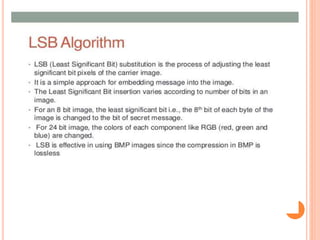
LSB(Least Significant bit) substitition is the process of adjusting the carrier
image into
Decryption Process
Benefits of the Private/Public encryption key
 It does not matter if the public encryption key has been copied by a third party
as it cannot decrypt (open the box) messages
 The receiving party knows that the sender's encrypted message has not been
decrypted and viewed by a third party as that requires the private key of which
the receiver has the only copy
 The sender's encrypted message has not been decrypted, tampered with and
re-encrypted by a third party as that would required both the private and public
keys
Digital Signatures
This is similar to encrypting messages in that there is a private key and a public
key. The sender using their private key to generate a block of characters. The
block of characters depends on the content of the message and the private key.
This means that some unique identification can be obtained from the digital
signature when it is decrypted using the public key. When the digital signature is
verified using the public key it also verifies that the message text was used to
generate the digital signature. This prevents a third party making changes to a
message
SUBMITED BY:- SUBMITED TO:-
ASHISH AGARWAL PROF.SHOLA USHARANI
16MCA1051
MODEL 2
Decryption

Cn ppt

  • 1.
    A POWER POINT PRESENTATION ON PBLTOPIC STEGANOGRAPHY Submitted By - Chirag Gupta Pavan Yadav Ashish Agarwal
  • 2.
    Abstract- Steganography is theart of hiding the fact that communication is taking place, by hiding information in other information. Many different carrier file formats can be used, but digital images are the most popular because of their frequency on the internet , there exists a large variety of steganography techniques.Steganography become more important as more people join the cyberspace revolution. Steganography is the art of concealing information in ways that prevents the detection of hidden messages. Stegranography include an array of secret communication methods that hide the message from being seen or discovered.Steganography hide the secrete message within the host data set and presence imperceptible and is to be reliably communicated to a receiver. The host data set is purposely corrupted, but in a covert way, designed to be invisible to an information analysis. Information hiding is an emerging research area, which encompasses applications such as copyright protection for digital media, watermarking, fingerprinting, and steganography.
  • 3.
    INTRODUCTION The word steganographyif of Greek origin and means "covered, or hidden writing". Steganography is the art and science of communicating in a way which hides the existence of the communication. By contrast, cryptography obscures the meaning of a message, but it does not conceal the fact that there is a message. Steganography and cryptography Cryptography--- the science of writing in secret codes--addresses all of the elements necessary for secure communication over an insecure channel, namely privacy, confidentiality, key exchange, authentication, and non- repudiation.But cryptography does not always provide safe communication. Consider an environment where the very use of encrypted message cause suspicion. The advantage of steganography over cryptography alone in that message do not attract attention to themselves, to messengers, or to recipients. Whereas the goaln of cryptography is to make data unreadable by a third party, the goal of steganography is to hide the data from a third party. Often , steganography and cryptography are used together to ensure security of the covert message.
  • 4.
     Encryption algorithm:This is the main key to any cryptographic system. This encryption algorithm subjects the plain text to various substitutions and transformations.  Secret key: The secret key is given by the user which will act as an input to the encryption algorithm. Based on this key, various substitutions and transformations on the plain text will differ.  Cipher text: This is the output generated by the encryption algorithm. The cipher text is the jumbled text. The cipher text differs with each and every secret key that has given to the encryption algorithm.  Decryption algorithm: This is opposite to the “encryption algorithm”. It will acquire cipher text and secret key as an input and produce plain text as an output.
  • 5.
    Start Application Encyption Decryption Imagefile BMP Image file Image Message IMAGE Message file
  • 7.
  • 8.
  • 9.
  • 10.
    MODULES:-  1.Encyption: Hiding DataInto a Image or Audio file using Encryption Algorithm.  2.Decryption: Extracting Data from Encrypted file using Decryption Algorithm.  3.Application Design: Creating a Application which will cover all the functions of Steganography like Encryption and Decryption.
  • 11.
    MODULE 2 -DECRYPTION  Decryption - Decryption is the process of taking encoded or encrypted text or other data and converting it back into text that you or the computer can read and understand. This term could be used to describe a method of un-encrypting the data manually or with un-encrypting the data using the proper codes or keys..  If the data needs to be viewable, it may require decryption. If a decryption passcode or key is not available, special software may be needed to decrypt the data using algorithms to crack the decryption and make the data readable
  • 12.
    HOW DECRYPTION WORKS The most successful algorithms use a key. A key is simply a parameter to the algorithm that allows the encryption and decryption process to occur.  There are many modern key-based cryptographic techniques . These are divided into two classes: symmetric and asymmetric (also called public/private) key cryptography. In symmetric key cryptography, the same key is used for both encryption and decryption..  Symmetric-key ciphers use the same key, or secret, for encrypting and decrypting a message or file. The most widely used symmetric-key cipher is AES, which was created to protect government classified information. Symmetric-key encryption is much faster than asymmetric encryption, but the sender must exchange the key used to encrypt the data with the recipient before he or she can decrypt it. This requirement to securely distribute and manage large numbers of keys means most cryptographic processes use a symmetric algorithm to efficiently encrypt data, but use an asymmetric algorithm to exchange the secret key.
  • 13.
    LSB(Least Significant bit)substitition is the process of adjusting the carrier image into
  • 15.
  • 16.
    Benefits of thePrivate/Public encryption key  It does not matter if the public encryption key has been copied by a third party as it cannot decrypt (open the box) messages  The receiving party knows that the sender's encrypted message has not been decrypted and viewed by a third party as that requires the private key of which the receiver has the only copy  The sender's encrypted message has not been decrypted, tampered with and re-encrypted by a third party as that would required both the private and public keys Digital Signatures This is similar to encrypting messages in that there is a private key and a public key. The sender using their private key to generate a block of characters. The block of characters depends on the content of the message and the private key. This means that some unique identification can be obtained from the digital signature when it is decrypted using the public key. When the digital signature is verified using the public key it also verifies that the message text was used to generate the digital signature. This prevents a third party making changes to a message
  • 18.
    SUBMITED BY:- SUBMITEDTO:- ASHISH AGARWAL PROF.SHOLA USHARANI 16MCA1051 MODEL 2 Decryption