Rahul.AP , MPT
MANAGEMENT OF PULMONARY
CONDITIONS
BREATHING EXERCISE
 Breathing ex: and ventilatory training are the
fundamental interventions for the prevention for acute
and chronic pulmonary disease mainly for COPD
(chronic bronchitis, emphysema and asthma), patients
with high spinal cord lesion and who underwent thoracic
and abdominal surgery and bedridden patients.
 Studies indicate that breathing exercise and ventilatory
training have affect and alter a patients rate and depth
of ventilation ,so these technique is used to improve the
pulmonary status and increase patients overall
endurance.
GOALS OF BREATHING
EXERCISE
 Improve ventilation
 Increase the effectiveness of cough and promote
airway clearance
 To prevent post operative pulmonary complications
 To improve the strength endurance coordination of the
muscles of ventilation
 Maintain and improve chest and thoracic spine mobility
 Promote relaxation and relive stress
 To teach the patient how to deal with episodes of
dyspnea
 Assisting in removal of secretions.
 Correct abnormal breathing patterns and decrease
the work of breathing.
 Aid in bronchial hygiene---Prevent accumulation of
pulmonary secretions, mobilization of these
secretions, and improve the cough mechanism.
GUIDELINE FOR TEACHING
BREATHING EXERCISES
 Choose a quiet area-to get a proper interaction with
minimal distraction
 Explain the patient about the aim and how it works for
his impairment
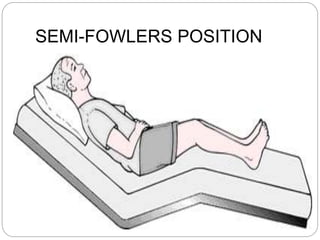
 Have the pat: in relaxed position and loosen the
clothes, make him in semi-fowlers position with head
and trunk elevated approx: 45˚ (total support to the
head and trunk and flexing the hip and knees with
pillow support) the abdominal muscle become relaxed
 Other positions, such as supine, sitting, or standing,
may be used as the patient progresses during
treatment.
SEMI-FOWLERS POSITION
 Observe and access the patients spontaneous breathing
pattern while at rest and during activity
 Determine whether Rx is indicated or not
 If necessary teach the patient relaxation techniques, relax
the muscles of upper thorax neck and shoulder to
minimize the use of accessory muscle work.
 Special attention on sternocleidomastoids,upper
trapezius and levator scapulae
 Demonstrate the breathing pattern to the patient
 Have the patient practice the correct technique in verity of
positions at rest and with activity
PRECUATIONS
 Never allow the patient to force expiration-it may
increase the turbulence in the air way which leads to
bronchospasm and airway resistance
 Avoid prolonged expiration-it cause the patient to gasp
with the next inspiration and the breathing pattern
become irregular and inefficient
 Do not allow the patient to initiate inspiration with
accessory muscles and upper chest ,advise him that
upper chest should be quiet during breathing
 Allow the patient to perform deep breathing only for 3-4
times (inspiration and expirations) to avoid
hyperventilation
INDICATIONS
 Cystic fibrosis
 Bronchiectasis
 Atelectasis
 Lung abscess
 Pneumonias
 Acute lung disease
 COPD –emphysema, chronic bronchitis
 For patients with a high spinal cord lesion/ spinal cord
injury, myopathies etc.
 After surgeries (thoracic or abdominal surgery)
 For patients who must remain in bed for an extended
period of time.(obstruction due to retained secretions)
 As relaxation procedure.
CONTRAINDICATIONS
 Severe pain and discomfort
 Acute medical or surgical emergency
 Patients with reduced conscious level
TYPES OF BREATHING
EXERCISES
 Diaphragmatic breathing
 Glossophryngeal breathing
 Pursed lip breathing
 Segmental breathing(costal expansion exercise)
a) Apical breathing
b) Lateral costal expansion
c) Posterior basal expansion
BREATHING EXERCISE
TECHNIQUES
DIAPHRAGMATIC BREATHING
 Diaphragm is the primary muscle for breathing
(inspiration) diaphragm controls breathing at an
involuntary level ,a patient with primary pulmonary
disease like COPD can be taught breathing control by
optimal use of diaphragm and relaxation of accessory
muscles
 Diaphragmatic breathing ex: are also use to mobilize
lung secretion in PD
PROCEDURE
 Prepare the patient in relaxed and comfortable position
in which the gravity assist the diaphragm such as semi-
fowlers position
 If you notice any accessory muscle activation stop him
and do relaxation techniques (shoulder roll or shrugs
coupled with relaxation)
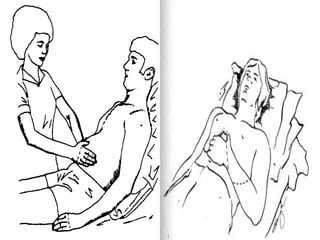
 Place your hands over the rectus abdominis just below
the ant: costal margin ask the patient to breath slowly
and deeply via nose by keeping the shoulder relaxed
and upper chest quiet allowing the abdominal to rise
now ask him to slowly let all the air out using controlled
expiration through mouth.
 Have him to practice this for 2-4 times if he finds any
difficulty in using diaphragm have the patient inhale
several times in succession through the nose by using

sniffing action this facilitates the diaphragm
 For self monitor have the patients hand over the ant:
costal margin and feel the movt: (hand rise and fall) by
placing one hand over abdomen he can also feel the
contraction of abdominal muscles which occurs with
controlled expiration or coughing
 After he understands and able to do the controlled
breathing using a diaphragmatic pattern keep the
shoulder relaxed and practice in verity of positions
(supine sitting standing) and during activity (walking and
climbing stair)
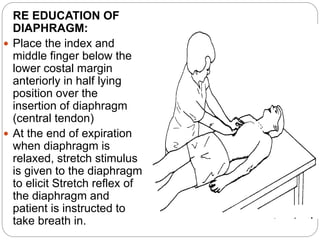
RE EDUCATION OF
DIAPHRAGM:
 Place the index and
middle finger below the
lower costal margin
anteriorly in half lying
position over the
insertion of diaphragm
(central tendon)
 At the end of expiration
when diaphragm is
relaxed, stretch stimulus
is given to the diaphragm
to elicit Stretch reflex of
the diaphragm and
patient is instructed to
take breath in.
Resisted diaphragmatic breathing
 PT use small weight, such as sandbag to strengthen and
improve the endurance of the diaphragm
 Have the patient in a head up position
 Place a small weight (3-5 lb) over the epigastric region of
his abdomen (1.30- 2.20 kg)
 Tell the patient to breath in deeply while trying to keep the
upper chest quiet
 Gradually increase the time that the patient breaths against
the resistance of weight
 Weight can be increased when he can sustain
diaphragmatic breathing pattern with out the use of any
accessory muscles of inspiration for 15minuts
Glossophryngeal breathing
 It is a means of increasing a patients inspiratory
capacity when there is a severe weakness of the
muscle of inspiration
 It is taught to patients who have difficulty in deep
breathing.
 This type of breathing pattern was originally
developed to assist post polio patients with
severe muscle weakness
PROCEDURE
 Patient take several gulp of air by closing the
mouth the tongue pushes the air back and trap it
in the pharynx the air is then forced to lungs when
the glottis is opened
PURSED LIP BREATHING
 Pursed-lip breathing is a strategy that involves lightly
pursing the lips together during controlled exhalation.
 Taught to patients with COPD to deal with episodes of
dyspnea.
 It helps to Improves ventilation and Releases trapped air
in the lungs
 Keeps the airways open longer and Prolong exhalation
slow the breathing rate
 It moves old air out of the lungs and allow new air to
enter the lungs
PROCEDURE
 Patient in a comfortable position and relaxed, explain the
patent about the expiration phase (it should be relaxed and
passive)
 abdominal muscle contraction must be avoided (therapist
hand over the patients abdominal to check for contraction)
 Ask the patient to breathe in slowly and deeply through the
nose and then breathe out gently through lightly pursed lips
(blowing on and bending the flame of a candle )
 By providing slight resistance an increased positive
pressure will generate with in the airway which helps to
keep open small bronchioles that otherwise collapse
 It can be applied as a 3-5 minutes “rescue
exercise” or an Emergency Procedure to
counteract acute exacerbations or dyspnea
(shortage of air or breathlessness) in COPD and
asthma.
SEGMENTAL BREATHING
 It is performed on a segment of lung, or a section of
chest wall that needs increased ventilation or
movement.
 Hypoventilation occur in certain areas of the lungs
because of chest wall fibrosis, pain after surgery,
atelectasis , trauma to chest wall, pneumonia and post
mastectomy scar
 Therefore, it will be important to emphasize expansion of
such areas of the lungs and chest wall
ADVANTAGES OF SEGMENTAL
BREATHING
 Prevent accumulation of pleural fluid and secreations
 Decreases paradoxical breathing
 Decrease panic
 Improve chest mobility
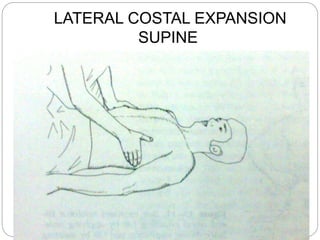
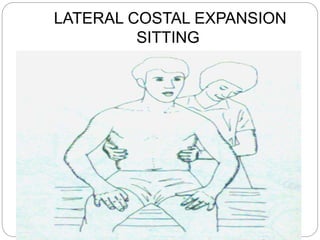
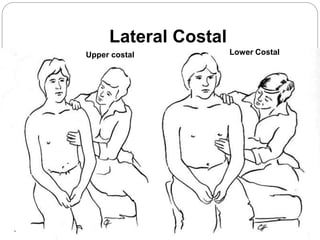
Lateral costal expansion
 This is sometimes called lateral basal expansion and
may be done unilaterally or bilaterally.
 The patient may be sitting or in a hook lying position.
 Place your hands along the lateral aspect of the lower
ribs
 Ask the patient to breathe out, and feel the rib cage
move downward and inward.
 As the patient breathes out, place firm downward
pressure into the ribs with the palms of your hands.
 Just prior to inspiration, apply a quick downward and
inward stretch to the chest. This places a quick stretch
on the external intercostals to facilitate their contraction.
These muscles move the ribs outward and upward
during inspiration.
 Apply light manual resistance to the lower ribs to
increase sensory awareness as the patient breathes in
deeply and the chest expands.
 When the patient breathes out, assist by gently
squeezing the rib cage in a downward and inward
direction.
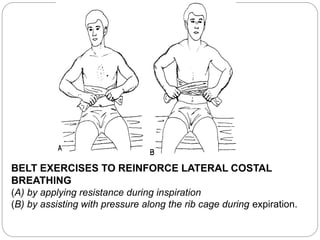
 The patient may then taught to perform the maneuver
independently, ask him to apply resistance with his
hand or with a towel
LATERAL COSTAL EXPANSION
SUPINE
LATERAL COSTAL EXPANSION
SITTING
Lateral Costal
Upper costal Lower Costal
BELT EXERCISES TO REINFORCE LATERAL COSTAL
BREATHING
(A) by applying resistance during inspiration
(B) by assisting with pressure along the rib cage during expiration.
Posterior basal expansion
 This form of segmental breathing is important for the post
surgical patients who is in bed in a semi-reclining position
for an extended period of time
 Secretion often accumulate over the posterior segments
of lower lobes
Procedure
 Have the patient sit and lean forward on a pillow, slightly
bending the hips
 Place the PT hand over the posterior aspect of the lower
rib and do the same procedure in lateral costal expansion
Right middle lobe or lingula expansion
 While the patient in sitting place your hand at either the
right or left side of the patient’s chest just below the
axilla, and follow the same procedure in lateral costal
expansion
FORCED EXPIRATORY
TECHINIQUES
 The FET employs a forced expiration or huff following a
medium size breath to mid lung volume then tighten the
abdominal muscle firmly while huffing (expiring
forcefully with an open glottis) with out contracting the
throat muscles
 There should be a period of 15-30 sec relaxation with
gentle diaphragmatic breathing that follow 1 or 2 huffs
 Once secretions is felt on the upper most airway a huff
or double cough can remove it
Thank you…

Breathing Exercise Rahul AP BPT,MPT (CRD&ICU) LIAHS Kannur

  • 1.
    Rahul.AP , MPT MANAGEMENTOF PULMONARY CONDITIONS
  • 2.
    BREATHING EXERCISE  Breathingex: and ventilatory training are the fundamental interventions for the prevention for acute and chronic pulmonary disease mainly for COPD (chronic bronchitis, emphysema and asthma), patients with high spinal cord lesion and who underwent thoracic and abdominal surgery and bedridden patients.  Studies indicate that breathing exercise and ventilatory training have affect and alter a patients rate and depth of ventilation ,so these technique is used to improve the pulmonary status and increase patients overall endurance.
  • 3.
    GOALS OF BREATHING EXERCISE Improve ventilation  Increase the effectiveness of cough and promote airway clearance  To prevent post operative pulmonary complications  To improve the strength endurance coordination of the muscles of ventilation  Maintain and improve chest and thoracic spine mobility  Promote relaxation and relive stress  To teach the patient how to deal with episodes of dyspnea  Assisting in removal of secretions.
  • 4.
     Correct abnormalbreathing patterns and decrease the work of breathing.  Aid in bronchial hygiene---Prevent accumulation of pulmonary secretions, mobilization of these secretions, and improve the cough mechanism.
  • 5.
    GUIDELINE FOR TEACHING BREATHINGEXERCISES  Choose a quiet area-to get a proper interaction with minimal distraction  Explain the patient about the aim and how it works for his impairment  Have the pat: in relaxed position and loosen the clothes, make him in semi-fowlers position with head and trunk elevated approx: 45˚ (total support to the head and trunk and flexing the hip and knees with pillow support) the abdominal muscle become relaxed  Other positions, such as supine, sitting, or standing, may be used as the patient progresses during treatment.
  • 6.
  • 7.
     Observe andaccess the patients spontaneous breathing pattern while at rest and during activity  Determine whether Rx is indicated or not  If necessary teach the patient relaxation techniques, relax the muscles of upper thorax neck and shoulder to minimize the use of accessory muscle work.  Special attention on sternocleidomastoids,upper trapezius and levator scapulae  Demonstrate the breathing pattern to the patient  Have the patient practice the correct technique in verity of positions at rest and with activity
  • 8.
    PRECUATIONS  Never allowthe patient to force expiration-it may increase the turbulence in the air way which leads to bronchospasm and airway resistance  Avoid prolonged expiration-it cause the patient to gasp with the next inspiration and the breathing pattern become irregular and inefficient  Do not allow the patient to initiate inspiration with accessory muscles and upper chest ,advise him that upper chest should be quiet during breathing  Allow the patient to perform deep breathing only for 3-4 times (inspiration and expirations) to avoid hyperventilation
  • 9.
    INDICATIONS  Cystic fibrosis Bronchiectasis  Atelectasis  Lung abscess  Pneumonias  Acute lung disease  COPD –emphysema, chronic bronchitis  For patients with a high spinal cord lesion/ spinal cord injury, myopathies etc.  After surgeries (thoracic or abdominal surgery)  For patients who must remain in bed for an extended period of time.(obstruction due to retained secretions)  As relaxation procedure.
  • 10.
    CONTRAINDICATIONS  Severe painand discomfort  Acute medical or surgical emergency  Patients with reduced conscious level
  • 11.
    TYPES OF BREATHING EXERCISES Diaphragmatic breathing  Glossophryngeal breathing  Pursed lip breathing  Segmental breathing(costal expansion exercise) a) Apical breathing b) Lateral costal expansion c) Posterior basal expansion
  • 12.
    BREATHING EXERCISE TECHNIQUES DIAPHRAGMATIC BREATHING Diaphragm is the primary muscle for breathing (inspiration) diaphragm controls breathing at an involuntary level ,a patient with primary pulmonary disease like COPD can be taught breathing control by optimal use of diaphragm and relaxation of accessory muscles  Diaphragmatic breathing ex: are also use to mobilize lung secretion in PD
  • 13.
    PROCEDURE  Prepare thepatient in relaxed and comfortable position in which the gravity assist the diaphragm such as semi- fowlers position  If you notice any accessory muscle activation stop him and do relaxation techniques (shoulder roll or shrugs coupled with relaxation)  Place your hands over the rectus abdominis just below the ant: costal margin ask the patient to breath slowly and deeply via nose by keeping the shoulder relaxed and upper chest quiet allowing the abdominal to rise now ask him to slowly let all the air out using controlled expiration through mouth.
  • 14.
     Have himto practice this for 2-4 times if he finds any difficulty in using diaphragm have the patient inhale several times in succession through the nose by using sniffing action this facilitates the diaphragm  For self monitor have the patients hand over the ant: costal margin and feel the movt: (hand rise and fall) by placing one hand over abdomen he can also feel the contraction of abdominal muscles which occurs with controlled expiration or coughing  After he understands and able to do the controlled breathing using a diaphragmatic pattern keep the shoulder relaxed and practice in verity of positions (supine sitting standing) and during activity (walking and climbing stair)
  • 17.
    RE EDUCATION OF DIAPHRAGM: Place the index and middle finger below the lower costal margin anteriorly in half lying position over the insertion of diaphragm (central tendon)  At the end of expiration when diaphragm is relaxed, stretch stimulus is given to the diaphragm to elicit Stretch reflex of the diaphragm and patient is instructed to take breath in.
  • 18.
    Resisted diaphragmatic breathing PT use small weight, such as sandbag to strengthen and improve the endurance of the diaphragm  Have the patient in a head up position  Place a small weight (3-5 lb) over the epigastric region of his abdomen (1.30- 2.20 kg)  Tell the patient to breath in deeply while trying to keep the upper chest quiet  Gradually increase the time that the patient breaths against the resistance of weight  Weight can be increased when he can sustain diaphragmatic breathing pattern with out the use of any accessory muscles of inspiration for 15minuts
  • 19.
    Glossophryngeal breathing  Itis a means of increasing a patients inspiratory capacity when there is a severe weakness of the muscle of inspiration  It is taught to patients who have difficulty in deep breathing.  This type of breathing pattern was originally developed to assist post polio patients with severe muscle weakness
  • 20.
    PROCEDURE  Patient takeseveral gulp of air by closing the mouth the tongue pushes the air back and trap it in the pharynx the air is then forced to lungs when the glottis is opened
  • 21.
    PURSED LIP BREATHING Pursed-lip breathing is a strategy that involves lightly pursing the lips together during controlled exhalation.  Taught to patients with COPD to deal with episodes of dyspnea.  It helps to Improves ventilation and Releases trapped air in the lungs  Keeps the airways open longer and Prolong exhalation slow the breathing rate  It moves old air out of the lungs and allow new air to enter the lungs
  • 22.
    PROCEDURE  Patient ina comfortable position and relaxed, explain the patent about the expiration phase (it should be relaxed and passive)  abdominal muscle contraction must be avoided (therapist hand over the patients abdominal to check for contraction)  Ask the patient to breathe in slowly and deeply through the nose and then breathe out gently through lightly pursed lips (blowing on and bending the flame of a candle )  By providing slight resistance an increased positive pressure will generate with in the airway which helps to keep open small bronchioles that otherwise collapse
  • 23.
     It canbe applied as a 3-5 minutes “rescue exercise” or an Emergency Procedure to counteract acute exacerbations or dyspnea (shortage of air or breathlessness) in COPD and asthma.
  • 24.
    SEGMENTAL BREATHING  Itis performed on a segment of lung, or a section of chest wall that needs increased ventilation or movement.  Hypoventilation occur in certain areas of the lungs because of chest wall fibrosis, pain after surgery, atelectasis , trauma to chest wall, pneumonia and post mastectomy scar  Therefore, it will be important to emphasize expansion of such areas of the lungs and chest wall
  • 25.
    ADVANTAGES OF SEGMENTAL BREATHING Prevent accumulation of pleural fluid and secreations  Decreases paradoxical breathing  Decrease panic  Improve chest mobility
  • 26.
    Lateral costal expansion This is sometimes called lateral basal expansion and may be done unilaterally or bilaterally.  The patient may be sitting or in a hook lying position.  Place your hands along the lateral aspect of the lower ribs  Ask the patient to breathe out, and feel the rib cage move downward and inward.  As the patient breathes out, place firm downward pressure into the ribs with the palms of your hands.  Just prior to inspiration, apply a quick downward and inward stretch to the chest. This places a quick stretch on the external intercostals to facilitate their contraction. These muscles move the ribs outward and upward during inspiration.
  • 27.
     Apply lightmanual resistance to the lower ribs to increase sensory awareness as the patient breathes in deeply and the chest expands.  When the patient breathes out, assist by gently squeezing the rib cage in a downward and inward direction.  The patient may then taught to perform the maneuver independently, ask him to apply resistance with his hand or with a towel
  • 28.
  • 29.
  • 30.
  • 31.
    BELT EXERCISES TOREINFORCE LATERAL COSTAL BREATHING (A) by applying resistance during inspiration (B) by assisting with pressure along the rib cage during expiration.
  • 32.
    Posterior basal expansion This form of segmental breathing is important for the post surgical patients who is in bed in a semi-reclining position for an extended period of time  Secretion often accumulate over the posterior segments of lower lobes Procedure  Have the patient sit and lean forward on a pillow, slightly bending the hips  Place the PT hand over the posterior aspect of the lower rib and do the same procedure in lateral costal expansion
  • 33.
    Right middle lobeor lingula expansion  While the patient in sitting place your hand at either the right or left side of the patient’s chest just below the axilla, and follow the same procedure in lateral costal expansion
  • 34.
    FORCED EXPIRATORY TECHINIQUES  TheFET employs a forced expiration or huff following a medium size breath to mid lung volume then tighten the abdominal muscle firmly while huffing (expiring forcefully with an open glottis) with out contracting the throat muscles  There should be a period of 15-30 sec relaxation with gentle diaphragmatic breathing that follow 1 or 2 huffs  Once secretions is felt on the upper most airway a huff or double cough can remove it
  • 35.