Under the Guidance of:
Dr. B.H Sripathi Rao (Prof & H
Dr.Gunachandra Rai (Prof &
Presented By:
Dr.Niti
Sarawgi
Temporo-mandibularTemporo-mandibular
Joint Reconstruction-Joint Reconstruction-
A ReviewA Review
IntroductionIntroduction
Some indications of TMJ reconstruction are :
1)Developmental disorders
2)Neoplasia of TMJ
3)Arthritic diseases
4)Trauma : Fracture
5)Ankylosis
Anatomy of TMJAnatomy of TMJ
Autogenous GraftsAutogenous Grafts
Sixth or seveth rib resected for the graft
Harvested costochondral graft
Graft placed in the TMJ
Costochondral graft
 Iliac Crest
 An iliac graft is a chondro-osseous graft, consists of a full-thickness piece of the
iliac crest, including the overlying cartilage layer as a cap.
 Fibular
 The fibula is tubular in shape and is densely cortical. It can be easily adapted to
passively fit in the glenoid fossa, and its narrow shape allows an easy fit.
 Sternoclavicular
 The Sternoclavicular joint (SCJ) and TMJ are similar anatomically and
physiologically. The head of the clavicle contains layers of cartilage that are similar
to the mandibular condyle.
 Metatarsal
 The metatarsophalangeal (MTP) joint can provide a good supply
of articular cartilage combined with up to 7 cm of vascularized
bone
 Coronoid
 In 1989, Hong et al. reported the use of coronoid process for
condylar reconstruction.
 Owing to its cotico-cancellous nature it is stiffer than CCG, so it
can resist heavier forces, and facilitate the use of rigid internal
fixation.
 Posterior border of ramus
 In 1986, Loftus et al. reconstructed the condyle by superior
repositioning of the pedicled stump of the proximal condylar
segment into the condylar fossa as a local osseous pedicled graft.
 It was based on the lateral pterygoid muscle in a case of
osteochondroma
 Now its use is limited to ankylosis cases.
Autogenous GraftsAutogenous Grafts
Advantages Limitations
Costochondral • Has a cartilage cap,
mimicking both the bone and
cartilaginous components
• Has intrinsic growth potential
• Easy accessibility and
adaptation,
• Gross anatomical similarity to
the mandibular condyle
• Unpredictable growth.
• Poor bone quality
• Possible separation of
cartilage from bone
• Possible donor-site
complications like
pleural tear,
pneumothorax
Sternoclavicular • Similar anatomical and
physiological characteristics
• Consists of a cartilaginous cap
• Has the potential for growth,
• Probability of
regeneration at donor site
• Unacceptable location
of surgical scar
• Donorsite
complications- Clavicle
fracture
Autogenous GraftsAutogenous Grafts
Advantages limitations
Fibular • Tubular in shape and
densely cortical
• Vascularized graft has
better survival rate
• Lacks articular cartilage,
• Donor-site complications like
ankle stiffness,instability and
weakness; numbness of the
lateral side of the leg;
Iliac Crest • Has a cartilage cap,
mimicking both the bone
and cartilaginous components
• Has potential for growth.
• Donor-site complications like
altered gait, poor scar/bone
contour, herniation of
abdominal contents.
Metatarsophalangea
l
• Combination of articular
cartilage and bone
• Fitting anatomy because of
small size
• Has potential for growth
• Donor-site complications like
aesthetic loss of a toe MTP joint
being a simple hinge joint does
not follow the same movements
as the TMJ.
Autogenous GraftsAutogenous Grafts
Advantages Limitations
Coronoid • Avoidance of a secondary
surgical site and associated
donor complications,
• Longstanding cases usually
have elongated and sturdy
coronoid
• Ankylosed segment also involves
the coronoid process, then not
possible to use,
• Relatively pointed architecture
• No long-term studies
Posterior border
of ramus
• Bone of a size and shape
adequate for new Condyle
with similar histological
characteristics
• Damage to the contour of the
mandibular angle
• Lack of growth,
• Two extra-oral incisions
• Lack of long-term studies
Alloplastic DevicesAlloplastic Devices
forfor
TMJ ReconstructionTMJ Reconstruction
Alloplastic GraftAlloplastic Graft
MaterialsMaterials
Kent-VitekKent-Vitek
ProsthesisProsthesis
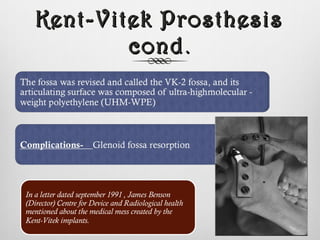
Kent-Vitek ProsthesisKent-Vitek Prosthesis
condcond..
Christensen’sChristensen’s
ProsthesisProsthesis
Patient-Specific all metal TJR mounted on a
model
.
Surgical placement of a customised TMJ TJR
Fossa and ramal components screw fixated
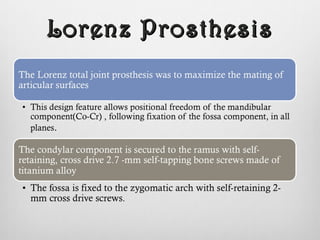
Lorenz ProsthesisLorenz Prosthesis
Lorenz Prosthesis
Lorenz Prosthesis
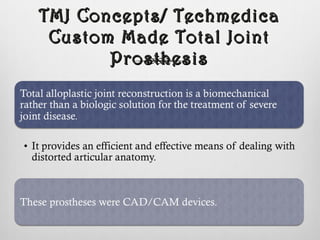
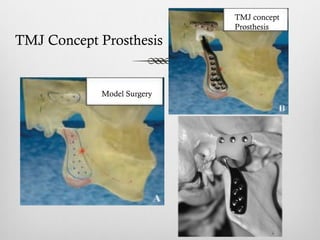
TMJ Concepts/ TechmedicaTMJ Concepts/ Techmedica
Custom Made Total JointCustom Made Total Joint
ProsthesisProsthesis
Model Surgery
TMJ concept
Prosthesis
TMJ Concept Prosthesis
Alloplastic Grafts condAlloplastic Grafts cond ..
DistractionDistraction
OsteogenesisOsteogenesis
 In 1997, Stucki-Mccormick was the first to apply transport distraction
osteogenesis (DO) for TMJ reconstruction
 The authors further observed, in the post-distraction MRI scans, an
intervening fibrous tissue layer which apparently performed as a
pseudo disc.
 Gap arthroplasty and bidirectional transport distraction of the
mandibular ramus is a good and effective therapeutic option in the
treatment of ankylosis and especially unilateral TMJ ankylosis
A reverse L corticotomy is made in the lateral
cortex with the vertical aspect extending from the
sigmoid notch to approximately 10 mm
from the angle.
The horizontal corticotomy extends to the posterior
border of the mandible
Distractor
Distraction Osteogenesis
Distraction OsteogenesisDistraction Osteogenesis
condcond..
 The forces produced by the distractor on the mandible are similar to
physiological forces during mandibular development.
 Distraction seems to have beneficial effects not only on the harmony
of the craniofacial complex but also on temporo-mandibular
articulation.
 By reestablishing correct function of the soft and skeletal tissues, it is
possible to regain the normal potential growth of the mandible .
Distraction OsteogenesisDistraction Osteogenesis
condcond
Tissue EngineeringTissue Engineering
 The principal elements of tissue engineering are the creation of a scaffold into
which cells are seeded.
 Then the applied biochemical or biomechanical stimulus to make the cells
grow and secrete substances that eventually produce the desired tissue that
can be used to replace diseased or missing tissue in humans.
DiscussionDiscussion
Discussion cond.Discussion cond.
ConclusionConclusion
Tmj reconstruction

Tmj reconstruction

  • 1.
    Under the Guidanceof: Dr. B.H Sripathi Rao (Prof & H Dr.Gunachandra Rai (Prof & Presented By: Dr.Niti Sarawgi
  • 2.
  • 3.
    IntroductionIntroduction Some indications ofTMJ reconstruction are : 1)Developmental disorders 2)Neoplasia of TMJ 3)Arthritic diseases 4)Trauma : Fracture 5)Ankylosis
  • 4.
  • 5.
  • 6.
    Sixth or sevethrib resected for the graft Harvested costochondral graft Graft placed in the TMJ Costochondral graft
  • 7.
     Iliac Crest An iliac graft is a chondro-osseous graft, consists of a full-thickness piece of the iliac crest, including the overlying cartilage layer as a cap.  Fibular  The fibula is tubular in shape and is densely cortical. It can be easily adapted to passively fit in the glenoid fossa, and its narrow shape allows an easy fit.  Sternoclavicular  The Sternoclavicular joint (SCJ) and TMJ are similar anatomically and physiologically. The head of the clavicle contains layers of cartilage that are similar to the mandibular condyle.
  • 8.
     Metatarsal  Themetatarsophalangeal (MTP) joint can provide a good supply of articular cartilage combined with up to 7 cm of vascularized bone  Coronoid  In 1989, Hong et al. reported the use of coronoid process for condylar reconstruction.  Owing to its cotico-cancellous nature it is stiffer than CCG, so it can resist heavier forces, and facilitate the use of rigid internal fixation.
  • 9.
     Posterior borderof ramus  In 1986, Loftus et al. reconstructed the condyle by superior repositioning of the pedicled stump of the proximal condylar segment into the condylar fossa as a local osseous pedicled graft.  It was based on the lateral pterygoid muscle in a case of osteochondroma  Now its use is limited to ankylosis cases.
  • 10.
    Autogenous GraftsAutogenous Grafts AdvantagesLimitations Costochondral • Has a cartilage cap, mimicking both the bone and cartilaginous components • Has intrinsic growth potential • Easy accessibility and adaptation, • Gross anatomical similarity to the mandibular condyle • Unpredictable growth. • Poor bone quality • Possible separation of cartilage from bone • Possible donor-site complications like pleural tear, pneumothorax Sternoclavicular • Similar anatomical and physiological characteristics • Consists of a cartilaginous cap • Has the potential for growth, • Probability of regeneration at donor site • Unacceptable location of surgical scar • Donorsite complications- Clavicle fracture
  • 11.
    Autogenous GraftsAutogenous Grafts Advantageslimitations Fibular • Tubular in shape and densely cortical • Vascularized graft has better survival rate • Lacks articular cartilage, • Donor-site complications like ankle stiffness,instability and weakness; numbness of the lateral side of the leg; Iliac Crest • Has a cartilage cap, mimicking both the bone and cartilaginous components • Has potential for growth. • Donor-site complications like altered gait, poor scar/bone contour, herniation of abdominal contents. Metatarsophalangea l • Combination of articular cartilage and bone • Fitting anatomy because of small size • Has potential for growth • Donor-site complications like aesthetic loss of a toe MTP joint being a simple hinge joint does not follow the same movements as the TMJ.
  • 12.
    Autogenous GraftsAutogenous Grafts AdvantagesLimitations Coronoid • Avoidance of a secondary surgical site and associated donor complications, • Longstanding cases usually have elongated and sturdy coronoid • Ankylosed segment also involves the coronoid process, then not possible to use, • Relatively pointed architecture • No long-term studies Posterior border of ramus • Bone of a size and shape adequate for new Condyle with similar histological characteristics • Damage to the contour of the mandibular angle • Lack of growth, • Two extra-oral incisions • Lack of long-term studies
  • 13.
    Alloplastic DevicesAlloplastic Devices forfor TMJReconstructionTMJ Reconstruction
  • 14.
  • 15.
  • 16.
  • 17.
  • 18.
    Patient-Specific all metalTJR mounted on a model . Surgical placement of a customised TMJ TJR Fossa and ramal components screw fixated
  • 19.
  • 20.
  • 21.
    TMJ Concepts/ TechmedicaTMJConcepts/ Techmedica Custom Made Total JointCustom Made Total Joint ProsthesisProsthesis
  • 22.
  • 23.
  • 24.
    DistractionDistraction OsteogenesisOsteogenesis  In 1997,Stucki-Mccormick was the first to apply transport distraction osteogenesis (DO) for TMJ reconstruction  The authors further observed, in the post-distraction MRI scans, an intervening fibrous tissue layer which apparently performed as a pseudo disc.  Gap arthroplasty and bidirectional transport distraction of the mandibular ramus is a good and effective therapeutic option in the treatment of ankylosis and especially unilateral TMJ ankylosis
  • 25.
    A reverse Lcorticotomy is made in the lateral cortex with the vertical aspect extending from the sigmoid notch to approximately 10 mm from the angle. The horizontal corticotomy extends to the posterior border of the mandible Distractor Distraction Osteogenesis
  • 26.
    Distraction OsteogenesisDistraction Osteogenesis condcond.. The forces produced by the distractor on the mandible are similar to physiological forces during mandibular development.  Distraction seems to have beneficial effects not only on the harmony of the craniofacial complex but also on temporo-mandibular articulation.  By reestablishing correct function of the soft and skeletal tissues, it is possible to regain the normal potential growth of the mandible .
  • 27.
  • 28.
    Tissue EngineeringTissue Engineering The principal elements of tissue engineering are the creation of a scaffold into which cells are seeded.  Then the applied biochemical or biomechanical stimulus to make the cells grow and secrete substances that eventually produce the desired tissue that can be used to replace diseased or missing tissue in humans.
  • 29.
  • 30.
  • 31.

Editor's Notes

  • #4 TMJ is the most active ball and socket joint used in about 2000 hinge and sliding motions per day such as talking swallowing kissing etc . TMJ reconstruction is required during end-stage joint disease that is when a joint is so negatively affected architecturally by disease or trauma that causes severe physical impairment . The goals of TMJ reconstruction include improvement of mandibular function and form , reduction of further suffering and disability and prevention of further morbidity .
  • #6 The current technique for TMJ replacement with the CCG was popularized by Poswillo (2–3 mm) CCG is biologically compatible like any autogenous graft, easily workable especially when contouring the cartilaginous part to fit into the glenoid fossa, and takes less time to heal and becomes incorporated into the new environment allowing restoration of the bone and cartilage components CCG also has the capacity for remoulding into an adaptive mandibular condyle, and there is always a potential at the donor site to grow and regenerate. An additional advantage in children is its growth potential. One of the main disputes is the lack of predictable growth .Reankylosis in the range 5–39% has been reported. Other disadvantages of the CCG are the poor quality of medullary and cortical bone, the possibility of resorption or infection,bone flexibility, elasticity that may cause the graft to be deformed and to produce occlusal changes with time, and the possible separation of the cartilage from the bone. Donor-site complications such as pleural tear,pneumothorax, pleural effusion and atelectasis;empyema; pneumonia and occasional fractures have also been reported Recently authors have recommended using thinner sections of cartilage due to the potential for overgrowth.
  • #11 :, pleural effusion, atelectasis, empyema damage to the great vessels, instability of the clavicle under stress with resulting shoulder instability
  • #12 : great toe flexion contractures and valgus deformity, pedal ischaemia and foot oedema altered gait, poor scar/bone contour, herniation of abdominal aesthetic loss of a toe MTP joint being a simple hinge joint does not follow the same movements as the TMJ II. Grafts derived from the vicinity contents, ilium fracture, peritonitis, and retroperitoneal haematoma
  • #16 This Proplast layer originally came in thicknesses of 2.5 and 4.5 mm. The inner layer of the prosthesis could be contoured to fit against the base of the skull. The flange of the prosthesis was secured to the zygomatic arch with screws.
  • #17 to encourage rapid ingrowth of both hard and soft tissues. Also, an L-shaped flange was incorporated into the posterior and inferior edge of the ramal surface as an anti-rotational groove.
  • #18 for treatment of severe internal derangement, adhesions, disc perforation, and ankylosis. Christensen was the first person to attempt to cover the fossa eminence with an anatomically correct device to treat ankylosis .
  • #20 The ramus of the mandibular component is currently manufactured in lengths of 45 mm, 50 mm, and 55 mm
  • #22 , while avoiding the issue of the vascularity of the periarticular tissues so essential in autogenous reconstruction, and it eliminates the need for a second surgical site with all the morbidity involved However, there is a need for a custom total alloplastic temporomandibular joint (TMJ) reconstruction prosthesis because of the increasing number of functionless, multiply operated TMJs in which a stock prosthesis is unable to correct the mutilated or variable anatomy (computer assisted design/computer assisted manufacture)
  • #25 The technique involves creating a transport disc of bone from the ramus of the mandible with an L-shaped osteotomy whilst preserving the medial periosteum and muscle attachment asto ensure an intact blood supply. The transport disc, after a latency period of 7 days, is advanced 1.0 mm/day (0.5 mm twice daily) until contact is made with the glenoid fossa and proper ramus height is established The distraction device is then held in place for 5 weeks until there is radiographic evidence of mineralisation at the trailing edge of the transport disc resulting in bridging of the defect without the need for bone grafting The leading edge of the transport disc tends to remodel and become rounded to form a neocondyle
  • #27 The mandibular lengthening obtained by gradual distraction can result not only in expansion of the mandibular bony tissue but in proportional and harmonic modification of the muscles and the surrounding softtissues
  • #28 Patients can open and close their mouths and masticate during DO, The long course of treatment required for distraction and consolidation may result in soft-tissue infection, bone infection, and psychological problem
  • #29 Ideally, an osteochondral construct in the shape of the mandibular condyle would be seeded with chondrocytes or chondrogenic cells, and osteoblasts or osteogenic cells to create a functional substitute of the mandibular condyle (e.g., growth factors, chemokines, etc Pluri-potential stem cells have the inherent ability to be transformed into many different types of tissue, depending on the growth environment to which they are subjected. Presumably, the differentiation of stem cells into the phenotype(s) of the injured tissues is due to the presence of soluble factors that are released from the injured tissues. Mesenchymal stem cells can be harvested from bone marrow as well as from fat via liposuction.
  • #30 The TMJ is a multiaxial, ginglymoarthroidal synovial joint endowed with a capacity to perform a wide range of movements, primarily through its bicondylar mandible freely articulating with a stationary (fixed) fossa of the squamous temporal bone . The challenge of TMJ ankylosis is an age old problem, and despite advances in surgical treatment the basic problems facing the clinician remain the same: restoration of mandibular function, prevention of recurrent ankylosis and provision for potential jaw growth in paediatric patients.
  • #31 They enjoy almost universal host acceptance with low rates of rejection, resorption and infection, and are easily workable at the operating table. Either hard or soft, they are adaptable to their host sites, and once in place generally adapt and remodel appropriately to the stresses put upon them. Clinically in mandibular reconstruction, where a condyle is absent, the jaw deviates laterally more when opening the mouth than in those with a condyle. When closing the mouth, tangential rather than vertical striking occurs on the occlusal surfaces, making mastication more difficult.
  • #32 TMJ reconstruction has been one of the greatest challenges to surgeons over decades, the reason being thatTMJ ia a complex anatomic structure. Postoperativedefects of TMJ can lead to poorer esthetic and functionaloutcomes. With improved knowledge on distractionosteogenesis and new avenues of tissue engineering the day is not too far when the surgeon will be able to provide a better quality of life with optimum function and esthetics to a patient operated for TMJ ankylosis.