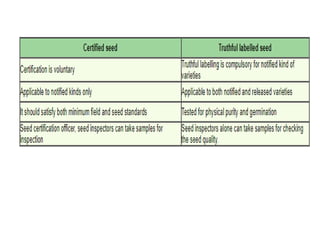
SEED CERTIFICATION
Prepared by
Dr. Pusarla Susmitha
Assistant Professor
Ph.D. Seed Science and Technology
INTRODUCTION
• Seed Certification is a legally sanctioned system for
quality control of seed multiplication and production
OBJECTIVES:
 Identification of new superior varieties
 Provision of supply of quality seeds by careful
maintenance
 Seed certification procedures and designed to ensure
physical and genetic purity
 Freedom from weed seeds and diseases with good
germinability of the certified seed
Concept of Seed Certification
1) The integrity of certified seed growers must be
recognized.
2) Field inspection must be made by seed inspectors.
3) Verification trials to establish identification of varieties
must be conducted.
4) Maintenance of proper records to establish satisfactory
pedigree of seed stocks.
5) There should be standards established for purity and
germination.
6) Sealing seeds to protect both grower and purchaser must
be approved.
7) Species of farm weeds which would be included within
the meaning of noxious weeds, must be defined
Organisation of Certification
Establishment and operation of a seed certification agency
Establishment of minimum seed certification standards
Establishment of procedures for field inspection, seed
processing, seed sampling and issuance of seed certification
tags
SEED CERTIFICATION AGENCIES
• Seed certification is done by the Seed Certification Agency (SSCA) of
the concerned state or by NSC where such an agency does not exist
FUNCTIONS OF NSC
1. Production and supply of foundation & certified seed.
2. To maintain improved seed stocks of improved varieties
3. Export and import of seed
4. Planning the production of breeder seed in consultation
with ICAR
5. Providing technical assistance to seeds corporations and
private agencies
6. Coordinating market research and sales promotion
efforts
7. Providing training facilities for the staff participating in
seed industry development
8. Providing certification services to states lacking
established and independent seed certification agencies
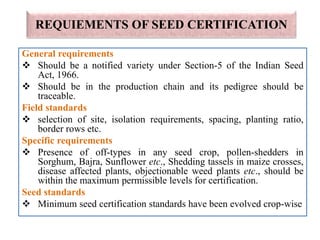
REQUIEMENTS OF SEED CERTIFICATION
General requirements
 Should be a notified variety under Section-5 of the Indian Seed
Act, 1966.
 Should be in the production chain and its pedigree should be
traceable.
Field standards
 selection of site, isolation requirements, spacing, planting ratio,
border rows etc.
Specific requirements
 Presence of off-types in any seed crop, pollen-shedders in
Sorghum, Bajra, Sunflower etc., Shedding tassels in maize crosses,
disease affected plants, objectionable weed plants etc., should be
within the maximum permissible levels for certification.
Seed standards
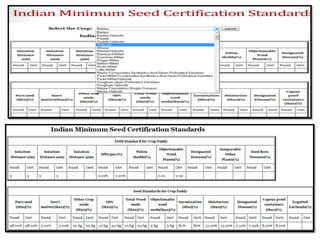
 Minimum seed certification standards have been evolved crop-wise
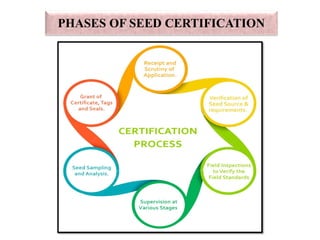
PHASES OF SEED CERTIFICATION
PROCEDURE OF SEED CERTIFICATION
1. Establishing Source of Seed
2. Field Area for Certification
3. Unit of Certification
4. Use of Chemical Hybridizing Agents (CHA’s)
5. Field Inspection & Re-inspection
6. Harvesting, Threshing and Transportation
7. Seed Lot and Lot size specifications
8. Seed Processing and Seed Treatment
9. Sampling of seeds and Seed Analysis Report
10. Recleaning, Resampling and Retesting
11. Downgrading of Seed Class
12. Packing, Tagging, Sealing-and issuance of the Certificate
13. Refusal for Certification
14. Validity Period of the Certificate
15. Revocation of Certificate
16. Retention of Certification Records
UNIT OF CERTIFICATION
(a) it is all under one variety and does not exceed 10 hectares
(c) Not divided into fields separated by more than 50 m between
them
(d) it is planted with seed belonging to the same class and stage in
the generation chain
(e) the crop over the entire area is more or less of the same stage
of growth so raised strictly as a single crop
(j) not grown as inter, companion or ratoon crop
In hybrid seed production, the seed producer can use proper
Chemical Hybridising Agents (‘CHAs’) on female line in order to
induce male sterility and subjected to grow-out test
USE OF CHA’s
FIELD INSPECTION & RE-INSPECTION
• The inspection of standing seed crops is an essential step in
verifying conformity of seed crops to prescribed certification
standards.
• To collect information on cropping history of the field to
verify whether the seed field meets the prescribed land
requirements.
• The Certification Agency may at its discretion, also perform
one or more re-inspections over and above the minimum
number of inspections prescribed, if considered necessary
• Seed processing means cleaning, drying, treating, grading and
other operations which will improve the quality of seeds
SEED PROCESSING
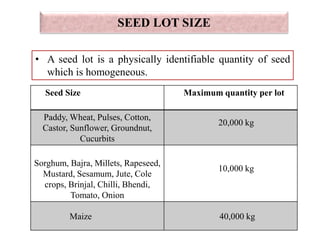
Seed Size Maximum quantity per lot
Paddy, Wheat, Pulses, Cotton,
Castor, Sunflower, Groundnut,
Cucurbits
20,000 kg
Sorghum, Bajra, Millets, Rapeseed,
Mustard, Sesamum, Jute, Cole
crops, Brinjal, Chilli, Bhendi,
Tomato, Onion
10,000 kg
Maize 40,000 kg
SEED LOT SIZE
• A seed lot is a physically identifiable quantity of seed
which is homogeneous.
• Certification Agency shall ensure packing, tagging and sealing and
issuance of certificate.
• An authorized official of the Certification Agency shall endorse the
signature on the reverse of each certification tag and shall affix stamp
indicating the official’s name and designation.
Packing, Tagging, Sealing and Issuance of the
Certificate
The lot number will
have four parts
• Month, Year code
• Production
Location Code
• Processing Plant
Code
• Seed Produce Code
Colour: Opal Green
Tag size: 15 cm x 10 cm
SEED ANALYSIS REPORT
• The Seed Testing Laboratory shall analysis the seed samples in
accordance with the prescribed procedure and deliver the Seed
Analysis Report to the Certification Agency from 30 days of the
date of receipt of the samples
• When a seed lot does not meet the prescribed seed standards, the
Certification Agency on the request of seed producer may permit
recleaning, resampling and retesting. It shall be permitted only
once.
• If a seed field or a seed lot is not found meeting prescribed
standards for the class for which it has been registered, the
Certification Agency will certify to the immediate lower class.
Recleaning, Resampling and Retesting
Downgrading of seed calss
VALIDITY PERIOD OF REPORT
• The validity period shall be nine months from the date of test at
the time of initial certification. The validity period could be
further extended for six months
• The holder of the certificate has, without reasonable cause, failed
to comply with the conditions subject to which the certificate has
been granted or has contravened any of the provisions of the Act
or the Rules
• The Certification Agency shall preserve in order all the documents
including the guard samples pertaining to certification of each seed
lot for two years from the date of grant/ extension of the certificate
and four years in respect of rejected seed crops or lots
Revocation of certificate
Retention of certification records
THANK YOU

seed-certification.pdf

  • 1.
    SEED CERTIFICATION Prepared by Dr.Pusarla Susmitha Assistant Professor Ph.D. Seed Science and Technology
  • 2.
    INTRODUCTION • Seed Certificationis a legally sanctioned system for quality control of seed multiplication and production OBJECTIVES:  Identification of new superior varieties  Provision of supply of quality seeds by careful maintenance  Seed certification procedures and designed to ensure physical and genetic purity  Freedom from weed seeds and diseases with good germinability of the certified seed
  • 3.
    Concept of SeedCertification 1) The integrity of certified seed growers must be recognized. 2) Field inspection must be made by seed inspectors. 3) Verification trials to establish identification of varieties must be conducted. 4) Maintenance of proper records to establish satisfactory pedigree of seed stocks. 5) There should be standards established for purity and germination. 6) Sealing seeds to protect both grower and purchaser must be approved. 7) Species of farm weeds which would be included within the meaning of noxious weeds, must be defined
  • 4.
    Organisation of Certification Establishmentand operation of a seed certification agency Establishment of minimum seed certification standards Establishment of procedures for field inspection, seed processing, seed sampling and issuance of seed certification tags
  • 5.
  • 6.
    • Seed certificationis done by the Seed Certification Agency (SSCA) of the concerned state or by NSC where such an agency does not exist
  • 7.
    FUNCTIONS OF NSC 1.Production and supply of foundation & certified seed. 2. To maintain improved seed stocks of improved varieties 3. Export and import of seed 4. Planning the production of breeder seed in consultation with ICAR 5. Providing technical assistance to seeds corporations and private agencies 6. Coordinating market research and sales promotion efforts 7. Providing training facilities for the staff participating in seed industry development 8. Providing certification services to states lacking established and independent seed certification agencies
  • 8.
    REQUIEMENTS OF SEEDCERTIFICATION General requirements  Should be a notified variety under Section-5 of the Indian Seed Act, 1966.  Should be in the production chain and its pedigree should be traceable. Field standards  selection of site, isolation requirements, spacing, planting ratio, border rows etc. Specific requirements  Presence of off-types in any seed crop, pollen-shedders in Sorghum, Bajra, Sunflower etc., Shedding tassels in maize crosses, disease affected plants, objectionable weed plants etc., should be within the maximum permissible levels for certification. Seed standards  Minimum seed certification standards have been evolved crop-wise
  • 9.
    PHASES OF SEEDCERTIFICATION
  • 11.
    PROCEDURE OF SEEDCERTIFICATION 1. Establishing Source of Seed 2. Field Area for Certification 3. Unit of Certification 4. Use of Chemical Hybridizing Agents (CHA’s) 5. Field Inspection & Re-inspection 6. Harvesting, Threshing and Transportation 7. Seed Lot and Lot size specifications 8. Seed Processing and Seed Treatment 9. Sampling of seeds and Seed Analysis Report 10. Recleaning, Resampling and Retesting 11. Downgrading of Seed Class 12. Packing, Tagging, Sealing-and issuance of the Certificate 13. Refusal for Certification 14. Validity Period of the Certificate 15. Revocation of Certificate 16. Retention of Certification Records
  • 13.
    UNIT OF CERTIFICATION (a)it is all under one variety and does not exceed 10 hectares (c) Not divided into fields separated by more than 50 m between them (d) it is planted with seed belonging to the same class and stage in the generation chain (e) the crop over the entire area is more or less of the same stage of growth so raised strictly as a single crop (j) not grown as inter, companion or ratoon crop In hybrid seed production, the seed producer can use proper Chemical Hybridising Agents (‘CHAs’) on female line in order to induce male sterility and subjected to grow-out test USE OF CHA’s
  • 14.
    FIELD INSPECTION &RE-INSPECTION • The inspection of standing seed crops is an essential step in verifying conformity of seed crops to prescribed certification standards. • To collect information on cropping history of the field to verify whether the seed field meets the prescribed land requirements. • The Certification Agency may at its discretion, also perform one or more re-inspections over and above the minimum number of inspections prescribed, if considered necessary • Seed processing means cleaning, drying, treating, grading and other operations which will improve the quality of seeds SEED PROCESSING
  • 16.
    Seed Size Maximumquantity per lot Paddy, Wheat, Pulses, Cotton, Castor, Sunflower, Groundnut, Cucurbits 20,000 kg Sorghum, Bajra, Millets, Rapeseed, Mustard, Sesamum, Jute, Cole crops, Brinjal, Chilli, Bhendi, Tomato, Onion 10,000 kg Maize 40,000 kg SEED LOT SIZE • A seed lot is a physically identifiable quantity of seed which is homogeneous.
  • 19.
    • Certification Agencyshall ensure packing, tagging and sealing and issuance of certificate. • An authorized official of the Certification Agency shall endorse the signature on the reverse of each certification tag and shall affix stamp indicating the official’s name and designation. Packing, Tagging, Sealing and Issuance of the Certificate The lot number will have four parts • Month, Year code • Production Location Code • Processing Plant Code • Seed Produce Code
  • 22.
    Colour: Opal Green Tagsize: 15 cm x 10 cm
  • 25.
    SEED ANALYSIS REPORT •The Seed Testing Laboratory shall analysis the seed samples in accordance with the prescribed procedure and deliver the Seed Analysis Report to the Certification Agency from 30 days of the date of receipt of the samples • When a seed lot does not meet the prescribed seed standards, the Certification Agency on the request of seed producer may permit recleaning, resampling and retesting. It shall be permitted only once. • If a seed field or a seed lot is not found meeting prescribed standards for the class for which it has been registered, the Certification Agency will certify to the immediate lower class. Recleaning, Resampling and Retesting Downgrading of seed calss
  • 30.
    VALIDITY PERIOD OFREPORT • The validity period shall be nine months from the date of test at the time of initial certification. The validity period could be further extended for six months • The holder of the certificate has, without reasonable cause, failed to comply with the conditions subject to which the certificate has been granted or has contravened any of the provisions of the Act or the Rules • The Certification Agency shall preserve in order all the documents including the guard samples pertaining to certification of each seed lot for two years from the date of grant/ extension of the certificate and four years in respect of rejected seed crops or lots Revocation of certificate Retention of certification records
  • 36.