INTRODUCTION TO CRUDE OIL ASSAY | Oil & Petrochemicals | 2015
Bruce Carlile
• Geographic
Footprint
• Oil &
Petrochemicals BUREAU VERITAS
COMPANY OVERVIEW
BV AT A GLANCE
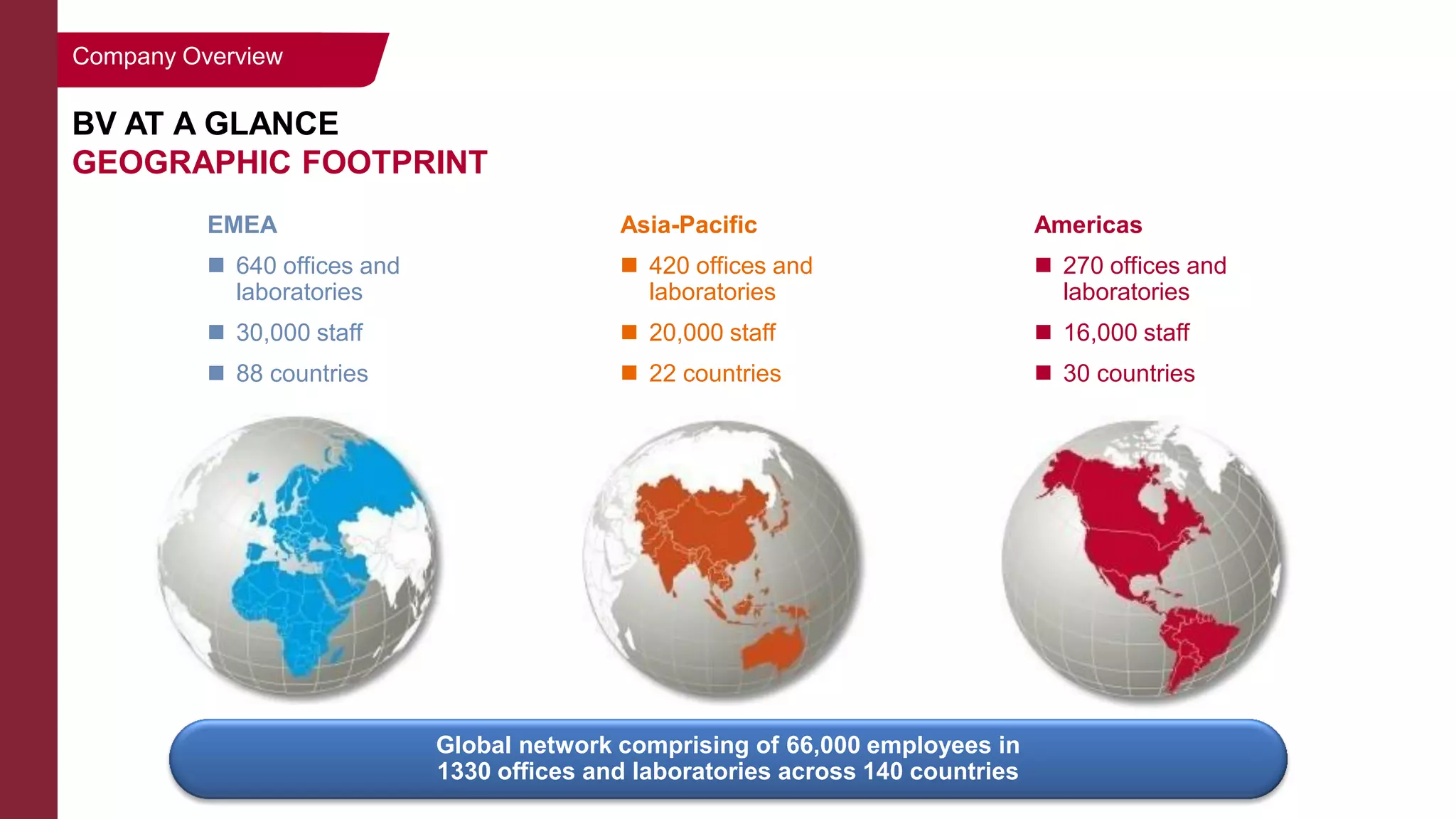
GEOGRAPHIC FOOTPRINT
Americas
 270 offices and
laboratories
 16,000 staff
 30 countries
Global network comprising of 66,000 employees in
1330 offices and laboratories across 140 countries
Asia-Pacific
 420 offices and
laboratories
 20,000 staff
 22 countries
EMEA
 640 offices and
laboratories
 30,000 staff
 88 countries
Company Overview
BV AT A GLANCE
KEY FIGURES
Established in 1828, Bureau Veritas is a global leader in Testing,
Inspection & Certification services in the areas of Quality, Health &
Safety, Environment and Social Responsibility across eight global
businesses.
Company Overview
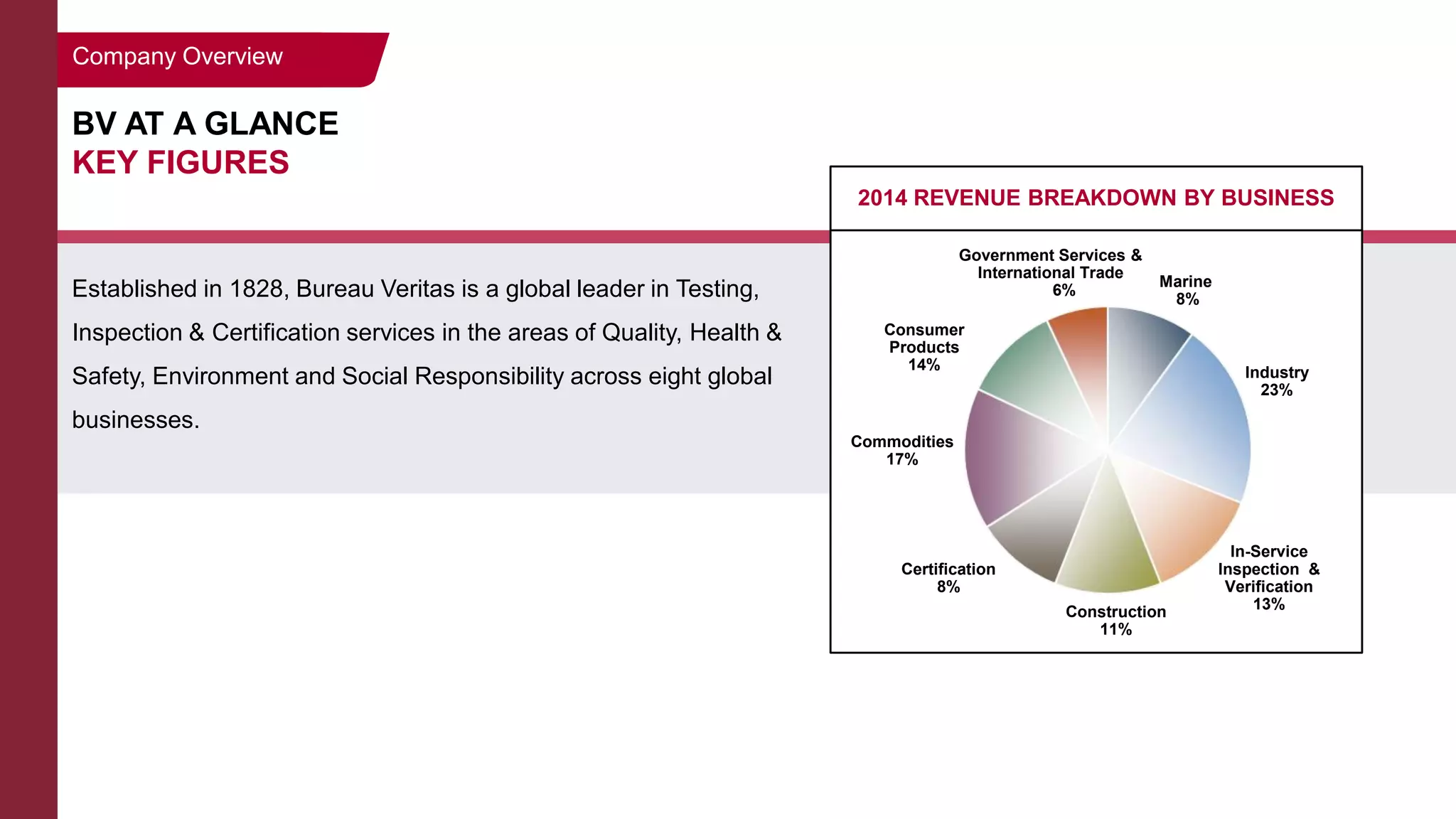
2014 REVENUE BREAKDOWN BY BUSINESS
Marine
8%
In-Service
Inspection &
Verification
13%
Certification
8%
Industry
23%
Government Services &
International Trade
6%
Consumer
Products
14%
Construction
11%
Commodities
17%
• What is Crude Assay
• Crude Oil Types
• Who Uses Assays
• Assay Types
• Mirroring the Refinery
• Data Integrity
• References
CRUDE OIL ASSAY
FOR THE NON-TECHNICAL
O&P
A crude oil assay is basically the chemical evaluation of crude oil feedstock’s by petroleum testing laboratories and
research centers. Each crude oil type has unique molecular, chemical characteristics. Hence, “crude oil
characterization”.
• No crude oil type is identical and have crucial differences.
• Results provide detailed hydrocarbon analysis data for producers, oil traders/gathering companies & refiners.
• Data helps refineries determine if a crude oil is compatible for a given refinery configuration or if the crude yield, quality,
petroleum product make or fractions are economical (MNRV) and within specification.
• Comprehensive view of the “whole crude” and each fraction of interest.
What is Crude Assay?
O&P
The varying crude oil types and sources
Crude Oil Types
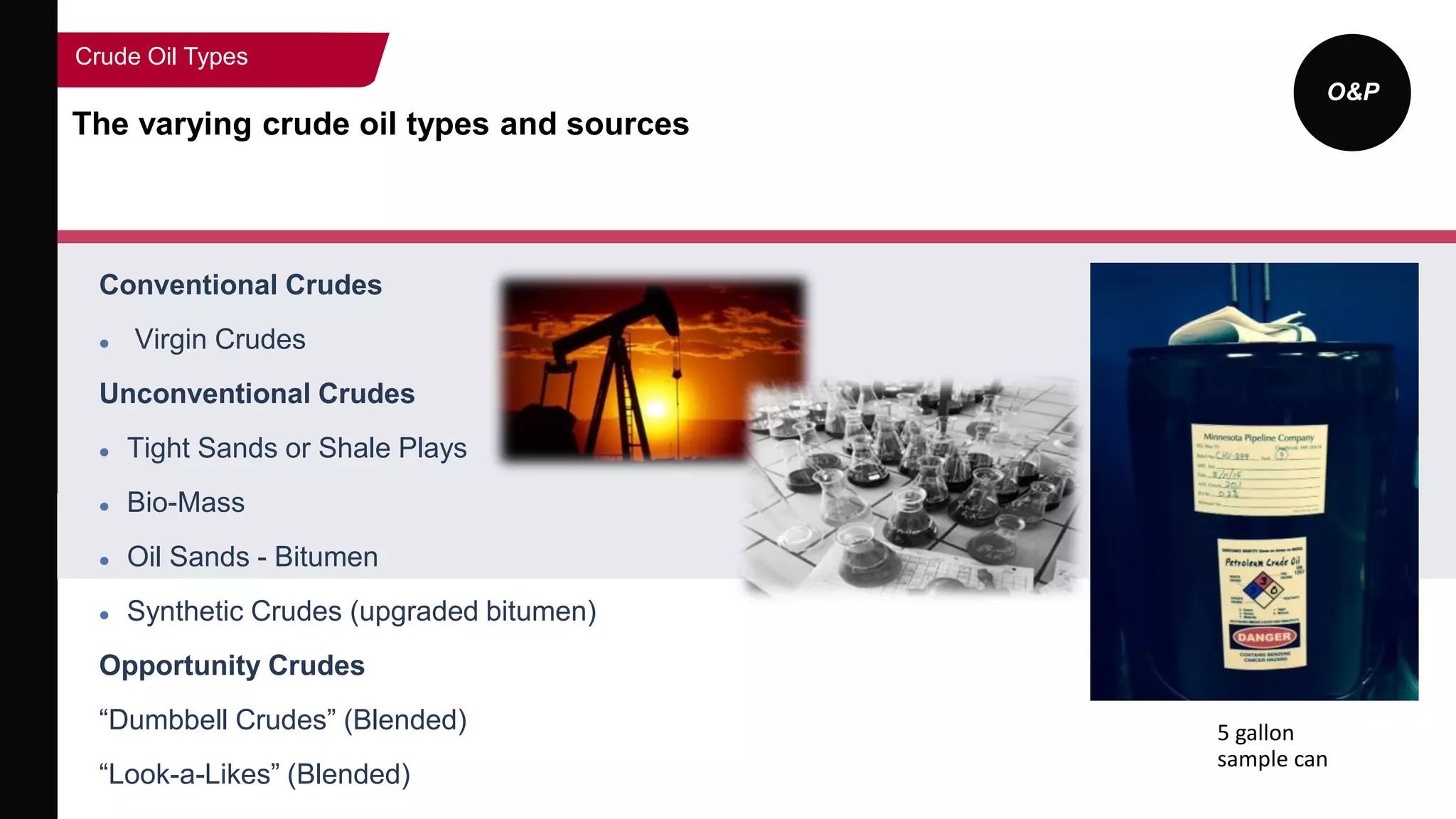
Conventional Crudes
 Virgin Crudes
Unconventional Crudes
 Tight Sands or Shale Plays
 Bio-Mass
 Oil Sands - Bitumen
 Synthetic Crudes (upgraded bitumen)
Opportunity Crudes
“Dumbbell Crudes” (Blended)
“Look-a-Likes” (Blended)
5 gallon
sample can
O&P
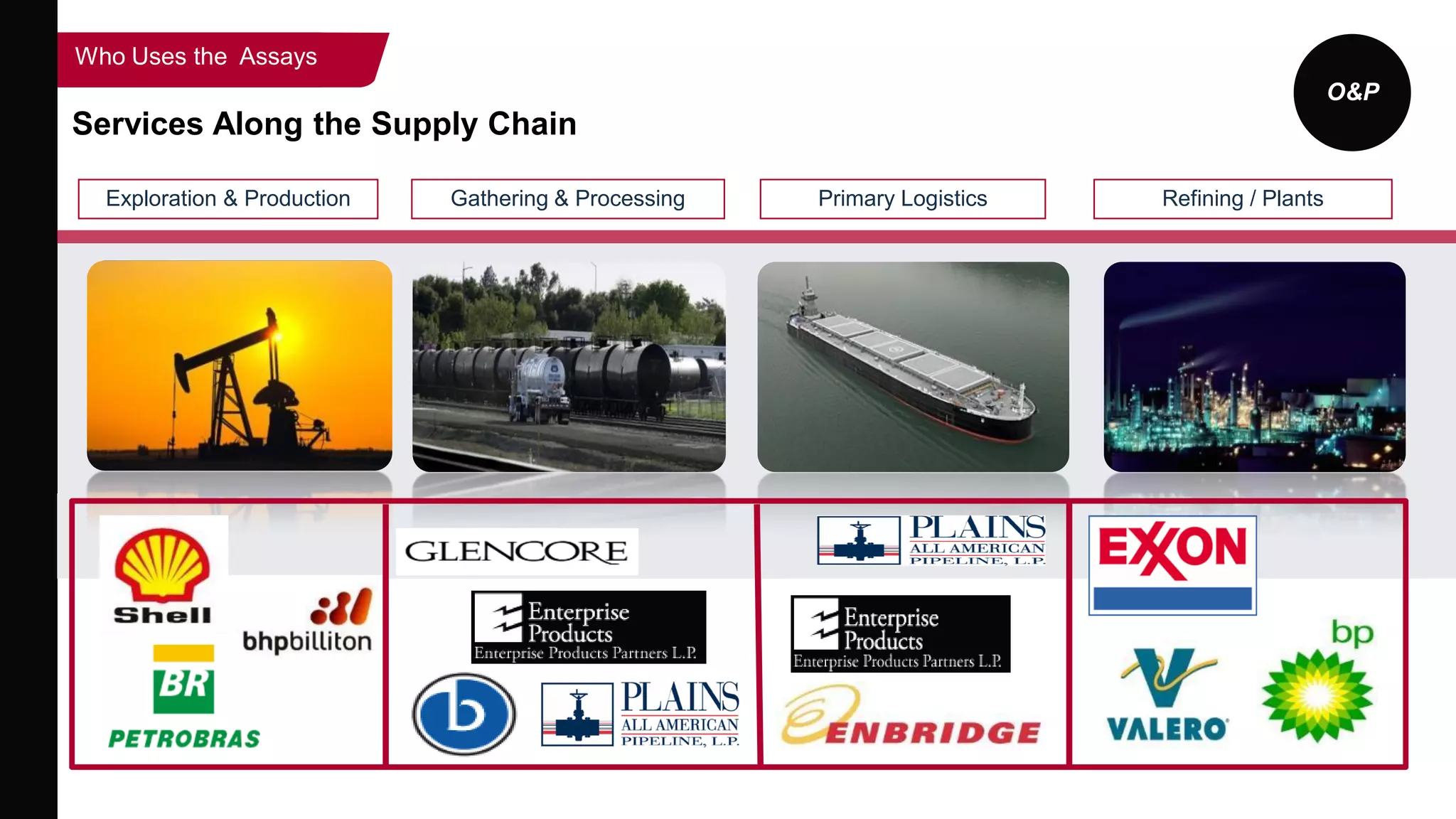
Services Along the Supply Chain
Who Uses the Assays
Exploration & Production Primary Logistics Refining / PlantsGathering & Processing
O&P
Crude Oil Assay Types
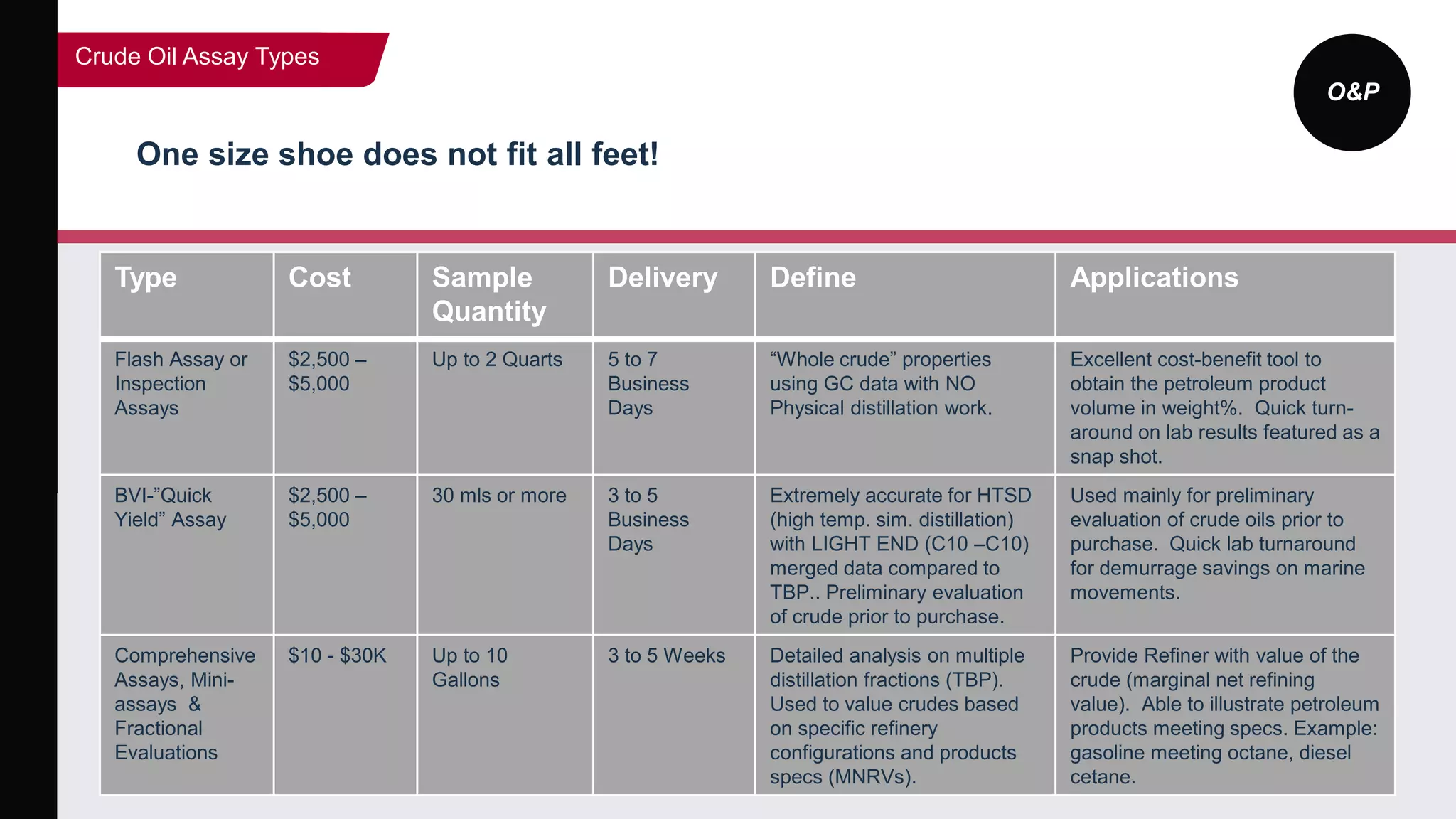
Type Cost Sample
Quantity
Delivery Define Applications
Flash Assay or
Inspection
Assays
$2,500 –
$5,000
Up to 2 Quarts 5 to 7
Business
Days
“Whole crude” properties
using GC data with NO
Physical distillation work.
Excellent cost-benefit tool to
obtain the petroleum product
volume in weight%. Quick turn-
around on lab results featured as a
snap shot.
BVI-”Quick
Yield” Assay
$2,500 –
$5,000
30 mls or more 3 to 5
Business
Days
Extremely accurate for HTSD
(high temp. sim. distillation)
with LIGHT END (C10 –C10)
merged data compared to
TBP.. Preliminary evaluation
of crude prior to purchase.
Used mainly for preliminary
evaluation of crude oils prior to
purchase. Quick lab turnaround
for demurrage savings on marine
movements.
Comprehensive
Assays, Mini-
assays &
Fractional
Evaluations
$10 - $30K Up to 10
Gallons
3 to 5 Weeks Detailed analysis on multiple
distillation fractions (TBP).
Used to value crudes based
on specific refinery
configurations and products
specs (MNRVs).
Provide Refiner with value of the
crude (marginal net refining
value). Able to illustrate petroleum
products meeting specs. Example:
gasoline meeting octane, diesel
cetane.
One size shoe does not fit all feet!
O&P
FLASH ASSAY OR INSPECTION ASSAYS
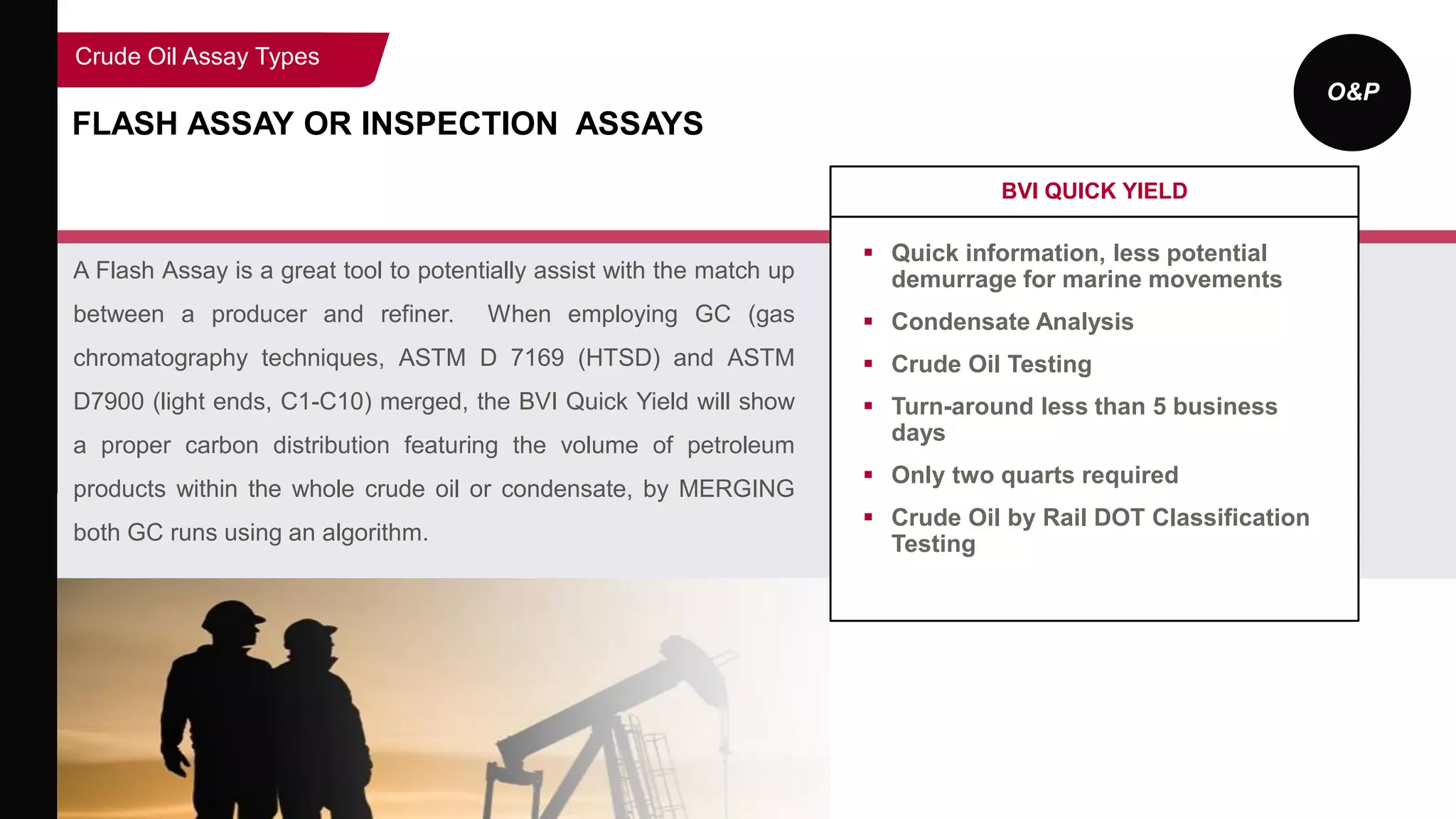
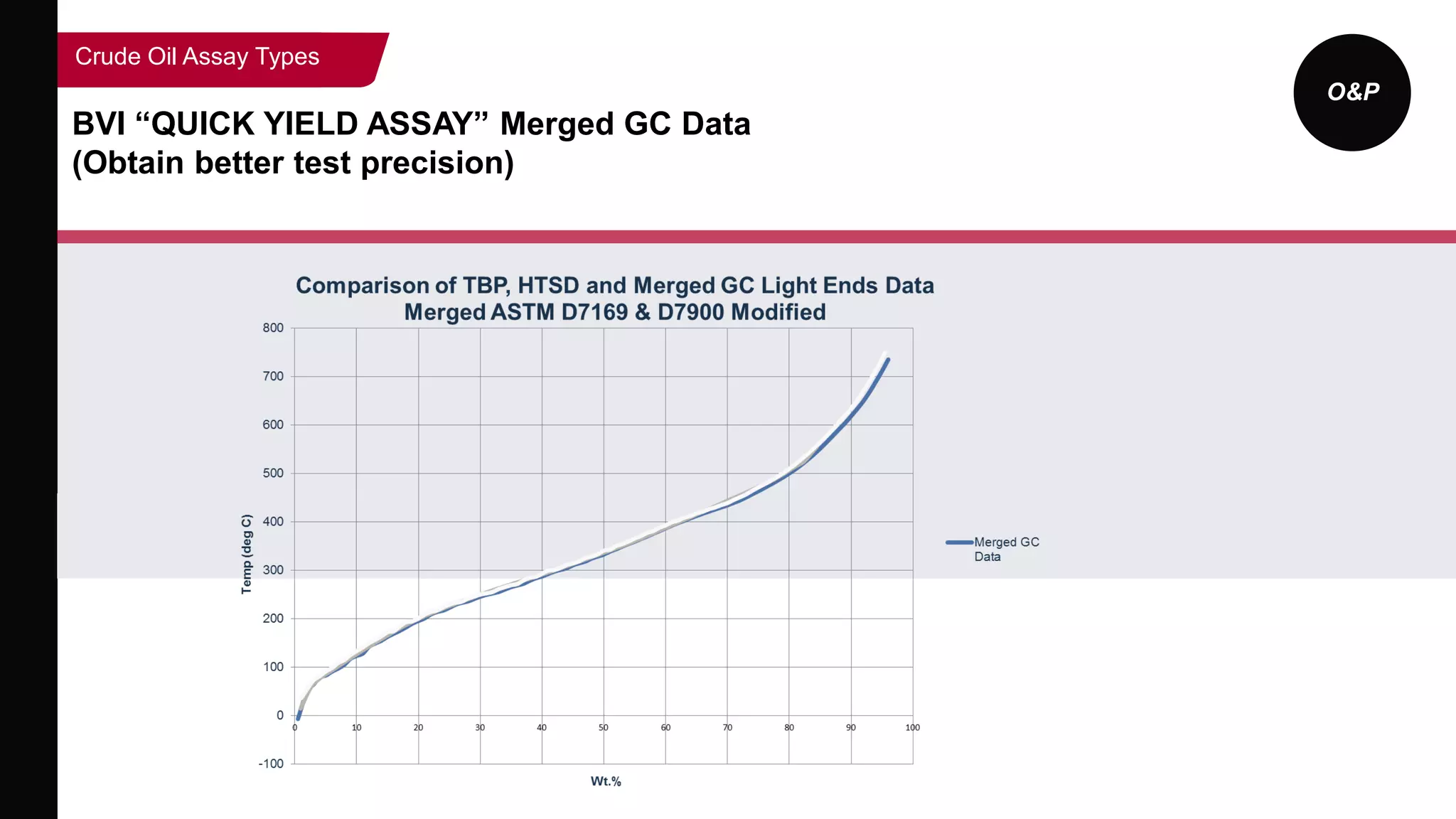
A Flash Assay is a great tool to potentially assist with the match up
between a producer and refiner. When employing GC (gas
chromatography techniques, ASTM D 7169 (HTSD) and ASTM
D7900 (light ends, C1-C10) merged, the BVI Quick Yield will show
a proper carbon distribution featuring the volume of petroleum
products within the whole crude oil or condensate, by MERGING
both GC runs using an algorithm.
BVI QUICK YIELD
 Quick information, less potential
demurrage for marine movements
 Condensate Analysis
 Crude Oil Testing
 Turn-around less than 5 business
days
 Only two quarts required
 Crude Oil by Rail DOT Classification
Testing
Crude Oil Assay Types
O&P
BVI “QUICK YIELD ASSAY” Merged GC Data
(Obtain better test precision)
Crude Oil Assay Types
O&P
COMPREHENSIVE ASSAYS OR FRACTIONAL
EVALUATION ASSAYS
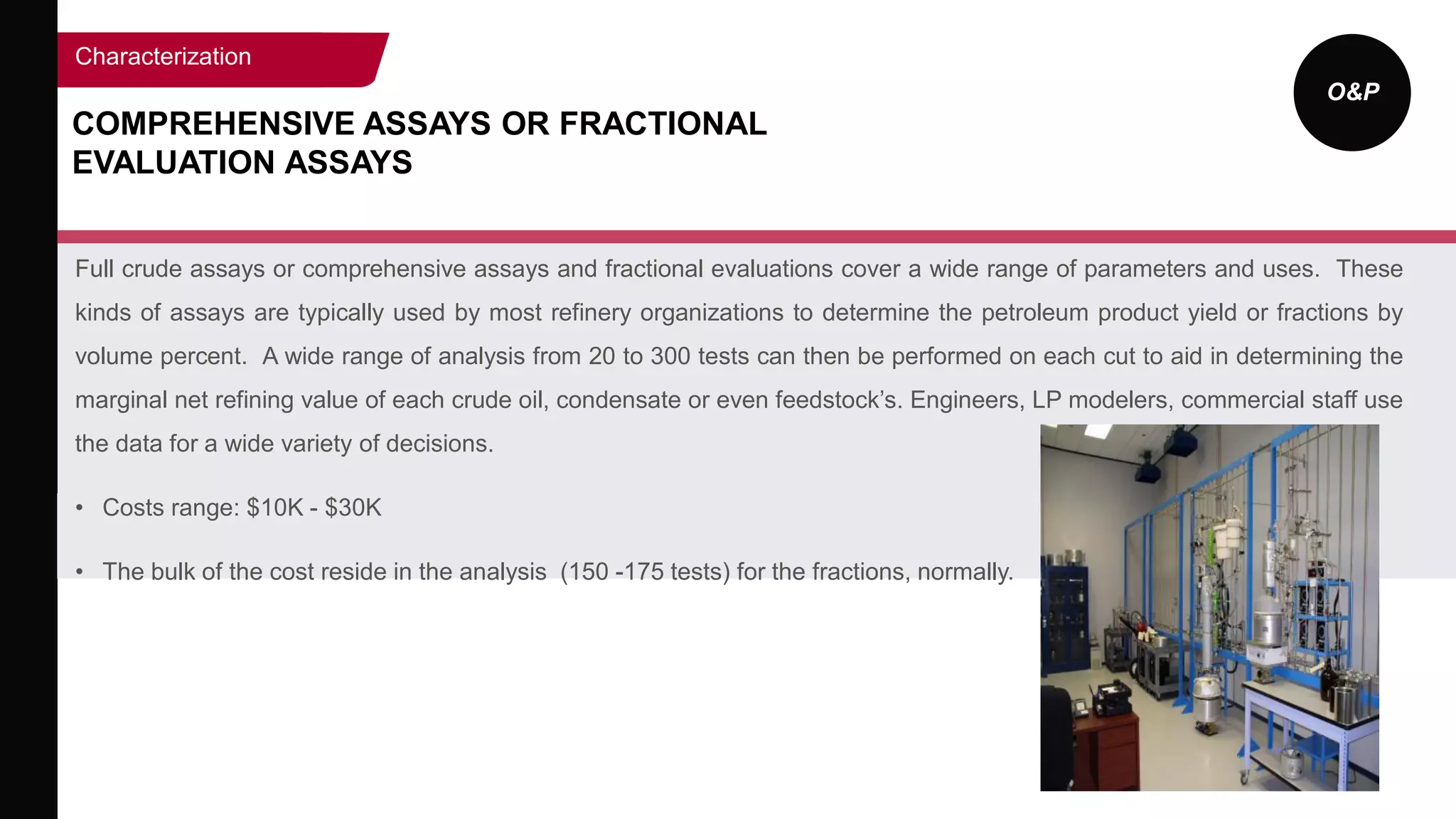
Full crude assays or comprehensive assays and fractional evaluations cover a wide range of parameters and uses. These
kinds of assays are typically used by most refinery organizations to determine the petroleum product yield or fractions by
volume percent. A wide range of analysis from 20 to 300 tests can then be performed on each cut to aid in determining the
marginal net refining value of each crude oil, condensate or even feedstock’s. Engineers, LP modelers, commercial staff use
the data for a wide variety of decisions.
• Costs range: $10K - $30K
• The bulk of the cost reside in the analysis (150 -175 tests) for the fractions, normally.
Characterization
O&P
COMPREHENSIVE ASSAYS
Characterization
Petroleum Fractions Boiling Range (°C) / (°F) Typical Analytical Parameters
Light gases <15.5°C (60°F)
quantitative determination of individual C2 to C4 and total C5+ hydrocarbons
by GC
Gasoline (light naphtha 15.5–149°C (60–300°F)
API Gravity, density or specific gravity, total sulfur, mercaptan sulfur,
hydrogen sulfide, octane number , quantitative determination of PIAN by GC
Kerosene (medium naphtha) 149–232°C (300–450°F)
API Gravity, density or specific gravity, total sulfur, mercaptan sulfur, hydrogen
sulfide, aniline point , total acid, naphthalene content, smoke point, total
nitrogen, basic nitrogen, cold properties (F/C/P), flash point
Distillate Fuel - Gas oil 232–343°C (450–650°F)
API Gravity, density or specific gravity, total sulfur, aniline point, total acid,
naphthalene content, smoke point, total nitrogen, basic nitrogen, cold
properties (C/P), flash point, viscosity,
cetane index (calculated)
Light vacuum gas oil 343–371°C (650–700°F)
API Gravity, density or specific gravity, total sulfur, aniline point, total acid,
total nitrogen, basic nitrogen, cold properties (C/P), viscosity, refractive index
Heavy vacuum gas oil 371–566°C (700–1050°F)
API Gravity, density or specific gravity, total sulfur, aniline point, total acid,
total nitrogen, basic nitrogen, cold properties (Pour Point), viscosity, trace
metals, asphaltenes, carbon residue, wax content, refractive index
Residuum >566°C (1050°F)
API Gravity, density or specific gravity, total sulfur, total acid, total nitrogen,
basic nitrogen, cold properties (Pour Point), viscosity, trace metals,
asphaltenes, carbon residue , wax content, penetration, softening point
O&P
COMPREHENSIVE ASSAYS
APPLICATIONS
 Refinery Process Optimization
 Refining product netback
evaluations
 Feedstock evaluations
 Splitter design work
 Enhance oil producer marketing
efforts
 Sample Management Programs
Characterization
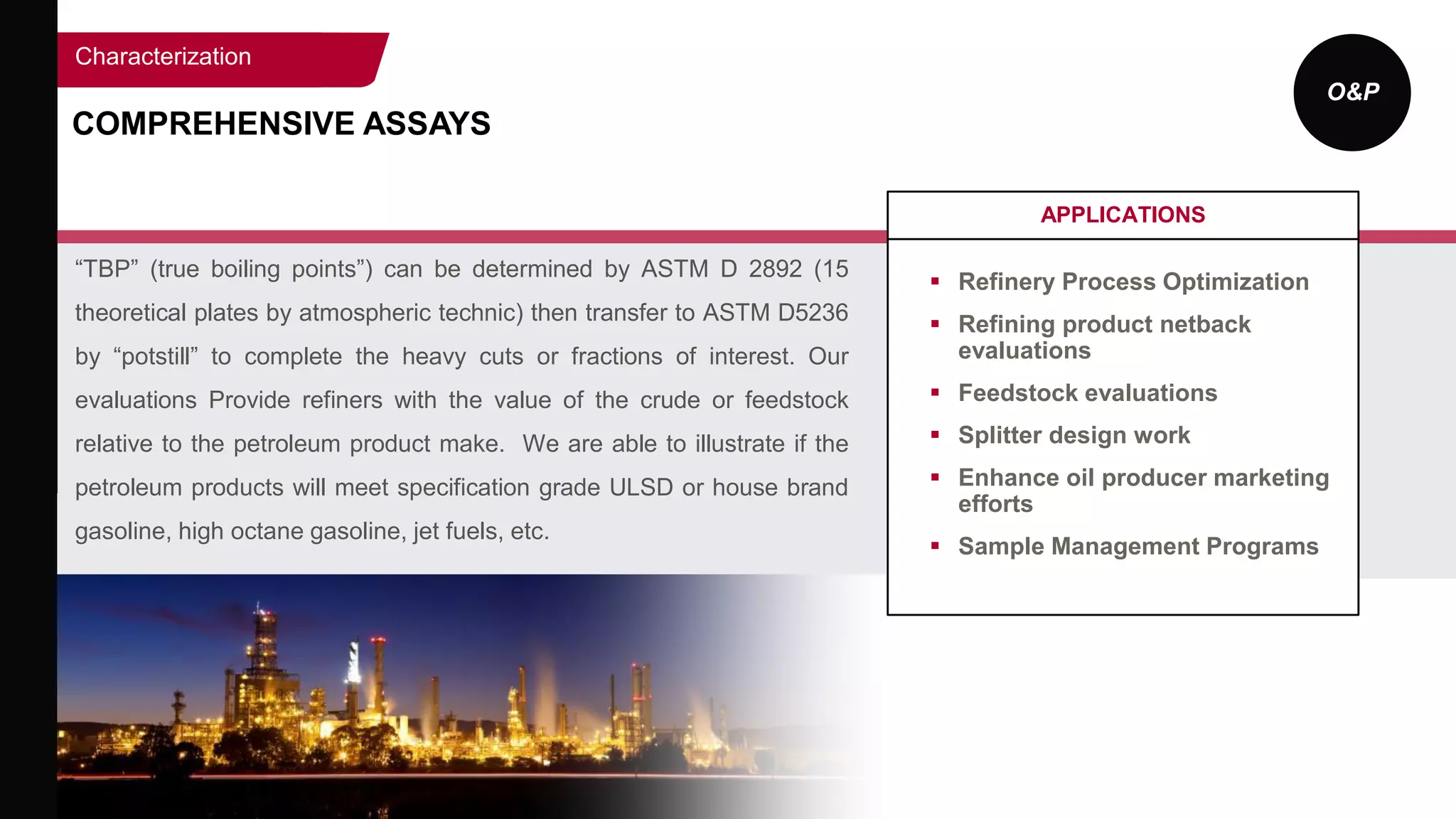
“TBP” (true boiling points”) can be determined by ASTM D 2892 (15
theoretical plates by atmospheric technic) then transfer to ASTM D5236
by “potstill” to complete the heavy cuts or fractions of interest. Our
evaluations Provide refiners with the value of the crude or feedstock
relative to the petroleum product make. We are able to illustrate if the
petroleum products will meet specification grade ULSD or house brand
gasoline, high octane gasoline, jet fuels, etc.
O&P
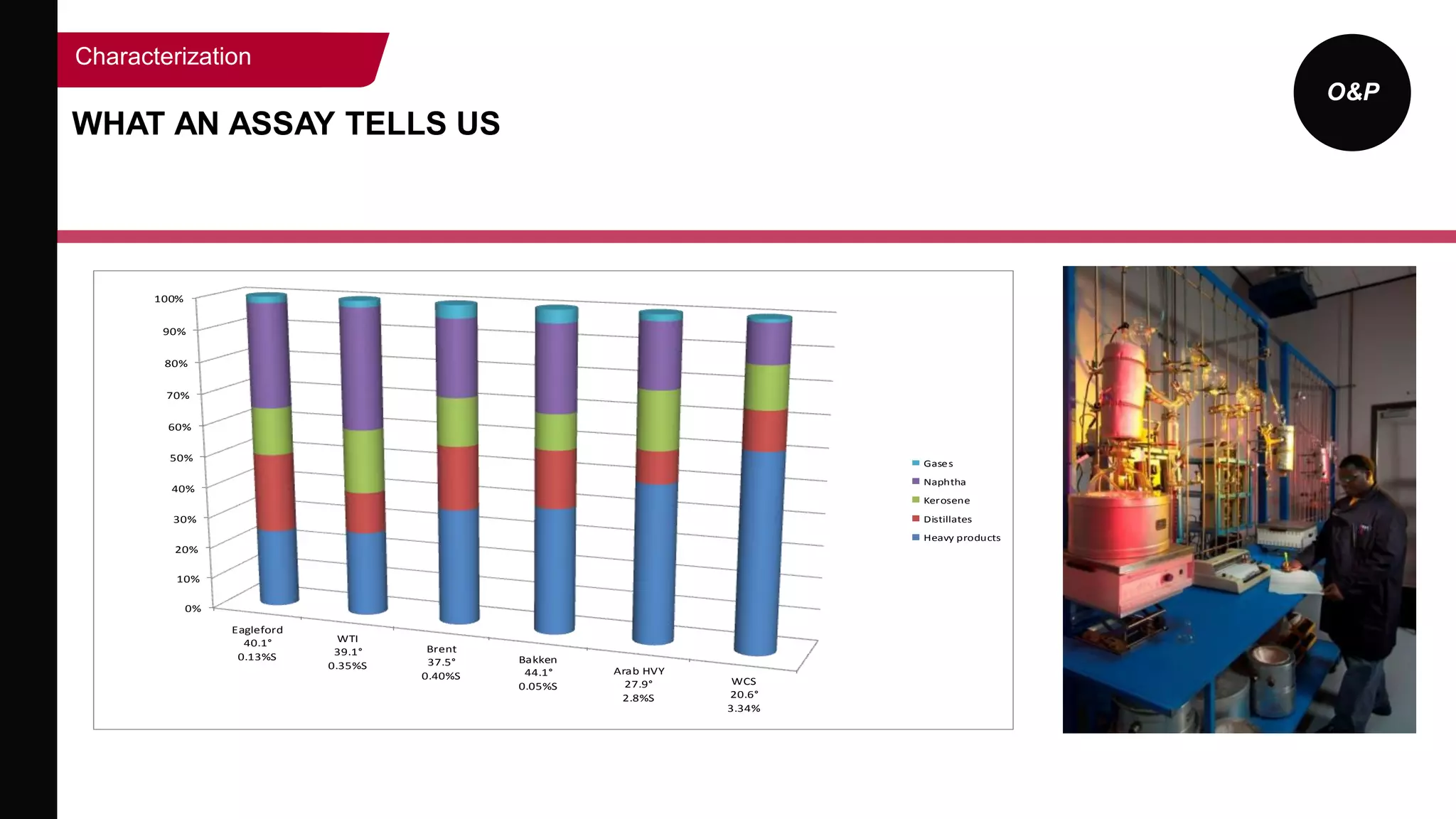
WHAT AN ASSAY TELLS US
Characterization
0%
10%
20%
30%
40%
50%
60%
70%
80%
90%
100%
Eagleford
40.1°
0.13%S
WTI
39.1°
0.35%S
Brent
37.5°
0.40%S
Bakken
44.1°
0.05%S
Arab HVY
27.9°
2.8%S
WCS
20.6°
3.34%
Gases
Naphtha
Kerosene
Distillates
Heavy products
O&P
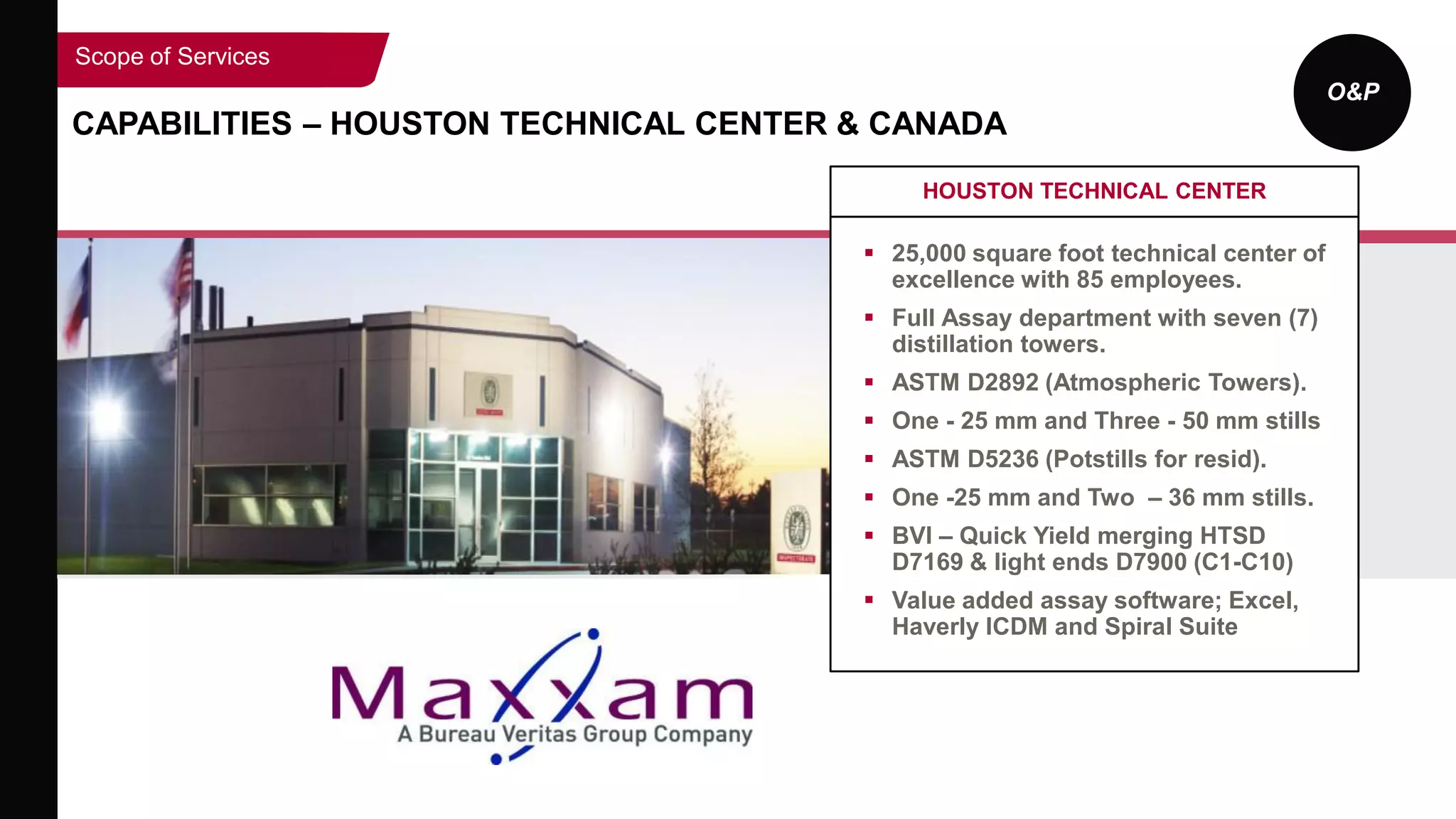
CAPABILITIES – HOUSTON TECHNICAL CENTER & CANADA
Scope of Services
HOUSTON TECHNICAL CENTER
 25,000 square foot technical center of
excellence with 85 employees.
 Full Assay department with seven (7)
distillation towers.
 ASTM D2892 (Atmospheric Towers).
 One - 25 mm and Three - 50 mm stills
 ASTM D5236 (Potstills for resid).
 One -25 mm and Two – 36 mm stills.
 BVI – Quick Yield merging HTSD
D7169 & light ends D7900 (C1-C10)
 Value added assay software; Excel,
Haverly ICDM and Spiral Suite
O&P
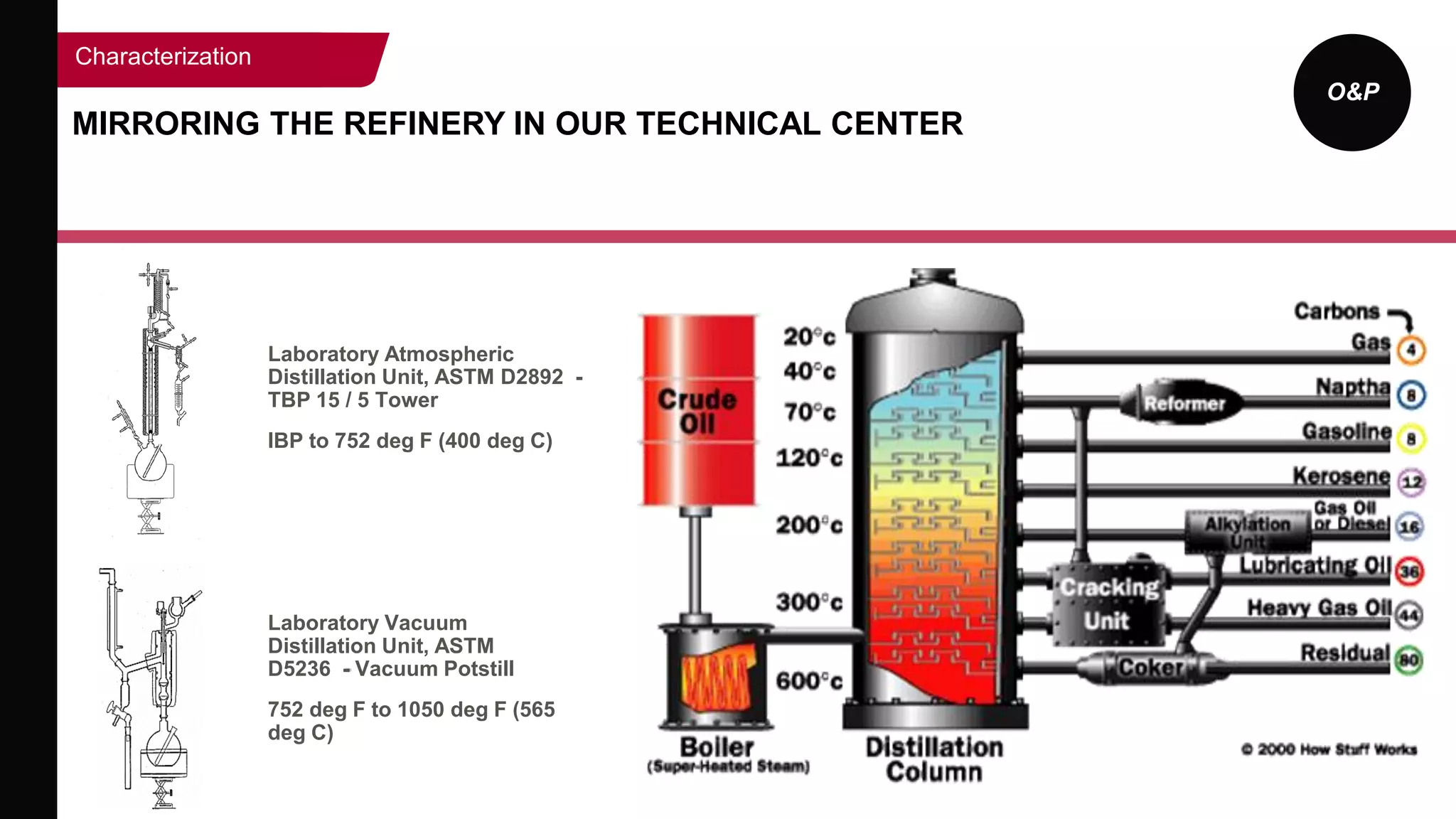
MIRRORING THE REFINERY IN OUR TECHNICAL CENTER
Characterization
Laboratory Atmospheric
Distillation Unit, ASTM D2892 -
TBP 15 / 5 Tower
IBP to 752 deg F (400 deg C)
Laboratory Vacuum
Distillation Unit, ASTM
D5236 - Vacuum Potstill
752 deg F to 1050 deg F (565
deg C)
O&P
DATA INTEGRITY
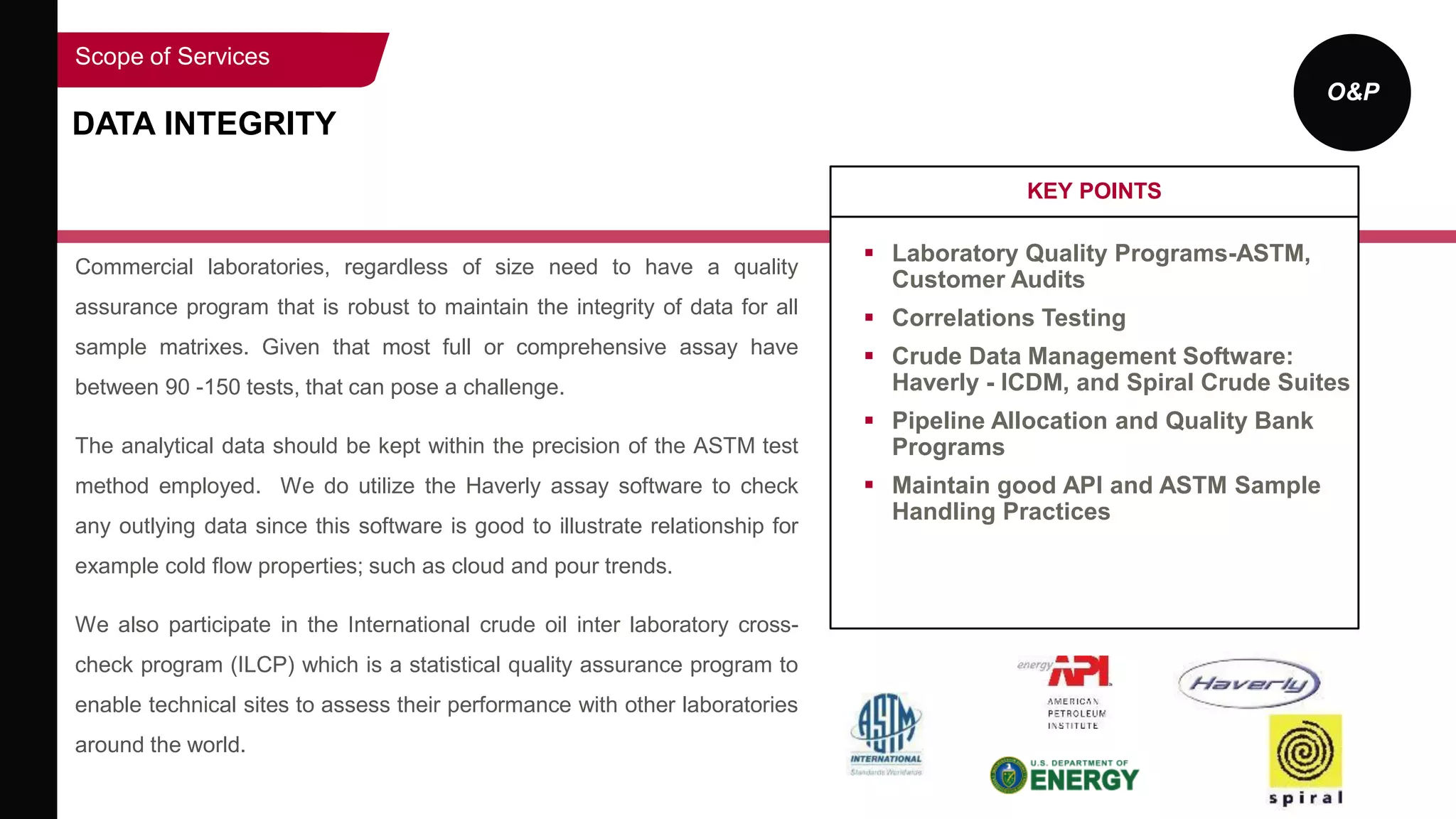
Commercial laboratories, regardless of size need to have a quality
assurance program that is robust to maintain the integrity of data for all
sample matrixes. Given that most full or comprehensive assay have
between 90 -150 tests, that can pose a challenge.
The analytical data should be kept within the precision of the ASTM test
method employed. We do utilize the Haverly assay software to check
any outlying data since this software is good to illustrate relationship for
example cold flow properties; such as cloud and pour trends.
We also participate in the International crude oil inter laboratory cross-
check program (ILCP) which is a statistical quality assurance program to
enable technical sites to assess their performance with other laboratories
around the world.
KEY POINTS
 Laboratory Quality Programs-ASTM,
Customer Audits
 Correlations Testing
 Crude Data Management Software:
Haverly - ICDM, and Spiral Crude Suites
 Pipeline Allocation and Quality Bank
Programs
 Maintain good API and ASTM Sample
Handling Practices
Scope of Services
O&P
MEMBERSHIPS & ACCREDITATIONS
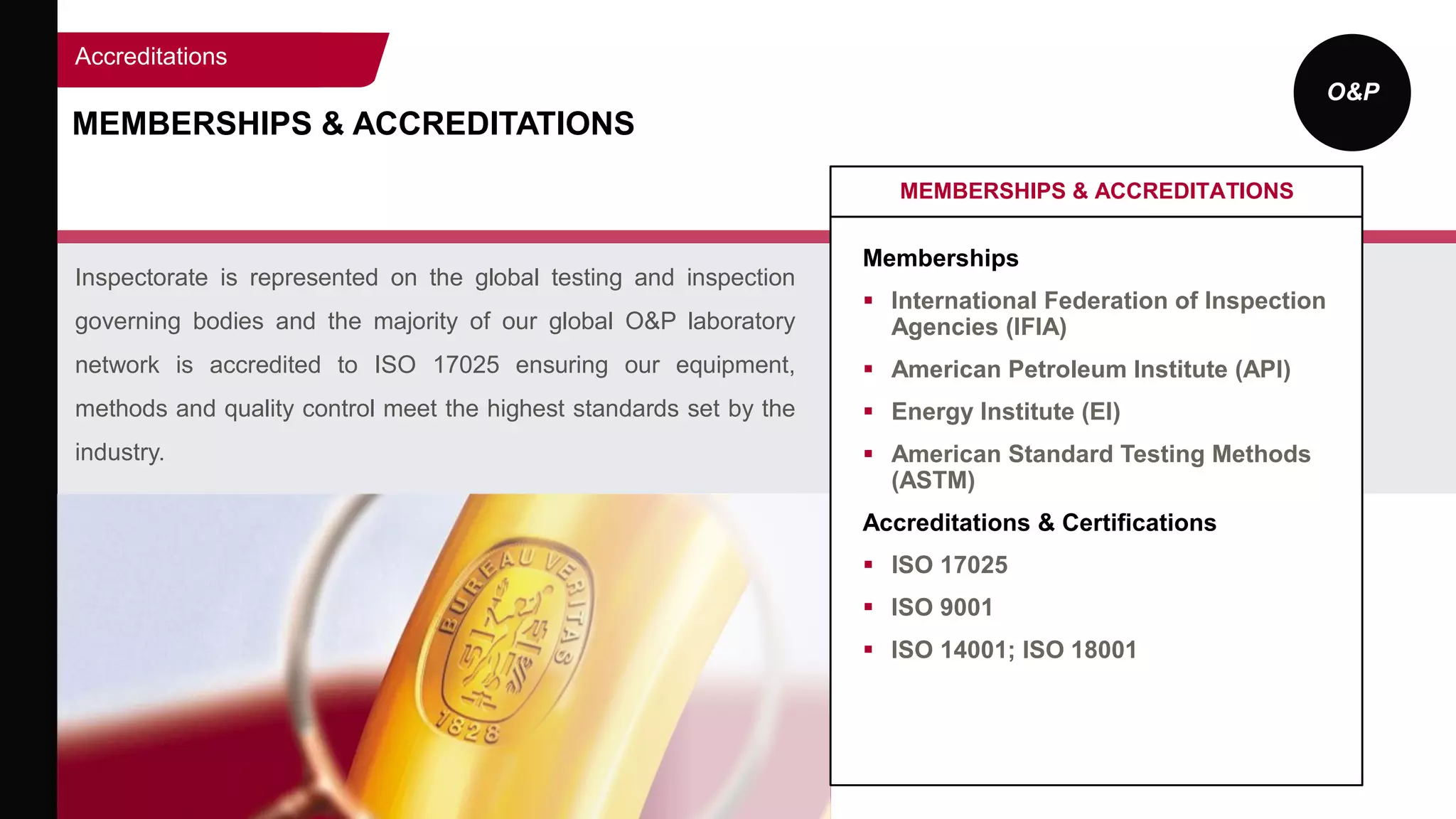
Inspectorate is represented on the global testing and inspection
governing bodies and the majority of our global O&P laboratory
network is accredited to ISO 17025 ensuring our equipment,
methods and quality control meet the highest standards set by the
industry.
MEMBERSHIPS & ACCREDITATIONS
Memberships
 International Federation of Inspection
Agencies (IFIA)
 American Petroleum Institute (API)
 Energy Institute (EI)
 American Standard Testing Methods
(ASTM)
Accreditations & Certifications
 ISO 17025
 ISO 9001
 ISO 14001; ISO 18001
Accreditations
O&P
IN SUMMARY
Summary
• Crude Oil Quality is more than Gravity & Sulfur.
• Partner with a reliable commercial 3rd party laboratory.
• Share your goals and expectations for a better outcome.
• Gain a good “Cost – Benefit” outcome.
• Engage in Industry Organizations/Events to network.
O&P
Contact Details:
Bruce Carlile, Business Development
Crudes Oil & Shale Play Operations
Inspectorate America Corporation
12000 Aerospace Avenue, Suite 200
Houston, TX 77034
Office Ph: (281) 848-5829
Email: bruce.carlile@inspectorate.com
Email: crude-assay@inspectorate.com
Website: www.bureauveritas.com
References:
COQA.org “Crude Oil Quality Association”
CCQTA.com “Canadian Crude Quality Technical
Association”
Haverly.com and Spiral.com
Crude Quality Monitor.com (Owner – Bill Lywood)
ASTM Booklet – “Crude Oil Quality & Sampling” by Harry
Giles (former, Director of the COQA)”
The Carl McCain Foundation
REFERENCES
References
CRUDE ASSAY Non-Tech Oct 2015 BC

CRUDE ASSAY Non-Tech Oct 2015 BC

  • 1.
    INTRODUCTION TO CRUDEOIL ASSAY | Oil & Petrochemicals | 2015 Bruce Carlile
  • 2.
    • Geographic Footprint • Oil& Petrochemicals BUREAU VERITAS COMPANY OVERVIEW
  • 3.
    BV AT AGLANCE GEOGRAPHIC FOOTPRINT Americas  270 offices and laboratories  16,000 staff  30 countries Global network comprising of 66,000 employees in 1330 offices and laboratories across 140 countries Asia-Pacific  420 offices and laboratories  20,000 staff  22 countries EMEA  640 offices and laboratories  30,000 staff  88 countries Company Overview
  • 4.
    BV AT AGLANCE KEY FIGURES Established in 1828, Bureau Veritas is a global leader in Testing, Inspection & Certification services in the areas of Quality, Health & Safety, Environment and Social Responsibility across eight global businesses. Company Overview 2014 REVENUE BREAKDOWN BY BUSINESS Marine 8% In-Service Inspection & Verification 13% Certification 8% Industry 23% Government Services & International Trade 6% Consumer Products 14% Construction 11% Commodities 17%
  • 5.
    • What isCrude Assay • Crude Oil Types • Who Uses Assays • Assay Types • Mirroring the Refinery • Data Integrity • References CRUDE OIL ASSAY FOR THE NON-TECHNICAL
  • 6.
    O&P A crude oilassay is basically the chemical evaluation of crude oil feedstock’s by petroleum testing laboratories and research centers. Each crude oil type has unique molecular, chemical characteristics. Hence, “crude oil characterization”. • No crude oil type is identical and have crucial differences. • Results provide detailed hydrocarbon analysis data for producers, oil traders/gathering companies & refiners. • Data helps refineries determine if a crude oil is compatible for a given refinery configuration or if the crude yield, quality, petroleum product make or fractions are economical (MNRV) and within specification. • Comprehensive view of the “whole crude” and each fraction of interest. What is Crude Assay?
  • 7.
    O&P The varying crudeoil types and sources Crude Oil Types Conventional Crudes  Virgin Crudes Unconventional Crudes  Tight Sands or Shale Plays  Bio-Mass  Oil Sands - Bitumen  Synthetic Crudes (upgraded bitumen) Opportunity Crudes “Dumbbell Crudes” (Blended) “Look-a-Likes” (Blended) 5 gallon sample can
  • 8.
    O&P Services Along theSupply Chain Who Uses the Assays Exploration & Production Primary Logistics Refining / PlantsGathering & Processing
  • 9.
    O&P Crude Oil AssayTypes Type Cost Sample Quantity Delivery Define Applications Flash Assay or Inspection Assays $2,500 – $5,000 Up to 2 Quarts 5 to 7 Business Days “Whole crude” properties using GC data with NO Physical distillation work. Excellent cost-benefit tool to obtain the petroleum product volume in weight%. Quick turn- around on lab results featured as a snap shot. BVI-”Quick Yield” Assay $2,500 – $5,000 30 mls or more 3 to 5 Business Days Extremely accurate for HTSD (high temp. sim. distillation) with LIGHT END (C10 –C10) merged data compared to TBP.. Preliminary evaluation of crude prior to purchase. Used mainly for preliminary evaluation of crude oils prior to purchase. Quick lab turnaround for demurrage savings on marine movements. Comprehensive Assays, Mini- assays & Fractional Evaluations $10 - $30K Up to 10 Gallons 3 to 5 Weeks Detailed analysis on multiple distillation fractions (TBP). Used to value crudes based on specific refinery configurations and products specs (MNRVs). Provide Refiner with value of the crude (marginal net refining value). Able to illustrate petroleum products meeting specs. Example: gasoline meeting octane, diesel cetane. One size shoe does not fit all feet!
  • 10.
    O&P FLASH ASSAY ORINSPECTION ASSAYS A Flash Assay is a great tool to potentially assist with the match up between a producer and refiner. When employing GC (gas chromatography techniques, ASTM D 7169 (HTSD) and ASTM D7900 (light ends, C1-C10) merged, the BVI Quick Yield will show a proper carbon distribution featuring the volume of petroleum products within the whole crude oil or condensate, by MERGING both GC runs using an algorithm. BVI QUICK YIELD  Quick information, less potential demurrage for marine movements  Condensate Analysis  Crude Oil Testing  Turn-around less than 5 business days  Only two quarts required  Crude Oil by Rail DOT Classification Testing Crude Oil Assay Types
  • 11.
    O&P BVI “QUICK YIELDASSAY” Merged GC Data (Obtain better test precision) Crude Oil Assay Types
  • 12.
    O&P COMPREHENSIVE ASSAYS ORFRACTIONAL EVALUATION ASSAYS Full crude assays or comprehensive assays and fractional evaluations cover a wide range of parameters and uses. These kinds of assays are typically used by most refinery organizations to determine the petroleum product yield or fractions by volume percent. A wide range of analysis from 20 to 300 tests can then be performed on each cut to aid in determining the marginal net refining value of each crude oil, condensate or even feedstock’s. Engineers, LP modelers, commercial staff use the data for a wide variety of decisions. • Costs range: $10K - $30K • The bulk of the cost reside in the analysis (150 -175 tests) for the fractions, normally. Characterization
  • 13.
    O&P COMPREHENSIVE ASSAYS Characterization Petroleum FractionsBoiling Range (°C) / (°F) Typical Analytical Parameters Light gases <15.5°C (60°F) quantitative determination of individual C2 to C4 and total C5+ hydrocarbons by GC Gasoline (light naphtha 15.5–149°C (60–300°F) API Gravity, density or specific gravity, total sulfur, mercaptan sulfur, hydrogen sulfide, octane number , quantitative determination of PIAN by GC Kerosene (medium naphtha) 149–232°C (300–450°F) API Gravity, density or specific gravity, total sulfur, mercaptan sulfur, hydrogen sulfide, aniline point , total acid, naphthalene content, smoke point, total nitrogen, basic nitrogen, cold properties (F/C/P), flash point Distillate Fuel - Gas oil 232–343°C (450–650°F) API Gravity, density or specific gravity, total sulfur, aniline point, total acid, naphthalene content, smoke point, total nitrogen, basic nitrogen, cold properties (C/P), flash point, viscosity, cetane index (calculated) Light vacuum gas oil 343–371°C (650–700°F) API Gravity, density or specific gravity, total sulfur, aniline point, total acid, total nitrogen, basic nitrogen, cold properties (C/P), viscosity, refractive index Heavy vacuum gas oil 371–566°C (700–1050°F) API Gravity, density or specific gravity, total sulfur, aniline point, total acid, total nitrogen, basic nitrogen, cold properties (Pour Point), viscosity, trace metals, asphaltenes, carbon residue, wax content, refractive index Residuum >566°C (1050°F) API Gravity, density or specific gravity, total sulfur, total acid, total nitrogen, basic nitrogen, cold properties (Pour Point), viscosity, trace metals, asphaltenes, carbon residue , wax content, penetration, softening point
  • 14.
    O&P COMPREHENSIVE ASSAYS APPLICATIONS  RefineryProcess Optimization  Refining product netback evaluations  Feedstock evaluations  Splitter design work  Enhance oil producer marketing efforts  Sample Management Programs Characterization “TBP” (true boiling points”) can be determined by ASTM D 2892 (15 theoretical plates by atmospheric technic) then transfer to ASTM D5236 by “potstill” to complete the heavy cuts or fractions of interest. Our evaluations Provide refiners with the value of the crude or feedstock relative to the petroleum product make. We are able to illustrate if the petroleum products will meet specification grade ULSD or house brand gasoline, high octane gasoline, jet fuels, etc.
  • 15.
    O&P WHAT AN ASSAYTELLS US Characterization 0% 10% 20% 30% 40% 50% 60% 70% 80% 90% 100% Eagleford 40.1° 0.13%S WTI 39.1° 0.35%S Brent 37.5° 0.40%S Bakken 44.1° 0.05%S Arab HVY 27.9° 2.8%S WCS 20.6° 3.34% Gases Naphtha Kerosene Distillates Heavy products
  • 16.
    O&P CAPABILITIES – HOUSTONTECHNICAL CENTER & CANADA Scope of Services HOUSTON TECHNICAL CENTER  25,000 square foot technical center of excellence with 85 employees.  Full Assay department with seven (7) distillation towers.  ASTM D2892 (Atmospheric Towers).  One - 25 mm and Three - 50 mm stills  ASTM D5236 (Potstills for resid).  One -25 mm and Two – 36 mm stills.  BVI – Quick Yield merging HTSD D7169 & light ends D7900 (C1-C10)  Value added assay software; Excel, Haverly ICDM and Spiral Suite
  • 17.
    O&P MIRRORING THE REFINERYIN OUR TECHNICAL CENTER Characterization Laboratory Atmospheric Distillation Unit, ASTM D2892 - TBP 15 / 5 Tower IBP to 752 deg F (400 deg C) Laboratory Vacuum Distillation Unit, ASTM D5236 - Vacuum Potstill 752 deg F to 1050 deg F (565 deg C)
  • 18.
    O&P DATA INTEGRITY Commercial laboratories,regardless of size need to have a quality assurance program that is robust to maintain the integrity of data for all sample matrixes. Given that most full or comprehensive assay have between 90 -150 tests, that can pose a challenge. The analytical data should be kept within the precision of the ASTM test method employed. We do utilize the Haverly assay software to check any outlying data since this software is good to illustrate relationship for example cold flow properties; such as cloud and pour trends. We also participate in the International crude oil inter laboratory cross- check program (ILCP) which is a statistical quality assurance program to enable technical sites to assess their performance with other laboratories around the world. KEY POINTS  Laboratory Quality Programs-ASTM, Customer Audits  Correlations Testing  Crude Data Management Software: Haverly - ICDM, and Spiral Crude Suites  Pipeline Allocation and Quality Bank Programs  Maintain good API and ASTM Sample Handling Practices Scope of Services
  • 19.
    O&P MEMBERSHIPS & ACCREDITATIONS Inspectorateis represented on the global testing and inspection governing bodies and the majority of our global O&P laboratory network is accredited to ISO 17025 ensuring our equipment, methods and quality control meet the highest standards set by the industry. MEMBERSHIPS & ACCREDITATIONS Memberships  International Federation of Inspection Agencies (IFIA)  American Petroleum Institute (API)  Energy Institute (EI)  American Standard Testing Methods (ASTM) Accreditations & Certifications  ISO 17025  ISO 9001  ISO 14001; ISO 18001 Accreditations
  • 20.
    O&P IN SUMMARY Summary • CrudeOil Quality is more than Gravity & Sulfur. • Partner with a reliable commercial 3rd party laboratory. • Share your goals and expectations for a better outcome. • Gain a good “Cost – Benefit” outcome. • Engage in Industry Organizations/Events to network.
  • 21.
    O&P Contact Details: Bruce Carlile,Business Development Crudes Oil & Shale Play Operations Inspectorate America Corporation 12000 Aerospace Avenue, Suite 200 Houston, TX 77034 Office Ph: (281) 848-5829 Email: bruce.carlile@inspectorate.com Email: crude-assay@inspectorate.com Website: www.bureauveritas.com References: COQA.org “Crude Oil Quality Association” CCQTA.com “Canadian Crude Quality Technical Association” Haverly.com and Spiral.com Crude Quality Monitor.com (Owner – Bill Lywood) ASTM Booklet – “Crude Oil Quality & Sampling” by Harry Giles (former, Director of the COQA)” The Carl McCain Foundation REFERENCES References