Petroleum Refinery I
[2022]
Dr.Omar Al-Kubaisi 1
An introduction to crude oil and its processing
• The composition and characteristics of crude oil
• The crude oil assay
• Other basic definitions and correlations
• Predicting product qualities
• Basic processes
• The processes common to most energy refineries
• Processes not so common to energy refineries
• The non-energy refineries
Dr.Omar Al-Kubaisi 2
The composition and characteristics of crude oil
• Crude oil is a mixture of literally hundreds of hydrocarbon compounds
ranging in size from the smallest, methane, with only one carbon
atom, to large compounds containing 300 and more carbon atoms.
• In order to utilize the crude oil assay it is necessary to understand the
data it provides and the significance of some of the laboratory tests
that are used in its compilation.
Dr.Omar Al-Kubaisi 3
Dr.Omar Al-Kubaisi 4
The true boiling point
curve
• This curve is produced by mass
spectrometry techniques much
quicker and more accurately
than by batch distillation. A
typical true boiling point curve
(TBP) is shown in Figure 1.
The ASTM distillation curve
• This type of distillation curve is used to on a routine basis
for plant and product quality control. This test is carried
out on crude oil fractions using a simple apparatus
designed to boil the test liquid and to condense the
vapors as they are produced. Vapor temperatures are
noted as the distillation proceeds and are plotted against
the distillate recovered. Because only one equilibrium
stage is used and no reflux is returned, the separation of
components is poor. Thus, the initial boiling point (IBP)
for ASTM is higher than the corresponding TBP point and
the final boiling point (FBP) of the ASTM is lower than
that for the TBP curve. There is a correlation between the
ASTM and the TBP curve.
Dr.Omar Al-Kubaisi 5
API gravity
• This is an expression of the density of an oil. Unless
stated otherwise the API gravity refers to density
at 60◦F (15.6◦C). Its relationship with specific
gravity is given by the expression
Dr.Omar Al-Kubaisi 6
Flash points
• The flash point of an oil is the temperature at which the vapor above the oil will
momentarily flash or explode. This temperature is determined by laboratory testing using
an apparatus consisting of a closed cup containing the oil, heating and stirring equipment,
and a special adjustable flame.
• The type of apparatus used for middle distillate and fuel oils is called the Pensky Marten
(PM), while the apparatus used in the case of Kerosene and lighter distillates is called the
Abel. Reference to these tests are given later in this Handbook, and full details of the tests
methods and procedures are given in ASTM Standards Part 7, Petroleum products and
Lubricants.
• There are many empirical methods for determining flash points from the ASTM distillation
curve. One such correlation is given by the expression
Dr.Omar Al-Kubaisi 7
Octane numbers
• Octane numbers are a measure of a gasoline’s resistance to knock or detonation
in a cylinder of a gasoline engine. The higher this resistance is the higher will be
the efficiency of the fuel to produce work. A relationship exists between the
antiknock characteristic of the gasoline (octane number) and the compression
ratio of the engine in which it is to be used.
• The higher the octane rating of the fuel then the higher the compression ratio of
engine in which it can be used.
• By definition, an octane number is that percentage of isooctane in a blend of
isooctane and normal heptane that exactly matches the knock behavior of the
gasoline. Thus, a 90 octane gasoline matches the knock characteristic of a blend
containing 90% isooctane and 10% n-heptane.
Dr.Omar Al-Kubaisi 8
Viscosity
• The viscosity of an oil is a measure of its
resistance to internal flow and is an
indication of its lubricating qualities. In the
oil industry it is usual to quote viscosities
either in centistokes (which is the unit for
kinematic viscosity), seconds Saybolt
universal, seconds Saybolt furol, or seconds
Redwood.
Dr.Omar Al-Kubaisi 9
Cloud and pour points
• Cloud and Pour Points are tests that indicate the
relative coagulation of wax in the oil. They do not
measure the actual wax content of the oil.
• In these tests, the oil is reduced in temperature
under strict control using an ice bath initially and
then a frozen brine bath, and finally a bath of dry ice
(solid CO2).
• The temperature at which the oil becomes hazy or
cloudy is taken as its cloud point.
• The temperature at which the oil ceases to flow
altogether is its pour point
Dr.Omar Al-Kubaisi 10
Sulfur content
•This is self explanatory and
is usually quoted as %wt
for the total sulfur in the
oil.
Dr.Omar Al-Kubaisi 11
Basic Definitions and
Correlations
• The composition of crude oil and its
fractions are not expressed in terms of
pure components, but as ‘cuts’ expressed
between a range of boiling points.
• These ‘cuts’ are further defined by
splitting them into smaller sections and
treating those sections as though they
were pure components.
• As such, each of these components will
have precise properties such as specific
gravity, viscosity, mole weight, pour point,
etc.
Dr.Omar Al-Kubaisi 12
A fraction with an upper cut point of 100◦F produces a yield of 20% volume of the
whole crude as that fraction. The next adjacent fraction has a lower cut point of 100◦F
and an upper one of 200◦F this represents a yield of 30−20% = 10% volume on crude
Mid boiling point
components
• Draw a horizontal line through this from
the 0% volume. Extend the line until the
area between the line and the curve on
both sides of the temperature point A are
equal
• The length of the horizontal line
measures the yield of component A
having a mid boiling point A ◦F. Repeat for
the next adjacent component and
continue until the whole curve is divided
into these mid boiling point components.
Dr.Omar Al-Kubaisi 13
Good, Connel et al
Method:
• Good, Connel et al accumulated data to
relate the ASTM end point to a TBP cut
point the light and middle distillate range
of crude.
• Their correlation are shown in the figure
1 beside :
• Thrift derived a probable shape of ASTM
data. As shown in figure 2 beside:
• The probability graph that he developed
is given as Figure 2. The product ASTM
curve from a well designed unit would be
a straight line from 0 %vol to 100 %vol on
this graph. Using these two graphs it is
possible now to predict the ASTM
distillation curve of a product knowing
only its TBP cut range.
Dr.Omar Al-Kubaisi 14
Figure 1 Correlation between TBP and ASTM end points.
ASTM distillation probability curves.
https://www.youtube.com/watch?v=ZCiRfq9d_PA
Predicting TBP and ASTM curves from assay
data
• The properties of products can be predicted by constructing mid
boiling point components from a TBP curve and assigning the
properties to each of these components.
• These assigned properties are obtained either from the assay data,
known components of similar boiling points, or established
relationships such as gravity, molecular weights, and boiling points.
Dr.Omar Al-Kubaisi 15
Mid-volume percentage point components
• This is easier than the mid boiling point concept and requires only
that the curve be divided into a number of volumetric sections. The
mid volume figure for each of these sections is merely the arithmetic
mean of the volume range of each component.
Dr.Omar Al-Kubaisi 16
Petroleum Refinery I
[2022]
Dr.Omar Al-Kubaisi 17
Laboratory Testing of Crude Oils
Dr.Omar Al-Kubaisi 18
True Boiling Point (TBP) Curve
• The composition of any crude oil sample is approximated by a true
boiling point (TBP) curve.
• The method for determining this is a batch distillation operation using
a large number of stages, usually > 60, and high reflux to distillate
ratio (> 5).
Dr.Omar Al-Kubaisi 19
ASTM D86 Distillation
• D86 distillation uses a simple Engler flask containing a calibrated
thermometer to measure the temperature of the vapor at the inlet to
the condensing tube. An inclined brass condenser in a cooling brass is
attached, to remove all distilled vapors; no liquid reflux is returned to
the flask. The condenser tube is cooled in an ice water bath to
maintain the condensing temperature between 32 and 40 °F (0–4.5
°C). The light components that boil at temperatures lower than the
condensing temperature are lost from the distilled product.
Dr.Omar Al-Kubaisi 20
Procedure
100 ml of sample is distilled and the vapor
temperature against volume recovered is
recorded. The initial boiling point (IBP) is
defined as the temperature at which the first
drop of liquid leaves the condenser tube. The
final boiling point (FBP) or “end point” is the
highest temperature recorded during the text.
The total volume of the distillate is recorded as
the recovery. Any liquid left in the still after the
end point temperature is recorded is cooled and
measured as the residue. The difference
between 100 ml (initial sample volume) and the
sum of the recovery and the residue is referred
to as the loss. Repeated tests give ±6 °F for the
initial boiling and end points. Intermediate
distillation points are reproducible within 2 ml
of distillate which corresponds to 6–7 °F. Figure
beside shows a modern TBP apparatus.
Dr.Omar Al-Kubaisi 21
Snapshot of liquid volume (%) vs. Temperature (oC) of TBP and ASTM D86 plots of distillation blend (Courtesy
of Honeywell UniSim software, Honeywell (R) and UniSim (R) are registered trademarks of Honeywell
International Inc.).
Boiling Points
• Figure beside illustrates the inter-
conversion between ASTM D –86
distillation 10% to 90% slope and the
different boiling points used to
characterize fractions of crude oil.
• This is done to determine the properties
such as the
• volumetric average boiling (VABP) point,
• weight average boiling point (WABP),
• molal average boiling point (MABP),
• mean average boiling point (MeABP)
• and cubic average boiling point (CABP).
On the basis of ASTM D-86 distillation
data, the VABP is :
Dr.Omar Al-Kubaisi 22
Characterizing Boiling Points of Petroleum Fractions (From API
Technical Data Book). Used by permission, Gas Processing
Suppliers Association Book Data, 12th ed., v.1 and 2. (2004).
where the subscripts 10, 30, 50, 70 and 90 refer to the
volume per cent recovered during the distillation.
Uses of Figure
• To locate the curve for the distillation
VABP in the appropriate set for the type
of boiling point desired.
• For a known 10–90% slope, to read a
correction for the VABP from the selected
VABP curve.
Dr.Omar Al-Kubaisi 23
Problem
Determine the mean average boiling point
(MeABP) and the molecular weight for a 56.8
°API petroleum fraction with the following
ASTM distillation data.
Dr.Omar Al-Kubaisi 24
in the set drawn with the dashed lines
(MeABP). Read across to obtain a correction
value of –54 on the ordinate.
MeABP = 325–54 = 271 °F.
At oAPI = 56.8, the molecular weight is 198
from
Correlations between MeABP. SpGr and Mol. Wt
Conversion Between
ASTM and TBP
Distillation
The True Boiling Point distillation
determination of petroleum crudes can often
be time consuming and tedious as compared
to the ASTM method. Therefore, a
correlation between ASTM and TBP
distillation is employed that achieves the
separation of TBP with little effort of the
ASTM distillation
• where a and b are constants varying with
percent of liquid sample distilled as
shown in Table 3.10. TBP is true boiling
point temperatures at 0, 10, 30, 50, 70,
90 and 95 volume percent distilled, in
degrees Rankine (oR).
Dr.Omar Al-Kubaisi 25
Watson’s Characterization Factor:
The MeAPB is used in the determination of
Watson characterization factor as expressed
by:
where MeAPB is in degrees Rankin(oR).
Example
• 1- VAPB
• VAPB= 224.2 oF (106.9 oC)
• Slope
• Slope =2.6325
• MeAPB= VAPB-ln∆
• ln∆
A petroleum cut has the following ASTM data
Convert these data to TPB data using the API
method. Plot the result and compare. If the
API gravity of this fraction is 62, Calculate the
Watson’s characterization factor.
Dr.Omar Al-Kubaisi 26
MEABP = VABP = 224.4–18.3 = 206.1 °F (96.8 °C)
oAPI = 62 Specific gravity = 141.5/(62+131.5) = 0.731
Watson characterization factor from Equation is:
Dr.Omar Al-Kubaisi 27
Process Descriptions of
Refinery Processes
Dr.Omar Al-Kubaisi 28
Process Descriptions of Refinery
Processes
Dr.Omar Al-Kubaisi 29
Dr.Omar Al-Kubaisi 30
Introduction
Refinery and Distillation Processes
Process Description of the Crude Distillation Unit
Crude Oil Desalting
The purpose of refinery is :
Dr.Omar Al-Kubaisi 31
Separate the crude oil into different
“fractions” or saleable components.
Shift the original component ratio
and properties to meet the
customer’s demand and
Remove the impurities detrimental
to product quality.
Types of refinery processing
Dr.Omar Al-Kubaisi 32
Skimming of Topping Processing
Cracking Processing
Lubricating Oil Processing
Skimming or Topping
Processing (Figure a):
This occurs by simple atmospheric -
pressure distillation; the crude oil is
separated into gasoline, kerosene and
fuel oil, or reduced crude oil, and
sometimes reformer charge stock, jet
fuel or gas oil. Topping is often
practiced on all types of crude oil.
Dr.Omar Al-Kubaisi 33
Cracking Processing
(Figure b)
This refers to a combined operation of
topping and thermal cracking; in most
refinery facilities, the gas oil is catalytically
cracked. No lubricating oils are produced in
this type of operation, and catalytic cracking
yields smaller residual fuel oil.
Dr.Omar Al-Kubaisi 34
Lubricating-oil
Processing (Figure c):
This process involves topping with the
manufacture of lubricants from the residue
of the crude oils. Paraffin-base crude oils are
generally processed for lubricants, while
mixed-base oils are often processed by
solvent extraction in Figure c. Naphthalene
oils are processed for lubricants only under
the most favorable condition.
Dr.Omar Al-Kubaisi 35
Dr.Omar Al-Kubaisi 36
Important Points about the Processing
• Characteristics provide the methods of processing that are employed for the
different base of oils and the products that are manufactured.
• Paraffin-base oils are particularly adaptable for the manufacture of lubricating oils.
• Lubricating oils are produced from mixed-base oils, but acid and solvent
treatment is usually necessary.
• Vacuum distillation or precipitation of asphalt by liquid propane is suited to the
processing of mixed and naphthalene-base oils because most of the asphalt or
tarry material may be left behind as a residue, and the cleaned lubricating-oil
stocks can be treated more cheaply than asphalt-bearing stocks.
• Naphthalene-base oils produce good asphalt and are usually in large quantities to
justify their manufacture.
• The gasoline from naphthalene crude oils is usually antiknock and may be sold
directly as premium-grade motor fuel.
Dr.Omar Al-Kubaisi 37
Dr.Omar Al-Kubaisi 38
illustrates the boiling range of refinery products of Texas mixed-base crude oil at 31.7°API,
Dr.Omar Al-Kubaisi 39
Flow diagram of a refinery facility for light oils (mainly gasoline, kerosene and distillates).
Dr.Omar Al-Kubaisi 40
Figure shows a process flow diagram of a refinery unit, involving three main processes as
separation, conversion, and treating
Process Description
Figure show a process flow diagram of a complex
refinery unit involving further processing as crude
product handling and auxiliary facilities. Here, the
feed is Arabian light crude oil from tank farm, which
is processed in the crude distillation unit. The first
physical separation process produces distillate
streams of Liquefied petroleum gas (LPG), naphtha,
kerosene, light gas oil, heavy gas oil and long
residue.
Dr.Omar Al-Kubaisi 41
Functions of some units
Dr.Omar Al-Kubaisi 42
The hydrodesulfurizer units
•Remove the sulfur components contained in the naphtha, kerosene and heavy gas oil.
The high-vacuum unit (HVU)
•processes long residue, which comes from the mild-vacuum columns of the crude distillers.
hydrocracker unit (HCU)
•The main product is a waxy distillate comes from ( HVU) which is used as feed to the
hydrocracker unit (HCU). The unit also produces short residue and black wash oil to be used
as feed–to the visbreaker unit (VBU).
The visbreaker unit( VBU)
•The visbreaker unit processes the short residue from the HVU, alternatively, long residue
from the crude distillers. The resulting products are naphtha and gas oil, and the visbroken
residue goes for blending either with kerosene or gas oil to be used as fuel oil.
Steps of Hydrocracking
The first section of hydrocracking unit
consists of a hydrocracker and fractionating
unit, sour gas and LPG treating units such as
aqueous di-isopropanolamine (ADIP).
The ADIP treating system consists of:
- ADIP Gas Absorption Systems
- LPG ADIP Extraction Systems
- ADIP Regeneration Section
Dr.Omar Al-Kubaisi 43
First Section of Hydrocracking
•The hydrocracker takes a heavy waxy distillate feed from the high-vacuum unit (HVU) and converts it in the reactors
by using a catalyst under highly exothermic reaction to LPG and light gases, naphtha, and kerosene and gas oil.
•The separation of the final products is achieved in the fractionating unit. Naphtha is sent to storage as platformer
feed, while the kerosene is sent to storage together with the kerosene from the hydrodesulfurization unit of the crude
distillation unit (CDU).
•Hydrocracker gas oil is also sent to storage with the gas oil from the hydrodesulfurization unit of the CDU. The LPG
(gas and liquid) is treated in the ADIP unit before being pumped to LPG unit
Dr.Omar Al-Kubaisi 44
Second Section of
Hydrocracking hydrogen
manufacturing unit
(HMU),
•The HMU takes in natural gas (NG) as feed and converts it to produce high-purity hydrogen
gas, which is then fed to the hydrocracker unit and other various units in the refinery that
use hydrogen as feed in their processes.
LPG Unit
•The LPG unit receives gas and liquid; the light gas is used as fuel for the refinery furnaces
and the liquid is separated into two final products: LPG is pumped to another facility, and
butane is added to chemical feed naphtha for KVP correction
Sour water
strippers
•Sour water strippers collect water from all the other refinery units and remove the sour
gases from it, which are mainly dissolved hydrogen sulfide (H2S) and ammonia (NH3).
•The cleaned up water is then pumped to utilities facility of the refinery for further
treatment before being pumped for irrigation. The sour gas is fed to the sulfur recovery unit
(SRU) where it is burnt in a series of furnaces, leaving the residual hot liquid sulfur that is
then pumped to a gas plant facility.
The second section consists of:
- hydrogen manufacturing unit (HMU),
- LPG unit,
- sour water strippers,
- regeneration units,
- sulfur recovery units (SRU).
Dr.Omar Al-Kubaisi 45
Dr.Omar Al-Kubaisi 46
Table summarizes the various processes in a typical refinery
Process Descriptions of
Refinery Processes
Process Description of the Crude Distillation Unit
Lecture 4
Dr.Omar Al-Kubaisi 47
Process Description of the Crude Distillation
Unit
• Crude oil distillation columns are in various sizes and the capacities
for processing the feed range from 5,000 to 10,000 barrels per day
(700 to 1,400 metric tons per day) to 400,000 barrels per day (56,000
metric tons per day).
• The first stage in the processing of crude oil is referred to as crude
distillation units (CDUs), crude topping units (CTUs), topping units,
atmospheric crude distillation units, atmospheric pipe-stills, etc.
Dr.Omar Al-Kubaisi 48
Typical refinery products.
Dr.Omar Al-Kubaisi 49
CDU Steps
• The CDU is accomplished in multi-draw
columns (strippers) for which all the heat is
supplied to the feed.
• The products are condensed and withdrawn
as side products, as the hot vapor portion of
the feed are contacted with colder liquid
reflux flowing down the column.
• The reflux is provided at the top of the flask
by pumping some of the condensed liquid
back to the top tray (Figure beside).
• The reflux is also provided at intermediate
locations in the column with pump around
cooling circuits.
• The hot liquid portions of the crude oil feed
are stripped with steam to remove dissolved
light hydrocarbons before leaving the
bottom of the column
Dr.Omar Al-Kubaisi 50
Crude Oil Desalting
• Crude oil carries with it some brine in the form of very fine water
droplets emulsified in the crude.
• The salt content of the crude measured in pounds per thousand
barrels (PTB) can be as high as 2000.
• Desalting of crude oil is an important part of the refinery operation as
the salt content should be minimized to 5.7 and 14.3 kg/1000 m3
(i.e., 2 and 5 PTB).
Dr.Omar Al-Kubaisi 51
What are the impacts of poor desalting?
• Poor desalting of the crude could adversely impact on the following:
Dr.Omar Al-Kubaisi 52
Corrosion of overhead equipment.
Salt deposits inside the tubes of furnaces and tube bundles of heat exchangers.
This causes fouling of the exchanger and thereby reducing the heat transfer
efficiency.
Salts are carried with the products and can poison the catalyst in the catalytic
cracking unit.
Types of Salts in Crude
Oil magnesium chloride (MgCl2)
calcium chloride (CaCl2)
sodium chloride (NaCl) with sodium chloride
being the abundant type.
• Salts in the crude oil are mostly in the form of dissolved
salts in fine water droplets emulsified in the crude.
• This is referred to as water-in-oil emulsion, where the
continuous phase is the oil, and the dispersed phase is
the water.
• The water droplets are relatively tiny such that they
cannot settle by gravity.
• These fine droplets have on their surfaces the big
asphaltene molecules with the fine solid particles
coming from sediments, sand or corrosion products.
• The presence of these molecules on the surface of the
droplets acts as a protector that prevents the droplets
from uniting with each other in what is referred to
coalescence.
• Furthermore, the salts can be in the form of crystals
that are suspended in the crude. Removing the salts
requires that they must be ionized in the water.
Therefore, wash water is added to the crude to
enhance the desalting process
Dr.Omar Al-Kubaisi 53
These chlorides except NaCl hydrolyze at high temperatures to
hydrogen chloride (HCl):
HCl dissolves in the overhead system water producing
hydrochloric acid, which is extremely corrosive
Dr.Omar Al-Kubaisi 54
Process Descriptions of
Refinery Processes
Process Description of the Desalting Process
Lecture 5
Dr.Omar Al-Kubaisi 55
Desalting Process
Water washing:
• Water is mixed with the incoming crude oil through a mixing
valve.
• The water dissolves salt crystals, and the mixing distributes
the salts into the water, uniformly producing fine droplets.
• Demulsifying agents are added to break the emulsion by
removing the asphaltenes from the surface of the droplets
Heating:
• The crude oil temperature should be in the range of 120–130 °F
(48.9–54.4 °C) since the water-oil separation is affected by the
viscosity and density of the oil.
Coalescence:
• The water droplets are so fine in diameter in the range of 1–10
μm that they do not settle by gravity. Coalescence produces
larger drops that can be settled by gravity.
The desalting process is accomplished
through the following steps:
Dr.Omar Al-Kubaisi 56
Coalescence
• This is accomplished
through electrostatic
electric fields between two
electrodes.
• The electric field ionizes the
water droplets and orients
them so that they are
attracted to each other.
• Agitation is also produced
and assists in coalescence.
The force of attraction
between the water droplets
is given by:
Dr.Omar Al-Kubaisi 57
Settling:
According to Stake's law, the settling rate of
the water droplets after coalescence is:
Dr.Omar Al-Kubaisi 58
• The crude oil is injected with five to six liquid volume percent water at a
temperature 200–300 °F (93– 149 °C).
• Both the ratio of water to oil and the operating conditions are functions of
the specific gravity of the crude oil, and typical operating conditions.
• The salts are dissolved in the wash water; oil and water phases are
separated in a settling vessel either
• by adding chemicals to aid in breaking up the emulsion or
• by the application of an electrostatic field to coalesce the droplets of salt
water.
• Either an AC or DC field may be applied at potentials of 16,000–35,000 V. In the
desalter, the salts (e.g., magnesium chlorides) selectively migrate to the aqueous
phase which forms a brine solution at the bottom of the desalter while the crude oil
that floats above forms a separate stream. Efficiencies up to 90–95% water removal
are achieved in a single stage and up to 99% in a two-stage desalting process.
Dr.Omar Al-Kubaisi 59
Dr.Omar Al-Kubaisi 60
Two-stage desalter.
Dr.Omar Al-Kubaisi 61
The application of an electrostatic field to coalesce
the droplets of salt water.
• Either an AC or DC field may be applied at potentials of 16,000–
35,000 V. In the desalter, the salts (e.g., magnesium chlorides)
selectively migrate to the aqueous phase which forms a brine solution
at the bottom of the desalter while the crude oil that floats above
forms a separate stream. Efficiencies up to 90–95% water removal are
achieved in a single stage and up to 99% in a two-stage desalting
process.
• A high-voltage field referred to as the “secondary field” of about
1000V/cm is applied between these two electrodes. Both the
ionization of the water droplets and coalescence takes place, and the
design achieves ~90% salt removal.
Dr.Omar Al-Kubaisi 62
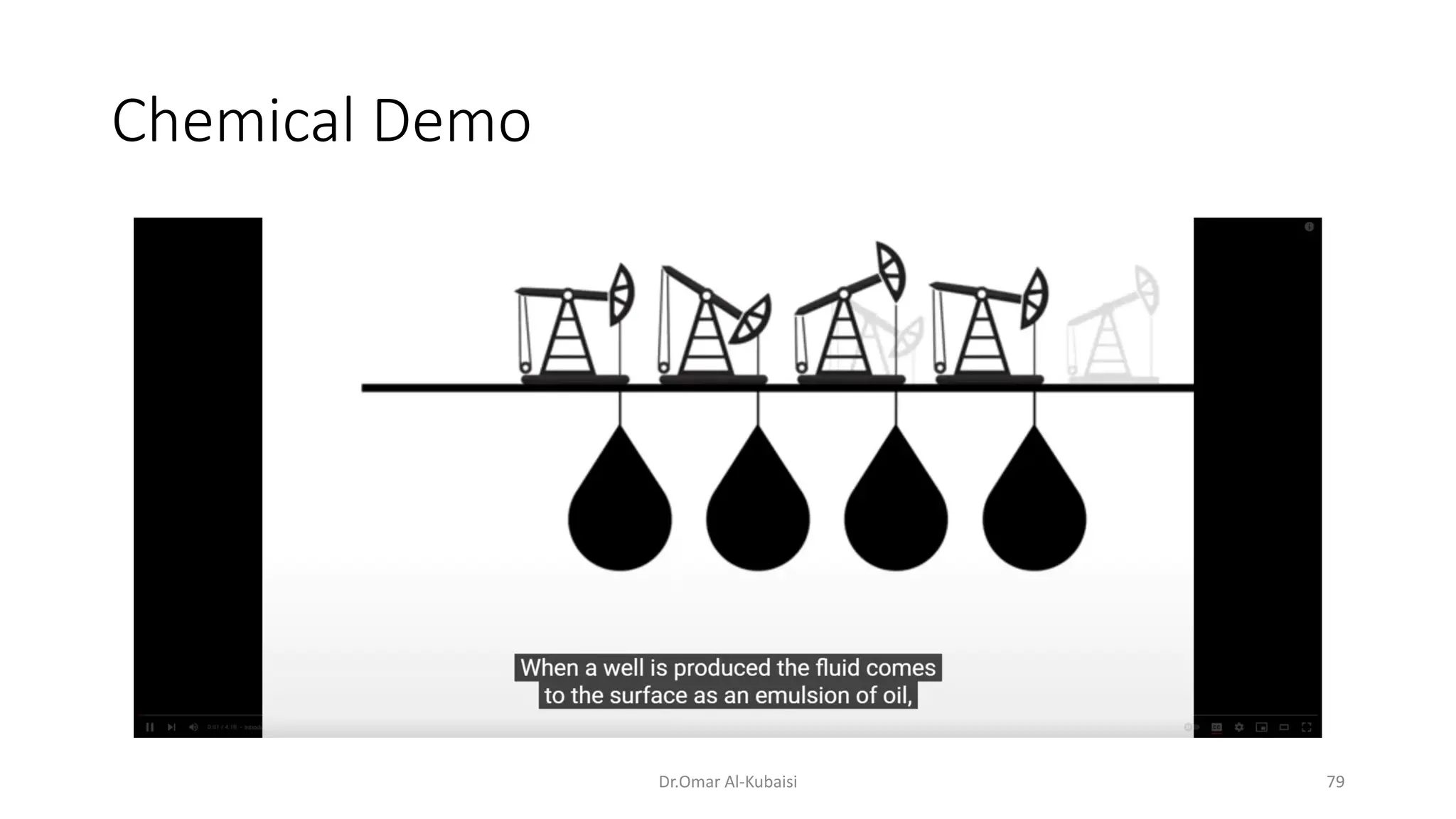
Chemical Demo
Dr.Omar Al-Kubaisi 63
Electrostatic Settler
Dr.Omar Al-Kubaisi 64
How to achieve the successful desalting
process?
Residence Time
Pressure Drop
Polymer Injection
Water quality
Dr.Omar Al-Kubaisi 65
Residence Time
• The higher the residence time in a desalter, the better the oil/water
separation.
• This variable can be only controlled with the vessel size, operating
level in the size or the feed rate. Since the vessel size cannot be
increased in size or reduce the feed rate, a small increase in operating
level may significantly improve the quality of the brine.
Dr.Omar Al-Kubaisi 66
Pressure drop
▪ This variable can be optimized, which is across the desalter mix valve.
▪ The higher the pressure drop, the better the mixing and thus the
improved removal of salts.
▪ However, too high a pressure drop can result in the formation of emulsion
layers that are difficult to break.
▪ The optimal pressure drop depends on the types of crudes; thus it is
important to perform test runs at dedicated periods to ensure that correct
operation is achieved.(Why?)
Dr.Omar Al-Kubaisi 67
Polymer injection:
• Polymers tend to assist in solids separation and emulsion breaking;
therefore, correct solution is applied for the system.
• Polymer types can effectively enhance the separation process for the
crudes that are used.
• Both the injection type and location are important as the longer a
chemical interacts with the crude, the better its separation.
• Polymer injection may be considered for solids separation at the
crude tank with another injection for breaking emulsions at the
desalter.
Dr.Omar Al-Kubaisi 68
Water quality:
• The quality of water employed for desalting is an essential
requirement.
• Some refinery facilities utilize stripped sour water as a source for the
desalter and contaminants in this waste stream may affect its
performance. Therefore, monitoring the quality of water is essential
so as not to pose problems in the desalter (Why?).
Dr.Omar Al-Kubaisi 69
What does the desalter process provide to
the refineries?
• The desalter provides a very critical service for the refinery, and thus
requires careful monitoring and regular optimization
Dr.Omar Al-Kubaisi 70
Process Descriptions of
Refinery Processes
Reflux arrangement
Lecture 6
Dr.Omar Al-Kubaisi 71
Desalting Process
Water washing:
• Water is mixed with the incoming crude oil through a mixing
valve.
• The water dissolves salt crystals, and the mixing distributes
the salts into the water, uniformly producing fine droplets.
• Demulsifying agents are added to break the emulsion by
removing the asphaltenes from the surface of the droplets
Heating:
• The crude oil temperature should be in the range of 120–130 °F
(48.9–54.4 °C) since the water-oil separation is affected by the
viscosity and density of the oil.
Coalescence:
• The water droplets are so fine in diameter in the range of 1–10
μm that they do not settle by gravity. Coalescence produces
larger drops that can be settled by gravity.
The desalting process is accomplished
through the following steps:
Dr.Omar Al-Kubaisi 72
Coalescence
• This is accomplished
through electrostatic
electric fields between two
electrodes.
• The electric field ionizes the
water droplets and orients
them so that they are
attracted to each other.
• Agitation is also produced
and assists in coalescence.
The force of attraction
between the water droplets
is given by:
Dr.Omar Al-Kubaisi 73
Settling:
According to Stake's law, the settling rate of
the water droplets after coalescence is:
Dr.Omar Al-Kubaisi 74
• The crude oil is injected with five to six liquid volume percent water at a
temperature 200–300 °F (93– 149 °C).
• Both the ratio of water to oil and the operating conditions are functions of
the specific gravity of the crude oil, and typical operating conditions.
• The salts are dissolved in the wash water; oil and water phases are
separated in a settling vessel either
• by adding chemicals to aid in breaking up the emulsion or
• by the application of an electrostatic field to coalesce the droplets of salt
water.
• Either an AC or DC field may be applied at potentials of 16,000–35,000 V. In the
desalter, the salts (e.g., magnesium chlorides) selectively migrate to the aqueous
phase which forms a brine solution at the bottom of the desalter while the crude oil
that floats above forms a separate stream. Efficiencies up to 90–95% water removal
are achieved in a single stage and up to 99% in a two-stage desalting process.
Dr.Omar Al-Kubaisi 75
Dr.Omar Al-Kubaisi 76
Two-stage desalter.
Dr.Omar Al-Kubaisi 77
The application of an electrostatic field to coalesce
the droplets of salt water.
• Either an AC or DC field may be applied at potentials of 16,000–
35,000 V. In the desalter, the salts (e.g., magnesium chlorides)
selectively migrate to the aqueous phase which forms a brine solution
at the bottom of the desalter while the crude oil that floats above
forms a separate stream. Efficiencies up to 90–95% water removal are
achieved in a single stage and up to 99% in a two-stage desalting
process.
• A high-voltage field referred to as the “secondary field” of about
1000V/cm is applied between these two electrodes. Both the
ionization of the water droplets and coalescence takes place, and the
design achieves ~90% salt removal.
Dr.Omar Al-Kubaisi 78
Chemical Demo
Dr.Omar Al-Kubaisi 79
Electrostatic Settler
Dr.Omar Al-Kubaisi 80
How to achieve the successful desalting
process?
Residence Time
Pressure Drop
Polymer Injection
Water quality
Dr.Omar Al-Kubaisi 81
Residence Time
• The higher the residence time in a desalter, the better the oil/water
separation.
• This variable can be only controlled with the vessel size, operating
level in the size or the feed rate. Since the vessel size cannot be
increased in size or reduce the feed rate, a small increase in operating
level may significantly improve the quality of the brine.
Dr.Omar Al-Kubaisi 82
Pressure drop
▪ This variable can be optimized, which is across the desalter mix valve.
▪ The higher the pressure drop, the better the mixing and thus the
improved removal of salts.
▪ However, too high a pressure drop can result in the formation of emulsion
layers that are difficult to break.
▪ The optimal pressure drop depends on the types of crudes; thus it is
important to perform test runs at dedicated periods to ensure that correct
operation is achieved.(Why?)
Dr.Omar Al-Kubaisi 83
Polymer injection:
• Polymers tend to assist in solids separation and emulsion breaking;
therefore, correct solution is applied for the system.
• Polymer types can effectively enhance the separation process for the
crudes that are used.
• Both the injection type and location are important as the longer a
chemical interacts with the crude, the better its separation.
• Polymer injection may be considered for solids separation at the
crude tank with another injection for breaking emulsions at the
desalter.
Dr.Omar Al-Kubaisi 84
Water quality:
• The quality of water employed for desalting is an essential
requirement.
• Some refinery facilities utilize stripped sour water as a source for the
desalter and contaminants in this waste stream may affect its
performance. Therefore, monitoring the quality of water is essential
so as not to pose problems in the desalter (Why?).
Dr.Omar Al-Kubaisi 85
What does the desalter process provide to
the refineries?
• The desalter provides a very critical service for the refinery, and thus
requires careful monitoring and regular optimization
Dr.Omar Al-Kubaisi 86
The reflux arrangements:
Top tray Reflux
Pump back reflux
Pump around Reflux
Dr.Omar Al-Kubaisi 87
Process Descriptions of
Refinery Processes
Reflux arrangement
Lecture 6
Dr.Omar Al-Kubaisi 88
Top tray reflux.
This reflux takes place at the top of the tray,
and the reflux is cooled and returned to the
tower.
In some towers/columns, no reflux is
provided to any other plate.
Operating the tower only with top reflux has
some disadvantages.(Why?)
The heat input to the column is through
heated crude at the bottom, and removal is
from the top. This creates a large traffic
vapor that requires a larger tower diameter.
The recovery of heat is less efficient, but the
unit is simple in design and operation
(Figure1 beside).
Dr. Omar Al-Kubaisi 89
Figure 1
Pump back reflux
• The reflux is provided at regular intervals
as this helps every plate to act as a true
fractionator.
• The vapor load on the tower is fairly
uniform and requires a smaller column
size.
• The rejected heat at the reflux locations
can be effectively utilized.
• Since the tower temperature increases
downwards, the reflux location can be
placed where the temperature is
sufficient for transferring heat to another
stream.
• Many refineries employ this arrangement
as the towers provide excellent service.
(Figure beside).
Dr.Omar Al-Kubaisi 90
Pump around reflux
• In this arrangement, the reflux from a
lower plate is taken, cooled and fed into
the column at a higher level by 2 to 3
plates.
• This creates a local problem of mixing
uneven compositions of reflux, and
liquids present on the tray.
• This can be overcome by treating all the
plates in this zone as a single plate,
which results in an increase in the height
and the number of plates of the column
(Figure beside).
Dr.Omar Al-Kubaisi 91
What are the functions of pumparound
cooling?
• To remove latent heat from the hot flash zone vapors and help
condense the side products.
• To improve the efficiency of the crude preheat train by allowing heat
recovery at higher temperature levels than the overhead condenser,
thus reducing the required crude furnace duty.
• To reduce the vapor flow rate through the column; this reduces the
required size of the column.
Dr.Omar Al-Kubaisi 92
How does these reflux arrangement work?
• The maximum boiling point of the liquid side products is controlled
on the main column by their draw rates. For example, to increase the
maximum boiling point of the kerosene product as shown in Figure 1,
• it is necessary to decrease the flow of the diesel product (which has a
higher boiling range) and to increase the flow of the kerosene
product.
• This adjustment allows heavier components to travel up the column
to the kerosene draw tray, thereby increasing the maximum boiling
point of the kerosene product. There may also be a decrease in the
lightest portion of the diesel product because of this adjustment.
Dr.Omar Al-Kubaisi 93
Pumparound Heat removal
• There are two possible ways to remove the heat from distillation
column:
Dr.Omar Al-Kubaisi 94
Top Tower Reflux (External Reflux)
Circulating Reflux (Internal Reflux)
The circulating/internal reflux
• The circulating/internal reflux stream is
referred to as the pumparound that aids to
remove heat from a tower. Figure d shows a
pumparound or internal reflux.
• The hot liquid at 550 °F is drawn from tray 11,
which is referred to as the pumparound draw
tray. The liquid pumparound is cooled to 450 °F
and returned to the tower at a higher elevation
onto tray 10. Figure d shows that the cold 450
°F pumparound return liquid enters the
downcomer from tray 9. Tray 10 is called the
pumparound return tray.
Dr.Omar Al-Kubaisi 95
Dr.Omar Al-Kubaisi 96
Dr.Omar Al-Kubaisi 97
The reflux arrangements
in atmospheric crude
distillation unit (CDU)
Part 2
Dr.Omar Al-Kubaisi 98
Another Purpose of the Pumaround
• Another purpose of the pumparound is to suppress top-tray flooding.
For example, if tray 1 or 2 floods, the following would occur:
Dr.Omar Al-Kubaisi 99
The tower-top temperature increases.
The distillate product becomes increasingly contaminated with heavier components. In a
refinery crude distillation, the endpoint of the naphtha overhead product would increase.
The pressure drop (ΔP) across the top few trays would increase.
The liquid level in the reflux drum would increase.
What is the indication of flooding in the
distillation column? How it is corrected?
• If the reflux rate is increased to reduce the tower-top temperature,
the top temperature will increase further rather than decrease. This is
an indication of top-tray flooding. This is corrected by increasing the
pumparound duty.
Dr.Omar Al-Kubaisi 100
Tower Pressure Drop and Flooding
• A characteristic of process equipment is such that the best operation
is attained at neither a very high nor a very low loading.
• The intermediate equipment load that results in the most efficient
operation is known as the best efficiency point.
• For distillation trays, the incipient flood point corresponds to the best
efficiency point.
Dr.Omar Al-Kubaisi 101
Flooding and Entertainment Demonstration
Dr.Omar Al-Kubaisi 102
Correlation to find Efficiency
• Correlations have been carried out to determine the best efficiency
point for valves and sieve trays and are determined by:
Dr.Omar Al-Kubaisi 103
Dr.Omar Al-Kubaisi 104
Thermal Cracking
Processes
Lecture 8
Dr.Omar Al-Kubaisi 105
Thermal Cracking Processes
• Thermal cracking is the cracking of short and long chain residues under
severe thermal conditions.
• The liquid products from processes are highly olefinic, aromatic and have
high-sulfur content.
• They require hydrogen treatment to improve their properties.
• Coking is the process of carbon removal from the heavy residues in
producing lighter components that are lower in sulfur as most of the sulfur
is retained in the coke.
• The thermal treatment of hydrocarbons involves a free-radical mechanism
where reactions take place in the initiation step.
• The reactions in the final step result in the formation of heavy fractions
and coke.
Dr.Omar Al-Kubaisi 106
Classes of Thermal Cracking Processes
Mild cracking
(Visbreaking)
• The mild cracking involves
sufficient heating to crack the
residue just enough to lower
its viscosity and to produce
some light products.
Delayed
coking
• Delayed coking requires
moderate thermal cracking to
convert the residue into
lighter products, leaving coke
behind.
Sever thermal
Cracking
• The third process requires
severe thermal cracking in
which part of the coke is
burned and used to heat the
feed in the cracking reactor,
as in fluid coking.
• In another part of the
process, steam is used to
crack most of the coke (flexi-
coking).
Dr.Omar Al-Kubaisi 107
The conditions for industrial thermal cracking
processes:
Visbreaking
• Mild heating (471-493
oC) at (3.4-14bar)
• Reduced viscosity of
fuel oil.
• Low conversion at 221
oC
• Heated oil or soaking
drum
Delayed coking
• Moderate heating
(482-516 oC); 6.2 bar
• Soak drums (452-
482oC)
• Residence time until
they are full of coke
• Coke is removed
hydraulically
• Coke Yield ~ 30% wt.
Fluid coking and flexi-
coking
• Sever heating ( 482-
566 oC)at 0.7 bar.
• Fluidized bed with
steam
• Higher yields of light
ends
• Less coke yield (20%
for fluid coking and
2% for flexi-coking)
Dr.Omar Al-Kubaisi 108
Vacuum distillation
• The vacuum distillation unit (VDU) follows the atmospheric or the
crude distillation unit (CDU) in refineries.
• The bottom of the atmospheric distillation is known as the reduced
crude or topped crude.
• The reduced crude bottoms from the atmospheric tower provide the
feed to the vacuum column where the second stage of distillation
takes place.
Dr.Omar Al-Kubaisi 109
Cracking does not occur in a vacuum column
• Cracking does not occur in a vacuum column because the column has
a large diameter and is operated at very low pressure, and
subsequently boiling takes place at a low temperature.
Dr.Omar Al-Kubaisi 110
Types of vacuum distillation columns
wet type
• The wet type unit uses steam to reduce
the partial pressure of oil in the flash
zone of the column to the required level
• The wet type unit requires a huge
quantity of steam, which is dependent
on the amount of vacuum
dry type
• The dry type unit depends solely on the
effectiveness of the vacuum inside the
column to vaporize the heavy oil
• The dry vacuum type has a higher flash
zone temperature than the wet vacuum
unit for the same service, and as it
provides a boot cooling circuit to keep
the column boot from coking and
becoming plugged. The boot cooler sub-
cools the liquid from the flash zone and
prevents coking.
Dr.Omar Al-Kubaisi 111
Wet and dry vacuum units
Dr.Omar Al-Kubaisi 112
What is the both unit have? How it works?
• The both unit have a wash grid above the flash zone, the feed to the
column enters the flash zone at very high velocity, and high amount
of heavy liquid entertained in the flash zone vapor.
• The heavy gas oil that is returned to the column over the wash grid
washes down the entrained liquids.
Dr.Omar Al-Kubaisi 113
Thermal Cracking Processes
Lecture 10
Dr.Omar Al-Kubaisi 114
Pressure Drop
• The pressure drop that occurs between the barometric condenser
and the vaporizer section of the column is essential, as the purpose of
vacuum operation is to produce a low effective pressure at the
vaporizer, and thus the vacuum must not be lost by excessive friction
loss through the vapor line, condensers and column plates.
• Avoiding a few millimeters (mm) of pressure drop from the
barometric to the vaporizer can save many pounds of process steam
as the saving in the quantity of steam is important.
Dr.Omar Al-Kubaisi 115
Vacuum Distillation Operation
• The operation of vacuum column is
similar to that of crude oil distillation
(atmospheric) column with refluxes,
side strippers, pumparounds, steam
injection, etc., except that the
operation is under vacuum conditions.
Figure beside shows a schematic of
high-vacuum distillation column for
processing long residue to waxy
distillate and short residue,
respectively.
Dr.Omar Al-Kubaisi 116
Steps of fractionation in the vacuum distillation
• This process has more internal reflux, and the side products are
drawn to meet specified viscosities and other related properties that
are important for lubricating oils.
• Not all topped crude oil is suitable for the production of lubricating
oils. For asphalt type crude oils, the vacuum column bottoms product
is used to make the road asphalt.
• For other types of crude oils, the material is charged to a coking
process, where it is cracked to petroleum coke and low-grade gas oils.
• The gas oils from the coking process must usually be treated to
remove sulfur and nitrogen before they are suitable for charge to
cracking units
Dr.Omar Al-Kubaisi 117
Process Description
• What are the causes of losses of products and equipment fouling in the
atmospheric pressure distillation?
• Highest temperature is required in the equipment, and thermal cracking would
occur- heavier fractions of crude oil will cracked.
• Why heavier fraction is fractioned under vacuum condition?
• Distillation is carried out with an absolute pressure in the tower flash zone area of
25-45 mm Hg.
• What we can do to enhance the vaporization in the distillation column?
• To enhance vaporization, the pressure is lowered even further to 10 mm Hg.
• Addition of steam increases the furnace tube velocity and reduces the coke
formation as well as decreasing the total hydrocarbon partial pressure in the vacuum
tower.
Dr.Omar Al-Kubaisi 118
• Enters at the
lower part of the
column
• 3-5 % vapors are
produced
• This provides
fractionation
between the
High –Vacuum
gas oil(HVGO)
draw-off tray
and the flash
zone.
Feed Entry
• The distillate is
low vacuum gas
oil(LVGO)
• Medium vacuum
gas oil (MVGO)
• High vacuum
gas-oil (HVGO)
• The two cuts of
MVGO and
HVGO are
essential to
extract heat
Products
• Columns
equipped with
packing for
fractionation,
heat exchange
zone. Why?
• To reduce the
pressure drop
in the column,
which is
important for
creating the a
low vacuum in
low section of
Vacuum equipped
with…
• Created by a
series of steam
jet ejectors that
use `100 psi (6.9
bar) steam.
Vacuum Creation
Dr.Omar Al-Kubaisi 119
Thermal Cracking
Processes
Steam Jet Ejectors
Lecture 11
Dr.Omar Al-Kubaisi 120
Steam Jet Ejector
• The ejector gas load consists of two sources:
Dr.Omar Al-Kubaisi 121
air in-leakage • The amount of air sucked into the system is
independent of throughput.
uncondensed
gas
• The uncondensed gas that results from thermal
cracking of the vacuum column charge in the
preheat furnace is proportional to the load on
the ejector interstage condensers and hence the
feed rate.
Explain the Steam Jet Ejectors Operation
Dr.Omar Al-Kubaisi 122
• The convergent-divergent steam jet is rather like a two-stage
compressor with no moving parts [4]. The figure in the previous
slide shows a simplified steam jet ejector, where high-pressure
motive steam enters through a steam nozzle.
• As the steam flows through this nozzle, its velocity greatly
increases as it flows to the condenser. The condenser condenses
the steam at a low temperature and low pressure. The steam
accelerates toward the cold surface of the tubes in the condenser,
where its large volume will disappear as the steam turns to water.
The motive steam accelerates to such a great velocity that it can
exceed the speed of sound (i.e., sonic velocity). This high increase
in velocity of the steam represents a tremendous increase in
kinetic energy of the steam. The source of this kinetic energy is the
pressure of the steam.
• As the high-velocity steam enters the mixing chamber (Figure), it
produces an extremely low pressure. The gas flows from the jet
suction nozzle and into the low pressure mixing chamber. The rest
of the jet is used to boost the gas from the mixing chamber up to
the higher pressure in the condenser, which is carried out in two
compression steps: converging and diverging.
Demonstration for the Steam Jet Ejectors
Dr.Omar Al-Kubaisi 123
Steam Jet Ejector
What will happen if an ejector is not
overloaded at a normal gas rate?
• If an ejector is not overloaded at a normal gas rate, reducing the
gas load will not result in the greatly improved vacuum. The
ejector is simply oversized at the lower charge rate and wastes
steam without obtaining any appreciable benefit in lower vacuum
tower pressure.
For what purpose steam jet ejectors
are employed?
• Steam jet ejectors are employed to recompress low
pressure steam to a higher-pressure steam. They
are sometimes used to compress low pressure
hydrocarbon vapors to higher-pressure
hydrocarbon gas.
Dr.Omar Al-Kubaisi 124
Dr.Omar Al-Kubaisi 125
• Vacuum distillation units have a system to create the
vacuum that uses either ejectors or a combination of
ejectors and liquid ring pumps.
• Ejectors recompress the gases through a nozzle where
vapors from the column are sucked into the venturi section
of the nozzle by a stream of medium- or low-pressure
steam.
• The vapor phase at the ejector exit is partially condensed in
an exchanger with cooling water.
• The liquid phase flows to the overhead drum. The vapor
phase goes from the condenser to another ejector-
condenser stage.
Vacuum Distillation Unit –Production of Waxy Distillate
Vacuum Distillation
Unit –Production of
Waxy Distillate
• Liquid ring pumps are similar to rotor
gas compressors. One pump can
replace two or three stages of ejectors
in dry or wet type vacuum distillation.
• They do not use steam and can
therefore reduce hydrocarbon-rich
aqueous condensates in a system using
ejectors.
• Systems with ejectors are flexible and
easy to operate.
• The higher investments required by
liquid ring pumps are offset by steam
consumption and lower installation
costs.
Dr.Omar Al-Kubaisi 126
Thermal Cracking
Processes
Coking
Lecture 12
Dr.Omar Al-Kubaisi 127
Coking
• Coking is a thermal cracking process as the operation is often considered to be the last stage in the refining
since the heaviest fraction (pitch or tar) is converted into very useful products. Coking is a process by which
the vacuum residue obtained from vacuum column is processed to making carbon electrodes.
• The process of coking is rather complex involving batch and continuous operations as it produces solid, liquid
and gaseous products.
Dr.Omar Al-Kubaisi 128
Coking types
Delayed coking
Fluid coking
Flexi coking
Contact coking
Dr.Omar Al-Kubaisi 129
Delayed Coking
• Objective
• The process objective is to convert low-value residue to valuable products such as naphtha, diesel and coker gas oil.
• Where this process occur?
• This process occurs in a large vessel at a slow pace (delayed), and it is the most important process among
the various coking methods (the precursor to delayed coking is the two-coil cracking process).
• Capabilities
• It is capable of cracking all types of feed materials, including solvent extracts. Thermo-cracking increases the hydrogen/
carbon ratio by carbon rejection in a semi-batch process.
• Feed Condition
• The feed to the delayed coker can be any undesirable heavy stream that contains high metal content. This
could be from a vacuum residue, a fluid catalytic cracking slurry and visbreaking tar (residues).
• The products from the coker are unsaturated gas (C1 – C4), olefins C C and iC4. The olefins are very desirable
feedstocks to the petrochemical industry. Isobutane (iC4) and olefins are sent to the alkylation units, and the
C3/C4 gases are sent to the LPG plant.
• The coker unit is the only unit in the refinery that produces coke. The highly aromatic naphtha does not
require reforming and is sent to the gasoline pool. Light coker gas oil is hydrotreated and sent to the kerosene
pool. Heavy coker gas oil is sent to the FCC for further cracking.
Dr.Omar Al-Kubaisi 130
Delayed Coking Process Steps
• In delayed coking process, heating is carried out in the furnace to initiate cracking, and the chemical reactions
are completed in huge and tall coke drums.
• Several coke drums in series are operated in a cyclic manner. While one drum is being filled, the other drums
are in the process of coking and decoking. By orderly rotating of the drums, the process can be termed
continuous, and a minimum of two drums are essential even for small capacity plants.
• Superheated feed in a large coke drum is flashed where the coke remains, and vapors leave the top and
returns to the distillation column.
• The heavy oils and light oils are recycled in different ratios to maximize the yield of either coke or distillates as
per the requirement. The off-line coke drum is drilled, and the petroleum coke is removed via hydro-jetting.
Dr.Omar Al-Kubaisi 131
Replacing for the Large drums in one of the
refinery…
Dr.Omar Al-Kubaisi 132
https://youtu.be/6KUDX1gLlF8
The expected yield of coke
• The expected yield of coke may be ~ 30% for reduced crudes or 80% for tars and pitches. Coke from these
units contains volatile matter up to 8–15%, and the bulk density of the coke obtained may be around 9 kg
per liter.
CDE (Conradson Decarbonizing Efficiency) of the plant may be reaching up to 99.8% [5]. The conditions and
parameters in delayed coking are given:
Dr.Omar Al-Kubaisi 133
What are the licensors that provide the
technologies for the coking method?
• The following licensors have provided the technologies for the
delayed coking method:
• ABB Lummus Global
• Conoco Philips
• Exxon Mobile Research
• Foster Wheeler/UOP LLG
Dr.Omar Al-Kubaisi 134
What are the delayed coking unit operations
consist of?
1. Feed preheat
2. Coking
3. Primary fractionation
4. Vapor recovery
5. Coke drum steam out/Blowdown
6. Decoking
7. Green coke handling
Dr.Omar Al-Kubaisi 135
What are the product of delayed coking unit?
1. Coker gas
2. Coker LPG
3. Coker naphtha
4. Light Coker gas oil (LCGO)
5. Heavy Coker gas oil (HCGO)
6. Green coke
Dr.Omar Al-Kubaisi 136
Figure shows the schematic of the delayed coking process.
Dr.Omar Al-Kubaisi 137
Thermal Cracking
Processes
Coking
Other Types of Coking
Lecture 13
Dr.Omar Al-Kubaisi 138
Fluid Coking
• The vacuum residue is
converted to valuable products
as naphtha, diesel and coker gas
oil.
• Fluid catalytic crackers use
catalysts to aid cracking and
here cracking and coking are
catalyzed by coke particles.
•
Dr.Omar Al-Kubaisi 139
Typical yields and dispositions of delayed and fluid coking processes.
Dr.Omar Al-Kubaisi 140
The process involves:
Dr.Omar Al-Kubaisi 141
• Preheating the residue feed,
• Scrubbing the coke particles and providing primary condensing of reactor vapors by introducing the feed to
the scrubber.
• The residue is atomized into a fluid coke bed, and thermocracking occurs on the particle surface.
• Coke particles leaving the reactor are steam stripped to remove remaining liquid hydrocarbons.
• Coke particles produced in the same unit assume more or less spherical shape and act as heat carriers while
travelling from the burner (regenerator) to the reactor; and coke carriers in reverse travel.
• Some portion of steam stripped coke is burnt, and the remaining coke is taken out.
• The hot coke particles are in a state of fluidization caused by incoming vapors. Therefore, the effective
continuous circulation of coke particles is unavoidable.
• Sub stoichiometric air is introduced to the burner to burn some of the coke and provide the necessary heat
for the reactor, and the reactor vapors leave the scrubber and flow to the fractionator.
Process flow diagram of fluidic coking unit.
Dr.Omar Al-Kubaisi 142
Flexi-Coking
• The feed consists of heavy residue and is fed into a scrubber fractionator reactor where thermal cracking
occurs.
• Steam is admitted from the bottom, and the coke fines circulate through the heater where further
coke formation takes place and then passes onto a gasifier where it encounters a stream of air and steam.
• Coke is withdrawn between the heater and the gasifier.
• The process heat is supplied by circulating hot coke between the heater and the reactor.
• Coke reacts with air and steam in the gasifier to produce heat and low Btu gas that can be used as fuel in
furnaces and boilers.
• About 97% of the coke generated is consumed during the process as a
small amount of coke is withdrawn from the heater and fine system which can be disposed in cement kilns or
used in metals recovery.
• Partial gasification and oxygen-enrichment can be used to provide additional
process flexibility.
• The primary advantage of the flexi coking (Figure beside) over fluid coking is that most of
the heating value of the coke product is made available as low-sulfur fuel gas, which can be burned without an
SO2 removal system on the resulting stack gas, whereas the system would be required if coke that contains 3–8
wt% sulfur is burned directly in a boiler.
Dr.Omar Al-Kubaisi 143
Process flow diagram of flexi-coking.
Dr.Omar Al-Kubaisi 144
The yields for a typical Middle East vacuum residue (~25 wt%,Concarbon, ~5 wt% sulfur) are:
Dr.Omar Al-Kubaisi 145
Contact Coking
• In contact coking, coke circulates
between the reactor and the heater.
• A part of the coke is always
necessary for supplying thermal
energy, and the remaining portion is
separated in the disengager. This
method gives great flexibility in
operation and control.
Dr.Omar Al-Kubaisi 146
Thermal Cracking
Processes
Coking
Coke Drums
Lecture 14
Dr.Omar Al-Kubaisi 147
Coke Drums
• Vacuum residue from VDU is preheated in
preheat exchangers against heavy coker gas
oil HCGO and heavy coker gas oil
pumparound and passes through the
fractionator boot where it is heated by
mixing with the heavy fractions, and the
resulting heater charge enters the coker
heater coil at a high velocity.
• Steam is introduced into the coil which
prevents coke deposition in the coil.
• The hot and partially vaporized mixture
enters the coke drum. The coke drum is
charged with the hot mixture to 1/2 to 2/3 of
the height of the drum.
Dr.Omar Al-Kubaisi 148
How does the hot-mix level measured in the
coke drums?
• The level of the hot-mix in drums is measured and controlled by a cathode-ray monitoring
device.
•
Dr.Omar Al-Kubaisi 149
What is the time required to charge the drum? What
will happen after the after the charging is complete?
The charging of a coke drum may require a period of 4–5 hrs. Once the charging is complete, the drum
is isolated from the stream. Effluents of the coke heater are then switched to the second drum.
What is the time required for the coking?
• Coking is a slow process, and it usually takes a period of 10–16 hrs.
The time of charging coke drums must balance the time of coking and
decoking operations.
Dr.Omar Al-Kubaisi 150
Explain the process of coking?
Dr.Omar Al-Kubaisi 151
• The feed is mixed with the stripped liquid (internal recycle)
at the bottom of the coker fractionator. This recycled stream
is heavier than the heavy coker gas oil and condenses in the
wash section of the column.
• The mixture is referred to as the heater charge. The
introduction of relatively cool coker feed into the
fractionator bottom reduces the tendency of coke formation
in the column bottoms.
• Fractionator bottoms liquid level is maintained by regulating
the flow rate of coker feed from the coker feed drum.
• A side stream of fractionator bottom liquid is continuously
circulated through the fractionator bottoms strainers by the
fractionator bottoms recirculating pump to remove the coke
fines.
Process continues…
• The coker heater charge is pumped by the coking heater charge pump, as the primary function of the
coker heater is rapidly to heat the feed to the required reaction temperature while avoiding premature
coke formation in the heater tubes.
• This steam is used for stripping light coker gas oil (LCGO) and heavy
coker gas oil (HCGO).
• The coker heater combustion air is also preheated against flue gas in the convection section to increase
efficiency.
• The coker heater is fired with fuel oil or fuel gas or combination of both fuels.
• A heater fuel gas drum separates any condensable liquids in the fuel gas before they reach the coker heater.
Dr.Omar Al-Kubaisi 152
Some important points about the coke drums
• What is benefit of using two-heater configuration in the coke drum?
• A two-heater configuration would allow offline decoking of one furnace without having to shut down
the entire unit.
• The coke drum feed leaves the heater at ~ 1040 °F (506 °C) and 4.0 kg/cm2. The coke drum inlet switch valve
diverts the hot coker feed to the bottom of the filling or coking mode coke drum.
• In the coke drum, the hot feed cracks to form coke and cracked products. Each coke drum is filled in a 24-hour
period.
• Why we need to use an antifoam chemical into the coke drums?
• An antifoam chemical is injected into the coke drum to prevent foam going into the coker fractionator.
• How we can prevent the coke formation in the coke drums?
• The cracked product leaves the top of the coke drum at 842 °F (450 °C) and 1.05 kg/cm2, which is quenched to 799 °F (426 °C) or less with
heavy coker gas oil to stop the cracking and polymerization reactions, and thus to prevent coke formation in the vapor line to the coker
fractionator.
Dr.Omar Al-Kubaisi 153
Fractionator column
Dr.Omar Al-Kubaisi 154
• The fractionator column of 24 trays and a spray zone divided
into two major sections by the heavy coker gas oil (HCGO)
draw pan.
• The quenched coke drum effluent vapor flows upwards
through the spray chamber, with some degree of cooling
accomplished by contact with HCGO wash liquid.
• The heavy recycled liquid is condensed and collected
on the wash section chimney and flows to the bottom
sump to combine with fresh coker feed.
• The product vapor flows to the upper section of the column
through the vapor risers in the heavy coker gas oil draw-off
pan.
• This vapor consists of the products and steam. Heat
removal and fractionation are accomplished in the
upper section of the fractionator
Heavy Coker Gas Oil (HCGO) Production
• HCGO draws are taken from the same draw tray and used for quenching, pumparound and HCGO stripper
feed.
• The HCGO quench, HCGO wash and HCGO pumparound are pumped by common pumps.
• The heat in the pumparound is also used to produce steam.
• The HCGO product draw from the coker fractionator flows under level control by gravity to the stripper. It is
steam-stripped in the stripper, and vapors are returned to the fractionator.
• The stripped HCGO product is pumped by the HCGO product pumps to heat the fresh feed, which is then
utilized in generating steam in the medium pressure (MP) steam generator.
• Finally, the HCGO product stream is cooled to 176 °F (80 °C) in the HCGO product air cooler and is routed as
cold HCGO product to the refinery fuels blending section.
Dr.Omar Al-Kubaisi 155
Light Coker Gas Oil (LCGO) Production
• LCGO is withdrawn from the chimney tray below tray 15 of the coker fractionator, and flows by gravity under
level control to the light coker gas oil stripper.
• Medium pressure superheated steam is used for stripping LCGO product, which is then successively cooled
to 104 °F (40 °C) and flows to the coalescers and salt driers and finally to storage and blending.
Dr.Omar Al-Kubaisi 156
Thermal Cracking
Processes
Coking
Yield Correlations for Flexi-coking
Lecture 15
Dr.Omar Al-Kubaisi 157
Yield Correlation for flexi-coking
• The yield correlations for flexi-coking are based on the Conradson carbon content of the vacuum residue
(CCR, wt%), its °API gravity and sulfur content (Sf).
• Correlations based on data compiled by Maples are expressed in weight percent yields as:
Gas wt% = 0.171943 × CCR wt% + 5.206667
Gasoline wt% = –0.115234 × CCR wt% + 18.594587
Coke wt% = 1.037233 × CCR wt% + 1.875742
Gas oil wt% = 100 – Gas wt% – Gasoline wt% – Coke wt%
Dr.Omar Al-Kubaisi 158
Gas composition:
• C4 wt% = –0.028627 × CCR wt% + 3.200754
• C–
2wt% = 0.647791 × [Gas wt%–C4 wt%] +
0.456001
• C3 wt% = Gas wt% – C4 wt% – C2
– wt%
Sulfur distribution in products:
• S wt% in Gasoline = 0.193461 Sf
• S wt% in Gas oil = 0.91482 Sf + 0.16921
• S wt% in Coke = 1.399667 Sf + 0.18691
• S in Gas = S in Feed – S in Gasoline – S in Gas oil– S in Coke
Dr.Omar Al-Kubaisi 159
Gravity of flexi-coker feed and gas oil
• Feed APIf = 0.5 × CCR wt% + 0.932644
• Gas oil API = 1.264942 × APIf + 0.506675 × CCR wt% – 0.79976
Dr.Omar Al-Kubaisi 160
• A vacuum residue of Conradson carbon residue (wt% CCR= 15) is fed into a delayed coker at a rate of
350,000 lb/h of API = 8.5 and a sulfur content of 3.0 wt%. Determine the amount of yield (lb/h) and their
sulfur content. Calculate the yields of liquid products in BDP.
Dr.Omar Al-Kubaisi 161

Petroleum Refinery IPetroleum Refinery I.pdf

  • 1.
  • 2.
    An introduction tocrude oil and its processing • The composition and characteristics of crude oil • The crude oil assay • Other basic definitions and correlations • Predicting product qualities • Basic processes • The processes common to most energy refineries • Processes not so common to energy refineries • The non-energy refineries Dr.Omar Al-Kubaisi 2
  • 3.
    The composition andcharacteristics of crude oil • Crude oil is a mixture of literally hundreds of hydrocarbon compounds ranging in size from the smallest, methane, with only one carbon atom, to large compounds containing 300 and more carbon atoms. • In order to utilize the crude oil assay it is necessary to understand the data it provides and the significance of some of the laboratory tests that are used in its compilation. Dr.Omar Al-Kubaisi 3
  • 4.
    Dr.Omar Al-Kubaisi 4 Thetrue boiling point curve • This curve is produced by mass spectrometry techniques much quicker and more accurately than by batch distillation. A typical true boiling point curve (TBP) is shown in Figure 1.
  • 5.
    The ASTM distillationcurve • This type of distillation curve is used to on a routine basis for plant and product quality control. This test is carried out on crude oil fractions using a simple apparatus designed to boil the test liquid and to condense the vapors as they are produced. Vapor temperatures are noted as the distillation proceeds and are plotted against the distillate recovered. Because only one equilibrium stage is used and no reflux is returned, the separation of components is poor. Thus, the initial boiling point (IBP) for ASTM is higher than the corresponding TBP point and the final boiling point (FBP) of the ASTM is lower than that for the TBP curve. There is a correlation between the ASTM and the TBP curve. Dr.Omar Al-Kubaisi 5
  • 6.
    API gravity • Thisis an expression of the density of an oil. Unless stated otherwise the API gravity refers to density at 60◦F (15.6◦C). Its relationship with specific gravity is given by the expression Dr.Omar Al-Kubaisi 6
  • 7.
    Flash points • Theflash point of an oil is the temperature at which the vapor above the oil will momentarily flash or explode. This temperature is determined by laboratory testing using an apparatus consisting of a closed cup containing the oil, heating and stirring equipment, and a special adjustable flame. • The type of apparatus used for middle distillate and fuel oils is called the Pensky Marten (PM), while the apparatus used in the case of Kerosene and lighter distillates is called the Abel. Reference to these tests are given later in this Handbook, and full details of the tests methods and procedures are given in ASTM Standards Part 7, Petroleum products and Lubricants. • There are many empirical methods for determining flash points from the ASTM distillation curve. One such correlation is given by the expression Dr.Omar Al-Kubaisi 7
  • 8.
    Octane numbers • Octanenumbers are a measure of a gasoline’s resistance to knock or detonation in a cylinder of a gasoline engine. The higher this resistance is the higher will be the efficiency of the fuel to produce work. A relationship exists between the antiknock characteristic of the gasoline (octane number) and the compression ratio of the engine in which it is to be used. • The higher the octane rating of the fuel then the higher the compression ratio of engine in which it can be used. • By definition, an octane number is that percentage of isooctane in a blend of isooctane and normal heptane that exactly matches the knock behavior of the gasoline. Thus, a 90 octane gasoline matches the knock characteristic of a blend containing 90% isooctane and 10% n-heptane. Dr.Omar Al-Kubaisi 8
  • 9.
    Viscosity • The viscosityof an oil is a measure of its resistance to internal flow and is an indication of its lubricating qualities. In the oil industry it is usual to quote viscosities either in centistokes (which is the unit for kinematic viscosity), seconds Saybolt universal, seconds Saybolt furol, or seconds Redwood. Dr.Omar Al-Kubaisi 9
  • 10.
    Cloud and pourpoints • Cloud and Pour Points are tests that indicate the relative coagulation of wax in the oil. They do not measure the actual wax content of the oil. • In these tests, the oil is reduced in temperature under strict control using an ice bath initially and then a frozen brine bath, and finally a bath of dry ice (solid CO2). • The temperature at which the oil becomes hazy or cloudy is taken as its cloud point. • The temperature at which the oil ceases to flow altogether is its pour point Dr.Omar Al-Kubaisi 10
  • 11.
    Sulfur content •This isself explanatory and is usually quoted as %wt for the total sulfur in the oil. Dr.Omar Al-Kubaisi 11
  • 12.
    Basic Definitions and Correlations •The composition of crude oil and its fractions are not expressed in terms of pure components, but as ‘cuts’ expressed between a range of boiling points. • These ‘cuts’ are further defined by splitting them into smaller sections and treating those sections as though they were pure components. • As such, each of these components will have precise properties such as specific gravity, viscosity, mole weight, pour point, etc. Dr.Omar Al-Kubaisi 12 A fraction with an upper cut point of 100◦F produces a yield of 20% volume of the whole crude as that fraction. The next adjacent fraction has a lower cut point of 100◦F and an upper one of 200◦F this represents a yield of 30−20% = 10% volume on crude
  • 13.
    Mid boiling point components •Draw a horizontal line through this from the 0% volume. Extend the line until the area between the line and the curve on both sides of the temperature point A are equal • The length of the horizontal line measures the yield of component A having a mid boiling point A ◦F. Repeat for the next adjacent component and continue until the whole curve is divided into these mid boiling point components. Dr.Omar Al-Kubaisi 13
  • 14.
    Good, Connel etal Method: • Good, Connel et al accumulated data to relate the ASTM end point to a TBP cut point the light and middle distillate range of crude. • Their correlation are shown in the figure 1 beside : • Thrift derived a probable shape of ASTM data. As shown in figure 2 beside: • The probability graph that he developed is given as Figure 2. The product ASTM curve from a well designed unit would be a straight line from 0 %vol to 100 %vol on this graph. Using these two graphs it is possible now to predict the ASTM distillation curve of a product knowing only its TBP cut range. Dr.Omar Al-Kubaisi 14 Figure 1 Correlation between TBP and ASTM end points. ASTM distillation probability curves. https://www.youtube.com/watch?v=ZCiRfq9d_PA
  • 15.
    Predicting TBP andASTM curves from assay data • The properties of products can be predicted by constructing mid boiling point components from a TBP curve and assigning the properties to each of these components. • These assigned properties are obtained either from the assay data, known components of similar boiling points, or established relationships such as gravity, molecular weights, and boiling points. Dr.Omar Al-Kubaisi 15
  • 16.
    Mid-volume percentage pointcomponents • This is easier than the mid boiling point concept and requires only that the curve be divided into a number of volumetric sections. The mid volume figure for each of these sections is merely the arithmetic mean of the volume range of each component. Dr.Omar Al-Kubaisi 16
  • 17.
  • 18.
    Laboratory Testing ofCrude Oils Dr.Omar Al-Kubaisi 18
  • 19.
    True Boiling Point(TBP) Curve • The composition of any crude oil sample is approximated by a true boiling point (TBP) curve. • The method for determining this is a batch distillation operation using a large number of stages, usually > 60, and high reflux to distillate ratio (> 5). Dr.Omar Al-Kubaisi 19
  • 20.
    ASTM D86 Distillation •D86 distillation uses a simple Engler flask containing a calibrated thermometer to measure the temperature of the vapor at the inlet to the condensing tube. An inclined brass condenser in a cooling brass is attached, to remove all distilled vapors; no liquid reflux is returned to the flask. The condenser tube is cooled in an ice water bath to maintain the condensing temperature between 32 and 40 °F (0–4.5 °C). The light components that boil at temperatures lower than the condensing temperature are lost from the distilled product. Dr.Omar Al-Kubaisi 20
  • 21.
    Procedure 100 ml ofsample is distilled and the vapor temperature against volume recovered is recorded. The initial boiling point (IBP) is defined as the temperature at which the first drop of liquid leaves the condenser tube. The final boiling point (FBP) or “end point” is the highest temperature recorded during the text. The total volume of the distillate is recorded as the recovery. Any liquid left in the still after the end point temperature is recorded is cooled and measured as the residue. The difference between 100 ml (initial sample volume) and the sum of the recovery and the residue is referred to as the loss. Repeated tests give ±6 °F for the initial boiling and end points. Intermediate distillation points are reproducible within 2 ml of distillate which corresponds to 6–7 °F. Figure beside shows a modern TBP apparatus. Dr.Omar Al-Kubaisi 21 Snapshot of liquid volume (%) vs. Temperature (oC) of TBP and ASTM D86 plots of distillation blend (Courtesy of Honeywell UniSim software, Honeywell (R) and UniSim (R) are registered trademarks of Honeywell International Inc.).
  • 22.
    Boiling Points • Figurebeside illustrates the inter- conversion between ASTM D –86 distillation 10% to 90% slope and the different boiling points used to characterize fractions of crude oil. • This is done to determine the properties such as the • volumetric average boiling (VABP) point, • weight average boiling point (WABP), • molal average boiling point (MABP), • mean average boiling point (MeABP) • and cubic average boiling point (CABP). On the basis of ASTM D-86 distillation data, the VABP is : Dr.Omar Al-Kubaisi 22 Characterizing Boiling Points of Petroleum Fractions (From API Technical Data Book). Used by permission, Gas Processing Suppliers Association Book Data, 12th ed., v.1 and 2. (2004). where the subscripts 10, 30, 50, 70 and 90 refer to the volume per cent recovered during the distillation.
  • 23.
    Uses of Figure •To locate the curve for the distillation VABP in the appropriate set for the type of boiling point desired. • For a known 10–90% slope, to read a correction for the VABP from the selected VABP curve. Dr.Omar Al-Kubaisi 23
  • 24.
    Problem Determine the meanaverage boiling point (MeABP) and the molecular weight for a 56.8 °API petroleum fraction with the following ASTM distillation data. Dr.Omar Al-Kubaisi 24 in the set drawn with the dashed lines (MeABP). Read across to obtain a correction value of –54 on the ordinate. MeABP = 325–54 = 271 °F. At oAPI = 56.8, the molecular weight is 198 from Correlations between MeABP. SpGr and Mol. Wt
  • 25.
    Conversion Between ASTM andTBP Distillation The True Boiling Point distillation determination of petroleum crudes can often be time consuming and tedious as compared to the ASTM method. Therefore, a correlation between ASTM and TBP distillation is employed that achieves the separation of TBP with little effort of the ASTM distillation • where a and b are constants varying with percent of liquid sample distilled as shown in Table 3.10. TBP is true boiling point temperatures at 0, 10, 30, 50, 70, 90 and 95 volume percent distilled, in degrees Rankine (oR). Dr.Omar Al-Kubaisi 25 Watson’s Characterization Factor: The MeAPB is used in the determination of Watson characterization factor as expressed by: where MeAPB is in degrees Rankin(oR).
  • 26.
    Example • 1- VAPB •VAPB= 224.2 oF (106.9 oC) • Slope • Slope =2.6325 • MeAPB= VAPB-ln∆ • ln∆ A petroleum cut has the following ASTM data Convert these data to TPB data using the API method. Plot the result and compare. If the API gravity of this fraction is 62, Calculate the Watson’s characterization factor. Dr.Omar Al-Kubaisi 26
  • 27.
    MEABP = VABP= 224.4–18.3 = 206.1 °F (96.8 °C) oAPI = 62 Specific gravity = 141.5/(62+131.5) = 0.731 Watson characterization factor from Equation is: Dr.Omar Al-Kubaisi 27
  • 28.
    Process Descriptions of RefineryProcesses Dr.Omar Al-Kubaisi 28
  • 29.
    Process Descriptions ofRefinery Processes Dr.Omar Al-Kubaisi 29
  • 30.
    Dr.Omar Al-Kubaisi 30 Introduction Refineryand Distillation Processes Process Description of the Crude Distillation Unit Crude Oil Desalting
  • 31.
    The purpose ofrefinery is : Dr.Omar Al-Kubaisi 31 Separate the crude oil into different “fractions” or saleable components. Shift the original component ratio and properties to meet the customer’s demand and Remove the impurities detrimental to product quality.
  • 32.
    Types of refineryprocessing Dr.Omar Al-Kubaisi 32 Skimming of Topping Processing Cracking Processing Lubricating Oil Processing
  • 33.
    Skimming or Topping Processing(Figure a): This occurs by simple atmospheric - pressure distillation; the crude oil is separated into gasoline, kerosene and fuel oil, or reduced crude oil, and sometimes reformer charge stock, jet fuel or gas oil. Topping is often practiced on all types of crude oil. Dr.Omar Al-Kubaisi 33
  • 34.
    Cracking Processing (Figure b) Thisrefers to a combined operation of topping and thermal cracking; in most refinery facilities, the gas oil is catalytically cracked. No lubricating oils are produced in this type of operation, and catalytic cracking yields smaller residual fuel oil. Dr.Omar Al-Kubaisi 34
  • 35.
    Lubricating-oil Processing (Figure c): Thisprocess involves topping with the manufacture of lubricants from the residue of the crude oils. Paraffin-base crude oils are generally processed for lubricants, while mixed-base oils are often processed by solvent extraction in Figure c. Naphthalene oils are processed for lubricants only under the most favorable condition. Dr.Omar Al-Kubaisi 35
  • 36.
  • 37.
    Important Points aboutthe Processing • Characteristics provide the methods of processing that are employed for the different base of oils and the products that are manufactured. • Paraffin-base oils are particularly adaptable for the manufacture of lubricating oils. • Lubricating oils are produced from mixed-base oils, but acid and solvent treatment is usually necessary. • Vacuum distillation or precipitation of asphalt by liquid propane is suited to the processing of mixed and naphthalene-base oils because most of the asphalt or tarry material may be left behind as a residue, and the cleaned lubricating-oil stocks can be treated more cheaply than asphalt-bearing stocks. • Naphthalene-base oils produce good asphalt and are usually in large quantities to justify their manufacture. • The gasoline from naphthalene crude oils is usually antiknock and may be sold directly as premium-grade motor fuel. Dr.Omar Al-Kubaisi 37
  • 38.
    Dr.Omar Al-Kubaisi 38 illustratesthe boiling range of refinery products of Texas mixed-base crude oil at 31.7°API,
  • 39.
    Dr.Omar Al-Kubaisi 39 Flowdiagram of a refinery facility for light oils (mainly gasoline, kerosene and distillates).
  • 40.
    Dr.Omar Al-Kubaisi 40 Figureshows a process flow diagram of a refinery unit, involving three main processes as separation, conversion, and treating
  • 41.
    Process Description Figure showa process flow diagram of a complex refinery unit involving further processing as crude product handling and auxiliary facilities. Here, the feed is Arabian light crude oil from tank farm, which is processed in the crude distillation unit. The first physical separation process produces distillate streams of Liquefied petroleum gas (LPG), naphtha, kerosene, light gas oil, heavy gas oil and long residue. Dr.Omar Al-Kubaisi 41
  • 42.
    Functions of someunits Dr.Omar Al-Kubaisi 42 The hydrodesulfurizer units •Remove the sulfur components contained in the naphtha, kerosene and heavy gas oil. The high-vacuum unit (HVU) •processes long residue, which comes from the mild-vacuum columns of the crude distillers. hydrocracker unit (HCU) •The main product is a waxy distillate comes from ( HVU) which is used as feed to the hydrocracker unit (HCU). The unit also produces short residue and black wash oil to be used as feed–to the visbreaker unit (VBU). The visbreaker unit( VBU) •The visbreaker unit processes the short residue from the HVU, alternatively, long residue from the crude distillers. The resulting products are naphtha and gas oil, and the visbroken residue goes for blending either with kerosene or gas oil to be used as fuel oil.
  • 43.
    Steps of Hydrocracking Thefirst section of hydrocracking unit consists of a hydrocracker and fractionating unit, sour gas and LPG treating units such as aqueous di-isopropanolamine (ADIP). The ADIP treating system consists of: - ADIP Gas Absorption Systems - LPG ADIP Extraction Systems - ADIP Regeneration Section Dr.Omar Al-Kubaisi 43
  • 44.
    First Section ofHydrocracking •The hydrocracker takes a heavy waxy distillate feed from the high-vacuum unit (HVU) and converts it in the reactors by using a catalyst under highly exothermic reaction to LPG and light gases, naphtha, and kerosene and gas oil. •The separation of the final products is achieved in the fractionating unit. Naphtha is sent to storage as platformer feed, while the kerosene is sent to storage together with the kerosene from the hydrodesulfurization unit of the crude distillation unit (CDU). •Hydrocracker gas oil is also sent to storage with the gas oil from the hydrodesulfurization unit of the CDU. The LPG (gas and liquid) is treated in the ADIP unit before being pumped to LPG unit Dr.Omar Al-Kubaisi 44
  • 45.
    Second Section of Hydrocrackinghydrogen manufacturing unit (HMU), •The HMU takes in natural gas (NG) as feed and converts it to produce high-purity hydrogen gas, which is then fed to the hydrocracker unit and other various units in the refinery that use hydrogen as feed in their processes. LPG Unit •The LPG unit receives gas and liquid; the light gas is used as fuel for the refinery furnaces and the liquid is separated into two final products: LPG is pumped to another facility, and butane is added to chemical feed naphtha for KVP correction Sour water strippers •Sour water strippers collect water from all the other refinery units and remove the sour gases from it, which are mainly dissolved hydrogen sulfide (H2S) and ammonia (NH3). •The cleaned up water is then pumped to utilities facility of the refinery for further treatment before being pumped for irrigation. The sour gas is fed to the sulfur recovery unit (SRU) where it is burnt in a series of furnaces, leaving the residual hot liquid sulfur that is then pumped to a gas plant facility. The second section consists of: - hydrogen manufacturing unit (HMU), - LPG unit, - sour water strippers, - regeneration units, - sulfur recovery units (SRU). Dr.Omar Al-Kubaisi 45
  • 46.
    Dr.Omar Al-Kubaisi 46 Tablesummarizes the various processes in a typical refinery
  • 47.
    Process Descriptions of RefineryProcesses Process Description of the Crude Distillation Unit Lecture 4 Dr.Omar Al-Kubaisi 47
  • 48.
    Process Description ofthe Crude Distillation Unit • Crude oil distillation columns are in various sizes and the capacities for processing the feed range from 5,000 to 10,000 barrels per day (700 to 1,400 metric tons per day) to 400,000 barrels per day (56,000 metric tons per day). • The first stage in the processing of crude oil is referred to as crude distillation units (CDUs), crude topping units (CTUs), topping units, atmospheric crude distillation units, atmospheric pipe-stills, etc. Dr.Omar Al-Kubaisi 48
  • 49.
  • 50.
    CDU Steps • TheCDU is accomplished in multi-draw columns (strippers) for which all the heat is supplied to the feed. • The products are condensed and withdrawn as side products, as the hot vapor portion of the feed are contacted with colder liquid reflux flowing down the column. • The reflux is provided at the top of the flask by pumping some of the condensed liquid back to the top tray (Figure beside). • The reflux is also provided at intermediate locations in the column with pump around cooling circuits. • The hot liquid portions of the crude oil feed are stripped with steam to remove dissolved light hydrocarbons before leaving the bottom of the column Dr.Omar Al-Kubaisi 50
  • 51.
    Crude Oil Desalting •Crude oil carries with it some brine in the form of very fine water droplets emulsified in the crude. • The salt content of the crude measured in pounds per thousand barrels (PTB) can be as high as 2000. • Desalting of crude oil is an important part of the refinery operation as the salt content should be minimized to 5.7 and 14.3 kg/1000 m3 (i.e., 2 and 5 PTB). Dr.Omar Al-Kubaisi 51
  • 52.
    What are theimpacts of poor desalting? • Poor desalting of the crude could adversely impact on the following: Dr.Omar Al-Kubaisi 52 Corrosion of overhead equipment. Salt deposits inside the tubes of furnaces and tube bundles of heat exchangers. This causes fouling of the exchanger and thereby reducing the heat transfer efficiency. Salts are carried with the products and can poison the catalyst in the catalytic cracking unit.
  • 53.
    Types of Saltsin Crude Oil magnesium chloride (MgCl2) calcium chloride (CaCl2) sodium chloride (NaCl) with sodium chloride being the abundant type. • Salts in the crude oil are mostly in the form of dissolved salts in fine water droplets emulsified in the crude. • This is referred to as water-in-oil emulsion, where the continuous phase is the oil, and the dispersed phase is the water. • The water droplets are relatively tiny such that they cannot settle by gravity. • These fine droplets have on their surfaces the big asphaltene molecules with the fine solid particles coming from sediments, sand or corrosion products. • The presence of these molecules on the surface of the droplets acts as a protector that prevents the droplets from uniting with each other in what is referred to coalescence. • Furthermore, the salts can be in the form of crystals that are suspended in the crude. Removing the salts requires that they must be ionized in the water. Therefore, wash water is added to the crude to enhance the desalting process Dr.Omar Al-Kubaisi 53 These chlorides except NaCl hydrolyze at high temperatures to hydrogen chloride (HCl): HCl dissolves in the overhead system water producing hydrochloric acid, which is extremely corrosive
  • 54.
  • 55.
    Process Descriptions of RefineryProcesses Process Description of the Desalting Process Lecture 5 Dr.Omar Al-Kubaisi 55
  • 56.
    Desalting Process Water washing: •Water is mixed with the incoming crude oil through a mixing valve. • The water dissolves salt crystals, and the mixing distributes the salts into the water, uniformly producing fine droplets. • Demulsifying agents are added to break the emulsion by removing the asphaltenes from the surface of the droplets Heating: • The crude oil temperature should be in the range of 120–130 °F (48.9–54.4 °C) since the water-oil separation is affected by the viscosity and density of the oil. Coalescence: • The water droplets are so fine in diameter in the range of 1–10 μm that they do not settle by gravity. Coalescence produces larger drops that can be settled by gravity. The desalting process is accomplished through the following steps: Dr.Omar Al-Kubaisi 56
  • 57.
    Coalescence • This isaccomplished through electrostatic electric fields between two electrodes. • The electric field ionizes the water droplets and orients them so that they are attracted to each other. • Agitation is also produced and assists in coalescence. The force of attraction between the water droplets is given by: Dr.Omar Al-Kubaisi 57
  • 58.
    Settling: According to Stake'slaw, the settling rate of the water droplets after coalescence is: Dr.Omar Al-Kubaisi 58
  • 59.
    • The crudeoil is injected with five to six liquid volume percent water at a temperature 200–300 °F (93– 149 °C). • Both the ratio of water to oil and the operating conditions are functions of the specific gravity of the crude oil, and typical operating conditions. • The salts are dissolved in the wash water; oil and water phases are separated in a settling vessel either • by adding chemicals to aid in breaking up the emulsion or • by the application of an electrostatic field to coalesce the droplets of salt water. • Either an AC or DC field may be applied at potentials of 16,000–35,000 V. In the desalter, the salts (e.g., magnesium chlorides) selectively migrate to the aqueous phase which forms a brine solution at the bottom of the desalter while the crude oil that floats above forms a separate stream. Efficiencies up to 90–95% water removal are achieved in a single stage and up to 99% in a two-stage desalting process. Dr.Omar Al-Kubaisi 59
  • 60.
  • 61.
  • 62.
    The application ofan electrostatic field to coalesce the droplets of salt water. • Either an AC or DC field may be applied at potentials of 16,000– 35,000 V. In the desalter, the salts (e.g., magnesium chlorides) selectively migrate to the aqueous phase which forms a brine solution at the bottom of the desalter while the crude oil that floats above forms a separate stream. Efficiencies up to 90–95% water removal are achieved in a single stage and up to 99% in a two-stage desalting process. • A high-voltage field referred to as the “secondary field” of about 1000V/cm is applied between these two electrodes. Both the ionization of the water droplets and coalescence takes place, and the design achieves ~90% salt removal. Dr.Omar Al-Kubaisi 62
  • 63.
  • 64.
  • 65.
    How to achievethe successful desalting process? Residence Time Pressure Drop Polymer Injection Water quality Dr.Omar Al-Kubaisi 65
  • 66.
    Residence Time • Thehigher the residence time in a desalter, the better the oil/water separation. • This variable can be only controlled with the vessel size, operating level in the size or the feed rate. Since the vessel size cannot be increased in size or reduce the feed rate, a small increase in operating level may significantly improve the quality of the brine. Dr.Omar Al-Kubaisi 66
  • 67.
    Pressure drop ▪ Thisvariable can be optimized, which is across the desalter mix valve. ▪ The higher the pressure drop, the better the mixing and thus the improved removal of salts. ▪ However, too high a pressure drop can result in the formation of emulsion layers that are difficult to break. ▪ The optimal pressure drop depends on the types of crudes; thus it is important to perform test runs at dedicated periods to ensure that correct operation is achieved.(Why?) Dr.Omar Al-Kubaisi 67
  • 68.
    Polymer injection: • Polymerstend to assist in solids separation and emulsion breaking; therefore, correct solution is applied for the system. • Polymer types can effectively enhance the separation process for the crudes that are used. • Both the injection type and location are important as the longer a chemical interacts with the crude, the better its separation. • Polymer injection may be considered for solids separation at the crude tank with another injection for breaking emulsions at the desalter. Dr.Omar Al-Kubaisi 68
  • 69.
    Water quality: • Thequality of water employed for desalting is an essential requirement. • Some refinery facilities utilize stripped sour water as a source for the desalter and contaminants in this waste stream may affect its performance. Therefore, monitoring the quality of water is essential so as not to pose problems in the desalter (Why?). Dr.Omar Al-Kubaisi 69
  • 70.
    What does thedesalter process provide to the refineries? • The desalter provides a very critical service for the refinery, and thus requires careful monitoring and regular optimization Dr.Omar Al-Kubaisi 70
  • 71.
    Process Descriptions of RefineryProcesses Reflux arrangement Lecture 6 Dr.Omar Al-Kubaisi 71
  • 72.
    Desalting Process Water washing: •Water is mixed with the incoming crude oil through a mixing valve. • The water dissolves salt crystals, and the mixing distributes the salts into the water, uniformly producing fine droplets. • Demulsifying agents are added to break the emulsion by removing the asphaltenes from the surface of the droplets Heating: • The crude oil temperature should be in the range of 120–130 °F (48.9–54.4 °C) since the water-oil separation is affected by the viscosity and density of the oil. Coalescence: • The water droplets are so fine in diameter in the range of 1–10 μm that they do not settle by gravity. Coalescence produces larger drops that can be settled by gravity. The desalting process is accomplished through the following steps: Dr.Omar Al-Kubaisi 72
  • 73.
    Coalescence • This isaccomplished through electrostatic electric fields between two electrodes. • The electric field ionizes the water droplets and orients them so that they are attracted to each other. • Agitation is also produced and assists in coalescence. The force of attraction between the water droplets is given by: Dr.Omar Al-Kubaisi 73
  • 74.
    Settling: According to Stake'slaw, the settling rate of the water droplets after coalescence is: Dr.Omar Al-Kubaisi 74
  • 75.
    • The crudeoil is injected with five to six liquid volume percent water at a temperature 200–300 °F (93– 149 °C). • Both the ratio of water to oil and the operating conditions are functions of the specific gravity of the crude oil, and typical operating conditions. • The salts are dissolved in the wash water; oil and water phases are separated in a settling vessel either • by adding chemicals to aid in breaking up the emulsion or • by the application of an electrostatic field to coalesce the droplets of salt water. • Either an AC or DC field may be applied at potentials of 16,000–35,000 V. In the desalter, the salts (e.g., magnesium chlorides) selectively migrate to the aqueous phase which forms a brine solution at the bottom of the desalter while the crude oil that floats above forms a separate stream. Efficiencies up to 90–95% water removal are achieved in a single stage and up to 99% in a two-stage desalting process. Dr.Omar Al-Kubaisi 75
  • 76.
  • 77.
  • 78.
    The application ofan electrostatic field to coalesce the droplets of salt water. • Either an AC or DC field may be applied at potentials of 16,000– 35,000 V. In the desalter, the salts (e.g., magnesium chlorides) selectively migrate to the aqueous phase which forms a brine solution at the bottom of the desalter while the crude oil that floats above forms a separate stream. Efficiencies up to 90–95% water removal are achieved in a single stage and up to 99% in a two-stage desalting process. • A high-voltage field referred to as the “secondary field” of about 1000V/cm is applied between these two electrodes. Both the ionization of the water droplets and coalescence takes place, and the design achieves ~90% salt removal. Dr.Omar Al-Kubaisi 78
  • 79.
  • 80.
  • 81.
    How to achievethe successful desalting process? Residence Time Pressure Drop Polymer Injection Water quality Dr.Omar Al-Kubaisi 81
  • 82.
    Residence Time • Thehigher the residence time in a desalter, the better the oil/water separation. • This variable can be only controlled with the vessel size, operating level in the size or the feed rate. Since the vessel size cannot be increased in size or reduce the feed rate, a small increase in operating level may significantly improve the quality of the brine. Dr.Omar Al-Kubaisi 82
  • 83.
    Pressure drop ▪ Thisvariable can be optimized, which is across the desalter mix valve. ▪ The higher the pressure drop, the better the mixing and thus the improved removal of salts. ▪ However, too high a pressure drop can result in the formation of emulsion layers that are difficult to break. ▪ The optimal pressure drop depends on the types of crudes; thus it is important to perform test runs at dedicated periods to ensure that correct operation is achieved.(Why?) Dr.Omar Al-Kubaisi 83
  • 84.
    Polymer injection: • Polymerstend to assist in solids separation and emulsion breaking; therefore, correct solution is applied for the system. • Polymer types can effectively enhance the separation process for the crudes that are used. • Both the injection type and location are important as the longer a chemical interacts with the crude, the better its separation. • Polymer injection may be considered for solids separation at the crude tank with another injection for breaking emulsions at the desalter. Dr.Omar Al-Kubaisi 84
  • 85.
    Water quality: • Thequality of water employed for desalting is an essential requirement. • Some refinery facilities utilize stripped sour water as a source for the desalter and contaminants in this waste stream may affect its performance. Therefore, monitoring the quality of water is essential so as not to pose problems in the desalter (Why?). Dr.Omar Al-Kubaisi 85
  • 86.
    What does thedesalter process provide to the refineries? • The desalter provides a very critical service for the refinery, and thus requires careful monitoring and regular optimization Dr.Omar Al-Kubaisi 86
  • 87.
    The reflux arrangements: Toptray Reflux Pump back reflux Pump around Reflux Dr.Omar Al-Kubaisi 87
  • 88.
    Process Descriptions of RefineryProcesses Reflux arrangement Lecture 6 Dr.Omar Al-Kubaisi 88
  • 89.
    Top tray reflux. Thisreflux takes place at the top of the tray, and the reflux is cooled and returned to the tower. In some towers/columns, no reflux is provided to any other plate. Operating the tower only with top reflux has some disadvantages.(Why?) The heat input to the column is through heated crude at the bottom, and removal is from the top. This creates a large traffic vapor that requires a larger tower diameter. The recovery of heat is less efficient, but the unit is simple in design and operation (Figure1 beside). Dr. Omar Al-Kubaisi 89 Figure 1
  • 90.
    Pump back reflux •The reflux is provided at regular intervals as this helps every plate to act as a true fractionator. • The vapor load on the tower is fairly uniform and requires a smaller column size. • The rejected heat at the reflux locations can be effectively utilized. • Since the tower temperature increases downwards, the reflux location can be placed where the temperature is sufficient for transferring heat to another stream. • Many refineries employ this arrangement as the towers provide excellent service. (Figure beside). Dr.Omar Al-Kubaisi 90
  • 91.
    Pump around reflux •In this arrangement, the reflux from a lower plate is taken, cooled and fed into the column at a higher level by 2 to 3 plates. • This creates a local problem of mixing uneven compositions of reflux, and liquids present on the tray. • This can be overcome by treating all the plates in this zone as a single plate, which results in an increase in the height and the number of plates of the column (Figure beside). Dr.Omar Al-Kubaisi 91
  • 92.
    What are thefunctions of pumparound cooling? • To remove latent heat from the hot flash zone vapors and help condense the side products. • To improve the efficiency of the crude preheat train by allowing heat recovery at higher temperature levels than the overhead condenser, thus reducing the required crude furnace duty. • To reduce the vapor flow rate through the column; this reduces the required size of the column. Dr.Omar Al-Kubaisi 92
  • 93.
    How does thesereflux arrangement work? • The maximum boiling point of the liquid side products is controlled on the main column by their draw rates. For example, to increase the maximum boiling point of the kerosene product as shown in Figure 1, • it is necessary to decrease the flow of the diesel product (which has a higher boiling range) and to increase the flow of the kerosene product. • This adjustment allows heavier components to travel up the column to the kerosene draw tray, thereby increasing the maximum boiling point of the kerosene product. There may also be a decrease in the lightest portion of the diesel product because of this adjustment. Dr.Omar Al-Kubaisi 93
  • 94.
    Pumparound Heat removal •There are two possible ways to remove the heat from distillation column: Dr.Omar Al-Kubaisi 94 Top Tower Reflux (External Reflux) Circulating Reflux (Internal Reflux)
  • 95.
    The circulating/internal reflux •The circulating/internal reflux stream is referred to as the pumparound that aids to remove heat from a tower. Figure d shows a pumparound or internal reflux. • The hot liquid at 550 °F is drawn from tray 11, which is referred to as the pumparound draw tray. The liquid pumparound is cooled to 450 °F and returned to the tower at a higher elevation onto tray 10. Figure d shows that the cold 450 °F pumparound return liquid enters the downcomer from tray 9. Tray 10 is called the pumparound return tray. Dr.Omar Al-Kubaisi 95
  • 96.
  • 97.
  • 98.
    The reflux arrangements inatmospheric crude distillation unit (CDU) Part 2 Dr.Omar Al-Kubaisi 98
  • 99.
    Another Purpose ofthe Pumaround • Another purpose of the pumparound is to suppress top-tray flooding. For example, if tray 1 or 2 floods, the following would occur: Dr.Omar Al-Kubaisi 99 The tower-top temperature increases. The distillate product becomes increasingly contaminated with heavier components. In a refinery crude distillation, the endpoint of the naphtha overhead product would increase. The pressure drop (ΔP) across the top few trays would increase. The liquid level in the reflux drum would increase.
  • 100.
    What is theindication of flooding in the distillation column? How it is corrected? • If the reflux rate is increased to reduce the tower-top temperature, the top temperature will increase further rather than decrease. This is an indication of top-tray flooding. This is corrected by increasing the pumparound duty. Dr.Omar Al-Kubaisi 100
  • 101.
    Tower Pressure Dropand Flooding • A characteristic of process equipment is such that the best operation is attained at neither a very high nor a very low loading. • The intermediate equipment load that results in the most efficient operation is known as the best efficiency point. • For distillation trays, the incipient flood point corresponds to the best efficiency point. Dr.Omar Al-Kubaisi 101
  • 102.
    Flooding and EntertainmentDemonstration Dr.Omar Al-Kubaisi 102
  • 103.
    Correlation to findEfficiency • Correlations have been carried out to determine the best efficiency point for valves and sieve trays and are determined by: Dr.Omar Al-Kubaisi 103
  • 104.
  • 105.
  • 106.
    Thermal Cracking Processes •Thermal cracking is the cracking of short and long chain residues under severe thermal conditions. • The liquid products from processes are highly olefinic, aromatic and have high-sulfur content. • They require hydrogen treatment to improve their properties. • Coking is the process of carbon removal from the heavy residues in producing lighter components that are lower in sulfur as most of the sulfur is retained in the coke. • The thermal treatment of hydrocarbons involves a free-radical mechanism where reactions take place in the initiation step. • The reactions in the final step result in the formation of heavy fractions and coke. Dr.Omar Al-Kubaisi 106
  • 107.
    Classes of ThermalCracking Processes Mild cracking (Visbreaking) • The mild cracking involves sufficient heating to crack the residue just enough to lower its viscosity and to produce some light products. Delayed coking • Delayed coking requires moderate thermal cracking to convert the residue into lighter products, leaving coke behind. Sever thermal Cracking • The third process requires severe thermal cracking in which part of the coke is burned and used to heat the feed in the cracking reactor, as in fluid coking. • In another part of the process, steam is used to crack most of the coke (flexi- coking). Dr.Omar Al-Kubaisi 107
  • 108.
    The conditions forindustrial thermal cracking processes: Visbreaking • Mild heating (471-493 oC) at (3.4-14bar) • Reduced viscosity of fuel oil. • Low conversion at 221 oC • Heated oil or soaking drum Delayed coking • Moderate heating (482-516 oC); 6.2 bar • Soak drums (452- 482oC) • Residence time until they are full of coke • Coke is removed hydraulically • Coke Yield ~ 30% wt. Fluid coking and flexi- coking • Sever heating ( 482- 566 oC)at 0.7 bar. • Fluidized bed with steam • Higher yields of light ends • Less coke yield (20% for fluid coking and 2% for flexi-coking) Dr.Omar Al-Kubaisi 108
  • 109.
    Vacuum distillation • Thevacuum distillation unit (VDU) follows the atmospheric or the crude distillation unit (CDU) in refineries. • The bottom of the atmospheric distillation is known as the reduced crude or topped crude. • The reduced crude bottoms from the atmospheric tower provide the feed to the vacuum column where the second stage of distillation takes place. Dr.Omar Al-Kubaisi 109
  • 110.
    Cracking does notoccur in a vacuum column • Cracking does not occur in a vacuum column because the column has a large diameter and is operated at very low pressure, and subsequently boiling takes place at a low temperature. Dr.Omar Al-Kubaisi 110
  • 111.
    Types of vacuumdistillation columns wet type • The wet type unit uses steam to reduce the partial pressure of oil in the flash zone of the column to the required level • The wet type unit requires a huge quantity of steam, which is dependent on the amount of vacuum dry type • The dry type unit depends solely on the effectiveness of the vacuum inside the column to vaporize the heavy oil • The dry vacuum type has a higher flash zone temperature than the wet vacuum unit for the same service, and as it provides a boot cooling circuit to keep the column boot from coking and becoming plugged. The boot cooler sub- cools the liquid from the flash zone and prevents coking. Dr.Omar Al-Kubaisi 111
  • 112.
    Wet and dryvacuum units Dr.Omar Al-Kubaisi 112
  • 113.
    What is theboth unit have? How it works? • The both unit have a wash grid above the flash zone, the feed to the column enters the flash zone at very high velocity, and high amount of heavy liquid entertained in the flash zone vapor. • The heavy gas oil that is returned to the column over the wash grid washes down the entrained liquids. Dr.Omar Al-Kubaisi 113
  • 114.
    Thermal Cracking Processes Lecture10 Dr.Omar Al-Kubaisi 114
  • 115.
    Pressure Drop • Thepressure drop that occurs between the barometric condenser and the vaporizer section of the column is essential, as the purpose of vacuum operation is to produce a low effective pressure at the vaporizer, and thus the vacuum must not be lost by excessive friction loss through the vapor line, condensers and column plates. • Avoiding a few millimeters (mm) of pressure drop from the barometric to the vaporizer can save many pounds of process steam as the saving in the quantity of steam is important. Dr.Omar Al-Kubaisi 115
  • 116.
    Vacuum Distillation Operation •The operation of vacuum column is similar to that of crude oil distillation (atmospheric) column with refluxes, side strippers, pumparounds, steam injection, etc., except that the operation is under vacuum conditions. Figure beside shows a schematic of high-vacuum distillation column for processing long residue to waxy distillate and short residue, respectively. Dr.Omar Al-Kubaisi 116
  • 117.
    Steps of fractionationin the vacuum distillation • This process has more internal reflux, and the side products are drawn to meet specified viscosities and other related properties that are important for lubricating oils. • Not all topped crude oil is suitable for the production of lubricating oils. For asphalt type crude oils, the vacuum column bottoms product is used to make the road asphalt. • For other types of crude oils, the material is charged to a coking process, where it is cracked to petroleum coke and low-grade gas oils. • The gas oils from the coking process must usually be treated to remove sulfur and nitrogen before they are suitable for charge to cracking units Dr.Omar Al-Kubaisi 117
  • 118.
    Process Description • Whatare the causes of losses of products and equipment fouling in the atmospheric pressure distillation? • Highest temperature is required in the equipment, and thermal cracking would occur- heavier fractions of crude oil will cracked. • Why heavier fraction is fractioned under vacuum condition? • Distillation is carried out with an absolute pressure in the tower flash zone area of 25-45 mm Hg. • What we can do to enhance the vaporization in the distillation column? • To enhance vaporization, the pressure is lowered even further to 10 mm Hg. • Addition of steam increases the furnace tube velocity and reduces the coke formation as well as decreasing the total hydrocarbon partial pressure in the vacuum tower. Dr.Omar Al-Kubaisi 118
  • 119.
    • Enters atthe lower part of the column • 3-5 % vapors are produced • This provides fractionation between the High –Vacuum gas oil(HVGO) draw-off tray and the flash zone. Feed Entry • The distillate is low vacuum gas oil(LVGO) • Medium vacuum gas oil (MVGO) • High vacuum gas-oil (HVGO) • The two cuts of MVGO and HVGO are essential to extract heat Products • Columns equipped with packing for fractionation, heat exchange zone. Why? • To reduce the pressure drop in the column, which is important for creating the a low vacuum in low section of Vacuum equipped with… • Created by a series of steam jet ejectors that use `100 psi (6.9 bar) steam. Vacuum Creation Dr.Omar Al-Kubaisi 119
  • 120.
    Thermal Cracking Processes Steam JetEjectors Lecture 11 Dr.Omar Al-Kubaisi 120
  • 121.
    Steam Jet Ejector •The ejector gas load consists of two sources: Dr.Omar Al-Kubaisi 121 air in-leakage • The amount of air sucked into the system is independent of throughput. uncondensed gas • The uncondensed gas that results from thermal cracking of the vacuum column charge in the preheat furnace is proportional to the load on the ejector interstage condensers and hence the feed rate.
  • 122.
    Explain the SteamJet Ejectors Operation Dr.Omar Al-Kubaisi 122 • The convergent-divergent steam jet is rather like a two-stage compressor with no moving parts [4]. The figure in the previous slide shows a simplified steam jet ejector, where high-pressure motive steam enters through a steam nozzle. • As the steam flows through this nozzle, its velocity greatly increases as it flows to the condenser. The condenser condenses the steam at a low temperature and low pressure. The steam accelerates toward the cold surface of the tubes in the condenser, where its large volume will disappear as the steam turns to water. The motive steam accelerates to such a great velocity that it can exceed the speed of sound (i.e., sonic velocity). This high increase in velocity of the steam represents a tremendous increase in kinetic energy of the steam. The source of this kinetic energy is the pressure of the steam. • As the high-velocity steam enters the mixing chamber (Figure), it produces an extremely low pressure. The gas flows from the jet suction nozzle and into the low pressure mixing chamber. The rest of the jet is used to boost the gas from the mixing chamber up to the higher pressure in the condenser, which is carried out in two compression steps: converging and diverging.
  • 123.
    Demonstration for theSteam Jet Ejectors Dr.Omar Al-Kubaisi 123
  • 124.
    Steam Jet Ejector Whatwill happen if an ejector is not overloaded at a normal gas rate? • If an ejector is not overloaded at a normal gas rate, reducing the gas load will not result in the greatly improved vacuum. The ejector is simply oversized at the lower charge rate and wastes steam without obtaining any appreciable benefit in lower vacuum tower pressure. For what purpose steam jet ejectors are employed? • Steam jet ejectors are employed to recompress low pressure steam to a higher-pressure steam. They are sometimes used to compress low pressure hydrocarbon vapors to higher-pressure hydrocarbon gas. Dr.Omar Al-Kubaisi 124
  • 125.
    Dr.Omar Al-Kubaisi 125 •Vacuum distillation units have a system to create the vacuum that uses either ejectors or a combination of ejectors and liquid ring pumps. • Ejectors recompress the gases through a nozzle where vapors from the column are sucked into the venturi section of the nozzle by a stream of medium- or low-pressure steam. • The vapor phase at the ejector exit is partially condensed in an exchanger with cooling water. • The liquid phase flows to the overhead drum. The vapor phase goes from the condenser to another ejector- condenser stage. Vacuum Distillation Unit –Production of Waxy Distillate
  • 126.
    Vacuum Distillation Unit –Productionof Waxy Distillate • Liquid ring pumps are similar to rotor gas compressors. One pump can replace two or three stages of ejectors in dry or wet type vacuum distillation. • They do not use steam and can therefore reduce hydrocarbon-rich aqueous condensates in a system using ejectors. • Systems with ejectors are flexible and easy to operate. • The higher investments required by liquid ring pumps are offset by steam consumption and lower installation costs. Dr.Omar Al-Kubaisi 126
  • 127.
  • 128.
    Coking • Coking isa thermal cracking process as the operation is often considered to be the last stage in the refining since the heaviest fraction (pitch or tar) is converted into very useful products. Coking is a process by which the vacuum residue obtained from vacuum column is processed to making carbon electrodes. • The process of coking is rather complex involving batch and continuous operations as it produces solid, liquid and gaseous products. Dr.Omar Al-Kubaisi 128
  • 129.
    Coking types Delayed coking Fluidcoking Flexi coking Contact coking Dr.Omar Al-Kubaisi 129
  • 130.
    Delayed Coking • Objective •The process objective is to convert low-value residue to valuable products such as naphtha, diesel and coker gas oil. • Where this process occur? • This process occurs in a large vessel at a slow pace (delayed), and it is the most important process among the various coking methods (the precursor to delayed coking is the two-coil cracking process). • Capabilities • It is capable of cracking all types of feed materials, including solvent extracts. Thermo-cracking increases the hydrogen/ carbon ratio by carbon rejection in a semi-batch process. • Feed Condition • The feed to the delayed coker can be any undesirable heavy stream that contains high metal content. This could be from a vacuum residue, a fluid catalytic cracking slurry and visbreaking tar (residues). • The products from the coker are unsaturated gas (C1 – C4), olefins C C and iC4. The olefins are very desirable feedstocks to the petrochemical industry. Isobutane (iC4) and olefins are sent to the alkylation units, and the C3/C4 gases are sent to the LPG plant. • The coker unit is the only unit in the refinery that produces coke. The highly aromatic naphtha does not require reforming and is sent to the gasoline pool. Light coker gas oil is hydrotreated and sent to the kerosene pool. Heavy coker gas oil is sent to the FCC for further cracking. Dr.Omar Al-Kubaisi 130
  • 131.
    Delayed Coking ProcessSteps • In delayed coking process, heating is carried out in the furnace to initiate cracking, and the chemical reactions are completed in huge and tall coke drums. • Several coke drums in series are operated in a cyclic manner. While one drum is being filled, the other drums are in the process of coking and decoking. By orderly rotating of the drums, the process can be termed continuous, and a minimum of two drums are essential even for small capacity plants. • Superheated feed in a large coke drum is flashed where the coke remains, and vapors leave the top and returns to the distillation column. • The heavy oils and light oils are recycled in different ratios to maximize the yield of either coke or distillates as per the requirement. The off-line coke drum is drilled, and the petroleum coke is removed via hydro-jetting. Dr.Omar Al-Kubaisi 131
  • 132.
    Replacing for theLarge drums in one of the refinery… Dr.Omar Al-Kubaisi 132 https://youtu.be/6KUDX1gLlF8
  • 133.
    The expected yieldof coke • The expected yield of coke may be ~ 30% for reduced crudes or 80% for tars and pitches. Coke from these units contains volatile matter up to 8–15%, and the bulk density of the coke obtained may be around 9 kg per liter. CDE (Conradson Decarbonizing Efficiency) of the plant may be reaching up to 99.8% [5]. The conditions and parameters in delayed coking are given: Dr.Omar Al-Kubaisi 133
  • 134.
    What are thelicensors that provide the technologies for the coking method? • The following licensors have provided the technologies for the delayed coking method: • ABB Lummus Global • Conoco Philips • Exxon Mobile Research • Foster Wheeler/UOP LLG Dr.Omar Al-Kubaisi 134
  • 135.
    What are thedelayed coking unit operations consist of? 1. Feed preheat 2. Coking 3. Primary fractionation 4. Vapor recovery 5. Coke drum steam out/Blowdown 6. Decoking 7. Green coke handling Dr.Omar Al-Kubaisi 135
  • 136.
    What are theproduct of delayed coking unit? 1. Coker gas 2. Coker LPG 3. Coker naphtha 4. Light Coker gas oil (LCGO) 5. Heavy Coker gas oil (HCGO) 6. Green coke Dr.Omar Al-Kubaisi 136
  • 137.
    Figure shows theschematic of the delayed coking process. Dr.Omar Al-Kubaisi 137
  • 138.
    Thermal Cracking Processes Coking Other Typesof Coking Lecture 13 Dr.Omar Al-Kubaisi 138
  • 139.
    Fluid Coking • Thevacuum residue is converted to valuable products as naphtha, diesel and coker gas oil. • Fluid catalytic crackers use catalysts to aid cracking and here cracking and coking are catalyzed by coke particles. • Dr.Omar Al-Kubaisi 139
  • 140.
    Typical yields anddispositions of delayed and fluid coking processes. Dr.Omar Al-Kubaisi 140
  • 141.
    The process involves: Dr.OmarAl-Kubaisi 141 • Preheating the residue feed, • Scrubbing the coke particles and providing primary condensing of reactor vapors by introducing the feed to the scrubber. • The residue is atomized into a fluid coke bed, and thermocracking occurs on the particle surface. • Coke particles leaving the reactor are steam stripped to remove remaining liquid hydrocarbons. • Coke particles produced in the same unit assume more or less spherical shape and act as heat carriers while travelling from the burner (regenerator) to the reactor; and coke carriers in reverse travel. • Some portion of steam stripped coke is burnt, and the remaining coke is taken out. • The hot coke particles are in a state of fluidization caused by incoming vapors. Therefore, the effective continuous circulation of coke particles is unavoidable. • Sub stoichiometric air is introduced to the burner to burn some of the coke and provide the necessary heat for the reactor, and the reactor vapors leave the scrubber and flow to the fractionator.
  • 142.
    Process flow diagramof fluidic coking unit. Dr.Omar Al-Kubaisi 142
  • 143.
    Flexi-Coking • The feedconsists of heavy residue and is fed into a scrubber fractionator reactor where thermal cracking occurs. • Steam is admitted from the bottom, and the coke fines circulate through the heater where further coke formation takes place and then passes onto a gasifier where it encounters a stream of air and steam. • Coke is withdrawn between the heater and the gasifier. • The process heat is supplied by circulating hot coke between the heater and the reactor. • Coke reacts with air and steam in the gasifier to produce heat and low Btu gas that can be used as fuel in furnaces and boilers. • About 97% of the coke generated is consumed during the process as a small amount of coke is withdrawn from the heater and fine system which can be disposed in cement kilns or used in metals recovery. • Partial gasification and oxygen-enrichment can be used to provide additional process flexibility. • The primary advantage of the flexi coking (Figure beside) over fluid coking is that most of the heating value of the coke product is made available as low-sulfur fuel gas, which can be burned without an SO2 removal system on the resulting stack gas, whereas the system would be required if coke that contains 3–8 wt% sulfur is burned directly in a boiler. Dr.Omar Al-Kubaisi 143 Process flow diagram of flexi-coking.
  • 144.
  • 145.
    The yields fora typical Middle East vacuum residue (~25 wt%,Concarbon, ~5 wt% sulfur) are: Dr.Omar Al-Kubaisi 145
  • 146.
    Contact Coking • Incontact coking, coke circulates between the reactor and the heater. • A part of the coke is always necessary for supplying thermal energy, and the remaining portion is separated in the disengager. This method gives great flexibility in operation and control. Dr.Omar Al-Kubaisi 146
  • 147.
  • 148.
    Coke Drums • Vacuumresidue from VDU is preheated in preheat exchangers against heavy coker gas oil HCGO and heavy coker gas oil pumparound and passes through the fractionator boot where it is heated by mixing with the heavy fractions, and the resulting heater charge enters the coker heater coil at a high velocity. • Steam is introduced into the coil which prevents coke deposition in the coil. • The hot and partially vaporized mixture enters the coke drum. The coke drum is charged with the hot mixture to 1/2 to 2/3 of the height of the drum. Dr.Omar Al-Kubaisi 148
  • 149.
    How does thehot-mix level measured in the coke drums? • The level of the hot-mix in drums is measured and controlled by a cathode-ray monitoring device. • Dr.Omar Al-Kubaisi 149 What is the time required to charge the drum? What will happen after the after the charging is complete? The charging of a coke drum may require a period of 4–5 hrs. Once the charging is complete, the drum is isolated from the stream. Effluents of the coke heater are then switched to the second drum.
  • 150.
    What is thetime required for the coking? • Coking is a slow process, and it usually takes a period of 10–16 hrs. The time of charging coke drums must balance the time of coking and decoking operations. Dr.Omar Al-Kubaisi 150
  • 151.
    Explain the processof coking? Dr.Omar Al-Kubaisi 151 • The feed is mixed with the stripped liquid (internal recycle) at the bottom of the coker fractionator. This recycled stream is heavier than the heavy coker gas oil and condenses in the wash section of the column. • The mixture is referred to as the heater charge. The introduction of relatively cool coker feed into the fractionator bottom reduces the tendency of coke formation in the column bottoms. • Fractionator bottoms liquid level is maintained by regulating the flow rate of coker feed from the coker feed drum. • A side stream of fractionator bottom liquid is continuously circulated through the fractionator bottoms strainers by the fractionator bottoms recirculating pump to remove the coke fines.
  • 152.
    Process continues… • Thecoker heater charge is pumped by the coking heater charge pump, as the primary function of the coker heater is rapidly to heat the feed to the required reaction temperature while avoiding premature coke formation in the heater tubes. • This steam is used for stripping light coker gas oil (LCGO) and heavy coker gas oil (HCGO). • The coker heater combustion air is also preheated against flue gas in the convection section to increase efficiency. • The coker heater is fired with fuel oil or fuel gas or combination of both fuels. • A heater fuel gas drum separates any condensable liquids in the fuel gas before they reach the coker heater. Dr.Omar Al-Kubaisi 152
  • 153.
    Some important pointsabout the coke drums • What is benefit of using two-heater configuration in the coke drum? • A two-heater configuration would allow offline decoking of one furnace without having to shut down the entire unit. • The coke drum feed leaves the heater at ~ 1040 °F (506 °C) and 4.0 kg/cm2. The coke drum inlet switch valve diverts the hot coker feed to the bottom of the filling or coking mode coke drum. • In the coke drum, the hot feed cracks to form coke and cracked products. Each coke drum is filled in a 24-hour period. • Why we need to use an antifoam chemical into the coke drums? • An antifoam chemical is injected into the coke drum to prevent foam going into the coker fractionator. • How we can prevent the coke formation in the coke drums? • The cracked product leaves the top of the coke drum at 842 °F (450 °C) and 1.05 kg/cm2, which is quenched to 799 °F (426 °C) or less with heavy coker gas oil to stop the cracking and polymerization reactions, and thus to prevent coke formation in the vapor line to the coker fractionator. Dr.Omar Al-Kubaisi 153
  • 154.
    Fractionator column Dr.Omar Al-Kubaisi154 • The fractionator column of 24 trays and a spray zone divided into two major sections by the heavy coker gas oil (HCGO) draw pan. • The quenched coke drum effluent vapor flows upwards through the spray chamber, with some degree of cooling accomplished by contact with HCGO wash liquid. • The heavy recycled liquid is condensed and collected on the wash section chimney and flows to the bottom sump to combine with fresh coker feed. • The product vapor flows to the upper section of the column through the vapor risers in the heavy coker gas oil draw-off pan. • This vapor consists of the products and steam. Heat removal and fractionation are accomplished in the upper section of the fractionator
  • 155.
    Heavy Coker GasOil (HCGO) Production • HCGO draws are taken from the same draw tray and used for quenching, pumparound and HCGO stripper feed. • The HCGO quench, HCGO wash and HCGO pumparound are pumped by common pumps. • The heat in the pumparound is also used to produce steam. • The HCGO product draw from the coker fractionator flows under level control by gravity to the stripper. It is steam-stripped in the stripper, and vapors are returned to the fractionator. • The stripped HCGO product is pumped by the HCGO product pumps to heat the fresh feed, which is then utilized in generating steam in the medium pressure (MP) steam generator. • Finally, the HCGO product stream is cooled to 176 °F (80 °C) in the HCGO product air cooler and is routed as cold HCGO product to the refinery fuels blending section. Dr.Omar Al-Kubaisi 155
  • 156.
    Light Coker GasOil (LCGO) Production • LCGO is withdrawn from the chimney tray below tray 15 of the coker fractionator, and flows by gravity under level control to the light coker gas oil stripper. • Medium pressure superheated steam is used for stripping LCGO product, which is then successively cooled to 104 °F (40 °C) and flows to the coalescers and salt driers and finally to storage and blending. Dr.Omar Al-Kubaisi 156
  • 157.
    Thermal Cracking Processes Coking Yield Correlationsfor Flexi-coking Lecture 15 Dr.Omar Al-Kubaisi 157
  • 158.
    Yield Correlation forflexi-coking • The yield correlations for flexi-coking are based on the Conradson carbon content of the vacuum residue (CCR, wt%), its °API gravity and sulfur content (Sf). • Correlations based on data compiled by Maples are expressed in weight percent yields as: Gas wt% = 0.171943 × CCR wt% + 5.206667 Gasoline wt% = –0.115234 × CCR wt% + 18.594587 Coke wt% = 1.037233 × CCR wt% + 1.875742 Gas oil wt% = 100 – Gas wt% – Gasoline wt% – Coke wt% Dr.Omar Al-Kubaisi 158
  • 159.
    Gas composition: • C4wt% = –0.028627 × CCR wt% + 3.200754 • C– 2wt% = 0.647791 × [Gas wt%–C4 wt%] + 0.456001 • C3 wt% = Gas wt% – C4 wt% – C2 – wt% Sulfur distribution in products: • S wt% in Gasoline = 0.193461 Sf • S wt% in Gas oil = 0.91482 Sf + 0.16921 • S wt% in Coke = 1.399667 Sf + 0.18691 • S in Gas = S in Feed – S in Gasoline – S in Gas oil– S in Coke Dr.Omar Al-Kubaisi 159
  • 160.
    Gravity of flexi-cokerfeed and gas oil • Feed APIf = 0.5 × CCR wt% + 0.932644 • Gas oil API = 1.264942 × APIf + 0.506675 × CCR wt% – 0.79976 Dr.Omar Al-Kubaisi 160
  • 161.
    • A vacuumresidue of Conradson carbon residue (wt% CCR= 15) is fed into a delayed coker at a rate of 350,000 lb/h of API = 8.5 and a sulfur content of 3.0 wt%. Determine the amount of yield (lb/h) and their sulfur content. Calculate the yields of liquid products in BDP. Dr.Omar Al-Kubaisi 161