A Brief Introduction to Petroleum Refining
By
Samarshi Chakraborty
Postdoctoral Fellow
IIT Kanpur
1
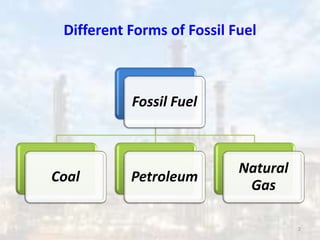
Different Forms of Fossil Fuel
Fossil Fuel
Coal Petroleum
Natural
Gas
2
Why Petroleum?
• Extraction of coal is very disruptive to surface and
underground environments. Coal removal results in large
amounts of waste products that can be harmful to the
environment. Groundwater can become contaminated during
mining and surface mining can be contaminated by leftover
waste. Pollutants are emitted during coal burning and may
cause acid rain, global warming and climate change.
• Petroleum produces less CO2 emissions than coal during
production. Produces less residue than coal.
• Petroleum is also known as Black Gold - because when
crude oil is extracted from the land it is black in color. People
call it gold because of its oils and value . It is very difficult to
find.
http://www.ei.lehigh.edu/learners/energy/impacts9.html
3
What is Crude oil and what it contains
• Crude oil is a naturally occurring, unrefined petroleum product
composed of hydrocarbon deposits (liquid and gas) and other
organic materials.
• Color: dark brown, bluish black or black.
•
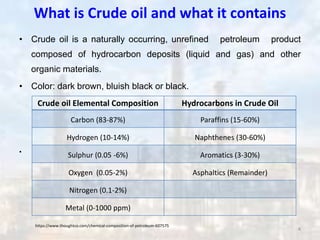
Crude oil Elemental Composition Hydrocarbons in Crude Oil
Carbon (83-87%) Paraffins (15-60%)
Hydrogen (10-14%) Naphthenes (30-60%)
Sulphur (0.05 -6%) Aromatics (3-30%)
Oxygen (0.05-2%) Asphaltics (Remainder)
Nitrogen (0.1-2%)
Metal (0-1000 ppm)
https://www.thoughtco.com/chemical-composition-of-petroleum-607575
4
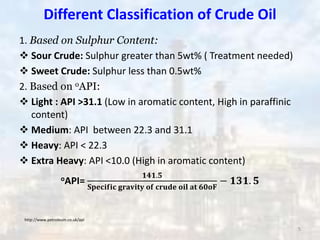
Different Classification of Crude Oil
1. Based on Sulphur Content:
 Sour Crude: Sulphur greater than 5wt% ( Treatment needed)
 Sweet Crude: Sulphur less than 0.5wt%
2. Based on oAPI:
 Light : API >31.1 (Low in aromatic content, High in paraffinic
content)
 Medium: API between 22.3 and 31.1
 Heavy: API < 22.3
 Extra Heavy: API <10.0 (High in aromatic content)
oAPI=
𝟏𝟒𝟏.𝟓
𝐒𝐩𝐞𝐜𝐢𝐟𝐢𝐜 𝐠𝐫𝐚𝐯𝐢𝐭𝐲 𝐨𝐟 𝐜𝐫𝐮𝐝𝐞 𝐨𝐢𝐥 𝐚𝐭 𝟔𝟎𝐨𝐅
− 𝟏𝟑𝟏. 𝟓
http://www.petroleum.co.uk/api
5
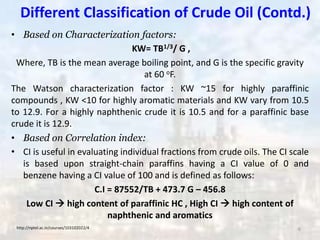
Different Classification of Crude Oil (Contd.)
• Based on Characterization factors:
KW= TB1/3/ G ,
Where, TB is the mean average boiling point, and G is the specific gravity
at 60 oF.
The Watson characterization factor : KW ~15 for highly paraffinic
compounds , KW <10 for highly aromatic materials and KW vary from 10.5
to 12.9. For a highly naphthenic crude it is 10.5 and for a paraffinic base
crude it is 12.9.
• Based on Correlation index:
• CI is useful in evaluating individual fractions from crude oils. The CI scale
is based upon straight-chain paraffins having a CI value of 0 and
benzene having a CI value of 100 and is defined as follows:
C.I = 87552/TB + 473.7 G – 456.8
Low CI  high content of paraffinic HC , High CI  high content of
naphthenic and aromatics
http://nptel.ac.in/courses/103102022/4 6
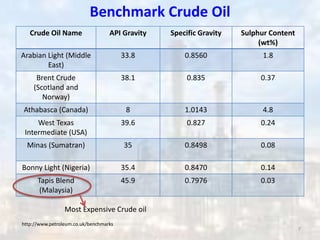
Benchmark Crude Oil
Crude Oil Name API Gravity Specific Gravity Sulphur Content
(wt%)
Arabian Light (Middle
East)
33.8 0.8560 1.8
Brent Crude
(Scotland and
Norway)
38.1 0.835 0.37
Athabasca (Canada) 8 1.0143 4.8
West Texas
Intermediate (USA)
39.6 0.827 0.24
Minas (Sumatran) 35 0.8498 0.08
Bonny Light (Nigeria) 35.4 0.8470 0.14
Tapis Blend
(Malaysia)
45.9 0.7976 0.03
Most Expensive Crude oil
http://www.petroleum.co.uk/benchmarks
7
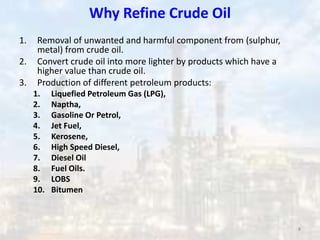
Why Refine Crude Oil
1. Removal of unwanted and harmful component from (sulphur,
metal) from crude oil.
2. Convert crude oil into more lighter by products which have a
higher value than crude oil.
3. Production of different petroleum products:
1. Liquefied Petroleum Gas (LPG),
2. Naptha,
3. Gasoline Or Petrol,
4. Jet Fuel,
5. Kerosene,
6. High Speed Diesel,
7. Diesel Oil
8. Fuel Oils.
9. LOBS
10. Bitumen
8
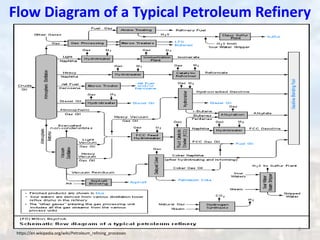
Flow Diagram of a Typical Petroleum Refinery
https://en.wikipedia.org/wiki/Petroleum_refining_processes
9
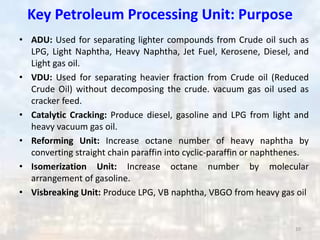
Key Petroleum Processing Unit: Purpose
• ADU: Used for separating lighter compounds from Crude oil such as
LPG, Light Naphtha, Heavy Naphtha, Jet Fuel, Kerosene, Diesel, and
Light gas oil.
• VDU: Used for separating heavier fraction from Crude oil (Reduced
Crude Oil) without decomposing the crude. vacuum gas oil used as
cracker feed.
• Catalytic Cracking: Produce diesel, gasoline and LPG from light and
heavy vacuum gas oil.
• Reforming Unit: Increase octane number of heavy naphtha by
converting straight chain paraffin into cyclic-paraffin or naphthenes.
• Isomerization Unit: Increase octane number by molecular
arrangement of gasoline.
• Visbreaking Unit: Produce LPG, VB naphtha, VBGO from heavy gas oil
10
Thank You
11

A brief introduction to petroleum refining

  • 1.
    A Brief Introductionto Petroleum Refining By Samarshi Chakraborty Postdoctoral Fellow IIT Kanpur 1
  • 2.
    Different Forms ofFossil Fuel Fossil Fuel Coal Petroleum Natural Gas 2
  • 3.
    Why Petroleum? • Extractionof coal is very disruptive to surface and underground environments. Coal removal results in large amounts of waste products that can be harmful to the environment. Groundwater can become contaminated during mining and surface mining can be contaminated by leftover waste. Pollutants are emitted during coal burning and may cause acid rain, global warming and climate change. • Petroleum produces less CO2 emissions than coal during production. Produces less residue than coal. • Petroleum is also known as Black Gold - because when crude oil is extracted from the land it is black in color. People call it gold because of its oils and value . It is very difficult to find. http://www.ei.lehigh.edu/learners/energy/impacts9.html 3
  • 4.
    What is Crudeoil and what it contains • Crude oil is a naturally occurring, unrefined petroleum product composed of hydrocarbon deposits (liquid and gas) and other organic materials. • Color: dark brown, bluish black or black. • Crude oil Elemental Composition Hydrocarbons in Crude Oil Carbon (83-87%) Paraffins (15-60%) Hydrogen (10-14%) Naphthenes (30-60%) Sulphur (0.05 -6%) Aromatics (3-30%) Oxygen (0.05-2%) Asphaltics (Remainder) Nitrogen (0.1-2%) Metal (0-1000 ppm) https://www.thoughtco.com/chemical-composition-of-petroleum-607575 4
  • 5.
    Different Classification ofCrude Oil 1. Based on Sulphur Content:  Sour Crude: Sulphur greater than 5wt% ( Treatment needed)  Sweet Crude: Sulphur less than 0.5wt% 2. Based on oAPI:  Light : API >31.1 (Low in aromatic content, High in paraffinic content)  Medium: API between 22.3 and 31.1  Heavy: API < 22.3  Extra Heavy: API <10.0 (High in aromatic content) oAPI= 𝟏𝟒𝟏.𝟓 𝐒𝐩𝐞𝐜𝐢𝐟𝐢𝐜 𝐠𝐫𝐚𝐯𝐢𝐭𝐲 𝐨𝐟 𝐜𝐫𝐮𝐝𝐞 𝐨𝐢𝐥 𝐚𝐭 𝟔𝟎𝐨𝐅 − 𝟏𝟑𝟏. 𝟓 http://www.petroleum.co.uk/api 5
  • 6.
    Different Classification ofCrude Oil (Contd.) • Based on Characterization factors: KW= TB1/3/ G , Where, TB is the mean average boiling point, and G is the specific gravity at 60 oF. The Watson characterization factor : KW ~15 for highly paraffinic compounds , KW <10 for highly aromatic materials and KW vary from 10.5 to 12.9. For a highly naphthenic crude it is 10.5 and for a paraffinic base crude it is 12.9. • Based on Correlation index: • CI is useful in evaluating individual fractions from crude oils. The CI scale is based upon straight-chain paraffins having a CI value of 0 and benzene having a CI value of 100 and is defined as follows: C.I = 87552/TB + 473.7 G – 456.8 Low CI  high content of paraffinic HC , High CI  high content of naphthenic and aromatics http://nptel.ac.in/courses/103102022/4 6
  • 7.
    Benchmark Crude Oil CrudeOil Name API Gravity Specific Gravity Sulphur Content (wt%) Arabian Light (Middle East) 33.8 0.8560 1.8 Brent Crude (Scotland and Norway) 38.1 0.835 0.37 Athabasca (Canada) 8 1.0143 4.8 West Texas Intermediate (USA) 39.6 0.827 0.24 Minas (Sumatran) 35 0.8498 0.08 Bonny Light (Nigeria) 35.4 0.8470 0.14 Tapis Blend (Malaysia) 45.9 0.7976 0.03 Most Expensive Crude oil http://www.petroleum.co.uk/benchmarks 7
  • 8.
    Why Refine CrudeOil 1. Removal of unwanted and harmful component from (sulphur, metal) from crude oil. 2. Convert crude oil into more lighter by products which have a higher value than crude oil. 3. Production of different petroleum products: 1. Liquefied Petroleum Gas (LPG), 2. Naptha, 3. Gasoline Or Petrol, 4. Jet Fuel, 5. Kerosene, 6. High Speed Diesel, 7. Diesel Oil 8. Fuel Oils. 9. LOBS 10. Bitumen 8
  • 9.
    Flow Diagram ofa Typical Petroleum Refinery https://en.wikipedia.org/wiki/Petroleum_refining_processes 9
  • 10.
    Key Petroleum ProcessingUnit: Purpose • ADU: Used for separating lighter compounds from Crude oil such as LPG, Light Naphtha, Heavy Naphtha, Jet Fuel, Kerosene, Diesel, and Light gas oil. • VDU: Used for separating heavier fraction from Crude oil (Reduced Crude Oil) without decomposing the crude. vacuum gas oil used as cracker feed. • Catalytic Cracking: Produce diesel, gasoline and LPG from light and heavy vacuum gas oil. • Reforming Unit: Increase octane number of heavy naphtha by converting straight chain paraffin into cyclic-paraffin or naphthenes. • Isomerization Unit: Increase octane number by molecular arrangement of gasoline. • Visbreaking Unit: Produce LPG, VB naphtha, VBGO from heavy gas oil 10
  • 11.