Livestock livelihoods and agri‐food systems flagship
This document is licensed for use under the Creative Commons 
Attribution 4.0 International Licence. May 2017.
Contact
Steve Staal
ILRI, Kenya
s.staal@cgiar.org
Objective
The flagship seeks to maximize livestock‐mediated livelihoods and resilience to risk among women and men 
smallholder and pastoral producers and their communities by:
• Targeting and prioritizing, integrating and piloting technological and institutional innovations, by integrating this 
work with that of the other flagships; and 
• Partnering with implementers, investors and advocates of livestock research and development.
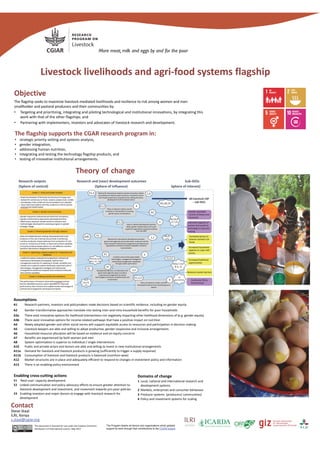
Theory of change
Research outputs                                    Research and (near) development outcomes                                             Sub‐IDOs 
(Sphere of control) (Sphere of influence)  Sphere of interest) 
Assumptions
A1 Research partners, investors and policymakers make decisions based on scientific evidence, including on gender equity
A2 Gender‐transformative approaches translate into lasting inter‐and intra‐household benefits for poor households
A3a There exist innovative options for livelihood interventions not negatively impacting other livelihood dimensions of (e.g. gender equity)
A3b There exist innovative options for income‐related pathways that have a positive impact on nutrition
A4 Newly adopted gender and other social norms will support equitable access to resources and participation in decision making
A5 Livestock keepers are able and willing to adopt productive, gender responsive and inclusive arrangements
A6 Household resource allocation will be based on evidence and on equity concerns
A7 Benefits are experienced by both women and men
A8 System optimization is superior to individual / single interventions
A10 Public and private actors and donors are able and willing to invest in new institutional arrangements
A11a Demand for livestock and livestock products is growing (sufficiently to trigger a supply response)
A11b Consumption of livestock and livestock products is balanced (nutrition‐wise)
A12 Market structures are in place and adequately efficient to respond to changes in investment policy and information
A13 There is an enabling policy environment
Enabling cross‐cutting actions
E1 'Next‐user' capacity development
E2 Linked communication and policy advocacy efforts to ensure greater attention to 
livestock development and investment, and movement towards pro‐poor policies
E3 Enabling investors and major donors to engage with livestock research for 
development
Domains of change
1 Local, national and international research and 
development systems
2 Markets, enterprises and consumer behaviour 
3 Producer systems  (producers/ communities)
4 Policy and investment systems for scaling
The flagship supports the CGAR research program in: 
• strategic priority setting and systems analysis,
• gender integration,
• addressing human nutrition,
• integrating and testing the technology flagship products, and 
• testing of innovative institutional arrangements.
The Program thanks all donors and organizations which globally
support its work through their contributions to the CGIAR system

Livestock livelihoods and agri‐food systems flagship

  • 1.
    Livestock livelihoods and agri‐food systems flagship This document is licensed for use under the Creative Commons  Attribution 4.0 International Licence. May 2017. Contact Steve Staal ILRI, Kenya s.staal@cgiar.org Objective The flagship seeks to maximize livestock‐mediated livelihoods and resilience to risk among women and men  smallholder and pastoral producers and their communities by: •Targeting and prioritizing, integrating and piloting technological and institutional innovations, by integrating this  work with that of the other flagships; and  • Partnering with implementers, investors and advocates of livestock research and development. Theory of change Research outputs                                    Research and (near) development outcomes                                             Sub‐IDOs  (Sphere of control) (Sphere of influence)  Sphere of interest)  Assumptions A1 Research partners, investors and policymakers make decisions based on scientific evidence, including on gender equity A2 Gender‐transformative approaches translate into lasting inter‐and intra‐household benefits for poor households A3a There exist innovative options for livelihood interventions not negatively impacting other livelihood dimensions of (e.g. gender equity) A3b There exist innovative options for income‐related pathways that have a positive impact on nutrition A4 Newly adopted gender and other social norms will support equitable access to resources and participation in decision making A5 Livestock keepers are able and willing to adopt productive, gender responsive and inclusive arrangements A6 Household resource allocation will be based on evidence and on equity concerns A7 Benefits are experienced by both women and men A8 System optimization is superior to individual / single interventions A10 Public and private actors and donors are able and willing to invest in new institutional arrangements A11a Demand for livestock and livestock products is growing (sufficiently to trigger a supply response) A11b Consumption of livestock and livestock products is balanced (nutrition‐wise) A12 Market structures are in place and adequately efficient to respond to changes in investment policy and information A13 There is an enabling policy environment Enabling cross‐cutting actions E1 'Next‐user' capacity development E2 Linked communication and policy advocacy efforts to ensure greater attention to  livestock development and investment, and movement towards pro‐poor policies E3 Enabling investors and major donors to engage with livestock research for  development Domains of change 1 Local, national and international research and  development systems 2 Markets, enterprises and consumer behaviour  3 Producer systems  (producers/ communities) 4 Policy and investment systems for scaling The flagship supports the CGAR research program in:  • strategic priority setting and systems analysis, • gender integration, • addressing human nutrition, • integrating and testing the technology flagship products, and  • testing of innovative institutional arrangements. The Program thanks all donors and organizations which globally support its work through their contributions to the CGIAR system