Uniting agriculture & nature for poverty reduction
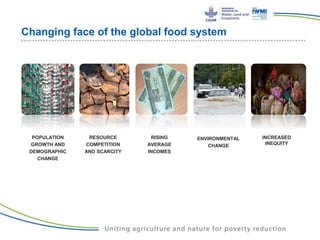
Changing face of the global food system
POPULATION
GROWTH AND
DEMOGRAPHIC
CHANGE
RISING
AVERAGE
INCOMES
RESOURCE
COMPETITION
AND SCARCITY
INCREASED
INEQUITY
ENVIRONMENTAL
CHANGE
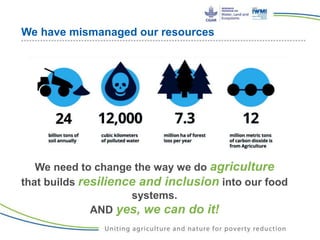
We have mismanaged our resources
We need to change the way we do agriculture
that builds resilience and inclusion into our food
systems.
AND yes, we can do it!
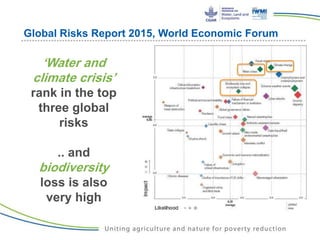
‘Water and
climate crisis’
rank in the top
three global
risks
.. and
biodiversity
loss is also
very high
Global Risks Report 2015, World Economic Forum
IWMI’s approach to research:
An award-winning, world-leading team:
 110 scientists
 35 research support staff
Multi-disciplinary:
 Diverse perspectives on any issue or problem
Multi-regional:
 On the ground, on the frontlines: 68% of staff in the field
 Diverse perspectives from 12 countries
Deeply connected to driving “outcomes”:
 Uptake team works across multi-country network
 Close relations with policy-makers, NGOs, farming
groups
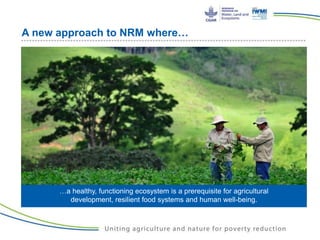
A new approach to NRM where…
…a healthy, functioning ecosystem is a prerequisite for agricultural
development, resilient food systems and human well-being.
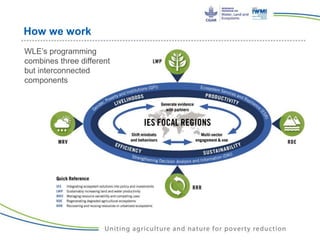
How we work
WLE’s programming
combines three different
but interconnected
components
WLE’s research
 Evidence-base knowledge
to support a more
sustainable intensification of
agriculture.
 Integrated solutions to
better manage risk related to
rising shocks.
 Models and scenarios to
understand trade-offs and
synergies.
 Institutional innovations
that include new policies and
arrangements to share
benefits equitably (Water
Funds, taxes, PES, Benefit
Sharing etc.)
 Harnessing big data for effective
decision-making
 Developing solutions for impact
and improved resilience
 Making peri-urban agriculture a
win-win for people and the
environment
Seeking to influence development choices by providing:
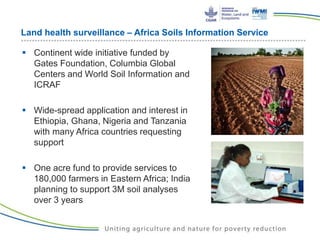
Land health surveillance – Africa Soils Information Service
 Continent wide initiative funded by
Gates Foundation, Columbia Global
Centers and World Soil Information and
ICRAF
 Wide-spread application and interest in
Ethiopia, Ghana, Nigeria and Tanzania
with many Africa countries requesting
support
 One acre fund to provide services to
180,000 farmers in Eastern Africa; India
planning to support 3M soil analyses
over 3 years
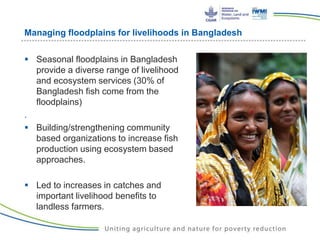
Managing floodplains for livelihoods in Bangladesh
 Seasonal floodplains in Bangladesh
provide a diverse range of livelihood
and ecosystem services (30% of
Bangladesh fish come from the
floodplains)
.
 Building/strengthening community
based organizations to increase fish
production using ecosystem based
approaches.
 Led to increases in catches and
important livelihood benefits to
landless farmers.
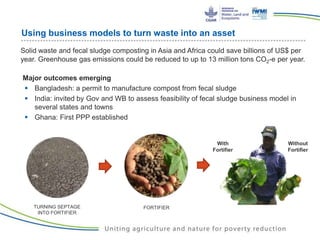
Using business models to turn waste into an asset
Solid waste and fecal sludge composting in Asia and Africa could save billions of US$ per
year. Greenhouse gas emissions could be reduced to up to 13 million tons CO2-e per year.
Major outcomes emerging
 Bangladesh: a permit to manufacture compost from fecal sludge
 India: invited by Gov and WB to assess feasibility of fecal sludge business model in
several states and towns
 Ghana: First PPP established
With
Fortifier
Without
Fortifier
FORTIFIERTURNING SEPTAGE
INTO FORTIFIER
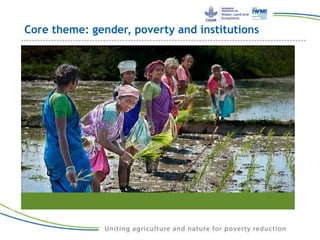
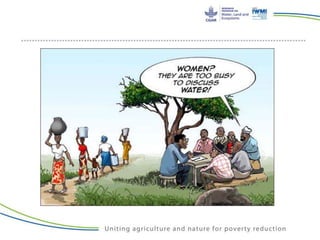
Core theme: gender, poverty and institutions
 About Gender, Poverty, and Institutions (GPI)
Photo: Ian Taylor/CPWF Mekong
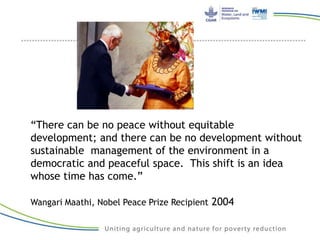
“There can be no peace without equitable
development; and there can be no development without
sustainable management of the environment in a
democratic and peaceful space. This shift is an idea
whose time has come.”
Wangari Maathi, Nobel Peace Prize Recipient 2004
Guiding principles: based on evidence & realities that:
 Gender is inherently political and cultural; and dynamic;
 Gender, poverty, and institutions are interlinked, and can not be
dealt with independently;
 Women and men have different roles, aspirations, needs,
knowledge sets and opportunities; and will experience costs and
benefits differently
 Women have less access than men to productive resources and
opportunities, but often carry the burden of nutrition and natural
resources;
 Resilience, through increased access to income, assets and rights,
is vital for women and communities.
 Equity can be a real driver of change in rural development.
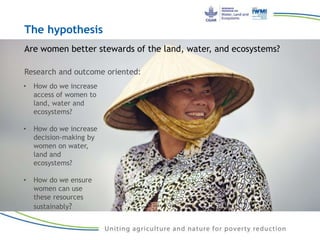
The hypothesis
Are women better stewards of the land, water, and ecosystems?
• How do we increase
access of women to
land, water and
ecosystems?
• How do we increase
decision-making by
women on water,
land and
ecosystems?
• How do we ensure
women can use
these resources
sustainably?
Research and outcome oriented:
The WLE gender matrix: developing research plans
 Research opportunities: flagships, focal regions, and own portfolio
 Content matrix:
• Technical angle: dealing with drought at basin level, where variability is
one of the issues
• Geographic: placing gender within the cultural context but also, for
instance, with issues of outmigration in Bihar, India
 Research plans:
• Focal region gender plans
• Technical research questions and entry points
 Outcomes
• Investable options for women
• Improved policy options for decision making
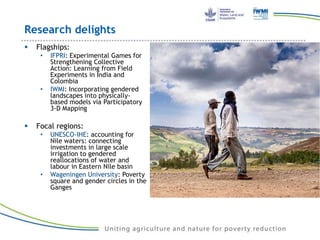
Research delights
 Flagships:
• IFPRI: Experimental Games for
Strengthening Collective
Action: Learning from Field
Experiments in India and
Colombia
• IWMI: Incorporating gendered
landscapes into physically-
based models via Participatory
3-D Mapping
 Focal regions:
• UNESCO-IHE: accounting for
Nile waters: connecting
investments in large scale
irrigation to gendered
reallocations of water and
labour in Eastern Nile basin
• Wageningen University: Poverty
square and gender circles in the
Ganges
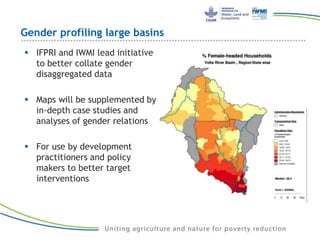
Gender profiling large basins
 IFPRI and IWMI lead initiative
to better collate gender
disaggregated data
 Maps will be supplemented by
in-depth case studies and
analyses of gender relations
 For use by development
practitioners and policy
makers to better target
interventions
Gender in Irrigation Learning and Improvement Tool
The demand:
 Irrigation agencies in Eastern and Southern Africa requested practical tools,
metrics and training to strengthen gender equity in irrigation schemes.
 Increasing awareness by regional bodies and governments in Asia and Africa of
the gap between gender goals at regional, national and sub-national levels
and the capacity, tools, and processes required to accomplish those goals.
The need:
 The tool can directly benefit women involved in current and future irrigation
schemes and in water user groups.
The tool:
 Targets and measures issues that are within the control of irrigation scheme
management
• Access to scheme resources
• Participation in scheme management
• Access to scheme benefits, e.g. market information, payments from sales
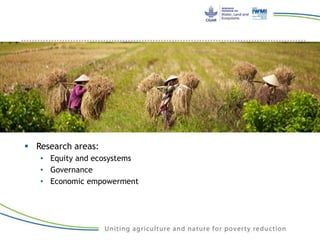
 Research areas:
• Equity and ecosystems
• Governance
• Economic empowerment
U N I T I N G A G R I C U LT U R E A N D N AT U R E F O R P O V E R T Y R E D U C T I O N
THANK YOU
wle.cgiar.org

WLE Gender Presentation for EC DEVCO Infopoint meeting

  • 1.
    Uniting agriculture &nature for poverty reduction
  • 2.
    Changing face ofthe global food system POPULATION GROWTH AND DEMOGRAPHIC CHANGE RISING AVERAGE INCOMES RESOURCE COMPETITION AND SCARCITY INCREASED INEQUITY ENVIRONMENTAL CHANGE
  • 3.
    We have mismanagedour resources We need to change the way we do agriculture that builds resilience and inclusion into our food systems. AND yes, we can do it!
  • 4.
    ‘Water and climate crisis’ rankin the top three global risks .. and biodiversity loss is also very high Global Risks Report 2015, World Economic Forum
  • 5.
    IWMI’s approach toresearch: An award-winning, world-leading team:  110 scientists  35 research support staff Multi-disciplinary:  Diverse perspectives on any issue or problem Multi-regional:  On the ground, on the frontlines: 68% of staff in the field  Diverse perspectives from 12 countries Deeply connected to driving “outcomes”:  Uptake team works across multi-country network  Close relations with policy-makers, NGOs, farming groups
  • 6.
    A new approachto NRM where… …a healthy, functioning ecosystem is a prerequisite for agricultural development, resilient food systems and human well-being.
  • 7.
    How we work WLE’sprogramming combines three different but interconnected components
  • 8.
    WLE’s research  Evidence-baseknowledge to support a more sustainable intensification of agriculture.  Integrated solutions to better manage risk related to rising shocks.  Models and scenarios to understand trade-offs and synergies.  Institutional innovations that include new policies and arrangements to share benefits equitably (Water Funds, taxes, PES, Benefit Sharing etc.)  Harnessing big data for effective decision-making  Developing solutions for impact and improved resilience  Making peri-urban agriculture a win-win for people and the environment Seeking to influence development choices by providing:
  • 9.
    Land health surveillance– Africa Soils Information Service  Continent wide initiative funded by Gates Foundation, Columbia Global Centers and World Soil Information and ICRAF  Wide-spread application and interest in Ethiopia, Ghana, Nigeria and Tanzania with many Africa countries requesting support  One acre fund to provide services to 180,000 farmers in Eastern Africa; India planning to support 3M soil analyses over 3 years
  • 10.
    Managing floodplains forlivelihoods in Bangladesh  Seasonal floodplains in Bangladesh provide a diverse range of livelihood and ecosystem services (30% of Bangladesh fish come from the floodplains) .  Building/strengthening community based organizations to increase fish production using ecosystem based approaches.  Led to increases in catches and important livelihood benefits to landless farmers.
  • 11.
    Using business modelsto turn waste into an asset Solid waste and fecal sludge composting in Asia and Africa could save billions of US$ per year. Greenhouse gas emissions could be reduced to up to 13 million tons CO2-e per year. Major outcomes emerging  Bangladesh: a permit to manufacture compost from fecal sludge  India: invited by Gov and WB to assess feasibility of fecal sludge business model in several states and towns  Ghana: First PPP established With Fortifier Without Fortifier FORTIFIERTURNING SEPTAGE INTO FORTIFIER
  • 12.
    Core theme: gender,poverty and institutions  About Gender, Poverty, and Institutions (GPI) Photo: Ian Taylor/CPWF Mekong
  • 14.
    “There can beno peace without equitable development; and there can be no development without sustainable management of the environment in a democratic and peaceful space. This shift is an idea whose time has come.” Wangari Maathi, Nobel Peace Prize Recipient 2004
  • 15.
    Guiding principles: basedon evidence & realities that:  Gender is inherently political and cultural; and dynamic;  Gender, poverty, and institutions are interlinked, and can not be dealt with independently;  Women and men have different roles, aspirations, needs, knowledge sets and opportunities; and will experience costs and benefits differently  Women have less access than men to productive resources and opportunities, but often carry the burden of nutrition and natural resources;  Resilience, through increased access to income, assets and rights, is vital for women and communities.  Equity can be a real driver of change in rural development.
  • 16.
    The hypothesis Are womenbetter stewards of the land, water, and ecosystems? • How do we increase access of women to land, water and ecosystems? • How do we increase decision-making by women on water, land and ecosystems? • How do we ensure women can use these resources sustainably? Research and outcome oriented:
  • 17.
    The WLE gendermatrix: developing research plans  Research opportunities: flagships, focal regions, and own portfolio  Content matrix: • Technical angle: dealing with drought at basin level, where variability is one of the issues • Geographic: placing gender within the cultural context but also, for instance, with issues of outmigration in Bihar, India  Research plans: • Focal region gender plans • Technical research questions and entry points  Outcomes • Investable options for women • Improved policy options for decision making
  • 18.
    Research delights  Flagships: •IFPRI: Experimental Games for Strengthening Collective Action: Learning from Field Experiments in India and Colombia • IWMI: Incorporating gendered landscapes into physically- based models via Participatory 3-D Mapping  Focal regions: • UNESCO-IHE: accounting for Nile waters: connecting investments in large scale irrigation to gendered reallocations of water and labour in Eastern Nile basin • Wageningen University: Poverty square and gender circles in the Ganges
  • 19.
    Gender profiling largebasins  IFPRI and IWMI lead initiative to better collate gender disaggregated data  Maps will be supplemented by in-depth case studies and analyses of gender relations  For use by development practitioners and policy makers to better target interventions
  • 20.
    Gender in IrrigationLearning and Improvement Tool The demand:  Irrigation agencies in Eastern and Southern Africa requested practical tools, metrics and training to strengthen gender equity in irrigation schemes.  Increasing awareness by regional bodies and governments in Asia and Africa of the gap between gender goals at regional, national and sub-national levels and the capacity, tools, and processes required to accomplish those goals. The need:  The tool can directly benefit women involved in current and future irrigation schemes and in water user groups. The tool:  Targets and measures issues that are within the control of irrigation scheme management • Access to scheme resources • Participation in scheme management • Access to scheme benefits, e.g. market information, payments from sales
  • 21.
     Research areas: •Equity and ecosystems • Governance • Economic empowerment
  • 22.
    U N IT I N G A G R I C U LT U R E A N D N AT U R E F O R P O V E R T Y R E D U C T I O N THANK YOU wle.cgiar.org