Writing a Literature Review

Essential Portion of ANYResearch Project
What is a literature review?
 NOT an annotated bibliography or a Work Cited
  Page
 NOT a summary of each of your sources listed
  one by one
 NOT just a descriptive summary of the historical
  background of your topic
A literature review…
 In a literature review, your central focus is
  examining and evaluating what has been said
  before on a topic, and establishing the relevance
  of this information to your own research.
 You may also identify what has not said in the
  literature and introduce it
What is „the literature‟?
 Information relevant to your topic of interest.
 Some works may deal specifically or more
  generally with your topic of interest
 Information, or „the literature‟, may be obtained
  from a variety of sources including books, journal
  articles, reports, etc.
   Usually the focus is on scholarly published
   materials
Types of „the literature‟
 Primary Source
   Original research from journals, articles or original
   materials such as historical documents, or creative
   works such as art or literature.
 Secondary Source
   Evaluations, reviews or syntheses of original work
 Tertiary Source
   Broadly scoped material put together usually from
   secondary sources to provide an overview, e.g. a
   textbook.
Selecting appropriate source material
 Relevance
   It should contribute to the development of your
   topic, clarify your position, provide an alternative
   point of view you wish to argue against or provide
   useful primary source material
 Authority
   It should be published in a reputable journal (or
   other such medium), have been critically evaluated,
   been used extensively as a source material, been
   peer reviewed or be a recognized authority in the
   area.
 Currency
     It should be recent research or still be influential in the area
5 C‟s of writing a literature review
 Cite
 Compare
 Contrast
 Critique
 Connect
5 C‟s of writing a literature review
 Cite
 Compare
 Contrast
 Critique
 Connect


There is no S (NOT A SUMMARY)
5 C‟s of writing a literature review
 Cite:
   Keep the primary focus on the literature
   Keep an “on-going” Work Cited Page


 Compare:
   The various arguments, theories, methodologies,
    approaches and findings expressed in the literature:
   What do the authors agree on?
   Who employs similar approaches?
5 C‟s of writing a literature review
 Contrast them ALL
   Contrast the various arguments, themes,
    methodologies, approaches and controversies
    expressed in the literature
   What are the major areas of disagreement,
    controversy, debate?

 Critique the literature:
   Which arguments are more persuasive, and why?
   Which approaches, findings, methodologies seem
    most reliable, valid, or appropriate, and why?
   Pay attention to the verbs you use to describe what
    it is an author says/ does: e.g. asserts,
5 C‟s of writing a literature review
 Connect the literature to your own area of
 research and investigation:
   How does your own work draw on/depart
   from/synthesize what has been said in the
   literature?.
5 C‟s of writing a literature review
 Connect the literature to your own area of
 research and investigation:
   How does your own work draw on/depart
   from/synthesize what has been said in the
   literature?.


   If a piece of literature DOES NOT CONNECT, DO
   NOT USE
Writing the literature review
1.   Identify research questions/areas/issues
     themes of investigation – what are you
     searching the literature to discover?
2.   Preview sample literature reviews in the same
     field.
3.   Obtain relevant sources.
4.   Keep bibliographical records of all sources
     referred to.
5.   Critically read each source (read for the
     arguments presented rather than for „facts‟).
     Make notes on the key questions/
     areas/issues/themes identified earlier.
1.   Evaluate the logic/cogency of each source, and
     its relevance to your own work.
2.   Organize material under subheadings according
     to various categories, chronology or
     similarities/differences in arguments or
     theories/findings.
3.   Write a mini-introduction, a series of paragraphs
     and a mini-conclusion for each of these
     categories.
4.   Write the introduction and conclusion to the
     literature review last.
5.   Draft and redraft.
Literature Review Structure
 Like a standard academic essay
 Made up of three key components:
   an introduction
   a body
   a conclusion.
Literature Review Structure
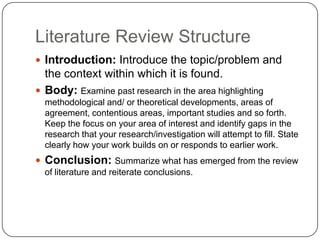
 Introduction: Introduce the topic/problem and
  the context within which it is found.
 Body: Examine past research in the area highlighting
  methodological and/ or theoretical developments, areas of
  agreement, contentious areas, important studies and so forth.
  Keep the focus on your area of interest and identify gaps in the
  research that your research/investigation will attempt to fill. State
  clearly how your work builds on or responds to earlier work.
 Conclusion: Summarize what has emerged from the review
  of literature and reiterate conclusions.
Literature Review Structure
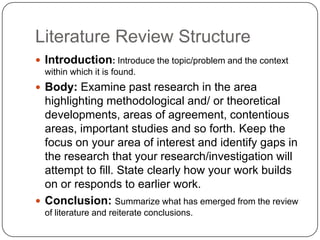
 Introduction: Introduce the topic/problem and the context
  within which it is found.
 Body: Examine past research in the area
  highlighting methodological and/ or theoretical
  developments, areas of agreement, contentious
  areas, important studies and so forth. Keep the
  focus on your area of interest and identify gaps in
  the research that your research/investigation will
  attempt to fill. State clearly how your work builds
  on or responds to earlier work.
 Conclusion: Summarize what has emerged from the review
  of literature and reiterate conclusions.
Literature Review Structure
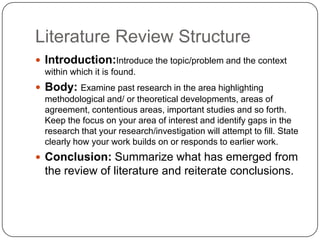
 Introduction:Introduce the topic/problem and the context
  within which it is found.
 Body: Examine past research in the area highlighting
  methodological and/ or theoretical developments, areas of
  agreement, contentious areas, important studies and so forth.
  Keep the focus on your area of interest and identify gaps in the
  research that your research/investigation will attempt to fill. State
  clearly how your work builds on or responds to earlier work.
 Conclusion: Summarize what has emerged from
  the review of literature and reiterate conclusions.
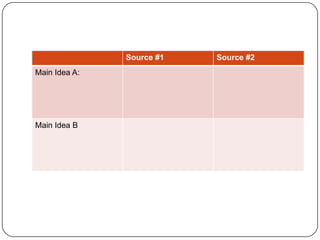
Source #1   Source #2
Main Idea A:


Main Idea B
CHECKLIST
 Did you outline the scope and purpose of the review?
 Have you identified appropriate source material
    mainly from primary and secondary sources?
   Did you keep bibliographical records of all the
    researched material?
   Is each source critically reviewed?
   Have you organized all the material you obtained from
    the sources?
   Have you developed your approach?
   Have you written a draft and edited it carefully?
   Is your literature review submitted on time and in the
    correct format?
SAMPLE Literature Review
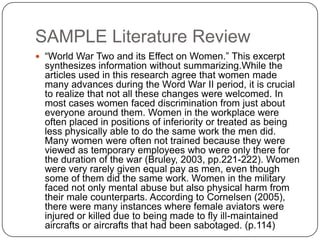
 “World War Two and its Effect on Women.” This excerpt
  synthesizes information without summarizing.While the
  articles used in this research agree that women made
  many advances during the Word War II period, it is crucial
  to realize that not all these changes were welcomed. In
  most cases women faced discrimination from just about
  everyone around them. Women in the workplace were
  often placed in positions of inferiority or treated as being
  less physically able to do the same work the men did.
  Many women were often not trained because they were
  viewed as temporary employees who were only there for
  the duration of the war (Bruley, 2003, pp.221-222). Women
  were very rarely given equal pay as men, even though
  some of them did the same work. Women in the military
  faced not only mental abuse but also physical harm from
  their male counterparts. According to Cornelsen (2005),
  there were many instances where female aviators were
  injured or killed due to being made to fly ill-maintained
  aircrafts or aircrafts that had been sabotaged. (p.114)
References
 Andersson, B., &Beveridge, A. (2007). A guide to
    assessments and skills in SCCA (2nd ed.).
    [Booklet].
   Perth, WA: Edith Cowan University.Hart, C.
    (1988).
   Doing a literature review: Releasing the social
    science research imagination. Thousand Oaks:
    Sage.Lamb, S. E. (1998).
   How to write it: A complete guide to everything
    you‟ll ever write. CA: Ten Speed Press.Rosen, L.
    J., & Behrens, L. (2000).
   The Allyn and Bacon handbook (4th ed.). Boston:
    Allyn& Bacon.

CRP Literature Review

  • 1.
    Writing a LiteratureReview Essential Portion of ANYResearch Project
  • 2.
    What is aliterature review?  NOT an annotated bibliography or a Work Cited Page  NOT a summary of each of your sources listed one by one  NOT just a descriptive summary of the historical background of your topic
  • 3.
    A literature review… In a literature review, your central focus is examining and evaluating what has been said before on a topic, and establishing the relevance of this information to your own research.  You may also identify what has not said in the literature and introduce it
  • 4.
    What is „theliterature‟?  Information relevant to your topic of interest.  Some works may deal specifically or more generally with your topic of interest  Information, or „the literature‟, may be obtained from a variety of sources including books, journal articles, reports, etc.  Usually the focus is on scholarly published materials
  • 5.
    Types of „theliterature‟  Primary Source  Original research from journals, articles or original materials such as historical documents, or creative works such as art or literature.  Secondary Source  Evaluations, reviews or syntheses of original work  Tertiary Source  Broadly scoped material put together usually from secondary sources to provide an overview, e.g. a textbook.
  • 6.
    Selecting appropriate sourcematerial  Relevance  It should contribute to the development of your topic, clarify your position, provide an alternative point of view you wish to argue against or provide useful primary source material  Authority  It should be published in a reputable journal (or other such medium), have been critically evaluated, been used extensively as a source material, been peer reviewed or be a recognized authority in the area.  Currency  It should be recent research or still be influential in the area
  • 7.
    5 C‟s ofwriting a literature review  Cite  Compare  Contrast  Critique  Connect
  • 8.
    5 C‟s ofwriting a literature review  Cite  Compare  Contrast  Critique  Connect There is no S (NOT A SUMMARY)
  • 9.
    5 C‟s ofwriting a literature review  Cite:  Keep the primary focus on the literature  Keep an “on-going” Work Cited Page  Compare:  The various arguments, theories, methodologies, approaches and findings expressed in the literature:  What do the authors agree on?  Who employs similar approaches?
  • 10.
    5 C‟s ofwriting a literature review  Contrast them ALL  Contrast the various arguments, themes, methodologies, approaches and controversies expressed in the literature  What are the major areas of disagreement, controversy, debate?  Critique the literature:  Which arguments are more persuasive, and why?  Which approaches, findings, methodologies seem most reliable, valid, or appropriate, and why?  Pay attention to the verbs you use to describe what it is an author says/ does: e.g. asserts,
  • 11.
    5 C‟s ofwriting a literature review  Connect the literature to your own area of research and investigation:  How does your own work draw on/depart from/synthesize what has been said in the literature?.
  • 12.
    5 C‟s ofwriting a literature review  Connect the literature to your own area of research and investigation:  How does your own work draw on/depart from/synthesize what has been said in the literature?.  If a piece of literature DOES NOT CONNECT, DO NOT USE
  • 13.
    Writing the literaturereview 1. Identify research questions/areas/issues themes of investigation – what are you searching the literature to discover? 2. Preview sample literature reviews in the same field. 3. Obtain relevant sources. 4. Keep bibliographical records of all sources referred to. 5. Critically read each source (read for the arguments presented rather than for „facts‟). Make notes on the key questions/ areas/issues/themes identified earlier.
  • 14.
    1. Evaluate the logic/cogency of each source, and its relevance to your own work. 2. Organize material under subheadings according to various categories, chronology or similarities/differences in arguments or theories/findings. 3. Write a mini-introduction, a series of paragraphs and a mini-conclusion for each of these categories. 4. Write the introduction and conclusion to the literature review last. 5. Draft and redraft.
  • 15.
    Literature Review Structure Like a standard academic essay  Made up of three key components:  an introduction  a body  a conclusion.
  • 16.
    Literature Review Structure Introduction: Introduce the topic/problem and the context within which it is found.  Body: Examine past research in the area highlighting methodological and/ or theoretical developments, areas of agreement, contentious areas, important studies and so forth. Keep the focus on your area of interest and identify gaps in the research that your research/investigation will attempt to fill. State clearly how your work builds on or responds to earlier work.  Conclusion: Summarize what has emerged from the review of literature and reiterate conclusions.
  • 17.
    Literature Review Structure Introduction: Introduce the topic/problem and the context within which it is found.  Body: Examine past research in the area highlighting methodological and/ or theoretical developments, areas of agreement, contentious areas, important studies and so forth. Keep the focus on your area of interest and identify gaps in the research that your research/investigation will attempt to fill. State clearly how your work builds on or responds to earlier work.  Conclusion: Summarize what has emerged from the review of literature and reiterate conclusions.
  • 18.
    Literature Review Structure Introduction:Introduce the topic/problem and the context within which it is found.  Body: Examine past research in the area highlighting methodological and/ or theoretical developments, areas of agreement, contentious areas, important studies and so forth. Keep the focus on your area of interest and identify gaps in the research that your research/investigation will attempt to fill. State clearly how your work builds on or responds to earlier work.  Conclusion: Summarize what has emerged from the review of literature and reiterate conclusions.
  • 19.
    Source #1 Source #2 Main Idea A: Main Idea B
  • 20.
    CHECKLIST  Did yououtline the scope and purpose of the review?  Have you identified appropriate source material mainly from primary and secondary sources?  Did you keep bibliographical records of all the researched material?  Is each source critically reviewed?  Have you organized all the material you obtained from the sources?  Have you developed your approach?  Have you written a draft and edited it carefully?  Is your literature review submitted on time and in the correct format?
  • 21.
    SAMPLE Literature Review “World War Two and its Effect on Women.” This excerpt synthesizes information without summarizing.While the articles used in this research agree that women made many advances during the Word War II period, it is crucial to realize that not all these changes were welcomed. In most cases women faced discrimination from just about everyone around them. Women in the workplace were often placed in positions of inferiority or treated as being less physically able to do the same work the men did. Many women were often not trained because they were viewed as temporary employees who were only there for the duration of the war (Bruley, 2003, pp.221-222). Women were very rarely given equal pay as men, even though some of them did the same work. Women in the military faced not only mental abuse but also physical harm from their male counterparts. According to Cornelsen (2005), there were many instances where female aviators were injured or killed due to being made to fly ill-maintained aircrafts or aircrafts that had been sabotaged. (p.114)
  • 22.
    References  Andersson, B.,&Beveridge, A. (2007). A guide to assessments and skills in SCCA (2nd ed.). [Booklet].  Perth, WA: Edith Cowan University.Hart, C. (1988).  Doing a literature review: Releasing the social science research imagination. Thousand Oaks: Sage.Lamb, S. E. (1998).  How to write it: A complete guide to everything you‟ll ever write. CA: Ten Speed Press.Rosen, L. J., & Behrens, L. (2000).  The Allyn and Bacon handbook (4th ed.). Boston: Allyn& Bacon.