XSS
Ayman Babiker
You Should Already
      Know
• HTML.
• JavaScript.
• PHP, ASP…     etc.
Cross Site Scripting (XSS)
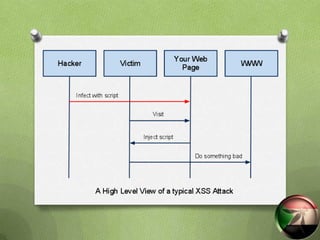
• One of the most common application-layer web
    attacks.
•   Operates on the client-side (in the user‟s web
    browser).
•   13% of total hacking technics (in 2011).
•   Neglected by the developers. WHY ?!.
•   Executed every time the page is loaded.
•   JavaScript, VBScript, ActiveX, HTML, or Flash.
Cross Site Scripting (XSS)
• XSS can cause a variety of problems for the
  end user (annoyance “alerts” ~ complete
  account compromise “session hijacking”).
• Installation of Trojan horse programs.
• Page modification and redirection.
XSS types

• Stored XSS Attacks.
• Reflected XSS Attacks.
• DOM Based XSS.
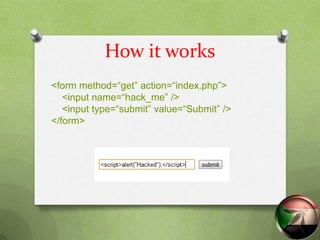
How it works
<form method=“get” action=“index.php”>
   <input name=“hack_me” />
   <input type=“submit” value=“Submit” />
</form>
How it works
<?php
 $txt=$_GET[„hack_me‟];
 echo $txt; // echo “<script>alert("Hacked");</script>”
?>
Alternate XSS Syntax
• Using Script in Attributes
   • <body onload=alert(Hacked ')>
   • <img src="http://url.to.file.which/not.exist"
     onerror=alert(document.cookie);>
• XSS using Script Via Encoded URI Schemes
   •   <img src=j&#X41vascript:alert(„Hacked')>
Commonly used to achieve the following malicious results:

• Identity theft.
• Accessing sensitive or restricted information.
• Gaining free access to otherwise paid for
    content.
•   Spying on user‟s web browsing habits.
•   Altering browser functionality.
•   Web application defacement.
•   Denial of Service attacks.
XSS Countermeasures
• There are a huge number of XSS attack
    vectors, following a few simple rules can
    completely defend against this serious attack.
•   The simplest form of XSS protection is to pass
    all external data through a filter (in server-side).
•   It is recommended to use libraries that has
    been tried and tested by the community.
•   XSS techniques keep changing (your filters will
    need to be updated periodically).
•   ESAPI (OWASP), AntiXSS (Microsoft).
XSS Countermeasures
• HTML Escape Before Inserting Untrusted Data
  into HTML Element Content:
   •   ESAPI Encoder Example:
       String safe = ESAPI.encoder().encodeForHTML(
       request.getParameter( "input" ) );
   •   AntiXSS Equivalent:
       string safe =
       Microsoft.Security.Application.AntiXss.HtmlEncode(
       Request.QueryString[ "input" ] );
XSS Countermeasures
• Also untrusted Data into:
   • HTML Common Attributes.
   • JavaScript Data Values.
   • HTML Style Property Values.
   • HTML URL Parameter Values.


• Also use HTTPOnly cookie flag.
More?
• http://ha.ckers.org/xss.html
• https://www.owasp.org/index.php/XSS_(Cross_Site
  _Scripting)_Prevention_Cheat_Sheet
The End.

Cross Site Scripting (XSS)

  • 1.
  • 2.
    You Should Already Know • HTML. • JavaScript. • PHP, ASP… etc.
  • 3.
    Cross Site Scripting(XSS) • One of the most common application-layer web attacks. • Operates on the client-side (in the user‟s web browser). • 13% of total hacking technics (in 2011). • Neglected by the developers. WHY ?!. • Executed every time the page is loaded. • JavaScript, VBScript, ActiveX, HTML, or Flash.
  • 4.
    Cross Site Scripting(XSS) • XSS can cause a variety of problems for the end user (annoyance “alerts” ~ complete account compromise “session hijacking”). • Installation of Trojan horse programs. • Page modification and redirection.
  • 5.
    XSS types • StoredXSS Attacks. • Reflected XSS Attacks. • DOM Based XSS.
  • 8.
    How it works <formmethod=“get” action=“index.php”> <input name=“hack_me” /> <input type=“submit” value=“Submit” /> </form>
  • 9.
    How it works <?php $txt=$_GET[„hack_me‟]; echo $txt; // echo “<script>alert("Hacked");</script>” ?>
  • 10.
    Alternate XSS Syntax •Using Script in Attributes • <body onload=alert(Hacked ')> • <img src="http://url.to.file.which/not.exist" onerror=alert(document.cookie);> • XSS using Script Via Encoded URI Schemes • <img src=j&#X41vascript:alert(„Hacked')>
  • 11.
    Commonly used toachieve the following malicious results: • Identity theft. • Accessing sensitive or restricted information. • Gaining free access to otherwise paid for content. • Spying on user‟s web browsing habits. • Altering browser functionality. • Web application defacement. • Denial of Service attacks.
  • 12.
    XSS Countermeasures • Thereare a huge number of XSS attack vectors, following a few simple rules can completely defend against this serious attack. • The simplest form of XSS protection is to pass all external data through a filter (in server-side). • It is recommended to use libraries that has been tried and tested by the community. • XSS techniques keep changing (your filters will need to be updated periodically). • ESAPI (OWASP), AntiXSS (Microsoft).
  • 13.
    XSS Countermeasures • HTMLEscape Before Inserting Untrusted Data into HTML Element Content: • ESAPI Encoder Example: String safe = ESAPI.encoder().encodeForHTML( request.getParameter( "input" ) ); • AntiXSS Equivalent: string safe = Microsoft.Security.Application.AntiXss.HtmlEncode( Request.QueryString[ "input" ] );
  • 14.
    XSS Countermeasures • Alsountrusted Data into: • HTML Common Attributes. • JavaScript Data Values. • HTML Style Property Values. • HTML URL Parameter Values. • Also use HTTPOnly cookie flag.
  • 15.
  • 16.