Cross-Site Scripting

Getting Developers to Take XSS Seriously

       Use Social Engineering to Enhance Your Vulnerability Reporting


                                    XSS
XSS


                          Contact Information

                            Jason Pubal


Website                              Social
www.intellavis.com/blog              http://www.linkedin.com/in/pubal
E-mail                               http://www.twitter.com/pubal
jpubal@gmail.com
XSS


Cross-Site Scripting
         Outline


   What is XSS?

           XSS History

   Detecting XSS

       Preventing XSS

   Reporting Tricks
XSS


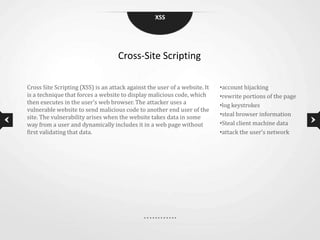
                                    Cross-Site Scripting

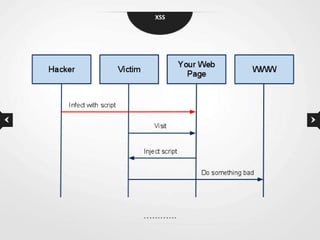
Cross Site Scripting (XSS) is an attack against the user of a website. It   •account hijacking
is a technique that forces a website to display malicious code, which       •rewrite portions of the page
then executes in the user’s web browser. The attacker uses a                •log keystrokes
vulnerable website to send malicious code to another end user of the
site. The vulnerability arises when the website takes data in some          •steal browser information
way from a user and dynamically includes it in a web page without           •Steal client machine data
first validating that data.                                                 •attack the user’s network
XSS
XSS


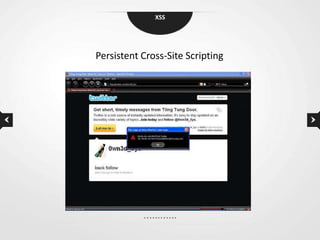
Persistent Cross-Site Scripting
XSS


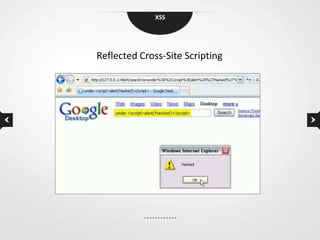
Reflected Cross-Site Scripting
XSS


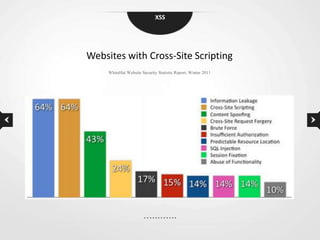
Websites with Cross-Site Scripting
     WhiteHat Website Security Statistic Report, Winter 2011
XSS


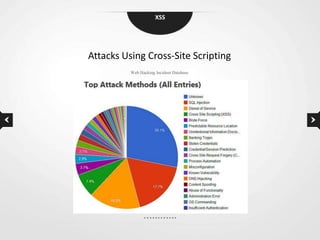
Attacks Using Cross-Site Scripting
          Web Hacking Incident Database
XSS


                               Real World Examples

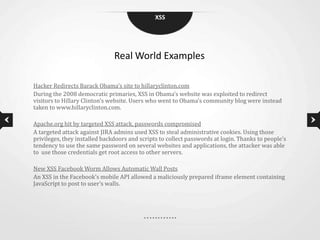
Hacker Redirects Barack Obama’s site to hillaryclinton.com
During the 2008 democratic primaries, XSS in Obama’s website was exploited to redirect
visitors to Hillary Clinton’s website. Users who went to Obama’s community blog were instead
taken to www.hillaryclinton.com.

Apache.org hit by targeted XSS attack, passwords compromised
A targeted attack against JIRA admins used XSS to steal administrative cookies. Using those
privileges, they installed backdoors and scripts to collect passwords at login. Thanks to people’s
tendency to use the same password on several websites and applications, the attacker was able
to use those credentials get root access to other servers.

New XSS Facebook Worm Allows Automatic Wall Posts
An XSS in the Facebook’s mobile API allowed a maliciously prepared iframe element containing
JavaScript to post to user’s walls.
XSS


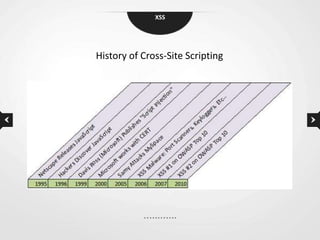
History of Cross-Site Scripting
XSS


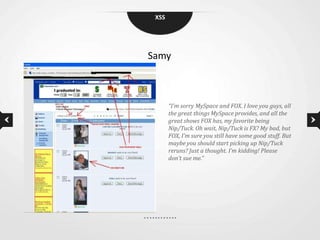
Samy


       “I’m sorry MySpace and FOX. I love you guys, all
       the great things MySpace provides, and all the
       great shows FOX has, my favorite being
       Nip/Tuck. Oh wait, Nip/Tuck is FX? My bad, but
       FOX, I’m sure you still have some good stuff. But
       maybe you should start picking up Nip/Tuck
       reruns? Just a thought. I’m kidding! Please
       don’t sue me.”
XSS


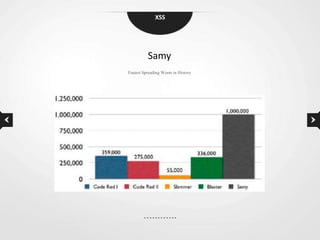
          Samy
Fastest Spreading Worm in History
XSS


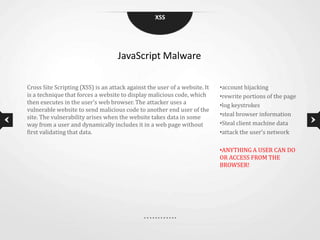
                                    JavaScript Malware

Cross Site Scripting (XSS) is an attack against the user of a website. It   •account hijacking
is a technique that forces a website to display malicious code, which       •rewrite portions of the page
then executes in the user’s web browser. The attacker uses a                •log keystrokes
vulnerable website to send malicious code to another end user of the
site. The vulnerability arises when the website takes data in some          •steal browser information
way from a user and dynamically includes it in a web page without           •Steal client machine data
first validating that data.                                                 •attack the user’s network

                                                                            •ANYTHING A USER CAN DO
                                                                            OR ACCESS FROM THE
                                                                            BROWSER!
XSS


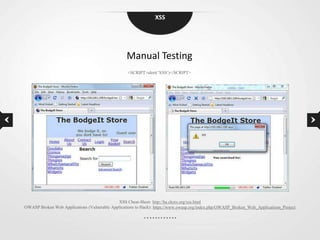
                                                  Manual Testing
                                                   <SCRIPT>alert(„XSS‟)</SCRIPT>


                                             XSS Cheat-Sheet: http://ha.ckers.org/xss.html
OWASP Broken Web Applications (Vulnerable Applications to Hack): https://www.owasp.org/index.php/OWASP_Broken_Web_Applications_Project
XSS


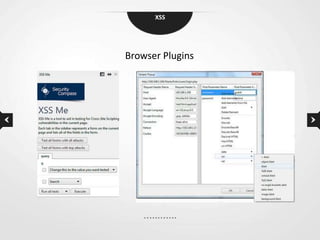
Browser Plugins
XSS


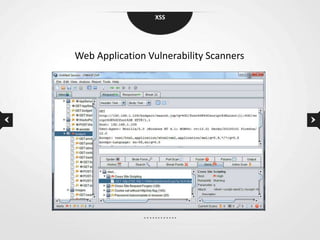
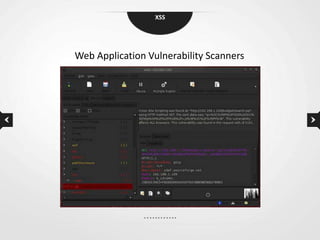
Web Application Vulnerability Scanners
XSS


Web Application Vulnerability Scanners
XSS


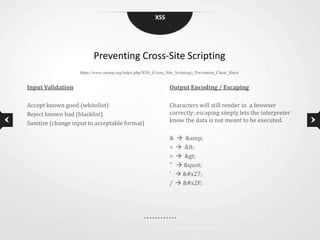
                         Preventing Cross-Site Scripting
                   https://www.owasp.org/index.php/XSS_(Cross_Site_Scripting)_Prevention_Cheat_Sheet


Input Validation                                                Output Encoding / Escaping

Accept known good (whitelist)                                   Characters will still render in a browser
Reject known bad (blacklist)                                    correctly; escaping simply lets the interpreter
Sanitize (change input to acceptable format)                    know the data is not meant to be executed.

                                                                &  &amp;
                                                                <  &lt;
                                                                >  &gt;
                                                                "  &quot;
                                                                '  &#x27;
                                                                /  &#x2F;
XSS


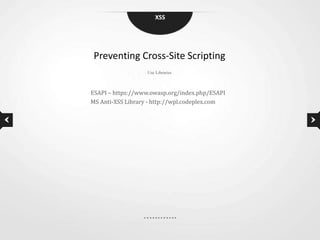
 Preventing Cross-Site Scripting
                   Use Libraries


ESAPI – https://www.owasp.org/index.php/ESAPI
MS Anti-XSS Library - http://wpl.codeplex.com
XSS


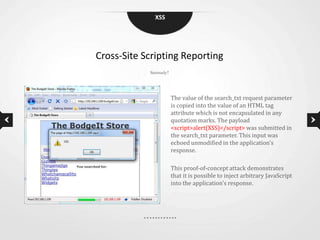
Cross-Site Scripting Reporting
            Seriously?


                         The value of the search_txt request parameter
                         is copied into the value of an HTML tag
                         attribute which is not encapsulated in any
                         quotation marks. The payload
                         <script>alert(XSS)</script> was submitted in
                         the search_txt parameter. This input was
                         echoed unmodified in the application's
                         response.

                         This proof-of-concept attack demonstrates
                         that it is possible to inject arbitrary JavaScript
                         into the application's response.
XSS


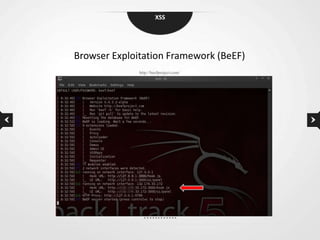
Browser Exploitation Framework (BeEF)
              http://beefproject.com/
XSS


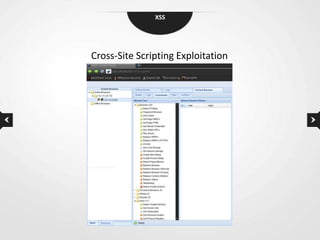
Cross-Site Scripting Exploitation
XSS


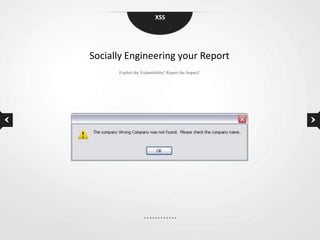
Socially Engineering your Report
      Exploit the Vulnerability! Report the Impact!
XSS


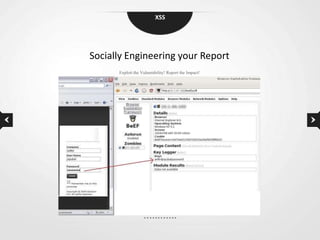
Socially Engineering your Report
      Exploit the Vulnerability! Report the Impact!
XSS


Socially Engineering your Report
      Exploit the Vulnerability! Report the Impact!
XSS


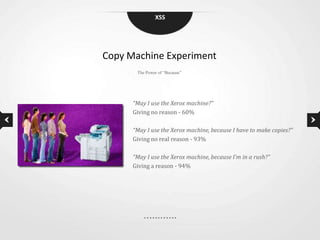
Copy Machine Experiment
       The Power of “Because”


      “May I use the Xerox machine?”
      Giving no reason - 60%

      “May I use the Xerox machine, because I have to make copies?”
      Giving no real reason - 93%

      “May I use the Xerox machine, because I’m in a rush?”
      Giving a reason - 94%
XSS


Commander’s Intent
     Give Them a Reason!
XSS


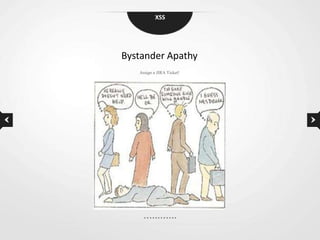
Bystander Apathy
   Assign a JIRA Ticket!
XSS


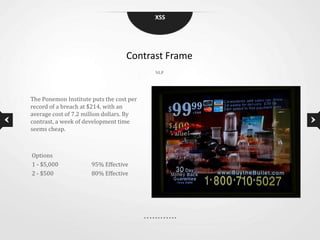
                                   Contrast Frame
                                          NLP


The Ponemon Institute puts the cost per
record of a breach at $214, with an
average cost of 7.2 million dollars. By
contrast, a week of development time
seems cheap.


Options
1 - $5,000            95% Effective
2 - $500              80% Effective
XSS


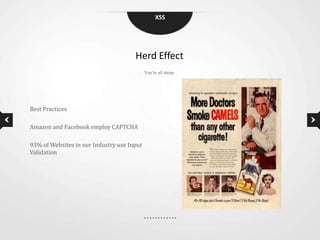
                                      Herd Effect
                                            You‟re all sheep.


Best Practices

Amazon and Facebook employ CAPTCHA

93% of Websites in our Industry use Input
Validation
XSS


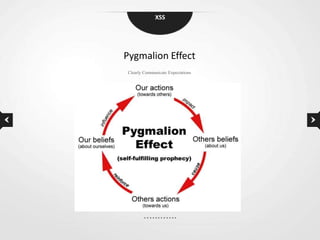
Pygmalion Effect
Clearly Communicate Expectations
XSS


                                 Metrics
                    If you want to improve something, measure it.


Measure to see if what you're doing is working. If not, try something else.
THANK YOU
   Questions?!

Convincing Developers to take Cross-Site Scripting Seriously

  • 1.
    Cross-Site Scripting Getting Developersto Take XSS Seriously Use Social Engineering to Enhance Your Vulnerability Reporting XSS
  • 2.
    XSS Contact Information Jason Pubal Website Social www.intellavis.com/blog http://www.linkedin.com/in/pubal E-mail http://www.twitter.com/pubal jpubal@gmail.com
  • 3.
    XSS Cross-Site Scripting Outline What is XSS? XSS History Detecting XSS Preventing XSS Reporting Tricks
  • 4.
    XSS Cross-Site Scripting Cross Site Scripting (XSS) is an attack against the user of a website. It •account hijacking is a technique that forces a website to display malicious code, which •rewrite portions of the page then executes in the user’s web browser. The attacker uses a •log keystrokes vulnerable website to send malicious code to another end user of the site. The vulnerability arises when the website takes data in some •steal browser information way from a user and dynamically includes it in a web page without •Steal client machine data first validating that data. •attack the user’s network
  • 5.
  • 6.
  • 7.
  • 8.
    XSS Websites with Cross-SiteScripting WhiteHat Website Security Statistic Report, Winter 2011
  • 9.
    XSS Attacks Using Cross-SiteScripting Web Hacking Incident Database
  • 10.
    XSS Real World Examples Hacker Redirects Barack Obama’s site to hillaryclinton.com During the 2008 democratic primaries, XSS in Obama’s website was exploited to redirect visitors to Hillary Clinton’s website. Users who went to Obama’s community blog were instead taken to www.hillaryclinton.com. Apache.org hit by targeted XSS attack, passwords compromised A targeted attack against JIRA admins used XSS to steal administrative cookies. Using those privileges, they installed backdoors and scripts to collect passwords at login. Thanks to people’s tendency to use the same password on several websites and applications, the attacker was able to use those credentials get root access to other servers. New XSS Facebook Worm Allows Automatic Wall Posts An XSS in the Facebook’s mobile API allowed a maliciously prepared iframe element containing JavaScript to post to user’s walls.
  • 11.
  • 12.
    XSS Samy “I’m sorry MySpace and FOX. I love you guys, all the great things MySpace provides, and all the great shows FOX has, my favorite being Nip/Tuck. Oh wait, Nip/Tuck is FX? My bad, but FOX, I’m sure you still have some good stuff. But maybe you should start picking up Nip/Tuck reruns? Just a thought. I’m kidding! Please don’t sue me.”
  • 13.
    XSS Samy Fastest Spreading Worm in History
  • 14.
    XSS JavaScript Malware Cross Site Scripting (XSS) is an attack against the user of a website. It •account hijacking is a technique that forces a website to display malicious code, which •rewrite portions of the page then executes in the user’s web browser. The attacker uses a •log keystrokes vulnerable website to send malicious code to another end user of the site. The vulnerability arises when the website takes data in some •steal browser information way from a user and dynamically includes it in a web page without •Steal client machine data first validating that data. •attack the user’s network •ANYTHING A USER CAN DO OR ACCESS FROM THE BROWSER!
  • 15.
    XSS Manual Testing <SCRIPT>alert(„XSS‟)</SCRIPT> XSS Cheat-Sheet: http://ha.ckers.org/xss.html OWASP Broken Web Applications (Vulnerable Applications to Hack): https://www.owasp.org/index.php/OWASP_Broken_Web_Applications_Project
  • 16.
  • 17.
  • 18.
  • 19.
    XSS Preventing Cross-Site Scripting https://www.owasp.org/index.php/XSS_(Cross_Site_Scripting)_Prevention_Cheat_Sheet Input Validation Output Encoding / Escaping Accept known good (whitelist) Characters will still render in a browser Reject known bad (blacklist) correctly; escaping simply lets the interpreter Sanitize (change input to acceptable format) know the data is not meant to be executed. &  &amp; <  &lt; >  &gt; "  &quot; '  &#x27; /  &#x2F;
  • 20.
    XSS Preventing Cross-SiteScripting Use Libraries ESAPI – https://www.owasp.org/index.php/ESAPI MS Anti-XSS Library - http://wpl.codeplex.com
  • 21.
    XSS Cross-Site Scripting Reporting Seriously? The value of the search_txt request parameter is copied into the value of an HTML tag attribute which is not encapsulated in any quotation marks. The payload <script>alert(XSS)</script> was submitted in the search_txt parameter. This input was echoed unmodified in the application's response. This proof-of-concept attack demonstrates that it is possible to inject arbitrary JavaScript into the application's response.
  • 22.
    XSS Browser Exploitation Framework(BeEF) http://beefproject.com/
  • 23.
  • 24.
    XSS Socially Engineering yourReport Exploit the Vulnerability! Report the Impact!
  • 25.
    XSS Socially Engineering yourReport Exploit the Vulnerability! Report the Impact!
  • 26.
    XSS Socially Engineering yourReport Exploit the Vulnerability! Report the Impact!
  • 27.
    XSS Copy Machine Experiment The Power of “Because” “May I use the Xerox machine?” Giving no reason - 60% “May I use the Xerox machine, because I have to make copies?” Giving no real reason - 93% “May I use the Xerox machine, because I’m in a rush?” Giving a reason - 94%
  • 28.
    XSS Commander’s Intent Give Them a Reason!
  • 29.
    XSS Bystander Apathy Assign a JIRA Ticket!
  • 30.
    XSS Contrast Frame NLP The Ponemon Institute puts the cost per record of a breach at $214, with an average cost of 7.2 million dollars. By contrast, a week of development time seems cheap. Options 1 - $5,000 95% Effective 2 - $500 80% Effective
  • 31.
    XSS Herd Effect You‟re all sheep. Best Practices Amazon and Facebook employ CAPTCHA 93% of Websites in our Industry use Input Validation
  • 32.
  • 33.
    XSS Metrics If you want to improve something, measure it. Measure to see if what you're doing is working. If not, try something else.
  • 34.
    THANK YOU Questions?!