Cross Cultural Dynamics
Presented By
Sudeep kohli
Pooja Raghav
Deepshikha
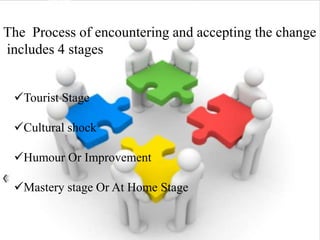
The Process of encountering and accepting the change
includes 4 stages
Tourist Stage
Cultural shock
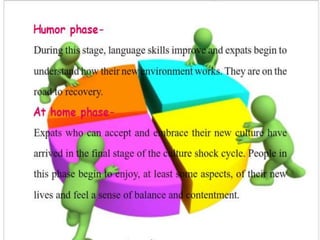
Humour Or Improvement
Mastery stage Or At Home Stage
Tourist Stage
 It is an initial stage in cultural shock cycle some expats
enter this phase while they are still in planning mode
 This stage of a cycle is met with heightened enthusiasm
excitement, possible fear of unknown sense and of
adventure and mission
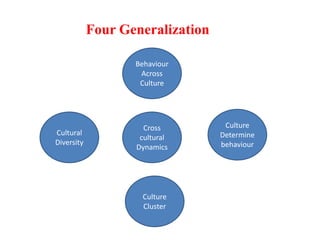
Behaviour
Across
Culture
Culture
Determine
behaviour
Cross
cultural
Dynamics
Cultural
Diversity
Culture
Cluster
Four Generalization
DIFFERENCE IN CULTURE
There are various dimensions of cultural difference like
work cultural in Japan
LUNCH:- They have their lunch at their desk and the
lunch finished in very short duration smoking is
Allowed even at the work place and in public place
Japanese employees tend to leave only after their
bosses have left and usually work late in to the night
People Perception
In some countries people view themselves and
other around them as by and large, honest and
trustworthy. In other countries other are
generally viewed in suspicion and are not
considered trustworthy
E.g. Stealing other persons properties is
unthinkeble
People differ from each other in their
orientation to time .in some countries, people
tend to be oriented towards the past, while in
some countries, the focus is on the present.
there are also some countries where people
have a futuristic outlook. e.g.:-north
American believe in preserving history and
continuing with tradition. Where Japan &
china are future oriented.
TIME DIMENSION
PUBLIC & PRIVATE SPACE
In few countries, people give a lot of importance
to their private & public space. E.g.:- The top
executives and heads of American organization
are not easily accessible to the lower level
employees to the public place. In countries like
Japan, private space is not given much
importance .
Cross Cultural Competencies
Cross-cultural competencies refers to the
knowledge, skills, and affect/motivation
that enable individuals to adapt effectively
in cross-cultural environment.
US Army document
Reference
Cross-cultural motivation:
You are curious about new surroundings and cultures and
actively seek out learning opportunities.
You demonstrate cross-cultural motivation when you:
• welcome the opportunity to learn more about the
geography and culture of your work term city, region and
country
• take initiative to explore your environment
• actively network with people from different cultures
• take interest in current events in your work term country
• engage with people in your employer organization and
community
Cross-cultural knowledge:
You have a good understanding of different cultures
and apply this knowledge in your daily life.
You demonstrate cross-cultural knowledge when you:
• recognize and respect cultural diversity
• learn appropriate, effective ways to communicate
with people from different cultural backgrounds
• know how to be diplomatic and sensitive to the
dynamics of a cross-cultural workplace
• understand how to communicate with people who
speak or write a different language
• know how to be adept in a new environment
• understand ways to cope with constant change
Strategic thinking
In the context of your cross-cultural encounter, you
engage in cultural interactions with the intent to
enhance your personal development and contribute to
your workplace.
You demonstrate strategic thinking when you:
• are conscious of your assumptions relating to cultural
issues and question them at all times
• think about how you can take initiative to learn from
co-workers from different cultural
backgrounds
• plan how to pursue networking opportunities with
people from different cultural backgrounds
Cross-cultural behaviour
You demonstrate flexibility in your interactions and are able
to recognize and adapt to cultural nuances in
the workplace and beyond.
You demonstrate cross-cultural behaviour when you:
• display a positive attitude towards change and new
environments
• adapt to different cross-cultural communication norms
• change your verbal and nonverbal behaviours according to
different situations
Cross cultural adoption

Cross cultural adoption

  • 1.
  • 2.
  • 6.
    The Process ofencountering and accepting the change includes 4 stages Tourist Stage Cultural shock Humour Or Improvement Mastery stage Or At Home Stage
  • 7.
    Tourist Stage  Itis an initial stage in cultural shock cycle some expats enter this phase while they are still in planning mode  This stage of a cycle is met with heightened enthusiasm excitement, possible fear of unknown sense and of adventure and mission
  • 10.
  • 12.
    DIFFERENCE IN CULTURE Thereare various dimensions of cultural difference like work cultural in Japan LUNCH:- They have their lunch at their desk and the lunch finished in very short duration smoking is Allowed even at the work place and in public place Japanese employees tend to leave only after their bosses have left and usually work late in to the night
  • 13.
    People Perception In somecountries people view themselves and other around them as by and large, honest and trustworthy. In other countries other are generally viewed in suspicion and are not considered trustworthy E.g. Stealing other persons properties is unthinkeble
  • 15.
    People differ fromeach other in their orientation to time .in some countries, people tend to be oriented towards the past, while in some countries, the focus is on the present. there are also some countries where people have a futuristic outlook. e.g.:-north American believe in preserving history and continuing with tradition. Where Japan & china are future oriented. TIME DIMENSION
  • 16.
    PUBLIC & PRIVATESPACE In few countries, people give a lot of importance to their private & public space. E.g.:- The top executives and heads of American organization are not easily accessible to the lower level employees to the public place. In countries like Japan, private space is not given much importance .
  • 17.
    Cross Cultural Competencies Cross-culturalcompetencies refers to the knowledge, skills, and affect/motivation that enable individuals to adapt effectively in cross-cultural environment. US Army document Reference
  • 18.
    Cross-cultural motivation: You arecurious about new surroundings and cultures and actively seek out learning opportunities. You demonstrate cross-cultural motivation when you: • welcome the opportunity to learn more about the geography and culture of your work term city, region and country • take initiative to explore your environment • actively network with people from different cultures • take interest in current events in your work term country • engage with people in your employer organization and community
  • 19.
    Cross-cultural knowledge: You havea good understanding of different cultures and apply this knowledge in your daily life. You demonstrate cross-cultural knowledge when you: • recognize and respect cultural diversity • learn appropriate, effective ways to communicate with people from different cultural backgrounds • know how to be diplomatic and sensitive to the dynamics of a cross-cultural workplace • understand how to communicate with people who speak or write a different language • know how to be adept in a new environment • understand ways to cope with constant change
  • 20.
    Strategic thinking In thecontext of your cross-cultural encounter, you engage in cultural interactions with the intent to enhance your personal development and contribute to your workplace. You demonstrate strategic thinking when you: • are conscious of your assumptions relating to cultural issues and question them at all times • think about how you can take initiative to learn from co-workers from different cultural backgrounds • plan how to pursue networking opportunities with people from different cultural backgrounds
  • 21.
    Cross-cultural behaviour You demonstrateflexibility in your interactions and are able to recognize and adapt to cultural nuances in the workplace and beyond. You demonstrate cross-cultural behaviour when you: • display a positive attitude towards change and new environments • adapt to different cross-cultural communication norms • change your verbal and nonverbal behaviours according to different situations