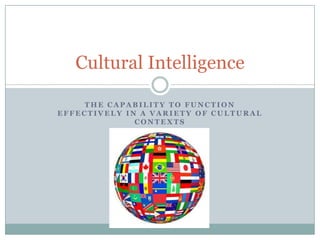

Cultural Intelligence

    THE CAPABILITY TO FUNCTION
EFFECTIVELY IN A VARIETY OF CULTURAL
              CONTEXTS
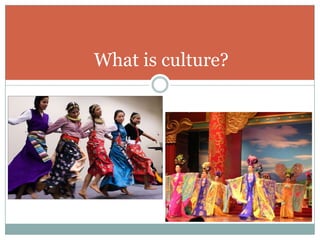
What is culture?
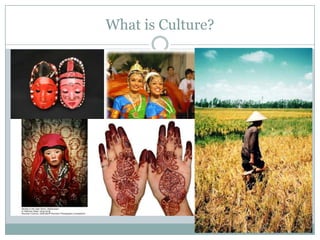
What is Culture?
What is culture?

 "Most social scientists today view culture as consisting primarily of
   the symbolic, ideational, and intangible aspects of human societies.

 The essence of a culture is not its artifacts, tools, or other tangible
   cultural elements but how the members of the group interpret, use,
   and perceive them.

 It is the values, symbols, interpretations, and perspectives that
   distinguish one people from another in modernized societies; it is
   not material objects and other tangible aspects of human societies.

 People within a culture usually interpret the meaning of symbols,
   artifacts, and behaviors in the same or in similar ways."
Source:
Banks, J.A., Banks, & McGee, C. A. (1989). Multicultural education. Needham Heights, MA: Allyn & Bacon.
What is culture?

HTTP://WWW.CARLA.UMN.EDU/CULTURE/D
          EFINITIONS.HTML
What about YOU?

 Do you speak another language (fluently)?
 Do you have a passport?
 Have you ever visited another country for vacation?
 Have you ever lived outside the USA?
 Do you see yourself ever living in another country?
 Do you think living in another country would be easy?
 Do you read the news about other countries?
 In your line of work, do you collaborate with individuals
  from other countries?
 Do you eat foods from other countries?
 If you could go ANYWHERE in the world, where would
  you want to go?
Are you prepared?
Cross-Cultural Sensitivity Inventory

 A 32-item instrument that provides dimensional
 scores for individuals on five subscales.

 Levels of sensitivity on issues & experiences related
 to cross-cultural or inter-cultural interaction
  (the higher the score, the more sensitive the individual is)


 Used to raise people’s awareness of the issues to
 consider prior to intercultural interaction.
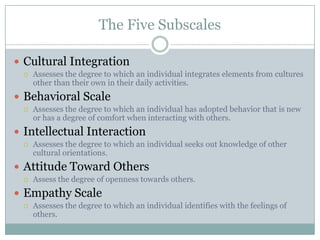
The Five Subscales

 Cultural Integration
    Assesses the degree to which an individual integrates elements from cultures
     other than their own in their daily activities.
 Behavioral Scale
    Assesses the degree to which an individual has adopted behavior that is new
     or has a degree of comfort when interacting with others.
 Intellectual Interaction
    Assesses the degree to which an individual seeks out knowledge of other
     cultural orientations.
 Attitude Toward Others
    Assess the degree of openness towards others.
 Empathy Scale
    Assesses the degree to which an individual identifies with the feelings of
     others.
HSBC Cultural Differences
Mistakes Americans Make
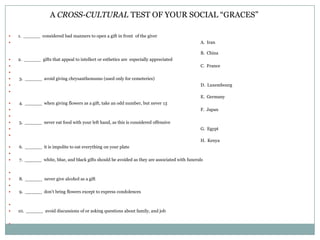
A CROSS-CULTURAL TEST OF YOUR SOCIAL “GRACES”

   1. ______ considered bad manners to open a gift in front of the giver
                                                                                              A. Iran

                                                                                               B. China
   2. ______ gifts that appeal to intellect or esthetics are especially appreciated
                                                                                              C. France

   3. ______ avoid giving chrysanthemums (used only for cemeteries)
                                                                                              D. Luxembourg

                                                                                               E. Germany
   4. ______ when giving flowers as a gift, take an odd number, but never 13
                                                                                              F. Japan

   5. ______ never eat food with your left hand, as this is considered offensive
                                                                                              G. Egypt

                                                                                               H. Kenya
   6. ______ it is impolite to eat everything on your plate

   7. ______ white, blue, and black gifts should be avoided as they are associated with funerals


   8. ______ never give alcohol as a gift

   9. ______ don’t bring flowers except to express condolences


   10. ______ avoid discussions of or asking questions about family, and job


What is cultural intelligence?

 The capability to function effectively across a variety
  of cultural contexts.
     Ethnic
     Generational
     Organizational Cultures


 Emphasis is on
   understanding different cultures

   Problem solving

   Effective adaptations for various cultural settings.
Why do we need cultural intelligence?

 The global workplace requires individuals
   to be sensitive to different cultures,

   to interact appropriately with people from different cultures, &

   to analyze new cultures as they are encountered


 Cultural intelligence is needed
   to manage the stress of culture shock, and

   the consequent frustration and confusion that typically result
    from clashes of cultural differences
Who needs cultural intelligence?

 Business leaders
 Government leaders
 Non-profit leaders
 Corporations
 Government agencies
 Universities
 ???
Individuals & Organizations
 How do individuals develop their capacity to adapt effectively across
  different cultures?

 Why do some individuals possess superior capacity to deal with the
  challenges of working in different cultures?

 How do individuals reach full productive potential working in culturally
  diverse work environments in the home countries and overseas?

 How do organizations build capability for effective work assignments in
  locations around the world?

 How do organizations optimize individual and collective performance
  when they harness the cultural diversity of their people across the
  world?
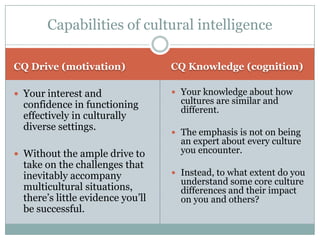
Capabilities of cultural intelligence

CQ Drive (motivation)              CQ Knowledge (cognition)

 Your interest and                 Your knowledge about how
  confidence in functioning          cultures are similar and
                                     different.
  effectively in culturally
  diverse settings.
                                    The emphasis is not on being
                                     an expert about every culture
 Without the ample drive to         you encounter.
  take on the challenges that
  inevitably accompany              Instead, to what extent do you
                                     understand some core culture
  multicultural situations,          differences and their impact
  there’s little evidence you’ll     on you and others?
  be successful.
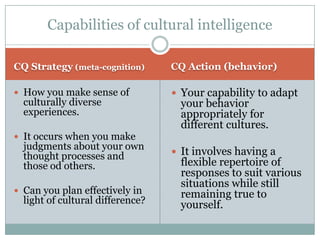
Capabilities of cultural intelligence

CQ Strategy (meta-cognition)      CQ Action (behavior)

 How you make sense of            Your capability to adapt
  culturally diverse                your behavior
  experiences.                      appropriately for
                                    different cultures.
 It occurs when you make
  judgments about your own
  thought processes and            It involves having a
  those od others.                  flexible repertoire of
                                    responses to suit various
                                    situations while still
 Can you plan effectively in       remaining true to
  light of cultural difference?     yourself.
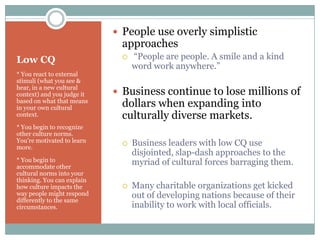
 People use overly simplistic
                             approaches
Low CQ                          “People are people. A smile and a kind
                                 word work anywhere.”
* You react to external
stimuli (what you see &
hear, in a new cultural
context) and you judge it    Business continue to lose millions of
based on what that means
in your own cultural         dollars when expanding into
context.                     culturally diverse markets.
* You begin to recognize
other culture norms.
You’re motivated to learn       Business leaders with low CQ use
more.
                                 disjointed, slap-dash approaches to the
* You begin to                   myriad of cultural forces barraging them.
accommodate other
cultural norms into your
thinking. You can explain
how culture impacts the         Many charitable organizations get kicked
way people might respond
differently to the same
                                 out of developing nations because of their
circumstances.                   inability to work with local officials.
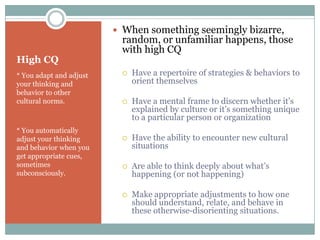
 When something seemingly bizarre,
                          random, or unfamiliar happens, those
                          with high CQ
High CQ
* You adapt and adjust       Have a repertoire of strategies & behaviors to
your thinking and             orient themselves
behavior to other
cultural norms.              Have a mental frame to discern whether it’s
                              explained by culture or it’s something unique
                              to a particular person or organization
* You automatically
adjust your thinking         Have the ability to encounter new cultural
and behavior when you         situations
get appropriate cues,
sometimes                    Are able to think deeply about what’s
subconsciously.               happening (or not happening)

                             Make appropriate adjustments to how one
                              should understand, relate, and behave in
                              these otherwise-disorienting situations.
What High CQ looks like:

Teachers                    Human Resource Managers


 When working with          Have a better sense of
 students from various        how to handle a
 cultural backgrounds,        Muslim employee’s
 they learn how to adapt      request to miss a sales
 their:                       conference during
    Teaching                 Ramadan.
    Assessments
    Feedback strategies
What High CQ looks like:

Hospitals                         Students


 When led by culturally           Have more long-term
 intelligent leaders, are          benefits
 more effective at:                   Volunteer
    Treating immigrant               Study Abroad
     patients
    Have fewer lawsuits due to
     misdiagnosis of those
     patients
Benefits of Increasing CQ

 SUPERIOR CROSS-CULTURAL ADJUSTMENT


     IMPROVED JOB PERFORMANCE


   ENHANCED PERSONAL WELL-BEING


       GREATER PROFITABILITY
Together We Can Be Catalysts!

 IMAGINE A LIBERAL POLITICIAN AND A TEA PARTY
  ACTIVIST ENGAGING IN RESPECTFUL DIALOGUE.

 IMAGINE A JEWISH FAMILY SHARING A HOLIDAY
            WITH A PALESTINIAN FAMILY.

 IMAGINE A CEO WORKING WITH A HIP-HOP ARTIST
             TO REDUCE WORLD HUNGER.

       IMAGINE AN ACLU ADVOCATE JOINING AN
       EVANGELICAL PASTOR TO PROMOTE WORLD
                      JUSTICE.
Discussion

 What is cultural intelligence?


 How can you improve your global awareness?


 What are some questions you may want to ask someone
  from another culture before going to their country?

 In order to improve your cultural intelligence, how could
  you “scare yourself?”

 What does “think widely, focus deeply” mean?

Cultural Intelligence

  • 1.
    Cultural Intelligence THE CAPABILITY TO FUNCTION EFFECTIVELY IN A VARIETY OF CULTURAL CONTEXTS
  • 2.
  • 3.
  • 4.
    What is culture? "Most social scientists today view culture as consisting primarily of the symbolic, ideational, and intangible aspects of human societies.  The essence of a culture is not its artifacts, tools, or other tangible cultural elements but how the members of the group interpret, use, and perceive them.  It is the values, symbols, interpretations, and perspectives that distinguish one people from another in modernized societies; it is not material objects and other tangible aspects of human societies.  People within a culture usually interpret the meaning of symbols, artifacts, and behaviors in the same or in similar ways." Source: Banks, J.A., Banks, & McGee, C. A. (1989). Multicultural education. Needham Heights, MA: Allyn & Bacon.
  • 5.
  • 6.
    What about YOU? Do you speak another language (fluently)?  Do you have a passport?  Have you ever visited another country for vacation?  Have you ever lived outside the USA?  Do you see yourself ever living in another country?  Do you think living in another country would be easy?  Do you read the news about other countries?  In your line of work, do you collaborate with individuals from other countries?  Do you eat foods from other countries?  If you could go ANYWHERE in the world, where would you want to go?
  • 7.
  • 8.
    Cross-Cultural Sensitivity Inventory A 32-item instrument that provides dimensional scores for individuals on five subscales.  Levels of sensitivity on issues & experiences related to cross-cultural or inter-cultural interaction (the higher the score, the more sensitive the individual is)  Used to raise people’s awareness of the issues to consider prior to intercultural interaction.
  • 9.
    The Five Subscales Cultural Integration  Assesses the degree to which an individual integrates elements from cultures other than their own in their daily activities.  Behavioral Scale  Assesses the degree to which an individual has adopted behavior that is new or has a degree of comfort when interacting with others.  Intellectual Interaction  Assesses the degree to which an individual seeks out knowledge of other cultural orientations.  Attitude Toward Others  Assess the degree of openness towards others.  Empathy Scale  Assesses the degree to which an individual identifies with the feelings of others.
  • 10.
  • 11.
  • 12.
    A CROSS-CULTURAL TESTOF YOUR SOCIAL “GRACES”  1. ______ considered bad manners to open a gift in front of the giver  A. Iran B. China  2. ______ gifts that appeal to intellect or esthetics are especially appreciated  C. France   3. ______ avoid giving chrysanthemums (used only for cemeteries)  D. Luxembourg  E. Germany  4. ______ when giving flowers as a gift, take an odd number, but never 13  F. Japan   5. ______ never eat food with your left hand, as this is considered offensive  G. Egypt  H. Kenya  6. ______ it is impolite to eat everything on your plate   7. ______ white, blue, and black gifts should be avoided as they are associated with funerals   8. ______ never give alcohol as a gift   9. ______ don’t bring flowers except to express condolences   10. ______ avoid discussions of or asking questions about family, and job 
  • 13.
    What is culturalintelligence?  The capability to function effectively across a variety of cultural contexts.  Ethnic  Generational  Organizational Cultures  Emphasis is on  understanding different cultures  Problem solving  Effective adaptations for various cultural settings.
  • 14.
    Why do weneed cultural intelligence?  The global workplace requires individuals  to be sensitive to different cultures,  to interact appropriately with people from different cultures, &  to analyze new cultures as they are encountered  Cultural intelligence is needed  to manage the stress of culture shock, and  the consequent frustration and confusion that typically result from clashes of cultural differences
  • 15.
    Who needs culturalintelligence?  Business leaders  Government leaders  Non-profit leaders  Corporations  Government agencies  Universities  ???
  • 16.
    Individuals & Organizations How do individuals develop their capacity to adapt effectively across different cultures?  Why do some individuals possess superior capacity to deal with the challenges of working in different cultures?  How do individuals reach full productive potential working in culturally diverse work environments in the home countries and overseas?  How do organizations build capability for effective work assignments in locations around the world?  How do organizations optimize individual and collective performance when they harness the cultural diversity of their people across the world?
  • 17.
    Capabilities of culturalintelligence CQ Drive (motivation) CQ Knowledge (cognition)  Your interest and  Your knowledge about how confidence in functioning cultures are similar and different. effectively in culturally diverse settings.  The emphasis is not on being an expert about every culture  Without the ample drive to you encounter. take on the challenges that inevitably accompany  Instead, to what extent do you understand some core culture multicultural situations, differences and their impact there’s little evidence you’ll on you and others? be successful.
  • 18.
    Capabilities of culturalintelligence CQ Strategy (meta-cognition) CQ Action (behavior)  How you make sense of  Your capability to adapt culturally diverse your behavior experiences. appropriately for different cultures.  It occurs when you make judgments about your own thought processes and  It involves having a those od others. flexible repertoire of responses to suit various situations while still  Can you plan effectively in remaining true to light of cultural difference? yourself.
  • 19.
     People useoverly simplistic approaches Low CQ  “People are people. A smile and a kind word work anywhere.” * You react to external stimuli (what you see & hear, in a new cultural context) and you judge it  Business continue to lose millions of based on what that means in your own cultural dollars when expanding into context. culturally diverse markets. * You begin to recognize other culture norms. You’re motivated to learn  Business leaders with low CQ use more. disjointed, slap-dash approaches to the * You begin to myriad of cultural forces barraging them. accommodate other cultural norms into your thinking. You can explain how culture impacts the  Many charitable organizations get kicked way people might respond differently to the same out of developing nations because of their circumstances. inability to work with local officials.
  • 20.
     When somethingseemingly bizarre, random, or unfamiliar happens, those with high CQ High CQ * You adapt and adjust  Have a repertoire of strategies & behaviors to your thinking and orient themselves behavior to other cultural norms.  Have a mental frame to discern whether it’s explained by culture or it’s something unique to a particular person or organization * You automatically adjust your thinking  Have the ability to encounter new cultural and behavior when you situations get appropriate cues, sometimes  Are able to think deeply about what’s subconsciously. happening (or not happening)  Make appropriate adjustments to how one should understand, relate, and behave in these otherwise-disorienting situations.
  • 21.
    What High CQlooks like: Teachers Human Resource Managers  When working with  Have a better sense of students from various how to handle a cultural backgrounds, Muslim employee’s they learn how to adapt request to miss a sales their: conference during  Teaching Ramadan.  Assessments  Feedback strategies
  • 22.
    What High CQlooks like: Hospitals Students  When led by culturally  Have more long-term intelligent leaders, are benefits more effective at:  Volunteer  Treating immigrant  Study Abroad patients  Have fewer lawsuits due to misdiagnosis of those patients
  • 23.
    Benefits of IncreasingCQ  SUPERIOR CROSS-CULTURAL ADJUSTMENT  IMPROVED JOB PERFORMANCE  ENHANCED PERSONAL WELL-BEING  GREATER PROFITABILITY
  • 24.
    Together We CanBe Catalysts!  IMAGINE A LIBERAL POLITICIAN AND A TEA PARTY ACTIVIST ENGAGING IN RESPECTFUL DIALOGUE.  IMAGINE A JEWISH FAMILY SHARING A HOLIDAY WITH A PALESTINIAN FAMILY.  IMAGINE A CEO WORKING WITH A HIP-HOP ARTIST TO REDUCE WORLD HUNGER.  IMAGINE AN ACLU ADVOCATE JOINING AN EVANGELICAL PASTOR TO PROMOTE WORLD JUSTICE.
  • 25.
    Discussion  What iscultural intelligence?  How can you improve your global awareness?  What are some questions you may want to ask someone from another culture before going to their country?  In order to improve your cultural intelligence, how could you “scare yourself?”  What does “think widely, focus deeply” mean?