Chapter 3: Cultural Conformity and Adaptation Holt Sociology
Starter  Piece of paper to turn in… 1. Look at the list on page 43.  What is being describe in this list? 2. Is this list a good example of how cultures change?  3. Be specific, how or what has changed since this list was penned?
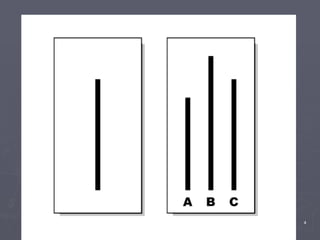
Asch Performance Test If you had Mr. Hunter for psychology, please move to the rear of the class.  If you haven’t taken psych move to the front. We will be looking at several optical illusions, and eye (right or left) dominance related to certain values.
 
Starter  Piece of paper to turn in… 1. Brainstorm as many words using the prefix ‘self-’ (American) in common use today. 2. What do these words suggest about American culture?
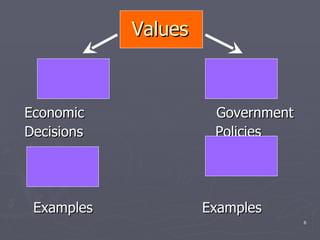
Values Economic  Government Decisions   Policies Examples   Examples
Traditional American Values Sociologist Robin Williams identified a set of 15 values that are central to the American way of life.
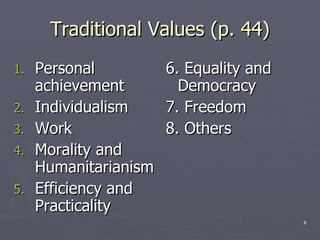
Traditional Values (p. 44) Personal achievement Individualism Work Morality and Humanitarianism Efficiency and Practicality 6. Equality and Democracy 7. Freedom 8. Others
Young Americans and Values (p. 47) Popcorn reading… On other side of starter, get into groups of 4 and answer the following questions: What issues concern you most?  Do your values differ from your parents’ values?  In what ways?  Should social values such as morality be taught in public school?
Starter to turn in: (1/26) What values (listed in this chapter) did the president use or cite in his speech last night?  How has the society of CHS changed in the past 3-4 years?  (policies, attitudes, physical, trends, teams, clubs…)
Sources of Social Change (6) #1.  Values and Beliefs: Values and beliefs  can be part of a greater ideology.  An ideology is a system of beliefs or ideas that justifies the social,  moral, religious, political or economic interests help by a group of society. “ The reason why…” Social Movement promotes social change…
Sources of Social Change (6) #2.   Technology  new ways of manipulating the environment.  Examples:
Sources of Social Change (6) #3.  Population: As populations change, so does culture. Examples:  larger population = more competition Examples: Growing immigration = more outside cultural influences Examples: Aging population, different focuses on lifestyles and use of resources (health care) “ How has CHS population changed?”
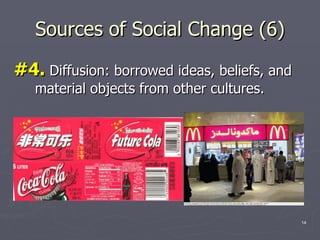
Sources of Social Change (6) #4.  Diffusion: borrowed ideas, beliefs, and material objects from other cultures.
Sources of Social Change (6) #5.  Physical Environment: Abundant resources in a country/region vs. scarce resources in a region. Natural disaster, As populations change, so does culture. “ How has CHS population changed?”
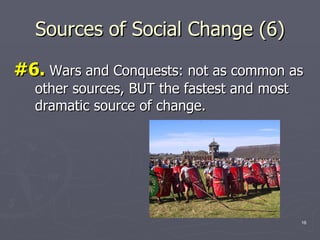
Sources of Social Change (6) #6.  Wars and Conquests: not as common as other sources, BUT the fastest and most dramatic source of change.
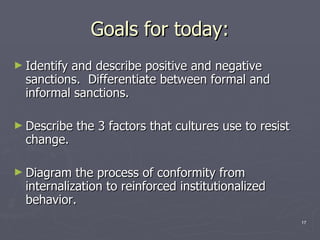
Goals for today: Identify and describe positive and negative sanctions.  Differentiate between formal and informal sanctions.  Describe the 3 factors that cultures use to resist change.  Diagram the process of conformity from internalization to reinforced institutionalized behavior.
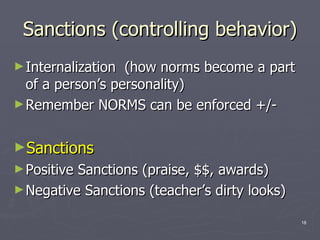
Sanctions (controlling behavior) Internalization  (how norms become a part of a person’s personality) Remember NORMS can be enforced +/- Sanctions Positive Sanctions (praise, $$, awards) Negative Sanctions (teacher’s dirty looks)
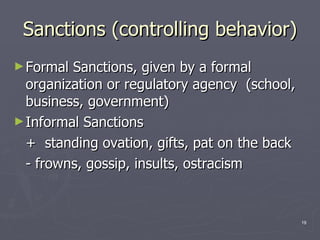
Sanctions (controlling behavior) Formal Sanctions, given by a formal organization or regulatory agency  (school, business, government) Informal Sanctions +  standing ovation, gifts, pat on the back - frowns, gossip, insults, ostracism
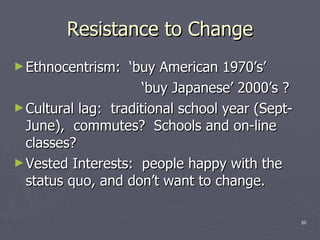
Resistance to Change Ethnocentrism:  ‘buy American 1970’s’ ‘buy Japanese’ 2000’s ? Cultural lag:  traditional school year (Sept-June),  commutes?  Schools and on-line classes? Vested Interests:  people happy with the status quo, and don’t want to change.
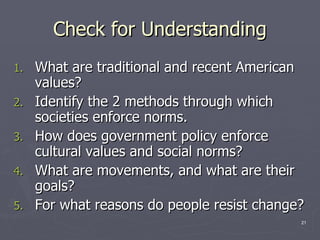
Check for Understanding What are traditional and recent American values? Identify the 2 methods through which societies enforce norms.  How does government policy enforce cultural values and social norms? What are movements, and what are their goals? For what reasons do people resist change?
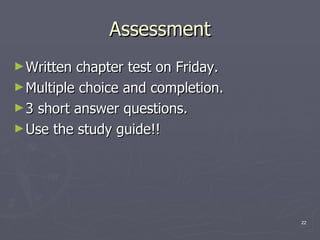
Assessment Written chapter test on Friday.  Multiple choice and completion. 3 short answer questions. Use the study guide!!

Ch. 3 cultural conformity and adaptation

  • 1.
    Chapter 3: CulturalConformity and Adaptation Holt Sociology
  • 2.
    Starter Pieceof paper to turn in… 1. Look at the list on page 43. What is being describe in this list? 2. Is this list a good example of how cultures change? 3. Be specific, how or what has changed since this list was penned?
  • 3.
    Asch Performance TestIf you had Mr. Hunter for psychology, please move to the rear of the class. If you haven’t taken psych move to the front. We will be looking at several optical illusions, and eye (right or left) dominance related to certain values.
  • 4.
  • 5.
    Starter Pieceof paper to turn in… 1. Brainstorm as many words using the prefix ‘self-’ (American) in common use today. 2. What do these words suggest about American culture?
  • 6.
    Values Economic Government Decisions Policies Examples Examples
  • 7.
    Traditional American ValuesSociologist Robin Williams identified a set of 15 values that are central to the American way of life.
  • 8.
    Traditional Values (p.44) Personal achievement Individualism Work Morality and Humanitarianism Efficiency and Practicality 6. Equality and Democracy 7. Freedom 8. Others
  • 9.
    Young Americans andValues (p. 47) Popcorn reading… On other side of starter, get into groups of 4 and answer the following questions: What issues concern you most? Do your values differ from your parents’ values? In what ways? Should social values such as morality be taught in public school?
  • 10.
    Starter to turnin: (1/26) What values (listed in this chapter) did the president use or cite in his speech last night? How has the society of CHS changed in the past 3-4 years? (policies, attitudes, physical, trends, teams, clubs…)
  • 11.
    Sources of SocialChange (6) #1. Values and Beliefs: Values and beliefs can be part of a greater ideology. An ideology is a system of beliefs or ideas that justifies the social, moral, religious, political or economic interests help by a group of society. “ The reason why…” Social Movement promotes social change…
  • 12.
    Sources of SocialChange (6) #2. Technology new ways of manipulating the environment. Examples:
  • 13.
    Sources of SocialChange (6) #3. Population: As populations change, so does culture. Examples: larger population = more competition Examples: Growing immigration = more outside cultural influences Examples: Aging population, different focuses on lifestyles and use of resources (health care) “ How has CHS population changed?”
  • 14.
    Sources of SocialChange (6) #4. Diffusion: borrowed ideas, beliefs, and material objects from other cultures.
  • 15.
    Sources of SocialChange (6) #5. Physical Environment: Abundant resources in a country/region vs. scarce resources in a region. Natural disaster, As populations change, so does culture. “ How has CHS population changed?”
  • 16.
    Sources of SocialChange (6) #6. Wars and Conquests: not as common as other sources, BUT the fastest and most dramatic source of change.
  • 17.
    Goals for today:Identify and describe positive and negative sanctions. Differentiate between formal and informal sanctions. Describe the 3 factors that cultures use to resist change. Diagram the process of conformity from internalization to reinforced institutionalized behavior.
  • 18.
    Sanctions (controlling behavior)Internalization (how norms become a part of a person’s personality) Remember NORMS can be enforced +/- Sanctions Positive Sanctions (praise, $$, awards) Negative Sanctions (teacher’s dirty looks)
  • 19.
    Sanctions (controlling behavior)Formal Sanctions, given by a formal organization or regulatory agency (school, business, government) Informal Sanctions + standing ovation, gifts, pat on the back - frowns, gossip, insults, ostracism
  • 20.
    Resistance to ChangeEthnocentrism: ‘buy American 1970’s’ ‘buy Japanese’ 2000’s ? Cultural lag: traditional school year (Sept-June), commutes? Schools and on-line classes? Vested Interests: people happy with the status quo, and don’t want to change.
  • 21.
    Check for UnderstandingWhat are traditional and recent American values? Identify the 2 methods through which societies enforce norms. How does government policy enforce cultural values and social norms? What are movements, and what are their goals? For what reasons do people resist change?
  • 22.
    Assessment Written chaptertest on Friday. Multiple choice and completion. 3 short answer questions. Use the study guide!!

Editor's Notes

  • #2 United Streaming Video Options: None