* Crocodile
*The American crocodile is considered an
 endangered species in nearly all parts of its
 North, Central, and South American range.
 Survey data, except in the United States, is poor
 or nonexistent, but conservationists agree that
 illegal hunting and habitat depletion has
 reduced populations of this wide-ranging reptile
 to critical levels.
*A small, remnant population lives in southern
 Florida, but most are found in southern Mexico,
 Central America, the Caribbean, and northern
 South America. Their habitat of choice is the
 fresh or brackish water of river estuaries,
 coastal lagoons, and mangrove swamps.
*A prehistoric-looking creature, it is distinguishable from
 its cousin, the American alligator, by its longer, thinner
 snout, its lighter color, and two long teeth on the lower
 jaw that are visible when its mouth is closed.
*This species is among the largest of the world's
 crocodiles, with Central and South American males
 reaching lengths of up to 20 feet (6.1 meters). Males in
 the U.S. population rarely exceed 13 feet (4 meters),
 however.
*Their diet consists mainly of small mammals,
 birds, fish, crabs, insects, snails, frogs, and
 occasionally carrion. They have been known to
 attack people, but are far more likely to flee at
 the sight of humans.
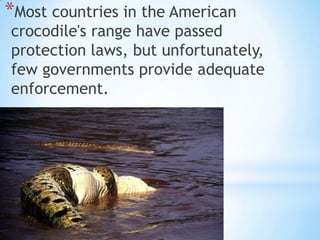
*Most countries in the American
crocodile's range have passed
protection laws, but unfortunately,
few governments provide adequate
enforcement.
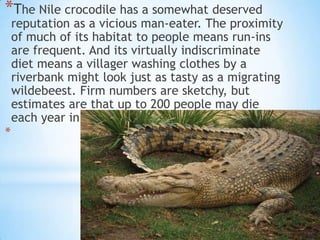
*The Nile crocodile has a somewhat deserved
    reputation as a vicious man-eater. The proximity
    of much of its habitat to people means run-ins
    are frequent. And its virtually indiscriminate
    diet means a villager washing clothes by a
    riverbank might look just as tasty as a migrating
    wildebeest. Firm numbers are sketchy, but
    estimates are that up to 200 people may die
    each year in the jaws of a Nile croc.
*
*Africa's largest crocodilian, these primordial
    brutes reach a maximum size of about 20 feet (6
    meters) and can weigh up to 1,650 pounds (730
    kilograms). Average sizes, though, are more in
    the range of 16 feet (5 meters) and 500 pounds
    (225 kilograms). They live throughout sub-
    Saharan Africa, the Nile Basin, and Madagascar
    in rivers, freshwater marshes, and mangrove
    swamps.
*
*The diet of the Nile crocodile is mainly
 fish, but it will attack almost anything
 unfortunate enough to cross its path,
 including zebras, small hippos,
 porcupines, birds, and other crocodiles. It
 will also scavenge carrion, and can eat up
 to half its body weight at a feeding.
*One unusual characteristic of this fearsome
 predator is its caring nature as a parent.
 Where most reptiles lay their eggs and move
 on, mother and father Nile crocs ferociously
 guard their nests until the eggs hatch, and
 they will often roll the eggs gently in their
 mouths to help hatching babies emerge.
*Hunted close to extinction in the 1940s
 through the 1960s, local and international
 protections have helped them rebound in
 most areas. In some regions, though,
 pollution, hunting, and habitat loss have
 severely depleted their numbers.
*Նյութը պատրաստեց`
* Միքայելյան Արտյուշը

Crocodile

  • 1.
  • 2.
    *The American crocodileis considered an endangered species in nearly all parts of its North, Central, and South American range. Survey data, except in the United States, is poor or nonexistent, but conservationists agree that illegal hunting and habitat depletion has reduced populations of this wide-ranging reptile to critical levels.
  • 3.
    *A small, remnantpopulation lives in southern Florida, but most are found in southern Mexico, Central America, the Caribbean, and northern South America. Their habitat of choice is the fresh or brackish water of river estuaries, coastal lagoons, and mangrove swamps.
  • 5.
    *A prehistoric-looking creature,it is distinguishable from its cousin, the American alligator, by its longer, thinner snout, its lighter color, and two long teeth on the lower jaw that are visible when its mouth is closed. *This species is among the largest of the world's crocodiles, with Central and South American males reaching lengths of up to 20 feet (6.1 meters). Males in the U.S. population rarely exceed 13 feet (4 meters), however.
  • 6.
    *Their diet consistsmainly of small mammals, birds, fish, crabs, insects, snails, frogs, and occasionally carrion. They have been known to attack people, but are far more likely to flee at the sight of humans.
  • 7.
    *Most countries inthe American crocodile's range have passed protection laws, but unfortunately, few governments provide adequate enforcement.
  • 9.
    *The Nile crocodilehas a somewhat deserved reputation as a vicious man-eater. The proximity of much of its habitat to people means run-ins are frequent. And its virtually indiscriminate diet means a villager washing clothes by a riverbank might look just as tasty as a migrating wildebeest. Firm numbers are sketchy, but estimates are that up to 200 people may die each year in the jaws of a Nile croc. *
  • 10.
    *Africa's largest crocodilian,these primordial brutes reach a maximum size of about 20 feet (6 meters) and can weigh up to 1,650 pounds (730 kilograms). Average sizes, though, are more in the range of 16 feet (5 meters) and 500 pounds (225 kilograms). They live throughout sub- Saharan Africa, the Nile Basin, and Madagascar in rivers, freshwater marshes, and mangrove swamps. *
  • 11.
    *The diet ofthe Nile crocodile is mainly fish, but it will attack almost anything unfortunate enough to cross its path, including zebras, small hippos, porcupines, birds, and other crocodiles. It will also scavenge carrion, and can eat up to half its body weight at a feeding.
  • 12.
    *One unusual characteristicof this fearsome predator is its caring nature as a parent. Where most reptiles lay their eggs and move on, mother and father Nile crocs ferociously guard their nests until the eggs hatch, and they will often roll the eggs gently in their mouths to help hatching babies emerge. *Hunted close to extinction in the 1940s through the 1960s, local and international protections have helped them rebound in most areas. In some regions, though, pollution, hunting, and habitat loss have severely depleted their numbers.
  • 16.