Jed Ryan J. Eldian
What are Killer Whales?
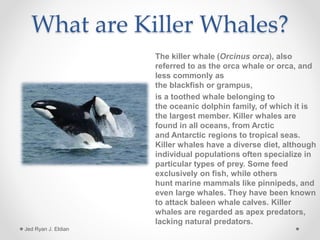
The killer whale (Orcinus orca), also
referred to as the orca whale or orca, and
less commonly as
the blackfish or grampus,
is a toothed whale belonging to
the oceanic dolphin family, of which it is
the largest member. Killer whales are
found in all oceans, from Arctic
and Antarctic regions to tropical seas.
Killer whales have a diverse diet, although
individual populations often specialize in
particular types of prey. Some feed
exclusively on fish, while others
hunt marine mammals like pinnipeds, and
even large whales. They have been known
to attack baleen whale calves. Killer
whales are regarded as apex predators,
lacking natural predators.
Jed Ryan J. Eldian
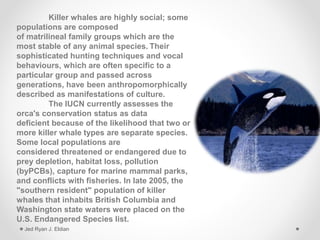
Killer whales are highly social; some
populations are composed
of matrilineal family groups which are the
most stable of any animal species. Their
sophisticated hunting techniques and vocal
behaviours, which are often specific to a
particular group and passed across
generations, have been anthropomorphically
described as manifestations of culture.
The IUCN currently assesses the
orca's conservation status as data
deficient because of the likelihood that two or
more killer whale types are separate species.
Some local populations are
considered threatened or endangered due to
prey depletion, habitat loss, pollution
(byPCBs), capture for marine mammal parks,
and conflicts with fisheries. In late 2005, the
"southern resident" population of killer
whales that inhabits British Columbia and
Washington state waters were placed on the
U.S. Endangered Species list.
Jed Ryan J. Eldian
Species Description
Weight: males can weigh up to 22,000 pounds (10,000 kg);
females can weigh up to 16,500 pounds (7,500 kg)
Length: males can reach 32 feet (10 m);
females can reach 28 feet (8.5 m)
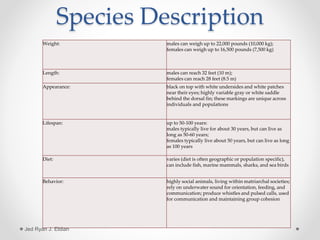
Appearance: black on top with white undersides and white patches
near their eyes; highly variable gray or white saddle
behind the dorsal fin; these markings are unique across
individuals and populations
Lifespan: up to 50-100 years:
males typically live for about 30 years, but can live as
long as 50-60 years;
females typically live about 50 years, but can live as long
as 100 years
Diet: varies (diet is often geographic or population specific),
can include fish, marine mammals, sharks, and sea birds
Behavior: highly social animals, living within matriarchal societies;
rely on underwater sound for orientation, feeding, and
communication; produce whistles and pulsed calls, used
for communication and maintaining group cohesion
Jed Ryan J. Eldian
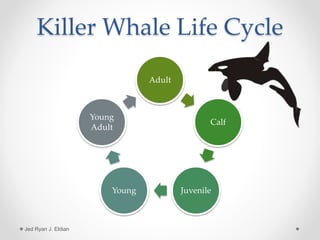
Killer Whale Life Cycle
Adult
Calf
JuvenileYoung
Young
Adult
Jed Ryan J. Eldian
Range and Habitat
Killer whales are found in all oceans and most seas. Due to their enormous
range, numbers, and density, distributional estimates are difficult to compare,[92] but
they clearly prefer higher latitudes and coastal areas over pelagic environments.[93]
Systematic surveys indicate the highest densities of killer whales (>0.40
individuals per 100 km²) in the northeast Atlantic around theNorwegian coast, in the
north Pacific along the Aleutian Islands, the Gulf of Alaska and in the Southern Ocean off
much of the coast ofAntarctica.[92] They are considered "common" (0.20–0.40 individuals
per 100 km²) in the eastern Pacific along the coasts of British
Columbia, Washington and Oregon, in the North Atlantic Ocean around Iceland and
the Faroe Islands. High densities have also been reported but not quantified in the
western North Pacific around the Sea of Japan (in very limited areas), Shiretoko
Peninsula and offKushiro (Resident and Transient groups began colonizing in these
areas possibly after in 2000s), Sea of Okhotsk, Kuril Islands,
Jed Ryan J. Eldian
Kamchatka and the Commander
Islands and in the Southern Hemisphere off
the coasts of South Australia, off the coast of
southern Braziland the tip of southern Africa.
They are reported as seasonally common in
the Canadian Arctic, including Baffin
Bay between Greenlandand Nunavut, and
around Tasmania and Macquarie
Island.[92] Information for offshore regions and
tropical waters is more scarce, but
widespread, if not frequent, sightings indicate
the killer whale can survive in most water
temperatures. They have been sighted, for
example, in the Mediterranean, the Arabian
Sea, the Gulf of Mexico and the Indian
Ocean around the Seychelles.[92] In the
Mediterranean, killer whales are considered
"visitors" with the exception of one small
population which lives in the Strait of
Gibraltar.[94] A distinct population may also
exist in Papua New Guinea
Jed Ryan J. Eldian
Population
Worldwide population estimates are
uncertain, but recent consensus suggests
an absolute minimum of 50,000. Local
estimates include roughly 25,000 in the
Antarctic, 8,500 in the tropical Pacific,
2,250–2,700 off the cooler northeast Pacific
and 500–1,500 off Norway. Japan's
Fisheries Agency estimated 2,321 killer
whales were in the seas around Japan.
Jed Ryan J. Eldian
Captivity
Jed Ryan J. Eldian
The killer whale's intelligence, trainability,
striking appearance, playfulness in captivity
and sheer size have made it a popular exhibit
at aquaria and aquatic theme parks. From 1976
to 1997, 55 whales were taken from the wild in
Iceland, 19 from Japan, and three from
Argentina. These figures exclude animals that
died during capture. Live captures fell
dramatically in the 1990s, and by 1999, about
40% of the 48 animals on display in the world
were captive-born.
Jed Ryan J. Eldian

Killer whale

  • 1.
  • 2.
    What are KillerWhales? The killer whale (Orcinus orca), also referred to as the orca whale or orca, and less commonly as the blackfish or grampus, is a toothed whale belonging to the oceanic dolphin family, of which it is the largest member. Killer whales are found in all oceans, from Arctic and Antarctic regions to tropical seas. Killer whales have a diverse diet, although individual populations often specialize in particular types of prey. Some feed exclusively on fish, while others hunt marine mammals like pinnipeds, and even large whales. They have been known to attack baleen whale calves. Killer whales are regarded as apex predators, lacking natural predators. Jed Ryan J. Eldian
  • 3.
    Killer whales arehighly social; some populations are composed of matrilineal family groups which are the most stable of any animal species. Their sophisticated hunting techniques and vocal behaviours, which are often specific to a particular group and passed across generations, have been anthropomorphically described as manifestations of culture. The IUCN currently assesses the orca's conservation status as data deficient because of the likelihood that two or more killer whale types are separate species. Some local populations are considered threatened or endangered due to prey depletion, habitat loss, pollution (byPCBs), capture for marine mammal parks, and conflicts with fisheries. In late 2005, the "southern resident" population of killer whales that inhabits British Columbia and Washington state waters were placed on the U.S. Endangered Species list. Jed Ryan J. Eldian
  • 4.
    Species Description Weight: malescan weigh up to 22,000 pounds (10,000 kg); females can weigh up to 16,500 pounds (7,500 kg) Length: males can reach 32 feet (10 m); females can reach 28 feet (8.5 m) Appearance: black on top with white undersides and white patches near their eyes; highly variable gray or white saddle behind the dorsal fin; these markings are unique across individuals and populations Lifespan: up to 50-100 years: males typically live for about 30 years, but can live as long as 50-60 years; females typically live about 50 years, but can live as long as 100 years Diet: varies (diet is often geographic or population specific), can include fish, marine mammals, sharks, and sea birds Behavior: highly social animals, living within matriarchal societies; rely on underwater sound for orientation, feeding, and communication; produce whistles and pulsed calls, used for communication and maintaining group cohesion Jed Ryan J. Eldian
  • 5.
    Killer Whale LifeCycle Adult Calf JuvenileYoung Young Adult Jed Ryan J. Eldian
  • 6.
    Range and Habitat Killerwhales are found in all oceans and most seas. Due to their enormous range, numbers, and density, distributional estimates are difficult to compare,[92] but they clearly prefer higher latitudes and coastal areas over pelagic environments.[93] Systematic surveys indicate the highest densities of killer whales (>0.40 individuals per 100 km²) in the northeast Atlantic around theNorwegian coast, in the north Pacific along the Aleutian Islands, the Gulf of Alaska and in the Southern Ocean off much of the coast ofAntarctica.[92] They are considered "common" (0.20–0.40 individuals per 100 km²) in the eastern Pacific along the coasts of British Columbia, Washington and Oregon, in the North Atlantic Ocean around Iceland and the Faroe Islands. High densities have also been reported but not quantified in the western North Pacific around the Sea of Japan (in very limited areas), Shiretoko Peninsula and offKushiro (Resident and Transient groups began colonizing in these areas possibly after in 2000s), Sea of Okhotsk, Kuril Islands, Jed Ryan J. Eldian
  • 7.
    Kamchatka and theCommander Islands and in the Southern Hemisphere off the coasts of South Australia, off the coast of southern Braziland the tip of southern Africa. They are reported as seasonally common in the Canadian Arctic, including Baffin Bay between Greenlandand Nunavut, and around Tasmania and Macquarie Island.[92] Information for offshore regions and tropical waters is more scarce, but widespread, if not frequent, sightings indicate the killer whale can survive in most water temperatures. They have been sighted, for example, in the Mediterranean, the Arabian Sea, the Gulf of Mexico and the Indian Ocean around the Seychelles.[92] In the Mediterranean, killer whales are considered "visitors" with the exception of one small population which lives in the Strait of Gibraltar.[94] A distinct population may also exist in Papua New Guinea Jed Ryan J. Eldian
  • 8.
    Population Worldwide population estimatesare uncertain, but recent consensus suggests an absolute minimum of 50,000. Local estimates include roughly 25,000 in the Antarctic, 8,500 in the tropical Pacific, 2,250–2,700 off the cooler northeast Pacific and 500–1,500 off Norway. Japan's Fisheries Agency estimated 2,321 killer whales were in the seas around Japan. Jed Ryan J. Eldian
  • 9.
  • 10.
    The killer whale'sintelligence, trainability, striking appearance, playfulness in captivity and sheer size have made it a popular exhibit at aquaria and aquatic theme parks. From 1976 to 1997, 55 whales were taken from the wild in Iceland, 19 from Japan, and three from Argentina. These figures exclude animals that died during capture. Live captures fell dramatically in the 1990s, and by 1999, about 40% of the 48 animals on display in the world were captive-born. Jed Ryan J. Eldian