REPTILES, AMPHIBIANS, ETC.
 F-1   Alligators             Allan R. Woodward and Dennis N. David
 F-7   Crayfish               James F. Fowler, Wendell Lorio, and Greg Lutz
 F-9   Frogs and Toads        Paul E. Moler
F-13   Salamanders            James L. Byford
F-15   Snakes, Nonpoisonous   James L. Byford
F-21   Rattlesnakes           Walter E. Howard
F-27   Turtles                James F. Fowler and Jimmy L. Avery
Allan R. Woodward
Alligator Research Biologist
Florida Game and Fresh Water Fish
                                            ALLIGATORS
  Commission
Gainesville, Florida 32601

Dennis N. David
Alligator Management Section Leader
Florida Game and Fresh Water Fish
  Commission
Gainesville, Florida 32601


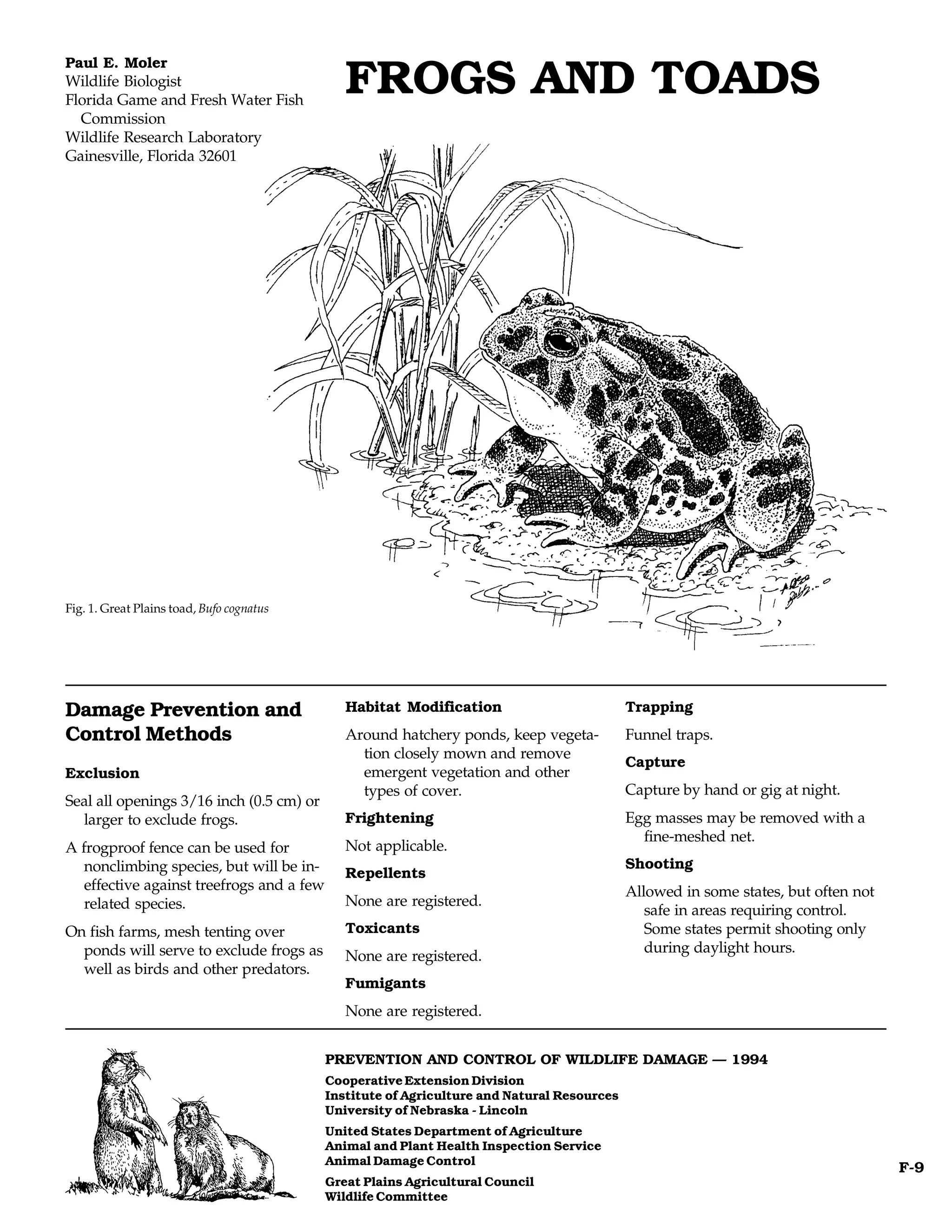
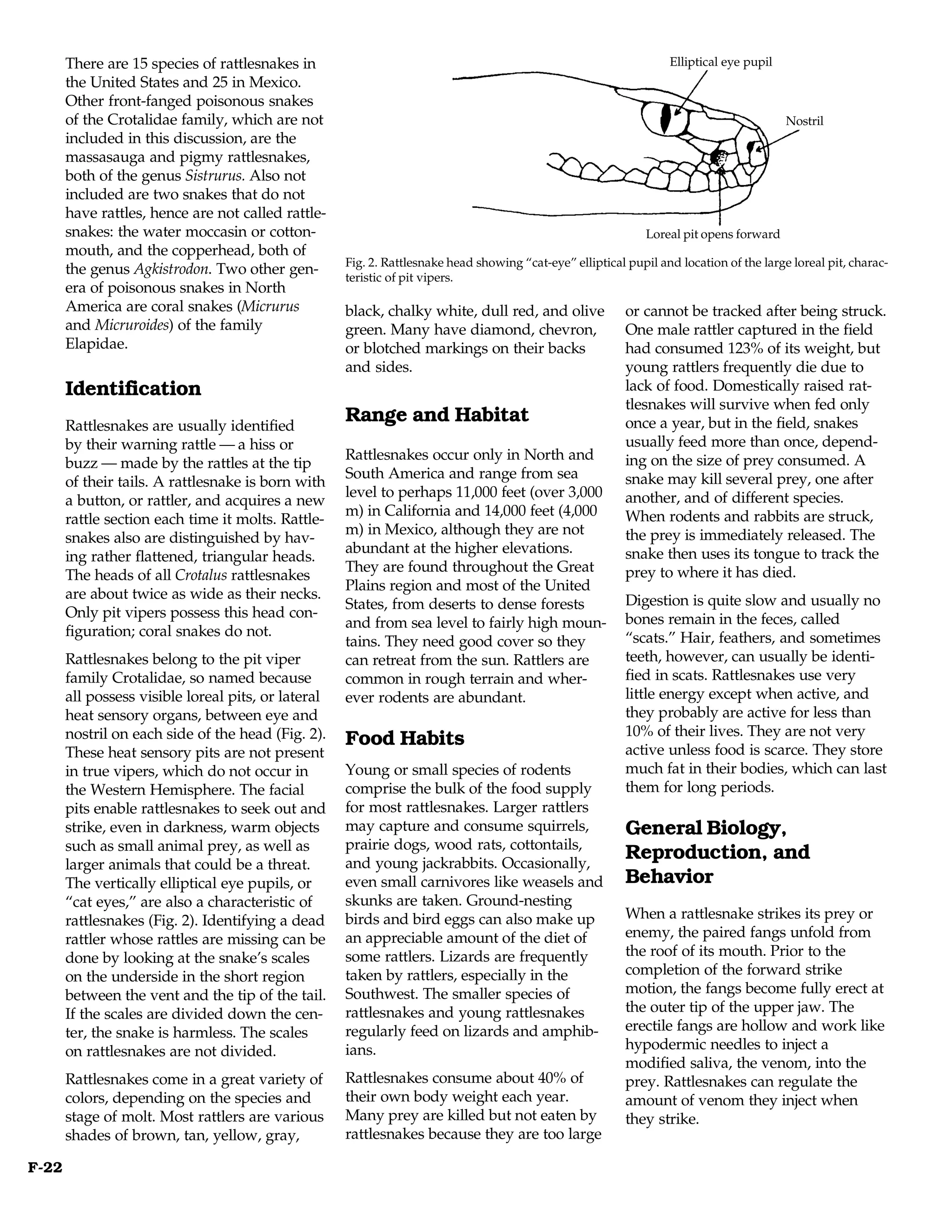
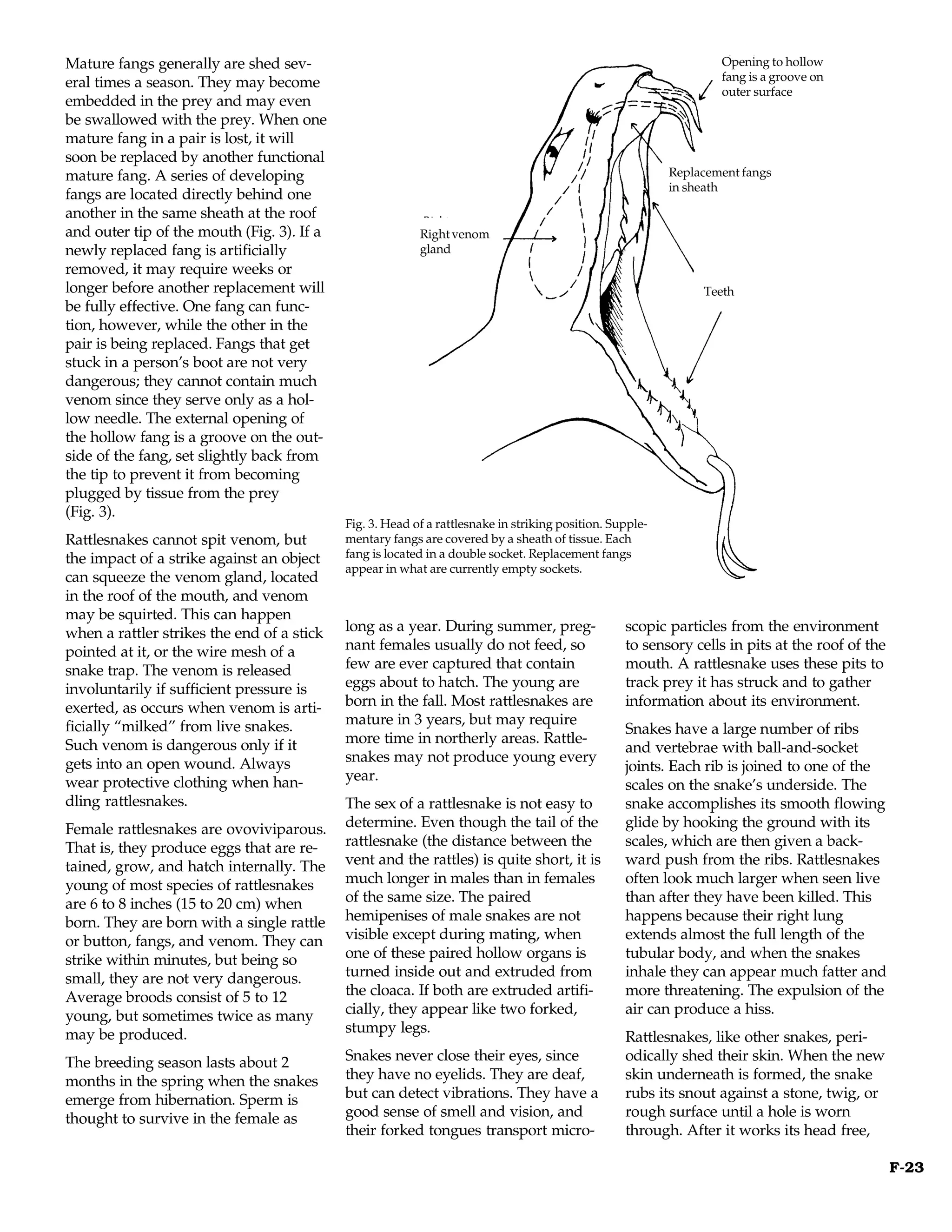
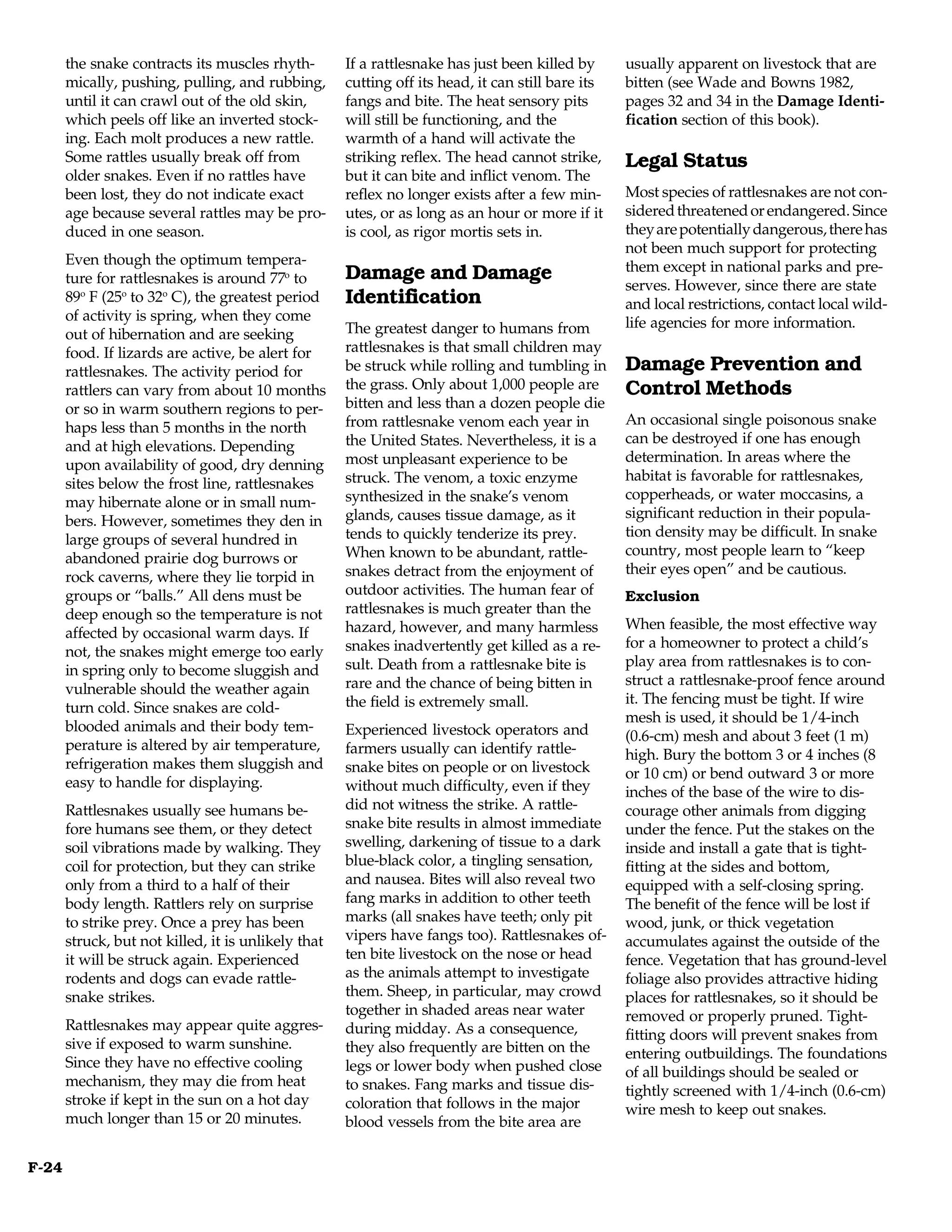
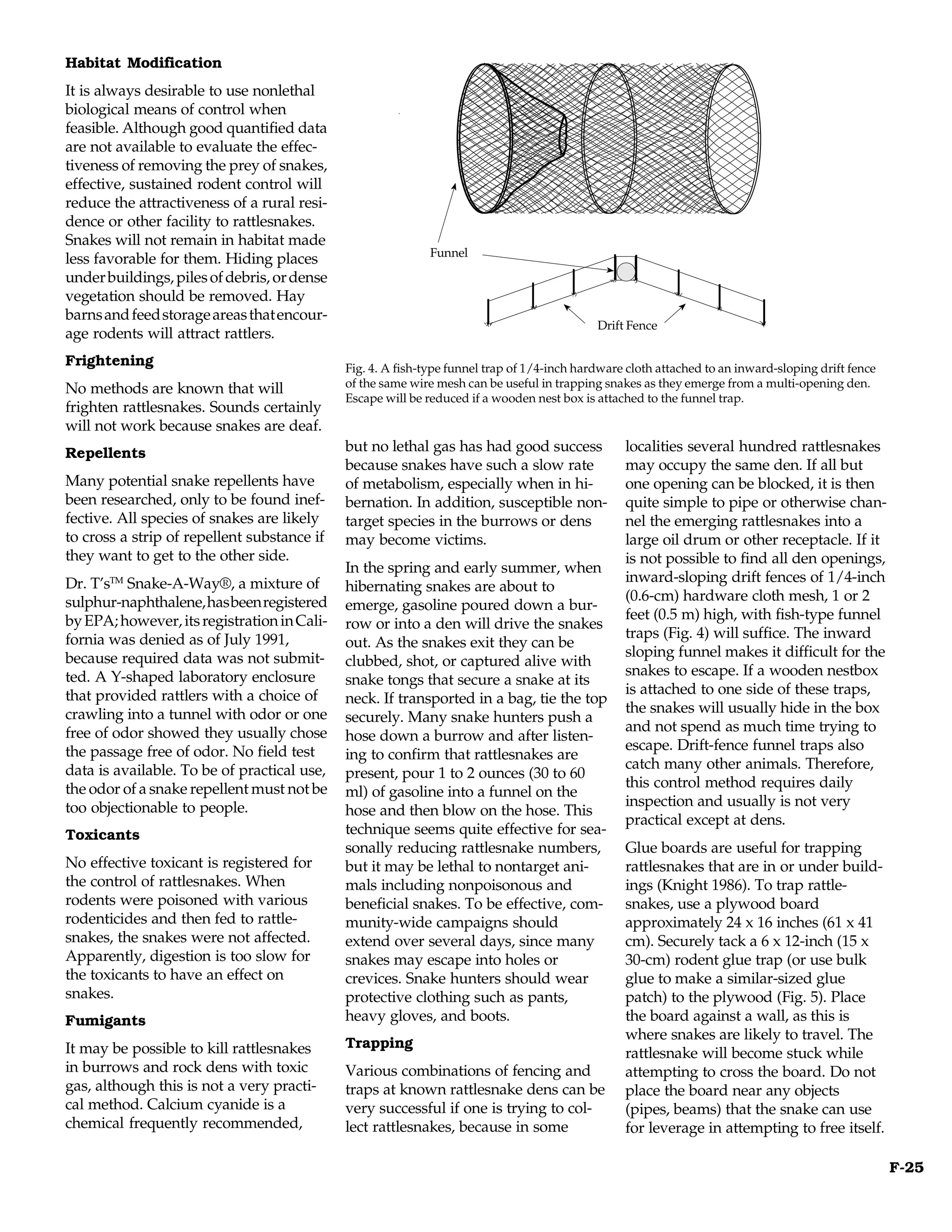
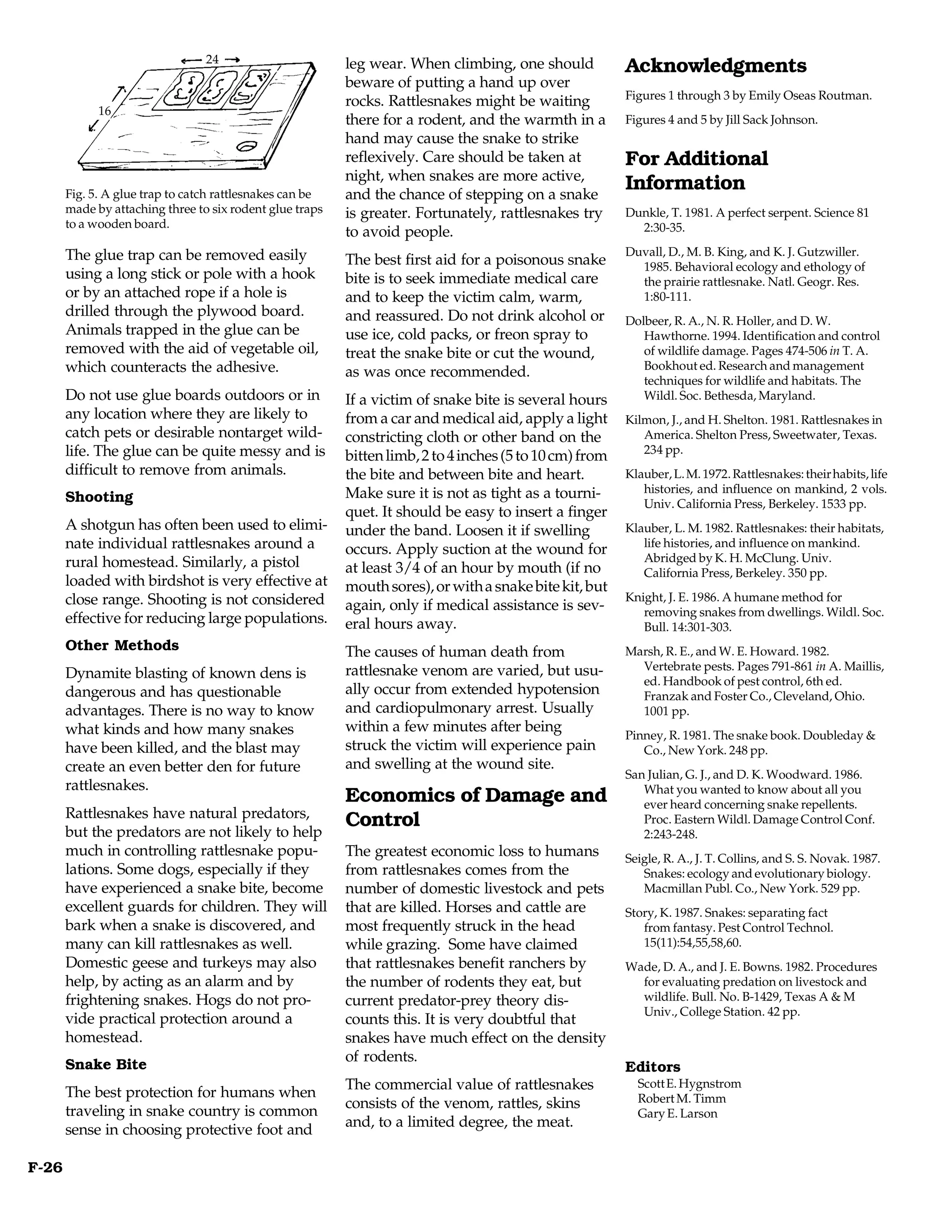
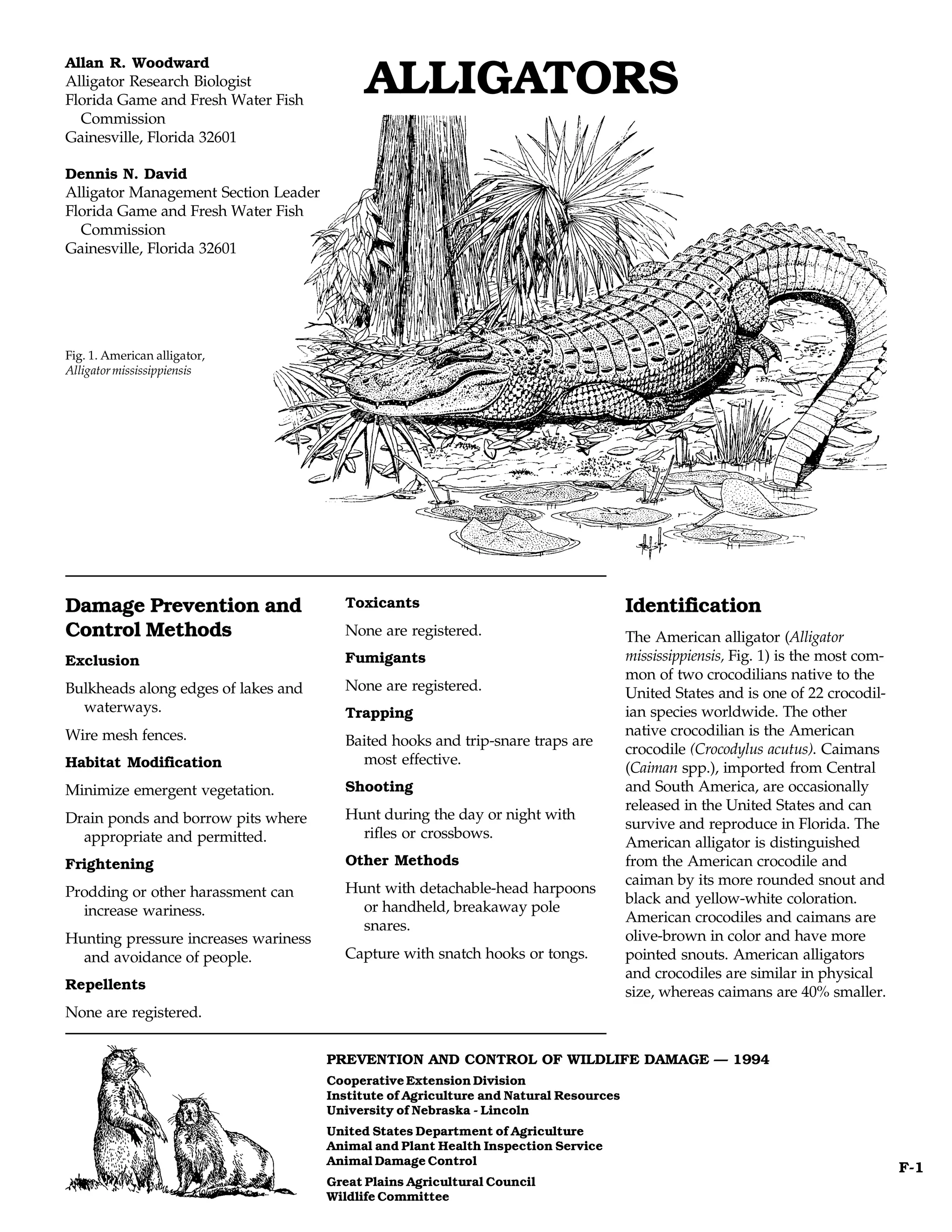
Fig. 1. American alligator,
Alligator mississippiensis


Damage Prevention and                   Toxicants                                      Identification
Control Methods                         None are registered.                           The American alligator (Alligator
Exclusion                               Fumigants                                      mississippiensis, Fig. 1) is the most com-
                                                                                       mon of two crocodilians native to the
Bulkheads along edges of lakes and      None are registered.                           United States and is one of 22 crocodil-
  waterways.                            Trapping                                       ian species worldwide. The other
Wire mesh fences.                                                                      native crocodilian is the American
                                        Baited hooks and trip-snare traps are
                                                                                       crocodile (Crocodylus acutus). Caimans
Habitat Modification                      most effective.
                                                                                       (Caiman spp.), imported from Central
Minimize emergent vegetation.           Shooting                                       and South America, are occasionally
                                                                                       released in the United States and can
Drain ponds and borrow pits where       Hunt during the day or night with
                                                                                       survive and reproduce in Florida. The
  appropriate and permitted.              rifles or crossbows.
                                                                                       American alligator is distinguished
Frightening                             Other Methods                                  from the American crocodile and
                                                                                       caiman by its more rounded snout and
Prodding or other harassment can        Hunt with detachable-head harpoons
                                                                                       black and yellow-white coloration.
  increase wariness.                      or handheld, breakaway pole
                                                                                       American crocodiles and caimans are
                                          snares.
Hunting pressure increases wariness                                                    olive-brown in color and have more
  and avoidance of people.              Capture with snatch hooks or tongs.            pointed snouts. American alligators
                                                                                       and crocodiles are similar in physical
Repellents                                                                             size, whereas caimans are 40% smaller.
None are registered.


                                      PREVENTION AND CONTROL OF WILDLIFE DAMAGE — 1994
                                      Cooperative Extension Division
                                      Institute of Agriculture and Natural Resources
                                      University of Nebraska - Lincoln
                                      United States Department of Agriculture
                                      Animal and Plant Health Inspection Service
                                      Animal Damage Control
                                                                                                                                    F-1
                                      Great Plains Agricultural Council
                                      Wildlife Committee
Range                                         fish and turtles comprise most of the         her hatchlings against intruders and
                                                    diet. Recent studies in Florida and           stay with them for up to 1 year, but
      The American alligator is found in            Louisiana indicate that cannibalism is        gradually loses her affinity for them as
      wetlands throughout the coastal plain         common among alligators. Alligators           the next breeding season approaches.
      of the southeastern United States.            readily take domestic dogs and cats. In
      Viable alligator populations are found                                                      Growth rates of alligators are variable
                                                    rural areas, larger alligators take
      in Texas, Oklahoma, Arkansas, Louisi-                                                       and dependent on diet, temperature,
                                                    calves, foals, goats, hogs, domestic
      ana, Mississippi, Alabama, Florida,                                                         and sex. Alligators take 7 to 10 years to
                                                    waterfowl, and occasionally, full-
      Georgia, South Carolina, and North                                                          reach 6 feet (1.8 m) in Louisiana, 9 to
                                                    grown cattle and horses.
      Carolina. The northern range is limited                                                     14 years in Florida, and up to 16 years
      by low winter temperatures. Alligators                                                      in North Carolina. When maintained
      are rarely found south of the Rio
                                                    General Biology,                              on farms under ideal temperature and
      Grande drainage. Alligators prefer            Reproduction, and                             nutrition, alligators can reach a length
      fresh water but also inhabit brackish         Behavior                                      of 6 feet (1.8 m) in 3 years.
      water and occasionally venture into                                                         Alligators are not normally aggressive
      salt water. American crocodiles are           Alligators are ectothermic — they rely
                                                                                                  toward humans, but aberrant behavior
      scarce and, in the United States, are         on external sources of heat to maintain
                                                                                                  occasionally occurs. Alligators can and
      only found in the warmer coastal              body temperature. They are most
                                                                                                  will attack humans and cause serious
      waters of Florida, south of Tampa and         active at warmer temperatures and
                                                                                                  injury or death. Most attacks are char-
      Miami. Caimans rarely survive win-            prefer 82o to 92o F (28o to 33o C). They
                                                                                                  acterized by a single bite and release
      ters north of central Florida and repro-      stop feeding when ambient tempera-
                                                                                                  with resulting puncture wounds.
      duce only in southernmost Florida.            ture drops below 70o F (21o C) and
                                                                                                  Single bites are usually made by
                                                    become dormant below 55o F (13o C).
                                                                                                  smaller alligators (less than 8 feet [2.4
      Habitat                                       Alligators are among the largest ani-         m]) and result in an immediate release,
                                                    mals in North America. Males can              possibly because they were unsure of
      Alligators can be found in almost any
                                                    attain a size of more than 14 feet (4.3       their intended prey. One-third of the
      type of fresh water, but population
                                                    m) and 1,000 pounds (473 kg). Females         attacks, however, involve repeated
      densities are greatest in wetlands with
                                                    can exceed 10 feet (3.1 m) and 250            bites, major injury, and sometimes
      an abundant food supply and adjacent
                                                    pounds (116 kg). Alligators of both           death. Serious and repeated attacks are
      marsh habitat for nesting. In Texas,
                                                    sexes become sexually mature when             normally made by alligators greater
      Louisiana, and South Carolina, the
                                                    they attain a length of 6 to 7 feet (1.8 to   than 8 feet in length and are most
      highest densities are found in highly
                                                    2.1 m), but their full reproductive           likely the result of chase and feeding
      productive coastal impoundments. In
                                                    capacity is not realized until females        behavior. Unprovoked attacks by alli-
      Florida, highest densities occur in
                                                    and males are at least 7 feet (2.1 m)         gators smaller than 5 feet (1.5 m) in
      nutrient-enriched lakes and marshes.
                                                    and 8 feet (2.4 m) long, respectively.        length are rare.
      Coastal and inland marshes maintain
      the highest alligator densities in Geor-      Alligators begin courtship in April           Contrary to popular belief, few attacks
      gia, Alabama, and Mississippi. Alliga-        throughout most of their range and            can be attributed to wounded or terri-
      tors commonly inhabit urban wetlands          breed in late May and early June.             torial alligators or females defending
      (canals, lagoons, ponds, impound-             Females lay a single clutch of 30 to 50       their nests or young. Necropsies of alli-
      ments, and streams) throughout their          eggs in a mound of vegetation from            gators that have attacked humans have
      range.                                        early June to mid-July. Nests average         shown that most are healthy and well-
                                                    about 2 feet (0.6 m) in height and 5 feet     nourished. It is unlikely that alligator
      Food Habits                                   (1.5 m) in diameter. Nests are con-           attacks are related to territorial
                                                    structed of the predominant surround-         defense. When defending a territory,
      Alligators are exclusively carnivorous
                                                    ing vegetation, which is commonly             alligators display, vocalize, and nor-
      and prey upon whatever creatures are
                                                    cordgrass (Spartina spp.), sawgrass           mally approach on the surface of the
      most available. Juvenile alligators (less
                                                    (Cladium jamaicense), cattail (Typha          water where they can be more intimi-
      than 4 feet [1.2 m]) eat crustaceans,
                                                    spp.), giant reed (Phragmytes spp.),          dating. In most serious alligator
      snails, and small fish; subadults (4 to 6
                                                    other marsh grasses, peat, pine               attacks, victims were unaware of the
      feet [1.2 to 1.8 m]) eat mostly fish, crus-
                                                    needles, and/or soil. Females tend            alligator prior to the attack. Female
      taceans, small mammals, and birds;
                                                    their nests and sometimes defend              alligators frequently defend their nest
      and adults (greater than 6 feet [1.8 m])
                                                    them against intruders, including             and young, but there have been no
      eat fish, mammals, turtles, birds, and
                                                    humans. Eggs normally take 65 days            confirmed reports of humans being
      other alligators. Diets are range-depen-
                                                    to complete incubation. In late August        bitten by protective females. Brooding
      dent; in Louisiana coastal marshes,
                                                    to early September, 9 to 10-inch (23 to       females typically try to intimidate
      adult alligators feed primarily on
                                                    25-cm) hatchlings are liberated from          intruders by displaying and hissing
      nutria (Myocastor coypus), whereas in
                                                    the nest by the female. She may defend        before attacking.
      Florida and northern Louisiana, rough

F-2
Alligators quickly become conditioned       larity of appearance” to other              alligator attacks in Florida, despite in-
to humans, especially when food is in-      endangered and threatened crocodil-         creasing human and alligator popula-
volved. Feeding-habituated alligators       ians. This provides federal protection      tions. The historically low attack rate
lose their fear of humans and can be        for alligators but allows state-            in Louisiana is attributed to a history
dangerous to unsuspecting humans,           approved management and control             of intense hunting.
especially children. Many aggressive        programs. Alligators can be legally
                                                                                        Repellents
or “fearless” alligators have to be re-     taken only by individuals with proper
moved each year following feeding by        licenses or permits. Florida, Louisiana,    None are registered.
humans. Ponds and waterways at golf         Georgia, South Carolina, and Texas          Toxicants
courses and high-density housing cre-       have problem or nuisance alligator
ate a similar problem when alligators       control programs that allow permitted       None are registered.
become accustomed to living near            hunters to kill or facilitate the removal   Trapping
people.                                     of nuisance alligators. Other states
                                            use state wildlife officials to remove      Alligators can be readily trapped be-
Damage and Damage                           problem animals.                            cause they are attracted to baits. A
Identification                                                                          baited hook is the simplest method
                                                                                        and is used in Louisiana as a general
Damage by alligators is usually limited     Damage Prevention and
                                                                                        harvest method and in Florida to
to injuries or death to humans or           Control Methods                             remove nuisance alligators. Hooks are
domestic animals. Most alligator bites                                                  rigged by embedding a large fish hook
                                            Exclusion
occur in Florida, which has document-                                                   (12/0 forged) in bait (nutria, fish, beef
ed approximately 140 unprovoked             Alligators are most dangerous in water      lungs, and chicken are popular) and
attacks from 1972 to 1991, or about 7       or at the water’s edge. They occasion-      suspended from a tree limb or pole
per year. Since 1972, 5 deaths have         ally make overland forays in search of      about 2 feet (0.6 m) above the surface
been positively attributed to alligators.   new habitat, mates, or prey. Concrete       of the water. The bait should be set
Historically, nonfatal attacks have also    or wooden bulkheads that are a mini-        closer to the water to catch smaller alli-
been documented in South Carolina           mum of 3 feet (1 m) above the high          gators. To increase success, baited
(8), Louisiana (2), Texas (1), Georgia      water mark will repel alligators along      hooks should be set in the evening and
(1), and Alabama (1).                       waterways and lakes. Alligators have        left overnight during the primary feed-
                                            been documented to climb 5-foot (1.5-       ing time of alligators. Once swallowed,
Alligators inflict damage with their
                                            m) chain-link fences to get at dogs.        the hook lodges in the alligator’s stom-
sharp, cone-shaped teeth and powerful
                                            Fences at least 5 feet high with 4-inch     ach and the alligator is retrieved with
jaws. Bites are characterized by punc-
                                            (10-cm) mesh will effectively exclude       the attached rope. This method can kill
ture wounds and/or torn flesh. Alliga-
                                            larger alligators if the top of the fence   or otherwise injure alligators and is not
tors, like other crocodilians that take
                                            is angled outward.                          suitable for alligators that are to be
large prey, prefer to seize an append-
age and twist it off by spinning. Many      Habitat Modification                        translocated. Hooked alligators are
serious injuries have involved badly                                                    most effectively killed by a shot to the
                                            Elimination of wetlands will eradicate      brain with a small caliber (.22) rifle.
damaged and broken arms on humans           alligators because they depend on
and legs on animals. Sometimes alliga-                                                  Powerheads (“bangsticks”) can also be
                                            water for cover, food, and temperature      used to kill alligators, but should only
tors bite or eat previously drowned         regulation. Most modifications of wet-
persons. Coroners can usually deter-                                                    be used with the barrel under water
                                            lands, however, are unlawful and            and according to manufacturer recom-
mine whether a person drowned               would adversely affect other wildlife.
before or after being bitten. Stories of                                                mendations.
                                            Elimination of emergent vegetation
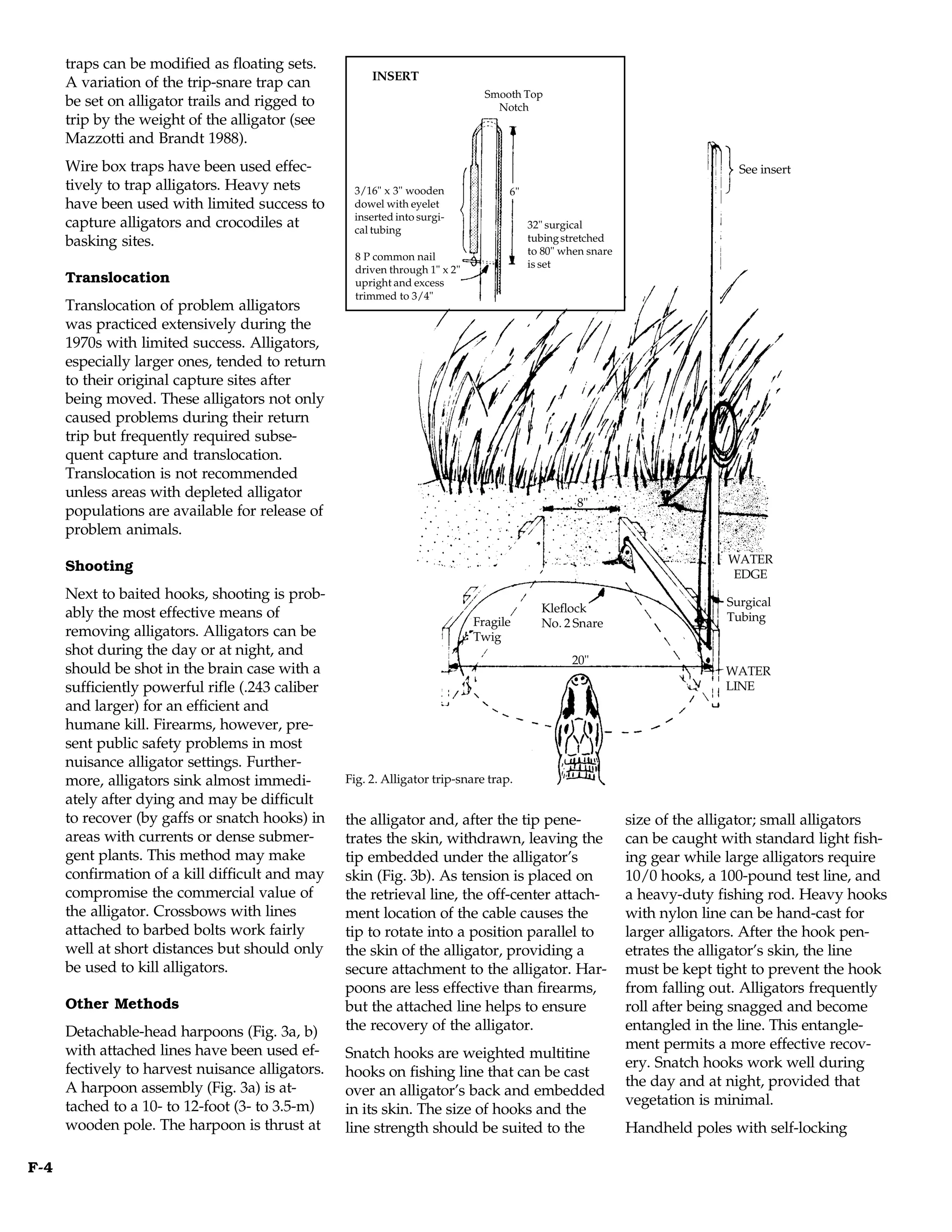
alligators breaking the legs of full-       can reduce alligator densities by           Trip-snare traps (Fig. 2) are more com-
grown men with their tails are              reducing cover. Check with appropri-        plicated and somewhat less effective
unfounded.                                  ate conservation authorities before         than are set hooks but do not injure or
Alligators sometimes excavate exten-        modifying any wetlands.                     kill alligators. An alligator is attracted
sive burrows or dens for refuges from                                                   to the bait and, because of the place-
                                            Frightening                                 ment of the guide boards, is forced to
cold temperatures, drought, and
predators (other alligators and hu-         Aversive conditioning using sticks to       enter from the end of the trap with the
mans). Burrowing by alligators can          prod “tame” alligators and rough han-       snare. The alligator puts its head
damage dikes in impoundments.               dling of captured alligators have been      through the self-locking snare (No. 3,
                                            attempted in several areas with limited     72-inch [1.84-m]; see Supplies and
                                            success. Hunting pressure appears to        Materials), seizes the bait, and releases
Legal Status                                                                            the trigger mechanism as it pulls the
                                            be the most effective means of increas-
The American alligator is federally         ing alligator wariness and may be re-       bait. The surgical tubing contracts and
classified as “threatened due to simi-      sponsible for limiting the incidence of     locks the snare on the alligator. These


                                                                                                                                     F-3
traps can be modified as floating sets.
                                                       INSERT
      A variation of the trip-snare trap can
                                                                               Smooth Top
      be set on alligator trails and rigged to                                   Notch
      trip by the weight of the alligator (see
      Mazzotti and Brandt 1988).
      Wire box traps have been used effec-                                                                                   See insert
      tively to trap alligators. Heavy nets        3/16" x 3" wooden               6"
      have been used with limited success to       dowel with eyelet
                                                   inserted into surgi-
      capture alligators and crocodiles at         cal tubing                           32" surgical
      basking sites.                                                                    tubing stretched
                                                                                        to 80" when snare
                                                    8 P common nail
                                                                                        is set
                                                    driven through 1" x 2"
      Translocation                                 upright and excess
                                                    trimmed to 3/4"
      Translocation of problem alligators
      was practiced extensively during the
      1970s with limited success. Alligators,
      especially larger ones, tended to return
      to their original capture sites after
      being moved. These alligators not only
      caused problems during their return
      trip but frequently required subse-
      quent capture and translocation.
      Translocation is not recommended
      unless areas with depleted alligator
                                                                                                 8"
      populations are available for release of
      problem animals.
                                                                                                                           WATER
      Shooting
                                                                                                                           EDGE
      Next to baited hooks, shooting is prob-                                                                              Surgical
      ably the most effective means of                                                    Kleflock
                                                                             Fragile      No. 2 Snare                      Tubing
      removing alligators. Alligators can be                                 Twig
      shot during the day or at night, and
                                                                                                20"
      should be shot in the brain case with a                                                                             WATER
      sufficiently powerful rifle (.243 caliber                                                                           LINE
      and larger) for an efficient and
      humane kill. Firearms, however, pre-
      sent public safety problems in most
      nuisance alligator settings. Further-
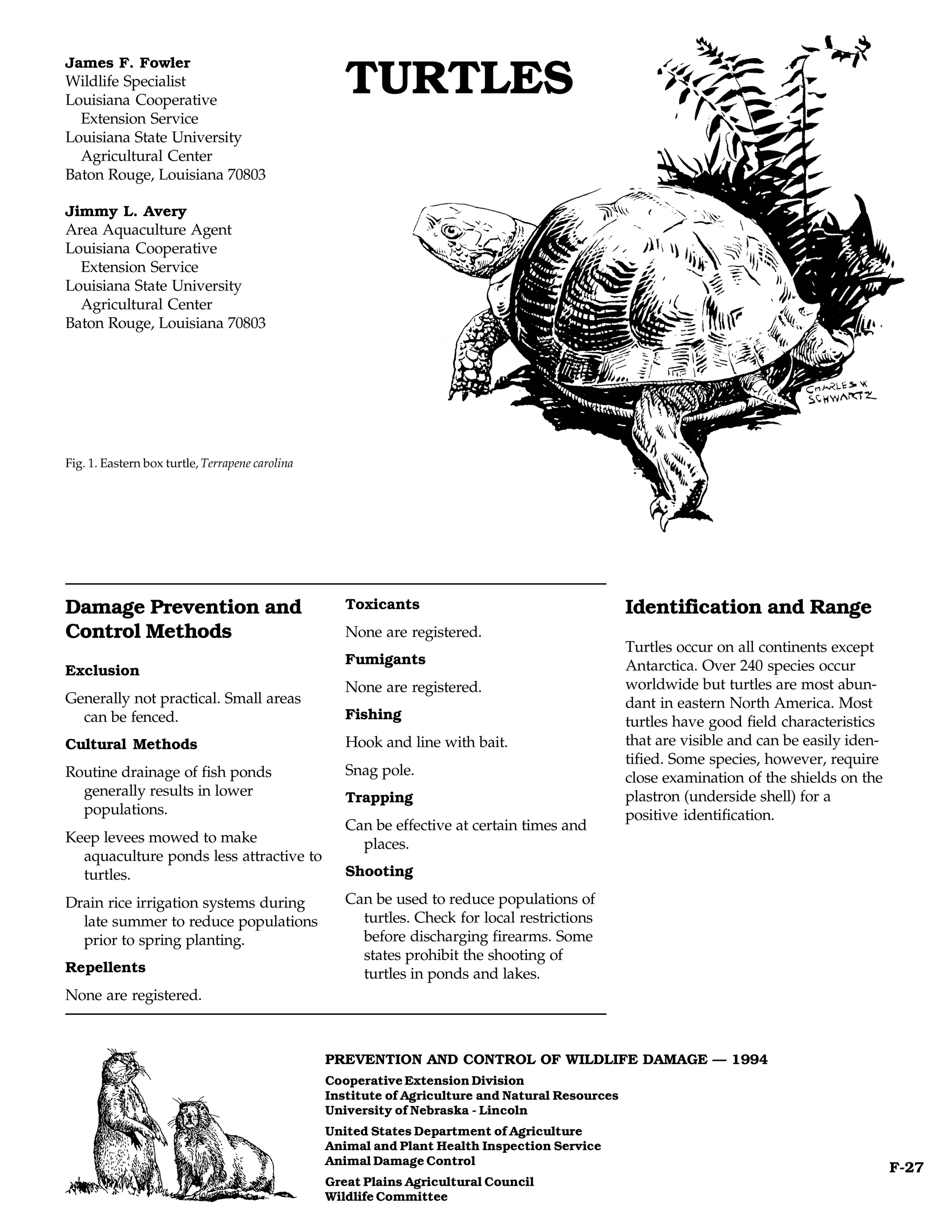
      more, alligators sink almost immedi-        Fig. 2. Alligator trip-snare trap.
      ately after dying and may be difficult
      to recover (by gaffs or snatch hooks) in    the alligator and, after the tip pene-                    size of the alligator; small alligators
      areas with currents or dense submer-        trates the skin, withdrawn, leaving the                   can be caught with standard light fish-
      gent plants. This method may make           tip embedded under the alligator’s                        ing gear while large alligators require
      confirmation of a kill difficult and may    skin (Fig. 3b). As tension is placed on                   10/0 hooks, a 100-pound test line, and
      compromise the commercial value of          the retrieval line, the off-center attach-                a heavy-duty fishing rod. Heavy hooks
      the alligator. Crossbows with lines         ment location of the cable causes the                     with nylon line can be hand-cast for
      attached to barbed bolts work fairly        tip to rotate into a position parallel to                 larger alligators. After the hook pen-
      well at short distances but should only     the skin of the alligator, providing a                    etrates the alligator’s skin, the line
      be used to kill alligators.                 secure attachment to the alligator. Har-                  must be kept tight to prevent the hook
                                                  poons are less effective than firearms,                   from falling out. Alligators frequently
      Other Methods                               but the attached line helps to ensure                     roll after being snagged and become
      Detachable-head harpoons (Fig. 3a, b)       the recovery of the alligator.                            entangled in the line. This entangle-
      with attached lines have been used ef-                                                                ment permits a more effective recov-
                                                  Snatch hooks are weighted multitine
      fectively to harvest nuisance alligators.                                                             ery. Snatch hooks work well during
                                                  hooks on fishing line that can be cast
      A harpoon assembly (Fig. 3a) is at-                                                                   the day and at night, provided that
                                                  over an alligator’s back and embedded
      tached to a 10- to 12-foot (3- to 3.5-m)                                                              vegetation is minimal.
                                                  in its skin. The size of hooks and the
      wooden pole. The harpoon is thrust at       line strength should be suited to the                     Handheld poles with self-locking

F-4
a                                                     Base                                        snares (sizes No. 2 and 3; Fig. 4) can be
                                                    (aluminum)
                                          Peg                                      Tube             used effectively to capture unwary
      Tip                           (stainless steel)                            (copper)           alligators at night. For smaller (less
(stainless steel)                                                                                   than 6 feet [1.8 m]) alligators, snares
                                                                                                    can be affixed to a pole with a hose
                                                                                                    clamp. For adult alligators, snares
                                                                                                    should be rigged to “break away”
                                                                                                    from the pole by attaching the snare to
                                                                                                    the pole with thin (1/2-inch [1-cm]
                                                                                                    wide) duct tape (Fig. 4). The tape or
                                                             Cable                                  clamps allow the snare to be maneu-
                                                        (stainless steel)
                                                                                                    vered and are designed to release after
                                                                                                    the snare is locked. Carefully place the
                                                                                                    snare around the alligator’s neck, then
                                                            Skin                                    jerk the pole and/or retrieval line to
  b                                                                                                 set the locking snare. A nylon retrieval
                                                                                                    rope should always be fastened to the
                                                                                                    snare and the rope secured to a boat or
                                                                                                    other heavy object.
                                               Muscle
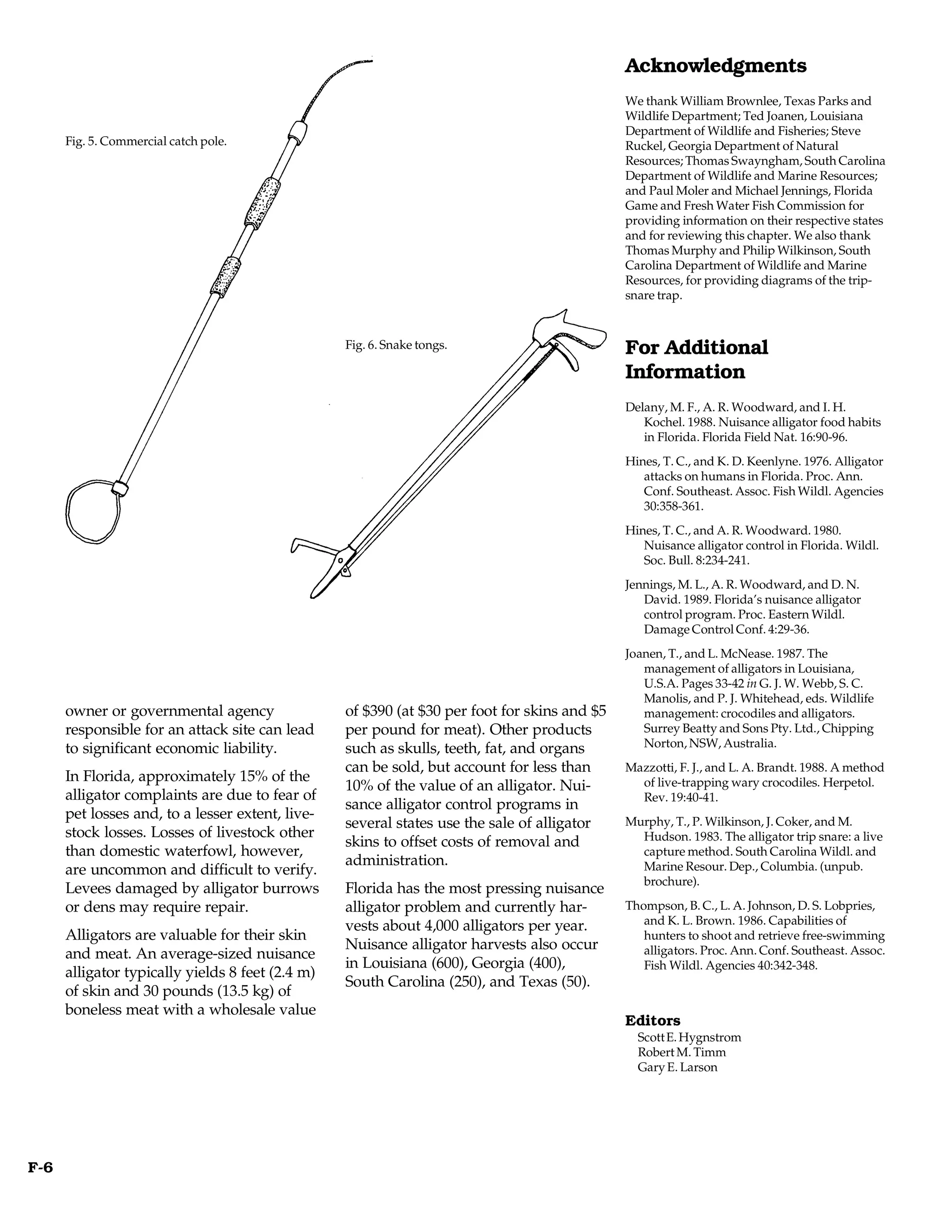
                                                                                                    For alligators less than 6 feet (1.8 m)
                                                                                                    long, commercially available catch
                                                                                                    poles (Fig. 5; see Supplies and
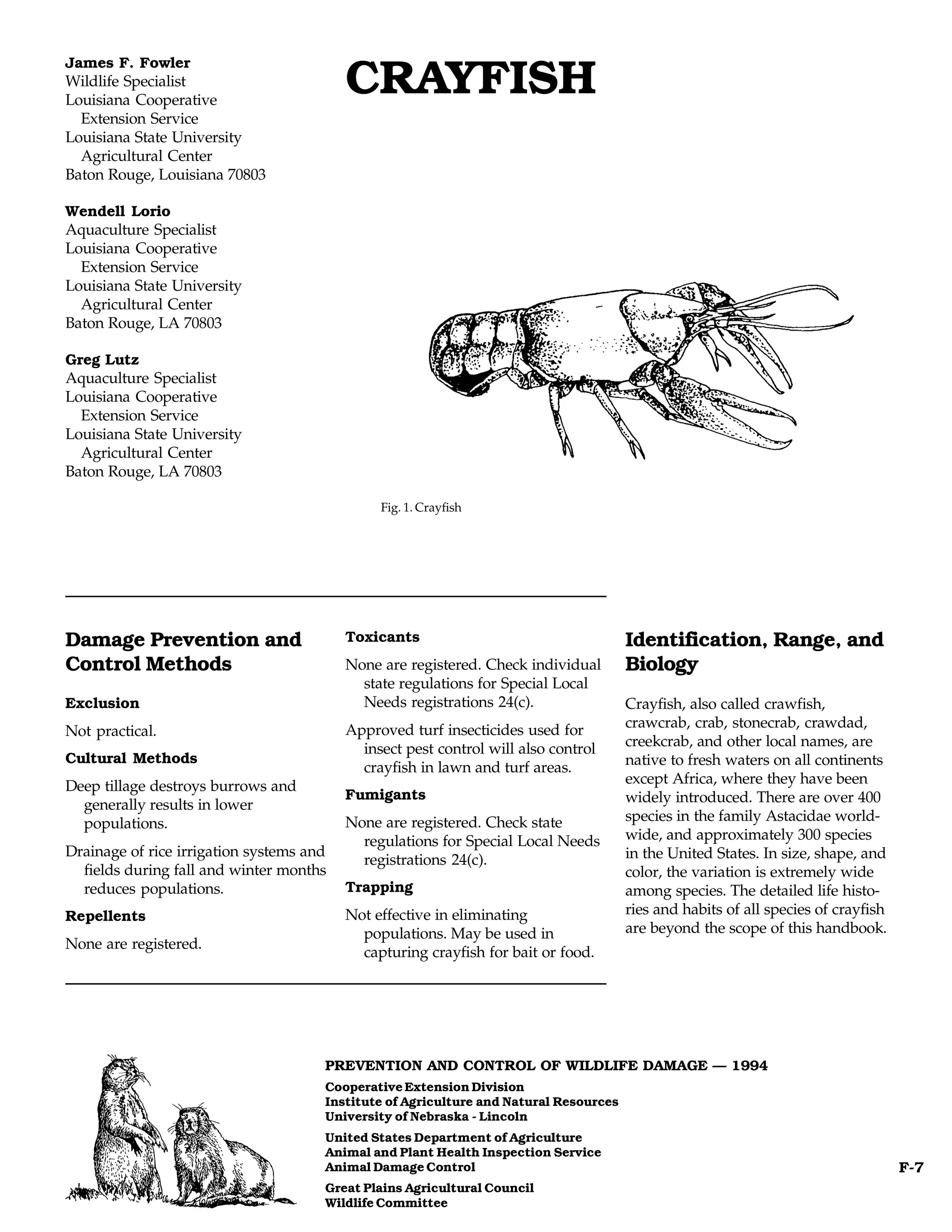
                                                                                                    Materials) can be used. Snake tongs
                                                                                                    (Fig. 6, see Supplies and Materials)
                                                                                                    are effective for catching alligators less
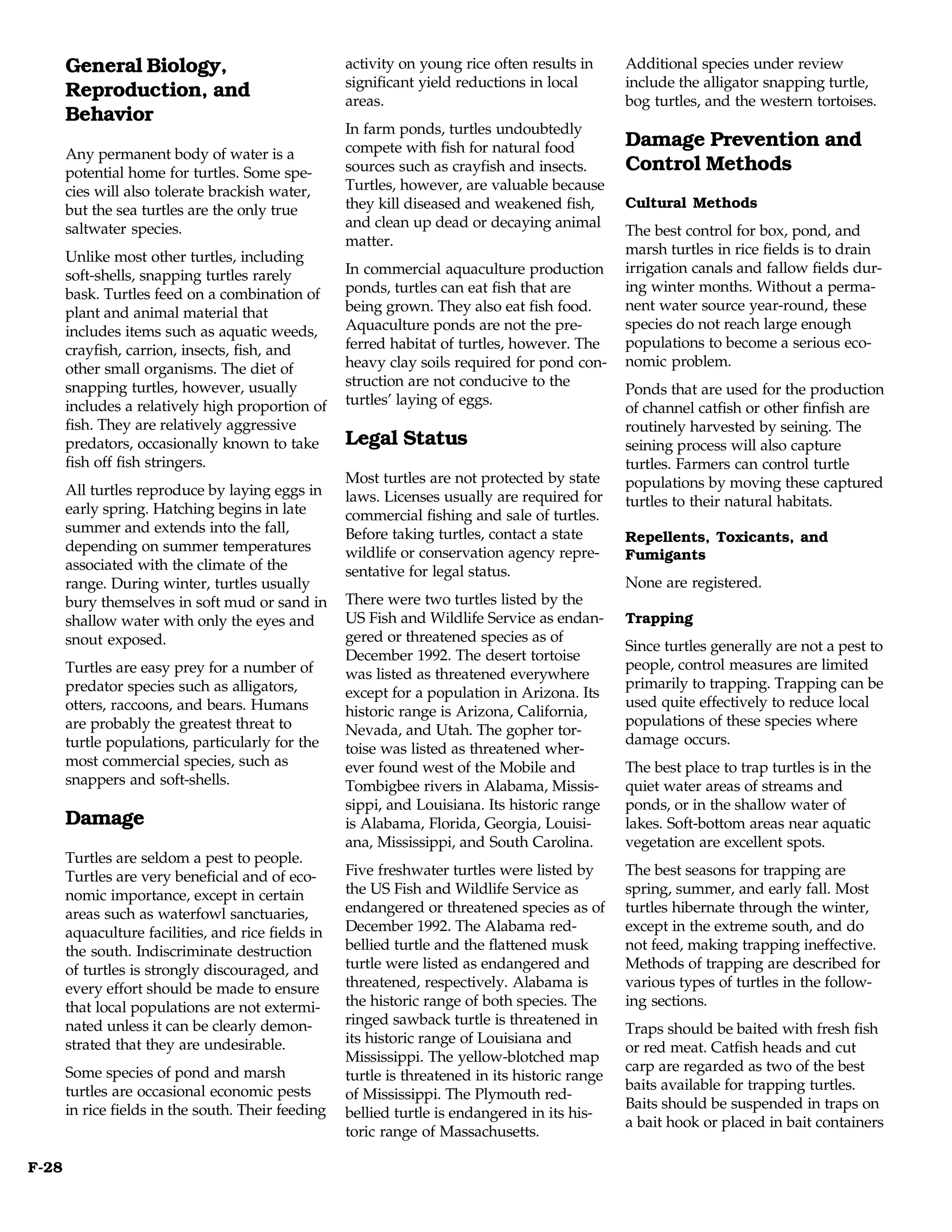
Fig. 3. (a) Detachable-head harpoon; (b) Rotation of harpoon tip after penetration.                 than 2 feet (0.6 m) long.

                                                                                                    Avoidance
                                                                                                    Measures can be taken to avoid con-
                                                                                                    frontations with alligators and sub-
                                                                                                    stantially reduce the probability of
                                                                                                    attacks. Avoid swimming or partici-
               Duct tape                                                                            pating in water activities in areas with
                (1/2")                                                                              large alligators. Avoid water activities
                                                                                                    at dusk and at night during the
                                                                                                    warmer months when alligators are
                                                                                                    most active. Alligators can quickly
                                                                                                    surge at least 5 feet (1.5 m) onto the
                                                                                                    shore to seize prey, so care should be
                                                                                                    taken when at the water’s edge. Do
                                                                                                    not feed alligators. Avoid approaching
                                                                                                    nests and capturing young (<2 feet
                                                                                                    [0.6 m]) alligators.


                            Locking snare (No. 3)                                           Nylon   Economics of Damage and
                                                                                            rope    Control
                                                                                                    Alligators can cause injuries and death
                                                                                                    to humans, livestock, and pets. All alli-
                                                                                                    gator bites require medical treatment
                                                                                                    and serious bites may require hospital-
                                                                                                    ization. Infections can result from alli-
                                                                                                    gator bites, particularly from the
                                                                                                    Aeromonas spp. bacteria.
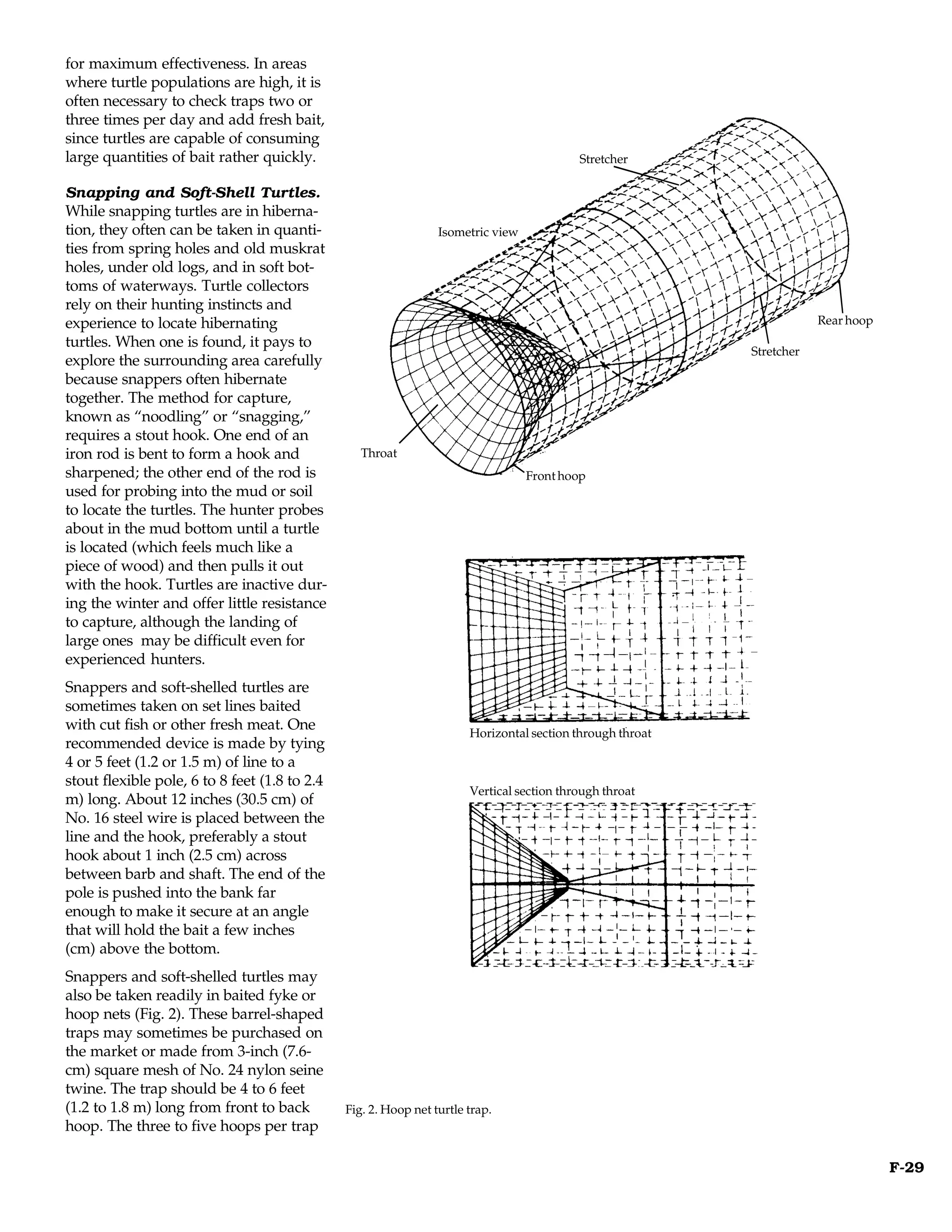
Fig. 4. Break-away snare.
                                                                                                    Lawsuits that arise from findings of
                                                                                                    negligence on the part of a private

                                                                                                                                                 F-5
Acknowledgments
                                                                                              We thank William Brownlee, Texas Parks and
                                                                                              Wildlife Department; Ted Joanen, Louisiana
                                                                                              Department of Wildlife and Fisheries; Steve
      Fig. 5. Commercial catch pole.                                                          Ruckel, Georgia Department of Natural
                                                                                              Resources; Thomas Swayngham, South Carolina
                                                                                              Department of Wildlife and Marine Resources;
                                                                                              and Paul Moler and Michael Jennings, Florida
                                                                                              Game and Fresh Water Fish Commission for
                                                                                              providing information on their respective states
                                                                                              and for reviewing this chapter. We also thank
                                                                                              Thomas Murphy and Philip Wilkinson, South
                                                                                              Carolina Department of Wildlife and Marine
                                                                                              Resources, for providing diagrams of the trip-
                                                                                              snare trap.


                                                  Fig. 6. Snake tongs.                        For Additional
                                                                                              Information
                                                                                              Delany, M. F., A. R. Woodward, and I. H.
                                                                                                 Kochel. 1988. Nuisance alligator food habits
                                                                                                 in Florida. Florida Field Nat. 16:90-96.
                                                                                              Hines, T. C., and K. D. Keenlyne. 1976. Alligator
                                                                                                 attacks on humans in Florida. Proc. Ann.
                                                                                                 Conf. Southeast. Assoc. Fish Wildl. Agencies
                                                                                                 30:358-361.
                                                                                              Hines, T. C., and A. R. Woodward. 1980.
                                                                                                 Nuisance alligator control in Florida. Wildl.
                                                                                                 Soc. Bull. 8:234-241.
                                                                                              Jennings, M. L., A. R. Woodward, and D. N.
                                                                                                 David. 1989. Florida’s nuisance alligator
                                                                                                 control program. Proc. Eastern Wildl.
                                                                                                 Damage Control Conf. 4:29-36.
                                                                                              Joanen, T., and L. McNease. 1987. The
                                                                                                 management of alligators in Louisiana,
                                                                                                 U.S.A. Pages 33-42 in G. J. W. Webb, S. C.
                                                                                                 Manolis, and P. J. Whitehead, eds. Wildlife
      owner or governmental agency                of $390 (at $30 per foot for skins and $5      management: crocodiles and alligators.
      responsible for an attack site can lead     per pound for meat). Other products            Surrey Beatty and Sons Pty. Ltd., Chipping
      to significant economic liability.          such as skulls, teeth, fat, and organs         Norton, NSW, Australia.
                                                  can be sold, but account for less than      Mazzotti, F. J., and L. A. Brandt. 1988. A method
      In Florida, approximately 15% of the                                                      of live-trapping wary crocodiles. Herpetol.
                                                  10% of the value of an alligator. Nui-
      alligator complaints are due to fear of                                                   Rev. 19:40-41.
                                                  sance alligator control programs in
      pet losses and, to a lesser extent, live-
                                                  several states use the sale of alligator    Murphy, T., P. Wilkinson, J. Coker, and M.
      stock losses. Losses of livestock other                                                   Hudson. 1983. The alligator trip snare: a live
                                                  skins to offset costs of removal and
      than domestic waterfowl, however,                                                         capture method. South Carolina Wildl. and
                                                  administration.                               Marine Resour. Dep., Columbia. (unpub.
      are uncommon and difficult to verify.
                                                                                                brochure).
      Levees damaged by alligator burrows         Florida has the most pressing nuisance
      or dens may require repair.                 alligator problem and currently har-        Thompson, B. C., L. A. Johnson, D. S. Lobpries,
                                                  vests about 4,000 alligators per year.         and K. L. Brown. 1986. Capabilities of
      Alligators are valuable for their skin                                                     hunters to shoot and retrieve free-swimming
                                                  Nuisance alligator harvests also occur         alligators. Proc. Ann. Conf. Southeast. Assoc.
      and meat. An average-sized nuisance
                                                  in Louisiana (600), Georgia (400),             Fish Wildl. Agencies 40:342-348.
      alligator typically yields 8 feet (2.4 m)
                                                  South Carolina (250), and Texas (50).
      of skin and 30 pounds (13.5 kg) of
      boneless meat with a wholesale value
                                                                                              Editors
                                                                                                Scott E. Hygnstrom
                                                                                                Robert M. Timm
                                                                                                Gary E. Larson


F-6
James F. Fowler
Wildlife Specialist
Louisiana Cooperative
                                          CRAYFISH
  Extension Service
Louisiana State University
  Agricultural Center
Baton Rouge, Louisiana 70803

Wendell Lorio
Aquaculture Specialist
Louisiana Cooperative
  Extension Service
Louisiana State University
  Agricultural Center
Baton Rouge, LA 70803

Greg Lutz
Aquaculture Specialist
Louisiana Cooperative
  Extension Service
Louisiana State University
  Agricultural Center
Baton Rouge, LA 70803

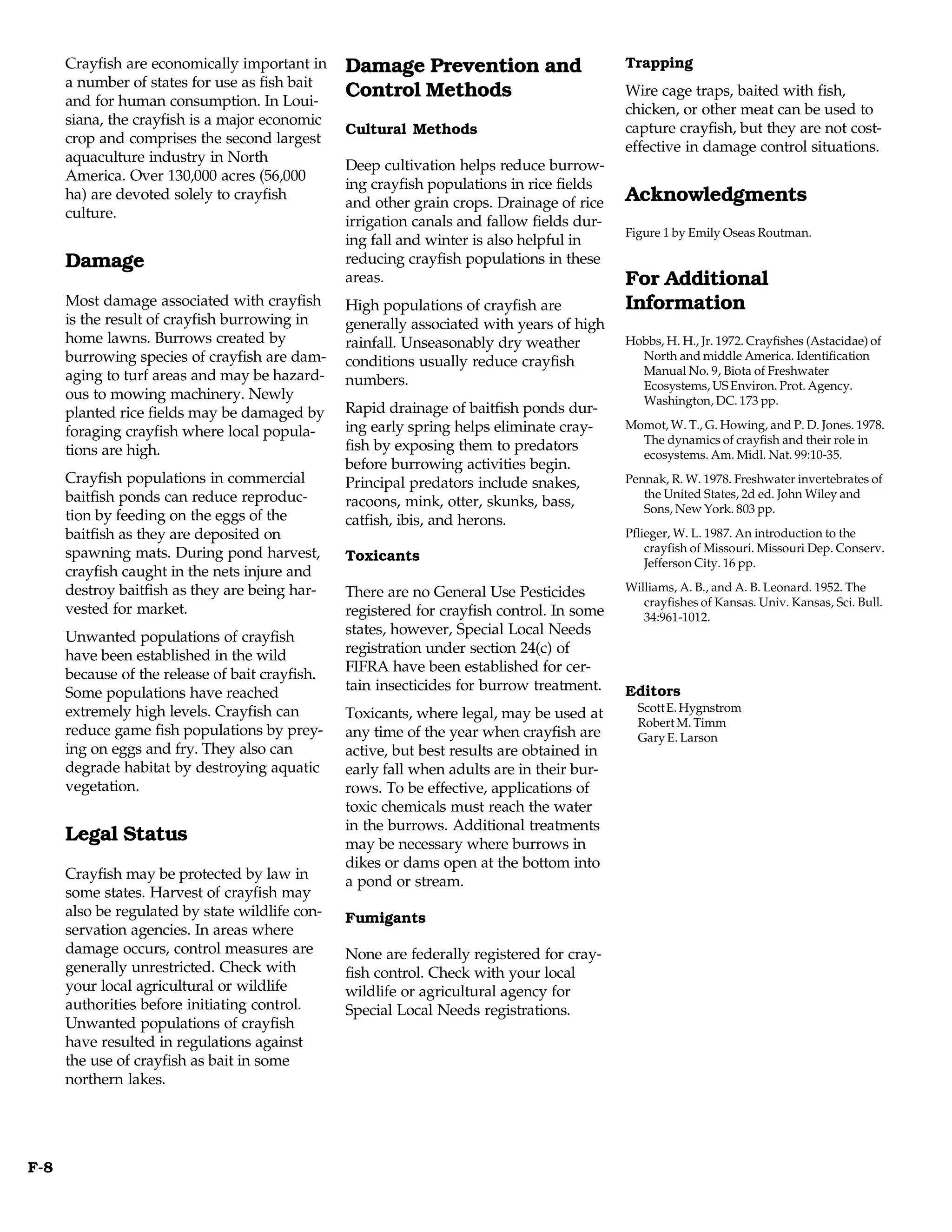
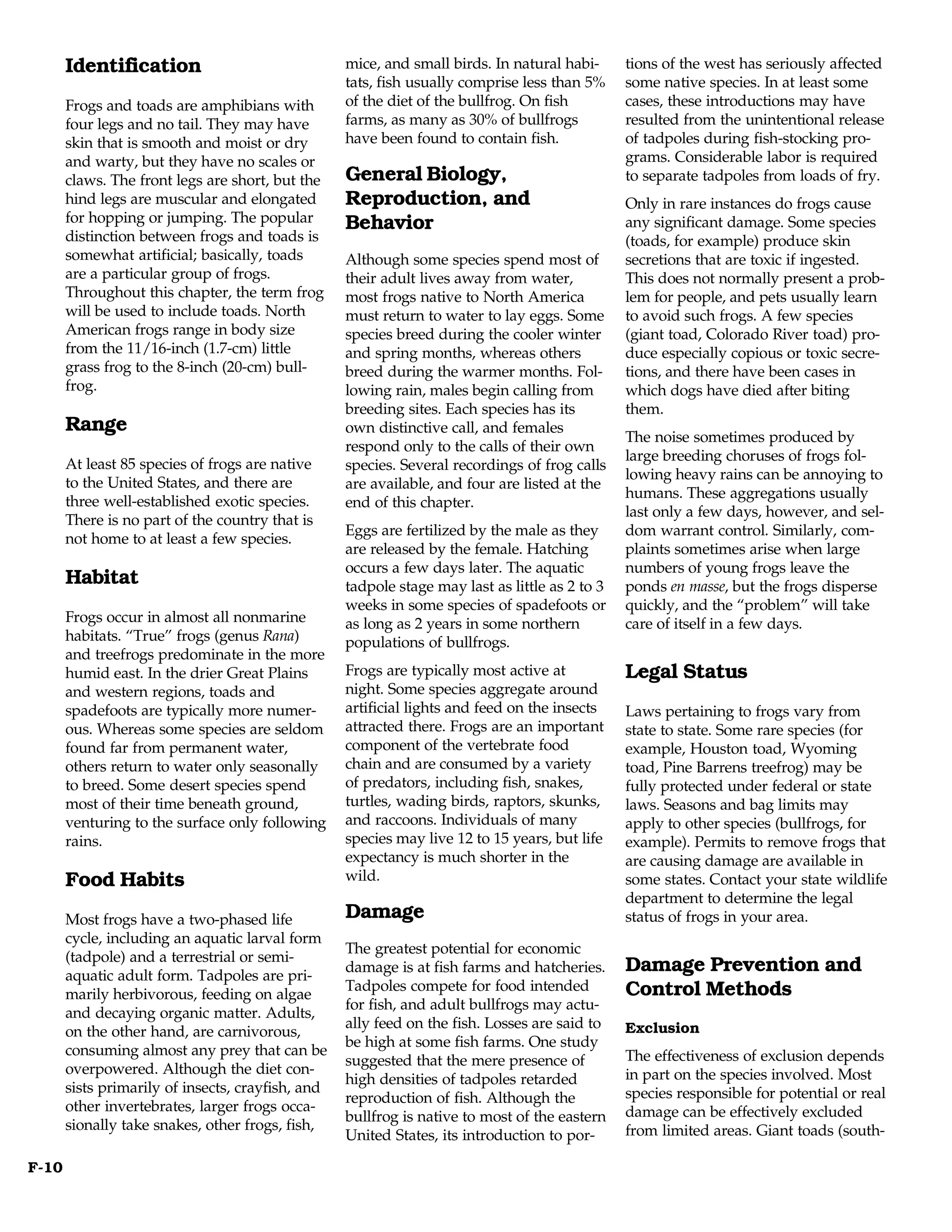
                                               Fig. 1. Crayfish


Damage Prevention and                     Toxicants                                    Identification, Range, and
Control Methods                           None are registered. Check individual        Biology
                                            state regulations for Special Local
Exclusion                                   Needs registrations 24(c).                 Crayfish, also called crawfish,
                                          Approved turf insecticides used for          crawcrab, crab, stonecrab, crawdad,
Not practical.
                                            insect pest control will also control      creekcrab, and other local names, are
Cultural Methods                                                                       native to fresh waters on all continents
                                            crayfish in lawn and turf areas.
Deep tillage destroys burrows and                                                      except Africa, where they have been
                                          Fumigants                                    widely introduced. There are over 400
  generally results in lower
  populations.                            None are registered. Check state             species in the family Astacidae world-
                                            regulations for Special Local Needs        wide, and approximately 300 species
Drainage of rice irrigation systems and                                                in the United States. In size, shape, and
                                            registrations 24(c).
  fields during fall and winter months                                                 color, the variation is extremely wide
  reduces populations.                    Trapping                                     among species. The detailed life histo-
Repellents                                Not effective in eliminating                 ries and habits of all species of crayfish
                                            populations. May be used in                are beyond the scope of this handbook.
None are registered.
                                            capturing crayfish for bait or food.


                                      PREVENTION AND CONTROL OF WILDLIFE DAMAGE — 1994
                                      Cooperative Extension Division
                                      Institute of Agriculture and Natural Resources
                                      University of Nebraska - Lincoln
                                      United States Department of Agriculture
                                      Animal and Plant Health Inspection Service
                                      Animal Damage Control                                                                         F-7
                                      Great Plains Agricultural Council
                                      Wildlife Committee
Crayfish are economically important in     Damage Prevention and                      Trapping
      a number of states for use as fish bait
      and for human consumption. In Loui-
                                                 Control Methods                            Wire cage traps, baited with fish,
                                                                                            chicken, or other meat can be used to
      siana, the crayfish is a major economic
                                                 Cultural Methods                           capture crayfish, but they are not cost-
      crop and comprises the second largest
                                                                                            effective in damage control situations.
      aquaculture industry in North
                                                 Deep cultivation helps reduce burrow-
      America. Over 130,000 acres (56,000
                                                 ing crayfish populations in rice fields
      ha) are devoted solely to crayfish
                                                 and other grain crops. Drainage of rice    Acknowledgments
      culture.
                                                 irrigation canals and fallow fields dur-
                                                                                            Figure 1 by Emily Oseas Routman.
                                                 ing fall and winter is also helpful in
      Damage                                     reducing crayfish populations in these
                                                 areas.                                     For Additional
      Most damage associated with crayfish       High populations of crayfish are           Information
      is the result of crayfish burrowing in     generally associated with years of high
      home lawns. Burrows created by             rainfall. Unseasonably dry weather         Hobbs, H. H., Jr. 1972. Crayfishes (Astacidae) of
      burrowing species of crayfish are dam-     conditions usually reduce crayfish           North and middle America. Identification
      aging to turf areas and may be hazard-                                                  Manual No. 9, Biota of Freshwater
                                                 numbers.                                     Ecosystems, US Environ. Prot. Agency.
      ous to mowing machinery. Newly                                                          Washington, DC. 173 pp.
      planted rice fields may be damaged by      Rapid drainage of baitfish ponds dur-
                                                 ing early spring helps eliminate cray-     Momot, W. T., G. Howing, and P. D. Jones. 1978.
      foraging crayfish where local popula-                                                   The dynamics of crayfish and their role in
      tions are high.                            fish by exposing them to predators
                                                                                              ecosystems. Am. Midl. Nat. 99:10-35.
                                                 before burrowing activities begin.
      Crayfish populations in commercial         Principal predators include snakes,        Pennak, R. W. 1978. Freshwater invertebrates of
      baitfish ponds can reduce reproduc-                                                      the United States, 2d ed. John Wiley and
                                                 racoons, mink, otter, skunks, bass,           Sons, New York. 803 pp.
      tion by feeding on the eggs of the         catfish, ibis, and herons.
      baitfish as they are deposited on                                                     Pflieger, W. L. 1987. An introduction to the
      spawning mats. During pond harvest,                                                       crayfish of Missouri. Missouri Dep. Conserv.
                                                 Toxicants                                      Jefferson City. 16 pp.
      crayfish caught in the nets injure and
      destroy baitfish as they are being har-    There are no General Use Pesticides        Williams, A. B., and A. B. Leonard. 1952. The
                                                                                               crayfishes of Kansas. Univ. Kansas, Sci. Bull.
      vested for market.                         registered for crayfish control. In some      34:961-1012.
      Unwanted populations of crayfish           states, however, Special Local Needs
      have been established in the wild          registration under section 24(c) of
      because of the release of bait crayfish.   FIFRA have been established for cer-
      Some populations have reached              tain insecticides for burrow treatment.    Editors
      extremely high levels. Crayfish can                                                     Scott E. Hygnstrom
                                                 Toxicants, where legal, may be used at
                                                                                              Robert M. Timm
      reduce game fish populations by prey-      any time of the year when crayfish are       Gary E. Larson
      ing on eggs and fry. They also can         active, but best results are obtained in
      degrade habitat by destroying aquatic      early fall when adults are in their bur-
      vegetation.                                rows. To be effective, applications of
                                                 toxic chemicals must reach the water
                                                 in the burrows. Additional treatments
      Legal Status                               may be necessary where burrows in
                                                 dikes or dams open at the bottom into
      Crayfish may be protected by law in        a pond or stream.
      some states. Harvest of crayfish may
      also be regulated by state wildlife con-   Fumigants
      servation agencies. In areas where
      damage occurs, control measures are        None are federally registered for cray-
      generally unrestricted. Check with         fish control. Check with your local
      your local agricultural or wildlife        wildlife or agricultural agency for
      authorities before initiating control.     Special Local Needs registrations.
      Unwanted populations of crayfish
      have resulted in regulations against
      the use of crayfish as bait in some
      northern lakes.


F-8
Paul E. Moler
Wildlife Biologist
Florida Game and Fresh Water Fish
                                              FROGS AND TOADS
  Commission
Wildlife Research Laboratory
Gainesville, Florida 32601


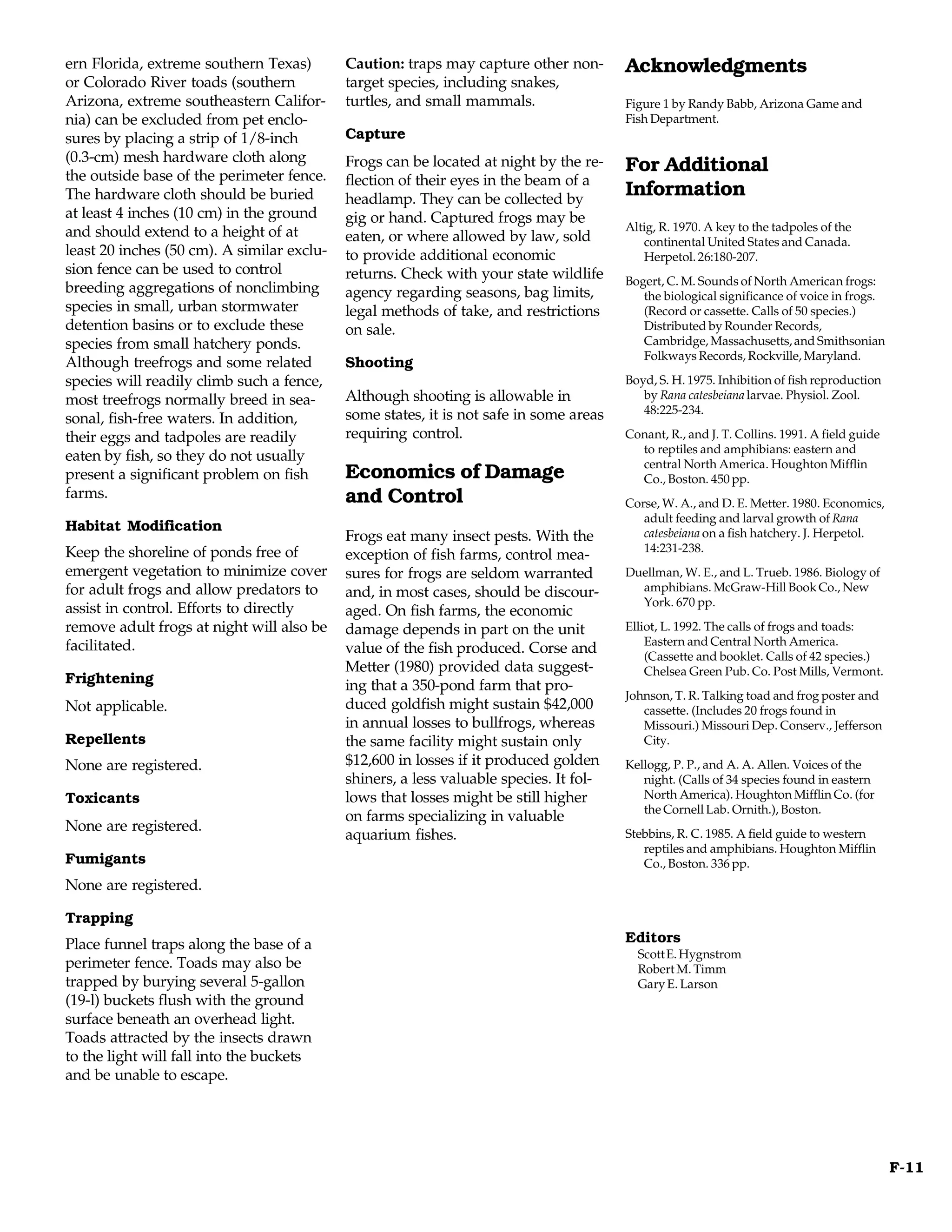
Fig. 1. Great Plains toad, Bufo cognatus


Damage Prevention and                         Habitat Modification                          Trapping
Control Methods                               Around hatchery ponds, keep vegeta-           Funnel traps.
                                                tion closely mown and remove
                                                                                            Capture
Exclusion                                       emergent vegetation and other
                                                types of cover.                             Capture by hand or gig at night.
Seal all openings 3/16 inch (0.5 cm) or
  larger to exclude frogs.                    Frightening                                   Egg masses may be removed with a
                                                                                              fine-meshed net.
A frogproof fence can be used for             Not applicable.
   nonclimbing species, but will be in-                                                     Shooting
                                              Repellents
   effective against treefrogs and a few                                                    Allowed in some states, but often not
   related species.                           None are registered.
                                                                                               safe in areas requiring control.
On fish farms, mesh tenting over              Toxicants                                        Some states permit shooting only
  ponds will serve to exclude frogs as                                                         during daylight hours.
                                              None are registered.
  well as birds and other predators.
                                              Fumigants
                                              None are registered.


                                           PREVENTION AND CONTROL OF WILDLIFE DAMAGE — 1994
                                           Cooperative Extension Division
                                           Institute of Agriculture and Natural Resources
                                           University of Nebraska - Lincoln
                                           United States Department of Agriculture
                                           Animal and Plant Health Inspection Service
                                           Animal Damage Control
                                                                                                                                    F-9
                                           Great Plains Agricultural Council
                                           Wildlife Committee
Identification                              mice, and small birds. In natural habi-      tions of the west has seriously affected
                                                   tats, fish usually comprise less than 5%     some native species. In at least some
       Frogs and toads are amphibians with         of the diet of the bullfrog. On fish         cases, these introductions may have
       four legs and no tail. They may have        farms, as many as 30% of bullfrogs           resulted from the unintentional release
       skin that is smooth and moist or dry        have been found to contain fish.             of tadpoles during fish-stocking pro-
       and warty, but they have no scales or                                                    grams. Considerable labor is required
       claws. The front legs are short, but the    General Biology,                             to separate tadpoles from loads of fry.
       hind legs are muscular and elongated        Reproduction, and                            Only in rare instances do frogs cause
       for hopping or jumping. The popular         Behavior                                     any significant damage. Some species
       distinction between frogs and toads is                                                   (toads, for example) produce skin
       somewhat artificial; basically, toads       Although some species spend most of          secretions that are toxic if ingested.
       are a particular group of frogs.            their adult lives away from water,           This does not normally present a prob-
       Throughout this chapter, the term frog      most frogs native to North America           lem for people, and pets usually learn
       will be used to include toads. North        must return to water to lay eggs. Some       to avoid such frogs. A few species
       American frogs range in body size           species breed during the cooler winter       (giant toad, Colorado River toad) pro-
       from the 11/16-inch (1.7-cm) little         and spring months, whereas others            duce especially copious or toxic secre-
       grass frog to the 8-inch (20-cm) bull-      breed during the warmer months. Fol-         tions, and there have been cases in
       frog.                                       lowing rain, males begin calling from        which dogs have died after biting
                                                   breeding sites. Each species has its         them.
       Range                                       own distinctive call, and females
                                                                                                The noise sometimes produced by
                                                   respond only to the calls of their own
                                                                                                large breeding choruses of frogs fol-
       At least 85 species of frogs are native     species. Several recordings of frog calls
                                                                                                lowing heavy rains can be annoying to
       to the United States, and there are         are available, and four are listed at the
                                                                                                humans. These aggregations usually
       three well-established exotic species.      end of this chapter.
                                                                                                last only a few days, however, and sel-
       There is no part of the country that is
                                                   Eggs are fertilized by the male as they      dom warrant control. Similarly, com-
       not home to at least a few species.
                                                   are released by the female. Hatching         plaints sometimes arise when large
                                                   occurs a few days later. The aquatic         numbers of young frogs leave the
       Habitat                                     tadpole stage may last as little as 2 to 3   ponds en masse, but the frogs disperse
                                                   weeks in some species of spadefoots or       quickly, and the “problem” will take
       Frogs occur in almost all nonmarine         as long as 2 years in some northern          care of itself in a few days.
       habitats. “True” frogs (genus Rana)         populations of bullfrogs.
       and treefrogs predominate in the more
       humid east. In the drier Great Plains       Frogs are typically most active at           Legal Status
       and western regions, toads and              night. Some species aggregate around
       spadefoots are typically more numer-        artificial lights and feed on the insects    Laws pertaining to frogs vary from
       ous. Whereas some species are seldom        attracted there. Frogs are an important      state to state. Some rare species (for
       found far from permanent water,             component of the vertebrate food             example, Houston toad, Wyoming
       others return to water only seasonally      chain and are consumed by a variety          toad, Pine Barrens treefrog) may be
       to breed. Some desert species spend         of predators, including fish, snakes,        fully protected under federal or state
       most of their time beneath ground,          turtles, wading birds, raptors, skunks,      laws. Seasons and bag limits may
       venturing to the surface only following     and raccoons. Individuals of many            apply to other species (bullfrogs, for
       rains.                                      species may live 12 to 15 years, but life    example). Permits to remove frogs that
                                                   expectancy is much shorter in the            are causing damage are available in
       Food Habits                                 wild.                                        some states. Contact your state wildlife
                                                                                                department to determine the legal
       Most frogs have a two-phased life           Damage                                       status of frogs in your area.
       cycle, including an aquatic larval form
                                                   The greatest potential for economic
       (tadpole) and a terrestrial or semi-
       aquatic adult form. Tadpoles are pri-
                                                   damage is at fish farms and hatcheries.      Damage Prevention and
                                                   Tadpoles compete for food intended           Control Methods
       marily herbivorous, feeding on algae
                                                   for fish, and adult bullfrogs may actu-
       and decaying organic matter. Adults,
                                                   ally feed on the fish. Losses are said to    Exclusion
       on the other hand, are carnivorous,
                                                   be high at some fish farms. One study
       consuming almost any prey that can be                                                    The effectiveness of exclusion depends
                                                   suggested that the mere presence of
       overpowered. Although the diet con-                                                      in part on the species involved. Most
                                                   high densities of tadpoles retarded
       sists primarily of insects, crayfish, and                                                species responsible for potential or real
                                                   reproduction of fish. Although the
       other invertebrates, larger frogs occa-                                                  damage can be effectively excluded
                                                   bullfrog is native to most of the eastern
       sionally take snakes, other frogs, fish,                                                 from limited areas. Giant toads (south-
                                                   United States, its introduction to por-

F-10
ern Florida, extreme southern Texas)        Caution: traps may capture other non-       Acknowledgments
or Colorado River toads (southern           target species, including snakes,
Arizona, extreme southeastern Califor-      turtles, and small mammals.                 Figure 1 by Randy Babb, Arizona Game and
nia) can be excluded from pet enclo-                                                    Fish Department.
sures by placing a strip of 1/8-inch        Capture
(0.3-cm) mesh hardware cloth along          Frogs can be located at night by the re-
the outside base of the perimeter fence.
                                                                                        For Additional
                                            flection of their eyes in the beam of a
The hardware cloth should be buried         headlamp. They can be collected by
                                                                                        Information
at least 4 inches (10 cm) in the ground     gig or hand. Captured frogs may be
and should extend to a height of at                                                     Altig, R. 1970. A key to the tadpoles of the
                                            eaten, or where allowed by law, sold           continental United States and Canada.
least 20 inches (50 cm). A similar exclu-   to provide additional economic                 Herpetol. 26:180-207.
sion fence can be used to control           returns. Check with your state wildlife     Bogert, C. M. Sounds of North American frogs:
breeding aggregations of nonclimbing        agency regarding seasons, bag limits,          the biological significance of voice in frogs.
species in small, urban stormwater          legal methods of take, and restrictions        (Record or cassette. Calls of 50 species.)
detention basins or to exclude these        on sale.                                       Distributed by Rounder Records,
species from small hatchery ponds.                                                         Cambridge, Massachusetts, and Smithsonian
                                                                                           Folkways Records, Rockville, Maryland.
Although treefrogs and some related         Shooting
species will readily climb such a fence,                                                Boyd, S. H. 1975. Inhibition of fish reproduction
most treefrogs normally breed in sea-       Although shooting is allowable in              by Rana catesbeiana larvae. Physiol. Zool.
                                            some states, it is not safe in some areas      48:225-234.
sonal, fish-free waters. In addition,
their eggs and tadpoles are readily         requiring control.                          Conant, R., and J. T. Collins. 1991. A field guide
                                                                                          to reptiles and amphibians: eastern and
eaten by fish, so they do not usually                                                     central North America. Houghton Mifflin
present a significant problem on fish       Economics of Damage                           Co., Boston. 450 pp.
farms.                                      and Control                                 Corse, W. A., and D. E. Metter. 1980. Economics,
                                                                                           adult feeding and larval growth of Rana
Habitat Modification                                                                       catesbeiana on a fish hatchery. J. Herpetol.
                                            Frogs eat many insect pests. With the
Keep the shoreline of ponds free of                                                        14:231-238.
                                            exception of fish farms, control mea-
emergent vegetation to minimize cover       sures for frogs are seldom warranted        Duellman, W. E., and L. Trueb. 1986. Biology of
for adult frogs and allow predators to      and, in most cases, should be discour-        amphibians. McGraw-Hill Book Co., New
                                                                                          York. 670 pp.
assist in control. Efforts to directly      aged. On fish farms, the economic
remove adult frogs at night will also be    damage depends in part on the unit          Elliot, L. 1992. The calls of frogs and toads:
facilitated.                                                                                Eastern and Central North America.
                                            value of the fish produced. Corse and           (Cassette and booklet. Calls of 42 species.)
                                            Metter (1980) provided data suggest-            Chelsea Green Pub. Co. Post Mills, Vermont.
Frightening                                 ing that a 350-pond farm that pro-
                                                                                        Johnson, T. R. Talking toad and frog poster and
Not applicable.                             duced goldfish might sustain $42,000           cassette. (Includes 20 frogs found in
                                            in annual losses to bullfrogs, whereas         Missouri.) Missouri Dep. Conserv., Jefferson
Repellents                                  the same facility might sustain only           City.

None are registered.                        $12,600 in losses if it produced golden     Kellogg, P. P., and A. A. Allen. Voices of the
                                            shiners, a less valuable species. It fol-      night. (Calls of 34 species found in eastern
Toxicants                                   lows that losses might be still higher         North America). Houghton Mifflin Co. (for
                                                                                           the Cornell Lab. Ornith.), Boston.
                                            on farms specializing in valuable
None are registered.
                                            aquarium fishes.                            Stebbins, R. C. 1985. A field guide to western
                                                                                           reptiles and amphibians. Houghton Mifflin
Fumigants                                                                                  Co., Boston. 336 pp.
None are registered.

Trapping
Place funnel traps along the base of a                                                  Editors
                                                                                          Scott E. Hygnstrom
perimeter fence. Toads may also be                                                        Robert M. Timm
trapped by burying several 5-gallon                                                       Gary E. Larson
(19-l) buckets flush with the ground
surface beneath an overhead light.
Toads attracted by the insects drawn
to the light will fall into the buckets
and be unable to escape.


                                                                                                                                             F-11
F-12
James L. Byford
Professor and Dean
School of Agriculture and
                                                      SALAMANDERS
  Home Economics
The University of Tennessee, Martin
Martin, Tennessee 38238


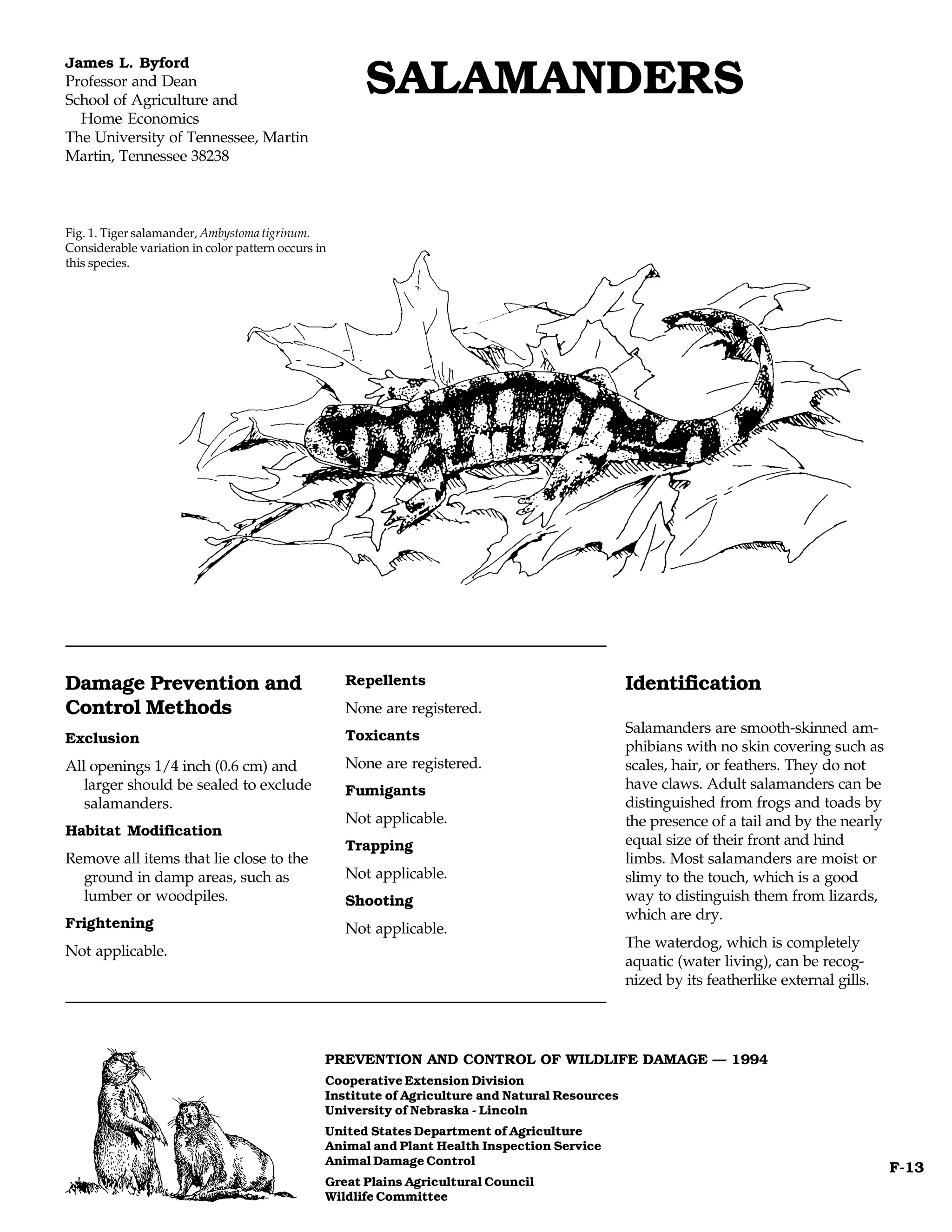
Fig. 1. Tiger salamander, Ambystoma tigrinum.
Considerable variation in color pattern occurs in
this species.


Damage Prevention and                               Repellents                                   Identification
Control Methods                                     None are registered.
                                                    Toxicants
                                                                                                 Salamanders are smooth-skinned am-
Exclusion
                                                                                                 phibians with no skin covering such as
All openings 1/4 inch (0.6 cm) and                  None are registered.                         scales, hair, or feathers. They do not
   larger should be sealed to exclude               Fumigants                                    have claws. Adult salamanders can be
   salamanders.                                                                                  distinguished from frogs and toads by
                                                    Not applicable.                              the presence of a tail and by the nearly
Habitat Modification
                                                    Trapping                                     equal size of their front and hind
Remove all items that lie close to the                                                           limbs. Most salamanders are moist or
  ground in damp areas, such as                     Not applicable.                              slimy to the touch, which is a good
  lumber or woodpiles.                              Shooting                                     way to distinguish them from lizards,
                                                                                                 which are dry.
Frightening                                         Not applicable.
                                                                                                 The waterdog, which is completely
Not applicable.
                                                                                                 aquatic (water living), can be recog-
                                                                                                 nized by its featherlike external gills.


                                                PREVENTION AND CONTROL OF WILDLIFE DAMAGE — 1994
                                                Cooperative Extension Division
                                                Institute of Agriculture and Natural Resources
                                                University of Nebraska - Lincoln
                                                United States Department of Agriculture
                                                Animal and Plant Health Inspection Service
                                                Animal Damage Control
                                                                                                                                            F-13
                                                Great Plains Agricultural Council
                                                Wildlife Committee
Range                                                                                  Fumigants
                                                   Legal Status
       There are several dozen kinds of                                                       Not applicable.
                                                   Salamanders are protected in most
       salamanders found in the United                                                        Trapping
                                                   states, as are other nongame animals.
       States, but most occur only in parts of
                                                   In some areas, they may be legally         Not applicable.
       one or several states. Because
                                                   taken to use as bait for fishing, but in
       salamanders are so dependent on                                                        Shooting
                                                   most areas they are completely pro-
       specific habitat conditions, their
                                                   tected. Some salamanders are on state      Not applicable.
       movements are limited and home
                                                   lists of threatened and endangered
       ranges are usually very small.
                                                   species.                                   Economics of Damage and
       Habitat                                                                                Control
                                                   Damage Prevention and                      As mentioned earlier, salamanders are
       Salamanders depend on water and             Control Methods                            completely harmless. They do not
       moisture for their existence. Because
                                                   Exclusion                                  have a poisonous bite and cause no
       they do not have a skin covering, they
                                                                                              hazard to people, except perhaps
       dehydrate rapidly in dry environ-           Salamanders generally do not enter         frightening them. They cause no dam-
       ments. The larvae spend the first part      buildings. On occasion, they may be        age to personal property. Therefore,
       of their lives in water. After the larval   found in a damp basement, if the base-     expense toward control of salaman-
       form changes to the adult form, most        ment stays moist most of the time and      ders is not justified. Most methods
       salamanders leave the water and live        there are items lying close to the damp    required to remove salamanders are
       in moist areas on land. They can            floor. In such cases, all openings 1/4     inexpensive and are consistent with
       usually be found under logs, under          inch (0.6 cm) and larger should be         good grooming of the yard and home
       rocks, near streams, and in other areas     sealed to exclude salamanders. Check       environment.
       where the ground is moist and shaded        for openings around the corners of
       from the sun.                               doors and windows, water pipes, and
                                                                                              Acknowledgments
                                                   electric service entrances. Holes in
       Food Habits                                 masonry foundations (poured concrete       Figure 1 by Emily Oseas Routman.
                                                   and concrete blocks or bricks) should
       All salamanders are predators. They         be sealed with mortar. Openings in
       commonly eat insects, slugs,                wood should be sealed with fine mesh       For Additional
       earthworms, and other invertebrates.        (1/8-inch [0.3-cm]) hardware cloth         Information
       Some eat leeches, tiny mollusks,            and/or sheet metal.
       crustaceans, and frogs’ eggs. As                                                       Barker, W. 1964. Familiar reptiles and
       aquatic larvae, they typically eat          Habitat Modification                          amphibians of America. Harper & Row.
                                                                                                 New York. 220 pp.
       aquatic invertebrates, but some may
       even be cannibalistic.                      In situations where salamanders are        Cochran, D. M. 1961. Living amphibians of the
                                                   inside buildings, steps should be taken       world. Doubleday. New York. 199 pp.
                                                   to dry out the basement area (see a
                                                                                              Conant, R. 1975. A field guide to reptiles and
       Behavior                                    construction specialist for this) or         amphibians of eastern and central North
                                                   remove objects from the floor of damp        America, 2d ed. Houghton Mifflin Co.,
       Salamanders generally are active when       basements where salamanders can              Boston. 429 pp.
       there is no sunshine—at night or on         hide. Keep areas outside of buildings      Goin, C. J., and O. B. Goin. 1962. Introduction to
       cloudy, rainy days. On sunny days           free from objects that salamanders can        herpetology. W. H. Freeman, San Francisco.
       they generally hide in moist areas,         hide under—lumber, sticks, old                341 pp.
       such as under stones and logs. Since        boards, or firewood. If such items are     Huheey, J. E., and A. Stupka. 1967. Amphibians
       salamanders are mostly nocturnal            off the ground (stacked on runners)          and reptiles of the Great Smoky Mountains
       (active at night), they are seldom seen     the soil underneath can dry, making          National Park. Univ. Tennessee Press.
       by people.                                                                               Knoxville. 98 pp.
                                                   the area unattractive to salamanders.
                                                                                              Schlauch, F. C. 1976. City snakes, suburban
                                                   Frightening                                   salamanders. Nat. Hist. 85:46-53.
       Damage
                                                   Not applicable.
       Salamanders do not cause damage to
                                                   Repellents
       people or property. Occasionally, they
       frighten people who are not familiar        None are registered.                       Editors
                                                                                                Scott E. Hygnstrom
       with them. None have a poisonous                                                         Robert M. Timm
                                                   Toxicants
       bite.                                                                                    Gary E. Larson
                                                   None are registered.

F-14
James L. Byford
Professor and Dean
School of Agriculture and
                                                    NONPOISONOUS
  Home Economics
The University of Tennessee, Martin
Martin, Tennessee 38238
                                                    SNAKES
Fig. 1. Bullsnake (gopher snake), Pituophis
melanoleucus


Damage Prevention and                            Frightening                                   Other Methods
Control Methods                                  Not applicable.                               Remove snakes from inside buildings
                                                 Repellents                                      by placing piles of damp burlap
Exclusion                                                                                        bags or towels in areas where
                                                 Several snake repellents have been              snakes have been seen. After snakes
Seal all openings (1/4 inch [0.6 cm]
                                                   promoted, but none are consistently           have been attracted, remove the
  and larger) with mortar, 1/8-inch
                                                   effective.                                    bags and snake(s) from the
  (0.3-cm) hardware cloth, sheet
  metal, or steel wool.                          Toxicants                                       building.
A snake-proof fence can be used to               None are registered.                          Glue boards can be used to capture
  exclude snakes.                                Fumigants                                       snakes found inside houses or other
                                                                                                 buildings. Once caught, the snake
Habitat Modification                             None are registered.                            and board can be taken outside. The
Reduce rodent populations.                       Trapping                                        snake can be released unharmed by
                                                                                                 pouring vegetable oil on it (the oil
Keep all vegetation closely mowed;               A funnel trap with drift fences can be
                                                                                                 counteracts the adhesive).
  remove bushes, shrubs, rocks,                     used.
  boards, firewood, and debris lying                                                           Since nonpoisonous snakes are
                                                 Shooting
  close to the ground, especially                                                                 completely harmless, control
  around buildings.                              Nonpoisonous snakes are protected by             programs for them are not necessary.
                                                   law in most states and indiscriminate          Learn how to distinguish between
Alter all sites that provide cool, damp,           killing is illegal. Shooting or clubbing       poisonous and nonpoisonous snakes
   dark habitat for snakes.                        is effective, however, where it is             in your area.
                                                   allowed, with permission from the
                                                   state wildlife agency.

                                              PREVENTION AND CONTROL OF WILDLIFE DAMAGE — 1994
                                              Cooperative Extension Division
                                              Institute of Agriculture and Natural Resources
                                              University of Nebraska - Lincoln
                                              United States Department of Agriculture
                                              Animal and Plant Health Inspection Service
                                              Animal Damage Control
                                              Great Plains Agricultural Council                                                          F-15
                                              Wildlife Committee
Identification
       Of the many kinds of snakes found in
       the United States, only the following
                                                                                                                                    Nonpoisonous
       are harmful: rattlesnakes, copper-
       heads, cottonmouths, coral snakes,
       and sea snakes. The latter group lives
       only in the oceans. All poisonous
       snakes, except coral snakes and sea
       snakes, belong in a group called pit
       vipers. There are three ways to distin-                                                                                      Poisonous
       guish between pit vipers and
       nonpoisonous snakes in the United
       States:
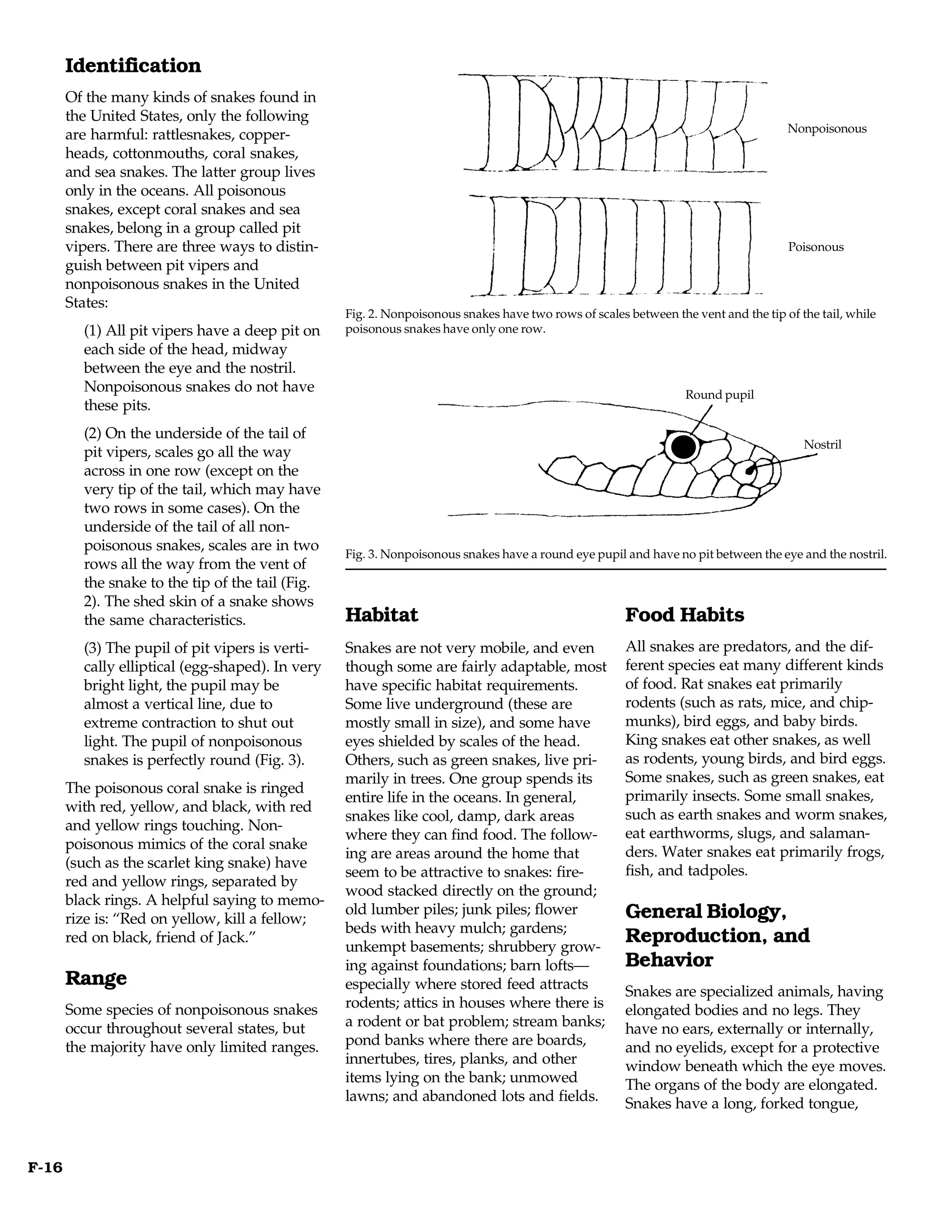
                                                  Fig. 2. Nonpoisonous snakes have two rows of scales between the vent and the tip of the tail, while
         (1) All pit vipers have a deep pit on    poisonous snakes have only one row.
         each side of the head, midway
         between the eye and the nostril.
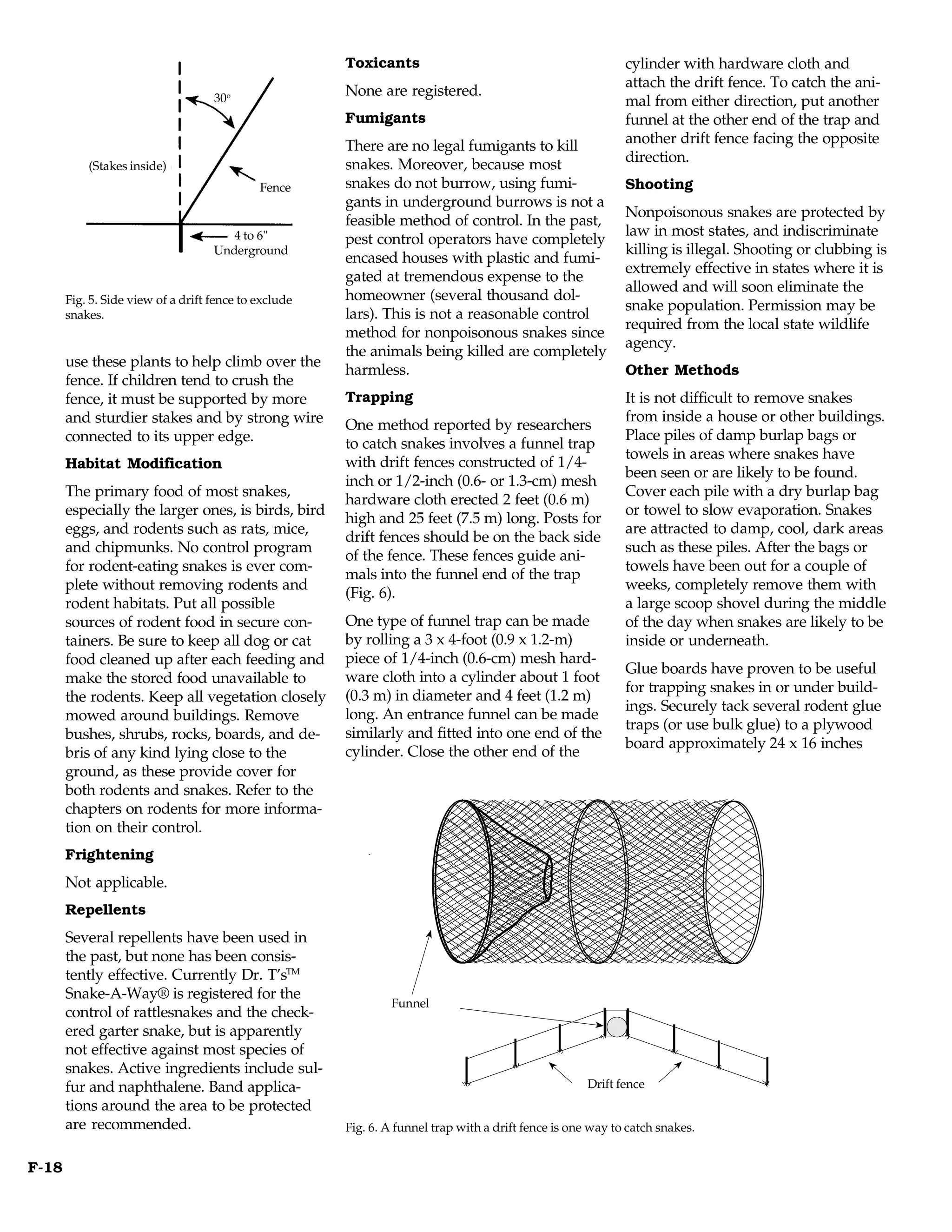
         Nonpoisonous snakes do not have                                                                         Round pupil
         these pits.
         (2) On the underside of the tail of
                                                                                                                                       Nostril
         pit vipers, scales go all the way
         across in one row (except on the
         very tip of the tail, which may have
         two rows in some cases). On the
         underside of the tail of all non-
         poisonous snakes, scales are in two
                                                  Fig. 3. Nonpoisonous snakes have a round eye pupil and have no pit between the eye and the nostril.
         rows all the way from the vent of
         the snake to the tip of the tail (Fig.
         2). The shed skin of a snake shows
         the same characteristics.                Habitat                                             Food Habits
         (3) The pupil of pit vipers is verti-    Snakes are not very mobile, and even                All snakes are predators, and the dif-
         cally elliptical (egg-shaped). In very   though some are fairly adaptable, most              ferent species eat many different kinds
         bright light, the pupil may be           have specific habitat requirements.                 of food. Rat snakes eat primarily
         almost a vertical line, due to           Some live underground (these are                    rodents (such as rats, mice, and chip-
         extreme contraction to shut out          mostly small in size), and some have                munks), bird eggs, and baby birds.
         light. The pupil of nonpoisonous         eyes shielded by scales of the head.                King snakes eat other snakes, as well
         snakes is perfectly round (Fig. 3).      Others, such as green snakes, live pri-             as rodents, young birds, and bird eggs.
                                                  marily in trees. One group spends its               Some snakes, such as green snakes, eat
       The poisonous coral snake is ringed
                                                  entire life in the oceans. In general,              primarily insects. Some small snakes,
       with red, yellow, and black, with red
                                                  snakes like cool, damp, dark areas                  such as earth snakes and worm snakes,
       and yellow rings touching. Non-
                                                  where they can find food. The follow-               eat earthworms, slugs, and salaman-
       poisonous mimics of the coral snake
                                                  ing are areas around the home that                  ders. Water snakes eat primarily frogs,
       (such as the scarlet king snake) have
                                                  seem to be attractive to snakes: fire-              fish, and tadpoles.
       red and yellow rings, separated by
                                                  wood stacked directly on the ground;
       black rings. A helpful saying to memo-
                                                  old lumber piles; junk piles; flower                General Biology,
       rize is: “Red on yellow, kill a fellow;
                                                  beds with heavy mulch; gardens;
       red on black, friend of Jack.”
                                                  unkempt basements; shrubbery grow-
                                                                                                      Reproduction, and
                                                  ing against foundations; barn lofts—                Behavior
       Range                                      especially where stored feed attracts               Snakes are specialized animals, having
       Some species of nonpoisonous snakes        rodents; attics in houses where there is            elongated bodies and no legs. They
       occur throughout several states, but       a rodent or bat problem; stream banks;              have no ears, externally or internally,
       the majority have only limited ranges.     pond banks where there are boards,                  and no eyelids, except for a protective
                                                  innertubes, tires, planks, and other                window beneath which the eye moves.
                                                  items lying on the bank; unmowed                    The organs of the body are elongated.
                                                  lawns; and abandoned lots and fields.               Snakes have a long, forked tongue,


F-16
which helps them smell. Gaseous par-      observed or felt, the bite was from a              concrete and concrete blocks or bricks)
ticles from odors are picked up by the    nonpoisonous snake. Also, bites from               should be sealed with mortar to
tongue and inserted into the two-holed    one of the pit vipers (copperheads,                exclude snakes. Holes in wooden
organ, called the Jacobson’s Organ, at    rattlesnakes, and cottonmouths) will               buildings can be sealed with fine mesh
the roof of the mouth.                    reveal two fang marks, in addition to              (1/8-inch [0.3-cm]) hardware cloth or
                                          teeth marks. All snakes have teeth;                sheet metal.
The two halves of the lower jaw are
                                          only pit vipers have fangs. North
not fused, but are connected by a liga-                                                      In some cases, the homeowner may get
                                          American pit vipers have only two
ment to each other. They are also                                                            peace of mind by constructing a snake-
                                          rows of teeth on top and two on the
loosely connected so the snake can                                                           proof fence around the home or yard
                                          bottom, whereas nonpoisonous snakes
swallow food much larger than its                                                            (Fig. 4). A properly constructed snake-
                                          have four on top and four on the
head. Because snakes are cold-blooded                                                        proof fence will keep out all poisonous
                                          bottom.
and not very active, one meal may last                                                       snakes and most harmless snakes
them several weeks. Also, because                                                            (some nonpoisonous snakes are fairly
they are cold-blooded, they may hiber-    Legal Status                                       good climbers). The cost of fencing a
nate during cold weather months or        In most states, snakes are considered              whole yard may be high, but it costs
aestivate during hot summer months        nongame wildlife and are protected by              little to enclose a play space for chil-
when the climate is severe. In either     state law unless they are about to                 dren too young to recognize danger-
case, they consume little or no food      cause personal or property damage.                 ous snakes. The following design is
during these times. Some snakes lay       Therefore, snakes should not be indis-             taken from information from the US
eggs, some hatch their eggs inside the    criminately killed. Some species are               Fish and Wildlife Service.
body, and some give live birth. The       listed on federal and/or state threat-             The fence should be made of heavy
young of copperheads, rattlesnakes,       ened and endangered species lists.                 galvanized hardware cloth, 36 inches
and cottonmouths are born alive.
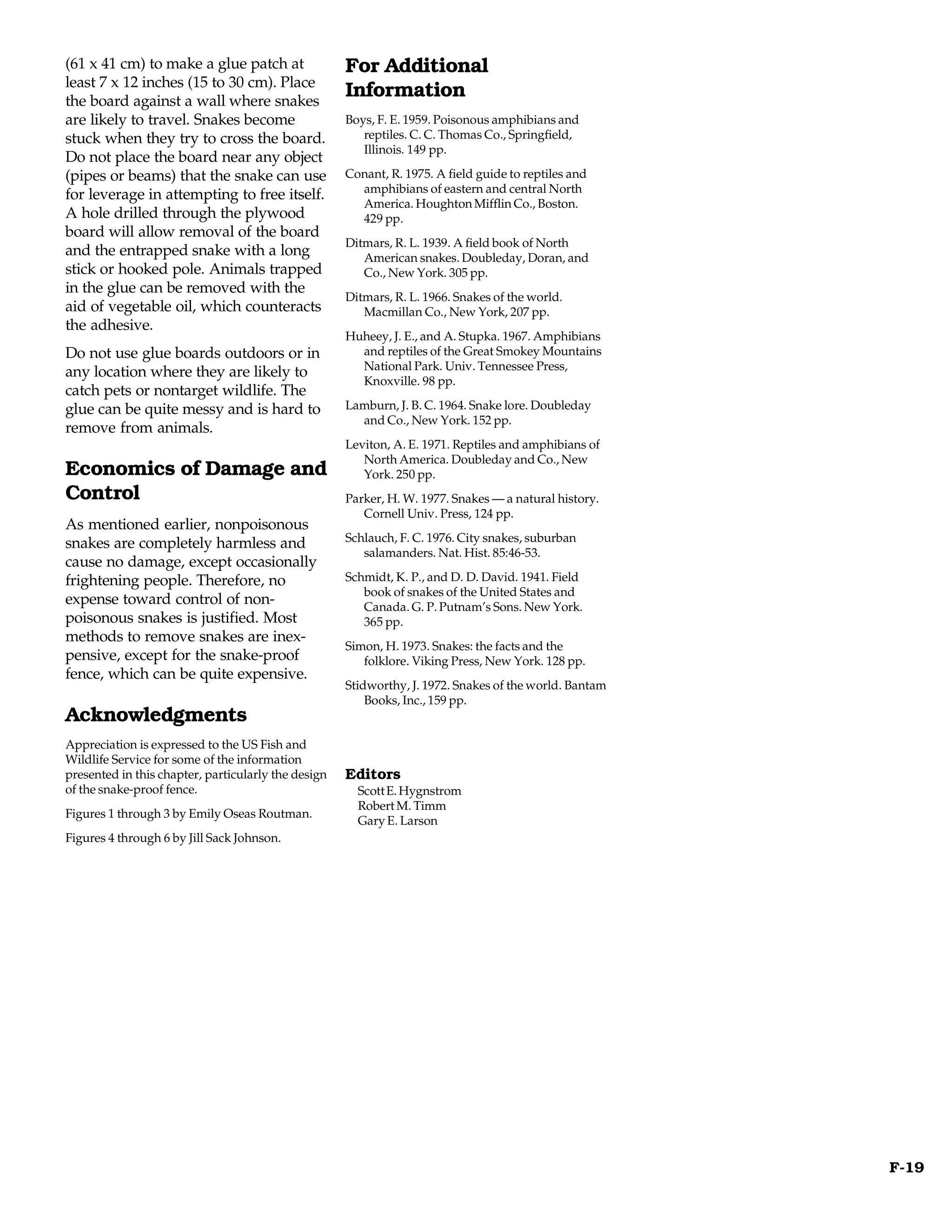
                                                                                             (91 cm) wide with a 1/4-inch (0.6-cm)
Nonpoisonous snakes are harmless to       Damage Prevention and                              mesh. The lower edge should be bur-
humans. In most cases, a snake will                                                          ied 6 inches (15 cm) in the ground, and
crawl away when approached if it feels
                                          Control Methods                                    the fence should be slanted outward
it can reach cover safely. No snakes      Exclusion                                          from the bottom to the top at a 30o
charge or attack people, with the                                                            angle (Fig. 5). Place supporting stakes
                                          Snakes enter houses, barns and other
exception of the racers, which occa-                                                         inside the fence and make sure that
                                          buildings when habitat conditions are
sionally bluff by advancing toward an                                                        any gate is tightly fitted. Gates should
                                          suitable inside the buildings. They are
intruder. Racers will retreat rapidly,                                                       swing inward because of the outward
                                          particularly attracted to rodents and
however, if challenged. Snakes react                                                         slope of the fence. A 36-inch (91-cm)
                                          insects as well as cool, damp, dark
only when cornered. Different species                                                        vertical fence with a 12-inch (30-cm) lip
                                          areas often associated with buildings.
react in different ways, playing dead                                                        at the top, facing outside and angled
                                          All openings 1/4 inch (0.6 cm) and
by turning over on the back, hissing,                                                        downward at a 30o angle would prob-
                                          larger should be sealed to exclude
opening the mouth in a menacing                                                              ably work as well. Any opening under
                                          snakes. Check the corners of doors and
manner, coiling, and striking and                                                            the fence should be firmly filled—con-
                                          windows, as well as around water
biting if necessary.                                                                         crete is preferable. Mow all vegetation
                                          pipe and electrical service entrances.
                                                                                             just outside the fence, for snakes might
                                          Holes in masonry foundations (poured
Damage and Damage
Identification
A nonpoisonous snake bite has no
venom and can do no more harm than
frighten the victim. After being bitten
several thousand times by non-
poisonous snakes, the author and his
students have never suffered any
adverse reaction, and no treatment
was ever used. The only harm non-
poisonous snakes can cause is frighten-
ing people who are not familiar with
them. A bite from a poisonous snake,
however, causes an almost immediate
reaction—swelling, tissue turning a
dark blue-black, a tingling sensation,    Fig. 4. Though fairly expensive, a properly constructed snake-proof fence can keep snakes from en-
and nausea. If none of these is           tering a given area.

                                                                                                                                               F-17
Toxicants                                             cylinder with hardware cloth and
                                                                                                             attach the drift fence. To catch the ani-
                                    30o
                                                       None are registered.
                                                                                                             mal from either direction, put another
                                                       Fumigants                                             funnel at the other end of the trap and
                                                       There are no legal fumigants to kill                  another drift fence facing the opposite
                                                       snakes. Moreover, because most                        direction.
           (Stakes inside)
                                             Fence     snakes do not burrow, using fumi-                     Shooting
                                                       gants in underground burrows is not a
                                                                                                             Nonpoisonous snakes are protected by
                                                       feasible method of control. In the past,
                                       4 to 6"                                                               law in most states, and indiscriminate
                                                       pest control operators have completely
                                    Underground                                                              killing is illegal. Shooting or clubbing is
                                                       encased houses with plastic and fumi-
                                                                                                             extremely effective in states where it is
                                                       gated at tremendous expense to the
                                                                                                             allowed and will soon eliminate the
       Fig. 5. Side view of a drift fence to exclude   homeowner (several thousand dol-
                                                                                                             snake population. Permission may be
       snakes.                                         lars). This is not a reasonable control
                                                                                                             required from the local state wildlife
                                                       method for nonpoisonous snakes since
                                                                                                             agency.
                                                       the animals being killed are completely
       use these plants to help climb over the
                                                       harmless.                                             Other Methods
       fence. If children tend to crush the
       fence, it must be supported by more             Trapping                                              It is not difficult to remove snakes
       and sturdier stakes and by strong wire                                                                from inside a house or other buildings.
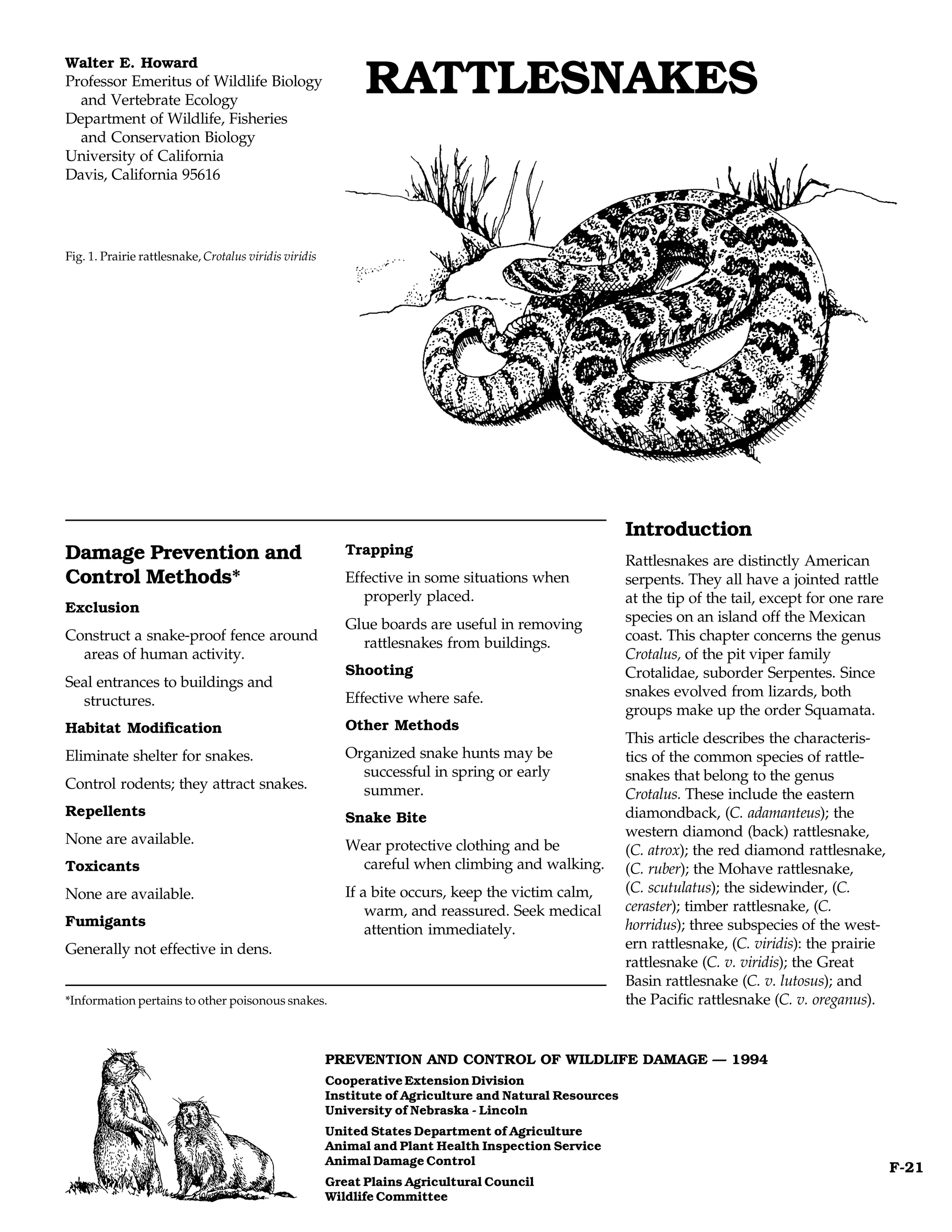
                                                       One method reported by researchers
       connected to its upper edge.                                                                          Place piles of damp burlap bags or
                                                       to catch snakes involves a funnel trap
                                                                                                             towels in areas where snakes have
       Habitat Modification                            with drift fences constructed of 1/4-
                                                                                                             been seen or are likely to be found.
                                                       inch or 1/2-inch (0.6- or 1.3-cm) mesh
       The primary food of most snakes,                                                                      Cover each pile with a dry burlap bag
                                                       hardware cloth erected 2 feet (0.6 m)
       especially the larger ones, is birds, bird                                                            or towel to slow evaporation. Snakes
                                                       high and 25 feet (7.5 m) long. Posts for
       eggs, and rodents such as rats, mice,                                                                 are attracted to damp, cool, dark areas
                                                       drift fences should be on the back side
       and chipmunks. No control program                                                                     such as these piles. After the bags or
                                                       of the fence. These fences guide ani-
       for rodent-eating snakes is ever com-                                                                 towels have been out for a couple of
                                                       mals into the funnel end of the trap
       plete without removing rodents and                                                                    weeks, completely remove them with
                                                       (Fig. 6).
       rodent habitats. Put all possible                                                                     a large scoop shovel during the middle
       sources of rodent food in secure con-           One type of funnel trap can be made                   of the day when snakes are likely to be
       tainers. Be sure to keep all dog or cat         by rolling a 3 x 4-foot (0.9 x 1.2-m)                 inside or underneath.
       food cleaned up after each feeding and          piece of 1/4-inch (0.6-cm) mesh hard-
                                                                                                             Glue boards have proven to be useful
       make the stored food unavailable to             ware cloth into a cylinder about 1 foot
                                                                                                             for trapping snakes in or under build-
       the rodents. Keep all vegetation closely        (0.3 m) in diameter and 4 feet (1.2 m)
                                                                                                             ings. Securely tack several rodent glue
       mowed around buildings. Remove                  long. An entrance funnel can be made
                                                                                                             traps (or use bulk glue) to a plywood
       bushes, shrubs, rocks, boards, and de-          similarly and fitted into one end of the
                                                                                                             board approximately 24 x 16 inches
       bris of any kind lying close to the             cylinder. Close the other end of the
       ground, as these provide cover for
       both rodents and snakes. Refer to the
       chapters on rodents for more informa-
       tion on their control.
       Frightening
       Not applicable.
       Repellents
       Several repellents have been used in
       the past, but none has been consis-
       tently effective. Currently Dr. T’sTM
       Snake-A-Way® is registered for the
                                                               Funnel
                                                                 Funnel
       control of rattlesnakes and the check-
       ered garter snake, but is apparently
       not effective against most species of
       snakes. Active ingredients include sul-
       fur and naphthalene. Band applica-                                                           Drift fence
                                                                                                     Drift fence
       tions around the area to be protected
       are recommended.                                Fig. 6. A funnel trap with a drift fence is one way to catch snakes.


F-18
(61 x 41 cm) to make a glue patch at                 For Additional
least 7 x 12 inches (15 to 30 cm). Place
the board against a wall where snakes
                                                     Information
are likely to travel. Snakes become                  Boys, F. E. 1959. Poisonous amphibians and
stuck when they try to cross the board.                 reptiles. C. C. Thomas Co., Springfield,
                                                        Illinois. 149 pp.
Do not place the board near any object
(pipes or beams) that the snake can use              Conant, R. 1975. A field guide to reptiles and
                                                       amphibians of eastern and central North
for leverage in attempting to free itself.
                                                       America. Houghton Mifflin Co., Boston.
A hole drilled through the plywood                     429 pp.
board will allow removal of the board
                                                     Ditmars, R. L. 1939. A field book of North
and the entrapped snake with a long                     American snakes. Doubleday, Doran, and
stick or hooked pole. Animals trapped                   Co., New York. 305 pp.
in the glue can be removed with the
                                                     Ditmars, R. L. 1966. Snakes of the world.
aid of vegetable oil, which counteracts                 Macmillan Co., New York, 207 pp.
the adhesive.
                                                     Huheey, J. E., and A. Stupka. 1967. Amphibians
Do not use glue boards outdoors or in                  and reptiles of the Great Smokey Mountains
                                                       National Park. Univ. Tennessee Press,
any location where they are likely to
                                                       Knoxville. 98 pp.
catch pets or nontarget wildlife. The
glue can be quite messy and is hard to               Lamburn, J. B. C. 1964. Snake lore. Doubleday
                                                       and Co., New York. 152 pp.
remove from animals.
                                                     Leviton, A. E. 1971. Reptiles and amphibians of
                                                        North America. Doubleday and Co., New
Economics of Damage and                                 York. 250 pp.
Control                                              Parker, H. W. 1977. Snakes — a natural history.
                                                        Cornell Univ. Press, 124 pp.
As mentioned earlier, nonpoisonous
snakes are completely harmless and                   Schlauch, F. C. 1976. City snakes, suburban
                                                        salamanders. Nat. Hist. 85:46-53.
cause no damage, except occasionally
frightening people. Therefore, no                    Schmidt, K. P., and D. D. David. 1941. Field
                                                        book of snakes of the United States and
expense toward control of non-                          Canada. G. P. Putnam’s Sons. New York.
poisonous snakes is justified. Most                     365 pp.
methods to remove snakes are inex-
                                                     Simon, H. 1973. Snakes: the facts and the
pensive, except for the snake-proof                     folklore. Viking Press, New York. 128 pp.
fence, which can be quite expensive.
                                                     Stidworthy, J. 1972. Snakes of the world. Bantam
                                                         Books, Inc., 159 pp.
Acknowledgments
Appreciation is expressed to the US Fish and
Wildlife Service for some of the information
presented in this chapter, particularly the design   Editors
of the snake-proof fence.                              Scott E. Hygnstrom
                                                       Robert M. Timm
Figures 1 through 3 by Emily Oseas Routman.
                                                       Gary E. Larson
Figures 4 through 6 by Jill Sack Johnson.


                                                                                                        F-19
F-20
Walter E. Howard
Professor Emeritus of Wildlife Biology
  and Vertebrate Ecology
                                                              RATTLESNAKES
Department of Wildlife, Fisheries
  and Conservation Biology
University of California
Davis, California 95616


Fig. 1. Prairie rattlesnake, Crotalus viridis viridis


                                                                                                         Introduction
Damage Prevention and                                      Trapping
                                                                                                         Rattlesnakes are distinctly American
Control Methods*                                           Effective in some situations when             serpents. They all have a jointed rattle
                                                              properly placed.                           at the tip of the tail, except for one rare
Exclusion
                                                           Glue boards are useful in removing            species on an island off the Mexican
Construct a snake-proof fence around                         rattlesnakes from buildings.                coast. This chapter concerns the genus
  areas of human activity.                                                                               Crotalus, of the pit viper family
                                                           Shooting                                      Crotalidae, suborder Serpentes. Since
Seal entrances to buildings and
                                                           Effective where safe.                         snakes evolved from lizards, both
  structures.
                                                                                                         groups make up the order Squamata.
Habitat Modification                                       Other Methods
                                                                                                         This article describes the characteris-
Eliminate shelter for snakes.                              Organized snake hunts may be                  tics of the common species of rattle-
                                                             successful in spring or early               snakes that belong to the genus
Control rodents; they attract snakes.                        summer.                                     Crotalus. These include the eastern
Repellents                                                 Snake Bite                                    diamondback, (C. adamanteus); the
None are available.                                                                                      western diamond (back) rattlesnake,
                                                           Wear protective clothing and be               (C. atrox); the red diamond rattlesnake,
Toxicants                                                   careful when climbing and walking.           (C. ruber); the Mohave rattlesnake,
None are available.                                        If a bite occurs, keep the victim calm,       (C. scutulatus); the sidewinder, (C.
                                                               warm, and reassured. Seek medical         ceraster); timber rattlesnake, (C.
Fumigants                                                                                                horridus); three subspecies of the west-
                                                               attention immediately.
Generally not effective in dens.                                                                         ern rattlesnake, (C. viridis): the prairie
                                                                                                         rattlesnake (C. v. viridis); the Great
                                                                                                         Basin rattlesnake (C. v. lutosus); and
*Information pertains to other poisonous snakes.                                                         the Pacific rattlesnake (C. v. oreganus).


                                                        PREVENTION AND CONTROL OF WILDLIFE DAMAGE — 1994
                                                        Cooperative Extension Division
                                                        Institute of Agriculture and Natural Resources
                                                        University of Nebraska - Lincoln
                                                        United States Department of Agriculture
                                                        Animal and Plant Health Inspection Service
                                                        Animal Damage Control
                                                                                                                                                       F-21
                                                        Great Plains Agricultural Council
                                                        Wildlife Committee
There are 15 species of rattlesnakes in                                                                     Elliptical eye pupil
       the United States and 25 in Mexico.
       Other front-fanged poisonous snakes
       of the Crotalidae family, which are not                                                                                            Nostril
       included in this discussion, are the
       massasauga and pigmy rattlesnakes,
       both of the genus Sistrurus. Also not
       included are two snakes that do not
       have rattles, hence are not called rattle-
       snakes: the water moccasin or cotton-                                                                   Loreal pit opens forward
       mouth, and the copperhead, both of
                                                     Fig. 2. Rattlesnake head showing “cat-eye” elliptical pupil and location of the large loreal pit, charac-
       the genus Agkistrodon. Two other gen-         teristic of pit vipers.
       era of poisonous snakes in North
       America are coral snakes (Micrurus            black, chalky white, dull red, and olive              or cannot be tracked after being struck.
       and Micruroides) of the family                green. Many have diamond, chevron,                    One male rattler captured in the field
       Elapidae.                                     or blotched markings on their backs                   had consumed 123% of its weight, but
                                                     and sides.                                            young rattlers frequently die due to
       Identification                                                                                      lack of food. Domestically raised rat-
                                                                                                           tlesnakes will survive when fed only
       Rattlesnakes are usually identified
                                                     Range and Habitat                                     once a year, but in the field, snakes
       by their warning rattle — a hiss or                                                                 usually feed more than once, depend-
                                                     Rattlesnakes occur only in North and                  ing on the size of prey consumed. A
       buzz — made by the rattles at the tip
                                                     South America and range from sea                      snake may kill several prey, one after
       of their tails. A rattlesnake is born with
                                                     level to perhaps 11,000 feet (over 3,000              another, and of different species.
       a button, or rattler, and acquires a new
                                                     m) in California and 14,000 feet (4,000               When rodents and rabbits are struck,
       rattle section each time it molts. Rattle-
                                                     m) in Mexico, although they are not                   the prey is immediately released. The
       snakes also are distinguished by hav-
                                                     abundant at the higher elevations.                    snake then uses its tongue to track the
       ing rather flattened, triangular heads.
                                                     They are found throughout the Great                   prey to where it has died.
       The heads of all Crotalus rattlesnakes
                                                     Plains region and most of the United
       are about twice as wide as their necks.                                                             Digestion is quite slow and usually no
                                                     States, from deserts to dense forests
       Only pit vipers possess this head con-                                                              bones remain in the feces, called
                                                     and from sea level to fairly high moun-
       figuration; coral snakes do not.                                                                    “scats.” Hair, feathers, and sometimes
                                                     tains. They need good cover so they
       Rattlesnakes belong to the pit viper          can retreat from the sun. Rattlers are                teeth, however, can usually be identi-
       family Crotalidae, so named because           common in rough terrain and wher-                     fied in scats. Rattlesnakes use very
       all possess visible loreal pits, or lateral   ever rodents are abundant.                            little energy except when active, and
       heat sensory organs, between eye and                                                                they probably are active for less than
       nostril on each side of the head (Fig. 2).                                                          10% of their lives. They are not very
                                                     Food Habits                                           active unless food is scarce. They store
       These heat sensory pits are not present
       in true vipers, which do not occur in         Young or small species of rodents                     much fat in their bodies, which can last
       the Western Hemisphere. The facial            comprise the bulk of the food supply                  them for long periods.
       pits enable rattlesnakes to seek out and      for most rattlesnakes. Larger rattlers
       strike, even in darkness, warm objects        may capture and consume squirrels,                    General Biology,
       such as small animal prey, as well as         prairie dogs, wood rats, cottontails,
                                                     and young jackrabbits. Occasionally,
                                                                                                           Reproduction, and
       larger animals that could be a threat.
       The vertically elliptical eye pupils, or      even small carnivores like weasels and                Behavior
       “cat eyes,” are also a characteristic of      skunks are taken. Ground-nesting
       rattlesnakes (Fig. 2). Identifying a dead     birds and bird eggs can also make up                  When a rattlesnake strikes its prey or
       rattler whose rattles are missing can be      an appreciable amount of the diet of                  enemy, the paired fangs unfold from
       done by looking at the snake’s scales         some rattlers. Lizards are frequently                 the roof of its mouth. Prior to the
       on the underside in the short region          taken by rattlers, especially in the                  completion of the forward strike
       between the vent and the tip of the tail.     Southwest. The smaller species of                     motion, the fangs become fully erect at
       If the scales are divided down the cen-       rattlesnakes and young rattlesnakes                   the outer tip of the upper jaw. The
       ter, the snake is harmless. The scales        regularly feed on lizards and amphib-                 erectile fangs are hollow and work like
       on rattlesnakes are not divided.              ians.                                                 hypodermic needles to inject a
                                                                                                           modified saliva, the venom, into the
       Rattlesnakes come in a great variety of       Rattlesnakes consume about 40% of                     prey. Rattlesnakes can regulate the
       colors, depending on the species and          their own body weight each year.                      amount of venom they inject when
       stage of molt. Most rattlers are various      Many prey are killed but not eaten by                 they strike.
       shades of brown, tan, yellow, gray,           rattlesnakes because they are too large

F-22
Mature fangs generally are shed sev-                                                                              Opening to hollow
                                                                                                                  fang is a groove on
eral times a season. They may become
                                                                                                                  outer surface
embedded in the prey and may even
be swallowed with the prey. When one
mature fang in a pair is lost, it will
soon be replaced by another functional
mature fang. A series of developing                                                                       Replacement fangs
                                                                                                          in sheath
fangs are located directly behind one
another in the same sheath at the roof
and outer tip of the mouth (Fig. 3). If a                 Right venom
newly replaced fang is artificially                       gland
removed, it may require weeks or
longer before another replacement will                                                                         Teeth
be fully effective. One fang can func-
tion, however, while the other in the
pair is being replaced. Fangs that get
stuck in a person’s boot are not very
dangerous; they cannot contain much
venom since they serve only as a hol-
low needle. The external opening of
the hollow fang is a groove on the out-
side of the fang, set slightly back from
the tip to prevent it from becoming
plugged by tissue from the prey
(Fig. 3).
                                            Fig. 3. Head of a rattlesnake in striking position. Supple-
Rattlesnakes cannot spit venom, but         mentary fangs are covered by a sheath of tissue. Each
the impact of a strike against an object    fang is located in a double socket. Replacement fangs
                                            appear in what are currently empty sockets.
can squeeze the venom gland, located
in the roof of the mouth, and venom
may be squirted. This can happen
when a rattler strikes the end of a stick   long as a year. During summer, preg-                  scopic particles from the environment
pointed at it, or the wire mesh of a        nant females usually do not feed, so                  to sensory cells in pits at the roof of the
snake trap. The venom is released           few are ever captured that contain                    mouth. A rattlesnake uses these pits to
involuntarily if sufficient pressure is     eggs about to hatch. The young are                    track prey it has struck and to gather
exerted, as occurs when venom is arti-      born in the fall. Most rattlesnakes are               information about its environment.
ficially “milked” from live snakes.         mature in 3 years, but may require
                                                                                                  Snakes have a large number of ribs
Such venom is dangerous only if it          more time in northerly areas. Rattle-
                                                                                                  and vertebrae with ball-and-socket
gets into an open wound. Always             snakes may not produce young every
                                                                                                  joints. Each rib is joined to one of the
wear protective clothing when han-          year.
                                                                                                  scales on the snake’s underside. The
dling rattlesnakes.                         The sex of a rattlesnake is not easy to               snake accomplishes its smooth flowing
Female rattlesnakes are ovoviviparous.      determine. Even though the tail of the                glide by hooking the ground with its
That is, they produce eggs that are re-     rattlesnake (the distance between the                 scales, which are then given a back-
tained, grow, and hatch internally. The     vent and the rattles) is quite short, it is           ward push from the ribs. Rattlesnakes
young of most species of rattlesnakes       much longer in males than in females                  often look much larger when seen live
are 6 to 8 inches (15 to 20 cm) when        of the same size. The paired                          than after they have been killed. This
born. They are born with a single rattle    hemipenises of male snakes are not                    happens because their right lung
or button, fangs, and venom. They can       visible except during mating, when                    extends almost the full length of the
strike within minutes, but being so         one of these paired hollow organs is                  tubular body, and when the snakes
small, they are not very dangerous.         turned inside out and extruded from                   inhale they can appear much fatter and
Average broods consist of 5 to 12           the cloaca. If both are extruded artifi-              more threatening. The expulsion of the
young, but sometimes twice as many          cially, they appear like two forked,                  air can produce a hiss.
may be produced.                            stumpy legs.
                                                                                                  Rattlesnakes, like other snakes, peri-
The breeding season lasts about 2           Snakes never close their eyes, since                  odically shed their skin. When the new
months in the spring when the snakes        they have no eyelids. They are deaf,                  skin underneath is formed, the snake
emerge from hibernation. Sperm is           but can detect vibrations. They have a                rubs its snout against a stone, twig, or
thought to survive in the female as         good sense of smell and vision, and                   rough surface until a hole is worn
                                            their forked tongues transport micro-                 through. After it works its head free,

                                                                                                                                                F-23
the snake contracts its muscles rhyth-        If a rattlesnake has just been killed by      usually apparent on livestock that are
       mically, pushing, pulling, and rubbing,       cutting off its head, it can still bare its   bitten (see Wade and Bowns 1982,
       until it can crawl out of the old skin,       fangs and bite. The heat sensory pits         pages 32 and 34 in the Damage Identi-
       which peels off like an inverted stock-       will still be functioning, and the            fication section of this book).
       ing. Each molt produces a new rattle.         warmth of a hand will activate the
       Some rattles usually break off from           striking reflex. The head cannot strike,      Legal Status
       older snakes. Even if no rattles have         but it can bite and inflict venom. The
       been lost, they do not indicate exact         reflex no longer exists after a few min-      Most species of rattlesnakes are not con-
       age because several rattles may be pro-       utes, or as long as an hour or more if it     sidered threatened or endangered. Since
       duced in one season.                          is cool, as rigor mortis sets in.             they are potentially dangerous, there has
                                                                                                   not been much support for protecting
       Even though the optimum tempera-                                                            them except in national parks and pre-
       ture for rattlesnakes is around 77o to        Damage and Damage
                                                                                                   serves. However, since there are state
       89o F (25o to 32o C), the greatest period     Identification                                and local restrictions, contact local wild-
       of activity is spring, when they come                                                       life agencies for more information.
       out of hibernation and are seeking            The greatest danger to humans from
       food. If lizards are active, be alert for     rattlesnakes is that small children may
       rattlesnakes. The activity period for         be struck while rolling and tumbling in       Damage Prevention and
       rattlers can vary from about 10 months        the grass. Only about 1,000 people are        Control Methods
       or so in warm southern regions to per-        bitten and less than a dozen people die
                                                     from rattlesnake venom each year in           An occasional single poisonous snake
       haps less than 5 months in the north
                                                     the United States. Nevertheless, it is a      can be destroyed if one has enough
       and at high elevations. Depending
                                                     most unpleasant experience to be              determination. In areas where the
       upon availability of good, dry denning
                                                     struck. The venom, a toxic enzyme             habitat is favorable for rattlesnakes,
       sites below the frost line, rattlesnakes
                                                     synthesized in the snake’s venom              copperheads, or water moccasins, a
       may hibernate alone or in small num-
                                                     glands, causes tissue damage, as it           significant reduction in their popula-
       bers. However, sometimes they den in
                                                     tends to quickly tenderize its prey.          tion density may be difficult. In snake
       large groups of several hundred in
                                                     When known to be abundant, rattle-            country, most people learn to “keep
       abandoned prairie dog burrows or
                                                     snakes detract from the enjoyment of          their eyes open” and be cautious.
       rock caverns, where they lie torpid in
       groups or “balls.” All dens must be           outdoor activities. The human fear of         Exclusion
       deep enough so the temperature is not         rattlesnakes is much greater than the
                                                     hazard, however, and many harmless            When feasible, the most effective way
       affected by occasional warm days. If
                                                     snakes inadvertently get killed as a re-      for a homeowner to protect a child’s
       not, the snakes might emerge too early
                                                     sult. Death from a rattlesnake bite is        play area from rattlesnakes is to con-
       in spring only to become sluggish and
                                                     rare and the chance of being bitten in        struct a rattlesnake-proof fence around
       vulnerable should the weather again
                                                     the field is extremely small.                 it. The fencing must be tight. If wire
       turn cold. Since snakes are cold-
                                                                                                   mesh is used, it should be 1/4-inch
       blooded animals and their body tem-           Experienced livestock operators and           (0.6-cm) mesh and about 3 feet (1 m)
       perature is altered by air temperature,       farmers usually can identify rattle-          high. Bury the bottom 3 or 4 inches (8
       refrigeration makes them sluggish and         snake bites on people or on livestock         or 10 cm) or bend outward 3 or more
       easy to handle for displaying.                without much difficulty, even if they         inches of the base of the wire to dis-
       Rattlesnakes usually see humans be-           did not witness the strike. A rattle-         courage other animals from digging
       fore humans see them, or they detect          snake bite results in almost immediate        under the fence. Put the stakes on the
       soil vibrations made by walking. They         swelling, darkening of tissue to a dark       inside and install a gate that is tight-
       coil for protection, but they can strike      blue-black color, a tingling sensation,       fitting at the sides and bottom,
       only from a third to a half of their          and nausea. Bites will also reveal two        equipped with a self-closing spring.
       body length. Rattlers rely on surprise        fang marks in addition to other teeth         The benefit of the fence will be lost if
       to strike prey. Once a prey has been          marks (all snakes have teeth; only pit        wood, junk, or thick vegetation
       struck, but not killed, it is unlikely that   vipers have fangs too). Rattlesnakes of-      accumulates against the outside of the
       it will be struck again. Experienced          ten bite livestock on the nose or head        fence. Vegetation that has ground-level
       rodents and dogs can evade rattle-            as the animals attempt to investigate         foliage also provides attractive hiding
       snake strikes.                                them. Sheep, in particular, may crowd         places for rattlesnakes, so it should be
                                                     together in shaded areas near water           removed or properly pruned. Tight-
       Rattlesnakes may appear quite aggres-         during midday. As a consequence,              fitting doors will prevent snakes from
       sive if exposed to warm sunshine.             they also frequently are bitten on the        entering outbuildings. The foundations
       Since they have no effective cooling          legs or lower body when pushed close          of all buildings should be sealed or
       mechanism, they may die from heat             to snakes. Fang marks and tissue dis-         tightly screened with 1/4-inch (0.6-cm)
       stroke if kept in the sun on a hot day        coloration that follows in the major          wire mesh to keep out snakes.
       much longer than 15 or 20 minutes.            blood vessels from the bite area are

F-24
Habitat Modification
It is always desirable to use nonlethal
biological means of control when
feasible. Although good quantified data
are not available to evaluate the effec-
tiveness of removing the prey of snakes,
effective, sustained rodent control will
reduce the attractiveness of a rural resi-
dence or other facility to rattlesnakes.
Snakes will not remain in habitat made
                                                            Funnel
                                                            Funnel
less favorable for them. Hiding places
under buildings, piles of debris, or dense
vegetation should be removed. Hay
barns and feed storage areas that encour-
                                                                                           Drift fence
                                                                                            Drift Fence
age rodents will attract rattlers.
Frightening                                  Fig. 4. A fish-type funnel trap of 1/4-inch hardware cloth attached to an inward-sloping drift fence
No methods are known that will               of the same wire mesh can be useful in trapping snakes as they emerge from a multi-opening den.
                                             Escape will be reduced if a wooden nest box is attached to the funnel trap.
frighten rattlesnakes. Sounds certainly
will not work because snakes are deaf.
Repellents                                   but no lethal gas has had good success              localities several hundred rattlesnakes
                                             because snakes have such a slow rate                may occupy the same den. If all but
Many potential snake repellents have         of metabolism, especially when in hi-               one opening can be blocked, it is then
been researched, only to be found inef-      bernation. In addition, susceptible non-            quite simple to pipe or otherwise chan-
fective. All species of snakes are likely    target species in the burrows or dens               nel the emerging rattlesnakes into a
to cross a strip of repellent substance if   may become victims.                                 large oil drum or other receptacle. If it
they want to get to the other side.                                                              is not possible to find all den openings,
                                             In the spring and early summer, when
Dr. T’sTM Snake-A-Way®, a mixture of                                                             inward-sloping drift fences of 1/4-inch
                                             hibernating snakes are about to
sulphur-naphthalene, has been registered                                                         (0.6-cm) hardware cloth mesh, 1 or 2
                                             emerge, gasoline poured down a bur-
by EPA; however, its registration in Cali-                                                       feet (0.5 m) high, with fish-type funnel
                                             row or into a den will drive the snakes
fornia was denied as of July 1991,                                                               traps (Fig. 4) will suffice. The inward
                                             out. As the snakes exit they can be
because required data was not submit-                                                            sloping funnel makes it difficult for the
                                             clubbed, shot, or captured alive with
ted. A Y-shaped laboratory enclosure                                                             snakes to escape. If a wooden nestbox
                                             snake tongs that secure a snake at its
that provided rattlers with a choice of                                                          is attached to one side of these traps,
                                             neck. If transported in a bag, tie the top
crawling into a tunnel with odor or one                                                          the snakes will usually hide in the box
                                             securely. Many snake hunters push a
free of odor showed they usually chose                                                           and not spend as much time trying to
                                             hose down a burrow and after listen-
the passage free of odor. No field test                                                          escape. Drift-fence funnel traps also
                                             ing to confirm that rattlesnakes are
data is available. To be of practical use,                                                       catch many other animals. Therefore,
                                             present, pour 1 to 2 ounces (30 to 60
the odor of a snake repellent must not be                                                        this control method requires daily
                                             ml) of gasoline into a funnel on the
too objectionable to people.                                                                     inspection and usually is not very
                                             hose and then blow on the hose. This
                                                                                                 practical except at dens.
Toxicants                                    technique seems quite effective for sea-
                                             sonally reducing rattlesnake numbers,               Glue boards are useful for trapping
No effective toxicant is registered for      but it may be lethal to nontarget ani-              rattlesnakes that are in or under build-
the control of rattlesnakes. When            mals including nonpoisonous and                     ings (Knight 1986). To trap rattle-
rodents were poisoned with various           beneficial snakes. To be effective, com-            snakes, use a plywood board
rodenticides and then fed to rattle-         munity-wide campaigns should                        approximately 24 x 16 inches (61 x 41
snakes, the snakes were not affected.        extend over several days, since many                cm). Securely tack a 6 x 12-inch (15 x
Apparently, digestion is too slow for        snakes may escape into holes or                     30-cm) rodent glue trap (or use bulk
the toxicants to have an effect on           crevices. Snake hunters should wear                 glue to make a similar-sized glue
snakes.                                      protective clothing such as pants,                  patch) to the plywood (Fig. 5). Place
Fumigants                                    heavy gloves, and boots.                            the board against a wall, as this is
                                                                                                 where snakes are likely to travel. The
It may be possible to kill rattlesnakes      Trapping
                                                                                                 rattlesnake will become stuck while
in burrows and rock dens with toxic          Various combinations of fencing and                 attempting to cross the board. Do not
gas, although this is not a very practi-     traps at known rattlesnake dens can be              place the board near any objects
cal method. Calcium cyanide is a             very successful if one is trying to col-            (pipes, beams) that the snake can use
chemical frequently recommended,             lect rattlesnakes, because in some                  for leverage in attempting to free itself.

                                                                                                                                                    F-25
24                       leg wear. When climbing, one should            Acknowledgments
                                                          beware of putting a hand up over
                                                                                                         Figures 1 through 3 by Emily Oseas Routman.
                                                          rocks. Rattlesnakes might be waiting
             16
                                                          there for a rodent, and the warmth in a        Figures 4 and 5 by Jill Sack Johnson.
                                                          hand may cause the snake to strike
                                                          reflexively. Care should be taken at           For Additional
                                                          night, when snakes are more active,
       Fig. 5. A glue trap to catch rattlesnakes can be   and the chance of stepping on a snake
                                                                                                         Information
       made by attaching three to six rodent glue traps   is greater. Fortunately, rattlesnakes try      Dunkle, T. 1981. A perfect serpent. Science 81
       to a wooden board.                                                                                  2:30-35.
                                                          to avoid people.
       The glue trap can be removed easily                                                               Duvall, D., M. B. King, and K. J. Gutzwiller.
                                                          The best first aid for a poisonous snake         1985. Behavioral ecology and ethology of
       using a long stick or pole with a hook             bite is to seek immediate medical care           the prairie rattlesnake. Natl. Geogr. Res.
       or by an attached rope if a hole is                and to keep the victim calm, warm,               1:80-111.
       drilled through the plywood board.                 and reassured. Do not drink alcohol or         Dolbeer, R. A., N. R. Holler, and D. W.
       Animals trapped in the glue can be                 use ice, cold packs, or freon spray to            Hawthorne. 1994. Identification and control
       removed with the aid of vegetable oil,             treat the snake bite or cut the wound,            of wildlife damage. Pages 474-506 in T. A.
       which counteracts the adhesive.                    as was once recommended.                          Bookhout ed. Research and management
                                                                                                            techniques for wildlife and habitats. The
       Do not use glue boards outdoors or in              If a victim of snake bite is several hours        Wildl. Soc. Bethesda, Maryland.
       any location where they are likely to              from a car and medical aid, apply a light      Kilmon, J., and H. Shelton. 1981. Rattlesnakes in
       catch pets or desirable nontarget wild-            constricting cloth or other band on the           America. Shelton Press, Sweetwater, Texas.
       life. The glue can be quite messy and is           bitten limb, 2 to 4 inches (5 to 10 cm) from      234 pp.
       difficult to remove from animals.                  the bite and between bite and heart.           Klauber, L. M. 1972. Rattlesnakes: their habits, life
                                                          Make sure it is not as tight as a tourni-         histories, and influence on mankind, 2 vols.
       Shooting                                                                                             Univ. California Press, Berkeley. 1533 pp.
                                                          quet. It should be easy to insert a finger
       A shotgun has often been used to elimi-            under the band. Loosen it if swelling          Klauber, L. M. 1982. Rattlesnakes: their habitats,
       nate individual rattlesnakes around a              occurs. Apply suction at the wound for            life histories, and influence on mankind.
       rural homestead. Similarly, a pistol                                                                 Abridged by K. H. McClung. Univ.
                                                          at least 3/4 of an hour by mouth (if no           California Press, Berkeley. 350 pp.
       loaded with birdshot is very effective at          mouth sores), or with a snake bite kit, but
       close range. Shooting is not considered                                                           Knight, J. E. 1986. A humane method for
                                                          again, only if medical assistance is sev-         removing snakes from dwellings. Wildl. Soc.
       effective for reducing large populations.          eral hours away.                                  Bull. 14:301-303.
       Other Methods                                      The causes of human death from                 Marsh, R. E., and W. E. Howard. 1982.
                                                          rattlesnake venom are varied, but usu-           Vertebrate pests. Pages 791-861 in A. Maillis,
       Dynamite blasting of known dens is                                                                  ed. Handbook of pest control, 6th ed.
       dangerous and has questionable                     ally occur from extended hypotension             Franzak and Foster Co., Cleveland, Ohio.
       advantages. There is no way to know                and cardiopulmonary arrest. Usually              1001 pp.
       what kinds and how many snakes                     within a few minutes after being
                                                                                                         Pinney, R. 1981. The snake book. Doubleday &
       have been killed, and the blast may                struck the victim will experience pain            Co., New York. 248 pp.
       create an even better den for future               and swelling at the wound site.
                                                                                                         San Julian, G. J., and D. K. Woodward. 1986.
       rattlesnakes.                                                                                        What you wanted to know about all you
                                                          Economics of Damage and                           ever heard concerning snake repellents.
       Rattlesnakes have natural predators,
                                                          Control                                           Proc. Eastern Wildl. Damage Control Conf.
       but the predators are not likely to help                                                             2:243-248.
       much in controlling rattlesnake popu-              The greatest economic loss to humans           Seigle, R. A., J. T. Collins, and S. S. Novak. 1987.
       lations. Some dogs, especially if they             from rattlesnakes comes from the                  Snakes: ecology and evolutionary biology.
       have experienced a snake bite, become              number of domestic livestock and pets             Macmillan Publ. Co., New York. 529 pp.
       excellent guards for children. They will           that are killed. Horses and cattle are         Story, K. 1987. Snakes: separating fact
       bark when a snake is discovered, and               most frequently struck in the head                from fantasy. Pest Control Technol.
       many can kill rattlesnakes as well.                while grazing. Some have claimed                  15(11):54,55,58,60.
       Domestic geese and turkeys may also                that rattlesnakes benefit ranchers by          Wade, D. A., and J. E. Bowns. 1982. Procedures
       help, by acting as an alarm and by                 the number of rodents they eat, but              for evaluating predation on livestock and
       frightening snakes. Hogs do not pro-               current predator-prey theory dis-                wildlife. Bull. No. B-1429, Texas A & M
                                                                                                           Univ., College Station. 42 pp.
       vide practical protection around a                 counts this. It is very doubtful that
       homestead.                                         snakes have much effect on the density
                                                          of rodents.
       Snake Bite                                                                                        Editors
                                                          The commercial value of rattlesnakes             Scott E. Hygnstrom
       The best protection for humans when                                                                 Robert M. Timm
                                                          consists of the venom, rattles, skins
       traveling in snake country is common                                                                Gary E. Larson
                                                          and, to a limited degree, the meat.
       sense in choosing protective foot and

F-26
James F. Fowler
Wildlife Specialist
Louisiana Cooperative
                                                    TURTLES
  Extension Service
Louisiana State University
  Agricultural Center
Baton Rouge, Louisiana 70803

Jimmy L. Avery
Area Aquaculture Agent
Louisiana Cooperative
  Extension Service
Louisiana State University
  Agricultural Center
Baton Rouge, Louisiana 70803


Fig. 1. Eastern box turtle, Terrapene carolina


Damage Prevention and                               Toxicants                                     Identification and Range
Control Methods                                     None are registered.
                                                                                                  Turtles occur on all continents except
                                                    Fumigants                                     Antarctica. Over 240 species occur
Exclusion
                                                    None are registered.                          worldwide but turtles are most abun-
Generally not practical. Small areas                                                              dant in eastern North America. Most
  can be fenced.                                    Fishing                                       turtles have good field characteristics
Cultural Methods                                    Hook and line with bait.                      that are visible and can be easily iden-
                                                                                                  tified. Some species, however, require
Routine drainage of fish ponds                      Snag pole.                                    close examination of the shields on the
  generally results in lower                        Trapping                                      plastron (underside shell) for a
  populations.                                                                                    positive identification.
                                                    Can be effective at certain times and
Keep levees mowed to make                             places.
  aquaculture ponds less attractive to
  turtles.                                          Shooting

Drain rice irrigation systems during                Can be used to reduce populations of
  late summer to reduce populations                   turtles. Check for local restrictions
  prior to spring planting.                           before discharging firearms. Some
                                                      states prohibit the shooting of
Repellents                                            turtles in ponds and lakes.
None are registered.


                                                 PREVENTION AND CONTROL OF WILDLIFE DAMAGE — 1994
                                                 Cooperative Extension Division
                                                 Institute of Agriculture and Natural Resources
                                                 University of Nebraska - Lincoln
                                                 United States Department of Agriculture
                                                 Animal and Plant Health Inspection Service
                                                 Animal Damage Control
                                                                                                                                             F-27
                                                 Great Plains Agricultural Council
                                                 Wildlife Committee
General Biology,                             activity on young rice often results in      Additional species under review
                                                    significant yield reductions in local        include the alligator snapping turtle,
       Reproduction, and                            areas.                                       bog turtles, and the western tortoises.
       Behavior
                                                    In farm ponds, turtles undoubtedly
                                                    compete with fish for natural food           Damage Prevention and
       Any permanent body of water is a
       potential home for turtles. Some spe-        sources such as crayfish and insects.        Control Methods
       cies will also tolerate brackish water,      Turtles, however, are valuable because
       but the sea turtles are the only true        they kill diseased and weakened fish,        Cultural Methods
       saltwater species.                           and clean up dead or decaying animal
                                                                                                 The best control for box, pond, and
                                                    matter.
       Unlike most other turtles, including                                                      marsh turtles in rice fields is to drain
       soft-shells, snapping turtles rarely         In commercial aquaculture production         irrigation canals and fallow fields dur-
       bask. Turtles feed on a combination of       ponds, turtles can eat fish that are         ing winter months. Without a perma-
       plant and animal material that               being grown. They also eat fish food.        nent water source year-round, these
       includes items such as aquatic weeds,        Aquaculture ponds are not the pre-           species do not reach large enough
       crayfish, carrion, insects, fish, and        ferred habitat of turtles, however. The      populations to become a serious eco-
       other small organisms. The diet of           heavy clay soils required for pond con-      nomic problem.
       snapping turtles, however, usually           struction are not conducive to the
                                                                                                 Ponds that are used for the production
       includes a relatively high proportion of     turtles’ laying of eggs.
                                                                                                 of channel catfish or other finfish are
       fish. They are relatively aggressive                                                      routinely harvested by seining. The
       predators, occasionally known to take        Legal Status                                 seining process will also capture
       fish off fish stringers.                                                                  turtles. Farmers can control turtle
                                                    Most turtles are not protected by state      populations by moving these captured
       All turtles reproduce by laying eggs in      laws. Licenses usually are required for
       early spring. Hatching begins in late                                                     turtles to their natural habitats.
                                                    commercial fishing and sale of turtles.
       summer and extends into the fall,            Before taking turtles, contact a state       Repellents, Toxicants, and
       depending on summer temperatures             wildlife or conservation agency repre-       Fumigants
       associated with the climate of the           sentative for legal status.
       range. During winter, turtles usually                                                     None are registered.
       bury themselves in soft mud or sand in       There were two turtles listed by the
       shallow water with only the eyes and         US Fish and Wildlife Service as endan-       Trapping
       snout exposed.                               gered or threatened species as of
                                                                                                 Since turtles generally are not a pest to
                                                    December 1992. The desert tortoise
       Turtles are easy prey for a number of                                                     people, control measures are limited
                                                    was listed as threatened everywhere
       predator species such as alligators,                                                      primarily to trapping. Trapping can be
                                                    except for a population in Arizona. Its
       otters, raccoons, and bears. Humans                                                       used quite effectively to reduce local
                                                    historic range is Arizona, California,
       are probably the greatest threat to                                                       populations of these species where
                                                    Nevada, and Utah. The gopher tor-
       turtle populations, particularly for the                                                  damage occurs.
                                                    toise was listed as threatened wher-
       most commercial species, such as             ever found west of the Mobile and            The best place to trap turtles is in the
       snappers and soft-shells.                    Tombigbee rivers in Alabama, Missis-         quiet water areas of streams and
                                                    sippi, and Louisiana. Its historic range     ponds, or in the shallow water of
       Damage                                       is Alabama, Florida, Georgia, Louisi-        lakes. Soft-bottom areas near aquatic
                                                    ana, Mississippi, and South Carolina.        vegetation are excellent spots.
       Turtles are seldom a pest to people.
       Turtles are very beneficial and of eco-      Five freshwater turtles were listed by       The best seasons for trapping are
       nomic importance, except in certain          the US Fish and Wildlife Service as          spring, summer, and early fall. Most
       areas such as waterfowl sanctuaries,         endangered or threatened species as of       turtles hibernate through the winter,
       aquaculture facilities, and rice fields in   December 1992. The Alabama red-              except in the extreme south, and do
       the south. Indiscriminate destruction        bellied turtle and the flattened musk        not feed, making trapping ineffective.
       of turtles is strongly discouraged, and      turtle were listed as endangered and         Methods of trapping are described for
       every effort should be made to ensure        threatened, respectively. Alabama is         various types of turtles in the follow-
       that local populations are not extermi-      the historic range of both species. The      ing sections.
       nated unless it can be clearly demon-        ringed sawback turtle is threatened in
                                                                                                 Traps should be baited with fresh fish
       strated that they are undesirable.           its historic range of Louisiana and
                                                                                                 or red meat. Catfish heads and cut
                                                    Mississippi. The yellow-blotched map
       Some species of pond and marsh                                                            carp are regarded as two of the best
                                                    turtle is threatened in its historic range
       turtles are occasional economic pests                                                     baits available for trapping turtles.
                                                    of Mississippi. The Plymouth red-
       in rice fields in the south. Their feeding                                                Baits should be suspended in traps on
                                                    bellied turtle is endangered in its his-
                                                                                                 a bait hook or placed in bait containers
                                                    toric range of Massachusetts.

F-28
for maximum effectiveness. In areas
where turtle populations are high, it is
often necessary to check traps two or
three times per day and add fresh bait,
since turtles are capable of consuming
large quantities of bait rather quickly.                                                   Stretcher

Snapping and Soft-Shell Turtles.
While snapping turtles are in hiberna-
tion, they often can be taken in quanti-                         Isometric view
ties from spring holes and old muskrat
holes, under old logs, and in soft bot-
toms of waterways. Turtle collectors
rely on their hunting instincts and
experience to locate hibernating                                                                                       Rear hoop
turtles. When one is found, it pays to
                                                                                                           Stretcher
explore the surrounding area carefully
because snappers often hibernate
together. The method for capture,
known as “noodling” or “snagging,”
requires a stout hook. One end of an
iron rod is bent to form a hook and               Throat
sharpened; the other end of the rod is                                            Front hoop
used for probing into the mud or soil
to locate the turtles. The hunter probes
about in the mud bottom until a turtle
is located (which feels much like a
piece of wood) and then pulls it out
with the hook. Turtles are inactive dur-
ing the winter and offer little resistance
to capture, although the landing of
large ones may be difficult even for
experienced hunters.
Snappers and soft-shelled turtles are
sometimes taken on set lines baited
with cut fish or other fresh meat. One
                                                                       Horizontal section through throat
recommended device is made by tying
4 or 5 feet (1.2 or 1.5 m) of line to a
stout flexible pole, 6 to 8 feet (1.8 to 2.4
                                                                       Vertical section through throat
m) long. About 12 inches (30.5 cm) of
No. 16 steel wire is placed between the
line and the hook, preferably a stout
hook about 1 inch (2.5 cm) across
between barb and shaft. The end of the
pole is pushed into the bank far
enough to make it secure at an angle
that will hold the bait a few inches
(cm) above the bottom.
Snappers and soft-shelled turtles may
also be taken readily in baited fyke or
hoop nets (Fig. 2). These barrel-shaped
traps may sometimes be purchased on
the market or made from 3-inch (7.6-
cm) square mesh of No. 24 nylon seine
twine. The trap should be 4 to 6 feet
(1.2 to 1.8 m) long from front to back         Fig. 2. Hoop net turtle trap.
hoop. The three to five hoops per trap

                                                                                                                                   F-29
should be 30 inches (76 cm) in diam-
       eter, made of wood or 6-gauge steel
       wire with welded joints. The funnel-
       shaped mouth should be 18 inches (46
       cm) deep from the front hoop to the
       opening inside. The entrance opening
       of the funnel should be 1 inch x 20
       inches (2.5 x 51 cm). The corners of the
       opening are tied by twine to the
       middle hoop. The rear or “box” end
       may be closed with a purse string.
       After the hoops have been installed,
       the net should be treated with a pre-
       servative of tanbark, cooper oleate, tar,
       or asphalt. To keep the trap extended,
       stretchers of wood or steel wire, about
       9 gauge or larger, are fastened along
       each side.
       Coarse mesh poultry wire may be sub-
       stituted for the twine. If this is done,
       the frame will be approximately 30
       inches (76 cm) square. The shape and
       dimensions of the entrance as specified                                  Fig. 3. Sink box turtle trap.
       should be the same in all traps, as it is
       easily negotiated by the turtles. The
       dimensions of the trap may be altered
       for ease of transportation. A door may
       be installed in the top to facilitate bait-
                                                                       3/8" iron rod
       ing and removal of turtles. Entrance
       funnels may be placed on each end if
       desired.
                                                                                                                   24"
       Fyke or hoop turtle traps should be set                   12"
       with the tops of the hoops just out of
       the water. This will permit the turtles
       to obtain air and lessen their struggles            11"
       to escape, and will enable other turtles                                        8"
       to enter the trap more freely. It is nec-
       essary to set traps this way if the tur-
       tles are to be taken alive. Traps set in
       streams must be anchored. If the water                                                                                       22"
       is too deep for the top of the trap to be
       out of the water, short logs can be
       lashed to each side to float the trap.
       Turtles enter more readily when the
       mouth of the trap is set downstream.

       Box, Pond, and Marsh Turtles.
       Because of their habits, these species
       must be captured with methods differ-         48"
       ent from those for snapping and soft-
                                                                                                           48"
       shelled turtles. They cannot be taken in
       numbers during the winter, like snap-
       pers, because they do not congregate
       in their hibernating places. In the sum-
       mer some species are gregarious,
       crowding together in numbers on pro-
                                                                                Fig. 4. Sink box turtle trap with pivotal boards.
       jecting logs and banks. By taking

F-30
advantage of this fact, these basking        Economics of Damage
species may be taken by trapping in a
box sunk in a place the turtles are
                                             and Control
using. The turtles crawl up onto the
                                             Three groups of turtles are of eco-
top of the box to bask in the sun, and
                                             nomic importance in North America.
many of them fall into the trap (Fig. 3).
                                             They include the snapping turtles; the
The top frame of the box may be con-         box, pond, and marsh turtles; and the
structed from discarded telephone            soft-shelled turtles. Snapping turtles
poles, imperfect ties, or logs about 8       are trapped for human consumption
inches (20 cm) in diameter. Old natural      and are being considered for aqua-
unpainted wood is preferred. The logs        culture. Red-eared turtles are cultured
are mitered at each end to fit together,     for the foreign pet trade. Soft-shell
and the inside enclosure made to mea-        turtles are also trapped for human
sure 2 to 3 feet (61 to 91 cm) square.       consumption.
About half of each log from the top
                                             Damage is typically of little economic
center to the inside under center is
                                             concern, but may be a problem in rice
lined with zinc or galvanized metal.
                                             and aquacultural production.
Turtles that have dropped into the trap
are unable to climb over the zinc or
galvanized metal covering. From the          Acknowledgments
outside water edge to the top of each
log, cleats can be nailed or the logs        Figure 1 from C. W. Schwartz: Wildlife
made rough, so turtles can easily climb      Drawings (1980), Missouri Department of
on top. Galvanized mesh wire can be          Conservation, Jefferson City.
fastened to the logs with staples,           Figures 2 through 4 from Wildlife Damage Control
hooks, or wire to form a wire basket         Handbook (1969), Kansas State University,
                                             Manhattan. Adapted by Emily Oseas Routman.
fitting the opening between the logs.
One-inch (2.5-cm) mesh is about right
if all sizes of turtles are to be trapped.
If only larger specimens are sought,
                                             For Additional
however, a 3-inch (7.6-cm) mesh can          Information
be used. The trap should be fastened
to a stump or some other permanent           Conant, R., and J. T. Collins. 1991. A field guide
anchor.                                        to reptiles and amphibians: eastern and
                                               central North America. 3d ed. Houghton
Some trappers prefer to use bait;              Mifflin Co. Boston. 450 pp.
others leave the traps unbaited. For the     Ernst, C. H., and R. W. Barbour. 1972. Turtles of
capture of snapping and soft-shelled            the United States. Univ. Kentucky Press,
turtles, the trap can be modified by            Lexington. 347 pp.
installing funnel-like entrances on one      Stebbens, R. L. 1985. A field guide to western
or two sides as described for the hoop          reptiles and amphibians. 2d ed. Houghton
traps.                                          Mifflin Co., Boston. 279 pp.

Another type of trap consists of a box
with an inclined board leading up to it.
The turtles climb up on the board to         Editors
bask and drop off into the box. Figure         Scott E. Hygnstrom
4 shows the same trap with pivotal             Robert M. Timm
boards placed so that turtles crawling         Gary E. Larson
out on the boards overbalance on the
terminal end and are dropped into the
box.

Shooting
In some states, shooting can also be
used as a means of reducing popula-
tions in ponds and lakes. This tech-
nique, however, is not very effective.

                                                                                                  F-31

Reptile capture

  • 1.
    REPTILES, AMPHIBIANS, ETC. F-1 Alligators Allan R. Woodward and Dennis N. David F-7 Crayfish James F. Fowler, Wendell Lorio, and Greg Lutz F-9 Frogs and Toads Paul E. Moler F-13 Salamanders James L. Byford F-15 Snakes, Nonpoisonous James L. Byford F-21 Rattlesnakes Walter E. Howard F-27 Turtles James F. Fowler and Jimmy L. Avery
  • 2.
    Allan R. Woodward AlligatorResearch Biologist Florida Game and Fresh Water Fish ALLIGATORS Commission Gainesville, Florida 32601 Dennis N. David Alligator Management Section Leader Florida Game and Fresh Water Fish Commission Gainesville, Florida 32601 Fig. 1. American alligator, Alligator mississippiensis Damage Prevention and Toxicants Identification Control Methods None are registered. The American alligator (Alligator Exclusion Fumigants mississippiensis, Fig. 1) is the most com- mon of two crocodilians native to the Bulkheads along edges of lakes and None are registered. United States and is one of 22 crocodil- waterways. Trapping ian species worldwide. The other Wire mesh fences. native crocodilian is the American Baited hooks and trip-snare traps are crocodile (Crocodylus acutus). Caimans Habitat Modification most effective. (Caiman spp.), imported from Central Minimize emergent vegetation. Shooting and South America, are occasionally released in the United States and can Drain ponds and borrow pits where Hunt during the day or night with survive and reproduce in Florida. The appropriate and permitted. rifles or crossbows. American alligator is distinguished Frightening Other Methods from the American crocodile and caiman by its more rounded snout and Prodding or other harassment can Hunt with detachable-head harpoons black and yellow-white coloration. increase wariness. or handheld, breakaway pole American crocodiles and caimans are snares. Hunting pressure increases wariness olive-brown in color and have more and avoidance of people. Capture with snatch hooks or tongs. pointed snouts. American alligators and crocodiles are similar in physical Repellents size, whereas caimans are 40% smaller. None are registered. PREVENTION AND CONTROL OF WILDLIFE DAMAGE — 1994 Cooperative Extension Division Institute of Agriculture and Natural Resources University of Nebraska - Lincoln United States Department of Agriculture Animal and Plant Health Inspection Service Animal Damage Control F-1 Great Plains Agricultural Council Wildlife Committee
  • 3.
    Range fish and turtles comprise most of the her hatchlings against intruders and diet. Recent studies in Florida and stay with them for up to 1 year, but The American alligator is found in Louisiana indicate that cannibalism is gradually loses her affinity for them as wetlands throughout the coastal plain common among alligators. Alligators the next breeding season approaches. of the southeastern United States. readily take domestic dogs and cats. In Viable alligator populations are found Growth rates of alligators are variable rural areas, larger alligators take in Texas, Oklahoma, Arkansas, Louisi- and dependent on diet, temperature, calves, foals, goats, hogs, domestic ana, Mississippi, Alabama, Florida, and sex. Alligators take 7 to 10 years to waterfowl, and occasionally, full- Georgia, South Carolina, and North reach 6 feet (1.8 m) in Louisiana, 9 to grown cattle and horses. Carolina. The northern range is limited 14 years in Florida, and up to 16 years by low winter temperatures. Alligators in North Carolina. When maintained are rarely found south of the Rio General Biology, on farms under ideal temperature and Grande drainage. Alligators prefer Reproduction, and nutrition, alligators can reach a length fresh water but also inhabit brackish Behavior of 6 feet (1.8 m) in 3 years. water and occasionally venture into Alligators are not normally aggressive salt water. American crocodiles are Alligators are ectothermic — they rely toward humans, but aberrant behavior scarce and, in the United States, are on external sources of heat to maintain occasionally occurs. Alligators can and only found in the warmer coastal body temperature. They are most will attack humans and cause serious waters of Florida, south of Tampa and active at warmer temperatures and injury or death. Most attacks are char- Miami. Caimans rarely survive win- prefer 82o to 92o F (28o to 33o C). They acterized by a single bite and release ters north of central Florida and repro- stop feeding when ambient tempera- with resulting puncture wounds. duce only in southernmost Florida. ture drops below 70o F (21o C) and Single bites are usually made by become dormant below 55o F (13o C). smaller alligators (less than 8 feet [2.4 Habitat Alligators are among the largest ani- m]) and result in an immediate release, mals in North America. Males can possibly because they were unsure of Alligators can be found in almost any attain a size of more than 14 feet (4.3 their intended prey. One-third of the type of fresh water, but population m) and 1,000 pounds (473 kg). Females attacks, however, involve repeated densities are greatest in wetlands with can exceed 10 feet (3.1 m) and 250 bites, major injury, and sometimes an abundant food supply and adjacent pounds (116 kg). Alligators of both death. Serious and repeated attacks are marsh habitat for nesting. In Texas, sexes become sexually mature when normally made by alligators greater Louisiana, and South Carolina, the they attain a length of 6 to 7 feet (1.8 to than 8 feet in length and are most highest densities are found in highly 2.1 m), but their full reproductive likely the result of chase and feeding productive coastal impoundments. In capacity is not realized until females behavior. Unprovoked attacks by alli- Florida, highest densities occur in and males are at least 7 feet (2.1 m) gators smaller than 5 feet (1.5 m) in nutrient-enriched lakes and marshes. and 8 feet (2.4 m) long, respectively. length are rare. Coastal and inland marshes maintain the highest alligator densities in Geor- Alligators begin courtship in April Contrary to popular belief, few attacks gia, Alabama, and Mississippi. Alliga- throughout most of their range and can be attributed to wounded or terri- tors commonly inhabit urban wetlands breed in late May and early June. torial alligators or females defending (canals, lagoons, ponds, impound- Females lay a single clutch of 30 to 50 their nests or young. Necropsies of alli- ments, and streams) throughout their eggs in a mound of vegetation from gators that have attacked humans have range. early June to mid-July. Nests average shown that most are healthy and well- about 2 feet (0.6 m) in height and 5 feet nourished. It is unlikely that alligator Food Habits (1.5 m) in diameter. Nests are con- attacks are related to territorial structed of the predominant surround- defense. When defending a territory, Alligators are exclusively carnivorous ing vegetation, which is commonly alligators display, vocalize, and nor- and prey upon whatever creatures are cordgrass (Spartina spp.), sawgrass mally approach on the surface of the most available. Juvenile alligators (less (Cladium jamaicense), cattail (Typha water where they can be more intimi- than 4 feet [1.2 m]) eat crustaceans, spp.), giant reed (Phragmytes spp.), dating. In most serious alligator snails, and small fish; subadults (4 to 6 other marsh grasses, peat, pine attacks, victims were unaware of the feet [1.2 to 1.8 m]) eat mostly fish, crus- needles, and/or soil. Females tend alligator prior to the attack. Female taceans, small mammals, and birds; their nests and sometimes defend alligators frequently defend their nest and adults (greater than 6 feet [1.8 m]) them against intruders, including and young, but there have been no eat fish, mammals, turtles, birds, and humans. Eggs normally take 65 days confirmed reports of humans being other alligators. Diets are range-depen- to complete incubation. In late August bitten by protective females. Brooding dent; in Louisiana coastal marshes, to early September, 9 to 10-inch (23 to females typically try to intimidate adult alligators feed primarily on 25-cm) hatchlings are liberated from intruders by displaying and hissing nutria (Myocastor coypus), whereas in the nest by the female. She may defend before attacking. Florida and northern Louisiana, rough F-2
  • 4.
    Alligators quickly becomeconditioned larity of appearance” to other alligator attacks in Florida, despite in- to humans, especially when food is in- endangered and threatened crocodil- creasing human and alligator popula- volved. Feeding-habituated alligators ians. This provides federal protection tions. The historically low attack rate lose their fear of humans and can be for alligators but allows state- in Louisiana is attributed to a history dangerous to unsuspecting humans, approved management and control of intense hunting. especially children. Many aggressive programs. Alligators can be legally Repellents or “fearless” alligators have to be re- taken only by individuals with proper moved each year following feeding by licenses or permits. Florida, Louisiana, None are registered. humans. Ponds and waterways at golf Georgia, South Carolina, and Texas Toxicants courses and high-density housing cre- have problem or nuisance alligator ate a similar problem when alligators control programs that allow permitted None are registered. become accustomed to living near hunters to kill or facilitate the removal Trapping people. of nuisance alligators. Other states use state wildlife officials to remove Alligators can be readily trapped be- Damage and Damage problem animals. cause they are attracted to baits. A Identification baited hook is the simplest method and is used in Louisiana as a general Damage by alligators is usually limited Damage Prevention and harvest method and in Florida to to injuries or death to humans or Control Methods remove nuisance alligators. Hooks are domestic animals. Most alligator bites rigged by embedding a large fish hook Exclusion occur in Florida, which has document- (12/0 forged) in bait (nutria, fish, beef ed approximately 140 unprovoked Alligators are most dangerous in water lungs, and chicken are popular) and attacks from 1972 to 1991, or about 7 or at the water’s edge. They occasion- suspended from a tree limb or pole per year. Since 1972, 5 deaths have ally make overland forays in search of about 2 feet (0.6 m) above the surface been positively attributed to alligators. new habitat, mates, or prey. Concrete of the water. The bait should be set Historically, nonfatal attacks have also or wooden bulkheads that are a mini- closer to the water to catch smaller alli- been documented in South Carolina mum of 3 feet (1 m) above the high gators. To increase success, baited (8), Louisiana (2), Texas (1), Georgia water mark will repel alligators along hooks should be set in the evening and (1), and Alabama (1). waterways and lakes. Alligators have left overnight during the primary feed- been documented to climb 5-foot (1.5- ing time of alligators. Once swallowed, Alligators inflict damage with their m) chain-link fences to get at dogs. the hook lodges in the alligator’s stom- sharp, cone-shaped teeth and powerful Fences at least 5 feet high with 4-inch ach and the alligator is retrieved with jaws. Bites are characterized by punc- (10-cm) mesh will effectively exclude the attached rope. This method can kill ture wounds and/or torn flesh. Alliga- larger alligators if the top of the fence or otherwise injure alligators and is not tors, like other crocodilians that take is angled outward. suitable for alligators that are to be large prey, prefer to seize an append- age and twist it off by spinning. Many Habitat Modification translocated. Hooked alligators are serious injuries have involved badly most effectively killed by a shot to the Elimination of wetlands will eradicate brain with a small caliber (.22) rifle. damaged and broken arms on humans alligators because they depend on and legs on animals. Sometimes alliga- Powerheads (“bangsticks”) can also be water for cover, food, and temperature used to kill alligators, but should only tors bite or eat previously drowned regulation. Most modifications of wet- persons. Coroners can usually deter- be used with the barrel under water lands, however, are unlawful and and according to manufacturer recom- mine whether a person drowned would adversely affect other wildlife. before or after being bitten. Stories of mendations. Elimination of emergent vegetation alligators breaking the legs of full- can reduce alligator densities by Trip-snare traps (Fig. 2) are more com- grown men with their tails are reducing cover. Check with appropri- plicated and somewhat less effective unfounded. ate conservation authorities before than are set hooks but do not injure or Alligators sometimes excavate exten- modifying any wetlands. kill alligators. An alligator is attracted sive burrows or dens for refuges from to the bait and, because of the place- Frightening ment of the guide boards, is forced to cold temperatures, drought, and predators (other alligators and hu- Aversive conditioning using sticks to enter from the end of the trap with the mans). Burrowing by alligators can prod “tame” alligators and rough han- snare. The alligator puts its head damage dikes in impoundments. dling of captured alligators have been through the self-locking snare (No. 3, attempted in several areas with limited 72-inch [1.84-m]; see Supplies and success. Hunting pressure appears to Materials), seizes the bait, and releases Legal Status the trigger mechanism as it pulls the be the most effective means of increas- The American alligator is federally ing alligator wariness and may be re- bait. The surgical tubing contracts and classified as “threatened due to simi- sponsible for limiting the incidence of locks the snare on the alligator. These F-3
  • 5.
    traps can bemodified as floating sets. INSERT A variation of the trip-snare trap can Smooth Top be set on alligator trails and rigged to Notch trip by the weight of the alligator (see Mazzotti and Brandt 1988). Wire box traps have been used effec- See insert tively to trap alligators. Heavy nets 3/16" x 3" wooden 6" have been used with limited success to dowel with eyelet inserted into surgi- capture alligators and crocodiles at cal tubing 32" surgical basking sites. tubing stretched to 80" when snare 8 P common nail is set driven through 1" x 2" Translocation upright and excess trimmed to 3/4" Translocation of problem alligators was practiced extensively during the 1970s with limited success. Alligators, especially larger ones, tended to return to their original capture sites after being moved. These alligators not only caused problems during their return trip but frequently required subse- quent capture and translocation. Translocation is not recommended unless areas with depleted alligator 8" populations are available for release of problem animals. WATER Shooting EDGE Next to baited hooks, shooting is prob- Surgical ably the most effective means of Kleflock Fragile No. 2 Snare Tubing removing alligators. Alligators can be Twig shot during the day or at night, and 20" should be shot in the brain case with a WATER sufficiently powerful rifle (.243 caliber LINE and larger) for an efficient and humane kill. Firearms, however, pre- sent public safety problems in most nuisance alligator settings. Further- more, alligators sink almost immedi- Fig. 2. Alligator trip-snare trap. ately after dying and may be difficult to recover (by gaffs or snatch hooks) in the alligator and, after the tip pene- size of the alligator; small alligators areas with currents or dense submer- trates the skin, withdrawn, leaving the can be caught with standard light fish- gent plants. This method may make tip embedded under the alligator’s ing gear while large alligators require confirmation of a kill difficult and may skin (Fig. 3b). As tension is placed on 10/0 hooks, a 100-pound test line, and compromise the commercial value of the retrieval line, the off-center attach- a heavy-duty fishing rod. Heavy hooks the alligator. Crossbows with lines ment location of the cable causes the with nylon line can be hand-cast for attached to barbed bolts work fairly tip to rotate into a position parallel to larger alligators. After the hook pen- well at short distances but should only the skin of the alligator, providing a etrates the alligator’s skin, the line be used to kill alligators. secure attachment to the alligator. Har- must be kept tight to prevent the hook poons are less effective than firearms, from falling out. Alligators frequently Other Methods but the attached line helps to ensure roll after being snagged and become Detachable-head harpoons (Fig. 3a, b) the recovery of the alligator. entangled in the line. This entangle- with attached lines have been used ef- ment permits a more effective recov- Snatch hooks are weighted multitine fectively to harvest nuisance alligators. ery. Snatch hooks work well during hooks on fishing line that can be cast A harpoon assembly (Fig. 3a) is at- the day and at night, provided that over an alligator’s back and embedded tached to a 10- to 12-foot (3- to 3.5-m) vegetation is minimal. in its skin. The size of hooks and the wooden pole. The harpoon is thrust at line strength should be suited to the Handheld poles with self-locking F-4
  • 6.
    a Base snares (sizes No. 2 and 3; Fig. 4) can be (aluminum) Peg Tube used effectively to capture unwary Tip (stainless steel) (copper) alligators at night. For smaller (less (stainless steel) than 6 feet [1.8 m]) alligators, snares can be affixed to a pole with a hose clamp. For adult alligators, snares should be rigged to “break away” from the pole by attaching the snare to the pole with thin (1/2-inch [1-cm] wide) duct tape (Fig. 4). The tape or Cable clamps allow the snare to be maneu- (stainless steel) vered and are designed to release after the snare is locked. Carefully place the snare around the alligator’s neck, then Skin jerk the pole and/or retrieval line to b set the locking snare. A nylon retrieval rope should always be fastened to the snare and the rope secured to a boat or other heavy object. Muscle For alligators less than 6 feet (1.8 m) long, commercially available catch poles (Fig. 5; see Supplies and Materials) can be used. Snake tongs (Fig. 6, see Supplies and Materials) are effective for catching alligators less Fig. 3. (a) Detachable-head harpoon; (b) Rotation of harpoon tip after penetration. than 2 feet (0.6 m) long. Avoidance Measures can be taken to avoid con- frontations with alligators and sub- stantially reduce the probability of attacks. Avoid swimming or partici- Duct tape pating in water activities in areas with (1/2") large alligators. Avoid water activities at dusk and at night during the warmer months when alligators are most active. Alligators can quickly surge at least 5 feet (1.5 m) onto the shore to seize prey, so care should be taken when at the water’s edge. Do not feed alligators. Avoid approaching nests and capturing young (<2 feet [0.6 m]) alligators. Locking snare (No. 3) Nylon Economics of Damage and rope Control Alligators can cause injuries and death to humans, livestock, and pets. All alli- gator bites require medical treatment and serious bites may require hospital- ization. Infections can result from alli- gator bites, particularly from the Aeromonas spp. bacteria. Fig. 4. Break-away snare. Lawsuits that arise from findings of negligence on the part of a private F-5
  • 7.
    Acknowledgments We thank William Brownlee, Texas Parks and Wildlife Department; Ted Joanen, Louisiana Department of Wildlife and Fisheries; Steve Fig. 5. Commercial catch pole. Ruckel, Georgia Department of Natural Resources; Thomas Swayngham, South Carolina Department of Wildlife and Marine Resources; and Paul Moler and Michael Jennings, Florida Game and Fresh Water Fish Commission for providing information on their respective states and for reviewing this chapter. We also thank Thomas Murphy and Philip Wilkinson, South Carolina Department of Wildlife and Marine Resources, for providing diagrams of the trip- snare trap. Fig. 6. Snake tongs. For Additional Information Delany, M. F., A. R. Woodward, and I. H. Kochel. 1988. Nuisance alligator food habits in Florida. Florida Field Nat. 16:90-96. Hines, T. C., and K. D. Keenlyne. 1976. Alligator attacks on humans in Florida. Proc. Ann. Conf. Southeast. Assoc. Fish Wildl. Agencies 30:358-361. Hines, T. C., and A. R. Woodward. 1980. Nuisance alligator control in Florida. Wildl. Soc. Bull. 8:234-241. Jennings, M. L., A. R. Woodward, and D. N. David. 1989. Florida’s nuisance alligator control program. Proc. Eastern Wildl. Damage Control Conf. 4:29-36. Joanen, T., and L. McNease. 1987. The management of alligators in Louisiana, U.S.A. Pages 33-42 in G. J. W. Webb, S. C. Manolis, and P. J. Whitehead, eds. Wildlife owner or governmental agency of $390 (at $30 per foot for skins and $5 management: crocodiles and alligators. responsible for an attack site can lead per pound for meat). Other products Surrey Beatty and Sons Pty. Ltd., Chipping to significant economic liability. such as skulls, teeth, fat, and organs Norton, NSW, Australia. can be sold, but account for less than Mazzotti, F. J., and L. A. Brandt. 1988. A method In Florida, approximately 15% of the of live-trapping wary crocodiles. Herpetol. 10% of the value of an alligator. Nui- alligator complaints are due to fear of Rev. 19:40-41. sance alligator control programs in pet losses and, to a lesser extent, live- several states use the sale of alligator Murphy, T., P. Wilkinson, J. Coker, and M. stock losses. Losses of livestock other Hudson. 1983. The alligator trip snare: a live skins to offset costs of removal and than domestic waterfowl, however, capture method. South Carolina Wildl. and administration. Marine Resour. Dep., Columbia. (unpub. are uncommon and difficult to verify. brochure). Levees damaged by alligator burrows Florida has the most pressing nuisance or dens may require repair. alligator problem and currently har- Thompson, B. C., L. A. Johnson, D. S. Lobpries, vests about 4,000 alligators per year. and K. L. Brown. 1986. Capabilities of Alligators are valuable for their skin hunters to shoot and retrieve free-swimming Nuisance alligator harvests also occur alligators. Proc. Ann. Conf. Southeast. Assoc. and meat. An average-sized nuisance in Louisiana (600), Georgia (400), Fish Wildl. Agencies 40:342-348. alligator typically yields 8 feet (2.4 m) South Carolina (250), and Texas (50). of skin and 30 pounds (13.5 kg) of boneless meat with a wholesale value Editors Scott E. Hygnstrom Robert M. Timm Gary E. Larson F-6
  • 8.
    James F. Fowler WildlifeSpecialist Louisiana Cooperative CRAYFISH Extension Service Louisiana State University Agricultural Center Baton Rouge, Louisiana 70803 Wendell Lorio Aquaculture Specialist Louisiana Cooperative Extension Service Louisiana State University Agricultural Center Baton Rouge, LA 70803 Greg Lutz Aquaculture Specialist Louisiana Cooperative Extension Service Louisiana State University Agricultural Center Baton Rouge, LA 70803 Fig. 1. Crayfish Damage Prevention and Toxicants Identification, Range, and Control Methods None are registered. Check individual Biology state regulations for Special Local Exclusion Needs registrations 24(c). Crayfish, also called crawfish, Approved turf insecticides used for crawcrab, crab, stonecrab, crawdad, Not practical. insect pest control will also control creekcrab, and other local names, are Cultural Methods native to fresh waters on all continents crayfish in lawn and turf areas. Deep tillage destroys burrows and except Africa, where they have been Fumigants widely introduced. There are over 400 generally results in lower populations. None are registered. Check state species in the family Astacidae world- regulations for Special Local Needs wide, and approximately 300 species Drainage of rice irrigation systems and in the United States. In size, shape, and registrations 24(c). fields during fall and winter months color, the variation is extremely wide reduces populations. Trapping among species. The detailed life histo- Repellents Not effective in eliminating ries and habits of all species of crayfish populations. May be used in are beyond the scope of this handbook. None are registered. capturing crayfish for bait or food. PREVENTION AND CONTROL OF WILDLIFE DAMAGE — 1994 Cooperative Extension Division Institute of Agriculture and Natural Resources University of Nebraska - Lincoln United States Department of Agriculture Animal and Plant Health Inspection Service Animal Damage Control F-7 Great Plains Agricultural Council Wildlife Committee
  • 9.
    Crayfish are economicallyimportant in Damage Prevention and Trapping a number of states for use as fish bait and for human consumption. In Loui- Control Methods Wire cage traps, baited with fish, chicken, or other meat can be used to siana, the crayfish is a major economic Cultural Methods capture crayfish, but they are not cost- crop and comprises the second largest effective in damage control situations. aquaculture industry in North Deep cultivation helps reduce burrow- America. Over 130,000 acres (56,000 ing crayfish populations in rice fields ha) are devoted solely to crayfish and other grain crops. Drainage of rice Acknowledgments culture. irrigation canals and fallow fields dur- Figure 1 by Emily Oseas Routman. ing fall and winter is also helpful in Damage reducing crayfish populations in these areas. For Additional Most damage associated with crayfish High populations of crayfish are Information is the result of crayfish burrowing in generally associated with years of high home lawns. Burrows created by rainfall. Unseasonably dry weather Hobbs, H. H., Jr. 1972. Crayfishes (Astacidae) of burrowing species of crayfish are dam- conditions usually reduce crayfish North and middle America. Identification aging to turf areas and may be hazard- Manual No. 9, Biota of Freshwater numbers. Ecosystems, US Environ. Prot. Agency. ous to mowing machinery. Newly Washington, DC. 173 pp. planted rice fields may be damaged by Rapid drainage of baitfish ponds dur- ing early spring helps eliminate cray- Momot, W. T., G. Howing, and P. D. Jones. 1978. foraging crayfish where local popula- The dynamics of crayfish and their role in tions are high. fish by exposing them to predators ecosystems. Am. Midl. Nat. 99:10-35. before burrowing activities begin. Crayfish populations in commercial Principal predators include snakes, Pennak, R. W. 1978. Freshwater invertebrates of baitfish ponds can reduce reproduc- the United States, 2d ed. John Wiley and racoons, mink, otter, skunks, bass, Sons, New York. 803 pp. tion by feeding on the eggs of the catfish, ibis, and herons. baitfish as they are deposited on Pflieger, W. L. 1987. An introduction to the spawning mats. During pond harvest, crayfish of Missouri. Missouri Dep. Conserv. Toxicants Jefferson City. 16 pp. crayfish caught in the nets injure and destroy baitfish as they are being har- There are no General Use Pesticides Williams, A. B., and A. B. Leonard. 1952. The crayfishes of Kansas. Univ. Kansas, Sci. Bull. vested for market. registered for crayfish control. In some 34:961-1012. Unwanted populations of crayfish states, however, Special Local Needs have been established in the wild registration under section 24(c) of because of the release of bait crayfish. FIFRA have been established for cer- Some populations have reached tain insecticides for burrow treatment. Editors extremely high levels. Crayfish can Scott E. Hygnstrom Toxicants, where legal, may be used at Robert M. Timm reduce game fish populations by prey- any time of the year when crayfish are Gary E. Larson ing on eggs and fry. They also can active, but best results are obtained in degrade habitat by destroying aquatic early fall when adults are in their bur- vegetation. rows. To be effective, applications of toxic chemicals must reach the water in the burrows. Additional treatments Legal Status may be necessary where burrows in dikes or dams open at the bottom into Crayfish may be protected by law in a pond or stream. some states. Harvest of crayfish may also be regulated by state wildlife con- Fumigants servation agencies. In areas where damage occurs, control measures are None are federally registered for cray- generally unrestricted. Check with fish control. Check with your local your local agricultural or wildlife wildlife or agricultural agency for authorities before initiating control. Special Local Needs registrations. Unwanted populations of crayfish have resulted in regulations against the use of crayfish as bait in some northern lakes. F-8
  • 10.
    Paul E. Moler WildlifeBiologist Florida Game and Fresh Water Fish FROGS AND TOADS Commission Wildlife Research Laboratory Gainesville, Florida 32601 Fig. 1. Great Plains toad, Bufo cognatus Damage Prevention and Habitat Modification Trapping Control Methods Around hatchery ponds, keep vegeta- Funnel traps. tion closely mown and remove Capture Exclusion emergent vegetation and other types of cover. Capture by hand or gig at night. Seal all openings 3/16 inch (0.5 cm) or larger to exclude frogs. Frightening Egg masses may be removed with a fine-meshed net. A frogproof fence can be used for Not applicable. nonclimbing species, but will be in- Shooting Repellents effective against treefrogs and a few Allowed in some states, but often not related species. None are registered. safe in areas requiring control. On fish farms, mesh tenting over Toxicants Some states permit shooting only ponds will serve to exclude frogs as during daylight hours. None are registered. well as birds and other predators. Fumigants None are registered. PREVENTION AND CONTROL OF WILDLIFE DAMAGE — 1994 Cooperative Extension Division Institute of Agriculture and Natural Resources University of Nebraska - Lincoln United States Department of Agriculture Animal and Plant Health Inspection Service Animal Damage Control F-9 Great Plains Agricultural Council Wildlife Committee
  • 11.
    Identification mice, and small birds. In natural habi- tions of the west has seriously affected tats, fish usually comprise less than 5% some native species. In at least some Frogs and toads are amphibians with of the diet of the bullfrog. On fish cases, these introductions may have four legs and no tail. They may have farms, as many as 30% of bullfrogs resulted from the unintentional release skin that is smooth and moist or dry have been found to contain fish. of tadpoles during fish-stocking pro- and warty, but they have no scales or grams. Considerable labor is required claws. The front legs are short, but the General Biology, to separate tadpoles from loads of fry. hind legs are muscular and elongated Reproduction, and Only in rare instances do frogs cause for hopping or jumping. The popular Behavior any significant damage. Some species distinction between frogs and toads is (toads, for example) produce skin somewhat artificial; basically, toads Although some species spend most of secretions that are toxic if ingested. are a particular group of frogs. their adult lives away from water, This does not normally present a prob- Throughout this chapter, the term frog most frogs native to North America lem for people, and pets usually learn will be used to include toads. North must return to water to lay eggs. Some to avoid such frogs. A few species American frogs range in body size species breed during the cooler winter (giant toad, Colorado River toad) pro- from the 11/16-inch (1.7-cm) little and spring months, whereas others duce especially copious or toxic secre- grass frog to the 8-inch (20-cm) bull- breed during the warmer months. Fol- tions, and there have been cases in frog. lowing rain, males begin calling from which dogs have died after biting breeding sites. Each species has its them. Range own distinctive call, and females The noise sometimes produced by respond only to the calls of their own large breeding choruses of frogs fol- At least 85 species of frogs are native species. Several recordings of frog calls lowing heavy rains can be annoying to to the United States, and there are are available, and four are listed at the humans. These aggregations usually three well-established exotic species. end of this chapter. last only a few days, however, and sel- There is no part of the country that is Eggs are fertilized by the male as they dom warrant control. Similarly, com- not home to at least a few species. are released by the female. Hatching plaints sometimes arise when large occurs a few days later. The aquatic numbers of young frogs leave the Habitat tadpole stage may last as little as 2 to 3 ponds en masse, but the frogs disperse weeks in some species of spadefoots or quickly, and the “problem” will take Frogs occur in almost all nonmarine as long as 2 years in some northern care of itself in a few days. habitats. “True” frogs (genus Rana) populations of bullfrogs. and treefrogs predominate in the more humid east. In the drier Great Plains Frogs are typically most active at Legal Status and western regions, toads and night. Some species aggregate around spadefoots are typically more numer- artificial lights and feed on the insects Laws pertaining to frogs vary from ous. Whereas some species are seldom attracted there. Frogs are an important state to state. Some rare species (for found far from permanent water, component of the vertebrate food example, Houston toad, Wyoming others return to water only seasonally chain and are consumed by a variety toad, Pine Barrens treefrog) may be to breed. Some desert species spend of predators, including fish, snakes, fully protected under federal or state most of their time beneath ground, turtles, wading birds, raptors, skunks, laws. Seasons and bag limits may venturing to the surface only following and raccoons. Individuals of many apply to other species (bullfrogs, for rains. species may live 12 to 15 years, but life example). Permits to remove frogs that expectancy is much shorter in the are causing damage are available in Food Habits wild. some states. Contact your state wildlife department to determine the legal Most frogs have a two-phased life Damage status of frogs in your area. cycle, including an aquatic larval form The greatest potential for economic (tadpole) and a terrestrial or semi- aquatic adult form. Tadpoles are pri- damage is at fish farms and hatcheries. Damage Prevention and Tadpoles compete for food intended Control Methods marily herbivorous, feeding on algae for fish, and adult bullfrogs may actu- and decaying organic matter. Adults, ally feed on the fish. Losses are said to Exclusion on the other hand, are carnivorous, be high at some fish farms. One study consuming almost any prey that can be The effectiveness of exclusion depends suggested that the mere presence of overpowered. Although the diet con- in part on the species involved. Most high densities of tadpoles retarded sists primarily of insects, crayfish, and species responsible for potential or real reproduction of fish. Although the other invertebrates, larger frogs occa- damage can be effectively excluded bullfrog is native to most of the eastern sionally take snakes, other frogs, fish, from limited areas. Giant toads (south- United States, its introduction to por- F-10
  • 12.
    ern Florida, extremesouthern Texas) Caution: traps may capture other non- Acknowledgments or Colorado River toads (southern target species, including snakes, Arizona, extreme southeastern Califor- turtles, and small mammals. Figure 1 by Randy Babb, Arizona Game and nia) can be excluded from pet enclo- Fish Department. sures by placing a strip of 1/8-inch Capture (0.3-cm) mesh hardware cloth along Frogs can be located at night by the re- the outside base of the perimeter fence. For Additional flection of their eyes in the beam of a The hardware cloth should be buried headlamp. They can be collected by Information at least 4 inches (10 cm) in the ground gig or hand. Captured frogs may be and should extend to a height of at Altig, R. 1970. A key to the tadpoles of the eaten, or where allowed by law, sold continental United States and Canada. least 20 inches (50 cm). A similar exclu- to provide additional economic Herpetol. 26:180-207. sion fence can be used to control returns. Check with your state wildlife Bogert, C. M. Sounds of North American frogs: breeding aggregations of nonclimbing agency regarding seasons, bag limits, the biological significance of voice in frogs. species in small, urban stormwater legal methods of take, and restrictions (Record or cassette. Calls of 50 species.) detention basins or to exclude these on sale. Distributed by Rounder Records, species from small hatchery ponds. Cambridge, Massachusetts, and Smithsonian Folkways Records, Rockville, Maryland. Although treefrogs and some related Shooting species will readily climb such a fence, Boyd, S. H. 1975. Inhibition of fish reproduction most treefrogs normally breed in sea- Although shooting is allowable in by Rana catesbeiana larvae. Physiol. Zool. some states, it is not safe in some areas 48:225-234. sonal, fish-free waters. In addition, their eggs and tadpoles are readily requiring control. Conant, R., and J. T. Collins. 1991. A field guide to reptiles and amphibians: eastern and eaten by fish, so they do not usually central North America. Houghton Mifflin present a significant problem on fish Economics of Damage Co., Boston. 450 pp. farms. and Control Corse, W. A., and D. E. Metter. 1980. Economics, adult feeding and larval growth of Rana Habitat Modification catesbeiana on a fish hatchery. J. Herpetol. Frogs eat many insect pests. With the Keep the shoreline of ponds free of 14:231-238. exception of fish farms, control mea- emergent vegetation to minimize cover sures for frogs are seldom warranted Duellman, W. E., and L. Trueb. 1986. Biology of for adult frogs and allow predators to and, in most cases, should be discour- amphibians. McGraw-Hill Book Co., New York. 670 pp. assist in control. Efforts to directly aged. On fish farms, the economic remove adult frogs at night will also be damage depends in part on the unit Elliot, L. 1992. The calls of frogs and toads: facilitated. Eastern and Central North America. value of the fish produced. Corse and (Cassette and booklet. Calls of 42 species.) Metter (1980) provided data suggest- Chelsea Green Pub. Co. Post Mills, Vermont. Frightening ing that a 350-pond farm that pro- Johnson, T. R. Talking toad and frog poster and Not applicable. duced goldfish might sustain $42,000 cassette. (Includes 20 frogs found in in annual losses to bullfrogs, whereas Missouri.) Missouri Dep. Conserv., Jefferson Repellents the same facility might sustain only City. None are registered. $12,600 in losses if it produced golden Kellogg, P. P., and A. A. Allen. Voices of the shiners, a less valuable species. It fol- night. (Calls of 34 species found in eastern Toxicants lows that losses might be still higher North America). Houghton Mifflin Co. (for the Cornell Lab. Ornith.), Boston. on farms specializing in valuable None are registered. aquarium fishes. Stebbins, R. C. 1985. A field guide to western reptiles and amphibians. Houghton Mifflin Fumigants Co., Boston. 336 pp. None are registered. Trapping Place funnel traps along the base of a Editors Scott E. Hygnstrom perimeter fence. Toads may also be Robert M. Timm trapped by burying several 5-gallon Gary E. Larson (19-l) buckets flush with the ground surface beneath an overhead light. Toads attracted by the insects drawn to the light will fall into the buckets and be unable to escape. F-11
  • 13.
  • 14.
    James L. Byford Professorand Dean School of Agriculture and SALAMANDERS Home Economics The University of Tennessee, Martin Martin, Tennessee 38238 Fig. 1. Tiger salamander, Ambystoma tigrinum. Considerable variation in color pattern occurs in this species. Damage Prevention and Repellents Identification Control Methods None are registered. Toxicants Salamanders are smooth-skinned am- Exclusion phibians with no skin covering such as All openings 1/4 inch (0.6 cm) and None are registered. scales, hair, or feathers. They do not larger should be sealed to exclude Fumigants have claws. Adult salamanders can be salamanders. distinguished from frogs and toads by Not applicable. the presence of a tail and by the nearly Habitat Modification Trapping equal size of their front and hind Remove all items that lie close to the limbs. Most salamanders are moist or ground in damp areas, such as Not applicable. slimy to the touch, which is a good lumber or woodpiles. Shooting way to distinguish them from lizards, which are dry. Frightening Not applicable. The waterdog, which is completely Not applicable. aquatic (water living), can be recog- nized by its featherlike external gills. PREVENTION AND CONTROL OF WILDLIFE DAMAGE — 1994 Cooperative Extension Division Institute of Agriculture and Natural Resources University of Nebraska - Lincoln United States Department of Agriculture Animal and Plant Health Inspection Service Animal Damage Control F-13 Great Plains Agricultural Council Wildlife Committee
  • 15.
    Range Fumigants Legal Status There are several dozen kinds of Not applicable. Salamanders are protected in most salamanders found in the United Trapping states, as are other nongame animals. States, but most occur only in parts of In some areas, they may be legally Not applicable. one or several states. Because taken to use as bait for fishing, but in salamanders are so dependent on Shooting most areas they are completely pro- specific habitat conditions, their tected. Some salamanders are on state Not applicable. movements are limited and home lists of threatened and endangered ranges are usually very small. species. Economics of Damage and Habitat Control Damage Prevention and As mentioned earlier, salamanders are Salamanders depend on water and Control Methods completely harmless. They do not moisture for their existence. Because Exclusion have a poisonous bite and cause no they do not have a skin covering, they hazard to people, except perhaps dehydrate rapidly in dry environ- Salamanders generally do not enter frightening them. They cause no dam- ments. The larvae spend the first part buildings. On occasion, they may be age to personal property. Therefore, of their lives in water. After the larval found in a damp basement, if the base- expense toward control of salaman- form changes to the adult form, most ment stays moist most of the time and ders is not justified. Most methods salamanders leave the water and live there are items lying close to the damp required to remove salamanders are in moist areas on land. They can floor. In such cases, all openings 1/4 inexpensive and are consistent with usually be found under logs, under inch (0.6 cm) and larger should be good grooming of the yard and home rocks, near streams, and in other areas sealed to exclude salamanders. Check environment. where the ground is moist and shaded for openings around the corners of from the sun. doors and windows, water pipes, and Acknowledgments electric service entrances. Holes in Food Habits masonry foundations (poured concrete Figure 1 by Emily Oseas Routman. and concrete blocks or bricks) should All salamanders are predators. They be sealed with mortar. Openings in commonly eat insects, slugs, wood should be sealed with fine mesh For Additional earthworms, and other invertebrates. (1/8-inch [0.3-cm]) hardware cloth Information Some eat leeches, tiny mollusks, and/or sheet metal. crustaceans, and frogs’ eggs. As Barker, W. 1964. Familiar reptiles and aquatic larvae, they typically eat Habitat Modification amphibians of America. Harper & Row. New York. 220 pp. aquatic invertebrates, but some may even be cannibalistic. In situations where salamanders are Cochran, D. M. 1961. Living amphibians of the inside buildings, steps should be taken world. Doubleday. New York. 199 pp. to dry out the basement area (see a Conant, R. 1975. A field guide to reptiles and Behavior construction specialist for this) or amphibians of eastern and central North remove objects from the floor of damp America, 2d ed. Houghton Mifflin Co., Salamanders generally are active when basements where salamanders can Boston. 429 pp. there is no sunshine—at night or on hide. Keep areas outside of buildings Goin, C. J., and O. B. Goin. 1962. Introduction to cloudy, rainy days. On sunny days free from objects that salamanders can herpetology. W. H. Freeman, San Francisco. they generally hide in moist areas, hide under—lumber, sticks, old 341 pp. such as under stones and logs. Since boards, or firewood. If such items are Huheey, J. E., and A. Stupka. 1967. Amphibians salamanders are mostly nocturnal off the ground (stacked on runners) and reptiles of the Great Smoky Mountains (active at night), they are seldom seen the soil underneath can dry, making National Park. Univ. Tennessee Press. by people. Knoxville. 98 pp. the area unattractive to salamanders. Schlauch, F. C. 1976. City snakes, suburban Frightening salamanders. Nat. Hist. 85:46-53. Damage Not applicable. Salamanders do not cause damage to Repellents people or property. Occasionally, they frighten people who are not familiar None are registered. Editors Scott E. Hygnstrom with them. None have a poisonous Robert M. Timm Toxicants bite. Gary E. Larson None are registered. F-14
  • 16.
    James L. Byford Professorand Dean School of Agriculture and NONPOISONOUS Home Economics The University of Tennessee, Martin Martin, Tennessee 38238 SNAKES Fig. 1. Bullsnake (gopher snake), Pituophis melanoleucus Damage Prevention and Frightening Other Methods Control Methods Not applicable. Remove snakes from inside buildings Repellents by placing piles of damp burlap Exclusion bags or towels in areas where Several snake repellents have been snakes have been seen. After snakes Seal all openings (1/4 inch [0.6 cm] promoted, but none are consistently have been attracted, remove the and larger) with mortar, 1/8-inch effective. bags and snake(s) from the (0.3-cm) hardware cloth, sheet metal, or steel wool. Toxicants building. A snake-proof fence can be used to None are registered. Glue boards can be used to capture exclude snakes. Fumigants snakes found inside houses or other buildings. Once caught, the snake Habitat Modification None are registered. and board can be taken outside. The Reduce rodent populations. Trapping snake can be released unharmed by pouring vegetable oil on it (the oil Keep all vegetation closely mowed; A funnel trap with drift fences can be counteracts the adhesive). remove bushes, shrubs, rocks, used. boards, firewood, and debris lying Since nonpoisonous snakes are Shooting close to the ground, especially completely harmless, control around buildings. Nonpoisonous snakes are protected by programs for them are not necessary. law in most states and indiscriminate Learn how to distinguish between Alter all sites that provide cool, damp, killing is illegal. Shooting or clubbing poisonous and nonpoisonous snakes dark habitat for snakes. is effective, however, where it is in your area. allowed, with permission from the state wildlife agency. PREVENTION AND CONTROL OF WILDLIFE DAMAGE — 1994 Cooperative Extension Division Institute of Agriculture and Natural Resources University of Nebraska - Lincoln United States Department of Agriculture Animal and Plant Health Inspection Service Animal Damage Control Great Plains Agricultural Council F-15 Wildlife Committee
  • 17.
    Identification Of the many kinds of snakes found in the United States, only the following Nonpoisonous are harmful: rattlesnakes, copper- heads, cottonmouths, coral snakes, and sea snakes. The latter group lives only in the oceans. All poisonous snakes, except coral snakes and sea snakes, belong in a group called pit vipers. There are three ways to distin- Poisonous guish between pit vipers and nonpoisonous snakes in the United States: Fig. 2. Nonpoisonous snakes have two rows of scales between the vent and the tip of the tail, while (1) All pit vipers have a deep pit on poisonous snakes have only one row. each side of the head, midway between the eye and the nostril. Nonpoisonous snakes do not have Round pupil these pits. (2) On the underside of the tail of Nostril pit vipers, scales go all the way across in one row (except on the very tip of the tail, which may have two rows in some cases). On the underside of the tail of all non- poisonous snakes, scales are in two Fig. 3. Nonpoisonous snakes have a round eye pupil and have no pit between the eye and the nostril. rows all the way from the vent of the snake to the tip of the tail (Fig. 2). The shed skin of a snake shows the same characteristics. Habitat Food Habits (3) The pupil of pit vipers is verti- Snakes are not very mobile, and even All snakes are predators, and the dif- cally elliptical (egg-shaped). In very though some are fairly adaptable, most ferent species eat many different kinds bright light, the pupil may be have specific habitat requirements. of food. Rat snakes eat primarily almost a vertical line, due to Some live underground (these are rodents (such as rats, mice, and chip- extreme contraction to shut out mostly small in size), and some have munks), bird eggs, and baby birds. light. The pupil of nonpoisonous eyes shielded by scales of the head. King snakes eat other snakes, as well snakes is perfectly round (Fig. 3). Others, such as green snakes, live pri- as rodents, young birds, and bird eggs. marily in trees. One group spends its Some snakes, such as green snakes, eat The poisonous coral snake is ringed entire life in the oceans. In general, primarily insects. Some small snakes, with red, yellow, and black, with red snakes like cool, damp, dark areas such as earth snakes and worm snakes, and yellow rings touching. Non- where they can find food. The follow- eat earthworms, slugs, and salaman- poisonous mimics of the coral snake ing are areas around the home that ders. Water snakes eat primarily frogs, (such as the scarlet king snake) have seem to be attractive to snakes: fire- fish, and tadpoles. red and yellow rings, separated by wood stacked directly on the ground; black rings. A helpful saying to memo- old lumber piles; junk piles; flower General Biology, rize is: “Red on yellow, kill a fellow; beds with heavy mulch; gardens; red on black, friend of Jack.” unkempt basements; shrubbery grow- Reproduction, and ing against foundations; barn lofts— Behavior Range especially where stored feed attracts Snakes are specialized animals, having Some species of nonpoisonous snakes rodents; attics in houses where there is elongated bodies and no legs. They occur throughout several states, but a rodent or bat problem; stream banks; have no ears, externally or internally, the majority have only limited ranges. pond banks where there are boards, and no eyelids, except for a protective innertubes, tires, planks, and other window beneath which the eye moves. items lying on the bank; unmowed The organs of the body are elongated. lawns; and abandoned lots and fields. Snakes have a long, forked tongue, F-16
  • 18.
    which helps themsmell. Gaseous par- observed or felt, the bite was from a concrete and concrete blocks or bricks) ticles from odors are picked up by the nonpoisonous snake. Also, bites from should be sealed with mortar to tongue and inserted into the two-holed one of the pit vipers (copperheads, exclude snakes. Holes in wooden organ, called the Jacobson’s Organ, at rattlesnakes, and cottonmouths) will buildings can be sealed with fine mesh the roof of the mouth. reveal two fang marks, in addition to (1/8-inch [0.3-cm]) hardware cloth or teeth marks. All snakes have teeth; sheet metal. The two halves of the lower jaw are only pit vipers have fangs. North not fused, but are connected by a liga- In some cases, the homeowner may get American pit vipers have only two ment to each other. They are also peace of mind by constructing a snake- rows of teeth on top and two on the loosely connected so the snake can proof fence around the home or yard bottom, whereas nonpoisonous snakes swallow food much larger than its (Fig. 4). A properly constructed snake- have four on top and four on the head. Because snakes are cold-blooded proof fence will keep out all poisonous bottom. and not very active, one meal may last snakes and most harmless snakes them several weeks. Also, because (some nonpoisonous snakes are fairly they are cold-blooded, they may hiber- Legal Status good climbers). The cost of fencing a nate during cold weather months or In most states, snakes are considered whole yard may be high, but it costs aestivate during hot summer months nongame wildlife and are protected by little to enclose a play space for chil- when the climate is severe. In either state law unless they are about to dren too young to recognize danger- case, they consume little or no food cause personal or property damage. ous snakes. The following design is during these times. Some snakes lay Therefore, snakes should not be indis- taken from information from the US eggs, some hatch their eggs inside the criminately killed. Some species are Fish and Wildlife Service. body, and some give live birth. The listed on federal and/or state threat- The fence should be made of heavy young of copperheads, rattlesnakes, ened and endangered species lists. galvanized hardware cloth, 36 inches and cottonmouths are born alive. (91 cm) wide with a 1/4-inch (0.6-cm) Nonpoisonous snakes are harmless to Damage Prevention and mesh. The lower edge should be bur- humans. In most cases, a snake will ied 6 inches (15 cm) in the ground, and crawl away when approached if it feels Control Methods the fence should be slanted outward it can reach cover safely. No snakes Exclusion from the bottom to the top at a 30o charge or attack people, with the angle (Fig. 5). Place supporting stakes Snakes enter houses, barns and other exception of the racers, which occa- inside the fence and make sure that buildings when habitat conditions are sionally bluff by advancing toward an any gate is tightly fitted. Gates should suitable inside the buildings. They are intruder. Racers will retreat rapidly, swing inward because of the outward particularly attracted to rodents and however, if challenged. Snakes react slope of the fence. A 36-inch (91-cm) insects as well as cool, damp, dark only when cornered. Different species vertical fence with a 12-inch (30-cm) lip areas often associated with buildings. react in different ways, playing dead at the top, facing outside and angled All openings 1/4 inch (0.6 cm) and by turning over on the back, hissing, downward at a 30o angle would prob- larger should be sealed to exclude opening the mouth in a menacing ably work as well. Any opening under snakes. Check the corners of doors and manner, coiling, and striking and the fence should be firmly filled—con- windows, as well as around water biting if necessary. crete is preferable. Mow all vegetation pipe and electrical service entrances. just outside the fence, for snakes might Holes in masonry foundations (poured Damage and Damage Identification A nonpoisonous snake bite has no venom and can do no more harm than frighten the victim. After being bitten several thousand times by non- poisonous snakes, the author and his students have never suffered any adverse reaction, and no treatment was ever used. The only harm non- poisonous snakes can cause is frighten- ing people who are not familiar with them. A bite from a poisonous snake, however, causes an almost immediate reaction—swelling, tissue turning a dark blue-black, a tingling sensation, Fig. 4. Though fairly expensive, a properly constructed snake-proof fence can keep snakes from en- and nausea. If none of these is tering a given area. F-17
  • 19.
    Toxicants cylinder with hardware cloth and attach the drift fence. To catch the ani- 30o None are registered. mal from either direction, put another Fumigants funnel at the other end of the trap and There are no legal fumigants to kill another drift fence facing the opposite snakes. Moreover, because most direction. (Stakes inside) Fence snakes do not burrow, using fumi- Shooting gants in underground burrows is not a Nonpoisonous snakes are protected by feasible method of control. In the past, 4 to 6" law in most states, and indiscriminate pest control operators have completely Underground killing is illegal. Shooting or clubbing is encased houses with plastic and fumi- extremely effective in states where it is gated at tremendous expense to the allowed and will soon eliminate the Fig. 5. Side view of a drift fence to exclude homeowner (several thousand dol- snake population. Permission may be snakes. lars). This is not a reasonable control required from the local state wildlife method for nonpoisonous snakes since agency. the animals being killed are completely use these plants to help climb over the harmless. Other Methods fence. If children tend to crush the fence, it must be supported by more Trapping It is not difficult to remove snakes and sturdier stakes and by strong wire from inside a house or other buildings. One method reported by researchers connected to its upper edge. Place piles of damp burlap bags or to catch snakes involves a funnel trap towels in areas where snakes have Habitat Modification with drift fences constructed of 1/4- been seen or are likely to be found. inch or 1/2-inch (0.6- or 1.3-cm) mesh The primary food of most snakes, Cover each pile with a dry burlap bag hardware cloth erected 2 feet (0.6 m) especially the larger ones, is birds, bird or towel to slow evaporation. Snakes high and 25 feet (7.5 m) long. Posts for eggs, and rodents such as rats, mice, are attracted to damp, cool, dark areas drift fences should be on the back side and chipmunks. No control program such as these piles. After the bags or of the fence. These fences guide ani- for rodent-eating snakes is ever com- towels have been out for a couple of mals into the funnel end of the trap plete without removing rodents and weeks, completely remove them with (Fig. 6). rodent habitats. Put all possible a large scoop shovel during the middle sources of rodent food in secure con- One type of funnel trap can be made of the day when snakes are likely to be tainers. Be sure to keep all dog or cat by rolling a 3 x 4-foot (0.9 x 1.2-m) inside or underneath. food cleaned up after each feeding and piece of 1/4-inch (0.6-cm) mesh hard- Glue boards have proven to be useful make the stored food unavailable to ware cloth into a cylinder about 1 foot for trapping snakes in or under build- the rodents. Keep all vegetation closely (0.3 m) in diameter and 4 feet (1.2 m) ings. Securely tack several rodent glue mowed around buildings. Remove long. An entrance funnel can be made traps (or use bulk glue) to a plywood bushes, shrubs, rocks, boards, and de- similarly and fitted into one end of the board approximately 24 x 16 inches bris of any kind lying close to the cylinder. Close the other end of the ground, as these provide cover for both rodents and snakes. Refer to the chapters on rodents for more informa- tion on their control. Frightening Not applicable. Repellents Several repellents have been used in the past, but none has been consis- tently effective. Currently Dr. T’sTM Snake-A-Way® is registered for the Funnel Funnel control of rattlesnakes and the check- ered garter snake, but is apparently not effective against most species of snakes. Active ingredients include sul- fur and naphthalene. Band applica- Drift fence Drift fence tions around the area to be protected are recommended. Fig. 6. A funnel trap with a drift fence is one way to catch snakes. F-18
  • 20.
    (61 x 41cm) to make a glue patch at For Additional least 7 x 12 inches (15 to 30 cm). Place the board against a wall where snakes Information are likely to travel. Snakes become Boys, F. E. 1959. Poisonous amphibians and stuck when they try to cross the board. reptiles. C. C. Thomas Co., Springfield, Illinois. 149 pp. Do not place the board near any object (pipes or beams) that the snake can use Conant, R. 1975. A field guide to reptiles and amphibians of eastern and central North for leverage in attempting to free itself. America. Houghton Mifflin Co., Boston. A hole drilled through the plywood 429 pp. board will allow removal of the board Ditmars, R. L. 1939. A field book of North and the entrapped snake with a long American snakes. Doubleday, Doran, and stick or hooked pole. Animals trapped Co., New York. 305 pp. in the glue can be removed with the Ditmars, R. L. 1966. Snakes of the world. aid of vegetable oil, which counteracts Macmillan Co., New York, 207 pp. the adhesive. Huheey, J. E., and A. Stupka. 1967. Amphibians Do not use glue boards outdoors or in and reptiles of the Great Smokey Mountains National Park. Univ. Tennessee Press, any location where they are likely to Knoxville. 98 pp. catch pets or nontarget wildlife. The glue can be quite messy and is hard to Lamburn, J. B. C. 1964. Snake lore. Doubleday and Co., New York. 152 pp. remove from animals. Leviton, A. E. 1971. Reptiles and amphibians of North America. Doubleday and Co., New Economics of Damage and York. 250 pp. Control Parker, H. W. 1977. Snakes — a natural history. Cornell Univ. Press, 124 pp. As mentioned earlier, nonpoisonous snakes are completely harmless and Schlauch, F. C. 1976. City snakes, suburban salamanders. Nat. Hist. 85:46-53. cause no damage, except occasionally frightening people. Therefore, no Schmidt, K. P., and D. D. David. 1941. Field book of snakes of the United States and expense toward control of non- Canada. G. P. Putnam’s Sons. New York. poisonous snakes is justified. Most 365 pp. methods to remove snakes are inex- Simon, H. 1973. Snakes: the facts and the pensive, except for the snake-proof folklore. Viking Press, New York. 128 pp. fence, which can be quite expensive. Stidworthy, J. 1972. Snakes of the world. Bantam Books, Inc., 159 pp. Acknowledgments Appreciation is expressed to the US Fish and Wildlife Service for some of the information presented in this chapter, particularly the design Editors of the snake-proof fence. Scott E. Hygnstrom Robert M. Timm Figures 1 through 3 by Emily Oseas Routman. Gary E. Larson Figures 4 through 6 by Jill Sack Johnson. F-19
  • 21.
  • 22.
    Walter E. Howard ProfessorEmeritus of Wildlife Biology and Vertebrate Ecology RATTLESNAKES Department of Wildlife, Fisheries and Conservation Biology University of California Davis, California 95616 Fig. 1. Prairie rattlesnake, Crotalus viridis viridis Introduction Damage Prevention and Trapping Rattlesnakes are distinctly American Control Methods* Effective in some situations when serpents. They all have a jointed rattle properly placed. at the tip of the tail, except for one rare Exclusion Glue boards are useful in removing species on an island off the Mexican Construct a snake-proof fence around rattlesnakes from buildings. coast. This chapter concerns the genus areas of human activity. Crotalus, of the pit viper family Shooting Crotalidae, suborder Serpentes. Since Seal entrances to buildings and Effective where safe. snakes evolved from lizards, both structures. groups make up the order Squamata. Habitat Modification Other Methods This article describes the characteris- Eliminate shelter for snakes. Organized snake hunts may be tics of the common species of rattle- successful in spring or early snakes that belong to the genus Control rodents; they attract snakes. summer. Crotalus. These include the eastern Repellents Snake Bite diamondback, (C. adamanteus); the None are available. western diamond (back) rattlesnake, Wear protective clothing and be (C. atrox); the red diamond rattlesnake, Toxicants careful when climbing and walking. (C. ruber); the Mohave rattlesnake, None are available. If a bite occurs, keep the victim calm, (C. scutulatus); the sidewinder, (C. warm, and reassured. Seek medical ceraster); timber rattlesnake, (C. Fumigants horridus); three subspecies of the west- attention immediately. Generally not effective in dens. ern rattlesnake, (C. viridis): the prairie rattlesnake (C. v. viridis); the Great Basin rattlesnake (C. v. lutosus); and *Information pertains to other poisonous snakes. the Pacific rattlesnake (C. v. oreganus). PREVENTION AND CONTROL OF WILDLIFE DAMAGE — 1994 Cooperative Extension Division Institute of Agriculture and Natural Resources University of Nebraska - Lincoln United States Department of Agriculture Animal and Plant Health Inspection Service Animal Damage Control F-21 Great Plains Agricultural Council Wildlife Committee
  • 23.
    There are 15species of rattlesnakes in Elliptical eye pupil the United States and 25 in Mexico. Other front-fanged poisonous snakes of the Crotalidae family, which are not Nostril included in this discussion, are the massasauga and pigmy rattlesnakes, both of the genus Sistrurus. Also not included are two snakes that do not have rattles, hence are not called rattle- snakes: the water moccasin or cotton- Loreal pit opens forward mouth, and the copperhead, both of Fig. 2. Rattlesnake head showing “cat-eye” elliptical pupil and location of the large loreal pit, charac- the genus Agkistrodon. Two other gen- teristic of pit vipers. era of poisonous snakes in North America are coral snakes (Micrurus black, chalky white, dull red, and olive or cannot be tracked after being struck. and Micruroides) of the family green. Many have diamond, chevron, One male rattler captured in the field Elapidae. or blotched markings on their backs had consumed 123% of its weight, but and sides. young rattlers frequently die due to Identification lack of food. Domestically raised rat- tlesnakes will survive when fed only Rattlesnakes are usually identified Range and Habitat once a year, but in the field, snakes by their warning rattle — a hiss or usually feed more than once, depend- Rattlesnakes occur only in North and ing on the size of prey consumed. A buzz — made by the rattles at the tip South America and range from sea snake may kill several prey, one after of their tails. A rattlesnake is born with level to perhaps 11,000 feet (over 3,000 another, and of different species. a button, or rattler, and acquires a new m) in California and 14,000 feet (4,000 When rodents and rabbits are struck, rattle section each time it molts. Rattle- m) in Mexico, although they are not the prey is immediately released. The snakes also are distinguished by hav- abundant at the higher elevations. snake then uses its tongue to track the ing rather flattened, triangular heads. They are found throughout the Great prey to where it has died. The heads of all Crotalus rattlesnakes Plains region and most of the United are about twice as wide as their necks. Digestion is quite slow and usually no States, from deserts to dense forests Only pit vipers possess this head con- bones remain in the feces, called and from sea level to fairly high moun- figuration; coral snakes do not. “scats.” Hair, feathers, and sometimes tains. They need good cover so they Rattlesnakes belong to the pit viper can retreat from the sun. Rattlers are teeth, however, can usually be identi- family Crotalidae, so named because common in rough terrain and wher- fied in scats. Rattlesnakes use very all possess visible loreal pits, or lateral ever rodents are abundant. little energy except when active, and heat sensory organs, between eye and they probably are active for less than nostril on each side of the head (Fig. 2). 10% of their lives. They are not very Food Habits active unless food is scarce. They store These heat sensory pits are not present in true vipers, which do not occur in Young or small species of rodents much fat in their bodies, which can last the Western Hemisphere. The facial comprise the bulk of the food supply them for long periods. pits enable rattlesnakes to seek out and for most rattlesnakes. Larger rattlers strike, even in darkness, warm objects may capture and consume squirrels, General Biology, such as small animal prey, as well as prairie dogs, wood rats, cottontails, and young jackrabbits. Occasionally, Reproduction, and larger animals that could be a threat. The vertically elliptical eye pupils, or even small carnivores like weasels and Behavior “cat eyes,” are also a characteristic of skunks are taken. Ground-nesting rattlesnakes (Fig. 2). Identifying a dead birds and bird eggs can also make up When a rattlesnake strikes its prey or rattler whose rattles are missing can be an appreciable amount of the diet of enemy, the paired fangs unfold from done by looking at the snake’s scales some rattlers. Lizards are frequently the roof of its mouth. Prior to the on the underside in the short region taken by rattlers, especially in the completion of the forward strike between the vent and the tip of the tail. Southwest. The smaller species of motion, the fangs become fully erect at If the scales are divided down the cen- rattlesnakes and young rattlesnakes the outer tip of the upper jaw. The ter, the snake is harmless. The scales regularly feed on lizards and amphib- erectile fangs are hollow and work like on rattlesnakes are not divided. ians. hypodermic needles to inject a modified saliva, the venom, into the Rattlesnakes come in a great variety of Rattlesnakes consume about 40% of prey. Rattlesnakes can regulate the colors, depending on the species and their own body weight each year. amount of venom they inject when stage of molt. Most rattlers are various Many prey are killed but not eaten by they strike. shades of brown, tan, yellow, gray, rattlesnakes because they are too large F-22
  • 24.
    Mature fangs generallyare shed sev- Opening to hollow fang is a groove on eral times a season. They may become outer surface embedded in the prey and may even be swallowed with the prey. When one mature fang in a pair is lost, it will soon be replaced by another functional mature fang. A series of developing Replacement fangs in sheath fangs are located directly behind one another in the same sheath at the roof and outer tip of the mouth (Fig. 3). If a Right venom newly replaced fang is artificially gland removed, it may require weeks or longer before another replacement will Teeth be fully effective. One fang can func- tion, however, while the other in the pair is being replaced. Fangs that get stuck in a person’s boot are not very dangerous; they cannot contain much venom since they serve only as a hol- low needle. The external opening of the hollow fang is a groove on the out- side of the fang, set slightly back from the tip to prevent it from becoming plugged by tissue from the prey (Fig. 3). Fig. 3. Head of a rattlesnake in striking position. Supple- Rattlesnakes cannot spit venom, but mentary fangs are covered by a sheath of tissue. Each the impact of a strike against an object fang is located in a double socket. Replacement fangs appear in what are currently empty sockets. can squeeze the venom gland, located in the roof of the mouth, and venom may be squirted. This can happen when a rattler strikes the end of a stick long as a year. During summer, preg- scopic particles from the environment pointed at it, or the wire mesh of a nant females usually do not feed, so to sensory cells in pits at the roof of the snake trap. The venom is released few are ever captured that contain mouth. A rattlesnake uses these pits to involuntarily if sufficient pressure is eggs about to hatch. The young are track prey it has struck and to gather exerted, as occurs when venom is arti- born in the fall. Most rattlesnakes are information about its environment. ficially “milked” from live snakes. mature in 3 years, but may require Snakes have a large number of ribs Such venom is dangerous only if it more time in northerly areas. Rattle- and vertebrae with ball-and-socket gets into an open wound. Always snakes may not produce young every joints. Each rib is joined to one of the wear protective clothing when han- year. scales on the snake’s underside. The dling rattlesnakes. The sex of a rattlesnake is not easy to snake accomplishes its smooth flowing Female rattlesnakes are ovoviviparous. determine. Even though the tail of the glide by hooking the ground with its That is, they produce eggs that are re- rattlesnake (the distance between the scales, which are then given a back- tained, grow, and hatch internally. The vent and the rattles) is quite short, it is ward push from the ribs. Rattlesnakes young of most species of rattlesnakes much longer in males than in females often look much larger when seen live are 6 to 8 inches (15 to 20 cm) when of the same size. The paired than after they have been killed. This born. They are born with a single rattle hemipenises of male snakes are not happens because their right lung or button, fangs, and venom. They can visible except during mating, when extends almost the full length of the strike within minutes, but being so one of these paired hollow organs is tubular body, and when the snakes small, they are not very dangerous. turned inside out and extruded from inhale they can appear much fatter and Average broods consist of 5 to 12 the cloaca. If both are extruded artifi- more threatening. The expulsion of the young, but sometimes twice as many cially, they appear like two forked, air can produce a hiss. may be produced. stumpy legs. Rattlesnakes, like other snakes, peri- The breeding season lasts about 2 Snakes never close their eyes, since odically shed their skin. When the new months in the spring when the snakes they have no eyelids. They are deaf, skin underneath is formed, the snake emerge from hibernation. Sperm is but can detect vibrations. They have a rubs its snout against a stone, twig, or thought to survive in the female as good sense of smell and vision, and rough surface until a hole is worn their forked tongues transport micro- through. After it works its head free, F-23
  • 25.
    the snake contractsits muscles rhyth- If a rattlesnake has just been killed by usually apparent on livestock that are mically, pushing, pulling, and rubbing, cutting off its head, it can still bare its bitten (see Wade and Bowns 1982, until it can crawl out of the old skin, fangs and bite. The heat sensory pits pages 32 and 34 in the Damage Identi- which peels off like an inverted stock- will still be functioning, and the fication section of this book). ing. Each molt produces a new rattle. warmth of a hand will activate the Some rattles usually break off from striking reflex. The head cannot strike, Legal Status older snakes. Even if no rattles have but it can bite and inflict venom. The been lost, they do not indicate exact reflex no longer exists after a few min- Most species of rattlesnakes are not con- age because several rattles may be pro- utes, or as long as an hour or more if it sidered threatened or endangered. Since duced in one season. is cool, as rigor mortis sets in. they are potentially dangerous, there has not been much support for protecting Even though the optimum tempera- them except in national parks and pre- ture for rattlesnakes is around 77o to Damage and Damage serves. However, since there are state 89o F (25o to 32o C), the greatest period Identification and local restrictions, contact local wild- of activity is spring, when they come life agencies for more information. out of hibernation and are seeking The greatest danger to humans from food. If lizards are active, be alert for rattlesnakes is that small children may rattlesnakes. The activity period for be struck while rolling and tumbling in Damage Prevention and rattlers can vary from about 10 months the grass. Only about 1,000 people are Control Methods or so in warm southern regions to per- bitten and less than a dozen people die from rattlesnake venom each year in An occasional single poisonous snake haps less than 5 months in the north the United States. Nevertheless, it is a can be destroyed if one has enough and at high elevations. Depending most unpleasant experience to be determination. In areas where the upon availability of good, dry denning struck. The venom, a toxic enzyme habitat is favorable for rattlesnakes, sites below the frost line, rattlesnakes synthesized in the snake’s venom copperheads, or water moccasins, a may hibernate alone or in small num- glands, causes tissue damage, as it significant reduction in their popula- bers. However, sometimes they den in tends to quickly tenderize its prey. tion density may be difficult. In snake large groups of several hundred in When known to be abundant, rattle- country, most people learn to “keep abandoned prairie dog burrows or snakes detract from the enjoyment of their eyes open” and be cautious. rock caverns, where they lie torpid in groups or “balls.” All dens must be outdoor activities. The human fear of Exclusion deep enough so the temperature is not rattlesnakes is much greater than the hazard, however, and many harmless When feasible, the most effective way affected by occasional warm days. If snakes inadvertently get killed as a re- for a homeowner to protect a child’s not, the snakes might emerge too early sult. Death from a rattlesnake bite is play area from rattlesnakes is to con- in spring only to become sluggish and rare and the chance of being bitten in struct a rattlesnake-proof fence around vulnerable should the weather again the field is extremely small. it. The fencing must be tight. If wire turn cold. Since snakes are cold- mesh is used, it should be 1/4-inch blooded animals and their body tem- Experienced livestock operators and (0.6-cm) mesh and about 3 feet (1 m) perature is altered by air temperature, farmers usually can identify rattle- high. Bury the bottom 3 or 4 inches (8 refrigeration makes them sluggish and snake bites on people or on livestock or 10 cm) or bend outward 3 or more easy to handle for displaying. without much difficulty, even if they inches of the base of the wire to dis- Rattlesnakes usually see humans be- did not witness the strike. A rattle- courage other animals from digging fore humans see them, or they detect snake bite results in almost immediate under the fence. Put the stakes on the soil vibrations made by walking. They swelling, darkening of tissue to a dark inside and install a gate that is tight- coil for protection, but they can strike blue-black color, a tingling sensation, fitting at the sides and bottom, only from a third to a half of their and nausea. Bites will also reveal two equipped with a self-closing spring. body length. Rattlers rely on surprise fang marks in addition to other teeth The benefit of the fence will be lost if to strike prey. Once a prey has been marks (all snakes have teeth; only pit wood, junk, or thick vegetation struck, but not killed, it is unlikely that vipers have fangs too). Rattlesnakes of- accumulates against the outside of the it will be struck again. Experienced ten bite livestock on the nose or head fence. Vegetation that has ground-level rodents and dogs can evade rattle- as the animals attempt to investigate foliage also provides attractive hiding snake strikes. them. Sheep, in particular, may crowd places for rattlesnakes, so it should be together in shaded areas near water removed or properly pruned. Tight- Rattlesnakes may appear quite aggres- during midday. As a consequence, fitting doors will prevent snakes from sive if exposed to warm sunshine. they also frequently are bitten on the entering outbuildings. The foundations Since they have no effective cooling legs or lower body when pushed close of all buildings should be sealed or mechanism, they may die from heat to snakes. Fang marks and tissue dis- tightly screened with 1/4-inch (0.6-cm) stroke if kept in the sun on a hot day coloration that follows in the major wire mesh to keep out snakes. much longer than 15 or 20 minutes. blood vessels from the bite area are F-24
  • 26.
    Habitat Modification It isalways desirable to use nonlethal biological means of control when feasible. Although good quantified data are not available to evaluate the effec- tiveness of removing the prey of snakes, effective, sustained rodent control will reduce the attractiveness of a rural resi- dence or other facility to rattlesnakes. Snakes will not remain in habitat made Funnel Funnel less favorable for them. Hiding places under buildings, piles of debris, or dense vegetation should be removed. Hay barns and feed storage areas that encour- Drift fence Drift Fence age rodents will attract rattlers. Frightening Fig. 4. A fish-type funnel trap of 1/4-inch hardware cloth attached to an inward-sloping drift fence No methods are known that will of the same wire mesh can be useful in trapping snakes as they emerge from a multi-opening den. Escape will be reduced if a wooden nest box is attached to the funnel trap. frighten rattlesnakes. Sounds certainly will not work because snakes are deaf. Repellents but no lethal gas has had good success localities several hundred rattlesnakes because snakes have such a slow rate may occupy the same den. If all but Many potential snake repellents have of metabolism, especially when in hi- one opening can be blocked, it is then been researched, only to be found inef- bernation. In addition, susceptible non- quite simple to pipe or otherwise chan- fective. All species of snakes are likely target species in the burrows or dens nel the emerging rattlesnakes into a to cross a strip of repellent substance if may become victims. large oil drum or other receptacle. If it they want to get to the other side. is not possible to find all den openings, In the spring and early summer, when Dr. T’sTM Snake-A-Way®, a mixture of inward-sloping drift fences of 1/4-inch hibernating snakes are about to sulphur-naphthalene, has been registered (0.6-cm) hardware cloth mesh, 1 or 2 emerge, gasoline poured down a bur- by EPA; however, its registration in Cali- feet (0.5 m) high, with fish-type funnel row or into a den will drive the snakes fornia was denied as of July 1991, traps (Fig. 4) will suffice. The inward out. As the snakes exit they can be because required data was not submit- sloping funnel makes it difficult for the clubbed, shot, or captured alive with ted. A Y-shaped laboratory enclosure snakes to escape. If a wooden nestbox snake tongs that secure a snake at its that provided rattlers with a choice of is attached to one side of these traps, neck. If transported in a bag, tie the top crawling into a tunnel with odor or one the snakes will usually hide in the box securely. Many snake hunters push a free of odor showed they usually chose and not spend as much time trying to hose down a burrow and after listen- the passage free of odor. No field test escape. Drift-fence funnel traps also ing to confirm that rattlesnakes are data is available. To be of practical use, catch many other animals. Therefore, present, pour 1 to 2 ounces (30 to 60 the odor of a snake repellent must not be this control method requires daily ml) of gasoline into a funnel on the too objectionable to people. inspection and usually is not very hose and then blow on the hose. This practical except at dens. Toxicants technique seems quite effective for sea- sonally reducing rattlesnake numbers, Glue boards are useful for trapping No effective toxicant is registered for but it may be lethal to nontarget ani- rattlesnakes that are in or under build- the control of rattlesnakes. When mals including nonpoisonous and ings (Knight 1986). To trap rattle- rodents were poisoned with various beneficial snakes. To be effective, com- snakes, use a plywood board rodenticides and then fed to rattle- munity-wide campaigns should approximately 24 x 16 inches (61 x 41 snakes, the snakes were not affected. extend over several days, since many cm). Securely tack a 6 x 12-inch (15 x Apparently, digestion is too slow for snakes may escape into holes or 30-cm) rodent glue trap (or use bulk the toxicants to have an effect on crevices. Snake hunters should wear glue to make a similar-sized glue snakes. protective clothing such as pants, patch) to the plywood (Fig. 5). Place Fumigants heavy gloves, and boots. the board against a wall, as this is where snakes are likely to travel. The It may be possible to kill rattlesnakes Trapping rattlesnake will become stuck while in burrows and rock dens with toxic Various combinations of fencing and attempting to cross the board. Do not gas, although this is not a very practi- traps at known rattlesnake dens can be place the board near any objects cal method. Calcium cyanide is a very successful if one is trying to col- (pipes, beams) that the snake can use chemical frequently recommended, lect rattlesnakes, because in some for leverage in attempting to free itself. F-25
  • 27.
    24 leg wear. When climbing, one should Acknowledgments beware of putting a hand up over Figures 1 through 3 by Emily Oseas Routman. rocks. Rattlesnakes might be waiting 16 there for a rodent, and the warmth in a Figures 4 and 5 by Jill Sack Johnson. hand may cause the snake to strike reflexively. Care should be taken at For Additional night, when snakes are more active, Fig. 5. A glue trap to catch rattlesnakes can be and the chance of stepping on a snake Information made by attaching three to six rodent glue traps is greater. Fortunately, rattlesnakes try Dunkle, T. 1981. A perfect serpent. Science 81 to a wooden board. 2:30-35. to avoid people. The glue trap can be removed easily Duvall, D., M. B. King, and K. J. Gutzwiller. The best first aid for a poisonous snake 1985. Behavioral ecology and ethology of using a long stick or pole with a hook bite is to seek immediate medical care the prairie rattlesnake. Natl. Geogr. Res. or by an attached rope if a hole is and to keep the victim calm, warm, 1:80-111. drilled through the plywood board. and reassured. Do not drink alcohol or Dolbeer, R. A., N. R. Holler, and D. W. Animals trapped in the glue can be use ice, cold packs, or freon spray to Hawthorne. 1994. Identification and control removed with the aid of vegetable oil, treat the snake bite or cut the wound, of wildlife damage. Pages 474-506 in T. A. which counteracts the adhesive. as was once recommended. Bookhout ed. Research and management techniques for wildlife and habitats. The Do not use glue boards outdoors or in If a victim of snake bite is several hours Wildl. Soc. Bethesda, Maryland. any location where they are likely to from a car and medical aid, apply a light Kilmon, J., and H. Shelton. 1981. Rattlesnakes in catch pets or desirable nontarget wild- constricting cloth or other band on the America. Shelton Press, Sweetwater, Texas. life. The glue can be quite messy and is bitten limb, 2 to 4 inches (5 to 10 cm) from 234 pp. difficult to remove from animals. the bite and between bite and heart. Klauber, L. M. 1972. Rattlesnakes: their habits, life Make sure it is not as tight as a tourni- histories, and influence on mankind, 2 vols. Shooting Univ. California Press, Berkeley. 1533 pp. quet. It should be easy to insert a finger A shotgun has often been used to elimi- under the band. Loosen it if swelling Klauber, L. M. 1982. Rattlesnakes: their habitats, nate individual rattlesnakes around a occurs. Apply suction at the wound for life histories, and influence on mankind. rural homestead. Similarly, a pistol Abridged by K. H. McClung. Univ. at least 3/4 of an hour by mouth (if no California Press, Berkeley. 350 pp. loaded with birdshot is very effective at mouth sores), or with a snake bite kit, but close range. Shooting is not considered Knight, J. E. 1986. A humane method for again, only if medical assistance is sev- removing snakes from dwellings. Wildl. Soc. effective for reducing large populations. eral hours away. Bull. 14:301-303. Other Methods The causes of human death from Marsh, R. E., and W. E. Howard. 1982. rattlesnake venom are varied, but usu- Vertebrate pests. Pages 791-861 in A. Maillis, Dynamite blasting of known dens is ed. Handbook of pest control, 6th ed. dangerous and has questionable ally occur from extended hypotension Franzak and Foster Co., Cleveland, Ohio. advantages. There is no way to know and cardiopulmonary arrest. Usually 1001 pp. what kinds and how many snakes within a few minutes after being Pinney, R. 1981. The snake book. Doubleday & have been killed, and the blast may struck the victim will experience pain Co., New York. 248 pp. create an even better den for future and swelling at the wound site. San Julian, G. J., and D. K. Woodward. 1986. rattlesnakes. What you wanted to know about all you Economics of Damage and ever heard concerning snake repellents. Rattlesnakes have natural predators, Control Proc. Eastern Wildl. Damage Control Conf. but the predators are not likely to help 2:243-248. much in controlling rattlesnake popu- The greatest economic loss to humans Seigle, R. A., J. T. Collins, and S. S. Novak. 1987. lations. Some dogs, especially if they from rattlesnakes comes from the Snakes: ecology and evolutionary biology. have experienced a snake bite, become number of domestic livestock and pets Macmillan Publ. Co., New York. 529 pp. excellent guards for children. They will that are killed. Horses and cattle are Story, K. 1987. Snakes: separating fact bark when a snake is discovered, and most frequently struck in the head from fantasy. Pest Control Technol. many can kill rattlesnakes as well. while grazing. Some have claimed 15(11):54,55,58,60. Domestic geese and turkeys may also that rattlesnakes benefit ranchers by Wade, D. A., and J. E. Bowns. 1982. Procedures help, by acting as an alarm and by the number of rodents they eat, but for evaluating predation on livestock and frightening snakes. Hogs do not pro- current predator-prey theory dis- wildlife. Bull. No. B-1429, Texas A & M Univ., College Station. 42 pp. vide practical protection around a counts this. It is very doubtful that homestead. snakes have much effect on the density of rodents. Snake Bite Editors The commercial value of rattlesnakes Scott E. Hygnstrom The best protection for humans when Robert M. Timm consists of the venom, rattles, skins traveling in snake country is common Gary E. Larson and, to a limited degree, the meat. sense in choosing protective foot and F-26
  • 28.
    James F. Fowler WildlifeSpecialist Louisiana Cooperative TURTLES Extension Service Louisiana State University Agricultural Center Baton Rouge, Louisiana 70803 Jimmy L. Avery Area Aquaculture Agent Louisiana Cooperative Extension Service Louisiana State University Agricultural Center Baton Rouge, Louisiana 70803 Fig. 1. Eastern box turtle, Terrapene carolina Damage Prevention and Toxicants Identification and Range Control Methods None are registered. Turtles occur on all continents except Fumigants Antarctica. Over 240 species occur Exclusion None are registered. worldwide but turtles are most abun- Generally not practical. Small areas dant in eastern North America. Most can be fenced. Fishing turtles have good field characteristics Cultural Methods Hook and line with bait. that are visible and can be easily iden- tified. Some species, however, require Routine drainage of fish ponds Snag pole. close examination of the shields on the generally results in lower Trapping plastron (underside shell) for a populations. positive identification. Can be effective at certain times and Keep levees mowed to make places. aquaculture ponds less attractive to turtles. Shooting Drain rice irrigation systems during Can be used to reduce populations of late summer to reduce populations turtles. Check for local restrictions prior to spring planting. before discharging firearms. Some states prohibit the shooting of Repellents turtles in ponds and lakes. None are registered. PREVENTION AND CONTROL OF WILDLIFE DAMAGE — 1994 Cooperative Extension Division Institute of Agriculture and Natural Resources University of Nebraska - Lincoln United States Department of Agriculture Animal and Plant Health Inspection Service Animal Damage Control F-27 Great Plains Agricultural Council Wildlife Committee
  • 29.
    General Biology, activity on young rice often results in Additional species under review significant yield reductions in local include the alligator snapping turtle, Reproduction, and areas. bog turtles, and the western tortoises. Behavior In farm ponds, turtles undoubtedly compete with fish for natural food Damage Prevention and Any permanent body of water is a potential home for turtles. Some spe- sources such as crayfish and insects. Control Methods cies will also tolerate brackish water, Turtles, however, are valuable because but the sea turtles are the only true they kill diseased and weakened fish, Cultural Methods saltwater species. and clean up dead or decaying animal The best control for box, pond, and matter. Unlike most other turtles, including marsh turtles in rice fields is to drain soft-shells, snapping turtles rarely In commercial aquaculture production irrigation canals and fallow fields dur- bask. Turtles feed on a combination of ponds, turtles can eat fish that are ing winter months. Without a perma- plant and animal material that being grown. They also eat fish food. nent water source year-round, these includes items such as aquatic weeds, Aquaculture ponds are not the pre- species do not reach large enough crayfish, carrion, insects, fish, and ferred habitat of turtles, however. The populations to become a serious eco- other small organisms. The diet of heavy clay soils required for pond con- nomic problem. snapping turtles, however, usually struction are not conducive to the Ponds that are used for the production includes a relatively high proportion of turtles’ laying of eggs. of channel catfish or other finfish are fish. They are relatively aggressive routinely harvested by seining. The predators, occasionally known to take Legal Status seining process will also capture fish off fish stringers. turtles. Farmers can control turtle Most turtles are not protected by state populations by moving these captured All turtles reproduce by laying eggs in laws. Licenses usually are required for early spring. Hatching begins in late turtles to their natural habitats. commercial fishing and sale of turtles. summer and extends into the fall, Before taking turtles, contact a state Repellents, Toxicants, and depending on summer temperatures wildlife or conservation agency repre- Fumigants associated with the climate of the sentative for legal status. range. During winter, turtles usually None are registered. bury themselves in soft mud or sand in There were two turtles listed by the shallow water with only the eyes and US Fish and Wildlife Service as endan- Trapping snout exposed. gered or threatened species as of Since turtles generally are not a pest to December 1992. The desert tortoise Turtles are easy prey for a number of people, control measures are limited was listed as threatened everywhere predator species such as alligators, primarily to trapping. Trapping can be except for a population in Arizona. Its otters, raccoons, and bears. Humans used quite effectively to reduce local historic range is Arizona, California, are probably the greatest threat to populations of these species where Nevada, and Utah. The gopher tor- turtle populations, particularly for the damage occurs. toise was listed as threatened wher- most commercial species, such as ever found west of the Mobile and The best place to trap turtles is in the snappers and soft-shells. Tombigbee rivers in Alabama, Missis- quiet water areas of streams and sippi, and Louisiana. Its historic range ponds, or in the shallow water of Damage is Alabama, Florida, Georgia, Louisi- lakes. Soft-bottom areas near aquatic ana, Mississippi, and South Carolina. vegetation are excellent spots. Turtles are seldom a pest to people. Turtles are very beneficial and of eco- Five freshwater turtles were listed by The best seasons for trapping are nomic importance, except in certain the US Fish and Wildlife Service as spring, summer, and early fall. Most areas such as waterfowl sanctuaries, endangered or threatened species as of turtles hibernate through the winter, aquaculture facilities, and rice fields in December 1992. The Alabama red- except in the extreme south, and do the south. Indiscriminate destruction bellied turtle and the flattened musk not feed, making trapping ineffective. of turtles is strongly discouraged, and turtle were listed as endangered and Methods of trapping are described for every effort should be made to ensure threatened, respectively. Alabama is various types of turtles in the follow- that local populations are not extermi- the historic range of both species. The ing sections. nated unless it can be clearly demon- ringed sawback turtle is threatened in Traps should be baited with fresh fish strated that they are undesirable. its historic range of Louisiana and or red meat. Catfish heads and cut Mississippi. The yellow-blotched map Some species of pond and marsh carp are regarded as two of the best turtle is threatened in its historic range turtles are occasional economic pests baits available for trapping turtles. of Mississippi. The Plymouth red- in rice fields in the south. Their feeding Baits should be suspended in traps on bellied turtle is endangered in its his- a bait hook or placed in bait containers toric range of Massachusetts. F-28
  • 30.
    for maximum effectiveness.In areas where turtle populations are high, it is often necessary to check traps two or three times per day and add fresh bait, since turtles are capable of consuming large quantities of bait rather quickly. Stretcher Snapping and Soft-Shell Turtles. While snapping turtles are in hiberna- tion, they often can be taken in quanti- Isometric view ties from spring holes and old muskrat holes, under old logs, and in soft bot- toms of waterways. Turtle collectors rely on their hunting instincts and experience to locate hibernating Rear hoop turtles. When one is found, it pays to Stretcher explore the surrounding area carefully because snappers often hibernate together. The method for capture, known as “noodling” or “snagging,” requires a stout hook. One end of an iron rod is bent to form a hook and Throat sharpened; the other end of the rod is Front hoop used for probing into the mud or soil to locate the turtles. The hunter probes about in the mud bottom until a turtle is located (which feels much like a piece of wood) and then pulls it out with the hook. Turtles are inactive dur- ing the winter and offer little resistance to capture, although the landing of large ones may be difficult even for experienced hunters. Snappers and soft-shelled turtles are sometimes taken on set lines baited with cut fish or other fresh meat. One Horizontal section through throat recommended device is made by tying 4 or 5 feet (1.2 or 1.5 m) of line to a stout flexible pole, 6 to 8 feet (1.8 to 2.4 Vertical section through throat m) long. About 12 inches (30.5 cm) of No. 16 steel wire is placed between the line and the hook, preferably a stout hook about 1 inch (2.5 cm) across between barb and shaft. The end of the pole is pushed into the bank far enough to make it secure at an angle that will hold the bait a few inches (cm) above the bottom. Snappers and soft-shelled turtles may also be taken readily in baited fyke or hoop nets (Fig. 2). These barrel-shaped traps may sometimes be purchased on the market or made from 3-inch (7.6- cm) square mesh of No. 24 nylon seine twine. The trap should be 4 to 6 feet (1.2 to 1.8 m) long from front to back Fig. 2. Hoop net turtle trap. hoop. The three to five hoops per trap F-29
  • 31.
    should be 30inches (76 cm) in diam- eter, made of wood or 6-gauge steel wire with welded joints. The funnel- shaped mouth should be 18 inches (46 cm) deep from the front hoop to the opening inside. The entrance opening of the funnel should be 1 inch x 20 inches (2.5 x 51 cm). The corners of the opening are tied by twine to the middle hoop. The rear or “box” end may be closed with a purse string. After the hoops have been installed, the net should be treated with a pre- servative of tanbark, cooper oleate, tar, or asphalt. To keep the trap extended, stretchers of wood or steel wire, about 9 gauge or larger, are fastened along each side. Coarse mesh poultry wire may be sub- stituted for the twine. If this is done, the frame will be approximately 30 inches (76 cm) square. The shape and dimensions of the entrance as specified Fig. 3. Sink box turtle trap. should be the same in all traps, as it is easily negotiated by the turtles. The dimensions of the trap may be altered for ease of transportation. A door may be installed in the top to facilitate bait- 3/8" iron rod ing and removal of turtles. Entrance funnels may be placed on each end if desired. 24" Fyke or hoop turtle traps should be set 12" with the tops of the hoops just out of the water. This will permit the turtles to obtain air and lessen their struggles 11" to escape, and will enable other turtles 8" to enter the trap more freely. It is nec- essary to set traps this way if the tur- tles are to be taken alive. Traps set in streams must be anchored. If the water 22" is too deep for the top of the trap to be out of the water, short logs can be lashed to each side to float the trap. Turtles enter more readily when the mouth of the trap is set downstream. Box, Pond, and Marsh Turtles. Because of their habits, these species must be captured with methods differ- 48" ent from those for snapping and soft- 48" shelled turtles. They cannot be taken in numbers during the winter, like snap- pers, because they do not congregate in their hibernating places. In the sum- mer some species are gregarious, crowding together in numbers on pro- Fig. 4. Sink box turtle trap with pivotal boards. jecting logs and banks. By taking F-30
  • 32.
    advantage of thisfact, these basking Economics of Damage species may be taken by trapping in a box sunk in a place the turtles are and Control using. The turtles crawl up onto the Three groups of turtles are of eco- top of the box to bask in the sun, and nomic importance in North America. many of them fall into the trap (Fig. 3). They include the snapping turtles; the The top frame of the box may be con- box, pond, and marsh turtles; and the structed from discarded telephone soft-shelled turtles. Snapping turtles poles, imperfect ties, or logs about 8 are trapped for human consumption inches (20 cm) in diameter. Old natural and are being considered for aqua- unpainted wood is preferred. The logs culture. Red-eared turtles are cultured are mitered at each end to fit together, for the foreign pet trade. Soft-shell and the inside enclosure made to mea- turtles are also trapped for human sure 2 to 3 feet (61 to 91 cm) square. consumption. About half of each log from the top Damage is typically of little economic center to the inside under center is concern, but may be a problem in rice lined with zinc or galvanized metal. and aquacultural production. Turtles that have dropped into the trap are unable to climb over the zinc or galvanized metal covering. From the Acknowledgments outside water edge to the top of each log, cleats can be nailed or the logs Figure 1 from C. W. Schwartz: Wildlife made rough, so turtles can easily climb Drawings (1980), Missouri Department of on top. Galvanized mesh wire can be Conservation, Jefferson City. fastened to the logs with staples, Figures 2 through 4 from Wildlife Damage Control hooks, or wire to form a wire basket Handbook (1969), Kansas State University, Manhattan. Adapted by Emily Oseas Routman. fitting the opening between the logs. One-inch (2.5-cm) mesh is about right if all sizes of turtles are to be trapped. If only larger specimens are sought, For Additional however, a 3-inch (7.6-cm) mesh can Information be used. The trap should be fastened to a stump or some other permanent Conant, R., and J. T. Collins. 1991. A field guide anchor. to reptiles and amphibians: eastern and central North America. 3d ed. Houghton Some trappers prefer to use bait; Mifflin Co. Boston. 450 pp. others leave the traps unbaited. For the Ernst, C. H., and R. W. Barbour. 1972. Turtles of capture of snapping and soft-shelled the United States. Univ. Kentucky Press, turtles, the trap can be modified by Lexington. 347 pp. installing funnel-like entrances on one Stebbens, R. L. 1985. A field guide to western or two sides as described for the hoop reptiles and amphibians. 2d ed. Houghton traps. Mifflin Co., Boston. 279 pp. Another type of trap consists of a box with an inclined board leading up to it. The turtles climb up on the board to Editors bask and drop off into the box. Figure Scott E. Hygnstrom 4 shows the same trap with pivotal Robert M. Timm boards placed so that turtles crawling Gary E. Larson out on the boards overbalance on the terminal end and are dropped into the box. Shooting In some states, shooting can also be used as a means of reducing popula- tions in ponds and lakes. This tech- nique, however, is not very effective. F-31