Killer Whales ( Orcinus Orca ) By: Ramsha Almas
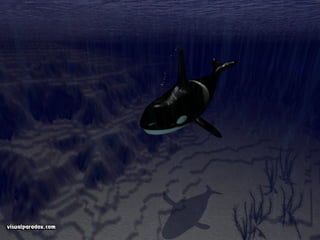
General Description Largest member of the dolphin family Mostly black with striking white patches above the eye, and below the lower jaw to the belly Transient  and  resident  whales have slightly different dorsal fins and saddle patches Average life expectancy :  M : 30 yrs,  F : 50 yrs Resident populations cover area of hundreds of square kms Transient populations often move through an area rapidly
 
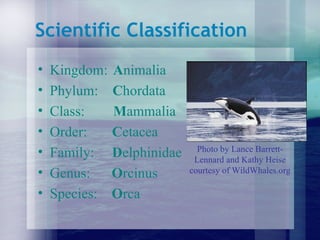
Scientific Classification Kingdom:  A nimalia Phylum:  C hordata Class:  M ammalia Order:  C etacea Family:  D elphinidae Genus:  O rcinus Species:  O rca Photo by Lance Barrett-Lennard and Kathy Heise courtesy of WildWhales.org
Habitat Travel in pods (groups) of 2-50, or can be solitary Found in all oceans Not limited by Habitat considerations (depth, temperature, salinity) Prefer coastal to temperate waters; prominent away from the tropics Can be found deep in the ocean, or near shore
Feeding Habits Most feed on fish, squid, marine birds, seals, porpoises, and other cetaceans Generally cooperate during hunting Have specialized feeding habits Each jaw contains 11 sharp conical teeth ideal for tearing prey Top carnivores in the marine food pyramid
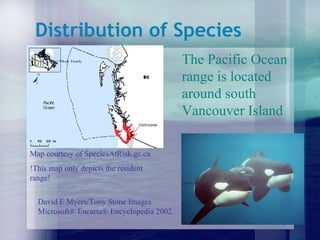
Distribution of Species The Pacific Ocean range is located around south Vancouver Island David E Myers/Tony Stone Images Killer Whale Family David E Myers/Tony Stone Images Microsoft® Encarta® Encyclopedia 2002.  Map courtesy of SpeciesAtRisk.gc.ca !This map only depicts the resident range!
Video courtesy of Johnny & Carmela Hinds; HQTV <http://www.aboututila.com/Entertainment/HQTV/Index.htm>
Threat Factors Prey reduced due to human fishing activity (whaling, culling, live capture Low potential rate growth Increase in toxic chemicals in habitat (polychlorinated biphenyls (PCBs) ) which harm and pollute immune systems Accidents with vessels more inevitable Exposure to oil spills
Recovery In Canada: Fisheries and Oceans Canada  Protected in Canada under the “Species at Risk Act” Killer Whale Recovery Team Appendix II of the Convention on International Trade in Endangered Species of Wild Fauna and Flora Plans approved, but no action plans yet taken
Did You Know? Known to prey on the blue whale Natal pods have been known to stay stable for life Orcas seek mates outside of their original pods to prevent inbreeding Important in Native American mythology Implied to be in competition with human fishing activity Are very easily trained to perform or act as show animals Use  echolocation  to perceive surroundings
Bibliography Barfield, A.W.F.  The Mammals of Canada . Toronto: University of Toronto Press, 1974 s.v. ‘Orcinus Orca’ Wursig, Bernd G. Encarta Encyclopaedia. 2002 edition. s.v. ‘Killer Whales’ Unknown. “Killer Whales”.  Wild Whales.  02.09.06.< http://www. wildwhales . org / killerwhale / history .html > Unknown. “Orca-Killer Whale”.  Marine Mammal Center.  02.09.06.<http://www.marinemammalcenter.org/learning/education/whales/orca.asp Unknown. “Killer Whale”.  Species At Risk.  02.09.06. <http://www.speciesatrisk.gc.ca/search/speciesDetails_e.cfm?SpeciesID=699> Thank you to Office.Microsoft.Com for the Design Template

Killer Whales

  • 1.
    Killer Whales (Orcinus Orca ) By: Ramsha Almas
  • 2.
    General Description Largestmember of the dolphin family Mostly black with striking white patches above the eye, and below the lower jaw to the belly Transient and resident whales have slightly different dorsal fins and saddle patches Average life expectancy : M : 30 yrs, F : 50 yrs Resident populations cover area of hundreds of square kms Transient populations often move through an area rapidly
  • 3.
  • 4.
    Scientific Classification Kingdom: A nimalia Phylum: C hordata Class: M ammalia Order: C etacea Family: D elphinidae Genus: O rcinus Species: O rca Photo by Lance Barrett-Lennard and Kathy Heise courtesy of WildWhales.org
  • 5.
    Habitat Travel inpods (groups) of 2-50, or can be solitary Found in all oceans Not limited by Habitat considerations (depth, temperature, salinity) Prefer coastal to temperate waters; prominent away from the tropics Can be found deep in the ocean, or near shore
  • 6.
    Feeding Habits Mostfeed on fish, squid, marine birds, seals, porpoises, and other cetaceans Generally cooperate during hunting Have specialized feeding habits Each jaw contains 11 sharp conical teeth ideal for tearing prey Top carnivores in the marine food pyramid
  • 7.
    Distribution of SpeciesThe Pacific Ocean range is located around south Vancouver Island David E Myers/Tony Stone Images Killer Whale Family David E Myers/Tony Stone Images Microsoft® Encarta® Encyclopedia 2002. Map courtesy of SpeciesAtRisk.gc.ca !This map only depicts the resident range!
  • 8.
    Video courtesy ofJohnny & Carmela Hinds; HQTV <http://www.aboututila.com/Entertainment/HQTV/Index.htm>
  • 9.
    Threat Factors Preyreduced due to human fishing activity (whaling, culling, live capture Low potential rate growth Increase in toxic chemicals in habitat (polychlorinated biphenyls (PCBs) ) which harm and pollute immune systems Accidents with vessels more inevitable Exposure to oil spills
  • 10.
    Recovery In Canada:Fisheries and Oceans Canada Protected in Canada under the “Species at Risk Act” Killer Whale Recovery Team Appendix II of the Convention on International Trade in Endangered Species of Wild Fauna and Flora Plans approved, but no action plans yet taken
  • 11.
    Did You Know?Known to prey on the blue whale Natal pods have been known to stay stable for life Orcas seek mates outside of their original pods to prevent inbreeding Important in Native American mythology Implied to be in competition with human fishing activity Are very easily trained to perform or act as show animals Use echolocation to perceive surroundings
  • 12.
    Bibliography Barfield, A.W.F. The Mammals of Canada . Toronto: University of Toronto Press, 1974 s.v. ‘Orcinus Orca’ Wursig, Bernd G. Encarta Encyclopaedia. 2002 edition. s.v. ‘Killer Whales’ Unknown. “Killer Whales”. Wild Whales. 02.09.06.< http://www. wildwhales . org / killerwhale / history .html > Unknown. “Orca-Killer Whale”. Marine Mammal Center. 02.09.06.<http://www.marinemammalcenter.org/learning/education/whales/orca.asp Unknown. “Killer Whale”. Species At Risk. 02.09.06. <http://www.speciesatrisk.gc.ca/search/speciesDetails_e.cfm?SpeciesID=699> Thank you to Office.Microsoft.Com for the Design Template