TOPIC: GAME BIRDS
Presented by
Mr ibrahim
•To
• Sir waqas ahmad
shams
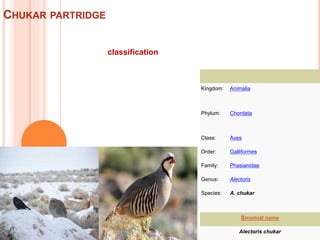
CHUKAR PARTRIDGE
classification
Kingdom: Animalia
Phylum: Chordata
Class: Aves
Order: Galliformes
Family: Phasianidae
Genus: Alectoris
Species: A. chukar
Binomial name
Alectoris chukar
DISTRIBUTION
 This partridge has its native range in Asia, including
Israel, Lebanon, Turkey, Iran, Afghanistan, Pakistan
and India, along the inner ranges of the Western
Himalayas to Nepal.
 Also found in united state ans south africa.
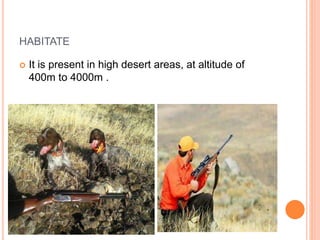
HABITATE
 It is present in high desert areas, at altitude of
400m to 4000m .
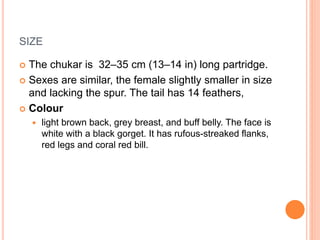
SIZE
 The chukar is 32–35 cm (13–14 in) long partridge.
 Sexes are similar, the female slightly smaller in size
and lacking the spur. The tail has 14 feathers,
 Colour
 light brown back, grey breast, and buff belly. The face is
white with a black gorget. It has rufous-streaked flanks,
red legs and coral red bill.
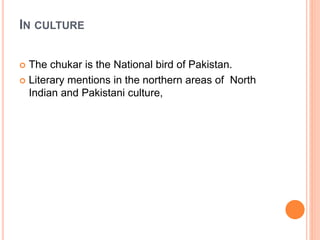
IN CULTURE
 The chukar is the National bird of Pakistan.
 Literary mentions in the northern areas of North
Indian and Pakistani culture,
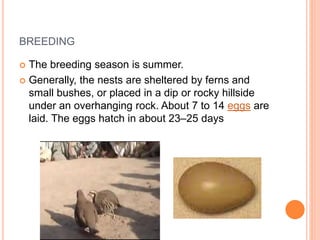
BREEDING
 The breeding season is summer.
 Generally, the nests are sheltered by ferns and
small bushes, or placed in a dip or rocky hillside
under an overhanging rock. About 7 to 14 eggs are
laid. The eggs hatch in about 23–25 days
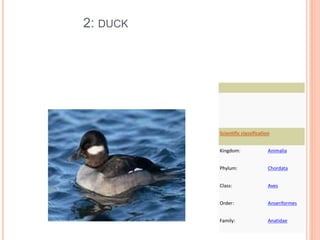
2: DUCK
Scientific classification
Kingdom: Animalia
Phylum: Chordata
Class: Aves
Order: Anseriformes
Family: Anatidae
INTRODUCTION
 Duck is the common name for a large number of species in
the Anatidae family of birds, which also
includes swans and geese. The ducks are divided among
several subfamilies in the Anatidae family; they do not
represent a monophyletic group (the group of all
descendants of a single common ancestral species) but
a form taxon, since swans and geese are not considered
ducks. Ducks are mostly aquatic birds, mostly smaller than
the swans and geese, and may be found in both fresh water
and sea water
ETYMOLOGY
 The word duck comes from Old
English *dūce "diver", a derivative of the verb
*dūcan "to duck, bend down low as if to get under
something, or dive", because of the way many
species in the dabbling duck group feed by
upending; compare
with Dutch duiken and German tauchen "to dive".
 This word replaced Old
English ened/ænid "duck
MORPHOLOGY
 The overall body plan of ducks is elongated and broad, and
the ducks are also relatively long-necked, albeit not as
long-necked as the geese and swans. The body shape of
diving ducks varies somewhat from this in being more
rounded.
 The scaled legs are strong and well developed
 The wings are very strong and are generally short and
pointed, and the flight of ducks requires fast continuous
strokes, requiring in turn strong wing muscles. Three
species of steamer duck are almost flightless, however.
Many species of duck are temporarily flightless
FEEDING
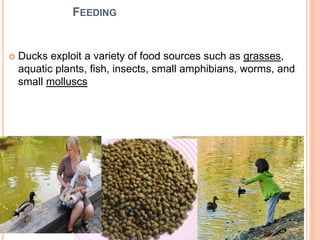
 Ducks exploit a variety of food sources such as grasses,
aquatic plants, fish, insects, small amphibians, worms, and
small molluscs
DISTRIBUTION
 The ducks have a cosmopolita
distribution occurring across most of the world
except for Antarctica.
 Habitate
 They are found in the lakes, rivers ,,oceanic water and
moist places
BREEDING
 Most duck species breed once a year, choosing to do so in
favourable conditions (spring/summer or wet seasons).
 Ducks also tend to make a nest before breeding, and after
hatching to lead their ducklings to water. Mother ducks are
very caring and protective of their young,
 But may abandon some of their ducklings if they are
physically stuck in an area they cannot get out of (including
nesting in an enclosed courtyard) or are not prospering due
to genetic defects or sickness brought about by hypothermia,
starvation, or disease.
 Ducklings can also be orphaned by inconsistent late hatching
where a few eggs hatch after the mother has abandoned the
nest and led her ducklings to water.
Ibrahim

Ibrahim

  • 1.
    TOPIC: GAME BIRDS Presentedby Mr ibrahim •To • Sir waqas ahmad shams
  • 2.
    CHUKAR PARTRIDGE classification Kingdom: Animalia Phylum:Chordata Class: Aves Order: Galliformes Family: Phasianidae Genus: Alectoris Species: A. chukar Binomial name Alectoris chukar
  • 3.
    DISTRIBUTION  This partridgehas its native range in Asia, including Israel, Lebanon, Turkey, Iran, Afghanistan, Pakistan and India, along the inner ranges of the Western Himalayas to Nepal.  Also found in united state ans south africa.
  • 4.
    HABITATE  It ispresent in high desert areas, at altitude of 400m to 4000m .
  • 5.
    SIZE  The chukaris 32–35 cm (13–14 in) long partridge.  Sexes are similar, the female slightly smaller in size and lacking the spur. The tail has 14 feathers,  Colour  light brown back, grey breast, and buff belly. The face is white with a black gorget. It has rufous-streaked flanks, red legs and coral red bill.
  • 6.
    IN CULTURE  Thechukar is the National bird of Pakistan.  Literary mentions in the northern areas of North Indian and Pakistani culture,
  • 7.
    BREEDING  The breedingseason is summer.  Generally, the nests are sheltered by ferns and small bushes, or placed in a dip or rocky hillside under an overhanging rock. About 7 to 14 eggs are laid. The eggs hatch in about 23–25 days
  • 8.
    2: DUCK Scientific classification Kingdom:Animalia Phylum: Chordata Class: Aves Order: Anseriformes Family: Anatidae
  • 9.
    INTRODUCTION  Duck isthe common name for a large number of species in the Anatidae family of birds, which also includes swans and geese. The ducks are divided among several subfamilies in the Anatidae family; they do not represent a monophyletic group (the group of all descendants of a single common ancestral species) but a form taxon, since swans and geese are not considered ducks. Ducks are mostly aquatic birds, mostly smaller than the swans and geese, and may be found in both fresh water and sea water
  • 10.
    ETYMOLOGY  The wordduck comes from Old English *dūce "diver", a derivative of the verb *dūcan "to duck, bend down low as if to get under something, or dive", because of the way many species in the dabbling duck group feed by upending; compare with Dutch duiken and German tauchen "to dive".  This word replaced Old English ened/ænid "duck
  • 11.
    MORPHOLOGY  The overallbody plan of ducks is elongated and broad, and the ducks are also relatively long-necked, albeit not as long-necked as the geese and swans. The body shape of diving ducks varies somewhat from this in being more rounded.  The scaled legs are strong and well developed  The wings are very strong and are generally short and pointed, and the flight of ducks requires fast continuous strokes, requiring in turn strong wing muscles. Three species of steamer duck are almost flightless, however. Many species of duck are temporarily flightless
  • 12.
    FEEDING  Ducks exploita variety of food sources such as grasses, aquatic plants, fish, insects, small amphibians, worms, and small molluscs
  • 13.
    DISTRIBUTION  The duckshave a cosmopolita distribution occurring across most of the world except for Antarctica.  Habitate  They are found in the lakes, rivers ,,oceanic water and moist places
  • 14.
    BREEDING  Most duckspecies breed once a year, choosing to do so in favourable conditions (spring/summer or wet seasons).  Ducks also tend to make a nest before breeding, and after hatching to lead their ducklings to water. Mother ducks are very caring and protective of their young,  But may abandon some of their ducklings if they are physically stuck in an area they cannot get out of (including nesting in an enclosed courtyard) or are not prospering due to genetic defects or sickness brought about by hypothermia, starvation, or disease.  Ducklings can also be orphaned by inconsistent late hatching where a few eggs hatch after the mother has abandoned the nest and led her ducklings to water.