Unit 1: Introduction
 Explain the nature of broadcast media
 Discuss the role of broadcast media
 Appreciate the planning and management of broadcast media
 Identify the techniques of financing for broadcast media
 Discuss the role of educationalT.V. particularly in the countries of
Pakistan, Singapore, China, Japan, UK andThailand
 State the role of educational radio in the countries like Pakistan,
Mexico, Japan and India
 Specify the production process forT.V. programmes
 Analyse the production process for radio programmesspecify the
evaluation techniques of broadcast media
 Discuss the role of personnel involved in broadcast media
 Analyse the problems involved in implementing broadcast media
1. Explain the nature of broadcast media
2. Identify the essential characteristics of broadcast media
3. Discuss the growth of educational radio andTV and
4. Analyse the potential role of broadcast media in distance
education
 The term broadcasting evolved from its use
as the agricultural method of sowing seeds in
a field by casting them broadly about.
 To communicate or transmit a signal,
a message, or content, such as audio or video
programming, to numerous recipients
simultaneously over a communication network
 Broadcast media describes all media that
is broadcast. That means that it is transmitted
as a signal and in 99% of cases this is referring
either to television or to radio.
 Broadcast media describes the traditional
forms of media that includes television and
radio. Technically, the term ‘broadcast media’
can include the internet as well and even such
things as Bluetooth, etc.
 Broadcast media mainly consists of
broadcasting through Radio and television.
 In our context, it is concerned with the use of
radio and television for the promotion of
distance education, supporting formal
education, implementing literacy projects
and facilitating health and or campaigns
related to agriculture
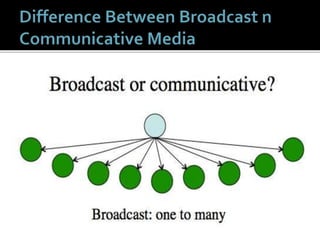
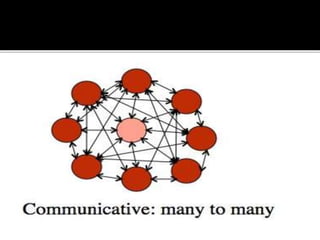
 It is different from Communicative Media as
in broadcast we transmit knowledge,
dispositions and skills from One to many
where as in Communicative media we
perform such functions from many to many.
 Broadcast media has the power to remove
disparity, enhance social status through
education as it tries to provide somewhat
equal opportunities and access to education.
 It takes the advantages of education to
maximum no of people in almost all parts of
a country.
 Where the facilities of formal education are
not available, or not utilized effectively and
efficiently, Distance education through
broadcast media is the solution.
 Entertainment
 News and information
 Advertisement
 Propaganda and
 Education
Here we focus on the use of broadcast media for
the dissemination and development of
Knowledge, skills and dispositions among students
, adults and masses.
Most countries have utilized or still utilizing BM.In
Pakistan the focus of broadcast media is to ensure/
support the following:
 (a) Universalization of elementary education
though both formal and non-formal modes.
 (b) Non-formal education for adults, linking
education to economic and social tasks.
 (c ) Development of vocational and professional
skills.
 (d)Training for citizenship.
 (e) Popularizing science with a view to develop a
scientific outlook.
 (f) Promoting national integration.
 (g) Providing information about themes of
national importance, population education,
energy conservation, preservation of wild life,
environmental sanitation, nutrition and health
 A major structural distinction is between
‘broadcast’ media that are primarily one-to-
many and one-way, and those media that are
primarily many-to-many or ‘communicative’,
allowing for two-way or multiple
communication connections. Communicative
media include those that give equal ‘power’
of communication between multiple end
users.
 Television and radio for example are primarily
broadcast or one-way media, as end users or
‘recipients’ cannot change the ‘message’
(although they may interpret it differently or
choose to ignore it). Note that it does not matter
really what delivery technology (terrestrial
broadcast, satellite, cable, DVD, Internet) is used
for television, it remains a ‘broadcast’ or one-
way medium. Some Internet technologies are
also primarily one way. For instance, an
institutional web site is primarily a one-way
technology.
 One advantage of broadcast media and
technologies is that they ensure a common
standard of learning materials for all students.
 This is particularly important in countries where
teachers are poorly qualified or of variable
quality.
 Also one-way broadcast media enable the
organization to control and manage the
information that is being transmitted,
ensuring quality control over content.
 Broadcasting media and technologies are
more likely to be favored by those with an
‘objectivist’ approach to teaching and
learning, since the ‘correct’ knowledge can be
transmitted to everyone receiving the
instruction. One disadvantage is that
additional resources are needed to provide
interaction with teachers or other learners.
 The telephone, video-conferencing, e-mail, online
discussion forums, most social media and the Internet
are examples of communicative media or
technologies, in that all users can communicate and
interact with each other, and in theory at least have
equal power in technology terms. The educational
significance of communicative media is that they
allow for interaction between learners and teachers,
and perhaps even more significantly, between a
learner and other learners, without the participants
needing to be present in the same place.
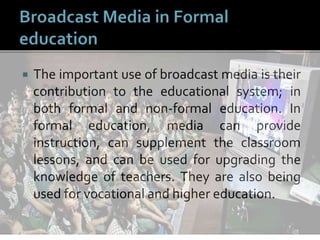
 The important use of broadcast media is their
contribution to the educational system; in
both formal and non-formal education. In
formal education, media can provide
instruction, can supplement the classroom
lessons, and can be used for upgrading the
knowledge of teachers. They are also being
used for vocational and higher education.
 In a non-formal context, the media can
provide fresh information and knowledge to
the rural communities where, in most cases,
no other sources of information is available.
They can help in literacy campaigns. By
motivating the general public, by
encouraging the individual learner, and by
providing the actual literacy instructions – the
most important in community development
efforts.
 It can be centrally or local community
controlled/operated
 It can be used to run a complete program or part
of a program
 It can be opened to all types of populations or
can be restricted to only specific students
 Broadcast media is an important source of
imparting distance education to thousands of
students/people
 It can address three domains of distance
educational objectives (Cognitive, Affective and
Psychomotor
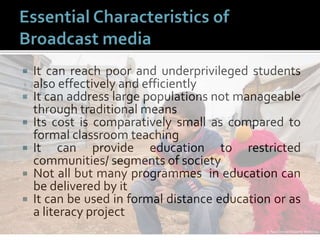
 It can reach poor and underprivileged students
also effectively and efficiently
 It can address large populations not manageable
through traditional means
 Its cost is comparatively small as compared to
formal classroom teaching
 It can provide education to restricted
communities/ segments of society
 Not all but many programmes in education can
be delivered by it
 It can be used in formal distance education or as
a literacy project
 https://www.youtube.com/watch?v=kdOgWo
LMVXM
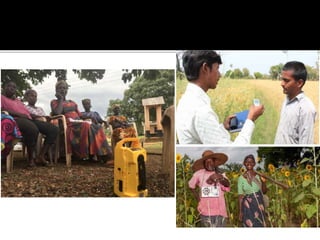
 The potential of Radio as a tool of social
development is being utilized throughout the
globe, be it developing or developed world. It
has a long history of penetration at grassroot
levels through community radio in the
western world.
 Radio is a mean not only for information and
entertainment but also for education. Radio
is being used for educational purposes all
over the world. In Pakistan it is also a medium
of communication. Pakistan broadcasting
corporation broadcasts educational programs
of Allama Iqbal Open University. There is no
denying the fact that educational
broadcasting in Pakistan is being run
successfully.
 In a study ,it was found that the majority of
the listeners possessed radio sets and was
getting benefit from the educational
programmes of radio.
 The programmes were informative and
motivating.
 The strategies of radio for rural education
were appreciable because these infused
mobility, widened horizon of rural people and
focused attention on the goals and problems
of rural people.
 Radio crime stories for Africa's youth
Join our detectives in their fight for truth and justice while gaining valuable
perspectives on critical issues. Cyber crime, domestic violence, environmental
pollution, human trafficking, terrorist recruitment, poaching, land grabbing and
counterfeit drugs – this is a series that gets to the heart of what challenges young
Africans. Continuing with Learning by Ear's tradition of successful educational
radio dramas, Crime Fighters provides knowledge and information in an
entertainment formate.
 Hasan and Khurshid (1994, p. 225) has depicted
Pakistani scene saying that, ―The bulk of
population of the country lives in rural areas
where facilities in the field of education are very
limited. Unlike the printed words and other
media of communication, radio enjoys the
unique advantages of reaching the far flung
areas and message can be easily understood by
everyone as it requires no prior standard of
education and knowledge‖
 The system of education suffers from many
problems. These include illiteracy; drop out,
short of female teachers in rural areas. Pakistan
Broadcasting Corporation covers 98%
geographical area of the country. And hence,
utilizing radio for accessibility and equity in
education
 Radio was seen as a source of information
through mass bulletins and radio talks especially
geared towards the rural masses‖.
 It is very successful in bringing change in the
attitudes, beliefs and traditional ways of the
thinking of the villagers and to remove
illiteracy, superstitions and misconceptions in
rural areas about things. Radio is very
commonly used both in urban as well as rural
areas.
 73% respondents said that the strategies for
rural education applied by radio were
suitable.
 73% admitted that radio programmes were
relevant to rural development.
 76% viewed that radio makes the rural people
realize the educational needs, problems and
responsibilities.
 71% radio listeners were of the view that
radio is a suitable mean for educating people.
The same percentage said that literacy can be
enhanced through distance and non- formal
education with the help of radio
 Educational Television in the world today
has made great advances worldwide in
creating innovative applications. There have
been many success stories of using television
for education in many countries
 Provides mass education opportunities.
 Stimulates learning
 Social quality in education
 Provides flexibility of time and space in
learning.
 Reduces dependency on verbal teaching and
teachers
 Enhances quality in education
 Enhances interest and motivation
 Supporting and enhancing teaching
 Using as supplementary for the other
materials.
 Reaches unreachable large audience
 Presenting unreachable facts and events
 Information transferred through television is different
from traditional education methods with respect to the
audio-visual presentation. Explanations related to the
subject and examples can be presented visually, so the
learner gets motivated, his/her desire for learning
increases, and therefore learning and remembering
become easier. Allowing thousands of people spreaded a
large and distance geographic regions to receive the same
program at the synchronous time, television broadcast
helps overcome the problem of inequality and imbalance
among the regions by providing equality in opportunities.
 Some of the disadvantages of television is that it
does not provide instant feedback. It’s too hard
to capture the viewers’ reactions about the
program. For this reason, the producer does not
have a chance to control if the program is not
watched by the viewer. Moreover, broadcast
television isn’t interactive. So that participating
of the viewers are getting low. Producer should
never forget these important disadvantages
when producing an educational television
program.
 Broadcast media can provide distance
education to the people of remote and far
flung areas which may not have the required
internet speed
 Broadcast Media is an effective source of
imparting knowledge, skills and dispositions
in students through distance education
 Through distance education it can lessen the
burden on formal education
 It can educate the target audience through non-
Formal programs of distance education
 It can accelerate the speed of educating the
masses through literacy projects
 Its general programs(Plays , stories and Dramas)
can be a good source of informal education as
they can inculcate moral and social values in
people
 Broadcast media through Distance Education
has the potential to support the community
projects of health, agriculture and
environmental education
 The success stories regarding the use of radio and television in
distance education to achieve desired targets are available to seek
guidance to implement such projects in Pakistan. Health and
education campaigns inTanzania.The farm forum in India and
Radio schools of Latin America are some of the examples
 For best results of use of Broadcast media in distance education, it
should be Partially centrally controlled and mainly flexible to be
local community operated
 Costing of the broadcast projects should be minimized to make it
more feasible to implementers and accessible to more people
 Its cost should not be measured directly by calculating no of
people it trained or educated or made literate rather indirect
positive effects and long term impact of such projects may also be
explored and considered
 While evaluating a distance education project,such
considerations should also be kept in mind while A
distinction may be made between Mass education
campaigns for producing literacy and courses offered by
Open university to produced trained manpower to meet
the needs of the Community and country as well.
 Single medium radio or television requires less planning
and organized efforts and management as compared to
multi-media, yet in distance education latter should be
used to have best results
 Distance education supported by broadcast media cannot
bring revolutionary change in people if the taught content
or courses do not have any application in their daily or
occupational lives
 Define broadcast media in your own words.
 What do you know about the nature of broadcast media?
 Explain the characteristics of broadcast media
 How can we utilize radio for the promotion of distance
education in our country?
 Explain the role of television in making effective distance
education.
 What have you understood regarding the potential role of
BM in distance education?
 In the context of latest and sophisticated communication
technologies, how we can utilize BM maximally to ensure
quality access to education to every potential student in
each corner of our country.

Broadcast media-Unit 1-introduction

  • 1.
  • 2.
     Explain thenature of broadcast media  Discuss the role of broadcast media  Appreciate the planning and management of broadcast media  Identify the techniques of financing for broadcast media  Discuss the role of educationalT.V. particularly in the countries of Pakistan, Singapore, China, Japan, UK andThailand  State the role of educational radio in the countries like Pakistan, Mexico, Japan and India  Specify the production process forT.V. programmes  Analyse the production process for radio programmesspecify the evaluation techniques of broadcast media  Discuss the role of personnel involved in broadcast media  Analyse the problems involved in implementing broadcast media
  • 3.
    1. Explain thenature of broadcast media 2. Identify the essential characteristics of broadcast media 3. Discuss the growth of educational radio andTV and 4. Analyse the potential role of broadcast media in distance education
  • 4.
     The termbroadcasting evolved from its use as the agricultural method of sowing seeds in a field by casting them broadly about.  To communicate or transmit a signal, a message, or content, such as audio or video programming, to numerous recipients simultaneously over a communication network
  • 5.
     Broadcast mediadescribes all media that is broadcast. That means that it is transmitted as a signal and in 99% of cases this is referring either to television or to radio.  Broadcast media describes the traditional forms of media that includes television and radio. Technically, the term ‘broadcast media’ can include the internet as well and even such things as Bluetooth, etc.
  • 6.
     Broadcast mediamainly consists of broadcasting through Radio and television.  In our context, it is concerned with the use of radio and television for the promotion of distance education, supporting formal education, implementing literacy projects and facilitating health and or campaigns related to agriculture
  • 7.
     It isdifferent from Communicative Media as in broadcast we transmit knowledge, dispositions and skills from One to many where as in Communicative media we perform such functions from many to many.  Broadcast media has the power to remove disparity, enhance social status through education as it tries to provide somewhat equal opportunities and access to education.
  • 8.
     It takesthe advantages of education to maximum no of people in almost all parts of a country.  Where the facilities of formal education are not available, or not utilized effectively and efficiently, Distance education through broadcast media is the solution.
  • 9.
     Entertainment  Newsand information  Advertisement  Propaganda and  Education
  • 10.
    Here we focuson the use of broadcast media for the dissemination and development of Knowledge, skills and dispositions among students , adults and masses. Most countries have utilized or still utilizing BM.In Pakistan the focus of broadcast media is to ensure/ support the following:  (a) Universalization of elementary education though both formal and non-formal modes.  (b) Non-formal education for adults, linking education to economic and social tasks.
  • 11.
     (c )Development of vocational and professional skills.  (d)Training for citizenship.  (e) Popularizing science with a view to develop a scientific outlook.  (f) Promoting national integration.  (g) Providing information about themes of national importance, population education, energy conservation, preservation of wild life, environmental sanitation, nutrition and health
  • 14.
     A majorstructural distinction is between ‘broadcast’ media that are primarily one-to- many and one-way, and those media that are primarily many-to-many or ‘communicative’, allowing for two-way or multiple communication connections. Communicative media include those that give equal ‘power’ of communication between multiple end users.
  • 15.
     Television andradio for example are primarily broadcast or one-way media, as end users or ‘recipients’ cannot change the ‘message’ (although they may interpret it differently or choose to ignore it). Note that it does not matter really what delivery technology (terrestrial broadcast, satellite, cable, DVD, Internet) is used for television, it remains a ‘broadcast’ or one- way medium. Some Internet technologies are also primarily one way. For instance, an institutional web site is primarily a one-way technology.
  • 16.
     One advantageof broadcast media and technologies is that they ensure a common standard of learning materials for all students.  This is particularly important in countries where teachers are poorly qualified or of variable quality.  Also one-way broadcast media enable the organization to control and manage the information that is being transmitted, ensuring quality control over content.
  • 17.
     Broadcasting mediaand technologies are more likely to be favored by those with an ‘objectivist’ approach to teaching and learning, since the ‘correct’ knowledge can be transmitted to everyone receiving the instruction. One disadvantage is that additional resources are needed to provide interaction with teachers or other learners.
  • 18.
     The telephone,video-conferencing, e-mail, online discussion forums, most social media and the Internet are examples of communicative media or technologies, in that all users can communicate and interact with each other, and in theory at least have equal power in technology terms. The educational significance of communicative media is that they allow for interaction between learners and teachers, and perhaps even more significantly, between a learner and other learners, without the participants needing to be present in the same place.
  • 19.
     The importantuse of broadcast media is their contribution to the educational system; in both formal and non-formal education. In formal education, media can provide instruction, can supplement the classroom lessons, and can be used for upgrading the knowledge of teachers. They are also being used for vocational and higher education.
  • 20.
     In anon-formal context, the media can provide fresh information and knowledge to the rural communities where, in most cases, no other sources of information is available. They can help in literacy campaigns. By motivating the general public, by encouraging the individual learner, and by providing the actual literacy instructions – the most important in community development efforts.
  • 22.
     It canbe centrally or local community controlled/operated  It can be used to run a complete program or part of a program  It can be opened to all types of populations or can be restricted to only specific students  Broadcast media is an important source of imparting distance education to thousands of students/people  It can address three domains of distance educational objectives (Cognitive, Affective and Psychomotor
  • 23.
     It canreach poor and underprivileged students also effectively and efficiently  It can address large populations not manageable through traditional means  Its cost is comparatively small as compared to formal classroom teaching  It can provide education to restricted communities/ segments of society  Not all but many programmes in education can be delivered by it  It can be used in formal distance education or as a literacy project
  • 24.
  • 25.
     The potentialof Radio as a tool of social development is being utilized throughout the globe, be it developing or developed world. It has a long history of penetration at grassroot levels through community radio in the western world.
  • 26.
     Radio isa mean not only for information and entertainment but also for education. Radio is being used for educational purposes all over the world. In Pakistan it is also a medium of communication. Pakistan broadcasting corporation broadcasts educational programs of Allama Iqbal Open University. There is no denying the fact that educational broadcasting in Pakistan is being run successfully.
  • 27.
     In astudy ,it was found that the majority of the listeners possessed radio sets and was getting benefit from the educational programmes of radio.
  • 28.
     The programmeswere informative and motivating.  The strategies of radio for rural education were appreciable because these infused mobility, widened horizon of rural people and focused attention on the goals and problems of rural people.
  • 29.
     Radio crimestories for Africa's youth Join our detectives in their fight for truth and justice while gaining valuable perspectives on critical issues. Cyber crime, domestic violence, environmental pollution, human trafficking, terrorist recruitment, poaching, land grabbing and counterfeit drugs – this is a series that gets to the heart of what challenges young Africans. Continuing with Learning by Ear's tradition of successful educational radio dramas, Crime Fighters provides knowledge and information in an entertainment formate.
  • 30.
     Hasan andKhurshid (1994, p. 225) has depicted Pakistani scene saying that, ―The bulk of population of the country lives in rural areas where facilities in the field of education are very limited. Unlike the printed words and other media of communication, radio enjoys the unique advantages of reaching the far flung areas and message can be easily understood by everyone as it requires no prior standard of education and knowledge‖
  • 31.
     The systemof education suffers from many problems. These include illiteracy; drop out, short of female teachers in rural areas. Pakistan Broadcasting Corporation covers 98% geographical area of the country. And hence, utilizing radio for accessibility and equity in education  Radio was seen as a source of information through mass bulletins and radio talks especially geared towards the rural masses‖.
  • 32.
     It isvery successful in bringing change in the attitudes, beliefs and traditional ways of the thinking of the villagers and to remove illiteracy, superstitions and misconceptions in rural areas about things. Radio is very commonly used both in urban as well as rural areas.
  • 33.
     73% respondentssaid that the strategies for rural education applied by radio were suitable.  73% admitted that radio programmes were relevant to rural development.  76% viewed that radio makes the rural people realize the educational needs, problems and responsibilities.
  • 34.
     71% radiolisteners were of the view that radio is a suitable mean for educating people. The same percentage said that literacy can be enhanced through distance and non- formal education with the help of radio
  • 35.
     Educational Televisionin the world today has made great advances worldwide in creating innovative applications. There have been many success stories of using television for education in many countries
  • 36.
     Provides masseducation opportunities.  Stimulates learning  Social quality in education  Provides flexibility of time and space in learning.  Reduces dependency on verbal teaching and teachers
  • 37.
     Enhances qualityin education  Enhances interest and motivation  Supporting and enhancing teaching  Using as supplementary for the other materials.  Reaches unreachable large audience  Presenting unreachable facts and events
  • 38.
     Information transferredthrough television is different from traditional education methods with respect to the audio-visual presentation. Explanations related to the subject and examples can be presented visually, so the learner gets motivated, his/her desire for learning increases, and therefore learning and remembering become easier. Allowing thousands of people spreaded a large and distance geographic regions to receive the same program at the synchronous time, television broadcast helps overcome the problem of inequality and imbalance among the regions by providing equality in opportunities.
  • 39.
     Some ofthe disadvantages of television is that it does not provide instant feedback. It’s too hard to capture the viewers’ reactions about the program. For this reason, the producer does not have a chance to control if the program is not watched by the viewer. Moreover, broadcast television isn’t interactive. So that participating of the viewers are getting low. Producer should never forget these important disadvantages when producing an educational television program.
  • 40.
     Broadcast mediacan provide distance education to the people of remote and far flung areas which may not have the required internet speed  Broadcast Media is an effective source of imparting knowledge, skills and dispositions in students through distance education  Through distance education it can lessen the burden on formal education
  • 41.
     It caneducate the target audience through non- Formal programs of distance education  It can accelerate the speed of educating the masses through literacy projects  Its general programs(Plays , stories and Dramas) can be a good source of informal education as they can inculcate moral and social values in people  Broadcast media through Distance Education has the potential to support the community projects of health, agriculture and environmental education
  • 42.
     The successstories regarding the use of radio and television in distance education to achieve desired targets are available to seek guidance to implement such projects in Pakistan. Health and education campaigns inTanzania.The farm forum in India and Radio schools of Latin America are some of the examples  For best results of use of Broadcast media in distance education, it should be Partially centrally controlled and mainly flexible to be local community operated  Costing of the broadcast projects should be minimized to make it more feasible to implementers and accessible to more people  Its cost should not be measured directly by calculating no of people it trained or educated or made literate rather indirect positive effects and long term impact of such projects may also be explored and considered
  • 43.
     While evaluatinga distance education project,such considerations should also be kept in mind while A distinction may be made between Mass education campaigns for producing literacy and courses offered by Open university to produced trained manpower to meet the needs of the Community and country as well.  Single medium radio or television requires less planning and organized efforts and management as compared to multi-media, yet in distance education latter should be used to have best results  Distance education supported by broadcast media cannot bring revolutionary change in people if the taught content or courses do not have any application in their daily or occupational lives
  • 44.
     Define broadcastmedia in your own words.  What do you know about the nature of broadcast media?  Explain the characteristics of broadcast media  How can we utilize radio for the promotion of distance education in our country?  Explain the role of television in making effective distance education.  What have you understood regarding the potential role of BM in distance education?  In the context of latest and sophisticated communication technologies, how we can utilize BM maximally to ensure quality access to education to every potential student in each corner of our country.