Learning and Memory in Everyday Life How Does Learning Work, and What Can You  Do To Become a Better Learner?
What is Learning? A  relatively permanent  change in your skills and knowledge as a function of your  experiences Being  relatively permanent  implies that it can change and that as long as you use the learning it will be available Psychologists know that learning has occurred because of a  change  in behavior Change  means that something new has been added to your repertoire of thoughts and actions Being a  function of experiences  means that whatever you learn is based on events you encounter daily
Factors Affecting the Acquisition of Information The First Factor: Time on Task Whenever you want to learn something, the more time you spend at it the more effective will be the learning The quality of the time is more important than the  actual time spent Concentrate on what’s going on, participate in  discussions, summarize and paraphrase ideas  for yourself, and ask questions Asking questions is important Overcome the belief that your questions are  silly or dumb or that by asking a question  you’re stupid Time on task is important for learning skills that are needed  to do a job well
The Second Factor: The Role of Practice Active Practice Enhances Learning Learning is an  active  process Being  actively  involved in your learning experience enhances learning and retention Time on task needs the following characteristics: Appropriate levels of interest and motivation to learn Attention is focused on the task A goal for what must be learned is established and pursued Questions are asked when something isn’t understood Feedback is sought in order to learn from mistakes Attempts are made to integrate and establish connections among  various ideas or components of the skill Rote repetition is discouraged Critical thinking processes such as analysis, synthesizing, and evaluating information are emphasized Whenever appropriate, ideas about and experiences with the  information are written down and/or discussed with others
More on Practice Distribute Your Practice over Time Massed Practice ( cramming ) doesn’t produce retention Consequently, learning doesn’t occur Inefficient and ineffective way to learn Massed Practice taxes your ability to remember information,  lowers your energy levels, produces fatigue, and enhances test  anxiety Distributed Practice, taking small chunks over time produces greater retention Twice the information is recalled through Distributed Practice On difficult and verbal learning, Distributed Practice enhances  learning Distributed Practice is most noticeable when information must  be recalled rather than recognized
The Third Factor: The Role of Feedback The Purpose of Feedback is to Reduce the Number of Errors that can be Produced Knowledge of Results enhances what is to be learned External Sources: Feedback from teachers, super- visors, tests Internal Sources: Perceptions of progress on task, cues  from body movements and thinking processes Feedback is most effective when it is immediate Feedback must be detailed, specific, and constructive It is important that detailed information be given  about what was wrong as well as specific suggestions  for how to improve: Constructive Feedback
The Fourth Factor: The Role of Positive Reinforcement Positive Reinforcers are Pleasant Stimuli that Occur after a Response and Increase the Likelihood of that Response Recurring Rewards Increase the Frequency of Desirable Behaviors They improve performance in sports, on the job, and in school; lead to  better health habits, communications in relationships, and in  communications skills themselves Positive Reinforcers Can Help Reduce the Frequency of Bad Habits Rewarding the behaviors that you do want will increase those  behaviors Positive Reinforcers Work Best When Given Immediately After a Response An association is made between the behavior and the reward Delay in reward may reinforce the wrong behavior Some of the Most Powerful Reinforces are Secondary Reinforcers
The Fifth Factor: Reinforcement Schedules Two Basic Reinforcement Schedules Continuous Reinforcement Reinforcing every correct response Partial Reinforcement Reinforcing only a certain number of correct responses or after  a given time schedule Partial Reinforcement Schedules Help Maintain Behaviors Over Time All reinforcement schedules have “gaps” produced by time or by the  number of responses that were not reinforced These “gaps” provide opportunities for other internal or external  rewards to become associated with the actions and can gain control  over them Partial Reinforcement Schedules Allow Behaviors Leading to Distant Rewards to be Maintained Long-term pay-offs after short-term losses
The Partial Reinforcement Schedules Fixed Ratio The reinforcer is given after a certain number of correct responses has occurred Variable Ratio A reinforcer is given after a varied number of correct responses has occurred Fixed Interval A reinforcer is given after a fixed time period has passed after the correct response Variable Ratio A reinforcer is given after a varied time period has passed after the correct response
The Sixth Factor: Extinction When Responses Are No Longer Followed by the Rewards That Control Them, Extinction Occurs The behaviors weaken and cease to occur It is not the same as forgetting; the incentive to perform is gone The reappearance of an extincted response is  spontaneous recovery Resistance to Extinction occurs due to: They were initially learned or maintained under partial reinforcement Your actions also come under the control of internal rewards (e.g.,  self-praise) or other external reinforcers in the environment When you give yourself praise for a job well-done, you tend to  be more comfortable about doing a good job the next time
The Seventh Factor: Negative Side Effects of Rewards Positive Reinforcers May Affect People and Events Beyond the Initial Target Behavior Reinforcing certain actions may produce unintended reprocussions People May Concentrate on Earning a Reward and Make Performing Desirable Behaviors Secondary Looking for “loopholes” becomes more important than learning The Effects of Positive Reinforcers May Not Generalize to Other Situations What is learned in one situation may not provide the motivation to continue the previously learned behavior External Reinforcers May Undermine Intrinsic Rewards Rewards given for something that is already enjoyable causes a loss of interest The Wrong Behaviors Can Be Inadvertently Reinforced Attention is a powerful secondary reinforcer, and it may come in many forms Rewards May Lose Their Attractiveness in the Long Run Too much of a good thing can cause a loss of motivation and interest .
The Eighth Factor: The Role of Negative Reinforcement Aversive Stimuli Whose Reduction or Termination Increases the Likelihood that an Ongoing Behavior Will Occur A Positive Reinforcer increases a response through  the administration of something desirable; Negative Reinforcers remove something undesirable in order to get or keep a response going When unpleasant stimuli occur people try to remove them by  escaping  or  avoiding  them Escaping or avoiding the situation can bring about drug abuse,  excessive daydreaming or fantasizing, or anxieties Many fears and phobias are avoidance responses
The Ninth Factor: The Role of Punishment The Use of an Aversive Stimulus to Eliminate or Decrease the Strength of a Response Punishment vs. Abuse vs. Discipline Punished behavior tends to occur less frequently, and this can be produced through: The inappropriate behavior leads to a natural and logical unpleasant  consequence There is an unpleasant stimulus given deliberately after a response Something pleasant is taken away after an inappropriate behavior Problems can occur through the use of punishment Frustration and anger can develop and a focus can be more on “getting  even” than learning anything new A fear response develops producing an avoidance response Many people can’t distinguish between punishment and abuse
More on Punishment Principles for Administering Punishment It must be applied immediately A connection needs to be made between the behavior and the  punishment The punishment should “fit” the infraction For something minor, the punishment must be minor It must be consistently applied Punishment must occur every time a problem behavior occurs  as well  as an explanation for the punishment It should be limited to specific responses Never use punishment indiscriminately or for anything  general such as making someone a “better person” It should be humanely and sensitively applied The physical and psychological well-being of the person needs to be  preserved
The Tenth Factor: The Role of Organization & Planning Without Organization and Planning, Practice, Feedback, and Reinforcement will do Little Good Effective time management aids learning Short-term planning and attitudes toward the use of time are the best  predictors of college grades, not academic ability Flexible monthly planning along with weekly and monthly rewards leads to better performance in school Time Management Practices for Success in School: Short-Range Planning   Attitudes Toward Time   Make a daily list     Don’t let others infringe on your time Plan each day   Work on school work on school days Schedule things to do   Always work on improving yourself Be clear on next week   Use your time constructively Set and keep priorities   Do assignments long before they’re due   Quit doing activities that are unconstructive
Remembering What You Learned  Memory is the ability to bring to conscious awareness the things you’ve experienced, imagined, and learned Memory is the result of learning Your ability to learn depends on your ability to remember previous  ideas Humanity’s unique ability to survive has depended on memory memory involves acquiring, encoding, storing, and retrieving information Two major theories of learning are the  memory system approach  and the  levels-of-processing approach
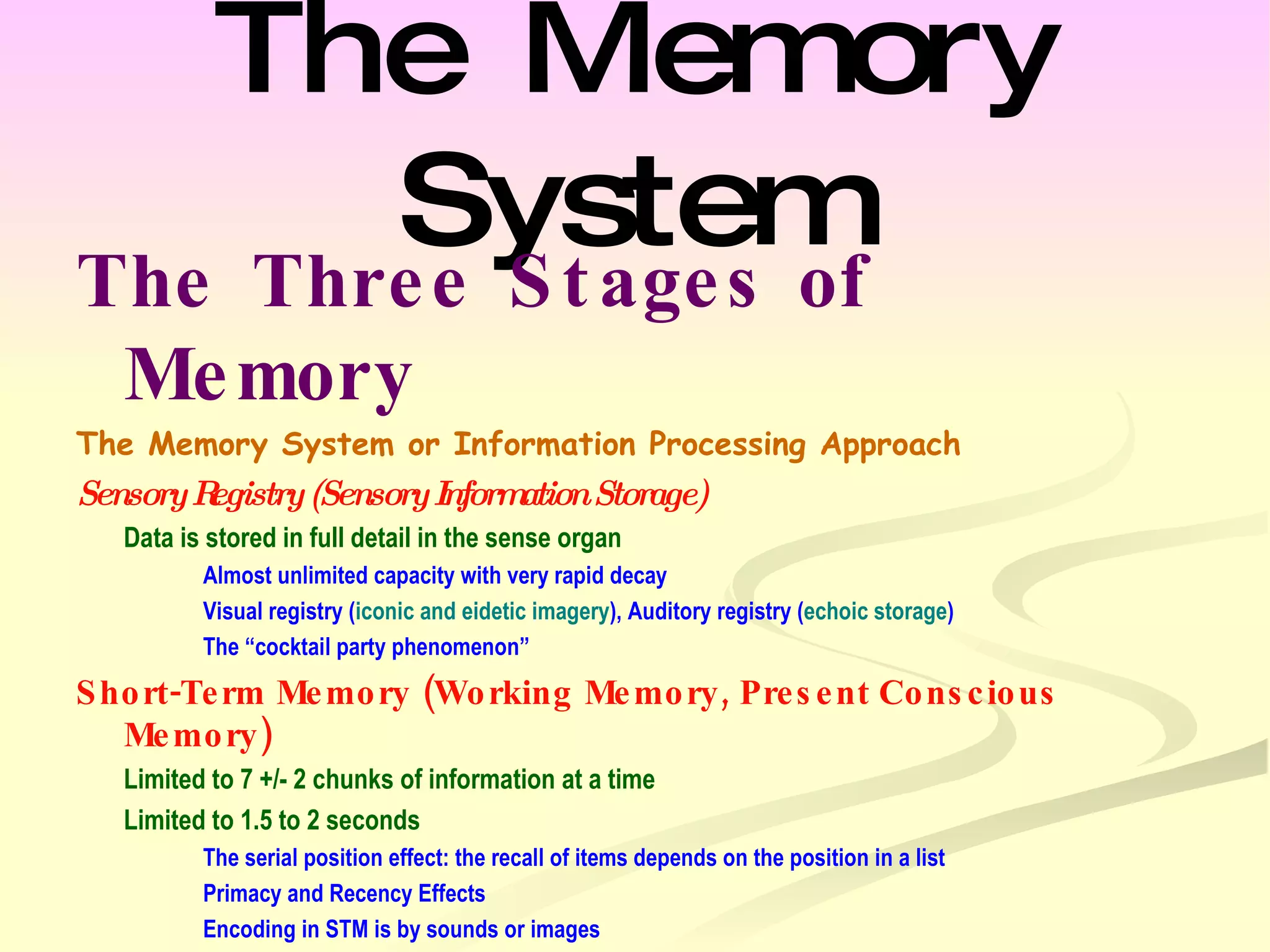
The Memory System The Three Stages of Memory  The Memory System or Information Processing Approach Sensory Registry (Sensory Information Storage) Data is stored in full detail in the sense organ Almost unlimited capacity with very rapid decay Visual registry ( iconic and eidetic imagery ), Auditory registry ( echoic storage ) The “cocktail party phenomenon” Short-Term Memory (Working Memory, Present Conscious Memory) Limited to 7 +/- 2 chunks of information at a time Limited to 1.5 to 2 seconds The serial position effect: the recall of items depends on the position in a list Primacy and Recency Effects Encoding in STM is by sounds or images Information is maintained in STM through Maintenance rehearsal ( Rote )
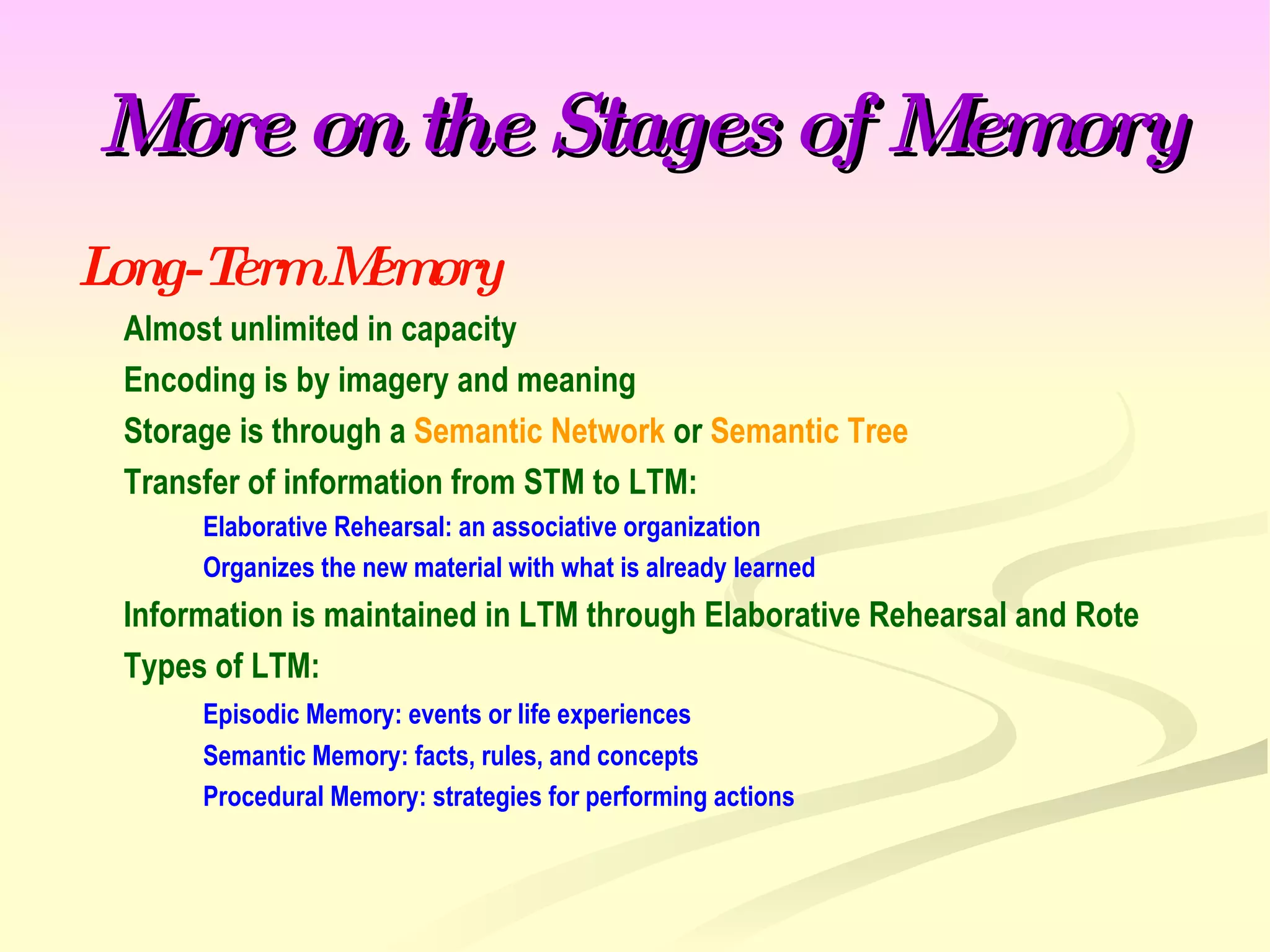
More on the Stages of Memory Long-Term Memory Almost unlimited in capacity Encoding is by imagery and meaning Storage is through a  Semantic Network  or  Semantic Tree Transfer of information from STM to LTM: Elaborative Rehearsal: an associative organization Organizes the new material with what is already learned Information is maintained in LTM through Elaborative Rehearsal and Rote Types of LTM: Episodic Memory: events or life experiences Semantic Memory: facts, rules, and concepts Procedural Memory: strategies for performing actions
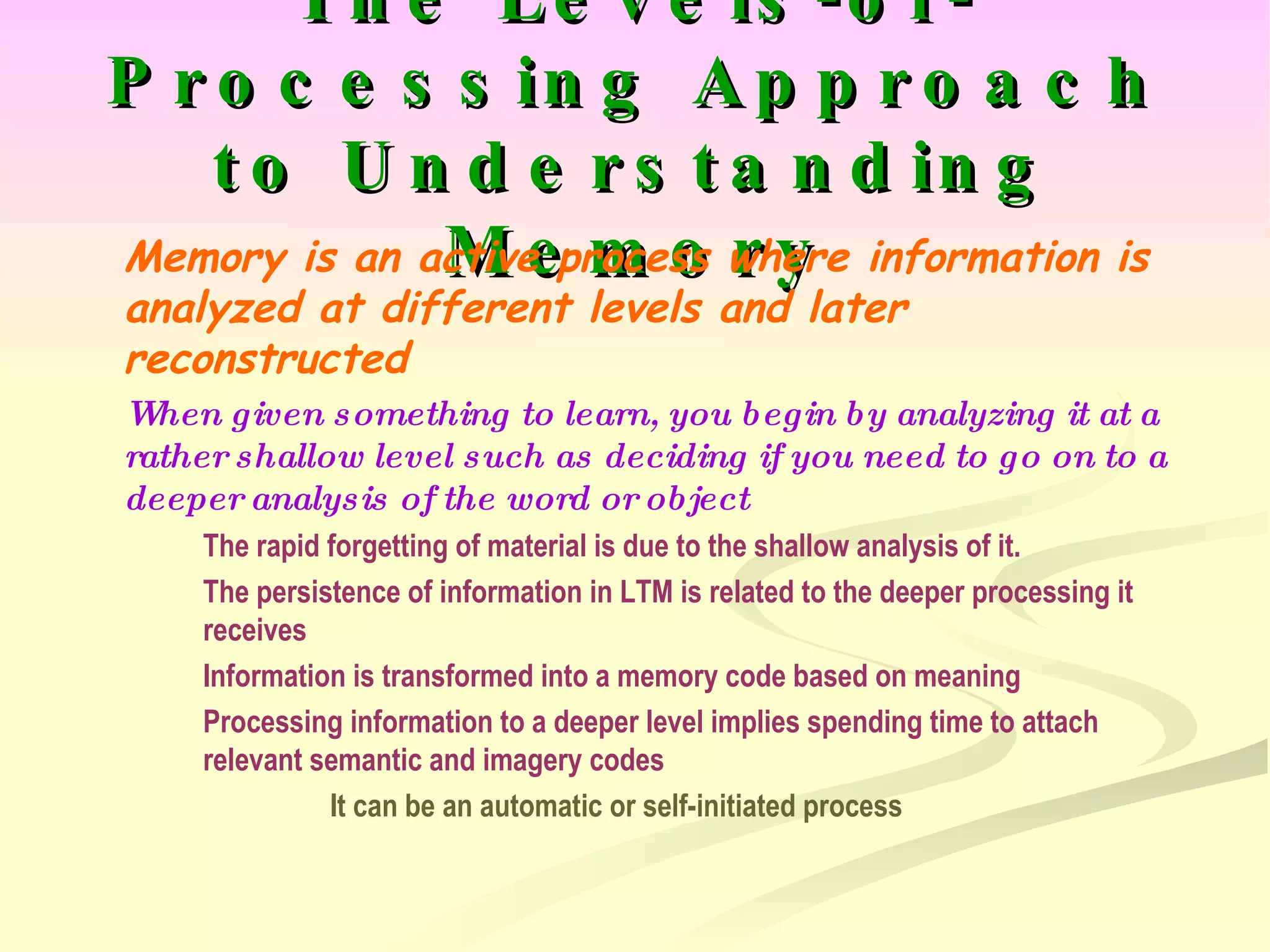
The Levels-of-Processing Approach to Understanding Memory Memory is an active process where information is analyzed at different levels and later reconstructed When given something to learn, you begin by analyzing it at a rather shallow level such as deciding if you need to go on to a deeper analysis of the word or object The rapid forgetting of material is due to the shallow analysis of it. The persistence of information in LTM is related to the deeper processing it  receives Information is transformed into a memory code based on meaning Processing information to a deeper level implies spending time to attach  relevant semantic and imagery codes It can be an automatic or self-initiated process
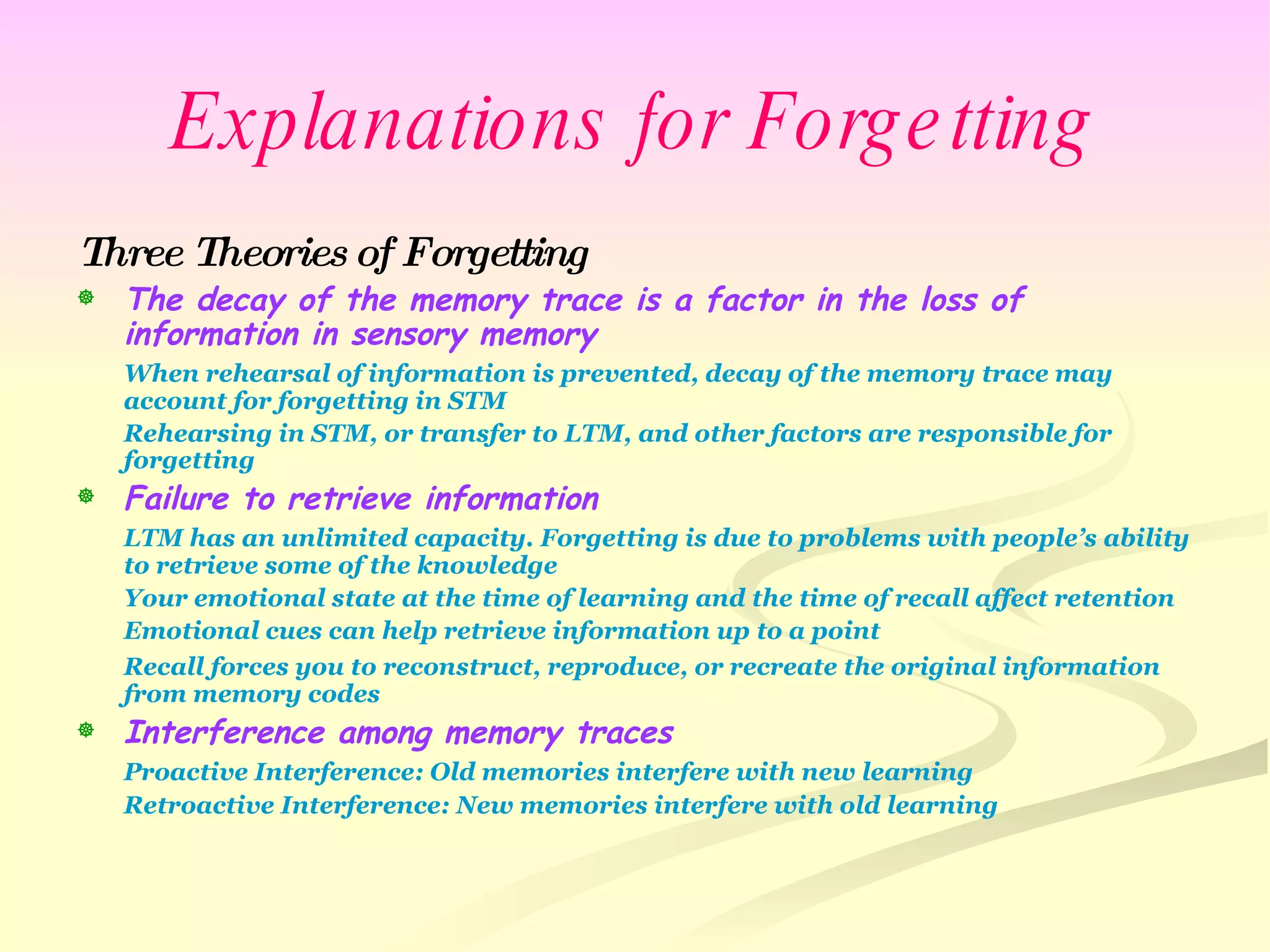
Explanations for Forgetting Three Theories of Forgetting The decay of the memory trace is a factor in the loss of information in sensory memory When rehearsal of information is prevented, decay of the memory trace may account for forgetting in STM Rehearsing in STM, or transfer to LTM, and other factors are responsible for forgetting Failure to retrieve information LTM has an unlimited capacity. Forgetting is due to problems with people’s ability to retrieve some of the knowledge Your emotional state at the time of learning and the time of recall affect retention Emotional cues can help retrieve information up to a point Recall forces you to reconstruct, reproduce, or recreate the original information from memory codes Interference among memory traces Proactive Interference: Old memories interfere with new learning Retroactive Interference: New memories interfere with old learning
Memory’s  seven fallacies Transience Forgetting that occurs with the passage of time Absent-Mindedness Often attributed to four things: 1) divided attention; 2) insufficient attention when encoding; 3) operating on “automatic” and 4) change blindness (encoding at an extremely shallow level) Blocking Retrieval cues are unavailable even though a word or name has been encoded or stored Misattribution Recalling events that never happened or recalling them incorrectly or at the wrong time or place Suggestability The tendency to incorporate misleading information from external cues into recollections Bias Memories are rescripted to fit present views Persistence Remembering things you wish to forget
Improving Your Memory Overlearning Practice beyond the point of learning or mastery Categorize Information Grouping or chunking information into groups or assigning information into categories Creating a cognitive map using pictures, drawings, designs to represent ideas Elaborate on the Information Embellish the information you’re learning by analyzing it in greater detail Get beyond the facts, and integrate information Reflect any ideas in writing such as in a journal relating past and present experiences Ask yourself questions about the material Use Mental Imagery Assigning an imagery code helps you to learn faster and remember longer Look for something interesting, and humorous about it
Improving Your Memory Use Mnemonic Devices Use short phrases where the first letter of each word creates a recall item Connect items in a short rhyming phrase or poem Repeating the information with a cadence and beat with music makes it easier to remember Use acronyms where words are formed out of the first letter of each item that needs to be remembered Narratives are short stories containing all the items to be remembered; the sillier the narrative, the easier it is to remember Substitutions convert relatively abstract materials into something more concrete and easier to remember: substitute a picture formed from the sounds in a name; substitute consonants in the alphabet, and vowels are used to fill in the gaps Keywords are used to form an image of the sound and a word Method of Loci is placing everything to be remembered in specific and recognizable places Peg systems or peg words are hooks to attach things you want to learn

Critical Thinking 4

  • 1.
    Learning and Memoryin Everyday Life How Does Learning Work, and What Can You Do To Become a Better Learner?
  • 2.
    What is Learning?A relatively permanent change in your skills and knowledge as a function of your experiences Being relatively permanent implies that it can change and that as long as you use the learning it will be available Psychologists know that learning has occurred because of a change in behavior Change means that something new has been added to your repertoire of thoughts and actions Being a function of experiences means that whatever you learn is based on events you encounter daily
  • 3.
    Factors Affecting theAcquisition of Information The First Factor: Time on Task Whenever you want to learn something, the more time you spend at it the more effective will be the learning The quality of the time is more important than the actual time spent Concentrate on what’s going on, participate in discussions, summarize and paraphrase ideas for yourself, and ask questions Asking questions is important Overcome the belief that your questions are silly or dumb or that by asking a question you’re stupid Time on task is important for learning skills that are needed to do a job well
  • 4.
    The Second Factor:The Role of Practice Active Practice Enhances Learning Learning is an active process Being actively involved in your learning experience enhances learning and retention Time on task needs the following characteristics: Appropriate levels of interest and motivation to learn Attention is focused on the task A goal for what must be learned is established and pursued Questions are asked when something isn’t understood Feedback is sought in order to learn from mistakes Attempts are made to integrate and establish connections among various ideas or components of the skill Rote repetition is discouraged Critical thinking processes such as analysis, synthesizing, and evaluating information are emphasized Whenever appropriate, ideas about and experiences with the information are written down and/or discussed with others
  • 5.
    More on PracticeDistribute Your Practice over Time Massed Practice ( cramming ) doesn’t produce retention Consequently, learning doesn’t occur Inefficient and ineffective way to learn Massed Practice taxes your ability to remember information, lowers your energy levels, produces fatigue, and enhances test anxiety Distributed Practice, taking small chunks over time produces greater retention Twice the information is recalled through Distributed Practice On difficult and verbal learning, Distributed Practice enhances learning Distributed Practice is most noticeable when information must be recalled rather than recognized
  • 6.
    The Third Factor:The Role of Feedback The Purpose of Feedback is to Reduce the Number of Errors that can be Produced Knowledge of Results enhances what is to be learned External Sources: Feedback from teachers, super- visors, tests Internal Sources: Perceptions of progress on task, cues from body movements and thinking processes Feedback is most effective when it is immediate Feedback must be detailed, specific, and constructive It is important that detailed information be given about what was wrong as well as specific suggestions for how to improve: Constructive Feedback
  • 7.
    The Fourth Factor:The Role of Positive Reinforcement Positive Reinforcers are Pleasant Stimuli that Occur after a Response and Increase the Likelihood of that Response Recurring Rewards Increase the Frequency of Desirable Behaviors They improve performance in sports, on the job, and in school; lead to better health habits, communications in relationships, and in communications skills themselves Positive Reinforcers Can Help Reduce the Frequency of Bad Habits Rewarding the behaviors that you do want will increase those behaviors Positive Reinforcers Work Best When Given Immediately After a Response An association is made between the behavior and the reward Delay in reward may reinforce the wrong behavior Some of the Most Powerful Reinforces are Secondary Reinforcers
  • 8.
    The Fifth Factor:Reinforcement Schedules Two Basic Reinforcement Schedules Continuous Reinforcement Reinforcing every correct response Partial Reinforcement Reinforcing only a certain number of correct responses or after a given time schedule Partial Reinforcement Schedules Help Maintain Behaviors Over Time All reinforcement schedules have “gaps” produced by time or by the number of responses that were not reinforced These “gaps” provide opportunities for other internal or external rewards to become associated with the actions and can gain control over them Partial Reinforcement Schedules Allow Behaviors Leading to Distant Rewards to be Maintained Long-term pay-offs after short-term losses
  • 9.
    The Partial ReinforcementSchedules Fixed Ratio The reinforcer is given after a certain number of correct responses has occurred Variable Ratio A reinforcer is given after a varied number of correct responses has occurred Fixed Interval A reinforcer is given after a fixed time period has passed after the correct response Variable Ratio A reinforcer is given after a varied time period has passed after the correct response
  • 10.
    The Sixth Factor:Extinction When Responses Are No Longer Followed by the Rewards That Control Them, Extinction Occurs The behaviors weaken and cease to occur It is not the same as forgetting; the incentive to perform is gone The reappearance of an extincted response is spontaneous recovery Resistance to Extinction occurs due to: They were initially learned or maintained under partial reinforcement Your actions also come under the control of internal rewards (e.g., self-praise) or other external reinforcers in the environment When you give yourself praise for a job well-done, you tend to be more comfortable about doing a good job the next time
  • 11.
    The Seventh Factor:Negative Side Effects of Rewards Positive Reinforcers May Affect People and Events Beyond the Initial Target Behavior Reinforcing certain actions may produce unintended reprocussions People May Concentrate on Earning a Reward and Make Performing Desirable Behaviors Secondary Looking for “loopholes” becomes more important than learning The Effects of Positive Reinforcers May Not Generalize to Other Situations What is learned in one situation may not provide the motivation to continue the previously learned behavior External Reinforcers May Undermine Intrinsic Rewards Rewards given for something that is already enjoyable causes a loss of interest The Wrong Behaviors Can Be Inadvertently Reinforced Attention is a powerful secondary reinforcer, and it may come in many forms Rewards May Lose Their Attractiveness in the Long Run Too much of a good thing can cause a loss of motivation and interest .
  • 12.
    The Eighth Factor:The Role of Negative Reinforcement Aversive Stimuli Whose Reduction or Termination Increases the Likelihood that an Ongoing Behavior Will Occur A Positive Reinforcer increases a response through the administration of something desirable; Negative Reinforcers remove something undesirable in order to get or keep a response going When unpleasant stimuli occur people try to remove them by escaping or avoiding them Escaping or avoiding the situation can bring about drug abuse, excessive daydreaming or fantasizing, or anxieties Many fears and phobias are avoidance responses
  • 13.
    The Ninth Factor:The Role of Punishment The Use of an Aversive Stimulus to Eliminate or Decrease the Strength of a Response Punishment vs. Abuse vs. Discipline Punished behavior tends to occur less frequently, and this can be produced through: The inappropriate behavior leads to a natural and logical unpleasant consequence There is an unpleasant stimulus given deliberately after a response Something pleasant is taken away after an inappropriate behavior Problems can occur through the use of punishment Frustration and anger can develop and a focus can be more on “getting even” than learning anything new A fear response develops producing an avoidance response Many people can’t distinguish between punishment and abuse
  • 14.
    More on PunishmentPrinciples for Administering Punishment It must be applied immediately A connection needs to be made between the behavior and the punishment The punishment should “fit” the infraction For something minor, the punishment must be minor It must be consistently applied Punishment must occur every time a problem behavior occurs as well as an explanation for the punishment It should be limited to specific responses Never use punishment indiscriminately or for anything general such as making someone a “better person” It should be humanely and sensitively applied The physical and psychological well-being of the person needs to be preserved
  • 15.
    The Tenth Factor:The Role of Organization & Planning Without Organization and Planning, Practice, Feedback, and Reinforcement will do Little Good Effective time management aids learning Short-term planning and attitudes toward the use of time are the best predictors of college grades, not academic ability Flexible monthly planning along with weekly and monthly rewards leads to better performance in school Time Management Practices for Success in School: Short-Range Planning Attitudes Toward Time Make a daily list Don’t let others infringe on your time Plan each day Work on school work on school days Schedule things to do Always work on improving yourself Be clear on next week Use your time constructively Set and keep priorities Do assignments long before they’re due Quit doing activities that are unconstructive
  • 16.
    Remembering What YouLearned Memory is the ability to bring to conscious awareness the things you’ve experienced, imagined, and learned Memory is the result of learning Your ability to learn depends on your ability to remember previous ideas Humanity’s unique ability to survive has depended on memory memory involves acquiring, encoding, storing, and retrieving information Two major theories of learning are the memory system approach and the levels-of-processing approach
  • 17.
    The Memory SystemThe Three Stages of Memory The Memory System or Information Processing Approach Sensory Registry (Sensory Information Storage) Data is stored in full detail in the sense organ Almost unlimited capacity with very rapid decay Visual registry ( iconic and eidetic imagery ), Auditory registry ( echoic storage ) The “cocktail party phenomenon” Short-Term Memory (Working Memory, Present Conscious Memory) Limited to 7 +/- 2 chunks of information at a time Limited to 1.5 to 2 seconds The serial position effect: the recall of items depends on the position in a list Primacy and Recency Effects Encoding in STM is by sounds or images Information is maintained in STM through Maintenance rehearsal ( Rote )
  • 18.
    More on theStages of Memory Long-Term Memory Almost unlimited in capacity Encoding is by imagery and meaning Storage is through a Semantic Network or Semantic Tree Transfer of information from STM to LTM: Elaborative Rehearsal: an associative organization Organizes the new material with what is already learned Information is maintained in LTM through Elaborative Rehearsal and Rote Types of LTM: Episodic Memory: events or life experiences Semantic Memory: facts, rules, and concepts Procedural Memory: strategies for performing actions
  • 19.
    The Levels-of-Processing Approachto Understanding Memory Memory is an active process where information is analyzed at different levels and later reconstructed When given something to learn, you begin by analyzing it at a rather shallow level such as deciding if you need to go on to a deeper analysis of the word or object The rapid forgetting of material is due to the shallow analysis of it. The persistence of information in LTM is related to the deeper processing it receives Information is transformed into a memory code based on meaning Processing information to a deeper level implies spending time to attach relevant semantic and imagery codes It can be an automatic or self-initiated process
  • 20.
    Explanations for ForgettingThree Theories of Forgetting The decay of the memory trace is a factor in the loss of information in sensory memory When rehearsal of information is prevented, decay of the memory trace may account for forgetting in STM Rehearsing in STM, or transfer to LTM, and other factors are responsible for forgetting Failure to retrieve information LTM has an unlimited capacity. Forgetting is due to problems with people’s ability to retrieve some of the knowledge Your emotional state at the time of learning and the time of recall affect retention Emotional cues can help retrieve information up to a point Recall forces you to reconstruct, reproduce, or recreate the original information from memory codes Interference among memory traces Proactive Interference: Old memories interfere with new learning Retroactive Interference: New memories interfere with old learning
  • 21.
    Memory’s sevenfallacies Transience Forgetting that occurs with the passage of time Absent-Mindedness Often attributed to four things: 1) divided attention; 2) insufficient attention when encoding; 3) operating on “automatic” and 4) change blindness (encoding at an extremely shallow level) Blocking Retrieval cues are unavailable even though a word or name has been encoded or stored Misattribution Recalling events that never happened or recalling them incorrectly or at the wrong time or place Suggestability The tendency to incorporate misleading information from external cues into recollections Bias Memories are rescripted to fit present views Persistence Remembering things you wish to forget
  • 22.
    Improving Your MemoryOverlearning Practice beyond the point of learning or mastery Categorize Information Grouping or chunking information into groups or assigning information into categories Creating a cognitive map using pictures, drawings, designs to represent ideas Elaborate on the Information Embellish the information you’re learning by analyzing it in greater detail Get beyond the facts, and integrate information Reflect any ideas in writing such as in a journal relating past and present experiences Ask yourself questions about the material Use Mental Imagery Assigning an imagery code helps you to learn faster and remember longer Look for something interesting, and humorous about it
  • 23.
    Improving Your MemoryUse Mnemonic Devices Use short phrases where the first letter of each word creates a recall item Connect items in a short rhyming phrase or poem Repeating the information with a cadence and beat with music makes it easier to remember Use acronyms where words are formed out of the first letter of each item that needs to be remembered Narratives are short stories containing all the items to be remembered; the sillier the narrative, the easier it is to remember Substitutions convert relatively abstract materials into something more concrete and easier to remember: substitute a picture formed from the sounds in a name; substitute consonants in the alphabet, and vowels are used to fill in the gaps Keywords are used to form an image of the sound and a word Method of Loci is placing everything to be remembered in specific and recognizable places Peg systems or peg words are hooks to attach things you want to learn