Memory, Intelligence and 
states of mind
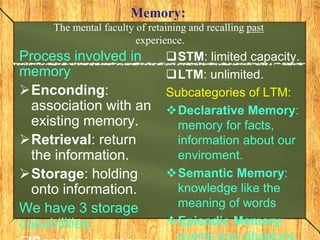
Memory: 
The mental faculty of retaining and recalling past 
experience. 
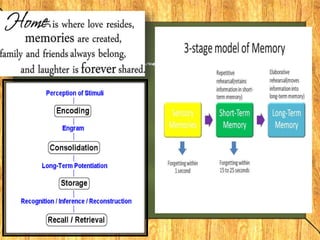
Process involved in 
memory: 
Enconding: 
association with an 
existing memory. 
Retrieval: return 
the information. 
Storage: holding 
onto information. 
We have 3 storage 
capabilities: 
Sensory memory: 
STM: limited capacity. 
LTM: unlimited. 
Subcategories of LTM: 
Declarative Memory: 
memory for facts, 
information about our 
enviroment. 
Semantic Memory: 
knowledge like the 
meaning of words 
Episodic Memory: 
events and situations.
Forgetting 
1. Interference 
Proactive interference is when an old memory makes it more 
difficult or impossible to remember a new memory, and 
retroactive interference occurs when new information 
interferes with your ability to remember previously learned 
information. 
2. Retrieval Failure 
According to this theory, a memory trace is created every 
time a new theory is formed. Decay theory suggests that over 
time, these memory traces begin to fade and disappear.
3. Failure to store 
Sometimes, losing information has less to do with 
forgetting and more to do with the fact that it never 
made it into long-term memory in the first place. 
4. Motivated Forgetting 
The two basic forms of motivated forgetting are: 
suppression, a conscious form of forgetting, and 
repression, an unconscious form of forgetting.
INTELLIGENCE 
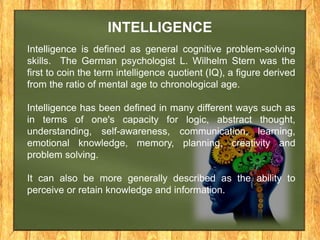
Intelligence is defined as general cognitive problem-solving 
skills. The German psychologist L. Wilhelm Stern was the 
first to coin the term intelligence quotient (IQ), a figure derived 
from the ratio of mental age to chronological age. 
Intelligence has been defined in many different ways such as 
in terms of one's capacity for logic, abstract thought, 
understanding, self-awareness, communication, learning, 
emotional knowledge, memory, planning, creativity and 
problem solving. 
It can also be more generally described as the ability to 
perceive or retain knowledge and information.
Relaxation 
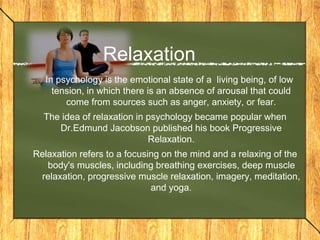
In psychology is the emotional state of a living being, of low 
tension, in which there is an absence of arousal that could 
come from sources such as anger, anxiety, or fear. 
The idea of relaxation in psychology became popular when 
Dr.Edmund Jacobson published his book Progressive 
Relaxation. 
Relaxation refers to a focusing on the mind and a relaxing of the 
body's muscles, including breathing exercises, deep muscle 
relaxation, progressive muscle relaxation, imagery, meditation, 
and yoga.
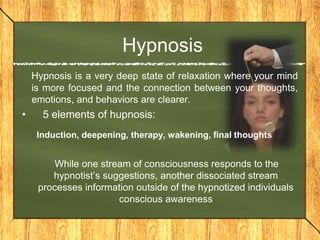
Hypnosis 
Hypnosis is a very deep state of relaxation where your mind 
is more focused and the connection between your thoughts, 
emotions, and behaviors are clearer. 
• 5 elements of hupnosis: 
Induction, deepening, therapy, wakening, final thoughts 
While one stream of consciousness responds to the 
hypnotist’s suggestions, another dissociated stream 
processes information outside of the hypnotized individuals 
conscious awareness
INTRODUCTION 
https://www.youtube.com/watch?v=1eTtzH_4gP8 
MEMORY 
http://www.youtube.com/watch?v=LbWZAckCam0 
FORGETTING 
http://www.youtube.com/watch?v=e5zH4N3ohR0&list=P 
Lb08E1Nek-5DmFI2_hGia5AFKIG5VUP3W 
INTELLIGENCE 
http://www.youtube.com/watch?v=kBbmerzR2JI

Chapter 6 memory, intelligence and states of mind (1)

  • 1.
    Memory, Intelligence and states of mind
  • 2.
    Memory: The mentalfaculty of retaining and recalling past experience. Process involved in memory: Enconding: association with an existing memory. Retrieval: return the information. Storage: holding onto information. We have 3 storage capabilities: Sensory memory: STM: limited capacity. LTM: unlimited. Subcategories of LTM: Declarative Memory: memory for facts, information about our enviroment. Semantic Memory: knowledge like the meaning of words Episodic Memory: events and situations.
  • 4.
    Forgetting 1. Interference Proactive interference is when an old memory makes it more difficult or impossible to remember a new memory, and retroactive interference occurs when new information interferes with your ability to remember previously learned information. 2. Retrieval Failure According to this theory, a memory trace is created every time a new theory is formed. Decay theory suggests that over time, these memory traces begin to fade and disappear.
  • 5.
    3. Failure tostore Sometimes, losing information has less to do with forgetting and more to do with the fact that it never made it into long-term memory in the first place. 4. Motivated Forgetting The two basic forms of motivated forgetting are: suppression, a conscious form of forgetting, and repression, an unconscious form of forgetting.
  • 6.
    INTELLIGENCE Intelligence isdefined as general cognitive problem-solving skills. The German psychologist L. Wilhelm Stern was the first to coin the term intelligence quotient (IQ), a figure derived from the ratio of mental age to chronological age. Intelligence has been defined in many different ways such as in terms of one's capacity for logic, abstract thought, understanding, self-awareness, communication, learning, emotional knowledge, memory, planning, creativity and problem solving. It can also be more generally described as the ability to perceive or retain knowledge and information.
  • 7.
    Relaxation In psychologyis the emotional state of a living being, of low tension, in which there is an absence of arousal that could come from sources such as anger, anxiety, or fear. The idea of relaxation in psychology became popular when Dr.Edmund Jacobson published his book Progressive Relaxation. Relaxation refers to a focusing on the mind and a relaxing of the body's muscles, including breathing exercises, deep muscle relaxation, progressive muscle relaxation, imagery, meditation, and yoga.
  • 8.
    Hypnosis Hypnosis isa very deep state of relaxation where your mind is more focused and the connection between your thoughts, emotions, and behaviors are clearer. • 5 elements of hupnosis: Induction, deepening, therapy, wakening, final thoughts While one stream of consciousness responds to the hypnotist’s suggestions, another dissociated stream processes information outside of the hypnotized individuals conscious awareness
  • 9.
    INTRODUCTION https://www.youtube.com/watch?v=1eTtzH_4gP8 MEMORY http://www.youtube.com/watch?v=LbWZAckCam0 FORGETTING http://www.youtube.com/watch?v=e5zH4N3ohR0&list=P Lb08E1Nek-5DmFI2_hGia5AFKIG5VUP3W INTELLIGENCE http://www.youtube.com/watch?v=kBbmerzR2JI