Chapters 7 & 8 PD 102
Week 6 Vocabulary WordsBanal: commonplace, triteJingoism: bellicose chauvinismParvenu: a person who has recently or suddenly acquired wealth, importance, position, or the like, but has not yet developed the conventionally appropriate manners, dress, surroundings, etc.
Chapter 7: Remember What is effective studying?It requires a great deal of commitment, organization, listening, developing personalized study skills, and building memory techniques Where you study is important
Basic Facts About MemoryEveryone remembers some info and forgets other infoYour senses help you take in infoWith very little effort, you can remember some infoWith rehearsal (study), you can remember a great deal of info Incoming info needs to be filed in the brain if you are to retain itInformation stored, or filed, in the brain must have a retrieval method Mnemonic devices, repetition, association, and rehearsal can help you store and retrieve info
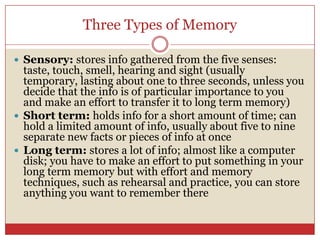
Three Types of MemorySensory: stores info gathered from the five senses: taste, touch, smell, hearing and sight (usually temporary, lasting about one to three seconds, unless you decide that the info is of particular importance to you and make an effort to transfer it to long term memory)Short term: holds info for a short amount of time; can hold a limited amount of info, usually about five to nine separate new facts or pieces of info at onceLong term: stores a lot of info; almost like a computer disk; you have to make an effort to put something in your long term memory but with effort and memory techniques, such as rehearsal and practice, you can store anything you want to remember there
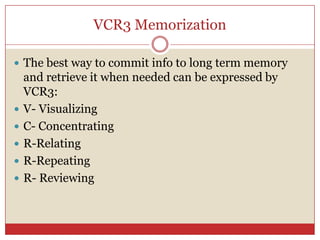
VCR3 MemorizationThe best way to commit info to long term memory and retrieve it when needed can be expressed by VCR3: V- Visualizing C- ConcentratingR-RelatingR-RepeatingR- Reviewing
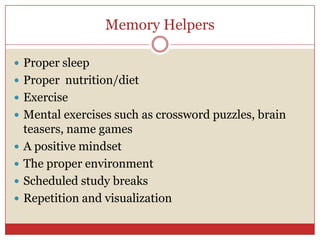
Memory Helpers Proper sleep Proper  nutrition/dietExerciseMental exercises such as crossword puzzles, brain teasers, name gamesA positive mindsetThe proper environmentScheduled study breaksRepetition and visualization
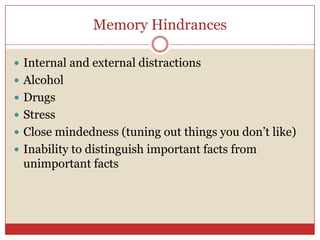
Memory Hindrances Internal and external distractionsAlcoholDrugsStressClose mindedness (tuning out things you don’t like)Inability to distinguish important facts from unimportant facts
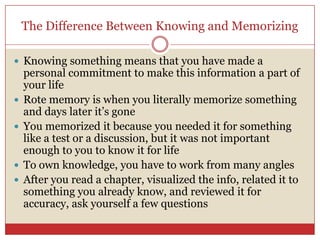
The Difference Between Knowing and Memorizing Knowing something means that you have made a personal commitment to make this information a part of your life Rote memory is when you literally memorize something and days later it’s goneYou memorized it because you needed it for something like a test or a discussion, but it was not important enough to you to know it for life To own knowledge, you have to work from many anglesAfter you read a chapter, visualized the info, related it to something you already know, and reviewed it for accuracy, ask yourself a few questions
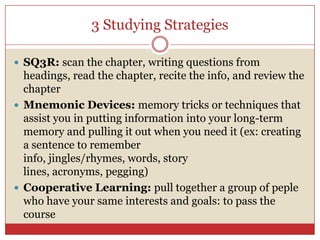
3 Studying StrategiesSQ3R: scan the chapter, writing questions from headings, read the chapter, recite the info, and review the chapterMnemonic Devices: memory tricks or techniques that assist you in putting information into your long-term memory and pulling it out when you need it (ex: creating a sentence to remember info, jingles/rhymes, words, story lines, acronyms, pegging)Cooperative Learning: pull together a group of peple who have your same interests and goals: to pass the course
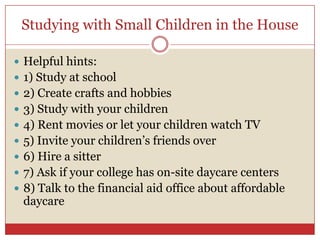
Studying with Small Children in the HouseHelpful hints: 1) Study at school2) Create crafts and hobbies3) Study with your children4) Rent movies or let your children watch TV5) Invite your children’s friends over6) Hire a sitter 7) Ask if your college has on-site daycare centers 8) Talk to the financial aid office about affordable daycare
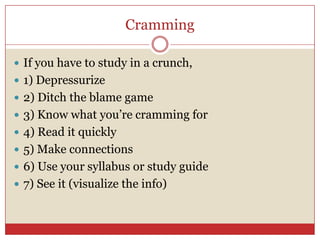
Cramming If you have to study in a crunch, 1) Depressurize2) Ditch the blame game3) Know what you’re cramming for 4) Read it quickly5) Make connections6) Use your syllabus or study guide7) See it (visualize the info)
AssessChapter 8:
Your Attitude Toward TestingMakes all the difference No test is an indication of who you are as a person or a measure of your worth as a human beingNo one can be good at all thingsThe best thing you can do for stress reduction is to silence your negative self talk about the exam or change your self talk to a positive trone
Helpful Hints for Reducing Test AnxietyApproach the test with an “I can” attitude
Prepare yourself emotionally for the test, control your self talk, and be positive
Remind yourself that you studied and that you know the material
Overlearn the material- you can’t study too muchGo to bed earlyEat a healthy meal before the testArrive early for the testSit back, relax, breathe, and clear your mind if you become nervousCome to the test with everything you need: pencils, calculators, and other suppliesRead over the entire test first; the questions that are easiest for you Check your answers but remember your first response is usually correct Ask the professor for a study sheetKnow what grade value the test holds
Three Types of Responses to Test Questions Almost every test question will elicit one of three types of responses from you as the test taker:1) Quick time response (when you read a question and know the answer immediately)2) Lag time response (when you read a question and the answer doesn’t come immediately)3) No response (you read a question two or three times and still have no response)
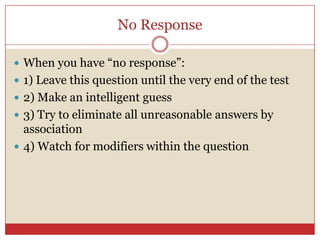
No Response When you have “no response”:1) Leave this question until the very end of the test2) Make an intelligent guess3) Try to eliminate all unreasonable answers by association4) Watch for modifiers within the question
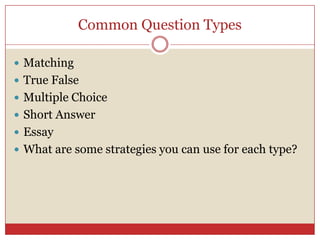
Common Question TypesMatchingTrue FalseMultiple ChoiceShort AnswerEssay What are some strategies you can use for each type?

Pd 102 Chapters 7 And 8

  • 1.
    Chapters 7 &8 PD 102
  • 2.
    Week 6 VocabularyWordsBanal: commonplace, triteJingoism: bellicose chauvinismParvenu: a person who has recently or suddenly acquired wealth, importance, position, or the like, but has not yet developed the conventionally appropriate manners, dress, surroundings, etc.
  • 3.
    Chapter 7: RememberWhat is effective studying?It requires a great deal of commitment, organization, listening, developing personalized study skills, and building memory techniques Where you study is important
  • 4.
    Basic Facts AboutMemoryEveryone remembers some info and forgets other infoYour senses help you take in infoWith very little effort, you can remember some infoWith rehearsal (study), you can remember a great deal of info Incoming info needs to be filed in the brain if you are to retain itInformation stored, or filed, in the brain must have a retrieval method Mnemonic devices, repetition, association, and rehearsal can help you store and retrieve info
  • 5.
    Three Types ofMemorySensory: stores info gathered from the five senses: taste, touch, smell, hearing and sight (usually temporary, lasting about one to three seconds, unless you decide that the info is of particular importance to you and make an effort to transfer it to long term memory)Short term: holds info for a short amount of time; can hold a limited amount of info, usually about five to nine separate new facts or pieces of info at onceLong term: stores a lot of info; almost like a computer disk; you have to make an effort to put something in your long term memory but with effort and memory techniques, such as rehearsal and practice, you can store anything you want to remember there
  • 6.
    VCR3 MemorizationThe bestway to commit info to long term memory and retrieve it when needed can be expressed by VCR3: V- Visualizing C- ConcentratingR-RelatingR-RepeatingR- Reviewing
  • 7.
    Memory Helpers Propersleep Proper nutrition/dietExerciseMental exercises such as crossword puzzles, brain teasers, name gamesA positive mindsetThe proper environmentScheduled study breaksRepetition and visualization
  • 8.
    Memory Hindrances Internaland external distractionsAlcoholDrugsStressClose mindedness (tuning out things you don’t like)Inability to distinguish important facts from unimportant facts
  • 9.
    The Difference BetweenKnowing and Memorizing Knowing something means that you have made a personal commitment to make this information a part of your life Rote memory is when you literally memorize something and days later it’s goneYou memorized it because you needed it for something like a test or a discussion, but it was not important enough to you to know it for life To own knowledge, you have to work from many anglesAfter you read a chapter, visualized the info, related it to something you already know, and reviewed it for accuracy, ask yourself a few questions
  • 10.
    3 Studying StrategiesSQ3R:scan the chapter, writing questions from headings, read the chapter, recite the info, and review the chapterMnemonic Devices: memory tricks or techniques that assist you in putting information into your long-term memory and pulling it out when you need it (ex: creating a sentence to remember info, jingles/rhymes, words, story lines, acronyms, pegging)Cooperative Learning: pull together a group of peple who have your same interests and goals: to pass the course
  • 11.
    Studying with SmallChildren in the HouseHelpful hints: 1) Study at school2) Create crafts and hobbies3) Study with your children4) Rent movies or let your children watch TV5) Invite your children’s friends over6) Hire a sitter 7) Ask if your college has on-site daycare centers 8) Talk to the financial aid office about affordable daycare
  • 12.
    Cramming If youhave to study in a crunch, 1) Depressurize2) Ditch the blame game3) Know what you’re cramming for 4) Read it quickly5) Make connections6) Use your syllabus or study guide7) See it (visualize the info)
  • 13.
  • 14.
    Your Attitude TowardTestingMakes all the difference No test is an indication of who you are as a person or a measure of your worth as a human beingNo one can be good at all thingsThe best thing you can do for stress reduction is to silence your negative self talk about the exam or change your self talk to a positive trone
  • 15.
    Helpful Hints forReducing Test AnxietyApproach the test with an “I can” attitude
  • 16.
    Prepare yourself emotionallyfor the test, control your self talk, and be positive
  • 17.
    Remind yourself thatyou studied and that you know the material
  • 18.
    Overlearn the material-you can’t study too muchGo to bed earlyEat a healthy meal before the testArrive early for the testSit back, relax, breathe, and clear your mind if you become nervousCome to the test with everything you need: pencils, calculators, and other suppliesRead over the entire test first; the questions that are easiest for you Check your answers but remember your first response is usually correct Ask the professor for a study sheetKnow what grade value the test holds
  • 19.
    Three Types ofResponses to Test Questions Almost every test question will elicit one of three types of responses from you as the test taker:1) Quick time response (when you read a question and know the answer immediately)2) Lag time response (when you read a question and the answer doesn’t come immediately)3) No response (you read a question two or three times and still have no response)
  • 20.
    No Response Whenyou have “no response”:1) Leave this question until the very end of the test2) Make an intelligent guess3) Try to eliminate all unreasonable answers by association4) Watch for modifiers within the question
  • 21.
    Common Question TypesMatchingTrueFalseMultiple ChoiceShort AnswerEssay What are some strategies you can use for each type?