Crime Scene Photography
Submitted by:- Submitted to:-
Pallavi kumari Department of
forensic science
Crime Scene Photography
Photography
Photography is derived from the Greek photos for “light’’
and – Graphos for “drawing”. It is the art, science and
practice of creating durable images by recording light or
other electromagnetic radiation, either chemically by
means of a sensitive material such as photographic film,
or electronically by means of an image sensor.
Videography
 Forensic video production is valuable for showing an overview
of the crime scene and should be considered in major cases.
While video cannot replace still photographs due to its lower
resolution, video does provide an easily understandable viewing
medium that shows the layout of the crime scene and the location
of evidence. Videos of crime scenes are not often used in court,
but they are valuable illustrations for explaining the scene to other
investigators and are often used to refresh the memory of those
who were involved in processing the crime scene.
Crime Scene Photography
 Testimonial evidence is faulty.
 Jurors are influenced by what they can see and
experience in the courtroom.
 Photographs of the crime scene and evidence is a
powerful tool in bringing the jury to the crime
scene.
Getting the Evidence into Court
 In order to be effective your evidence must be
admitted into court evidence.
 The following guidelines must be followed.
 Do not disturb the scene
 Get a complete set of pictures
 Pay attention to camera angles
 Record all data
Rule #1 Do NOT Disturb the Scene
 This is the cardinal rule of crime scene
photography
 Investigators need to see the scene as it was
when the police arrived
 Leave scales and labels out of your first series of
pictures
 After the scene has been photographed in its
original state, you shoot a second series of
evidence pictures.
Rule #2 Complete Set of Pictures
 You must move around the scene to see
everything - So must the camera
 Generally speaking, each important object in the
scene should appear in at least three pictures
 The overview should cover the entire scene to
bring out the relationships between the objects.
The mid range shot shows and important object
and its immediate surroundings. Finally, each
close-up shows a key detail clearly.
Example of Three Step Process
1. Overview
2. Mid-Range
3. Focused
Overview
Mid-Range
Close-Up
Rule #3 Pay Attention to Angles
 Relationships of size and distance may be distorted by
the wrong viewpoint
 Shoot most pictures with the camera at eye level. This is
the height from which people normally see things and
that makes it easier to judge perspective.
 Ask yourself questions such as:
 Does this picture reveal the true position of the witness to the
crime?
 Does the picture distort what I am shooting?
 Am I shooting from the perspective of an observer.
Distortion
 To prevent distortion that may skew the image
and even prevent its admissibility, try to take the
photos at a perpendicular angle.
Selecting A Lens
Regular Aspect Lens
Wide Angle Lens
Rule #4 Record all Data
 Make a sketch of where each picture was shot
 Write the details of each shot
 Location, date, time, photographer, camera settings
 Label all pictures and negatives.
Taking the Pictures
 A crime scene photographer has command of the
art of photography.
 All pictures must be
 Sharp
 Focused
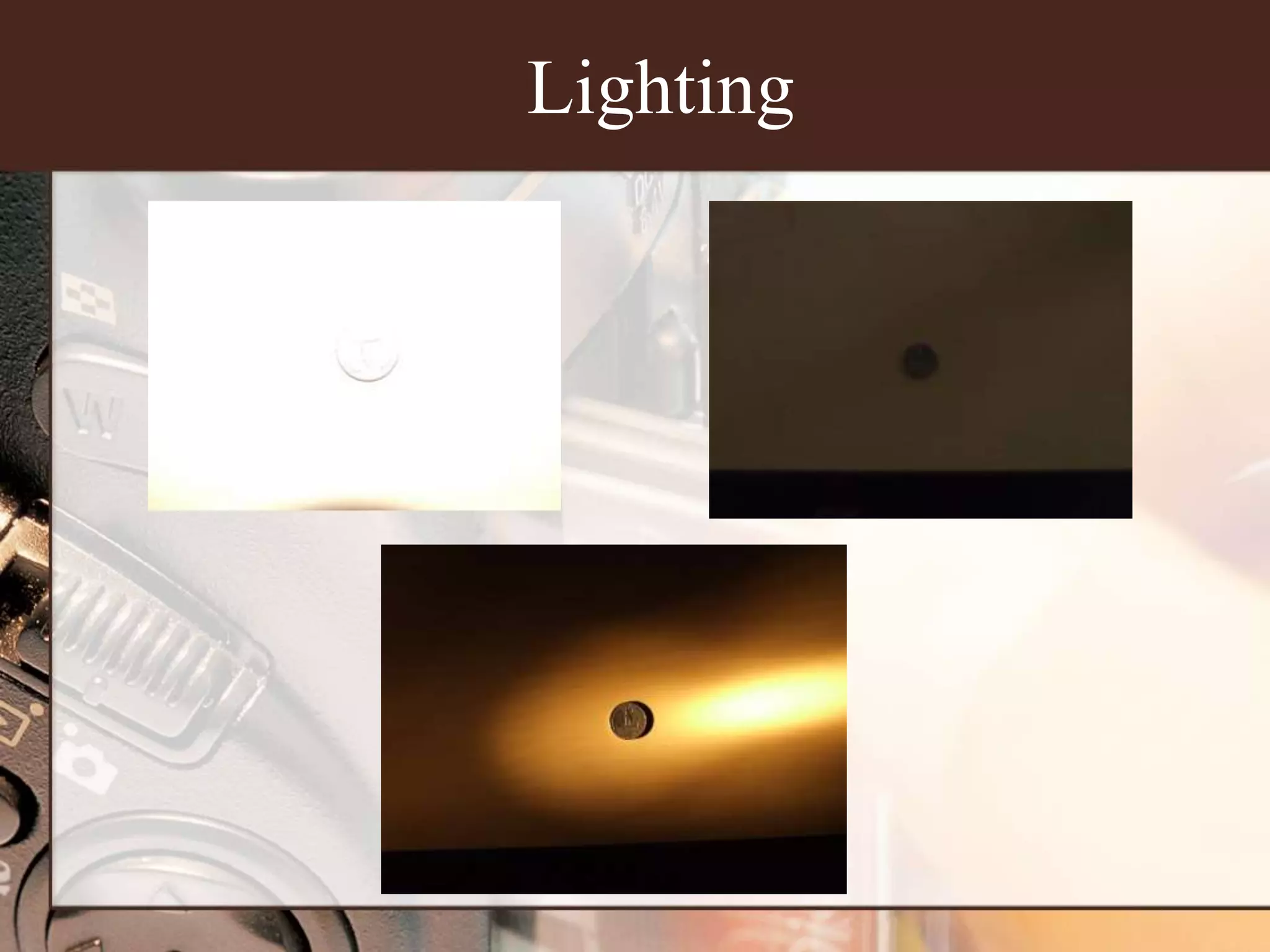
 Properly exposed
 Framed properly
 Have proper lighting
Lighting
Not Enough Light?
 Exposure times can be altered to brighten
photographs
 Longer exposure times required a tripod and no
movement of the camera
 Alternate light sources
 Ultraviolet
 Infrared
 fluorescent
Forensic application of photography and
videography
1. Secure the crime scene.
2. Evaluate the condition .
3. Helping the investigator for leading in case.
4. Evidence marker.
5. Recording evidence position.
6. Evaluate the evidences which evidence were
present the crime scene.
Thank you

Crime_Scene_Photography.ppt

  • 1.
    Crime Scene Photography Submittedby:- Submitted to:- Pallavi kumari Department of forensic science
  • 2.
  • 3.
    Photography Photography is derivedfrom the Greek photos for “light’’ and – Graphos for “drawing”. It is the art, science and practice of creating durable images by recording light or other electromagnetic radiation, either chemically by means of a sensitive material such as photographic film, or electronically by means of an image sensor.
  • 4.
    Videography  Forensic videoproduction is valuable for showing an overview of the crime scene and should be considered in major cases. While video cannot replace still photographs due to its lower resolution, video does provide an easily understandable viewing medium that shows the layout of the crime scene and the location of evidence. Videos of crime scenes are not often used in court, but they are valuable illustrations for explaining the scene to other investigators and are often used to refresh the memory of those who were involved in processing the crime scene.
  • 5.
    Crime Scene Photography Testimonial evidence is faulty.  Jurors are influenced by what they can see and experience in the courtroom.  Photographs of the crime scene and evidence is a powerful tool in bringing the jury to the crime scene.
  • 6.
    Getting the Evidenceinto Court  In order to be effective your evidence must be admitted into court evidence.  The following guidelines must be followed.  Do not disturb the scene  Get a complete set of pictures  Pay attention to camera angles  Record all data
  • 7.
    Rule #1 DoNOT Disturb the Scene  This is the cardinal rule of crime scene photography  Investigators need to see the scene as it was when the police arrived  Leave scales and labels out of your first series of pictures  After the scene has been photographed in its original state, you shoot a second series of evidence pictures.
  • 8.
    Rule #2 CompleteSet of Pictures  You must move around the scene to see everything - So must the camera  Generally speaking, each important object in the scene should appear in at least three pictures  The overview should cover the entire scene to bring out the relationships between the objects. The mid range shot shows and important object and its immediate surroundings. Finally, each close-up shows a key detail clearly.
  • 9.
    Example of ThreeStep Process 1. Overview 2. Mid-Range 3. Focused
  • 10.
  • 11.
  • 12.
  • 13.
    Rule #3 PayAttention to Angles  Relationships of size and distance may be distorted by the wrong viewpoint  Shoot most pictures with the camera at eye level. This is the height from which people normally see things and that makes it easier to judge perspective.  Ask yourself questions such as:  Does this picture reveal the true position of the witness to the crime?  Does the picture distort what I am shooting?  Am I shooting from the perspective of an observer.
  • 14.
    Distortion  To preventdistortion that may skew the image and even prevent its admissibility, try to take the photos at a perpendicular angle.
  • 15.
    Selecting A Lens RegularAspect Lens Wide Angle Lens
  • 16.
    Rule #4 Recordall Data  Make a sketch of where each picture was shot  Write the details of each shot  Location, date, time, photographer, camera settings  Label all pictures and negatives.
  • 17.
    Taking the Pictures A crime scene photographer has command of the art of photography.  All pictures must be  Sharp  Focused  Properly exposed  Framed properly  Have proper lighting
  • 18.
  • 19.
    Not Enough Light? Exposure times can be altered to brighten photographs  Longer exposure times required a tripod and no movement of the camera  Alternate light sources  Ultraviolet  Infrared  fluorescent
  • 20.
    Forensic application ofphotography and videography 1. Secure the crime scene. 2. Evaluate the condition . 3. Helping the investigator for leading in case. 4. Evidence marker. 5. Recording evidence position. 6. Evaluate the evidences which evidence were present the crime scene.
  • 21.