
●NAME OF SCHOOL: SAGE SCHOOL OF SCIENCE
●PROGRAM: MASTER OF SCIENCE
●SPECIALIZATION: FORENSIC SCIENCE
●SUBJECT: PRINT AND PATTERN EVIDENCE
●SEMESTER: 1
●GUIDED BY: MISS SWETA VERMA
●SUBMITTED BY: PINA PATEL
Forensic Photography
Table of Contents
Eligibility of forensic
photographer
Introduction
Purpose Of
Photography
02 04
01
Methods & Angles
of Photography
03
Forensic
Importance
Reference
07
06
Admissibility of
photographic evidence
05
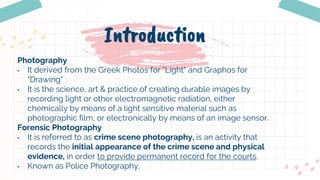
Introduction
Photography
• It derived from the Greek Photos for "Light" and Graphos for
"Drawing"
• It is the science, art & practice of creating durable images by
recording light or other electromagnetic radiation, either
chemically by means of a light sensitive material such as
photographic film, or electronically by means of an image sensor.
Forensic Photography
• It is referred to as crime scene photography, is an activity that
records the initial appearance of the crime scene and physical
evidence, in order to provide permanent record for the courts.
• Known as Police Photography.
 Providing Courtroom with visual evidence of what took place
or existed at crime scene.
 To document what is there and where it is in relationship to
the scene, whether it is obviously connected to the crime or
not.
 Assist in mental reconstruction of the structure.
 Clarify and aid interviews.
 Identify witness.
 Prove suspects presence at scene.
 Proof in court cases, used by investigators, prosecutor,
defense attorneys, witnesses.
Purpose of Photography
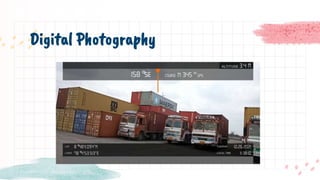
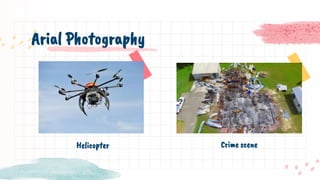
• Taking Photographs
of the ground from
an elevated position.
• Platforms for these
photography include
Helicopters, Air
crafts.
• Used for taking
photographs for big
Crime scene.
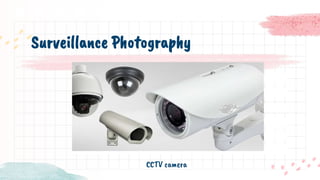
• Photographing the
behavior activities, or
other changing info.,
usually of people.
• It include observation
from a distance by
electronic equipment.
• Useful investigate
criminal Activity.
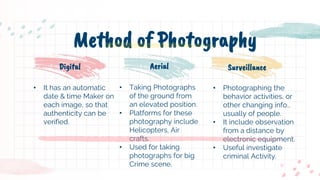
• It has an automatic
date & time Maker on
each image, so that
authenticity can be
verified.
Method of Photography
Digital Aerial Surveillance
Digital Photography
Arial Photography
Helicopter Crime scene
Surveillance Photography
CCTV camera
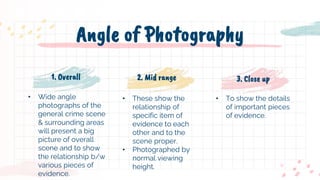
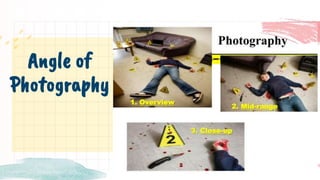
• These show the
relationship of
specific item of
evidence to each
other and to the
scene proper.
• Photographed by
normal viewing
height.
• Wide angle
photographs of the
general crime scene
& surrounding areas
will present a big
picture of overall
scene and to show
the relationship b/w
various pieces of
evidence.
• To show the details
of important pieces
of evidence.
2. Mid range
1. Overall 3. Close up
Angle of Photography
Angle of
Photography
Eligibility Of Forensic Photographer
 The Photographer is a person who
belong to field of forensic.
 If the person is non forensic then the
Person should have experience of 25
Years in Photography.
Admissibility of Photographic Evidence
 Object Pictured must be material or relevant to the point
in issue.
 The photograph must not appeal to the emotions or tend
to prejudice the court or jury.
 The photograph must be free from distortion and not
misrepresent the scene or the object it purports to
reproduce.
 Photography is the basis of all crime scenes and is carried out on priority.
 Its Initial part of trial.
 The judgement often is based upon crime scene photographs to prove
prima facie evidence.
 Without crime scene photograph, it would be hard to develop the theories
for it is in the photograph where actual crime scene can be preserved for
further analysis.
 It is through photograph where scenarios of the happening of the
unfortunate events can be recreated.
Forensic Importance
Reference
• https://www.google.com/url?sa=t&source=web&rct=j&url=https://annamaria.edu/wp-
content/uploads/2020/09/Karlyn-Brown-Fall-
2019.pdf&ved=2ahUKEwjs7pzX05j1AhW8xYsBHVSVB_UQFnoECDMQAQ&usg=AOv
Vaw24WzGwhf1eLgpC5TKv6n9G
• https://www.google.com/url?sa=t&source=web&rct=j&url=https://juniperpublishers.com/j
fsci/pdf/JFSCI.MS.ID.555581.pdf&ved=2ahUKEwjs7pzX05j1AhW8xYsBHVSVB_UQFn
oECBEQAQ&usg=AOvVaw0FGDbGh9oso3PtSGpsYHT1
• Forensic Photography: A Practitioner's Guide
• Fundamental of Forensic Photography: Practical Technique for evidence
documentation on Location and in the laboratory
• The Practical Methodology of Forensic Photography 2nd edition By David R. Redsicker
• Handbook of Forensic Photography by Sanford L.Weiss.
Thank you

Forensic photography

  • 1.
    ●NAME OF SCHOOL:SAGE SCHOOL OF SCIENCE ●PROGRAM: MASTER OF SCIENCE ●SPECIALIZATION: FORENSIC SCIENCE ●SUBJECT: PRINT AND PATTERN EVIDENCE ●SEMESTER: 1 ●GUIDED BY: MISS SWETA VERMA ●SUBMITTED BY: PINA PATEL Forensic Photography
  • 2.
    Table of Contents Eligibilityof forensic photographer Introduction Purpose Of Photography 02 04 01 Methods & Angles of Photography 03 Forensic Importance Reference 07 06 Admissibility of photographic evidence 05
  • 3.
    Introduction Photography • It derivedfrom the Greek Photos for "Light" and Graphos for "Drawing" • It is the science, art & practice of creating durable images by recording light or other electromagnetic radiation, either chemically by means of a light sensitive material such as photographic film, or electronically by means of an image sensor. Forensic Photography • It is referred to as crime scene photography, is an activity that records the initial appearance of the crime scene and physical evidence, in order to provide permanent record for the courts. • Known as Police Photography.
  • 4.
     Providing Courtroomwith visual evidence of what took place or existed at crime scene.  To document what is there and where it is in relationship to the scene, whether it is obviously connected to the crime or not.  Assist in mental reconstruction of the structure.  Clarify and aid interviews.  Identify witness.  Prove suspects presence at scene.  Proof in court cases, used by investigators, prosecutor, defense attorneys, witnesses. Purpose of Photography
  • 5.
    • Taking Photographs ofthe ground from an elevated position. • Platforms for these photography include Helicopters, Air crafts. • Used for taking photographs for big Crime scene. • Photographing the behavior activities, or other changing info., usually of people. • It include observation from a distance by electronic equipment. • Useful investigate criminal Activity. • It has an automatic date & time Maker on each image, so that authenticity can be verified. Method of Photography Digital Aerial Surveillance
  • 6.
  • 7.
  • 8.
  • 9.
    • These showthe relationship of specific item of evidence to each other and to the scene proper. • Photographed by normal viewing height. • Wide angle photographs of the general crime scene & surrounding areas will present a big picture of overall scene and to show the relationship b/w various pieces of evidence. • To show the details of important pieces of evidence. 2. Mid range 1. Overall 3. Close up Angle of Photography
  • 10.
  • 11.
    Eligibility Of ForensicPhotographer  The Photographer is a person who belong to field of forensic.  If the person is non forensic then the Person should have experience of 25 Years in Photography.
  • 12.
    Admissibility of PhotographicEvidence  Object Pictured must be material or relevant to the point in issue.  The photograph must not appeal to the emotions or tend to prejudice the court or jury.  The photograph must be free from distortion and not misrepresent the scene or the object it purports to reproduce.
  • 13.
     Photography isthe basis of all crime scenes and is carried out on priority.  Its Initial part of trial.  The judgement often is based upon crime scene photographs to prove prima facie evidence.  Without crime scene photograph, it would be hard to develop the theories for it is in the photograph where actual crime scene can be preserved for further analysis.  It is through photograph where scenarios of the happening of the unfortunate events can be recreated. Forensic Importance
  • 14.
    Reference • https://www.google.com/url?sa=t&source=web&rct=j&url=https://annamaria.edu/wp- content/uploads/2020/09/Karlyn-Brown-Fall- 2019.pdf&ved=2ahUKEwjs7pzX05j1AhW8xYsBHVSVB_UQFnoECDMQAQ&usg=AOv Vaw24WzGwhf1eLgpC5TKv6n9G • https://www.google.com/url?sa=t&source=web&rct=j&url=https://juniperpublishers.com/j fsci/pdf/JFSCI.MS.ID.555581.pdf&ved=2ahUKEwjs7pzX05j1AhW8xYsBHVSVB_UQFn oECBEQAQ&usg=AOvVaw0FGDbGh9oso3PtSGpsYHT1 •Forensic Photography: A Practitioner's Guide • Fundamental of Forensic Photography: Practical Technique for evidence documentation on Location and in the laboratory • The Practical Methodology of Forensic Photography 2nd edition By David R. Redsicker • Handbook of Forensic Photography by Sanford L.Weiss.
  • 15.