SOCIOLOGY OF
CRIME
CONCEPTS AND PERSPECTIVES
DEVIANCE
The word deviance has come from the word “deviate” which
means to stray or go away from an accepted path.
Deviance is behavior which does not comply with the dominant
norms of a specific society off or ridiculed.
“Horton and Hunt” The term deviation is given to any failure to
conform to customary norms.
People are seen as deviant it can lead to negative sanctions such as being
told
RELATIVE AND ABSOLUTE DEVIANCE
 Define deviance in an absolute way it would mean that in all
societies and at all times certain forms of behavior will be
considered deviant.
 Define deviance in a relative way it would mean that different
societies at different times develop different ways of seeing the
same form of behavior. Thus, in effect, someone could commit an
act in one society that would be seen as deviant while they could
commit the same act in a different society and be seen as non-
deviant.
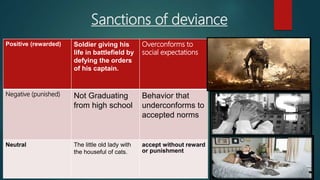
Sanctions of deviance
Positive (rewarded) Soldier giving his
life in battlefield by
defying the orders
of his captain.
Overconforms to
social expectations
Negative (punished) Not Graduating
from high school
Behavior that
underconforms to
accepted norms
Neutral The little old lady with
the houseful of cats.
accept without reward
or punishment
Deviance is often divided into two types
of deviant activities
 The first, crime is the violation of formally
enacted laws and is referred to as formal
deviance. Examples of formal deviance
would include: Robert, punched a
pregnant lady in the face
 The second type of deviant behavior refers
to violations of informal social norms,
norms that have not been codified into law,
and is referred as informal deviance.
Examples of informal deviance might
include: Gary walked through his local
library whilst talking loudly on his
mobile phone”.
CRIME
Crime is an act of contravening the statues enacted by legislations after
lengthy debates on what constitutes a criminal offense and what penalties
to institute for certain crimes. The sociological discipline that concerns itself
with criminal studies is termed criminology.
According to the legal definition, “crime” is any form of conduct which is
declared to be socially harmful in a state and such forbidden by law under
pain of some punishment.
There are mild and severe crimes. The mild ones can include a mere
shoplifting or beating someone while the severe crimes can include murder,
stealing large sums of money, and sexual harassment.
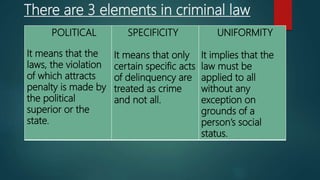
There are 3 elements in criminal law
POLITICAL
It means that the
laws, the violation
of which attracts
penalty is made by
the political
superior or the
state.
SPECIFICITY
It means that only
certain specific acts
of delinquency are
treated as crime
and not all.
UNIFORMITY
It implies that the
law must be
applied to all
without any
exception on
grounds of a
person’s social
status.
Difference between Deviance and Crime
Juvenile delinquency
 A crime is termed juvenile delinquency when committed by a
young person under a certain age.
The legal definition of Juvenile Delinquency is “any act
prohibited by law for children up to prescribed age limit is
Juvenile Delinquency” and it follows, that if a child found to
have committed an act of Juvenile Delinquency then he must
be produced before the court which is specially set up for
Juvenile Delinquent.
 A Delinquency as a social problem
 B. Delinquency as a behavioral problem.
 C. Delinquency as a legal problem.
Who are Juvenile Delinquents?
 Juvenile delinquents are regularly youngsters between the ages of 10 and 17 who have carried out a
criminal demonstration.
 (1) Neurotic Offenders Neurotic offender delinquency is due to influential unconscious impulses which
often produces guilt and motivates them to indulge into delinquent activities in their society. For
example, sometime stealing is done to fulfill their partners wishes and not for personal material gain.
To these delinquents, their internal problems should be handled by externalizing the problem within
the surroundings.
 Character Disorder Offenders This category of offenders often feels very guilty and regret when they
commit petty criminal acts. Because there is lack of positive identification models in their surroundings,
they failed to develop willpower and do what they want to do when they get the chance of doing it.
They are incapable to control their impulses in a socially acceptable manner.
Types of Character Disorder Offenders
 Gang Organized Delinquency Unsocialized Delinquents
 Accidental Delinquency Occasional Offender
 Professional Delinquency
Juvenile delinquency in India
 Juveniles who went to school committed crimes more than those who did not, in
2017, according to the latest report of National Crime Records Bureau (NCRB) on
‘Crime in India’.
 The number of ‘educated’ juvenile offenders, who have studied up to matriculation and higher
secondary levels, increased to 6,260 in 2017 from 4,244 in 2016 — a difference of over 32 per
cent,
 The NCRB report also showed that of the total 2,677 crimes committed by juveniles in Delhi, 46
were murder cases, 132 were rape cases, 93 molestation cases, 320 robberies, 17 incidents of
unnatural sex, seven dacoities and 49 cases of rash driving.
 The most common crime committed by juveniles in Delhi was theft — 1,381
cases.
Causes for juvenile delinquency
-Suggestions

 Control of delinquency needs effective implementation of Juvenile Justice Act, with
full public awareness and proper orientation and training to professionals and law
enforcement agencies.

Application of UN Rules for Juveniles Deprived of their Liberty (1990)
 Advocacy for various legal provisions provided for juveniles.

A proper mechanism should be created to assess the needs and requirements of
the juveniles and it should be reviewed regularly.

The approach of the agencies like police involved in the system may be more of
reformative character rather than pure penal. The objective may be to reform the
delinquents, rather than just to punish them.
 · Government should put more emphasis of useful and attractive beneficial
long-term schemes for Juveniles so that they feel motivated to join main
stream of the society and regain their self-confidence, which is generally
lost because of the callous attitude of the society.
 State Governments and Union Territories administrations should
encourage and provide support to voluntary organization to start or
modernize juvenile services including community services.
· Longer association of community and voluntary organizations in the
schemes of Government programs like nutrition for all, literacy, health,
eradication of child labor, etc. shall help to a great extent to weed out
delinquency.
Definitions of crime
 SOCIOLOGICAL DEFINITION OF CRIME
 RAFFAELE GAROFALO “crime is an immoral and harmful act which is
regarded as a criminal by public opinion because it is an injury to the
morality”
 LEGAL DEFINITION OF CRIME
 CROSS AND JONES “Crime as a legal wrong the remedy for which is
punishment of the offender at the instance of the state”
 BEHAVIOURAL DEFINITION OF CRIME
The violation of prevailing norms or cultural standards prescribing how
humans ought to behave.
Schools of criminology
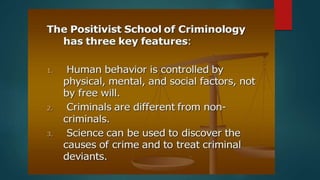
 Modern criminology is the product of two main schools of
thought: The classical school originating in the 18th century,
and the positivist school originating in the 19th century.
 CLASSICAL SCHOOL POSITIVIST SCHOOL
 Jeremy Bentham 1.Cesare Lombroso
 Cesare Beccaria 2.Raffaele Garofalo
3.Enrico Ferri
JEREMY BENTHAM
 Bentham’s contribution to ‘classical’ theory is based on
the fact that he was a utilitarian, interested in the
happiness and well being of the population and
therefore believing that punishment, in the form of the
infliction of pain, should always be justified in terms of a
greater good.
 At the heart of Bentham’s writing was the idea that
human behavior is directed at maximizing pleasure
and minimizing pain, (the pleasure-pain principle).
 Bentham believed that crime was committed on the
outset, by individuals who seek to gain excitement, money,
sex or anything of value to the individual.
CESARE BECCARIA
 stated that; ‘It is better to prevent crimes than to punish
them’.
 Beccaria believed that laws needed to be put into place in
order to make punishments consistent and in line with the
crime.
 He believed that crime prevention in its effectiveness is
down to three main ideas, these being the certainty of the
crime and how likely it is to happened, the celerity of the
crime and how quickly the punishment is inflicted and also
the severity of the crime, and how much pain is inflicted.
 Beccaria thought that the severity of the penalties given
should be proportionate to the crime committed and no
more than what is necessary in order to deter the offender
and others from committing further crimes.
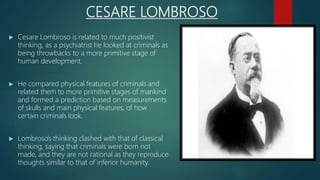
CESARE LOMBROSO
 Cesare Lombroso is related to much positivist
thinking, as a psychiatrist he looked at criminals as
being throwbacks to a more primitive stage of
human development.
 He compared physical features of criminals and
related them to more primitive stages of mankind
and formed a prediction based on measurements
of skulls and main physical features, of how
certain criminals look.
 Lombroso’s thinking clashed with that of classical
thinking, saying that criminals were born not
made, and they are not rational as they reproduce
thoughts similar to that of inferior humanity.
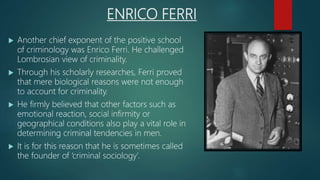
ENRICO FERRI
 Another chief exponent of the positive school
of criminology was Enrico Ferri. He challenged
Lombrosian view of criminality.
 Through his scholarly researches, Ferri proved
that mere biological reasons were not enough
to account for criminality.
 He firmly believed that other factors such as
emotional reaction, social infirmity or
geographical conditions also play a vital role in
determining criminal tendencies in men.
 It is for this reason that he is sometimes called
the founder of ‘criminal sociology’.
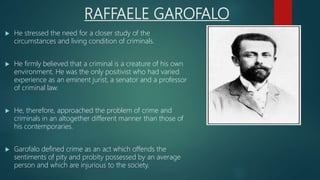
RAFFAELE GAROFALO
 He stressed the need for a closer study of the
circumstances and living condition of criminals.
 He firmly believed that a criminal is a creature of his own
environment. He was the only positivist who had varied
experience as an eminent jurist, a senator and a professor
of criminal law.
 He, therefore, approached the problem of crime and
criminals in an altogether different manner than those of
his contemporaries.
 Garofalo defined crime as an act which offends the
sentiments of pity and probity possessed by an average
person and which are injurious to the society.
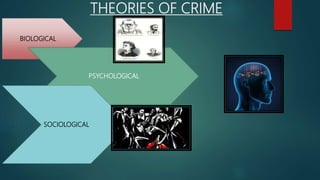
THEORIES OF CRIME
BIOLOGICAL
PSYCHOLOGICAL
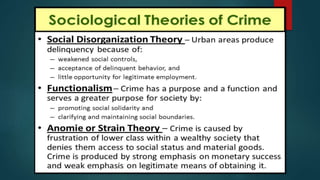
SOCIOLOGICAL
Biological theory of crime
 According to biological
theory, the bio-physical
factors like genetic
influence, chromosomal
abnormalities, bio-chemical
irregularities etc. predispose
certain people to crime.
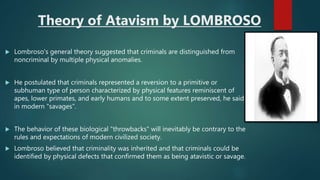
Theory of Atavism by LOMBROSO
 Lombroso's general theory suggested that criminals are distinguished from
noncriminal by multiple physical anomalies.
 He postulated that criminals represented a reversion to a primitive or
subhuman type of person characterized by physical features reminiscent of
apes, lower primates, and early humans and to some extent preserved, he said,
in modern "savages".
 The behavior of these biological "throwbacks" will inevitably be contrary to the
rules and expectations of modern civilized society.
 Lombroso believed that criminality was inherited and that criminals could be
identified by physical defects that confirmed them as being atavistic or savage.
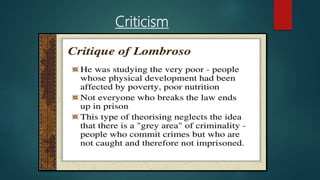
Criticism
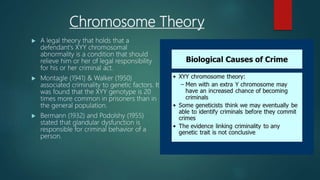
Chromosome Theory
 A legal theory that holds that a
defendant's XYY chromosomal
abnormality is a condition that should
relieve him or her of legal responsibility
for his or her criminal act.
 Montagle (1941) & Walker (1950)
associated criminality to genetic factors. It
was found that the XYY genotype is 20
times more common in prisoners than in
the general population.
 Bermann (1932) and Podolshy (1955)
stated that glandular dysfunction is
responsible for criminal behavior of a
person.
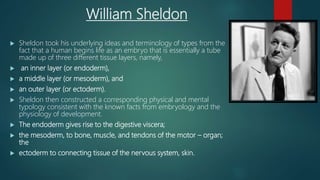
William Sheldon
 Sheldon took his underlying ideas and terminology of types from the
fact that a human begins life as an embryo that is essentially a tube
made up of three different tissue layers, namely,
 an inner layer (or endoderm),
 a middle layer (or mesoderm), and
 an outer layer (or ectoderm).
 Sheldon then constructed a corresponding physical and mental
typology consistent with the known facts from embryology and the
physiology of development.
 The endoderm gives rise to the digestive viscera;
 the mesoderm, to bone, muscle, and tendons of the motor – organ;
the
 ectoderm to connecting tissue of the nervous system, skin.
Sheldon’s theory of Somatotype
Sheldon's
Somatotype
Character Shape Picture
Ectomorph
[cerebrotonic]
quiet, fragile,
restrained, non-
assertive, sensitive
lean, delicate, poor
muscles
Mesomorph
[somatotonic]
active, assertive,
vigorous,
combative
muscular
Endomorph
[viscerotonic]
relaxed, sociable,
tolerant, comfort-
loving, peaceful
plump, buxom,
developed visceral
structure
Ecto Meso Endo
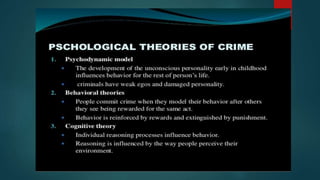
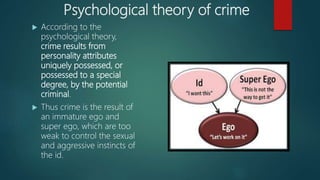
Psychological theory of crime
 According to the
psychological theory,
crime results from
personality attributes
uniquely possessed, or
possessed to a special
degree, by the potential
criminal.
 Thus crime is the result of
an immature ego and
super ego, which are too
weak to control the sexual
and aggressive instincts of
the id.
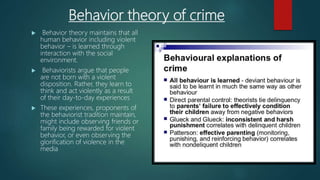
Behavior theory of crime
 Behavior theory maintains that all
human behavior including violent
behavior – is learned through
interaction with the social
environment.
 Behaviorists argue that people
are not born with a violent
disposition. Rather, they learn to
think and act violently as a result
of their day-to-day experiences
 These experiences, proponents of
the behaviorist tradition maintain,
might include observing friends or
family being rewarded for violent
behavior, or even observing the
glorification of violence in the
media
Cognitive theory of crime
 Cognitive theories of crime explain criminal behavior as a defect in
moral thinking, thought processes, and mental development. Cognitive
theories also help us to understand how an individual's personality and
intelligence level are linked to delinquency.
 Cognitive theories focus on how we perceive the world around us, how
we think, and the factors that influence our mental development (family
upbringing, parental modeling, personality, intelligence). These theories
help to explain how we develop morally in our thought process.
Jean Piaget (1932)
Kohlberg’s of moral development
 Kohlberg (1969) applied the concept of
moral development to the study of criminal
behavior.
 He argued that all people travel through six
different stages of moral development.
 At the first stage, people only obey the law
because they are afraid of punishment.
 By the sixth stage, however, people obey
the law because it is an assumed obligation
and because they believe in the universal
principles of justice, equity, and respect for
others.
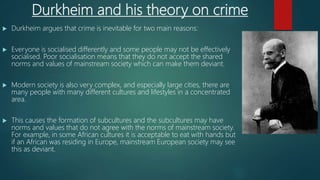
Durkheim and his theory on crime
 Durkheim argues that crime is inevitable for two main reasons:
 Everyone is socialised differently and some people may not be effectively
socialised. Poor socialisation means that they do not accept the shared
norms and values of mainstream society which can make them deviant.
 Modern society is also very complex, and especially large cities, there are
many people with many different cultures and lifestyles in a concentrated
area.
 This causes the formation of subcultures and the subcultures may have
norms and values that do not agree with the norms of mainstream society.
For example, in some African cultures it is acceptable to eat with hands but
if an African was residing in Europe, mainstream European society may see
this as deviant.
 A limited amount of crime is inevitable and even necessary
 Crime has positive functions -A certain amount of crime contributes to the well-being of a society.
 On the other hand, too much crime is bad for society and can help bring about its collapse,
institutions of social control are necessary to keep the amount of crime in check. Refer here to
Durkheim’s Theory of Suicide
 THREE POSITIVE FUNCTION OF CRIME.
 SOCIAL REGULATION
 SOCIAL INTEGRATION
 SOCIAL CHANGE
Criticism of Durkheim
 Durkheim doesn’t state which level of crime is the right amount.
 Just because crime has a function in society does not necessarily mean
that society is deliberately creating crime in order for the functions of it to
be prevalent.
 It doesn’t focus on how crime affects individuals or groups in society
 It also doesn’t recognize that crime can weaken solidarity and increase
isolation – most women stay in at night due to the fear of rape.
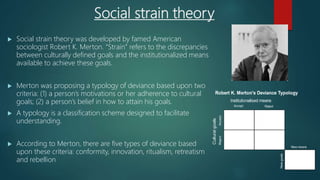
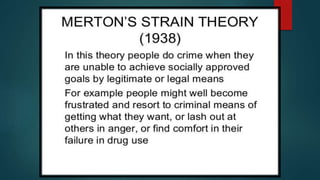
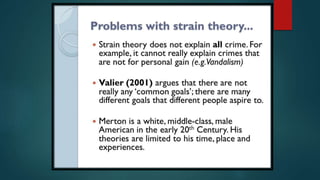
Social strain theory
 Social strain theory was developed by famed American
sociologist Robert K. Merton. “Strain” refers to the discrepancies
between culturally defined goals and the institutionalized means
available to achieve these goals.
 Merton was proposing a typology of deviance based upon two
criteria: (1) a person’s motivations or her adherence to cultural
goals; (2) a person’s belief in how to attain his goals.
 A typology is a classification scheme designed to facilitate
understanding.
 According to Merton, there are five types of deviance based
upon these criteria: conformity, innovation, ritualism, retreatism
and rebellion
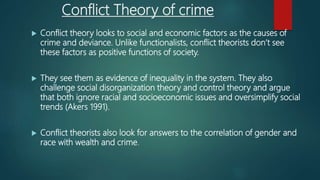
Conflict Theory of crime
 Conflict theory looks to social and economic factors as the causes of
crime and deviance. Unlike functionalists, conflict theorists don’t see
these factors as positive functions of society.
 They see them as evidence of inequality in the system. They also
challenge social disorganization theory and control theory and argue
that both ignore racial and socioeconomic issues and oversimplify social
trends (Akers 1991).
 Conflict theorists also look for answers to the correlation of gender and
race with wealth and crime.
Karl Marx: An Unequal System
 Conflict theory was greatly influenced by the work of German philosopher, economist, and social
scientist Karl Marx.
 Marx believed that the general population was divided into two groups. He labeled the wealthy,
who controlled the means of production and business, the bourgeois.
 He labeled the workers who depended on the bourgeois for employment and survival the
proletariat.
 Marx believed that the bourgeois centralized their power and influence through government, laws,
and other authority agencies in order to maintain and expand their positions of power in society.
 Though Marx spoke little of deviance, his ideas created the foundation for conflict theorists who
study the intersection of deviance and crime with wealth and power.
C. Wright Mills: The Power Elite
 In his book The Power Elite (1956), sociologist C. Wright Mills described the
existence of what he dubbed the power elite, a small group of wealthy and
influential people at the top of society who hold the power and resources.
 Wealthy executives, politicians, celebrities, and military leaders often have
access to national and international power, and in some cases, their decisions
affect everyone in society. Because of this, the rules of society are stacked in
favor of a privileged few who manipulate them to stay on top.
 It is these people who decide what is criminal and what is not, and the effects
are often felt most by those who have little power.
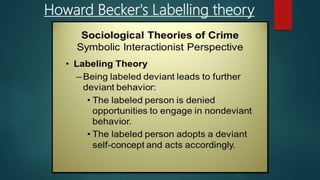
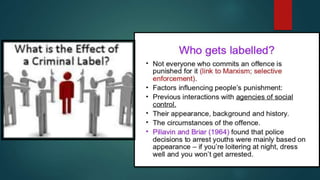
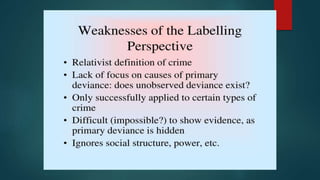
Howard Becker's Labelling theory
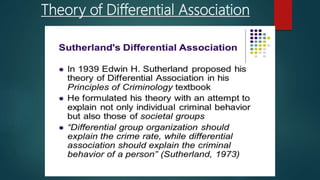
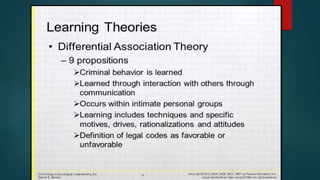
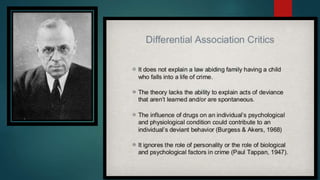
Theory of Differential Association
sakshi.pptx
sakshi.pptx

sakshi.pptx

  • 1.
  • 2.
    DEVIANCE The word deviancehas come from the word “deviate” which means to stray or go away from an accepted path. Deviance is behavior which does not comply with the dominant norms of a specific society off or ridiculed. “Horton and Hunt” The term deviation is given to any failure to conform to customary norms. People are seen as deviant it can lead to negative sanctions such as being told
  • 3.
    RELATIVE AND ABSOLUTEDEVIANCE  Define deviance in an absolute way it would mean that in all societies and at all times certain forms of behavior will be considered deviant.  Define deviance in a relative way it would mean that different societies at different times develop different ways of seeing the same form of behavior. Thus, in effect, someone could commit an act in one society that would be seen as deviant while they could commit the same act in a different society and be seen as non- deviant.
  • 4.
    Sanctions of deviance Positive(rewarded) Soldier giving his life in battlefield by defying the orders of his captain. Overconforms to social expectations Negative (punished) Not Graduating from high school Behavior that underconforms to accepted norms Neutral The little old lady with the houseful of cats. accept without reward or punishment
  • 5.
    Deviance is oftendivided into two types of deviant activities  The first, crime is the violation of formally enacted laws and is referred to as formal deviance. Examples of formal deviance would include: Robert, punched a pregnant lady in the face  The second type of deviant behavior refers to violations of informal social norms, norms that have not been codified into law, and is referred as informal deviance. Examples of informal deviance might include: Gary walked through his local library whilst talking loudly on his mobile phone”.
  • 6.
    CRIME Crime is anact of contravening the statues enacted by legislations after lengthy debates on what constitutes a criminal offense and what penalties to institute for certain crimes. The sociological discipline that concerns itself with criminal studies is termed criminology. According to the legal definition, “crime” is any form of conduct which is declared to be socially harmful in a state and such forbidden by law under pain of some punishment. There are mild and severe crimes. The mild ones can include a mere shoplifting or beating someone while the severe crimes can include murder, stealing large sums of money, and sexual harassment.
  • 7.
    There are 3elements in criminal law POLITICAL It means that the laws, the violation of which attracts penalty is made by the political superior or the state. SPECIFICITY It means that only certain specific acts of delinquency are treated as crime and not all. UNIFORMITY It implies that the law must be applied to all without any exception on grounds of a person’s social status.
  • 8.
  • 9.
    Juvenile delinquency  Acrime is termed juvenile delinquency when committed by a young person under a certain age. The legal definition of Juvenile Delinquency is “any act prohibited by law for children up to prescribed age limit is Juvenile Delinquency” and it follows, that if a child found to have committed an act of Juvenile Delinquency then he must be produced before the court which is specially set up for Juvenile Delinquent.  A Delinquency as a social problem  B. Delinquency as a behavioral problem.  C. Delinquency as a legal problem.
  • 10.
    Who are JuvenileDelinquents?  Juvenile delinquents are regularly youngsters between the ages of 10 and 17 who have carried out a criminal demonstration.  (1) Neurotic Offenders Neurotic offender delinquency is due to influential unconscious impulses which often produces guilt and motivates them to indulge into delinquent activities in their society. For example, sometime stealing is done to fulfill their partners wishes and not for personal material gain. To these delinquents, their internal problems should be handled by externalizing the problem within the surroundings.  Character Disorder Offenders This category of offenders often feels very guilty and regret when they commit petty criminal acts. Because there is lack of positive identification models in their surroundings, they failed to develop willpower and do what they want to do when they get the chance of doing it. They are incapable to control their impulses in a socially acceptable manner. Types of Character Disorder Offenders  Gang Organized Delinquency Unsocialized Delinquents  Accidental Delinquency Occasional Offender  Professional Delinquency
  • 11.
    Juvenile delinquency inIndia  Juveniles who went to school committed crimes more than those who did not, in 2017, according to the latest report of National Crime Records Bureau (NCRB) on ‘Crime in India’.  The number of ‘educated’ juvenile offenders, who have studied up to matriculation and higher secondary levels, increased to 6,260 in 2017 from 4,244 in 2016 — a difference of over 32 per cent,  The NCRB report also showed that of the total 2,677 crimes committed by juveniles in Delhi, 46 were murder cases, 132 were rape cases, 93 molestation cases, 320 robberies, 17 incidents of unnatural sex, seven dacoities and 49 cases of rash driving.  The most common crime committed by juveniles in Delhi was theft — 1,381 cases.
  • 12.
  • 13.
    -Suggestions   Control ofdelinquency needs effective implementation of Juvenile Justice Act, with full public awareness and proper orientation and training to professionals and law enforcement agencies.  Application of UN Rules for Juveniles Deprived of their Liberty (1990)  Advocacy for various legal provisions provided for juveniles.  A proper mechanism should be created to assess the needs and requirements of the juveniles and it should be reviewed regularly.  The approach of the agencies like police involved in the system may be more of reformative character rather than pure penal. The objective may be to reform the delinquents, rather than just to punish them.
  • 14.
     · Governmentshould put more emphasis of useful and attractive beneficial long-term schemes for Juveniles so that they feel motivated to join main stream of the society and regain their self-confidence, which is generally lost because of the callous attitude of the society.  State Governments and Union Territories administrations should encourage and provide support to voluntary organization to start or modernize juvenile services including community services. · Longer association of community and voluntary organizations in the schemes of Government programs like nutrition for all, literacy, health, eradication of child labor, etc. shall help to a great extent to weed out delinquency.
  • 15.
    Definitions of crime SOCIOLOGICAL DEFINITION OF CRIME  RAFFAELE GAROFALO “crime is an immoral and harmful act which is regarded as a criminal by public opinion because it is an injury to the morality”  LEGAL DEFINITION OF CRIME  CROSS AND JONES “Crime as a legal wrong the remedy for which is punishment of the offender at the instance of the state”  BEHAVIOURAL DEFINITION OF CRIME The violation of prevailing norms or cultural standards prescribing how humans ought to behave.
  • 16.
    Schools of criminology Modern criminology is the product of two main schools of thought: The classical school originating in the 18th century, and the positivist school originating in the 19th century.  CLASSICAL SCHOOL POSITIVIST SCHOOL  Jeremy Bentham 1.Cesare Lombroso  Cesare Beccaria 2.Raffaele Garofalo 3.Enrico Ferri
  • 18.
    JEREMY BENTHAM  Bentham’scontribution to ‘classical’ theory is based on the fact that he was a utilitarian, interested in the happiness and well being of the population and therefore believing that punishment, in the form of the infliction of pain, should always be justified in terms of a greater good.  At the heart of Bentham’s writing was the idea that human behavior is directed at maximizing pleasure and minimizing pain, (the pleasure-pain principle).  Bentham believed that crime was committed on the outset, by individuals who seek to gain excitement, money, sex or anything of value to the individual.
  • 19.
    CESARE BECCARIA  statedthat; ‘It is better to prevent crimes than to punish them’.  Beccaria believed that laws needed to be put into place in order to make punishments consistent and in line with the crime.  He believed that crime prevention in its effectiveness is down to three main ideas, these being the certainty of the crime and how likely it is to happened, the celerity of the crime and how quickly the punishment is inflicted and also the severity of the crime, and how much pain is inflicted.  Beccaria thought that the severity of the penalties given should be proportionate to the crime committed and no more than what is necessary in order to deter the offender and others from committing further crimes.
  • 21.
    CESARE LOMBROSO  CesareLombroso is related to much positivist thinking, as a psychiatrist he looked at criminals as being throwbacks to a more primitive stage of human development.  He compared physical features of criminals and related them to more primitive stages of mankind and formed a prediction based on measurements of skulls and main physical features, of how certain criminals look.  Lombroso’s thinking clashed with that of classical thinking, saying that criminals were born not made, and they are not rational as they reproduce thoughts similar to that of inferior humanity.
  • 22.
    ENRICO FERRI  Anotherchief exponent of the positive school of criminology was Enrico Ferri. He challenged Lombrosian view of criminality.  Through his scholarly researches, Ferri proved that mere biological reasons were not enough to account for criminality.  He firmly believed that other factors such as emotional reaction, social infirmity or geographical conditions also play a vital role in determining criminal tendencies in men.  It is for this reason that he is sometimes called the founder of ‘criminal sociology’.
  • 23.
    RAFFAELE GAROFALO  Hestressed the need for a closer study of the circumstances and living condition of criminals.  He firmly believed that a criminal is a creature of his own environment. He was the only positivist who had varied experience as an eminent jurist, a senator and a professor of criminal law.  He, therefore, approached the problem of crime and criminals in an altogether different manner than those of his contemporaries.  Garofalo defined crime as an act which offends the sentiments of pity and probity possessed by an average person and which are injurious to the society.
  • 25.
  • 26.
    Biological theory ofcrime  According to biological theory, the bio-physical factors like genetic influence, chromosomal abnormalities, bio-chemical irregularities etc. predispose certain people to crime.
  • 27.
    Theory of Atavismby LOMBROSO  Lombroso's general theory suggested that criminals are distinguished from noncriminal by multiple physical anomalies.  He postulated that criminals represented a reversion to a primitive or subhuman type of person characterized by physical features reminiscent of apes, lower primates, and early humans and to some extent preserved, he said, in modern "savages".  The behavior of these biological "throwbacks" will inevitably be contrary to the rules and expectations of modern civilized society.  Lombroso believed that criminality was inherited and that criminals could be identified by physical defects that confirmed them as being atavistic or savage.
  • 28.
  • 29.
    Chromosome Theory  Alegal theory that holds that a defendant's XYY chromosomal abnormality is a condition that should relieve him or her of legal responsibility for his or her criminal act.  Montagle (1941) & Walker (1950) associated criminality to genetic factors. It was found that the XYY genotype is 20 times more common in prisoners than in the general population.  Bermann (1932) and Podolshy (1955) stated that glandular dysfunction is responsible for criminal behavior of a person.
  • 30.
    William Sheldon  Sheldontook his underlying ideas and terminology of types from the fact that a human begins life as an embryo that is essentially a tube made up of three different tissue layers, namely,  an inner layer (or endoderm),  a middle layer (or mesoderm), and  an outer layer (or ectoderm).  Sheldon then constructed a corresponding physical and mental typology consistent with the known facts from embryology and the physiology of development.  The endoderm gives rise to the digestive viscera;  the mesoderm, to bone, muscle, and tendons of the motor – organ; the  ectoderm to connecting tissue of the nervous system, skin.
  • 31.
    Sheldon’s theory ofSomatotype Sheldon's Somatotype Character Shape Picture Ectomorph [cerebrotonic] quiet, fragile, restrained, non- assertive, sensitive lean, delicate, poor muscles Mesomorph [somatotonic] active, assertive, vigorous, combative muscular Endomorph [viscerotonic] relaxed, sociable, tolerant, comfort- loving, peaceful plump, buxom, developed visceral structure Ecto Meso Endo
  • 33.
    Psychological theory ofcrime  According to the psychological theory, crime results from personality attributes uniquely possessed, or possessed to a special degree, by the potential criminal.  Thus crime is the result of an immature ego and super ego, which are too weak to control the sexual and aggressive instincts of the id.
  • 34.
    Behavior theory ofcrime  Behavior theory maintains that all human behavior including violent behavior – is learned through interaction with the social environment.  Behaviorists argue that people are not born with a violent disposition. Rather, they learn to think and act violently as a result of their day-to-day experiences  These experiences, proponents of the behaviorist tradition maintain, might include observing friends or family being rewarded for violent behavior, or even observing the glorification of violence in the media
  • 35.
    Cognitive theory ofcrime  Cognitive theories of crime explain criminal behavior as a defect in moral thinking, thought processes, and mental development. Cognitive theories also help us to understand how an individual's personality and intelligence level are linked to delinquency.  Cognitive theories focus on how we perceive the world around us, how we think, and the factors that influence our mental development (family upbringing, parental modeling, personality, intelligence). These theories help to explain how we develop morally in our thought process.
  • 36.
  • 38.
    Kohlberg’s of moraldevelopment  Kohlberg (1969) applied the concept of moral development to the study of criminal behavior.  He argued that all people travel through six different stages of moral development.  At the first stage, people only obey the law because they are afraid of punishment.  By the sixth stage, however, people obey the law because it is an assumed obligation and because they believe in the universal principles of justice, equity, and respect for others.
  • 40.
    Durkheim and histheory on crime  Durkheim argues that crime is inevitable for two main reasons:  Everyone is socialised differently and some people may not be effectively socialised. Poor socialisation means that they do not accept the shared norms and values of mainstream society which can make them deviant.  Modern society is also very complex, and especially large cities, there are many people with many different cultures and lifestyles in a concentrated area.  This causes the formation of subcultures and the subcultures may have norms and values that do not agree with the norms of mainstream society. For example, in some African cultures it is acceptable to eat with hands but if an African was residing in Europe, mainstream European society may see this as deviant.
  • 41.
     A limitedamount of crime is inevitable and even necessary  Crime has positive functions -A certain amount of crime contributes to the well-being of a society.  On the other hand, too much crime is bad for society and can help bring about its collapse, institutions of social control are necessary to keep the amount of crime in check. Refer here to Durkheim’s Theory of Suicide  THREE POSITIVE FUNCTION OF CRIME.  SOCIAL REGULATION  SOCIAL INTEGRATION  SOCIAL CHANGE
  • 42.
    Criticism of Durkheim Durkheim doesn’t state which level of crime is the right amount.  Just because crime has a function in society does not necessarily mean that society is deliberately creating crime in order for the functions of it to be prevalent.  It doesn’t focus on how crime affects individuals or groups in society  It also doesn’t recognize that crime can weaken solidarity and increase isolation – most women stay in at night due to the fear of rape.
  • 43.
    Social strain theory Social strain theory was developed by famed American sociologist Robert K. Merton. “Strain” refers to the discrepancies between culturally defined goals and the institutionalized means available to achieve these goals.  Merton was proposing a typology of deviance based upon two criteria: (1) a person’s motivations or her adherence to cultural goals; (2) a person’s belief in how to attain his goals.  A typology is a classification scheme designed to facilitate understanding.  According to Merton, there are five types of deviance based upon these criteria: conformity, innovation, ritualism, retreatism and rebellion
  • 47.
    Conflict Theory ofcrime  Conflict theory looks to social and economic factors as the causes of crime and deviance. Unlike functionalists, conflict theorists don’t see these factors as positive functions of society.  They see them as evidence of inequality in the system. They also challenge social disorganization theory and control theory and argue that both ignore racial and socioeconomic issues and oversimplify social trends (Akers 1991).  Conflict theorists also look for answers to the correlation of gender and race with wealth and crime.
  • 48.
    Karl Marx: AnUnequal System  Conflict theory was greatly influenced by the work of German philosopher, economist, and social scientist Karl Marx.  Marx believed that the general population was divided into two groups. He labeled the wealthy, who controlled the means of production and business, the bourgeois.  He labeled the workers who depended on the bourgeois for employment and survival the proletariat.  Marx believed that the bourgeois centralized their power and influence through government, laws, and other authority agencies in order to maintain and expand their positions of power in society.  Though Marx spoke little of deviance, his ideas created the foundation for conflict theorists who study the intersection of deviance and crime with wealth and power.
  • 49.
    C. Wright Mills:The Power Elite  In his book The Power Elite (1956), sociologist C. Wright Mills described the existence of what he dubbed the power elite, a small group of wealthy and influential people at the top of society who hold the power and resources.  Wealthy executives, politicians, celebrities, and military leaders often have access to national and international power, and in some cases, their decisions affect everyone in society. Because of this, the rules of society are stacked in favor of a privileged few who manipulate them to stay on top.  It is these people who decide what is criminal and what is not, and the effects are often felt most by those who have little power.
  • 50.
  • 53.