Sociology in Modules 2nd Edition Schaefer
Solutions Manual download
https://testbankdeal.com/product/sociology-in-modules-2nd-
edition-schaefer-solutions-manual/
Visit testbankdeal.com today to download the complete set of
test bank or solution manual
We have selected some products that you may be interested in
Click the link to download now or visit testbankdeal.com
for more options!.
Sociology in Modules 2nd Edition Schaefer Test Bank
https://testbankdeal.com/product/sociology-in-modules-2nd-edition-
schaefer-test-bank/
Sociology in Modules 3rd Edition Schaefer Test Bank
https://testbankdeal.com/product/sociology-in-modules-3rd-edition-
schaefer-test-bank/
Sociology in Modules 4th Edition T Schaefer Test Bank
https://testbankdeal.com/product/sociology-in-modules-4th-edition-t-
schaefer-test-bank/
Foundations of Financial Management Canadian 11th Edition
Block Test Bank
https://testbankdeal.com/product/foundations-of-financial-management-
canadian-11th-edition-block-test-bank/
World History 7th Edition Duiker Test Bank
https://testbankdeal.com/product/world-history-7th-edition-duiker-
test-bank/
Bank Management and Financial Services 9th Edition Rose
Test Bank
https://testbankdeal.com/product/bank-management-and-financial-
services-9th-edition-rose-test-bank/
Basic Marketing A Strategic Marketing Planning Approach
18th Edition Perreault Test Bank
https://testbankdeal.com/product/basic-marketing-a-strategic-
marketing-planning-approach-18th-edition-perreault-test-bank/
Basic College Mathematics 6th Edition Martin-Gay Test Bank
https://testbankdeal.com/product/basic-college-mathematics-6th-
edition-martin-gay-test-bank/
Mosbys Canadian Textbook for The Support Worker 4th
Edition Sorrentino Test Bank
https://testbankdeal.com/product/mosbys-canadian-textbook-for-the-
support-worker-4th-edition-sorrentino-test-bank/
Using Financial Accounting Information The Alternative to
Debits and Credits 9th Edition Porter Solutions Manual
https://testbankdeal.com/product/using-financial-accounting-
information-the-alternative-to-debits-and-credits-9th-edition-porter-
solutions-manual/
IM – 7 | 1
CHAPTER
7 DEVIANCE, CRIME, AND
SOCIAL CONTROL
CHAPTER OUTLINE
MODULE 23: SOCIAL CONTROL
Conformity and Obedience
Informal and Formal Social Control
Law and Society
MODULE 24: WHAT IS
DEVIANCE?
Deviance and Social Stigma
Deviance and Technology
Sociological Perspectives on Deviance
MODULE 25: CRIME
Types of Crime
Crime Statistics
Boxes
Sociology on Campus: Binge Drinking
Trendspotting: Incarceration Nation
Research Today: Does Crime Pay?
Sociology on Campus: Campus Crime
Taking Sociology to Work: Stephanie
Vezzani, Special Agent, U.S. Secret
Service
Social Policy and Social Control: The
Death Penalty in the United States and
Worldwide
IM – 7 | 2
LEARNING OBJECTIVES WHAT’S NEW IN CHAPTER 7
1. Define and discuss the elements of social
control.
2. Discuss the classic Milgram experiment and
its implications for obedience and
conformity.
3. Discuss what is meant by informal and
formal social control.
4. Define deviance and social stigma.
5. Discuss the various functionalist concepts
and views explaining deviance.
6. Discuss the various interactionist concepts
and views explaining deviance.
7. Discuss the explanations of deviance from
the conflict and feminist perspectives.
8. Describe the various types of crime.
9. Discuss the nature and extent of crime in the
United States.
Module 25: Crime
• Subsection on hate crime, with figure,
“Categorization of Reported Hate
Crimes”
• Reorganized section on crime statistics,
with subsections on (a) index crimes and
victimization surveys, (b) crime trends,
and (c) international crime rates.
• Social Policy section on the death
penalty, with Mapping Life Worldwide
map, “Death Penalty Status by Country”
CHAPTER SUMMARY
The term social control refers to techniques and strategies for preventing deviant human behavior. Social
control occurs in families, peer groups, and bureaucratic organizations. Members of society are expected
to act in accordance with social norms. Sanctions, which may be either penalties or rewards, help to
induce behavior consistent with social norms.
Conformity is defined as going along with one’s peers even though they have no special right to direct
our behavior. Obedience is defined as compliance with higher authorities in a hierarchal structure. Social
controls may occur casually and informally through such means as smiles, laughter, and ridicule.
Authorized agents, such as police officers, physicians, school administrators, employers, and military
officers, carry out formal social control. Law is defined as governmental social control and reflects
continually changing standards of what is right and wrong.
Sociologists define deviance as behavior that violates the standards of conduct or expectations of a group
or society. Deviance involves the violations of group norms that may or may not be formalized into law.
It is a comprehensive concept that includes not only criminal behavior, but also many actions not subject
to prosecution. Deviance can be understood only within its social context. The term stigma was coined by
Erving Goffman to describe the labels society uses to devalue the members of certain social groups.
People are often stigmatized for deviant behaviors they may no longer engage in.
IM – 7 | 3
According to the functionalist view, deviance is a normal part of human existence. Functionalists suggest
that deviance helps to define the limits of proper behavior. Robert Merton adapted Émile Durkheim’s
notion of anomie to explain why people accept or reject the goals of a society. Merton’s theory posits five
basic forms of adaptations: (1) conformity, (2) innovation, (3) ritualism, (4) retreatism, and (5) rebellion.
Merton’s anomie theory, though popular, has had relatively few applications.
The interactionist perspective is reflected in theories based on cultural transmission, social
disorganization, and labeling. Cultural transmission, associated with criminologist Edwin Sutherland,
suggests that criminal behavior is learned through interactions with others. He used the term differential
association to describe the process through which exposure to attitudes favorable to criminal acts leads to
violation of rules. Social disorganization theory suggests that deviance increases when communal
relationships in neighborhoods and social networks are weakened or absent. Labeling theory emphasizes
how a person comes to be labeled as deviant or to accept the label. Labeling theory is also referred to as
the societal-reaction approach. The popularity of labeling theory is evident in the emergence of the social
constructionist perspective, which purports that deviance is the product of the culture in which we live.
Social constructionists focus on the decision-making process that creates the deviant identity.
The conflict view of deviance suggests that people with power protect their own interests and define
deviance to suit their own needs. Relating to differential justice, Richard Quinney argues that lawmaking
is often an attempt by the powerful to coerce others into their own brand of morality. Akin to the roots of
conflict theory, the feminist perspective suggests that deviance, including crime, tends to flow from
economic relationships. Feminists suggest that cultural views and attitudes toward women influence how
women are perceived and labeled.
Crime represents a deviation from formal social norms administered by the state. Types of crime include
professional crime, organized crime, white-collar and technology-based crime, corporate crime,
transnational crime, and victimless crime. There has been a significant decline in violent crime in the
United States. The accuracy of measuring crime and tabulating crime statistics varies widely. The
National Crime Victimization Survey was initiated in 1972 to question ordinary people about crime
victimization.
RESOURCE INTEGRATOR
Focus Questions Resources
1. What are the various
means of social control?
IN THE TEXT
Key Terms: social control, sanctions, conformity, obedience, informal
social control, formal social control, law, control theory
Boxes: Sociology on Campus: Binge Drinking
IN THE INSTRUCTOR’S MANUAL
Additional Lecture Ideas: Ethical Implications of Milgram’s Research
(7-1); Social Control on the Streets (7-2)
Classroom Discussion Topics: Group Pressure (7-2); The Power of
Authority (7-3); Field Trip to Prison (7-4); Public Opinion on Death
Penalty (7-9)
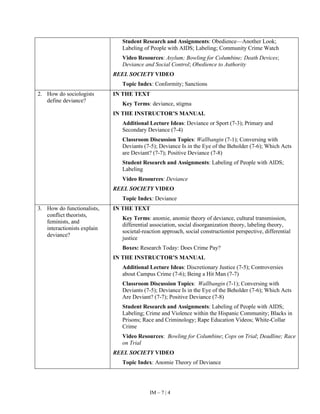
IM – 7 | 4
Student Research and Assignments: Obedience—Another Look;
Labeling of People with AIDS; Labeling; Community Crime Watch
Video Resources: Asylum; Bowling for Columbine; Death Devices;
Deviance and Social Control; Obedience to Authority
REEL SOCIETY VIDEO
Topic Index: Conformity; Sanctions
2. How do sociologists
define deviance?
IN THE TEXT
Key Terms: deviance, stigma
IN THE INSTRUCTOR’S MANUAL
Additional Lecture Ideas: Deviance or Sport (7-3); Primary and
Secondary Deviance (7-4)
Classroom Discussion Topics: Wallbangin (7-1); Conversing with
Deviants (7-5); Deviance Is in the Eye of the Beholder (7-6); Which Acts
are Deviant? (7-7); Positive Deviance (7-8)
Student Research and Assignments: Labeling of People with AIDS;
Labeling
Video Resources: Deviance
REEL SOCIETY VIDEO
Topic Index: Deviance
3. How do functionalists,
conflict theorists,
feminists, and
interactionists explain
deviance?
IN THE TEXT
Key Terms: anomie, anomie theory of deviance, cultural transmission,
differential association, social disorganization theory, labeling theory,
societal-reaction approach, social constructionist perspective, differential
justice
Boxes: Research Today: Does Crime Pay?
IN THE INSTRUCTOR’S MANUAL
Additional Lecture Ideas: Discretionary Justice (7-5); Controversies
about Campus Crime (7-6); Being a Hit Man (7-7)
Classroom Discussion Topics: Wallbangin (7-1); Conversing with
Deviants (7-5); Deviance Is in the Eye of the Beholder (7-6); Which Acts
Are Deviant? (7-7); Positive Deviance (7-8)
Student Research and Assignments: Labeling of People with AIDS;
Labeling; Crime and Violence within the Hispanic Community; Blacks in
Prisons; Race and Criminology; Rape Education Videos; White-Collar
Crime
Video Resources: Bowling for Columbine; Cops on Trial; Deadline; Race
on Trial
REEL SOCIETY VIDEO
Topic Index: Anomie Theory of Deviance
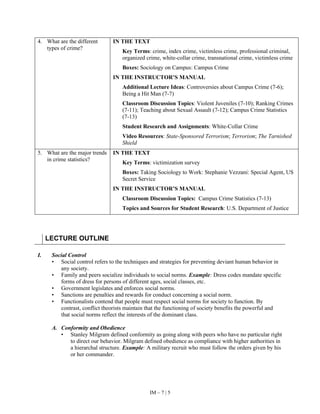
IM – 7 | 5
4. What are the different
types of crime?
IN THE TEXT
Key Terms: crime, index crime, victimless crime, professional criminal,
organized crime, white-collar crime, transnational crime, victimless crime
Boxes: Sociology on Campus: Campus Crime
IN THE INSTRUCTOR’S MANUAL
Additional Lecture Ideas: Controversies about Campus Crime (7-6);
Being a Hit Man (7-7)
Classroom Discussion Topics: Violent Juveniles (7-10); Ranking Crimes
(7-11); Teaching about Sexual Assault (7-12); Campus Crime Statistics
(7-13)
Student Research and Assignments: White-Collar Crime
Video Resources: State-Sponsored Terrorism; Terrorism; The Tarnished
Shield
5. What are the major trends
in crime statistics?
IN THE TEXT
Key Terms: victimization survey
Boxes: Taking Sociology to Work: Stephanie Vezzani: Special Agent, US
Secret Service
IN THE INSTRUCTOR’S MANUAL
Classroom Discussion Topics: Campus Crime Statistics (7-13)
Topics and Sources for Student Research: U.S. Department of Justice
LECTURE OUTLINE
I. Social Control
• Social control refers to the techniques and strategies for preventing deviant human behavior in
any society.
• Family and peers socialize individuals to social norms. Example: Dress codes mandate specific
forms of dress for persons of different ages, social classes, etc.
• Government legislates and enforces social norms.
• Sanctions are penalties and rewards for conduct concerning a social norm.
• Functionalists contend that people must respect social norms for society to function. By
contrast, conflict theorists maintain that the functioning of society benefits the powerful and
that social norms reflect the interests of the dominant class.
A. Conformity and Obedience
• Stanley Milgram defined conformity as going along with peers who have no particular right
to direct our behavior. Milgram defined obedience as compliance with higher authorities in
a hierarchal structure. Example: A military recruit who must follow the orders given by his
or her commander.
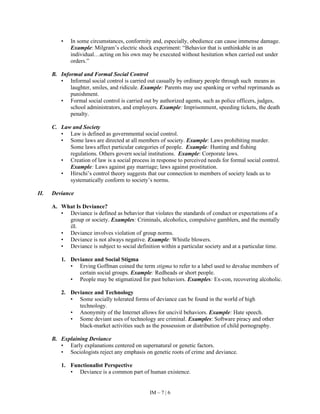
IM – 7 | 6
• In some circumstances, conformity and, especially, obedience can cause immense damage.
Example: Milgram’s electric shock experiment: “Behavior that is unthinkable in an
individual…acting on his own may be executed without hesitation when carried out under
orders.”
B. Informal and Formal Social Control
• Informal social control is carried out casually by ordinary people through such means as
laughter, smiles, and ridicule. Example: Parents may use spanking or verbal reprimands as
punishment.
• Formal social control is carried out by authorized agents, such as police officers, judges,
school administrators, and employers. Example: Imprisonment, speeding tickets, the death
penalty.
C. Law and Society
• Law is defined as governmental social control.
• Some laws are directed at all members of society. Example: Laws prohibiting murder.
Some laws affect particular categories of people. Example: Hunting and fishing
regulations. Others govern social institutions. Example: Corporate laws.
• Creation of law is a social process in response to perceived needs for formal social control.
Example: Laws against gay marriage; laws against prostitution.
• Hirschi’s control theory suggests that our connection to members of society leads us to
systematically conform to society’s norms.
II. Deviance
A. What Is Deviance?
• Deviance is defined as behavior that violates the standards of conduct or expectations of a
group or society. Examples: Criminals, alcoholics, compulsive gamblers, and the mentally
ill.
• Deviance involves violation of group norms.
• Deviance is not always negative. Example: Whistle blowers.
• Deviance is subject to social definition within a particular society and at a particular time.
1. Deviance and Social Stigma
• Erving Goffman coined the term stigma to refer to a label used to devalue members of
certain social groups. Example: Redheads or short people.
• People may be stigmatized for past behaviors. Examples: Ex-con, recovering alcoholic.
2. Deviance and Technology
• Some socially tolerated forms of deviance can be found in the world of high
technology.
• Anonymity of the Internet allows for uncivil behaviors. Example: Hate speech.
• Some deviant uses of technology are criminal. Examples: Software piracy and other
black-market activities such as the possession or distribution of child pornography.
B. Explaining Deviance
• Early explanations centered on supernatural or genetic factors.
• Sociologists reject any emphasis on genetic roots of crime and deviance.
1. Functionalist Perspective
• Deviance is a common part of human existence.
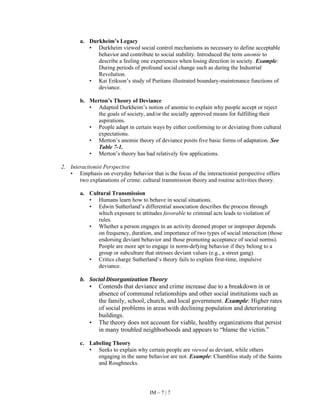
IM – 7 | 7
a. Durkheim’s Legacy
• Durkheim viewed social control mechanisms as necessary to define acceptable
behavior and contribute to social stability. Introduced the term anomie to
describe a feeling one experiences when losing direction in society. Example:
During periods of profound social change such as during the Industrial
Revolution.
• Kai Erikson’s study of Puritans illustrated boundary-maintenance functions of
deviance.
b. Merton’s Theory of Deviance
• Adapted Durkheim’s notion of anomie to explain why people accept or reject
the goals of society, and/or the socially approved means for fulfilling their
aspirations.
• People adapt in certain ways by either conforming to or deviating from cultural
expectations.
• Merton’s anomie theory of deviance posits five basic forms of adaptation. See
Table 7-1.
• Merton’s theory has had relatively few applications.
2. Interactionist Perspective
• Emphasis on everyday behavior that is the focus of the interactionist perspective offers
two explanations of crime: cultural transmission theory and routine activities theory.
a. Cultural Transmission
• Humans learn how to behave in social situations.
• Edwin Sutherland’s differential association describes the process through
which exposure to attitudes favorable to criminal acts leads to violation of
rules.
• Whether a person engages in an activity deemed proper or improper depends
on frequency, duration, and importance of two types of social interaction (those
endorsing deviant behavior and those promoting acceptance of social norms).
People are more apt to engage in norm-defying behavior if they belong to a
group or subculture that stresses deviant values (e.g., a street gang).
• Critics charge Sutherland’s theory fails to explain first-time, impulsive
deviance.
b. Social Disorganization Theory
• Contends that deviance and crime increase due to a breakdown in or
absence of communal relationships and other social institutions such as
the family, school, church, and local government. Example: Higher rates
of social problems in areas with declining population and deteriorating
buildings.
• The theory does not account for viable, healthy organizations that persist
in many troubled neighborhoods and appears to “blame the victim.”
c. Labeling Theory
• Seeks to explain why certain people are viewed as deviant, while others
engaging in the same behavior are not. Example: Chambliss study of the Saints
and Roughnecks.
IM – 7 | 8
• Also called the societal-reaction approach. It is the response to an act, not the
behavior itself, that determines deviance. Example: Assigning a “trouble-
maker” to a program for the learning disabled; labeling someone an “addict,”
or a “slow learner.”
• Labeling theory focuses on regulatory agents (police, probation officers,
psychiatrists, judges, teachers, etc.), who play a significant role in creating the
deviant identity by designating certain people as deviant. Example: Racial
profiling; laws which designate certain persons as “illegal” (i.e., laws
regulating undocumented citizens).
• Labeling does not fully explain why some people accept a label and
others do not.
• Labeling theory influenced the emergence of the social constructionist
perspective, which suggests deviance is the product of the culture we live in.
Examples: Being a “deadbeat dad” or a “single mother.”
3. Conflict Theory
• People with power protect their own interests and define deviance to suit their own
needs.
• Richard Quinney suggests the criminal justice system serves the interests of the
powerful. Lawmaking is an attempt by the powerful to coerce others into their own
morality. Example: Victimless crimes.
• Differential justice: Conflict theory suggests criminal suspects are treated differently on
the basis of race, ethnicity, or social class. African Americans and Latinos are at a
disadvantage in the justice system, both as juveniles and as adults. See Social Policy
Section on application of the death penalty.
• Differential justice may lead to increased violence and crime, as those who view
themselves as victims of unfair treatment strike out, not against the powerful so much
as against fellow victims.
4. Feminist Perspective
• Some suggest that existing approaches to deviance and crime developed with only men
in mind. Example: Earlier legal views on spousal rape, reflecting overwhelming male
composition of state legislatures at the time.
• Society tends to treat women in a stereotypical fashion. Cultural views and attitudes
toward women influence how they are perceived and labeled. Example: Women with
numerous/frequent sexual partners are subjected to greater scorn than promiscuous
men.
• Deviance, including crime, flows from economic relationships. Example:
Traditionally, men have greater opportunity to commit crimes such as embezzlement
and fraud.
• As women assume more active and powerful roles, gender differences in deviance and
crime are narrowing.
III. Crime
• Crime is a violation of criminal law for which some governmental authority applies formal penalties.
• Index crimes are the eight types of crime that are tabulated each year by the FBI. They include murder, rape, robbery, and assault
(all of which are violent crimes committed against people) and property crimes of burglary, theft, motor vehicle theft, and arson.
A. Types of Crime
IM – 7 | 9
1. Victimless Crimes
• The willing exchange among adults of widely desired, but illegal, goods and services.
Examples: Prostitution, drug abuse, gambling.
• Proponents of decriminalization are troubled by attempts to legislate a moral code for
adults. These crimes are impossible to prevent, and an overburdened criminal justice
system should concentrate on offenses with real victims.
• Critics of decriminalization object to the notion that these crimes are “victimless.”
Examples: Over-drinking, compulsive gambling, and illegal drugs cause personal and
property damage. Prostitution reinforces idea that women are “toys” or objects to be
used for men’s pleasure. Alcohol and drug abuse can lead to drunk driving, etc.
2. Professional Crime
• Professional criminal (career criminal) is a person who pursues crime as a day-to-day
occupation. Example: Burglary or safecracking.
• They devote their entire working time to planning and executing crimes. They develop
skilled techniques and enjoy a certain degree of status among other criminals.
• Edward Sutherland (1937) offered pioneering insights into behavior of professional
criminals by publishing an annotated account written by a professional thief.
3. Organized Crime
• The work of a group that regulates relations between various criminal enterprises
involved in illegal activities, including smuggling and sale of illegal drugs, prostitution,
and gambling.
• Organized crime is a secret activity that evades law enforcement. It takes over
legitimate business, gains influence over labor unions, corrupts public officials,
intimidates witnesses, and taxes merchants for protection services.
• The global nature of organized crime can be found in the acts of transnational
organized crime affiliates, whose criminal activities include drug and arms smuggling,
money laundering, and trafficking in illegal immigrants and stolen goods.
4. White-Collar and Technology-Based Crime
• White-collar crime: illegal acts committed in the course of business activities by
affluent, “respectable” people. Examples: Income tax evasion, embezzlement, bribery.
• Edwin Sutherland coined the term white-collar crime in 1939 in reference to
individuals. The term has been broadened to include offenses by businesses and
corporations.
• Corporate crime is any criminal act by a corporation that is punishable by the
government. It takes many forms and includes individuals, organizations, and
institutions among its victims. Examples: Stock fraud and manipulation, accounting
fraud, production of unsafe goods, environmental pollution, anticompetitive behavior,
public health violations, and bribery and corruption.
• Computer crime: High technology allows criminals to carry out embezzlement or
electronic fraud, often leaving few traces. A 2009 study by the FBI White Collar
Crime Center found over 270,000 Internet crimes are reported every year.
• Convictions for such illegal acts do not generally harm a person’s reputation, status, or
career aspirations as much as conviction for a street crime.
5. Transnational Crime
IM – 7 | 10
• Crime that occurs across multiple national borders. Rather than concentrating on
specific countries, international crime spans the globe. Examples: terrorism, trafficking
in human beings (includes sex trade), trafficking in endangered species, drugs, and
stolen art/antiquities. See Table 7-3 for types of transnational crime.
• Not exclusive of other types of crime. Organized criminal networks are increasingly
global. Technology facilitates illegal activities. Example: child pornography.
B. Crime Statistics
• Crime statistics are not as accurate or reliable as social scientists would like.
1. Understanding Crime Statistics
a. Crime Rates
• There has been a significant decline in violent crime nationwide. Some suggest as
the reasons for the decline: a booming economy, community-oriented policing, gun
control laws, and an increase in the prison population.
• The proportion of major crimes committed by women has increased. Feminist
scholars draw our attention to one significant countertrend: the proportion of
major crimes committed by women has increased. However, violent crimes
committed by women, which have never been common, have declined.
b. Measuring Crime Rates
• Measuring of crime rates is conducted several ways.
• Crime Index: published annually by the FBI as part of the Uniform Crime Reports:
includes statistics on murder, rape, robbery, assault, burglary, larceny-theft, motor
vehicle theft, and arson. Disproportionately devoted to property crimes.
• Limitation of official crime statistics: They include only crimes actually reported to
law enforcement agencies.
• National Crime Victimization Survey (NCVS). Initiated in 1972, it is an annual
report compiled by the Bureau of Justice Statistics. Based on interviews of over
84,000 U.S. households, asking ordinary people whether they were victims of
specific crimes during the preceding year.
2. International Crime Rates
• Violent crime rates are higher in the United States than in Western Europe. U.S. may
place a greater individual emphasis on economic achievement. And, culture of the U.S.
has long tolerated many forms of violence.
• England, Italy, Australia, and New Zealand have higher rates of car theft.
• Russia has experienced an increase in violent crime since the overthrow of the
Communist party rule.
IV. Social Policy and Social Control: The Death Penalty in the United States and Worldwide
A. The Issue
• Questions surrounding the death penalty, from supporters of capital punishment and critics,
include: How can the government prevent the execution of innocent men and women? Is it right
to resort to a punishment that imitates the crime it seeks to condemn? Is life in prison enough of a
punishment for a truly heinous crime?
B. The Setting
IM – 7 | 11
• Today, the death penalty is still on the books in most states in the U.S. In other parts
of the world, serious thought has been given to the ethical implications of the ultimate
penalty. As of late 2010, 95 nations had renounced capital punishment, and many
more use it only sparingly, if at all. Different sociological theories approach the issue
in different ways.
C. Sociological Insights
1. Functionalist Perspectice
o Viewed from Émile Durkheim’s functionalist perspective, sanctions against
deviant acts help to reinforce society’s standards of proper behavior.
Supporters of capital punishment insist that fear of execution will prevent at
least some criminals from committing serious offenses
2. Conflict Perspective
o Conflict theorists counter that the persistence of social inequality in today’s society
puts poor people at a disadvantage in the criminal justice system
D. Policy Implications
• Recently, policy initiatives have moved in two different directions.In several death penalty
states, legislators are considering broadening the range of offenses for which convicted
criminals may be sentenced to execution. In these states, child molesters who did not murder
their victims could become eligible for the death penalty, along with certain repeat offenders.
The countertrend, a movement away from the death penalty, is based on doubts about
whether an execution can be carried out humanely.
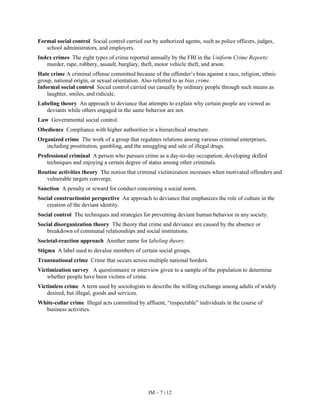
KEY TERMS
Anomie Durkheim’s term for the loss of direction felt in a society when social control of individual
behavior has become ineffective.
Anomie theory of deviance Robert Merton’s theory of deviance as an adaptation of socially prescribed
goals or of the means governing their attainment, or both.
Conformity Going along with one’s peers—individuals of our own status who have no special right to
direct our behavior.
Control theory A view of conformity and deviance that suggests that our connection to members of
society leads us to systematically conform to society’s norms.
Crime A violation of criminal law for which some governmental authority applies formal penalties.
Cultural transmission A school of criminology that argues that criminal behavior is learned through
social interactions.
Deviance Behavior that violates the standards of conduct or expectations of a group or society.
Differential association A theory of deviance proposed by Edwin Sutherland that holds that violation of
rules results from exposure to attitudes favorable to criminal acts.
Differential justice Differences in the way social control is exercised over different groups.
IM – 7 | 12
Formal social control Social control carried out by authorized agents, such as police officers, judges,
school administrators, and employers.
Index crimes The eight types of crime reported annually by the FBI in the Uniform Crime Reports:
murder, rape, robbery, assault, burglary, theft, motor vehicle theft, and arson.
Hate crime A criminal offense committed because of the offender’s bias against a race, religion, ethnic
group, national origin, or sexual orientation. Also referred to as bias crime.
Informal social control Social control carried out casually by ordinary people through such means as
laughter, smiles, and ridicule.
Labeling theory An approach to deviance that attempts to explain why certain people are viewed as
deviants while others engaged in the same behavior are not.
Law Governmental social control.
Obedience Compliance with higher authorities in a hierarchical structure.
Organized crime The work of a group that regulates relations among various criminal enterprises,
including prostitution, gambling, and the smuggling and sale of illegal drugs.
Professional criminal A person who pursues crime as a day-to-day occupation, developing skilled
techniques and enjoying a certain degree of status among other criminals.
Routine activities theory The notion that criminal victimization increases when motivated offenders and
vulnerable targets converge.
Sanction A penalty or reward for conduct concerning a social norm.
Social constructionist perspective An approach to deviance that emphasizes the role of culture in the
creation of the deviant identity.
Social control The techniques and strategies for preventing deviant human behavior in any society.
Social disorganization theory The theory that crime and deviance are caused by the absence or
breakdown of communal relationships and social institutions.
Societal-reaction approach Another name for labeling theory.
Stigma A label used to devalue members of certain social groups.
Transnational crime Crime that occurs across multiple national borders.
Victimization survey A questionnaire or interview given to a sample of the population to determine
whether people have been victims of crime.
Victimless crime A term used by sociologists to describe the willing exchange among adults of widely
desired, but illegal, goods and services.
White-collar crime Illegal acts committed by affluent, “respectable” individuals in the course of
business activities.
Discovering Diverse Content Through
Random Scribd Documents
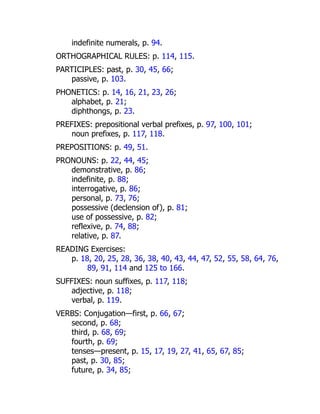
indefinite numerals, p. 94.
ORTHOGRAPHICAL RULES: p. 114, 115.
PARTICIPLES: past, p. 30, 45, 66;
passive, p. 103.
PHONETICS: p. 14, 16, 21, 23, 26;
alphabet, p. 21;
diphthongs, p. 23.
PREFIXES: prepositional verbal prefixes, p. 97, 100, 101;
noun prefixes, p. 117, 118.
PREPOSITIONS: p. 49, 51.
PRONOUNS: p. 22, 44, 45;
demonstrative, p. 86;
indefinite, p. 88;
interrogative, p. 86;
personal, p. 73, 76;
possessive (declension of), p. 81;
use of possessive, p. 82;
reflexive, p. 74, 88;
relative, p. 87.
READING Exercises:
p. 18, 20, 25, 28, 36, 38, 40, 43, 44, 47, 52, 55, 58, 64, 76,
89, 91, 114 and 125 to 166.
SUFFIXES: noun suffixes, p. 117, 118;
adjective, p. 118;
verbal, p. 119.
VERBS: Conjugation—first, p. 66, 67;
second, p. 68;
third, p. 68, 69;
fourth, p. 69;
tenses—present, p. 15, 17, 19, 27, 41, 65, 67, 85;
past, p. 30, 85;
future, p. 34, 85;
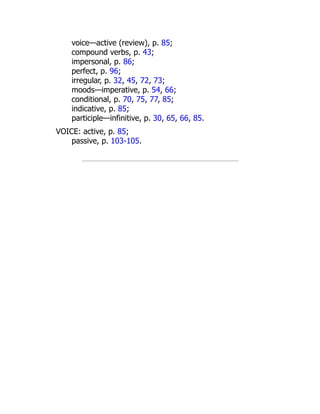
voice—active (review), p. 85;
compound verbs, p. 43;
impersonal, p. 86;
perfect, p. 96;
irregular, p. 32, 45, 72, 73;
moods—imperative, p. 54, 66;
conditional, p. 70, 75, 77, 85;
indicative, p. 85;
participle—infinitive, p. 30, 65, 66, 85.
VOICE: active, p. 85;
passive, p. 103-105.
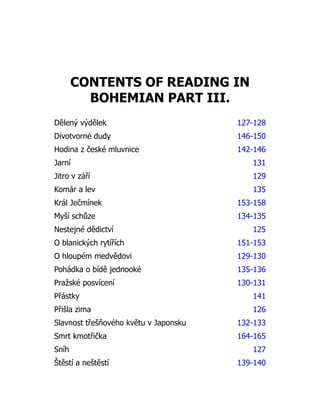
CONTENTS OF READING IN
BOHEMIAN PART III.
Dělený výdělek 127-128
Divotvorné dudy 146-150
Hodina z české mluvnice 142-146
Jarní 131
Jitro v září 129
Komár a lev 135
Král Ječmínek 153-158
Myší schůze 134-135
Nestejné dědictví 125
O blanických rytířích 151-153
O hloupém medvědovi 129-130
Pohádka o bídě jednooké 135-136
Pražské posvícení 130-131
Přástky 141
Přišla zima 126
Slavnost třešňového květu v Japonsku 132-133
Smrt kmotřička 164-165
Sníh 127
Štěstí a neštěstí 139-140
Trpaslíci a vejce 126-127
Ze staré Prahy 137-138
Zlatovláska 158-162
*** END OF THE PROJECT GUTENBERG EBOOK BOHEMIAN
GRAMMAR ***
Updated editions will replace the previous one—the old editions
will be renamed.
Creating the works from print editions not protected by U.S.
copyright law means that no one owns a United States
copyright in these works, so the Foundation (and you!) can copy
and distribute it in the United States without permission and
without paying copyright royalties. Special rules, set forth in the
General Terms of Use part of this license, apply to copying and
distributing Project Gutenberg™ electronic works to protect the
PROJECT GUTENBERG™ concept and trademark. Project
Gutenberg is a registered trademark, and may not be used if
you charge for an eBook, except by following the terms of the
trademark license, including paying royalties for use of the
Project Gutenberg trademark. If you do not charge anything for
copies of this eBook, complying with the trademark license is
very easy. You may use this eBook for nearly any purpose such
as creation of derivative works, reports, performances and
research. Project Gutenberg eBooks may be modified and
printed and given away—you may do practically ANYTHING in
the United States with eBooks not protected by U.S. copyright
law. Redistribution is subject to the trademark license, especially
commercial redistribution.
START: FULL LICENSE
THE FULL PROJECT GUTENBERG LICENSE
PLEASE READ THIS BEFORE YOU DISTRIBUTE OR USE THIS WORK
To protect the Project Gutenberg™ mission of promoting the
free distribution of electronic works, by using or distributing this
work (or any other work associated in any way with the phrase
“Project Gutenberg”), you agree to comply with all the terms of
the Full Project Gutenberg™ License available with this file or
online at www.gutenberg.org/license.
Section 1. General Terms of Use and
Redistributing Project Gutenberg™
electronic works
1.A. By reading or using any part of this Project Gutenberg™
electronic work, you indicate that you have read, understand,
agree to and accept all the terms of this license and intellectual
property (trademark/copyright) agreement. If you do not agree
to abide by all the terms of this agreement, you must cease
using and return or destroy all copies of Project Gutenberg™
electronic works in your possession. If you paid a fee for
obtaining a copy of or access to a Project Gutenberg™
electronic work and you do not agree to be bound by the terms
of this agreement, you may obtain a refund from the person or
entity to whom you paid the fee as set forth in paragraph 1.E.8.
1.B. “Project Gutenberg” is a registered trademark. It may only
be used on or associated in any way with an electronic work by
people who agree to be bound by the terms of this agreement.
There are a few things that you can do with most Project
Gutenberg™ electronic works even without complying with the
full terms of this agreement. See paragraph 1.C below. There
are a lot of things you can do with Project Gutenberg™
electronic works if you follow the terms of this agreement and
help preserve free future access to Project Gutenberg™
electronic works. See paragraph 1.E below.
1.C. The Project Gutenberg Literary Archive Foundation (“the
Foundation” or PGLAF), owns a compilation copyright in the
collection of Project Gutenberg™ electronic works. Nearly all the
individual works in the collection are in the public domain in the
United States. If an individual work is unprotected by copyright
law in the United States and you are located in the United
States, we do not claim a right to prevent you from copying,
distributing, performing, displaying or creating derivative works
based on the work as long as all references to Project
Gutenberg are removed. Of course, we hope that you will
support the Project Gutenberg™ mission of promoting free
access to electronic works by freely sharing Project Gutenberg™
works in compliance with the terms of this agreement for
keeping the Project Gutenberg™ name associated with the
work. You can easily comply with the terms of this agreement
by keeping this work in the same format with its attached full
Project Gutenberg™ License when you share it without charge
with others.
1.D. The copyright laws of the place where you are located also
govern what you can do with this work. Copyright laws in most
countries are in a constant state of change. If you are outside
the United States, check the laws of your country in addition to
the terms of this agreement before downloading, copying,
displaying, performing, distributing or creating derivative works
based on this work or any other Project Gutenberg™ work. The
Foundation makes no representations concerning the copyright
status of any work in any country other than the United States.
1.E. Unless you have removed all references to Project
Gutenberg:
1.E.1. The following sentence, with active links to, or other
immediate access to, the full Project Gutenberg™ License must
appear prominently whenever any copy of a Project
Gutenberg™ work (any work on which the phrase “Project
Gutenberg” appears, or with which the phrase “Project
Gutenberg” is associated) is accessed, displayed, performed,
viewed, copied or distributed:
This eBook is for the use of anyone anywhere in the United
States and most other parts of the world at no cost and
with almost no restrictions whatsoever. You may copy it,
give it away or re-use it under the terms of the Project
Gutenberg License included with this eBook or online at
www.gutenberg.org. If you are not located in the United
States, you will have to check the laws of the country
where you are located before using this eBook.
1.E.2. If an individual Project Gutenberg™ electronic work is
derived from texts not protected by U.S. copyright law (does not
contain a notice indicating that it is posted with permission of
the copyright holder), the work can be copied and distributed to
anyone in the United States without paying any fees or charges.
If you are redistributing or providing access to a work with the
phrase “Project Gutenberg” associated with or appearing on the
work, you must comply either with the requirements of
paragraphs 1.E.1 through 1.E.7 or obtain permission for the use
of the work and the Project Gutenberg™ trademark as set forth
in paragraphs 1.E.8 or 1.E.9.
1.E.3. If an individual Project Gutenberg™ electronic work is
posted with the permission of the copyright holder, your use and
distribution must comply with both paragraphs 1.E.1 through
1.E.7 and any additional terms imposed by the copyright holder.
Additional terms will be linked to the Project Gutenberg™
License for all works posted with the permission of the copyright
holder found at the beginning of this work.
1.E.4. Do not unlink or detach or remove the full Project
Gutenberg™ License terms from this work, or any files
containing a part of this work or any other work associated with
Project Gutenberg™.
1.E.5. Do not copy, display, perform, distribute or redistribute
this electronic work, or any part of this electronic work, without
prominently displaying the sentence set forth in paragraph 1.E.1
with active links or immediate access to the full terms of the
Project Gutenberg™ License.
1.E.6. You may convert to and distribute this work in any binary,
compressed, marked up, nonproprietary or proprietary form,
including any word processing or hypertext form. However, if
you provide access to or distribute copies of a Project
Gutenberg™ work in a format other than “Plain Vanilla ASCII” or
other format used in the official version posted on the official
Project Gutenberg™ website (www.gutenberg.org), you must,
at no additional cost, fee or expense to the user, provide a copy,
a means of exporting a copy, or a means of obtaining a copy
upon request, of the work in its original “Plain Vanilla ASCII” or
other form. Any alternate format must include the full Project
Gutenberg™ License as specified in paragraph 1.E.1.
1.E.7. Do not charge a fee for access to, viewing, displaying,
performing, copying or distributing any Project Gutenberg™
works unless you comply with paragraph 1.E.8 or 1.E.9.
1.E.8. You may charge a reasonable fee for copies of or
providing access to or distributing Project Gutenberg™
electronic works provided that:
• You pay a royalty fee of 20% of the gross profits you derive
from the use of Project Gutenberg™ works calculated using the
method you already use to calculate your applicable taxes. The
fee is owed to the owner of the Project Gutenberg™ trademark,
but he has agreed to donate royalties under this paragraph to
the Project Gutenberg Literary Archive Foundation. Royalty
payments must be paid within 60 days following each date on
which you prepare (or are legally required to prepare) your
periodic tax returns. Royalty payments should be clearly marked
as such and sent to the Project Gutenberg Literary Archive
Foundation at the address specified in Section 4, “Information
about donations to the Project Gutenberg Literary Archive
Foundation.”
• You provide a full refund of any money paid by a user who
notifies you in writing (or by e-mail) within 30 days of receipt
that s/he does not agree to the terms of the full Project
Gutenberg™ License. You must require such a user to return or
destroy all copies of the works possessed in a physical medium
and discontinue all use of and all access to other copies of
Project Gutenberg™ works.
• You provide, in accordance with paragraph 1.F.3, a full refund of
any money paid for a work or a replacement copy, if a defect in
the electronic work is discovered and reported to you within 90
days of receipt of the work.
• You comply with all other terms of this agreement for free
distribution of Project Gutenberg™ works.
1.E.9. If you wish to charge a fee or distribute a Project
Gutenberg™ electronic work or group of works on different
terms than are set forth in this agreement, you must obtain
permission in writing from the Project Gutenberg Literary
Archive Foundation, the manager of the Project Gutenberg™
trademark. Contact the Foundation as set forth in Section 3
below.
1.F.
1.F.1. Project Gutenberg volunteers and employees expend
considerable effort to identify, do copyright research on,
transcribe and proofread works not protected by U.S. copyright
law in creating the Project Gutenberg™ collection. Despite these
efforts, Project Gutenberg™ electronic works, and the medium
on which they may be stored, may contain “Defects,” such as,
but not limited to, incomplete, inaccurate or corrupt data,
transcription errors, a copyright or other intellectual property
infringement, a defective or damaged disk or other medium, a
computer virus, or computer codes that damage or cannot be
read by your equipment.
1.F.2. LIMITED WARRANTY, DISCLAIMER OF DAMAGES - Except
for the “Right of Replacement or Refund” described in
paragraph 1.F.3, the Project Gutenberg Literary Archive
Foundation, the owner of the Project Gutenberg™ trademark,
and any other party distributing a Project Gutenberg™ electronic
work under this agreement, disclaim all liability to you for
damages, costs and expenses, including legal fees. YOU AGREE
THAT YOU HAVE NO REMEDIES FOR NEGLIGENCE, STRICT
LIABILITY, BREACH OF WARRANTY OR BREACH OF CONTRACT
EXCEPT THOSE PROVIDED IN PARAGRAPH 1.F.3. YOU AGREE
THAT THE FOUNDATION, THE TRADEMARK OWNER, AND ANY
DISTRIBUTOR UNDER THIS AGREEMENT WILL NOT BE LIABLE
TO YOU FOR ACTUAL, DIRECT, INDIRECT, CONSEQUENTIAL,
PUNITIVE OR INCIDENTAL DAMAGES EVEN IF YOU GIVE
NOTICE OF THE POSSIBILITY OF SUCH DAMAGE.
1.F.3. LIMITED RIGHT OF REPLACEMENT OR REFUND - If you
discover a defect in this electronic work within 90 days of
receiving it, you can receive a refund of the money (if any) you
paid for it by sending a written explanation to the person you
received the work from. If you received the work on a physical
medium, you must return the medium with your written
explanation. The person or entity that provided you with the
defective work may elect to provide a replacement copy in lieu
of a refund. If you received the work electronically, the person
or entity providing it to you may choose to give you a second
opportunity to receive the work electronically in lieu of a refund.
If the second copy is also defective, you may demand a refund
in writing without further opportunities to fix the problem.
1.F.4. Except for the limited right of replacement or refund set
forth in paragraph 1.F.3, this work is provided to you ‘AS-IS’,
WITH NO OTHER WARRANTIES OF ANY KIND, EXPRESS OR
IMPLIED, INCLUDING BUT NOT LIMITED TO WARRANTIES OF
MERCHANTABILITY OR FITNESS FOR ANY PURPOSE.
1.F.5. Some states do not allow disclaimers of certain implied
warranties or the exclusion or limitation of certain types of
damages. If any disclaimer or limitation set forth in this
agreement violates the law of the state applicable to this
agreement, the agreement shall be interpreted to make the
maximum disclaimer or limitation permitted by the applicable
state law. The invalidity or unenforceability of any provision of
this agreement shall not void the remaining provisions.
1.F.6. INDEMNITY - You agree to indemnify and hold the
Foundation, the trademark owner, any agent or employee of the
Foundation, anyone providing copies of Project Gutenberg™
electronic works in accordance with this agreement, and any
volunteers associated with the production, promotion and
distribution of Project Gutenberg™ electronic works, harmless
from all liability, costs and expenses, including legal fees, that
arise directly or indirectly from any of the following which you
do or cause to occur: (a) distribution of this or any Project
Gutenberg™ work, (b) alteration, modification, or additions or
deletions to any Project Gutenberg™ work, and (c) any Defect
you cause.
Section 2. Information about the Mission
of Project Gutenberg™
Project Gutenberg™ is synonymous with the free distribution of
electronic works in formats readable by the widest variety of
computers including obsolete, old, middle-aged and new
computers. It exists because of the efforts of hundreds of
volunteers and donations from people in all walks of life.
Volunteers and financial support to provide volunteers with the
assistance they need are critical to reaching Project
Gutenberg™’s goals and ensuring that the Project Gutenberg™
collection will remain freely available for generations to come. In
2001, the Project Gutenberg Literary Archive Foundation was
created to provide a secure and permanent future for Project
Gutenberg™ and future generations. To learn more about the
Project Gutenberg Literary Archive Foundation and how your
efforts and donations can help, see Sections 3 and 4 and the
Foundation information page at www.gutenberg.org.
Section 3. Information about the Project
Gutenberg Literary Archive Foundation
The Project Gutenberg Literary Archive Foundation is a non-
profit 501(c)(3) educational corporation organized under the
laws of the state of Mississippi and granted tax exempt status
by the Internal Revenue Service. The Foundation’s EIN or
federal tax identification number is 64-6221541. Contributions
to the Project Gutenberg Literary Archive Foundation are tax
deductible to the full extent permitted by U.S. federal laws and
your state’s laws.
The Foundation’s business office is located at 809 North 1500
West, Salt Lake City, UT 84116, (801) 596-1887. Email contact
links and up to date contact information can be found at the
Foundation’s website and official page at
www.gutenberg.org/contact
Section 4. Information about Donations to
the Project Gutenberg Literary Archive
Foundation
Project Gutenberg™ depends upon and cannot survive without
widespread public support and donations to carry out its mission
of increasing the number of public domain and licensed works
that can be freely distributed in machine-readable form
accessible by the widest array of equipment including outdated
equipment. Many small donations ($1 to $5,000) are particularly
important to maintaining tax exempt status with the IRS.
The Foundation is committed to complying with the laws
regulating charities and charitable donations in all 50 states of
the United States. Compliance requirements are not uniform
and it takes a considerable effort, much paperwork and many
fees to meet and keep up with these requirements. We do not
solicit donations in locations where we have not received written
confirmation of compliance. To SEND DONATIONS or determine
the status of compliance for any particular state visit
www.gutenberg.org/donate.
While we cannot and do not solicit contributions from states
where we have not met the solicitation requirements, we know
of no prohibition against accepting unsolicited donations from
donors in such states who approach us with offers to donate.
International donations are gratefully accepted, but we cannot
make any statements concerning tax treatment of donations
received from outside the United States. U.S. laws alone swamp
our small staff.
Please check the Project Gutenberg web pages for current
donation methods and addresses. Donations are accepted in a
number of other ways including checks, online payments and
credit card donations. To donate, please visit:
www.gutenberg.org/donate.
Section 5. General Information About
Project Gutenberg™ electronic works
Professor Michael S. Hart was the originator of the Project
Gutenberg™ concept of a library of electronic works that could
be freely shared with anyone. For forty years, he produced and
distributed Project Gutenberg™ eBooks with only a loose
network of volunteer support.
Project Gutenberg™ eBooks are often created from several
printed editions, all of which are confirmed as not protected by
copyright in the U.S. unless a copyright notice is included. Thus,
we do not necessarily keep eBooks in compliance with any
particular paper edition.
Most people start at our website which has the main PG search
facility: www.gutenberg.org.
This website includes information about Project Gutenberg™,
including how to make donations to the Project Gutenberg
Literary Archive Foundation, how to help produce our new
eBooks, and how to subscribe to our email newsletter to hear
about new eBooks.
Welcome to our website – the perfect destination for book lovers and
knowledge seekers. We believe that every book holds a new world,
offering opportunities for learning, discovery, and personal growth.
That’s why we are dedicated to bringing you a diverse collection of
books, ranging from classic literature and specialized publications to
self-development guides and children's books.
More than just a book-buying platform, we strive to be a bridge
connecting you with timeless cultural and intellectual values. With an
elegant, user-friendly interface and a smart search system, you can
quickly find the books that best suit your interests. Additionally,
our special promotions and home delivery services help you save time
and fully enjoy the joy of reading.
Join us on a journey of knowledge exploration, passion nurturing, and
personal growth every day!
testbankdeal.com


Sociology in Modules 2nd Edition Schaefer Solutions Manual

  • 1.
    Sociology in Modules2nd Edition Schaefer Solutions Manual download https://testbankdeal.com/product/sociology-in-modules-2nd- edition-schaefer-solutions-manual/ Visit testbankdeal.com today to download the complete set of test bank or solution manual
  • 2.
    We have selectedsome products that you may be interested in Click the link to download now or visit testbankdeal.com for more options!. Sociology in Modules 2nd Edition Schaefer Test Bank https://testbankdeal.com/product/sociology-in-modules-2nd-edition- schaefer-test-bank/ Sociology in Modules 3rd Edition Schaefer Test Bank https://testbankdeal.com/product/sociology-in-modules-3rd-edition- schaefer-test-bank/ Sociology in Modules 4th Edition T Schaefer Test Bank https://testbankdeal.com/product/sociology-in-modules-4th-edition-t- schaefer-test-bank/ Foundations of Financial Management Canadian 11th Edition Block Test Bank https://testbankdeal.com/product/foundations-of-financial-management- canadian-11th-edition-block-test-bank/
  • 3.
    World History 7thEdition Duiker Test Bank https://testbankdeal.com/product/world-history-7th-edition-duiker- test-bank/ Bank Management and Financial Services 9th Edition Rose Test Bank https://testbankdeal.com/product/bank-management-and-financial- services-9th-edition-rose-test-bank/ Basic Marketing A Strategic Marketing Planning Approach 18th Edition Perreault Test Bank https://testbankdeal.com/product/basic-marketing-a-strategic- marketing-planning-approach-18th-edition-perreault-test-bank/ Basic College Mathematics 6th Edition Martin-Gay Test Bank https://testbankdeal.com/product/basic-college-mathematics-6th- edition-martin-gay-test-bank/ Mosbys Canadian Textbook for The Support Worker 4th Edition Sorrentino Test Bank https://testbankdeal.com/product/mosbys-canadian-textbook-for-the- support-worker-4th-edition-sorrentino-test-bank/
  • 4.
    Using Financial AccountingInformation The Alternative to Debits and Credits 9th Edition Porter Solutions Manual https://testbankdeal.com/product/using-financial-accounting- information-the-alternative-to-debits-and-credits-9th-edition-porter- solutions-manual/
  • 5.
    IM – 7| 1 CHAPTER 7 DEVIANCE, CRIME, AND SOCIAL CONTROL CHAPTER OUTLINE MODULE 23: SOCIAL CONTROL Conformity and Obedience Informal and Formal Social Control Law and Society MODULE 24: WHAT IS DEVIANCE? Deviance and Social Stigma Deviance and Technology Sociological Perspectives on Deviance MODULE 25: CRIME Types of Crime Crime Statistics Boxes Sociology on Campus: Binge Drinking Trendspotting: Incarceration Nation Research Today: Does Crime Pay? Sociology on Campus: Campus Crime Taking Sociology to Work: Stephanie Vezzani, Special Agent, U.S. Secret Service Social Policy and Social Control: The Death Penalty in the United States and Worldwide
  • 6.
    IM – 7| 2 LEARNING OBJECTIVES WHAT’S NEW IN CHAPTER 7 1. Define and discuss the elements of social control. 2. Discuss the classic Milgram experiment and its implications for obedience and conformity. 3. Discuss what is meant by informal and formal social control. 4. Define deviance and social stigma. 5. Discuss the various functionalist concepts and views explaining deviance. 6. Discuss the various interactionist concepts and views explaining deviance. 7. Discuss the explanations of deviance from the conflict and feminist perspectives. 8. Describe the various types of crime. 9. Discuss the nature and extent of crime in the United States. Module 25: Crime • Subsection on hate crime, with figure, “Categorization of Reported Hate Crimes” • Reorganized section on crime statistics, with subsections on (a) index crimes and victimization surveys, (b) crime trends, and (c) international crime rates. • Social Policy section on the death penalty, with Mapping Life Worldwide map, “Death Penalty Status by Country” CHAPTER SUMMARY The term social control refers to techniques and strategies for preventing deviant human behavior. Social control occurs in families, peer groups, and bureaucratic organizations. Members of society are expected to act in accordance with social norms. Sanctions, which may be either penalties or rewards, help to induce behavior consistent with social norms. Conformity is defined as going along with one’s peers even though they have no special right to direct our behavior. Obedience is defined as compliance with higher authorities in a hierarchal structure. Social controls may occur casually and informally through such means as smiles, laughter, and ridicule. Authorized agents, such as police officers, physicians, school administrators, employers, and military officers, carry out formal social control. Law is defined as governmental social control and reflects continually changing standards of what is right and wrong. Sociologists define deviance as behavior that violates the standards of conduct or expectations of a group or society. Deviance involves the violations of group norms that may or may not be formalized into law. It is a comprehensive concept that includes not only criminal behavior, but also many actions not subject to prosecution. Deviance can be understood only within its social context. The term stigma was coined by Erving Goffman to describe the labels society uses to devalue the members of certain social groups. People are often stigmatized for deviant behaviors they may no longer engage in.
  • 7.
    IM – 7| 3 According to the functionalist view, deviance is a normal part of human existence. Functionalists suggest that deviance helps to define the limits of proper behavior. Robert Merton adapted Émile Durkheim’s notion of anomie to explain why people accept or reject the goals of a society. Merton’s theory posits five basic forms of adaptations: (1) conformity, (2) innovation, (3) ritualism, (4) retreatism, and (5) rebellion. Merton’s anomie theory, though popular, has had relatively few applications. The interactionist perspective is reflected in theories based on cultural transmission, social disorganization, and labeling. Cultural transmission, associated with criminologist Edwin Sutherland, suggests that criminal behavior is learned through interactions with others. He used the term differential association to describe the process through which exposure to attitudes favorable to criminal acts leads to violation of rules. Social disorganization theory suggests that deviance increases when communal relationships in neighborhoods and social networks are weakened or absent. Labeling theory emphasizes how a person comes to be labeled as deviant or to accept the label. Labeling theory is also referred to as the societal-reaction approach. The popularity of labeling theory is evident in the emergence of the social constructionist perspective, which purports that deviance is the product of the culture in which we live. Social constructionists focus on the decision-making process that creates the deviant identity. The conflict view of deviance suggests that people with power protect their own interests and define deviance to suit their own needs. Relating to differential justice, Richard Quinney argues that lawmaking is often an attempt by the powerful to coerce others into their own brand of morality. Akin to the roots of conflict theory, the feminist perspective suggests that deviance, including crime, tends to flow from economic relationships. Feminists suggest that cultural views and attitudes toward women influence how women are perceived and labeled. Crime represents a deviation from formal social norms administered by the state. Types of crime include professional crime, organized crime, white-collar and technology-based crime, corporate crime, transnational crime, and victimless crime. There has been a significant decline in violent crime in the United States. The accuracy of measuring crime and tabulating crime statistics varies widely. The National Crime Victimization Survey was initiated in 1972 to question ordinary people about crime victimization. RESOURCE INTEGRATOR Focus Questions Resources 1. What are the various means of social control? IN THE TEXT Key Terms: social control, sanctions, conformity, obedience, informal social control, formal social control, law, control theory Boxes: Sociology on Campus: Binge Drinking IN THE INSTRUCTOR’S MANUAL Additional Lecture Ideas: Ethical Implications of Milgram’s Research (7-1); Social Control on the Streets (7-2) Classroom Discussion Topics: Group Pressure (7-2); The Power of Authority (7-3); Field Trip to Prison (7-4); Public Opinion on Death Penalty (7-9)
  • 8.
    IM – 7| 4 Student Research and Assignments: Obedience—Another Look; Labeling of People with AIDS; Labeling; Community Crime Watch Video Resources: Asylum; Bowling for Columbine; Death Devices; Deviance and Social Control; Obedience to Authority REEL SOCIETY VIDEO Topic Index: Conformity; Sanctions 2. How do sociologists define deviance? IN THE TEXT Key Terms: deviance, stigma IN THE INSTRUCTOR’S MANUAL Additional Lecture Ideas: Deviance or Sport (7-3); Primary and Secondary Deviance (7-4) Classroom Discussion Topics: Wallbangin (7-1); Conversing with Deviants (7-5); Deviance Is in the Eye of the Beholder (7-6); Which Acts are Deviant? (7-7); Positive Deviance (7-8) Student Research and Assignments: Labeling of People with AIDS; Labeling Video Resources: Deviance REEL SOCIETY VIDEO Topic Index: Deviance 3. How do functionalists, conflict theorists, feminists, and interactionists explain deviance? IN THE TEXT Key Terms: anomie, anomie theory of deviance, cultural transmission, differential association, social disorganization theory, labeling theory, societal-reaction approach, social constructionist perspective, differential justice Boxes: Research Today: Does Crime Pay? IN THE INSTRUCTOR’S MANUAL Additional Lecture Ideas: Discretionary Justice (7-5); Controversies about Campus Crime (7-6); Being a Hit Man (7-7) Classroom Discussion Topics: Wallbangin (7-1); Conversing with Deviants (7-5); Deviance Is in the Eye of the Beholder (7-6); Which Acts Are Deviant? (7-7); Positive Deviance (7-8) Student Research and Assignments: Labeling of People with AIDS; Labeling; Crime and Violence within the Hispanic Community; Blacks in Prisons; Race and Criminology; Rape Education Videos; White-Collar Crime Video Resources: Bowling for Columbine; Cops on Trial; Deadline; Race on Trial REEL SOCIETY VIDEO Topic Index: Anomie Theory of Deviance
  • 9.
    IM – 7| 5 4. What are the different types of crime? IN THE TEXT Key Terms: crime, index crime, victimless crime, professional criminal, organized crime, white-collar crime, transnational crime, victimless crime Boxes: Sociology on Campus: Campus Crime IN THE INSTRUCTOR’S MANUAL Additional Lecture Ideas: Controversies about Campus Crime (7-6); Being a Hit Man (7-7) Classroom Discussion Topics: Violent Juveniles (7-10); Ranking Crimes (7-11); Teaching about Sexual Assault (7-12); Campus Crime Statistics (7-13) Student Research and Assignments: White-Collar Crime Video Resources: State-Sponsored Terrorism; Terrorism; The Tarnished Shield 5. What are the major trends in crime statistics? IN THE TEXT Key Terms: victimization survey Boxes: Taking Sociology to Work: Stephanie Vezzani: Special Agent, US Secret Service IN THE INSTRUCTOR’S MANUAL Classroom Discussion Topics: Campus Crime Statistics (7-13) Topics and Sources for Student Research: U.S. Department of Justice LECTURE OUTLINE I. Social Control • Social control refers to the techniques and strategies for preventing deviant human behavior in any society. • Family and peers socialize individuals to social norms. Example: Dress codes mandate specific forms of dress for persons of different ages, social classes, etc. • Government legislates and enforces social norms. • Sanctions are penalties and rewards for conduct concerning a social norm. • Functionalists contend that people must respect social norms for society to function. By contrast, conflict theorists maintain that the functioning of society benefits the powerful and that social norms reflect the interests of the dominant class. A. Conformity and Obedience • Stanley Milgram defined conformity as going along with peers who have no particular right to direct our behavior. Milgram defined obedience as compliance with higher authorities in a hierarchal structure. Example: A military recruit who must follow the orders given by his or her commander.
  • 10.
    IM – 7| 6 • In some circumstances, conformity and, especially, obedience can cause immense damage. Example: Milgram’s electric shock experiment: “Behavior that is unthinkable in an individual…acting on his own may be executed without hesitation when carried out under orders.” B. Informal and Formal Social Control • Informal social control is carried out casually by ordinary people through such means as laughter, smiles, and ridicule. Example: Parents may use spanking or verbal reprimands as punishment. • Formal social control is carried out by authorized agents, such as police officers, judges, school administrators, and employers. Example: Imprisonment, speeding tickets, the death penalty. C. Law and Society • Law is defined as governmental social control. • Some laws are directed at all members of society. Example: Laws prohibiting murder. Some laws affect particular categories of people. Example: Hunting and fishing regulations. Others govern social institutions. Example: Corporate laws. • Creation of law is a social process in response to perceived needs for formal social control. Example: Laws against gay marriage; laws against prostitution. • Hirschi’s control theory suggests that our connection to members of society leads us to systematically conform to society’s norms. II. Deviance A. What Is Deviance? • Deviance is defined as behavior that violates the standards of conduct or expectations of a group or society. Examples: Criminals, alcoholics, compulsive gamblers, and the mentally ill. • Deviance involves violation of group norms. • Deviance is not always negative. Example: Whistle blowers. • Deviance is subject to social definition within a particular society and at a particular time. 1. Deviance and Social Stigma • Erving Goffman coined the term stigma to refer to a label used to devalue members of certain social groups. Example: Redheads or short people. • People may be stigmatized for past behaviors. Examples: Ex-con, recovering alcoholic. 2. Deviance and Technology • Some socially tolerated forms of deviance can be found in the world of high technology. • Anonymity of the Internet allows for uncivil behaviors. Example: Hate speech. • Some deviant uses of technology are criminal. Examples: Software piracy and other black-market activities such as the possession or distribution of child pornography. B. Explaining Deviance • Early explanations centered on supernatural or genetic factors. • Sociologists reject any emphasis on genetic roots of crime and deviance. 1. Functionalist Perspective • Deviance is a common part of human existence.
  • 11.
    IM – 7| 7 a. Durkheim’s Legacy • Durkheim viewed social control mechanisms as necessary to define acceptable behavior and contribute to social stability. Introduced the term anomie to describe a feeling one experiences when losing direction in society. Example: During periods of profound social change such as during the Industrial Revolution. • Kai Erikson’s study of Puritans illustrated boundary-maintenance functions of deviance. b. Merton’s Theory of Deviance • Adapted Durkheim’s notion of anomie to explain why people accept or reject the goals of society, and/or the socially approved means for fulfilling their aspirations. • People adapt in certain ways by either conforming to or deviating from cultural expectations. • Merton’s anomie theory of deviance posits five basic forms of adaptation. See Table 7-1. • Merton’s theory has had relatively few applications. 2. Interactionist Perspective • Emphasis on everyday behavior that is the focus of the interactionist perspective offers two explanations of crime: cultural transmission theory and routine activities theory. a. Cultural Transmission • Humans learn how to behave in social situations. • Edwin Sutherland’s differential association describes the process through which exposure to attitudes favorable to criminal acts leads to violation of rules. • Whether a person engages in an activity deemed proper or improper depends on frequency, duration, and importance of two types of social interaction (those endorsing deviant behavior and those promoting acceptance of social norms). People are more apt to engage in norm-defying behavior if they belong to a group or subculture that stresses deviant values (e.g., a street gang). • Critics charge Sutherland’s theory fails to explain first-time, impulsive deviance. b. Social Disorganization Theory • Contends that deviance and crime increase due to a breakdown in or absence of communal relationships and other social institutions such as the family, school, church, and local government. Example: Higher rates of social problems in areas with declining population and deteriorating buildings. • The theory does not account for viable, healthy organizations that persist in many troubled neighborhoods and appears to “blame the victim.” c. Labeling Theory • Seeks to explain why certain people are viewed as deviant, while others engaging in the same behavior are not. Example: Chambliss study of the Saints and Roughnecks.
  • 12.
    IM – 7| 8 • Also called the societal-reaction approach. It is the response to an act, not the behavior itself, that determines deviance. Example: Assigning a “trouble- maker” to a program for the learning disabled; labeling someone an “addict,” or a “slow learner.” • Labeling theory focuses on regulatory agents (police, probation officers, psychiatrists, judges, teachers, etc.), who play a significant role in creating the deviant identity by designating certain people as deviant. Example: Racial profiling; laws which designate certain persons as “illegal” (i.e., laws regulating undocumented citizens). • Labeling does not fully explain why some people accept a label and others do not. • Labeling theory influenced the emergence of the social constructionist perspective, which suggests deviance is the product of the culture we live in. Examples: Being a “deadbeat dad” or a “single mother.” 3. Conflict Theory • People with power protect their own interests and define deviance to suit their own needs. • Richard Quinney suggests the criminal justice system serves the interests of the powerful. Lawmaking is an attempt by the powerful to coerce others into their own morality. Example: Victimless crimes. • Differential justice: Conflict theory suggests criminal suspects are treated differently on the basis of race, ethnicity, or social class. African Americans and Latinos are at a disadvantage in the justice system, both as juveniles and as adults. See Social Policy Section on application of the death penalty. • Differential justice may lead to increased violence and crime, as those who view themselves as victims of unfair treatment strike out, not against the powerful so much as against fellow victims. 4. Feminist Perspective • Some suggest that existing approaches to deviance and crime developed with only men in mind. Example: Earlier legal views on spousal rape, reflecting overwhelming male composition of state legislatures at the time. • Society tends to treat women in a stereotypical fashion. Cultural views and attitudes toward women influence how they are perceived and labeled. Example: Women with numerous/frequent sexual partners are subjected to greater scorn than promiscuous men. • Deviance, including crime, flows from economic relationships. Example: Traditionally, men have greater opportunity to commit crimes such as embezzlement and fraud. • As women assume more active and powerful roles, gender differences in deviance and crime are narrowing. III. Crime • Crime is a violation of criminal law for which some governmental authority applies formal penalties. • Index crimes are the eight types of crime that are tabulated each year by the FBI. They include murder, rape, robbery, and assault (all of which are violent crimes committed against people) and property crimes of burglary, theft, motor vehicle theft, and arson. A. Types of Crime
  • 13.
    IM – 7| 9 1. Victimless Crimes • The willing exchange among adults of widely desired, but illegal, goods and services. Examples: Prostitution, drug abuse, gambling. • Proponents of decriminalization are troubled by attempts to legislate a moral code for adults. These crimes are impossible to prevent, and an overburdened criminal justice system should concentrate on offenses with real victims. • Critics of decriminalization object to the notion that these crimes are “victimless.” Examples: Over-drinking, compulsive gambling, and illegal drugs cause personal and property damage. Prostitution reinforces idea that women are “toys” or objects to be used for men’s pleasure. Alcohol and drug abuse can lead to drunk driving, etc. 2. Professional Crime • Professional criminal (career criminal) is a person who pursues crime as a day-to-day occupation. Example: Burglary or safecracking. • They devote their entire working time to planning and executing crimes. They develop skilled techniques and enjoy a certain degree of status among other criminals. • Edward Sutherland (1937) offered pioneering insights into behavior of professional criminals by publishing an annotated account written by a professional thief. 3. Organized Crime • The work of a group that regulates relations between various criminal enterprises involved in illegal activities, including smuggling and sale of illegal drugs, prostitution, and gambling. • Organized crime is a secret activity that evades law enforcement. It takes over legitimate business, gains influence over labor unions, corrupts public officials, intimidates witnesses, and taxes merchants for protection services. • The global nature of organized crime can be found in the acts of transnational organized crime affiliates, whose criminal activities include drug and arms smuggling, money laundering, and trafficking in illegal immigrants and stolen goods. 4. White-Collar and Technology-Based Crime • White-collar crime: illegal acts committed in the course of business activities by affluent, “respectable” people. Examples: Income tax evasion, embezzlement, bribery. • Edwin Sutherland coined the term white-collar crime in 1939 in reference to individuals. The term has been broadened to include offenses by businesses and corporations. • Corporate crime is any criminal act by a corporation that is punishable by the government. It takes many forms and includes individuals, organizations, and institutions among its victims. Examples: Stock fraud and manipulation, accounting fraud, production of unsafe goods, environmental pollution, anticompetitive behavior, public health violations, and bribery and corruption. • Computer crime: High technology allows criminals to carry out embezzlement or electronic fraud, often leaving few traces. A 2009 study by the FBI White Collar Crime Center found over 270,000 Internet crimes are reported every year. • Convictions for such illegal acts do not generally harm a person’s reputation, status, or career aspirations as much as conviction for a street crime. 5. Transnational Crime
  • 14.
    IM – 7| 10 • Crime that occurs across multiple national borders. Rather than concentrating on specific countries, international crime spans the globe. Examples: terrorism, trafficking in human beings (includes sex trade), trafficking in endangered species, drugs, and stolen art/antiquities. See Table 7-3 for types of transnational crime. • Not exclusive of other types of crime. Organized criminal networks are increasingly global. Technology facilitates illegal activities. Example: child pornography. B. Crime Statistics • Crime statistics are not as accurate or reliable as social scientists would like. 1. Understanding Crime Statistics a. Crime Rates • There has been a significant decline in violent crime nationwide. Some suggest as the reasons for the decline: a booming economy, community-oriented policing, gun control laws, and an increase in the prison population. • The proportion of major crimes committed by women has increased. Feminist scholars draw our attention to one significant countertrend: the proportion of major crimes committed by women has increased. However, violent crimes committed by women, which have never been common, have declined. b. Measuring Crime Rates • Measuring of crime rates is conducted several ways. • Crime Index: published annually by the FBI as part of the Uniform Crime Reports: includes statistics on murder, rape, robbery, assault, burglary, larceny-theft, motor vehicle theft, and arson. Disproportionately devoted to property crimes. • Limitation of official crime statistics: They include only crimes actually reported to law enforcement agencies. • National Crime Victimization Survey (NCVS). Initiated in 1972, it is an annual report compiled by the Bureau of Justice Statistics. Based on interviews of over 84,000 U.S. households, asking ordinary people whether they were victims of specific crimes during the preceding year. 2. International Crime Rates • Violent crime rates are higher in the United States than in Western Europe. U.S. may place a greater individual emphasis on economic achievement. And, culture of the U.S. has long tolerated many forms of violence. • England, Italy, Australia, and New Zealand have higher rates of car theft. • Russia has experienced an increase in violent crime since the overthrow of the Communist party rule. IV. Social Policy and Social Control: The Death Penalty in the United States and Worldwide A. The Issue • Questions surrounding the death penalty, from supporters of capital punishment and critics, include: How can the government prevent the execution of innocent men and women? Is it right to resort to a punishment that imitates the crime it seeks to condemn? Is life in prison enough of a punishment for a truly heinous crime? B. The Setting
  • 15.
    IM – 7| 11 • Today, the death penalty is still on the books in most states in the U.S. In other parts of the world, serious thought has been given to the ethical implications of the ultimate penalty. As of late 2010, 95 nations had renounced capital punishment, and many more use it only sparingly, if at all. Different sociological theories approach the issue in different ways. C. Sociological Insights 1. Functionalist Perspectice o Viewed from Émile Durkheim’s functionalist perspective, sanctions against deviant acts help to reinforce society’s standards of proper behavior. Supporters of capital punishment insist that fear of execution will prevent at least some criminals from committing serious offenses 2. Conflict Perspective o Conflict theorists counter that the persistence of social inequality in today’s society puts poor people at a disadvantage in the criminal justice system D. Policy Implications • Recently, policy initiatives have moved in two different directions.In several death penalty states, legislators are considering broadening the range of offenses for which convicted criminals may be sentenced to execution. In these states, child molesters who did not murder their victims could become eligible for the death penalty, along with certain repeat offenders. The countertrend, a movement away from the death penalty, is based on doubts about whether an execution can be carried out humanely. KEY TERMS Anomie Durkheim’s term for the loss of direction felt in a society when social control of individual behavior has become ineffective. Anomie theory of deviance Robert Merton’s theory of deviance as an adaptation of socially prescribed goals or of the means governing their attainment, or both. Conformity Going along with one’s peers—individuals of our own status who have no special right to direct our behavior. Control theory A view of conformity and deviance that suggests that our connection to members of society leads us to systematically conform to society’s norms. Crime A violation of criminal law for which some governmental authority applies formal penalties. Cultural transmission A school of criminology that argues that criminal behavior is learned through social interactions. Deviance Behavior that violates the standards of conduct or expectations of a group or society. Differential association A theory of deviance proposed by Edwin Sutherland that holds that violation of rules results from exposure to attitudes favorable to criminal acts. Differential justice Differences in the way social control is exercised over different groups.
  • 16.
    IM – 7| 12 Formal social control Social control carried out by authorized agents, such as police officers, judges, school administrators, and employers. Index crimes The eight types of crime reported annually by the FBI in the Uniform Crime Reports: murder, rape, robbery, assault, burglary, theft, motor vehicle theft, and arson. Hate crime A criminal offense committed because of the offender’s bias against a race, religion, ethnic group, national origin, or sexual orientation. Also referred to as bias crime. Informal social control Social control carried out casually by ordinary people through such means as laughter, smiles, and ridicule. Labeling theory An approach to deviance that attempts to explain why certain people are viewed as deviants while others engaged in the same behavior are not. Law Governmental social control. Obedience Compliance with higher authorities in a hierarchical structure. Organized crime The work of a group that regulates relations among various criminal enterprises, including prostitution, gambling, and the smuggling and sale of illegal drugs. Professional criminal A person who pursues crime as a day-to-day occupation, developing skilled techniques and enjoying a certain degree of status among other criminals. Routine activities theory The notion that criminal victimization increases when motivated offenders and vulnerable targets converge. Sanction A penalty or reward for conduct concerning a social norm. Social constructionist perspective An approach to deviance that emphasizes the role of culture in the creation of the deviant identity. Social control The techniques and strategies for preventing deviant human behavior in any society. Social disorganization theory The theory that crime and deviance are caused by the absence or breakdown of communal relationships and social institutions. Societal-reaction approach Another name for labeling theory. Stigma A label used to devalue members of certain social groups. Transnational crime Crime that occurs across multiple national borders. Victimization survey A questionnaire or interview given to a sample of the population to determine whether people have been victims of crime. Victimless crime A term used by sociologists to describe the willing exchange among adults of widely desired, but illegal, goods and services. White-collar crime Illegal acts committed by affluent, “respectable” individuals in the course of business activities.
  • 17.
    Discovering Diverse ContentThrough Random Scribd Documents
  • 18.
    indefinite numerals, p.94. ORTHOGRAPHICAL RULES: p. 114, 115. PARTICIPLES: past, p. 30, 45, 66; passive, p. 103. PHONETICS: p. 14, 16, 21, 23, 26; alphabet, p. 21; diphthongs, p. 23. PREFIXES: prepositional verbal prefixes, p. 97, 100, 101; noun prefixes, p. 117, 118. PREPOSITIONS: p. 49, 51. PRONOUNS: p. 22, 44, 45; demonstrative, p. 86; indefinite, p. 88; interrogative, p. 86; personal, p. 73, 76; possessive (declension of), p. 81; use of possessive, p. 82; reflexive, p. 74, 88; relative, p. 87. READING Exercises: p. 18, 20, 25, 28, 36, 38, 40, 43, 44, 47, 52, 55, 58, 64, 76, 89, 91, 114 and 125 to 166. SUFFIXES: noun suffixes, p. 117, 118; adjective, p. 118; verbal, p. 119. VERBS: Conjugation—first, p. 66, 67; second, p. 68; third, p. 68, 69; fourth, p. 69; tenses—present, p. 15, 17, 19, 27, 41, 65, 67, 85; past, p. 30, 85; future, p. 34, 85;
  • 19.
    voice—active (review), p.85; compound verbs, p. 43; impersonal, p. 86; perfect, p. 96; irregular, p. 32, 45, 72, 73; moods—imperative, p. 54, 66; conditional, p. 70, 75, 77, 85; indicative, p. 85; participle—infinitive, p. 30, 65, 66, 85. VOICE: active, p. 85; passive, p. 103-105.
  • 20.
    CONTENTS OF READINGIN BOHEMIAN PART III. Dělený výdělek 127-128 Divotvorné dudy 146-150 Hodina z české mluvnice 142-146 Jarní 131 Jitro v září 129 Komár a lev 135 Král Ječmínek 153-158 Myší schůze 134-135 Nestejné dědictví 125 O blanických rytířích 151-153 O hloupém medvědovi 129-130 Pohádka o bídě jednooké 135-136 Pražské posvícení 130-131 Přástky 141 Přišla zima 126 Slavnost třešňového květu v Japonsku 132-133 Smrt kmotřička 164-165 Sníh 127 Štěstí a neštěstí 139-140
  • 21.
    Trpaslíci a vejce126-127 Ze staré Prahy 137-138 Zlatovláska 158-162
  • 22.
    *** END OFTHE PROJECT GUTENBERG EBOOK BOHEMIAN GRAMMAR *** Updated editions will replace the previous one—the old editions will be renamed. Creating the works from print editions not protected by U.S. copyright law means that no one owns a United States copyright in these works, so the Foundation (and you!) can copy and distribute it in the United States without permission and without paying copyright royalties. Special rules, set forth in the General Terms of Use part of this license, apply to copying and distributing Project Gutenberg™ electronic works to protect the PROJECT GUTENBERG™ concept and trademark. Project Gutenberg is a registered trademark, and may not be used if you charge for an eBook, except by following the terms of the trademark license, including paying royalties for use of the Project Gutenberg trademark. If you do not charge anything for copies of this eBook, complying with the trademark license is very easy. You may use this eBook for nearly any purpose such as creation of derivative works, reports, performances and research. Project Gutenberg eBooks may be modified and printed and given away—you may do practically ANYTHING in the United States with eBooks not protected by U.S. copyright law. Redistribution is subject to the trademark license, especially commercial redistribution. START: FULL LICENSE
  • 23.
    THE FULL PROJECTGUTENBERG LICENSE
  • 24.
    PLEASE READ THISBEFORE YOU DISTRIBUTE OR USE THIS WORK To protect the Project Gutenberg™ mission of promoting the free distribution of electronic works, by using or distributing this work (or any other work associated in any way with the phrase “Project Gutenberg”), you agree to comply with all the terms of the Full Project Gutenberg™ License available with this file or online at www.gutenberg.org/license. Section 1. General Terms of Use and Redistributing Project Gutenberg™ electronic works 1.A. By reading or using any part of this Project Gutenberg™ electronic work, you indicate that you have read, understand, agree to and accept all the terms of this license and intellectual property (trademark/copyright) agreement. If you do not agree to abide by all the terms of this agreement, you must cease using and return or destroy all copies of Project Gutenberg™ electronic works in your possession. If you paid a fee for obtaining a copy of or access to a Project Gutenberg™ electronic work and you do not agree to be bound by the terms of this agreement, you may obtain a refund from the person or entity to whom you paid the fee as set forth in paragraph 1.E.8. 1.B. “Project Gutenberg” is a registered trademark. It may only be used on or associated in any way with an electronic work by people who agree to be bound by the terms of this agreement. There are a few things that you can do with most Project Gutenberg™ electronic works even without complying with the full terms of this agreement. See paragraph 1.C below. There are a lot of things you can do with Project Gutenberg™ electronic works if you follow the terms of this agreement and help preserve free future access to Project Gutenberg™ electronic works. See paragraph 1.E below.
  • 25.
    1.C. The ProjectGutenberg Literary Archive Foundation (“the Foundation” or PGLAF), owns a compilation copyright in the collection of Project Gutenberg™ electronic works. Nearly all the individual works in the collection are in the public domain in the United States. If an individual work is unprotected by copyright law in the United States and you are located in the United States, we do not claim a right to prevent you from copying, distributing, performing, displaying or creating derivative works based on the work as long as all references to Project Gutenberg are removed. Of course, we hope that you will support the Project Gutenberg™ mission of promoting free access to electronic works by freely sharing Project Gutenberg™ works in compliance with the terms of this agreement for keeping the Project Gutenberg™ name associated with the work. You can easily comply with the terms of this agreement by keeping this work in the same format with its attached full Project Gutenberg™ License when you share it without charge with others. 1.D. The copyright laws of the place where you are located also govern what you can do with this work. Copyright laws in most countries are in a constant state of change. If you are outside the United States, check the laws of your country in addition to the terms of this agreement before downloading, copying, displaying, performing, distributing or creating derivative works based on this work or any other Project Gutenberg™ work. The Foundation makes no representations concerning the copyright status of any work in any country other than the United States. 1.E. Unless you have removed all references to Project Gutenberg: 1.E.1. The following sentence, with active links to, or other immediate access to, the full Project Gutenberg™ License must appear prominently whenever any copy of a Project Gutenberg™ work (any work on which the phrase “Project
  • 26.
    Gutenberg” appears, orwith which the phrase “Project Gutenberg” is associated) is accessed, displayed, performed, viewed, copied or distributed: This eBook is for the use of anyone anywhere in the United States and most other parts of the world at no cost and with almost no restrictions whatsoever. You may copy it, give it away or re-use it under the terms of the Project Gutenberg License included with this eBook or online at www.gutenberg.org. If you are not located in the United States, you will have to check the laws of the country where you are located before using this eBook. 1.E.2. If an individual Project Gutenberg™ electronic work is derived from texts not protected by U.S. copyright law (does not contain a notice indicating that it is posted with permission of the copyright holder), the work can be copied and distributed to anyone in the United States without paying any fees or charges. If you are redistributing or providing access to a work with the phrase “Project Gutenberg” associated with or appearing on the work, you must comply either with the requirements of paragraphs 1.E.1 through 1.E.7 or obtain permission for the use of the work and the Project Gutenberg™ trademark as set forth in paragraphs 1.E.8 or 1.E.9. 1.E.3. If an individual Project Gutenberg™ electronic work is posted with the permission of the copyright holder, your use and distribution must comply with both paragraphs 1.E.1 through 1.E.7 and any additional terms imposed by the copyright holder. Additional terms will be linked to the Project Gutenberg™ License for all works posted with the permission of the copyright holder found at the beginning of this work. 1.E.4. Do not unlink or detach or remove the full Project Gutenberg™ License terms from this work, or any files
  • 27.
    containing a partof this work or any other work associated with Project Gutenberg™. 1.E.5. Do not copy, display, perform, distribute or redistribute this electronic work, or any part of this electronic work, without prominently displaying the sentence set forth in paragraph 1.E.1 with active links or immediate access to the full terms of the Project Gutenberg™ License. 1.E.6. You may convert to and distribute this work in any binary, compressed, marked up, nonproprietary or proprietary form, including any word processing or hypertext form. However, if you provide access to or distribute copies of a Project Gutenberg™ work in a format other than “Plain Vanilla ASCII” or other format used in the official version posted on the official Project Gutenberg™ website (www.gutenberg.org), you must, at no additional cost, fee or expense to the user, provide a copy, a means of exporting a copy, or a means of obtaining a copy upon request, of the work in its original “Plain Vanilla ASCII” or other form. Any alternate format must include the full Project Gutenberg™ License as specified in paragraph 1.E.1. 1.E.7. Do not charge a fee for access to, viewing, displaying, performing, copying or distributing any Project Gutenberg™ works unless you comply with paragraph 1.E.8 or 1.E.9. 1.E.8. You may charge a reasonable fee for copies of or providing access to or distributing Project Gutenberg™ electronic works provided that: • You pay a royalty fee of 20% of the gross profits you derive from the use of Project Gutenberg™ works calculated using the method you already use to calculate your applicable taxes. The fee is owed to the owner of the Project Gutenberg™ trademark, but he has agreed to donate royalties under this paragraph to the Project Gutenberg Literary Archive Foundation. Royalty
  • 28.
    payments must bepaid within 60 days following each date on which you prepare (or are legally required to prepare) your periodic tax returns. Royalty payments should be clearly marked as such and sent to the Project Gutenberg Literary Archive Foundation at the address specified in Section 4, “Information about donations to the Project Gutenberg Literary Archive Foundation.” • You provide a full refund of any money paid by a user who notifies you in writing (or by e-mail) within 30 days of receipt that s/he does not agree to the terms of the full Project Gutenberg™ License. You must require such a user to return or destroy all copies of the works possessed in a physical medium and discontinue all use of and all access to other copies of Project Gutenberg™ works. • You provide, in accordance with paragraph 1.F.3, a full refund of any money paid for a work or a replacement copy, if a defect in the electronic work is discovered and reported to you within 90 days of receipt of the work. • You comply with all other terms of this agreement for free distribution of Project Gutenberg™ works. 1.E.9. If you wish to charge a fee or distribute a Project Gutenberg™ electronic work or group of works on different terms than are set forth in this agreement, you must obtain permission in writing from the Project Gutenberg Literary Archive Foundation, the manager of the Project Gutenberg™ trademark. Contact the Foundation as set forth in Section 3 below. 1.F. 1.F.1. Project Gutenberg volunteers and employees expend considerable effort to identify, do copyright research on, transcribe and proofread works not protected by U.S. copyright
  • 29.
    law in creatingthe Project Gutenberg™ collection. Despite these efforts, Project Gutenberg™ electronic works, and the medium on which they may be stored, may contain “Defects,” such as, but not limited to, incomplete, inaccurate or corrupt data, transcription errors, a copyright or other intellectual property infringement, a defective or damaged disk or other medium, a computer virus, or computer codes that damage or cannot be read by your equipment. 1.F.2. LIMITED WARRANTY, DISCLAIMER OF DAMAGES - Except for the “Right of Replacement or Refund” described in paragraph 1.F.3, the Project Gutenberg Literary Archive Foundation, the owner of the Project Gutenberg™ trademark, and any other party distributing a Project Gutenberg™ electronic work under this agreement, disclaim all liability to you for damages, costs and expenses, including legal fees. YOU AGREE THAT YOU HAVE NO REMEDIES FOR NEGLIGENCE, STRICT LIABILITY, BREACH OF WARRANTY OR BREACH OF CONTRACT EXCEPT THOSE PROVIDED IN PARAGRAPH 1.F.3. YOU AGREE THAT THE FOUNDATION, THE TRADEMARK OWNER, AND ANY DISTRIBUTOR UNDER THIS AGREEMENT WILL NOT BE LIABLE TO YOU FOR ACTUAL, DIRECT, INDIRECT, CONSEQUENTIAL, PUNITIVE OR INCIDENTAL DAMAGES EVEN IF YOU GIVE NOTICE OF THE POSSIBILITY OF SUCH DAMAGE. 1.F.3. LIMITED RIGHT OF REPLACEMENT OR REFUND - If you discover a defect in this electronic work within 90 days of receiving it, you can receive a refund of the money (if any) you paid for it by sending a written explanation to the person you received the work from. If you received the work on a physical medium, you must return the medium with your written explanation. The person or entity that provided you with the defective work may elect to provide a replacement copy in lieu of a refund. If you received the work electronically, the person or entity providing it to you may choose to give you a second opportunity to receive the work electronically in lieu of a refund.
  • 30.
    If the secondcopy is also defective, you may demand a refund in writing without further opportunities to fix the problem. 1.F.4. Except for the limited right of replacement or refund set forth in paragraph 1.F.3, this work is provided to you ‘AS-IS’, WITH NO OTHER WARRANTIES OF ANY KIND, EXPRESS OR IMPLIED, INCLUDING BUT NOT LIMITED TO WARRANTIES OF MERCHANTABILITY OR FITNESS FOR ANY PURPOSE. 1.F.5. Some states do not allow disclaimers of certain implied warranties or the exclusion or limitation of certain types of damages. If any disclaimer or limitation set forth in this agreement violates the law of the state applicable to this agreement, the agreement shall be interpreted to make the maximum disclaimer or limitation permitted by the applicable state law. The invalidity or unenforceability of any provision of this agreement shall not void the remaining provisions. 1.F.6. INDEMNITY - You agree to indemnify and hold the Foundation, the trademark owner, any agent or employee of the Foundation, anyone providing copies of Project Gutenberg™ electronic works in accordance with this agreement, and any volunteers associated with the production, promotion and distribution of Project Gutenberg™ electronic works, harmless from all liability, costs and expenses, including legal fees, that arise directly or indirectly from any of the following which you do or cause to occur: (a) distribution of this or any Project Gutenberg™ work, (b) alteration, modification, or additions or deletions to any Project Gutenberg™ work, and (c) any Defect you cause. Section 2. Information about the Mission of Project Gutenberg™
  • 31.
    Project Gutenberg™ issynonymous with the free distribution of electronic works in formats readable by the widest variety of computers including obsolete, old, middle-aged and new computers. It exists because of the efforts of hundreds of volunteers and donations from people in all walks of life. Volunteers and financial support to provide volunteers with the assistance they need are critical to reaching Project Gutenberg™’s goals and ensuring that the Project Gutenberg™ collection will remain freely available for generations to come. In 2001, the Project Gutenberg Literary Archive Foundation was created to provide a secure and permanent future for Project Gutenberg™ and future generations. To learn more about the Project Gutenberg Literary Archive Foundation and how your efforts and donations can help, see Sections 3 and 4 and the Foundation information page at www.gutenberg.org. Section 3. Information about the Project Gutenberg Literary Archive Foundation The Project Gutenberg Literary Archive Foundation is a non- profit 501(c)(3) educational corporation organized under the laws of the state of Mississippi and granted tax exempt status by the Internal Revenue Service. The Foundation’s EIN or federal tax identification number is 64-6221541. Contributions to the Project Gutenberg Literary Archive Foundation are tax deductible to the full extent permitted by U.S. federal laws and your state’s laws. The Foundation’s business office is located at 809 North 1500 West, Salt Lake City, UT 84116, (801) 596-1887. Email contact links and up to date contact information can be found at the Foundation’s website and official page at www.gutenberg.org/contact
  • 32.
    Section 4. Informationabout Donations to the Project Gutenberg Literary Archive Foundation Project Gutenberg™ depends upon and cannot survive without widespread public support and donations to carry out its mission of increasing the number of public domain and licensed works that can be freely distributed in machine-readable form accessible by the widest array of equipment including outdated equipment. Many small donations ($1 to $5,000) are particularly important to maintaining tax exempt status with the IRS. The Foundation is committed to complying with the laws regulating charities and charitable donations in all 50 states of the United States. Compliance requirements are not uniform and it takes a considerable effort, much paperwork and many fees to meet and keep up with these requirements. We do not solicit donations in locations where we have not received written confirmation of compliance. To SEND DONATIONS or determine the status of compliance for any particular state visit www.gutenberg.org/donate. While we cannot and do not solicit contributions from states where we have not met the solicitation requirements, we know of no prohibition against accepting unsolicited donations from donors in such states who approach us with offers to donate. International donations are gratefully accepted, but we cannot make any statements concerning tax treatment of donations received from outside the United States. U.S. laws alone swamp our small staff. Please check the Project Gutenberg web pages for current donation methods and addresses. Donations are accepted in a number of other ways including checks, online payments and
  • 33.
    credit card donations.To donate, please visit: www.gutenberg.org/donate. Section 5. General Information About Project Gutenberg™ electronic works Professor Michael S. Hart was the originator of the Project Gutenberg™ concept of a library of electronic works that could be freely shared with anyone. For forty years, he produced and distributed Project Gutenberg™ eBooks with only a loose network of volunteer support. Project Gutenberg™ eBooks are often created from several printed editions, all of which are confirmed as not protected by copyright in the U.S. unless a copyright notice is included. Thus, we do not necessarily keep eBooks in compliance with any particular paper edition. Most people start at our website which has the main PG search facility: www.gutenberg.org. This website includes information about Project Gutenberg™, including how to make donations to the Project Gutenberg Literary Archive Foundation, how to help produce our new eBooks, and how to subscribe to our email newsletter to hear about new eBooks.
  • 34.
    Welcome to ourwebsite – the perfect destination for book lovers and knowledge seekers. We believe that every book holds a new world, offering opportunities for learning, discovery, and personal growth. That’s why we are dedicated to bringing you a diverse collection of books, ranging from classic literature and specialized publications to self-development guides and children's books. More than just a book-buying platform, we strive to be a bridge connecting you with timeless cultural and intellectual values. With an elegant, user-friendly interface and a smart search system, you can quickly find the books that best suit your interests. Additionally, our special promotions and home delivery services help you save time and fully enjoy the joy of reading. Join us on a journey of knowledge exploration, passion nurturing, and personal growth every day! testbankdeal.com