LOGBOOK
LOGBOOK RECORDING/NOTE TAKING
RECORDING/NOTETAKING
Reference: The Security Handbook by Philip Purpura, C.P.P
Reference: The Security Handbook by Philip Purpura, C.P.P.
.
Importance of Log Book Recording/Note Taking
Importance of Log Book Recording/Note Taking
The Main purpose of Log Book recording/note taking is the
The Main purpose of Log Book recording/note taking is the
fact that
fact that it serves or is used as a basis or as a documentary
it serves or is used as a basis or as a documentary
evidence of things
evidence of things, events or situations that happen within the
, events or situations that happen within the
AOR of those who log entry into these books. In several known
AOR of those who log entry into these books. In several known
instances these logbook entries have been used as evidence in
instances these logbook entries have been used as evidence in
court. A major part of a security officer’s job is to observe and
court. A major part of a security officer’s job is to observe and
report unusual occurrences, crimes, unsafe conditions, fire
report unusual occurrences, crimes, unsafe conditions, fire
hazard, and violation of policies and procedures. Specific
hazard, and violation of policies and procedures. Specific
examples include a suspicious movement of inventory, a damage
examples include a suspicious movement of inventory, a damage
intrusion alarm system, or a fire extinguisher requiring
intrusion alarm system, or a fire extinguisher requiring
recharging. The overall purpose of such reporting is to protect
recharging. The overall purpose of such reporting is to protect
people and assets.
people and assets.
2.
Study the followinglist. An understanding of the facts listed
Study the following list. An understanding of the facts listed
can have a definite impact on a security officer’s career.
can have a definite impact on a security officer’s career.
1.
1. Report writing reflects on a security officer’s communication
Report writing reflects on a security officer’s communication
abilities.
abilities.
2.
2. Supervisors get to know their subordinates through report’s.
Supervisors get to know their subordinates through report’s.
3.
3. Performance evaluations are partially based on the quality of
Performance evaluations are partially based on the quality of
report writing by subordinates.
report writing by subordinates.
4.
4. Many supervisors consider report writing a major factor in
Many supervisors consider report writing a major factor in
promotions.
promotions.
5.
5. Security and lost prevention managers use individual reports and
Security and lost prevention managers use individual reports and
summation of many reports to study lost trends and to plan and
summation of many reports to study lost trends and to plan and
budget.
budget.
6.
6. As in many cases, a sole security officer’s may be the first person to
As in many cases, a sole security officer’s may be the first person to
respond after a serious event such as a robbery. In certain
respond after a serious event such as a robbery. In certain
instances, the security officer may be a witness. Under such
instances, the security officer may be a witness. Under such
circumstances, all concerned parties will look security officer for
circumstances, all concerned parties will look security officer for
facts.
facts.
7.
7. Once a report is prepared, it may serve as a reference for the
Once a report is prepared, it may serve as a reference for the
security officer, supervisors, manager, public police, or those
security officer, supervisors, manager, public police, or those
involved in criminal and civil proceedings.
involved in criminal and civil proceedings.
3.
8.
8. The valueof a quality report is illustrated when at a later date,
The value of a quality report is illustrated when at a later date,
the security officer has to testify about its contents in court.
the security officer has to testify about its contents in court.
9.
9. The value of quality reports is illustrated when an analysis of
The value of quality reports is illustrated when an analysis of
several reports produces a suspect in a series of crimes or
several reports produces a suspect in a series of crimes or
reveal a serious safety hazard that can be corrected.
reveal a serious safety hazard that can be corrected.
SIX (6) FOUNDATION OF TAKING NOTES
SIX (6) FOUNDATION OF TAKING NOTES
Six (6) basic questions are the foundation of taking notes and
Six (6) basic questions are the foundation of taking notes and
report writing. When security officer arrive at the scene of an
report writing. When security officer arrive at the scene of an
incident, they should seek answers to the following questions.
incident, they should seek answers to the following questions.
A standard form prepared by the company usually contain
A standard form prepared by the company usually contain
these questions.
these questions.
1. Who?
1. Who?
a.
a. Who contacted security about the incident?
Who contacted security about the incident?
b.
b. Who are individuals involve?”
Who are individuals involve?”
c.
c. Who are the victims?
Who are the victims?
4.
d.
d. Who arethe witnesses?
Who are the witnesses?
e. Who are the suspects?
e. Who are the suspects?
f. Who will sign the complaint?
f. Who will sign the complaint?
g. Names, addresses, telephone number’s, and other
g. Names, addresses, telephone number’s, and other
identifying information are important.
identifying information are important.
2. What?
2. What?
a. What is the whole story of the incident?
a. What is the whole story of the incident?
b. What happened before, during, and after the incident?
b. What happened before, during, and after the incident?
c. What actions are taken by all those involved?
c. What actions are taken by all those involved?
d. What was stated by each individual?
d. What was stated by each individual?
e. What evidence was collected?
e. What evidence was collected?
f. What authorities where contacted after the incident?
f. What authorities where contacted after the incident?
3. Where?
3. Where?
a. Where did the incident occur?
a. Where did the incident occur?
b. Where were all the individuals before, during, and after
b. Where were all the individuals before, during, and after
the incident?
the incident?
c. Where was evidence found?
c. Where was evidence found?
5.
4.
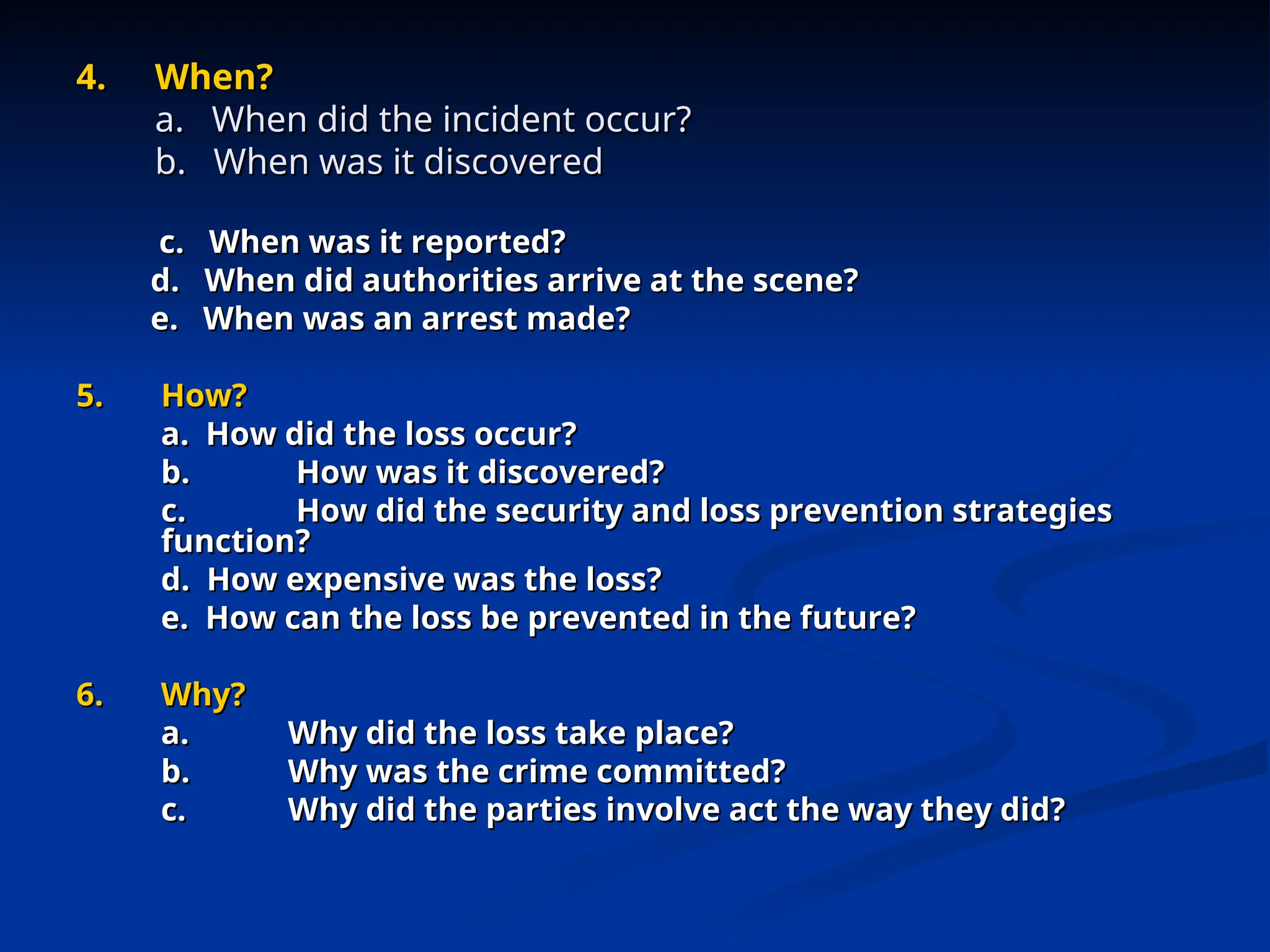
4. When?
When?
a. Whendid the incident occur?
a. When did the incident occur?
b. When was it discovered
b. When was it discovered
c. When was it reported?
c. When was it reported?
d. When did authorities arrive at the scene?
d. When did authorities arrive at the scene?
e. When was an arrest made?
e. When was an arrest made?
5.
5. How?
How?
a. How did the loss occur?
a. How did the loss occur?
b.
b. How was it discovered?
How was it discovered?
c.
c. How did the security and loss prevention strategies
How did the security and loss prevention strategies
function?
function?
d. How expensive was the loss?
d. How expensive was the loss?
e. How can the loss be prevented in the future?
e. How can the loss be prevented in the future?
6.
6. Why?
Why?
a.
a. Why did the loss take place?
Why did the loss take place?
b.
b. Why was the crime committed?
Why was the crime committed?
c.
c. Why did the parties involve act the way they did?
Why did the parties involve act the way they did?
6.
Naturally, many otherquestions may be asked during an inquiry.
Naturally, many other questions may be asked during an inquiry.
However, the above six questions are universally accepted in the
However, the above six questions are universally accepted in the
private and public sectors as a beginning point to record the facts
private and public sectors as a beginning point to record the facts
after a critical incident.
after a critical incident.
It is important to point out that not all questions asked will
It is important to point out that not all questions asked will
produce complete and accurate answers. Several reasons can
produce complete and accurate answers. Several reasons can
be given as to why this happens. A victim is a witness may be
be given as to why this happens. A victim is a witness may be
reluctant to speak, the parties involved may hide the truth or
reluctant to speak, the parties involved may hide the truth or
ulterior motives may obscure the facts.
ulterior motives may obscure the facts.
The “
The “why
why” question is particularly difficult to answer, even though it
” question is particularly difficult to answer, even though it
helps establish a motive. In one case, security personnel at a
helps establish a motive. In one case, security personnel at a
manufacturing plant were trying to discover why vandalism was
manufacturing plant were trying to discover why vandalism was
increasing in the company cafeteria. Finally, investigators
increasing in the company cafeteria. Finally, investigators
narrowed the culprit to the expensive, bland food served at the
narrowed the culprit to the expensive, bland food served at the
cafeteria, which seemed to be an indirect cause of the problem.
cafeteria, which seemed to be an indirect cause of the problem.
Soon after, the food serve contractor was changed and the
Soon after, the food serve contractor was changed and the
vandalism stopped. In another case, security officer tried to
vandalism stopped. In another case, security officer tried to
answer why two forklifts collided, resulting in injuries and
answer why two forklifts collided, resulting in injuries and
damage. Persistent questioning revealed the forklift drivers
damage. Persistent questioning revealed the forklift drivers
were playing “chicken” while workers bet on the contest.
were playing “chicken” while workers bet on the contest.
7.
IMPROVEMENT OF SKILLSTO TAKE NOTES
IMPROVEMENT OF SKILLS TO TAKE NOTES –
–
Guidelines:
Guidelines:
The following guidelines provide useful tips to improve your
The following guidelines provide useful tips to improve your
skills for taking notes:
skills for taking notes:
1.
1. Always carry at least one (1) pen and one (1) pencil. If one is
Always carry at least one (1) pen and one (1) pencil. If one is
broken, the other will be available.
broken, the other will be available.
2.
2. A small, loose leaf notebook capable of fitting into a pocket is
A small, loose leaf notebook capable of fitting into a pocket is
best. These is an essential item.
best. These is an essential item.
3.
3. It is not recommended that a security officer rely on memory
It is not recommended that a security officer rely on memory
as the major source of information to complete a subsequent
as the major source of information to complete a subsequent
report. When an emergency occurs, many activities are
report. When an emergency occurs, many activities are
taking place. Therefore, facts can easily be forgotten or
taking place. Therefore, facts can easily be forgotten or
distorted.
distorted.
4.
4. When notes are taken while an event is occurring, or soon
When notes are taken while an event is occurring, or soon
afterwards, accuracy is enhanced.
afterwards, accuracy is enhanced.
5.
5. Witnesses, victims, and offenders may change their story or
Witnesses, victims, and offenders may change their story or
cite inaccurate information at a later date. The security
cite inaccurate information at a later date. The security
officers notebook can play an important role in refreshing
officers notebook can play an important role in refreshing
memory and/or refuting erroneous testimony.
memory and/or refuting erroneous testimony.
8.
6. Notes ona loss event should be given in chronological order.
6. Notes on a loss event should be given in chronological order.
In other words, what happened before, during and after the
In other words, what happened before, during and after the
event.
event.
7. Use abbreviations and symbols to note as many important detail
7. Use abbreviations and symbols to note as many important detail
as possible, especially if time is limited. Later, when preparing
as possible, especially if time is limited. Later, when preparing
the final report, avoid abbreviations and provide complete
the final report, avoid abbreviations and provide complete
information.
information.
8.
8. Concentrate on the main events of an incident.
Concentrate on the main events of an incident.
9.
9. Diagrams, specific measurements, and photographs may be
Diagrams, specific measurements, and photographs may be
required in certain cases.
required in certain cases.
10.
10. Security officers should keep in mind that a notebook and its
Security officers should keep in mind that a notebook and its
contents may be questioned in court if a case goes to trial.
contents may be questioned in court if a case goes to trial.
11.
11. Since court cases can take many years to resolve in our system
Since court cases can take many years to resolve in our system
of justice, notes and records should be saved for several years.
of justice, notes and records should be saved for several years.
12.
12. Provide proper protection for notebooks to prevent loss or
Provide proper protection for notebooks to prevent loss or
alteration of information.
alteration of information.
9.
TYPES OF REPORTS
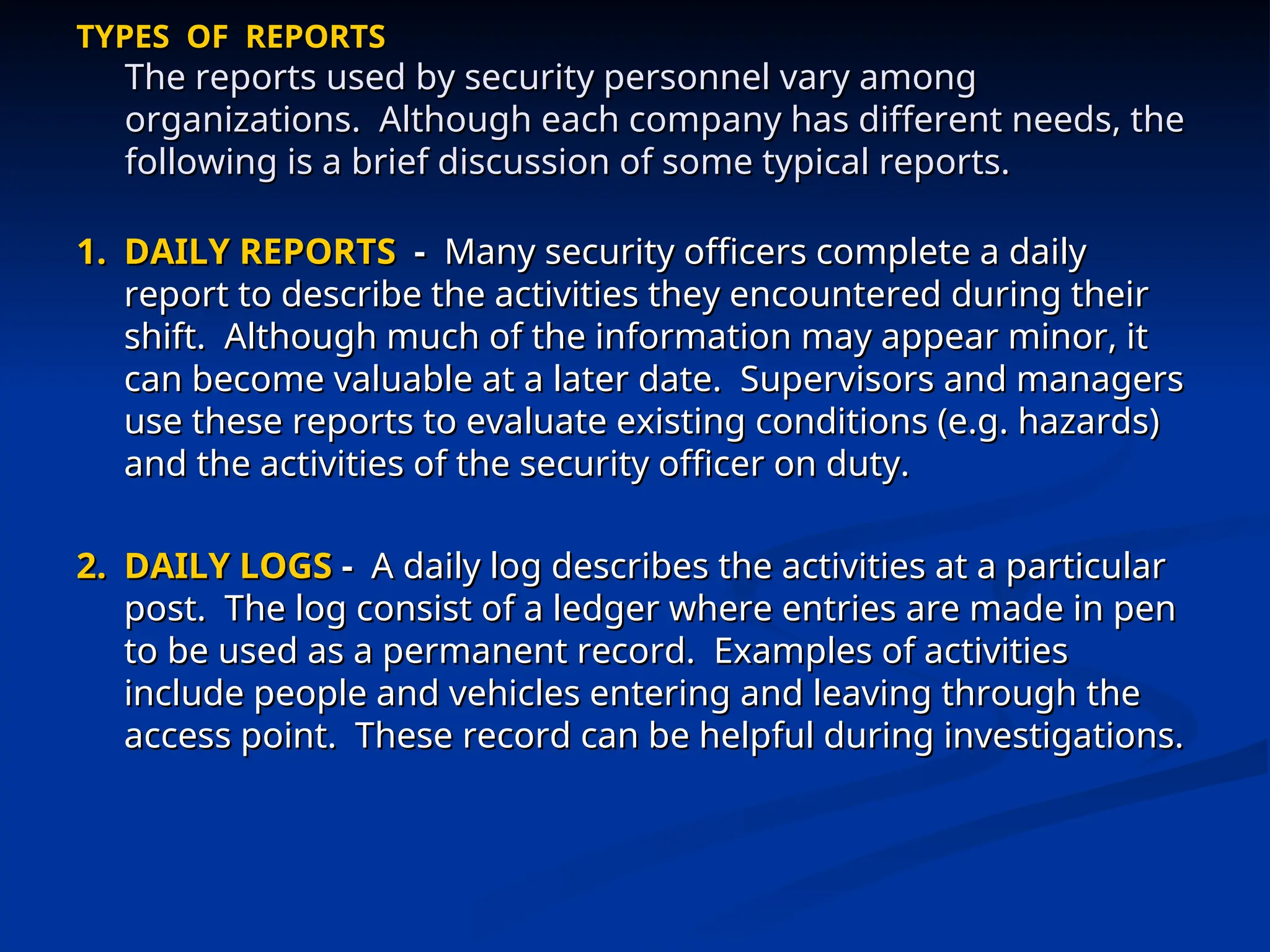
TYPESOF REPORTS
The reports used by security personnel vary among
The reports used by security personnel vary among
organizations. Although each company has different needs, the
organizations. Although each company has different needs, the
following is a brief discussion of some typical reports.
following is a brief discussion of some typical reports.
1.
1. DAILY REPORTS
DAILY REPORTS -
- Many security officers complete a daily
Many security officers complete a daily
report to describe the activities they encountered during their
report to describe the activities they encountered during their
shift. Although much of the information may appear minor, it
shift. Although much of the information may appear minor, it
can become valuable at a later date. Supervisors and managers
can become valuable at a later date. Supervisors and managers
use these reports to evaluate existing conditions (e.g. hazards)
use these reports to evaluate existing conditions (e.g. hazards)
and the activities of the security officer on duty.
and the activities of the security officer on duty.
2.
2. DAILY LOGS
DAILY LOGS -
- A daily log describes the activities at a particular
A daily log describes the activities at a particular
post. The log consist of a ledger where entries are made in pen
post. The log consist of a ledger where entries are made in pen
to be used as a permanent record. Examples of activities
to be used as a permanent record. Examples of activities
include people and vehicles entering and leaving through the
include people and vehicles entering and leaving through the
access point. These record can be helpful during investigations.
access point. These record can be helpful during investigations.
10.
3. INCIDENT REPORTS
3.INCIDENT REPORTS - Incident reports enable security officers
- Incident reports enable security officers
to record basic questions (Who? What happened? Where?
to record basic questions (Who? What happened? Where?
When? How? Why?) concerning a crime, fire, accident, or other
When? How? Why?) concerning a crime, fire, accident, or other
incident.
incident.
Much information is recorded in incident reports because of the
Much information is recorded in incident reports because of the
serious nature of lost events. Supervisors, managers, top
serious nature of lost events. Supervisors, managers, top
executives, government personnel, and insurance
executives, government personnel, and insurance
representative are some of the many people who may review
representative are some of the many people who may review
incident reports. They are interested in as much information as
incident reports. They are interested in as much information as
possible to evaluate loss events.
possible to evaluate loss events.
4. OTHER REPORTS
4. OTHER REPORTS - In addition to these three major reports,
- In addition to these three major reports,
a host of other reports or papers may be used to increase the
a host of other reports or papers may be used to increase the
effectiveness of security. For example, a daily truck report is
effectiveness of security. For example, a daily truck report is
helpful to register trucks entering and leaving the premises.
helpful to register trucks entering and leaving the premises.
Also, visitor passes help to maintain accountability of temporary
Also, visitor passes help to maintain accountability of temporary
visitors. Last, property passes provide an authorization and
visitors. Last, property passes provide an authorization and
description of property to be removed from the premises.
description of property to be removed from the premises.