Managing debtors
One of the key advantages of offering credit to
  customers is an increase in sales.
Credit is often used as a competitive marketing
  device to attract new customers.
Against the increased sales must be set the cost
  of offering credit:-
• Increased investment in debtors and reduced
  cash-flow to the firm.
• Increase in bad debt losses.
Managing debtors
The main issues which have to be considered
  by a firm in setting credit policy are:
• Establish payment terms
• analyze credit risk
• Decide when and whom to offer credit
• How to collect the debt
Payment terms
Payment term refers to when customers have to pay
  the invoice and what discounts are available for
  prompt payment.
Payment terms can include:-
• cash term
• Credit term
Cash terms
This offers the greatest protection to the seller.
The buyers pays either in advance (CASH IN
  ADVANCE) or upon taking delivery of the goods
  (CASH ON DELIVERY).
Payment terms
Credit terms
The seller delivers the goods and the buyer pays later,
  but the buyers does not sign a formal debt contract.
Credit terms (i.e. credit period and the cash discount for
  prompt payment) are usually stated on the invoice.
3/15 net 45 implies 3% discount if payment is within 15
  days otherwise full payment required within 45 days.
The implicit interest rate in the above credit term is
  about 45%. A buyer should forego the discount only if
  alternative finance cannot be obtained.
Setting credit terms
If a buyer is willing to borrow at this rate, then it is
   highly likely that they are desperate for cash.
The interest rate implicit in the credit term is found
   from the following formula:-
                              365
Interest rate = [ 1 + D      ] N -1
                   100 – D
 D is the cash discount percentage and N is the
   number of days that payment can be delayed by
   foregoing the discount.
Setting credit terms: Example
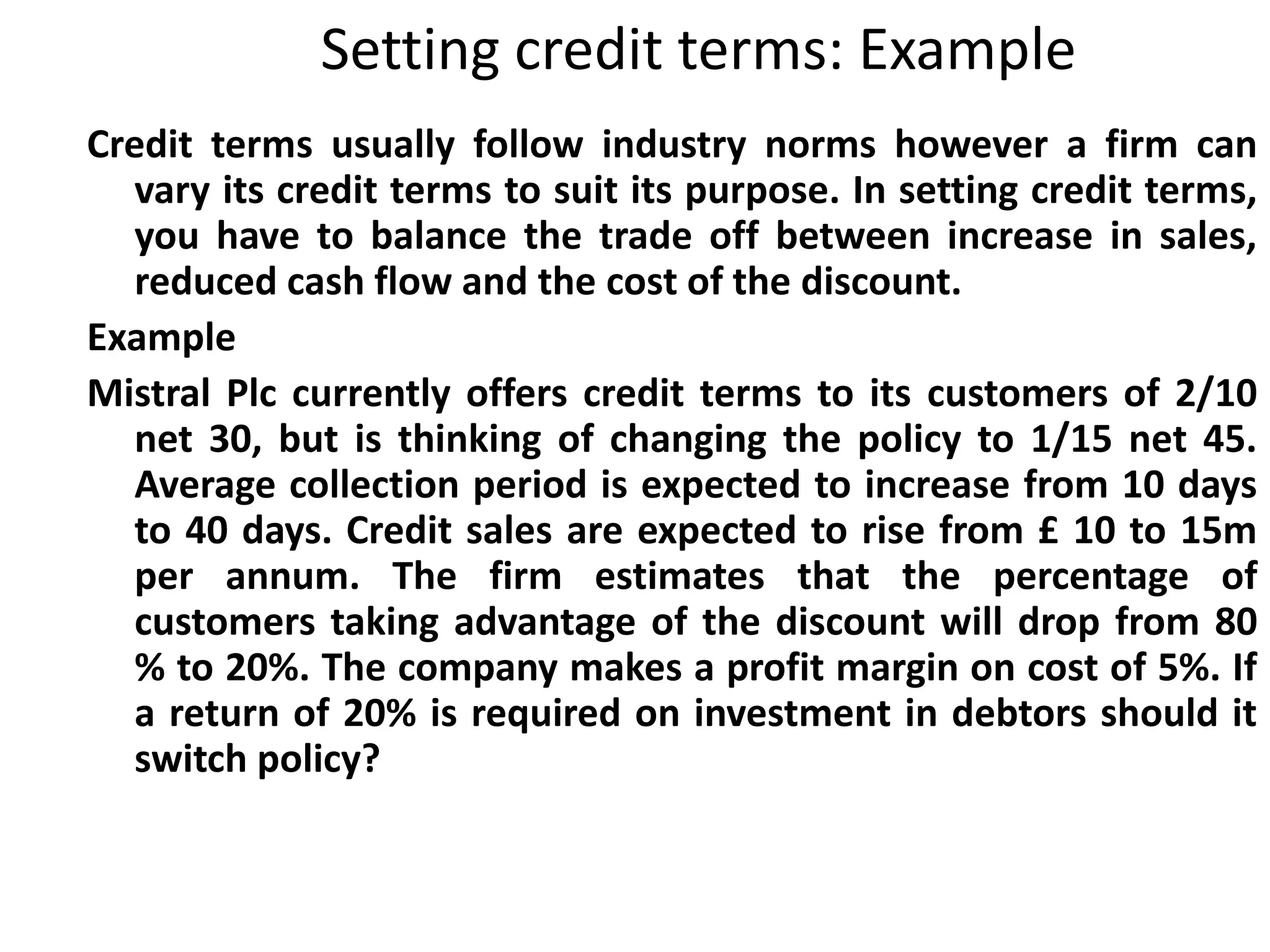
Credit terms usually follow industry norms however a firm can
  vary its credit terms to suit its purpose. In setting credit terms,
  you have to balance the trade off between increase in sales,
  reduced cash flow and the cost of the discount.
Example
Mistral Plc currently offers credit terms to its customers of 2/10
  net 30, but is thinking of changing the policy to 1/15 net 45.
  Average collection period is expected to increase from 10 days
  to 40 days. Credit sales are expected to rise from £ 10 to 15m
  per annum. The firm estimates that the percentage of
  customers taking advantage of the discount will drop from 80
  % to 20%. The company makes a profit margin on cost of 5%. If
  a return of 20% is required on investment in debtors should it
  switch policy?
Setting credit terms: Example
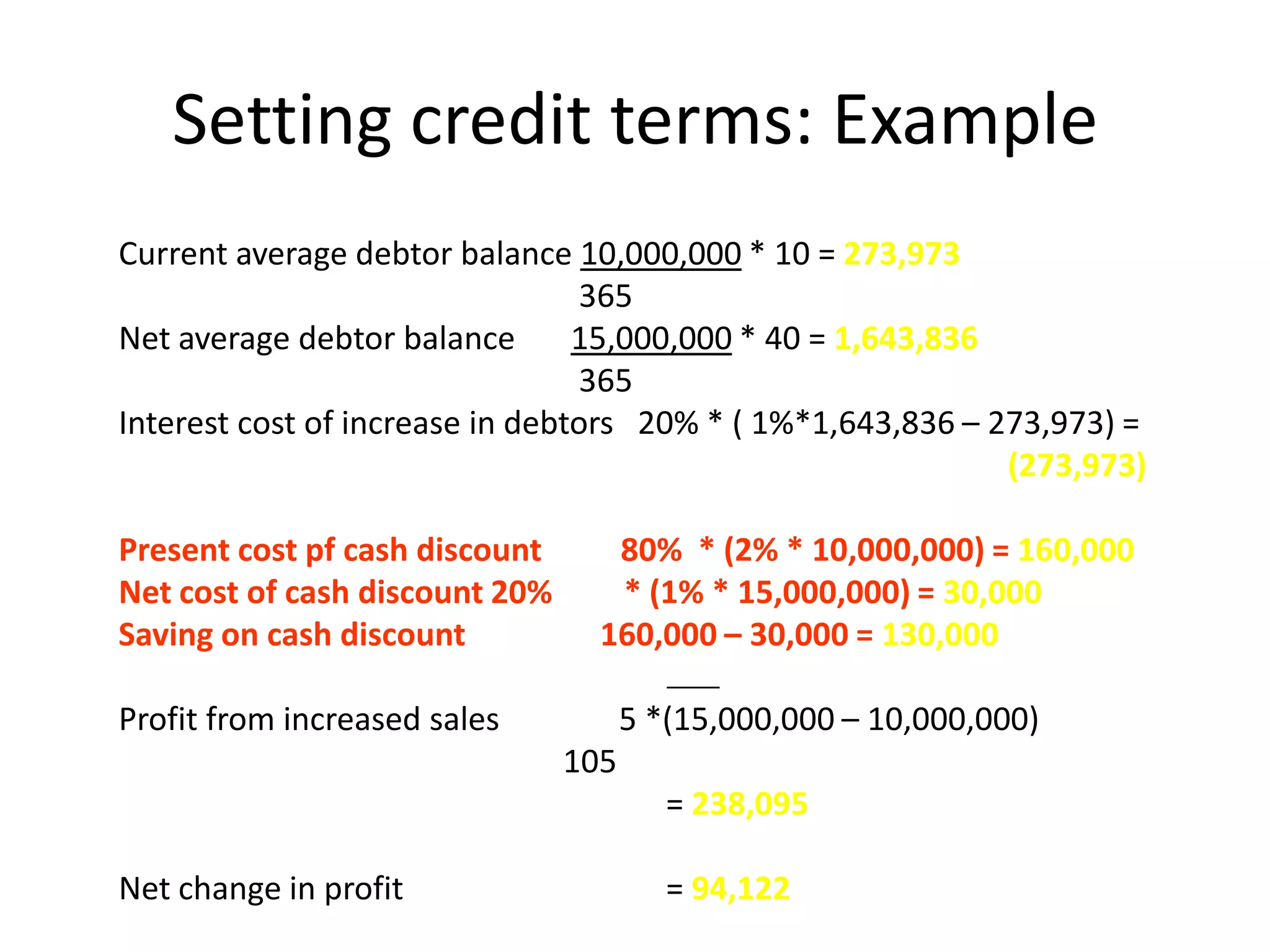
Current average debtor balance 10,000,000 * 10 = 273,973
                                 365
Net average debtor balance       15,000,000 * 40 = 1,643,836
                                 365
Interest cost of increase in debtors 20% * ( 1%*1,643,836 – 273,973) =
                                                             (273,973)

Present cost pf cash discount      80% * (2% * 10,000,000) = 160,000
Net cost of cash discount 20%      * (1% * 15,000,000) = 30,000
Saving on cash discount           160,000 – 30,000 = 130,000

Profit from increased sales           5 *(15,000,000 – 10,000,000)
                                105
                                         = 238,095

Net change in profit                     = 94,122
Managing credit risk
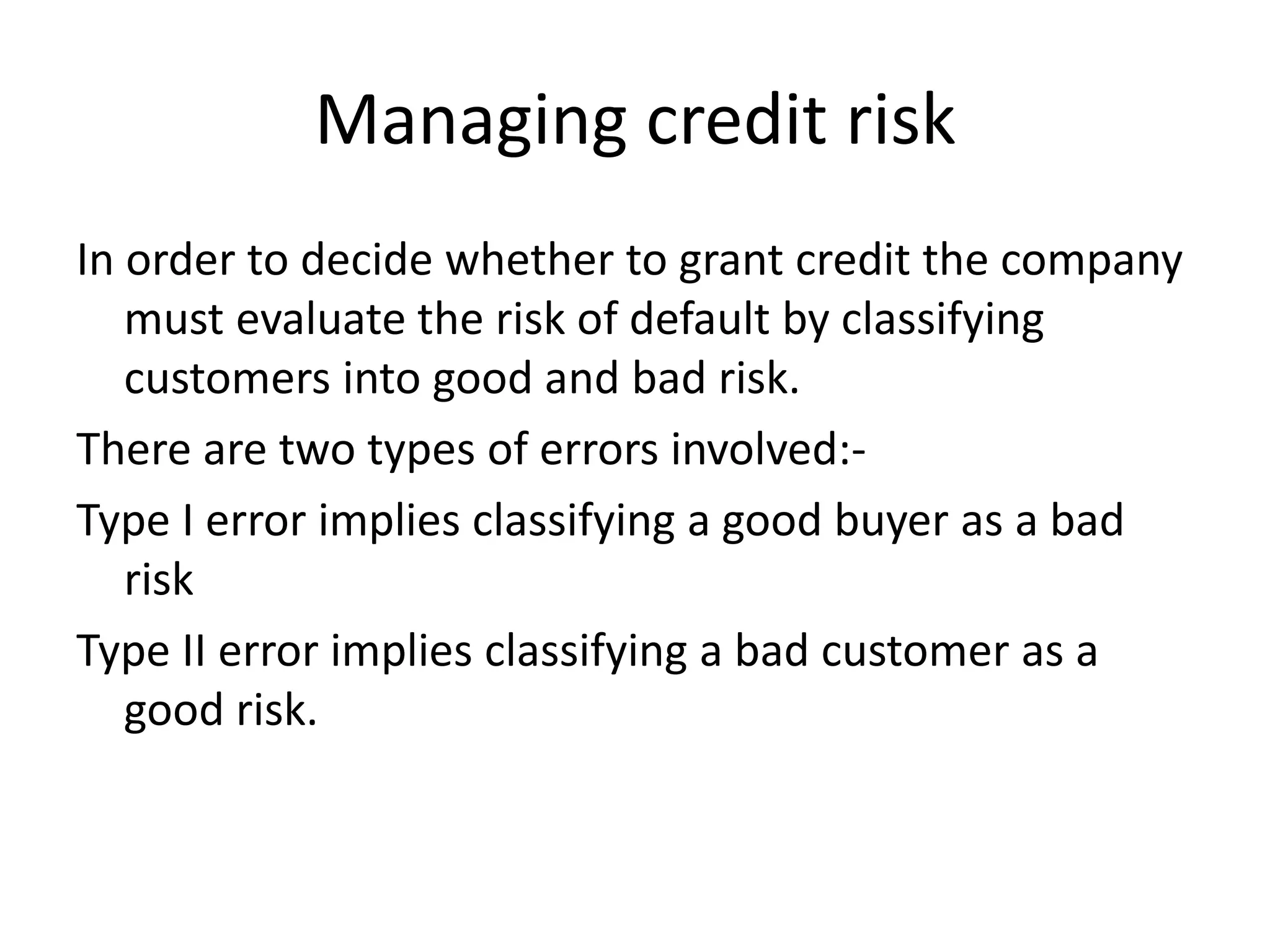
In order to decide whether to grant credit the company
   must evaluate the risk of default by classifying
   customers into good and bad risk.
There are two types of errors involved:-
Type I error implies classifying a good buyer as a bad
   risk
Type II error implies classifying a bad customer as a
   good risk.
Managing credit risk
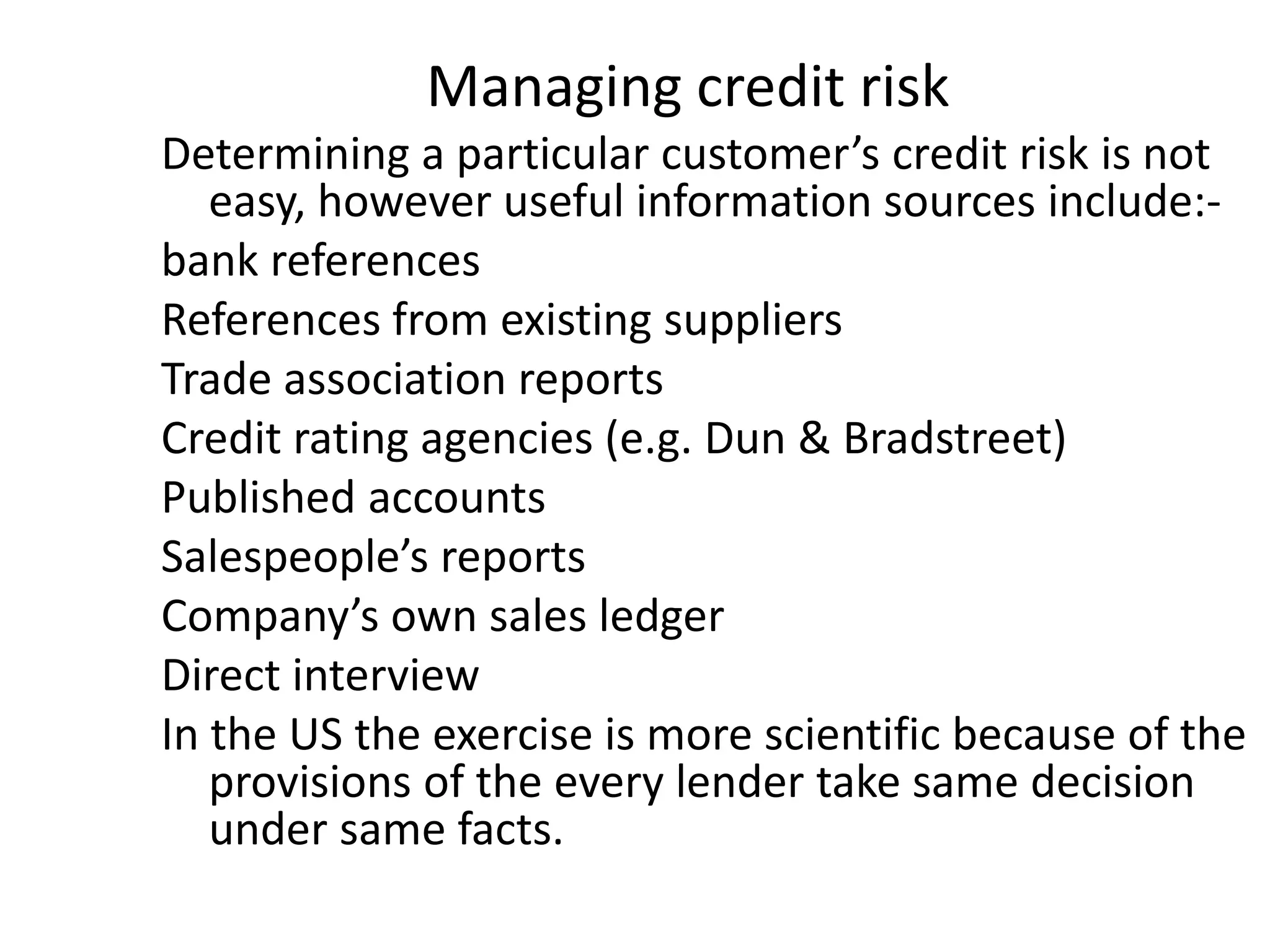
Determining a particular customer’s credit risk is not
   easy, however useful information sources include:-
bank references
References from existing suppliers
Trade association reports
Credit rating agencies (e.g. Dun & Bradstreet)
Published accounts
Salespeople’s reports
Company’s own sales ledger
Direct interview
In the US the exercise is more scientific because of the
   provisions of the every lender take same decision
   under same facts.
Statistical techniques for determining
               credit risk
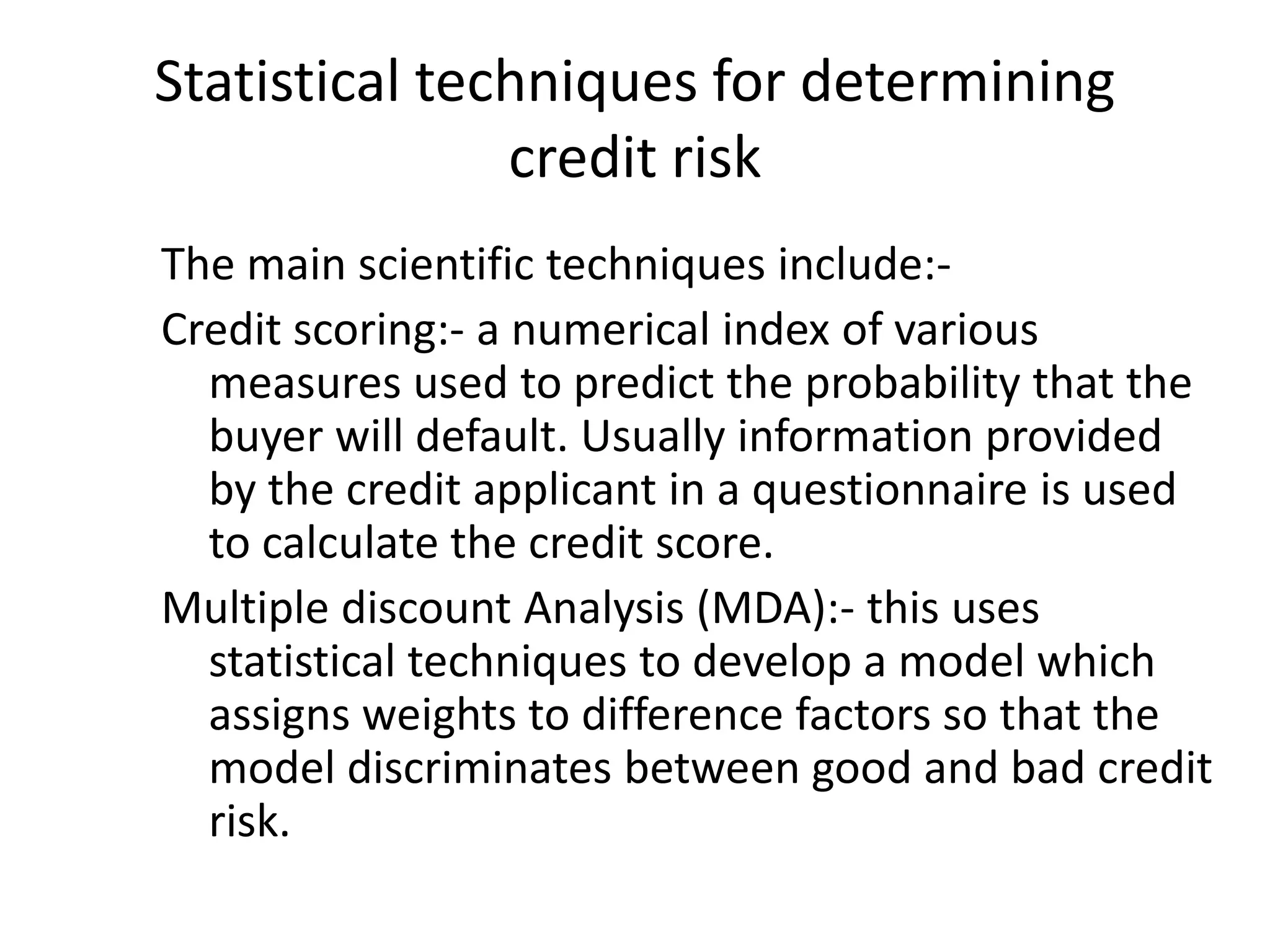
The main scientific techniques include:-
Credit scoring:- a numerical index of various
  measures used to predict the probability that the
  buyer will default. Usually information provided
  by the credit applicant in a questionnaire is used
  to calculate the credit score.
Multiple discount Analysis (MDA):- this uses
  statistical techniques to develop a model which
  assigns weights to difference factors so that the
  model discriminates between good and bad credit
  risk.
Statistical techniques for determining
               credit risk
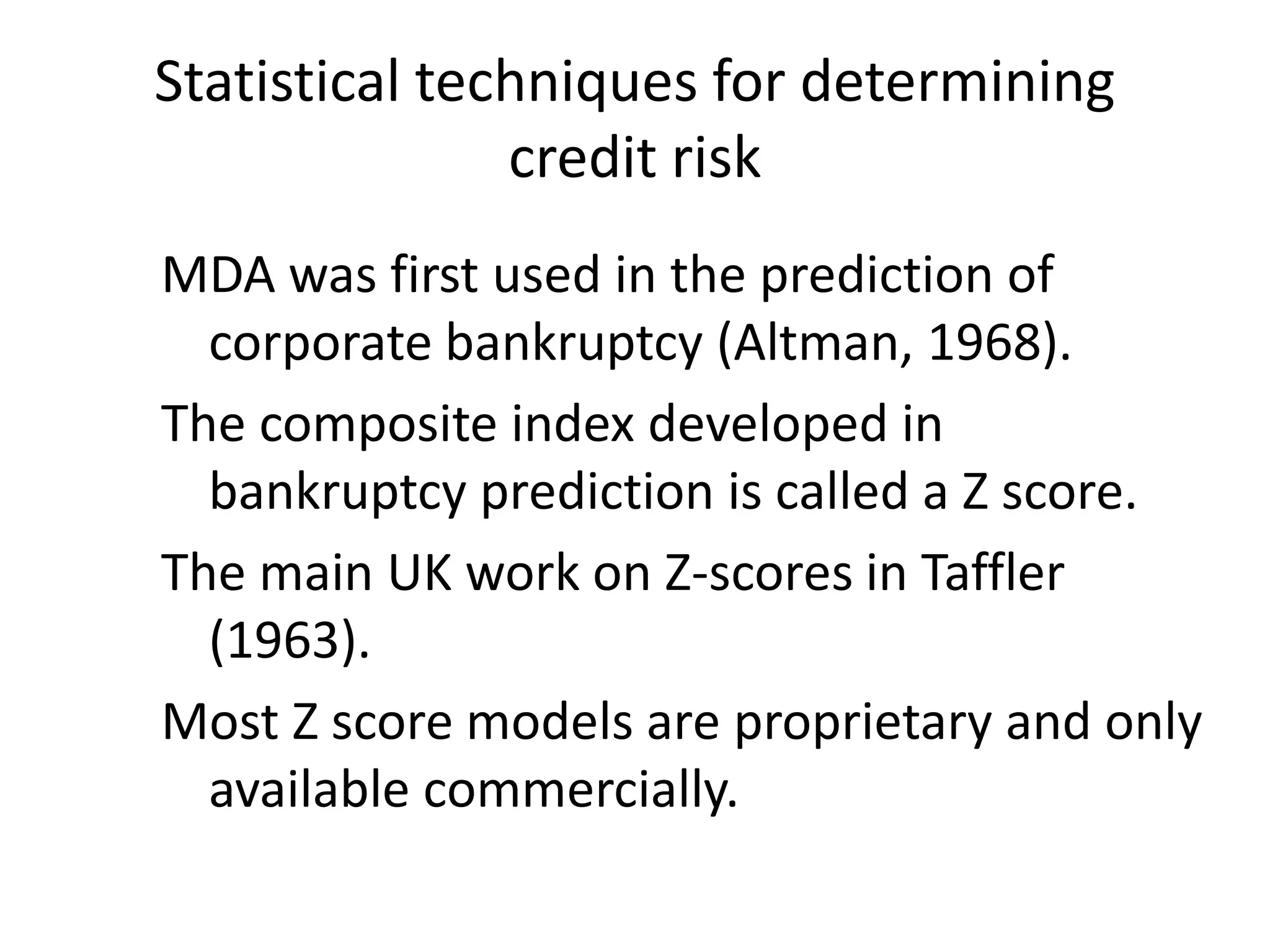
MDA was first used in the prediction of
  corporate bankruptcy (Altman, 1968).
The composite index developed in
  bankruptcy prediction is called a Z score.
The main UK work on Z-scores in Taffler
  (1963).
Most Z score models are proprietary and only
  available commercially.
Making the credit decision
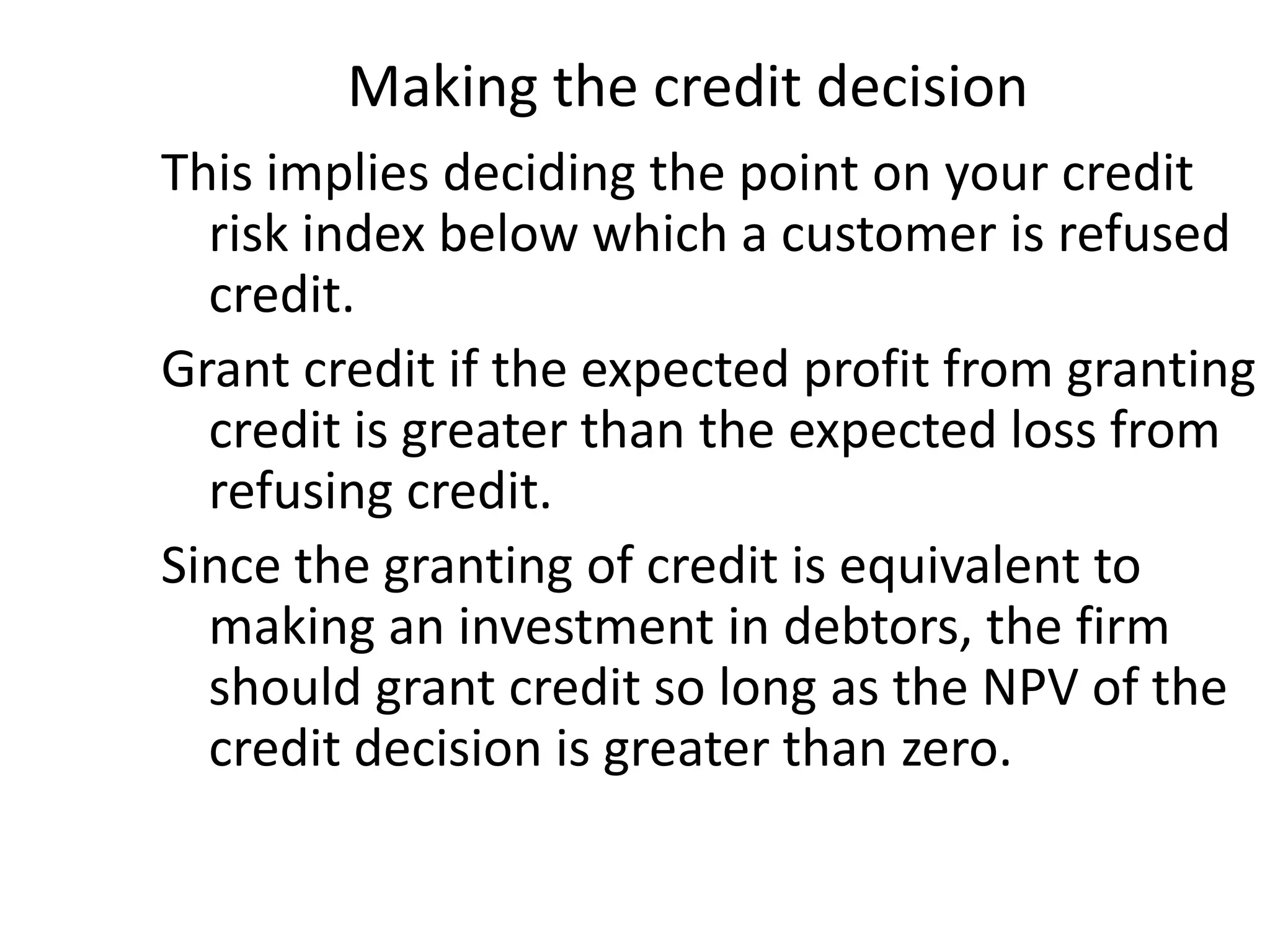
This implies deciding the point on your credit
  risk index below which a customer is refused
  credit.
Grant credit if the expected profit from granting
  credit is greater than the expected loss from
  refusing credit.
Since the granting of credit is equivalent to
  making an investment in debtors, the firm
  should grant credit so long as the NPV of the
  credit decision is greater than zero.
Making the credit decision
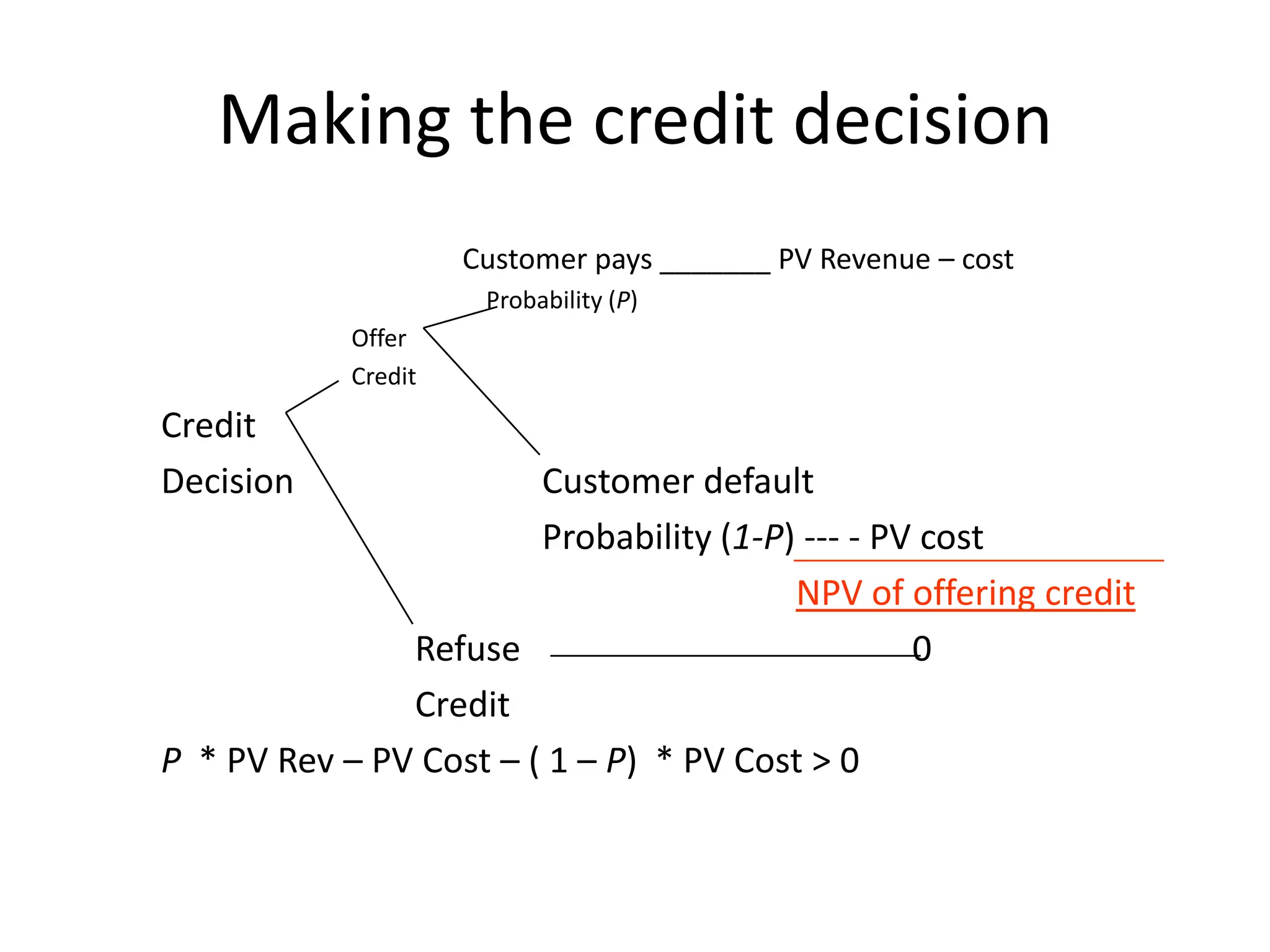
                     Customer pays _______ PV Revenue – cost
                      Probability (P)
            Offer
            Credit
Credit
Decision                Customer default
                        Probability (1-P) --- - PV cost
                                         NPV of offering credit
               Refuse                             0
               Credit
P * PV Rev – PV Cost – ( 1 – P) * PV Cost > 0
Making credit decision: Example
Vents Ltd sells on credit with average collection
   period of 45 days
The selling price of each item is $500 with a
   profit margin on cost of 10%
If the company required return on debtors is
   15% per annum, what probability of collection
   is required for the company to extend credit
   to a customer
Making credit decision: Example
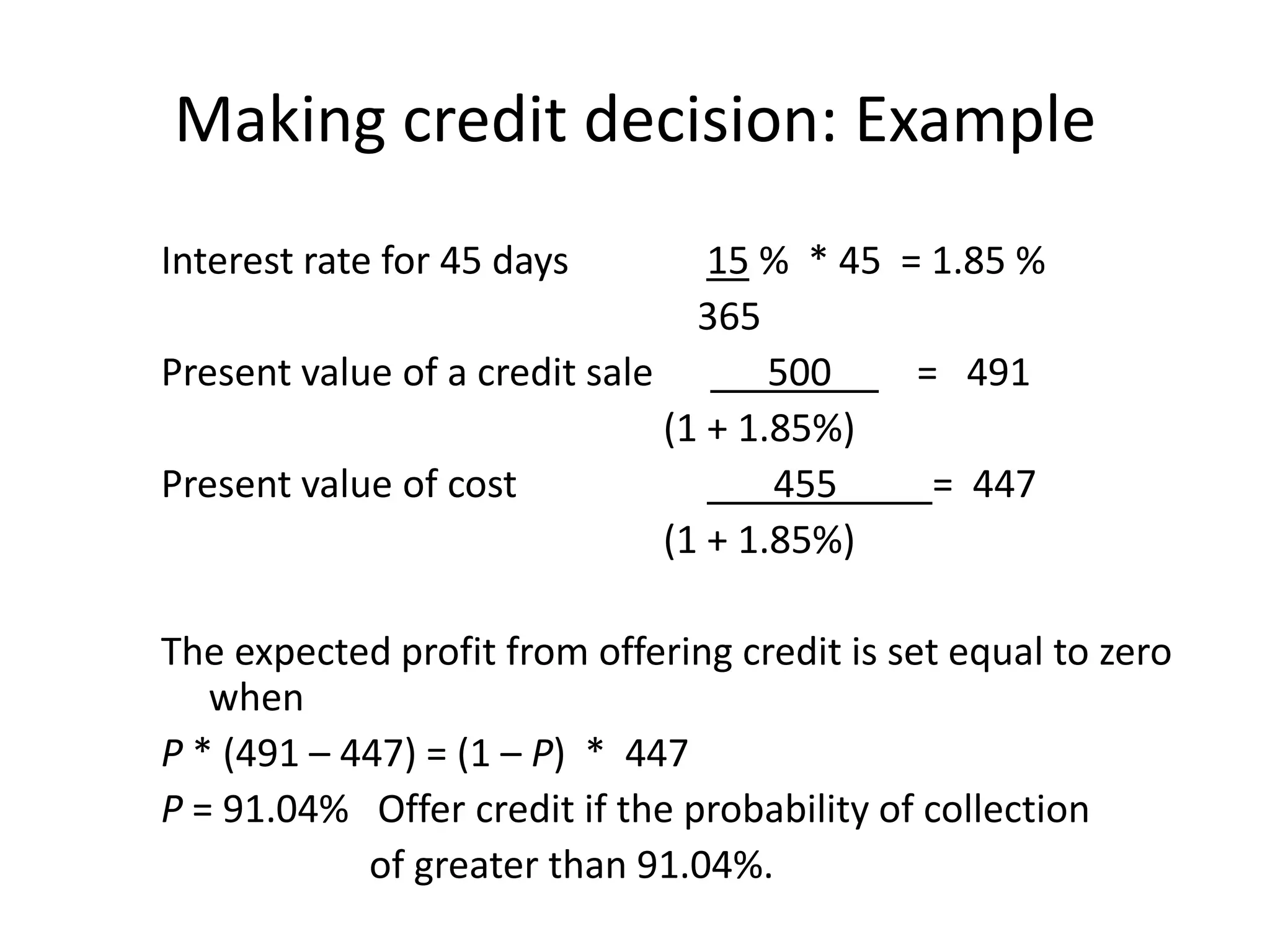
Interest rate for 45 days         15 % * 45 = 1.85 %
                                 365
Present value of a credit sale        500    = 491
                               (1 + 1.85%)
Present value of cost                 455     = 447
                               (1 + 1.85%)

The expected profit from offering credit is set equal to zero
   when
P * (491 – 447) = (1 – P) * 447
P = 91.04% Offer credit if the probability of collection
            of greater than 91.04%.
Incentive problems in making credit
             decisions
There are potentially some incentive problems in
   making credit decisions.
If sales managers are judged solely on the basis of
   sales targets, then they are more willing to grant
   credit in order to increase sales, irrespective of the
   bad debt losses incurred or the resources tied up in
   debtors.
A possible approach is to base compensation for sales
   people on the profitability of credit sales, including
   the cost of funds tied up in debtors.
Collection policy
Collecting debts can be arduous.
Once an account is overdue the seller has two
  choices:-
• Collect the debt yourself. Send statements, write
  insistent letters and make phone calls.
• Hire a professional debt collector or lawyer. They
  are expensive and can cost between 15% and 40%
  of the amount collected.
• Factoring.
• Another way of spending up cash-flow from sales is
  factoring.
• A factor buys a company’s debt on a non-recourse
  basis.
Factoring
The factor pays the seller based on the agreed average
   collection period irrespective of when the buyer paid the
   debt. This is called maturity factoring.
For this service the factor can charge fees of about 1% to 2% of
   the invoice value.
 The advantages of factoring include:-
• The seller is guaranteed payment on time.
• The seller does not risk the business relationship with the
   buyer, by chasing the buyer for the debt. Let the factor be
   the bad guy.
• The factor guarantees implicit claims made by the seller

Managing debtors

  • 1.
    Managing debtors One ofthe key advantages of offering credit to customers is an increase in sales. Credit is often used as a competitive marketing device to attract new customers. Against the increased sales must be set the cost of offering credit:- • Increased investment in debtors and reduced cash-flow to the firm. • Increase in bad debt losses.
  • 2.
    Managing debtors The mainissues which have to be considered by a firm in setting credit policy are: • Establish payment terms • analyze credit risk • Decide when and whom to offer credit • How to collect the debt
  • 3.
    Payment terms Payment termrefers to when customers have to pay the invoice and what discounts are available for prompt payment. Payment terms can include:- • cash term • Credit term Cash terms This offers the greatest protection to the seller. The buyers pays either in advance (CASH IN ADVANCE) or upon taking delivery of the goods (CASH ON DELIVERY).
  • 4.
    Payment terms Credit terms Theseller delivers the goods and the buyer pays later, but the buyers does not sign a formal debt contract. Credit terms (i.e. credit period and the cash discount for prompt payment) are usually stated on the invoice. 3/15 net 45 implies 3% discount if payment is within 15 days otherwise full payment required within 45 days. The implicit interest rate in the above credit term is about 45%. A buyer should forego the discount only if alternative finance cannot be obtained.
  • 5.
    Setting credit terms Ifa buyer is willing to borrow at this rate, then it is highly likely that they are desperate for cash. The interest rate implicit in the credit term is found from the following formula:- 365 Interest rate = [ 1 + D ] N -1 100 – D D is the cash discount percentage and N is the number of days that payment can be delayed by foregoing the discount.
  • 6.
    Setting credit terms:Example Credit terms usually follow industry norms however a firm can vary its credit terms to suit its purpose. In setting credit terms, you have to balance the trade off between increase in sales, reduced cash flow and the cost of the discount. Example Mistral Plc currently offers credit terms to its customers of 2/10 net 30, but is thinking of changing the policy to 1/15 net 45. Average collection period is expected to increase from 10 days to 40 days. Credit sales are expected to rise from £ 10 to 15m per annum. The firm estimates that the percentage of customers taking advantage of the discount will drop from 80 % to 20%. The company makes a profit margin on cost of 5%. If a return of 20% is required on investment in debtors should it switch policy?
  • 7.
    Setting credit terms:Example Current average debtor balance 10,000,000 * 10 = 273,973 365 Net average debtor balance 15,000,000 * 40 = 1,643,836 365 Interest cost of increase in debtors 20% * ( 1%*1,643,836 – 273,973) = (273,973) Present cost pf cash discount 80% * (2% * 10,000,000) = 160,000 Net cost of cash discount 20% * (1% * 15,000,000) = 30,000 Saving on cash discount 160,000 – 30,000 = 130,000 Profit from increased sales 5 *(15,000,000 – 10,000,000) 105 = 238,095 Net change in profit = 94,122
  • 8.
    Managing credit risk Inorder to decide whether to grant credit the company must evaluate the risk of default by classifying customers into good and bad risk. There are two types of errors involved:- Type I error implies classifying a good buyer as a bad risk Type II error implies classifying a bad customer as a good risk.
  • 9.
    Managing credit risk Determininga particular customer’s credit risk is not easy, however useful information sources include:- bank references References from existing suppliers Trade association reports Credit rating agencies (e.g. Dun & Bradstreet) Published accounts Salespeople’s reports Company’s own sales ledger Direct interview In the US the exercise is more scientific because of the provisions of the every lender take same decision under same facts.
  • 10.
    Statistical techniques fordetermining credit risk The main scientific techniques include:- Credit scoring:- a numerical index of various measures used to predict the probability that the buyer will default. Usually information provided by the credit applicant in a questionnaire is used to calculate the credit score. Multiple discount Analysis (MDA):- this uses statistical techniques to develop a model which assigns weights to difference factors so that the model discriminates between good and bad credit risk.
  • 11.
    Statistical techniques fordetermining credit risk MDA was first used in the prediction of corporate bankruptcy (Altman, 1968). The composite index developed in bankruptcy prediction is called a Z score. The main UK work on Z-scores in Taffler (1963). Most Z score models are proprietary and only available commercially.
  • 12.
    Making the creditdecision This implies deciding the point on your credit risk index below which a customer is refused credit. Grant credit if the expected profit from granting credit is greater than the expected loss from refusing credit. Since the granting of credit is equivalent to making an investment in debtors, the firm should grant credit so long as the NPV of the credit decision is greater than zero.
  • 13.
    Making the creditdecision Customer pays _______ PV Revenue – cost Probability (P) Offer Credit Credit Decision Customer default Probability (1-P) --- - PV cost NPV of offering credit Refuse 0 Credit P * PV Rev – PV Cost – ( 1 – P) * PV Cost > 0
  • 14.
    Making credit decision:Example Vents Ltd sells on credit with average collection period of 45 days The selling price of each item is $500 with a profit margin on cost of 10% If the company required return on debtors is 15% per annum, what probability of collection is required for the company to extend credit to a customer
  • 15.
    Making credit decision:Example Interest rate for 45 days 15 % * 45 = 1.85 % 365 Present value of a credit sale 500 = 491 (1 + 1.85%) Present value of cost 455 = 447 (1 + 1.85%) The expected profit from offering credit is set equal to zero when P * (491 – 447) = (1 – P) * 447 P = 91.04% Offer credit if the probability of collection of greater than 91.04%.
  • 16.
    Incentive problems inmaking credit decisions There are potentially some incentive problems in making credit decisions. If sales managers are judged solely on the basis of sales targets, then they are more willing to grant credit in order to increase sales, irrespective of the bad debt losses incurred or the resources tied up in debtors. A possible approach is to base compensation for sales people on the profitability of credit sales, including the cost of funds tied up in debtors.
  • 17.
    Collection policy Collecting debtscan be arduous. Once an account is overdue the seller has two choices:- • Collect the debt yourself. Send statements, write insistent letters and make phone calls. • Hire a professional debt collector or lawyer. They are expensive and can cost between 15% and 40% of the amount collected. • Factoring. • Another way of spending up cash-flow from sales is factoring. • A factor buys a company’s debt on a non-recourse basis.
  • 18.
    Factoring The factor paysthe seller based on the agreed average collection period irrespective of when the buyer paid the debt. This is called maturity factoring. For this service the factor can charge fees of about 1% to 2% of the invoice value. The advantages of factoring include:- • The seller is guaranteed payment on time. • The seller does not risk the business relationship with the buyer, by chasing the buyer for the debt. Let the factor be the bad guy. • The factor guarantees implicit claims made by the seller