Unit 4: Credit (Good/Bad Debt)
  □   Credit
  □   Advantages and Disadvantages of Credit
  □   Applying for Credit
  □   Credit History and it’s Importance
  □   Manage Credit
  □   Consequences of Excess Debt
  □   Inaccurate Credit Report
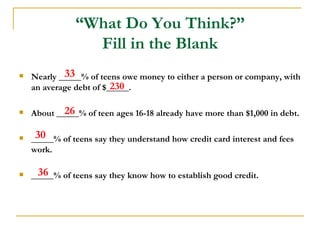
“What Do You Think?”
                 Fill in the Blank
           33
    Nearly _____% of teens owe money to either a person or company, with
                         230
    an average debt of $_____.

           26
    About _____% of teen ages 16-18 already have more than $1,000 in debt.

    30
    _____% of teens say they understand how credit card interest and fees
    work.

    36
    _____% of teens say they know how to establish good credit.
Credit
   What is credit and why use it?
       Say you dream of buying a $15,000 car. Even if you saved $200 a
        month and put it in a savings account where it earned 3%
        interest, it would still take you 7 years to save what you needed
        to buy the car. Seven years is a long time to wait for a car!
       But there’s a way you can get that car sooner – by taking out a
        loan. Taking out a loan allows you to buy what you want or need
        now, and pay for it later.
       You’ll still have to save some money for a down payment on the
        car, but you’ll end up getting the keys much faster than having to
        save the whole amount.
       Your credit score is how well you “use” your credit…
Credit
   Credit means someone is willing to loan
    you money, called principal, in exchange for
    your promise to repay it, usually with
    interest.
       Interest is the amount you pay to use someone
        else’s money.
           The higher the interest rate, the higher the total
            amount you pay to buy something on credit.
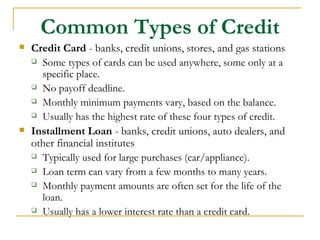
Common Types of Credit
   Credit Card - banks, credit unions, stores, and gas stations
     Some types of cards can be used anywhere, some only at a

      specific place.
     No payoff deadline.

     Monthly minimum payments vary, based on the balance.

     Usually has the highest rate of these four types of credit.

   Installment Loan - banks, credit unions, auto dealers, and
    other financial institutes
     Typically used for large purchases (car/appliance).

     Loan term can vary from a few months to many years.

     Monthly payment amounts are often set for the life of the

      loan.
     Usually has a lower interest rate than a credit card.
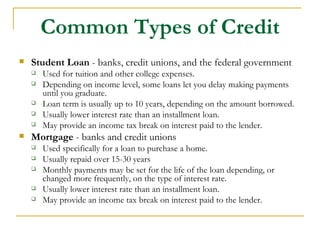
Common Types of Credit
   Student Loan - banks, credit unions, and the federal government
       Used for tuition and other college expenses.
       Depending on income level, some loans let you delay making payments
        until you graduate.
       Loan term is usually up to 10 years, depending on the amount borrowed.
       Usually lower interest rate than an installment loan.
       May provide an income tax break on interest paid to the lender.
   Mortgage - banks and credit unions
       Used specifically for a loan to purchase a home.
       Usually repaid over 15-30 years
       Monthly payments may be set for the life of the loan depending, or
        changed more frequently, on the type of interest rate.
       Usually lower interest rate than an installment loan.
       May provide an income tax break on interest paid to the lender.
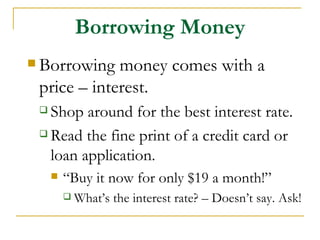
Borrowing Money
 Borrowing  money comes with a
 price – interest.
  Shop around for the best interest rate.
  Read the fine print of a credit card or

   loan application.
        “Buy it now for only $19 a month!”
          What’s   the interest rate? – Doesn’t say. Ask!
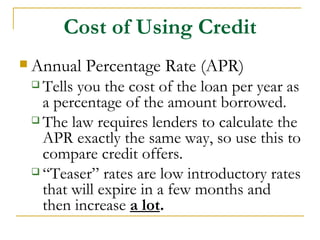
Cost of Using Credit
 Annual   Percentage Rate (APR)
  Tells you the cost of the loan per year as
   a percentage of the amount borrowed.
  The law requires lenders to calculate the
   APR exactly the same way, so use this to
   compare credit offers.
  “Teaser” rates are low introductory rates
   that will expire in a few months and
   then increase a lot.
Cost of Using Credit
   Advertisers like to focus on the size of the
    monthly payment, “Buy it now for only $19 a
    month!” But that doesn’t tell you what you really
    pay for the item.
   First, read the fine print of a credit card or loan
    application.
   Second, compare several options before making a
    final choice.
Cost of Using Credit
     Other factors include:
      Annual Fee – yearly charge you pay for the privilege of using
       credit (credit card companies)
      Credit Limit – maximum amount of credit a lender will extend
       to a customer
               Over-the-limit fee – spending more than your credit limit
       Finance Charge – actual dollar cost of using credit to maintain a
        balance (credit card statement)
       Origination Fee – charge for setting up the loan (home loans)
       Loan Term – length of time you have to pay off the loan, the
        longer the term, the lower the monthly payments (installment,
        student, and mortgage loans)
               Late fee – penalty for making a payment after the due date
                  universal default – clause in their agreement stating they can hike up your interest
                   rate if you make just one late payment
       Grace Period – length of time you have before you start
        accumulating interest
FAQ About Credit
   Brainstorm general questions you or someone
    your age would have about credit. Write these
    questions and their respective answers as a 5
    Frequently Asked Questions (FAQs) list that
    might appear on a creditor’s Website.
Risks and Rewards of Credit
    What are your perceptions about credit?
    What are the risks?
    What do you think are the rewards of using it?
    What else is interesting about credit?
     Perceptions:

     Risks:

     Rewards:

     Just Interesting:
Risks and Rewards of Credit
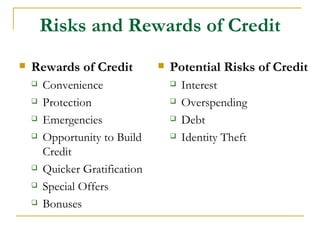
   Rewards of Credit              Potential Risks of Credit
       Convenience                    Interest
       Protection                     Overspending
       Emergencies                    Debt
       Opportunity to Build           Identity Theft
        Credit
       Quicker Gratification
       Special Offers
       Bonuses
Are You Creditworthy?
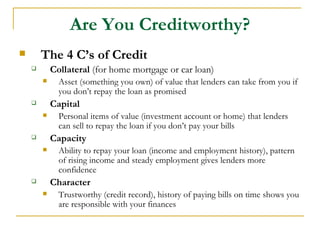
       The 4 C’s of Credit
           Collateral (for home mortgage or car loan)
             Asset (something you own) of value that lenders can take from you if
              you don’t repay the loan as promised
           Capital
             Personal items of value (investment account or home) that lenders
              can sell to repay the loan if you don’t pay your bills
           Capacity
             Ability to repay your loan (income and employment history), pattern
              of rising income and steady employment gives lenders more
              confidence
           Character
             Trustworthy (credit record), history of paying bills on time shows you
              are responsible with your finances
The 4 C’s of Credit

    Think about your own creditworthiness.
     Identify specific evidence to show how

      you meet any or all of the 4 C’s of
      Credit.
Loans
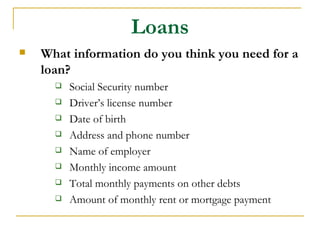
   What information do you think you need for a
    loan?
         Social Security number
         Driver’s license number
         Date of birth
         Address and phone number
         Name of employer
         Monthly income amount
         Total monthly payments on other debts
         Amount of monthly rent or mortgage payment
Credit
   Just as your report card tracks your success in
    school, a credit report tracks your success in
    managing money responsibly.
            Your credit history will follow you for the rest of your life.

    A. Lenders look to see how well you’ve managed credit in the
       past before issuing credit.
    B. Credit report tells lenders any credit you have, loan
       amounts you’ve received, credit card balances and limits,
       whether you paid your bills on time for the past 7 to 19
       years – Credit Score tells lenders all this information with
       one number.
Good/Bad Credit
C. Credit reporting agencies sell credit report
    information to businesses that are interested in
    finding out your creditworthiness.
        Good Credit History score, you won’t get approved to borrow
         If you have a bad credit
        theAlways pay your bills nottime able to rent an apartment, or not
              money you need, on being
        
         getting aa job. You can get approved, but you pay a lot more for the
             Have savings account and make regular deposits
         privilege formakecredit cards and loans you reallypay higher interest for a
             Apply
                    – only higher down payments or need and keep them
        
             long time
        rates. better to maintain a low balance on one card and pay it off each
             It’s
            month than to have no balance at all
        Hurt your Credit History
           Make late payments
           Bounced checks (writing checks when you don’t have enough money in
            your account to cover them)
           Having a lot of credit cards and loans
           Maintaining high balances on your credit cards and loans
           Changing credit cards frequently
Credit Score
   Wrong Credit Score
       The law requires that credit bureaus provide
        information about your credit history correctly,
        completely, and confidentially.
           You have the right to see everything in your report and
            who reported the information.
           You are entitled to a free credit report every year, so
            monitor your score for fraudulent use of your identity
           Contact a credit reporting agency, ask a representative to
            investigate the information. You can also attach a short
            statement.
               By law, the agency must research the questionable item and correct or
                delete anything that’s incorrect
               They must delete any unfavorable information that is 7 years old
               They must remove any bankruptcy information that more than 10 years old
Credit Score
   How do you get credit with no credit history?
       Asking a trusted adult to co-sign a credit card or car loan
        for you
           They are equally responsible for paying the debt and if you
            don’t pay the bill, they are held legally and financially
            responsible
       Ask the place where you have your savings or checking
        account for a credit card application (you already have a
        track record there)
       Apply for a credit card from a store (easier to get)
       Apply for a secured credit card (you deposit money in an
        account and can make charges against that amount)
       If you’re renting a place with some friends, make sure to get
        at least one of the utility bills in your name and pay it on
        time
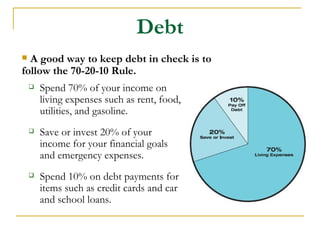
Debt
 A good way to keep debt in check is to
follow the 70-20-10 Rule.
       Spend 70% of your income on
        living expenses such as rent, food,
        utilities, and gasoline.
       Save or invest 20% of your
        income for your financial goals
        and emergency expenses.
       Spend 10% on debt payments for
        items such as credit cards and car
        and school loans.
Taking Care of Debt
   Keep financial files
       Terms and agreements for your loan applications
       Receipts of items you charged to your credit card
       Monthly statements for at least 1 year
       Tax returns for 7 years
       A list of credit card numbers and telephone numbers for each card
        issuer
   Put the plastic away, stop adding to your debt, and start
    living entirely on cash.
   Commit to repay all your debts
   Figure out how much you really owe (calculate interest)
   Create a repayment plan
Taking Care of Debt
   If debt occurs because of an illness, divorce,
    business loss, or other event beyond your control,
    contact your creditors immediately, they will work
    with you because they want to be repaid. It also
    costs them money to send your debt to a
    collection agency, so they’d rather avoid that if
    you seem committed to repaying the debt in full.
    If they don’t work with you, contact AICCCA
    (Association of Independent Consumer Credit
    Counseling Agencies) at www.aiccca.org
Taking Care of Debt
     Last resort is bankruptcy
      Chapter 7 (much harder to declare) – effectively
       allows you to erase most of your debt. You must
       typically be unemployed or have a very low income
       and undergo financial counseling to apply.
      Chapter 13 – allows you to repay many of your
       debts over a period of time, usually no more than 5
       years. A court typically oversees the repayment plan
       to make sure that you do.
      Not all debt can be erased by bankruptcy
         Student loans
         Child support
         Alimony
         Penalties and fines for crimes committed
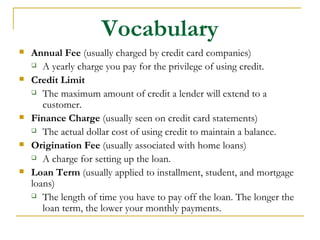
Vocabulary
   Annual Fee (usually charged by credit card companies)
     A yearly charge you pay for the privilege of using credit.

   Credit Limit
     The maximum amount of credit a lender will extend to a

       customer.
   Finance Charge (usually seen on credit card statements)
     The actual dollar cost of using credit to maintain a balance.

   Origination Fee (usually associated with home loans)
     A charge for setting up the loan.

   Loan Term (usually applied to installment, student, and mortgage
    loans)
     The length of time you have to pay off the loan. The longer the

       loan term, the lower your monthly payments.
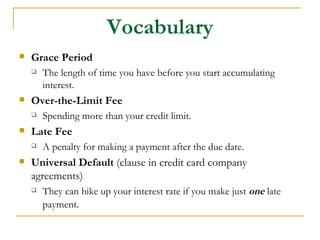
Vocabulary
   Grace Period
       The length of time you have before you start accumulating
        interest.
   Over-the-Limit Fee
       Spending more than your credit limit.
   Late Fee
       A penalty for making a payment after the due date.
   Universal Default (clause in credit card company
    agreements)
       They can hike up your interest rate if you make just one late
        payment.

Credit

  • 1.
    Unit 4: Credit(Good/Bad Debt) □ Credit □ Advantages and Disadvantages of Credit □ Applying for Credit □ Credit History and it’s Importance □ Manage Credit □ Consequences of Excess Debt □ Inaccurate Credit Report
  • 2.
    “What Do YouThink?” Fill in the Blank  33 Nearly _____% of teens owe money to either a person or company, with 230 an average debt of $_____.  26 About _____% of teen ages 16-18 already have more than $1,000 in debt.  30 _____% of teens say they understand how credit card interest and fees work.  36 _____% of teens say they know how to establish good credit.
  • 3.
    Credit  What is credit and why use it?  Say you dream of buying a $15,000 car. Even if you saved $200 a month and put it in a savings account where it earned 3% interest, it would still take you 7 years to save what you needed to buy the car. Seven years is a long time to wait for a car!  But there’s a way you can get that car sooner – by taking out a loan. Taking out a loan allows you to buy what you want or need now, and pay for it later.  You’ll still have to save some money for a down payment on the car, but you’ll end up getting the keys much faster than having to save the whole amount.  Your credit score is how well you “use” your credit…
  • 4.
    Credit  Credit means someone is willing to loan you money, called principal, in exchange for your promise to repay it, usually with interest.  Interest is the amount you pay to use someone else’s money.  The higher the interest rate, the higher the total amount you pay to buy something on credit.
  • 5.
    Common Types ofCredit  Credit Card - banks, credit unions, stores, and gas stations  Some types of cards can be used anywhere, some only at a specific place.  No payoff deadline.  Monthly minimum payments vary, based on the balance.  Usually has the highest rate of these four types of credit.  Installment Loan - banks, credit unions, auto dealers, and other financial institutes  Typically used for large purchases (car/appliance).  Loan term can vary from a few months to many years.  Monthly payment amounts are often set for the life of the loan.  Usually has a lower interest rate than a credit card.
  • 6.
    Common Types ofCredit  Student Loan - banks, credit unions, and the federal government  Used for tuition and other college expenses.  Depending on income level, some loans let you delay making payments until you graduate.  Loan term is usually up to 10 years, depending on the amount borrowed.  Usually lower interest rate than an installment loan.  May provide an income tax break on interest paid to the lender.  Mortgage - banks and credit unions  Used specifically for a loan to purchase a home.  Usually repaid over 15-30 years  Monthly payments may be set for the life of the loan depending, or changed more frequently, on the type of interest rate.  Usually lower interest rate than an installment loan.  May provide an income tax break on interest paid to the lender.
  • 7.
    Borrowing Money  Borrowing money comes with a price – interest.  Shop around for the best interest rate.  Read the fine print of a credit card or loan application.  “Buy it now for only $19 a month!”  What’s the interest rate? – Doesn’t say. Ask!
  • 8.
    Cost of UsingCredit  Annual Percentage Rate (APR)  Tells you the cost of the loan per year as a percentage of the amount borrowed.  The law requires lenders to calculate the APR exactly the same way, so use this to compare credit offers.  “Teaser” rates are low introductory rates that will expire in a few months and then increase a lot.
  • 9.
    Cost of UsingCredit  Advertisers like to focus on the size of the monthly payment, “Buy it now for only $19 a month!” But that doesn’t tell you what you really pay for the item.  First, read the fine print of a credit card or loan application.  Second, compare several options before making a final choice.
  • 10.
    Cost of UsingCredit  Other factors include:  Annual Fee – yearly charge you pay for the privilege of using credit (credit card companies)  Credit Limit – maximum amount of credit a lender will extend to a customer  Over-the-limit fee – spending more than your credit limit  Finance Charge – actual dollar cost of using credit to maintain a balance (credit card statement)  Origination Fee – charge for setting up the loan (home loans)  Loan Term – length of time you have to pay off the loan, the longer the term, the lower the monthly payments (installment, student, and mortgage loans)  Late fee – penalty for making a payment after the due date  universal default – clause in their agreement stating they can hike up your interest rate if you make just one late payment  Grace Period – length of time you have before you start accumulating interest
  • 11.
    FAQ About Credit  Brainstorm general questions you or someone your age would have about credit. Write these questions and their respective answers as a 5 Frequently Asked Questions (FAQs) list that might appear on a creditor’s Website.
  • 12.
    Risks and Rewardsof Credit  What are your perceptions about credit?  What are the risks?  What do you think are the rewards of using it?  What else is interesting about credit?  Perceptions:  Risks:  Rewards:  Just Interesting:
  • 13.
    Risks and Rewardsof Credit  Rewards of Credit  Potential Risks of Credit  Convenience  Interest  Protection  Overspending  Emergencies  Debt  Opportunity to Build  Identity Theft Credit  Quicker Gratification  Special Offers  Bonuses
  • 14.
    Are You Creditworthy?  The 4 C’s of Credit  Collateral (for home mortgage or car loan)  Asset (something you own) of value that lenders can take from you if you don’t repay the loan as promised  Capital  Personal items of value (investment account or home) that lenders can sell to repay the loan if you don’t pay your bills  Capacity  Ability to repay your loan (income and employment history), pattern of rising income and steady employment gives lenders more confidence  Character  Trustworthy (credit record), history of paying bills on time shows you are responsible with your finances
  • 15.
    The 4 C’sof Credit  Think about your own creditworthiness.  Identify specific evidence to show how you meet any or all of the 4 C’s of Credit.
  • 16.
    Loans  What information do you think you need for a loan?  Social Security number  Driver’s license number  Date of birth  Address and phone number  Name of employer  Monthly income amount  Total monthly payments on other debts  Amount of monthly rent or mortgage payment
  • 17.
    Credit  Just as your report card tracks your success in school, a credit report tracks your success in managing money responsibly.  Your credit history will follow you for the rest of your life. A. Lenders look to see how well you’ve managed credit in the past before issuing credit. B. Credit report tells lenders any credit you have, loan amounts you’ve received, credit card balances and limits, whether you paid your bills on time for the past 7 to 19 years – Credit Score tells lenders all this information with one number.
  • 18.
    Good/Bad Credit C. Creditreporting agencies sell credit report information to businesses that are interested in finding out your creditworthiness.  Good Credit History score, you won’t get approved to borrow If you have a bad credit theAlways pay your bills nottime able to rent an apartment, or not money you need, on being  getting aa job. You can get approved, but you pay a lot more for the Have savings account and make regular deposits privilege formakecredit cards and loans you reallypay higher interest for a Apply – only higher down payments or need and keep them  long time rates. better to maintain a low balance on one card and pay it off each It’s month than to have no balance at all  Hurt your Credit History  Make late payments  Bounced checks (writing checks when you don’t have enough money in your account to cover them)  Having a lot of credit cards and loans  Maintaining high balances on your credit cards and loans  Changing credit cards frequently
  • 19.
    Credit Score  Wrong Credit Score  The law requires that credit bureaus provide information about your credit history correctly, completely, and confidentially.  You have the right to see everything in your report and who reported the information.  You are entitled to a free credit report every year, so monitor your score for fraudulent use of your identity  Contact a credit reporting agency, ask a representative to investigate the information. You can also attach a short statement.  By law, the agency must research the questionable item and correct or delete anything that’s incorrect  They must delete any unfavorable information that is 7 years old  They must remove any bankruptcy information that more than 10 years old
  • 20.
    Credit Score  How do you get credit with no credit history?  Asking a trusted adult to co-sign a credit card or car loan for you  They are equally responsible for paying the debt and if you don’t pay the bill, they are held legally and financially responsible  Ask the place where you have your savings or checking account for a credit card application (you already have a track record there)  Apply for a credit card from a store (easier to get)  Apply for a secured credit card (you deposit money in an account and can make charges against that amount)  If you’re renting a place with some friends, make sure to get at least one of the utility bills in your name and pay it on time
  • 21.
    Debt  A goodway to keep debt in check is to follow the 70-20-10 Rule.  Spend 70% of your income on living expenses such as rent, food, utilities, and gasoline.  Save or invest 20% of your income for your financial goals and emergency expenses.  Spend 10% on debt payments for items such as credit cards and car and school loans.
  • 22.
    Taking Care ofDebt  Keep financial files  Terms and agreements for your loan applications  Receipts of items you charged to your credit card  Monthly statements for at least 1 year  Tax returns for 7 years  A list of credit card numbers and telephone numbers for each card issuer  Put the plastic away, stop adding to your debt, and start living entirely on cash.  Commit to repay all your debts  Figure out how much you really owe (calculate interest)  Create a repayment plan
  • 23.
    Taking Care ofDebt  If debt occurs because of an illness, divorce, business loss, or other event beyond your control, contact your creditors immediately, they will work with you because they want to be repaid. It also costs them money to send your debt to a collection agency, so they’d rather avoid that if you seem committed to repaying the debt in full. If they don’t work with you, contact AICCCA (Association of Independent Consumer Credit Counseling Agencies) at www.aiccca.org
  • 24.
    Taking Care ofDebt  Last resort is bankruptcy  Chapter 7 (much harder to declare) – effectively allows you to erase most of your debt. You must typically be unemployed or have a very low income and undergo financial counseling to apply.  Chapter 13 – allows you to repay many of your debts over a period of time, usually no more than 5 years. A court typically oversees the repayment plan to make sure that you do.  Not all debt can be erased by bankruptcy  Student loans  Child support  Alimony  Penalties and fines for crimes committed
  • 25.
    Vocabulary  Annual Fee (usually charged by credit card companies)  A yearly charge you pay for the privilege of using credit.  Credit Limit  The maximum amount of credit a lender will extend to a customer.  Finance Charge (usually seen on credit card statements)  The actual dollar cost of using credit to maintain a balance.  Origination Fee (usually associated with home loans)  A charge for setting up the loan.  Loan Term (usually applied to installment, student, and mortgage loans)  The length of time you have to pay off the loan. The longer the loan term, the lower your monthly payments.
  • 26.
    Vocabulary  Grace Period  The length of time you have before you start accumulating interest.  Over-the-Limit Fee  Spending more than your credit limit.  Late Fee  A penalty for making a payment after the due date.  Universal Default (clause in credit card company agreements)  They can hike up your interest rate if you make just one late payment.