Mr. Elsesser
Introduction to
Financial Management
Answer these
questions…
What is your definition
credit?
 Credit:
An arrangement to receive cash, goods, or services now
and pay for them in the future.
 How Credit Works:
 You borrow money from a creditor to use for personal
needs.
 Using credit may increase the amount of money you
can spend now, but the cost of credit decreases the
amount of money you will have in the future.
 Consumer credit is a major force in the American
economy, and the use of credit is a basic factor in
personal and family financial planning.
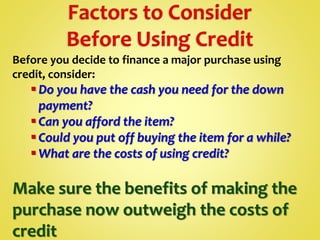
Before you decide to finance a major purchase using
credit, consider:
Do you have the cash you need for the down
payment?
Can you afford the item?
Could you put off buying the item for a while?
What are the costs of using credit?
Make sure the benefits of making the
purchase now outweigh the costs of
credit
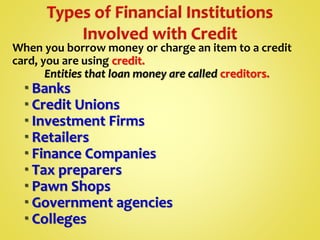
When you borrow money or charge an item to a credit
card, you are using credit.
Entities that loan money are called creditors.
 Banks
 Credit Unions
 Investment Firms
 Retailers
 Finance Companies
 Tax preparers
 Pawn Shops
 Government agencies
 Colleges
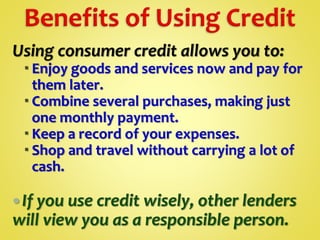
Using consumer credit allows you to:
 Enjoy goods and services now and pay for
them later.
 Combine several purchases, making just
one monthly payment.
 Keep a record of your expenses.
 Shop and travel without carrying a lot of
cash.
If you use credit wisely, other lenders
will view you as a responsible person.
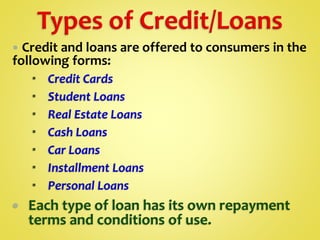
 Credit and loans are offered to consumers in the
following forms:
 Credit Cards
 Student Loans
 Real Estate Loans
 Cash Loans
 Car Loans
 Installment Loans
 Personal Loans
 Each type of loan has its own repayment
terms and conditions of use.
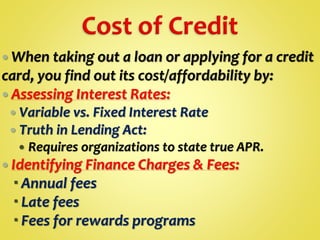
 When taking out a loan or applying for a credit
card, you find out its cost/affordability by:
 Assessing Interest Rates:
 Variable vs. Fixed Interest Rate
 Truth in Lending Act:
 Requires organizations to state true APR.
 Identifying Finance Charges & Fees:
 Annual fees
 Late fees
 Fees for rewards programs
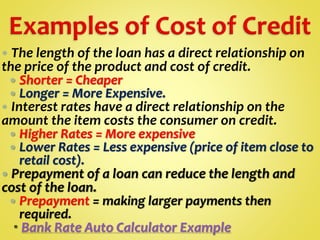
 The length of the loan has a direct relationship on
the price of the product and cost of credit.
 Shorter = Cheaper
 Longer = More Expensive.
 Interest rates have a direct relationship on the
amount the item costs the consumer on credit.
 Higher Rates = More expensive
 Lower Rates = Less expensive (price of item close to
retail cost).
 Prepayment of a loan can reduce the length and
cost of the loan.
 Prepayment = making larger payments then
required.
 Bank Rate Auto Calculator Example
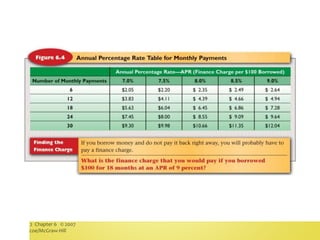
Business and Personal Finance
Unit 2 Chapter 6 © 2007
Glencoe/McGraw-Hill
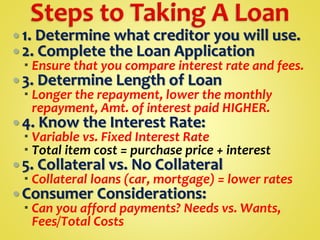
 1. Determine what creditor you will use.
 2. Complete the Loan Application
 Ensure that you compare interest rate and fees.
 3. Determine Length of Loan
 Longer the repayment, lower the monthly
repayment, Amt. of interest paid HIGHER.
 4. Know the Interest Rate:
 Variable vs. Fixed Interest Rate
 Total item cost = purchase price + interest
 5. Collateral vs. No Collateral
 Collateral loans (car, mortgage) = lower rates
 Consumer Considerations:
 Can you afford payments? Needs vs. Wants,
Fees/Total Costs
 There are a variety of factors that determine whether a
lender will extend credit to you:
 Five C’s of Credit:
 Character
 Examines person’s living & employment situation.
 Capacity
 Can you repay? Examines salary & other debts.
 Capital
 Looks at your net worth/assets. How else could you repay?
 Collateral
 Property or other things you own to secure the loan.
 Credit History
 Do you pay bills on time? Have you filled for bankruptcy?
 Sometimes Three C’s are used:
 Character, Capacity, Collateral
Business and Personal Finance
Unit 2 Chapter 6 © 2007
Glencoe/McGraw-Hill 33Business and Personal Finance Unit 2 Chapter 6 © 2007 Glencoe/McGraw-Hill
One Is Enough
When you turn 18, you may start receiving applications for credit
cards. Be a smart consumer and compare interest rates, annual
fees, and any other fees. Decide which credit card best suits your
needs and apply for that one. Toss any other applications you get
into the trash.
Why should you get the best (or lowest) interest rate for a credit
card?
 Lenders will review your credit history to find out if
you have been a responsible user of credit in past.
 Your credit history is a score compiled into a:
 Credit Rating:
 A measure of a person’s ability/willingness to make
credit payments on time.
 Lender has the right to deny loans based on credit
history, score. Inadequate income or assets.
 Equal Credit Opportunity Act (ECOA):
 Gives all credit applicants equal rights—disallows
denial of credit due to age, gender, race, sexual
orientation or handicap.
 Your credit report is examined through your
FICO score (credit score).
 What is considered in the score?
 Examines a payment history, amounts owed, length
of credit history, new credit, types of credit used.
 What does a High credit mean?
 You are an A+ borrower. You will get best interest rates, low
fees, good insurance rates, good looks with perspective
employers.
 Steps to improve your credit score:
 Check credit report, reduce debt, ensure timely payments, apply
for new accts only as needed, ensure responsibility in new credit
endeavors—especially if you have errored in the past.
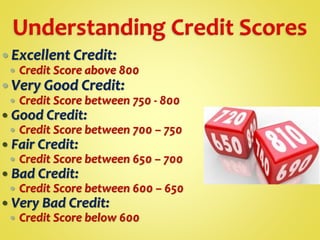
 Excellent Credit:
 Credit Score above 800
 Very Good Credit:
 Credit Score between 750 - 800
 Good Credit:
 Credit Score between 700 – 750
 Fair Credit:
 Credit Score between 650 – 700
 Bad Credit:
 Credit Score between 600 – 650
 Very Bad Credit:
 Credit Score below 600
 Applying for a credit card or other line of credit
 Opening a new loan account
 Paying Bills late
 Filing for personal bankruptcy
 Having a high debt balance
 Having a high debt to credit ratio
 If consumers default on loans—bank or lender
strengthens ability to ensure repayment by
damaging your credit score.
 Can be obtained for free one time per year from
each of 3 credit agencies
 Equifax, Experian, TransUnion
 Can also obtain within 60 days of denial of credit or
employment.
 Will be shared with landlords, employers, lenders.
 Paid loans remain on report for 7 years.
 Negative information remains on report for 7 years.
 It is the consumer’s responsibility to check for
errors and follow the process to correct the errors on
the report.
 Ex: Inaccuracies, credit fraud, etc.
 Know your rights!
 Truth in Lending Act of 1968
 Call creditors, pay on time, close unnecessary
accounts, notify card companies immediately when
faced with payment problems.
 Properly close credit card accounts
 Obtain written notification.
 Credit Repair through credit counseling
 Consumer Credit Counseling Services (CCCS)
 Bankruptcy:
 Chapter 7 (10 years on credit report)
 Chapter 13 (7 years on credit report)
 More on bankruptcy.
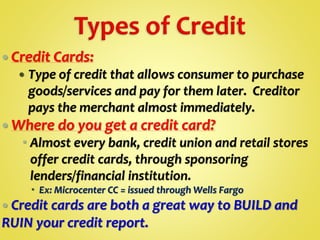
 Credit Cards:
 Type of credit that allows consumer to purchase
goods/services and pay for them later. Creditor
pays the merchant almost immediately.
 Where do you get a credit card?
 Almost every bank, credit union and retail stores
offer credit cards, through sponsoring
lenders/financial institution.
 Ex: Microcenter CC = issued through Wells Fargo
 Credit cards are both a great way to BUILD and
RUIN your credit report.
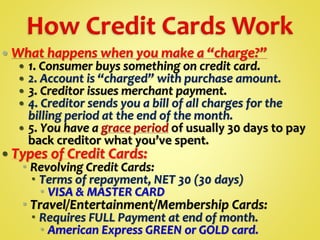
 What happens when you make a “charge?”
 1. Consumer buys something on credit card.
 2. Account is “charged” with purchase amount.
 3. Creditor issues merchant payment.
 4. Creditor sends you a bill of all charges for the
billing period at the end of the month.
 5. You have a grace period of usually 30 days to pay
back creditor what you’ve spent.
 Types of Credit Cards:
 Revolving Credit Cards:
 Terms of repayment, NET 30 (30 days)
 VISA & MASTER CARD
 Travel/Entertainment/Membership Cards:
 Requires FULL Payment at end of month.
 American Express GREEN or GOLD card.
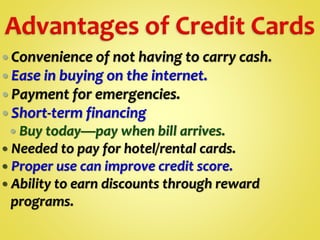
 Convenience of not having to carry cash.
 Ease in buying on the internet.
 Payment for emergencies.
 Short-term financing
 Buy today—pay when bill arrives.
 Needed to pay for hotel/rental cards.
 Proper use can improve credit score.
 Ability to earn discounts through reward
programs.
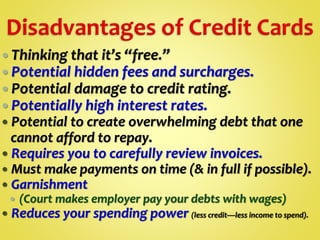
 Thinking that it’s “free.”
 Potential hidden fees and surcharges.
 Potential damage to credit rating.
 Potentially high interest rates.
 Potential to create overwhelming debt that one
cannot afford to repay.
 Requires you to carefully review invoices.
 Must make payments on time (& in full if possible).
 Garnishment
 (Court makes employer pay your debts with wages)
 Reduces your spending power (less credit—less income to spend).
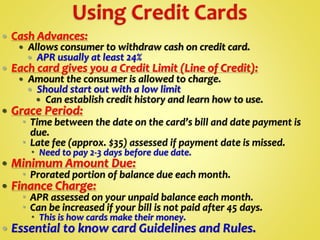
 Cash Advances:
 Allows consumer to withdraw cash on credit card.
 APR usually at least 24%
 Each card gives you a Credit Limit (Line of Credit):
 Amount the consumer is allowed to charge.
 Should start out with a low limit
 Can establish credit history and learn how to use.
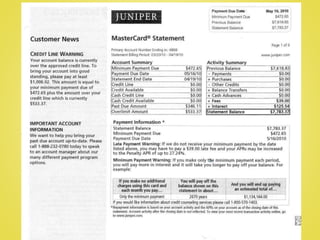
 Grace Period:
 Time between the date on the card’s bill and date payment is
due.
 Late fee (approx. $35) assessed if payment date is missed.
 Need to pay 2-3 days before due date.
 Minimum Amount Due:
 Prorated portion of balance due each month.
 Finance Charge:
 APR assessed on your unpaid balance each month.
 Can be increased if your bill is not paid after 45 days.
 This is how cards make their money.
 Essential to know card Guidelines and Rules.
ll
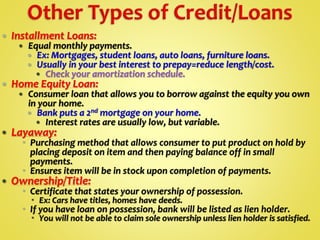
 Installment Loans:
 Equal monthly payments.
 Ex: Mortgages, student loans, auto loans, furniture loans.
 Usually in your best interest to prepay=reduce length/cost.
 Check your amortization schedule.
 Home Equity Loan:
 Consumer loan that allows you to borrow against the equity you own
in your home.
 Bank puts a 2nd mortgage on your home.
 Interest rates are usually low, but variable.
 Layaway:
 Purchasing method that allows consumer to put product on hold by
placing deposit on item and then paying balance off in small
payments.
 Ensures item will be in stock upon completion of payments.
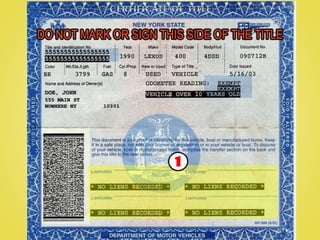
 Ownership/Title:
 Certificate that states your ownership of possession.
 Ex: Cars have titles, homes have deeds.
 If you have loan on possession, bank will be listed as lien holder.
 You will not be able to claim sole ownership unless lien holder is satisfied.
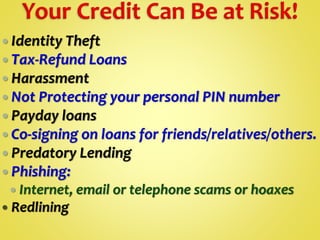
 Identity Theft
 Tax-Refund Loans
 Harassment
 Not Protecting your personal PIN number
 Payday loans
 Co-signing on loans for friends/relatives/others.
 Predatory Lending
 Phishing:
 Internet, email or telephone scams or hoaxes
 Redlining
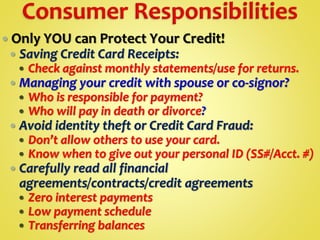
 Only YOU can Protect Your Credit!
 Saving Credit Card Receipts:
 Check against monthly statements/use for returns.
 Managing your credit with spouse or co-signor?
 Who is responsible for payment?
 Who will pay in death or divorce?
 Avoid identity theft or Credit Card Fraud:
 Don’t allow others to use your card.
 Know when to give out your personal ID (SS#/Acct. #)
 Carefully read all financial
agreements/contracts/credit agreements
 Zero interest payments
 Low payment schedule
 Transferring balances

Unit 5: Credit (Notes)

  • 1.
  • 2.
  • 3.
     Credit: An arrangementto receive cash, goods, or services now and pay for them in the future.  How Credit Works:  You borrow money from a creditor to use for personal needs.  Using credit may increase the amount of money you can spend now, but the cost of credit decreases the amount of money you will have in the future.  Consumer credit is a major force in the American economy, and the use of credit is a basic factor in personal and family financial planning.
  • 4.
    Before you decideto finance a major purchase using credit, consider: Do you have the cash you need for the down payment? Can you afford the item? Could you put off buying the item for a while? What are the costs of using credit? Make sure the benefits of making the purchase now outweigh the costs of credit
  • 5.
    When you borrowmoney or charge an item to a credit card, you are using credit. Entities that loan money are called creditors.  Banks  Credit Unions  Investment Firms  Retailers  Finance Companies  Tax preparers  Pawn Shops  Government agencies  Colleges
  • 6.
    Using consumer creditallows you to:  Enjoy goods and services now and pay for them later.  Combine several purchases, making just one monthly payment.  Keep a record of your expenses.  Shop and travel without carrying a lot of cash. If you use credit wisely, other lenders will view you as a responsible person.
  • 7.
     Credit andloans are offered to consumers in the following forms:  Credit Cards  Student Loans  Real Estate Loans  Cash Loans  Car Loans  Installment Loans  Personal Loans  Each type of loan has its own repayment terms and conditions of use.
  • 8.
     When takingout a loan or applying for a credit card, you find out its cost/affordability by:  Assessing Interest Rates:  Variable vs. Fixed Interest Rate  Truth in Lending Act:  Requires organizations to state true APR.  Identifying Finance Charges & Fees:  Annual fees  Late fees  Fees for rewards programs
  • 9.
     The lengthof the loan has a direct relationship on the price of the product and cost of credit.  Shorter = Cheaper  Longer = More Expensive.  Interest rates have a direct relationship on the amount the item costs the consumer on credit.  Higher Rates = More expensive  Lower Rates = Less expensive (price of item close to retail cost).  Prepayment of a loan can reduce the length and cost of the loan.  Prepayment = making larger payments then required.  Bank Rate Auto Calculator Example
  • 10.
    Business and PersonalFinance Unit 2 Chapter 6 © 2007 Glencoe/McGraw-Hill
  • 11.
     1. Determinewhat creditor you will use.  2. Complete the Loan Application  Ensure that you compare interest rate and fees.  3. Determine Length of Loan  Longer the repayment, lower the monthly repayment, Amt. of interest paid HIGHER.  4. Know the Interest Rate:  Variable vs. Fixed Interest Rate  Total item cost = purchase price + interest  5. Collateral vs. No Collateral  Collateral loans (car, mortgage) = lower rates  Consumer Considerations:  Can you afford payments? Needs vs. Wants, Fees/Total Costs
  • 12.
     There area variety of factors that determine whether a lender will extend credit to you:  Five C’s of Credit:  Character  Examines person’s living & employment situation.  Capacity  Can you repay? Examines salary & other debts.  Capital  Looks at your net worth/assets. How else could you repay?  Collateral  Property or other things you own to secure the loan.  Credit History  Do you pay bills on time? Have you filled for bankruptcy?  Sometimes Three C’s are used:  Character, Capacity, Collateral
  • 13.
    Business and PersonalFinance Unit 2 Chapter 6 © 2007 Glencoe/McGraw-Hill 33Business and Personal Finance Unit 2 Chapter 6 © 2007 Glencoe/McGraw-Hill One Is Enough When you turn 18, you may start receiving applications for credit cards. Be a smart consumer and compare interest rates, annual fees, and any other fees. Decide which credit card best suits your needs and apply for that one. Toss any other applications you get into the trash. Why should you get the best (or lowest) interest rate for a credit card?
  • 14.
     Lenders willreview your credit history to find out if you have been a responsible user of credit in past.  Your credit history is a score compiled into a:  Credit Rating:  A measure of a person’s ability/willingness to make credit payments on time.  Lender has the right to deny loans based on credit history, score. Inadequate income or assets.  Equal Credit Opportunity Act (ECOA):  Gives all credit applicants equal rights—disallows denial of credit due to age, gender, race, sexual orientation or handicap.
  • 15.
     Your creditreport is examined through your FICO score (credit score).  What is considered in the score?  Examines a payment history, amounts owed, length of credit history, new credit, types of credit used.  What does a High credit mean?  You are an A+ borrower. You will get best interest rates, low fees, good insurance rates, good looks with perspective employers.  Steps to improve your credit score:  Check credit report, reduce debt, ensure timely payments, apply for new accts only as needed, ensure responsibility in new credit endeavors—especially if you have errored in the past.
  • 16.
     Excellent Credit: Credit Score above 800  Very Good Credit:  Credit Score between 750 - 800  Good Credit:  Credit Score between 700 – 750  Fair Credit:  Credit Score between 650 – 700  Bad Credit:  Credit Score between 600 – 650  Very Bad Credit:  Credit Score below 600
  • 17.
     Applying fora credit card or other line of credit  Opening a new loan account  Paying Bills late  Filing for personal bankruptcy  Having a high debt balance  Having a high debt to credit ratio  If consumers default on loans—bank or lender strengthens ability to ensure repayment by damaging your credit score.
  • 18.
     Can beobtained for free one time per year from each of 3 credit agencies  Equifax, Experian, TransUnion  Can also obtain within 60 days of denial of credit or employment.  Will be shared with landlords, employers, lenders.  Paid loans remain on report for 7 years.  Negative information remains on report for 7 years.  It is the consumer’s responsibility to check for errors and follow the process to correct the errors on the report.  Ex: Inaccuracies, credit fraud, etc.
  • 19.
     Know yourrights!  Truth in Lending Act of 1968  Call creditors, pay on time, close unnecessary accounts, notify card companies immediately when faced with payment problems.  Properly close credit card accounts  Obtain written notification.  Credit Repair through credit counseling  Consumer Credit Counseling Services (CCCS)  Bankruptcy:  Chapter 7 (10 years on credit report)  Chapter 13 (7 years on credit report)  More on bankruptcy.
  • 20.
     Credit Cards: Type of credit that allows consumer to purchase goods/services and pay for them later. Creditor pays the merchant almost immediately.  Where do you get a credit card?  Almost every bank, credit union and retail stores offer credit cards, through sponsoring lenders/financial institution.  Ex: Microcenter CC = issued through Wells Fargo  Credit cards are both a great way to BUILD and RUIN your credit report.
  • 21.
     What happenswhen you make a “charge?”  1. Consumer buys something on credit card.  2. Account is “charged” with purchase amount.  3. Creditor issues merchant payment.  4. Creditor sends you a bill of all charges for the billing period at the end of the month.  5. You have a grace period of usually 30 days to pay back creditor what you’ve spent.  Types of Credit Cards:  Revolving Credit Cards:  Terms of repayment, NET 30 (30 days)  VISA & MASTER CARD  Travel/Entertainment/Membership Cards:  Requires FULL Payment at end of month.  American Express GREEN or GOLD card.
  • 22.
     Convenience ofnot having to carry cash.  Ease in buying on the internet.  Payment for emergencies.  Short-term financing  Buy today—pay when bill arrives.  Needed to pay for hotel/rental cards.  Proper use can improve credit score.  Ability to earn discounts through reward programs.
  • 23.
     Thinking thatit’s “free.”  Potential hidden fees and surcharges.  Potential damage to credit rating.  Potentially high interest rates.  Potential to create overwhelming debt that one cannot afford to repay.  Requires you to carefully review invoices.  Must make payments on time (& in full if possible).  Garnishment  (Court makes employer pay your debts with wages)  Reduces your spending power (less credit—less income to spend).
  • 24.
     Cash Advances: Allows consumer to withdraw cash on credit card.  APR usually at least 24%  Each card gives you a Credit Limit (Line of Credit):  Amount the consumer is allowed to charge.  Should start out with a low limit  Can establish credit history and learn how to use.  Grace Period:  Time between the date on the card’s bill and date payment is due.  Late fee (approx. $35) assessed if payment date is missed.  Need to pay 2-3 days before due date.  Minimum Amount Due:  Prorated portion of balance due each month.  Finance Charge:  APR assessed on your unpaid balance each month.  Can be increased if your bill is not paid after 45 days.  This is how cards make their money.  Essential to know card Guidelines and Rules.
  • 25.
  • 26.
     Installment Loans: Equal monthly payments.  Ex: Mortgages, student loans, auto loans, furniture loans.  Usually in your best interest to prepay=reduce length/cost.  Check your amortization schedule.  Home Equity Loan:  Consumer loan that allows you to borrow against the equity you own in your home.  Bank puts a 2nd mortgage on your home.  Interest rates are usually low, but variable.  Layaway:  Purchasing method that allows consumer to put product on hold by placing deposit on item and then paying balance off in small payments.  Ensures item will be in stock upon completion of payments.  Ownership/Title:  Certificate that states your ownership of possession.  Ex: Cars have titles, homes have deeds.  If you have loan on possession, bank will be listed as lien holder.  You will not be able to claim sole ownership unless lien holder is satisfied.
  • 28.
     Identity Theft Tax-Refund Loans  Harassment  Not Protecting your personal PIN number  Payday loans  Co-signing on loans for friends/relatives/others.  Predatory Lending  Phishing:  Internet, email or telephone scams or hoaxes  Redlining
  • 29.
     Only YOUcan Protect Your Credit!  Saving Credit Card Receipts:  Check against monthly statements/use for returns.  Managing your credit with spouse or co-signor?  Who is responsible for payment?  Who will pay in death or divorce?  Avoid identity theft or Credit Card Fraud:  Don’t allow others to use your card.  Know when to give out your personal ID (SS#/Acct. #)  Carefully read all financial agreements/contracts/credit agreements  Zero interest payments  Low payment schedule  Transferring balances