Unit 3 – Inves ting

 ○ S aving vs . Inves ting
 ○ Time Value of Money
 ○ Inves tment Options
 ○ Ris k and Reward of Inves ting
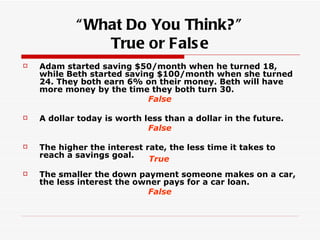
“ What Do You Think? ”
                True or Fals e
   Adam started saving $50/month when he turned 18,
    while Beth started saving $100/month when she turned
    24. They both earn 6% on their money. Beth will have
    more money by the time they both turn 30.
                            False

   A dollar today is worth less than a dollar in the future.
                             False

   The higher the interest rate, the less time it takes to
    reach a savings goal.    True
   The smaller the down payment someone makes on a car,
    the less interest the owner pays for a car loan.
                            False
S aving vs . Inves ting
   Why it’s important to save and invest
    your money?
   What is the difference between saving
    and investing?
    Investing:
     You will be less tempted to spend your

      money.
     Your money will make money for you

      (interest).
S aving vs . Inves ting

   Last unit we talked about “PYF”
    (Paying Yourself First), but what do
    you do with that money?
       Invest it so that it makes you more
        money!
S aving vs . Inves ting
   Saving – what people do to meet short-
    term goals.
       Safe
       Earns a small amount of interest
       Easy to access
   Investing – setting money aside for long-
    term goals.
       Might not grow because they rise and fall in
        value over time.
       In the long run they earn a lot more than
        savings accounts.
Ways to S ave and Inves t
   Brainstorm at least 3 ways that you
    know people save money to use later.
       Example: stash money in a dresser
        drawer
   Brainstorm at least 3 ways people
    invest money for future income and
    profit.
       Example: buy shares of stock
The A dvantage of S tarting E arly
   The Impact of Time on the Value of
    Money
       Did You Know?
       Figure 3-1
Time Value of Money
   A dollar is not always worth a dollar.
    Sometimes it’s worth more, sometimes
    less.
   The value of a dollar changes
    dramatically depending on when you
    get it and what you do with it.
   Relationship among time, money,
    and rate of interest.
Time Value of Money
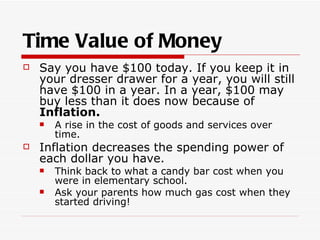
   Say you have $100 today. If you keep it in
    your dresser drawer for a year, you will still
    have $100 in a year. In a year, $100 may
    buy less than it does now because of
    Inflation.
       A rise in the cost of goods and services over
        time.
   Inflation decreases the spending power of
    each dollar you have.
       Think back to what a candy bar cost when you
        were in elementary school.
       Ask your parents how much gas cost when they
        started driving!
Time Value of Money
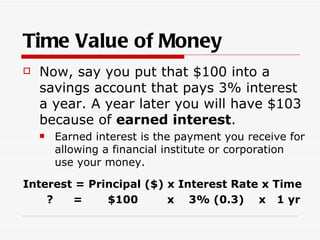
   Now, say you put that $100 into a
    savings account that pays 3% interest
    a year. A year later you will have $103
    because of earned interest.
       Earned interest is the payment you receive for
        allowing a financial institute or corporation
        use your money.

Interest = Principal ($) x Interest Rate x Time
    ?   =     $100       x 3% (0.3) x 1 yr
Time Value of Money
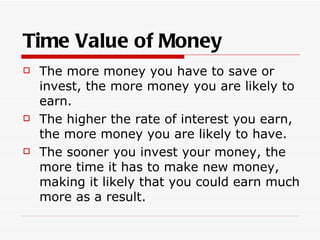
   The more money you have to save or
    invest, the more money you are likely to
    earn.
   The higher the rate of interest you earn,
    the more money you are likely to have.
   The sooner you invest your money, the
    more time it has to make new money,
    making it likely that you could earn much
    more as a result.
The Power of C ompounding
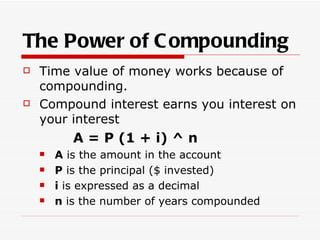
   Time value of money works because of
    compounding.
   Compound interest earns you interest on
    your interest
           A = P (1 + i) ^ n
       A is the amount in the account
       P is the principal ($ invested)
       i is expressed as a decimal
       n is the number of years compounded
The Power of C ompounding
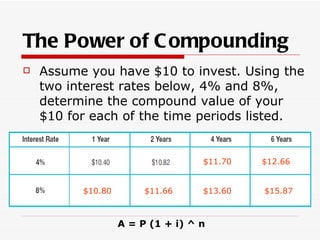
   Assume you have $10 to invest. Using the
    two interest rates below, 4% and 8%,
    determine the compound value of your
    $10 for each of the time periods listed.


                                   $11.70   $12.66


          $10.80        $11.66     $13.60   $15.87


                   A = P (1 + i) ^ n
The Price of Procras tination
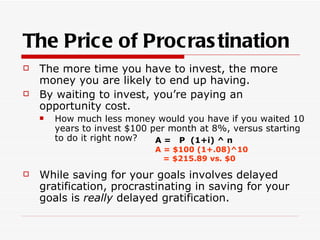
   The more time you have to invest, the more
    money you are likely to end up having.
   By waiting to invest, you’re paying an
    opportunity cost.
       How much less money would you have if you waited 10
        years to invest $100 per month at 8%, versus starting
        to do it right now?   A = P (1+i) ^ n
                             A = $100 (1+.08)^10
                               = $215.89 vs. $0

   While saving for your goals involves delayed
    gratification, procrastinating in saving for your
    goals is really delayed gratification.
The Rule of 72:
Double Your Money
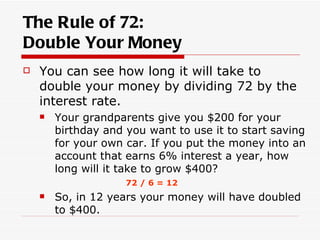
   You can see how long it will take to
    double your money by dividing 72 by the
    interest rate.
       Your grandparents give you $200 for your
        birthday and you want to use it to start saving
        for your own car. If you put the money into an
        account that earns 6% interest a year, how
        long will it take to grow $400?
                     72 / 6 = 12
       So, in 12 years your money will have doubled
        to $400.
The Rule of 72:
Double Your Money
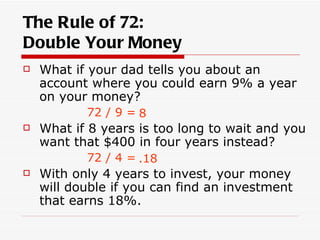
   What if your dad tells you about an
    account where you could earn 9% a year
    on your money?
           72 / 9 = 8
   What if 8 years is too long to wait and you
    want that $400 in four years instead?
           72 / 4 = .18
   With only 4 years to invest, your money
    will double if you can find an investment
    that earns 18%.
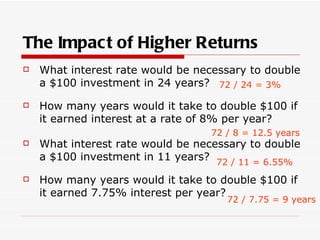
The Impac t of Higher Returns
   What interest rate would be necessary to double
    a $100 investment in 24 years? 72 / 24 = 3%
   How many years would it take to double $100 if
    it earned interest at a rate of 8% per year?
                                  72 / 8 = 12.5 years
   What interest rate would be necessary to double
    a $100 investment in 11 years? 72 / 11 = 6.55%
   How many years would it take to double $100 if
    it earned 7.75% interest per year?
                                     72 / 7.75 = 9 years
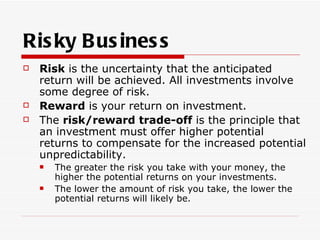
Ris ky B us ines s
   Risk is the uncertainty that the anticipated
    return will be achieved. All investments involve
    some degree of risk.
   Reward is your return on investment.
   The risk/reward trade-off is the principle that
    an investment must offer higher potential
    returns to compensate for the increased potential
    unpredictability.
       The greater the risk you take with your money, the
        higher the potential returns on your investments.
       The lower the amount of risk you take, the lower the
        potential returns will likely be.
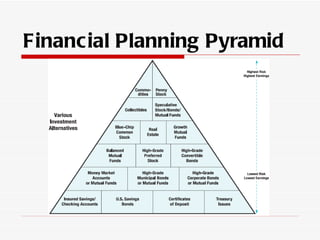
Financial Planning Pyramid
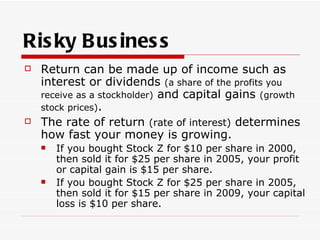
Ris ky B us ines s
   Return can be made up of income such as
    interest or dividends (a share of the profits you
    receive as a stockholder) and capital gains (growth
    stock prices).
   The rate of return (rate of interest) determines
    how fast your money is growing.
       If you bought Stock Z for $10 per share in 2000,
        then sold it for $25 per share in 2005, your profit
        or capital gain is $15 per share.
       If you bought Stock Z for $25 per share in 2005,
        then sold it for $15 per share in 2009, your capital
        loss is $10 per share.
Income vs . Growth
Inves tments
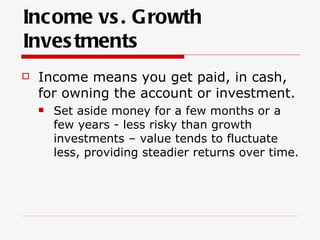
   Income means you get paid, in cash,
    for owning the account or investment.
       Set aside money for a few months or a
        few years - less risky than growth
        investments – value tends to fluctuate
        less, providing steadier returns over time.
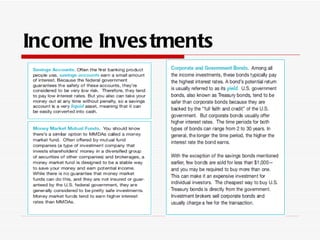
Income Inves tments
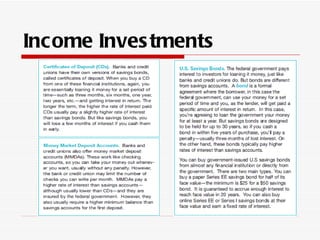
Income Inves tments
Income vs . Growth
Inves tments
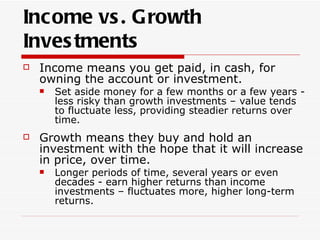
   Income means you get paid, in cash, for
    owning the account or investment.
       Set aside money for a few months or a few years -
        less risky than growth investments – value tends
        to fluctuate less, providing steadier returns over
        time.
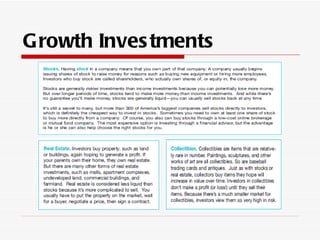
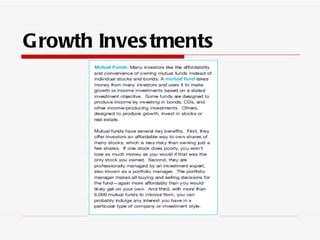
   Growth means they buy and hold an
    investment with the hope that it will increase
    in price, over time.
       Longer periods of time, several years or even
        decades - earn higher returns than income
        investments – fluctuates more, higher long-term
        returns.
Growth Inves tments
Growth Inves tments
Divers ification:
S pread Your Money A round
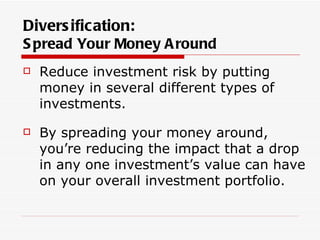
   Reduce investment risk by putting
    money in several different types of
    investments.
   By spreading your money around,
    you’re reducing the impact that a drop
    in any one investment’s value can have
    on your overall investment portfolio.
Divers ification
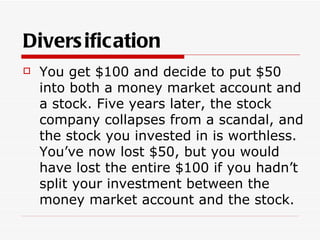
   You get $100 and decide to put $50
    into both a money market account and
    a stock. Five years later, the stock
    company collapses from a scandal, and
    the stock you invested in is worthless.
    You’ve now lost $50, but you would
    have lost the entire $100 if you hadn’t
    split your investment between the
    money market account and the stock.
Dollar C os t A veraging
   The practice of investing a fixed amount
    in the same investment at regular
    intervals, regardless of what the market is
    doing.
       Eliminates worrying about investing at the
        “right” or “wrong” time.
       Evens out the ups and downs of the market.
        As the price of the investment rises, you
        simply end up purchasing fewer shares and
        when the price falls, you end up purchasing
        more.
Dollar C os t A veraging
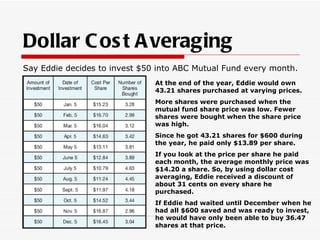
Say Eddie decides to invest $50 into ABC Mutual Fund every month.
                               At the end of the year, Eddie would own
                               43.21 shares purchased at varying prices.
                               More shares were purchased when the
                               mutual fund share price was low. Fewer
                               shares were bought when the share price
                               was high.
                               Since he got 43.21 shares for $600 during
                               the year, he paid only $13.89 per share.
                               If you look at the price per share he paid
                               each month, the average monthly price was
                               $14.20 a share. So, by using dollar cost
                               averaging, Eddie received a discount of
                               about 31 cents on every share he
                               purchased.
                               If Eddie had waited until December when he
                               had all $600 saved and was ready to invest,
                               he would have only been able to buy 36.47
                               shares at that price.
Vocabulary
    Saving
        Short-term goals, safe, earn small amount of interest, easy
         access to money
    Investing
        Longer-term goals, no guarantee money will grow,
         investments rise and fall in value over time, usually make
         more than savings account in long run
    Time Value of Money
        Relationship among time, money, and rate of interest
    Inflation
        A rise in the cost of goods and services over time
    Earned Interest
        Payment you receive for allowing a financial institution or
         corporation to use your money
    Compound Interest
        Earning interest on interest
Vocabulary
    Rule of 72
        How long it’ll take to double your money (divide 72 by the
         interest rate)
    Stock Market
        Place where stocks are bought and sold
    Dividends
        A share of the profits you receive as a stockholder
    Capital Gains
        Investor buys a stock and sells it later at a higher price
    Capital Loss
        Investor ends up selling a stock at a lower price
    Rate of Return
        Annual percentage return on an investment
    Diversification
        Reducing investment risk by putting money in several
         different types of investments

Investing

  • 1.
    Unit 3 –Inves ting ○ S aving vs . Inves ting ○ Time Value of Money ○ Inves tment Options ○ Ris k and Reward of Inves ting
  • 2.
    “ What DoYou Think? ” True or Fals e  Adam started saving $50/month when he turned 18, while Beth started saving $100/month when she turned 24. They both earn 6% on their money. Beth will have more money by the time they both turn 30. False  A dollar today is worth less than a dollar in the future. False  The higher the interest rate, the less time it takes to reach a savings goal. True  The smaller the down payment someone makes on a car, the less interest the owner pays for a car loan. False
  • 3.
    S aving vs. Inves ting  Why it’s important to save and invest your money?  What is the difference between saving and investing? Investing:  You will be less tempted to spend your money.  Your money will make money for you (interest).
  • 4.
    S aving vs. Inves ting  Last unit we talked about “PYF” (Paying Yourself First), but what do you do with that money?  Invest it so that it makes you more money!
  • 5.
    S aving vs. Inves ting  Saving – what people do to meet short- term goals.  Safe  Earns a small amount of interest  Easy to access  Investing – setting money aside for long- term goals.  Might not grow because they rise and fall in value over time.  In the long run they earn a lot more than savings accounts.
  • 6.
    Ways to Save and Inves t  Brainstorm at least 3 ways that you know people save money to use later.  Example: stash money in a dresser drawer  Brainstorm at least 3 ways people invest money for future income and profit.  Example: buy shares of stock
  • 7.
    The A dvantageof S tarting E arly  The Impact of Time on the Value of Money  Did You Know?  Figure 3-1
  • 8.
    Time Value ofMoney  A dollar is not always worth a dollar. Sometimes it’s worth more, sometimes less.  The value of a dollar changes dramatically depending on when you get it and what you do with it.  Relationship among time, money, and rate of interest.
  • 9.
    Time Value ofMoney  Say you have $100 today. If you keep it in your dresser drawer for a year, you will still have $100 in a year. In a year, $100 may buy less than it does now because of Inflation.  A rise in the cost of goods and services over time.  Inflation decreases the spending power of each dollar you have.  Think back to what a candy bar cost when you were in elementary school.  Ask your parents how much gas cost when they started driving!
  • 10.
    Time Value ofMoney  Now, say you put that $100 into a savings account that pays 3% interest a year. A year later you will have $103 because of earned interest.  Earned interest is the payment you receive for allowing a financial institute or corporation use your money. Interest = Principal ($) x Interest Rate x Time ? = $100 x 3% (0.3) x 1 yr
  • 11.
    Time Value ofMoney  The more money you have to save or invest, the more money you are likely to earn.  The higher the rate of interest you earn, the more money you are likely to have.  The sooner you invest your money, the more time it has to make new money, making it likely that you could earn much more as a result.
  • 12.
    The Power ofC ompounding  Time value of money works because of compounding.  Compound interest earns you interest on your interest A = P (1 + i) ^ n  A is the amount in the account  P is the principal ($ invested)  i is expressed as a decimal  n is the number of years compounded
  • 13.
    The Power ofC ompounding  Assume you have $10 to invest. Using the two interest rates below, 4% and 8%, determine the compound value of your $10 for each of the time periods listed. $11.70 $12.66 $10.80 $11.66 $13.60 $15.87 A = P (1 + i) ^ n
  • 14.
    The Price ofProcras tination  The more time you have to invest, the more money you are likely to end up having.  By waiting to invest, you’re paying an opportunity cost.  How much less money would you have if you waited 10 years to invest $100 per month at 8%, versus starting to do it right now? A = P (1+i) ^ n A = $100 (1+.08)^10 = $215.89 vs. $0  While saving for your goals involves delayed gratification, procrastinating in saving for your goals is really delayed gratification.
  • 15.
    The Rule of72: Double Your Money  You can see how long it will take to double your money by dividing 72 by the interest rate.  Your grandparents give you $200 for your birthday and you want to use it to start saving for your own car. If you put the money into an account that earns 6% interest a year, how long will it take to grow $400? 72 / 6 = 12  So, in 12 years your money will have doubled to $400.
  • 16.
    The Rule of72: Double Your Money  What if your dad tells you about an account where you could earn 9% a year on your money? 72 / 9 = 8  What if 8 years is too long to wait and you want that $400 in four years instead? 72 / 4 = .18  With only 4 years to invest, your money will double if you can find an investment that earns 18%.
  • 17.
    The Impac tof Higher Returns  What interest rate would be necessary to double a $100 investment in 24 years? 72 / 24 = 3%  How many years would it take to double $100 if it earned interest at a rate of 8% per year? 72 / 8 = 12.5 years  What interest rate would be necessary to double a $100 investment in 11 years? 72 / 11 = 6.55%  How many years would it take to double $100 if it earned 7.75% interest per year? 72 / 7.75 = 9 years
  • 18.
    Ris ky Bus ines s  Risk is the uncertainty that the anticipated return will be achieved. All investments involve some degree of risk.  Reward is your return on investment.  The risk/reward trade-off is the principle that an investment must offer higher potential returns to compensate for the increased potential unpredictability.  The greater the risk you take with your money, the higher the potential returns on your investments.  The lower the amount of risk you take, the lower the potential returns will likely be.
  • 19.
  • 20.
    Ris ky Bus ines s  Return can be made up of income such as interest or dividends (a share of the profits you receive as a stockholder) and capital gains (growth stock prices).  The rate of return (rate of interest) determines how fast your money is growing.  If you bought Stock Z for $10 per share in 2000, then sold it for $25 per share in 2005, your profit or capital gain is $15 per share.  If you bought Stock Z for $25 per share in 2005, then sold it for $15 per share in 2009, your capital loss is $10 per share.
  • 21.
    Income vs .Growth Inves tments  Income means you get paid, in cash, for owning the account or investment.  Set aside money for a few months or a few years - less risky than growth investments – value tends to fluctuate less, providing steadier returns over time.
  • 22.
  • 23.
  • 24.
    Income vs .Growth Inves tments  Income means you get paid, in cash, for owning the account or investment.  Set aside money for a few months or a few years - less risky than growth investments – value tends to fluctuate less, providing steadier returns over time.  Growth means they buy and hold an investment with the hope that it will increase in price, over time.  Longer periods of time, several years or even decades - earn higher returns than income investments – fluctuates more, higher long-term returns.
  • 25.
  • 26.
  • 27.
    Divers ification: S preadYour Money A round  Reduce investment risk by putting money in several different types of investments.  By spreading your money around, you’re reducing the impact that a drop in any one investment’s value can have on your overall investment portfolio.
  • 28.
    Divers ification  You get $100 and decide to put $50 into both a money market account and a stock. Five years later, the stock company collapses from a scandal, and the stock you invested in is worthless. You’ve now lost $50, but you would have lost the entire $100 if you hadn’t split your investment between the money market account and the stock.
  • 29.
    Dollar C ost A veraging  The practice of investing a fixed amount in the same investment at regular intervals, regardless of what the market is doing.  Eliminates worrying about investing at the “right” or “wrong” time.  Evens out the ups and downs of the market. As the price of the investment rises, you simply end up purchasing fewer shares and when the price falls, you end up purchasing more.
  • 30.
    Dollar C ost A veraging Say Eddie decides to invest $50 into ABC Mutual Fund every month. At the end of the year, Eddie would own 43.21 shares purchased at varying prices. More shares were purchased when the mutual fund share price was low. Fewer shares were bought when the share price was high. Since he got 43.21 shares for $600 during the year, he paid only $13.89 per share. If you look at the price per share he paid each month, the average monthly price was $14.20 a share. So, by using dollar cost averaging, Eddie received a discount of about 31 cents on every share he purchased. If Eddie had waited until December when he had all $600 saved and was ready to invest, he would have only been able to buy 36.47 shares at that price.
  • 31.
    Vocabulary  Saving  Short-term goals, safe, earn small amount of interest, easy access to money  Investing  Longer-term goals, no guarantee money will grow, investments rise and fall in value over time, usually make more than savings account in long run  Time Value of Money  Relationship among time, money, and rate of interest  Inflation  A rise in the cost of goods and services over time  Earned Interest  Payment you receive for allowing a financial institution or corporation to use your money  Compound Interest  Earning interest on interest
  • 32.
    Vocabulary  Rule of 72  How long it’ll take to double your money (divide 72 by the interest rate)  Stock Market  Place where stocks are bought and sold  Dividends  A share of the profits you receive as a stockholder  Capital Gains  Investor buys a stock and sells it later at a higher price  Capital Loss  Investor ends up selling a stock at a lower price  Rate of Return  Annual percentage return on an investment  Diversification  Reducing investment risk by putting money in several different types of investments