

Financial Literacy


An introduction to financial literacy for the
          almost-college student
What do you know about
  financial literacy?
Video
   View here
Quiz Time!

This same financial literacy quiz was given
to a sample of 500 American adults. The
average score was 40%. Can you do
better?
1. If you have caused an
accident, which type of
automobile insurance would
cover damage to your own car?
   a) Term


   b) Collision


   c) Comprehensive


   d) Liability
2. Matt and Eric are young men. Each has a good credit history.
They work at the same company and make approximately the
same salary. Matt has borrowed $6,000 to take a foreign vacation.
Eric has borrowed $6,000 to buy a car. Who is likely to pay the
lowest finance charge?


   a) Matt will pay less because people who travel overseas are
    better risks.


   b) They will both pay the same because they have almost
    identical financial backgrounds.


   c) Eric will pay less because the car is collateral for the loan.


   d) They will both pay the same because the rate is set by law.
3. If you went to college and earned a 4-year
degree, how much more money could you
expect to earn than if you only had a high
school diploma?

    a) A little more; about 20% more.


    b) A lot more; about 70% more.


    c) About 10 times as much.


    d) No more; I would make about the same
     either way.
4. Many savings programs are protected by the
Federal government against loss. Which of the
following is not?


    a) A bond issued by one of the 50 States


    b) A U. S. Treasury Bond


    c) A U. S. Savings Bond


    d) A certificate of deposit at the bank
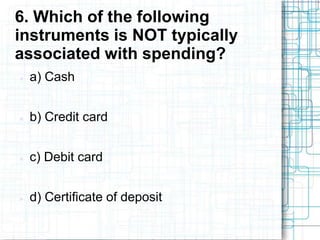
6. Which of the following
instruments is NOT typically
associated with spending?
   a) Cash


   b) Credit card


   c) Debit card


   d) Certificate of deposit
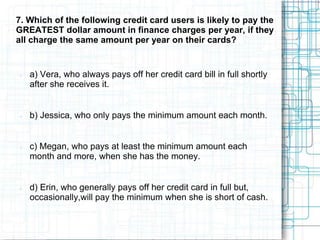
7. Which of the following credit card users is likely to pay the
GREATEST dollar amount in finance charges per year, if they
all charge the same amount per year on their cards?


   a) Vera, who always pays off her credit card bill in full shortly
    after she receives it.


   b) Jessica, who only pays the minimum amount each month.


   c) Megan, who pays at least the minimum amount each
    month and more, when she has the money.


   d) Erin, who generally pays off her credit card in full but,
    occasionally,will pay the minimum when she is short of cash.
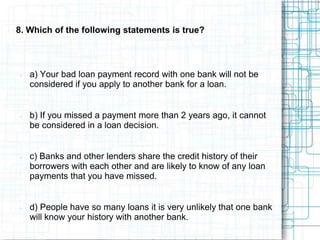
8. Which of the following statements is true?


   a) Your bad loan payment record with one bank will not be
    considered if you apply to another bank for a loan.


   b) If you missed a payment more than 2 years ago, it cannot
    be considered in a loan decision.


   c) Banks and other lenders share the credit history of their
    borrowers with each other and are likely to know of any loan
    payments that you have missed.


   d) People have so many loans it is very unlikely that one bank
    will know your history with another bank.
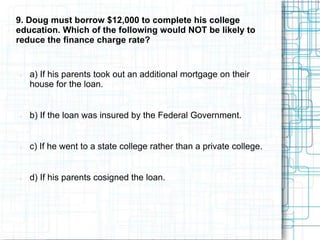
9. Doug must borrow $12,000 to complete his college
education. Which of the following would NOT be likely to
reduce the finance charge rate?


   a) If his parents took out an additional mortgage on their
    house for the loan.


   b) If the loan was insured by the Federal Government.


   c) If he went to a state college rather than a private college.


   d) If his parents cosigned the loan.
10. If you had a savings account at a bank, which
of the following would be correct concerning the
interest that you would earn on this account?


   a) Sales tax may be charged on the interest that you
    earn.


   b) You cannot earn interest until you pass your 18th
    birthday.


   c) Earnings from savings account interest may not be
    taxed.


   d) Income tax may be charged on the interest if your
    income is high enough.
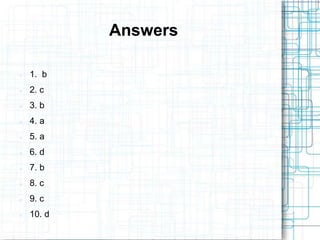
Answers

   1. b
   2. c
   3. b
   4. a
   5. a
   6. d
   7. b
   8. c
   9. c
   10. d
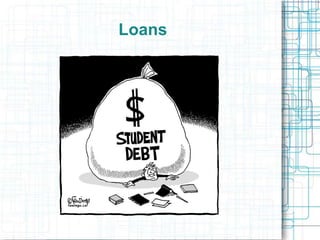
Loans
Loans

   Subsidized Federal Loans (Low interest-rate, typically
    based on need)
   Unsubsidized Federal Loans (Not based on
    need, generally low-interest)
   Federal Plus Loans (Awarded based on credit
    history, typically small amounts)
   Federal Perkins Loans (Awarded based on extreme
    financial need, very low interest)
   Private Lenders (Variety of loan packages, high
    interest-rates, much riskier)
What to look for in loans?

   Principal – This is the initial amount you
    borrow.
   Interest Rate- This is the amount of extra
    money you have to pay per year
   Rules – Some loans stipulate that you
    have to pay if you fall below being a full-
    time student.
   Penalties
   How long after graduation until you have
    to pay back the loans?
Loans

College loan officers have absolutely no
incentive to be honest with you. They will tell
you anything as long as they get you into
their school. These are salespeople!
Don’t fall into the trap of easy money, debt is
not worth it.
Some facts about finance…
Some facts about finance...

   Americans now owe more than $875
    billion on student loans, which is more
    than the total amount that Americans owe
    on their credit cards
   The unemployment rate for college
    graduates under the age of 25 is over 9%
Some facts about finance...

   Starting salaries for college graduates
    across the United States are down in
    2011 by 4%.
   According to a recent survey by
    Twentysomething Inc., a staggering 85
    percent of college seniors planned to
    move back home after graduation last
    May
Some facts about finance...

   Since 1982, the cost of medical care in
    the United States has gone up over
    200% but that is nothing compared to the
    cost of college tuition which has gone up
    by more than 400%!!!
Loans

   It's important to put your futures into
    perspective. If you're going to medical
    school, taking out loans to pay for medical
    school may not be a bad idea. If you major
    in something that doesn't tend to pay well,
    ask yourself if it's worth it to take out the
    loans in the first place.
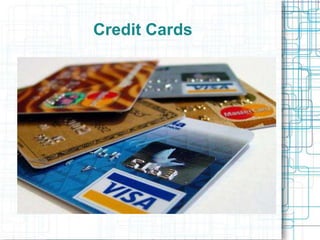
Credit Cards
Credit Cards

   Use a credit card to build credit history,
    not to pay for things you can't actually
    afford
   Credit history is necessary for things like:
    qualifying for apartments, mortgages,
    auto loans etc.
   The trick is to use them as a cash
    analog, NOT as a substitute.
   Credit card interest rates are huge!!!
Some facts about credit cards...

National debt of countries In order of debt:


  United States: $10 Trillion
  United Kingdom: $8 Trillion
  Germany: $4 Trillion
  France: $3 Trillion
  Italy: $2 Trillion
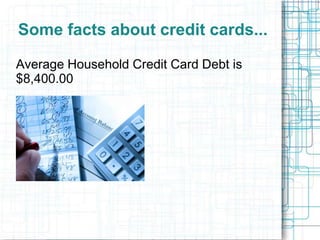
Some facts about credit cards...

Average Household Credit Card Debt is
$8,400.00
Credit Score

   Your credit score helps you qualify for
    loans, mortgages etc.
   You build credit by paying your bills on
    time
   Your credit score dwindles when you miss
    payments or do other financially unsound
    things
Interest Rates

   Interest rates can cost a lot more than you
    realize.
   Let's look at a spreadsheet that can
    calculate interest rates for you.
Budgeting

   Budgets are extremely useful in
    keeping track and planning your
    spending.
   When used in conjunction with credit
    cards, budgets help you stay within
    your means!
   Lets take a look at a budget
Savings

   Commit yourself to putting away a
    certain amount each month.
   If you're saving at least 10%, you're
    doing way better than most Americans!
But this isn't going to affect me...
Any Questions?

Beth Tfiloh HS: Financial Literacy Presentation

  • 1.
    Financial Literacy An introductionto financial literacy for the almost-college student
  • 2.
    What do youknow about financial literacy?
  • 3.
    Video  View here
  • 4.
    Quiz Time! This samefinancial literacy quiz was given to a sample of 500 American adults. The average score was 40%. Can you do better?
  • 5.
    1. If youhave caused an accident, which type of automobile insurance would cover damage to your own car?  a) Term  b) Collision  c) Comprehensive  d) Liability
  • 6.
    2. Matt andEric are young men. Each has a good credit history. They work at the same company and make approximately the same salary. Matt has borrowed $6,000 to take a foreign vacation. Eric has borrowed $6,000 to buy a car. Who is likely to pay the lowest finance charge?  a) Matt will pay less because people who travel overseas are better risks.  b) They will both pay the same because they have almost identical financial backgrounds.  c) Eric will pay less because the car is collateral for the loan.  d) They will both pay the same because the rate is set by law.
  • 7.
    3. If youwent to college and earned a 4-year degree, how much more money could you expect to earn than if you only had a high school diploma?  a) A little more; about 20% more.  b) A lot more; about 70% more.  c) About 10 times as much.  d) No more; I would make about the same either way.
  • 8.
    4. Many savingsprograms are protected by the Federal government against loss. Which of the following is not?  a) A bond issued by one of the 50 States  b) A U. S. Treasury Bond  c) A U. S. Savings Bond  d) A certificate of deposit at the bank
  • 9.
    6. Which ofthe following instruments is NOT typically associated with spending?  a) Cash  b) Credit card  c) Debit card  d) Certificate of deposit
  • 10.
    7. Which ofthe following credit card users is likely to pay the GREATEST dollar amount in finance charges per year, if they all charge the same amount per year on their cards?  a) Vera, who always pays off her credit card bill in full shortly after she receives it.  b) Jessica, who only pays the minimum amount each month.  c) Megan, who pays at least the minimum amount each month and more, when she has the money.  d) Erin, who generally pays off her credit card in full but, occasionally,will pay the minimum when she is short of cash.
  • 11.
    8. Which ofthe following statements is true?  a) Your bad loan payment record with one bank will not be considered if you apply to another bank for a loan.  b) If you missed a payment more than 2 years ago, it cannot be considered in a loan decision.  c) Banks and other lenders share the credit history of their borrowers with each other and are likely to know of any loan payments that you have missed.  d) People have so many loans it is very unlikely that one bank will know your history with another bank.
  • 12.
    9. Doug mustborrow $12,000 to complete his college education. Which of the following would NOT be likely to reduce the finance charge rate?  a) If his parents took out an additional mortgage on their house for the loan.  b) If the loan was insured by the Federal Government.  c) If he went to a state college rather than a private college.  d) If his parents cosigned the loan.
  • 13.
    10. If youhad a savings account at a bank, which of the following would be correct concerning the interest that you would earn on this account?  a) Sales tax may be charged on the interest that you earn.  b) You cannot earn interest until you pass your 18th birthday.  c) Earnings from savings account interest may not be taxed.  d) Income tax may be charged on the interest if your income is high enough.
  • 14.
    Answers  1. b  2. c  3. b  4. a  5. a  6. d  7. b  8. c  9. c  10. d
  • 15.
  • 16.
    Loans  Subsidized Federal Loans (Low interest-rate, typically based on need)  Unsubsidized Federal Loans (Not based on need, generally low-interest)  Federal Plus Loans (Awarded based on credit history, typically small amounts)  Federal Perkins Loans (Awarded based on extreme financial need, very low interest)  Private Lenders (Variety of loan packages, high interest-rates, much riskier)
  • 17.
    What to lookfor in loans?  Principal – This is the initial amount you borrow.  Interest Rate- This is the amount of extra money you have to pay per year  Rules – Some loans stipulate that you have to pay if you fall below being a full- time student.  Penalties  How long after graduation until you have to pay back the loans?
  • 18.
    Loans College loan officershave absolutely no incentive to be honest with you. They will tell you anything as long as they get you into their school. These are salespeople! Don’t fall into the trap of easy money, debt is not worth it.
  • 19.
    Some facts aboutfinance…
  • 20.
    Some facts aboutfinance...  Americans now owe more than $875 billion on student loans, which is more than the total amount that Americans owe on their credit cards  The unemployment rate for college graduates under the age of 25 is over 9%
  • 21.
    Some facts aboutfinance...  Starting salaries for college graduates across the United States are down in 2011 by 4%.  According to a recent survey by Twentysomething Inc., a staggering 85 percent of college seniors planned to move back home after graduation last May
  • 22.
    Some facts aboutfinance...  Since 1982, the cost of medical care in the United States has gone up over 200% but that is nothing compared to the cost of college tuition which has gone up by more than 400%!!!
  • 23.
    Loans  It's important to put your futures into perspective. If you're going to medical school, taking out loans to pay for medical school may not be a bad idea. If you major in something that doesn't tend to pay well, ask yourself if it's worth it to take out the loans in the first place.
  • 24.
  • 25.
    Credit Cards  Use a credit card to build credit history, not to pay for things you can't actually afford  Credit history is necessary for things like: qualifying for apartments, mortgages, auto loans etc.  The trick is to use them as a cash analog, NOT as a substitute.  Credit card interest rates are huge!!!
  • 26.
    Some facts aboutcredit cards... National debt of countries In order of debt: United States: $10 Trillion United Kingdom: $8 Trillion Germany: $4 Trillion France: $3 Trillion Italy: $2 Trillion
  • 27.
    Some facts aboutcredit cards... Average Household Credit Card Debt is $8,400.00
  • 28.
    Credit Score  Your credit score helps you qualify for loans, mortgages etc.  You build credit by paying your bills on time  Your credit score dwindles when you miss payments or do other financially unsound things
  • 29.
    Interest Rates  Interest rates can cost a lot more than you realize.  Let's look at a spreadsheet that can calculate interest rates for you.
  • 30.
    Budgeting  Budgets are extremely useful in keeping track and planning your spending.  When used in conjunction with credit cards, budgets help you stay within your means!  Lets take a look at a budget
  • 31.
    Savings  Commit yourself to putting away a certain amount each month.  If you're saving at least 10%, you're doing way better than most Americans!
  • 32.
    But this isn'tgoing to affect me...
  • 33.