Creating sustainable digital
communities for students and
teachers
                                           Dr Shirley Reushle
                                           Associate Director
                           Australian Digital Futures Institute
                University of Southern Queensland, Australia
                                 shirley.reushle@usq.edu.au
What is a digital learning community?


Guiding principles for building and fostering
       digital learning communities


Examples of digital learning communities


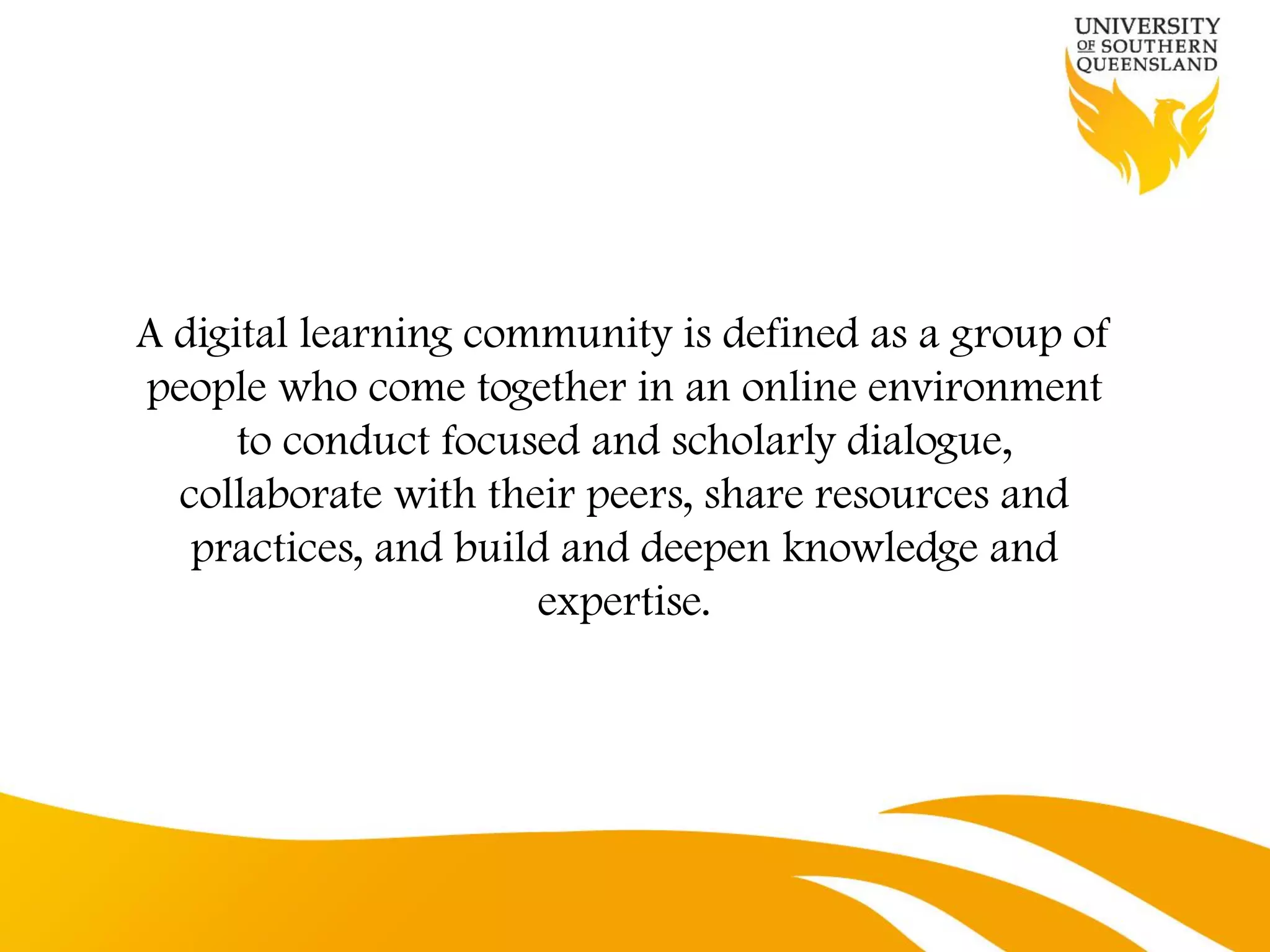
        It's difficult to stay current and informed in a climate where
                       everything is changing (George Siemens)
A digital learning community is defined as a group of
people who come together in an online environment
      to conduct focused and scholarly dialogue,
  collaborate with their peers, share resources and
   practices, and build and deepen knowledge and
                      expertise.
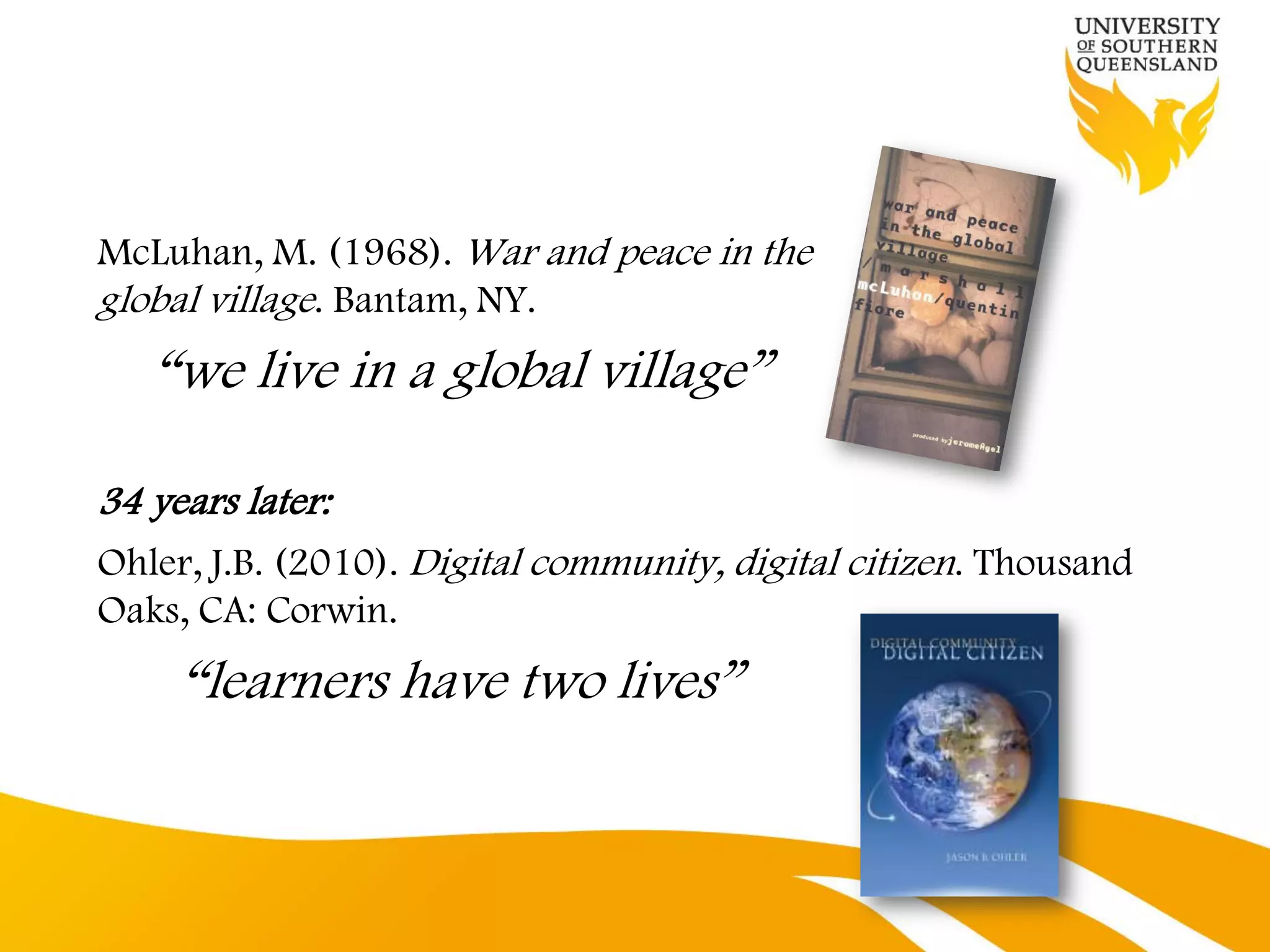
McLuhan, M. (1968). War and peace in the
global village. Bantam, NY.
   “we live in a global village”

34 years later:
Ohler, J.B. (2010). Digital community, digital citizen. Thousand
Oaks, CA: Corwin.
     “learners have two lives”
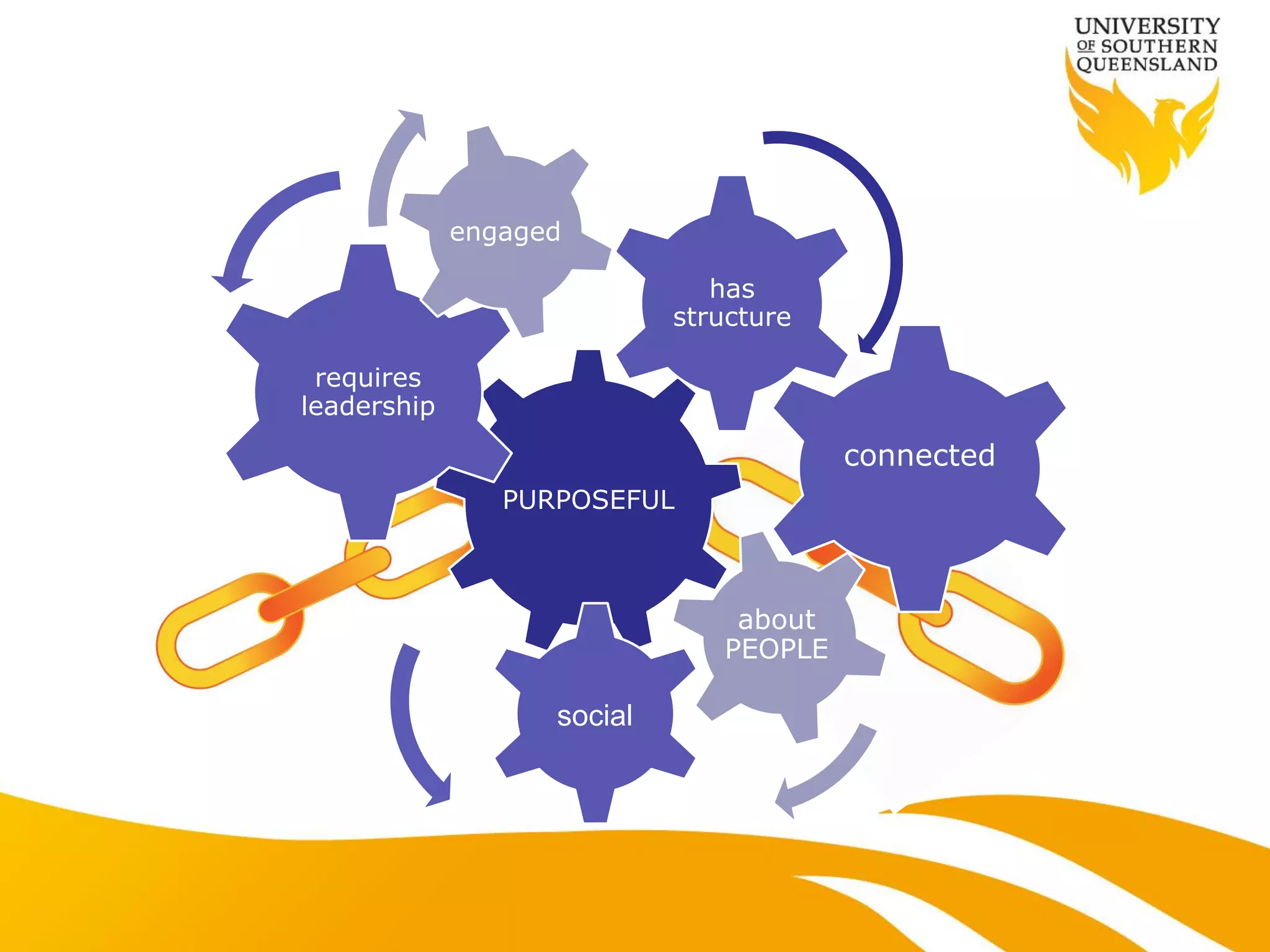
engaged

                               has
                            structure

 requires
leadership
                                        connected
                PURPOSEFUL


                                about
                               PEOPLE

                   social
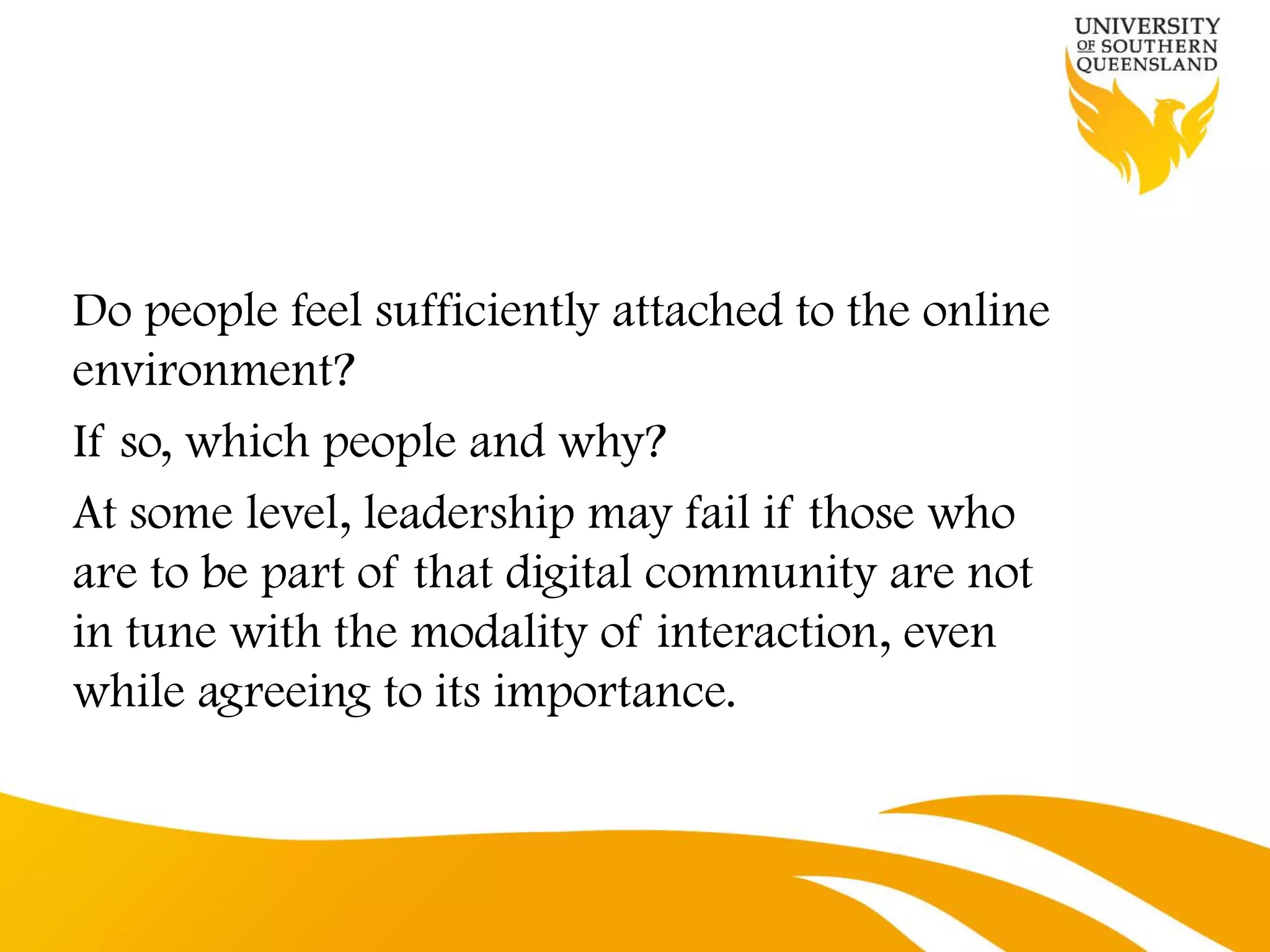
Do people feel sufficiently attached to the online
environment?
If so, which people and why?
At some level, leadership may fail if those who
are to be part of that digital community are not
in tune with the modality of interaction, even
while agreeing to its importance.
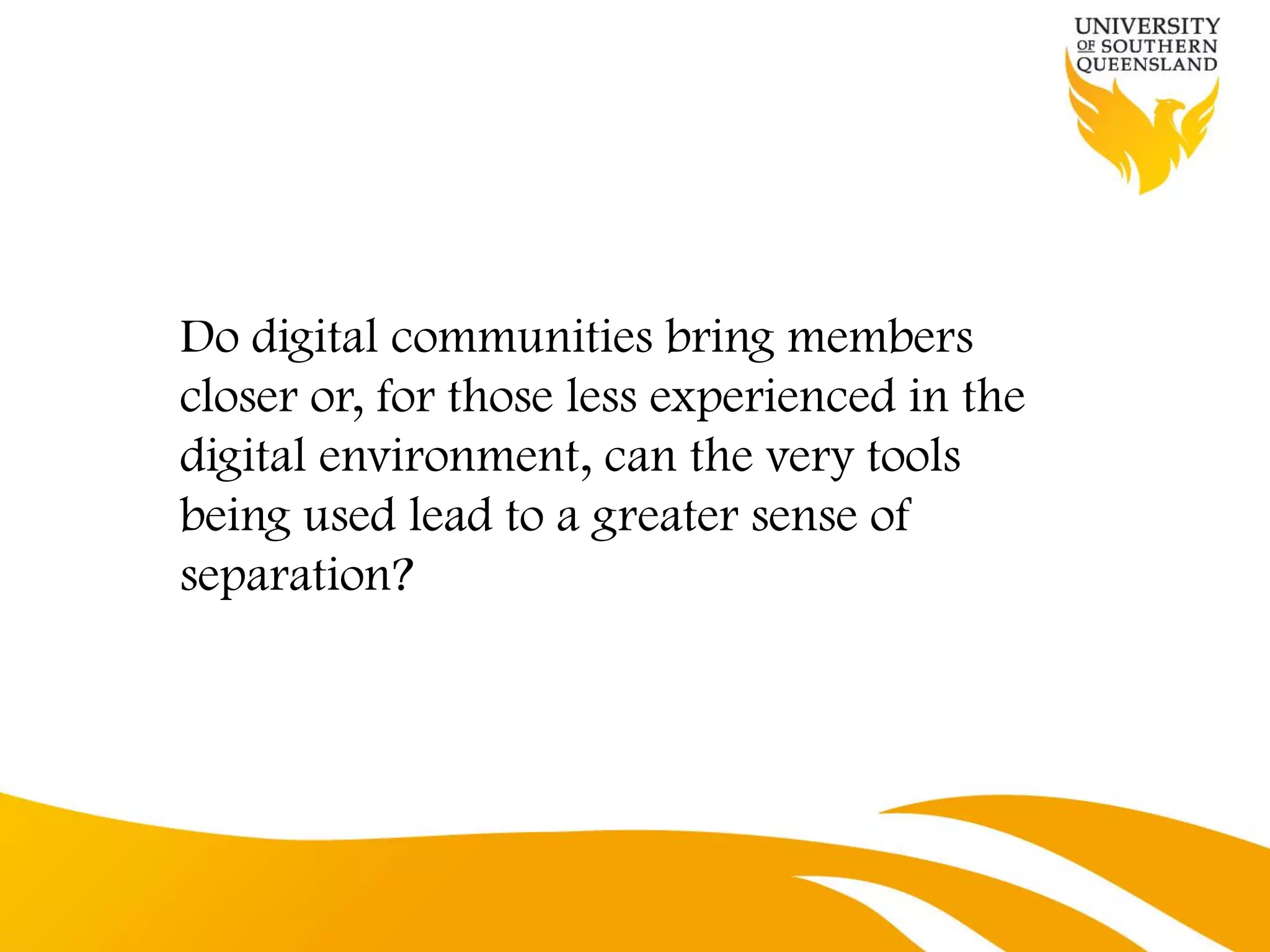
Do digital communities bring members
closer or, for those less experienced in the
digital environment, can the very tools
being used lead to a greater sense of
separation?
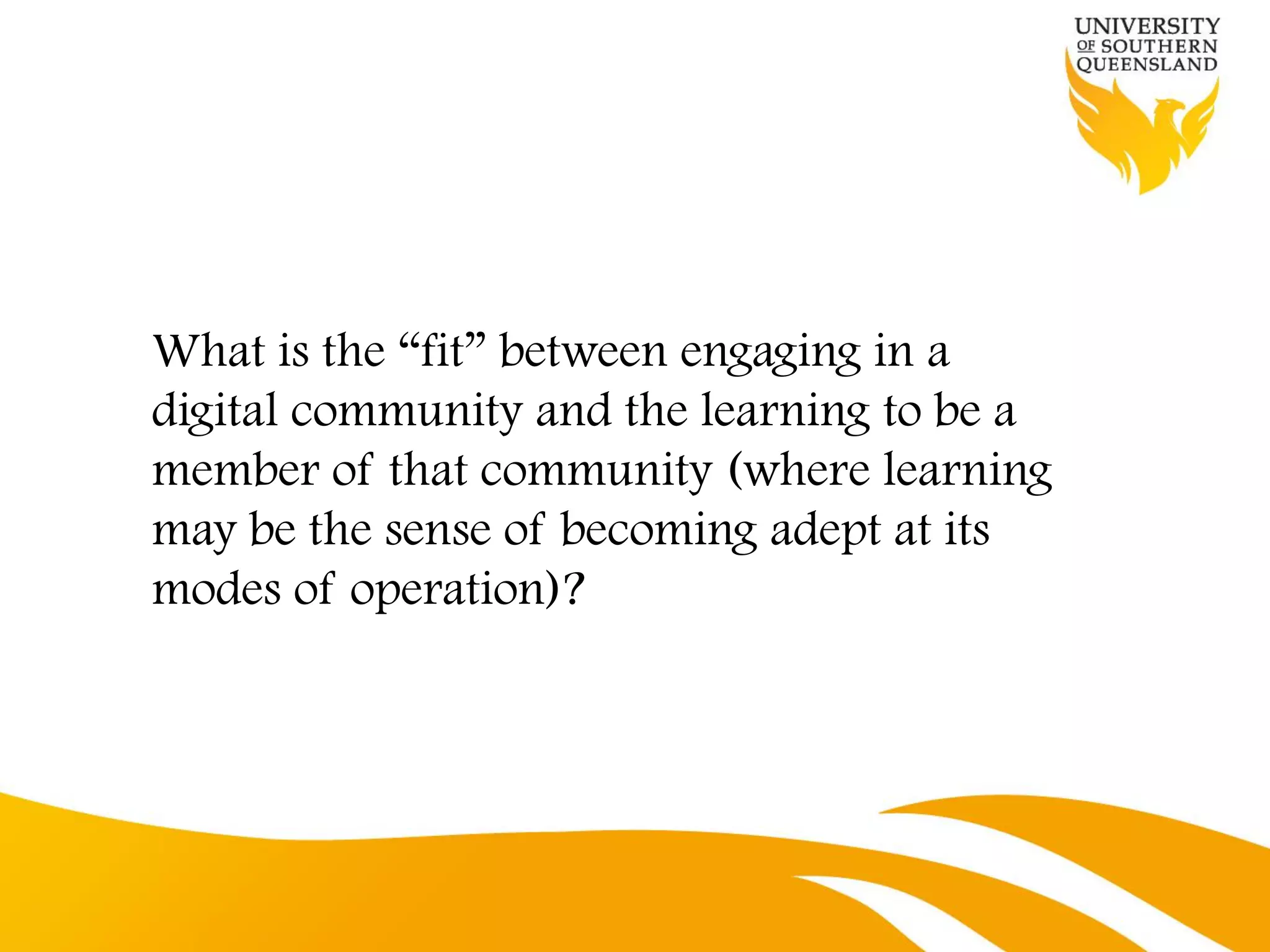
What is the “fit” between engaging in a
digital community and the learning to be a
member of that community (where learning
may be the sense of becoming adept at its
modes of operation)?
3 Cases…
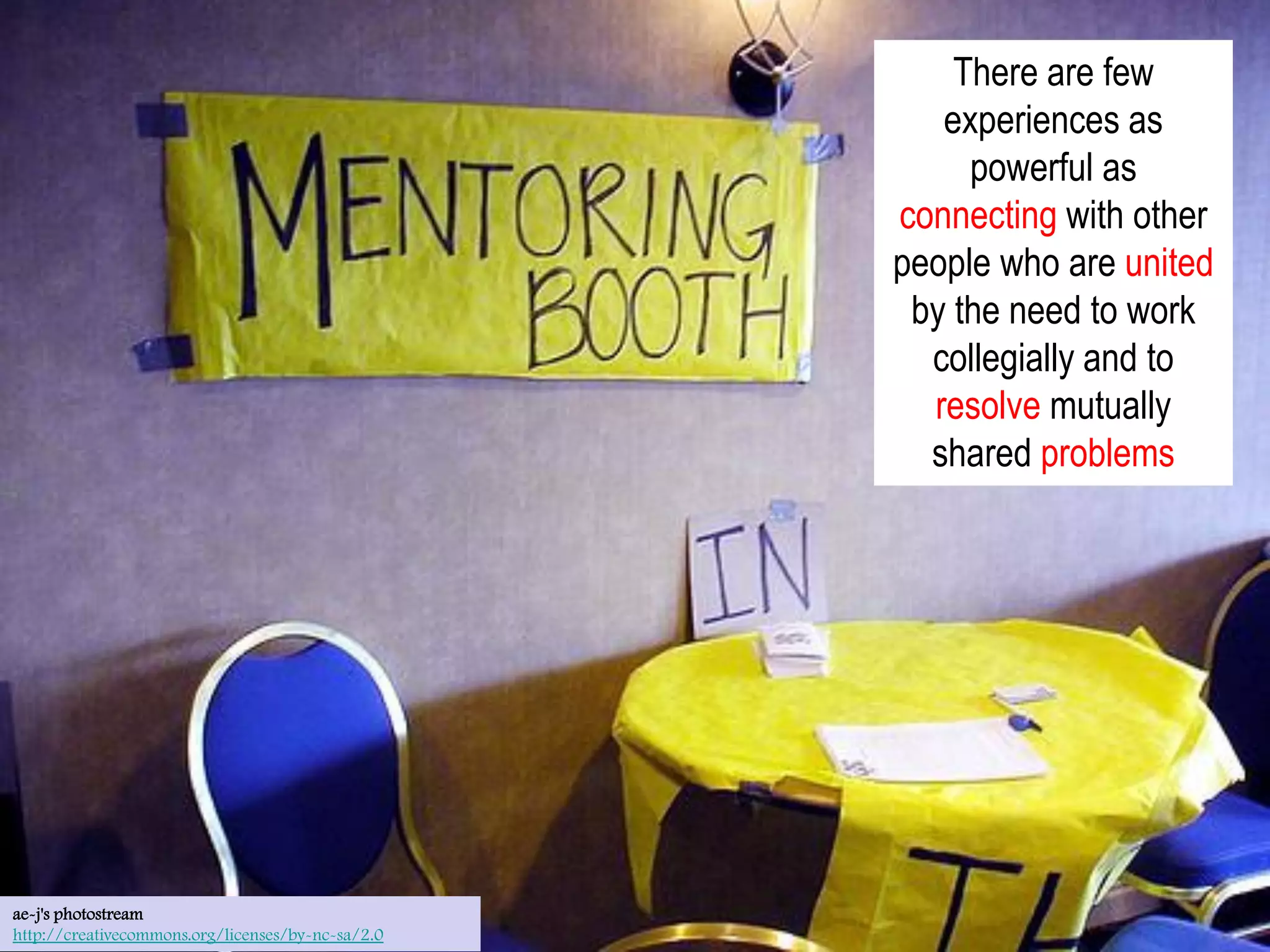
There are few
                                                      experiences as
                                                        powerful as
                                                   connecting with other
                                                   people who are united
                                                    by the need to work
                                                     collegially and to
                                                     resolve mutually
                                                     shared problems


ae-j's photostream
http://creativecommons.org/licenses/by-nc-sa/2.0
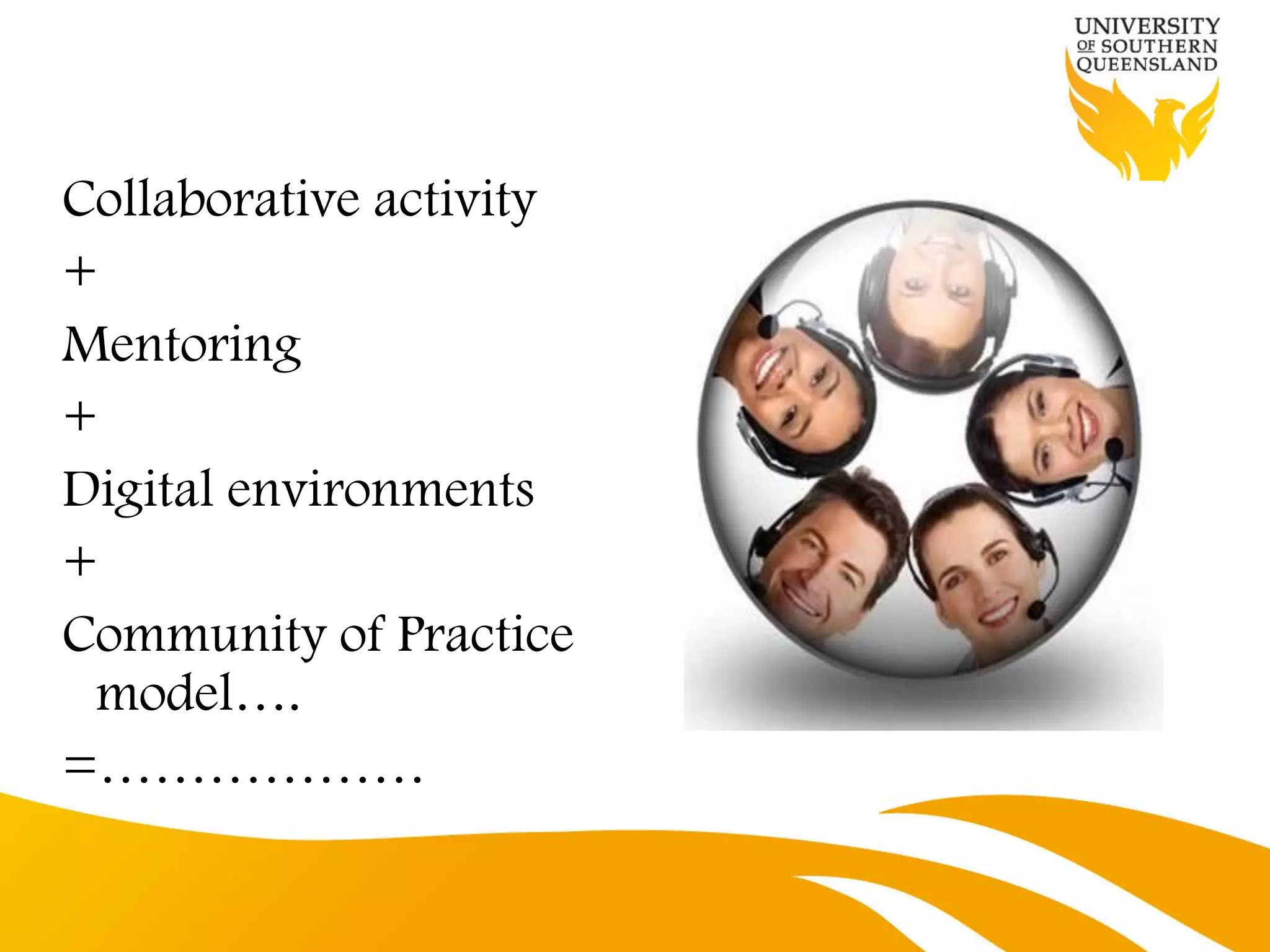
Collaborative activity
+
Mentoring
+
Digital environments
+
Community of Practice
 model….
=………………
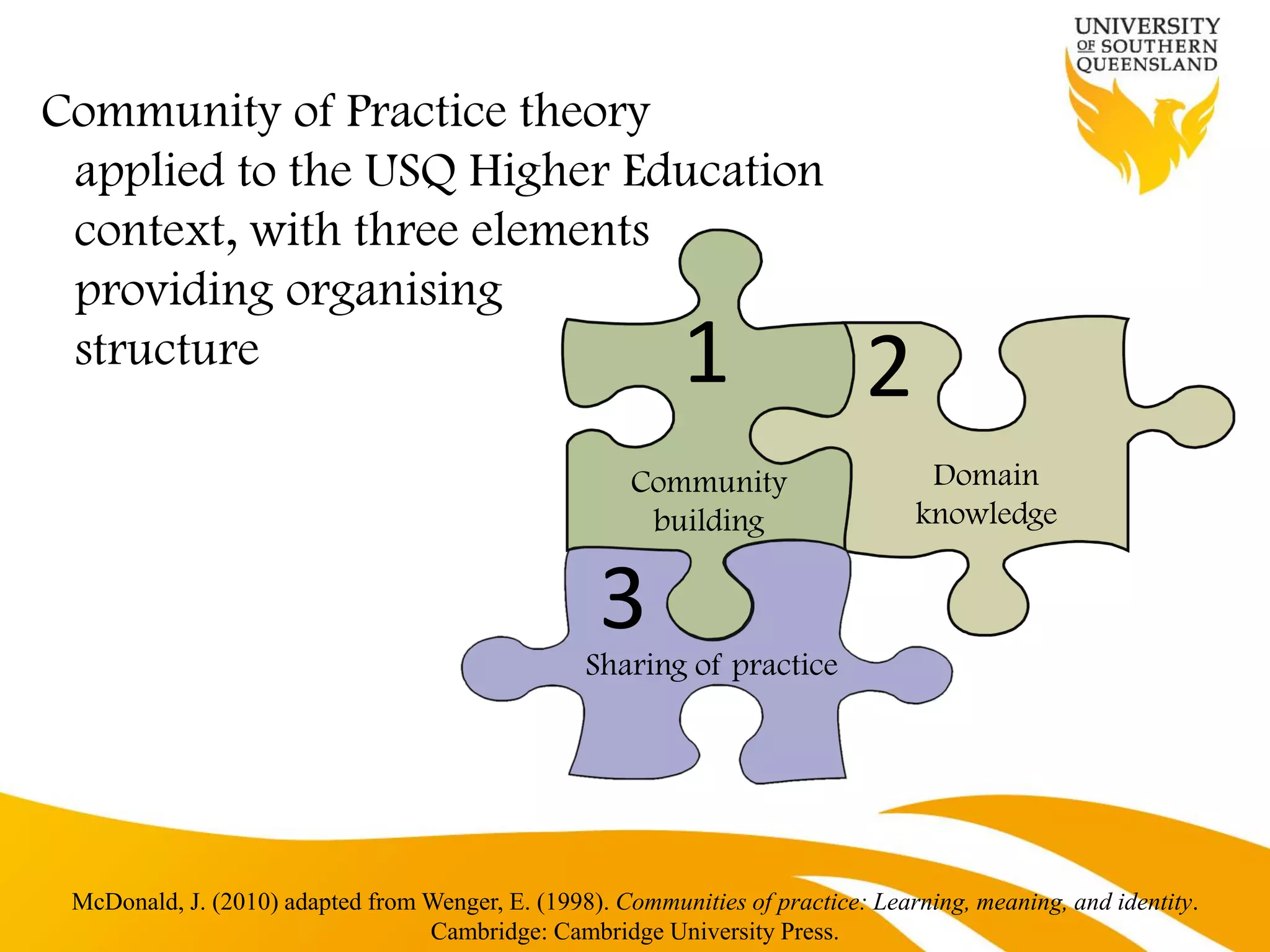
Community of Practice theory
 applied to the USQ Higher Education
 context, with three elements
 providing organising
 structure                                                  1                2
                                                       Community                   Domain
                                                        building                  knowledge


                                                    3
                                                  Sharing of practice


 McDonald, J. (2010) adapted from Wenger, E. (1998). Communities of practice: Learning, meaning, and identity.
                                  Cambridge: Cambridge University Press.
A domain of knowledge that creates a common
 ground and sense of common identity (builds
 member capacity)
A community of people who care about the
 domain and create the social fabric of learning
 (grow a learning community)

A shared practice developed to become effective
 in the domain (innovations noted and this saves
 reinventing the wheel)
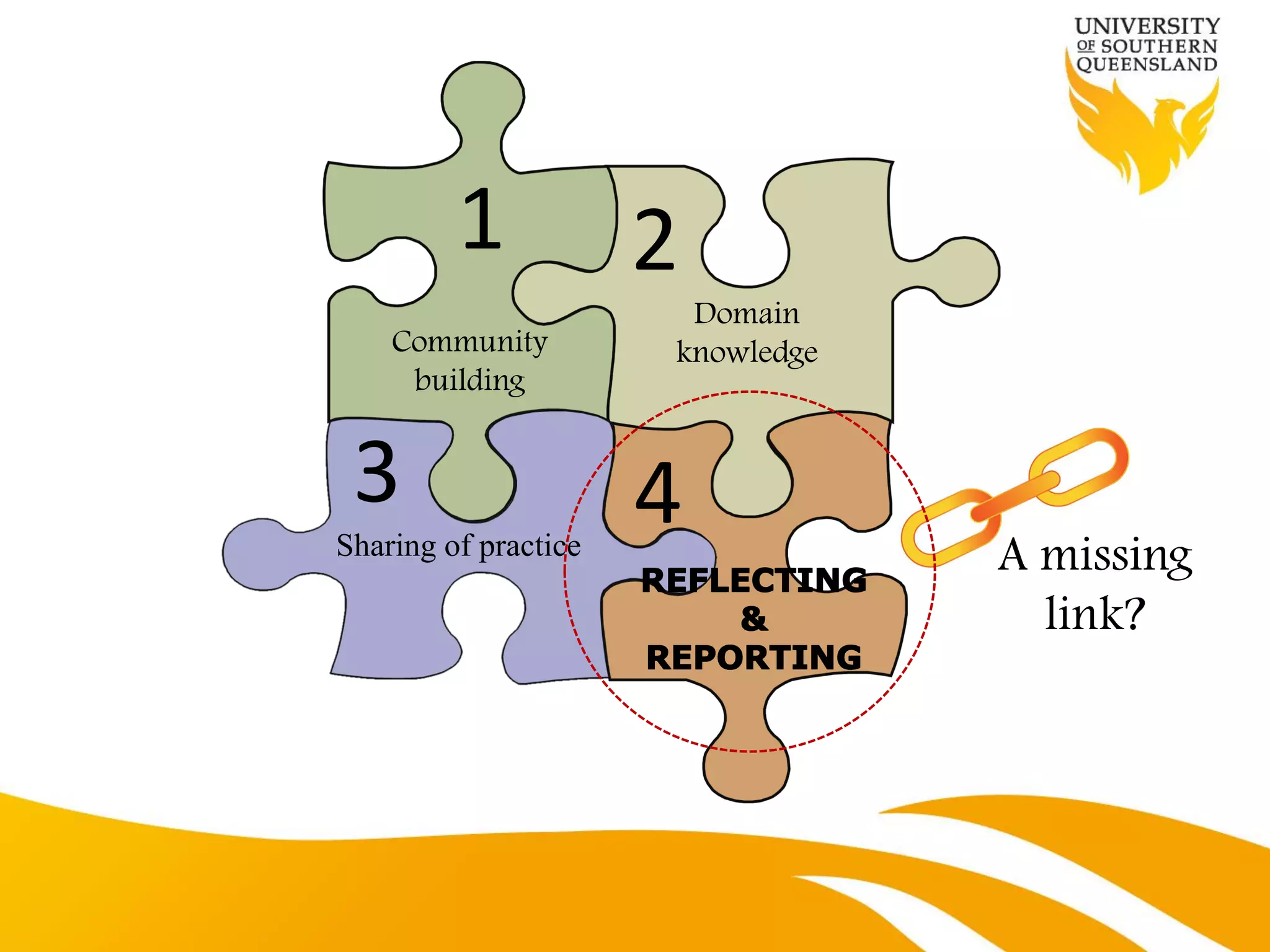
1            2
                       Domain
    Community         knowledge
     building


 3                    4
Sharing of practice               A missing
                                    link?
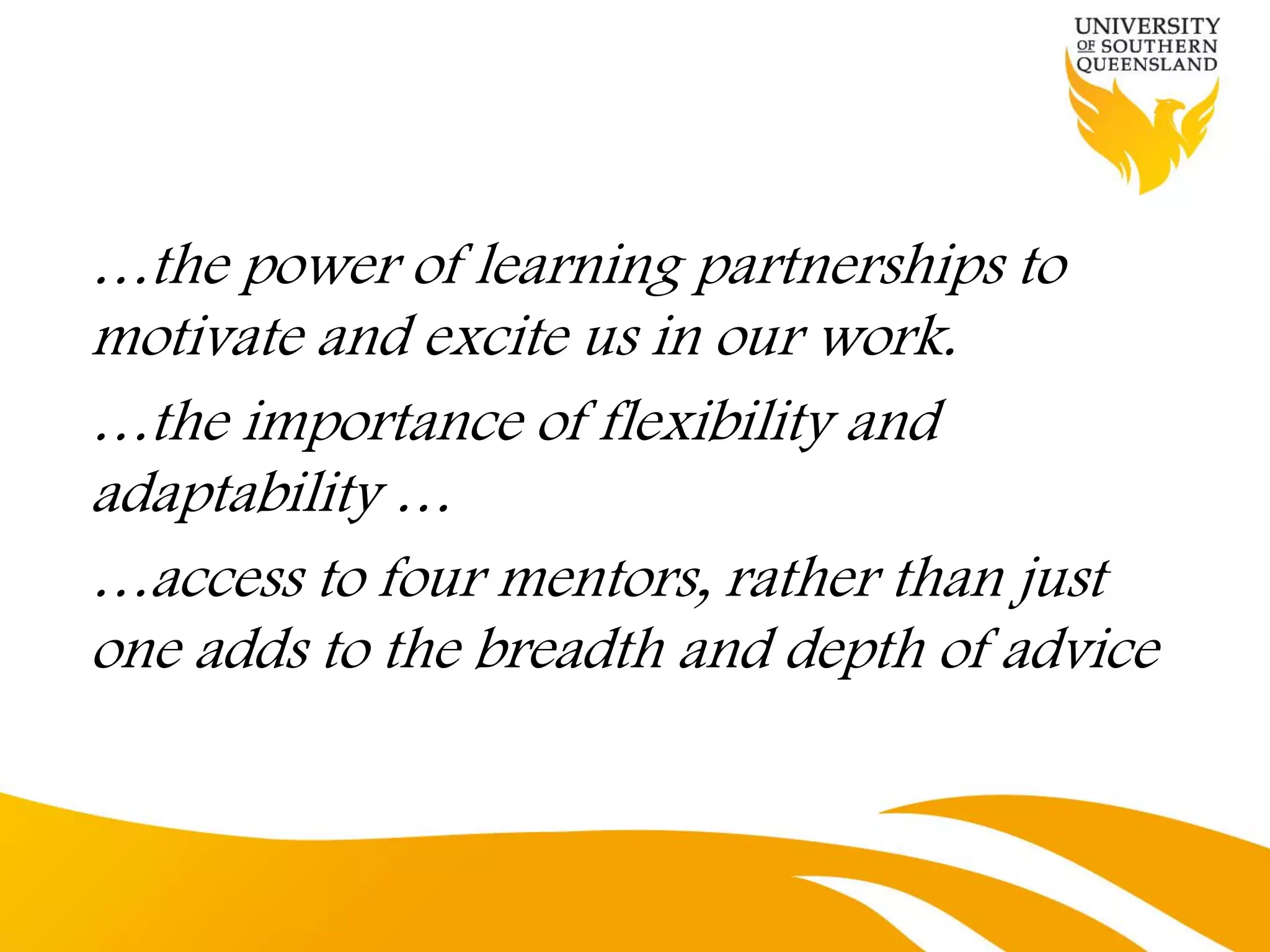
…the power of learning partnerships to
motivate and excite us in our work.
…the importance of flexibility and
adaptability …
…access to four mentors, rather than just
one adds to the breadth and depth of advice
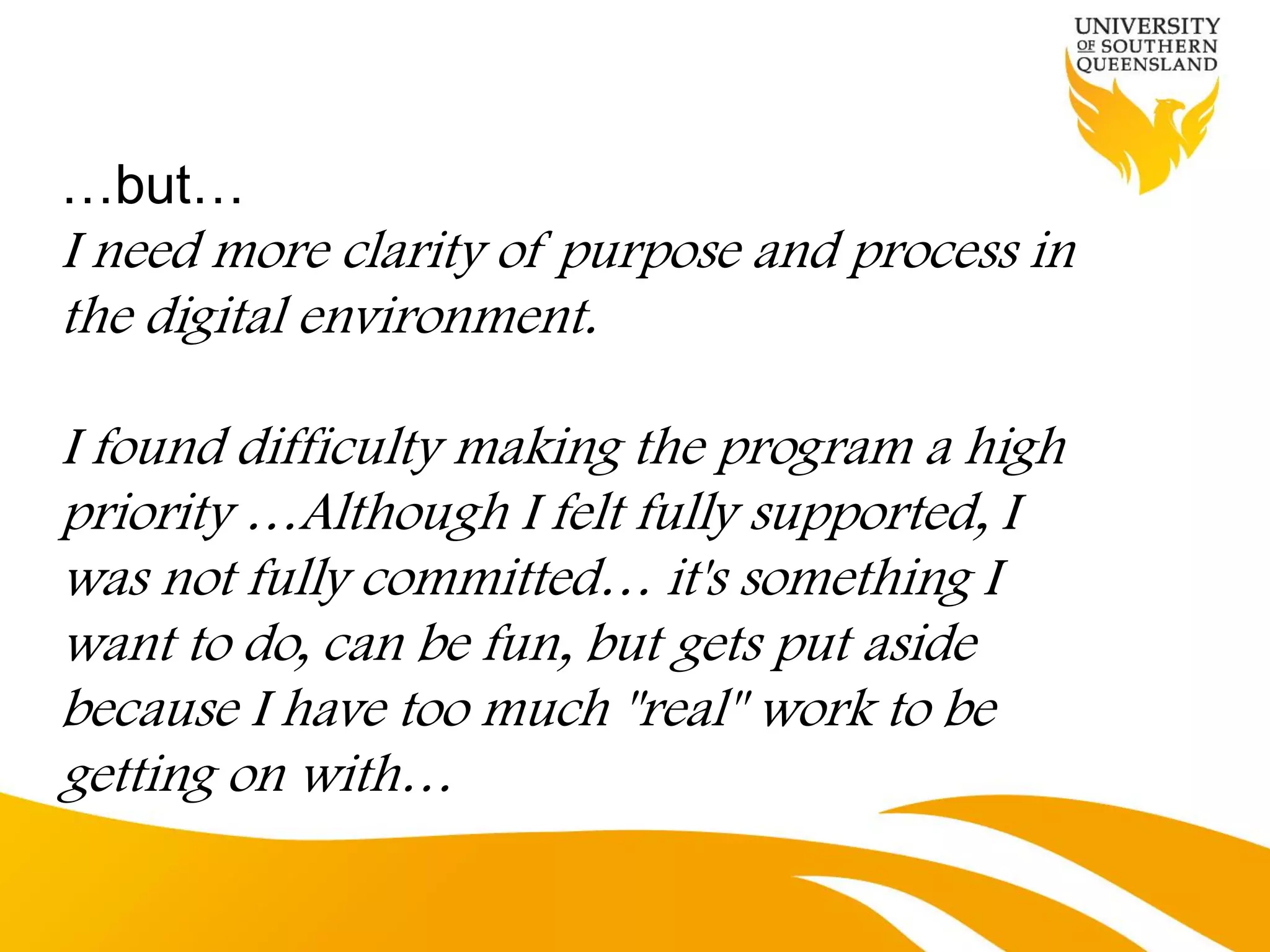
…but…
I need more clarity of purpose and process in
the digital environment.

I found difficulty making the program a high
priority …Although I felt fully supported, I
was not fully committed… it's something I
want to do, can be fun, but gets put aside
because I have too much "real" work to be
getting on with…
Follow the Sun Learning Futures Festival
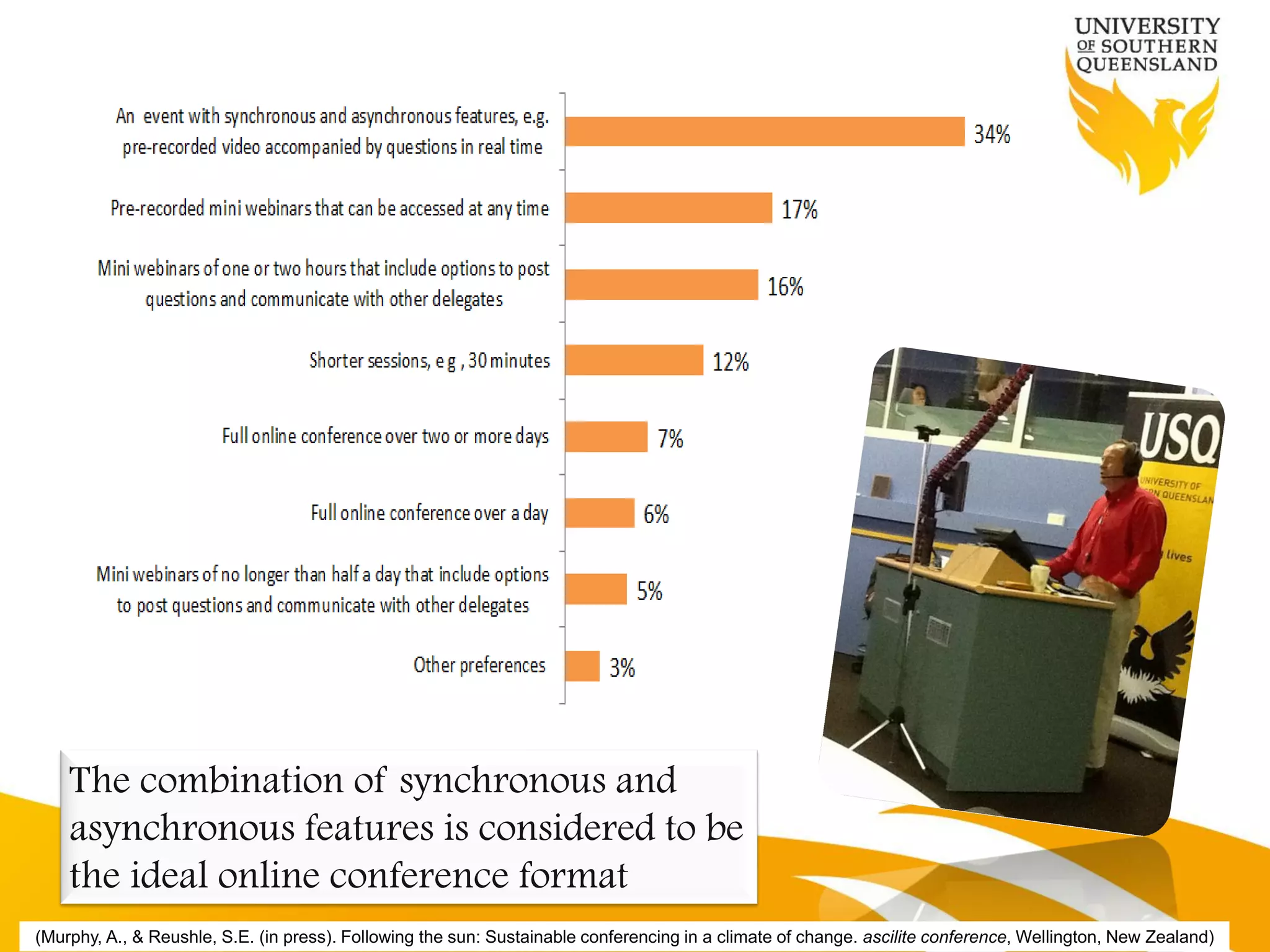
The combination of synchronous and
    asynchronous features is considered to be
    the ideal online conference format
(Murphy, A., & Reushle, S.E. (in press). Following the sun: Sustainable conferencing in a climate of change. ascilite conference, Wellington, New Zealand)
This was a truly collaborative endeavour. I was intrigued
 by the 24-hour format and the calibre of hosts and
 presenters. Excellent speakers and panels, who know
 how to conduct themselves in synchronous
 environments, and well trained moderators.
 Enlightening and thought-provoking.


This has been extraordinary and probably the best single
 experience in my 10 years in Higher Education. So
 much breadth and depth and such a sense of
 connectedness.
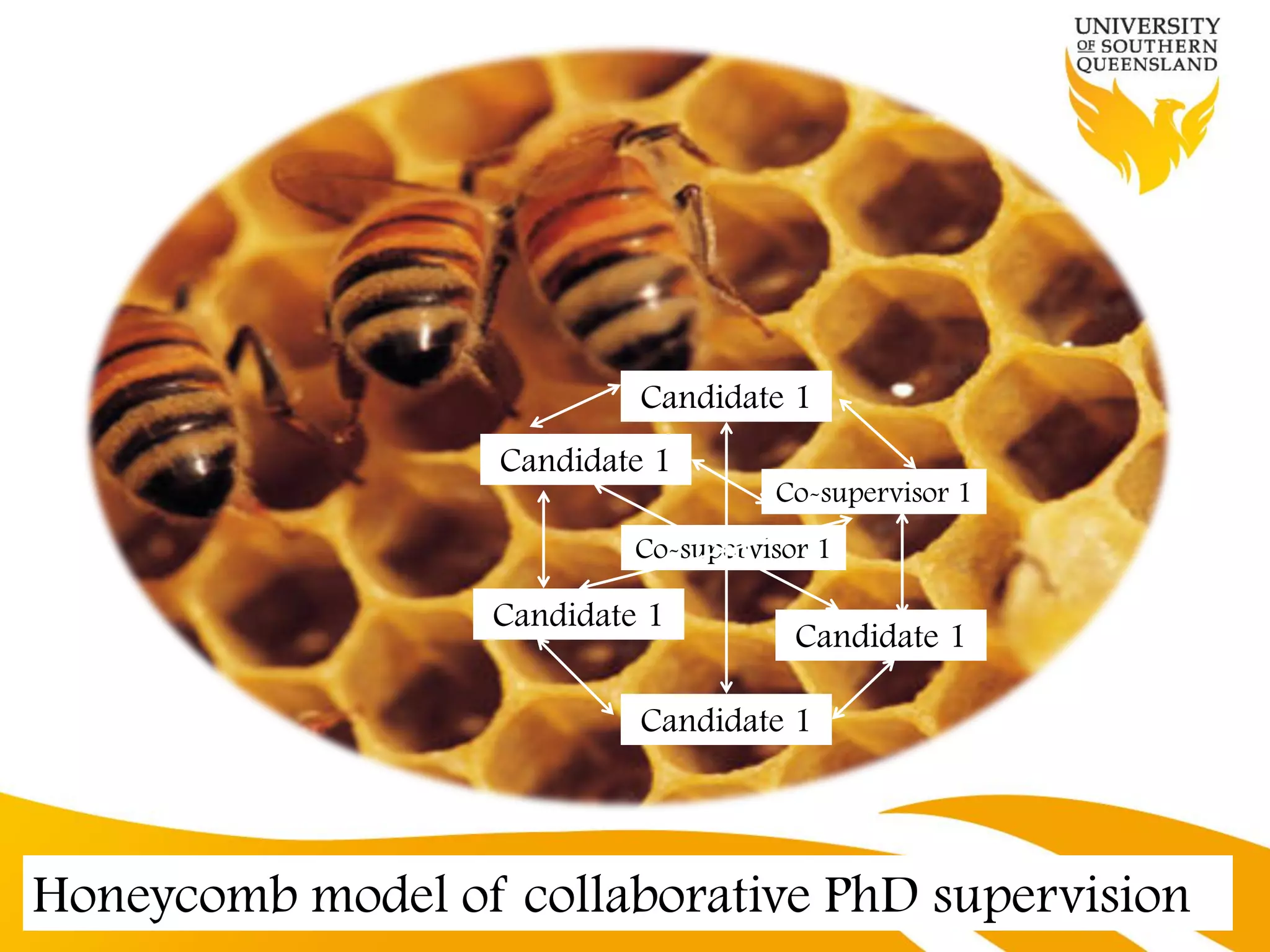
Candidate 1
                   Candidate 1
                                      Co-supervisor 1
                            Co-supervisor 1

                   Candidate 1
                                        Candidate 1

                            Candidate 1


Honeycomb model of collaborative PhD supervision
To sum up…
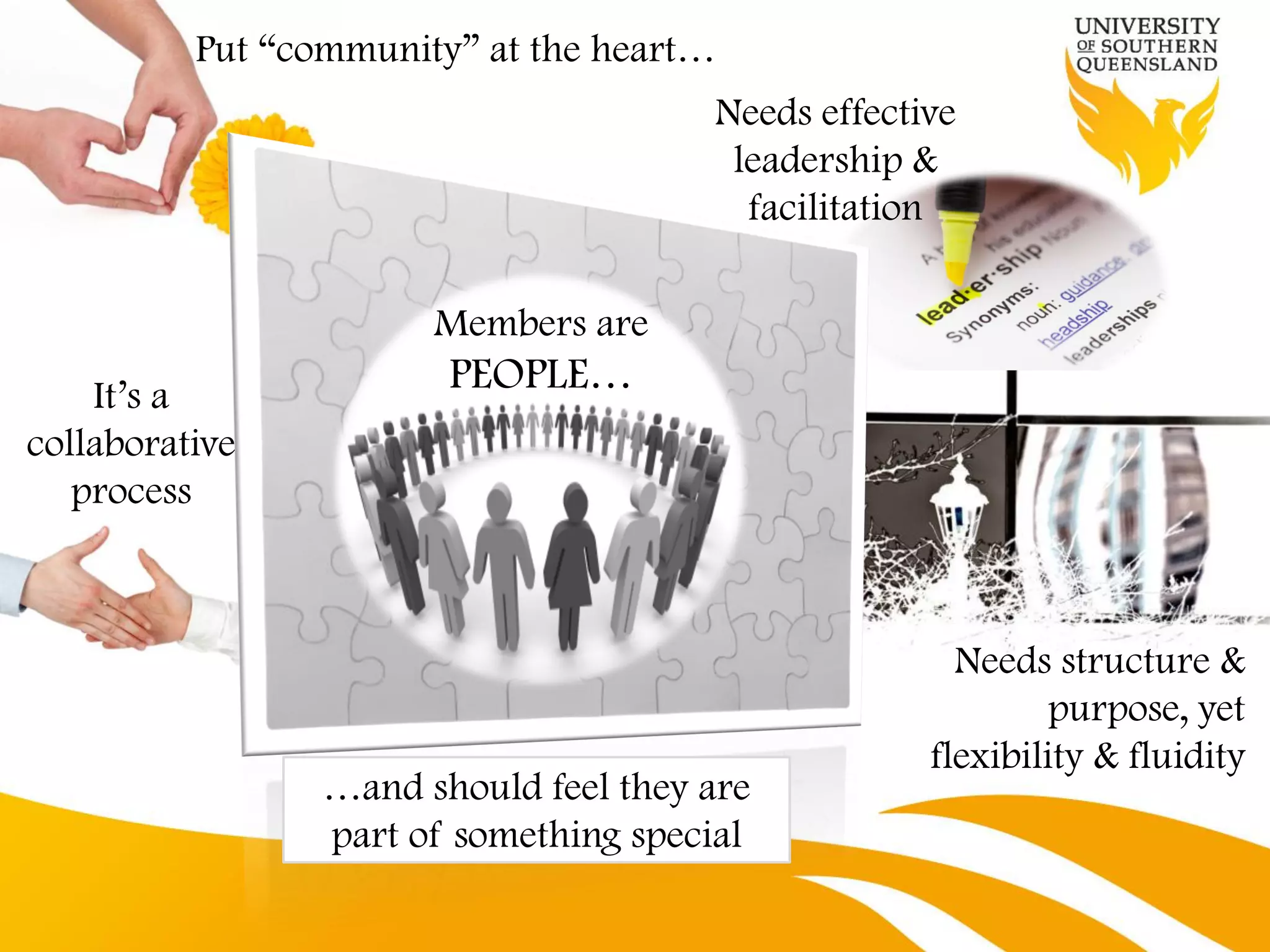
Put “community” at the heart…
                                       Needs effective
                                        leadership &
                                         facilitation

                       Members are
    It’s a
                        PEOPLE…
collaborative
   process


                                                      Needs structure &
                                                             purpose, yet
                                                    flexibility & fluidity
                 …and should feel they are
                 part of something special
Questions
Creating sustainable digital communities for students and teachers
                     shirley.reushle@usq.edu.au
               Australian Digital Futures Institute
          University of Southern Queensland, Australia


                 This work is licensed under a
Creative Commons Attribution-NonCommercial-ShareAlike 3.0 Unported
                              License


                                                   Images sourced from
                                                   http://www.kozzi.com

Creating sustainable digital communities for students & teachers

  • 1.
    Creating sustainable digital communitiesfor students and teachers Dr Shirley Reushle Associate Director Australian Digital Futures Institute University of Southern Queensland, Australia shirley.reushle@usq.edu.au
  • 2.
    What is adigital learning community? Guiding principles for building and fostering digital learning communities Examples of digital learning communities It's difficult to stay current and informed in a climate where everything is changing (George Siemens)
  • 3.
    A digital learningcommunity is defined as a group of people who come together in an online environment to conduct focused and scholarly dialogue, collaborate with their peers, share resources and practices, and build and deepen knowledge and expertise.
  • 4.
    McLuhan, M. (1968).War and peace in the global village. Bantam, NY. “we live in a global village” 34 years later: Ohler, J.B. (2010). Digital community, digital citizen. Thousand Oaks, CA: Corwin. “learners have two lives”
  • 5.
    engaged has structure requires leadership connected PURPOSEFUL about PEOPLE social
  • 6.
    Do people feelsufficiently attached to the online environment? If so, which people and why? At some level, leadership may fail if those who are to be part of that digital community are not in tune with the modality of interaction, even while agreeing to its importance.
  • 7.
    Do digital communitiesbring members closer or, for those less experienced in the digital environment, can the very tools being used lead to a greater sense of separation?
  • 8.
    What is the“fit” between engaging in a digital community and the learning to be a member of that community (where learning may be the sense of becoming adept at its modes of operation)?
  • 9.
  • 10.
    There are few experiences as powerful as connecting with other people who are united by the need to work collegially and to resolve mutually shared problems ae-j's photostream http://creativecommons.org/licenses/by-nc-sa/2.0
  • 11.
  • 12.
    Community of Practicetheory applied to the USQ Higher Education context, with three elements providing organising structure 1 2 Community Domain building knowledge 3 Sharing of practice McDonald, J. (2010) adapted from Wenger, E. (1998). Communities of practice: Learning, meaning, and identity. Cambridge: Cambridge University Press.
  • 13.
    A domain ofknowledge that creates a common ground and sense of common identity (builds member capacity) A community of people who care about the domain and create the social fabric of learning (grow a learning community) A shared practice developed to become effective in the domain (innovations noted and this saves reinventing the wheel)
  • 14.
    1 2 Domain Community knowledge building 3 4 Sharing of practice A missing link?
  • 15.
    …the power oflearning partnerships to motivate and excite us in our work. …the importance of flexibility and adaptability … …access to four mentors, rather than just one adds to the breadth and depth of advice
  • 16.
    …but… I need moreclarity of purpose and process in the digital environment. I found difficulty making the program a high priority …Although I felt fully supported, I was not fully committed… it's something I want to do, can be fun, but gets put aside because I have too much "real" work to be getting on with…
  • 17.
    Follow the SunLearning Futures Festival
  • 20.
    The combination ofsynchronous and asynchronous features is considered to be the ideal online conference format (Murphy, A., & Reushle, S.E. (in press). Following the sun: Sustainable conferencing in a climate of change. ascilite conference, Wellington, New Zealand)
  • 21.
    This was atruly collaborative endeavour. I was intrigued by the 24-hour format and the calibre of hosts and presenters. Excellent speakers and panels, who know how to conduct themselves in synchronous environments, and well trained moderators. Enlightening and thought-provoking. This has been extraordinary and probably the best single experience in my 10 years in Higher Education. So much breadth and depth and such a sense of connectedness.
  • 22.
    Candidate 1 Candidate 1 Co-supervisor 1 Co-supervisor 1 Candidate 1 Candidate 1 Candidate 1 Honeycomb model of collaborative PhD supervision
  • 23.
  • 24.
    Put “community” atthe heart… Needs effective leadership & facilitation Members are It’s a PEOPLE… collaborative process Needs structure & purpose, yet flexibility & fluidity …and should feel they are part of something special
  • 25.
  • 26.
    Creating sustainable digitalcommunities for students and teachers shirley.reushle@usq.edu.au Australian Digital Futures Institute University of Southern Queensland, Australia This work is licensed under a Creative Commons Attribution-NonCommercial-ShareAlike 3.0 Unported License Images sourced from http://www.kozzi.com