www.minedu.govt.nz
© New Zealand Ministry of Education 2009 - copying restricted to use by New Zealand education sector.
Page 1
Shared clarity about
the next steps in
learning
www.minedu.govt.nz
© New Zealand Ministry of Education 2009 - copying restricted to use by New Zealand education sector.
Page 2
‘Next steps’ is about the direction or the plan that the
teacher and students need to have about where the
learning is headed.
It is about what the teacher needs to do in order to
effectively communicate the direction to the students.
It addresses the question, ‘After we have learnt this,
what do we learn next?’.
‘Next steps’ is what the students need to be able to do
to play their part in ensuring that the teaching and
learning has direction for them.
www.minedu.govt.nz
© New Zealand Ministry of Education 2009 - copying restricted to use by New Zealand education sector.
Page 3
You can use this presentation to:
• update, review and/or reflect on how ‘Next steps’ is
developed in your classroom or school
• use as a resource for exploring professional development
in Next Steps in Learning
• clarify the purpose and value of sharing ‘big picture’
relevance
• identify strategies and resources for developing next steps
with students
www.minedu.govt.nz
© New Zealand Ministry of Education 2009 - copying restricted to use by New Zealand education sector.
Page 4
“But it is important to remember that it is
the pupils who will take the next steps
and the more they are involved in the
process, the greater will be their
understanding of how to extend their
learning.”
Assessment Reform Group (1999) p.8
www.minedu.govt.nz
© New Zealand Ministry of Education 2009 - copying restricted to use by New Zealand education sector.
Page 5
Where ‘next steps’ fits in
• When sharing the ‘big picture’ relevance of the
learning
• ‘Feed forward’ when promoting further learning
(oral/written)
• Self or peer assessment against success criteria
• Reflection time
• Learning conversations about assessment results
www.minedu.govt.nz
© New Zealand Ministry of Education 2009 - copying restricted to use by New Zealand education sector.
Page 6
The indicators of ‘next step’ capability
• Starting with the end in mind
• Excellent knowledge of subject and its learning
progressions
• Identity with and enthusiasm for the subject
• ‘Where to next’ resources which show student
learning progressions
www.minedu.govt.nz
© New Zealand Ministry of Education 2009 - copying restricted to use by New Zealand education sector.
Page 7
Starting with the end in mind
• For students to understand where they are headed
with their learning, teachers should constantly share
with them the ‘big picture’ of learning, at the
beginning of each unit of work and throughout the
progression of the learning.
• This enables students to monitor their progress
against defined benchmarks or progressions.
www.minedu.govt.nz
© New Zealand Ministry of Education 2009 - copying restricted to use by New Zealand education sector.
Page 8
Excellent curriculum knowledge
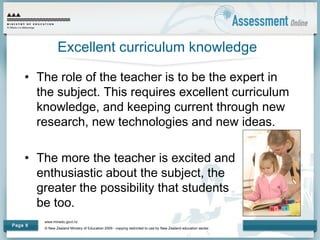
• The role of the teacher is to be the expert in
the subject. This requires excellent curriculum
knowledge, and keeping current through new
research, new technologies and new ideas.
• The more the teacher is excited and
enthusiastic about the subject, the
greater the possibility that students will
be too.
www.minedu.govt.nz
© New Zealand Ministry of Education 2009 - copying restricted to use by New Zealand education sector.
Page 9
Identity with the subject
• The more the teacher is excited and
enthusiastic about the subject, the greater
the possibility that students will be too.
• A challenge for teachers is to build student
identity with the subject so the students see
themselves as ‘writers, mathematicians, and
scientists.’
www.minedu.govt.nz
© New Zealand Ministry of Education 2009 - copying restricted to use by New Zealand education sector.
Page 10
Progressions of learning
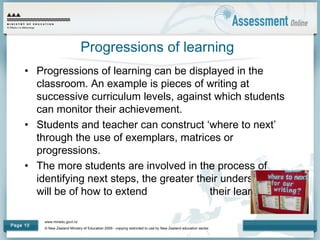
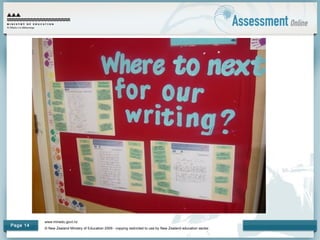
• Progressions of learning can be displayed in the
classroom. An example is pieces of writing at
successive curriculum levels, against which students
can monitor their achievement.
• Students and teacher can construct ‘where to next’
through the use of exemplars, matrices or
progressions.
• The more students are involved in the process of
identifying next steps, the greater their understanding
will be of how to extend their learning.
www.minedu.govt.nz
© New Zealand Ministry of Education 2009 - copying restricted to use by New Zealand education sector.
Page 11
What students need…
• A clear idea of what they are learning – the
big picture
• A clear idea of where they are currently at in
their learning
• A sense of progression for the next steps
• The above should be explicit and exemplified
www.minedu.govt.nz
© New Zealand Ministry of Education 2009 - copying restricted to use by New Zealand education sector.
Page 12
A Challenge
Create a resource to use with your
students to show them where they
are with their learning, and what
their next steps are.
You could create this resource
for any curriculum area.
www.minedu.govt.nz
© New Zealand Ministry of Education 2009 - copying restricted to use by New Zealand education sector.
Page 13
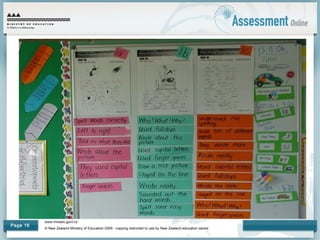
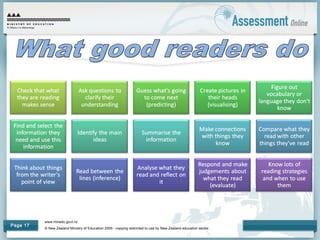
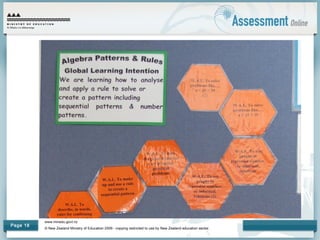
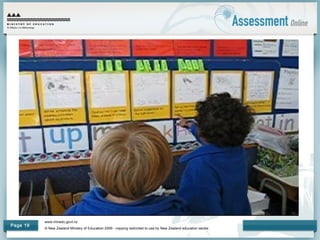
Some examples:
• Levelled exemplars to display on the wall
• Planning enlarged and on the wall
• Student-speak indicators
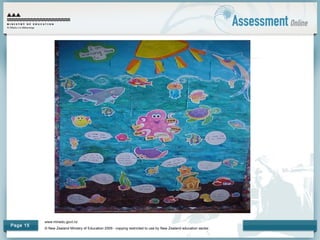
• Visual displays
• Processes for focused student goal setting
• Modelling books
• NCEA prescriptions in student speak
www.minedu.govt.nz
© New Zealand Ministry of Education 2009 - copying restricted to use by New Zealand education sector.
Page 14
www.minedu.govt.nz
© New Zealand Ministry of Education 2009 - copying restricted to use by New Zealand education sector.
Page 15
www.minedu.govt.nz
© New Zealand Ministry of Education 2009 - copying restricted to use by New Zealand education sector.
Page 16
www.minedu.govt.nz
© New Zealand Ministry of Education 2009 - copying restricted to use by New Zealand education sector.
Page 17
www.minedu.govt.nz
© New Zealand Ministry of Education 2009 - copying restricted to use by New Zealand education sector.
Page 18
www.minedu.govt.nz
© New Zealand Ministry of Education 2009 - copying restricted to use by New Zealand education sector.
Page 19
www.minedu.govt.nz
© New Zealand Ministry of Education 2009 - copying restricted to use by New Zealand education sector.
Page 20
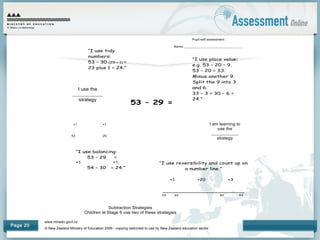
53 – 29 =
“I use tidy
numbers:
53 – 30 (29 + 1) =
23 plus 1 = 24.”
“I use place value:
e.g. 53 – 20 – 9.
53 – 20 = 33.
Minus another 9.
Split the 9 into 3
and 6.
33 – 3 = 30 – 6 =
24.”
Subtraction Strategies
Children at Stage 6 use two of these strategies
“I use balancing:
53 – 29 =
+1 +1
54 – 30 = 24.”
“I use reversibility and count up on
a number line.”
+1 +20 +3
________________________
29 30 50 53
53
+1 +1
29
Pupil self assessment
Name: _______________________________
I use the
___________
strategy
I am learning to
use the
___________
strategy
www.minedu.govt.nz
© New Zealand Ministry of Education 2009 - copying restricted to use by New Zealand education sector.
Page 21
References and readings
• Absolum, M. (2006). Clarity in the classroom. Auckland: Hodder
Education. pp. 165-173

Next+steps+in+learning

  • 1.
    www.minedu.govt.nz © New ZealandMinistry of Education 2009 - copying restricted to use by New Zealand education sector. Page 1 Shared clarity about the next steps in learning
  • 2.
    www.minedu.govt.nz © New ZealandMinistry of Education 2009 - copying restricted to use by New Zealand education sector. Page 2 ‘Next steps’ is about the direction or the plan that the teacher and students need to have about where the learning is headed. It is about what the teacher needs to do in order to effectively communicate the direction to the students. It addresses the question, ‘After we have learnt this, what do we learn next?’. ‘Next steps’ is what the students need to be able to do to play their part in ensuring that the teaching and learning has direction for them.
  • 3.
    www.minedu.govt.nz © New ZealandMinistry of Education 2009 - copying restricted to use by New Zealand education sector. Page 3 You can use this presentation to: • update, review and/or reflect on how ‘Next steps’ is developed in your classroom or school • use as a resource for exploring professional development in Next Steps in Learning • clarify the purpose and value of sharing ‘big picture’ relevance • identify strategies and resources for developing next steps with students
  • 4.
    www.minedu.govt.nz © New ZealandMinistry of Education 2009 - copying restricted to use by New Zealand education sector. Page 4 “But it is important to remember that it is the pupils who will take the next steps and the more they are involved in the process, the greater will be their understanding of how to extend their learning.” Assessment Reform Group (1999) p.8
  • 5.
    www.minedu.govt.nz © New ZealandMinistry of Education 2009 - copying restricted to use by New Zealand education sector. Page 5 Where ‘next steps’ fits in • When sharing the ‘big picture’ relevance of the learning • ‘Feed forward’ when promoting further learning (oral/written) • Self or peer assessment against success criteria • Reflection time • Learning conversations about assessment results
  • 6.
    www.minedu.govt.nz © New ZealandMinistry of Education 2009 - copying restricted to use by New Zealand education sector. Page 6 The indicators of ‘next step’ capability • Starting with the end in mind • Excellent knowledge of subject and its learning progressions • Identity with and enthusiasm for the subject • ‘Where to next’ resources which show student learning progressions
  • 7.
    www.minedu.govt.nz © New ZealandMinistry of Education 2009 - copying restricted to use by New Zealand education sector. Page 7 Starting with the end in mind • For students to understand where they are headed with their learning, teachers should constantly share with them the ‘big picture’ of learning, at the beginning of each unit of work and throughout the progression of the learning. • This enables students to monitor their progress against defined benchmarks or progressions.
  • 8.
    www.minedu.govt.nz © New ZealandMinistry of Education 2009 - copying restricted to use by New Zealand education sector. Page 8 Excellent curriculum knowledge • The role of the teacher is to be the expert in the subject. This requires excellent curriculum knowledge, and keeping current through new research, new technologies and new ideas. • The more the teacher is excited and enthusiastic about the subject, the greater the possibility that students will be too.
  • 9.
    www.minedu.govt.nz © New ZealandMinistry of Education 2009 - copying restricted to use by New Zealand education sector. Page 9 Identity with the subject • The more the teacher is excited and enthusiastic about the subject, the greater the possibility that students will be too. • A challenge for teachers is to build student identity with the subject so the students see themselves as ‘writers, mathematicians, and scientists.’
  • 10.
    www.minedu.govt.nz © New ZealandMinistry of Education 2009 - copying restricted to use by New Zealand education sector. Page 10 Progressions of learning • Progressions of learning can be displayed in the classroom. An example is pieces of writing at successive curriculum levels, against which students can monitor their achievement. • Students and teacher can construct ‘where to next’ through the use of exemplars, matrices or progressions. • The more students are involved in the process of identifying next steps, the greater their understanding will be of how to extend their learning.
  • 11.
    www.minedu.govt.nz © New ZealandMinistry of Education 2009 - copying restricted to use by New Zealand education sector. Page 11 What students need… • A clear idea of what they are learning – the big picture • A clear idea of where they are currently at in their learning • A sense of progression for the next steps • The above should be explicit and exemplified
  • 12.
    www.minedu.govt.nz © New ZealandMinistry of Education 2009 - copying restricted to use by New Zealand education sector. Page 12 A Challenge Create a resource to use with your students to show them where they are with their learning, and what their next steps are. You could create this resource for any curriculum area.
  • 13.
    www.minedu.govt.nz © New ZealandMinistry of Education 2009 - copying restricted to use by New Zealand education sector. Page 13 Some examples: • Levelled exemplars to display on the wall • Planning enlarged and on the wall • Student-speak indicators • Visual displays • Processes for focused student goal setting • Modelling books • NCEA prescriptions in student speak
  • 14.
    www.minedu.govt.nz © New ZealandMinistry of Education 2009 - copying restricted to use by New Zealand education sector. Page 14
  • 15.
    www.minedu.govt.nz © New ZealandMinistry of Education 2009 - copying restricted to use by New Zealand education sector. Page 15
  • 16.
    www.minedu.govt.nz © New ZealandMinistry of Education 2009 - copying restricted to use by New Zealand education sector. Page 16
  • 17.
    www.minedu.govt.nz © New ZealandMinistry of Education 2009 - copying restricted to use by New Zealand education sector. Page 17
  • 18.
    www.minedu.govt.nz © New ZealandMinistry of Education 2009 - copying restricted to use by New Zealand education sector. Page 18
  • 19.
    www.minedu.govt.nz © New ZealandMinistry of Education 2009 - copying restricted to use by New Zealand education sector. Page 19
  • 20.
    www.minedu.govt.nz © New ZealandMinistry of Education 2009 - copying restricted to use by New Zealand education sector. Page 20 53 – 29 = “I use tidy numbers: 53 – 30 (29 + 1) = 23 plus 1 = 24.” “I use place value: e.g. 53 – 20 – 9. 53 – 20 = 33. Minus another 9. Split the 9 into 3 and 6. 33 – 3 = 30 – 6 = 24.” Subtraction Strategies Children at Stage 6 use two of these strategies “I use balancing: 53 – 29 = +1 +1 54 – 30 = 24.” “I use reversibility and count up on a number line.” +1 +20 +3 ________________________ 29 30 50 53 53 +1 +1 29 Pupil self assessment Name: _______________________________ I use the ___________ strategy I am learning to use the ___________ strategy
  • 21.
    www.minedu.govt.nz © New ZealandMinistry of Education 2009 - copying restricted to use by New Zealand education sector. Page 21 References and readings • Absolum, M. (2006). Clarity in the classroom. Auckland: Hodder Education. pp. 165-173