Deakin Research Online
Deakin University’s institutional research repository
DDeakin Research Online
Research Online
This is the published version (version of record) of:

Torlina, Luba and Lichtenstein, Sharman 2004, Integration of knowledge management in
virtual groups, in Innovations Through Information Technology, 2004 Information Resources
Management Association International Conference, IGI Publishing, Hershey, Pa., pp. 101-
104.


Available from Deakin Research Online:
http://hdl.handle.net/10536/DRO/DU:30005351


Reproduced with the kind permission of the copyright owner


Copyright : 2004, IGI Publishing
Innovations Through Information Technology      101


                     Integration of Knowledge
                                ..
                   Management In Virtual Groups
                                                    Luba Torlina and Sharman Lichtenstein
                  School of Information Business Systems, Faculty of Buincss and Law, Deakin University, Melbourne Campus
                                 221 Burwood Highway, Burwood, Victoria 3125 Australia, lubat@deakin.edu.au


ABSTRACT
 This paper focuses 011 exploring knowledge work in two types of virtual           were benefits to be harvested li'om identifying and comparing knowledge
 groups, allempting to ident!{y common themes and key diiferentiators.             work issues in these two types of structures - for guiding the design of
 We were particularly interested in investigating how various forums               complementary, integrated virtual spaces and processes where knowl-
 support, 01' do 110t sllpporl, collective virtual knowledge work. 0111' study     edge work could flourish, and defining corresponding requirements for
 demonstrates that, despite apparent differences in purpose and objectives         supporting systems and technologies. Following, we provide an intro-
 (drive,I), synergies exist between virtual COlll/II1l11i1ies and teams. Virtual   duction to knowledge work in virtual communities and teams, discuss
groups sllch as virtual C0JJ1111 unities, communities of pracrice and virtual      findings from two case studies, draw conclusions and offer final remarks.
teams jJeljorm emergent Imowledge work based on relationships,
interaction and self-regulation. These groups carry out a variety of               KNOWLEDGE WORK IN VIRTUAL COMMUNITIES
valuable knowledge work, which is often 1Il0tivated by individual or               AND TEAMS
group-based - rather than managerial -. needs. We develop a model of                     We commence by offering definitions of 'virtual community' and
the role !!{ virtual groups in knowledge management (Kit4) in business             'virtual teum', terms which are often confused by theorists and practi-
and social organi::afions, and suggest that Oil/' model forms a basis for          tioners. We define a virtual community as groups of people who engage
further exploration of this increasingly important topic.                          in many-to-many interactions online, and form wherever people with
                                                                                   common interests are able to interact (Cothrel & Williams, 1999),
INTRODUCTION                                                                       generally representing weak tie networks such as social networks and
       Knowledge management (KM) is increasingly linked to work                    networks of practice. Virtual teams embrace a wide range of project-
 performed by often-distributed groups consisting of communities and               based, task-based or topic-based occupational kams and groups working
 teams collaborating to solve complex problems across specialisations              in a virtual space. Classically, they are defined as strong tie networks,
 (Schaffers et aI., 2003). Group work can be allocated by managemcnt,              however we extend the definition to medium-to-strong tie networks
 with autonomy awarded to groups for all kinds of activities, including            for example, a collective of groups of people at work who temporarily
 critical decision-making. Increasingly, however, group work is self-              assemble to fulfil a business purpose. Virtual teams may be part of a
 motivated, with workers congregating around emergency, ad hoc needs               virtual community, or may exist as a separate entity independent of
 (Alavi & Tiwana, 2(02).                                                           other on-line structures.
       Computer-mediated communication (CivIC) has become a popular
 channel for communication, cooperation and collaboration by virtual               ViI,tllal Communities aud Knowledge Management
 comm1lnities al1d teams. Nowadays, these virtual groups play significant                Early virtual communities were formed around social issues, how-
 roles in all kinds of societal and organizational activities - for example,       ever more reeently, community-building has emerged as an important
 outsourcing (Hiltz & 'furoff, 1993; Schaffel'S et al., Z003). Interest-           business opportunity. Hagel & Armstrong (1997) argue that in the
 ingly, virtual groups have also led to the emergence of specific subcul-          commercial world, virtual communities have the potential to overturn
 tures, with new management and self-management practices and tools                many traditional business structures, while Bressler & Grantham (2000)
 extending and sometimes replacing existing physical mechanisms and                suggest that in the new business climate, successful businesses must
structures (Toriina and Kazakevitch, 2003).                                        transform themselves into a community of employees who cluster in
       Businesses and society gain from virtual group knowledge work in            pursuit of a common objective. In contrast, Rhcingold (1999) believes
different, but related ways. Businesses benefit through the establishment          it unlikely the cOlllmunity model will ever deliver direct revenue,
of internal knowlt,dge flo' links and the sbaring and creation of                suggesting that the greatest value of a community arises from the quality
knowledge leading to organizational learning and innovation (Hlupic &              of generated content, knowledge, experience sharing, improved com-
Qureshi, Z003; Schrage. 1990: Sharkie, 20(3). Society benefits through             munications, and new forms of culture.
the establIshment of knowledge networks based on shared interests and                    Virtual comlllunities involve knowledge sharing, illustrated by the
objectives; validation of knowledge created elsewhere; and the provision           application of what has been learned through the community (Lueg,
of a fertile environment for knowledge stimulation and innovation.                 200 I). These communities support the capture, sharing and manage-
Perhaps more importantly, such communities simultaneously reflect                  ment of knowledge' that is otherwise ditlicult to access and structure.
and convey changes in the body of knowledge and learning structures in             Hypertext tools are employed to construct forums, with linked discus-
the wider society, transferring knowledge of a broader societal context            sions on specific topics of interest, thereby enabling knowledge genera-
- such as national culture, arts, social lifc, humanitarIan issues and             tion, and linking of knowledge objects througb hyperlinks (Beinhaucr,
politics (Reinghold, 1999: Castells, 2000)                                         2000; Radding, 1998). Personal profiles of members' specialisations
       Researchers have recently begun to investigate KM in virtual group          spawn subgroups that share more personalised knowledge (Beinhauer,
work (for example- Alavi & Tiwana, 2002; Bieber et al., 2002;                      2000)
Lichtenstein & Swatman, 2003). Schaffers el al. (2003) called for
greater research into the role of KM in supporting and integrating new             Virtual Teams lind Knowledge Management
types of complex co-operative work, within and across increasingly                     Virtual teams which work across time zones and geographical
networked organizational boundanes. Accordingly, we elected to inves-              boundaries are increasingly prevalent in businesses (Townsend et aI.,
tigate knowledge work in virtual communities and teams, feeling there              1993), with expertS suggesting they are the best choice structure for


Copyright 1£) 2004, Idea Group Inc. Ctlpying or distributing in print or electrolllc forms without written penmssion of Idea Group Inc. is prohibited.
102 2004 IRMA International Conference
 harnessing, integrating and applying distributed knowledge in organiza-              The sources o[ value for community members include the high level
tions and other collaborative groups        largely because the individuals     of mcmber interactions and contributions to community content.
involved provide a context in which their tacit, specialist knowledge can       Although generated content is not filtered, site management encourages
be recombined into collective knowledge (Alavi & Tiwana, 2002)                  high quality content by enabling author and publication ratings, thus
Indeed, without such group work, there is no opportunity [or individuals        creating a knowledge evaluation process as well as relationships and
to idcntif", synergies in their specialist knowledge. Ratcheva (forthcom-       knowledge links between members.
ing) finds such synergies in virtual teamwork, while Qureshi et al. (2000)            Community members establish formal and informal groups and
explain the contribution to learning of socia-cognitive conflict resolu-        associations within the community. The basis for such groups or teams
tion in virtual teams, when the competing viewpoints are offered from           may be sharing a specific interest in a particular genre or style, or
diverse knowledge backgrounds.                                                  pursuing a group interest such as establishing a new club, or publishing
      Virtual team knowledge work is able to capitalise on the ease with        a book together, or simply appreciating one another's work. Higher
which team composition can be altered in virtual space, combined with           quality knowledge is thus generatcd (Beinhauer, 2000). Exercising
participant acceptance of such fluid team structures. As needed, people         freedom of site use, a diversity of authors have joined the community,
can be rotated in (and out) of teams (Alavi & Tiwana, 2002; Townsend            creating stratification and relative isolation "by choice" of the different
et al., 1998) and, according to Schaffers (2003), such evolving needs           groups. Border-crossing of groups is possible, however people usually
tend to be for people's knowledge.                                              choose to read, review, and socialise with the members of their own
                                                                                informal group. Bonds and trust thus develops, leading to greater
FINDINGS I?ROM CASE STIJDmS OF LITEIUU; AND                                     knowledge sharing. Such informal grouping also offers a natural mecha-
EMAIL                                                                           nism for managing complex implicit knowledge.
       In this section, we report findings from two case studies of a virtual
community and a virtual team environment. We were interested in                  Knowledge Work by Virtual Teams in Organizational Email
investigating knowledge work in business organizations as well as in                   As reported elsewhere (Lichtenstein & Swatman, 2003), we found
social non-professional virtual organizations with intensive knowledge           that virtual teams were summoned through an initial message inspired
generation. Discourse analysis (Fairclough, 1992) was employed to                by a need perceived to be of mutual interest to team members. This
analyse text and documcnts in context, enabling the identification of            message became part of a knowledge trail consisting of successive,
patterns, themes and trends. Feature analysis (Kitchenham & Jones,               related emails in one or more threads emanating from the first knowledge
 1997) was used to identify the key features of CMC technologies for             seed email In the conversations, selected because knowledge develop-
 virtual communities and teams, from specifications found in existing            ment took place, knowledge was crystallised along the knowledge trail
literature.                                                                      through processes of knowledge qualification and combination, with
      The virtual community investigated was 'liteLru'           a Russian      reference to knowledge resources including authorities, documents, and
literary publishing site       implemented as a portal. A preliminary           contributions of insights, ideas, suggestions and context by participants.
investigation of knowledge work in twenty knowledge intensive com-                     New participants were co-opted as needed for their decision-
munities, based in Australia, US and Russia was undertaken through              making power, interest or additional knowledge. Infrequently, team
discourse and feature analysis. Liter.ru was selected for an in-depth case      members were dropped off the circulation list. By the end of knowledge
study as an example of a successful KM syskm with an integrated                 trails, the tacit knowledge of participants had clearly been shared and
computer-mediated environment, and a management model that en-                  combined, and new organizational knowledge had been created in the
courages community building, quality content generation and innova-             form of plans, innovation, decisions and actions. As a result of the
tion. The virtual teams studied operated in the context of a large              concomitant organizational learning, new social and intellectual capital
Australian university, and collaborated using email. For this study. five       had also been created.
hundred consecutive messages and three hundred conversations featur-                   Team members were motivated to undertake knowledge work out
ing knowledge development wcre collected from the Eudora email                  of a knowledge need. To an extent, this motivation was enabled by the
archive of an academic (one of the authors) at a large Australian               medium of email - which has been likened to an employee habitat,
university. The fact that the two authors are members of the same               commanding high levels of attention and organizational work through-
academic department enabled participant involvement in the research,            out a typical workday (Ducheneaut & Bellotti, 2(01) Email allows
thereby providing context and understanding.                                    spontaneous discourse, while its messages have been found to possess
                                                                                high levels of attention-attracting and excellent sensemaking charac-
Knowledge Wol"i, in a Virtual Community: Liter,Ru                               teristics, including personalisation and contextualisation (Lichtenstein
      In introducing the relevance of our choice of study of liter.ru in a      & Swatman, 2003).
KM context, we note that the primary aim of this communitv is to                      Relationships developed among employees were collegial, with
establish a creative environment, rathe;- than simply aiming for" online        bonds strengthened by the sense of shared purpose in working to resolve
publishing. The virtual space comprises an interactive meeting place for        evolving collective work needs and issues. Group knowledge work was
authors and readers, and also fulfils the role of a knowledge sharing           not monitored by management. Instead, teams co-opted decision-
facility. The collected publications constitute a constantly updated            makers, other experts and peers as needed, to receive approval and other
knowledge repository, forming the basis for a high quality, contempo-           qualification (evaluation) of new knowledge being developed, in the light
rary digital library. Knowledge generation is carried out by the commu-         of current organizational objectives, plans and regulation.
nity members through their interest-specific activities - pUblication,
reviewing, discussions and other value-added activities. Patterns of            Role of Virtual Groups ill Organizational Knowledgc
knowledge work described in (Lichtenstein & Swatman" 2003) - and in             Managemcnt
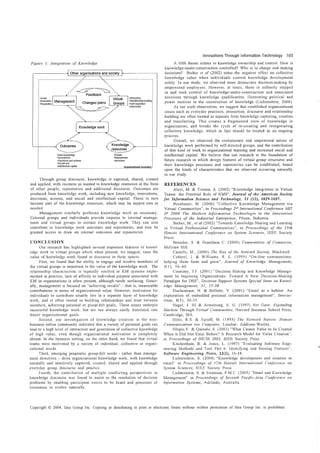
the virtual team analysis below - are clearly identified in liter I'U                 From our empirical findings, we provide a model of the integration
      Management of the community is based on thc self-management               of virtual groups in organizational KM systems, for organizations where
model which includes adaptive development of self-regulatory measures           virtual groups play a key role (Figure I).
and policy, complemented by effective, integrated web-based tools. The                Knowledge work is integrated in an organization-wide KM context.
community website allows for immediate publication and sharing of               Groups arc self~motivated, based on the building of relationships which
information and knowledge. Online reviewing of new literary work                can vary from collegial Ifor example, in the workplace) to warm and
immediately follows publication, with feedback and responses given in           personal (for example, in a societal virtual community). CTroups are self-
real time. Learning is thus accomplished, cnabling community develop-           regulated and self-organizing, making decisions often without recourse
ment through the negotiated knowledge of accepted and unaccepted                to management, then proViding feedback to management who respond
collective norms, as well as enabling authors to shape their future work        with altered organizatlOnal plans or information about goals, policy or
on the basis of knowledge gained.                                               knowledge evaluation. If management is needed for decision-making
                                                                                purposes, representatives may b0 co-opted into virtual group work.

Copyright © 2004, Idea Group Inc. Copying or distributing in print or electronic forms without written permission of Idea Group Inc. is prohibited.
Innovations Through Information Technology      103
Figure 1: Integration oj' Knowledge                                                                                        A fifth theme relates to knowledge ownership and control. How is
                                                                                                                      knowledge-under-construction controlled? Who is in charge and making
                                 Other organisations and society •                                                   decisions? Bieber et al (2002) notes the negative effect on collective
     , -------------------------------
     -                                         --------------    -----------------------------------">           ,
                                                                                                                     knowledge value when individuals control knowledge development
     ,
     ,                                                                                                           ,
                                                                                                                 ,   solely In our study, we observed more democratIc decision-making by
     ,
     ,                                                                                                           ,
                                                                                                                 ,
     ,                                                                                                           ,   empowered employees. However, at times, those in authority stepped
    :
    :
                                       ~~
                                                Feedback
                                                                                                                :
                                                                                                                 :
                                                                                                                     in and took control of knowledge-under-construction and associated
    ;'Goals                                                                               ·Motivation            i   decisions throngh knowledge qualification, illustrating political and
    : ·Evaluation                                                                         ·Relationship-bullding:    power motives in the construction of knowledge (Lichtenstein, 2004).
    : 'Reguiation                                                                         ·Self-regulation      :
                                                                                                                           As our sixth observation, we suggest that established organizatiunal
                                                                                                                     Issues such as everyday practices, interaction, discourse and relationship
                                                                                                                     building are often treated as separate from knowledge capturing, creation
                                                                                                                     aIllI transferring. This creates a fragmented view of knowledge in
                                                                                                                     organization, and breaks the cycle of re-creating and renegotiating
                                                                                                                     collective knowledge, which in fact should be treated as an ongoing
                                                                                                                     process.
                                                                                                                           Overall, we observed the evolutionary and empowered nature of
                                                                                                                     knowledge work performed by self-directed groups, and the contribution
                                                                        resources                                    of this kind of work to organizational learning and increased social and
                     'New kncrNledge                                      ·People                                    intellectual capital. We believe that our research is the foundation of
                     ·Innovations                                         ·Repositories
    i                :~;~II~:O~Sdand ~ctions                              -discourse                            I
                                                                                                                     future research in which design features of virtual group structures and
                                                                                                                     their knowledge processes and repositories can be established, based
    l_____________ :~n!:I~~:I~~_:~~~a~ ________ _________________________ _
                                                                          9!If:!lJ[s_aJ8Jfl.Bj _b_OJ~l!dJ1!Y_:
                                                                                                                     upon the kinds of characteristics that we observed occurring naturally
                                                                                                                     in Ollr study.
     Through group discourse, knowledge is captur0d, shared, created
and applied, with recourse as needed to knowledge resources in the form                                              REI<'ERENCES
of other people, repositories and additional discourse. Outcomes are                                                        Alavi, M. & Tiwana, A. (2002) "Knowledge Integration in Virtual
produced from knowledge work, including new knowledge, innovations,                                                   Teams: the Potential Role of KMS", Journal of the American Socie(v
decisions, actions, and social and intellectual capital. These in turn                                               for Illformation Science find Technology, S3 (12), 1029-1037.
become part of the knowledge resources, which may be tapped into as                                                         Beinhauer, M. (2000) "Collective Knowledge Management via
needed.                                                                                                               Virtual Communities", in Proceedings 2"" International Conj'erence MIT
     Managcment similarly performs knowledge work as necessary.                                                       II' 2000 The A10dern Information Technologie in the Innovation
External groups and individuals provide impetus to internal manage-                                                   Processes of the [ndustrial Enterprises, Pilzen, Bohemia.
ment and virtual groups to initiate knowledge work. Thcy can also                                                           Bieber, M., et al (2002) "Towards Knowledge Sharing and Learning
contribute to knowledge work outcOl1les and repositories, and may be                                                  1Il Virtual Professional Communities", in Proceedings of the 35th
granted access to draw on internal outcomes and repositories.                                                         [{awaii International Conference 011 System Sciences, IEEE Society
                                                                                                                      Press.
CONCL[lSION                                                                                                                 Bressler, S. & Grantham C. (2000) COllIlllunities of COlllmerce,
        Our research has highlighted several important features of knowl-                                             McGraw Hill.
edge work in virtual groups which when present, we suggest, raise the                                                       Castells, M., (2000) The Rise oj'the Network SOCiety, Blackwell
value of knowledge work found in discourse in these spaces.                                                                 Cothrel, J. & Williams, R. L. (1999) "On-line communities:
      First, we found that the ability to engage and involve members of                                               helping them form and grow", Journal of Knowledge ,1anagement,
the virtual groups is important to the value of the knowledge work. The                                              3(1), 54-60.
relationship characteristic is typically omitted in KM systems imple-                                                       Courtney, J.F. (2001) "Decision Making and Knowledge Manage-
mented in practice; lack of affinity or individual purpose associated with                                           ment In Inquiring Organizations: Toward A New Decision-Making
KM in organizations is often present, although rarely surfacing. Gener-                                              Paradigm for DSS", Decision Support Systems Special [sslIe on Knowl-
ally, management is focused 011 "achieving results" - that is, measurable                                            edge Management, 31, 17-38.
contributions in terms of organizational value. [Iowever, motivation for                                                    Ducheneaut, N & Bellotti, V (2001) .. Email as a habitat: An
individuals to contribllte usually lies in a separate layer of knowledge                                             exploration of embedded personal information management", Interac-
work, and is often rooted in building relationships and trust between                                                tiOIlS, 8(5), 30-35.
members, achieving personal or group-felt goals,. These issues underpin                                                     Hagel, J. HI & Armstrong, A. G. (1997) Net Gaill: Expanding
successful knowledge work, but are not always easily translated into                                                 A1arkets Through Virtual COllllllunities, Harvard Business School Press,
direct organizational goals.                                                                                         Cambridge, MA.
      Second, our investigation of knowledge creation 111 the non-                                                         Biltz, R.S. & Turoff, M. (1993) The Network Nation: Human
business online community indicated that a variety of personal goals can                                             CO/l7l11ullication via Computer, London: Addison-Wesley.
lead to a high level of interaction and generation of collective WlOwledge                                                 Hlupic,V. & Qureshi, S. (2003) "What Causes Value to be Created
of high value, even though organizational motivation is completely                                                   When it Did Not Exist Before') A Research Model for Value Creation",
absent. In the business setting, on the other hand, we found that virtual                                            III Proceedings oj' /-{[CSS 2003, IEEE Society Press.
teams were motivated by a variety of individual, collective or organi-                                                     KitchenhaI11, B. & Jones, L. (1997) "Evaluating Software Engi-
zational needs                                                                                                       neering Methods and Tool Part 6: Identifying and Scoring Features",
      Third, emerging pragmatic group-felt needs - rather than manage-                                               Software Engineering Notes, 22(2), 16-18.
ment directives - drive organizational knowledge work, with knowledge                                                      Lichtenstein, S. (2004) "Knowledge development and creation in
naturally and intuitively captured, created, shared and applied through                                              email" in Proceedings of 37th Hawaii Jl1fel'l1alional Conference 011
everyday group discourse and practice                                                                                ,System Sciences, IEET Society Press.
      Fourth, the contribution of multiple conflicting perspectives in                                                     Lichtenstein, S. & Swatman, PM.C (2003) .. Email and Knowledge
knowledge discourse was found to assist in the resolution of decision                                                Management" in Proceedings of Seventh Pacific-Asia COllference on
problems by enabling participant voices to be heard and processes of                                                 [nformation Systems, Adelaide, Australia.
consenSllS to evolve naturally.


Copyright © 2004, Idea Group Inc. Copying or distributing in print or electromc forms without written permIssion of Idea Group Inc is prohibited
104 2004 IRMA International Conference
       Loermans, J. (2002) "Synergizing the learning organization and
 knowledge management", Journal of Knowledge llianagement. 6(3),
 285-294.
       Lueg, C. (2001) "Information dissemination in virtual communi-
 ties as challenge to real world companies" in Proceedings of 1-" IFIP
 Conference on e-Comlnerc::e, e-Business and e-GoVel'l1ment, Zurich.
       Qureshi, I., Bogenrieder, I & KumaI', K. (2000) "Managing pat·tici-
 pative diversity in virtual teams: requirements for Collaborative Tech-
 nology support", in Proceedings IIICSS 2000, IEEE Society Press.
       Rheingold, II. (J 999) COllllllunity Development in the Cybersociely
of the Future, http://www.partnerships.org.uk/bol/howard.htm (accessed
 3/1 0/2003)
       Radding, A. (1998) Knowledge management: Succeeding in the
 Information-Based Global EconolllY, Computer Technology Research
Group, Charleston, SC.
       Ratcheva, V. (forthcoming) "Creating Synergetic Knowledge in
Virtual Teams", Journal of Knowledge Management, forthcoming.
      Schaffers, B., Ribak, A., Tschammer, V. & Aschmoneit, P. (2003)
"New Models for Co-operation in Work and Business: Socio-economic
drivers and technological enablers", in E-Business: Econolllic Impact
and Policy Implication: Proceedings of JI" Bcrlecon Workshop on the
Economics of IT, Berlin.
      Schrage, lVI. (1990) Shared Minds: the New Technologies ()j'
Col1aboratioll, New York: Random House.
      Sharkie, R. (2003) "Knowledge creation and its place in the
development of sustainable competitive advantage", Journal (~r Knowl-
edge Management, 7( J), 20-31
      Snowden, D. (2002) "Complex acts of knowing: paradox and
descriptive sell~awareness", Journal of Knowledge llianagement, 6(2),
100-111.
      Torlina, 1.. & Kazakevitch, G. (2003) "Web Publishing Revisited
- A Case Study of Literary W cbsites in Russia" in Proceedings of the
Seventh Pac(flc Asia Conference on Information Systems, Adelaide,
Australia.
      Townsend, A.M., DeMarie, S.M., & Hendrickson, A.R. (1998)
"Virtual teams: technology and the workplace of the future", /1cadeIllY
or Management Executive, J 2, J 7-29.


Copyright © 2004, Idea Group Inc. Copying or distributing in print or electronic forms without written permission of Idca Group Inc. is prohibited.

Torlina integrationofknowledge-2004

  • 1.
    Deakin Research Online DeakinUniversity’s institutional research repository DDeakin Research Online Research Online This is the published version (version of record) of: Torlina, Luba and Lichtenstein, Sharman 2004, Integration of knowledge management in virtual groups, in Innovations Through Information Technology, 2004 Information Resources Management Association International Conference, IGI Publishing, Hershey, Pa., pp. 101- 104. Available from Deakin Research Online: http://hdl.handle.net/10536/DRO/DU:30005351 Reproduced with the kind permission of the copyright owner Copyright : 2004, IGI Publishing
  • 2.
    Innovations Through InformationTechnology 101 Integration of Knowledge .. Management In Virtual Groups Luba Torlina and Sharman Lichtenstein School of Information Business Systems, Faculty of Buincss and Law, Deakin University, Melbourne Campus 221 Burwood Highway, Burwood, Victoria 3125 Australia, lubat@deakin.edu.au ABSTRACT This paper focuses 011 exploring knowledge work in two types of virtual were benefits to be harvested li'om identifying and comparing knowledge groups, allempting to ident!{y common themes and key diiferentiators. work issues in these two types of structures - for guiding the design of We were particularly interested in investigating how various forums complementary, integrated virtual spaces and processes where knowl- support, 01' do 110t sllpporl, collective virtual knowledge work. 0111' study edge work could flourish, and defining corresponding requirements for demonstrates that, despite apparent differences in purpose and objectives supporting systems and technologies. Following, we provide an intro- (drive,I), synergies exist between virtual COlll/II1l11i1ies and teams. Virtual duction to knowledge work in virtual communities and teams, discuss groups sllch as virtual C0JJ1111 unities, communities of pracrice and virtual findings from two case studies, draw conclusions and offer final remarks. teams jJeljorm emergent Imowledge work based on relationships, interaction and self-regulation. These groups carry out a variety of KNOWLEDGE WORK IN VIRTUAL COMMUNITIES valuable knowledge work, which is often 1Il0tivated by individual or AND TEAMS group-based - rather than managerial -. needs. We develop a model of We commence by offering definitions of 'virtual community' and the role !!{ virtual groups in knowledge management (Kit4) in business 'virtual teum', terms which are often confused by theorists and practi- and social organi::afions, and suggest that Oil/' model forms a basis for tioners. We define a virtual community as groups of people who engage further exploration of this increasingly important topic. in many-to-many interactions online, and form wherever people with common interests are able to interact (Cothrel & Williams, 1999), INTRODUCTION generally representing weak tie networks such as social networks and Knowledge management (KM) is increasingly linked to work networks of practice. Virtual teams embrace a wide range of project- performed by often-distributed groups consisting of communities and based, task-based or topic-based occupational kams and groups working teams collaborating to solve complex problems across specialisations in a virtual space. Classically, they are defined as strong tie networks, (Schaffers et aI., 2003). Group work can be allocated by managemcnt, however we extend the definition to medium-to-strong tie networks with autonomy awarded to groups for all kinds of activities, including for example, a collective of groups of people at work who temporarily critical decision-making. Increasingly, however, group work is self- assemble to fulfil a business purpose. Virtual teams may be part of a motivated, with workers congregating around emergency, ad hoc needs virtual community, or may exist as a separate entity independent of (Alavi & Tiwana, 2(02). other on-line structures. Computer-mediated communication (CivIC) has become a popular channel for communication, cooperation and collaboration by virtual ViI,tllal Communities aud Knowledge Management comm1lnities al1d teams. Nowadays, these virtual groups play significant Early virtual communities were formed around social issues, how- roles in all kinds of societal and organizational activities - for example, ever more reeently, community-building has emerged as an important outsourcing (Hiltz & 'furoff, 1993; Schaffel'S et al., Z003). Interest- business opportunity. Hagel & Armstrong (1997) argue that in the ingly, virtual groups have also led to the emergence of specific subcul- commercial world, virtual communities have the potential to overturn tures, with new management and self-management practices and tools many traditional business structures, while Bressler & Grantham (2000) extending and sometimes replacing existing physical mechanisms and suggest that in the new business climate, successful businesses must structures (Toriina and Kazakevitch, 2003). transform themselves into a community of employees who cluster in Businesses and society gain from virtual group knowledge work in pursuit of a common objective. In contrast, Rhcingold (1999) believes different, but related ways. Businesses benefit through the establishment it unlikely the cOlllmunity model will ever deliver direct revenue, of internal knowlt,dge flo' links and the sbaring and creation of suggesting that the greatest value of a community arises from the quality knowledge leading to organizational learning and innovation (Hlupic & of generated content, knowledge, experience sharing, improved com- Qureshi, Z003; Schrage. 1990: Sharkie, 20(3). Society benefits through munications, and new forms of culture. the establIshment of knowledge networks based on shared interests and Virtual comlllunities involve knowledge sharing, illustrated by the objectives; validation of knowledge created elsewhere; and the provision application of what has been learned through the community (Lueg, of a fertile environment for knowledge stimulation and innovation. 200 I). These communities support the capture, sharing and manage- Perhaps more importantly, such communities simultaneously reflect ment of knowledge' that is otherwise ditlicult to access and structure. and convey changes in the body of knowledge and learning structures in Hypertext tools are employed to construct forums, with linked discus- the wider society, transferring knowledge of a broader societal context sions on specific topics of interest, thereby enabling knowledge genera- - such as national culture, arts, social lifc, humanitarIan issues and tion, and linking of knowledge objects througb hyperlinks (Beinhaucr, politics (Reinghold, 1999: Castells, 2000) 2000; Radding, 1998). Personal profiles of members' specialisations Researchers have recently begun to investigate KM in virtual group spawn subgroups that share more personalised knowledge (Beinhauer, work (for example- Alavi & Tiwana, 2002; Bieber et al., 2002; 2000) Lichtenstein & Swatman, 2003). Schaffers el al. (2003) called for greater research into the role of KM in supporting and integrating new Virtual Teams lind Knowledge Management types of complex co-operative work, within and across increasingly Virtual teams which work across time zones and geographical networked organizational boundanes. Accordingly, we elected to inves- boundaries are increasingly prevalent in businesses (Townsend et aI., tigate knowledge work in virtual communities and teams, feeling there 1993), with expertS suggesting they are the best choice structure for Copyright 1£) 2004, Idea Group Inc. Ctlpying or distributing in print or electrolllc forms without written penmssion of Idea Group Inc. is prohibited.
  • 3.
    102 2004 IRMAInternational Conference harnessing, integrating and applying distributed knowledge in organiza- The sources o[ value for community members include the high level tions and other collaborative groups largely because the individuals of mcmber interactions and contributions to community content. involved provide a context in which their tacit, specialist knowledge can Although generated content is not filtered, site management encourages be recombined into collective knowledge (Alavi & Tiwana, 2002) high quality content by enabling author and publication ratings, thus Indeed, without such group work, there is no opportunity [or individuals creating a knowledge evaluation process as well as relationships and to idcntif", synergies in their specialist knowledge. Ratcheva (forthcom- knowledge links between members. ing) finds such synergies in virtual teamwork, while Qureshi et al. (2000) Community members establish formal and informal groups and explain the contribution to learning of socia-cognitive conflict resolu- associations within the community. The basis for such groups or teams tion in virtual teams, when the competing viewpoints are offered from may be sharing a specific interest in a particular genre or style, or diverse knowledge backgrounds. pursuing a group interest such as establishing a new club, or publishing Virtual team knowledge work is able to capitalise on the ease with a book together, or simply appreciating one another's work. Higher which team composition can be altered in virtual space, combined with quality knowledge is thus generatcd (Beinhauer, 2000). Exercising participant acceptance of such fluid team structures. As needed, people freedom of site use, a diversity of authors have joined the community, can be rotated in (and out) of teams (Alavi & Tiwana, 2002; Townsend creating stratification and relative isolation "by choice" of the different et al., 1998) and, according to Schaffers (2003), such evolving needs groups. Border-crossing of groups is possible, however people usually tend to be for people's knowledge. choose to read, review, and socialise with the members of their own informal group. Bonds and trust thus develops, leading to greater FINDINGS I?ROM CASE STIJDmS OF LITEIUU; AND knowledge sharing. Such informal grouping also offers a natural mecha- EMAIL nism for managing complex implicit knowledge. In this section, we report findings from two case studies of a virtual community and a virtual team environment. We were interested in Knowledge Work by Virtual Teams in Organizational Email investigating knowledge work in business organizations as well as in As reported elsewhere (Lichtenstein & Swatman, 2003), we found social non-professional virtual organizations with intensive knowledge that virtual teams were summoned through an initial message inspired generation. Discourse analysis (Fairclough, 1992) was employed to by a need perceived to be of mutual interest to team members. This analyse text and documcnts in context, enabling the identification of message became part of a knowledge trail consisting of successive, patterns, themes and trends. Feature analysis (Kitchenham & Jones, related emails in one or more threads emanating from the first knowledge 1997) was used to identify the key features of CMC technologies for seed email In the conversations, selected because knowledge develop- virtual communities and teams, from specifications found in existing ment took place, knowledge was crystallised along the knowledge trail literature. through processes of knowledge qualification and combination, with The virtual community investigated was 'liteLru' a Russian reference to knowledge resources including authorities, documents, and literary publishing site implemented as a portal. A preliminary contributions of insights, ideas, suggestions and context by participants. investigation of knowledge work in twenty knowledge intensive com- New participants were co-opted as needed for their decision- munities, based in Australia, US and Russia was undertaken through making power, interest or additional knowledge. Infrequently, team discourse and feature analysis. Liter.ru was selected for an in-depth case members were dropped off the circulation list. By the end of knowledge study as an example of a successful KM syskm with an integrated trails, the tacit knowledge of participants had clearly been shared and computer-mediated environment, and a management model that en- combined, and new organizational knowledge had been created in the courages community building, quality content generation and innova- form of plans, innovation, decisions and actions. As a result of the tion. The virtual teams studied operated in the context of a large concomitant organizational learning, new social and intellectual capital Australian university, and collaborated using email. For this study. five had also been created. hundred consecutive messages and three hundred conversations featur- Team members were motivated to undertake knowledge work out ing knowledge development wcre collected from the Eudora email of a knowledge need. To an extent, this motivation was enabled by the archive of an academic (one of the authors) at a large Australian medium of email - which has been likened to an employee habitat, university. The fact that the two authors are members of the same commanding high levels of attention and organizational work through- academic department enabled participant involvement in the research, out a typical workday (Ducheneaut & Bellotti, 2(01) Email allows thereby providing context and understanding. spontaneous discourse, while its messages have been found to possess high levels of attention-attracting and excellent sensemaking charac- Knowledge Wol"i, in a Virtual Community: Liter,Ru teristics, including personalisation and contextualisation (Lichtenstein In introducing the relevance of our choice of study of liter.ru in a & Swatman, 2003). KM context, we note that the primary aim of this communitv is to Relationships developed among employees were collegial, with establish a creative environment, rathe;- than simply aiming for" online bonds strengthened by the sense of shared purpose in working to resolve publishing. The virtual space comprises an interactive meeting place for evolving collective work needs and issues. Group knowledge work was authors and readers, and also fulfils the role of a knowledge sharing not monitored by management. Instead, teams co-opted decision- facility. The collected publications constitute a constantly updated makers, other experts and peers as needed, to receive approval and other knowledge repository, forming the basis for a high quality, contempo- qualification (evaluation) of new knowledge being developed, in the light rary digital library. Knowledge generation is carried out by the commu- of current organizational objectives, plans and regulation. nity members through their interest-specific activities - pUblication, reviewing, discussions and other value-added activities. Patterns of Role of Virtual Groups ill Organizational Knowledgc knowledge work described in (Lichtenstein & Swatman" 2003) - and in Managemcnt the virtual team analysis below - are clearly identified in liter I'U From our empirical findings, we provide a model of the integration Management of the community is based on thc self-management of virtual groups in organizational KM systems, for organizations where model which includes adaptive development of self-regulatory measures virtual groups play a key role (Figure I). and policy, complemented by effective, integrated web-based tools. The Knowledge work is integrated in an organization-wide KM context. community website allows for immediate publication and sharing of Groups arc self~motivated, based on the building of relationships which information and knowledge. Online reviewing of new literary work can vary from collegial Ifor example, in the workplace) to warm and immediately follows publication, with feedback and responses given in personal (for example, in a societal virtual community). CTroups are self- real time. Learning is thus accomplished, cnabling community develop- regulated and self-organizing, making decisions often without recourse ment through the negotiated knowledge of accepted and unaccepted to management, then proViding feedback to management who respond collective norms, as well as enabling authors to shape their future work with altered organizatlOnal plans or information about goals, policy or on the basis of knowledge gained. knowledge evaluation. If management is needed for decision-making purposes, representatives may b0 co-opted into virtual group work. Copyright © 2004, Idea Group Inc. Copying or distributing in print or electronic forms without written permission of Idea Group Inc. is prohibited.
  • 4.
    Innovations Through InformationTechnology 103 Figure 1: Integration oj' Knowledge A fifth theme relates to knowledge ownership and control. How is knowledge-under-construction controlled? Who is in charge and making Other organisations and society • decisions? Bieber et al (2002) notes the negative effect on collective , ------------------------------- - -------------- -----------------------------------"> , knowledge value when individuals control knowledge development , , , , solely In our study, we observed more democratIc decision-making by , , , , , , empowered employees. However, at times, those in authority stepped : : ~~ Feedback : : in and took control of knowledge-under-construction and associated ;'Goals ·Motivation i decisions throngh knowledge qualification, illustrating political and : ·Evaluation ·Relationship-bullding: power motives in the construction of knowledge (Lichtenstein, 2004). : 'Reguiation ·Self-regulation : As our sixth observation, we suggest that established organizatiunal Issues such as everyday practices, interaction, discourse and relationship building are often treated as separate from knowledge capturing, creation aIllI transferring. This creates a fragmented view of knowledge in organization, and breaks the cycle of re-creating and renegotiating collective knowledge, which in fact should be treated as an ongoing process. Overall, we observed the evolutionary and empowered nature of knowledge work performed by self-directed groups, and the contribution resources of this kind of work to organizational learning and increased social and 'New kncrNledge ·People intellectual capital. We believe that our research is the foundation of ·Innovations ·Repositories i :~;~II~:O~Sdand ~ctions -discourse I future research in which design features of virtual group structures and their knowledge processes and repositories can be established, based l_____________ :~n!:I~~:I~~_:~~~a~ ________ _________________________ _ 9!If:!lJ[s_aJ8Jfl.Bj _b_OJ~l!dJ1!Y_: upon the kinds of characteristics that we observed occurring naturally in Ollr study. Through group discourse, knowledge is captur0d, shared, created and applied, with recourse as needed to knowledge resources in the form REI<'ERENCES of other people, repositories and additional discourse. Outcomes are Alavi, M. & Tiwana, A. (2002) "Knowledge Integration in Virtual produced from knowledge work, including new knowledge, innovations, Teams: the Potential Role of KMS", Journal of the American Socie(v decisions, actions, and social and intellectual capital. These in turn for Illformation Science find Technology, S3 (12), 1029-1037. become part of the knowledge resources, which may be tapped into as Beinhauer, M. (2000) "Collective Knowledge Management via needed. Virtual Communities", in Proceedings 2"" International Conj'erence MIT Managcment similarly performs knowledge work as necessary. II' 2000 The A10dern Information Technologie in the Innovation External groups and individuals provide impetus to internal manage- Processes of the [ndustrial Enterprises, Pilzen, Bohemia. ment and virtual groups to initiate knowledge work. Thcy can also Bieber, M., et al (2002) "Towards Knowledge Sharing and Learning contribute to knowledge work outcOl1les and repositories, and may be 1Il Virtual Professional Communities", in Proceedings of the 35th granted access to draw on internal outcomes and repositories. [{awaii International Conference 011 System Sciences, IEEE Society Press. CONCL[lSION Bressler, S. & Grantham C. (2000) COllIlllunities of COlllmerce, Our research has highlighted several important features of knowl- McGraw Hill. edge work in virtual groups which when present, we suggest, raise the Castells, M., (2000) The Rise oj'the Network SOCiety, Blackwell value of knowledge work found in discourse in these spaces. Cothrel, J. & Williams, R. L. (1999) "On-line communities: First, we found that the ability to engage and involve members of helping them form and grow", Journal of Knowledge ,1anagement, the virtual groups is important to the value of the knowledge work. The 3(1), 54-60. relationship characteristic is typically omitted in KM systems imple- Courtney, J.F. (2001) "Decision Making and Knowledge Manage- mented in practice; lack of affinity or individual purpose associated with ment In Inquiring Organizations: Toward A New Decision-Making KM in organizations is often present, although rarely surfacing. Gener- Paradigm for DSS", Decision Support Systems Special [sslIe on Knowl- ally, management is focused 011 "achieving results" - that is, measurable edge Management, 31, 17-38. contributions in terms of organizational value. [Iowever, motivation for Ducheneaut, N & Bellotti, V (2001) .. Email as a habitat: An individuals to contribllte usually lies in a separate layer of knowledge exploration of embedded personal information management", Interac- work, and is often rooted in building relationships and trust between tiOIlS, 8(5), 30-35. members, achieving personal or group-felt goals,. These issues underpin Hagel, J. HI & Armstrong, A. G. (1997) Net Gaill: Expanding successful knowledge work, but are not always easily translated into A1arkets Through Virtual COllllllunities, Harvard Business School Press, direct organizational goals. Cambridge, MA. Second, our investigation of knowledge creation 111 the non- Biltz, R.S. & Turoff, M. (1993) The Network Nation: Human business online community indicated that a variety of personal goals can CO/l7l11ullication via Computer, London: Addison-Wesley. lead to a high level of interaction and generation of collective WlOwledge Hlupic,V. & Qureshi, S. (2003) "What Causes Value to be Created of high value, even though organizational motivation is completely When it Did Not Exist Before') A Research Model for Value Creation", absent. In the business setting, on the other hand, we found that virtual III Proceedings oj' /-{[CSS 2003, IEEE Society Press. teams were motivated by a variety of individual, collective or organi- KitchenhaI11, B. & Jones, L. (1997) "Evaluating Software Engi- zational needs neering Methods and Tool Part 6: Identifying and Scoring Features", Third, emerging pragmatic group-felt needs - rather than manage- Software Engineering Notes, 22(2), 16-18. ment directives - drive organizational knowledge work, with knowledge Lichtenstein, S. (2004) "Knowledge development and creation in naturally and intuitively captured, created, shared and applied through email" in Proceedings of 37th Hawaii Jl1fel'l1alional Conference 011 everyday group discourse and practice ,System Sciences, IEET Society Press. Fourth, the contribution of multiple conflicting perspectives in Lichtenstein, S. & Swatman, PM.C (2003) .. Email and Knowledge knowledge discourse was found to assist in the resolution of decision Management" in Proceedings of Seventh Pacific-Asia COllference on problems by enabling participant voices to be heard and processes of [nformation Systems, Adelaide, Australia. consenSllS to evolve naturally. Copyright © 2004, Idea Group Inc. Copying or distributing in print or electromc forms without written permIssion of Idea Group Inc is prohibited
  • 5.
    104 2004 IRMAInternational Conference Loermans, J. (2002) "Synergizing the learning organization and knowledge management", Journal of Knowledge llianagement. 6(3), 285-294. Lueg, C. (2001) "Information dissemination in virtual communi- ties as challenge to real world companies" in Proceedings of 1-" IFIP Conference on e-Comlnerc::e, e-Business and e-GoVel'l1ment, Zurich. Qureshi, I., Bogenrieder, I & KumaI', K. (2000) "Managing pat·tici- pative diversity in virtual teams: requirements for Collaborative Tech- nology support", in Proceedings IIICSS 2000, IEEE Society Press. Rheingold, II. (J 999) COllllllunity Development in the Cybersociely of the Future, http://www.partnerships.org.uk/bol/howard.htm (accessed 3/1 0/2003) Radding, A. (1998) Knowledge management: Succeeding in the Information-Based Global EconolllY, Computer Technology Research Group, Charleston, SC. Ratcheva, V. (forthcoming) "Creating Synergetic Knowledge in Virtual Teams", Journal of Knowledge Management, forthcoming. Schaffers, B., Ribak, A., Tschammer, V. & Aschmoneit, P. (2003) "New Models for Co-operation in Work and Business: Socio-economic drivers and technological enablers", in E-Business: Econolllic Impact and Policy Implication: Proceedings of JI" Bcrlecon Workshop on the Economics of IT, Berlin. Schrage, lVI. (1990) Shared Minds: the New Technologies ()j' Col1aboratioll, New York: Random House. Sharkie, R. (2003) "Knowledge creation and its place in the development of sustainable competitive advantage", Journal (~r Knowl- edge Management, 7( J), 20-31 Snowden, D. (2002) "Complex acts of knowing: paradox and descriptive sell~awareness", Journal of Knowledge llianagement, 6(2), 100-111. Torlina, 1.. & Kazakevitch, G. (2003) "Web Publishing Revisited - A Case Study of Literary W cbsites in Russia" in Proceedings of the Seventh Pac(flc Asia Conference on Information Systems, Adelaide, Australia. Townsend, A.M., DeMarie, S.M., & Hendrickson, A.R. (1998) "Virtual teams: technology and the workplace of the future", /1cadeIllY or Management Executive, J 2, J 7-29. Copyright © 2004, Idea Group Inc. Copying or distributing in print or electronic forms without written permission of Idca Group Inc. is prohibited.