


The Social Web & Higher Education?

    Student, faculty, staff, institutions want to use it.
    !   We are social by nature
    !   We are driven by our passions
    !   We seek identity & individuality
    !   We no longer feel bound by that which is immediately around
      us
    !   We seek better ways to manage information overload
    !   We spend more time connected virtually to one another than
      we do physically
    !   We can interact with one another in ways that were never
      possible before (or were extremely cost prohibitive)


2
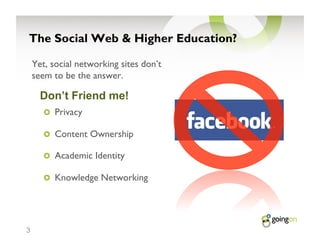
Yet, social networking sites don’t
    seem to be the answer.

      Don’t Friend me!
       !   Privacy

       !   Content Ownership

       !   Academic Identity

       !   Knowledge Networking


3
The Engagement Principle
    As institutional leaders, faculty and staff, we care about
    engagement.
    !   The majority of students drop out because of a lack of
      connection to the university.
    !   Increased student engagement can lead to:
      •  Higher retention rates
      •  Improved academic performance
      •  Contextual, situational or differential learning, resulting in the building of
         higher order thinking skills
    !   Increased faculty & staff engagement can lead to:
      •  Stronger ability to meet institution goals, mission & vision
      •  Tighter alignment with institution values


4
What About Academic Identity? Networking?

    In a world where we are one of many, we seek identity & look for
    others to network with.
    !   Active, vibrant virtual commons & communities promote
      stronger institutional & individual identity, which can lead
      to:
      •    Higher recruitment rates
      •    Increased utilization of institutional resources, academic or not
      •    Increased extended community participation
      •    Increased participation in life-long learning offerings
    !   Networking is critical as students seek opportunities within or
      beyond your institution upon graduation.
      •  Personal learning networks are a key part of 21st century professional
         success.

5
What does engagement look like…

6
In the age of the social web?


7
Case Study: The Penn LPS Commons

    The University of Pennsylvania College of Liberal & Professional
    Studies engages students through virtual commons focused on
    social learning.
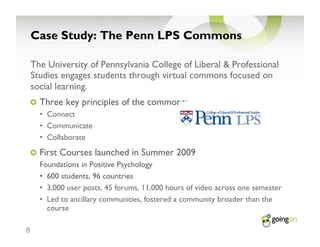
    !   Three key principles of the commons:
      •  Connect
      •  Communicate
      •  Collaborate
    !   First Courses launched in Summer 2009
      Foundations in Positive Psychology
      •  600 students, 96 countries
      •  3,000 user posts, 45 forums, 11,000 hours of video across one semester
      •  Led to ancillary communities, fostered a community broader than the
         course

8
Case Study: The Penn LPS Commons

    Success multiplied for the Penn LPS Commons, delivering similar
    results to courses across disciplines, countries & diverse student
    populations. Success was driven by:
    !   Commitment to fostering (not forcing) collaboration by faculty
      & staff
    !   Use of social learning constructs when developing the
      curriculum
    !   Opportunities for students to build pro les & network
    !   Ease of accessing streams of content & updates
    !   Ease of contributing content
    !   Community-oriented (vs. course) nature of the entire
      experience


9
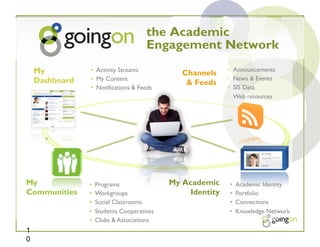
the Academic
                                       Engagement Network
    My          •  Activity Streams                          •    Announcements
                                                Channels
    Dashboard   •  My Content                                •    News & Events
                                                 & Feeds
                •  Notifications & Feeds                     •    SIS Data
                                                             •    Web resources


My              •    Programs                My Academic      •    Academic Identity
Communities     •    Workgroups                   Identity    •    Portfolio
                •    Social Classrooms                        •    Connections
                •    Students Cooperatives                    •    Knowledge Network
                •    Clubs & Associations
1
0
If We Build it, Will They Come?

    1.  Remember the fundamentals
      •  Domain, community, & practice
      •  Think participant goals rst, institutional outcomes second
    2.  Design for growth
      •  Create exible goals & tools that allow for growth at any pace
      •  Build aspects that promote new, differentiated activity
    3.  Build critical mass
      •  Involve key participants early
      •  Pick strong projects to start with that involve diverse participation
      •  Develop buy-in quickly
    4.  Develop permeable spaces & encourage ow
      •  Allow external & internal constituents to interact
      •  Involve novices & experts


1
1
If We Build it, Will They Come?

    5.  Make sure all participants derive value
      •  Everyone should see value in participating, regardless of skill level or
         involvement
      •  Conduct focus groups, employ role-based scenarios
    6.  Abide by community norms and foster trust
      •  Allow the community to develop its own policies & procedures
      •  Establish community-based ownership
    7.  Encourage identity building
      •  Promote activities that encourage students to “own” their pro le
      •  Allow the pro le to move among communities as desired


1
2
Want to Learn More?


               www.GoingOn.com

                     Melissa Loble
            Vice President, Client Strategy
                melissal@goingon.com
                    949-923-0508


1
3

Don't Friend Me: GoingOn EduComm presentation June2011

  • 2.
    The Social Web& Higher Education? Student, faculty, staff, institutions want to use it. !   We are social by nature !   We are driven by our passions !   We seek identity & individuality !   We no longer feel bound by that which is immediately around us !   We seek better ways to manage information overload !   We spend more time connected virtually to one another than we do physically !   We can interact with one another in ways that were never possible before (or were extremely cost prohibitive) 2
  • 3.
    Yet, social networkingsites don’t seem to be the answer. Don’t Friend me! !   Privacy !   Content Ownership !   Academic Identity !   Knowledge Networking 3
  • 4.
    The Engagement Principle As institutional leaders, faculty and staff, we care about engagement. !   The majority of students drop out because of a lack of connection to the university. !   Increased student engagement can lead to: •  Higher retention rates •  Improved academic performance •  Contextual, situational or differential learning, resulting in the building of higher order thinking skills !   Increased faculty & staff engagement can lead to: •  Stronger ability to meet institution goals, mission & vision •  Tighter alignment with institution values 4
  • 5.
    What About AcademicIdentity? Networking? In a world where we are one of many, we seek identity & look for others to network with. !   Active, vibrant virtual commons & communities promote stronger institutional & individual identity, which can lead to: •  Higher recruitment rates •  Increased utilization of institutional resources, academic or not •  Increased extended community participation •  Increased participation in life-long learning offerings !   Networking is critical as students seek opportunities within or beyond your institution upon graduation. •  Personal learning networks are a key part of 21st century professional success. 5
  • 6.
    What does engagementlook like… 6
  • 7.
    In the ageof the social web? 7
  • 8.
    Case Study: ThePenn LPS Commons The University of Pennsylvania College of Liberal & Professional Studies engages students through virtual commons focused on social learning. !   Three key principles of the commons: •  Connect •  Communicate •  Collaborate !   First Courses launched in Summer 2009 Foundations in Positive Psychology •  600 students, 96 countries •  3,000 user posts, 45 forums, 11,000 hours of video across one semester •  Led to ancillary communities, fostered a community broader than the course 8
  • 9.
    Case Study: ThePenn LPS Commons Success multiplied for the Penn LPS Commons, delivering similar results to courses across disciplines, countries & diverse student populations. Success was driven by: !   Commitment to fostering (not forcing) collaboration by faculty & staff !   Use of social learning constructs when developing the curriculum !   Opportunities for students to build pro les & network !   Ease of accessing streams of content & updates !   Ease of contributing content !   Community-oriented (vs. course) nature of the entire experience 9
  • 10.
    the Academic Engagement Network My •  Activity Streams •  Announcements Channels Dashboard •  My Content •  News & Events & Feeds •  Notifications & Feeds •  SIS Data •  Web resources My •  Programs My Academic •  Academic Identity Communities •  Workgroups Identity •  Portfolio •  Social Classrooms •  Connections •  Students Cooperatives •  Knowledge Network •  Clubs & Associations 1 0
  • 11.
    If We Buildit, Will They Come? 1.  Remember the fundamentals •  Domain, community, & practice •  Think participant goals rst, institutional outcomes second 2.  Design for growth •  Create exible goals & tools that allow for growth at any pace •  Build aspects that promote new, differentiated activity 3.  Build critical mass •  Involve key participants early •  Pick strong projects to start with that involve diverse participation •  Develop buy-in quickly 4.  Develop permeable spaces & encourage ow •  Allow external & internal constituents to interact •  Involve novices & experts 1 1
  • 12.
    If We Buildit, Will They Come? 5.  Make sure all participants derive value •  Everyone should see value in participating, regardless of skill level or involvement •  Conduct focus groups, employ role-based scenarios 6.  Abide by community norms and foster trust •  Allow the community to develop its own policies & procedures •  Establish community-based ownership 7.  Encourage identity building •  Promote activities that encourage students to “own” their pro le •  Allow the pro le to move among communities as desired 1 2
  • 13.
    Want to LearnMore? www.GoingOn.com Melissa Loble Vice President, Client Strategy melissal@goingon.com 949-923-0508 1 3