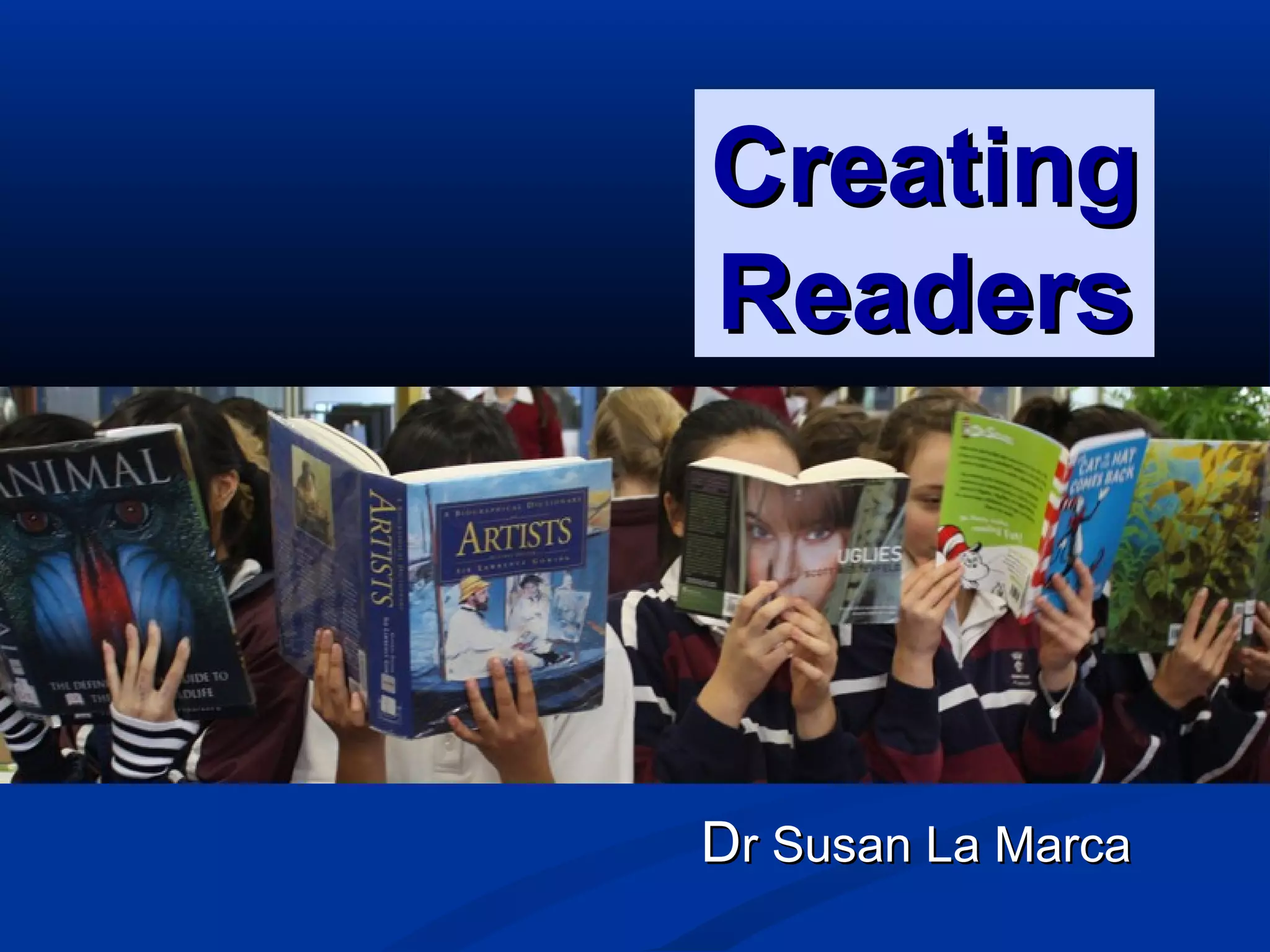
Creating
Readers


Dr Susan La Marca
Reading and school
achievement
  A print- rich environment leads to more
  reading and free voluntary reading is
  the best predictor of comprehension,
  vocabulary growth, spelling and
  grammatical ability and writing style.

                Lonsdale, M. (2003) Impact of School Libraries on Student
                           Achievement: a Review of the Research p. 1.
Reading and school
achievement
  …reading for fun had a positive
  relationship to average scores. At all
  three ages (9, 13, 17 years), students
  who said they read for fun scored
  higher than peers who said they never
  read for fun.
                                 Campbell, J. R., Hombo, C. M., & Mazzeo, J. (2000)
            1999 Trends in Academic Progress: Three Decades of Student Performance
Reading and school
achievement

  The results show how important it is not
  just to teach students to read but to
  engage them in reading as part of their
  lives.

               OECD (2000) Reading for Change: Performance and Engagement
                             Across Countries. Results form PISA 2000 p. 12.
Reading and school
achievement
The number of books a student has
access to correlates to the levels of
achievement and engagement.


             OECD (2000) Reading for Change: Performance and Engagement
                                Across Countries. Results form PISA 2000
Reading and school
achievement
The time parents spend ‘communicating’
with students correlates to achievement
and engagement levels.


            OECD (2000) Reading for Change: Performance and Engagement
                               Across Countries. Results form PISA 2000
What can Families do?
  Access


  Choice


  Time   and Space

  Support
Access


Reading materials at home


            OECD (2000) Reading for Change: Performance and Engagement
                               Across Countries. Results form PISA 2000
Access
The research supports the
commonsense view that when books
are readily available, when the print
environment is enriched, more reading
is done.


                  Krashen, S. (2004) The Power of Reading, p. 57
Ownership


         Public   library (incl. sales)
Access
         Bookshops     – new & secondhand

         Magazine    subscriptions

         Book   borrowing

         Audio    books

         ebooks
Choice
Space
Time

See reading as relevant and important:


•    turn off the television


•    don’t always offer other options
Support


Readers are made by readers.


                          Aidan Chambers
Support

Children learn about literature from what
the adults around them do about it.


                           Zahnleiter, 1985, p. 187
Support   Reading   aloud

          Knowledgeable     adults

          Role   models

          Talk
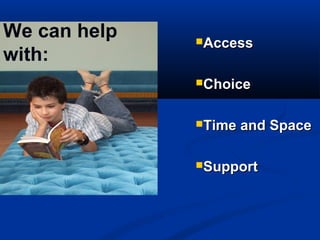
We can help   Access
with:
              Choice


              Time   and Space

              Support

Creating readers parent talk

  • 1.
  • 2.
    Reading and school achievement A print- rich environment leads to more reading and free voluntary reading is the best predictor of comprehension, vocabulary growth, spelling and grammatical ability and writing style. Lonsdale, M. (2003) Impact of School Libraries on Student Achievement: a Review of the Research p. 1.
  • 3.
    Reading and school achievement …reading for fun had a positive relationship to average scores. At all three ages (9, 13, 17 years), students who said they read for fun scored higher than peers who said they never read for fun. Campbell, J. R., Hombo, C. M., & Mazzeo, J. (2000) 1999 Trends in Academic Progress: Three Decades of Student Performance
  • 4.
    Reading and school achievement The results show how important it is not just to teach students to read but to engage them in reading as part of their lives. OECD (2000) Reading for Change: Performance and Engagement Across Countries. Results form PISA 2000 p. 12.
  • 5.
    Reading and school achievement Thenumber of books a student has access to correlates to the levels of achievement and engagement. OECD (2000) Reading for Change: Performance and Engagement Across Countries. Results form PISA 2000
  • 6.
    Reading and school achievement Thetime parents spend ‘communicating’ with students correlates to achievement and engagement levels. OECD (2000) Reading for Change: Performance and Engagement Across Countries. Results form PISA 2000
  • 7.
    What can Familiesdo? Access Choice Time and Space Support
  • 8.
    Access Reading materials athome OECD (2000) Reading for Change: Performance and Engagement Across Countries. Results form PISA 2000
  • 9.
    Access The research supportsthe commonsense view that when books are readily available, when the print environment is enriched, more reading is done. Krashen, S. (2004) The Power of Reading, p. 57
  • 10.
    Ownership Public library (incl. sales) Access Bookshops – new & secondhand Magazine subscriptions Book borrowing Audio books ebooks
  • 11.
  • 12.
  • 15.
    Time See reading asrelevant and important: • turn off the television • don’t always offer other options
  • 16.
    Support Readers are madeby readers. Aidan Chambers
  • 17.
    Support Children learn aboutliterature from what the adults around them do about it. Zahnleiter, 1985, p. 187
  • 18.
    Support Reading aloud Knowledgeable adults Role models Talk
  • 19.
    We can help Access with: Choice Time and Space Support

Editor's Notes

  • #2 Thank you It’s wonderful that you are here – being here shows a dedication to one of the most powerful areas of your child’s education that you can influence - reading. I’d like to first share with you some of the research that is relevant - All of the most recent research makes a strong case for clear links between the amount of pleasure reading that young people do and their levels of achievement in reading and other areas of learning. Lonsdale in a review for Australian school libraries found that
  • #3 Such finding have been replicated world wide. The National Assessment for Educational progress’s long term reading research report in America found that:
  • #4 The OECD report Reading for change in an international study into the reading of young people found that
  • #5 Engagement is a key and something that schools are working very hard at. Your own efforts to support and encourage your children to read is an important addition to what schools can do. In fact (AND I PROBABLY SHOULDN’T SAY THIS) it may be more important. The OECD study is large and extensive but I would like to share with you two other facts from this report. The report found that:
  • #6 This suggestion, that numbers of books are necessary for the success of our children, is one I will return to later. The report also found that:
  • #7 So we need reading materials, lots of them, and we need communication. The report is referring to all kinds of communication. Those parents who discussed all kinds of things with their children – school, work, sport, current affairs, and what they were reading tended to have students who were more highly engaged with reading and higher achievers at school based assessment. This study covered 32 OECD countries, it is highly regarded and cannot be ignored. OK.so what can we do?
  • #8 I would like to briefly consider each one of these areas and how they can contribute to creating readers and a reading culture in our homes. Firstly, Access. The OECD report, Reading for Change, found that one of the most importance factors common to good readers was:
  • #9 That is the report indicated a high correlation between the availability of reading materials in the home and students levels of engagement in reading as an activity. The earlier slide I showed talked about large numbers of books but the OECD report makes the link between the numbers of reading materials in the home not just school. Enormously powerful research that has clear implications. Krashen an important commentator in the field found that:
  • #10 So what types of things can we do to provide the reading materials that are needed for the creation of readers? I’d like to consider a few ideas to support this important access:
  • #11 Ownership Research and anecdotal evidence suggests that all of us like to own books, particularly our favorite books. Rereading our favorites is a way we maintain relationships with old friends while negotiating the structure of the book, learning about books - as we see it differently each time we read it. It might drive parents and teachers crazy but it is normal! To be given the book you love is a wonderful gift. Foster this ownership by making books a common gift but not just to your child but between adults and friends. This is so that the young members of the family see that books are valuable and appreciated gifts to all of us this is a form of modeling. And Make sure they have a place to store their expanding library. Public libraries – join, visit together, also use its online facilities. Look out for sales – wonderful bargains! Bookshops - elaborate Magazines – elaborate Book borrowing – books are expensive – encourage them to lend books amongst their friends / search out the shelves of older cousins or siblings – these books will be read voraciously by younger members of the family. Get your child to ask older relations or friends about the books they read as a child and search them out. Audio – not to be discounted – an important addition. I would next like to consider choice, firstly with a message from the experts:
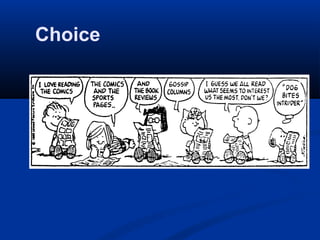
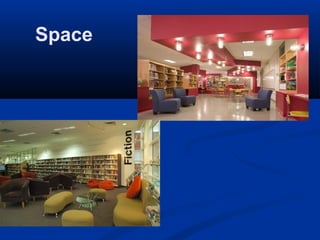
  • #12 We all read differently, enjoy different reading experiences, have different needs and abilities. Choice is a very important component in reading for pleasure. If we want children to read freely with interest and passion we must let them read what they want to read. This does not mean we can’t offer them options but we must also recognise their different needs. Just like adults kids like different formats – own boys. As parents we often get concerned about what our kids are reading but if we are to support their pleasure reading, and we have already shown the importance eof this pleasure reading, we must allow hem to read what they want to. Next - time and space. Perhaps we should provide spaces for our children to read in that look like this:
  • #13 Or perhaps like this
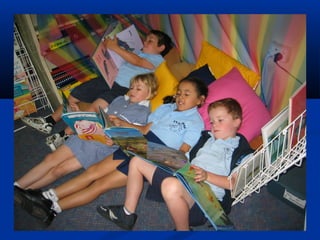
  • #14 Or perhaps something vastly more simple
  • #15 Doesn’t this look inviting and comfortable! And it’s simple. A lot of our recreational rooms in houses are geared to the viewing of screens - so consider making spaces to read if you don’t have them already. Involve the children in the process to increase their sense of ownership of the space. A nook in their own room might be the perfect spot, a special chair or cushion. Or for summer maybe an outdoor space. Most children find their own but you can help make it happen. And the other half of time and space – time. Many people often tell me they don’t have time to read but if anyone can make the time if they really believe it is valuable, if it is something they really want to do. There are a couple of hints about time in relation to the family and children more specifically. If we do value reading we need to:
  • #16 Turn off television -often we have it on unnecessarily Don’t always offer other options – let them be bored!!. Endless activities often gobble up possible reading time. This leads nicely into my last area - that of Support. Aidan Chambers said that:
  • #17 And Zahnleiter said that:
  • #18 So, Consider what message you give to the children around you about reading, them as readers, and reading as a valued activity. Do you provide positive perceptions on reading? Do you let the children see that you think it is a valuable activity? Do you value them as a reader – their opinions, their likes and dislikes? The support our children need is varied. They need:
  • #19 No one is ever to old to be read to. Eddie – LOTR Or - Get them to read to you. Knowledgeable adults – this could be you, teachers, librarians, booksellers or other family to help them find reading experiences they will enjoy. Role models - to help them see that reading is fun and wonderful And talk - With you, and others - particularly friends as there is nothing more powerful than peer group. This bring us back to the beginning of our discussion. We have explored some of the evidence that indicates how powerful reading can be in relation to learning and we have explored some of the factors that can support this:
  • #20 Now on to the wonderful books!!!!