School Libraries Supporting Learning
              Day Two
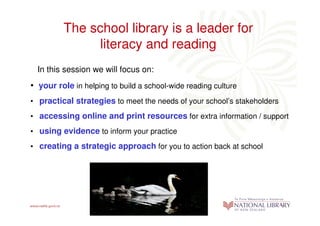
The school library is a leader for
               literacy and reading
  In this session we will focus on:
• your role in helping to build a school-wide reading culture
• practical strategies to meet the needs of your school’s stakeholders
• accessing online and print resources for extra information / support
• using evidence to inform your practice
• creating a strategic approach for you to action back at school
The greatest gift is a passion for reading.
It is cheap, it consoles, it distracts, it excites,
     it gives you knowledge of the world
         and experience of a wide kind.
                  ~Elizabeth Hardwick~
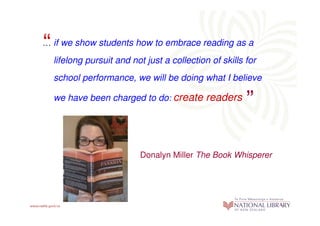
“
… if we show students how to embrace reading as a

    lifelong pursuit and not just a collection of skills for
    school performance, we will be doing what I believe  “
    we have been charged to do: create readers


                           Donalyn Miller The Book Whisperer
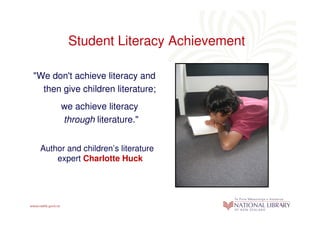
Student Literacy Achievement

"We don't achieve literacy and
  then give children literature;
       we achieve literacy
       through literature."


 Author and children’s literature
     expert Charlotte Huck
3 key messages…
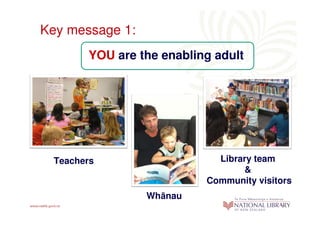
Key message 1:
       YOU are the enabling adult


 Teachers                   Library team
                                 &
                          Community visitors
                 Whānau
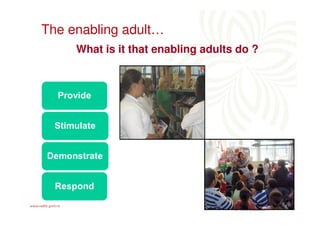
The enabling adult…
     What is it that enabling adults do ?
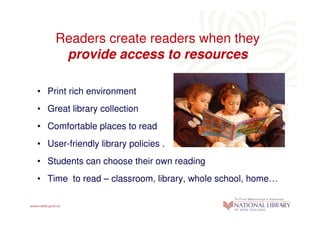
Readers create readers when they
     provide access to resources

• Print rich environment
• Great library collection
• Comfortable places to read
• User-friendly library policies .
• Students can choose their own reading
• Time to read – classroom, library, whole school, home…
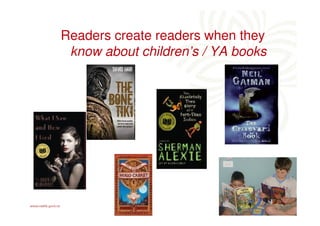
Readers create readers when they
 know about children’s / YA books
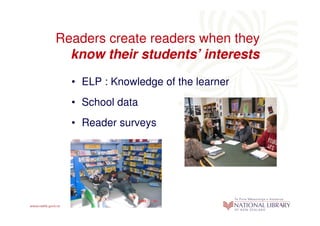
Readers create readers when they
  know their students’ interests
  • ELP : Knowledge of the learner
  • School data
  • Reader surveys
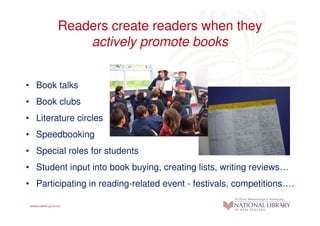
Readers create readers when they
            actively promote books


• Book talks
• Book clubs
• Literature circles
• Speedbooking
• Special roles for students
• Student input into book buying, creating lists, writing reviews…
• Participating in reading-related event - festivals, competitions….
Readers create readers when they
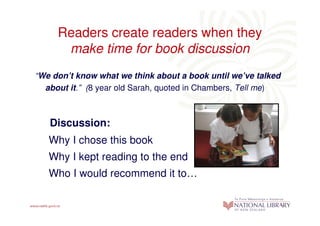
      make time for book discussion
“We don’t know what we think about a book until we’ve talked
  about it.” (8 year old Sarah, quoted in Chambers, Tell me)


   Discussion:
   Why I chose this book
   Why I kept reading to the end
   Who I would recommend it to…
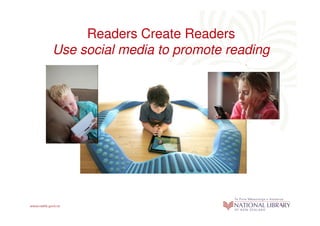
Readers Create Readers
Use social media to promote reading
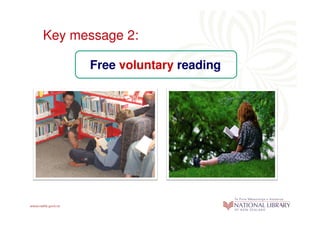
Key message 2:

      Free voluntary reading
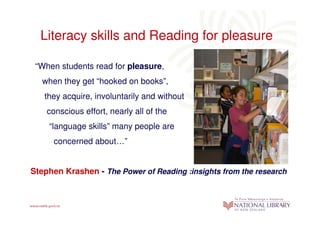
Literacy skills and Reading for pleasure

 “When students read for pleasure,
  when they get “hooked on books”,
   they acquire, involuntarily and without
    conscious effort, nearly all of the
    “language skills” many people are
      concerned about…”


Stephen Krashen - The Power of Reading :insights from the research
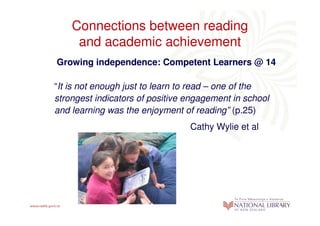
Connections between reading
     and academic achievement
Growing independence: Competent Learners @ 14

“It is not enough just to learn to read – one of the
strongest indicators of positive engagement in school
and learning was the enjoyment of reading” (p.25)
                                 Cathy Wylie et al
“Reading for pleasure can easily sound
                       like some kind of wishy-washy, soft
                       option, while instructional stuff like
                       learning to read through “synthetic
                       phonics”… sounds tough and
                       purposeful.

                      In actual fact… research shows children
Michael Rosen
Writer and            who read for pleasure achieve better
former Children’s     school performance than those who
Laureate              don’t.”
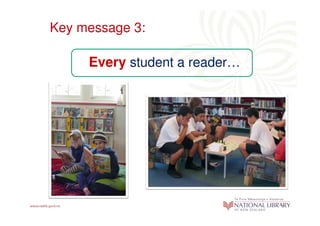
Key message 3:

     Every student a reader…
Every student a reader…

    "If we believe in the value and power of books,
  stories, poems and plays, we also have to remember
that it will never be enough simply to publish good stuff.
We have to be committed, ingenious, flexible and
experimental in coming up with ways of making all
  that literature come alive for every single child
             - no exceptions allowed.”
                   Michael Rosen
Readers create readers when they
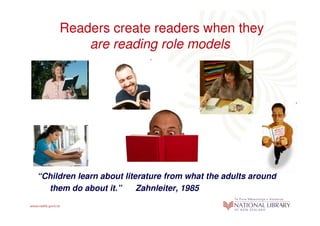
         are reading role models


“Children learn about literature from what the adults around
  them do about it.”      Zahnleiter, 1985
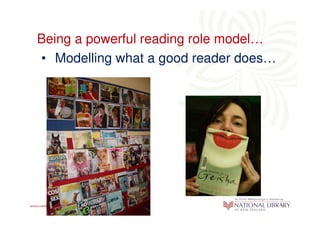
Being a powerful reading role model…
• Modelling what a good reader does…
Readers create readers when they
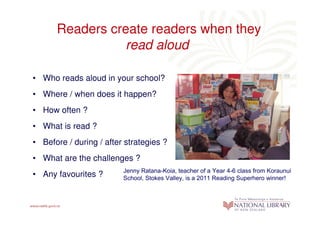
                 read aloud

• Who reads aloud in your school?
• Where / when does it happen?
• How often ?
• What is read ?
• Before / during / after strategies ?
• What are the challenges ?
                         Jenny Ratana-Koia, teacher of a Year 4-6 class from Koraunui
• Any favourites ?       School, Stokes Valley, is a 2011 Reading Superhero winner!
Celebrating the book…

Kids’ Lit Quiz, NZ Post Book Awards, Storylines,
Montana Poetry Day, NZ Bookweek, create a
book blog, bookfairs, competitions…
What does this mean for our school ?

• Students
• Teachers
• Principal / BOT
• Parents / school community


• What I am going to follow up back at school?
Time for a break…

      Browse the displays
 and have some reading time,
talking time, and refreshment…
Your school library collection


Participants will:
• Understand how the collection supports learning and
  literacy in their school
• Understand the steps involved in the life cycle of library
  resources
• Be able to find supporting tools using the ODC
• Become aware of trends in collection development
Why do we have a collection?

Scenario:
The principal and BOT of a new school are questioning the
  need for a library or a collection.
You are the pro-library DP.
• What will your arguments be?
• What might their arguments be?
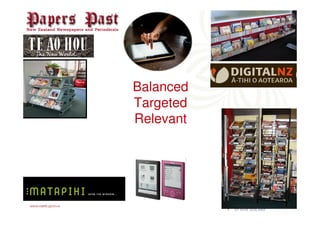
Balanced
Targeted
Relevant
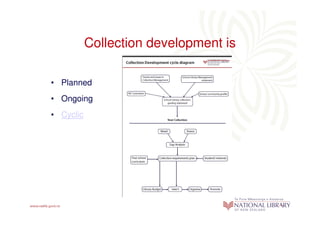
Collection development is

• Planned
• Ongoing
• Cyclic
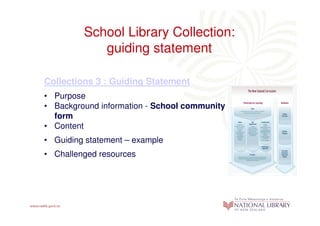
School Library Collection:
            guiding statement

Collections 3 : Guiding Statement
• Purpose
• Background information - School community profile
  form
• Content
• Guiding statement – example
• Challenged resources
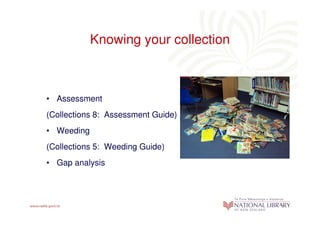
Knowing your collection


• Assessment
(Collections 8: Assessment Guide)
• Weeding
(Collections 5: Weeding Guide)
• Gap analysis
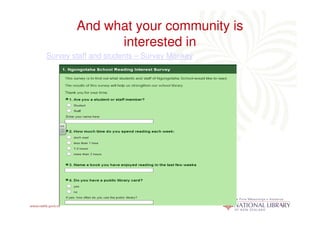
And what your community is
              interested in
Survey staff and students – Survey Monkey
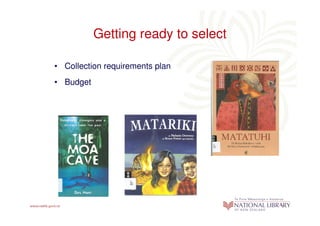
Getting ready to select

• Collection requirements plan
• Budget
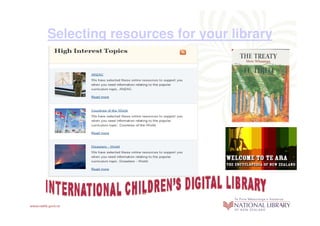
Selecting resources for your library
Example of Library Catalogue

• Pigeon Mountain Library Catalogue I hope with websites
  and high interest topics catalogued – watch this space.
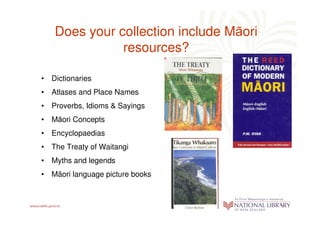
Does your collection include Māori
              resources?

• Dictionaries Dictionaries
• Atlases and Place Names
• Proverbs, Idioms & Sayings
• Māori Concepts
• Encyclopaedias
• The Treaty of Waitangi
• Myths and legends
• Mäori language picture books
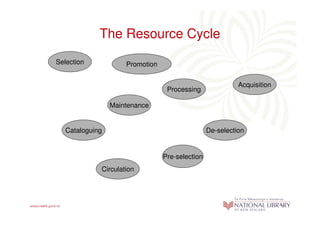
The Resource Cycle
Selection            Promotion


                                                           Acquisition
                                  Processing

                 Maintenance


   Cataloguing                                   De-selection


                                 Pre-selection
             Circulation
Looking at the future of the book


• http://www.ted.com/talks/mike_matas.html
Lunch
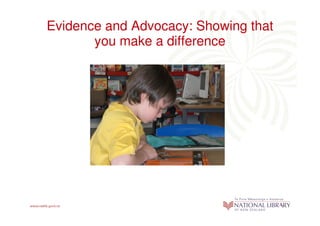
Evidence and Advocacy: Showing that
       you make a difference
In this session....

We will talk about the following:

• The concepts of Evidence , Evidence-based
practice and Advocacy

• Making the connections from the evidence, to the
  library, and student learning

• Interacting and collaborating with the key people in
  your school community

• Tools that will assist you
What is a school library?

• The school library is the school’s
  physical and virtual learning commons
  where inquiry, thinking, imagination,
  discovery and creativity are central to
  students’ information-to-knowledge
  journey and to their personal, social and
  cultural growth
The school library contributes to learner
        outcomes that are …


linked to the visions, principles and
competencies as identified in the school
curriculum
Vision

•Confident, connected, actively involved,
lifelong learners

•Effective users of communication tools

•Literate and numerate

•Active seekers, users and creators of
knowledge
Principles


•Empowering all students to learn regardless
of their personal circumstances

•Students learning how to learn

•Links across learning areas

•Future focussed
Competencies

•Competent thinking and problem solving
actively seeking, using and creating
knowledge

•Making sense of information

•Competent users of language, symbols and
text in a range of contexts

•Confident users of ICT to access and
provide information and to communicate with
others
Evidence-based practice


Using evidence of what you've done to show
        that you make a difference
      and to inform what you do next.
We use Evidence to demonstrate the library's
               impact on student learning


Evidence is provided by collecting information, data, and stories
                   from a variety of sources.

      Collecting evidence is an ongoing cyclical process

     Evidence Based Practice involves three dimensions:

                     •Evidence for practice

                     •Evidence in practice

                     •Evidence of practice
Why collect evidence ?

•   To identify areas in which the library can develop services to support student
    learning.
•   To show the difference the library makes to student learning such as:

     –   Creating motivated and engaged readers

     –   Developing positive attitudes towards reading

     –   Practising and developing skills in inquiry learning

     –   Digital citizenship

•   To change perceptions about the role of library staff
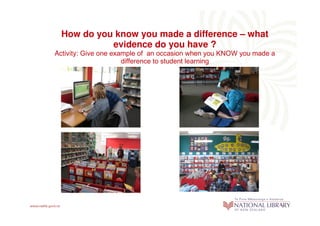
How do you know you made a difference – what
            evidence do you have ?
Activity: Give one example of an occasion when you KNOW you made a
                      difference to student learning
Here’s the challenge…
To collect evidence of how the library supports student learning….
                               found”
Libraries usually measure “the found” i.e. the number of classes in library,
    number of items borrowed, number of books purchased etc. These are
    a measure of pathways to learning not of learning itself. (Information
    outputs)
   It is about knowing and showing how a school library helps students
   learn, and the learning outcomes that are enabled, i.e. “the
   understood”
   understood”.
    We boost achievement. Loertscher and Todd (2003) p.9
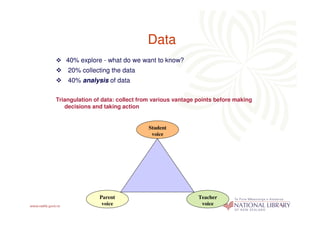
Data
   40% explore - what do we want to know?
    20% collecting the data
    40% analysis of data

Triangulation of data: collect from various vantage points before making
   decisions and taking action


                                  Student
                                   voice


                Parent                              Teacher
                 voice                               voice
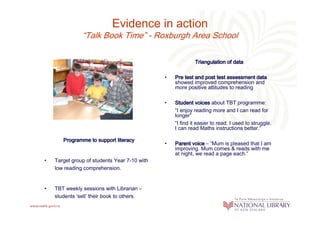
Evidence in action
               “Talk Book Time” - Roxburgh Area School


                                                           Triangulation of data

                                              •   Pre test and post test assessment data
                                                  showed improved comprehension and
                                                  more positive attitudes to reading

                                              •   Student voices about TBT programme:
                                                  “I enjoy reading more and I can read for
                                                  longer”
                                                  “I find it easier to read. I used to struggle.
                                                  I can read Maths instructions better.”

       Programme to support literacy
                                              •   Parent voice – “Mum is pleased that I am
                                                  improving. Mum comes & reads with me
                                                  at night, we read a page each.”
•   Target group of students Year 7-10 with
    low reading comprehension.


•   TBT weekly sessions with Librarian –
    students ‘sell’ their book to others.
What evidence?


•Formal / informal

•Quantitative / Qualitative

•Do not underestimate the power and
value of your users stories


•
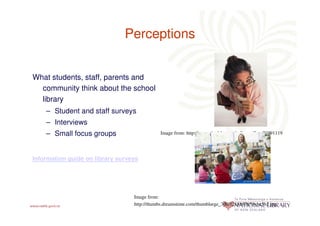
Perceptions


What students, staff, parents and
  community think about the school
  library
    – Student and staff surveys
    – Interviews
    – Small focus groups                     Image from: http://www.thedebutanteball.com/?m=20091119


Information guide on library surveys


                                  Image from:
                                  http://thumbs.dreamstime.com/thumblarge_300/1218867653ybc5b2.jpg
Tools for collecting
                               school-based evidence
•   Surveys of students and teachers – Information guide on library surveys


•   Student-generated products – bibliographies, presentations etc

•   Student assessment data

•   Recorded observations of groups of students

•   Collaboration log - recording formal and informal collaborations with staff and students

•   Group discussion with staff

•   Records of student involvement in the library such as librarians and tech angels

•   Record of school community involvement with the library

•   School library data – system reports such as individual borrower histories
Linking evidence to advocacy

• You are doing a great job … making a real difference to
  learner outcomes … and you have the evidence to
  demonstrate your value ...


• SO how do you make sure that you and your library are
  valued and supported at your school
Advocacy


  Advocacy can be one person or many “speaking out and
                    winning influence."


School libraries making a difference – Advocacy campaign
   http://www.schoollibrariesadvocacy.org.uk/what.asp
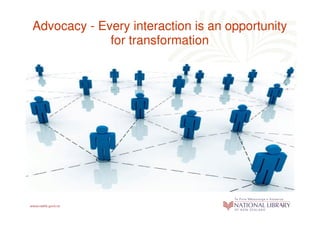
Advocacy - Every interaction is an opportunity
             for transformation
Activity

Identifying people who are key to your school library


• Who will support your work and vision ?
• Who does not support your work and vision ?
• Who is neutral ?
• Who are your potential champions ?
Then:
• How are you going to change their views ?
   Negative   Positive / Neutral   Positive
Your Library’s ‘elevator speech’


Tell your own library story to someone in the
group.

Scenario to set the scene - the principal brings
a new family to the library what do you tell
them about your library ?


                                Image from: http://photography.mojado.com/archives/2004/06/11/elevator.php
Advocacy tools

AASL provide great, practical ideas that will help you in your
  advocacy journey
                http://advocacytipoftheday.wordpress.com/
Examples
•   Take photos of students reading and send the picture home for the
    fridge with a THANKS
•   Take a 30 second contribution to every faculty meeting – something to
    make someone’s job easier.
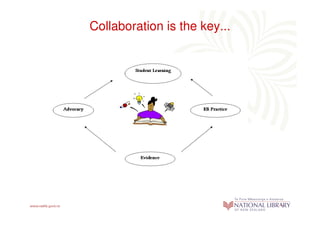
Collaboration is the key...
Linking theory to practice

• We will now look at your “library-based initiatives to
  make a positive difference to student learning in your
  school”
• Who were your collaborating partners
• What evidence do you have of the success of your
  initiative
• How can you use this evidence to advocate for your
  library?
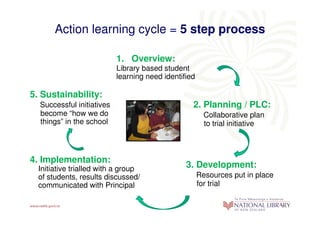
Action learning cycle = 5 step process

                           1. Overview:
                           Library based student
                           learning need identified

5. Sustainability:
  Successful initiatives                          2. Planning / PLC:
  become “how we do                                     Collaborative plan
  things” in the school                                 to trial initiative


4. Implementation:
  Initiative trialled with a group              3. Development:
  of students, results discussed/                     Resources put in place
  communicated with Principal                         for trial
Activity

• Using the ‘Effectiveness Progression
  Process: Action Learning Cycle Planner’
  Plan a model initiative.
• Focus on identifying learner outcomes,
  sources of evidence, identifying potential
  collaborating partners, and how you use the
  results of this initiative to raise the profile of
  your library and role in your school
  community
Time to wrap up…

Reminder about the information on the
Services to Schools website and Online
              community
     Complete evaluation forms

SLSL Day 2

  • 1.
  • 2.
    The school libraryis a leader for literacy and reading In this session we will focus on: • your role in helping to build a school-wide reading culture • practical strategies to meet the needs of your school’s stakeholders • accessing online and print resources for extra information / support • using evidence to inform your practice • creating a strategic approach for you to action back at school
  • 3.
    The greatest giftis a passion for reading. It is cheap, it consoles, it distracts, it excites, it gives you knowledge of the world and experience of a wide kind. ~Elizabeth Hardwick~
  • 4.
    “ … if weshow students how to embrace reading as a lifelong pursuit and not just a collection of skills for school performance, we will be doing what I believe “ we have been charged to do: create readers Donalyn Miller The Book Whisperer
  • 5.
    Student Literacy Achievement "Wedon't achieve literacy and then give children literature; we achieve literacy through literature." Author and children’s literature expert Charlotte Huck
  • 6.
  • 7.
    Key message 1: YOU are the enabling adult Teachers Library team & Community visitors Whānau
  • 8.
    The enabling adult… What is it that enabling adults do ?
  • 9.
    Readers create readerswhen they provide access to resources • Print rich environment • Great library collection • Comfortable places to read • User-friendly library policies . • Students can choose their own reading • Time to read – classroom, library, whole school, home…
  • 10.
    Readers create readerswhen they know about children’s / YA books
  • 11.
    Readers create readerswhen they know their students’ interests • ELP : Knowledge of the learner • School data • Reader surveys
  • 12.
    Readers create readerswhen they actively promote books • Book talks • Book clubs • Literature circles • Speedbooking • Special roles for students • Student input into book buying, creating lists, writing reviews… • Participating in reading-related event - festivals, competitions….
  • 13.
    Readers create readerswhen they make time for book discussion “We don’t know what we think about a book until we’ve talked about it.” (8 year old Sarah, quoted in Chambers, Tell me) Discussion: Why I chose this book Why I kept reading to the end Who I would recommend it to…
  • 14.
    Readers Create Readers Usesocial media to promote reading
  • 15.
    Key message 2: Free voluntary reading
  • 16.
    Literacy skills andReading for pleasure “When students read for pleasure, when they get “hooked on books”, they acquire, involuntarily and without conscious effort, nearly all of the “language skills” many people are concerned about…” Stephen Krashen - The Power of Reading :insights from the research
  • 17.
    Connections between reading and academic achievement Growing independence: Competent Learners @ 14 “It is not enough just to learn to read – one of the strongest indicators of positive engagement in school and learning was the enjoyment of reading” (p.25) Cathy Wylie et al
  • 18.
    “Reading for pleasurecan easily sound like some kind of wishy-washy, soft option, while instructional stuff like learning to read through “synthetic phonics”… sounds tough and purposeful. In actual fact… research shows children Michael Rosen Writer and who read for pleasure achieve better former Children’s school performance than those who Laureate don’t.”
  • 19.
    Key message 3: Every student a reader…
  • 20.
    Every student areader… "If we believe in the value and power of books, stories, poems and plays, we also have to remember that it will never be enough simply to publish good stuff. We have to be committed, ingenious, flexible and experimental in coming up with ways of making all that literature come alive for every single child - no exceptions allowed.” Michael Rosen
  • 21.
    Readers create readerswhen they are reading role models “Children learn about literature from what the adults around them do about it.” Zahnleiter, 1985
  • 22.
    Being a powerfulreading role model… • Modelling what a good reader does…
  • 23.
    Readers create readerswhen they read aloud • Who reads aloud in your school? • Where / when does it happen? • How often ? • What is read ? • Before / during / after strategies ? • What are the challenges ? Jenny Ratana-Koia, teacher of a Year 4-6 class from Koraunui • Any favourites ? School, Stokes Valley, is a 2011 Reading Superhero winner!
  • 24.
    Celebrating the book… Kids’Lit Quiz, NZ Post Book Awards, Storylines, Montana Poetry Day, NZ Bookweek, create a book blog, bookfairs, competitions…
  • 25.
    What does thismean for our school ? • Students • Teachers • Principal / BOT • Parents / school community • What I am going to follow up back at school?
  • 26.
    Time for abreak… Browse the displays and have some reading time, talking time, and refreshment…
  • 27.
    Your school librarycollection Participants will: • Understand how the collection supports learning and literacy in their school • Understand the steps involved in the life cycle of library resources • Be able to find supporting tools using the ODC • Become aware of trends in collection development
  • 28.
    Why do wehave a collection? Scenario: The principal and BOT of a new school are questioning the need for a library or a collection. You are the pro-library DP. • What will your arguments be? • What might their arguments be?
  • 29.
  • 30.
    Collection development is •Planned • Ongoing • Cyclic
  • 31.
    School Library Collection: guiding statement Collections 3 : Guiding Statement • Purpose • Background information - School community profile form • Content • Guiding statement – example • Challenged resources
  • 32.
    Knowing your collection •Assessment (Collections 8: Assessment Guide) • Weeding (Collections 5: Weeding Guide) • Gap analysis
  • 33.
    And what yourcommunity is interested in Survey staff and students – Survey Monkey
  • 34.
    Getting ready toselect • Collection requirements plan • Budget
  • 35.
  • 36.
    Example of LibraryCatalogue • Pigeon Mountain Library Catalogue I hope with websites and high interest topics catalogued – watch this space.
  • 37.
    Does your collectioninclude Māori resources? • Dictionaries Dictionaries • Atlases and Place Names • Proverbs, Idioms & Sayings • Māori Concepts • Encyclopaedias • The Treaty of Waitangi • Myths and legends • Mäori language picture books
  • 38.
    The Resource Cycle Selection Promotion Acquisition Processing Maintenance Cataloguing De-selection Pre-selection Circulation
  • 39.
    Looking at thefuture of the book • http://www.ted.com/talks/mike_matas.html
  • 40.
  • 41.
    Evidence and Advocacy:Showing that you make a difference
  • 42.
    In this session.... Wewill talk about the following: • The concepts of Evidence , Evidence-based practice and Advocacy • Making the connections from the evidence, to the library, and student learning • Interacting and collaborating with the key people in your school community • Tools that will assist you
  • 43.
    What is aschool library? • The school library is the school’s physical and virtual learning commons where inquiry, thinking, imagination, discovery and creativity are central to students’ information-to-knowledge journey and to their personal, social and cultural growth
  • 44.
    The school librarycontributes to learner outcomes that are … linked to the visions, principles and competencies as identified in the school curriculum
  • 45.
    Vision •Confident, connected, activelyinvolved, lifelong learners •Effective users of communication tools •Literate and numerate •Active seekers, users and creators of knowledge
  • 46.
    Principles •Empowering all studentsto learn regardless of their personal circumstances •Students learning how to learn •Links across learning areas •Future focussed
  • 47.
    Competencies •Competent thinking andproblem solving actively seeking, using and creating knowledge •Making sense of information •Competent users of language, symbols and text in a range of contexts •Confident users of ICT to access and provide information and to communicate with others
  • 48.
    Evidence-based practice Using evidenceof what you've done to show that you make a difference and to inform what you do next.
  • 49.
    We use Evidenceto demonstrate the library's impact on student learning Evidence is provided by collecting information, data, and stories from a variety of sources. Collecting evidence is an ongoing cyclical process Evidence Based Practice involves three dimensions: •Evidence for practice •Evidence in practice •Evidence of practice
  • 50.
    Why collect evidence? • To identify areas in which the library can develop services to support student learning. • To show the difference the library makes to student learning such as: – Creating motivated and engaged readers – Developing positive attitudes towards reading – Practising and developing skills in inquiry learning – Digital citizenship • To change perceptions about the role of library staff
  • 51.
    How do youknow you made a difference – what evidence do you have ? Activity: Give one example of an occasion when you KNOW you made a difference to student learning
  • 52.
    Here’s the challenge… Tocollect evidence of how the library supports student learning…. found” Libraries usually measure “the found” i.e. the number of classes in library, number of items borrowed, number of books purchased etc. These are a measure of pathways to learning not of learning itself. (Information outputs) It is about knowing and showing how a school library helps students learn, and the learning outcomes that are enabled, i.e. “the understood” understood”. We boost achievement. Loertscher and Todd (2003) p.9
  • 53.
    Data 40% explore - what do we want to know? 20% collecting the data 40% analysis of data Triangulation of data: collect from various vantage points before making decisions and taking action Student voice Parent Teacher voice voice
  • 54.
    Evidence in action “Talk Book Time” - Roxburgh Area School Triangulation of data • Pre test and post test assessment data showed improved comprehension and more positive attitudes to reading • Student voices about TBT programme: “I enjoy reading more and I can read for longer” “I find it easier to read. I used to struggle. I can read Maths instructions better.” Programme to support literacy • Parent voice – “Mum is pleased that I am improving. Mum comes & reads with me at night, we read a page each.” • Target group of students Year 7-10 with low reading comprehension. • TBT weekly sessions with Librarian – students ‘sell’ their book to others.
  • 55.
    What evidence? •Formal /informal •Quantitative / Qualitative •Do not underestimate the power and value of your users stories •
  • 56.
    Perceptions What students, staff,parents and community think about the school library – Student and staff surveys – Interviews – Small focus groups Image from: http://www.thedebutanteball.com/?m=20091119 Information guide on library surveys Image from: http://thumbs.dreamstime.com/thumblarge_300/1218867653ybc5b2.jpg
  • 57.
    Tools for collecting school-based evidence • Surveys of students and teachers – Information guide on library surveys • Student-generated products – bibliographies, presentations etc • Student assessment data • Recorded observations of groups of students • Collaboration log - recording formal and informal collaborations with staff and students • Group discussion with staff • Records of student involvement in the library such as librarians and tech angels • Record of school community involvement with the library • School library data – system reports such as individual borrower histories
  • 58.
    Linking evidence toadvocacy • You are doing a great job … making a real difference to learner outcomes … and you have the evidence to demonstrate your value ... • SO how do you make sure that you and your library are valued and supported at your school
  • 59.
    Advocacy Advocacycan be one person or many “speaking out and winning influence." School libraries making a difference – Advocacy campaign http://www.schoollibrariesadvocacy.org.uk/what.asp
  • 60.
    Advocacy - Everyinteraction is an opportunity for transformation
  • 61.
    Activity Identifying people whoare key to your school library • Who will support your work and vision ? • Who does not support your work and vision ? • Who is neutral ? • Who are your potential champions ? Then: • How are you going to change their views ? Negative Positive / Neutral Positive
  • 62.
    Your Library’s ‘elevatorspeech’ Tell your own library story to someone in the group. Scenario to set the scene - the principal brings a new family to the library what do you tell them about your library ? Image from: http://photography.mojado.com/archives/2004/06/11/elevator.php
  • 63.
    Advocacy tools AASL providegreat, practical ideas that will help you in your advocacy journey http://advocacytipoftheday.wordpress.com/ Examples • Take photos of students reading and send the picture home for the fridge with a THANKS • Take a 30 second contribution to every faculty meeting – something to make someone’s job easier.
  • 64.
  • 65.
    Linking theory topractice • We will now look at your “library-based initiatives to make a positive difference to student learning in your school” • Who were your collaborating partners • What evidence do you have of the success of your initiative • How can you use this evidence to advocate for your library?
  • 66.
    Action learning cycle= 5 step process 1. Overview: Library based student learning need identified 5. Sustainability: Successful initiatives 2. Planning / PLC: become “how we do Collaborative plan things” in the school to trial initiative 4. Implementation: Initiative trialled with a group 3. Development: of students, results discussed/ Resources put in place communicated with Principal for trial
  • 67.
    Activity • Using the‘Effectiveness Progression Process: Action Learning Cycle Planner’ Plan a model initiative. • Focus on identifying learner outcomes, sources of evidence, identifying potential collaborating partners, and how you use the results of this initiative to raise the profile of your library and role in your school community
  • 68.
    Time to wrapup… Reminder about the information on the Services to Schools website and Online community Complete evaluation forms