PISA 2009 at a Glance
This work is published on the responsibility of the Secretary-General of the OECD. The
opinions expressed and arguments employed herein do not necessarily reflect the official
views of the Organisation or of the governments of its member countries.


  Please cite this publication as:
  OECD (2010), PISA 2009 at a Glance, OECD Publishing.
  http://dx.doi.org/10.1787/9789264095298-en


ISBN 978-92-64-09522-9 (print)
ISBN 978-92-64-09525-0 (PDF)
ISBN 978-92-64-09529-8 (HTML)


The statistical data for Israel are supplied by and under the responsibility of the relevant Israeli authorities. The use
of such data by the OECD is without prejudice to the status of the Golan Heights, East Jerusalem and Israeli
settlements in the West Bank under the terms of international law.


Photo credits: Cover © Monique Pouzet/Fotolia
Chapter 1 © Lisa F. Young/Shutterstock.com.
Chapter 2 © Eléonore H/Fotolia.com.
Chapter 3 © Colibri/Fotolia.com.
Chapter 4 © Kinetic Imagery/Shutterstock.com.


Corrigenda to OECD publications may be found on line at: www.oecd.org/publishing/corrigenda.
PISATM , OECD/PISATM and the PISA logo are trademaks of the Organisation for Economic Co-operation and
Development (OECD). All use of OECD trademarks is prohibited without written permission from the OECD.
© OECD 2010

You can copy, download or print OECD content for your own use, and you can include excerpts from OECD publications, databases and
multimedia products in your own documents, presentations, blogs, websites and teaching materials, provided that suitable
acknowledgment of OECD as source and copyright owner is given. All requests for public or commercial use and translation rights should
be submitted to rights@oecd.org. Requests for permission to photocopy portions of this material for public or commercial use shall be
addressed directly to the Copyright Clearance Center (CCC) at info@copyright.com or the Centre français d’exploitation du droit de copie (CFC)
at contact@cfcopies.com.
FOREWORD


                                                    Foreword
          P  ISA 2009 at a Glance offers a reader-friendly introduction to five of the six volumes of PISA 2009
          Results.
               PISA, the OECD’s Programme for International Student Assessment, evaluates the quality,
          equity and efficiency of school systems in some 70 countries that, together, make up nine-tenths of
          the world economy. PISA represents a commitment by governments to regularly monitor the
          outcomes of education systems within an internationally agreed framework. It also provides a basis
          for international collaboration in defining and implementing educational goals in innovative ways
          that reflect judgements about the skills that are relevant to adult life.
               Around 470 000 students participated in PISA 2009, representing about 26 million 15-year-
          olds in the schools of the 65 participating countries and economies. Some 50 000 students took part
          in a second round of this assessment, representing about 2 million 15-year-olds from 10 additional
          partner countries and economies.
                The main focus of PISA 2009 was reading. The survey also updated performance assessments
          in mathematics and science. PISA considers students’ knowledge in these areas not in isolation, but
          in relation to their ability to reflect on their knowledge and experience and apply them to real-world
          issues. The emphasis is on mastering processes, understanding concepts and functioning in various
          contexts within each assessment area.
              For the first time, the PISA 2009 survey also assessed 15-year-old students’ ability to read,
          understand and apply digital texts.
                The structure of PISA at a Glance 2009 mirrors that of the PISA 2009 Results volumes. The
          first section, “What Students Know and Can Do”, presents an overview of 15-year-olds’ performance
          in reading, mathematics and science in the 2009 assessment. The second part, “Overcoming Social
          Background”, discusses how socio-economic background is related to learning opportunities and
          outcomes. “Learning to Learn”, the third part of PISA at a Glance, surveys students’ attitudes
          towards, and their levels of engagement in, reading and learning. The last section, “What Makes a
          School Successful?”, examines how education policies and allocation of resources are associated with
          student reading performance. Findings from the fifth volume of PISA 2009 Results, Learning
          Trends, are incorporated throughout.
               Figures and charts are all accompanied by a dynamic hyperlink, or StatLink, that directs readers
          to an Internet site where the corresponding data are available in Excel™ format. Reference is often
          made to charts and tables that appear in PISA 2009 Results volumes. This material can generally
          be accessed via the StatLinks accompanying the charts or at www.pisa.oecd.org, where readers can
          find out more about PISA.


PISA 2009 AT A GLANCE © OECD 2010                                                                                   3
TABLE OF CONTENTS


                                                           Table of Contents
       Reader’s Guide . . . . . . . . . . . . . . . . . . . . . . . . . . . . . . . . . . . . . . . . . . . . . . . . . . . . . . . . . . . . . .         7

       1. What Students Know and Can Do . . . . . . . . . . . . . . . . . . . . . . . . . . . . . . . . . . . . . . . . . .                               11
           What can students do in reading? . . . . . . . . . . . . . . . . . . . . . . . . . . . . . . . . . . . . . . . . . . .                         12
           How do countries/economies perform in reading overall? . . . . . . . . . . . . . . . . . . . . . . .                                           14
           How do girls compare to boys in reading skills?. . . . . . . . . . . . . . . . . . . . . . . . . . . . . . . .                                 16
           What can students do in mathematics? . . . . . . . . . . . . . . . . . . . . . . . . . . . . . . . . . . . . . .                               18
           How do countries/economies perform in mathematics overall? . . . . . . . . . . . . . . . . . .                                                 20
           How do girls compare to boys in mathematics skills?. . . . . . . . . . . . . . . . . . . . . . . . . . .                                       22
           What can students do in science? . . . . . . . . . . . . . . . . . . . . . . . . . . . . . . . . . . . . . . . . . . .                         24
           How do countries/economies perform in science overall? . . . . . . . . . . . . . . . . . . . . . . .                                           26
           How do girls compare to boys in science? . . . . . . . . . . . . . . . . . . . . . . . . . . . . . . . . . . . . .                             28
           How many students are top performers? . . . . . . . . . . . . . . . . . . . . . . . . . . . . . . . . . . . . .                                30

           Trends . . . . . . . . . . . . . . . . . . . . . . . . . . . . . . . . . . . . . . . . . . . . . . . . . . . . . . . . . . . . . . . . . . .   32
           Performance in reading since 2000 . . . . . . . . . . . . . . . . . . . . . . . . . . . . . . . . . . . . . . . . . . .                        32
           Changes in reading scores since 2000 . . . . . . . . . . . . . . . . . . . . . . . . . . . . . . . . . . . . . . . .                           34
           Reading scores among low-performing students . . . . . . . . . . . . . . . . . . . . . . . . . . . . . . .                                     36
           Reading scores among high-performing students . . . . . . . . . . . . . . . . . . . . . . . . . . . . . .                                      38
           Girls’ and boys’ reading performance since 2000 . . . . . . . . . . . . . . . . . . . . . . . . . . . . . . .                                  40
           Performance in mathematics since 2003 . . . . . . . . . . . . . . . . . . . . . . . . . . . . . . . . . . . . . .                              42
           Performance in science since 2006 . . . . . . . . . . . . . . . . . . . . . . . . . . . . . . . . . . . . . . . . . . .                        44

       2. Overcoming Social Background . . . . . . . . . . . . . . . . . . . . . . . . . . . . . . . . . . . . . . . . . . . . .                          47
           Does socio-economic background affect reading performance? . . . . . . . . . . . . . . . . . .                                                 48
           Can disadvantaged students defy the odds against them?. . . . . . . . . . . . . . . . . . . . . . .                                            50
           How do students from single-parent families perform in reading? . . . . . . . . . . . . . . .                                                  52
           How do students with an immigrant background perform in reading? . . . . . . . . . . . .                                                       54
           Does where a student lives affect his or her reading performance? . . . . . . . . . . . . . . .                                                56
           How equitably are school resources distributed? . . . . . . . . . . . . . . . . . . . . . . . . . . . . . . .                                  58

           Trends . . . . . . . . . . . . . . . . . . . . . . . . . . . . . . . . . . . . . . . . . . . . . . . . . . . . . . . . . . . . . . . . . . .   60
           Socio-economic background and reading performance . . . . . . . . . . . . . . . . . . . . . . . . .                                            60
           Relative performance of students from immigrant backgrounds . . . . . . . . . . . . . . . . .                                                  62

       3. Learning to Learn . . . . . . . . . . . . . . . . . . . . . . . . . . . . . . . . . . . . . . . . . . . . . . . . . . . . . . . . .             65
           Are students who enjoy reading better readers? . . . . . . . . . . . . . . . . . . . . . . . . . . . . . . .                                   66
           What kinds of reading are associated with being a good reader? . . . . . . . . . . . . . . . . .                                               68
           Do boys and girls have different reading habits? . . . . . . . . . . . . . . . . . . . . . . . . . . . . . . .                                 70
           What learning strategies help students perform better? . . . . . . . . . . . . . . . . . . . . . . . .                                         72
           Trends . . . . . . . . . . . . . . . . . . . . . . . . . . . . . . . . . . . . . . . . . . . . . . . . . . . . . . . . . . . . . . . . . . .   74
           Reading for enjoyment . . . . . . . . . . . . . . . . . . . . . . . . . . . . . . . . . . . . . . . . . . . . . . . . . . . . .                74
           Reading for enjoyment, by gender and background. . . . . . . . . . . . . . . . . . . . . . . . . . . . .                                       76


4                                                                                                                                PISA 2009 AT A GLANCE © OECD 2010
TABLE OF CONTENTS


          4. What Makes a School Successful?. . . . . . . . . . . . . . . . . . . . . . . . . . . . . . . . . . . . . . . . . . .                           79
             Does selecting and grouping students affect reading performance? . . . . . . . . . . . . . .                                                   80
             How do education systems and schools select and group students? . . . . . . . . . . . . . .                                                    82
             Does school governance affect students’ reading performance? . . . . . . . . . . . . . . . . . .                                               84
             How are schools governed in different countries? . . . . . . . . . . . . . . . . . . . . . . . . . . . . . .                                   86
             How do countries/economies allocate educational resources? . . . . . . . . . . . . . . . . . . .                                               88
             Do students perform better in more disciplined schools? . . . . . . . . . . . . . . . . . . . . . . .                                          90
             How favourable is the learning climate in schools? . . . . . . . . . . . . . . . . . . . . . . . . . . . . .                                   92

             Trends . . . . . . . . . . . . . . . . . . . . . . . . . . . . . . . . . . . . . . . . . . . . . . . . . . . . . . . . . . . . . . . . . . .   94
             Teacher-student relations . . . . . . . . . . . . . . . . . . . . . . . . . . . . . . . . . . . . . . . . . . . . . . . . . .                  94
             Disciplinary climate during lessons . . . . . . . . . . . . . . . . . . . . . . . . . . . . . . . . . . . . . . . . . .                        96


                       This book has...

                                        StatLinks2
                                        A service that delivers Excel® files
                                        from the printed page!
                       Look for the StatLinks at the bottom right-hand corner of the tables or graphs in this book.
                       To download the matching Excel® spreadsheet, just type the link into your Internet browser,
                       starting with the http://dx.doi.org prefix.
                       If you’re reading the PDF e-book edition, and your PC is connected to the Internet, simply
                       click on the link. You’ll find StatLinks appearing in more OECD books.


PISA 2009 AT A GLANCE © OECD 2010                                                                                                                                5
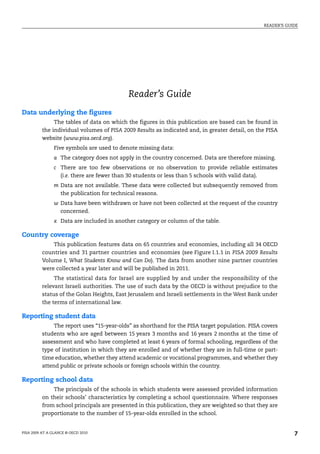
PISA countries and economies
                                              Partners countries and economies              Partners countries
                OECD countries
                                                        in PISA 2009                    in previous PISA surveys

                   Australia                              Albania                         Dominican Republic
                    Austria                              Argentina                            Macedonia
                   Belgium                               Azerbaijan                            Moldova
                    Canada                                 Brazil
                     Chile                                Bulgaria
                Czech Republic                           Colombia
                   Denmark                              Costa Rica*
                    Estonia                                Croatia
                    Finland                               Georgia*
                    France                        Himachal Pradesh-India*
                   Germany                            Hong Kong, China
                    Greece                               Indonesia
                   Hungary                                 Jordan
                    Iceland                             Kazakhstan
                    Ireland                              Kyrgyzstan
                    Israel                                 Latvia
                     Italy                              Liechtenstein
                    Japan                                 Lithuania
                    Korea                              Macao, China
                 Luxembourg                              Malaysia*
                    Mexico                                 Malta*
                  Netherlands                            Mauritius
                 New Zealand                        Miranda-Venezuela*
                   Norway                               Montenegro
                    Poland                          Netherlands-Antilles*
                   Portugal                               Panama
                Slovak Republic                             Peru
                   Slovenia                                Qatar
                    Spain                                 Romania
                   Sweden                            Russian Federation
                  Switzerland                              Serbia
                    Turkey                            Shanghai, China
                United Kingdom                           Singapore
                 United States                       Tamil Nadu-India*
                                                       Chinese Taipei
                                                          Thailand
                                                    Trinidad and Tobago
                                                           Tunisia
                                                          Uruguay
                                                   United Arab Emirates*
                                                          Vietnam*

    * These partner countries and economies carried out the assessment in 2010 instead of 2009.


6                                                                                                 PISA 2009 AT A GLANCE © OECD 2010
READER’S GUIDE


                                            Reader’s Guide
Data underlying the figures
               The tables of data on which the figures in this publication are based can be found in
          the individual volumes of PISA 2009 Results as indicated and, in greater detail, on the PISA
          website (www.pisa.oecd.org).
                Five symbols are used to denote missing data:
                a The category does not apply in the country concerned. Data are therefore missing.
                c There are too few observations or no observation to provide reliable estimates
                  (i.e. there are fewer than 30 students or less than 5 schools with valid data).
                m Data are not available. These data were collected but subsequently removed from
                  the publication for technical reasons.
                w Data have been withdrawn or have not been collected at the request of the country
                  concerned.
                x Data are included in another category or column of the table.

Country coverage
              This publication features data on 65 countries and economies, including all 34 OECD
          countries and 31 partner countries and economies (see Figure I.1.1 in PISA 2009 Results
          Volume I, What Students Know and Can Do). The data from another nine partner countries
          were collected a year later and will be published in 2011.
               The statistical data for Israel are supplied by and under the responsibility of the
          relevant Israeli authorities. The use of such data by the OECD is without prejudice to the
          status of the Golan Heights, East Jerusalem and Israeli settlements in the West Bank under
          the terms of international law.

Reporting student data
               The report uses “15-year-olds” as shorthand for the PISA target population. PISA covers
          students who are aged between 15 years 3 months and 16 years 2 months at the time of
          assessment and who have completed at least 6 years of formal schooling, regardless of the
          type of institution in which they are enrolled and of whether they are in full-time or part-
          time education, whether they attend academic or vocational programmes, and whether they
          attend public or private schools or foreign schools within the country.

Reporting school data
              The principals of the schools in which students were assessed provided information
          on their schools’ characteristics by completing a school questionnaire. Where responses
          from school principals are presented in this publication, they are weighted so that they are
          proportionate to the number of 15-year-olds enrolled in the school.


PISA 2009 AT A GLANCE © OECD 2010                                                                           7
READER’S GUIDE


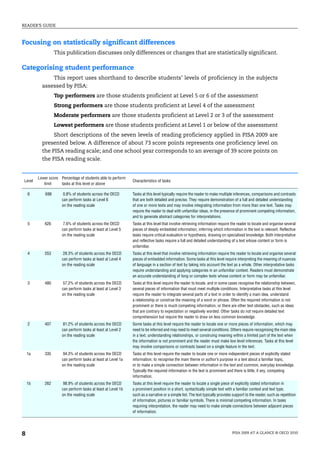
Focusing on statistically significant differences
                   This publication discusses only differences or changes that are statistically significant.

Categorising student performance
               This report uses shorthand to describe students’ levels of proficiency in the subjects
           assessed by PISA:
                   Top performers are those students proficient at Level 5 or 6 of the assessment
                   Strong performers are those students proficient at Level 4 of the assessment
                   Moderate performers are those students proficient at Level 2 or 3 of the assessment
                   Lowest performers are those students proficient at Level 1 or below of the assessment
                Short descriptions of the seven levels of reading proficiency applied in PISA 2009 are
           presented below. A difference of about 73 score points represents one proficiency level on
           the PISA reading scale; and one school year corresponds to an average of 39 score points on
           the PISA reading scale.


         Lower score Percentage of students able to perform
 Level                                                         Characteristics of tasks
            limit    tasks at this level or above

    6        698       0.8% of students across the OECD        Tasks at this level typically require the reader to make multiple inferences, comparisons and contrasts
                      can perform tasks at Level 6             that are both detailed and precise. They require demonstration of a full and detailed understanding
                      on the reading scale                     of one or more texts and may involve integrating information from more than one text. Tasks may
                                                               require the reader to deal with unfamiliar ideas, in the presence of prominent competing information,
                                                               and to generate abstract categories for interpretations.
    5       626        7.6% of students across the OECD        Tasks at this level that involve retrieving information require the reader to locate and organise several
                      can perform tasks at least at Level 5    pieces of deeply embedded information, inferring which information in the text is relevant. Reflective
                      on the reading scale                     tasks require critical evaluation or hypothesis, drawing on specialised knowledge. Both interpretative
                                                               and reflective tasks require a full and detailed understanding of a text whose content or form is
                                                               unfamiliar.
    4       553        28.3% of students across the OECD       Tasks at this level that involve retrieving information require the reader to locate and organise several
                      can perform tasks at least at Level 4    pieces of embedded information. Some tasks at this level require interpreting the meaning of nuances
                      on the reading scale                     of language in a section of text by taking into account the text as a whole. Other interpretative tasks
                                                               require understanding and applying categories in an unfamiliar context. Readers must demonstrate
                                                               an accurate understanding of long or complex texts whose content or form may be unfamiliar.
    3       480        57.2% of students across the OECD       Tasks at this level require the reader to locate, and in some cases recognise the relationship between,
                      can perform tasks at least at Level 3    several pieces of information that must meet multiple conditions. Interpretative tasks at this level
                      on the reading scale                     require the reader to integrate several parts of a text in order to identify a main idea, understand
                                                               a relationship or construe the meaning of a word or phrase. Often the required information is not
                                                               prominent or there is much competing information, or there are other text obstacles, such as ideas
                                                               that are contrary to expectation or negatively worded. Other tasks do not require detailed text
                                                               comprehension but require the reader to draw on less common knowledge.
    2       407        81.2% of students across the OECD       Some tasks at this level require the reader to locate one or more pieces of information, which may
                      can perform tasks at least at Level 2    need to be inferred and may need to meet several conditions. Others require recognising the main idea
                      on the reading scale                     in a text, understanding relationships, or construing meaning within a limited part of the text when
                                                               the information is not prominent and the reader must make low level inferences. Tasks at this level
                                                               may involve comparisons or contrasts based on a single feature in the text.
    1a      335        94.3% of students across the OECD       Tasks at this level require the reader to locate one or more independent pieces of explicitly stated
                      can perform tasks at least at Level 1a   information, to recognise the main theme or author’s purpose in a text about a familiar topic,
                      on the reading scale                     or to make a simple connection between information in the text and common, everyday knowledge.
                                                               Typically the required information in the text is prominent and there is little, if any, competing
                                                               information.
    1b      262        98.9% of students across the OECD       Tasks at this level require the reader to locate a single piece of explicitly stated information in
                      can perform tasks at least at Level 1b   a prominent position in a short, syntactically simple text with a familiar context and text type,
                      on the reading scale                     such as a narrative or a simple list. The text typically provides support to the reader, such as repetition
                                                               of information, pictures or familiar symbols. There is minimal competing information. In tasks
                                                               requiring interpretation, the reader may need to make simple connections between adjacent pieces
                                                               of information.


8                                                                                                                               PISA 2009 AT A GLANCE © OECD 2010
READER’S GUIDE


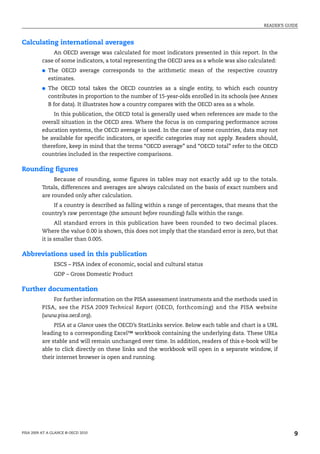
Calculating international averages
              An OECD average was calculated for most indicators presented in this report. In the
          case of some indicators, a total representing the OECD area as a whole was also calculated:
          ●   The OECD average corresponds to the arithmetic mean of the respective country
              estimates.
          ●   The OECD total takes the OECD countries as a single entity, to which each country
              contributes in proportion to the number of 15-year-olds enrolled in its schools (see Annex
              B for data). It illustrates how a country compares with the OECD area as a whole.
              In this publication, the OECD total is generally used when references are made to the
          overall situation in the OECD area. Where the focus is on comparing performance across
          education systems, the OECD average is used. In the case of some countries, data may not
          be available for specific indicators, or specific categories may not apply. Readers should,
          therefore, keep in mind that the terms “OECD average” and “OECD total” refer to the OECD
          countries included in the respective comparisons.

Rounding figures
               Because of rounding, some figures in tables may not exactly add up to the totals.
          Totals, differences and averages are always calculated on the basis of exact numbers and
          are rounded only after calculation.
              If a country is described as falling within a range of percentages, that means that the
          country’s raw percentage (the amount before rounding) falls within the range.
                All standard errors in this publication have been rounded to two decimal places.
          Where the value 0.00 is shown, this does not imply that the standard error is zero, but that
          it is smaller than 0.005.

Abbreviations used in this publication
                ESCS – PISA index of economic, social and cultural status
                GDP – Gross Domestic Product

Further documentation
              For further information on the PISA assessment instruments and the methods used in
          PISA, see the PISA 2009 Technical Report (OECD, forthcoming) and the PISA website
          (www.pisa.oecd.org).
               PISA at a Glance uses the OECD’s StatLinks service. Below each table and chart is a URL
          leading to a corresponding Excel™ workbook containing the underlying data. These URLs
          are stable and will remain unchanged over time. In addition, readers of this e-book will be
          able to click directly on these links and the workbook will open in a separate window, if
          their internet browser is open and running.


PISA 2009 AT A GLANCE © OECD 2010                                                                             9
1. WHAT STUDENTS KNOW AND CAN DO

                                    What can students do in reading?
                                    How do countries/economies perform in reading overall?
                                    How do girls compare to boys in reading skills?
                                    What can students do in mathematics?
                                    How do countries/economies perform in mathematics overall?
                                    How do girls compare to boys in mathematics skills?
                                    What can students do in science?
                                    How do countries/economies perform in science overall?
                                    How do girls compare to boys in science?
                                    How many students are top performers?

                                    Trends
                                    Performance in reading since 2000
                                    Changes in reading scores since 2000
                                    Reading scores among low-performing students
                                    Reading scores among high-performing students
                                    Girls’ and boys’ reading performance since 2000
                                    Performance in mathematics since 2003
                                    Performance in science since 2006


PISA 2009 AT A GLANCE © OECD 2010                                                            11
1. WHAT STUDENTS KNOW AND CAN DO
What can students do in reading?
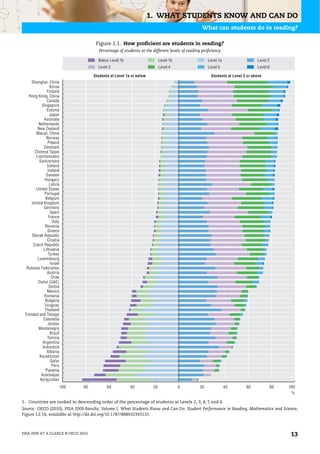
– On average across OECD countries, 19% of 15-year-olds          form a pool of talent that will help countries to compete
  do not attain reading proficiency Level 2, and 8% attain       in the global knowledge economy. In New Zealand, the
  proficiency Level 5 or above.                                  partner economy Shanghai, China and the partner
– Only 1% of students, on average across OECD countries,         country Singapore, 16% to 19% of students are top per-
  and nowhere more than 3%, can perform the most com-            formers, at least twice the OECD average. But for some
  plex reading tasks at proficiency Level 6.                     countries, developing even a small corps of high-
                                                                 performing students remains an aspiration: in
– In 10 partner countries, only a minority of students reaches
                                                                 16 countries, less than 1% of students reach Level 5.
  Level 2. However, the great majority of 15-year-olds in
  these countries shows at least some reading proficiency.       Among top performing students, only a few can com-
                                                                 plete the most difficult tasks and attain Level 6, the
                                                                 new top proficiency level introduced in PISA 2009. On
What it means                                                    average, 1% of students in OECD countries reach this
                                                                 level; while in Australia; New Zealand; Shanghai,
Students who do not attain the PISA baseline profi-              China and Singapore, 2% to 3% of students do. How-
ciency Level 2 in reading lack the essential skills              ever, in 3 OECD countries and 18 partner countries
needed to participate effectively and productively in            and economies, less than one-tenth of one per cent of
society. A key priority for all countries is to ensure that      students reach Level 6.
as many students as possible attain at least Level 2. At
the other end of the performance range, countries
can gain competitive advantage in the knowledge                  Definitions
economy by educating their students to handle com-
plex reading tasks at Levels 5 and 6.                            In the PISA survey, reading tasks are ranked by diffi-
                                                                 culty and are associated with each of the seven profi-
                                                                 ciency levels from 1b (easiest) to 6 (hardest). A student
Findings                                                         reaches a given proficiency level if the test results
                                                                 show that he or she has at least a 50% chance of per-
On average in OECD countries, just over four in five             forming a task at that level. Students are classified at
students (81%) are proficient in reading to at least             the highest level at which they are proficient.
Level 2. In the OECD countries Finland and Korea,
                                                                 Information on data for Israel: http://dx.doi.org/10.1787/
and the partner economies Hong Kong, China and
                                                                 888932315602
Shanghai, China, over 90% of students reach Level 2 or
above, but in 10 partner countries only a minority of
students does so. Students who fail to reach Level
2 struggle to perform many everyday reading tasks,
and evidence from earlier PISA surveys shows                       Going further
that these students are unlikely to become lifelong
learners or do well in the labour market.                          Descriptions of what students can do at each
                                                                   proficiency level, and examples of tasks, are pre-
However, even most students who do not attain Level
                                                                   sented in Chapter 2 of PISA 2009 ResultsVolume
2 can read at some level. In PISA 2009, the measure-
                                                                   I,What Students Know and Can Do: Student Perfor-
ment of proficiency was extended to incorporate
                                                                   mance in Reading, Mathematics and Science. Full
some very straightforward reading tasks, categorised
                                                                   data are shown in Table I.2.1 at the back of that
as Level 1b. On average in OECD countries, 99% of stu-
                                                                   volume.
dents are proficient at Level 1b or above, as are at least
90% of students in all 65 countries and economies that
participated in PISA 2009, except Albania, Argentina,
Kyrgyzstan, Panama, Peru and Qatar.
At the other end of the performance scale, an average            Further reading from the OECD
of 8% of students in OECD countries can complete com-
plex reading tasks at Level 5 or 6. These top performers         PISA 2009 Assessment Framework (2009).


12                                                                                            PISA 2009 AT A GLANCE © OECD 2010
1. WHAT STUDENTS KNOW AND CAN DO
                                                                                                  What can students do in reading?

                                       Figure 1.1. How proficient are students in reading?
                                        Percentage of students at the different levels of reading proficiency

                                        Below Level 1b                      Level 1b                  Level 1a                  Level 2
                                        Level 3                             Level 4                   Level 5                   Level 6

                                      Students at Level 1a or below                                    Students at Level 2 or above
     Shanghai, China
                  Korea
                Finland
   Hong Kong, China
                Canada
            Singapore
                Estonia
                  Japan
              Australia
          Netherlands
         New Zealand
        Macao, China
               Norway
                Poland
             Denmark
       Chinese Taipei
        Liechtenstein
          Switzerland
                Iceland
                Ireland
               Sweden
              Hungary
                 Latvia
        United States
              Portugal
               Belgium
     United Kingdom
             Germany
                  Spain
                 France
                   Italy
              Slovenia
                Greece
      Slovak Republic
                Croatia
      Czech Republic
             Lithuania
                 Turkey
         Luxembourg
                  Israel
  Russian Federation
                Austria
                   Chile
         Dubai (UAE)
                 Serbia
                Mexico
              Romania
              Bulgaria
              Uruguay
              Thailand
 Trinidad and Tobago
             Colombia
                Jordan
         Montenegro
                  Brazil
                Tunisia
             Argentina
            Indonesia
                Albania
          Kazakhstan
                  Qatar
                   Peru
               Panama
            Azerbaijan
           Kyrgyzstan
                           100   80          60           40           20              0         20              40       60              80   100
                                                                                                                                                %

1. Countries are ranked in descending order of the percentage of students at Levels 2, 3, 4, 5 and 6.
Source: OECD (2010), PISA 2009 Results, Volume I, What Students Know and Can Do: Student Performance in Reading, Mathematics and Science,
Figure I.2.14, available at http://dx.doi.org/10.1787/888932343133.


PISA 2009 AT A GLANCE © OECD 2010                                                                                                               13
1. WHAT STUDENTS KNOW AND CAN DO
How do countries/economies perform in reading overall?
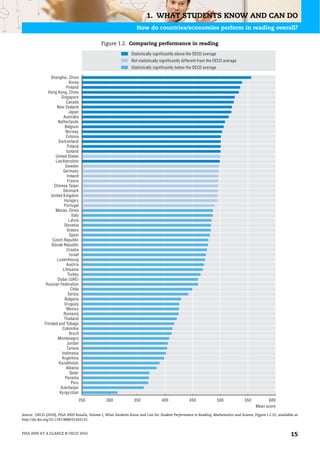
– The partner economy Shanghai, China shows the highest         information in relatively complex written material. In
  average reading performance in PISA 2009, followed            the lowest-performing OECD country, Mexico, students
  by the OECD countries Korea and Finland, the partner          are, on average, proficient to the bottom of Level 2, and
  economy Hong Kong, China and the partner country              in 11 partner countries, average proficiency is at Level
  Singapore.                                                    1a or 1b. At these lowest levels, students are only capa-
– In most OECD countries, average reading performance is        ble of locating and interpreting explicit information in
  at proficiency Level 3. In the partner countries and econo-   simple written texts.
  mies, the average ranges widely, from Level 1a to Level 4.
                                                                Definitions
What it means
                                                                In the original PISA survey in 2000, the mean reading
The mean PISA reading score for each country/economy            score was set at 500 points for participating OECD
summarises the performance of students overall. These           countries. In 2009, with a slightly wider range of OECD
scores show that reading standards vary greatly among           countries, the average score was 493 points. The
countries and economies in ways that cannot simply be           original PISA scale was set such that approximately
attributed to the countries’ different stages of economic       two-thirds of students across OECD countries score
development. A nation’s wealth influences educational           between 400 and 600 points. A gap of 72 points in
success; but GDP per capita now explains only 6% of the         reading scores is equivalent to one proficiency level in
differences between countries’ average student perfor-          reading.
mance. The other 94% of diffe-rences reflect the fact that      The country averages shown here are estimates based
two countries of similar prosperity can produce very dif-       on the PISA sample. In many cases, differences
ferent educational results.                                     between countries/economies are too close to be sta-
                                                                tistically significant. In such cases, it cannot be said
                                                                which of a pair of countries/economies has students
Findings                                                        with higher average performance.
The OECD countries Finland and Korea and the                    Information on data for Israel: http://dx.doi.org/10.1787/
partner economies Hong Kong, China and Shanghai,                888932315602
China show mean reading scores well above any other
participants in PISA 2009. Of these, Shanghai, China’s
score is much higher than that of the other three,
whose mean reading scores are not significantly                   Going further
different from each other.
Australia, Canada, Japan, New Zealand and the part-               A full set of comparisons across countries and
ner country Singapore also score well above the OECD              economies, showing in which cases differences
average, by at least 22 score points, or nearly one-third         between mean performances are statistically sig-
of a proficiency level.                                           nificant, are presented in Chapter 2 of PISA 2009
                                                                  Results Volume I,What Students Know and Can Do:
Another seven OECD countries – Belgium, Estonia,
                                                                  Student Performance in Reading, Mathematics and
Iceland, the Netherlands, Norway, Poland and
                                                                  Science.
Switzerland – and the partner country Liechtenstein
also perform significantly above the OECD average.
Overall, the range in country scores is wide, represent-
ing large differences in how well students in different
countries can read. On average, students in Shanghai,           Further reading from the OECD
China are proficient to near the bottom of Level 4. At
this level, students can identify, interpret and reflect on     PISA 2009 Assessment Framework (2009).


14                                                                                           PISA 2009 AT A GLANCE © OECD 2010
1. WHAT STUDENTS KNOW AND CAN DO
                                                                    How do countries/economies perform in reading overall?

                                               Figure 1.2. Comparing performance in reading

                                                                 Statistically significantly above the OECD average
                                                                 Not statistically significantly different from the OECD average
                                                                 Statistically significantly below the OECD average

                 Shanghai, China
                              Korea
                            Finland
               Hong Kong, China
                        Singapore
                            Canada
                     New Zealand
                              Japan
                          Australia
                      Netherlands
                           Belgium
                           Norway
                            Estonia
                      Switzerland
                            Poland
                            Iceland
                    United States
                    Liechtenstein
                           Sweden
                         Germany
                            Ireland
                             France
                   Chinese Taipei
                          Denmark
                 United Kingdom
                          Hungary
                          Portugal
                    Macao, China
                               Italy
                             Latvia
                          Slovenia
                            Greece
                              Spain
                  Czech Republic
                  Slovak Republic
                            Croatia
                              Israel
                     Luxembourg
                            Austria
                         Lithuania
                             Turkey
                     Dubai (UAE)
              Russian Federation
                               Chile
                             Serbia
                          Bulgaria
                          Uruguay
                            Mexico
                          Romania
                          Thailand
             Trinidad and Tobago
                         Colombia
                              Brazil
                     Montenegro
                            Jordan
                            Tunisia
                        Indonesia
                         Argentina
                      Kazakhstan
                            Albania
                              Qatar
                           Panama
                               Peru
                        Azerbaijan
                       Kyrgyzstan
                                       250        300              350             400              450               500            550         600
                                                                                                                                           Mean score
Source: OECD (2010), PISA 2009 Results, Volume I, What Students Know and Can Do: Student Performance in Reading, Mathematics and Science, Figure I.2.15, available at
http://dx.doi.org/10.1787/888932343133.


PISA 2009 AT A GLANCE © OECD 2010                                                                                                                               15
1. WHAT STUDENTS KNOW AND CAN DO
How do girls compare to boys in reading skills?
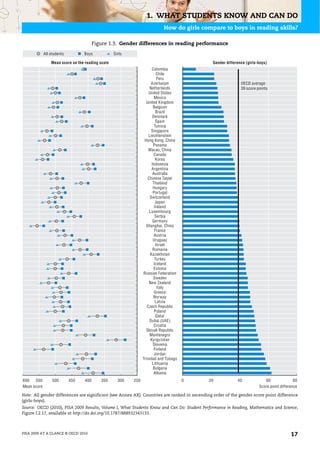
– In every one of the 65 countries and economies that          the baseline Level 2, on average, while girls perform
  participated in PISA 2009, girls have significantly higher   below that level, on average, in only 5 countries.
  average reading scores than boys.                            But the extent of underperformance among boys is a
– The gender gap in reading varies from more than 50 score     crucial issue nearly everywhere. On average in OECD
  points in 14 countries and economies to less than            countries, only one in eight girls, but one in four boys,
  25 points in 7 countries.                                    fails to reach Level 2. In some countries, the great
– In some high-performing countries, the gender gap is         majority of underperformers are boys. In Finland, only
  large; but in some East Asian countries and economies,       3% of girls but 13% of boys do not attain Level 2, while
  boys score well above the OECD average.                      in the partner country Latvia, 9% of girls and 27% of
                                                               boys do not attain that level.

What it means
                                                               Definitions
Lower reading proficiency among boys has become a
major concern in many education systems. Closing               The gender gap measures the difference between the
the gender gap will help to improve reading perfor-            mean performance of boys and girls in reading. On the
mance overall.                                                 PISA reading scale, the mean score for OECD countries
                                                               was originally set at 500 points, and around two-
                                                               thirds of students in OECD countries score between
Findings                                                       400 and 600 points. One proficiency level is equivalent
                                                               to 72 score points.
Girls outperform boys in reading in every PISA coun-
                                                               Information on data for Israel: http://dx.doi.org/10.1787/
try. In OECD countries, the average gender gap is
                                                               888932315602
39 score points, or over half a proficiency level.
The widest gender gaps, seen in Albania, Bulgaria and
Lithuania, are well over twice the size of the smallest
gaps, seen in the OECD country Chile and the partner
countries Colombia and Peru.                                     Going further
Wide gender gaps are seen in Nordic countries,
                                                                 A full set of comparisons across countries, show-
including the highest-scoring OECD country, Finland,
                                                                 ing details of gender differences in reading skills, is
and in some other high-performing countries, such
                                                                 presented in Chapter 2 of PISA 2009 Results Volume
as New Zealand. In Finland, boys score one-fifth of a
                                                                 I,What Students Know and Can Do: Student Perfor-
proficiency level above the OECD average whereas
                                                                 mance in Reading, Mathematics and Science. Full data
girls score close to one proficiency level higher. In
                                                                 are shown in Tables I.2.3 (mean scores) and I.2.2
Korea and the partner economies Hong Kong, China
                                                                 (proficiency levels) at the back of that volume.
and Shanghai, China, all high-scoring countries with
gender gaps close to the average, boys perform better
than they do in other countries, scoring well above the
OECD average for both genders by 24 to 43 points.
Gender differences are most stark when comparing               Further reading from the OECD
the proportion of boys and girls who perform at the
lowest reading proficiency levels. In 18 countries that        Equally Prepared for Life? How 15-year-old Boys and Girls
score below the OECD average, boys perform below                 Perform in School (2009).


16                                                                                          PISA 2009 AT A GLANCE © OECD 2010
1. WHAT STUDENTS KNOW AND CAN DO
                                                                            How do girls compare to boys in reading skills?

                                         Figure 1.3. Gender differences in reading performance

             All students         Boys             Girls

                 Mean score on the reading scale                                              Gender difference (girls-boys)
                                                                       Colombia
                                                                           Chile
                                                                           Peru
                                                                       Azerbaijan                            OECD average
                                                                      Netherlands                            39 score points
                                                                     United States
                                                                         Mexico
                                                                   United Kingdom
                                                                        Belgium
                                                                          Brazil
                                                                        Denmark
                                                                          Spain
                                                                         Tunisia
                                                                       Singapore
                                                                     Liechtenstein
                                                                  Hong Kong, China
                                                                        Panama
                                                                     Macao, China
                                                                         Canada
                                                                          Korea
                                                                       Indonesia
                                                                       Argentina
                                                                        Australia
                                                                    Chinese Taipei
                                                                        Thailand
                                                                        Hungary
                                                                        Portugal
                                                                      Switzerland
                                                                          Japan
                                                                         Ireland
                                                                     Luxembourg
                                                                          Serbia
                                                                        Germany
                                                                   Shanghai, China
                                                                         France
                                                                         Austria
                                                                        Uruguay
                                                                          Israel
                                                                        Romania
                                                                      Kazakhstan
                                                                         Turkey
                                                                         Iceland
                                                                         Estonia
                                                                 Russian Federation
                                                                        Sweden
                                                                     New Zealand
                                                                           Italy
                                                                         Greece
                                                                        Norway
                                                                          Latvia
                                                                    Czech Republic
                                                                         Poland
                                                                          Qatar
                                                                     Dubai (UAE)
                                                                         Croatia
                                                                   Slovak Republic
                                                                     Montenegro
                                                                      Kyrgyzstan
                                                                        Slovenia
                                                                         Finland
                                                                         Jordan
                                                                 Trinidad and Tobago
                                                                       Lithuania
                                                                        Bulgaria
                                                                         Albania
600   550         500       450    400      350      300   250                         0    20             40             60               80
Mean score                                                                                                             Score point difference

Note: All gender differences are significant (see Annex AX). Countries are ranked in ascending order of the gender score point difference
(girls-boys).
Source: OECD (2010), PISA 2009 Results, Volume I, What Students Know and Can Do: Student Performance in Reading, Mathematics and Science,
Figure I.2.17, available at http://dx.doi.org/10.1787/888932343133.


PISA 2009 AT A GLANCE © OECD 2010                                                                                                        17
1. WHAT STUDENTS KNOW AND CAN DO
What can students do in mathematics?
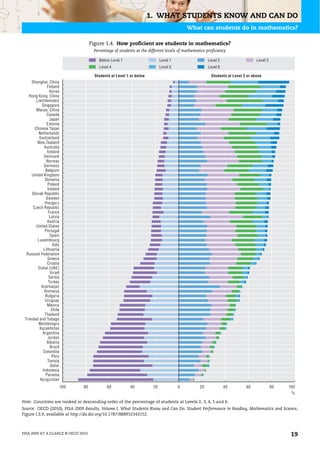
– On average across OECD countries, 22% of 15-year-olds         Chinese Taipei (29%), Hong Kong, China (31%) and
  perform below the baseline proficiency Level 2 in mathe-      Singapore (36%), and as many as half of the students
  matics while 13% are top performers in mathematics,           in Shanghai, China are top performers in mathema-
  attaining Level 5 or 6.                                       tics. But in 12 countries, less than 1% of students
– In six countries and economies, more than 90% of              reach Level 5 or 6.
  students reach at least Level 2, but in 17 countries only a   Among these high performers, fewer than a quarter,
  minority do so.                                               on average (3% in OECD countries), attain Level 6, the
– In Korea and the partner countries and economies              highest proficiency level. However, in Shanghai,
  Chinese Taipei; Hong Kong, China; Shanghai, China and         China, more than one-quarter of students (27%) do so
  Singapore, between 25% and 51% of students are top            and in the partner country Singapore, one student in
  performers in mathematics, attaining Level 5 or 6.            six (16%) does. The OECD countries with the largest
                                                                percentage of students attaining Level 6 are Korea and
                                                                Switzerland, where 8% of students in these countries
What it means                                                   reach this level.

Students whose proficiency in mathematics is limited
to Level 1a or below can, at best, perform simple               Definitions
mathematical tasks in very familiar contexts. They
will find it difficult to think mathematically, limiting        In the PISA survey, mathematics tasks are ranked by
their ability to make sense of a complex world. A               difficulty and are associated with each of the six pro-
priority for all countries is to ensure that as many            ficiency levels from 1 (easiest) to 6 (hardest). A student
students as possible attain at least the baseline profi-        reaches a given proficiency level if the test results
ciency Level 2. At the other end of the performance             show that he or she has at least a 50% chance of per-
range, having a corps of students capable of the com-           forming a task at that level. Students are classified at
plex mathematical thinking required at Levels 5 and             the highest level at which they are proficient.
6 will help countries to establish a competitive advan-         Information on data for Israel: http://dx.doi.org/10.1787/
tage in the global marketplace.                                 888932315602


Findings

On average across OECD countries, nearly four in five
                                                                  Going further
students (78%) are proficient in mathematics to at
least the baseline Level 2. At that level, students can           Descriptions of what students can do at each
use basic mathematical algorithms, formulae, proce-               proficiency level and examples of tasks are pre-
dures, or conventions, and can reason mathemati-                  sented in Chapter 3 of PISA 2009 Results Volume
cally. In the OECD countries Finland and Korea, and in            I,What Students Know and Can Do: Student Perfor-
the partner countries and economies Hong Kong,                    mance in Reading, Mathematics and Science. Full
China; Liechtenstein; Shanghai, China and Singapore,              data are shown in Table I.3.1 at the back of that
over 90% of students reach Level 2 or above. But only a           volume.
minority of students reaches Level 2 in Chile, Mexico
and 15 partner countries.
At the other end of the scale, one in eight students
(13%), on average in OECD countries, is proficient at
Level 5 or6. These top performers are capable of                Further reading from the OECD
complex mathematical tasks requiring broad, well-
developed thinking and reasoning skills. In Korea, the          Mathematics performance was assessed in depth in 2003, and
highest-performing OECD country in mathematics,                   will be again in 2012. See: The PISA 2003 Assessment
one in four students (26%) reaches this level. More stu-          Framework (2003) and Learning for Tomorrow’s World,
dents do so in the partner country and economies,                 First Results From PISA 2003 (2004).


18                                                                                           PISA 2009 AT A GLANCE © OECD 2010
1. WHAT STUDENTS KNOW AND CAN DO
                                                                                           What can students do in mathematics?

                                      Figure 1.4. How proficient are students in mathematics?
                                       Percentage of students at the different levels of mathematics proficiency

                                          Below Level 1                      Level 1                  Level 2                   Level 3
                                          Level 4                            Level 5                  Level 6

                                        Students at Level 1 or below                                   Students at Level 2 or above
     Shanghai, China
                Finland
                  Korea
   Hong Kong, China
        Liechtenstein
            Singapore
        Macao, China
                Canada
                  Japan
                Estonia
       Chinese Taipei
          Netherlands
          Switzerland
         New Zealand
              Australia
                Iceland
             Denmark
               Norway
             Germany
               Belgium
     United Kingdom
              Slovenia
                Poland
                Ireland
      Slovak Republic
               Sweden
              Hungary
      Czech Republic
                 France
                 Latvia
                Austria
        United States
              Portugal
                  Spain
         Luxembourg
                   Italy
             Lithuania
  Russian Federation
                Greece
                Croatia
         Dubai (UAE)
                  Israel
                 Serbia
                 Turkey
            Azerbaijan
              Romania
              Bulgaria
              Uruguay
                Mexico
                   Chile
              Thailand
 Trinidad and Tobago
         Montenegro
          Kazakhstan
             Argentina
                Jordan
                Albania
                  Brazil
             Colombia
                   Peru
                Tunisia
                  Qatar
            Indonesia
               Panama
           Kyrgyzstan
                           100   80           60           40           20             0         20             40        60              80   100
                                                                                                                                                %

Note: Countries are ranked in descending order of the percentage of students at Levels 2, 3, 4, 5 and 6.
Source: OECD (2010), PISA 2009 Results, Volume I, What Students Know and Can Do: Student Performance in Reading, Mathematics and Science,
Figure I.3.9, available at http://dx.doi.org/10.1787/888932343152.


PISA 2009 AT A GLANCE © OECD 2010                                                                                                               19
1. WHAT STUDENTS KNOW AND CAN DO
How do countries/economies perform in mathematics overall?
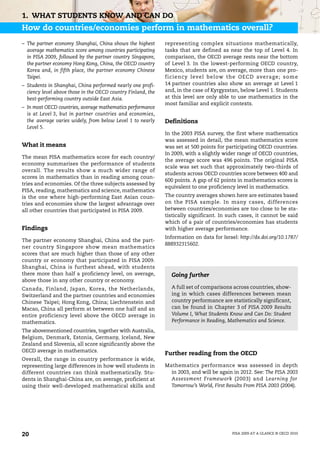
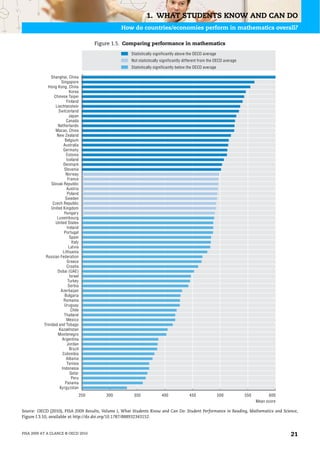
– The partner economy Shanghai, China shows the highest       representing complex situations mathematically,
  average mathematics score among countries participating     tasks that are defined as near the top of Level 4. In
  in PISA 2009, followed by the partner country Singapore,    comparison, the OECD average rests near the bottom
  the partner economy Hong Kong, China, the OECD country      of Level 3. In the lowest-performing OECD country,
  Korea and, in fifth place, the partner economy Chinese      Mexico, students are, on average, more than one pro-
  Taipei.                                                     ficiency level below the OEC D averag e; som e
– Students in Shanghai, China performed nearly one profi-     14 partner countries also show an average at Level 1
  ciency level above those in the OECD country Finland, the   and, in the case of Kyrgyzstan, below Level 1. Students
  best-performing country outside East Asia.                  at this level are only able to use mathematics in the
                                                              most familiar and explicit contexts.
– In most OECD countries, average mathematics performance
  is at Level 3, but in partner countries and economies,
  the average varies widely, from below Level 1 to nearly     Definitions
  Level 5.
                                                              In the 2003 PISA survey, the first where mathematics
                                                              was assessed in detail, the mean mathematics score
What it means                                                 was set at 500 points for participating OECD countries.
                                                              In 2009, with a slightly wider range of OECD countries,
The mean PISA mathematics score for each country/
                                                              the average score was 496 points. The original PISA
economy summarises the performance of students
                                                              scale was set such that approximately two-thirds of
overall. The results show a much wider range of
                                                              students across OECD countries score between 400 and
scores in mathematics than in reading among coun-
                                                              600 points. A gap of 62 points in mathematics scores is
tries and economies. Of the three subjects assessed by
                                                              equivalent to one proficiency level in mathematics.
PISA, reading, mathematics and science, mathematics
is the one where high-performing East Asian coun-             The country averages shown here are estimates based
tries and economies show the largest advantage over           on the PISA sample. In many cases, differences
all other countries that participated in PISA 2009.           between countries/economies are too close to be sta-
                                                              tistically significant. In such cases, it cannot be said
                                                              which of a pair of countries/economies has students
Findings                                                      with higher average performance.
                                                              Information on data for Israel: http://dx.doi.org/10.1787/
The partner economy Shanghai, China and the part-
                                                              888932315602.
ner country Singapore show mean mathematics
scores that are much higher than those of any other
country or economy that participated in PISA 2009.
Shanghai, China is furthest ahead, with students
there more than half a proficiency level, on average,           Going further
above those in any other country or economy.
Canada, Finland, Japan, Korea, the Netherlands,                 A full set of comparisons across countries, show-
Switzerland and the partner countries and economies             ing in which cases differences between mean
Chinese Taipei; Hong Kong, China; Liechtenstein and             country performance are statistically significant,
Macao, China all perform at between one half and an             can be found in Chapter 3 of PISA 2009 Results
entire proficiency level above the OECD average in              Volume I, What Students Know and Can Do: Student
mathematics.                                                    Performance in Reading, Mathematics and Science.

The abovementioned countries, together with Australia,
Belgium, Denmark, Estonia, Germany, Iceland, New
Zealand and Slovenia, all score significantly above the
OECD average in mathematics.
                                                              Further reading from the OECD
Overall, the range in country performance is wide,
representing large differences in how well students in        Mathematics performance was assessed in depth
different countries can think mathematically. Stu-              in 2003, and will be again in 2012. See: The PISA 2003
dents in Shanghai-China are, on average, proficient at          Assessment Framework (2003) and Learning for
using their well-developed mathematical skills and              Tomorrow’s World, First Results From PISA 2003 (2004).


20                                                                                         PISA 2009 AT A GLANCE © OECD 2010
1. WHAT STUDENTS KNOW AND CAN DO
                                                      How do countries/economies perform in mathematics overall?

                                            Figure 1.5. Comparing performance in mathematics

                                                         Statistically significantly above the OECD average
                                                         Not statistically significantly different from the OECD average
                                                         Statistically significantly below the OECD average

               Shanghai, China
                      Singapore
             Hong Kong, China
                             Korea
                 Chinese Taipei
                          Finland
                  Liechtenstein
                    Switzerland
                            Japan
                          Canada
                    Netherlands
                  Macao, China
                   New Zealand
                         Belgium
                        Australia
                        Germany
                          Estonia
                          Iceland
                        Denmark
                         Slovenia
                          Norway
                           France
                Slovak Republic
                           Austria
                           Poland
                          Sweden
                Czech Republic
               United Kingdom
                         Hungary
                   Luxembourg
                  United States
                           Ireland
                         Portugal
                             Spain
                              Italy
                            Latvia
                        Lithuania
            Russian Federation
                           Greece
                           Croatia
                   Dubai (UAE)
                             Israel
                           Turkey
                            Serbia
                      Azerbaijan
                         Bulgaria
                        Romania
                         Uruguay
                              Chile
                         Thailand
                          Mexico
           Trinidad and Tobago
                    Kazakhstan
                   Montenegro
                       Argentina
                           Jordan
                             Brazil
                       Colombia
                          Albania
                           Tunisia
                       Indonesia
                             Qatar
                              Peru
                         Panama
                     Kyrgyzstan
                                      250       300       350              400             450                500          550         600
                                                                                                                                 Mean score

Source: OECD (2010), PISA 2009 Results, Volume I, What Students Know and Can Do: Student Performance in Reading, Mathematics and Science,
Figure I.3.10, available at http://dx.doi.org/10.1787/888932343152.


PISA 2009 AT A GLANCE © OECD 2010                                                                                                             21
1. WHAT STUDENTS KNOW AND CAN DO
How do girls compare to boys in mathematics skills?
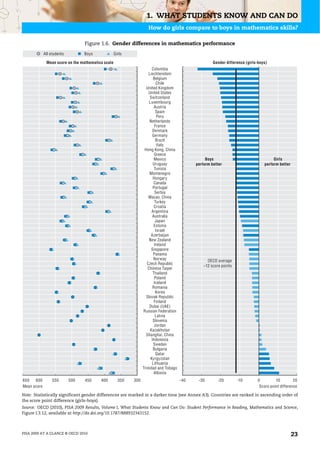
– Boys outperform girls in mathematics in 35 of the             the partner country and economies Chinese Taipei;
  65 countries and economies that participated in               Shanghai, China and Singapore, at least 10% of girls
  PISA 2009. In five countries, girls outperform boys, and in   attain proficiency Level 6 in mathematics; in no OECD
  25 countries there is no significant difference between the   country, except Switzerland, do even 10% of boys
  genders.                                                      reach this level. While this shows girls’ potential to
– On average in OECD countries, boys outperform girls in        perform at the very highest levels in mathematics, in
  mathematics by 12 score points – a gender gap that is         OECD countries, on average, 4% of boys, but only 2% of
  only one-third as large as that for reading, in which girls   girls, reach Level 6.
  outperform boys.                                              At the other end of the performance spectrum, in
– In Belgium, Chile, Switzerland, the United Kingdom,           OECD countries, an average of 21% of boys and 23% of
  the United States, and the partner countries Colombia         girls do not reach the baseline proficiency Level 2 in
  and Liechtenstein, boys outperform girls by more              mathematics.
  than 20 score points, close to one-third of a proficiency
  level.
                                                                Definitions

                                                                The gender gap measures the difference between the
What it means
                                                                mean performance of boys and girls in mathematics.
Mathematics is an important life skill, and the stereo-         On the PISA mathematics scale, the mean score for
typed notion that girls are “not good at numbers” has           OECD countries was originally set at 500 points, and
often limited girls’ opportunities. But PISA results            around two-thirds of students in OECD countries
show that, in some countries, girls perform as well as          score between 400 and 600 points. One proficiency
boys in mathematics. That can be a signal to policy             level is equivalent to 62 score points.
makers that skills in mathematics are not related to            Information on data for Israel: http://dx.doi.org/10.1787/
gender and that more can be done to raise girls’ level          888932315602.
of performance in mathematics.


Findings
                                                                  Going further
Boys outperform girls in mathematics by an average
of 12 points across OECD countries. This is a small gap           A full set of comparisons across countries, show-
compared to the 39 points, on average, in favour of               ing details of gender differences in mathematics
girls in reading performance.                                     performance, is presented in PISA 2009 Results
In 35 out of the 65 countries and economies that par-             Volume I,What Students Know and Can Do: Student
ticipated in PISA 2009, boys score significantly higher           Performance in Reading, Mathematics and Science. Full
in mathematics than girls. However, in 25 countries,              data are shown in Tables I.3.3 (mean scores) and
there is no statistically significant difference, and in          I.3.2 (proficiency levels) at the back of that volume.
5 countries, girls have slightly higher scores.
In Belgium, Chile, Switzerland, the United Kingdom, the
United States and the partner countries Colombia and
Liechtenstein, boys have a substantial score advantage,
                                                                Further reading from the OECD
of between 20 and 33 points, in mathematics perfor-
mance. However, even among these countries, only in             Mathematics performance, including gender differ-
Colombia is the male advantage in mathematics greater             ences in various mathematical skills, was assessed
than the female advantage in reading.                             in depth in 2003, and will be again in 2012. See:
In four out of the six best-performing countries and              The PISA 2003 Assessment Framework (2003) and
economies overall, there is little or no gender differ-           Learning for Tomorrow’s World, First Results from
ence in mathematics performance. Among these, in                  PISA 2003 (2004).


22                                                                                           PISA 2009 AT A GLANCE © OECD 2010
1. WHAT STUDENTS KNOW AND CAN DO
                                                                     How do girls compare to boys in mathematics skills?

                                  Figure 1.6. Gender differences in mathematics performance

             All students         Boys              Girls

              Mean score on the mathematics scale                                                      Gender difference (girls-boys)
                                                                        Colombia
                                                                      Liechtenstein
                                                                         Belgium
                                                                            Chile
                                                                    United Kingdom
                                                                      United States
                                                                       Switzerland
                                                                      Luxembourg
                                                                          Austria
                                                                           Spain
                                                                            Peru
                                                                       Netherlands
                                                                          France
                                                                         Denmark
                                                                         Germany
                                                                           Brazil
                                                                            Italy
                                                                   Hong Kong, China
                                                                          Greece
                                                                          Mexico                   Boys                                 Girls
                                                                         Uruguay              perform better                       perform better
                                                                          Tunisia
                                                                      Montenegro
                                                                         Hungary
                                                                          Canada
                                                                         Portugal
                                                                           Serbia
                                                                      Macao, China
                                                                          Turkey
                                                                          Croatia
                                                                        Argentina
                                                                         Australia
                                                                           Japan
                                                                          Estonia
                                                                           Israel
                                                                        Azerbaijan
                                                                      New Zealand
                                                                          Ireland
                                                                        Singapore
                                                                         Panama
                                                                         Norway                     OECD average
                                                                     Czech Republic
                                                                                                  –12 score points
                                                                     Chinese Taipei
                                                                         Thailand
                                                                          Poland
                                                                          Iceland
                                                                         Romania
                                                                           Korea
                                                                    Slovak Republic
                                                                          Finland
                                                                      Dubai (UAE)
                                                                  Russian Federation
                                                                           Latvia
                                                                         Slovenia
                                                                          Jordan
                                                                       Kazakhstan
                                                                    Shanghai, China
                                                                        Indonesia
                                                                         Sweden
                                                                         Bulgaria
                                                                           Qatar
                                                                       Kyrgyzstan
                                                                        Lithuania
                                                                  Trinidad and Tobago
                                                                          Albania
650   600         550       500   450     400         350   300                         -40    -30        -20        -10        0         10         20
Mean score                                                                                                                       Score point difference

Note: Statistically significant gender differences are marked in a darker tone (see Annex A3). Countries are ranked in ascending order of
the score point difference (girls-boys).
Source: OECD (2010), PISA 2009 Results, Volume I, What Students Know and Can Do: Student Performance in Reading, Mathematics and Science,
Figure I.3.12, available at http://dx.doi.org/10.1787/888932343152.


PISA 2009 AT A GLANCE © OECD 2010                                                                                                                   23
1. WHAT STUDENTS KNOW AND CAN DO
What can students do in science?
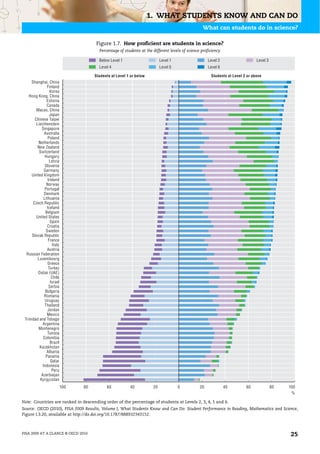
– On average across OECD countries, 18% of 15-year-olds do        performers, only a small minority of 15-year-olds
  not attain the baseline proficiency Level 2 in science, while   (1% in OECD countries) can perform the most difficult
  more than 8% of students are top performers at Level 5 or 6.    science tasks, at Level 6. These tasks require advanced
– In 7 countries and economies, more than 90% of students         scientific thinking and reasoning. However, in the
  reach at least Level 2, but in 13 countries only a minority     partner country Singapore, 5% of students perform at
  does so.                                                        Level 6 and in New Zealand and the partner economy
                                                                  Shanghai, China, 4% of students reach this level.
– In Finland, New Zealand, the partner economy Shanghai,
  China and the partner country Singapore, at least 17% of        On the other hand, some countries have almost no
  students are top performers at Level 5 or 6 – twice the OECD    students at these levels: in Mexico and in 15 partner
  average.                                                        countries, less than 1% of students reach Level 5.


What it means                                                     Definitions

Students whose proficiency in science is limited to               In PISA, science tasks are ranked by difficulty and are
Level 1 will find it difficult to participate fully in society    associated with each of the six proficiency levels from
at a time when science and technology play a large role           1 (easiest) to 6 (hardest). A student reaches a given
in daily life. Those students capable of the advanced             proficiency level if the test results show that he or she
scientific thinking required at Levels 5 and 6 could              has at least a 50% chance of performing a task at that
become part of a corps of future innovators who will              level. Students are classified at the highest level at
boost their countries’ technological and innovative               which they are proficient.
capacities in science-related industries.                         Information on data for Israel: http://dx.doi.org/10.1787/
                                                                  888932315602.

Findings

On average in OECD countries, over four in five stu-
dents (82%) are proficient in science to at least the               Going further
baseline Level 2. At that level, students have adequate
scientific knowledge to provide possible explanations               Descriptions of what students can do at each pro-
in familiar contexts or draw conclusions based on                   ficiency level and examples of tasks are pre-
simple investigations. In Canada, Estonia, Finland,                 sented in Chapter 3 of PISA 2009 Results Volume I,
Korea and the partner economies Hong Kong, China;                   What Students Know and Can Do: Student Perfor-
Macao, China and Shanghai, China; over 90% of                       mance in Reading, Mathematics and Science. Full
students reach Level 2 or above; but in 13 partner                  data are shown in Table I.3.4 at the back of that
countries, only a minority of students reaches Level 2.             volume.
At the other end of the scale, one in twelve students
(8.5%), on average in OECD countries, is proficient at
Level 5 or 6. These top performers are capable of
applying scientific knowledge and skills to a variety of          Further reading from the OECD
complex scientific questions drawn from the real
world. In Finland, New Zealand, the partner economy               Student performance in science was assessed in
Shanghai, China and the partner country Singapore,                  depth in 2006, and will be again in 2015. See:
between 17% and 25% of students reach at least                      Assessing Scientific, Reading and Mathematical Literacy:
Level 5, which means that the pool of future workers                A Framework for PISA 2006 (2006) and PISA 2006,
with high proficiency in science is over twice                      Science Competencies for Tomorrow’s World, Volume 1:
that of the average OECD country. Among these high                  Analysis (2007).


24                                                                                             PISA 2009 AT A GLANCE © OECD 2010
1. WHAT STUDENTS KNOW AND CAN DO
                                                                                                   What can students do in science?

                                      Figure 1.7. How proficient are students in science?
                                        Percentage of students at the different levels of science proficiency

                                        Below Level 1                      Level 1                    Level 2                   Level 3
                                        Level 4                            Level 5                    Level 6

                                      Students at Level 1 or below                                     Students at Level 2 or above
     Shanghai, China
               Finland
                  Korea
   Hong Kong, China
               Estonia
               Canada
        Macao, China
                  Japan
       Chinese Taipei
        Liechtenstein
           Singapore
             Australia
                Poland
         Netherlands
         New Zealand
          Switzerland
              Hungary
                 Latvia
              Slovenia
             Germany
     United Kingdom
                Ireland
               Norway
              Portugal
             Denmark
             Lithuania
      Czech Republic
               Iceland
              Belgium
        United States
                  Spain
                Croatia
               Sweden
      Slovak Republic
                France
                   Italy
                Austria
  Russian Federation
         Luxembourg
                Greece
                 Turkey
         Dubai (UAE)
                   Chile
                  Israel
                 Serbia
              Bulgaria
             Romania
              Uruguay
              Thailand
                Jordan
               Mexico
 Trinidad and Tobago
            Argentina
         Montenegro
                Tunisia
            Colombia
                  Brazil
          Kazakhstan
               Albania
              Panama
                  Qatar
            Indonesia
                   Peru
           Azerbaijan
          Kyrgyzstan
                           100   80         60           40           20             0           20             40        60              80   100
                                                                                                                                                %

Note: Countries are ranked in descending order of the percentage of students at Levels 2, 3, 4, 5 and 6.
Source: OECD (2010), PISA 2009 Results, Volume I, What Students Know and Can Do: Student Performance in Reading, Mathematics and Science,
Figure I.3.20, available at http://dx.doi.org/10.1787/888932343152.


PISA 2009 AT A GLANCE © OECD 2010                                                                                                               25
1. WHAT STUDENTS KNOW AND CAN DO
How do countries/economies perform in science overall?
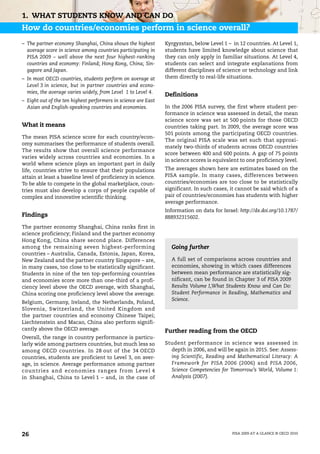
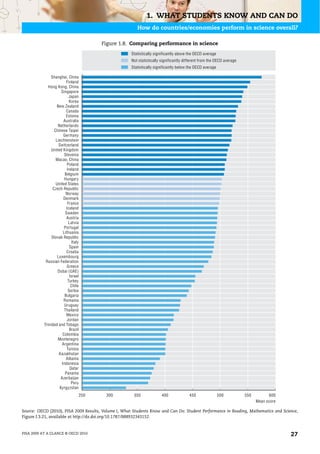
– The partner economy Shanghai, China shows the highest         Kyrgyzstan, below Level 1 – in 12 countries. At Level 1,
  average score in science among countries participating in     students have limited knowledge about science that
  PISA 2009 – well above the next four highest-ranking          they can only apply in familiar situations. At Level 4,
  countries and economy: Finland; Hong Kong, China; Sin-        students can select and integrate explanations from
  gapore and Japan.                                             different disciplines of science or technology and link
– In most OECD countries, students perform on average at        them directly to real-life situations.
  Level 3 in science, but in partner countries and econo-
  mies, the average varies widely, from Level 1 to Level 4.
                                                                Definitions
– Eight out of the ten highest performers in science are East
  Asian and English-speaking countries and economies.           In the 2006 PISA survey, the first where student per-
                                                                formance in science was assessed in detail, the mean
                                                                science score was set at 500 points for those OECD
What it means                                                   countries taking part. In 2009, the average score was
                                                                501 points among the participating OECD countries.
The mean PISA science score for each country/econ-
                                                                The original PISA scale was set such that approxi-
omy summarises the performance of students overall.
                                                                mately two-thirds of students across OECD countries
The results show that overall science performance
                                                                score between 400 and 600 points. A gap of 75 points
varies widely across countries and economies. In a
                                                                in science scores is equivalent to one proficiency level.
world where science plays an important part in daily
life, countries strive to ensure that their populations         The averages shown here are estimates based on the
attain at least a baseline level of proficiency in science.     PISA sample. In many cases, differences between
To be able to compete in the global marketplace, coun-          countries/economies are too close to be statistically
tries must also develop a corps of people capable of            significant. In such cases, it cannot be said which of a
complex and innovative scientific thinking.                     pair of countries/economies has students with higher
                                                                average performance.
                                                                Information on data for Israel: http://dx.doi.org/10.1787/
Findings                                                        888932315602.
The partner economy Shanghai, China ranks first in
science proficiency; Finland and the partner economy
Hong Kong, China share second place. Differences
among the remaining seven highest-performing                      Going further
countries – Australia, Canada, Estonia, Japan, Korea,
New Zealand and the partner country Singapore – are,              A full set of comparisons across countries and
in many cases, too close to be statistically significant.         economies, showing in which cases differences
Students in nine of the ten top-performing countries              between mean performance are statistically sig-
and economies score more than one-third of a profi-               nificant, can be found in Chapter 3 of PISA 2009
ciency level above the OECD average, with Shanghai,               Results Volume I,What Students Know and Can Do:
China scoring one proficiency level above the average.            Student Performance in Reading, Mathematics and
                                                                  Science.
Belgium, Germany, Ireland, the Netherlands, Poland,
Slovenia, Switzerland, the United Kingdom and
the partner countries and economy Chinese Taipei;
Liechtenstein and Macao, China also perform signifi-
cantly above the OECD average.                                  Further reading from the OECD
Overall, the range in country performance is particu-
larly wide among partners countries, but much less so           Student performance in science was assessed in
among OECD countries. In 28 out of the 34 OECD                    depth in 2006, and will be again in 2015. See: Assess-
countries, students are proficient to Level 3, on aver-           ing Scientific, Reading and Mathematical Literacy: A
age, in science. Average performance among partner                Framework for PISA 2006 (2006) and PISA 2006,
countries and economies rang es from Level 4                      Science Competencies for Tomorrow’s World, Volume 1:
in Shanghai, China to Level 1 – and, in the case of               Analysis (2007).


26                                                                                           PISA 2009 AT A GLANCE © OECD 2010
1. WHAT STUDENTS KNOW AND CAN DO
                                                         How do countries/economies perform in science overall?

                                           Figure 1.8. Comparing performance in science

                                                      Statistically significantly above the OECD average
                                                      Not statistically significantly different from the OECD average
                                                      Statistically significantly below the OECD average

               Shanghai, China
                          Finland
             Hong Kong, China
                      Singapore
                            Japan
                            Korea
                   New Zealand
                          Canada
                          Estonia
                        Australia
                    Netherlands
                 Chinese Taipei
                       Germany
                  Liechtenstein
                    Switzerland
               United Kingdom
                        Slovenia
                  Macao, China
                          Poland
                          Ireland
                         Belgium
                        Hungary
                  United States
                Czech Republic
                         Norway
                       Denmark
                           France
                          Iceland
                         Sweden
                          Austria
                           Latvia
                        Portugal
                       Lithuania
                Slovak Republic
                             Italy
                            Spain
                          Croatia
                   Luxembourg
            Russian Federation
                          Greece
                   Dubai (UAE)
                            Israel
                           Turkey
                             Chile
                           Serbia
                        Bulgaria
                        Romania
                        Uruguay
                        Thailand
                          Mexico
                          Jordan
           Trinidad and Tobago
                            Brazil
                       Colombia
                   Montenegro
                       Argentina
                          Tunisia
                    Kazakhstan
                          Albania
                      Indonesia
                            Qatar
                         Panama
                      Azerbaijan
                             Peru
                     Kyrgyzstan
                                     250    300        350              400             450                500          550         600
                                                                                                                              Mean score

Source: OECD (2010), PISA 2009 Results, Volume I, What Students Know and Can Do: Student Performance in Reading, Mathematics and Science,
Figure I.3.21, available at http://dx.doi.org/10.1787/888932343152.


PISA 2009 AT A GLANCE © OECD 2010                                                                                                          27
1. WHAT STUDENTS KNOW AND CAN DO
How do girls compare to boys in science?
– Girls outperform boys in science in 21 of the 65 countries   mance is above the OECD average, there is a gender gap
  and economies that participated in PISA 2009; in             of 10 points or more only in Finland, Slovenia and the
  11 countries, boys outperform girls, and in 33 countries     partner country Liechtenstein.
  there is no significant difference in performance between    In OECD countries, slightly more boys than girls attain
  the genders.                                                 a high level of performance in science: 8% of girls and
– On average in OECD countries, boys and girls perform         9% of boys reach proficiency Level 5 or 6.
  about the same in science.                                   A previous, more detailed assessment of science,
– In the partner countries and economy Albania, Dubai          conducted in 2006, showed some gender difference in
  (UAE), Jordan and Qatar, girls outperform boys in science    particular aspects of science performance. Girls were
  by more than one-third of a proficiency level.               relatively stronger at identifying scientific issues,
                                                               while boys were better at explaining phenomena
                                                               scientifically.
What it means

Reaching a basic understanding of scientific principles        Definitions
is now essential for both boys and girls if they want to
participate fully in society. Despite the prevalence of        The gender gap measures the difference between the
stereotyping to the contrary, PISA results show that           mean performance scores of boys and girls in science.
being proficient in science is not linked to one gender        On the PISA science scale, the mean score for OECD
or the other.                                                  countries was originally set at 500 points, and around
                                                               two-thirds of students in OECD countries score
                                                               between 400 and 600 points. One proficiency level is
Findings                                                       equivalent to 75 score points.
Of the three subjects assessed by PISA, reading, mathe-        Information on data for Israel: http://dx.doi.org/10.1787/
matics and science, science is the one in which gender         888932315602.
gaps in performance are narrowest. On average across
OECD countries, boys and girls achieve the same
scores. Boys outperform girls in 11 countries, girls
outperform boys in 21, and in the remaining countries            Going further
that participated in PISA 2009, there is no significant
difference in science performance between boys and               A full set of comparisons across countries and
girls. This suggests that science is a domain where              economies, showing details of gender differ-
policies that focus on gender equality have succeeded            ences in science performance, is presented in
the most.                                                        PISA 2009 Results Volume I, What Students Know
Girls score substantially higher in science, by more             and Can Do: Student Performance in Reading,
than 20 points in 4 partner countries and one partner            Mathematics and Science. Full data are shown in
economy: Albania, Dubai (UAE), Jordan, Kyrgyzstan and            Tables I.3.6 (mean scores) and I.3.5 (proficiency
Qatar. Only in the partner country Colombia do boys              levels) at the back of that volume.
score at least 20 points higher than girls. Among OECD
countries, the largest differences in performance
between genders, between 10 and 20 points, are seen
in Finland, Slovenia and Turkey, where girls outperform        Further reading from the OECD
boys, and in Denmark and the United States, where
boys outperform girls. In countries with the strongest         Science performance, including gender differences in
performance in science, boys and girls generally do               different aspects of science, was assessed in depth
equally well. Among the top ten countries in science              in 2006, and will be again in 2015. See: Assessing Sci-
performance, only in Finland and New Zealand is there             entific, Reading and Mathematical Literacy: A Framework
a significant difference between boys’ and girls’ science         for PISA 2006 (2006) and PISA 2006, Science Competen-
scores. Among the 21 countries whose science perfor-              cies for Tomorrow’s World, Volume 1: Analysis (2007).


28                                                                                          PISA 2009 AT A GLANCE © OECD 2010
1. WHAT STUDENTS KNOW AND CAN DO
                                                                                       How do girls compare to boys in science?

                                         Figure 1.9. Gender differences in science performance

             All students         Boys             Girls

                 Mean score on the science scale                                                     Gender difference (girls-boys)
                                                                        Colombia
                                                                     Liechtenstein
                                                                     United States
                                                                         Denmark
                                                                    United Kingdom
                                                                            Chile
                                                                      Switzerland
                                                                          Austria
                                                                           Spain
                                                                      Luxembourg                  Boys                           Girls
                                                                          Mexico             perform better                 perform better
                                                                         Belgium
                                                                         Germany
                                                                          Canada
                                                                            Peru
                                                                      Netherlands
                                                                          France
                                                                           Brazil
                                                                  Hong Kong, China
                                                                          Iceland
                                                                          Tunisia
                                                                         Hungary                                       OECD average
                                                                    Shanghai, China                                    0 score point
                                                                    Slovak Republic
                                                                          Estonia
                                                                         Australia
                                                                     Chinese Taipei
                                                                       Singapore
                                                                         Uruguay
                                                                           Serbia
                                                                            Italy
                                                                         Panama
                                                                           Korea
                                                                     Macao, China
                                                                          Ireland
                                                                           Israel
                                                                 Russian Federation
                                                                         Portugal
                                                                         Norway
                                                                         Sweden
                                                                    Czech Republic
                                                                          Poland
                                                                      New Zealand
                                                                           Latvia
                                                                       Azerbaijan
                                                                        Argentina
                                                                      Kazakhstan
                                                                          Croatia
                                                                        Indonesia
                                                                          Greece
                                                                         Romania
                                                                           Japan
                                                                          Turkey
                                                                      Montenegro
                                                                         Thailand
                                                                         Slovenia
                                                                          Finland
                                                                        Lithuania
                                                                 Trinidad and Tobago
                                                                         Bulgaria
                                                                       Kyrgyzstan
                                                                           Qatar
                                                                      Dubai (UAE)
                                                                          Albania
                                                                          Jordan
600   550         500       450    400      350      300   250                         -40        -20              0             20               40
Mean score                                                                                                                    Score point difference

Note: Statistically significant gender differences are marked in a darker tone (see Annex A3). Countries are ranked in ascending order of
the score-point difference (girls-boys).
Source: OECD (2010), PISA 2009 Results, Volume I, What Students Know and Can Do: Student Performance in Reading, Mathematics and Science,
Figure I.3.23, available at http://dx.doi.org/10.1787/888932343152.


PISA 2009 AT A GLANCE © OECD 2010                                                                                                               29
1. WHAT STUDENTS KNOW AND CAN DO
How many students are top performers?
– One in six students in OECD countries is a top performer    ers across the three subject areas is similar between
  in reading, mathematics or science, but only a quarter of   boys and girls: 4.4% of girls and 3.8% of boys are top
  these students are top performers in all three areas.       performers in all three subject areas, and 15.6% of
– Around 10% of students are top performers in reading,       girls and 17.0% of boys are top performers in at least
  mathematics and science in New Zealand, the partner         one subject area. However, while the gender gap
  economy Shanghai, China and the partner country             among students who are top performers is small only
  Singapore.                                                  in science (1.0% of girls and 1.5% of boys), it is large
                                                              among those who are top performers in reading only
– Countries vary greatly in the relative numbers of top
                                                              (2.8% of girls and 0.5% of boys) and in mathematics
  performers in different subjects.
                                                              only (3.4% of girls and 6.6% of boys).

What it means
                                                              Definitions
The rapidly growing demand for highly skilled workers
                                                              Top performance is defined as reaching Level 5 or 6 on
has led to a global competition for talent. High-level
                                                              the PISA scales. In each subject area, this relates to
skills are critical for creating new technologies and
                                                              being proficient in difficult tasks that require students
innovation. Looking at the top-performing students in
                                                              to handle complex information. The threshold scores
reading, mathematics and science allows countries to
                                                              for top performance are slightly different in each
estimate their future talent pool, and to consider ways
                                                              subject: 626 points in reading, 607 points in mathe-
of improving it.
                                                              matics and 633 points in science.
                                                              Information on data for Israel: http://dx.doi.org/10.1787/
Findings                                                      888932315602.

On average in OECD countries, 8% of students reach
proficiency Level 5 or 6 in reading. Some 13% of stu-
dents reach this level in mathematics and 9% reach
this level in science. While 16% of students are top
                                                                Going further
performers in at least one area, only 4% of students
attain this level of proficiency in all three subjects.         A full set of comparisons across countries and
In the partner economy Shanghai, China and in                   economies, showing how many students are top
Singapore, 12% to 15% of students are top performers in         performers in each subject and in overlapping
all three subjects – at least three times the OECD aver-        combinations of subjects, is presented in
age. In New Zealand, 10% of students are top performers         Chapter 3 of PISA 2009 Results Volume I,What
in all three subjects, and in Australia, Finland, Japan and     Students Know and Can Do: Student Performance in
the partner economy Hong Kong, China, more than 8%              Reading, Mathematics and Science. Full data are
of students, or twice the OECD average, are.                    shown in Tables I.3.7 and I.3.8 at the back of that
Despite similarities across countries for each subject          volume.
area, a high rank in one subject is no guarantee for a
high rank in the others. For example, Switzerland has
one of the highest shares of top performers in mathe-
matics, but just an average share of top performers in
reading.                                                      Further reading from the OECD
Across the three subjects and across countries, girls
are as likely to be top performers as boys. On average        Top of the Class – High Performers in Science in PISA 2006
across OECD countries, the proportion of top perform-            (2009).


30                                                                                         PISA 2009 AT A GLANCE © OECD 2010
1. WHAT STUDENTS KNOW AND CAN DO
                                                                                       How many students are top performers?

     Figure 1.10. Overlapping of top performers in reading, mathematics and science on average in the OECD


                                                                    Reading
                                              Science only        and science
                                                 1.2%                0.8%

                                                                                          Reading only
                                                                                             1.6%
                                                                   Reading,
                                                                  mathematics
                                              Mathematics         and science
                                              and science            4.1%         Reading
                                                 2.5%
                                                                                     and
                                                                                 mathematics
                                                                                    1.2%


                                                         Mathematics only
                                                              5.0%

                                                                                               Non-top performers
                                                                                               in any of the three domains
                                                                                               83.7%

Source: OECD (2010), PISA 2009 Results, Volume I, What Students Know and Can Do: Student Performance in Reading, Mathematics and Science,
Figure I.3a, available at http://dx.doi.org/10.1787/888932343152.


                            Figure 1.11. Top performers in reading, mathematics and science
                                       Percentage of students reaching the two highest levels of proficiency

                                    Reading                                 Science                                Mathematics
     60


     50


     40


     30


     20


     10


      0
                Si e a in a
                         a d


                         bo l y
                          nl e
                         Ja nd
                         Ko a n
        ng us re a


         Ch ub Gr ur g

               h T E)
           ec se UA e

                      A bl i
                   Po us t ic


                 A r C z il
                           nt e
             M Ro e r b a
                on m i a
                  ng an ia
          U n B, C h d a
               i te elg in a
                  th t a m
                          la s
                     Sw ancs
                                  e


          Li D r tu ria
       Sl htenmar l
         ov S s k
                   Re ven n
                         pu i a
            n C Spa ic


                  Co ne ia
                    P a mb o
                          na ia
               F e r o in
                         ra tia
 Tr MacLith at v n
      Un S w N el ann
          i t e i t or w d


                  ao u a i a
                       , C ni a
                  d lga a
                           b a
                    Ur ur k o


                                  a
                   z a ex u
                       k h ico
                         ai an
                      Jo land
                           n n
        O E d K z er ay
                    a v gdo d


                         ug ey


                   rg a a
                          Q a ay
                         Br t ar


                 In y z s n i a
                A z don t an
                         ba ia
                                  n
                   Ge er a m
                        rm ge
                         Is n y
                            la l
                   Hu e l a d
                         n nd
                           to y
                 xe I ni a


                         pu e


              ec en ga
                      Po r ae


                     ge hil
                        S in


                               m
                      F i por


                     er t e
                       Fr nd


       C z ine a i ( e e c


              a n Bu hin
                      To ri


               Ky A l b i s i
                     E s gar
                    ng lan


              ak lo tei


                         L io


                       T ag
                      Ic ede


              C D in l an


                      Ir n


                       l o gr


                      Tu rda
              K a M Per


                             ij a
             Ko C t r a l


                             bl


                     te an
                   Re a ip


                    er e s
                     m ta
             N e d S iu


                              a
                             u
                             p


                             a


                             a


                   Th st
                    de a
                             a
                 w , Ch


                             t
                     Z
            Ne hai


                   A
               g


            Lu

             D
          an


         ad
         ia
Sh


     ss


      id
   Ho


   in
  Ru


Note: Countries are ranked in descending order of the percentage of top performers in reading (Levels 5 and 6).
Source: OECD (2010), PISA 2009 Results, Volume I, What Students Know and Can Do: Student Performance in Reading, Mathematics and Science,
Figure I.3a, available at http://dx.doi.org/10.1787/888932343152.


PISA 2009 AT A GLANCE © OECD 2010                                                                                                    31
1. WHAT STUDENTS KNOW AND CAN DO – TRENDS
Performance in reading since 2000
– Between PISA 2000 and PISA 2009, reading performance        Portugal reached the OECD average, and Israel and
  improved in 13 countries, declined in 4 and was unchanged   the partner country Latvia were still below the OECD
  in 21.                                                      average but had closed over half the gap. The partner
– Among countries that performed above the OECD average       country Brazil also improved, even though it remains
  in 2000, Korea’s reading scores improved, while those of    more than one proficiency level below the OECD
  Australia, Ireland and Sweden declined.                     average.

– The four countries that show the greatest improvement in    Korea, which was already an above-average performer
  reading scores, Chile and the partner countries Albania,    in 2000, improved its mean score to equal that of the
  Peru and Indonesia, all performed far below the OECD        top-performing OECD country in reading, Finland.
  average in 2000.                                            Among countries whose reading performance
                                                              declined, two had been among the top five performers
                                                              in PISA 2000: Ireland, whose scores fell to the OECD
What it means                                                 average, and Australia, which remained above average.
                                                              Sweden had performed above the OECD average
In the past decade, most countries have substantially
                                                              in 2000, but showed average performance in 2009. In
increased their investment in education. PISA helps to
                                                              the Czech Republic, mean scores were just below the
monitor whether outcomes are improving as a result.
                                                              average in 2000, and fell further below average in 2009.
In 2009, PISA focused on reading for the first time
since the original PISA survey in 2000. This allows for
a comparison of how student performance has                   Definitions
evolved over the past decade.
                                                              Changes in mean PISA reading scores are reported
                                                              here only where they are statistically significant. Only
Findings                                                      those 38 countries with comparable results in both
                                                              the 2000 and the 2009 PISA reading assessments are
Mean reading performance remained unchanged, on
                                                              considered in this section.
average, across the 26 OECD countries with compara-
ble results in both the 2000 and the 2009 PISA reading        The different number of OECD countries participating
assessments. Reading performance improved in                  in successive PISA assessments is reflected through
seven of these countries and in six partner countries,        separate OECD averages that provide reference points
and declined in four OECD countries. In the rest of the       for trend comparisons. For reading, the main reference
38 countries that participated in both surveys, there         point is the OECD average for the 26 OECD countries that
was no significant change.                                    participated in both PISA 2000 and PISA 2009. Among
                                                              OECD countries, the Slovak Republic and Turkey joined
Among the four countries showing the greatest
                                                              PISA in 2003, and results from Luxembourg, the
improvement, average reading performance had been
                                                              Netherlands, the United Kingdom and Austria are not
very low in 2000. Chile’s mean score in 2000 was at the
                                                              comparable between 2000 and 2009. Estonia and
bottom of the baseline reading proficiency Level 2, that
                                                              Slovenia only participated in 2006 and 2009.
of the partner countries Albania and Indonesia was at
Level 1, and that of the partner country Peru stood           Information on data for Israel: http://dx.doi.org/10.1787/
below Level 1. The reading scores of 15-year-olds             888932315602.
rose by 31 to 43 points in these four countries, or
around half a proficiency level. This is a substantial
achievement in just nine years. For example, with the
improvement, the gap between Chile’s mean score and             Going further
the OECD average was nearly halved.
Among the other nine countries showing improvement              Further analysis of changes in reading perfor-
in reading scores, seven had performed somewhat                 mance between 2000 and 2009 is presented in
below the OECD average in 2000, with mean scores in             PISA 2009 Results Volume V, Learning Trends:
the upper half of proficiency Level 2 or the very bottom        Changes in Student Performance Since 2000. Full
of Level 3. Of these below-average performers in 2000,          data are shown in Table V.2.1 at the back of that
Poland and the partner country Liechtenstein attained           volume.
above-average scores in 2009, Germany, Hungary and


32                                                                                         PISA 2009 AT A GLANCE © OECD 2010
1. WHAT STUDENTS KNOW AND CAN DO – TRENDS
                                                                                        Performance in reading since 2000

                            Figure 1.12. Change in reading performance between 2000 and 2009

              Peru
              Chile
            Albania
          Indonesia
             Latvia
             Israel
            Poland
           Portugal
      Liechtenstein
             Brazil
             Korea
           Hungary
          Germany
            Greece
  Hong Kong, China
        Switzerland
            Mexico
   OECD26 average
           Belgium
           Bulgaria
              Italy
          Denmark
           Norway
 Russian Federation
             Japan
          Romania
      United States
            Iceland
       New Zealand
            France
           Thailand
            Canada
            Finland
             Spain
          Australia
     Czech Republic
           Sweden
          Argentina
            Ireland

                      -35   -30   -25   -20   -15   -10    -5     0      5     10      15     20       25      30    35      40     45    50
                                                                             Score point change in reading performance between 2000 and 2009

Note: Statistically significant score point changes are marked in a darker tone. Countries are ranked in descending order of the score
point change in reading performance between 2000 and 2009.
Source: OECD (2010), PISA 2009 Results, Volume V, Learning Trends: Changes in Student Performance Since 2000, Figure V.2.1, available at
http://dx.doi.org/10.1787/888932359967.


PISA 2009 AT A GLANCE © OECD 2010                                                                                                         33
1. WHAT STUDENTS KNOW AND CAN DO – TRENDS
Changes in reading scores since 2000
– In countries where reading improved overall between 2000     Japan, Korea and the partner economy Hong Kong,
  and 2009, girls’ scores generally rose more than those       China was this rise greater than one percentage point.
  of boys.                                                     Of these, only Israel and Korea showed overall
– In most countries that saw improvements in reading           improvements in reading performance. In most
  performance, the number of low-performing students fell      countries that showed overall declines in reading per-
  sharply; but in only two countries, Israel and Korea, were   formance, the number of top performers fell and
  there also substantially more top performers.                the number of low performers rose significantly.
                                                               The exception was Australia, where the proportion
– In several countries, the impact of socio-economic back-
                                                               of top performers fell sharply, from 18% to 13%, but
  ground on reading performance weakened significantly.
                                                               the proportion of low performers did not change
                                                               significantly.
What it means                                                  Between 2000 and 2009, the relationship between stu-
                                                               dent background and reading performance weakened
Nearly a decade after the first PISA survey, countries         in nine countries, including three of the five countries
can see not just whether they have raised standards            where reading scores improved the most – Chile and
overall, but also whether they have succeeded in               the partner countries Albania and Latvia. Germany is
raising performance among various groups.                      the only other country where the relationship weak-
                                                               ened while performance improved. On the other
                                                               hand, the relationship appears to be stronger in five
Findings
                                                               countries.
Changes in reading performance between 2000
and 2009 were not the same across all groups of
                                                               Definitions
students or all levels of proficiency.
Boys’ reading scores rose in only five countries, com-         Level 2 is considered the baseline level of proficiency
pared to 13 countries where girls’ reading scores              in reading, at which students begin to demonstrate
improved. In most countries where reading perfor-              the competencies that will enable them to participate
mance improved overall, girls’ performance improved            effectively and productively in life. PISA tasks at this
more than boys’ did – around twice the rise in score           level may involve comparisons or contrasts based on a
points or more in Israel, Korea, Poland, Portugal and          single feature in a text. They may also require stu-
the partner country Brazil. However, in Chile, and the         dents to make a comparison or several connections
partner countries Albania and Peru, boys made great            between the text and outside knowledge, by drawing
strides in reading, improving by at least 35 points, or        on personal experience and attitudes. Top performers
over half a proficiency level.                                 are those students who attain proficiency Level 5 or 6,
Conversely, boys’ reading performance declined in              the highest levels of performance.
eight countries, while girls’ reading performance              Information on data for Israel: http://dx.doi.org/10.1787/
declined in only two. In Ireland, boys scored 37 points        888932315602.
lower in 2009 than in 2000, falling, on average, from
the middle of proficiency Level 3 to the top of Level 2.
Rises in mean country scores were more often driven
by a reduction in the proportion of low-performing               Going further
students than by an increase in the proportion of
top performers. The percentage of students who                   More detailed information on how reading
do not reach the baseline proficiency Level 2 fell               p e r f o r m a n c e h a s ev o l v e d b e t w e e n 2 0 0 0
in 14 countries. In Chile and the partner countries              and 2009 is provided in Chapter 2 of PISA 2009
Albania, Indonesia, Latvia and Peru, this fall was               Results Volume V, Learning Trends: Changes in
substantial: between 12 and 18 percentage points.                Student Performance since 2000.
But only six countries showed a rise in the number of
students reaching Level 5 or above; and in only Israel,


34                                                                                              PISA 2009 AT A GLANCE © OECD 2010
1. WHAT STUDENTS KNOW AND CAN DO – TRENDS
                                                                                           Changes in reading scores since 2000

                                     Table 1.1. A summary of changes in reading performance
                                                                                                                                        Association
                                                                                           Share of students   Share of students
                               Mean score                                                                                           of socio-economic
                                               All students     Boys           Girls       below proficiency     at proficiency
                             in reading 2009                                                                                         background with
                                                                                                Level 2        Level 5 or above
                                                                                                                                   reading performance

Peru                              370               43            35             50             –14.8                 0.4                  0.1
Chile                             449               40            42             40             –17.6                 0.8                 –7.6
Albania                           385               36            35             39             –13.7                 0.1                 –9.9
Indonesia                         402               31            23             39             –15.2                                     –6.9
Latvia                            484               26            28             23             –12.5                –1.2                –11.0
Israel                            474               22             9             35              –6.7                 3.3                 –8.4
Poland                            500               21            14             28              –8.2                 1.3                 –1.5
Portugal                          489               19            12             26              –8.6                 0.6                 –4.7
Liechtenstein                     499               17            16             17              –6.4                –0.4                –13.3
Brazil                            412               16             9             21              –6.2                 0.8                 –0.6
Korea                             539               15             4             25               0.0                 7.2                  8.5
Hungary                           494               14            11             17              –5.1                 1.0                 –4.2
Germany                           497               13            10             15              –4.2                –1.2                 –7.7
Greece                            483                9             3             13              –3.1                 0.6                  2.0
 Hong Kong, China                 533                8             0             17              –0.8                 2.9                 –8.6
Switzerland                       501                6             1             10              –3.6                –1.1                 –2.3
Mexico                            425                3             1              6              –4.0                –0.5                 –7.3
Belgium                           506               –1             0             –5              –1.2                –0.8                  0.7
Bulgaria                          429               –1            –8              6               0.7                 0.6                 –4.5
Italy                             486               –1            –5              2               2.1                 0.5                  3.2
Denmark                           495               –2            –5             –1              –2.7                –3.4                 –3.2
Norway                            503               –2            –5             –1              –2.5                –2.8                  0.4
Russian Federation                459               –2            –6              1              –0.1                 0.0                  1.4
Japan                             520               –2            –6              3               3.5                 3.6                    c
Romania                           424               –3           –18             11              –0.9                –1.5                 10.7
United States                     500               –5            –2             –6              –0.3                –2.4                 –9.2
Iceland                           500               –7           –10             –6               2.3                –0.5                  5.4
New Zealand                       521               –8            –8             –8               0.6                –3.0                  4.9
France                            496               –9           –15             –4               4.6                 1.1                  7.0
Thailand                          421               –9            –6            –10               5.8                –0.2                 –0.7
Canada                            524              –10           –12            –10               0.7                –4.0                 –6.4
Finland                           536              –11           –12             –8               1.2                –4.0                  5.8
Spain                             481              –12           –14            –10               3.3                –0.9                  1.5
Australia                         515              –13           –17            –13               1.8                –4.9                 –1.4
Czech Republic                    478              –13           –17             –6               5.6                –1.9                –11.4
Sweden                            497              –19           –24            –15               4.9                –2.2                  7.7
Argentina                         398              –20           –15            –22               7.7                –0.7                 –1.7
Ireland                           496              –31           –37            –26               6.2                –7.3                  5.8


           Mean score in reading 2009 is statistically significantly above the OECD average. Changes in reading performance and in the share
           of students at proficiency Level 5 or above are statistically significantly positive. Changes in the share of students below proficiency
           Level 2 and in the association of socio-economic background with reading is statistically significantly negative.
           Mean score in reading 2009 is not statistically significantly different from the OECD average. Changes in reading performance and
           in the share of students at proficiency Level 5 or above, in the share of students below proficiency Level 2 and in the association
           of socio-economic background with reading are not statistically significantly different.
           Mean score in reading 2009 is statistically significantly below the OECD average. Changes in reading performance and in the share
           of students at proficiency Level 5 or above are statistically significantly negative. Changes in the share of students below proficiency
           Level 2 and in the association of socio-economic background with reading is statistically significantly positive.
Source: OECD (2010), PISA 2009 Results, Volume V, Learning Trends: Changes in Student Performance Since 2000, Figure V.1.1, available at
http://dx.doi.org/10.1787/888932359948.


PISA 2009 AT A GLANCE © OECD 2010                                                                                                                 35
1. WHAT STUDENTS KNOW AND CAN DO – TRENDS
Reading scores among low-performing students
– In four countries that showed low levels of performance     OECD average. There, and in five other below-average
  in 2000, the proportion of low-performing students had      performers in 2000 – Germany, Hungary, Poland,
  fallen sharply by 2009.                                     Portugal and the partner country Liechtenstein – a
– During this period, Germany, Hungary, Poland, Portugal,     reduction in the proportion of low-performing stu-
  Switzerland and the partner countries Latvia and            dents helped to raise the average score.
  Liechtenstein reduced the proportion of low-performing      In only one country where the percentage of low
  students to below or close to the OECD average.             performers was below average in 2000 – Denmark –
– In the Czech Republic, France and Spain, the number of      did that percentage fall further. In contrast, in the
  low-performing students rose between 2000 and 2009 to       Czech Republic, France, Iceland, Ireland, Spain and
  close to or above the OECD average.                         Sweden, where fewer students than average or close
                                                              to average were low performers in reading in 2000,
                                                              their numbers had risen by 2009.
What it means
Particularly in countries where only a minority of
                                                              Definitions
students is able to read beyond a basic level, impro-
ving performance among low achievers contributes              Students are defined as low performers if they do not
significantly to raising the overall standard. In OECD        attain reading proficiency Level 2. The countries
countries, where the great majority of students reaches       involved in this comparison are only those that parti-
at least proficiency Level 2, the challenge is to limit the   cipated in both PISA 2000 and 2009. Changes in the
number of students who do not. In some of these coun-         percentage of low-performing students are only
tries, immigration and other changes that affect the          reported if they are statistically significant. They are
socio-economic profile of the student population can          expressed as “percentage point changes”, such that a
make the task more difficult.                                 rise from 5% to 10% is a five percentage point change,
                                                              even though the proportion has doubled.
Findings                                                      Information on data for Israel: http://dx.doi.org/10.1787/
                                                              888932315602.
The proportion of students who do not attain the
baseline proficiency Level 2 fell significantly
in 14 countries and rose in 7 between 2000 and 2009.
The biggest improvements were seen in those coun-
tries where underperformance had been the most                  Going further
pervasive. Most notably, in nine years, the proportion
of students who did not attain Level 2 fell from 80% to         Further analysis of changes in reading perfor-
65% in Peru; from 70% to 57% in Albania; from 69% to            mance among low-performing students is
53% in Indonesia; and from 48% to 31% in Chile.                 presented in Chapter 2 of PISA 2009 Results
The only other country that showed a drop of at least           Volume V, Learning Trends: Changes in Student Perfor-
10 percentage points in the proportion of low-                  mance Since 2000. Full data are shown in
performing students was the partner country Latvia,             Table V.2.2 at the back of that volume.
where the proportion fell from 30% to 18%, close to the


36                                                                                         PISA 2009 AT A GLANCE © OECD 2010
1. WHAT STUDENTS KNOW AND CAN DO – TRENDS
                                                                              Reading scores among low-performing students

            Figure 1.13. Percentage of students below proficiency Level 2 in reading in 2000 and 2009
                                                                              2009                      2000
                      Change in the percentage of students below proficiency Level 2 in reading between 2000 and 2009
             Korea     o
            Finland    o
  Hong Kong, China     o
            Canada     o
             Japan     o
          Australia    o
       New Zealand     o
           Norway      o
            Poland     –
          Denmark      –
      Liechtenstein    –
        Switzerland    –
            Iceland    +
            Ireland    +
           Sweden      +
           Hungary     –
             Latvia    –
      United States    o
           Portugal    –
           Belgium     o
   OECD26 average      –
          Germany      –
             Spain     +
            France     +
              Italy    o
            Greece     o
     Czech Republic    +
             Israel    o
 Russian Federation    o
              Chile    –
            Mexico     –
          Romania      o
           Bulgaria    o
           Thailand    +
             Brazil    –
          Argentina    o
          Indonesia    –
            Albania    –
              Peru     –

                           0             10           20            30            40            50            60            70            80           90
                                                                                                          Percentage of students below proficiency Level 2

                                                                   2009 higher             2009 lower             No statistically
                                                                    than 2000              than 2000           significant difference

                               95% confidence level                      +                      –                        o

Note: Countries are ranked in ascending order of the percentage of students below proficiency Level 2 in reading in 2009.
Source: OECD (2010), PISA 2009 Results, Volume V, Learning Trends: Changes in Student Performance Since 2000, Figure V.2.4, available at
http://dx.doi.org/10.1787/888932359967.


PISA 2009 AT A GLANCE © OECD 2010                                                                                                                       37
1. WHAT STUDENTS KNOW AND CAN DO – TRENDS
Reading scores among high-performing students
– In Japan, Korea and the partner economy Hong Kong,           students performed at Level 5 or 6 in 2000, but this
  China, the percentage of top performers in reading rose to   proportion was reduced by between three and five
  among the highest in PISA by 2009, having been only at       percentage points in 2009. These countries still had
  or below the OECD average in 2000.                           well above the average proportion of top performers
– The biggest changes in the proportion of top performers in   in 2009, but their advantage over other countries had
  reading are seen in Korea and Israel, which doubled that     narrowed.
  proportion, and in Ireland, where it halved.                 In Denmark, the proportion of top performers
                                                               fell sharply from 8% to below 5% during the period.
                                                               Unusually, Denmark saw a fall in the number of both
What it means                                                  top and low performers, with more students perfor-
                                                               ming at middle levels of reading proficiency. In Norway,
The 8% of students capable of performing complex
                                                               the proportion of top performers decreased by three
reading tasks at Level 5 or 6 will be at the forefront of a
                                                               percentage points, to the average level.
competitive, knowledge-based world economy. Some
countries have very few students at these levels, and          In Romania, the proportion of top performers fell from
will need to improve the performance of their best             an already low level of 2% in 2000 to less than 1%
students in order to enhance competitive capacity.             in 2009.


Findings                                                       Definitions

The proportion of top performers in reading, proficient        Students are defined as top performers if they are
at Level 5 or above, rose significantly in six countries       proficient to at least Level 5 on the seven-level reading
but fell in ten others between 2000 and 2009.                  proficiency scale. The countries involved in this com-
                                                               parison are only those that have comparable results in
Three of the four countries that showed the greatest
                                                               both the 2000 and the 2009 PISA reading survey.
increase in top performers during this period now
                                                               Changes in the percentage of low-performing stu-
have among the highest percentage of these students
                                                               dents are only reported if they are statistically
in the world. In 2000, Japan and the partner economy
                                                               significant. They are expressed as “percentage point
Hong Kong, China had only about the OECD average of
                                                               changes”, such that a rise from 5% to 10% is a five
9% of students reading at Level 5 or above; Korea was
                                                               percentage point change, even though the proportion
well below this average, with 6% of top performers.
                                                               has doubled.
By 2009, between 12% and 13% of students in all these
countries were top performers. Korea more than                 Information on data for Israel: http://dx.doi.org/10.1787/
doubled the percentage of top performers in reading            888932315602.
in nine years.
Israel also nearly doubled the percentage of top per-
formers in reading, to 7%. While this is close to the
OECD average, it is a greater proportion than that               Going further
found in the other countries whose average reading
scores are similar to Israel’s.                                  Further analysis of changes in top performance in
                                                                 reading between 2000 and 2009 is presented in
In the five countries that had the highest proportion
                                                                 Chapter 2 of PISA 2009 Results Volume V, Learning
of top performers in reading in 2000, this proportion
                                                                 Trends: Changes in Student Performance Since 2000.
shrunk significantly by 2009. Most notably, the per-
                                                                 Full data are shown in Table V.2.2 at the back of
centage in Ireland halved from 14% to 7%, now close
                                                                 that volume.
to the OECD average. In Australia, Canada, Finland
and New Zealand, far above the average proportion of


38                                                                                          PISA 2009 AT A GLANCE © OECD 2010
1. WHAT STUDENTS KNOW AND CAN DO – TRENDS
                                                                             Reading scores among high-performing students

                           Figure 1.14. Percentage of top performers in reading in 2000 and 2009
                                                                              2009                      2000
                      Change in the percentage of top performers in reading between 2000 and 2009
       New Zealand     –
            Finland    –
             Japan     +
             Korea     +
          Australia    –
            Canada     –
  Hong Kong, China     +
           Belgium     o
      United States    o
            France     o
           Sweden      –
            Iceland    o
           Norway      –
        Switzerland    o
          Germany      o
             Israel    +
            Poland     o
            Ireland    –
           Hungary     o
              Italy    o
            Greece     o
     Czech Republic    –
           Portugal    o
          Denmark      –
      Liechtenstein    o
             Spain     o
 Russian Federation    o
             Latvia    o
           Bulgaria    o
             Brazil    +
              Chile    +
          Argentina    o
          Romania      –
              Peru     o
            Mexico     o
           Thailand    o
            Albania    o
          Indonesia    o

                           0            2             4         6            8          10             12          14           16           18         20
                                                                                                                              Percentage of top performers

                                                                    2009 higher           2009 lower              No statistically
                                                                     than 2000            than 2000            significant difference

                               95% confidence level                     +                      –                         o

Note: Countries are ranked in descending order of top performers in reading in 2009.
Source: OECD (2010), PISA 2009 Results, Volume V, Learning Trends: Changes in Student Performance Since 2000, Figure V.2.5, available at
http://dx.doi.org/10.1787/888932359967.


PISA 2009 AT A GLANCE © OECD 2010                                                                                                                       39
1. WHAT STUDENTS KNOW AND CAN DO – TRENDS
Girls’ and boys’ reading performance since 2000
– Girls still outperform boys in reading; indeed the gender   of the other countries with widening gender gaps,
  gap widened by more than one-fifth between PISA 2000        Portugal, the partner country Brazil and the partner
  and PISA 2009.                                              economy Hong Kong, China, girls’ performance
– The gender gap widened greatly in nine countries; in no     improved while that of boys did not. In the partner
  country did it narrow.                                      countries Indonesia and Peru, both boys and girls
                                                              improved, but girls did so to a greater extent. In France
– In six of these countries, girls’ reading performance
                                                              and Sweden, boys’ reading performance declined, but
  improved considerably; but in France, Sweden and the
                                                              girls’ performance either remained the same (France)
  partner country Romania, a decline in performance
                                                              or also declined (Sweden), although by a lesser degree.
  among boys was the main reason that the gender gap
  widened.                                                    The gender gap is particularly wide in the proportion
                                                              of low-performing students. In 2009, twice as many
                                                              boys (24%) as girls (12%) did not attain the baseline
What it means                                                 reading proficiency Level 2. Across OECD countries,
                                                              this gap widened since 2000 because of a two percent-
With boys lagging behind in reading performance, one          age point drop in the proportion of girls at this level
way to improve overall results is to get boys more            and no change in the proportion of boys at this level.
interested and engaged in reading. In the short term,
                                                              The proportion of low-performing boys increased by
this may require paying more attention to the reading
                                                              the largest amount in Ireland, where the proportion
preferences of boys who, for example, show relatively
                                                              rose from one boy in seven (13%) in 2000 to nearly one
strong interest in reading newspapers and reading on
                                                              in four (23%) in 2009.
line, rather than aiming for a single model of reading
engagement. In the long run, tackling the gender gap
in reading performance will require the concerted             Definitions
effort of parents, teachers and society at large to
change the stereotypical notions of what boys and             The gender gap is defined as the difference in score
girls excel in and what they enjoy doing.                     points between the average scores of boys and girls.
                                                              Differences over time are noted only when they are
                                                              statistically significant.
Findings
                                                              Information on data for Israel: http://dx.doi.org/10.1787/
The gender gap in reading performance did not narrow          888932315602.
in any country between 2000 and 2009. On average in
OECD countries, girls scored 39 points higher than boys
in 2009 compared to 32 points in 2000. This represents
a widening of the gender gap of more than 20%.
In Israel, Korea and the partner country Romania, girls         Going further
outperformed boys by a wider margin – more than
20 score points – in 2009 than they did in 2000. But the        Further analysis of changes in the gender gap
reasons behind these changes varied. In Israel                  between 2000 and 2009 is presented in Chapter 2
and Korea, girls’ reading levels rose (by over half             of PISA 2009 Results Volume V, Learning Trends:
a proficiency level in Israel), while boys’ reading per-        Changes in Student Performance Since 2000. Full data
formance did not improve. In contrast, in Romania,              are shown in Tables V.2.4, V.2.5 and V.2.6 at the
boys’ reading performance declined, while girls’                back of that volume.
performance was similar to that in 2000. In three


40                                                                                         PISA 2009 AT A GLANCE © OECD 2010
1. WHAT STUDENTS KNOW AND CAN DO – TRENDS
                                                                              Girls’ and boys’ reading performance since 2000

              Figure 1.15. Comparison of gender differences in performance between 2000 and 2009
                                                                            2009                         2000

                                                                   Girls perform better in all countries/economies
                       Change in the performance gap between boys and girls in reading between 2000 and 2009
              Chile     o
              Peru      o
      United States     o
            Mexico      o
           Belgium      o
             Brazil     +
          Denmark       o
             Spain      o
      Liechtenstein     o
  Hong Kong, China      +
            Canada      o
             Korea      +
          Indonesia     +
          Argentina     o
          Australia     o
           Thailand     o
           Hungary      o
           Portugal     +
        Switzerland     o
             Japan      o
            Ireland     o
          Germany       o
            France      +
             Israel     +
          Romania       +
            Iceland     o
 Russian Federation     o
           Sweden       +
       New Zealand      o
               Italy    o
            Greece      o
           Norway       o
             Latvia     o
     Czech Republic     o
            Poland      o
            Finland     o
           Bulgaria     o
            Albania     o

                            0                 10              20                 30                 40               50     60                70
                                                                                                                          Score point difference

                                                                   2009 higher           No statistically
                                                                    than 2000         significant difference

                                95% confidence level                    +                       o

Note: All gender differences in PISA 2009 are significant. Gender differences in 2000 that are statistically significant are marked in a
darker tone. Countries are ranked in ascending order of gender differences (girls – boys) in 2009.
Source: OECD (2010), PISA 2009 Results, Volume V, Learning Trends: Changes in Student Performance Since 2000, Figure V.2.7, available at
http://dx.doi.org/10.1787/888932359967.


PISA 2009 AT A GLANCE © OECD 2010                                                                                                             41
1. WHAT STUDENTS KNOW AND CAN DO – TRENDS
Performance in mathematics since 2003
– Between PISA 2003 and PISA 2009, mathematics perfor-      Germany’s mean performance in mathematics
  mance improved in 8 countries, declined in 9, and was     improved from OECD average levels in 2003 to above-
  unchanged in 22.                                          average levels in 2009.
– Seven of the eight countries that showed better perfor-   In eight of the nine countries where mathematics per-
  mance in mathematics were still well below the OECD       formance declined, students had scored above the
  average in both 2003 and 2009.                            OECD average in 2003. Despite a drop of 12 score
– All of the declines in mathematics performance occurred   points, the Netherlands remains among the highest-
  in countries that had scored at or above the OECD         scoring countries in the PISA mathematics survey. In
  average in 2003.                                          Australia, Belgium, Denmark and Iceland, mean
                                                            scores also remained above the OECD average in 2009.
                                                            However, in the Czech Republic, France and Sweden,
What it means                                               mean performance in mathematics declined from
                                                            above-average levels in 2003 to around the OECD
Even countries that show improvements in mathema-
                                                            average in 2009. In Ireland, performance declined
tics performance can still perform below the OECD
                                                            from around the OECD average to below average.
average, while those that show a decline in perfor-
mance can continue to outperform others. While
changes in mean mathematics scores describe overall         Definitions
trends, these data can mask changes among the
                                                            Trends in performance in mathematics are derived
lowest- and the highest-achieving students.
                                                            by comparing results from PISA 2009 with those from
                                                            the 2003 and 2006 assessments. Since trends in
                                                            mathematics start in 2003, as opposed to trends in
Findings
                                                            reading, which start in 2000, performance changes in
Mean mathematics performance remained                       mathematics since 2003 are expected to be smaller
unchanged, on average, across the 28 OECD countries         than performance changes in reading since 2000.
with comparable results in the PISA 2003 and 2009           PISA 2003 provides results in mathematics that were
surveys. However, it improved in six of these countries     measured with more precision than in PISA 2006 and
and in two partner countries. Mexico and Brazil             PISA 2009, since the latter two surveys devoted less
showed the largest improvements over the period:            testing time to mathematics. Changes in mean PISA
33 and 30 score points, respectively, or around half a      mathematics scores are reported here only where
proficiency level. Mathematics performance declined         they are statistically significant. Not all countries that
in nine OECD countries over the same period. In the         participated in PISA 2009 had valid results in the
rest of the 39 countries that have comparable results       PISA 2003 survey too; this section only reports on the
in both assessments, there was no significant change.       39 countries that did.
Seven countries that showed the greatest improve-           Information on data for Israel: http://dx.doi.org/10.1787/
ment in mathematics performance are still below the         888932315602.
OECD average. Of these, Italy and Portugal are now
only just below average, Greece is half a proficiency
level below, and Mexico, Turkey and the partner coun-         Going further
tries Brazil and Tunisia are between one and two pro-
ficiency levels below average.                                Further analysis of changes in mathematics
In some of these countries, the overall improvement           performance between 2000 and 2009 is presented
was the result of significant improvements among the          in PISA 2009 Results Volume V, Learning Trends:
lowest-performing students. For example, in Mexico,           Changes in Student Performance Since 2000. Full data
the percentage of students performing below profi-            are shown in Tables V.3.1 and V.3.2 at the back of
ciency Level 2 or below fell from 66% to 51%, and in          that volume.
Turkey it dropped from 52% to 42%.


42                                                                                       PISA 2009 AT A GLANCE © OECD 2010
1. WHAT STUDENTS KNOW AND CAN DO – TRENDS
                                                                                Performance in mathematics since 2003

                             Figure 1.16. Change in mathematics performance between 2003 and 2009
             Mexico
              Brazil
             Turkey
             Greece
           Portugal
               Italy
             Tunisia
          Indonesia
           Germany
        Switzerland
             Serbia
             Poland
           Uruguay
      United States
   Hong Kong, China
              Korea
            Norway
           Thailand
       Liechtenstein
           Hungary
   OECD28 average
 Russian Federation
              Latvia
    Slovak Republic
              Spain
      Macao, China
            Finland
       Luxembourg
       New Zealand
              Japan
            Canada
            Iceland
           Australia
           Denmark
        Netherlands
            Belgium
             France
            Sweden
             Ireland
     Czech Republic
                       -25      -20    -15   -10     -5        0       5        10        15       20         25       30       35      40
                                                                       Score point change in mathematics performance between 2003 and 2009

Note: Statistically significant score point changes are marked in a darker tone. Countries are ranked in descending order of the score
point change on the mathematical scale between 2003 and 2009.
Source: OECD (2010), PISA 2009 Results, Volume V, Learning Trends: Changes in Student Performance Since 2000, Figure V.3.1, available at
http://dx.doi.org/10.1787/888932359986.


PISA 2009 AT A GLANCE © OECD 2010                                                                                                       43
1. WHAT STUDENTS KNOW AND CAN DO – TRENDS
Performance in science since 2006
– Between PISA 2006 and PISA 2009, performance in science      • Poland improved its science performance from
  improved in 11 countries, declined in 5, and was unchanged     around the OECD average to above average.
  in 40.                                                       • Norway and the United States performed below the
– Nine of the 11 countries that showed improvements              OECD average in science in 2006, but reached the
  in science performance over the period scored below            average in 2009.
  the OECD average in science in both PISA 2006 and            • Italy and Portugal improved their mean science
  PISA 2009.                                                     scores to just below the OECD average.
– Four of the five countries that showed declines in science   • The remaining five countries, Turkey and the partner
  performance over the period had scored above the average       countries Brazil, Colombia, Qatar and Tunisia, had
  in 2006.                                                       performed well below the OECD average in 2006.
                                                               In the five countries that showed declines in science
What it means                                                  performance, the drop in score points was relatively
                                                               small: between 7 and 12 points. Despite a slight
An understanding of science and technology is central          decline in performance, Finland was the highest-
to students’ preparedness for life in modern society.          scoring OECD country in science in 2009. Slovenia and
It enables them to participate fully in a society in           the partner economy Chinese Taipei also showed
which science and technology play a significant role.          declines, but remained above the OECD average. In the
PISA results tracked over a period of years show               Czech Republic, science scores dropped from above
whether school systems are becoming more successful            the OECD average in 2006 to around the average three
in helping students attain that understanding.                 years later.


Findings                                                       Definitions
Mean science performance remained unchanged, on                Trends in science performance are derived by compa-
average, across the 33 OECD countries and in 6 of the          ring results from PISA 2009 with those from the
23 partner countries and economies with comparable             PISA 2006 assessment. Since the trends in science start
results in the PISA 2006 and PISA 2009 assessments.            from 2006, as opposed to the trends in reading, which
However, 11 countries saw significant improvements in          start from 2000, performance changes in science
average science performance, and 5 saw significant             since 2006 are expected to be smaller than perfor-
declines.                                                      mance changes in reading since 2000, and smaller than
By far the greatest changes were in Turkey and the             performance changes in mathematics since 2003.
partner country Qatar. In both these countries, average        Changes in mean PISA science scores are reported here
science scores rose by 30 score points or nearly half a        only where they are statistically significant. Not all
proficiency level – a remarkable improvement in just           countries participating in PISA 2009 had comparable
three years. In both of these countries, the proportion        results in the PISA 2006 survey too; this section only
of students who did not attain proficiency Level 2 in          reports on the 56 countries that did.
science fell sharply, even though these proportions            Information on data for Israel: http://dx.doi.org/10.1787/
remain high by international standards. In Qatar, the          888932315602.
proportion shrank from 79% to 65%, and in Turkey from
47% to 30%.
Of the 11 countries that saw improvements in perfor-
mance, 9 had performed below the OECD average                    Going further
in 2006, one was close to the average, and the remaining
country was above it. However, compared to perfor-               Further analysis of changes in science perfor-
mance in reading and mathematics, the countries that             mance between 2000 and 2009 is presented
saw improvements in science scores were spread more              in PISA 2009 Results Volume V, Learning Trends:
widely across the performance range in 2006:                     Changes in Student Performance Since 2000. Full data
• Korea had performed well above the OECD average                are shown in Tables V.3.4 and V.3.5 at the back of
  in 2006 and, with its improvement, became one of               that volume.
  the top performers in science in 2009.


44                                                                                          PISA 2009 AT A GLANCE © OECD 2010
1. WHAT STUDENTS KNOW AND CAN DO – TRENDS
                                                                                        Performance in science since 2006

                               Figure 1.17. Change in science performance between 2006 and 2009
                Qatar
              Turkey
            Portugal
                Korea
              Tunisia
                Brazil
          Colombia
                 Italy
             Norway
      United States
              Poland
           Romania
          Argentina
                 Chile
               Japan
        Kyrgyzstan
               Serbia
  Hong Kong, China
             Mexico
            Bulgaria
        Switzerland
             Iceland
           Germany
               Latvia
            Thailand
           Lithuania
           Denmark
              France
  OECD33 average
   Slovak Republic
       New Zealand
                Israel
           Australia
      Macao, China
                Spain
              Ireland
            Uruguay
   United Kingdom
 Russian Federation
            Hungary
      Liechtenstein
       Luxembourg
       Netherlands
              Greece
             Estonia
            Belgium
             Canada
              Jordan
              Croatia
            Slovenia
             Sweden
         Azerbaijan
             Finland
       Montenegro
          Indonesia
     Chinese Taipei
    Czech Republic
                         -20     -15     -10     -5         0          5        10          15           20         25         30        35
                                                                            Score point change in science performance between 2006 and 2009

Note: Statistically significant score-point changes are marked in a darker tone. Countries are ranked in descending order of the score
point change in science performance between 2006 and 2009.
Source: OECD (2010), PISA 2009 Results, Volume V, Learning Trends: Changes in Student Performance Since 2000, Figure V.3.5, available at
http://dx.doi.org/10.1787/888932359986.


PISA 2009 AT A GLANCE © OECD 2010                                                                                                        45
2. OVERCOMING SOCIAL BACKGROUND

                                    Does socio-economic background affect reading performance?
                                    Can disadvantaged students defy the odds against them?
                                    How do students from single-parent families perform in reading?
                                    How do students with an immigrant background perform
                                    in reading?
                                    Does where a student lives affect his or her reading performance?
                                    How equitably are school resources distributed?

                                    Trends
                                    Socio-economic background and reading performance
                                    Relative performance of students from immigrant backgrounds


PISA 2009 AT A GLANCE © OECD 2010                                                                 47
2. OVERCOMING SOCIAL BACKGROUND
Does socio-economic background affect reading performance?
– The average association between socio-economic back-        On average across OECD countries, 14% of variation in
  ground and reading performance is strong, particularly in   students’ reading performance can be explained by
  France, New Zealand, the partner country Bulgaria and       their socio-economic backgrounds. In Hungary and the
  the partner economy Dubai (UAE).                            partner countries Bulgaria, Peru and Uruguay, more
– More than 20% of the variation in reading scores among      than 20% of the variation is so explained. In contrast,
  students in Hungary and the partner countries Bulgaria,     in Iceland and the partner country and economies
  Peru and Uruguay is explained by differences in socio-      Hong Kong, China; Qatar and Macao, China, less than
  economic background.                                        7% of the variation in student performance is explained
                                                              by socio-economic background.
– The four top-performing countries in reading show a
  below-average impact of socio-economic background on        This analysis shows that a student’s socio-economic
  students’ reading performance.                              background is associated with his or her reading perfor-
                                                              mance to some extent in all countries. However, in the
                                                              four countries and economies with the highest reading
What it means                                                 performance, namely Shanghai, China; Korea; Finland
In trying to provide students with equitable learning         and Hong Kong, China, the link between student back-
opportunities, education systems aim to reduce the            ground and performance is weaker than on average.
extent to which a student’s socio-economic background         This shows that it is possible to achieve the highest
affects his or her performance in school. Performance         levels of performance while providing students with
differences that are related to student background are        relatively equitable learning opportunities.
evident in every country. But PISA results show that
some countries have been more successful than others
in mitigating the impact of socio-economic background
                                                              Definitions
on students’ performance in reading.                          Socio-economic background is measured according to
                                                              the PISA index of social, cultural and economic status,
Findings                                                      which is based on information, provided by students,
                                                              about their parents’ education and occupations and
There are two main ways of measuring how closely
                                                              their home possessions, such as a desk to use for
reading performance is linked to social background.
                                                              studying and the number of books in the home. On this
One considers the average gap in performance between
                                                              index, one “unit” is equivalent to one standard devia-
students from different socio-economic backgrounds.
                                                              tion across all OECD students meaning that across all
This gap is greatest in France, New Zealand, the partner
                                                              OECD countries, about two-thirds of students are from
country Bulgaria and the partner economy Dubai (UAE),
                                                              a socio-economic background that is between one unit
where it is at least 30% wider than the OECD average.
                                                              above and one unit below the average.
In these countries, a student’s predicted score is
most heavily influenced by his or her socio-economic          Information on data for Israel: http://dx.doi.org/10.1787/
background.                                                   888932315602.
While this measure can be used to predict differences
in reading scores among students from different back-
grounds, many students defy these predictions. Socio-
economically advantaged students perform better                 Going further
on average, but a number perform poorly, just as a
number of disadvantaged students perform well.                  Further analysis is presented in Chapter 2 of
To show the extent to which levels of student perfor-           PISA 2009 Volume II, Overcoming Social Background:
mance conform to a pattern predicted by socio-                  Equity in Learning Opportunities and Outcomes. Full
economic status, PISA also measures the percentage              data are shown in Table II.3.2 at the back of that
of variation in reading performance than can be                 volume.
explained by a student’s background.


48                                                                                         PISA 2009 AT A GLANCE © OECD 2010
2. OVERCOMING SOCIAL BACKGROUND
                                                           Does socio-economic background affect reading performance?

                                   Figure 2.1. Socio-economic background and reading performance
                                 Average reading score point difference                                         Percentage of variation in reading performance
                               associated with socio-economic background                                           explained by socio-economic background
        Macao, China                                                                     Macao, China
            Indonesia                                                                              Qatar
   Hong Kong, China                                                                 Hong Kong, China
                Tunisia                                                                          Iceland
            Azerbaijan                                                                       Azerbaijan
              Thailand                                                                           Estonia
                Jordan                                                                       Indonesia
                Mexico                                                                           Finland
                  Qatar                                                                          Jordan
        Liechtenstein                                                                            Tunisia
                Iceland                                                                  Liechtenstein
                 Serbia                                                                         Norway
     Shanghai, China                                                                               Japan
             Colombia                                                                            Canada
                  Brazil                                                          Trinidad and Tobago
                Estonia                                                                           Serbia
                 Latvia                                                                   Montenegro
                 Turkey                                                                           Latvia
                  Spain                                                                          Albania
              Portugal                                                                           Croatia
         Montenegro                                                                                Korea
                Finland                                                            Russian Federation
                Albania                                                                             Italy
                   Chile                                                                Chinese Taipei
               Panama                                                                      Kazakhstan
                Canada                                                                Shanghai, China
                Croatia                                                                Czech Republic
                  Korea                                                                          Greece
                   Italy                                                                           Israel
             Lithuania                                                                           Ireland
                Greece                                                                         Australia
       Chinese Taipei                                                                      Netherlands
               Norway                                                                              Brazil
              Romania                                                                          Thailand
             Denmark                                                                            Sweden
              Uruguay                                                                          Romania
          Netherlands                                                                              Spain
  Russian Federation                                                                          Lithuania
 Trinidad and Tobago                                                                  United Kingdom
          Kazakhstan                                                                    OECD average
       OECD average                                                                        Switzerland
                Poland                                                                    Dubai (UAE)
              Slovenia                                                                         Slovenia
                Ireland                                                                          Mexico
             Argentina                                                                        Denmark
          Switzerland                                                                       Kyrgyzstan
         Luxembourg                                                                    Slovak Republic
                  Japan                                                                          Poland
           Kyrgyzstan                                                                        Singapore
      Slovak Republic                                                                          Portugal
                   Peru                                                                          Austria
        United States                                                                     New Zealand
                  Israel                                                                      Colombia
               Sweden                                                                             France
             Germany                                                                     United States
     United Kingdom                                                                           Germany
      Czech Republic                                                                      Luxembourg
              Australia                                                                         Panama
               Belgium                                                                              Chile
            Singapore                                                                             Turkey
              Hungary                                                                           Belgium
                Austria                                                                       Argentina
         Dubai (UAE)                                                                           Bulgaria
                 France                                                                        Uruguay
              Bulgaria                                                                         Hungary
         New Zealand                                                                                Peru
                           0       10      20     30      40       50      60                               0         5      10      15       20       25     30
                                                       Score point difference                                                             Percentage of variation

Note: Values that are statistically different from the OECD average are marked in dark violet.
Source: OECD (2010), PISA 2009 Results, Volume II, Overcoming Social Background: Equity in Learning Opportunities and Outcomes, Figures II.3.3
and II.3.4, available at http://dx.doi.org/10.1787/888932343589.


PISA 2009 AT A GLANCE © OECD 2010                                                                                                                             49
2. OVERCOMING SOCIAL BACKGROUND
Can disadvantaged students defy the odds against them?
– Across OECD countries, nearly one-third of disadvan-         resilient. The majority of disadvantaged girls in this
  taged students are identified as “resilient”, meaning that   category are found in Finland, Korea, Poland, Portugal
  they perform better in reading than would be predicted       and the partner country and economies Hong Kong,
  from their socio-economic backgrounds.                       China; Macao, China; Shanghai, China and Singapore.
– The majority of students from socio-economically disad-
  vantaged backgrounds in Korea and the partner economies
                                                               Definitions
  Hong Kong, China; Macao, China and Shanghai, China are
  considered resilient.                                        Based on the performance of students from different
– Only 23% of boys, but 40% of girls, from disadvantaged       backgrounds across countries, PISA predicts how well
  backgrounds are considered resilient in reading.             a student will perform. Each student’s performance
                                                               can be measured in terms of how much they exceed or
                                                               fall below this prediction. The quarter of all students
What it means                                                  across countries who do best relative to those predic-
                                                               tions can be seen as the group of students who most
Despite a strong association between socio-economic
                                                               exceed expectations. A 15-year-old who is among the
background and reading performance, many students
                                                               25% most socio-economically disadvantaged students
from disadvantaged backgrounds defy predictions
                                                               in his or her own country, and whose reading perfor-
and perform well. Thus educators should not assume
                                                               mance is ranked among the international group of
that someone from a disadvantaged background is
                                                               students who most exceed expectations, is described
incapable of high achievement.
                                                               as “resilient”. Such a student combines the characte-
                                                               ristics of having the weakest prospects and doing the
Findings                                                       best given those prospects.
                                                               Information on data for Israel: http://dx.doi.org/10.1787/
Students’ observed performance in reading can be com-          888932315602.
pared to what would be expected of them, given their
socio-economic background. When a disadvantaged
student’s performance is ranked among the top quarter
internationally, relative to expectation, he or she is clas-
sified as “resilient”. By this measure, 31% of students
                                                                 Going further
from disadvantaged backgrounds in OECD countries are
resilient.                                                       Further analysis is presented in Chapter 3 of
In Korea and the partner economies Hong Kong, China;             PISA 2009 Results Volume II, Overcoming Social
Macao, China and Shanghai, China; between one half               Background: Equity in Learning Opportunities and
and three-quarters of students from disadvantaged                Outcomes. Full data are shown in Table II.3.3 at
backgrounds are resilient. In these countries and eco-           the back of that volume.
nomies, most students with modest backgrounds
do far better in reading than would be expected. In
contrast, in nine partner countries, fewer than one in
ten disadvantaged students do so.
In all countries, girls from disadvantaged backgrounds         Further reading from the OECD
are far more likely to show resilience in reading
performance than boys. Across OECD countries 40%               Against the Odds: Disadvantaged Students Who Succeed in
of girls, compared to 23% of boys, are considered                School (forthcoming)


50                                                                                          PISA 2009 AT A GLANCE © OECD 2010
2. OVERCOMING SOCIAL BACKGROUND
                                                            Can disadvantaged students defy the odds against them?

                         Figure 2.2. Percentage of resilient students among disadvantaged students
               Shanghai, China
             Hong Kong, China
                            Korea
                  Macao, China
                      Singapore
                          Finland
                            Japan
                           Turkey
                          Canada
                        Portugal
                 Chinese Taipei
                          Poland
                   New Zealand
                            Spain
                  Liechtenstein
                          Estonia
                    Netherlands
                             Italy
                    Switzerland
                           Latvia
                        Australia
                 OECD average
                           France
                         Belgium
                          Ireland
                          Iceland
                          Mexico
                  United States
                          Greece
                        Thailand
                          Croatia
                          Tunisia
                         Norway
                        Hungary
                         Sweden
                        Slovenia
                      Indonesia
                       Denmark
                             Chile
               United Kingdom
                            Israel
                       Colombia
                       Germany
                            Brazil
                Czech Republic
                Slovak Republic
                   Luxembourg
                       Lithuania
                          Austria
            Russian Federation
           Trinidad and Tobago
                        Uruguay
                           Serbia
                          Jordan
                          Albania
                       Argentina
                   Dubai (UAE)
                        Romania
                        Bulgaria
                         Panama
                   Montenegro
                    Kazakhstan
                             Peru
                      Azerbaijan
                            Qatar
                     Kyrgyzstan
                                     0     10          20           30           40          50           60            70           80
                                                                                                        Percentage of resilient students

Note: A student is classified as resilient if he or she is in the bottom quarter of the PISA index of economic, social and cultural status in the
country of assessment and performs in the top quarter across students from all countries after accounting for socio-economic
background. The share of resilient students among all students has been multiplied by 4 so that the percentage values presented here
reflect the percentage of resilient students among disadvantaged students (those in the bottom quarter of the PISA index of social,
economic and cultural status).
Source: OECD (2010), PISA 2009 Results, Volume II, Overcoming Social Background: Equity in Learning Opportunities and Outcomes, Figure II.3.6,
available at http://dx.doi.org/10.1787/888932343589.


PISA 2009 AT A GLANCE © OECD 2010                                                                                                            51
2. OVERCOMING SOCIAL BACKGROUND
How do students from single-parent families perform in reading?
– In most countries, children from single-parent families do     background. Score point differences after accounting
  not perform as well as students from two-parent or other       for socio-economic background range from 13 points in
  types of families.                                             Ireland, Poland and Mexico, to 28 points in the partner
– In the United States and several partner countries, children   country Trinidad and Tobago, 38 points in the partner
  from single-parent families score much lower in reading        country Jordan, and to as high as 61 points in the part-
  than their peers from two-parent or other types of families,   ner country Qatar. In all of these countries, at least one
  even after accounting for socio-economic background.           in ten students live in a single-parent family; in the
                                                                 United States and Trinidad and Tobago, nearly 25% of
– In nearly half of all participating countries, there is no
                                                                 students do.
  difference in reading performance between students from
  single-parent families and those from other types of           However, in half of the countries that participated in
  families, after accounting for socio-economic background.      PISA 2009, there was no significant relationship
                                                                 between living in a single-parent family and reading
                                                                 performance, once socio-economic background had
What it means                                                    been taken into account. In the partner countries,
Across the OECD area, 17% of the students who partici-           Croatia, Estonia, Kazakhstan, Kyrgyzstan and Peru,
pated in PISA 2009 are from single-parent families. In           students from single-parent families performed better-
general, the parents of these students have lower educa-         than-average in reading, after accounting for socio-
tional qualifications and lower occupational status than         economic background.
parents on average across OECD countries. But PISA
results show that theses disadvantages do not necessa-           Definitions
rily translate into lower performance among children
from single-parent households. These findings prompt             This analysis measures the score point difference in
the question of whether public policy, including policies        reading performance between 15-year-olds who live
on welfare and childcare as well as on education, can            with one parent compared to other 15-year-olds.
help to make it easier for single parents to support their       In accounting for socio-economic background, it
children’s education.                                            shows the average difference in reading performance
                                                                 between students from different types of families
                                                                 with similar backgrounds.
Findings
                                                                 Information on data for Israel: http://dx.doi.org/10.1787/
On average across OECD countries, the performance                888932315602.
gap between students from single-parent families and
students from other types of families is 18 score
points, before taking socio-economic background into
account. However, after adjusting for student back-
ground, the gap is, on average, just five points.
In some countries, even after taking socio-economic                Going further
background into account, children from single-parent
households still face considerable challenges. Among               Further analysis is presented in Chapter 2 of
OECD countries, the disadvantage is highest in the                 PISA 2009 Results Volume II, Overcoming Social
United States, where 15-year-olds from single-parent               Background: Equity in Learning Opportunities and
families score more than 40 points below their peers               Outcomes. Full data are shown in Table II.2.5 at
from other types of families in reading, and 23 score              the back of that volume.
points below even after accounting for socio-economic


52                                                                                            PISA 2009 AT A GLANCE © OECD 2010
2. OVERCOMING SOCIAL BACKGROUND
                                                         How do students from single-parent families perform in reading?

                Figure 2.3. Reading performance difference between students from single-parent families
                                          and those from other types of families
                                         Differences in performance before and after accounting for socio-economic background

                Differences in performance between students from single-parent families and other types of families, before accounting for socio-economic background
                Differences in performance between students from single-parent families and other types of families, after accounting for socio-economic background

                                     Students from single-parent                                       Students from other types
                                       families perform better                                         of families perform better
                              Percentage of students from a single-parent family
                     Qatar    12
                   Jordan     10
   Trinidad and Tobago        28
                   Tunisia     7
            Dubai (UAE)       11
           United States      24
                  Albania      9
           Liechtenstein      20
               Indonesia       8
                 Bulgaria     18
                 Panama       27
              Singapore       11
                  Mexico      22
                   Ireland    16
                   Poland     15
                    Japan     15
               Argentina      24
                     Korea    13
            Luxembourg        17
                 Belgium      18
                     Brazil   24
                   Greece     11
      Hong Kong, China        12
                  Finland     20
          Chinese Taipei      14
                  Iceland     17
            Netherlands       15
                     Israel   12
         Czech Republic       18
               Colombia       29
              Azerbaijan       7
                Lithuania     22
                  Canada      17
                Australia     19
                Germany       17
         OECD average         17
                     Spain    14
                  Sweden      15
                Romania       13
            New Zealand       20
        Slovak Republic       16
                 Uruguay      25
                 Thailand     18
       Shanghai, China        11
                   Turkey      8
                   France     19
                Denmark       17
                 Hungary      21
           Macao, China       15
                      Italy   11
                  Norway      15
       United Kingdom         22
                    Serbia    13
                      Chile   25
                    Latvia    25
             Switzerland      18
            Montenegro        10
    Russian Federation        26
                 Portugal     16
                 Slovenia     12
                  Austria     16
                  Estonia     25
             Kyrgyzstan       22
                   Croatia    11
                      Peru    20
             Kazakhstan       20

                                   -30                  -10                  10                   30                     50                     70                   90
                                                                                                                                                 Score point difference

Note: Score point differences that are statistically significant are marked in a darker tone. Countries are ranked in descending order of
the score point differences between students from single-parent families and other types of families after accounting for socio-economic
background.
Source: OECD (2010), PISA 2009 Results, Volume II, Overcoming Social Background: Equity in Learning Opportunities and Outcomes, Figure II.2.5,
available at http://dx.doi.org/10.1787/888932343570.


PISA 2009 AT A GLANCE © OECD 2010                                                                                                                                      53
2. OVERCOMING SOCIAL BACKGROUND
How do students with an immigrant background perform in reading?
– Even after accounting for socio-economic background,      immigrant background constitute 9%, 15% and 12%
  students with an immigrant background score, on aver-     of the student population, respectively, the differences
  age, 27 points below students without an immigrant        between students with and without an immigrant
  background. However, this varies greatly across coun-     background are all above 40 score points; in Italy, where
  tries.                                                    5% of students have an immigrant background, the
– Students with an immigrant background who speak a         difference is as high as 53 score points, even after
  language at home that is different from the one used in   accounting for socio-economic background. The diverse
  the PISA assessment scored, on average, 35 points lower   linguistic, cultural, economic and social backgrounds of
  than students without an immigrant background, after      immigrant students in different countries help explain
  accounting for socio-economic background.                 why their performance varies considerably. However,
                                                            given the PISA results, such variation in performance
                                                            cannot simply be attributed to the students’ individual
What it means                                               characteristics or the fact that they are more socio-
Students with an immigrant background who speak a           economically disadvantaged.
different language at home than the one in which the
PISA assessment was conducted face considerable
                                                            Definitions
challenges in reading and other aspects of education.
In general, they tend to show lower levels of perfor-       This analysis defines students with an immigrant
mance even after their socio-economic background is         background as those who were born in the country
taken into account. However, the gaps in performance        of assessment but whose parents are foreign-born
vary greatly and, in some countries, students from an       (second-generation) and those who are foreign-born
immigrant background perform just as well as their          whose parents are also foreign-born (first-generation).
non-immigrant peers.                                        Students were asked if they speak the language of
                                                            assessment at home to determine whether they are at
Findings                                                    a linguistic disadvantage.
                                                            Information on data for Israel: http://dx.doi.org/10.1787/
In most countries, students without an immigrant
                                                            888932315602.
background outperform immigrant students whose
home language is different from the one in which they
were assessed. On average across OECD countries,
students from an immigrant background scored
57 points below their non-immigrant peers in reading.         Going further
While this gap shrunk to 35 score points after socio-
economic background was taken into account, the               Further analysis is presented in Chapter 4 of
difference still amounts to nearly half a proficiency         PISA 2009 Results Volume II, Overcoming Social
level in reading.                                             Background: Equity in Learning Opportunities and
In some countries, large gaps in performance remain,          Outcomes. Full data are shown in Tables II.4.1
even after accounting for socio-economic background.          and II.4.4 at the back of that volume.
In Spain, Belgium and Sweden, where students with an


54                                                                                       PISA 2009 AT A GLANCE © OECD 2010
2. OVERCOMING SOCIAL BACKGROUND
                                             How do students with an immigrant background perform in reading?

                  Figure 2.4. Immigrant status, language spoken at home and reading performance
  Performance differences between students with an immigrant background whose language at home is different from the language of assessment
                                                and students without an immigrant background

             Difference in reading performance between students without an immigrant background and students with an immigrant background who speak
             a language at home that is different from the language of assessment, after accounting for socio-economic background
             Difference in reading performance between students without an immigrant background and students with an immigrant background who speak
             a language at home that is different from the language of assessment, before accounting for socio-economic background

                                    Students with an immigrant background                              Students without an immigrant
                                   whose language at home is different than                              background perform better
                                   the assessment language perform better
               Qatar
         Dubai (UAE)
               Israel
        United States
          Kazakhstan
            Australia
      Czech Republic
              Canada
         Netherlands
           Singapore
  Trinidad and Tobago
      United Kingdom
         Luxembourg
             Slovenia
              France
              Austria
            Germany
          Switzerland
        Liechtenstein
         New Zealand
       OECD average
    Hong Kong, China
               Latvia
        Macao, China
            Denmark
              Jordan
             Norway
            Portugal
             Sweden
             Belgium
              Estonia
              Greece
               Spain
              Ireland
              Iceland
   Russian Federation
                Italy
             Panama
              Finland
              Mexico

                    -160    -140     -120    -100    -80     -60     -40      -20    0       20     40      60      80      100      120      140 160
                                                                                                                                  Score point difference

Note: Score point differences that are statistically significant are marked in a darker tone. Countries are ranked in ascending order of
score point differences between students without an immigrant background and students with an immigrant background who speak
a language at home that is different from the language of a assessment, after accounting for the economic, social and cultural status
of students.
Source: OECD (2010), PISA 2009 Results, Volume II, Overcoming Social Background: Equity in Learning Opportunities and Outcomes, Figure II.4.10,
available at http://dx.doi.org/10.1787/888932343608.


PISA 2009 AT A GLANCE © OECD 2010                                                                                                                   55
2. OVERCOMING SOCIAL BACKGROUND
Does where a student lives affect his or her reading performance?
– In most countries, students in cities perform better than    The variation in performance reflects differences in
  those in rural areas, even after accounting for the higher   the educational opportunities available in rural and
  average socio-economic status of city-dwellers.              urban areas, and the characteristics of these loca-
– The performance differences between students who live in     tions, such as population density, distribution of
  cities and those who live in rural areas are greatest in     labour markets, and the extent to which urban and
  Hungary and Turkey. They are also very large in Chile,       suburban areas are sought and populated by individu-
  Mexico and the Slovak Republic, and in the partner           als from different backgrounds.
  countries Bulgaria, Kyrgyzstan, Panama and Peru, where       The PISA data can also be used to compare the perfor-
  students in cities are, on average, more than one profi-     mance of students in large cities across countries. In
  ciency level ahead of those in rural areas.                  Canada, Japan and Korea, for example, students in cit-
                                                               ies with over one million people perform better than
                                                               those in large cities in other OECD countries. In
What it means
                                                               Poland, students in large cities perform at a similar
In some countries, the size or location of the commu-          absolute level to those in Canada, Japan and Korea;
nity in which a school is located is strongly related to       but when the different socio-economic composition
student performance. In large communities or                   of urban and rural areas is taken into account, stu-
densely populated areas, more educational resources            dents in large cities in Poland do not perform as well.
may be available for students. Isolated communities            This reflects the fact that students in Polish cities
might need targeted support or specific educational            have much higher socio-economic status on average
policies to ensure that students attending schools in          than those in the countryside.
these areas reach their full potential.

                                                               Definitions
Findings
                                                               PISA categorises the communities in which the schools
Across OECD countries, students in urban schools
                                                               and students were assessed as i) villages, hamlets or
perform an average of 23 score points higher in reading
                                                               rural areas with fewer than 3 000 people, ii) small
than students in other areas, even after accounting
                                                               towns with 3 000 to 15 000 people, iii) towns with 15 000
for socio-economic background. The difference is
                                                               to 100 000 people, iv) cities with 100 000 to one million
largest in Hungary and in the partner countries
                                                               people and v) large cities with over a million people.
Bulgaria, Kyrgyzstan, Panama and Peru. In each of
                                                               The analysis above compares the performance of
these countries, 15-year-olds in city schools are at least
                                                               students in villages, hamlets or rural areas with that of
one proficiency level ahead of those in rural schools.
                                                               students in cities with 100 000 or more people.
The performance gap between students living in urban
and rural areas is at least half a proficiency level in        Information on data for Israel: http://dx.doi.org/10.1787/
Chile, the Czech Republic, Italy, Mexico, Portugal, the        888932315602.
Slovak Republic, Slovenia, Turkey and in the partner
countries Albania, Argentina, Bulgaria, Indonesia,
Jordan, Kyrgyzstan, Panama, Peru, Qatar, Romania and
Tunisia.
School location and student performance, however,                Going further
are not strongly related after accounting for socio-
economic differences in Belgium, Finland, Germany,               Further analysis is presented in Chapter 2
Greece, Iceland, Ireland, Israel, the Netherlands, Poland,       of PISA 2009 Results Volume II, Overcoming Social
Sweden, the United Kingdom and the United States                 Background: Equity in Learning Opportunities and
and in the partner countries and economy Croatia,                Outcomes. Full data are shown in Table II.2.6 at
Dubai (UAE), Montenegro, the Russian Federation and              the back of that volume.
Serbia.


56                                                                                          PISA 2009 AT A GLANCE © OECD 2010
2. OVERCOMING SOCIAL BACKGROUND
                                                   Does where a student lives affect his or her reading performance?

                                            Figure 2.5. Reading performance, by school location
                                                Mean scores after accounting for socio-economic background

                                               Village, hamlet or rural area (fewer than 3 000 people)
                                              City (100 000 to about 1 000 000 people)               Large city (with over 1 000 000 people)

                Shanghai, China
                             Korea
                           Finland
              Hong Kong, China
                           Canada
                    New Zealand
                             Japan
                       Singapore
                         Australia
                    Luxembourg
                     Netherlands
                     Switzerland
                          Norway
                           Estonia
                           Poland
                         Portugal
                             Israel
                  Chinese Taipei
                         Hungary
                           Iceland
                           Ireland
                          Sweden
                  OECD average
                        Denmark
                   United States
                        Germany
                             Spain
                          Belgium
                 Czech Republic
                            Latvia
                United Kingdom
                   Liechtenstein
                 Slovak Republic
                              Italy
                   Macao, China
                           Greece
                         Slovenia
                           Croatia
             Russian Federation
                        Lithuania
                           Austria
                            Turkey
                    Dubai (UAE)
                         Bulgaria
                              Chile
                            Serbia
                           Tunisia
                           Mexico
                         Thailand
                         Romania
                             Qatar
                         Uruguay
                        Colombia
                          Panama
                       Indonesia
            Trinidad and Tobago
                        Argentina
                             Brazil
                     Kazakhstan
                           Jordan
                    Montenegro
                           Albania
                              Peru
                      Kyrgyzstan
                       Azerbaijan
                                      250        300             350              400             450             500             550          600
                                                                                                                                         Mean score

 Note: Countries are ranked in descending order of the average performance of students in cities (cities and large cities). For
 Liechtenstein and Trinidad and Tobago, where this is not possible, the average of remaining categories were used, including village,
 hamlet and rural area (shown), and two other categories which are not shown in this Figure (small town [3 000 to about 15 000 people]
 and town [15 000 to about 100 000 people]).
 Source: OECD (2010), PISA 2009 Results, Volume II, Overcoming Social Background: Equity in Learning Opportunities and Outcomes, Figure II.2.6,
 available at http://dx.doi.org/10.1787/888932343570.


PISA 2009 AT A GLANCE © OECD 2010                                                                                                                     57
2. OVERCOMING SOCIAL BACKGROUND
How equitably are school resources distributed?
– In half of all OECD countries, students from more socio-     socio-economically advantaged backgrounds have
  economically disadvantaged backgrounds tend to benefit       more full-time teachers with university degrees.
  from lower student-teacher ratios. However, in most coun-    This advantage is highest in Austria, Belgium, the
  tries, schools with more socio-economically advantaged       Netherlands, Slovenia and the partner countries
  students tend to have more full-time teachers with univer-   Azerbaijan, Liechtenstein, Peru and Trinidad and
  sity degrees.                                                Tobago. Only in the Slovak Republic, the partner econo-
– In Israel, Slovenia, Turkey and the United States, more      mies Dubai (UAE) and Macao, China and the partner
  advantaged students generally attend schools with            country Qatar do schools with a large population of
  favourable student-teacher ratios.                           less-advantaged students tend to have more highly
                                                               qualified teachers. These results suggest that while
                                                               socio-economically disadvantaged schools are often
What it means                                                  relatively well provided for in terms of the quantity of
                                                               teaching resources, this is not true for the quality of
A major challenge in many countries is to ensure that          these resources.
resources for education are equitably distributed. This
can mean devoting more resources to schools attended
by students from less advantaged backgrounds. How-             Definitions
ever, in some cases, it is the more advantaged schools
that end up with superior human and material                   A positive relationship between the socio-economic
resources, both in quality and quantity.                       background of students and schools and resources for
                                                               education implies that more advantaged schools also
                                                               enjoy more or better resources. A negative relation-
Findings                                                       ship implies that more or better resources are devoted
                                                               to disadvantaged schools. No relationship implies
In around half of OECD countries, socio-economically           that resources are distributed similarly among socio-
disadvantaged schools have lower student-teacher               economically advantaged and disadvantaged schools.
ratios, suggesting that these countries try to help the
                                                               Information on data for Israel: http://dx.doi.org/10.1787/
students in such schools by providing more teachers.
                                                               888932315602.
This relationship is particularly pronounced in Belgium,
Denmark, Estonia, Germany, Iceland, Ireland, Italy,
Japan, Korea, Luxembourg, the Netherlands, Portugal
and Spain. However, in Israel, Slovenia, Turkey and the
United States, and in the partner countries and econo-           Going further
mies Dubai (UAE); Brazil; Indonesia; Singapore and
Shanghai, China the reverse is true: more socio-                 Further analysis is presented in Chapter 2 of
economically advantaged schools enjoy better student-            PISA 2009 Volume II, Overcoming Social Background:
teacher ratios.                                                  Equity in Learning Opportunities and Outcomes. Full
When it comes to the quality of teachers, on the other           data are shown in Table II.2.2 at the back of that
hand, the picture is considerably different. In most             volume.
countries, schools whose students are mostly from


58                                                                                          PISA 2009 AT A GLANCE © OECD 2010
2. OVERCOMING SOCIAL BACKGROUND
                                                                            How equitably are school resources distributed?

                    Table 2.1. Relationship between schools’ average socio-economic background
                                                and school resources
                              Simple correlation between the school mean                             Simple correlation between the school mean
                                  socio-economic background and:                                         socio-economic background and:

                            Percentage of teachers                                                 Percentage of teachers
                              with university-level     Student/teacher                              with university-level     Student/teacher
                           degree (ISCED 5A) among           ratio                                degree (ISCED 5A) among           ratio
                             all full-time teachers                                                 all full-time teachers

Australia                                                                   OECD average                     +                        +
Austria                              ++                                     Partners
Belgium                              ++                       ++            Albania                         ++                        +
Canada                                                                      Argentina
Chile                                 +                                     Azerbaijan                      ++                        +
Czech Republic                       ++                                     Brazil                                                    –
Denmark                               +                        +            Bulgaria                         +                        +
Estonia                                                       ++            Colombia
Finland                                                                     Croatia                          +                       ++
France                                w                       w             Dubai (UAE)                      –                        –
Germany                                                        +            Hong Kong, China                 +
Greece                                +                        +            Indonesia                        +                        –
Hungary                                                                     Jordan
Iceland                              ++                       ++            Kazakhstan                      ++                       ++
Ireland                                                       ++            Kyrgyzstan                      ++                        +
Israel                                +                        –            Latvia                           +                       ++
Italy                                 +                       ++            Liechtenstein                   ++                       ++
Japan                                 +                       ++            Lithuania                        +                        +
Korea                                                         ++            Macao, China                     –                        +
Luxembourg                           ++                        +            Montenegro                      ++                       ++
Mexico                                                                      Panama
Netherlands                          ++                       ++            Peru                            ++
New Zealand                                                                 Qatar                            –                        +
Norway                                +                        +            Romania
Poland                                                                      Russian Federation              ++                        +
Portugal                                                      ++            Serbia                                                    +
Slovak Republic                       –                                     Shanghai, China                 ++                        –
Slovenia                             ++                        –            Singapore                        +                        –
Spain                                 m                       ++            Chinese Taipei                   +
Sweden                                                         +            Thailand                         +
Switzerland                           +                                     Trinidad and Tobago             ++                       ++
Turkey                                                         –            Tunisia                          +
United Kingdom                                                              Uruguay
United States                                                  –


          Disadvantaged schools are more likely to have more or                Advantaged schools are more likely to have more or
          better resources                                                     better resources
Correlation is: ++ greater than 0.3
                 + between 0.3 and 0.0
                 – between –0.03 and 0.0
                 – – less than –0.3
Note: Correlation indicates the strength of the relationship between the school mean socio-economic background and quality of
resources.
Source: OECD (2010), PISA 2009 Results, Volume II, Overcoming Social Background: Equity in Learning Opportunities and Outcomes, Figure II.2.3,
available at http://dx.doi.org/10.1787/888932343570.


PISA 2009 AT A GLANCE © OECD 2010                                                                                                                59
2. OVERCOMING SOCIAL BACKGROUND – TRENDS
Socio-economic background and reading performance
– The performance gap between students from different         reading in 2009, now has one of the narrowest gaps in
  socio-economic backgrounds narrowed in nine countries       reading performance between students from advan-
  between 2000 and 2009, most markedly in the Czech           taged and disadvantaged backgrounds. Even the most
  Republic and the partner countries Albania and Latvia.      disadvantaged quarter of students in Hong Kong,
– The gap widened in five countries, most markedly in         China have reading scores above the OECD average.
  Korea, Sweden and the partner country Romania.              In contrast, the performance gap between these
– In the other 22 countries with comparable results in both   groups of students widened in five countries during
  PISA 2000 and 2009, the relationship between socio-         the same period. In Finland, Iceland and Korea, three
  economic background and reading performance was             of the countries with the narrowest performance gaps
  unchanged.                                                  between students from different backgrounds in 2000,
                                                              these gaps had widened significantly by 2009
                                                              but remain well below average. The partner country
What it means                                                 Romania no longer shows relatively small social
                                                              differences in reading performance between advan-
A major priority of education systems is to offer equi-       taged and disadvantaged students as it did in 2000;
table learning opportunities, and ultimately realise          it is now close to the OECD average. And in Sweden,
equitable learning outcomes, regardless of students’          the gap widened from close to average to above
socio-economic backgrounds. Nine years may be                 average.
considered a relatively short time in which to weaken
the relationship between student background and
reading performance, yet PISA results show that some          Definitions
countries have succeeded in doing just that.
                                                              Socio-economic background is measured on an inter-
                                                              national index of social, cultural and economic status,
Findings                                                      using students’ reports of their parents’ education
                                                              and occupations and their home possessions, such as
In nine countries, the predicted difference in reading        whether they have a desk for doing school work and
scores between students from different social back-           how many books they have in the house. On this
grounds narrowed between 2000 and 2009. In these              index, one “unit” is equivalent to one standard devia-
countries, students’ socio-economic background had            tion across OECD countries meaning that, in these
less of an impact on their reading performance                countries, about two-thirds of students come from
in 2009. For example, in 2000, the Czech Republic             backgrounds that are between one unit above and one
showed the largest gap in reading performance                 unit below average.
among students from different backgrounds, but
                                                              Information on data for Israel: http://dx.doi.org/10.1787/
by 2009 this gap had narrowed to a greater extent than
                                                              888932315602.
in any other country. In Germany and the United
States, two other countries with wide disparities in
students’ socio-economic backgrounds, these gaps
also narrowed over the period. But the performance
gaps in all three countries remain larger than or close
to the OECD average.                                            Going further
In Canada, Chile and the partner countries Albania
and Latvia, the impact of social background was closer          Further analysis of changes in the relationship
to average in 2000, but also weakened over the period.          between reading performance and socio-
In Mexico and the partner economy Hong Kong,                    economic background between 2000 and 2009 is
China; the relationship between socio-economic                  presented in Chapter 4 of PISA 2009 Results
background and reading performance was already                  Volume V, Learning Trends: Changes in Student
relatively weak in 2000 and had weakened further                Performance Since 2000. Full data are shown in
by 2009. As a result, Hong Kong, China, which scored            Table V.4.3 at the back of that volume.
among the top five countries and economies in


60                                                                                         PISA 2009 AT A GLANCE © OECD 2010
2. OVERCOMING SOCIAL BACKGROUND – TRENDS
                                                                      Socio-economic background and reading performance

    Figure 2.6. Relationship between students’ socio-economic background and their reading performance
                                              in 2000 and 2009
                                                                                2009                      2000
                       Change in the relationship between the socio-economic background and reading performance between 2000 and 2009
       New Zealand      o
           Bulgaria     o
           Hungary      o
           Belgium      o
          Australia     o
     Czech Republic     –
          Germany       –
           Sweden       +
             Israel     o
      United States     –
              Peru      o
        Switzerland     o
          Argentina     o
            Ireland     o
            Poland      o
   OECD26 average       o
 Russian Federation     o
          Denmark       o
          Romania       +
           Norway       o
            Greece      o
               Italy    o
             Korea      +
            Canada      –
                  -
              Chile     –
            Albania     –
            Finland     +
           Portugal     o
             Spain      o
             Latvia     –
             Brazil     o
            Iceland     +
      Liechtenstein     o
            Mexico      –
           Thailand     o
  Hong Kong, China      –
          Indonesia     o

                            0                 10               20                 30                 40                 50                60                 70
                                                       Sore point difference associated with one unit of the PISA index of economic, social and cultural status

                                                                    2009 higher              2009 lower              No statistically
                                                                     than 2000               than 2000            significant difference

                                95% confidence level                      +                       –                         o

Note: Countries are ranked in descending order of the overall association of the socio-economic background in 2009.
Source: OECD (2010), PISA 2009 Results, Volume V, Learning Trends: Changes in Student Performance Since 2000, Figure V.4.4, available at
http://dx.doi.org/10.1787/888932360005.


PISA 2009 AT A GLANCE © OECD 2010                                                                                                                            61
2. OVERCOMING SOCIAL BACKGROUND – TRENDS
Relative performance of students from immigrant backgrounds
– Overall in OECD countries, the relative performance of       immigrant backgrounds performed better in reading
  students with immigrant backgrounds did not change           than their native peers. This is partly explained by
  between 2000 and 2009.                                       the relatively high socio-economic status of many
– The performance gap between students with an immigrant       immigrants in Australia, whose children now make
  background and those without was widest in Belgium,          up nearly a quarter of the country’s population of
  Germany and Switzerland in 2000, but the gap had             15-year-olds.
  narrowed greatly by 2009.                                    In Italy and Ireland, the performance gap between
– In Ireland and Italy, a substantial increase in the number   students with and without an immigrant background
  of immigrant students over the period was accompanied        widened. In Ireland, students with an immigrant
  by a sharp deterioration in both their absolute and          background performed considerably better, on aver-
  relative performance in reading.                             age, than native-born students in 2000, but in 2009,
                                                               they performed considerably worse. This relates to a
                                                               dramatic increase in the immigrant population in
What it means                                                  Ireland, which led to an increase in the proportion of
                                                               students with immigrant backgrounds from 2% to 8%
The immigrant population of many OECD countries                over the nine years. While there was a general decline
is growing. In countries with comparable data, the             in reading performance in Ireland during the period,
proportion of 15-year-olds with an immigrant back-             reading scores among students with an immigrant
ground increased by two percentage points, on average,         background fell even further.
between 2000 and 2009, although in some countries
                                                               Italy, too, saw a rise in the proportion of students with
the proportion decreased. Learning outcomes among
                                                               an immigrant background from just 1% in 2000 to
students from an immigrant background are thus
                                                               nearly 6% nine years later. Here, the performance of
the subject of some scrutiny among education policy
                                                               students without an immigrant background did not
makers, particularly in countries where these students
                                                               change significantly during the period, but the perfor-
show significantly poorer performance in school
                                                               mance of students with an immigrant background
than their peers who do not come from immigrant
                                                               was lower in 2009. They are now one full proficiency
backgrounds.
                                                               level behind native students, instead of half a profi-
                                                               ciency level lower as they were in 2000.
Findings

On average in OECD countries, the performance gap              Definitions
between students with and without an immigrant
                                                               The term “immigrant students” refers to students
background remained broadly similar over the period.
                                                               with an immigrant background: they were either born
Students without an immigrant background now
                                                               outside the country in which the assessment was
outperform others by an average of 43 score points
                                                               conducted or have parents who were. Native students
instead of the 44 score points recorded in 2000.
                                                               are those who were born in the country, as were their
However, this relatively stable average masks substan-         parents.
tial changes in a number of countries. In some coun-
                                                               Information on data for Israel: http://dx.doi.org/10.1787/
tries where immigrant students had reading scores
                                                               888932315602.
well below those of native students in 2000, the gap
has narrowed considerably. For example, the perfor-
mance gap between students with immigrant back-
grounds and those without was greatest in Belgium
and Switzerland in 2000: the equivalent of well over
one proficiency level. These gaps were narrowed                  Going further
by over half a proficiency level by 2009, although in
both cases, they are still wider than the OECD average.          Further analysis of changes in the relationship
Germany shows a similar trend, while in the partner              between immigrant status and student perfor-
country Liechtenstein the gap has more than halved.              mance between 2000 and 2009 is presented in
In New Zealand, the performance gap between these                Chapter 4 of PISA 2009 Results Volume V, Learning
two groups of students, already relatively narrow                Trends: Changes in Student Performance Since 2000.
in 2000, shrunk further by 2009. In Australia, students          Full data are shown in Table V.4.4 at the back of
with and without immigrant backgrounds had similar               that volume.
reading scores in 2000; nine years later, students with


62                                                                                          PISA 2009 AT A GLANCE © OECD 2010
2. OVERCOMING SOCIAL BACKGROUND – TRENDS
                                                          Relative performance of students from immigrant backgrounds

                        Figure 2.7. Immigrant background and reading performance in 2000 and 2009
                                                                                  2009                   2000

                                   Students with an immigrant                             Students without an immigrant
                                      background perform                                       background perform
                                             better                                                   better
                        Change in the performance difference between students without and those with an immigrant background between 2000 and 2009

            Hungary      o

           Australia     –

              Israel     o

   Hong Kong, China      o

             Canada      o

              Latvia     o

        New Zealand      –

       United States     o

      Czech Republic     o

  Russian Federation     o

            Portugal     o

             Ireland     +

       Liechtenstein     –

           Argentina     o

         Switzerland     –

            Norway       o

           Germany       –

             Greece      o

              Spain      o

             France      o

           Denmark       o

            Sweden       o

            Belgium      –

             Finland     o

                Italy    +

             Mexico      o

                             -40              -20               0           20           40             60             80                100             120
                                                                                                                                      Score point difference

                                                                    2009 higher            2009 lower           No statistically
                                                                     than 2000             than 2000         significant difference

                                   95% confidence level                 +                      –                       o

 Note: Statistically significant score point differences are marked in a darker tone. Countries are ranked in ascending order of the
 performance difference between students without and those with an immigrant background in 2009.
 Source: OECD (2010), PISA 2009 Results, Volume V, Learning Trends: Changes in Student Performance Since 2000, Figure V.4.7, available at
 http://dx.doi.org/10.1787/888932360005.


PISA 2009 AT A GLANCE © OECD 2010                                                                                                                        63
3. LEARNING TO LEARN

                                    Are students who enjoy reading better readers?
                                    What kinds of reading are associated with being a good reader?
                                    Do boys and girls have different reading habits?
                                    What learning strategies help students perform better?

                                    Trends
                                    Reading for enjoyment
                                    Reading for enjoyment, by gender and background


PISA 2009 AT A GLANCE © OECD 2010                                                               65
3. LEARNING TO LEARN
Are students who enjoy reading better readers?
– Across OECD countries, the quarter of students who enjoy      reach exceptionally high reading levels, around the
  reading most score one-and-a-half proficiency levels higher   middle of Level 4.
  in reading than the quarter who enjoy reading the least.      Of the 17 countries where at least 20% of the variation
– Variations in reading enjoyment explain 18% of differences    in reading performance is explained by enjoyment of
  in reading performance.                                       reading, 16 are OECD countries. On average in OECD
– The link between reading performance and enjoyment of         countries, there is a difference of 103 points between
  reading tends to be strongest in countries where students     the average scores of the top and bottom quarter of
  do best in reading overall.                                   students ranked by reading enjoyment. The quarter
                                                                of students who score the lowest are generally only
                                                                able to perform relatively simple reading tasks at the
What it means                                                   baseline proficiency Level 2. The quarter of students
                                                                who show the highest levels of reading enjoyment
Students who enjoy reading, and therefore make it a             attain at least proficiency Level 4, meaning that they
regular part of their lives, are able to build their reading    have a 50% chance of completing a relatively complex
skills through practice. PISA shows strong associations         reading task.
between reading enjoyment and performance. This
does not mean that results show that enjoyment of
reading has a direct impact on reading scores; rather,          Definitions
the finding is consistent with research showing that
such enjoyment is an important precondition for                 Reading enjoyment is measured on an index based on
becoming an effective reader. Therefore, to bolster             student responses to a questionnaire. PISA asked
reading performance, schools can both instruct stu-             them how strongly they agreed with statements about
dents in reading techniques and foster an interest in           their attitudes towards reading, such as “I only read if
reading.                                                        I have to”, “I enjoy going to a bookstore or a library”
                                                                and “I cannot sit still and read for more than a few
                                                                minutes”.
Findings                                                        Information on data for Israel: http://dx.doi.org/10.1787/
                                                                888932315602.
In almost all countries, students who enjoy reading are
significantly more likely to be good readers. Across
OECD countries, this difference accounts for an average
of 18% of the variation in reading performance. This
means that one could predict nearly one-fifth of the              Going further
differences in student reading scores based on how
much students enjoy reading.                                      Further analysis is presented in Chapters 1 and 2
                                                                  of PISA 2009 Results Volume III, Learning to Learn:
PISA results show that the group of countries where
                                                                  Student Engagement, Strategies and Practices. Full
enjoyment of reading makes the least difference in
                                                                  data are shown in Table III.1.1 at the back of that
reading performance tends to have lower reading
                                                                  volume.
scores, overall, than those countries where enjoyment
of reading makes more of a difference.
In Australia and Finland, two of the best-performing
countries overall, over 25% of differences in reading
performance are associated with how much students               Further reading from the OECD
enjoy reading. In these countries and in New Zealand,
the quarter of students who enjoy reading the most              Learners for Life: Student Approaches to Learning (2003).


66                                                                                           PISA 2009 AT A GLANCE © OECD 2010
3. LEARNING TO LEARN
                                                                                  Are students who enjoy reading better readers?

                  Figure 3.1. The relationship between enjoying reading and performance in reading

                                                                     Bottom quarter                 Top quarter
                                     % of explained variance in student performance
                          Finland    27
                        Australia    26
                          Ireland    24
                    Switzerland      22
                   New Zealand       22
                         Norway      22
                          Iceland    22
                         Sweden      22
                 Chinese Taipei      22
               United Kingdom        22
                       Denmark       21
                       Germany       21
                           France    21
                          Estonia    21
                Czech Republic       21
                        Hungary      20
                          Canada     20
                          Austria    20
                          Poland     19
                  Liechtenstein      18
                       Lithuania     18
                 OECD average        18
                            Spain    18
                            Korea    18
                  United States      17
                        Slovenia     17
                   Luxembourg        17
                      Singapore      17
                          Greece     17
                           Latvia    17
                    Netherlands      17
                         Belgium     17
                             Italy   16
                            Japan    15
            Russian Federation       15
                Slovak Republic      14
                        Portugal     14
             Hong Kong, China        14
                          Croatia    14
                   Dubai (UAE)       14
               Shanghai, China       12
                          Albania    12
                  Macao, China       11
                   Montenegro        10
                           Serbia     9
                        Bulgaria      9
                             Chile    8
                            Israel    8
                        Thailand      8
                        Uruguay       7
           Trinidad and Tobago        7
                            Qatar     7
                           Turkey     6
                          Jordan      5
                        Romania       5
                            Brazil    5
                      Azerbaijan      4
                          Mexico      4
                       Argentina      4
                      Indonesia       3
                     Kyrgyzstan       2
                             Peru     2
                         Panama       1
                       Colombia       1
                          Tunisia     0
                    Kazakhstan        0
                                          250          300            350             400   450         500          550         600
                                                                                                                           Mean score

Note: Countries are ranked in descending order of percentage of explained variance in student performance.
Source: OECD (2010), PISA 2009 Results, Volume III, Learning to Learn: Student Engagement, Strategies and Practices, Figure III.1.3, available at
http://dx.doi.org/10.1787/888932360176.


PISA 2009 AT A GLANCE © OECD 2010                                                                                                            67
3. LEARNING TO LEARN
What kinds of reading are associated with being a good reader?
– In most countries, students who read fiction for enjoyment    there is no significant positive relationship with
  are much more likely to be good readers.                      performance. The difference is greater than 35 score
– Students who read newspapers, magazines and non-              points in the Netherlands, Poland, Slovenia, Spain,
  fiction are also better readers in many countries, although   Sweden and the partner countries Bulgaria, Croatia
  the effect on reading performance is not as pronounced.       and Lithuania.

– Students are much more likely to read newspapers and          Reading comic books is generally associated with a
  magazines frequently than other types of reading material.    low level of reading performance. This could well be
                                                                because weaker readers find comic books more
                                                                accessible.
What it means
                                                                These findings need to be set alongside the actual
Students who read widely for pleasure have a better             frequency with which students read different mate-
chance to build and enhance their reading skills. While         rials for enjoyment. On average in OECD countries:
the strongest readers are those who read fiction, in            • 62% of students read newspapers at least several
practice many students show a preference for other                times a month;
forms of reading that have more direct relevance to
                                                                • 58% read magazines;
their daily lives. Encouraging the reading of diverse
materials, such as magazines, newspapers and non-               • 31% read fiction;
fiction, can help to make reading a habit, especially for       • 22% read comic books; and
some weaker readers who might not be inclined to read           • 19% read non-fiction.
a work of fiction.

                                                                Definitions
Findings
In most countries, students who read fiction are par-           Students were asked how often they read various
ticularly likely to be good readers. On average across          types of material because they want to. The graph
OECD countries, students who read fiction for their             opposite compares those who said they read fiction
own enjoyment at least several times a month score              and comic books “several times a week” or “several
53 points above those who do so less frequently. This           times a month” to those who said they read these
is equivalent to three-quarters of a proficiency level.         materials less frequently or do not read them for
                                                                enjoyment at all. The results take into account stu-
However, the link between reading fiction and strong
                                                                dents’ gender, socio-economic background and immi-
reading performance varies greatly across countries.
                                                                grant status.
In Mexico, Turkey and seven other countries, this link
is not apparent; but in the OECD countries Australia,           Information on data for Israel: http://dx.doi.org/10.1787/
Austria, Finland, Luxembourg and Sweden, there is a             888932315602.
gap of at least one proficiency level between the
scores of those 15-year-olds who read fiction fre-
quently and those students who read fiction less
often. Students who read magazines and newspapers
regularly for enjoyment also tend to be better readers            Going further
than those who do not. However, the relationship is
                                                                  Further analysis is presented in Chapters 1 and 2
less strong than that between performance and
                                                                  of PISA 2009 Results Volume III, Learning to Learn:
reading fiction. Only in Iceland, Israel, Sweden and
                                                                  Student Engagement, Strategies and Practices. Full
the partner countries Kyrgyzstan and Peru do regular
                                                                  data are shown on Tables III.1.2, III.1.6 and III.2.9
readers of newspapers score at least 35 points more,
                                                                  at the back of that volume.
on average, than other students. Students who
read magazines regularly score at least 35 points
above those who do not in Finland, Hungary, the
Netherlands, the Slovak Republic and in the partner
countries Bulgaria and Montenegro.
                                                                Further reading from the OECD
Frequent readers of non-fiction read at a higher level
than average in some countries, but in most countries,          Learners for Life: Student Approaches to Learning (2003).


68                                                                                           PISA 2009 AT A GLANCE © OECD 2010
3. LEARNING TO LEARN
                                                     What kinds of reading are associated with being a good reader?

        Figure 3.2. Relationship between the types of materials students read and performance in reading
                                          Fiction                                                                    Comic books
              Australia                                                                    Norway
               Sweden                                                                       Iceland
                Austria                                                                        Italy
     United Kingdom                                                                         Finland
                Iceland                                                                    Belgium
                Finland                                                                  Denmark
          Switzerland                                                                      Sweden
                 France                                                                      France
      Czech Republic                                                                  Netherlands
        Liechtenstein                                                                 Switzerland
               Norway                                                                         Japan
         Luxembourg                                                                       Thailand
                Ireland                                                                       Spain
               Belgium                                                                      Jordan
         New Zealand                                                                Macao, China
             Germany                                                                    Singapore
                Canada                                                                   Germany
          Netherlands                                                                       Canada
                  Spain                                                           Czech Republic
              Slovenia                                                                   Colombia
      Slovak Republic                                                                     Australia
                  Japan                                                                     Greece
        United States                                                                   Indonesia
            Singapore                                 OECD average                 Chinese Taipei                            OECD average
                Poland                                37 score points                   Azerbaijan                           3 score points
             Denmark                                                              Slovak Republic
                   Italy                                                             Luxembourg
                Croatia                                                                       Qatar
                Greece                                                                    Portugal
                Estonia                                                                       Korea
             Lithuania                                                                    Uruguay
  Russian Federation                                                           Hong Kong, China
   Hong Kong, China                                                          Trinidad and Tobago
       Chinese Taipei                                                               Liechtenstein
        Macao, China                                                                           Chile
         Dubai (UAE)                                                                     Argentina
 Trinidad and Tobago                                                                 New Zealand
                  Korea                                                                     Croatia
              Portugal                                                                    Slovenia
              Hungary                                                               United States
         Montenegro                                                                        Panama
              Bulgaria                                                                      Austria
                  Qatar                                                                   Hungary
                  Israel                                                         United Kingdom
                 Serbia                                                                     Ireland
                 Latvia                                                                        Peru
              Thailand                                                               Montenegro
                   Chile                                                                    Mexico
     Shanghai, China                                                                        Poland
              Romania                                                                Dubai (UAE)
              Uruguay                                                            Shanghai, China
            Indonesia                                                                         Brazil
            Azerbaijan                                                                   Lithuania
                Albania                                                                   Romania
             Argentina                                                                    Bulgaria
               Panama                                                                        Turkey
           Kyrgyzstan                                                                       Tunisia
                 Turkey                                                                      Serbia
                   Peru                                                                Kyrgyzstan
                  Brazil                                                                    Albania
                Mexico                                                                      Estonia
                Jordan                                                                       Latvia
                Tunisia                                                       Russian Federation
          Kazakhstan                                                                          Israel
             Colombia                                                                 Kazakhstan
                           -20   0   20             40        60        80                             -40     -20       0           20           40
                                                    Score point difference                                                    Score point difference

Note: Score point differences that are statistically significant are marked in a darker tone. Score point difference associated with reading
several times a month or several times a week compared to a student who does not read for enjoyment, accounting for gender, socio-
economic background and whether the student has an immigrant background.
Source: Source: OECD (2010), PISA 2009 Results, Volume III, Learning to Learn: Student Engagement, Strategies and Practices, Figure III.1.6,
available at http://dx.doi.org/10.1787/888932360176.


PISA 2009 AT A GLANCE © OECD 2010                                                                                                                69
3. LEARNING TO LEARN
Do boys and girls have different reading habits?
– In almost every country, girls read for enjoyment more       example, in the partner countries and economy
  than boys.                                                   Albania; Indonesia; Kazakhstan; Kyrgyzstan; Shanghai,
– On average, only about half of boys read for enjoyment; in   China and Thailand, at least 80% of boys and 90% of
  Austria, Luxembourg, the Netherlands and the partner         girls said that they read for enjoyment.
  country Liechtenstein, less than 40% do so.                  Other data from PISA show that girls and boys typically
– Girls read fiction and magazines more than boys, but         enjoy different kinds of reading. Girls are twice as likely
  boys are more likely to read newspapers and comic books.     to read fiction for enjoyment, and are more likely than
                                                               boys to read magazines; boys more commonly read
                                                               newspapers and comic books. This pattern applies
What it means                                                  across virtually every country in the case of girls’
                                                               greater enjoyment of fiction and magazines, and across
The fact that girls outperform boys in reading is associ-
                                                               the great majority of countries in the case of boys pre-
ated with girls’ greater enjoyment of reading. Policy
                                                               ferring comic books and newspapers.
makers in countries where this gap is particularly
pronounced should consider including measures                  The fact that two in three boys, on average in OECD
to improve students’ engagement in reading in any              countries, reported that they read newspapers for
strategy to raise reading proficiency levels. With PISA        pleasure, compared to only one in five who said they
results showing that boys have different reading habits        read fiction for enjoyment, shows that there could
than girls, policy makers should take into account             be far more potential for strengthening boys’ reading
boys’ preference for reading different types of material       skills by encouraging other types of reading in addi-
when trying to raise their interest in and enjoyment of        tion to literature.
reading.
                                                               Definitions
Findings
                                                               Students who participated in PISA were asked how
In every country except Korea, girls reported reading          much time they spend each day reading because they
for enjoyment more than boys. On average across                want to. The questionnaire also asked how often they
OECD countries, just over half of boys (52%) but nearly        read different types of materials because they want to.
three-quarters of girls (73%) said that they read for          The results show the percentage of those 15-year-olds
enjoyment.                                                     who read these kinds of materials at least “several
The gender gap in the proportion of girls and boys             times a month” or “several times a week”.
who read for enjoyment is greatest in Estonia, the             Information on data for Israel: http://dx.doi.org/10.1787/
Netherlands and in the partner countries Latvia and            888932315602.
Lithuania, where it is at least 30 percentage points.
In 14 countries, only a minority of boys said that they
read for enjoyment. In Austria, Luxembourg, the
Netherlands and the partner country Liechtenstein,
fewer than 40% said that they read for enjoyment.                Going further
In some of the countries that show small gender differ-
ences in enjoyment of reading, both boys and girls are           Further analysis is presented in Chapter 2
relatively unlikely to report that they enjoy reading. In        of PISA 2009 Results Volume III, Learning to Learn:
Japan, for example, only 54% of boys and 58% of girls            Student Engagement, Strategies and Practices. Full
reported that they enjoy reading. In some countries,             data are shown in Tables III.2.2 and III.2.10 at the
the narrow gender gap reflects the opposite: both boys           back of that volume.
and girls enjoy reading to nearly the same extent. For


70                                                                                          PISA 2009 AT A GLANCE © OECD 2010
3. LEARNING TO LEARN
                                                                            Do boys and girls have different reading habits?

  Figure 3.3. Percentage of boys and girls who read                          Figure 3.4. What boys and girls read for enjoyment,
                    for enjoyment                                                               OECD average
                                                                             Percentage of boys and girls who reported that they read the following
                                       Boys             Girls
                                                                                  materials because they want to “several times a month” or
                  Korea                                                                             “several times a week”
          Kazakhstan
                  Japan                                                                                          Boys                                 Girls
            Azerbaijan                                                       Percentage of students
                   Peru                                                         70
     Shanghai, China           OECD average boys
                Jordan                      52%
           Kyrgyzstan                                                           60
    Hong Kong, China
            Indonesia
                Albania
              Thailand                                                          50
       Chinese Taipei
        Macao, China
                  Qatar                                                         40
               Panama
                Ireland
                Greece                                                          30
         Dubai (UAE)
                Tunisia
             Colombia                                                           20
                Mexico
         Montenegro
  Russian Federation                                                            10
             Argentina
            Singapore
                 France                                                          0
              Hungary
                                                                                          es


                                                                                                             s


                                                                                                                                s)


                                                                                                                                                  s


                                                                                                                                                                    rs
 Trinidad and Tobago

                                                                                                          ok


                                                                                                                                                 ok
                                                                                                                            rie


                                                                                                                                                                   pe
                                                                                          in


                                                                                                        bo


                                                                                                                                             bo
                                                                                         az


                                                                                                                                                               pa
                  Brazil


                                                                                                                           to
                                                                                     ag


                                                                                                                        ,s


                                                                                                                                             n
                                                                                                    ic


                                                                                                                                                              ws
                                                                                                                                          tio
                                                                                                    m
             Denmark
                                                                                     M


                                                                                                                      es


                                                                                                                                                          Ne
                                                                                                Co


                                                                                                                                       fic
                                                                                                                   iv
                 Turkey


                                                                                                                                     n-
                                                                                                                  at
                                                                                                                 rr


                                                                                                                                  No
              Romania                                                                                        na
                                                                                                          s,

         New Zealand
                                                                                                          el
                                                                                                        ov


     United Kingdom                                         OECD
                                                                                                     (n


                  Spain                                     average
                                                                                                    n
                                                                                                io


               Belgium
                                                                                               ct


                                                            girls
                                                                                               Fi


                   Chile                                    73%
               Norway                                                       Source: OECD (2010), PISA 2009 Results, Volume III, Learning to Learn:
        Liechtenstein
                  Israel                                                    Student Engagement, Strategies and Practices, Figure III.2.14, available
              Australia                                                     at http://dx.doi.org/10.1787/888932360195.
                Iceland
              Bulgaria
                 Serbia
        United States
                Austria
                Croatia
      Slovak Republic
          Switzerland
               Sweden
         Luxembourg
                   Italy
              Uruguay
                Canada
      Czech Republic
                Finland
             Germany
              Portugal
              Slovenia
                Poland
                Estonia
                 Latvia
          Netherlands
             Lithuania
                           0      20       40      60           80    100

Note: Countries are ranked in ascending order of the difference of
boys and girls who read for enjoyment.
Source: OECD (2010), PISA 2009 Results, Volume III, Learning to Learn:
Student Engagement, Strategies and Practices, Figure III.2.4, available
at http://dx.doi.org/10.1787/888932360195.


PISA 2009 AT A GLANCE © OECD 2010                                                                                                                                        71
3. LEARNING TO LEARN
What learning strategies help students perform better?
– Students who know how best to summarise information         higher, on average, than the bottom quarter in all OECD
  that they read can perform much harder reading tasks, on    countries and in all but six partner countries. The gap
  average, than those who do not.                             is much greater in some countries, exceeding 120 score
– Students also perform better when they know which strat-    points in Austria, Belgium, the Czech Republic, Japan,
  egies help them to understand and remember information,     Luxembourg, New Zealand and Switzerland.
  and by adopting strategies to guide their own learning.     Students who show the greatest awareness of strate-
– Having a deep understanding of reading strategies, and      gies to summarise, understand and remember infor-
  using those strategies, are even stronger predictors of     mation are classified as “deep” readers and learners
  reading performance than whether students read widely       in the PISA analysis. Students who read a variety
  for pleasure.                                               of material for enjoyment are classified as “wide”
                                                              readers. The analysis shows that students who read
                                                              deeply and widely perform particularly well. However,
What it means                                                 students who are wide readers but are unaware of
                                                              effective learning strategies tend to perform below
PISA measures the extent to which students adopt cer-         average. On the other hand, deep readers show
tain strategies for reading and learning, and how aware       around average performance even when they rarely
they are of which strategies work best. The results           read for enjoyment.
support research showing that by consciously adopting
effective learning strategies, students will learn more
effectively than if they just follow teachers’ instruc-       Definitions
tions. This underlines the importance for parents,
teachers and schools to provide students with the tools       Students were rated on their awareness of effective
to become effective readers and learners.                     reading and learning strategies according to how well
                                                              they could rank the value of various practices in
                                                              the “correct” order, as assessed by reading experts.
Findings                                                      Examples of such statements for summarising strate-
                                                              gies are: “I carefully check whether the most important
PISA results show that students perform better in             facts in the text are represented in the summary” (most
reading, on average, if they understand and use certain       effective); and “I try to copy out accurately as many
strategies for learning. In the order of the strength of      sentences as possible” (least effective). This testing of
this link, reading performance tends to be higher             students’ awareness of strategies was separate from
among:                                                        questions about their actual practices in using them.
• Students who know what strategies to adopt to               For example, students were rated on their use of
  summarise what they read. On average across OECD            control strategies based on whether they reported
  countries, the quarter of students who could most           doing such things as figuring out in advance what they
  accurately identify which of these strategies work          need to learn.
  best scored 107 points (one-and-a-half proficiency          Information on data for Israel: http://dx.doi.org/10.1787/
  levels) higher than the quarter with the least aware-       888932315602.
  ness of effective strategies.
• Students who know what strategies to adopt to
  understand and remember information. In this case,
  the performance gap between the top and bottom
  quarters of students is 90 score points.                      Going further
• Students who use strategies to control their own
                                                                Further analysis is presented in Chapter 1
  learning, based on their reports of their own beha-
                                                                in PISA 2009 Results Volume III, Learning to Learn:
  viour. The performance gap between students who
                                                                Student Engagement, Strategies and Practices. Full
  use these kinds of strategies and those who do not
                                                                data on student learning strategies are shown in
  is 68 points.
                                                                Tables III.1.14-III.1.23 at the back of that volume.
• Students who reported using strategies to “elaborate”
  what they read, by relating it to what they already
  know. The average gap was just 14 points, and signifi-
  cant in 40 of the 65 countries that participated in PISA.
When measured by the awareness of strategies to               Further reading from the OECD
summarise information, the top quarter of students
read at least one proficiency level (72 score points)         Learners for Life: Student Approaches to Learning (2003).


72                                                                                         PISA 2009 AT A GLANCE © OECD 2010
3. LEARNING TO LEARN
                                                                      What learning strategies help students perform better?

          Figure 3.5. How students’ awareness of effective strategies to summarise information relates
                                         to their reading performance

                                                                     Bottom quarter                  Top quarter
                                     % of variance explained in student performance
                         Belgium     28
                  Liechtenstein      27
                Czech Republic       27
                    Switzerland      26
                        Hungary      26
                            Korea    26
                        Portugal     26
                            Japan    26
                    Netherlands      25
                       Germany       25
                          Finland    24
                   New Zealand       23
                          Austria    23
                          Croatia    22
                        Australia    22
                      Singapore      22
                Slovak Republic      22
                           France    22
                   Luxembourg        22
                        Slovenia     21
                          Poland     21
                         Sweden      21
                 OECD average        21
                           Serbia    21
                   Dubai (UAE)       20
                        Uruguay      20
                       Denmark       20
                         Norway      20
                             Italy   20
                          Iceland    20
                            Israel   19
                            Spain    18
                           Latvia    18
                          Estonia    18
                        Bulgaria     18
               United Kingdom        18
                          Mexico     18
                       Colombia      18
                          Ireland    17
                    Kazakhstan       17
                       Lithuania     16
                             Chile   16
                        Romania      16
                 Chinese Taipei      16
                          Canada     16
            Russian Federation       16
                             Peru    15
           Trinidad and Tobago       15
                  United States      15
                           Turkey    15
                       Argentina     14
               Shanghai, China       14
                         Panama      14
                            Brazil   14
             Hong Kong, China        14
                   Montenegro        13
                          Greece     13
                     Kyrgyzstan      11
                      Indonesia      11
                          Albania    10
                            Qatar    10
                  Macao, China        8
                        Thailand      7
                          Jordan      7
                          Tunisia     6
                      Azerbaijan      2
                                          250          300            350             400   450         500           550         600
                                                                                                                            Mean score

Note: Countries are ranked in descending order of the percentage of explained variance in student performance.
Source: OECD (2010), PISA 2009 Results, Volume III, Learning to Learn: Student Engagement, Strategies and Practices, Figure III.1.14, available at
http://dx.doi.org/10.1787/888932360176.


PISA 2009 AT A GLANCE © OECD 2010                                                                                                             73
3. LEARNING TO LEARN – TRENDS
Reading for enjoyment
– Fewer students reported reading for enjoyment in 2009        about reading in 2000 were considerably less so
  compared to 2000.                                            in 2009. For example, in Portugal, more than one
– This decline was seen in the majority of countries that      student in three did not read for enjoyment in 2009,
  participated in PISA in both years.                          compared to fewer than one in five in 2000.

– The greatest decline in reading for enjoyment occurred in    In contrast, the percentage of students who reported
  Chile, the Czech Republic, Finland, Mexico, Portugal and     that they read for enjoyment rose in six countries. The
  the partner countries Argentina, Liechtenstein and Latvia.   increase was greatest in Japan, where the smallest
  The greatest increase in reading for enjoyment occurred in   proportion of students – just 45% – reported that they
  Japan.                                                       read for enjoyment in 2000. By 2009 this proportion
                                                               had grown to 56%, although this was still well below
                                                               the OECD average.
What it means

Reading for enjoyment is an important part of the              Definitions
engagement in reading that helps students perfect their
reading skills. PISA results show that, in all countries,      Students were asked how much time they spend each
students who enjoy reading the most perform signifi-           day reading for enjoyment. The possible answers
cantly better than students who enjoy reading the least.       ranged from “I do not read for enjoyment” (students
While the majority of students do read for enjoyment,          who chose that statement were classified as those who
the growth in the minority who do not should prompt            do not read for enjoyment) to “more than 2 hours a
schools to try to engage students in reading activities        day” (students who chose statements indicating that
that they find relevant and interesting.                       they read for enjoyment from up to 30 minutes a day to
                                                               more than 2 hours a day were classified as those who
                                                               read for enjoyment). Only those countries that have
Findings                                                       valid results in both PISA 2000 and 2009 are compared.
                                                               Information on data for Israel: http://dx.doi.org/10.1787/
Students in 2009 tended to be less enthusiastic about
                                                               888932315602.
reading than their counterparts were in 2000. The
percentage of students who reported reading for
enjoyment fell from 69% to 64%.
In 22 of the 38 countries for which comparable data
are available, the percentage of 15-year-olds who                Going further
reported that they enjoy reading fell. In 10 countries it
did not change significantly, and in 6 countries the             Further analysis of changes in reading for enjoy-
percentage rose.                                                 ment between 2000 and 2009 are presented in
The largest declines in reading enjoyment, by at least           Chapter 5 of PISA 2009 Results Volume V, Learning
double the average rate, occurred in Chile, the Czech            Trends: Changes in Student Performance Since 2000.
Republic, Finland, Mexico, Portugal and the partner              Full data are shown in Table V.5.1 at the back of
countries Argentina, Liechtenstein and Latvia. In                that volume.
some cases, students who had been very enthusiastic


74                                                                                          PISA 2009 AT A GLANCE © OECD 2010
3. LEARNING TO LEARN – TRENDS
                                                                                                                       Reading for enjoyment

                      Figure 3.6. Percentage of students who read for enjoyment in 2000 and 2009
                                                                            2009                       2000
                      Change in the percentage of students who read for enjoyment between 2000 and 2009
            Albania    o
           Thailand    +
          Indonesia    o
              Peru     –
            Greece     +
  Hong Kong, China     +
 Russian Federation    o
             Brazil    –
            Mexico     –
          Romania      –
           Hungary     o
           Bulgaria    +
             Latvia    –
            Canada     +
       New Zealand     o
            Poland     –
            Finland    –
          Denmark      –
              Italy    –
             Israel    o
           Portugal    –
          Australia    –
           Sweden      o
            Iceland    –
             Korea     –
            France     –
             Spain     –
              Chile    –
           Norway      –
          Germany      o
          Argentina    –
            Ireland    –
      United States    o
     Czech Republic    –
             Japan     +
           Belgium     o
        Switzerland    –
      Liechtenstein    –

                           30                 40             50                 60                70              80                90              100
                                                                                                          Percentage of students who read for enjoyment

                                                                  2009 higher            2009 lower              No statistically
                                                                   than 2000             than 2000            significant difference

                                95% confidence level                   +                      –                         o

Note: Countries are ranked in descending order of percentage of students who read for enjoyment in 2009.
Source: OECD (2010), PISA 2009 Results, Volume V, Learning Trends: Changes in Student Performance Since 2000, Figure V.5.1, available at
http://dx.doi.org/10.1787/888932360024.


PISA 2009 AT A GLANCE © OECD 2010                                                                                                                    75
3. LEARNING TO LEARN – TRENDS
Reading for enjoyment, by gender and background
– Twice as many boys as girls lost interest in reading           economically disadvantaged boys have become much
  between 2000 and 2009, widening the gender gap even            less likely to enjoy reading. In 2000, a clear majority of
  further.                                                       these boys, 57%, reported that they read for enjoyment.
– Students from less advantaged backgrounds lost interest        By 2009, only a minority of 46% did. This decline of
  in reading at a greater rate than those from advantaged        11 percentage points was over double the average
  backgrounds.                                                   decline in reading for enjoyment. In contrast, among
                                                                 the most advantaged girls, 82% reported that they read
– Boys from disadvantaged backgrounds show even less
                                                                 for enjoyment in 2009, down only slightly from 84%
  interest in reading than they did in 2000. In Portugal and
                                                                 in 2000.
  the partner country Latvia, the proportion of these students
  who reported reading for enjoyment shrunk from over two-       In some countries, the drop in the proportion of disad-
  thirds to less than 50%.                                       vantaged boys who reported that they read for enjoy-
                                                                 ment has been particularly marked. In Portugal and the
                                                                 partner country Latvia, for example, that proportion
What it means                                                    shrunk from more than 66% to under 50%; in the Czech
                                                                 Republic, it fell from 59% to just 37%.
The gender gap in enjoyment of reading helps to
explain why girls continue to outperform boys signifi-
cantly in reading. It is also worrying that the impact of        Definitions
socio-economic background on reading for enjoyment,
which had been relatively weak in 2000, is growing               Students were asked how much time they spend each
stronger. These trends highlight the particular urgency          day reading for enjoyment. The possible answers ranged
of finding ways to engage boys from disadvantaged                from “I do not read for enjoyment” (students who chose
backgrounds in reading for pleasure.                             that statement were classified as those who do not read
                                                                 for enjoyment) to “more than 2 hours a day” (students
                                                                 who chose statements indicating that they read for
Findings                                                         enjoyment from up to 30 minutes a day to more than
                                                                 2 hours a day were classified as those who read for
The drop in the percentage of students who read for              enjoyment). Only those countries that participated in
enjoyment, by five percentag e points overall                    both PISA 2000 and 2009 are compared. The classifica-
between 2000 and 2009, was more severe for some                  tion of students by socio-economic background is based
groups than for others.                                          on an index reflecting social, economic and cultural
Enjoyment of reading fell by six percentage point for            characteristics of students’ families, as reported by the
boys compared to three percentage points for girls,              students.
on average in OECD countries. This means that the gap            Information on data for Israel: http://dx.doi.org/10.1787/
between boys’ and girls’ enjoyment of reading                    888932315602.
widened. The percentage of boys who reported that
they enjoy reading fell from 60% in 2000 to 54% in 2009.
The widening of the gender gap in enjoyment of reading
applied to students from both socio-economically                   Going further
advantaged and disadvantaged backgrounds. However,
the decline in reading for enjoyment was greater among             Further analysis of changes in reading for enjoy-
disadvantaged students than among advantaged                       ment between 2000 and 2009 are presented in
students. As a result, the gap between the most and                Chapter 5 of PISA 2009 Results Volume V, Learning
least advantaged students in reading for enjoyment                 Trends: Changes in Student Performance Since 2000.
widened, on average, from 10 to 16 percentage points.              Full data are shown in Tables V.5.1 and V.5.4 at the
The combined impact of widening social and gender                  back of that volume.
differences in reading for enjoyment means that socio-


76                                                                                            PISA 2009 AT A GLANCE © OECD 2010
3. LEARNING TO LEARN – TRENDS
                                                                       Reading for enjoyment, by gender and background

          Figure 3.7. Change in the percentage of boys and girls who read for enjoyment between 2009
                                    and 2000, by socio-economic background

                              Bottom quarter of socio-economic background                  Top quarter of socio-economic background
           Change in percentage of students who read for enjoyment between 2000 and 2009
            0


            -2


            -4


            -6


            -8


           -10


           -12
                                           Boys                                                            Girls

Source: OECD (2010), PISA 2009 Results, Volume V, Learning Trends: Changes in Student Performance Since 2000, Figure V.5.10, available at
http://dx.doi.org/10.1787/888932360024.


PISA 2009 AT A GLANCE © OECD 2010                                                                                                     77
4. WHAT MAKES A SCHOOL SUCCESSFUL?

                                    Does selecting and grouping students affect reading performance?
                                    How do education systems and schools select and group students?
                                    Does school governance affect students’ reading performance?
                                    How are schools governed in different countries?
                                    How do countries/economies allocate educational resources?
                                    Do students perform better in more disciplined schools?
                                    How favourable is the learning climate in schools?

                                    Trends
                                    Teacher-student relations
                                    Disciplinary climate during lessons


PISA 2009 AT A GLANCE © OECD 2010                                                                79
4. WHAT MAKES A SCHOOL SUCCESSFUL?
Does selecting and grouping students affect reading performance?
– In countries where students repeat grades more often,                        some extent, high transfer rates may also be symptoms,
  reading scores tend to be lower and the association between                  rather than a cause, of underperforming schools and
  reading performance and students’ socio-economic                             school systems.
  background tends to be stronger. The same is true in                         On average across OECD countries, those countries
  countries where more schools transfer difficult students to                  where more schools group students by ability in all
  other schools.                                                               subjects tend to show lower scores in reading. However,
– In countries where more schools groups students by ability                   within some countries, the reverse is sometimes true.
  in all subjects, reading scores are lower.                                   In countries that select students at a young age for
– Where schools select students for different learning                         different education programmes, such as academic or
  programmes at a young age, differences in achievement                        vocational “tracks”, there tend to be greater differ-
  b e t w e e n s o c i o - e c o n o m i c a l l y a d va n t a g e d a n d   ences in results among students from different socio-
  disadvantaged students tend to be greater.                                   economic backgrounds. These school systems do not
                                                                               show better-than-average results overall. The age of
                                                                               selection and socio-economic inequity may be linked
What it means                                                                  because at a younger age, students are more depen-
                                                                               dent upon their parents and their parents’ resources,
By measuring aspects of student selection and grouping
                                                                               so more advantaged families can get their children
across 34 OECD countries, PISA can show the general
                                                                               onto higher-achieving programmes.
relationship between these policies and student perfor-
mance in reading. The results show that some types of
differentiation among students tend to be associated                           Definitions
with lower levels of performance and less equity among
                                                                               PISA uses the term “differentiation” to discuss these
students from different socio-economic backgrounds.
                                                                               various selection policies. “Vertical differentiation”
Countries using such practices need to ensure that they
                                                                               refers to the ways in which students progress through
do not result in inequities in learning opportunities
                                                                               the education system as they become older. Even
linked to students’ socio-economic backgrounds.
                                                                               though the student population is differentiated into
                                                                               grade levels in practically all schools in PISA, in some
Findings                                                                       countries, all 15-year-old students attend the same
                                                                               grade level, while in other countries they are
PISA shows that reading performance in countries                               dispersed throughout various grade levels as a result
where schools frequently use grade repetition is worse                         of policies governing the age of entrance into the
than in those where schools seldom have students                               school system and/or grade repetition. “Horizontal
repeat grades, even after accounting for countries’                            differentiation” refers to differences in instruction
national income. Around 15% of the variation in perfor-                        within a grade or education level. It can be applied
mance across OECD countries can be explained by                                by the education system or by individual schools and
differences in the rates of grade repetition. Within                           involves grouping students according to their inter-
countries too, schools where more students repeat                              ests and/or performance.
grades tend to show lower scores in reading. And those                         Information on data for Israel: http://dx.doi.org/10.1787/
countries with greater rates of grade repetition also                          888932315602.
show a greater impact of socio-economic background
on performance. This may be because schools that
have students repeat grades may have less incentive
                                                                                 Going further
to try to improve the performance of struggling and
disadvantaged students.                                                          Further analysis is presented in Chapter 2 of
Another practice associated with lower scores in reading                         PISA 2009 Results Volume IV, What Makes a School
overall and greater performance gaps between students                            Successful? Resources, Policies and Practices. Data on
from different socio-economic backgrounds is transfer-                           the effects in individual countries and econo-
ring students to different schools. This practice accounts                       mies are shown in Tables IV.2.1 to IV.2.3 at the
for over one-third of the performance variation across                           back of that volume.
countries. Transferring students because of low aca-
demic achievement, behavioural problems or special
learning needs could be linked to schools that have lim-
                                                                               Further reading from the OECD
ited incentives to work with difficult students. Students
who are transferred to other schools face difficulties in                      Learning for Tomorrow’s World: First Results from
adjustment that may also affect their performance. To                            PISA 2003 (2004).


80                                                                                                          PISA 2009 AT A GLANCE © OECD 2010
4. WHAT MAKES A SCHOOL SUCCESSFUL?
                                                        Does selecting and grouping students affect reading performance?

                 Table 4.1. How school systems' policies for selecting and grouping students are related
                                               to educational outcomes
How these policies are related to…                                    …reading performance.           …equal learning opportunities for all students.

 More grade repetition                                                         X                                            X
 Average age of entry into primary school                                       x                                           x
 More school programmes                                                         x                                           x
 Early selection for school programmes                                          x                                           X
 More students in selective schools                                             x                                           x
 More students are transferred to other schools                                X                                            X
 More students are grouped by ability in all subjects                          X                                            x

X is negatively related to performance or equity.
x Smaller symbols indicate no statistically significant relationship.
Source: OECD (2010), PISA 2009 Results, Volume IV, What Makes a School Successful?: Resources, Policies and Practices, Figure IV.2.1a, available
at http://dx.doi.org/10.1787/888932343380.


PISA 2009 AT A GLANCE © OECD 2010                                                                                                                  81
4. WHAT MAKES A SCHOOL SUCCESSFUL?
How do education systems and schools select and group students?
– In most OECD and partner countries, students are not         At the level of individual schools, students can be
  selected for different schools and programmes before age     grouped by ability and, in the case of low-achieving
  15. In others, they are selected at the start of secondary   students or those with behavioural problems or
  school.                                                      special learning needs, can be transferred to different
– The Netherlands and Switzerland have the greatest            schools. These practices are relatively rare in most
  degree of student selection across schools, grades and       countries, but are applied in some.
  programmes.                                                  Most 15-year-old students in most countries are in class
– High-performing countries can be found among those           with other students of a similar age, having progressed
  that select and group students both the most and the         together through the school system. However, grade
  least; but only in the latter countries are performance      repetition is very common in some school systems: PISA
  differences between socio-economically advantaged and        results show that in 11 countries, at least one-third of
  disadvantaged students small.                                15-year-olds reported that they had repeated at least one
                                                               year of school.

What it means
                                                               Definitions
Education systems today face a major challenge in
delivering equal chances to diverse student popula-            Countries listed in the chart on the facing page are
tions. Some choose to do so by educating all children          grouped on the basis of “latent profile analysis”, a
together, others by differentiating between groups of          technique used to classify countries into a number of
students.                                                      groups that share similar features in several aspects
                                                               related to selecting and grouping students.
                                                               Information on data for Israel: http://dx.doi.org/10.1787/
Findings                                                       888932315602.
At the level of the education system, countries make
different choices about what age to start grouping
children into different classes and programmes, how
many different programmes to create and whether to
select students for these classes and programmes by              Going further
ability. Most countries do not select students before the
age of 15, so most of the students who participated in           Further analysis is presented in Chapter 3 of
PISA either attend non-selective schools or did so until         PISA 2009 Results Volume IV, What Makes a School
recently. However, in 15 countries, 9 of them OECD               Successful? Resources, Policies and Practices. Data
members, students tend to have been divided into                 on differentiation in individual countries and
various education programmes, such as academic or                economies are shown in Tables IV.3.1 to IV.3.4 at
vocational “tracks” from early in their secondary                the back of that volume.
education.


82                                                                                          PISA 2009 AT A GLANCE © OECD 2010
4. WHAT MAKES A SCHOOL SUCCESSFUL?
                                                  How do education systems and schools select and group students?

           Table 4.2. How school systems select and group students for schools, grades and programmes
This figure divides countries into groups with similar characteristics according to how students are grouped and selected at
the system level, the school level and for different grades.

                                                                            In a group of countries with low levels           In a group of countries with high levels
                                                                                  of vertical differentiation…                       of vertical differentiation…

                                                                           …on average 7% of 15-year-olds have                …on average 29% of 15-year-olds have
                                                                             repeated one grade or more…                         repeated one grade or more…

                                                                                …and 7% did not start school                      …and 11% did not start school
                                                                                    at the usual ages.                                 at the usual ages.

                                                                              In a group             In a group                  In a group            In a group
                                                                        of countries with low of countries with high       of countries with low of countries with high
                                                                         levels of horizontal  levels of horizontal         levels of horizontal  levels of horizontal
                                                                            differentiation        differentiation             differentiation       differentiation
                                                                        at the school level... at the school level...      at the school level… at the school level...

                                                                         …on average 15%       …on average 33%       …on average 15%       …on average 33%
                                                                          of students are in    of students are in    of students are in    of students are in
                                                                        schools that transfer schools that transfer schools that transfer schools that transfer
                                                                          students to other     students to other     students to other     students to other
                                                                         schools due to low    schools due to low    schools due to low    schools due to low
                                                                            achievement,          achievement,          achievement,          achievement,
                                                                        behavioural problems behavioural problems behavioural problems behavioural problems
                                                                         or special learning   or special learning   or special learning   or special learning
                                                                               needs...              needs...              needs…                needs...

                                                                        …and 8% of students             …and 38%          …and 8% of students             …and 38%
                                                                         are in schools that         of students are in    are in schools that         of students are in
                                                                         group students by          schools that group     group students by          schools that group
                                                                        ability in all subjects.   students by ability in ability in all subjects.   students by ability in
                                                                                                        all subjects.                                     all subjects.

   In a group        …on average       …the average     …and 17%        Australia,* Canada,**             Jordan             Spain, Argentina,         Chile, Colombia,
  of countries      15-year-olds are     first age    of students are   Denmark, Estonia,**                                   Brazil, Tunisia,               Peru
 with low levels       enrolled in     of selection     in selective     Finland,** Greece,                                      Uruguay
  of horizontal       1.1 separate      is 15.8...        schools.            Iceland,**
 differentiation    programmes…                                            New Zealand,*
 at the system                                                           Norway,** Poland,*
     level…                                                               Sweden, United
                                                                            States, United
                                                                              Kingdom,
                                                                         Kazakhstan, Latvia,
                                                                         Lithuania, Russian
                                                                              Federation

    In a group       …on average       …the average     …and 42%        Ireland; Israel; Italy;        Indonesia,            Mexico, Portugal        Luxembourg; Macao,
   of countries     15-year-olds are     first age    of students are    Japan;** Korea;**          Kyrgyzstan, Qatar,                                  China; Panama
  with medium           enrolled       of selection     in selective     Slovenia; Albania;         Romania, Chinese
       levels        in 3 separate      is 14.5...        schools.           Azerbaijan;                 Taipei
   of horizontal    programmes…                                             Dubai (UAE);
  differentiation                                                       Hong Kong, China;**
  at the system                                                             Montenegro,
      level…                                                              Shanghai-China;*
                                                                              Thailand

    In a group        …on average      …the average     …and 61%           Austria, Czech            Turkey, Bulgaria,      Belgium,* Germany,          Netherlands,*
   of countries     15-year-olds are     first age    of students are    Republic, Hungary,               Serbia            Trinidad and Tobago         Switzerland*
 with high levels        enrolled      of selection     in selective      Slovak Republic,
   of horizontal     in 4.3 separate    is 11.2...        schools.             Croatia,
  differentiation   programmes…                                            Liechtenstein,
  at the system                                                              Singapore*
      level…

* Perform higher than the OECD average.
** Perform higher than the OECD average and where the relationship between students’ socio-economic background and performance is
   weaker than the OECD average.
Source: OECD (2010), PISA 2009 Results, Volume IV, What Makes a School Successful?: Resources, Policies and Practices, Figure IV.3.2, available at
http://dx.doi.org/10.1787/888932343399.


PISA 2009 AT A GLANCE © OECD 2010                                                                                                                                       83
4. WHAT MAKES A SCHOOL SUCCESSFUL?
Does school governance affect students’ reading performance?
– Countries where schools have greater responsibility for     • Within those countries where schools post achieve-
  their curricular and assessment policies tend to show         ment data publicly and, in so doing, are held
  better student performance.                                   accountable for performance results, those schools
– In the countries that have systems to ensure accounta-        that enjoy greater autonomy over resource allocation
  bilty for student performance, schools that are granted       tend to perform better than those granted less auton-
  autonomy over resource allocation achieve higher average      omy over their curricula. However, in countries
  scores.                                                       where there are no such accountability arrange-
                                                                ments, the reverse is true.
– Within countries, schools that compete for enrolment tend
  to show better results; but countries with more school      • A more competitive environment, in which many
  competition do not necessarily show better student            schools compete for student enrolment, does not
  performance in reading.                                       automatically produce better learning outcomes.
                                                              • Within many countries, schools that compete more
                                                                for students tend to show higher levels of student per-
What it means                                                   formance in reading, but this is often accounted for by
                                                                the higher socio-economic status of the students in
Since the early 1980s, educational reforms in many
                                                                these schools. Parents with a higher socio-economic
countries have intended to improve the quality of
                                                                status are more likely to take a school’s academic per-
instruction in schools by offering a greater diversity of
                                                                formance into consideration when choosing a school
courses and greater autonomy for schools to respond
                                                                for their children.
to local needs, allowing schools to compete for enrol-
ment and providing more choice for parents. PISA
results suggest that some features of autonomy and            Definitions
accountability are associated with better performance.
Yet some of the assumptions underlying school                 PISA 2009 asked school principals to report whether the
competition and choice have been called into question.        teachers, the principal, the school’s governing board, the
It is unclear, for example, whether parents have the          regional or local education authorities or the national
necessary information to choose the best schools for          education authority had considerable responsibility for
their children. It is also unclear whether parents            allocating resources to schools (appointing and dismis-
always give sufficient priority to the quality of the         sing teachers, establishing teachers’ starting salaries
school when making these choices. And school choice           and salary raises, formulating school budgets and
may also lead to the unintended racial, ethnic or socio-      allocating them within the school) and responsibility for
economic segregation of schools. Autonomy, evalua-            the curriculum and instructional assessment within the
tion, governance and choice can be combined in many           school (establishing student-assessment policies,
ways, with varying effects on student performance.            choosing textbooks, determining which courses are
                                                              offered and the content of those courses).
                                                              Information on data for Israel: http://dx.doi.org/10.1787/
Findings
                                                              888932315602.
In countries where schools enjoy autonomy over their
curricula and assessments, students tend to perform
better, after accounting for national income. School
autonomy over these matters accounts for around
                                                                Going further
25% of the performance differences among countries
that participated in PISA.                                      Further analysis is presented in Chapter 2 of
While other relationships between a single feature of           PISA 2009 Results Volume IV, What Makes a School
school governance and student performance are harder            Successful? Resources, Policies and Practices. Data
to discern, analyses of PISA results have concluded that:       on the effects in individual countries and
• In countries where schools have greater autonomy              economies are shown in Tables IV.2.1 and IV.2.4
  over what is taught and how students are assessed,            to IV.2.10 at the back of that volume.
  students tend to perform better.


84                                                                                         PISA 2009 AT A GLANCE © OECD 2010
4. WHAT MAKES A SCHOOL SUCCESSFUL?
                                                        Does school governance affect students’ reading performance?

                  Table 4.3. How the governance of school systems is related to educational outcomes
                                                                                                                    …equal learning opportunities
                        How these types of school governance are related to…            ….reading performance.
                                                                                                                         for all students.

School autonomy         Systems whose schools have more responsibility for curricula              ✓                              ✓
                        and assessments

                        Systems whose schools have more responsibility                            ✓                              x
                        for resource allocation

School competition      Systems where more schools compete for enrolment                          ✓                              x

                        Systems where there are more student in private schools                   ✓                              x

x is negatively related to performance or equity.
✓ is positively related to performance or equity. Smaller symbols indicate no statistically significant relationship.
Source: OECD (2010), PISA 2009 Results, Volume IV, What Makes a School Successful?: Resources, Policies and Practices, Figure IV.2.4a, available
at http://dx.doi.org/10.1787/888932343380.


PISA 2009 AT A GLANCE © OECD 2010                                                                                                              85
4. WHAT MAKES A SCHOOL SUCCESSFUL?
How are schools governed in different countries?
– Most education systems now grant substantial autonomy      schools have the authority to design curricula, and
  over curricula and assessments to individual schools.      parents and students can choose among a variety of
– Most school systems still have limited amounts of compe-   schools for enrolment.
  tition for student enrolment.                              School systems with above-average performance levels
– More school autonomy and less school competition are       and a relatively weak association between perfor-
  characteristics of many high-performing school systems,    mance and students’ socio-economic backgrounds
  but they do not guarantee strong reading performance.      tend to grant greater autonomy to schools in formula-
                                                             ting and using curricula and assessments and have less
                                                             school competition. However, not all OECD countries
What it means                                                that share this configuration show above-average
                                                             performance in reading. This suggests that while
Countries that have devolved authority over curricula        granting more autonomy and having less school com-
and assessments to individual schools tend to                petition is consistent with developing a successful
perform well in PISA. However, while the general             school system, it does not automatically do so. Other
trend has been towards greater autonomy, countries           conditions must also be in place for this configuration
have taken different paths in how, and the extent to         to be effective in improving performance and equity.
which, they devolve power to schools and create more
competition among schools by allowing greater choice
for parents and students. This analysis considers            Definitions
these differences by dividing countries into groups
with similar combinations of characteristics.                Countries listed in the chart on the facing page are
                                                             grouped on the basis of “latent profile analysis”, a
                                                             technique used to classify countries into a number of
Findings                                                     groups that share similar features in several aspects
                                                             related to school governance.
Across OECD countries, the most common pattern is to
                                                             Information on data for Israel: http://dx.doi.org/10.1787/
give schools discretion over curricular and assessment
                                                             888932315602.
decisions, but to restrict competition for enrolment
among schools. School systems that opt for this combi-
nation of greater autonomy but less school competition
tend to have relatively few private schools. Twenty-
three OECD countries and 15 partner countries and
                                                               Going further
economies share this configuration.
In another 4 OECD countries and 11 partner countries,          Further analysis is presented in Chapter 3
both competition and autonomy are relatively                   of PISA 2009 Results Volume IV, What Makes a
restricted.                                                    School Successful? Resources, Policies and Practices.
Six OECD countries and five partner countries and              Data on autonomy and school competition
economies offer high levels of both autonomy and               in individual countries and economies are
competition, either in the form of a high prevalence           shown in Tables IV.3.6 to IV.3.8 at the back of that
of private schools or greater competition among                volume.
schools for enrolment. In these school systems,


86                                                                                        PISA 2009 AT A GLANCE © OECD 2010
4. WHAT MAKES A SCHOOL SUCCESSFUL?
                                                                          How are schools governed in different countries?

                                            Table 4.4. How school systems are governed
This figure divides countries into groups with similar characteristics according to the amount of school autonomy and
school competition.

                                                                                                  In a group of countries      In a group of countries
                                                                                                      with less school            with more school
                                                                                                       competition…                 competition…

                                                                                                     …on average 73%              …on average 89%
                                                                                                 of students are in schools   of students are in schools
                                                                                                  that compete with other      that compete with other
                                                                                                 schools for enrolment…       schools for enrolment…

                                                                                                 …and 8% of students are      …and 52% of students are
                                                                                                   in private schools.           in private schools.

     In a group      …on average 61%    …55% of students   …14% of students     …and 18%             Greece, Mexico,                      –
    of countries      of students are     are in schools    are in schools    of students are        Portugal, Turkey,
  with less school       in schools        that choose      that determine       in schools        Albania, Azerbaijan,
  autonomy over        that establish    which textbooks   course content…      that decide         Bulgaria, Croatia,
  curriculum and        assessment         are used…                          which courses        Kazakhstan, Jordan,
   assessment...         policies…                                              are offered.       Montenegro, Qatar,
                                                                                                 Serbia, Tunisia, Uruguay,

     In a group      …on average 92%    …97% of students   …85% of students     …and 87%              Austria; Canada;**        Australia;* Belgium;*
    of countries      of students are     are in schools    are in schools    of students are    Czech Republic; Denmark;          Chile; Ireland;
 with more school        in schools        that choose      that determine       in schools          Estonia;** Finland;**     Korea;** Netherlands;*
     autonomy          that establish    which textbooks   course content…      that decide           Germany; Hungary;            Dubai (UAE);
  over curriculum       assessment         are used…                          which courses            Iceland;** Israel;       Hong Kong, China;**
 and assessment...       policies…                                              are offered.    Italy; Japan;** Luxembourg;          Indonesia;
                                                                                                  New Zealand;* Norway;**          Macao, China;
                                                                                                  Poland;* Slovak Republic;       Chinese Taipei.
                                                                                                  Slovenia; Spain; Sweden;
                                                                                                         Switzerland;*
                                                                                                       United Kingdom;
                                                                                                   United States; Panama;
                                                                                                       Argentina; Brazil;
                                                                                                    Colombia; Kyrgyzstan;
                                                                                                     Latvia; Liechtenstein;
                                                                                                  Lithuania; Peru; Romania;
                                                                                                      Russian Federation;
                                                                                                       Shanghai, China;*
                                                                                                    Singapore;* Thailand;
                                                                                                     Trinidad and Tobago

* Perform higher than the OECD average.
** Perform higher than the OECD average and where the relationship between students’ socio-economic background and performance is
   weaker than the OECD average.
Source: OECD (2010), PISA 2009 Results, Volume IV, What Makes a School Successful?: Resources, Policies and Practices, Figure IV.3.5, available at
http://dx.doi.org/10.1787/888932343399.


PISA 2009 AT A GLANCE © OECD 2010                                                                                                                     87
4. WHAT MAKES A SCHOOL SUCCESSFUL?
How do countries/economies allocate educational resources?
– Students perform better in those countries that pay          a high level of spending on education, concentrated
  teachers more, relative to national income, while smaller    on generous pay for teachers and achieving strong
  classes are not necessarily associated with better reading   learning outcomes. In Mexico and Chile, on the other
  performance.                                                 hand, overall spending is relatively low, but by accep-
– Within countries, schools with more resources attain         ting larger classes, these countries manage to keep
  higher scores, largely because their students tend to come   teachers’ pay high.
  from more advantaged backgrounds.                            All partner countries and economies spend relatively
– Some countries choose to keep class size large and pay       less on education than OECD countries do. Around
  teachers higher salaries. This group includes the top        one-third of these countries choose to focus invest-
  performers in reading, such as Japan, Korea, the partner     ment on higher salaries for teachers. Hong Kong,
  economies Hong Kong, China and Shanghai, China and           China; Shanghai, China and Singapore are among the
  the partner country Singapore.                               top five performers in reading, even though they
                                                               spend very modest amounts on education in absolute
                                                               terms.
What it means

School systems need to balance the need for adequate           Definitions
levels of resources with other demands on public
spending. Systems vary in how they spend their                 Countries listed in the chart on the facing page are
resources, from buying textbooks to lengthening the            grouped on the basis of “latent profile analysis”, a
school year to improving the physical structure of             technique used to classify countries into a number of
schools to providing more extracurricular activities           groups that share similar features in several aspects
for students. However, most extra spending is directed         related to educational resources.
either towards higher teachers’ salaries or smaller            Information on data for Israel: http://dx.doi.org/10.1787/
class size. PISA results show teachers’ salaries to be an      888932315602.
important factor linked to student performance
among those examined.


Findings                                                         Going further

Some OECD countries spend much more on education                 Further analysis is presented in Chapter 3 of
than others. Yet most OECD countries opt to devote               PISA 2009 Results Volume IV, What Makes a School
their resources to maintaining relatively small classes          Successful? Resources, Policies and Practices. Data on
and modest teachers’ salaries.                                   resources in individual countries and economies
Four OECD countries show the opposite pattern, with              are shown in Tables IV.3.21 to IV.3.23 at the back
much higher-than-average salaries for teachers and               of that volume.
large classes. Japan and Korea do so in the context of


88                                                                                          PISA 2009 AT A GLANCE © OECD 2010
4. WHAT MAKES A SCHOOL SUCCESSFUL?
                                                           How do countries/economies allocate educational resources?

                                     Table 4.5. How school systems allocate resources for education
This figure divides countries into groups with similar characteristics according to how much is spent for education and how
it is allocated.

                                                                               In a group of countries with small class    In a group of countries with large class
                                                                                 size and/or low teachers’ salaries…          size and high teachers’ salaries…

                                                                                …there are an average of 23 students        …there are an average of 36 students
                                                                                    in a class on the language                  in a class on the language
                                                                                          of instruction…                             of instruction…

                                                                                   …and teachers earn 1.18 times               …and teachers earn 1.72 times
                                                                                           GDP/capita.1                                GDP/capita.1

      In a group of countries with        …an average of USD 39 463 is spent     Czech Republic, Estonia,** Hungary,          Chile; Mexico; Brazil; Colombia;
      low cumulative expenditure           on educating each student from      Greece, Israel, New Zealand,* Poland,*      Hong Kong, China;** Jordan; Indonesia;
             on education…                          age 6 to 15.                  Portugal, Slovak Republic, Turkey,          Macao, China; Shanghai, China;*
                                                                               Albania, Argentina, Azerbaijan, Bulgaria,        Singapore;* Chinese Taipei;
                                                                                   Croatia, Dubai (UAE), Kazakhstan,                     Thailand
                                                                                   Kyrgyzstan, Latvia, Liechtenstein,
                                                                                Lithuania, Montenegro, Panama, Peru,
                                                                                 Qatar, Romania, Russian Federation,
                                                                                 Serbia, Tunisia, Trinidad and Tobago,
                                                                                                Uruguay

        In a group of countries           …an average of USD 81 238 is spent   Australia,* Austria, Belgium,* Canada,**               Japan,** Korea**
   with high cumulative expenditure        on educating each student from       Denmark, Finland,** France, Germany,
            on education…                           age 6 to 15.                Iceland,** Ireland, Italy, Luxembourg,
                                                                                  Norway,** Netherlands,* Slovenia,
                                                                                    Spain, Sweden, Switzerland,*
                                                                                    United Kingdom, United States

1. This is the weighted average of upper and lower secondary teachers. The average is computed by weighting teachers’ salaries for
    upper and lower secondary education according to how many 15-year-olds are enrolled (for countries with valid information on both
    if 15-year-old students attend both upper and lower secondary schools).
* Perform higher than the OECD average.
** Perform higher than the OECD average and where the relationship between students’ socio-economic background and performance is
   weaker than the OECD average.
Note: The estimates in the grey cells indicate the average values of the variables used in latent profile analysis in each group. See Annex
A5 for technical details.
Source: OECD (2010), PISA 2009 Results, Volume IV, What Makes a School Successful?: Resources, Policies and Practices, Figure IV.3.7, available at
http://dx.doi.org/10.1787/888932343399.


PISA 2009 AT A GLANCE © OECD 2010                                                                                                                               89
4. WHAT MAKES A SCHOOL SUCCESSFUL?
Do students perform better in more disciplined schools?
– In many countries, students do better in schools with a           for these standards to be achieved. However, this is
  stronger disciplinary climate, good teacher-student rela-         largely linked to the fact that parents with higher
  tions and positive teacher attitudes and behaviour, even          socio-economic status are more likely to bring such
  after accounting for students’ and schools’ socio-economic        pressure to bear, and their children could be expected
  backgrounds.                                                      to perform better anyway. Once the link with socio-
– In nearly half of the countries that participated in PISA, stu-   economic status has been accounted for, there is no
  dents do better in schools whose principals reported high         effect, on average, across OECD countries, although in
  levels of parental pressure for higher academic standards         some countries the relationship remains apparent.
  and achievement; but in most cases, this effect is wholly         Teacher-related factors that affect school climate,
  explained by the fact that it is usually more socio-economi-      such as teacher absenteeism and low expectations for
  cally advantaged parents who exert this pressure.                 students, also show a strong association with student
                                                                    performance in a number of countries.

What it means
                                                                    Definitions
Educational policies and practices can only be effec-
tive if they are implemented in a climate conducive to              These aspects of the environment at school are based
learning. PISA results show which aspects of the                    on reports by students and by school principals:
learning environment are strongly related to better                 • For student-teacher relations and disciplinary cli-
student performance.                                                  mate, students were asked about their experiences in
                                                                      school.
Findings                                                            • Teachers’ stimulation of students’ engagement in
                                                                      reading was measured through students’ reports on
In many countries, students perform better in schools                 their interactions with teachers, such as how often
with a better disciplinary climate. To some extent, this              they are asked to explain the meaning of a text.
is because students in these schools are more likely to             • Teacher-related factors affecting school climate
come from more socio-economically advantaged                          were measured through principals’ reports on how
backgrounds. However, even after accounting for this                  teachers’ behaviour and attitudes, such as their
effect, the relationship remains significant in 16 OECD               expectations of students, affect learning.
countries and 22 partner countries and economies. It
                                                                    • Parents’ expectations of high academic standards
is particularly strong in the Netherlands and the part-
                                                                      and achievement and the pressure they put on
ner countries and economies Azerbaijan; Hong Kong,
                                                                      schools to meet these expectations were evaluated
China; Macao, China and Romania. In these countries,
                                                                      by questioning school principals.
schools attain higher scores in reading where there is
the least classroom disruption, regardless of the                   Information on data for Israel: http://dx.doi.org/10.1787/
schools’ socio-economic background.                                 888932315602.
In some countries, students perform better in reading in
those schools where students reported that they have
good relations with teachers. This link is strongest in
Ireland, Japan and the partner country Jordan, after                  Going further
accounting for socio-economic background. While the
highest-performing schools do not necessarily have the                Further analysis is presented in Chapter 4 of
strongest teacher-student relations, in most countries,               PISA 2009 Results Volume IV, What Makes a School
individual students who perceive these relations to be                Successful? Resources, Policies and Practices. Data
strong are more likely to do well in reading.                         on the effects in individual countries and
In 29 countries, students perform noticeably better in                economies are shown in Table IV.2.13 at the back
those schools whose principals reported that parents                  of that volume.
expect high academic standards and exert pressure


90                                                                                               PISA 2009 AT A GLANCE © OECD 2010
4. WHAT MAKES A SCHOOL SUCCESSFUL?
                                                                     Do students perform better in more disciplined schools?

Table 4.6. Countries/Economies where the learning environment at school is related to reading performance
This figure divides countries into groups with similar charasteritics according to the learning environment.

                                     Without accounting for the socio-economic                              With accounting for the socio-economic
                                and demographic background of students and schools                    and demographic background of students and schools

                            …students perform worse            …students perform better            …students perform worse         …students perform better
                                  in reading.                        in reading.                         in reading.                     in reading.

                             Austria, Germany, Spain,             Australia, Denmark,                      Austria             Australia, Czech Republic, Estonia,
                                    Switzerland             Finland, Iceland, Ireland, Israel,                                  Greece, Iceland, Ireland, Israel,
In schools with better                                               Japan, Mexico                                                  Japan, Mexico, Portugal
teacher-student            Argentina, Colombia, Croatia,   Hong Kong, China; Jordan; Qatar;         Kazakhstan, Kyrgyzstan        Bulgaria; Brazil; Hong Kong,
relations…                   Kazakhstan, Kyrgyzstan,          Shanghai, China; Tunisia                                         China; Jordan; Peru; Qatar; Tunisia
                           Montenegro, Panama, Serbia,
                                     Uruguay

                                                              Australia, Austria, Belgium,                                     Australia, Austria, Czech Republic,
                                                              Czech Republic, Denmark,                                           Denmark, Greece, Israel, Italy,
                                                             France, Iceland, Ireland, Italy,                                     Japan, Mexico, Netherlands,
                                                           Japan, Netherlands, New Zealand,                                     New Zealand, Norway, Poland,
                                                           Slovak Republic, Slovenia, Spain,                                       Slovak Republic, Slovenia,
                                                             Sweden, Switzerland, Turkey                                                      Spain

                                                           Azerbaijan; Croatia; Dubai (UAE);                                      Azerbaijan; Brazil; Colombia;
In schools with better                                      Hong Kong, China; Kazakhstan;                                             Croatia; Dubai (UAE);
disciplinary climates...                                        Kyrgyzstan; Lithuania;                                             Hong Kong, China; Jordan;
                                                             Macao, China; Montenegro;                                         Kazakhstan; Kyrgyzstan; Lithuania;
                                                               Panama; Qatar; Romania;                                          Latvia; Macao, China; Panama;
                                                            Russian Federation; Singapore;                                           Peru; Qatar; Romania;
                                                               Serbia; Shanghai, China;                                                Russian Federation;
                                                            Trinidad and Tobago; Uruguay                                          Shanghai, China; Singapore;
                                                                                                                                         Chinese Taipei;
                                                                                                                                 Trinidad and Tobago; Uruguay

                                                             Australia, Austria, Belgium,                                            Austria, Belgium, Chile,
                                                            Canada, Chile, Czech Republic,                                          Czech Republic, Estonia,
                                                             Denmark, Estonia, Germany,                                             Germany, Greece, Israel,
                                                            Greece, Hungary, Ireland, Italy,                                      Italy, Japan, Korea, Mexico,
In schools where                                             Japan, Korea, Luxembourg,                                                 Netherlands, Spain
teachers’ attitudes                                           Netherlands, New Zealand,
and behaviours                                                 Slovak Republic, Spain,
positively affect                                           Switzerland, United Kingdom,
student learning...                                                 United States

                                                           Argentina; Bulgaria; Brazil; Croatia;        Chinese Taipei                 Argentina, Brazil,
                                                            Dubai (UAE); Hong Kong, China;                                        Croatia, Romania, Thailand,
                                                                  Indonesia; Singapore;                                                     Uruguay
                                                             Trinidad and Tobago; Uruguay

                                                                Belgium, Canada, Chile,                                           Canada, Italy, New Zealand,
                                                               Czech Republic, Denmark,                                                     Norway
                                                              Greece, Ireland, Israel, Italy,
                                                              Japan, Korea, New Zealand,
In schools where
                                                               Norway, Poland, Portugal,
more parents expect
                                                               Slovenia, Sweden, Turkey,
the school to set
                                                                    United Kingdom
and achieve high
academic standards…                 Azerbaijan                  Albania, Brazil, Croatia,                 Azerbaijan            Bulgaria, Kazakhstan, Lithuania,
                                                             Kazakhstan, Lithuania, Latvia,                                       Latvia, Trinidad and Tobago
                                                            Russian Federation, Singapore,
                                                            Trinidad and Tobago, Uruguay

Note: Only those school systems where there is a statistically significant relationship between the learning environment and reading
performance are listed.
Source: OECD (2010), PISA 2009 Results, Volume IV, What Makes a School Successful?: Resources, Policies and Practices, Figure IV.2.12, available
at http://dx.doi.org/10.1787/888932343380.


PISA 2009 AT A GLANCE © OECD 2010                                                                                                                               91
4. WHAT MAKES A SCHOOL SUCCESSFUL?
How favourable is the learning climate in schools?
– In most countries, teachers and students enjoy good          economies Albania; Azerbaijan; Hong Kong, China;
  relations. Student-teacher relations are weakest in Japan,   Indonesia; Kazakhstan; Kyrgyzstan; Latvia; Lithuania;
  Korea, Poland and Slovenia.                                  Montenegro; Romania; the Russian Federation;
– In most countries, classrooms are orderly most of the        Shanghai, China and Thailand. It is least favourable in
  time. Classroom disorder is reported most frequently in      Finland, Greece, the Netherlands and the partner
  Finland, Greece, the Netherlands and the partner country     country Argentina. In these countries, between 40%
  Argentina.                                                   and 50% of students reported that there is noise and
                                                               disorder in most or all classes.
                                                               The greatest variation in disciplinary climate is
What it means                                                  reported in Austria, Ireland, Luxembourg and Slovenia.
                                                               In these countries, some students enjoy relatively
Research into what makes schools effective finds that
                                                               orderly classrooms while others reported that their
learning requires an orderly and co-operative environ-
                                                               lessons were regularly disrupted. Some of this variation
ment, both in and outside the classroom. PISA results
                                                               occurs within schools. However, in the Czech Republic,
show that students who reported having good relations
                                                               Estonia, Italy, Japan, Slovenia and the partner country
with teachers and a strong disciplinary climate in the
                                                               Latvia, differences in disciplinary climate are
classroom tend to perform better in reading.
                                                               most closely linked to the particular school a student
                                                               attends.
Findings

Students in both OECD and partner countries and                Definitions
economies are generally satisfied with the quality of
                                                               For information on teacher-student relations,
their relationships with teachers. For example, 85% of
                                                               PISA 2009 asked students to report the extent of their
students agreed or strongly agreed that they get along
                                                               agreement with several statements, including
with most of their teachers, and 79% reported that
                                                               whether they get along with the teachers, whether
teachers are available if students need extra help.
                                                               teachers are interested in their personal well-being
Nevertheless, there are considerable variations in the         and whether teachers take the student seriously. For
strength of teacher-student relations. Overall, they           questions on disciplinary climate, students were
are strongest in Canada, Portugal, Turkey, the United          asked to describe the frequency with which interrup-
States and the partner countries and economy                   tions occur in reading lessons. To determine the
Albania, Azerbaijan, Colombia, Dubai (UAE), Jordan,            extent to which teacher-related behaviours affect
Kazakhstan, Kyrgyzstan, Panama and Peru. Teacher-              student learning, school principals were asked to
student relations are weakest in Japan, Korea, Poland          report the extent to which they perceived learning
and Slovenia.                                                  in their schools to be hindered by such factors as
One aspect of these relations that varies greatly across       teachers’ low expectations of students, poor student-
countries is whether students feel that teachers are           teacher relations and absenteeism among teachers.
interested in their well-being. Only 28% of students in        Information on data for Israel: http://dx.doi.org/10.1787/
Japan and 30% in Slovenia believe this, compared to            888932315602.
over 80% in the United States.
A majority of students in all countries enjoy orderly
classrooms. For example, on average across OECD
countries, three-quarters of students reported never or
only in some lessons are they not able to start class            Going further
work as soon as lessons begin. The most common form
of disruption reported is noise, with nearly one-third of        Further analysis is presented in Chapter 4 of
students reporting that it affects learning in most or all       PISA 2009 Results Volume IV, What Makes a School
lessons. On the other hand, less than one-fifth of               Successful? Resources, Policies and Practices. Data on
students reported that disruption prevents them from             individual countries and economies are shown
working well in most or all lessons.                             in Tables IV.4.1 and IV.4.2 at the back of that
Overall, the disciplinary climate is most favourable in          volume.
Japan, Korea, Germany and the partner countries and


92                                                                                          PISA 2009 AT A GLANCE © OECD 2010
4. WHAT MAKES A SCHOOL SUCCESSFUL?
                                                                                            How favourable is the learning climate in schools?

                               Table 4.7. Strength of teacher-student relations and disciplinary climate
                                                 Teacher-student relations                                                          Disciplinary climate

                                                                                                                % of students reporting that the following phenomena happen
                         % of students agreeing or strongly agreeing with the following statements
                                                                                                                      “never or hardly ever” or “in some lessons”

                                         Most                                                                                          The teacher
                                                       Most of my           If I need                   Students                                                         Students don’t
                      I get along       of my                                             Most of my                      There        has to wait a
                                                          teachers        extra help,                  don’t listen                                          Students     start working
                       well with     teachers are                                          teachers                     is noise         long time
                                                        really listen    I will receive                  to what                                           cannot work   for a long time
                      most of my      interested                                           treat me                        and       for the students
                                                      to what I have      it from my                   the teacher                                             well.     after the lesson
                       teachers.        in my                                                fairly.                    disorder.       to quieten
                                                           to say.         teachers.                      says.                                                              begins.
                                      well-being.                                                                                          down.

OECD
Australia                 85              78                71                84              85           68              61               71                 82              76
Austria                   87              59                61                67              77           73              74               71                 77              70
Belgium                   83              63                67                84              86           72              63               68                 85              71
Canada                    89              80                74                89              88           71              61               72                 82              73
Chile                     85              74                72                77              71           74              63               65                 82              70
Czech Republic            80              67                57                78              72           63              66               68                 75              70
Denmark                   89              79                71                79              85           72              65               78                 88              82
Estonia                   86              76                60                85              75           70              69               73                 80              78
Finland                   87              49                63                84              80           60              52               63                 80              68
France                    78              53                62                80              88           64              56               64                 76              63
Germany                   85              58                69                71              77           85              84               78                 82              81
Greece                    87              66                62                63              65           55              58               62                 56              65
Hungary                   86              68                79                77              74           71              71               69                 80              78
Iceland                   88              73                74                82              80           74              67               73                 84              81
Ireland                   82              76                63                77              81           64              65               70                 81              75
Israel                    83              61                68                70              80           78              75               73                 77              74
Italy                     82              72                62                77              79           66              68               70                 81              74
Japan                     73              28                63                64              74           92              90               93                 87              91
Korea                     79              60                57                83              75           90              77               88                 90              87
Luxembourg                82              59                63                72              78           60              65               64                 71              64
Mexico                    86              77                77                78              75           79              73               79                 83              77
Netherlands               87              61                66                85              85           68              59               63                 81              55
New Zealand               88              77                73                87              86           68              61               68                 82              74
Norway                    84              57                55                74              74           67              61               66                 77              67
Poland                    81              35                60                73              71           67              74               74                 79              80
Portugal                  94              89                82                90              82           78              76               80                 86              79
Slovak Republic           85              71                66                79              75           67              74               73                 81              75
Slovenia                  80              30                56                74              74           59              66               68                 78              70
Spain                     82              70                67                68              79           73              74               73                 83              73
Sweden                    89              75                71                82              82           75              67               71                 83              76
Switzerland               85              69                70                82              83           72              74               74                 81              76
Turkey                    86              88                78                87              69           86              77               74                 77              78
United Kingdom            86              78                69                88              83           73              68               74                 86              81
United States             90              81                74                88              89           76              72               79                 87              82
OECD average              85              66                67                79              79           71              68               72                 81              75

Partners
Albania                   89              86                89                92              94           89              88               86                 87              88
Argentina                 83              75                73                68              80           67              57               62                 74              66
Azerbaijan                90              77                86                91              89           90              90               88                 87              86
Brazil                    86              81                74                78              83           75              60               67                 76              63
Bulgaria                  85              53                71                80              73           69              72               73                 75              77
Colombia                  86              82                75                79              91           82              78               81                 88              77
Croatia                   87              65                60                69              70           59              68               69                 75              73
Dubai (UAE)               89              83                75                87              79           77              72               73                 83              77
Hong Kong, China          89              71                67                89              82           87              88               89                 88              86
Indonesia                 93              82                63                85              91           84              75               79                 84              84
Jordan                    83              81                77                80              71           81              75               74                 76              74
Kazakhstan                93              83                80                93              89           88              93               91                 88              92
Kyrgyzstan                90              69                75                89              87           86              88               84                 82              86
Latvia                    86              65                69                85              82           78              78               79                 86              86
Liechtenstein             82              66                66                78              75           71              81               76                 79              80
Lithuania                 85              56                66                78              80           78              82               84                 84              84
Macao, China              83              64                53                78              71           80              86               84                 85              80
Montenegro                89              69                75                76              79           72              82               80                 82              81
Panama                    90              83                77                79              89           77              73               75                 81              76
Peru                      88              81                82                85              83           83              77               85                 85              82
Qatar                     78              77                71                80              74           72              68               66                 73              70
Romania                   89              62                77                74              84           89              89               89                 89              87
Russian Federation        88              76                73                82              80           81              86               85                 85              89
Serbia                    89              86                69                72              80           63              74               74                 79              75
Shanghai, China           89              81                79                90              85           85              88               90                 87              89
Singapore                 91              81                74                88              87           78              70               77                 87              83
Chinese Taipei            88              72                64                89              83           78              81               80                 84              78
Thailand                  87              77                82                83              87           91              85               86                 91              91
Trinidad and Tobago       84              80                67                82              78           71              69               66                 81              75
Tunisia                   83              51                72                77              81           76              62               66                 69              65
Uruguay                   88              71                81                67              73           74              67               69                 80              74

Source: OECD (2010), PISA 2009 Results, Volume IV, What Makes a School Successful?: Resources, Policies and Practices, Figure IV.4.2, available at
http://dx.doi.org/10.1787/888932343418.


PISA 2009 AT A GLANCE © OECD 2010                                                                                                                                                    93
4. WHAT MAKES A SCHOOL SUCCESSFUL – TRENDS
Teacher-student relations
– In 20 out of 38 countries, the proportion of students who   extra help if they needed it rose from 59% in 2000 to
  reported that teachers listen to them rose significantly    71% in 2009.
  between 2000 and 2009.                                      In half of the remaining countries, there were smaller
– In 2009, more students reported that they were treated      increases in the proportion of students who reported
  fairly by teachers and got extra help when they needed it   that teachers listen to them; but in six countries, that
  than their counterparts did in 2000.                        proportion shrunk, particularly in Italy (71% in 2000 to
– Teacher-student relations improved most in countries        62% in 2009) and Mexico (85% in 2000 to 77% in 2009).
  where they had been weakest, including Germany, Korea       The proportion of 15-year-olds who reported that they
  and Japan.                                                  could get extra help from teachers if they needed
                                                              it increased by more than 10 percentage points in
                                                              Germany, Poland, Portugal and the partner countries
What it means                                                 Albania and Latvia. The greatest increase was in
                                                              Poland, where the proportion of students who so
Positive student-teacher relationships are crucial for
                                                              reported rose from 57% to 73%.
establishing a classroom environment that is conducive
to learning. Research finds that students, particularly       Poland also saw a similar increase in the proportion of
socio-economically disadvantaged students, learn more         students who reported that teachers treat them fairly:
and have fewer disciplinary problems when they feel           from a low 57% in 2000 to 71% in 2009. That propor-
that their teachers take them seriously.                      tion rose by 10 percentage points or more in France,
                                                              Italy and the partner economy Hong Kong, China.
While the media sometimes depicts the climate in
schools as becoming more difficult, PISA results show
that relations between teachers and students have             Definitions
become more positive, and offer no evidence to support
the notion that students are becoming progressively           PISA 2009 asked students to agree or disagree with
more disengaged from school.                                  several statements regarding their relationships with
                                                              their teachers in school. These statements focused on
                                                              whether students got along with their teachers,
Findings                                                      whether teachers were interested in students’ personal
                                                              well-being, whether teachers took the students seri-
In 2000, PISA results suggested that the majority of
                                                              ously, whether teachers were a source of support if the
students were generally satisfied with the quality of
                                                              students needed extra help, and whether teachers
their relations with teachers. By 2009, the quality of
                                                              treated students fairly. Similar questions were asked
student-teacher relations was even better.
                                                              in 2000, so teacher-student relations could be com-
The increase in the proportion of students reporting          pared across time.
that their teachers “really listen to what I have to say”
                                                              Information on data for Israel: http://dx.doi.org/10.1787/
exceeded 10 percentage points in Germany, Iceland,
                                                              888932315602.
Japan, Korea and the partner country Albania. In 2000,
three of these countries, Germany, Korea and Japan,
showed the smallest proportion of students who so
reported among the 26 OECD countries with compara-
ble data. In Korea, for example, six in ten students            Going further
in 2000 reported that teachers did not listen to them,
while in Germany and Japan 50% of students so                   Further analysis of changes in student-teacher
reported. In 2009, a clear majority of students (between        relationships between 2000 and 2009 is presented
57% and 69%) in these three countries reported that             in PISA 2009 Results Volume V, Learning Trends:
teachers listen to them. In other aspects of teacher-           Changes in Student Performance Since 2000. Full
student relations, similar patterns emerged in these            data are shown in Table V.5.11 at the back of that
countries. For example, in Germany, the proportion of           volume.
students who reported that teachers would give them


94                                                                                         PISA 2009 AT A GLANCE © OECD 2010
4. WHAT MAKES A SCHOOL SUCCESSFUL – TRENDS
                                                                                                                       Teacher-student relations

                             Figure 4.1. Change in teacher-student relations between 2000 and 2009
                                     Percentage of students agreeing or strongly agreeing with the following statements

                                                                    2009                    2000

                                    Most of my teachers really listen                                                        If I need extra help,
                                          to what I have to say                                                      I will receive it from my teachers
                        Change in the percentage of students who “agree”                                     Change in the percentage of students who “agree”
                        or “strongly agree” between 2000 and 2009                                            or “strongly agree” between 2000 and 2009
              Albania    +                                                                       Albania      +
                Peru     +                                                                     Portugal       +
            Thailand     +                                                                       Canada       +
            Portugal     +                                                             Hong Kong, China       +
             Hungary     o                                                                 United States      +
              Mexico     –                                                                  New Zealand       +
            Romania      +                                                                         Latvia     +
               Brazil    o                                                                    Indonesia       +
              Canada     +                                                                           Peru     +
              Iceland    +                                                                     Australia      o
        United States    o                                                                       Finland      o
           Argentina     +                                                                      Belgium       +
   Russian Federation    +                                                                          Korea     +
         New Zealand     +                                                                      Thailand      o
                Chile    +                                                                  Switzerland       +
             Sweden      +                                                            Russian Federation      +
            Australia    o                                                                       Iceland      +
            Denmark      o                                                                      Sweden        +
             Bulgaria    –                                                                         France     +
         Switzerland     +                                                                      Bulgaria      +
               Latvia    +                                                                     Denmark        o
            Germany      +                                                                       Mexico       o
               Israel    +                                                               Czech Republic       +
               Spain     +                                                                          Brazil    –
             Belgium     o                                                                 Liechtenstein      o
    Hong Kong, China     o                                                                           Chile    +
        Liechtenstein    o                                                                         Ireland    +
           Indonesia     –                                                                      Hungary       +
               Japan     +                                                                           Italy    +
              Ireland    +                                                                      Norway        +
              Finland    o                                                                     Romania        o
                Italy    –                                                                         Poland     +
              Greece     –                                                                     Germany        +
              France     o                                                                          Israel    o
              Poland     –                                                                          Spain     o
               Korea     +                                                                    Argentina       o
      Czech Republic     o                                                                          Japan     o
             Norway      o                                                                         Greece     o

                              40       50     60      70    80      90 100                                        50 55 60 65 70 75 80 85 90 95 100
                                                       Percentage of students                                                     Percentage of students

                                                                        2009 higher            2009 lower               No statistically
                                                                         than 2000             than 2000             significant difference

                                   95% confidence level                     +                        –                         o

Note: Countries are ranked in descending order of the percentage of students on the items in 2009.
Source: OECD (2010), PISA 2009 Results, Volume V, Learning Trends: Changes in Student Performance Since 2000, Figure V.5.11, available at
http://dx.doi.org/10.1787/888932360024.


PISA 2009 AT A GLANCE © OECD 2010                                                                                                                           95
4. WHAT MAKES A SCHOOL SUCCESSFUL – TRENDS
Disciplinary climate during lessons
– In general across OECD countries, the disciplinary climate     of more than ten percentage points in this proportion,
  during lessons improved between 2000 and 2009.                 while the proportion grew between five and ten
– In 2009, students in Chile, Greece and Italy reported less     percentage points in Germany, Israel, Japan and the
  noise and disruption in classes than their counterparts        partner countries Peru and Romania.
  did in 2000. As a result, these countries now show a dis-      Over the period, there was no change among OECD
  ciplinary climate that is closer to the average. Meanwhile,    countries in the share of students who reported that
  students in Australia, the Czech Republic and Ireland          there was noise and disorder. However, some of the
  reported more such classroom disruptions, which means          countries where only one in two students reported
  that these countries fall close to, or below, average levels   noise and disorder occurring “never” or in “some
  of class discipline.                                           lessons” showed large improvements: in 2000,
                                                                 between 51% and 54% of students in Chile, Greece and
                                                                 Italy reported that there was “never” or “almost never”
What it means                                                    noise and disorder in some lessons; by 2009, this
                                                                 proportion had increased to 63% in Chile, 58% in
Classrooms and schools with more disciplinary prob-
                                                                 Greece and 68% in Italy.
lems are less conducive to learning, since teachers
have to spend more time creating an orderly environ-             At the same time, some countries showed worsening
ment before instruction can begin. Interruptions in              conditions: in Poland, Switzerland and the partner
the classroom disrupt students’ concentration on, and            country Liechtenstein, this proportion decreased by
their engagement in, their lessons.                              seven to nine percentage points, although it remained at
                                                                 above-average levels. In Australia, the Czech Republic
                                                                 and Ireland, the share of students who reported that
Findings                                                         noise and disorder never occur, or only in some lessons,
                                                                 also decreased by seven to nine percentage points, but in
On average across OECD countries, the percentage of              these countries, this proportion is now close to or even
students who reported that their teacher never or                below average.
almost never has to wait a long time for them to quieten
down increased by six percentage points – up to 73%
in 2009 from 67% in 2000. Some 25 countries saw similar          Definitions
improvements, and in the remaining 13 countries with
comparable data there was no change.                             Students were asked to describe how often (never,
                                                                 in some, most or all lessons) interruptions occur in
The change in this proportion was particularly large –
                                                                 reading lessons. These disruptions include: students
more than 10 percentage points – in Germany, Israel,
                                                                 do not listen to what the teacher says, there is noise
Italy, Spain, Sweden, the partner economy Hong Kong,
                                                                 and disorder, the teacher has to wait a long time for
China and the partner country Indonesia. The largest
                                                                 students to quieten down, students cannot work well,
improvements occurred mostly among those countries
                                                                 and students do not start working for a long time after
whose students had reported worse conditions in 2000,
                                                                 the lesson begins. Similar questions were asked in
such as Italy and Indonesia.
                                                                 PISA 2000, so responses can be compared across time.
PISA results show that, on average across OECD coun-
                                                                 Information on data for Israel: http://dx.doi.org/10.1787/
tries, the proportion of students who responded
                                                                 888932315602
“never” or “almost never” to the statement, “students
don’t listen to what the teacher says”, fell by three
percentage points from 2000 to 2009, but these pro-
portions remain high: 75% in 2000 and 72% in 2009. In
18 countries, fewer students disagreed that “students              Going further
don’t listen to what the teacher says” in most or all
lessons, signalling a worsening disciplinary climate.              Further analysis of changes in disciplinary climate
This proportion decreased by more than ten percen-                 between 2000 and 2009 is presented in Chapter 5
tage points in Australia, the Czech Republic, Greece,              of PISA 2009 Results Volume V, Learning Trends:
Ireland, Poland and the partner country Liechtenstein.             Changes in Student Performance Since 2000. Full
However, in ten countries, the share of students who               data are shown in Table V.5.12 at the back of that
did not agree with that statement grew. Korea and the              volume.
partner economy Hong Kong, China showed increases


96                                                                                            PISA 2009 AT A GLANCE © OECD 2010
4. WHAT MAKES A SCHOOL SUCCESSFUL – TRENDS
                                                                                                   Disciplinary climate during lessons

                              Figure 4.2. Change in disciplinary climate between 2000 and 2009
                   Percentage of students reporting that the following things happen “never or hardly ever” or “in some lessons”

                                                                 2009                    2000

                                       Students don’t listen                                                        The teacher has to wait a long time
                                     to what the teacher says                                                        for the students to quieten down
                        Change in the percentage of students who report                                   Change in the percentage of students who report
                        that this happens “never or hardly ever”                                          that this happens “never or hardly ever”
                        or “in some lessons” between 2000 and 2009                                        or “in some lessons” between 2000 and 2009
               Japan     +                                                                       Japan     +
            Thailand     +                                                          Hong Kong, China       +
               Korea     +                                                                  Romania        +
              Albania    o                                                                       Korea     +
            Romania      +                                                                   Thailand      +
    Hong Kong, China     +                                                                    Albania      o
            Germany      +                                                         Russian Federation      +
           Indonesia     o                                                                        Peru     +
                Peru     +                                                                  Portugal       +
   Russian Federation    –                                                                 Indonesia       +
              Mexico     o                                                                      Latvia     o
            Portugal     o                                                                    Mexico       +
               Israel    +                                                              United States      +
               Latvia    –                                                                  Denmark        +
        United States    o                                                                  Germany        +
               Brazil    +                                                              Liechtenstein      o
             Sweden      +                                                               Switzerland       o
              Iceland    –                                                                      Poland     o
                Chile    o                                                                   Bulgaria      +
               Spain     o                                                                    Iceland      +
         Switzerland     –                                                                       Israel    +
             Belgium     –                                                                       Spain     +
            Denmark      –                                                                    Canada       +
        Liechtenstein    –                                                                   Sweden        +
              Canada     –                                                                  Australia      o
             Hungary     –                                                                      Ireland    o
             Bulgaria    o                                                                        Italy    +
            Australia    –                                                                   Hungary       o
         New Zealand     –                                                               New Zealand       o
              Poland     –                                                                   Belgium       +
           Argentina     o                                                            Czech Republic       o
             Norway      –                                                                       Brazil    +
                Italy    o                                                                   Norway        +
              France     –                                                                        Chile    +
              Ireland    –                                                                      France     o
      Czech Republic     –                                                                    Finland      o
              Finland    –                                                                      Greece     +
              Greece     –                                                                 Argentina       o

                             50 55 60 65 70 75 80 85 90 95 100                                                 40       50        60    70    80      90 100
                                             Percentage of students                                                                      Percentage of students

                                                                     2009 higher            2009 lower                 No statistically
                                                                      than 2000             than 2000               significant difference

                               95% confidence level                       +                       –                           o

Note: Countries are ranked in descending order of the percentage of students on the items in 2009.
Source: OECD (2010), PISA 2009 Results, Volume V, Learning Trends: Changes in Student Performance Since 2000, Figure V.5.12, available at
http://dx.doi.org/10.1787/888932360024.


PISA 2009 AT A GLANCE © OECD 2010                                                                                                                           97
ORGANISATION FOR ECONOMIC CO-OPERATION
                         AND DEVELOPMENT

     The OECD is a unique forum where governments work together to address the economic, social and
environmental challenges of globalisation. The OECD is also at the forefront of efforts to understand and
to help governments respond to new developments and concerns, such as corporate governance, the
information economy and the challenges of an ageing population. The Organisation provides a setting
where governments can compare policy experiences, seek answers to common problems, identify good
practice and work to co-ordinate domestic and international policies.
     The OECD member countries are: Australia, Austria, Belgium, Canada, Chile, the Czech Republic,
Denmark, Finland, France, Germany, Greece, Hungary, Iceland, Ireland, Israel, Italy, Japan, Korea, Luxembourg,
Mexico, the Netherlands, New Zealand, Norway, Poland, Portugal, the Slovak Republic, Slovenia, Spain,
Sweden, Switzerland, Turkey, the United Kingdom and the United States. The European Commission takes part
in the work of the OECD.
    OECD Publishing disseminates widely the results of the Organisation’s statistics gathering and
research on economic, social and environmental issues, as well as the conventions, guidelines and
standards agreed by its members.


                                 OECD PUBLISHING, 2, rue André-Pascal, 75775 PARIS CEDEX 16
                                   (98 2010 13 1 P) ISBN 978-92-64-09522-9 – No. 57779 2010
PISA 2009 at a Glance
PISA 2009 at a Glance is a companion publication to PISA 2009 Results, the six-volume report on
the 2009 survey conducted by the OECD’s Programme for International Student Assessment (PISA).
PISA assesses the extent to which students near the end of compulsory education have acquired
some of the knowledge and skills that are essential for full participation in modern societies. Its
triennial assessments of 15-year-olds focus on reading, mathematics and science.
PISA 2009 at a Glance provides easily accessible data on the some of the main issues analysed in
the full report:
• What students know and can do: How do students compare in the knowledge and skills they show
   at school? Which countries are the best performers? Which perform poorly?
• Overcoming social background: Does a student’s socio-economic background affect his or her
   performance in school?
• Learning to learn: Are there some types of reading, and some ways of learning, that are better for
   students than others?
• What makes a school successful?: What traits do high-performing schools have in common?
• Learning trends: Has student performance improved or deteriorated since 2000?
Each issue is presented on a two-page spread. The left-hand page explains what the issue means
both for students and for participating countries and economies, discusses the main findings and
provides readers with a roadmap for finding out more in other OECD publications and databases.
The right-hand page contains clearly presented charts and tables, accompanied by dynamic
hyperlinks (StatLinks) that direct readers to the corresponding data in Excel™ format.
PISA 2009 at a Glance is an ideal introduction to PISA and to the OECD’s rich trove of internationally
comparable data on education and learning.


  Please cite this publication as:
  OECD (2010), PISA 2009 at a Glance, OECD Publishing.
  http://dx.doi.org/10.1787/9789264095298-en
  This work is published on the OECD iLibrary, which gathers all OECD books, periodicals and statistical
  databases. Visit www.oecd-ilibrary.org, and do not hesitate to contact us for more information.


                                                               ISBN 978-92-64-09522-9

www.oecd.org/publishing
                                                                        98 2010 13 1 P   -:HSTCQE=U^ZWW^:

Pisa 2009 at a glance

  • 1.
    PISA 2009 ata Glance
  • 2.
    PISA 2009 ata Glance
  • 3.
    This work ispublished on the responsibility of the Secretary-General of the OECD. The opinions expressed and arguments employed herein do not necessarily reflect the official views of the Organisation or of the governments of its member countries. Please cite this publication as: OECD (2010), PISA 2009 at a Glance, OECD Publishing. http://dx.doi.org/10.1787/9789264095298-en ISBN 978-92-64-09522-9 (print) ISBN 978-92-64-09525-0 (PDF) ISBN 978-92-64-09529-8 (HTML) The statistical data for Israel are supplied by and under the responsibility of the relevant Israeli authorities. The use of such data by the OECD is without prejudice to the status of the Golan Heights, East Jerusalem and Israeli settlements in the West Bank under the terms of international law. Photo credits: Cover © Monique Pouzet/Fotolia Chapter 1 © Lisa F. Young/Shutterstock.com. Chapter 2 © Eléonore H/Fotolia.com. Chapter 3 © Colibri/Fotolia.com. Chapter 4 © Kinetic Imagery/Shutterstock.com. Corrigenda to OECD publications may be found on line at: www.oecd.org/publishing/corrigenda. PISATM , OECD/PISATM and the PISA logo are trademaks of the Organisation for Economic Co-operation and Development (OECD). All use of OECD trademarks is prohibited without written permission from the OECD. © OECD 2010 You can copy, download or print OECD content for your own use, and you can include excerpts from OECD publications, databases and multimedia products in your own documents, presentations, blogs, websites and teaching materials, provided that suitable acknowledgment of OECD as source and copyright owner is given. All requests for public or commercial use and translation rights should be submitted to rights@oecd.org. Requests for permission to photocopy portions of this material for public or commercial use shall be addressed directly to the Copyright Clearance Center (CCC) at info@copyright.com or the Centre français d’exploitation du droit de copie (CFC) at contact@cfcopies.com.
  • 4.
    FOREWORD Foreword P ISA 2009 at a Glance offers a reader-friendly introduction to five of the six volumes of PISA 2009 Results. PISA, the OECD’s Programme for International Student Assessment, evaluates the quality, equity and efficiency of school systems in some 70 countries that, together, make up nine-tenths of the world economy. PISA represents a commitment by governments to regularly monitor the outcomes of education systems within an internationally agreed framework. It also provides a basis for international collaboration in defining and implementing educational goals in innovative ways that reflect judgements about the skills that are relevant to adult life. Around 470 000 students participated in PISA 2009, representing about 26 million 15-year- olds in the schools of the 65 participating countries and economies. Some 50 000 students took part in a second round of this assessment, representing about 2 million 15-year-olds from 10 additional partner countries and economies. The main focus of PISA 2009 was reading. The survey also updated performance assessments in mathematics and science. PISA considers students’ knowledge in these areas not in isolation, but in relation to their ability to reflect on their knowledge and experience and apply them to real-world issues. The emphasis is on mastering processes, understanding concepts and functioning in various contexts within each assessment area. For the first time, the PISA 2009 survey also assessed 15-year-old students’ ability to read, understand and apply digital texts. The structure of PISA at a Glance 2009 mirrors that of the PISA 2009 Results volumes. The first section, “What Students Know and Can Do”, presents an overview of 15-year-olds’ performance in reading, mathematics and science in the 2009 assessment. The second part, “Overcoming Social Background”, discusses how socio-economic background is related to learning opportunities and outcomes. “Learning to Learn”, the third part of PISA at a Glance, surveys students’ attitudes towards, and their levels of engagement in, reading and learning. The last section, “What Makes a School Successful?”, examines how education policies and allocation of resources are associated with student reading performance. Findings from the fifth volume of PISA 2009 Results, Learning Trends, are incorporated throughout. Figures and charts are all accompanied by a dynamic hyperlink, or StatLink, that directs readers to an Internet site where the corresponding data are available in Excel™ format. Reference is often made to charts and tables that appear in PISA 2009 Results volumes. This material can generally be accessed via the StatLinks accompanying the charts or at www.pisa.oecd.org, where readers can find out more about PISA. PISA 2009 AT A GLANCE © OECD 2010 3
  • 5.
    TABLE OF CONTENTS Table of Contents Reader’s Guide . . . . . . . . . . . . . . . . . . . . . . . . . . . . . . . . . . . . . . . . . . . . . . . . . . . . . . . . . . . . . . 7 1. What Students Know and Can Do . . . . . . . . . . . . . . . . . . . . . . . . . . . . . . . . . . . . . . . . . . 11 What can students do in reading? . . . . . . . . . . . . . . . . . . . . . . . . . . . . . . . . . . . . . . . . . . . 12 How do countries/economies perform in reading overall? . . . . . . . . . . . . . . . . . . . . . . . 14 How do girls compare to boys in reading skills?. . . . . . . . . . . . . . . . . . . . . . . . . . . . . . . . 16 What can students do in mathematics? . . . . . . . . . . . . . . . . . . . . . . . . . . . . . . . . . . . . . . 18 How do countries/economies perform in mathematics overall? . . . . . . . . . . . . . . . . . . 20 How do girls compare to boys in mathematics skills?. . . . . . . . . . . . . . . . . . . . . . . . . . . 22 What can students do in science? . . . . . . . . . . . . . . . . . . . . . . . . . . . . . . . . . . . . . . . . . . . 24 How do countries/economies perform in science overall? . . . . . . . . . . . . . . . . . . . . . . . 26 How do girls compare to boys in science? . . . . . . . . . . . . . . . . . . . . . . . . . . . . . . . . . . . . . 28 How many students are top performers? . . . . . . . . . . . . . . . . . . . . . . . . . . . . . . . . . . . . . 30 Trends . . . . . . . . . . . . . . . . . . . . . . . . . . . . . . . . . . . . . . . . . . . . . . . . . . . . . . . . . . . . . . . . . . . 32 Performance in reading since 2000 . . . . . . . . . . . . . . . . . . . . . . . . . . . . . . . . . . . . . . . . . . . 32 Changes in reading scores since 2000 . . . . . . . . . . . . . . . . . . . . . . . . . . . . . . . . . . . . . . . . 34 Reading scores among low-performing students . . . . . . . . . . . . . . . . . . . . . . . . . . . . . . . 36 Reading scores among high-performing students . . . . . . . . . . . . . . . . . . . . . . . . . . . . . . 38 Girls’ and boys’ reading performance since 2000 . . . . . . . . . . . . . . . . . . . . . . . . . . . . . . . 40 Performance in mathematics since 2003 . . . . . . . . . . . . . . . . . . . . . . . . . . . . . . . . . . . . . . 42 Performance in science since 2006 . . . . . . . . . . . . . . . . . . . . . . . . . . . . . . . . . . . . . . . . . . . 44 2. Overcoming Social Background . . . . . . . . . . . . . . . . . . . . . . . . . . . . . . . . . . . . . . . . . . . . . 47 Does socio-economic background affect reading performance? . . . . . . . . . . . . . . . . . . 48 Can disadvantaged students defy the odds against them?. . . . . . . . . . . . . . . . . . . . . . . 50 How do students from single-parent families perform in reading? . . . . . . . . . . . . . . . 52 How do students with an immigrant background perform in reading? . . . . . . . . . . . . 54 Does where a student lives affect his or her reading performance? . . . . . . . . . . . . . . . 56 How equitably are school resources distributed? . . . . . . . . . . . . . . . . . . . . . . . . . . . . . . . 58 Trends . . . . . . . . . . . . . . . . . . . . . . . . . . . . . . . . . . . . . . . . . . . . . . . . . . . . . . . . . . . . . . . . . . . 60 Socio-economic background and reading performance . . . . . . . . . . . . . . . . . . . . . . . . . 60 Relative performance of students from immigrant backgrounds . . . . . . . . . . . . . . . . . 62 3. Learning to Learn . . . . . . . . . . . . . . . . . . . . . . . . . . . . . . . . . . . . . . . . . . . . . . . . . . . . . . . . . 65 Are students who enjoy reading better readers? . . . . . . . . . . . . . . . . . . . . . . . . . . . . . . . 66 What kinds of reading are associated with being a good reader? . . . . . . . . . . . . . . . . . 68 Do boys and girls have different reading habits? . . . . . . . . . . . . . . . . . . . . . . . . . . . . . . . 70 What learning strategies help students perform better? . . . . . . . . . . . . . . . . . . . . . . . . 72 Trends . . . . . . . . . . . . . . . . . . . . . . . . . . . . . . . . . . . . . . . . . . . . . . . . . . . . . . . . . . . . . . . . . . . 74 Reading for enjoyment . . . . . . . . . . . . . . . . . . . . . . . . . . . . . . . . . . . . . . . . . . . . . . . . . . . . . 74 Reading for enjoyment, by gender and background. . . . . . . . . . . . . . . . . . . . . . . . . . . . . 76 4 PISA 2009 AT A GLANCE © OECD 2010
  • 6.
    TABLE OF CONTENTS 4. What Makes a School Successful?. . . . . . . . . . . . . . . . . . . . . . . . . . . . . . . . . . . . . . . . . . . 79 Does selecting and grouping students affect reading performance? . . . . . . . . . . . . . . 80 How do education systems and schools select and group students? . . . . . . . . . . . . . . 82 Does school governance affect students’ reading performance? . . . . . . . . . . . . . . . . . . 84 How are schools governed in different countries? . . . . . . . . . . . . . . . . . . . . . . . . . . . . . . 86 How do countries/economies allocate educational resources? . . . . . . . . . . . . . . . . . . . 88 Do students perform better in more disciplined schools? . . . . . . . . . . . . . . . . . . . . . . . 90 How favourable is the learning climate in schools? . . . . . . . . . . . . . . . . . . . . . . . . . . . . . 92 Trends . . . . . . . . . . . . . . . . . . . . . . . . . . . . . . . . . . . . . . . . . . . . . . . . . . . . . . . . . . . . . . . . . . . 94 Teacher-student relations . . . . . . . . . . . . . . . . . . . . . . . . . . . . . . . . . . . . . . . . . . . . . . . . . . 94 Disciplinary climate during lessons . . . . . . . . . . . . . . . . . . . . . . . . . . . . . . . . . . . . . . . . . . 96 This book has... StatLinks2 A service that delivers Excel® files from the printed page! Look for the StatLinks at the bottom right-hand corner of the tables or graphs in this book. To download the matching Excel® spreadsheet, just type the link into your Internet browser, starting with the http://dx.doi.org prefix. If you’re reading the PDF e-book edition, and your PC is connected to the Internet, simply click on the link. You’ll find StatLinks appearing in more OECD books. PISA 2009 AT A GLANCE © OECD 2010 5
  • 7.
    PISA countries andeconomies Partners countries and economies Partners countries OECD countries in PISA 2009 in previous PISA surveys Australia Albania Dominican Republic Austria Argentina Macedonia Belgium Azerbaijan Moldova Canada Brazil Chile Bulgaria Czech Republic Colombia Denmark Costa Rica* Estonia Croatia Finland Georgia* France Himachal Pradesh-India* Germany Hong Kong, China Greece Indonesia Hungary Jordan Iceland Kazakhstan Ireland Kyrgyzstan Israel Latvia Italy Liechtenstein Japan Lithuania Korea Macao, China Luxembourg Malaysia* Mexico Malta* Netherlands Mauritius New Zealand Miranda-Venezuela* Norway Montenegro Poland Netherlands-Antilles* Portugal Panama Slovak Republic Peru Slovenia Qatar Spain Romania Sweden Russian Federation Switzerland Serbia Turkey Shanghai, China United Kingdom Singapore United States Tamil Nadu-India* Chinese Taipei Thailand Trinidad and Tobago Tunisia Uruguay United Arab Emirates* Vietnam* * These partner countries and economies carried out the assessment in 2010 instead of 2009. 6 PISA 2009 AT A GLANCE © OECD 2010
  • 8.
    READER’S GUIDE Reader’s Guide Data underlying the figures The tables of data on which the figures in this publication are based can be found in the individual volumes of PISA 2009 Results as indicated and, in greater detail, on the PISA website (www.pisa.oecd.org). Five symbols are used to denote missing data: a The category does not apply in the country concerned. Data are therefore missing. c There are too few observations or no observation to provide reliable estimates (i.e. there are fewer than 30 students or less than 5 schools with valid data). m Data are not available. These data were collected but subsequently removed from the publication for technical reasons. w Data have been withdrawn or have not been collected at the request of the country concerned. x Data are included in another category or column of the table. Country coverage This publication features data on 65 countries and economies, including all 34 OECD countries and 31 partner countries and economies (see Figure I.1.1 in PISA 2009 Results Volume I, What Students Know and Can Do). The data from another nine partner countries were collected a year later and will be published in 2011. The statistical data for Israel are supplied by and under the responsibility of the relevant Israeli authorities. The use of such data by the OECD is without prejudice to the status of the Golan Heights, East Jerusalem and Israeli settlements in the West Bank under the terms of international law. Reporting student data The report uses “15-year-olds” as shorthand for the PISA target population. PISA covers students who are aged between 15 years 3 months and 16 years 2 months at the time of assessment and who have completed at least 6 years of formal schooling, regardless of the type of institution in which they are enrolled and of whether they are in full-time or part- time education, whether they attend academic or vocational programmes, and whether they attend public or private schools or foreign schools within the country. Reporting school data The principals of the schools in which students were assessed provided information on their schools’ characteristics by completing a school questionnaire. Where responses from school principals are presented in this publication, they are weighted so that they are proportionate to the number of 15-year-olds enrolled in the school. PISA 2009 AT A GLANCE © OECD 2010 7
  • 9.
    READER’S GUIDE Focusing onstatistically significant differences This publication discusses only differences or changes that are statistically significant. Categorising student performance This report uses shorthand to describe students’ levels of proficiency in the subjects assessed by PISA: Top performers are those students proficient at Level 5 or 6 of the assessment Strong performers are those students proficient at Level 4 of the assessment Moderate performers are those students proficient at Level 2 or 3 of the assessment Lowest performers are those students proficient at Level 1 or below of the assessment Short descriptions of the seven levels of reading proficiency applied in PISA 2009 are presented below. A difference of about 73 score points represents one proficiency level on the PISA reading scale; and one school year corresponds to an average of 39 score points on the PISA reading scale. Lower score Percentage of students able to perform Level Characteristics of tasks limit tasks at this level or above 6 698 0.8% of students across the OECD Tasks at this level typically require the reader to make multiple inferences, comparisons and contrasts can perform tasks at Level 6 that are both detailed and precise. They require demonstration of a full and detailed understanding on the reading scale of one or more texts and may involve integrating information from more than one text. Tasks may require the reader to deal with unfamiliar ideas, in the presence of prominent competing information, and to generate abstract categories for interpretations. 5 626 7.6% of students across the OECD Tasks at this level that involve retrieving information require the reader to locate and organise several can perform tasks at least at Level 5 pieces of deeply embedded information, inferring which information in the text is relevant. Reflective on the reading scale tasks require critical evaluation or hypothesis, drawing on specialised knowledge. Both interpretative and reflective tasks require a full and detailed understanding of a text whose content or form is unfamiliar. 4 553 28.3% of students across the OECD Tasks at this level that involve retrieving information require the reader to locate and organise several can perform tasks at least at Level 4 pieces of embedded information. Some tasks at this level require interpreting the meaning of nuances on the reading scale of language in a section of text by taking into account the text as a whole. Other interpretative tasks require understanding and applying categories in an unfamiliar context. Readers must demonstrate an accurate understanding of long or complex texts whose content or form may be unfamiliar. 3 480 57.2% of students across the OECD Tasks at this level require the reader to locate, and in some cases recognise the relationship between, can perform tasks at least at Level 3 several pieces of information that must meet multiple conditions. Interpretative tasks at this level on the reading scale require the reader to integrate several parts of a text in order to identify a main idea, understand a relationship or construe the meaning of a word or phrase. Often the required information is not prominent or there is much competing information, or there are other text obstacles, such as ideas that are contrary to expectation or negatively worded. Other tasks do not require detailed text comprehension but require the reader to draw on less common knowledge. 2 407 81.2% of students across the OECD Some tasks at this level require the reader to locate one or more pieces of information, which may can perform tasks at least at Level 2 need to be inferred and may need to meet several conditions. Others require recognising the main idea on the reading scale in a text, understanding relationships, or construing meaning within a limited part of the text when the information is not prominent and the reader must make low level inferences. Tasks at this level may involve comparisons or contrasts based on a single feature in the text. 1a 335 94.3% of students across the OECD Tasks at this level require the reader to locate one or more independent pieces of explicitly stated can perform tasks at least at Level 1a information, to recognise the main theme or author’s purpose in a text about a familiar topic, on the reading scale or to make a simple connection between information in the text and common, everyday knowledge. Typically the required information in the text is prominent and there is little, if any, competing information. 1b 262 98.9% of students across the OECD Tasks at this level require the reader to locate a single piece of explicitly stated information in can perform tasks at least at Level 1b a prominent position in a short, syntactically simple text with a familiar context and text type, on the reading scale such as a narrative or a simple list. The text typically provides support to the reader, such as repetition of information, pictures or familiar symbols. There is minimal competing information. In tasks requiring interpretation, the reader may need to make simple connections between adjacent pieces of information. 8 PISA 2009 AT A GLANCE © OECD 2010
  • 10.
    READER’S GUIDE Calculating internationalaverages An OECD average was calculated for most indicators presented in this report. In the case of some indicators, a total representing the OECD area as a whole was also calculated: ● The OECD average corresponds to the arithmetic mean of the respective country estimates. ● The OECD total takes the OECD countries as a single entity, to which each country contributes in proportion to the number of 15-year-olds enrolled in its schools (see Annex B for data). It illustrates how a country compares with the OECD area as a whole. In this publication, the OECD total is generally used when references are made to the overall situation in the OECD area. Where the focus is on comparing performance across education systems, the OECD average is used. In the case of some countries, data may not be available for specific indicators, or specific categories may not apply. Readers should, therefore, keep in mind that the terms “OECD average” and “OECD total” refer to the OECD countries included in the respective comparisons. Rounding figures Because of rounding, some figures in tables may not exactly add up to the totals. Totals, differences and averages are always calculated on the basis of exact numbers and are rounded only after calculation. If a country is described as falling within a range of percentages, that means that the country’s raw percentage (the amount before rounding) falls within the range. All standard errors in this publication have been rounded to two decimal places. Where the value 0.00 is shown, this does not imply that the standard error is zero, but that it is smaller than 0.005. Abbreviations used in this publication ESCS – PISA index of economic, social and cultural status GDP – Gross Domestic Product Further documentation For further information on the PISA assessment instruments and the methods used in PISA, see the PISA 2009 Technical Report (OECD, forthcoming) and the PISA website (www.pisa.oecd.org). PISA at a Glance uses the OECD’s StatLinks service. Below each table and chart is a URL leading to a corresponding Excel™ workbook containing the underlying data. These URLs are stable and will remain unchanged over time. In addition, readers of this e-book will be able to click directly on these links and the workbook will open in a separate window, if their internet browser is open and running. PISA 2009 AT A GLANCE © OECD 2010 9
  • 12.
    1. WHAT STUDENTSKNOW AND CAN DO What can students do in reading? How do countries/economies perform in reading overall? How do girls compare to boys in reading skills? What can students do in mathematics? How do countries/economies perform in mathematics overall? How do girls compare to boys in mathematics skills? What can students do in science? How do countries/economies perform in science overall? How do girls compare to boys in science? How many students are top performers? Trends Performance in reading since 2000 Changes in reading scores since 2000 Reading scores among low-performing students Reading scores among high-performing students Girls’ and boys’ reading performance since 2000 Performance in mathematics since 2003 Performance in science since 2006 PISA 2009 AT A GLANCE © OECD 2010 11
  • 13.
    1. WHAT STUDENTSKNOW AND CAN DO What can students do in reading? – On average across OECD countries, 19% of 15-year-olds form a pool of talent that will help countries to compete do not attain reading proficiency Level 2, and 8% attain in the global knowledge economy. In New Zealand, the proficiency Level 5 or above. partner economy Shanghai, China and the partner – Only 1% of students, on average across OECD countries, country Singapore, 16% to 19% of students are top per- and nowhere more than 3%, can perform the most com- formers, at least twice the OECD average. But for some plex reading tasks at proficiency Level 6. countries, developing even a small corps of high- performing students remains an aspiration: in – In 10 partner countries, only a minority of students reaches 16 countries, less than 1% of students reach Level 5. Level 2. However, the great majority of 15-year-olds in these countries shows at least some reading proficiency. Among top performing students, only a few can com- plete the most difficult tasks and attain Level 6, the new top proficiency level introduced in PISA 2009. On What it means average, 1% of students in OECD countries reach this level; while in Australia; New Zealand; Shanghai, Students who do not attain the PISA baseline profi- China and Singapore, 2% to 3% of students do. How- ciency Level 2 in reading lack the essential skills ever, in 3 OECD countries and 18 partner countries needed to participate effectively and productively in and economies, less than one-tenth of one per cent of society. A key priority for all countries is to ensure that students reach Level 6. as many students as possible attain at least Level 2. At the other end of the performance range, countries can gain competitive advantage in the knowledge Definitions economy by educating their students to handle com- plex reading tasks at Levels 5 and 6. In the PISA survey, reading tasks are ranked by diffi- culty and are associated with each of the seven profi- ciency levels from 1b (easiest) to 6 (hardest). A student Findings reaches a given proficiency level if the test results show that he or she has at least a 50% chance of per- On average in OECD countries, just over four in five forming a task at that level. Students are classified at students (81%) are proficient in reading to at least the highest level at which they are proficient. Level 2. In the OECD countries Finland and Korea, Information on data for Israel: http://dx.doi.org/10.1787/ and the partner economies Hong Kong, China and 888932315602 Shanghai, China, over 90% of students reach Level 2 or above, but in 10 partner countries only a minority of students does so. Students who fail to reach Level 2 struggle to perform many everyday reading tasks, and evidence from earlier PISA surveys shows Going further that these students are unlikely to become lifelong learners or do well in the labour market. Descriptions of what students can do at each proficiency level, and examples of tasks, are pre- However, even most students who do not attain Level sented in Chapter 2 of PISA 2009 ResultsVolume 2 can read at some level. In PISA 2009, the measure- I,What Students Know and Can Do: Student Perfor- ment of proficiency was extended to incorporate mance in Reading, Mathematics and Science. Full some very straightforward reading tasks, categorised data are shown in Table I.2.1 at the back of that as Level 1b. On average in OECD countries, 99% of stu- volume. dents are proficient at Level 1b or above, as are at least 90% of students in all 65 countries and economies that participated in PISA 2009, except Albania, Argentina, Kyrgyzstan, Panama, Peru and Qatar. At the other end of the performance scale, an average Further reading from the OECD of 8% of students in OECD countries can complete com- plex reading tasks at Level 5 or 6. These top performers PISA 2009 Assessment Framework (2009). 12 PISA 2009 AT A GLANCE © OECD 2010
  • 14.
    1. WHAT STUDENTSKNOW AND CAN DO What can students do in reading? Figure 1.1. How proficient are students in reading? Percentage of students at the different levels of reading proficiency Below Level 1b Level 1b Level 1a Level 2 Level 3 Level 4 Level 5 Level 6 Students at Level 1a or below Students at Level 2 or above Shanghai, China Korea Finland Hong Kong, China Canada Singapore Estonia Japan Australia Netherlands New Zealand Macao, China Norway Poland Denmark Chinese Taipei Liechtenstein Switzerland Iceland Ireland Sweden Hungary Latvia United States Portugal Belgium United Kingdom Germany Spain France Italy Slovenia Greece Slovak Republic Croatia Czech Republic Lithuania Turkey Luxembourg Israel Russian Federation Austria Chile Dubai (UAE) Serbia Mexico Romania Bulgaria Uruguay Thailand Trinidad and Tobago Colombia Jordan Montenegro Brazil Tunisia Argentina Indonesia Albania Kazakhstan Qatar Peru Panama Azerbaijan Kyrgyzstan 100 80 60 40 20 0 20 40 60 80 100 % 1. Countries are ranked in descending order of the percentage of students at Levels 2, 3, 4, 5 and 6. Source: OECD (2010), PISA 2009 Results, Volume I, What Students Know and Can Do: Student Performance in Reading, Mathematics and Science, Figure I.2.14, available at http://dx.doi.org/10.1787/888932343133. PISA 2009 AT A GLANCE © OECD 2010 13
  • 15.
    1. WHAT STUDENTSKNOW AND CAN DO How do countries/economies perform in reading overall? – The partner economy Shanghai, China shows the highest information in relatively complex written material. In average reading performance in PISA 2009, followed the lowest-performing OECD country, Mexico, students by the OECD countries Korea and Finland, the partner are, on average, proficient to the bottom of Level 2, and economy Hong Kong, China and the partner country in 11 partner countries, average proficiency is at Level Singapore. 1a or 1b. At these lowest levels, students are only capa- – In most OECD countries, average reading performance is ble of locating and interpreting explicit information in at proficiency Level 3. In the partner countries and econo- simple written texts. mies, the average ranges widely, from Level 1a to Level 4. Definitions What it means In the original PISA survey in 2000, the mean reading The mean PISA reading score for each country/economy score was set at 500 points for participating OECD summarises the performance of students overall. These countries. In 2009, with a slightly wider range of OECD scores show that reading standards vary greatly among countries, the average score was 493 points. The countries and economies in ways that cannot simply be original PISA scale was set such that approximately attributed to the countries’ different stages of economic two-thirds of students across OECD countries score development. A nation’s wealth influences educational between 400 and 600 points. A gap of 72 points in success; but GDP per capita now explains only 6% of the reading scores is equivalent to one proficiency level in differences between countries’ average student perfor- reading. mance. The other 94% of diffe-rences reflect the fact that The country averages shown here are estimates based two countries of similar prosperity can produce very dif- on the PISA sample. In many cases, differences ferent educational results. between countries/economies are too close to be sta- tistically significant. In such cases, it cannot be said which of a pair of countries/economies has students Findings with higher average performance. The OECD countries Finland and Korea and the Information on data for Israel: http://dx.doi.org/10.1787/ partner economies Hong Kong, China and Shanghai, 888932315602 China show mean reading scores well above any other participants in PISA 2009. Of these, Shanghai, China’s score is much higher than that of the other three, whose mean reading scores are not significantly Going further different from each other. Australia, Canada, Japan, New Zealand and the part- A full set of comparisons across countries and ner country Singapore also score well above the OECD economies, showing in which cases differences average, by at least 22 score points, or nearly one-third between mean performances are statistically sig- of a proficiency level. nificant, are presented in Chapter 2 of PISA 2009 Results Volume I,What Students Know and Can Do: Another seven OECD countries – Belgium, Estonia, Student Performance in Reading, Mathematics and Iceland, the Netherlands, Norway, Poland and Science. Switzerland – and the partner country Liechtenstein also perform significantly above the OECD average. Overall, the range in country scores is wide, represent- ing large differences in how well students in different countries can read. On average, students in Shanghai, Further reading from the OECD China are proficient to near the bottom of Level 4. At this level, students can identify, interpret and reflect on PISA 2009 Assessment Framework (2009). 14 PISA 2009 AT A GLANCE © OECD 2010
  • 16.
    1. WHAT STUDENTSKNOW AND CAN DO How do countries/economies perform in reading overall? Figure 1.2. Comparing performance in reading Statistically significantly above the OECD average Not statistically significantly different from the OECD average Statistically significantly below the OECD average Shanghai, China Korea Finland Hong Kong, China Singapore Canada New Zealand Japan Australia Netherlands Belgium Norway Estonia Switzerland Poland Iceland United States Liechtenstein Sweden Germany Ireland France Chinese Taipei Denmark United Kingdom Hungary Portugal Macao, China Italy Latvia Slovenia Greece Spain Czech Republic Slovak Republic Croatia Israel Luxembourg Austria Lithuania Turkey Dubai (UAE) Russian Federation Chile Serbia Bulgaria Uruguay Mexico Romania Thailand Trinidad and Tobago Colombia Brazil Montenegro Jordan Tunisia Indonesia Argentina Kazakhstan Albania Qatar Panama Peru Azerbaijan Kyrgyzstan 250 300 350 400 450 500 550 600 Mean score Source: OECD (2010), PISA 2009 Results, Volume I, What Students Know and Can Do: Student Performance in Reading, Mathematics and Science, Figure I.2.15, available at http://dx.doi.org/10.1787/888932343133. PISA 2009 AT A GLANCE © OECD 2010 15
  • 17.
    1. WHAT STUDENTSKNOW AND CAN DO How do girls compare to boys in reading skills? – In every one of the 65 countries and economies that the baseline Level 2, on average, while girls perform participated in PISA 2009, girls have significantly higher below that level, on average, in only 5 countries. average reading scores than boys. But the extent of underperformance among boys is a – The gender gap in reading varies from more than 50 score crucial issue nearly everywhere. On average in OECD points in 14 countries and economies to less than countries, only one in eight girls, but one in four boys, 25 points in 7 countries. fails to reach Level 2. In some countries, the great – In some high-performing countries, the gender gap is majority of underperformers are boys. In Finland, only large; but in some East Asian countries and economies, 3% of girls but 13% of boys do not attain Level 2, while boys score well above the OECD average. in the partner country Latvia, 9% of girls and 27% of boys do not attain that level. What it means Definitions Lower reading proficiency among boys has become a major concern in many education systems. Closing The gender gap measures the difference between the the gender gap will help to improve reading perfor- mean performance of boys and girls in reading. On the mance overall. PISA reading scale, the mean score for OECD countries was originally set at 500 points, and around two- thirds of students in OECD countries score between Findings 400 and 600 points. One proficiency level is equivalent to 72 score points. Girls outperform boys in reading in every PISA coun- Information on data for Israel: http://dx.doi.org/10.1787/ try. In OECD countries, the average gender gap is 888932315602 39 score points, or over half a proficiency level. The widest gender gaps, seen in Albania, Bulgaria and Lithuania, are well over twice the size of the smallest gaps, seen in the OECD country Chile and the partner countries Colombia and Peru. Going further Wide gender gaps are seen in Nordic countries, A full set of comparisons across countries, show- including the highest-scoring OECD country, Finland, ing details of gender differences in reading skills, is and in some other high-performing countries, such presented in Chapter 2 of PISA 2009 Results Volume as New Zealand. In Finland, boys score one-fifth of a I,What Students Know and Can Do: Student Perfor- proficiency level above the OECD average whereas mance in Reading, Mathematics and Science. Full data girls score close to one proficiency level higher. In are shown in Tables I.2.3 (mean scores) and I.2.2 Korea and the partner economies Hong Kong, China (proficiency levels) at the back of that volume. and Shanghai, China, all high-scoring countries with gender gaps close to the average, boys perform better than they do in other countries, scoring well above the OECD average for both genders by 24 to 43 points. Gender differences are most stark when comparing Further reading from the OECD the proportion of boys and girls who perform at the lowest reading proficiency levels. In 18 countries that Equally Prepared for Life? How 15-year-old Boys and Girls score below the OECD average, boys perform below Perform in School (2009). 16 PISA 2009 AT A GLANCE © OECD 2010
  • 18.
    1. WHAT STUDENTSKNOW AND CAN DO How do girls compare to boys in reading skills? Figure 1.3. Gender differences in reading performance All students Boys Girls Mean score on the reading scale Gender difference (girls-boys) Colombia Chile Peru Azerbaijan OECD average Netherlands 39 score points United States Mexico United Kingdom Belgium Brazil Denmark Spain Tunisia Singapore Liechtenstein Hong Kong, China Panama Macao, China Canada Korea Indonesia Argentina Australia Chinese Taipei Thailand Hungary Portugal Switzerland Japan Ireland Luxembourg Serbia Germany Shanghai, China France Austria Uruguay Israel Romania Kazakhstan Turkey Iceland Estonia Russian Federation Sweden New Zealand Italy Greece Norway Latvia Czech Republic Poland Qatar Dubai (UAE) Croatia Slovak Republic Montenegro Kyrgyzstan Slovenia Finland Jordan Trinidad and Tobago Lithuania Bulgaria Albania 600 550 500 450 400 350 300 250 0 20 40 60 80 Mean score Score point difference Note: All gender differences are significant (see Annex AX). Countries are ranked in ascending order of the gender score point difference (girls-boys). Source: OECD (2010), PISA 2009 Results, Volume I, What Students Know and Can Do: Student Performance in Reading, Mathematics and Science, Figure I.2.17, available at http://dx.doi.org/10.1787/888932343133. PISA 2009 AT A GLANCE © OECD 2010 17
  • 19.
    1. WHAT STUDENTSKNOW AND CAN DO What can students do in mathematics? – On average across OECD countries, 22% of 15-year-olds Chinese Taipei (29%), Hong Kong, China (31%) and perform below the baseline proficiency Level 2 in mathe- Singapore (36%), and as many as half of the students matics while 13% are top performers in mathematics, in Shanghai, China are top performers in mathema- attaining Level 5 or 6. tics. But in 12 countries, less than 1% of students – In six countries and economies, more than 90% of reach Level 5 or 6. students reach at least Level 2, but in 17 countries only a Among these high performers, fewer than a quarter, minority do so. on average (3% in OECD countries), attain Level 6, the – In Korea and the partner countries and economies highest proficiency level. However, in Shanghai, Chinese Taipei; Hong Kong, China; Shanghai, China and China, more than one-quarter of students (27%) do so Singapore, between 25% and 51% of students are top and in the partner country Singapore, one student in performers in mathematics, attaining Level 5 or 6. six (16%) does. The OECD countries with the largest percentage of students attaining Level 6 are Korea and Switzerland, where 8% of students in these countries What it means reach this level. Students whose proficiency in mathematics is limited to Level 1a or below can, at best, perform simple Definitions mathematical tasks in very familiar contexts. They will find it difficult to think mathematically, limiting In the PISA survey, mathematics tasks are ranked by their ability to make sense of a complex world. A difficulty and are associated with each of the six pro- priority for all countries is to ensure that as many ficiency levels from 1 (easiest) to 6 (hardest). A student students as possible attain at least the baseline profi- reaches a given proficiency level if the test results ciency Level 2. At the other end of the performance show that he or she has at least a 50% chance of per- range, having a corps of students capable of the com- forming a task at that level. Students are classified at plex mathematical thinking required at Levels 5 and the highest level at which they are proficient. 6 will help countries to establish a competitive advan- Information on data for Israel: http://dx.doi.org/10.1787/ tage in the global marketplace. 888932315602 Findings On average across OECD countries, nearly four in five Going further students (78%) are proficient in mathematics to at least the baseline Level 2. At that level, students can Descriptions of what students can do at each use basic mathematical algorithms, formulae, proce- proficiency level and examples of tasks are pre- dures, or conventions, and can reason mathemati- sented in Chapter 3 of PISA 2009 Results Volume cally. In the OECD countries Finland and Korea, and in I,What Students Know and Can Do: Student Perfor- the partner countries and economies Hong Kong, mance in Reading, Mathematics and Science. Full China; Liechtenstein; Shanghai, China and Singapore, data are shown in Table I.3.1 at the back of that over 90% of students reach Level 2 or above. But only a volume. minority of students reaches Level 2 in Chile, Mexico and 15 partner countries. At the other end of the scale, one in eight students (13%), on average in OECD countries, is proficient at Level 5 or6. These top performers are capable of Further reading from the OECD complex mathematical tasks requiring broad, well- developed thinking and reasoning skills. In Korea, the Mathematics performance was assessed in depth in 2003, and highest-performing OECD country in mathematics, will be again in 2012. See: The PISA 2003 Assessment one in four students (26%) reaches this level. More stu- Framework (2003) and Learning for Tomorrow’s World, dents do so in the partner country and economies, First Results From PISA 2003 (2004). 18 PISA 2009 AT A GLANCE © OECD 2010
  • 20.
    1. WHAT STUDENTSKNOW AND CAN DO What can students do in mathematics? Figure 1.4. How proficient are students in mathematics? Percentage of students at the different levels of mathematics proficiency Below Level 1 Level 1 Level 2 Level 3 Level 4 Level 5 Level 6 Students at Level 1 or below Students at Level 2 or above Shanghai, China Finland Korea Hong Kong, China Liechtenstein Singapore Macao, China Canada Japan Estonia Chinese Taipei Netherlands Switzerland New Zealand Australia Iceland Denmark Norway Germany Belgium United Kingdom Slovenia Poland Ireland Slovak Republic Sweden Hungary Czech Republic France Latvia Austria United States Portugal Spain Luxembourg Italy Lithuania Russian Federation Greece Croatia Dubai (UAE) Israel Serbia Turkey Azerbaijan Romania Bulgaria Uruguay Mexico Chile Thailand Trinidad and Tobago Montenegro Kazakhstan Argentina Jordan Albania Brazil Colombia Peru Tunisia Qatar Indonesia Panama Kyrgyzstan 100 80 60 40 20 0 20 40 60 80 100 % Note: Countries are ranked in descending order of the percentage of students at Levels 2, 3, 4, 5 and 6. Source: OECD (2010), PISA 2009 Results, Volume I, What Students Know and Can Do: Student Performance in Reading, Mathematics and Science, Figure I.3.9, available at http://dx.doi.org/10.1787/888932343152. PISA 2009 AT A GLANCE © OECD 2010 19
  • 21.
    1. WHAT STUDENTSKNOW AND CAN DO How do countries/economies perform in mathematics overall? – The partner economy Shanghai, China shows the highest representing complex situations mathematically, average mathematics score among countries participating tasks that are defined as near the top of Level 4. In in PISA 2009, followed by the partner country Singapore, comparison, the OECD average rests near the bottom the partner economy Hong Kong, China, the OECD country of Level 3. In the lowest-performing OECD country, Korea and, in fifth place, the partner economy Chinese Mexico, students are, on average, more than one pro- Taipei. ficiency level below the OEC D averag e; som e – Students in Shanghai, China performed nearly one profi- 14 partner countries also show an average at Level 1 ciency level above those in the OECD country Finland, the and, in the case of Kyrgyzstan, below Level 1. Students best-performing country outside East Asia. at this level are only able to use mathematics in the most familiar and explicit contexts. – In most OECD countries, average mathematics performance is at Level 3, but in partner countries and economies, the average varies widely, from below Level 1 to nearly Definitions Level 5. In the 2003 PISA survey, the first where mathematics was assessed in detail, the mean mathematics score What it means was set at 500 points for participating OECD countries. In 2009, with a slightly wider range of OECD countries, The mean PISA mathematics score for each country/ the average score was 496 points. The original PISA economy summarises the performance of students scale was set such that approximately two-thirds of overall. The results show a much wider range of students across OECD countries score between 400 and scores in mathematics than in reading among coun- 600 points. A gap of 62 points in mathematics scores is tries and economies. Of the three subjects assessed by equivalent to one proficiency level in mathematics. PISA, reading, mathematics and science, mathematics is the one where high-performing East Asian coun- The country averages shown here are estimates based tries and economies show the largest advantage over on the PISA sample. In many cases, differences all other countries that participated in PISA 2009. between countries/economies are too close to be sta- tistically significant. In such cases, it cannot be said which of a pair of countries/economies has students Findings with higher average performance. Information on data for Israel: http://dx.doi.org/10.1787/ The partner economy Shanghai, China and the part- 888932315602. ner country Singapore show mean mathematics scores that are much higher than those of any other country or economy that participated in PISA 2009. Shanghai, China is furthest ahead, with students there more than half a proficiency level, on average, Going further above those in any other country or economy. Canada, Finland, Japan, Korea, the Netherlands, A full set of comparisons across countries, show- Switzerland and the partner countries and economies ing in which cases differences between mean Chinese Taipei; Hong Kong, China; Liechtenstein and country performance are statistically significant, Macao, China all perform at between one half and an can be found in Chapter 3 of PISA 2009 Results entire proficiency level above the OECD average in Volume I, What Students Know and Can Do: Student mathematics. Performance in Reading, Mathematics and Science. The abovementioned countries, together with Australia, Belgium, Denmark, Estonia, Germany, Iceland, New Zealand and Slovenia, all score significantly above the OECD average in mathematics. Further reading from the OECD Overall, the range in country performance is wide, representing large differences in how well students in Mathematics performance was assessed in depth different countries can think mathematically. Stu- in 2003, and will be again in 2012. See: The PISA 2003 dents in Shanghai-China are, on average, proficient at Assessment Framework (2003) and Learning for using their well-developed mathematical skills and Tomorrow’s World, First Results From PISA 2003 (2004). 20 PISA 2009 AT A GLANCE © OECD 2010
  • 22.
    1. WHAT STUDENTSKNOW AND CAN DO How do countries/economies perform in mathematics overall? Figure 1.5. Comparing performance in mathematics Statistically significantly above the OECD average Not statistically significantly different from the OECD average Statistically significantly below the OECD average Shanghai, China Singapore Hong Kong, China Korea Chinese Taipei Finland Liechtenstein Switzerland Japan Canada Netherlands Macao, China New Zealand Belgium Australia Germany Estonia Iceland Denmark Slovenia Norway France Slovak Republic Austria Poland Sweden Czech Republic United Kingdom Hungary Luxembourg United States Ireland Portugal Spain Italy Latvia Lithuania Russian Federation Greece Croatia Dubai (UAE) Israel Turkey Serbia Azerbaijan Bulgaria Romania Uruguay Chile Thailand Mexico Trinidad and Tobago Kazakhstan Montenegro Argentina Jordan Brazil Colombia Albania Tunisia Indonesia Qatar Peru Panama Kyrgyzstan 250 300 350 400 450 500 550 600 Mean score Source: OECD (2010), PISA 2009 Results, Volume I, What Students Know and Can Do: Student Performance in Reading, Mathematics and Science, Figure I.3.10, available at http://dx.doi.org/10.1787/888932343152. PISA 2009 AT A GLANCE © OECD 2010 21
  • 23.
    1. WHAT STUDENTSKNOW AND CAN DO How do girls compare to boys in mathematics skills? – Boys outperform girls in mathematics in 35 of the the partner country and economies Chinese Taipei; 65 countries and economies that participated in Shanghai, China and Singapore, at least 10% of girls PISA 2009. In five countries, girls outperform boys, and in attain proficiency Level 6 in mathematics; in no OECD 25 countries there is no significant difference between the country, except Switzerland, do even 10% of boys genders. reach this level. While this shows girls’ potential to – On average in OECD countries, boys outperform girls in perform at the very highest levels in mathematics, in mathematics by 12 score points – a gender gap that is OECD countries, on average, 4% of boys, but only 2% of only one-third as large as that for reading, in which girls girls, reach Level 6. outperform boys. At the other end of the performance spectrum, in – In Belgium, Chile, Switzerland, the United Kingdom, OECD countries, an average of 21% of boys and 23% of the United States, and the partner countries Colombia girls do not reach the baseline proficiency Level 2 in and Liechtenstein, boys outperform girls by more mathematics. than 20 score points, close to one-third of a proficiency level. Definitions The gender gap measures the difference between the What it means mean performance of boys and girls in mathematics. Mathematics is an important life skill, and the stereo- On the PISA mathematics scale, the mean score for typed notion that girls are “not good at numbers” has OECD countries was originally set at 500 points, and often limited girls’ opportunities. But PISA results around two-thirds of students in OECD countries show that, in some countries, girls perform as well as score between 400 and 600 points. One proficiency boys in mathematics. That can be a signal to policy level is equivalent to 62 score points. makers that skills in mathematics are not related to Information on data for Israel: http://dx.doi.org/10.1787/ gender and that more can be done to raise girls’ level 888932315602. of performance in mathematics. Findings Going further Boys outperform girls in mathematics by an average of 12 points across OECD countries. This is a small gap A full set of comparisons across countries, show- compared to the 39 points, on average, in favour of ing details of gender differences in mathematics girls in reading performance. performance, is presented in PISA 2009 Results In 35 out of the 65 countries and economies that par- Volume I,What Students Know and Can Do: Student ticipated in PISA 2009, boys score significantly higher Performance in Reading, Mathematics and Science. Full in mathematics than girls. However, in 25 countries, data are shown in Tables I.3.3 (mean scores) and there is no statistically significant difference, and in I.3.2 (proficiency levels) at the back of that volume. 5 countries, girls have slightly higher scores. In Belgium, Chile, Switzerland, the United Kingdom, the United States and the partner countries Colombia and Liechtenstein, boys have a substantial score advantage, Further reading from the OECD of between 20 and 33 points, in mathematics perfor- mance. However, even among these countries, only in Mathematics performance, including gender differ- Colombia is the male advantage in mathematics greater ences in various mathematical skills, was assessed than the female advantage in reading. in depth in 2003, and will be again in 2012. See: In four out of the six best-performing countries and The PISA 2003 Assessment Framework (2003) and economies overall, there is little or no gender differ- Learning for Tomorrow’s World, First Results from ence in mathematics performance. Among these, in PISA 2003 (2004). 22 PISA 2009 AT A GLANCE © OECD 2010
  • 24.
    1. WHAT STUDENTSKNOW AND CAN DO How do girls compare to boys in mathematics skills? Figure 1.6. Gender differences in mathematics performance All students Boys Girls Mean score on the mathematics scale Gender difference (girls-boys) Colombia Liechtenstein Belgium Chile United Kingdom United States Switzerland Luxembourg Austria Spain Peru Netherlands France Denmark Germany Brazil Italy Hong Kong, China Greece Mexico Boys Girls Uruguay perform better perform better Tunisia Montenegro Hungary Canada Portugal Serbia Macao, China Turkey Croatia Argentina Australia Japan Estonia Israel Azerbaijan New Zealand Ireland Singapore Panama Norway OECD average Czech Republic –12 score points Chinese Taipei Thailand Poland Iceland Romania Korea Slovak Republic Finland Dubai (UAE) Russian Federation Latvia Slovenia Jordan Kazakhstan Shanghai, China Indonesia Sweden Bulgaria Qatar Kyrgyzstan Lithuania Trinidad and Tobago Albania 650 600 550 500 450 400 350 300 -40 -30 -20 -10 0 10 20 Mean score Score point difference Note: Statistically significant gender differences are marked in a darker tone (see Annex A3). Countries are ranked in ascending order of the score point difference (girls-boys). Source: OECD (2010), PISA 2009 Results, Volume I, What Students Know and Can Do: Student Performance in Reading, Mathematics and Science, Figure I.3.12, available at http://dx.doi.org/10.1787/888932343152. PISA 2009 AT A GLANCE © OECD 2010 23
  • 25.
    1. WHAT STUDENTSKNOW AND CAN DO What can students do in science? – On average across OECD countries, 18% of 15-year-olds do performers, only a small minority of 15-year-olds not attain the baseline proficiency Level 2 in science, while (1% in OECD countries) can perform the most difficult more than 8% of students are top performers at Level 5 or 6. science tasks, at Level 6. These tasks require advanced – In 7 countries and economies, more than 90% of students scientific thinking and reasoning. However, in the reach at least Level 2, but in 13 countries only a minority partner country Singapore, 5% of students perform at does so. Level 6 and in New Zealand and the partner economy Shanghai, China, 4% of students reach this level. – In Finland, New Zealand, the partner economy Shanghai, China and the partner country Singapore, at least 17% of On the other hand, some countries have almost no students are top performers at Level 5 or 6 – twice the OECD students at these levels: in Mexico and in 15 partner average. countries, less than 1% of students reach Level 5. What it means Definitions Students whose proficiency in science is limited to In PISA, science tasks are ranked by difficulty and are Level 1 will find it difficult to participate fully in society associated with each of the six proficiency levels from at a time when science and technology play a large role 1 (easiest) to 6 (hardest). A student reaches a given in daily life. Those students capable of the advanced proficiency level if the test results show that he or she scientific thinking required at Levels 5 and 6 could has at least a 50% chance of performing a task at that become part of a corps of future innovators who will level. Students are classified at the highest level at boost their countries’ technological and innovative which they are proficient. capacities in science-related industries. Information on data for Israel: http://dx.doi.org/10.1787/ 888932315602. Findings On average in OECD countries, over four in five stu- dents (82%) are proficient in science to at least the Going further baseline Level 2. At that level, students have adequate scientific knowledge to provide possible explanations Descriptions of what students can do at each pro- in familiar contexts or draw conclusions based on ficiency level and examples of tasks are pre- simple investigations. In Canada, Estonia, Finland, sented in Chapter 3 of PISA 2009 Results Volume I, Korea and the partner economies Hong Kong, China; What Students Know and Can Do: Student Perfor- Macao, China and Shanghai, China; over 90% of mance in Reading, Mathematics and Science. Full students reach Level 2 or above; but in 13 partner data are shown in Table I.3.4 at the back of that countries, only a minority of students reaches Level 2. volume. At the other end of the scale, one in twelve students (8.5%), on average in OECD countries, is proficient at Level 5 or 6. These top performers are capable of applying scientific knowledge and skills to a variety of Further reading from the OECD complex scientific questions drawn from the real world. In Finland, New Zealand, the partner economy Student performance in science was assessed in Shanghai, China and the partner country Singapore, depth in 2006, and will be again in 2015. See: between 17% and 25% of students reach at least Assessing Scientific, Reading and Mathematical Literacy: Level 5, which means that the pool of future workers A Framework for PISA 2006 (2006) and PISA 2006, with high proficiency in science is over twice Science Competencies for Tomorrow’s World, Volume 1: that of the average OECD country. Among these high Analysis (2007). 24 PISA 2009 AT A GLANCE © OECD 2010
  • 26.
    1. WHAT STUDENTSKNOW AND CAN DO What can students do in science? Figure 1.7. How proficient are students in science? Percentage of students at the different levels of science proficiency Below Level 1 Level 1 Level 2 Level 3 Level 4 Level 5 Level 6 Students at Level 1 or below Students at Level 2 or above Shanghai, China Finland Korea Hong Kong, China Estonia Canada Macao, China Japan Chinese Taipei Liechtenstein Singapore Australia Poland Netherlands New Zealand Switzerland Hungary Latvia Slovenia Germany United Kingdom Ireland Norway Portugal Denmark Lithuania Czech Republic Iceland Belgium United States Spain Croatia Sweden Slovak Republic France Italy Austria Russian Federation Luxembourg Greece Turkey Dubai (UAE) Chile Israel Serbia Bulgaria Romania Uruguay Thailand Jordan Mexico Trinidad and Tobago Argentina Montenegro Tunisia Colombia Brazil Kazakhstan Albania Panama Qatar Indonesia Peru Azerbaijan Kyrgyzstan 100 80 60 40 20 0 20 40 60 80 100 % Note: Countries are ranked in descending order of the percentage of students at Levels 2, 3, 4, 5 and 6. Source: OECD (2010), PISA 2009 Results, Volume I, What Students Know and Can Do: Student Performance in Reading, Mathematics and Science, Figure I.3.20, available at http://dx.doi.org/10.1787/888932343152. PISA 2009 AT A GLANCE © OECD 2010 25
  • 27.
    1. WHAT STUDENTSKNOW AND CAN DO How do countries/economies perform in science overall? – The partner economy Shanghai, China shows the highest Kyrgyzstan, below Level 1 – in 12 countries. At Level 1, average score in science among countries participating in students have limited knowledge about science that PISA 2009 – well above the next four highest-ranking they can only apply in familiar situations. At Level 4, countries and economy: Finland; Hong Kong, China; Sin- students can select and integrate explanations from gapore and Japan. different disciplines of science or technology and link – In most OECD countries, students perform on average at them directly to real-life situations. Level 3 in science, but in partner countries and econo- mies, the average varies widely, from Level 1 to Level 4. Definitions – Eight out of the ten highest performers in science are East Asian and English-speaking countries and economies. In the 2006 PISA survey, the first where student per- formance in science was assessed in detail, the mean science score was set at 500 points for those OECD What it means countries taking part. In 2009, the average score was 501 points among the participating OECD countries. The mean PISA science score for each country/econ- The original PISA scale was set such that approxi- omy summarises the performance of students overall. mately two-thirds of students across OECD countries The results show that overall science performance score between 400 and 600 points. A gap of 75 points varies widely across countries and economies. In a in science scores is equivalent to one proficiency level. world where science plays an important part in daily life, countries strive to ensure that their populations The averages shown here are estimates based on the attain at least a baseline level of proficiency in science. PISA sample. In many cases, differences between To be able to compete in the global marketplace, coun- countries/economies are too close to be statistically tries must also develop a corps of people capable of significant. In such cases, it cannot be said which of a complex and innovative scientific thinking. pair of countries/economies has students with higher average performance. Information on data for Israel: http://dx.doi.org/10.1787/ Findings 888932315602. The partner economy Shanghai, China ranks first in science proficiency; Finland and the partner economy Hong Kong, China share second place. Differences among the remaining seven highest-performing Going further countries – Australia, Canada, Estonia, Japan, Korea, New Zealand and the partner country Singapore – are, A full set of comparisons across countries and in many cases, too close to be statistically significant. economies, showing in which cases differences Students in nine of the ten top-performing countries between mean performance are statistically sig- and economies score more than one-third of a profi- nificant, can be found in Chapter 3 of PISA 2009 ciency level above the OECD average, with Shanghai, Results Volume I,What Students Know and Can Do: China scoring one proficiency level above the average. Student Performance in Reading, Mathematics and Science. Belgium, Germany, Ireland, the Netherlands, Poland, Slovenia, Switzerland, the United Kingdom and the partner countries and economy Chinese Taipei; Liechtenstein and Macao, China also perform signifi- cantly above the OECD average. Further reading from the OECD Overall, the range in country performance is particu- larly wide among partners countries, but much less so Student performance in science was assessed in among OECD countries. In 28 out of the 34 OECD depth in 2006, and will be again in 2015. See: Assess- countries, students are proficient to Level 3, on aver- ing Scientific, Reading and Mathematical Literacy: A age, in science. Average performance among partner Framework for PISA 2006 (2006) and PISA 2006, countries and economies rang es from Level 4 Science Competencies for Tomorrow’s World, Volume 1: in Shanghai, China to Level 1 – and, in the case of Analysis (2007). 26 PISA 2009 AT A GLANCE © OECD 2010
  • 28.
    1. WHAT STUDENTSKNOW AND CAN DO How do countries/economies perform in science overall? Figure 1.8. Comparing performance in science Statistically significantly above the OECD average Not statistically significantly different from the OECD average Statistically significantly below the OECD average Shanghai, China Finland Hong Kong, China Singapore Japan Korea New Zealand Canada Estonia Australia Netherlands Chinese Taipei Germany Liechtenstein Switzerland United Kingdom Slovenia Macao, China Poland Ireland Belgium Hungary United States Czech Republic Norway Denmark France Iceland Sweden Austria Latvia Portugal Lithuania Slovak Republic Italy Spain Croatia Luxembourg Russian Federation Greece Dubai (UAE) Israel Turkey Chile Serbia Bulgaria Romania Uruguay Thailand Mexico Jordan Trinidad and Tobago Brazil Colombia Montenegro Argentina Tunisia Kazakhstan Albania Indonesia Qatar Panama Azerbaijan Peru Kyrgyzstan 250 300 350 400 450 500 550 600 Mean score Source: OECD (2010), PISA 2009 Results, Volume I, What Students Know and Can Do: Student Performance in Reading, Mathematics and Science, Figure I.3.21, available at http://dx.doi.org/10.1787/888932343152. PISA 2009 AT A GLANCE © OECD 2010 27
  • 29.
    1. WHAT STUDENTSKNOW AND CAN DO How do girls compare to boys in science? – Girls outperform boys in science in 21 of the 65 countries mance is above the OECD average, there is a gender gap and economies that participated in PISA 2009; in of 10 points or more only in Finland, Slovenia and the 11 countries, boys outperform girls, and in 33 countries partner country Liechtenstein. there is no significant difference in performance between In OECD countries, slightly more boys than girls attain the genders. a high level of performance in science: 8% of girls and – On average in OECD countries, boys and girls perform 9% of boys reach proficiency Level 5 or 6. about the same in science. A previous, more detailed assessment of science, – In the partner countries and economy Albania, Dubai conducted in 2006, showed some gender difference in (UAE), Jordan and Qatar, girls outperform boys in science particular aspects of science performance. Girls were by more than one-third of a proficiency level. relatively stronger at identifying scientific issues, while boys were better at explaining phenomena scientifically. What it means Reaching a basic understanding of scientific principles Definitions is now essential for both boys and girls if they want to participate fully in society. Despite the prevalence of The gender gap measures the difference between the stereotyping to the contrary, PISA results show that mean performance scores of boys and girls in science. being proficient in science is not linked to one gender On the PISA science scale, the mean score for OECD or the other. countries was originally set at 500 points, and around two-thirds of students in OECD countries score between 400 and 600 points. One proficiency level is Findings equivalent to 75 score points. Of the three subjects assessed by PISA, reading, mathe- Information on data for Israel: http://dx.doi.org/10.1787/ matics and science, science is the one in which gender 888932315602. gaps in performance are narrowest. On average across OECD countries, boys and girls achieve the same scores. Boys outperform girls in 11 countries, girls outperform boys in 21, and in the remaining countries Going further that participated in PISA 2009, there is no significant difference in science performance between boys and A full set of comparisons across countries and girls. This suggests that science is a domain where economies, showing details of gender differ- policies that focus on gender equality have succeeded ences in science performance, is presented in the most. PISA 2009 Results Volume I, What Students Know Girls score substantially higher in science, by more and Can Do: Student Performance in Reading, than 20 points in 4 partner countries and one partner Mathematics and Science. Full data are shown in economy: Albania, Dubai (UAE), Jordan, Kyrgyzstan and Tables I.3.6 (mean scores) and I.3.5 (proficiency Qatar. Only in the partner country Colombia do boys levels) at the back of that volume. score at least 20 points higher than girls. Among OECD countries, the largest differences in performance between genders, between 10 and 20 points, are seen in Finland, Slovenia and Turkey, where girls outperform Further reading from the OECD boys, and in Denmark and the United States, where boys outperform girls. In countries with the strongest Science performance, including gender differences in performance in science, boys and girls generally do different aspects of science, was assessed in depth equally well. Among the top ten countries in science in 2006, and will be again in 2015. See: Assessing Sci- performance, only in Finland and New Zealand is there entific, Reading and Mathematical Literacy: A Framework a significant difference between boys’ and girls’ science for PISA 2006 (2006) and PISA 2006, Science Competen- scores. Among the 21 countries whose science perfor- cies for Tomorrow’s World, Volume 1: Analysis (2007). 28 PISA 2009 AT A GLANCE © OECD 2010
  • 30.
    1. WHAT STUDENTSKNOW AND CAN DO How do girls compare to boys in science? Figure 1.9. Gender differences in science performance All students Boys Girls Mean score on the science scale Gender difference (girls-boys) Colombia Liechtenstein United States Denmark United Kingdom Chile Switzerland Austria Spain Luxembourg Boys Girls Mexico perform better perform better Belgium Germany Canada Peru Netherlands France Brazil Hong Kong, China Iceland Tunisia Hungary OECD average Shanghai, China 0 score point Slovak Republic Estonia Australia Chinese Taipei Singapore Uruguay Serbia Italy Panama Korea Macao, China Ireland Israel Russian Federation Portugal Norway Sweden Czech Republic Poland New Zealand Latvia Azerbaijan Argentina Kazakhstan Croatia Indonesia Greece Romania Japan Turkey Montenegro Thailand Slovenia Finland Lithuania Trinidad and Tobago Bulgaria Kyrgyzstan Qatar Dubai (UAE) Albania Jordan 600 550 500 450 400 350 300 250 -40 -20 0 20 40 Mean score Score point difference Note: Statistically significant gender differences are marked in a darker tone (see Annex A3). Countries are ranked in ascending order of the score-point difference (girls-boys). Source: OECD (2010), PISA 2009 Results, Volume I, What Students Know and Can Do: Student Performance in Reading, Mathematics and Science, Figure I.3.23, available at http://dx.doi.org/10.1787/888932343152. PISA 2009 AT A GLANCE © OECD 2010 29
  • 31.
    1. WHAT STUDENTSKNOW AND CAN DO How many students are top performers? – One in six students in OECD countries is a top performer ers across the three subject areas is similar between in reading, mathematics or science, but only a quarter of boys and girls: 4.4% of girls and 3.8% of boys are top these students are top performers in all three areas. performers in all three subject areas, and 15.6% of – Around 10% of students are top performers in reading, girls and 17.0% of boys are top performers in at least mathematics and science in New Zealand, the partner one subject area. However, while the gender gap economy Shanghai, China and the partner country among students who are top performers is small only Singapore. in science (1.0% of girls and 1.5% of boys), it is large among those who are top performers in reading only – Countries vary greatly in the relative numbers of top (2.8% of girls and 0.5% of boys) and in mathematics performers in different subjects. only (3.4% of girls and 6.6% of boys). What it means Definitions The rapidly growing demand for highly skilled workers Top performance is defined as reaching Level 5 or 6 on has led to a global competition for talent. High-level the PISA scales. In each subject area, this relates to skills are critical for creating new technologies and being proficient in difficult tasks that require students innovation. Looking at the top-performing students in to handle complex information. The threshold scores reading, mathematics and science allows countries to for top performance are slightly different in each estimate their future talent pool, and to consider ways subject: 626 points in reading, 607 points in mathe- of improving it. matics and 633 points in science. Information on data for Israel: http://dx.doi.org/10.1787/ Findings 888932315602. On average in OECD countries, 8% of students reach proficiency Level 5 or 6 in reading. Some 13% of stu- dents reach this level in mathematics and 9% reach this level in science. While 16% of students are top Going further performers in at least one area, only 4% of students attain this level of proficiency in all three subjects. A full set of comparisons across countries and In the partner economy Shanghai, China and in economies, showing how many students are top Singapore, 12% to 15% of students are top performers in performers in each subject and in overlapping all three subjects – at least three times the OECD aver- combinations of subjects, is presented in age. In New Zealand, 10% of students are top performers Chapter 3 of PISA 2009 Results Volume I,What in all three subjects, and in Australia, Finland, Japan and Students Know and Can Do: Student Performance in the partner economy Hong Kong, China, more than 8% Reading, Mathematics and Science. Full data are of students, or twice the OECD average, are. shown in Tables I.3.7 and I.3.8 at the back of that Despite similarities across countries for each subject volume. area, a high rank in one subject is no guarantee for a high rank in the others. For example, Switzerland has one of the highest shares of top performers in mathe- matics, but just an average share of top performers in reading. Further reading from the OECD Across the three subjects and across countries, girls are as likely to be top performers as boys. On average Top of the Class – High Performers in Science in PISA 2006 across OECD countries, the proportion of top perform- (2009). 30 PISA 2009 AT A GLANCE © OECD 2010
  • 32.
    1. WHAT STUDENTSKNOW AND CAN DO How many students are top performers? Figure 1.10. Overlapping of top performers in reading, mathematics and science on average in the OECD Reading Science only and science 1.2% 0.8% Reading only 1.6% Reading, mathematics Mathematics and science and science 4.1% Reading 2.5% and mathematics 1.2% Mathematics only 5.0% Non-top performers in any of the three domains 83.7% Source: OECD (2010), PISA 2009 Results, Volume I, What Students Know and Can Do: Student Performance in Reading, Mathematics and Science, Figure I.3a, available at http://dx.doi.org/10.1787/888932343152. Figure 1.11. Top performers in reading, mathematics and science Percentage of students reaching the two highest levels of proficiency Reading Science Mathematics 60 50 40 30 20 10 0 Si e a in a a d bo l y nl e Ja nd Ko a n ng us re a Ch ub Gr ur g h T E) ec se UA e A bl i Po us t ic A r C z il nt e M Ro e r b a on m i a ng an ia U n B, C h d a i te elg in a th t a m la s Sw ancs e Li D r tu ria Sl htenmar l ov S s k Re ven n pu i a n C Spa ic Co ne ia P a mb o na ia F e r o in ra tia Tr MacLith at v n Un S w N el ann i t e i t or w d ao u a i a , C ni a d lga a b a Ur ur k o a z a ex u k h ico ai an Jo land n n O E d K z er ay a v gdo d ug ey rg a a Q a ay Br t ar In y z s n i a A z don t an ba ia n Ge er a m rm ge Is n y la l Hu e l a d n nd to y xe I ni a pu e ec en ga Po r ae ge hil S in m F i por er t e Fr nd C z ine a i ( e e c a n Bu hin To ri Ky A l b i s i E s gar ng lan ak lo tei L io T ag Ic ede C D in l an Ir n l o gr Tu rda K a M Per ij a Ko C t r a l bl te an Re a ip er e s m ta N e d S iu a u p a a Th st de a a w , Ch t Z Ne hai A g Lu D an ad ia Sh ss id Ho in Ru Note: Countries are ranked in descending order of the percentage of top performers in reading (Levels 5 and 6). Source: OECD (2010), PISA 2009 Results, Volume I, What Students Know and Can Do: Student Performance in Reading, Mathematics and Science, Figure I.3a, available at http://dx.doi.org/10.1787/888932343152. PISA 2009 AT A GLANCE © OECD 2010 31
  • 33.
    1. WHAT STUDENTSKNOW AND CAN DO – TRENDS Performance in reading since 2000 – Between PISA 2000 and PISA 2009, reading performance Portugal reached the OECD average, and Israel and improved in 13 countries, declined in 4 and was unchanged the partner country Latvia were still below the OECD in 21. average but had closed over half the gap. The partner – Among countries that performed above the OECD average country Brazil also improved, even though it remains in 2000, Korea’s reading scores improved, while those of more than one proficiency level below the OECD Australia, Ireland and Sweden declined. average. – The four countries that show the greatest improvement in Korea, which was already an above-average performer reading scores, Chile and the partner countries Albania, in 2000, improved its mean score to equal that of the Peru and Indonesia, all performed far below the OECD top-performing OECD country in reading, Finland. average in 2000. Among countries whose reading performance declined, two had been among the top five performers in PISA 2000: Ireland, whose scores fell to the OECD What it means average, and Australia, which remained above average. Sweden had performed above the OECD average In the past decade, most countries have substantially in 2000, but showed average performance in 2009. In increased their investment in education. PISA helps to the Czech Republic, mean scores were just below the monitor whether outcomes are improving as a result. average in 2000, and fell further below average in 2009. In 2009, PISA focused on reading for the first time since the original PISA survey in 2000. This allows for a comparison of how student performance has Definitions evolved over the past decade. Changes in mean PISA reading scores are reported here only where they are statistically significant. Only Findings those 38 countries with comparable results in both the 2000 and the 2009 PISA reading assessments are Mean reading performance remained unchanged, on considered in this section. average, across the 26 OECD countries with compara- ble results in both the 2000 and the 2009 PISA reading The different number of OECD countries participating assessments. Reading performance improved in in successive PISA assessments is reflected through seven of these countries and in six partner countries, separate OECD averages that provide reference points and declined in four OECD countries. In the rest of the for trend comparisons. For reading, the main reference 38 countries that participated in both surveys, there point is the OECD average for the 26 OECD countries that was no significant change. participated in both PISA 2000 and PISA 2009. Among OECD countries, the Slovak Republic and Turkey joined Among the four countries showing the greatest PISA in 2003, and results from Luxembourg, the improvement, average reading performance had been Netherlands, the United Kingdom and Austria are not very low in 2000. Chile’s mean score in 2000 was at the comparable between 2000 and 2009. Estonia and bottom of the baseline reading proficiency Level 2, that Slovenia only participated in 2006 and 2009. of the partner countries Albania and Indonesia was at Level 1, and that of the partner country Peru stood Information on data for Israel: http://dx.doi.org/10.1787/ below Level 1. The reading scores of 15-year-olds 888932315602. rose by 31 to 43 points in these four countries, or around half a proficiency level. This is a substantial achievement in just nine years. For example, with the improvement, the gap between Chile’s mean score and Going further the OECD average was nearly halved. Among the other nine countries showing improvement Further analysis of changes in reading perfor- in reading scores, seven had performed somewhat mance between 2000 and 2009 is presented in below the OECD average in 2000, with mean scores in PISA 2009 Results Volume V, Learning Trends: the upper half of proficiency Level 2 or the very bottom Changes in Student Performance Since 2000. Full of Level 3. Of these below-average performers in 2000, data are shown in Table V.2.1 at the back of that Poland and the partner country Liechtenstein attained volume. above-average scores in 2009, Germany, Hungary and 32 PISA 2009 AT A GLANCE © OECD 2010
  • 34.
    1. WHAT STUDENTSKNOW AND CAN DO – TRENDS Performance in reading since 2000 Figure 1.12. Change in reading performance between 2000 and 2009 Peru Chile Albania Indonesia Latvia Israel Poland Portugal Liechtenstein Brazil Korea Hungary Germany Greece Hong Kong, China Switzerland Mexico OECD26 average Belgium Bulgaria Italy Denmark Norway Russian Federation Japan Romania United States Iceland New Zealand France Thailand Canada Finland Spain Australia Czech Republic Sweden Argentina Ireland -35 -30 -25 -20 -15 -10 -5 0 5 10 15 20 25 30 35 40 45 50 Score point change in reading performance between 2000 and 2009 Note: Statistically significant score point changes are marked in a darker tone. Countries are ranked in descending order of the score point change in reading performance between 2000 and 2009. Source: OECD (2010), PISA 2009 Results, Volume V, Learning Trends: Changes in Student Performance Since 2000, Figure V.2.1, available at http://dx.doi.org/10.1787/888932359967. PISA 2009 AT A GLANCE © OECD 2010 33
  • 35.
    1. WHAT STUDENTSKNOW AND CAN DO – TRENDS Changes in reading scores since 2000 – In countries where reading improved overall between 2000 Japan, Korea and the partner economy Hong Kong, and 2009, girls’ scores generally rose more than those China was this rise greater than one percentage point. of boys. Of these, only Israel and Korea showed overall – In most countries that saw improvements in reading improvements in reading performance. In most performance, the number of low-performing students fell countries that showed overall declines in reading per- sharply; but in only two countries, Israel and Korea, were formance, the number of top performers fell and there also substantially more top performers. the number of low performers rose significantly. The exception was Australia, where the proportion – In several countries, the impact of socio-economic back- of top performers fell sharply, from 18% to 13%, but ground on reading performance weakened significantly. the proportion of low performers did not change significantly. What it means Between 2000 and 2009, the relationship between stu- dent background and reading performance weakened Nearly a decade after the first PISA survey, countries in nine countries, including three of the five countries can see not just whether they have raised standards where reading scores improved the most – Chile and overall, but also whether they have succeeded in the partner countries Albania and Latvia. Germany is raising performance among various groups. the only other country where the relationship weak- ened while performance improved. On the other hand, the relationship appears to be stronger in five Findings countries. Changes in reading performance between 2000 and 2009 were not the same across all groups of Definitions students or all levels of proficiency. Boys’ reading scores rose in only five countries, com- Level 2 is considered the baseline level of proficiency pared to 13 countries where girls’ reading scores in reading, at which students begin to demonstrate improved. In most countries where reading perfor- the competencies that will enable them to participate mance improved overall, girls’ performance improved effectively and productively in life. PISA tasks at this more than boys’ did – around twice the rise in score level may involve comparisons or contrasts based on a points or more in Israel, Korea, Poland, Portugal and single feature in a text. They may also require stu- the partner country Brazil. However, in Chile, and the dents to make a comparison or several connections partner countries Albania and Peru, boys made great between the text and outside knowledge, by drawing strides in reading, improving by at least 35 points, or on personal experience and attitudes. Top performers over half a proficiency level. are those students who attain proficiency Level 5 or 6, Conversely, boys’ reading performance declined in the highest levels of performance. eight countries, while girls’ reading performance Information on data for Israel: http://dx.doi.org/10.1787/ declined in only two. In Ireland, boys scored 37 points 888932315602. lower in 2009 than in 2000, falling, on average, from the middle of proficiency Level 3 to the top of Level 2. Rises in mean country scores were more often driven by a reduction in the proportion of low-performing Going further students than by an increase in the proportion of top performers. The percentage of students who More detailed information on how reading do not reach the baseline proficiency Level 2 fell p e r f o r m a n c e h a s ev o l v e d b e t w e e n 2 0 0 0 in 14 countries. In Chile and the partner countries and 2009 is provided in Chapter 2 of PISA 2009 Albania, Indonesia, Latvia and Peru, this fall was Results Volume V, Learning Trends: Changes in substantial: between 12 and 18 percentage points. Student Performance since 2000. But only six countries showed a rise in the number of students reaching Level 5 or above; and in only Israel, 34 PISA 2009 AT A GLANCE © OECD 2010
  • 36.
    1. WHAT STUDENTSKNOW AND CAN DO – TRENDS Changes in reading scores since 2000 Table 1.1. A summary of changes in reading performance Association Share of students Share of students Mean score of socio-economic All students Boys Girls below proficiency at proficiency in reading 2009 background with Level 2 Level 5 or above reading performance Peru 370 43 35 50 –14.8 0.4 0.1 Chile 449 40 42 40 –17.6 0.8 –7.6 Albania 385 36 35 39 –13.7 0.1 –9.9 Indonesia 402 31 23 39 –15.2 –6.9 Latvia 484 26 28 23 –12.5 –1.2 –11.0 Israel 474 22 9 35 –6.7 3.3 –8.4 Poland 500 21 14 28 –8.2 1.3 –1.5 Portugal 489 19 12 26 –8.6 0.6 –4.7 Liechtenstein 499 17 16 17 –6.4 –0.4 –13.3 Brazil 412 16 9 21 –6.2 0.8 –0.6 Korea 539 15 4 25 0.0 7.2 8.5 Hungary 494 14 11 17 –5.1 1.0 –4.2 Germany 497 13 10 15 –4.2 –1.2 –7.7 Greece 483 9 3 13 –3.1 0.6 2.0 Hong Kong, China 533 8 0 17 –0.8 2.9 –8.6 Switzerland 501 6 1 10 –3.6 –1.1 –2.3 Mexico 425 3 1 6 –4.0 –0.5 –7.3 Belgium 506 –1 0 –5 –1.2 –0.8 0.7 Bulgaria 429 –1 –8 6 0.7 0.6 –4.5 Italy 486 –1 –5 2 2.1 0.5 3.2 Denmark 495 –2 –5 –1 –2.7 –3.4 –3.2 Norway 503 –2 –5 –1 –2.5 –2.8 0.4 Russian Federation 459 –2 –6 1 –0.1 0.0 1.4 Japan 520 –2 –6 3 3.5 3.6 c Romania 424 –3 –18 11 –0.9 –1.5 10.7 United States 500 –5 –2 –6 –0.3 –2.4 –9.2 Iceland 500 –7 –10 –6 2.3 –0.5 5.4 New Zealand 521 –8 –8 –8 0.6 –3.0 4.9 France 496 –9 –15 –4 4.6 1.1 7.0 Thailand 421 –9 –6 –10 5.8 –0.2 –0.7 Canada 524 –10 –12 –10 0.7 –4.0 –6.4 Finland 536 –11 –12 –8 1.2 –4.0 5.8 Spain 481 –12 –14 –10 3.3 –0.9 1.5 Australia 515 –13 –17 –13 1.8 –4.9 –1.4 Czech Republic 478 –13 –17 –6 5.6 –1.9 –11.4 Sweden 497 –19 –24 –15 4.9 –2.2 7.7 Argentina 398 –20 –15 –22 7.7 –0.7 –1.7 Ireland 496 –31 –37 –26 6.2 –7.3 5.8 Mean score in reading 2009 is statistically significantly above the OECD average. Changes in reading performance and in the share of students at proficiency Level 5 or above are statistically significantly positive. Changes in the share of students below proficiency Level 2 and in the association of socio-economic background with reading is statistically significantly negative. Mean score in reading 2009 is not statistically significantly different from the OECD average. Changes in reading performance and in the share of students at proficiency Level 5 or above, in the share of students below proficiency Level 2 and in the association of socio-economic background with reading are not statistically significantly different. Mean score in reading 2009 is statistically significantly below the OECD average. Changes in reading performance and in the share of students at proficiency Level 5 or above are statistically significantly negative. Changes in the share of students below proficiency Level 2 and in the association of socio-economic background with reading is statistically significantly positive. Source: OECD (2010), PISA 2009 Results, Volume V, Learning Trends: Changes in Student Performance Since 2000, Figure V.1.1, available at http://dx.doi.org/10.1787/888932359948. PISA 2009 AT A GLANCE © OECD 2010 35
  • 37.
    1. WHAT STUDENTSKNOW AND CAN DO – TRENDS Reading scores among low-performing students – In four countries that showed low levels of performance OECD average. There, and in five other below-average in 2000, the proportion of low-performing students had performers in 2000 – Germany, Hungary, Poland, fallen sharply by 2009. Portugal and the partner country Liechtenstein – a – During this period, Germany, Hungary, Poland, Portugal, reduction in the proportion of low-performing stu- Switzerland and the partner countries Latvia and dents helped to raise the average score. Liechtenstein reduced the proportion of low-performing In only one country where the percentage of low students to below or close to the OECD average. performers was below average in 2000 – Denmark – – In the Czech Republic, France and Spain, the number of did that percentage fall further. In contrast, in the low-performing students rose between 2000 and 2009 to Czech Republic, France, Iceland, Ireland, Spain and close to or above the OECD average. Sweden, where fewer students than average or close to average were low performers in reading in 2000, their numbers had risen by 2009. What it means Particularly in countries where only a minority of Definitions students is able to read beyond a basic level, impro- ving performance among low achievers contributes Students are defined as low performers if they do not significantly to raising the overall standard. In OECD attain reading proficiency Level 2. The countries countries, where the great majority of students reaches involved in this comparison are only those that parti- at least proficiency Level 2, the challenge is to limit the cipated in both PISA 2000 and 2009. Changes in the number of students who do not. In some of these coun- percentage of low-performing students are only tries, immigration and other changes that affect the reported if they are statistically significant. They are socio-economic profile of the student population can expressed as “percentage point changes”, such that a make the task more difficult. rise from 5% to 10% is a five percentage point change, even though the proportion has doubled. Findings Information on data for Israel: http://dx.doi.org/10.1787/ 888932315602. The proportion of students who do not attain the baseline proficiency Level 2 fell significantly in 14 countries and rose in 7 between 2000 and 2009. The biggest improvements were seen in those coun- tries where underperformance had been the most Going further pervasive. Most notably, in nine years, the proportion of students who did not attain Level 2 fell from 80% to Further analysis of changes in reading perfor- 65% in Peru; from 70% to 57% in Albania; from 69% to mance among low-performing students is 53% in Indonesia; and from 48% to 31% in Chile. presented in Chapter 2 of PISA 2009 Results The only other country that showed a drop of at least Volume V, Learning Trends: Changes in Student Perfor- 10 percentage points in the proportion of low- mance Since 2000. Full data are shown in performing students was the partner country Latvia, Table V.2.2 at the back of that volume. where the proportion fell from 30% to 18%, close to the 36 PISA 2009 AT A GLANCE © OECD 2010
  • 38.
    1. WHAT STUDENTSKNOW AND CAN DO – TRENDS Reading scores among low-performing students Figure 1.13. Percentage of students below proficiency Level 2 in reading in 2000 and 2009 2009 2000 Change in the percentage of students below proficiency Level 2 in reading between 2000 and 2009 Korea o Finland o Hong Kong, China o Canada o Japan o Australia o New Zealand o Norway o Poland – Denmark – Liechtenstein – Switzerland – Iceland + Ireland + Sweden + Hungary – Latvia – United States o Portugal – Belgium o OECD26 average – Germany – Spain + France + Italy o Greece o Czech Republic + Israel o Russian Federation o Chile – Mexico – Romania o Bulgaria o Thailand + Brazil – Argentina o Indonesia – Albania – Peru – 0 10 20 30 40 50 60 70 80 90 Percentage of students below proficiency Level 2 2009 higher 2009 lower No statistically than 2000 than 2000 significant difference 95% confidence level + – o Note: Countries are ranked in ascending order of the percentage of students below proficiency Level 2 in reading in 2009. Source: OECD (2010), PISA 2009 Results, Volume V, Learning Trends: Changes in Student Performance Since 2000, Figure V.2.4, available at http://dx.doi.org/10.1787/888932359967. PISA 2009 AT A GLANCE © OECD 2010 37
  • 39.
    1. WHAT STUDENTSKNOW AND CAN DO – TRENDS Reading scores among high-performing students – In Japan, Korea and the partner economy Hong Kong, students performed at Level 5 or 6 in 2000, but this China, the percentage of top performers in reading rose to proportion was reduced by between three and five among the highest in PISA by 2009, having been only at percentage points in 2009. These countries still had or below the OECD average in 2000. well above the average proportion of top performers – The biggest changes in the proportion of top performers in in 2009, but their advantage over other countries had reading are seen in Korea and Israel, which doubled that narrowed. proportion, and in Ireland, where it halved. In Denmark, the proportion of top performers fell sharply from 8% to below 5% during the period. Unusually, Denmark saw a fall in the number of both What it means top and low performers, with more students perfor- ming at middle levels of reading proficiency. In Norway, The 8% of students capable of performing complex the proportion of top performers decreased by three reading tasks at Level 5 or 6 will be at the forefront of a percentage points, to the average level. competitive, knowledge-based world economy. Some countries have very few students at these levels, and In Romania, the proportion of top performers fell from will need to improve the performance of their best an already low level of 2% in 2000 to less than 1% students in order to enhance competitive capacity. in 2009. Findings Definitions The proportion of top performers in reading, proficient Students are defined as top performers if they are at Level 5 or above, rose significantly in six countries proficient to at least Level 5 on the seven-level reading but fell in ten others between 2000 and 2009. proficiency scale. The countries involved in this com- parison are only those that have comparable results in Three of the four countries that showed the greatest both the 2000 and the 2009 PISA reading survey. increase in top performers during this period now Changes in the percentage of low-performing stu- have among the highest percentage of these students dents are only reported if they are statistically in the world. In 2000, Japan and the partner economy significant. They are expressed as “percentage point Hong Kong, China had only about the OECD average of changes”, such that a rise from 5% to 10% is a five 9% of students reading at Level 5 or above; Korea was percentage point change, even though the proportion well below this average, with 6% of top performers. has doubled. By 2009, between 12% and 13% of students in all these countries were top performers. Korea more than Information on data for Israel: http://dx.doi.org/10.1787/ doubled the percentage of top performers in reading 888932315602. in nine years. Israel also nearly doubled the percentage of top per- formers in reading, to 7%. While this is close to the OECD average, it is a greater proportion than that Going further found in the other countries whose average reading scores are similar to Israel’s. Further analysis of changes in top performance in reading between 2000 and 2009 is presented in In the five countries that had the highest proportion Chapter 2 of PISA 2009 Results Volume V, Learning of top performers in reading in 2000, this proportion Trends: Changes in Student Performance Since 2000. shrunk significantly by 2009. Most notably, the per- Full data are shown in Table V.2.2 at the back of centage in Ireland halved from 14% to 7%, now close that volume. to the OECD average. In Australia, Canada, Finland and New Zealand, far above the average proportion of 38 PISA 2009 AT A GLANCE © OECD 2010
  • 40.
    1. WHAT STUDENTSKNOW AND CAN DO – TRENDS Reading scores among high-performing students Figure 1.14. Percentage of top performers in reading in 2000 and 2009 2009 2000 Change in the percentage of top performers in reading between 2000 and 2009 New Zealand – Finland – Japan + Korea + Australia – Canada – Hong Kong, China + Belgium o United States o France o Sweden – Iceland o Norway – Switzerland o Germany o Israel + Poland o Ireland – Hungary o Italy o Greece o Czech Republic – Portugal o Denmark – Liechtenstein o Spain o Russian Federation o Latvia o Bulgaria o Brazil + Chile + Argentina o Romania – Peru o Mexico o Thailand o Albania o Indonesia o 0 2 4 6 8 10 12 14 16 18 20 Percentage of top performers 2009 higher 2009 lower No statistically than 2000 than 2000 significant difference 95% confidence level + – o Note: Countries are ranked in descending order of top performers in reading in 2009. Source: OECD (2010), PISA 2009 Results, Volume V, Learning Trends: Changes in Student Performance Since 2000, Figure V.2.5, available at http://dx.doi.org/10.1787/888932359967. PISA 2009 AT A GLANCE © OECD 2010 39
  • 41.
    1. WHAT STUDENTSKNOW AND CAN DO – TRENDS Girls’ and boys’ reading performance since 2000 – Girls still outperform boys in reading; indeed the gender of the other countries with widening gender gaps, gap widened by more than one-fifth between PISA 2000 Portugal, the partner country Brazil and the partner and PISA 2009. economy Hong Kong, China, girls’ performance – The gender gap widened greatly in nine countries; in no improved while that of boys did not. In the partner country did it narrow. countries Indonesia and Peru, both boys and girls improved, but girls did so to a greater extent. In France – In six of these countries, girls’ reading performance and Sweden, boys’ reading performance declined, but improved considerably; but in France, Sweden and the girls’ performance either remained the same (France) partner country Romania, a decline in performance or also declined (Sweden), although by a lesser degree. among boys was the main reason that the gender gap widened. The gender gap is particularly wide in the proportion of low-performing students. In 2009, twice as many boys (24%) as girls (12%) did not attain the baseline What it means reading proficiency Level 2. Across OECD countries, this gap widened since 2000 because of a two percent- With boys lagging behind in reading performance, one age point drop in the proportion of girls at this level way to improve overall results is to get boys more and no change in the proportion of boys at this level. interested and engaged in reading. In the short term, The proportion of low-performing boys increased by this may require paying more attention to the reading the largest amount in Ireland, where the proportion preferences of boys who, for example, show relatively rose from one boy in seven (13%) in 2000 to nearly one strong interest in reading newspapers and reading on in four (23%) in 2009. line, rather than aiming for a single model of reading engagement. In the long run, tackling the gender gap in reading performance will require the concerted Definitions effort of parents, teachers and society at large to change the stereotypical notions of what boys and The gender gap is defined as the difference in score girls excel in and what they enjoy doing. points between the average scores of boys and girls. Differences over time are noted only when they are statistically significant. Findings Information on data for Israel: http://dx.doi.org/10.1787/ The gender gap in reading performance did not narrow 888932315602. in any country between 2000 and 2009. On average in OECD countries, girls scored 39 points higher than boys in 2009 compared to 32 points in 2000. This represents a widening of the gender gap of more than 20%. In Israel, Korea and the partner country Romania, girls Going further outperformed boys by a wider margin – more than 20 score points – in 2009 than they did in 2000. But the Further analysis of changes in the gender gap reasons behind these changes varied. In Israel between 2000 and 2009 is presented in Chapter 2 and Korea, girls’ reading levels rose (by over half of PISA 2009 Results Volume V, Learning Trends: a proficiency level in Israel), while boys’ reading per- Changes in Student Performance Since 2000. Full data formance did not improve. In contrast, in Romania, are shown in Tables V.2.4, V.2.5 and V.2.6 at the boys’ reading performance declined, while girls’ back of that volume. performance was similar to that in 2000. In three 40 PISA 2009 AT A GLANCE © OECD 2010
  • 42.
    1. WHAT STUDENTSKNOW AND CAN DO – TRENDS Girls’ and boys’ reading performance since 2000 Figure 1.15. Comparison of gender differences in performance between 2000 and 2009 2009 2000 Girls perform better in all countries/economies Change in the performance gap between boys and girls in reading between 2000 and 2009 Chile o Peru o United States o Mexico o Belgium o Brazil + Denmark o Spain o Liechtenstein o Hong Kong, China + Canada o Korea + Indonesia + Argentina o Australia o Thailand o Hungary o Portugal + Switzerland o Japan o Ireland o Germany o France + Israel + Romania + Iceland o Russian Federation o Sweden + New Zealand o Italy o Greece o Norway o Latvia o Czech Republic o Poland o Finland o Bulgaria o Albania o 0 10 20 30 40 50 60 70 Score point difference 2009 higher No statistically than 2000 significant difference 95% confidence level + o Note: All gender differences in PISA 2009 are significant. Gender differences in 2000 that are statistically significant are marked in a darker tone. Countries are ranked in ascending order of gender differences (girls – boys) in 2009. Source: OECD (2010), PISA 2009 Results, Volume V, Learning Trends: Changes in Student Performance Since 2000, Figure V.2.7, available at http://dx.doi.org/10.1787/888932359967. PISA 2009 AT A GLANCE © OECD 2010 41
  • 43.
    1. WHAT STUDENTSKNOW AND CAN DO – TRENDS Performance in mathematics since 2003 – Between PISA 2003 and PISA 2009, mathematics perfor- Germany’s mean performance in mathematics mance improved in 8 countries, declined in 9, and was improved from OECD average levels in 2003 to above- unchanged in 22. average levels in 2009. – Seven of the eight countries that showed better perfor- In eight of the nine countries where mathematics per- mance in mathematics were still well below the OECD formance declined, students had scored above the average in both 2003 and 2009. OECD average in 2003. Despite a drop of 12 score – All of the declines in mathematics performance occurred points, the Netherlands remains among the highest- in countries that had scored at or above the OECD scoring countries in the PISA mathematics survey. In average in 2003. Australia, Belgium, Denmark and Iceland, mean scores also remained above the OECD average in 2009. However, in the Czech Republic, France and Sweden, What it means mean performance in mathematics declined from above-average levels in 2003 to around the OECD Even countries that show improvements in mathema- average in 2009. In Ireland, performance declined tics performance can still perform below the OECD from around the OECD average to below average. average, while those that show a decline in perfor- mance can continue to outperform others. While changes in mean mathematics scores describe overall Definitions trends, these data can mask changes among the Trends in performance in mathematics are derived lowest- and the highest-achieving students. by comparing results from PISA 2009 with those from the 2003 and 2006 assessments. Since trends in mathematics start in 2003, as opposed to trends in Findings reading, which start in 2000, performance changes in Mean mathematics performance remained mathematics since 2003 are expected to be smaller unchanged, on average, across the 28 OECD countries than performance changes in reading since 2000. with comparable results in the PISA 2003 and 2009 PISA 2003 provides results in mathematics that were surveys. However, it improved in six of these countries measured with more precision than in PISA 2006 and and in two partner countries. Mexico and Brazil PISA 2009, since the latter two surveys devoted less showed the largest improvements over the period: testing time to mathematics. Changes in mean PISA 33 and 30 score points, respectively, or around half a mathematics scores are reported here only where proficiency level. Mathematics performance declined they are statistically significant. Not all countries that in nine OECD countries over the same period. In the participated in PISA 2009 had valid results in the rest of the 39 countries that have comparable results PISA 2003 survey too; this section only reports on the in both assessments, there was no significant change. 39 countries that did. Seven countries that showed the greatest improve- Information on data for Israel: http://dx.doi.org/10.1787/ ment in mathematics performance are still below the 888932315602. OECD average. Of these, Italy and Portugal are now only just below average, Greece is half a proficiency level below, and Mexico, Turkey and the partner coun- Going further tries Brazil and Tunisia are between one and two pro- ficiency levels below average. Further analysis of changes in mathematics In some of these countries, the overall improvement performance between 2000 and 2009 is presented was the result of significant improvements among the in PISA 2009 Results Volume V, Learning Trends: lowest-performing students. For example, in Mexico, Changes in Student Performance Since 2000. Full data the percentage of students performing below profi- are shown in Tables V.3.1 and V.3.2 at the back of ciency Level 2 or below fell from 66% to 51%, and in that volume. Turkey it dropped from 52% to 42%. 42 PISA 2009 AT A GLANCE © OECD 2010
  • 44.
    1. WHAT STUDENTSKNOW AND CAN DO – TRENDS Performance in mathematics since 2003 Figure 1.16. Change in mathematics performance between 2003 and 2009 Mexico Brazil Turkey Greece Portugal Italy Tunisia Indonesia Germany Switzerland Serbia Poland Uruguay United States Hong Kong, China Korea Norway Thailand Liechtenstein Hungary OECD28 average Russian Federation Latvia Slovak Republic Spain Macao, China Finland Luxembourg New Zealand Japan Canada Iceland Australia Denmark Netherlands Belgium France Sweden Ireland Czech Republic -25 -20 -15 -10 -5 0 5 10 15 20 25 30 35 40 Score point change in mathematics performance between 2003 and 2009 Note: Statistically significant score point changes are marked in a darker tone. Countries are ranked in descending order of the score point change on the mathematical scale between 2003 and 2009. Source: OECD (2010), PISA 2009 Results, Volume V, Learning Trends: Changes in Student Performance Since 2000, Figure V.3.1, available at http://dx.doi.org/10.1787/888932359986. PISA 2009 AT A GLANCE © OECD 2010 43
  • 45.
    1. WHAT STUDENTSKNOW AND CAN DO – TRENDS Performance in science since 2006 – Between PISA 2006 and PISA 2009, performance in science • Poland improved its science performance from improved in 11 countries, declined in 5, and was unchanged around the OECD average to above average. in 40. • Norway and the United States performed below the – Nine of the 11 countries that showed improvements OECD average in science in 2006, but reached the in science performance over the period scored below average in 2009. the OECD average in science in both PISA 2006 and • Italy and Portugal improved their mean science PISA 2009. scores to just below the OECD average. – Four of the five countries that showed declines in science • The remaining five countries, Turkey and the partner performance over the period had scored above the average countries Brazil, Colombia, Qatar and Tunisia, had in 2006. performed well below the OECD average in 2006. In the five countries that showed declines in science What it means performance, the drop in score points was relatively small: between 7 and 12 points. Despite a slight An understanding of science and technology is central decline in performance, Finland was the highest- to students’ preparedness for life in modern society. scoring OECD country in science in 2009. Slovenia and It enables them to participate fully in a society in the partner economy Chinese Taipei also showed which science and technology play a significant role. declines, but remained above the OECD average. In the PISA results tracked over a period of years show Czech Republic, science scores dropped from above whether school systems are becoming more successful the OECD average in 2006 to around the average three in helping students attain that understanding. years later. Findings Definitions Mean science performance remained unchanged, on Trends in science performance are derived by compa- average, across the 33 OECD countries and in 6 of the ring results from PISA 2009 with those from the 23 partner countries and economies with comparable PISA 2006 assessment. Since the trends in science start results in the PISA 2006 and PISA 2009 assessments. from 2006, as opposed to the trends in reading, which However, 11 countries saw significant improvements in start from 2000, performance changes in science average science performance, and 5 saw significant since 2006 are expected to be smaller than perfor- declines. mance changes in reading since 2000, and smaller than By far the greatest changes were in Turkey and the performance changes in mathematics since 2003. partner country Qatar. In both these countries, average Changes in mean PISA science scores are reported here science scores rose by 30 score points or nearly half a only where they are statistically significant. Not all proficiency level – a remarkable improvement in just countries participating in PISA 2009 had comparable three years. In both of these countries, the proportion results in the PISA 2006 survey too; this section only of students who did not attain proficiency Level 2 in reports on the 56 countries that did. science fell sharply, even though these proportions Information on data for Israel: http://dx.doi.org/10.1787/ remain high by international standards. In Qatar, the 888932315602. proportion shrank from 79% to 65%, and in Turkey from 47% to 30%. Of the 11 countries that saw improvements in perfor- mance, 9 had performed below the OECD average Going further in 2006, one was close to the average, and the remaining country was above it. However, compared to perfor- Further analysis of changes in science perfor- mance in reading and mathematics, the countries that mance between 2000 and 2009 is presented saw improvements in science scores were spread more in PISA 2009 Results Volume V, Learning Trends: widely across the performance range in 2006: Changes in Student Performance Since 2000. Full data • Korea had performed well above the OECD average are shown in Tables V.3.4 and V.3.5 at the back of in 2006 and, with its improvement, became one of that volume. the top performers in science in 2009. 44 PISA 2009 AT A GLANCE © OECD 2010
  • 46.
    1. WHAT STUDENTSKNOW AND CAN DO – TRENDS Performance in science since 2006 Figure 1.17. Change in science performance between 2006 and 2009 Qatar Turkey Portugal Korea Tunisia Brazil Colombia Italy Norway United States Poland Romania Argentina Chile Japan Kyrgyzstan Serbia Hong Kong, China Mexico Bulgaria Switzerland Iceland Germany Latvia Thailand Lithuania Denmark France OECD33 average Slovak Republic New Zealand Israel Australia Macao, China Spain Ireland Uruguay United Kingdom Russian Federation Hungary Liechtenstein Luxembourg Netherlands Greece Estonia Belgium Canada Jordan Croatia Slovenia Sweden Azerbaijan Finland Montenegro Indonesia Chinese Taipei Czech Republic -20 -15 -10 -5 0 5 10 15 20 25 30 35 Score point change in science performance between 2006 and 2009 Note: Statistically significant score-point changes are marked in a darker tone. Countries are ranked in descending order of the score point change in science performance between 2006 and 2009. Source: OECD (2010), PISA 2009 Results, Volume V, Learning Trends: Changes in Student Performance Since 2000, Figure V.3.5, available at http://dx.doi.org/10.1787/888932359986. PISA 2009 AT A GLANCE © OECD 2010 45
  • 48.
    2. OVERCOMING SOCIALBACKGROUND Does socio-economic background affect reading performance? Can disadvantaged students defy the odds against them? How do students from single-parent families perform in reading? How do students with an immigrant background perform in reading? Does where a student lives affect his or her reading performance? How equitably are school resources distributed? Trends Socio-economic background and reading performance Relative performance of students from immigrant backgrounds PISA 2009 AT A GLANCE © OECD 2010 47
  • 49.
    2. OVERCOMING SOCIALBACKGROUND Does socio-economic background affect reading performance? – The average association between socio-economic back- On average across OECD countries, 14% of variation in ground and reading performance is strong, particularly in students’ reading performance can be explained by France, New Zealand, the partner country Bulgaria and their socio-economic backgrounds. In Hungary and the the partner economy Dubai (UAE). partner countries Bulgaria, Peru and Uruguay, more – More than 20% of the variation in reading scores among than 20% of the variation is so explained. In contrast, students in Hungary and the partner countries Bulgaria, in Iceland and the partner country and economies Peru and Uruguay is explained by differences in socio- Hong Kong, China; Qatar and Macao, China, less than economic background. 7% of the variation in student performance is explained by socio-economic background. – The four top-performing countries in reading show a below-average impact of socio-economic background on This analysis shows that a student’s socio-economic students’ reading performance. background is associated with his or her reading perfor- mance to some extent in all countries. However, in the four countries and economies with the highest reading What it means performance, namely Shanghai, China; Korea; Finland In trying to provide students with equitable learning and Hong Kong, China, the link between student back- opportunities, education systems aim to reduce the ground and performance is weaker than on average. extent to which a student’s socio-economic background This shows that it is possible to achieve the highest affects his or her performance in school. Performance levels of performance while providing students with differences that are related to student background are relatively equitable learning opportunities. evident in every country. But PISA results show that some countries have been more successful than others in mitigating the impact of socio-economic background Definitions on students’ performance in reading. Socio-economic background is measured according to the PISA index of social, cultural and economic status, Findings which is based on information, provided by students, about their parents’ education and occupations and There are two main ways of measuring how closely their home possessions, such as a desk to use for reading performance is linked to social background. studying and the number of books in the home. On this One considers the average gap in performance between index, one “unit” is equivalent to one standard devia- students from different socio-economic backgrounds. tion across all OECD students meaning that across all This gap is greatest in France, New Zealand, the partner OECD countries, about two-thirds of students are from country Bulgaria and the partner economy Dubai (UAE), a socio-economic background that is between one unit where it is at least 30% wider than the OECD average. above and one unit below the average. In these countries, a student’s predicted score is most heavily influenced by his or her socio-economic Information on data for Israel: http://dx.doi.org/10.1787/ background. 888932315602. While this measure can be used to predict differences in reading scores among students from different back- grounds, many students defy these predictions. Socio- economically advantaged students perform better Going further on average, but a number perform poorly, just as a number of disadvantaged students perform well. Further analysis is presented in Chapter 2 of To show the extent to which levels of student perfor- PISA 2009 Volume II, Overcoming Social Background: mance conform to a pattern predicted by socio- Equity in Learning Opportunities and Outcomes. Full economic status, PISA also measures the percentage data are shown in Table II.3.2 at the back of that of variation in reading performance than can be volume. explained by a student’s background. 48 PISA 2009 AT A GLANCE © OECD 2010
  • 50.
    2. OVERCOMING SOCIALBACKGROUND Does socio-economic background affect reading performance? Figure 2.1. Socio-economic background and reading performance Average reading score point difference Percentage of variation in reading performance associated with socio-economic background explained by socio-economic background Macao, China Macao, China Indonesia Qatar Hong Kong, China Hong Kong, China Tunisia Iceland Azerbaijan Azerbaijan Thailand Estonia Jordan Indonesia Mexico Finland Qatar Jordan Liechtenstein Tunisia Iceland Liechtenstein Serbia Norway Shanghai, China Japan Colombia Canada Brazil Trinidad and Tobago Estonia Serbia Latvia Montenegro Turkey Latvia Spain Albania Portugal Croatia Montenegro Korea Finland Russian Federation Albania Italy Chile Chinese Taipei Panama Kazakhstan Canada Shanghai, China Croatia Czech Republic Korea Greece Italy Israel Lithuania Ireland Greece Australia Chinese Taipei Netherlands Norway Brazil Romania Thailand Denmark Sweden Uruguay Romania Netherlands Spain Russian Federation Lithuania Trinidad and Tobago United Kingdom Kazakhstan OECD average OECD average Switzerland Poland Dubai (UAE) Slovenia Slovenia Ireland Mexico Argentina Denmark Switzerland Kyrgyzstan Luxembourg Slovak Republic Japan Poland Kyrgyzstan Singapore Slovak Republic Portugal Peru Austria United States New Zealand Israel Colombia Sweden France Germany United States United Kingdom Germany Czech Republic Luxembourg Australia Panama Belgium Chile Singapore Turkey Hungary Belgium Austria Argentina Dubai (UAE) Bulgaria France Uruguay Bulgaria Hungary New Zealand Peru 0 10 20 30 40 50 60 0 5 10 15 20 25 30 Score point difference Percentage of variation Note: Values that are statistically different from the OECD average are marked in dark violet. Source: OECD (2010), PISA 2009 Results, Volume II, Overcoming Social Background: Equity in Learning Opportunities and Outcomes, Figures II.3.3 and II.3.4, available at http://dx.doi.org/10.1787/888932343589. PISA 2009 AT A GLANCE © OECD 2010 49
  • 51.
    2. OVERCOMING SOCIALBACKGROUND Can disadvantaged students defy the odds against them? – Across OECD countries, nearly one-third of disadvan- resilient. The majority of disadvantaged girls in this taged students are identified as “resilient”, meaning that category are found in Finland, Korea, Poland, Portugal they perform better in reading than would be predicted and the partner country and economies Hong Kong, from their socio-economic backgrounds. China; Macao, China; Shanghai, China and Singapore. – The majority of students from socio-economically disad- vantaged backgrounds in Korea and the partner economies Definitions Hong Kong, China; Macao, China and Shanghai, China are considered resilient. Based on the performance of students from different – Only 23% of boys, but 40% of girls, from disadvantaged backgrounds across countries, PISA predicts how well backgrounds are considered resilient in reading. a student will perform. Each student’s performance can be measured in terms of how much they exceed or fall below this prediction. The quarter of all students What it means across countries who do best relative to those predic- tions can be seen as the group of students who most Despite a strong association between socio-economic exceed expectations. A 15-year-old who is among the background and reading performance, many students 25% most socio-economically disadvantaged students from disadvantaged backgrounds defy predictions in his or her own country, and whose reading perfor- and perform well. Thus educators should not assume mance is ranked among the international group of that someone from a disadvantaged background is students who most exceed expectations, is described incapable of high achievement. as “resilient”. Such a student combines the characte- ristics of having the weakest prospects and doing the Findings best given those prospects. Information on data for Israel: http://dx.doi.org/10.1787/ Students’ observed performance in reading can be com- 888932315602. pared to what would be expected of them, given their socio-economic background. When a disadvantaged student’s performance is ranked among the top quarter internationally, relative to expectation, he or she is clas- sified as “resilient”. By this measure, 31% of students Going further from disadvantaged backgrounds in OECD countries are resilient. Further analysis is presented in Chapter 3 of In Korea and the partner economies Hong Kong, China; PISA 2009 Results Volume II, Overcoming Social Macao, China and Shanghai, China; between one half Background: Equity in Learning Opportunities and and three-quarters of students from disadvantaged Outcomes. Full data are shown in Table II.3.3 at backgrounds are resilient. In these countries and eco- the back of that volume. nomies, most students with modest backgrounds do far better in reading than would be expected. In contrast, in nine partner countries, fewer than one in ten disadvantaged students do so. In all countries, girls from disadvantaged backgrounds Further reading from the OECD are far more likely to show resilience in reading performance than boys. Across OECD countries 40% Against the Odds: Disadvantaged Students Who Succeed in of girls, compared to 23% of boys, are considered School (forthcoming) 50 PISA 2009 AT A GLANCE © OECD 2010
  • 52.
    2. OVERCOMING SOCIALBACKGROUND Can disadvantaged students defy the odds against them? Figure 2.2. Percentage of resilient students among disadvantaged students Shanghai, China Hong Kong, China Korea Macao, China Singapore Finland Japan Turkey Canada Portugal Chinese Taipei Poland New Zealand Spain Liechtenstein Estonia Netherlands Italy Switzerland Latvia Australia OECD average France Belgium Ireland Iceland Mexico United States Greece Thailand Croatia Tunisia Norway Hungary Sweden Slovenia Indonesia Denmark Chile United Kingdom Israel Colombia Germany Brazil Czech Republic Slovak Republic Luxembourg Lithuania Austria Russian Federation Trinidad and Tobago Uruguay Serbia Jordan Albania Argentina Dubai (UAE) Romania Bulgaria Panama Montenegro Kazakhstan Peru Azerbaijan Qatar Kyrgyzstan 0 10 20 30 40 50 60 70 80 Percentage of resilient students Note: A student is classified as resilient if he or she is in the bottom quarter of the PISA index of economic, social and cultural status in the country of assessment and performs in the top quarter across students from all countries after accounting for socio-economic background. The share of resilient students among all students has been multiplied by 4 so that the percentage values presented here reflect the percentage of resilient students among disadvantaged students (those in the bottom quarter of the PISA index of social, economic and cultural status). Source: OECD (2010), PISA 2009 Results, Volume II, Overcoming Social Background: Equity in Learning Opportunities and Outcomes, Figure II.3.6, available at http://dx.doi.org/10.1787/888932343589. PISA 2009 AT A GLANCE © OECD 2010 51
  • 53.
    2. OVERCOMING SOCIALBACKGROUND How do students from single-parent families perform in reading? – In most countries, children from single-parent families do background. Score point differences after accounting not perform as well as students from two-parent or other for socio-economic background range from 13 points in types of families. Ireland, Poland and Mexico, to 28 points in the partner – In the United States and several partner countries, children country Trinidad and Tobago, 38 points in the partner from single-parent families score much lower in reading country Jordan, and to as high as 61 points in the part- than their peers from two-parent or other types of families, ner country Qatar. In all of these countries, at least one even after accounting for socio-economic background. in ten students live in a single-parent family; in the United States and Trinidad and Tobago, nearly 25% of – In nearly half of all participating countries, there is no students do. difference in reading performance between students from single-parent families and those from other types of However, in half of the countries that participated in families, after accounting for socio-economic background. PISA 2009, there was no significant relationship between living in a single-parent family and reading performance, once socio-economic background had What it means been taken into account. In the partner countries, Across the OECD area, 17% of the students who partici- Croatia, Estonia, Kazakhstan, Kyrgyzstan and Peru, pated in PISA 2009 are from single-parent families. In students from single-parent families performed better- general, the parents of these students have lower educa- than-average in reading, after accounting for socio- tional qualifications and lower occupational status than economic background. parents on average across OECD countries. But PISA results show that theses disadvantages do not necessa- Definitions rily translate into lower performance among children from single-parent households. These findings prompt This analysis measures the score point difference in the question of whether public policy, including policies reading performance between 15-year-olds who live on welfare and childcare as well as on education, can with one parent compared to other 15-year-olds. help to make it easier for single parents to support their In accounting for socio-economic background, it children’s education. shows the average difference in reading performance between students from different types of families with similar backgrounds. Findings Information on data for Israel: http://dx.doi.org/10.1787/ On average across OECD countries, the performance 888932315602. gap between students from single-parent families and students from other types of families is 18 score points, before taking socio-economic background into account. However, after adjusting for student back- ground, the gap is, on average, just five points. In some countries, even after taking socio-economic Going further background into account, children from single-parent households still face considerable challenges. Among Further analysis is presented in Chapter 2 of OECD countries, the disadvantage is highest in the PISA 2009 Results Volume II, Overcoming Social United States, where 15-year-olds from single-parent Background: Equity in Learning Opportunities and families score more than 40 points below their peers Outcomes. Full data are shown in Table II.2.5 at from other types of families in reading, and 23 score the back of that volume. points below even after accounting for socio-economic 52 PISA 2009 AT A GLANCE © OECD 2010
  • 54.
    2. OVERCOMING SOCIALBACKGROUND How do students from single-parent families perform in reading? Figure 2.3. Reading performance difference between students from single-parent families and those from other types of families Differences in performance before and after accounting for socio-economic background Differences in performance between students from single-parent families and other types of families, before accounting for socio-economic background Differences in performance between students from single-parent families and other types of families, after accounting for socio-economic background Students from single-parent Students from other types families perform better of families perform better Percentage of students from a single-parent family Qatar 12 Jordan 10 Trinidad and Tobago 28 Tunisia 7 Dubai (UAE) 11 United States 24 Albania 9 Liechtenstein 20 Indonesia 8 Bulgaria 18 Panama 27 Singapore 11 Mexico 22 Ireland 16 Poland 15 Japan 15 Argentina 24 Korea 13 Luxembourg 17 Belgium 18 Brazil 24 Greece 11 Hong Kong, China 12 Finland 20 Chinese Taipei 14 Iceland 17 Netherlands 15 Israel 12 Czech Republic 18 Colombia 29 Azerbaijan 7 Lithuania 22 Canada 17 Australia 19 Germany 17 OECD average 17 Spain 14 Sweden 15 Romania 13 New Zealand 20 Slovak Republic 16 Uruguay 25 Thailand 18 Shanghai, China 11 Turkey 8 France 19 Denmark 17 Hungary 21 Macao, China 15 Italy 11 Norway 15 United Kingdom 22 Serbia 13 Chile 25 Latvia 25 Switzerland 18 Montenegro 10 Russian Federation 26 Portugal 16 Slovenia 12 Austria 16 Estonia 25 Kyrgyzstan 22 Croatia 11 Peru 20 Kazakhstan 20 -30 -10 10 30 50 70 90 Score point difference Note: Score point differences that are statistically significant are marked in a darker tone. Countries are ranked in descending order of the score point differences between students from single-parent families and other types of families after accounting for socio-economic background. Source: OECD (2010), PISA 2009 Results, Volume II, Overcoming Social Background: Equity in Learning Opportunities and Outcomes, Figure II.2.5, available at http://dx.doi.org/10.1787/888932343570. PISA 2009 AT A GLANCE © OECD 2010 53
  • 55.
    2. OVERCOMING SOCIALBACKGROUND How do students with an immigrant background perform in reading? – Even after accounting for socio-economic background, immigrant background constitute 9%, 15% and 12% students with an immigrant background score, on aver- of the student population, respectively, the differences age, 27 points below students without an immigrant between students with and without an immigrant background. However, this varies greatly across coun- background are all above 40 score points; in Italy, where tries. 5% of students have an immigrant background, the – Students with an immigrant background who speak a difference is as high as 53 score points, even after language at home that is different from the one used in accounting for socio-economic background. The diverse the PISA assessment scored, on average, 35 points lower linguistic, cultural, economic and social backgrounds of than students without an immigrant background, after immigrant students in different countries help explain accounting for socio-economic background. why their performance varies considerably. However, given the PISA results, such variation in performance cannot simply be attributed to the students’ individual What it means characteristics or the fact that they are more socio- Students with an immigrant background who speak a economically disadvantaged. different language at home than the one in which the PISA assessment was conducted face considerable Definitions challenges in reading and other aspects of education. In general, they tend to show lower levels of perfor- This analysis defines students with an immigrant mance even after their socio-economic background is background as those who were born in the country taken into account. However, the gaps in performance of assessment but whose parents are foreign-born vary greatly and, in some countries, students from an (second-generation) and those who are foreign-born immigrant background perform just as well as their whose parents are also foreign-born (first-generation). non-immigrant peers. Students were asked if they speak the language of assessment at home to determine whether they are at Findings a linguistic disadvantage. Information on data for Israel: http://dx.doi.org/10.1787/ In most countries, students without an immigrant 888932315602. background outperform immigrant students whose home language is different from the one in which they were assessed. On average across OECD countries, students from an immigrant background scored 57 points below their non-immigrant peers in reading. Going further While this gap shrunk to 35 score points after socio- economic background was taken into account, the Further analysis is presented in Chapter 4 of difference still amounts to nearly half a proficiency PISA 2009 Results Volume II, Overcoming Social level in reading. Background: Equity in Learning Opportunities and In some countries, large gaps in performance remain, Outcomes. Full data are shown in Tables II.4.1 even after accounting for socio-economic background. and II.4.4 at the back of that volume. In Spain, Belgium and Sweden, where students with an 54 PISA 2009 AT A GLANCE © OECD 2010
  • 56.
    2. OVERCOMING SOCIALBACKGROUND How do students with an immigrant background perform in reading? Figure 2.4. Immigrant status, language spoken at home and reading performance Performance differences between students with an immigrant background whose language at home is different from the language of assessment and students without an immigrant background Difference in reading performance between students without an immigrant background and students with an immigrant background who speak a language at home that is different from the language of assessment, after accounting for socio-economic background Difference in reading performance between students without an immigrant background and students with an immigrant background who speak a language at home that is different from the language of assessment, before accounting for socio-economic background Students with an immigrant background Students without an immigrant whose language at home is different than background perform better the assessment language perform better Qatar Dubai (UAE) Israel United States Kazakhstan Australia Czech Republic Canada Netherlands Singapore Trinidad and Tobago United Kingdom Luxembourg Slovenia France Austria Germany Switzerland Liechtenstein New Zealand OECD average Hong Kong, China Latvia Macao, China Denmark Jordan Norway Portugal Sweden Belgium Estonia Greece Spain Ireland Iceland Russian Federation Italy Panama Finland Mexico -160 -140 -120 -100 -80 -60 -40 -20 0 20 40 60 80 100 120 140 160 Score point difference Note: Score point differences that are statistically significant are marked in a darker tone. Countries are ranked in ascending order of score point differences between students without an immigrant background and students with an immigrant background who speak a language at home that is different from the language of a assessment, after accounting for the economic, social and cultural status of students. Source: OECD (2010), PISA 2009 Results, Volume II, Overcoming Social Background: Equity in Learning Opportunities and Outcomes, Figure II.4.10, available at http://dx.doi.org/10.1787/888932343608. PISA 2009 AT A GLANCE © OECD 2010 55
  • 57.
    2. OVERCOMING SOCIALBACKGROUND Does where a student lives affect his or her reading performance? – In most countries, students in cities perform better than The variation in performance reflects differences in those in rural areas, even after accounting for the higher the educational opportunities available in rural and average socio-economic status of city-dwellers. urban areas, and the characteristics of these loca- – The performance differences between students who live in tions, such as population density, distribution of cities and those who live in rural areas are greatest in labour markets, and the extent to which urban and Hungary and Turkey. They are also very large in Chile, suburban areas are sought and populated by individu- Mexico and the Slovak Republic, and in the partner als from different backgrounds. countries Bulgaria, Kyrgyzstan, Panama and Peru, where The PISA data can also be used to compare the perfor- students in cities are, on average, more than one profi- mance of students in large cities across countries. In ciency level ahead of those in rural areas. Canada, Japan and Korea, for example, students in cit- ies with over one million people perform better than those in large cities in other OECD countries. In What it means Poland, students in large cities perform at a similar In some countries, the size or location of the commu- absolute level to those in Canada, Japan and Korea; nity in which a school is located is strongly related to but when the different socio-economic composition student performance. In large communities or of urban and rural areas is taken into account, stu- densely populated areas, more educational resources dents in large cities in Poland do not perform as well. may be available for students. Isolated communities This reflects the fact that students in Polish cities might need targeted support or specific educational have much higher socio-economic status on average policies to ensure that students attending schools in than those in the countryside. these areas reach their full potential. Definitions Findings PISA categorises the communities in which the schools Across OECD countries, students in urban schools and students were assessed as i) villages, hamlets or perform an average of 23 score points higher in reading rural areas with fewer than 3 000 people, ii) small than students in other areas, even after accounting towns with 3 000 to 15 000 people, iii) towns with 15 000 for socio-economic background. The difference is to 100 000 people, iv) cities with 100 000 to one million largest in Hungary and in the partner countries people and v) large cities with over a million people. Bulgaria, Kyrgyzstan, Panama and Peru. In each of The analysis above compares the performance of these countries, 15-year-olds in city schools are at least students in villages, hamlets or rural areas with that of one proficiency level ahead of those in rural schools. students in cities with 100 000 or more people. The performance gap between students living in urban and rural areas is at least half a proficiency level in Information on data for Israel: http://dx.doi.org/10.1787/ Chile, the Czech Republic, Italy, Mexico, Portugal, the 888932315602. Slovak Republic, Slovenia, Turkey and in the partner countries Albania, Argentina, Bulgaria, Indonesia, Jordan, Kyrgyzstan, Panama, Peru, Qatar, Romania and Tunisia. School location and student performance, however, Going further are not strongly related after accounting for socio- economic differences in Belgium, Finland, Germany, Further analysis is presented in Chapter 2 Greece, Iceland, Ireland, Israel, the Netherlands, Poland, of PISA 2009 Results Volume II, Overcoming Social Sweden, the United Kingdom and the United States Background: Equity in Learning Opportunities and and in the partner countries and economy Croatia, Outcomes. Full data are shown in Table II.2.6 at Dubai (UAE), Montenegro, the Russian Federation and the back of that volume. Serbia. 56 PISA 2009 AT A GLANCE © OECD 2010
  • 58.
    2. OVERCOMING SOCIALBACKGROUND Does where a student lives affect his or her reading performance? Figure 2.5. Reading performance, by school location Mean scores after accounting for socio-economic background Village, hamlet or rural area (fewer than 3 000 people) City (100 000 to about 1 000 000 people) Large city (with over 1 000 000 people) Shanghai, China Korea Finland Hong Kong, China Canada New Zealand Japan Singapore Australia Luxembourg Netherlands Switzerland Norway Estonia Poland Portugal Israel Chinese Taipei Hungary Iceland Ireland Sweden OECD average Denmark United States Germany Spain Belgium Czech Republic Latvia United Kingdom Liechtenstein Slovak Republic Italy Macao, China Greece Slovenia Croatia Russian Federation Lithuania Austria Turkey Dubai (UAE) Bulgaria Chile Serbia Tunisia Mexico Thailand Romania Qatar Uruguay Colombia Panama Indonesia Trinidad and Tobago Argentina Brazil Kazakhstan Jordan Montenegro Albania Peru Kyrgyzstan Azerbaijan 250 300 350 400 450 500 550 600 Mean score Note: Countries are ranked in descending order of the average performance of students in cities (cities and large cities). For Liechtenstein and Trinidad and Tobago, where this is not possible, the average of remaining categories were used, including village, hamlet and rural area (shown), and two other categories which are not shown in this Figure (small town [3 000 to about 15 000 people] and town [15 000 to about 100 000 people]). Source: OECD (2010), PISA 2009 Results, Volume II, Overcoming Social Background: Equity in Learning Opportunities and Outcomes, Figure II.2.6, available at http://dx.doi.org/10.1787/888932343570. PISA 2009 AT A GLANCE © OECD 2010 57
  • 59.
    2. OVERCOMING SOCIALBACKGROUND How equitably are school resources distributed? – In half of all OECD countries, students from more socio- socio-economically advantaged backgrounds have economically disadvantaged backgrounds tend to benefit more full-time teachers with university degrees. from lower student-teacher ratios. However, in most coun- This advantage is highest in Austria, Belgium, the tries, schools with more socio-economically advantaged Netherlands, Slovenia and the partner countries students tend to have more full-time teachers with univer- Azerbaijan, Liechtenstein, Peru and Trinidad and sity degrees. Tobago. Only in the Slovak Republic, the partner econo- – In Israel, Slovenia, Turkey and the United States, more mies Dubai (UAE) and Macao, China and the partner advantaged students generally attend schools with country Qatar do schools with a large population of favourable student-teacher ratios. less-advantaged students tend to have more highly qualified teachers. These results suggest that while socio-economically disadvantaged schools are often What it means relatively well provided for in terms of the quantity of teaching resources, this is not true for the quality of A major challenge in many countries is to ensure that these resources. resources for education are equitably distributed. This can mean devoting more resources to schools attended by students from less advantaged backgrounds. How- Definitions ever, in some cases, it is the more advantaged schools that end up with superior human and material A positive relationship between the socio-economic resources, both in quality and quantity. background of students and schools and resources for education implies that more advantaged schools also enjoy more or better resources. A negative relation- Findings ship implies that more or better resources are devoted to disadvantaged schools. No relationship implies In around half of OECD countries, socio-economically that resources are distributed similarly among socio- disadvantaged schools have lower student-teacher economically advantaged and disadvantaged schools. ratios, suggesting that these countries try to help the Information on data for Israel: http://dx.doi.org/10.1787/ students in such schools by providing more teachers. 888932315602. This relationship is particularly pronounced in Belgium, Denmark, Estonia, Germany, Iceland, Ireland, Italy, Japan, Korea, Luxembourg, the Netherlands, Portugal and Spain. However, in Israel, Slovenia, Turkey and the United States, and in the partner countries and econo- Going further mies Dubai (UAE); Brazil; Indonesia; Singapore and Shanghai, China the reverse is true: more socio- Further analysis is presented in Chapter 2 of economically advantaged schools enjoy better student- PISA 2009 Volume II, Overcoming Social Background: teacher ratios. Equity in Learning Opportunities and Outcomes. Full When it comes to the quality of teachers, on the other data are shown in Table II.2.2 at the back of that hand, the picture is considerably different. In most volume. countries, schools whose students are mostly from 58 PISA 2009 AT A GLANCE © OECD 2010
  • 60.
    2. OVERCOMING SOCIALBACKGROUND How equitably are school resources distributed? Table 2.1. Relationship between schools’ average socio-economic background and school resources Simple correlation between the school mean Simple correlation between the school mean socio-economic background and: socio-economic background and: Percentage of teachers Percentage of teachers with university-level Student/teacher with university-level Student/teacher degree (ISCED 5A) among ratio degree (ISCED 5A) among ratio all full-time teachers all full-time teachers Australia OECD average + + Austria ++ Partners Belgium ++ ++ Albania ++ + Canada Argentina Chile + Azerbaijan ++ + Czech Republic ++ Brazil – Denmark + + Bulgaria + + Estonia ++ Colombia Finland Croatia + ++ France w w Dubai (UAE) – – Germany + Hong Kong, China + Greece + + Indonesia + – Hungary Jordan Iceland ++ ++ Kazakhstan ++ ++ Ireland ++ Kyrgyzstan ++ + Israel + – Latvia + ++ Italy + ++ Liechtenstein ++ ++ Japan + ++ Lithuania + + Korea ++ Macao, China – + Luxembourg ++ + Montenegro ++ ++ Mexico Panama Netherlands ++ ++ Peru ++ New Zealand Qatar – + Norway + + Romania Poland Russian Federation ++ + Portugal ++ Serbia + Slovak Republic – Shanghai, China ++ – Slovenia ++ – Singapore + – Spain m ++ Chinese Taipei + Sweden + Thailand + Switzerland + Trinidad and Tobago ++ ++ Turkey – Tunisia + United Kingdom Uruguay United States – Disadvantaged schools are more likely to have more or Advantaged schools are more likely to have more or better resources better resources Correlation is: ++ greater than 0.3 + between 0.3 and 0.0 – between –0.03 and 0.0 – – less than –0.3 Note: Correlation indicates the strength of the relationship between the school mean socio-economic background and quality of resources. Source: OECD (2010), PISA 2009 Results, Volume II, Overcoming Social Background: Equity in Learning Opportunities and Outcomes, Figure II.2.3, available at http://dx.doi.org/10.1787/888932343570. PISA 2009 AT A GLANCE © OECD 2010 59
  • 61.
    2. OVERCOMING SOCIALBACKGROUND – TRENDS Socio-economic background and reading performance – The performance gap between students from different reading in 2009, now has one of the narrowest gaps in socio-economic backgrounds narrowed in nine countries reading performance between students from advan- between 2000 and 2009, most markedly in the Czech taged and disadvantaged backgrounds. Even the most Republic and the partner countries Albania and Latvia. disadvantaged quarter of students in Hong Kong, – The gap widened in five countries, most markedly in China have reading scores above the OECD average. Korea, Sweden and the partner country Romania. In contrast, the performance gap between these – In the other 22 countries with comparable results in both groups of students widened in five countries during PISA 2000 and 2009, the relationship between socio- the same period. In Finland, Iceland and Korea, three economic background and reading performance was of the countries with the narrowest performance gaps unchanged. between students from different backgrounds in 2000, these gaps had widened significantly by 2009 but remain well below average. The partner country What it means Romania no longer shows relatively small social differences in reading performance between advan- A major priority of education systems is to offer equi- taged and disadvantaged students as it did in 2000; table learning opportunities, and ultimately realise it is now close to the OECD average. And in Sweden, equitable learning outcomes, regardless of students’ the gap widened from close to average to above socio-economic backgrounds. Nine years may be average. considered a relatively short time in which to weaken the relationship between student background and reading performance, yet PISA results show that some Definitions countries have succeeded in doing just that. Socio-economic background is measured on an inter- national index of social, cultural and economic status, Findings using students’ reports of their parents’ education and occupations and their home possessions, such as In nine countries, the predicted difference in reading whether they have a desk for doing school work and scores between students from different social back- how many books they have in the house. On this grounds narrowed between 2000 and 2009. In these index, one “unit” is equivalent to one standard devia- countries, students’ socio-economic background had tion across OECD countries meaning that, in these less of an impact on their reading performance countries, about two-thirds of students come from in 2009. For example, in 2000, the Czech Republic backgrounds that are between one unit above and one showed the largest gap in reading performance unit below average. among students from different backgrounds, but Information on data for Israel: http://dx.doi.org/10.1787/ by 2009 this gap had narrowed to a greater extent than 888932315602. in any other country. In Germany and the United States, two other countries with wide disparities in students’ socio-economic backgrounds, these gaps also narrowed over the period. But the performance gaps in all three countries remain larger than or close to the OECD average. Going further In Canada, Chile and the partner countries Albania and Latvia, the impact of social background was closer Further analysis of changes in the relationship to average in 2000, but also weakened over the period. between reading performance and socio- In Mexico and the partner economy Hong Kong, economic background between 2000 and 2009 is China; the relationship between socio-economic presented in Chapter 4 of PISA 2009 Results background and reading performance was already Volume V, Learning Trends: Changes in Student relatively weak in 2000 and had weakened further Performance Since 2000. Full data are shown in by 2009. As a result, Hong Kong, China, which scored Table V.4.3 at the back of that volume. among the top five countries and economies in 60 PISA 2009 AT A GLANCE © OECD 2010
  • 62.
    2. OVERCOMING SOCIALBACKGROUND – TRENDS Socio-economic background and reading performance Figure 2.6. Relationship between students’ socio-economic background and their reading performance in 2000 and 2009 2009 2000 Change in the relationship between the socio-economic background and reading performance between 2000 and 2009 New Zealand o Bulgaria o Hungary o Belgium o Australia o Czech Republic – Germany – Sweden + Israel o United States – Peru o Switzerland o Argentina o Ireland o Poland o OECD26 average o Russian Federation o Denmark o Romania + Norway o Greece o Italy o Korea + Canada – - Chile – Albania – Finland + Portugal o Spain o Latvia – Brazil o Iceland + Liechtenstein o Mexico – Thailand o Hong Kong, China – Indonesia o 0 10 20 30 40 50 60 70 Sore point difference associated with one unit of the PISA index of economic, social and cultural status 2009 higher 2009 lower No statistically than 2000 than 2000 significant difference 95% confidence level + – o Note: Countries are ranked in descending order of the overall association of the socio-economic background in 2009. Source: OECD (2010), PISA 2009 Results, Volume V, Learning Trends: Changes in Student Performance Since 2000, Figure V.4.4, available at http://dx.doi.org/10.1787/888932360005. PISA 2009 AT A GLANCE © OECD 2010 61
  • 63.
    2. OVERCOMING SOCIALBACKGROUND – TRENDS Relative performance of students from immigrant backgrounds – Overall in OECD countries, the relative performance of immigrant backgrounds performed better in reading students with immigrant backgrounds did not change than their native peers. This is partly explained by between 2000 and 2009. the relatively high socio-economic status of many – The performance gap between students with an immigrant immigrants in Australia, whose children now make background and those without was widest in Belgium, up nearly a quarter of the country’s population of Germany and Switzerland in 2000, but the gap had 15-year-olds. narrowed greatly by 2009. In Italy and Ireland, the performance gap between – In Ireland and Italy, a substantial increase in the number students with and without an immigrant background of immigrant students over the period was accompanied widened. In Ireland, students with an immigrant by a sharp deterioration in both their absolute and background performed considerably better, on aver- relative performance in reading. age, than native-born students in 2000, but in 2009, they performed considerably worse. This relates to a dramatic increase in the immigrant population in What it means Ireland, which led to an increase in the proportion of students with immigrant backgrounds from 2% to 8% The immigrant population of many OECD countries over the nine years. While there was a general decline is growing. In countries with comparable data, the in reading performance in Ireland during the period, proportion of 15-year-olds with an immigrant back- reading scores among students with an immigrant ground increased by two percentage points, on average, background fell even further. between 2000 and 2009, although in some countries Italy, too, saw a rise in the proportion of students with the proportion decreased. Learning outcomes among an immigrant background from just 1% in 2000 to students from an immigrant background are thus nearly 6% nine years later. Here, the performance of the subject of some scrutiny among education policy students without an immigrant background did not makers, particularly in countries where these students change significantly during the period, but the perfor- show significantly poorer performance in school mance of students with an immigrant background than their peers who do not come from immigrant was lower in 2009. They are now one full proficiency backgrounds. level behind native students, instead of half a profi- ciency level lower as they were in 2000. Findings On average in OECD countries, the performance gap Definitions between students with and without an immigrant The term “immigrant students” refers to students background remained broadly similar over the period. with an immigrant background: they were either born Students without an immigrant background now outside the country in which the assessment was outperform others by an average of 43 score points conducted or have parents who were. Native students instead of the 44 score points recorded in 2000. are those who were born in the country, as were their However, this relatively stable average masks substan- parents. tial changes in a number of countries. In some coun- Information on data for Israel: http://dx.doi.org/10.1787/ tries where immigrant students had reading scores 888932315602. well below those of native students in 2000, the gap has narrowed considerably. For example, the perfor- mance gap between students with immigrant back- grounds and those without was greatest in Belgium and Switzerland in 2000: the equivalent of well over one proficiency level. These gaps were narrowed Going further by over half a proficiency level by 2009, although in both cases, they are still wider than the OECD average. Further analysis of changes in the relationship Germany shows a similar trend, while in the partner between immigrant status and student perfor- country Liechtenstein the gap has more than halved. mance between 2000 and 2009 is presented in In New Zealand, the performance gap between these Chapter 4 of PISA 2009 Results Volume V, Learning two groups of students, already relatively narrow Trends: Changes in Student Performance Since 2000. in 2000, shrunk further by 2009. In Australia, students Full data are shown in Table V.4.4 at the back of with and without immigrant backgrounds had similar that volume. reading scores in 2000; nine years later, students with 62 PISA 2009 AT A GLANCE © OECD 2010
  • 64.
    2. OVERCOMING SOCIALBACKGROUND – TRENDS Relative performance of students from immigrant backgrounds Figure 2.7. Immigrant background and reading performance in 2000 and 2009 2009 2000 Students with an immigrant Students without an immigrant background perform background perform better better Change in the performance difference between students without and those with an immigrant background between 2000 and 2009 Hungary o Australia – Israel o Hong Kong, China o Canada o Latvia o New Zealand – United States o Czech Republic o Russian Federation o Portugal o Ireland + Liechtenstein – Argentina o Switzerland – Norway o Germany – Greece o Spain o France o Denmark o Sweden o Belgium – Finland o Italy + Mexico o -40 -20 0 20 40 60 80 100 120 Score point difference 2009 higher 2009 lower No statistically than 2000 than 2000 significant difference 95% confidence level + – o Note: Statistically significant score point differences are marked in a darker tone. Countries are ranked in ascending order of the performance difference between students without and those with an immigrant background in 2009. Source: OECD (2010), PISA 2009 Results, Volume V, Learning Trends: Changes in Student Performance Since 2000, Figure V.4.7, available at http://dx.doi.org/10.1787/888932360005. PISA 2009 AT A GLANCE © OECD 2010 63
  • 66.
    3. LEARNING TOLEARN Are students who enjoy reading better readers? What kinds of reading are associated with being a good reader? Do boys and girls have different reading habits? What learning strategies help students perform better? Trends Reading for enjoyment Reading for enjoyment, by gender and background PISA 2009 AT A GLANCE © OECD 2010 65
  • 67.
    3. LEARNING TOLEARN Are students who enjoy reading better readers? – Across OECD countries, the quarter of students who enjoy reach exceptionally high reading levels, around the reading most score one-and-a-half proficiency levels higher middle of Level 4. in reading than the quarter who enjoy reading the least. Of the 17 countries where at least 20% of the variation – Variations in reading enjoyment explain 18% of differences in reading performance is explained by enjoyment of in reading performance. reading, 16 are OECD countries. On average in OECD – The link between reading performance and enjoyment of countries, there is a difference of 103 points between reading tends to be strongest in countries where students the average scores of the top and bottom quarter of do best in reading overall. students ranked by reading enjoyment. The quarter of students who score the lowest are generally only able to perform relatively simple reading tasks at the What it means baseline proficiency Level 2. The quarter of students who show the highest levels of reading enjoyment Students who enjoy reading, and therefore make it a attain at least proficiency Level 4, meaning that they regular part of their lives, are able to build their reading have a 50% chance of completing a relatively complex skills through practice. PISA shows strong associations reading task. between reading enjoyment and performance. This does not mean that results show that enjoyment of reading has a direct impact on reading scores; rather, Definitions the finding is consistent with research showing that such enjoyment is an important precondition for Reading enjoyment is measured on an index based on becoming an effective reader. Therefore, to bolster student responses to a questionnaire. PISA asked reading performance, schools can both instruct stu- them how strongly they agreed with statements about dents in reading techniques and foster an interest in their attitudes towards reading, such as “I only read if reading. I have to”, “I enjoy going to a bookstore or a library” and “I cannot sit still and read for more than a few minutes”. Findings Information on data for Israel: http://dx.doi.org/10.1787/ 888932315602. In almost all countries, students who enjoy reading are significantly more likely to be good readers. Across OECD countries, this difference accounts for an average of 18% of the variation in reading performance. This means that one could predict nearly one-fifth of the Going further differences in student reading scores based on how much students enjoy reading. Further analysis is presented in Chapters 1 and 2 of PISA 2009 Results Volume III, Learning to Learn: PISA results show that the group of countries where Student Engagement, Strategies and Practices. Full enjoyment of reading makes the least difference in data are shown in Table III.1.1 at the back of that reading performance tends to have lower reading volume. scores, overall, than those countries where enjoyment of reading makes more of a difference. In Australia and Finland, two of the best-performing countries overall, over 25% of differences in reading performance are associated with how much students Further reading from the OECD enjoy reading. In these countries and in New Zealand, the quarter of students who enjoy reading the most Learners for Life: Student Approaches to Learning (2003). 66 PISA 2009 AT A GLANCE © OECD 2010
  • 68.
    3. LEARNING TOLEARN Are students who enjoy reading better readers? Figure 3.1. The relationship between enjoying reading and performance in reading Bottom quarter Top quarter % of explained variance in student performance Finland 27 Australia 26 Ireland 24 Switzerland 22 New Zealand 22 Norway 22 Iceland 22 Sweden 22 Chinese Taipei 22 United Kingdom 22 Denmark 21 Germany 21 France 21 Estonia 21 Czech Republic 21 Hungary 20 Canada 20 Austria 20 Poland 19 Liechtenstein 18 Lithuania 18 OECD average 18 Spain 18 Korea 18 United States 17 Slovenia 17 Luxembourg 17 Singapore 17 Greece 17 Latvia 17 Netherlands 17 Belgium 17 Italy 16 Japan 15 Russian Federation 15 Slovak Republic 14 Portugal 14 Hong Kong, China 14 Croatia 14 Dubai (UAE) 14 Shanghai, China 12 Albania 12 Macao, China 11 Montenegro 10 Serbia 9 Bulgaria 9 Chile 8 Israel 8 Thailand 8 Uruguay 7 Trinidad and Tobago 7 Qatar 7 Turkey 6 Jordan 5 Romania 5 Brazil 5 Azerbaijan 4 Mexico 4 Argentina 4 Indonesia 3 Kyrgyzstan 2 Peru 2 Panama 1 Colombia 1 Tunisia 0 Kazakhstan 0 250 300 350 400 450 500 550 600 Mean score Note: Countries are ranked in descending order of percentage of explained variance in student performance. Source: OECD (2010), PISA 2009 Results, Volume III, Learning to Learn: Student Engagement, Strategies and Practices, Figure III.1.3, available at http://dx.doi.org/10.1787/888932360176. PISA 2009 AT A GLANCE © OECD 2010 67
  • 69.
    3. LEARNING TOLEARN What kinds of reading are associated with being a good reader? – In most countries, students who read fiction for enjoyment there is no significant positive relationship with are much more likely to be good readers. performance. The difference is greater than 35 score – Students who read newspapers, magazines and non- points in the Netherlands, Poland, Slovenia, Spain, fiction are also better readers in many countries, although Sweden and the partner countries Bulgaria, Croatia the effect on reading performance is not as pronounced. and Lithuania. – Students are much more likely to read newspapers and Reading comic books is generally associated with a magazines frequently than other types of reading material. low level of reading performance. This could well be because weaker readers find comic books more accessible. What it means These findings need to be set alongside the actual Students who read widely for pleasure have a better frequency with which students read different mate- chance to build and enhance their reading skills. While rials for enjoyment. On average in OECD countries: the strongest readers are those who read fiction, in • 62% of students read newspapers at least several practice many students show a preference for other times a month; forms of reading that have more direct relevance to • 58% read magazines; their daily lives. Encouraging the reading of diverse materials, such as magazines, newspapers and non- • 31% read fiction; fiction, can help to make reading a habit, especially for • 22% read comic books; and some weaker readers who might not be inclined to read • 19% read non-fiction. a work of fiction. Definitions Findings In most countries, students who read fiction are par- Students were asked how often they read various ticularly likely to be good readers. On average across types of material because they want to. The graph OECD countries, students who read fiction for their opposite compares those who said they read fiction own enjoyment at least several times a month score and comic books “several times a week” or “several 53 points above those who do so less frequently. This times a month” to those who said they read these is equivalent to three-quarters of a proficiency level. materials less frequently or do not read them for enjoyment at all. The results take into account stu- However, the link between reading fiction and strong dents’ gender, socio-economic background and immi- reading performance varies greatly across countries. grant status. In Mexico, Turkey and seven other countries, this link is not apparent; but in the OECD countries Australia, Information on data for Israel: http://dx.doi.org/10.1787/ Austria, Finland, Luxembourg and Sweden, there is a 888932315602. gap of at least one proficiency level between the scores of those 15-year-olds who read fiction fre- quently and those students who read fiction less often. Students who read magazines and newspapers regularly for enjoyment also tend to be better readers Going further than those who do not. However, the relationship is Further analysis is presented in Chapters 1 and 2 less strong than that between performance and of PISA 2009 Results Volume III, Learning to Learn: reading fiction. Only in Iceland, Israel, Sweden and Student Engagement, Strategies and Practices. Full the partner countries Kyrgyzstan and Peru do regular data are shown on Tables III.1.2, III.1.6 and III.2.9 readers of newspapers score at least 35 points more, at the back of that volume. on average, than other students. Students who read magazines regularly score at least 35 points above those who do not in Finland, Hungary, the Netherlands, the Slovak Republic and in the partner countries Bulgaria and Montenegro. Further reading from the OECD Frequent readers of non-fiction read at a higher level than average in some countries, but in most countries, Learners for Life: Student Approaches to Learning (2003). 68 PISA 2009 AT A GLANCE © OECD 2010
  • 70.
    3. LEARNING TOLEARN What kinds of reading are associated with being a good reader? Figure 3.2. Relationship between the types of materials students read and performance in reading Fiction Comic books Australia Norway Sweden Iceland Austria Italy United Kingdom Finland Iceland Belgium Finland Denmark Switzerland Sweden France France Czech Republic Netherlands Liechtenstein Switzerland Norway Japan Luxembourg Thailand Ireland Spain Belgium Jordan New Zealand Macao, China Germany Singapore Canada Germany Netherlands Canada Spain Czech Republic Slovenia Colombia Slovak Republic Australia Japan Greece United States Indonesia Singapore OECD average Chinese Taipei OECD average Poland 37 score points Azerbaijan 3 score points Denmark Slovak Republic Italy Luxembourg Croatia Qatar Greece Portugal Estonia Korea Lithuania Uruguay Russian Federation Hong Kong, China Hong Kong, China Trinidad and Tobago Chinese Taipei Liechtenstein Macao, China Chile Dubai (UAE) Argentina Trinidad and Tobago New Zealand Korea Croatia Portugal Slovenia Hungary United States Montenegro Panama Bulgaria Austria Qatar Hungary Israel United Kingdom Serbia Ireland Latvia Peru Thailand Montenegro Chile Mexico Shanghai, China Poland Romania Dubai (UAE) Uruguay Shanghai, China Indonesia Brazil Azerbaijan Lithuania Albania Romania Argentina Bulgaria Panama Turkey Kyrgyzstan Tunisia Turkey Serbia Peru Kyrgyzstan Brazil Albania Mexico Estonia Jordan Latvia Tunisia Russian Federation Kazakhstan Israel Colombia Kazakhstan -20 0 20 40 60 80 -40 -20 0 20 40 Score point difference Score point difference Note: Score point differences that are statistically significant are marked in a darker tone. Score point difference associated with reading several times a month or several times a week compared to a student who does not read for enjoyment, accounting for gender, socio- economic background and whether the student has an immigrant background. Source: Source: OECD (2010), PISA 2009 Results, Volume III, Learning to Learn: Student Engagement, Strategies and Practices, Figure III.1.6, available at http://dx.doi.org/10.1787/888932360176. PISA 2009 AT A GLANCE © OECD 2010 69
  • 71.
    3. LEARNING TOLEARN Do boys and girls have different reading habits? – In almost every country, girls read for enjoyment more example, in the partner countries and economy than boys. Albania; Indonesia; Kazakhstan; Kyrgyzstan; Shanghai, – On average, only about half of boys read for enjoyment; in China and Thailand, at least 80% of boys and 90% of Austria, Luxembourg, the Netherlands and the partner girls said that they read for enjoyment. country Liechtenstein, less than 40% do so. Other data from PISA show that girls and boys typically – Girls read fiction and magazines more than boys, but enjoy different kinds of reading. Girls are twice as likely boys are more likely to read newspapers and comic books. to read fiction for enjoyment, and are more likely than boys to read magazines; boys more commonly read newspapers and comic books. This pattern applies What it means across virtually every country in the case of girls’ greater enjoyment of fiction and magazines, and across The fact that girls outperform boys in reading is associ- the great majority of countries in the case of boys pre- ated with girls’ greater enjoyment of reading. Policy ferring comic books and newspapers. makers in countries where this gap is particularly pronounced should consider including measures The fact that two in three boys, on average in OECD to improve students’ engagement in reading in any countries, reported that they read newspapers for strategy to raise reading proficiency levels. With PISA pleasure, compared to only one in five who said they results showing that boys have different reading habits read fiction for enjoyment, shows that there could than girls, policy makers should take into account be far more potential for strengthening boys’ reading boys’ preference for reading different types of material skills by encouraging other types of reading in addi- when trying to raise their interest in and enjoyment of tion to literature. reading. Definitions Findings Students who participated in PISA were asked how In every country except Korea, girls reported reading much time they spend each day reading because they for enjoyment more than boys. On average across want to. The questionnaire also asked how often they OECD countries, just over half of boys (52%) but nearly read different types of materials because they want to. three-quarters of girls (73%) said that they read for The results show the percentage of those 15-year-olds enjoyment. who read these kinds of materials at least “several The gender gap in the proportion of girls and boys times a month” or “several times a week”. who read for enjoyment is greatest in Estonia, the Information on data for Israel: http://dx.doi.org/10.1787/ Netherlands and in the partner countries Latvia and 888932315602. Lithuania, where it is at least 30 percentage points. In 14 countries, only a minority of boys said that they read for enjoyment. In Austria, Luxembourg, the Netherlands and the partner country Liechtenstein, fewer than 40% said that they read for enjoyment. Going further In some of the countries that show small gender differ- ences in enjoyment of reading, both boys and girls are Further analysis is presented in Chapter 2 relatively unlikely to report that they enjoy reading. In of PISA 2009 Results Volume III, Learning to Learn: Japan, for example, only 54% of boys and 58% of girls Student Engagement, Strategies and Practices. Full reported that they enjoy reading. In some countries, data are shown in Tables III.2.2 and III.2.10 at the the narrow gender gap reflects the opposite: both boys back of that volume. and girls enjoy reading to nearly the same extent. For 70 PISA 2009 AT A GLANCE © OECD 2010
  • 72.
    3. LEARNING TOLEARN Do boys and girls have different reading habits? Figure 3.3. Percentage of boys and girls who read Figure 3.4. What boys and girls read for enjoyment, for enjoyment OECD average Percentage of boys and girls who reported that they read the following Boys Girls materials because they want to “several times a month” or Korea “several times a week” Kazakhstan Japan Boys Girls Azerbaijan Percentage of students Peru 70 Shanghai, China OECD average boys Jordan 52% Kyrgyzstan 60 Hong Kong, China Indonesia Albania Thailand 50 Chinese Taipei Macao, China Qatar 40 Panama Ireland Greece 30 Dubai (UAE) Tunisia Colombia 20 Mexico Montenegro Russian Federation 10 Argentina Singapore France 0 Hungary es s s) s rs Trinidad and Tobago ok ok rie pe in bo bo az pa Brazil to ag ,s n ic ws tio m Denmark M es Ne Co fic iv Turkey n- at rr No Romania na s, New Zealand el ov United Kingdom OECD (n Spain average n io Belgium ct girls Fi Chile 73% Norway Source: OECD (2010), PISA 2009 Results, Volume III, Learning to Learn: Liechtenstein Israel Student Engagement, Strategies and Practices, Figure III.2.14, available Australia at http://dx.doi.org/10.1787/888932360195. Iceland Bulgaria Serbia United States Austria Croatia Slovak Republic Switzerland Sweden Luxembourg Italy Uruguay Canada Czech Republic Finland Germany Portugal Slovenia Poland Estonia Latvia Netherlands Lithuania 0 20 40 60 80 100 Note: Countries are ranked in ascending order of the difference of boys and girls who read for enjoyment. Source: OECD (2010), PISA 2009 Results, Volume III, Learning to Learn: Student Engagement, Strategies and Practices, Figure III.2.4, available at http://dx.doi.org/10.1787/888932360195. PISA 2009 AT A GLANCE © OECD 2010 71
  • 73.
    3. LEARNING TOLEARN What learning strategies help students perform better? – Students who know how best to summarise information higher, on average, than the bottom quarter in all OECD that they read can perform much harder reading tasks, on countries and in all but six partner countries. The gap average, than those who do not. is much greater in some countries, exceeding 120 score – Students also perform better when they know which strat- points in Austria, Belgium, the Czech Republic, Japan, egies help them to understand and remember information, Luxembourg, New Zealand and Switzerland. and by adopting strategies to guide their own learning. Students who show the greatest awareness of strate- – Having a deep understanding of reading strategies, and gies to summarise, understand and remember infor- using those strategies, are even stronger predictors of mation are classified as “deep” readers and learners reading performance than whether students read widely in the PISA analysis. Students who read a variety for pleasure. of material for enjoyment are classified as “wide” readers. The analysis shows that students who read deeply and widely perform particularly well. However, What it means students who are wide readers but are unaware of effective learning strategies tend to perform below PISA measures the extent to which students adopt cer- average. On the other hand, deep readers show tain strategies for reading and learning, and how aware around average performance even when they rarely they are of which strategies work best. The results read for enjoyment. support research showing that by consciously adopting effective learning strategies, students will learn more effectively than if they just follow teachers’ instruc- Definitions tions. This underlines the importance for parents, teachers and schools to provide students with the tools Students were rated on their awareness of effective to become effective readers and learners. reading and learning strategies according to how well they could rank the value of various practices in the “correct” order, as assessed by reading experts. Findings Examples of such statements for summarising strate- gies are: “I carefully check whether the most important PISA results show that students perform better in facts in the text are represented in the summary” (most reading, on average, if they understand and use certain effective); and “I try to copy out accurately as many strategies for learning. In the order of the strength of sentences as possible” (least effective). This testing of this link, reading performance tends to be higher students’ awareness of strategies was separate from among: questions about their actual practices in using them. • Students who know what strategies to adopt to For example, students were rated on their use of summarise what they read. On average across OECD control strategies based on whether they reported countries, the quarter of students who could most doing such things as figuring out in advance what they accurately identify which of these strategies work need to learn. best scored 107 points (one-and-a-half proficiency Information on data for Israel: http://dx.doi.org/10.1787/ levels) higher than the quarter with the least aware- 888932315602. ness of effective strategies. • Students who know what strategies to adopt to understand and remember information. In this case, the performance gap between the top and bottom quarters of students is 90 score points. Going further • Students who use strategies to control their own Further analysis is presented in Chapter 1 learning, based on their reports of their own beha- in PISA 2009 Results Volume III, Learning to Learn: viour. The performance gap between students who Student Engagement, Strategies and Practices. Full use these kinds of strategies and those who do not data on student learning strategies are shown in is 68 points. Tables III.1.14-III.1.23 at the back of that volume. • Students who reported using strategies to “elaborate” what they read, by relating it to what they already know. The average gap was just 14 points, and signifi- cant in 40 of the 65 countries that participated in PISA. When measured by the awareness of strategies to Further reading from the OECD summarise information, the top quarter of students read at least one proficiency level (72 score points) Learners for Life: Student Approaches to Learning (2003). 72 PISA 2009 AT A GLANCE © OECD 2010
  • 74.
    3. LEARNING TOLEARN What learning strategies help students perform better? Figure 3.5. How students’ awareness of effective strategies to summarise information relates to their reading performance Bottom quarter Top quarter % of variance explained in student performance Belgium 28 Liechtenstein 27 Czech Republic 27 Switzerland 26 Hungary 26 Korea 26 Portugal 26 Japan 26 Netherlands 25 Germany 25 Finland 24 New Zealand 23 Austria 23 Croatia 22 Australia 22 Singapore 22 Slovak Republic 22 France 22 Luxembourg 22 Slovenia 21 Poland 21 Sweden 21 OECD average 21 Serbia 21 Dubai (UAE) 20 Uruguay 20 Denmark 20 Norway 20 Italy 20 Iceland 20 Israel 19 Spain 18 Latvia 18 Estonia 18 Bulgaria 18 United Kingdom 18 Mexico 18 Colombia 18 Ireland 17 Kazakhstan 17 Lithuania 16 Chile 16 Romania 16 Chinese Taipei 16 Canada 16 Russian Federation 16 Peru 15 Trinidad and Tobago 15 United States 15 Turkey 15 Argentina 14 Shanghai, China 14 Panama 14 Brazil 14 Hong Kong, China 14 Montenegro 13 Greece 13 Kyrgyzstan 11 Indonesia 11 Albania 10 Qatar 10 Macao, China 8 Thailand 7 Jordan 7 Tunisia 6 Azerbaijan 2 250 300 350 400 450 500 550 600 Mean score Note: Countries are ranked in descending order of the percentage of explained variance in student performance. Source: OECD (2010), PISA 2009 Results, Volume III, Learning to Learn: Student Engagement, Strategies and Practices, Figure III.1.14, available at http://dx.doi.org/10.1787/888932360176. PISA 2009 AT A GLANCE © OECD 2010 73
  • 75.
    3. LEARNING TOLEARN – TRENDS Reading for enjoyment – Fewer students reported reading for enjoyment in 2009 about reading in 2000 were considerably less so compared to 2000. in 2009. For example, in Portugal, more than one – This decline was seen in the majority of countries that student in three did not read for enjoyment in 2009, participated in PISA in both years. compared to fewer than one in five in 2000. – The greatest decline in reading for enjoyment occurred in In contrast, the percentage of students who reported Chile, the Czech Republic, Finland, Mexico, Portugal and that they read for enjoyment rose in six countries. The the partner countries Argentina, Liechtenstein and Latvia. increase was greatest in Japan, where the smallest The greatest increase in reading for enjoyment occurred in proportion of students – just 45% – reported that they Japan. read for enjoyment in 2000. By 2009 this proportion had grown to 56%, although this was still well below the OECD average. What it means Reading for enjoyment is an important part of the Definitions engagement in reading that helps students perfect their reading skills. PISA results show that, in all countries, Students were asked how much time they spend each students who enjoy reading the most perform signifi- day reading for enjoyment. The possible answers cantly better than students who enjoy reading the least. ranged from “I do not read for enjoyment” (students While the majority of students do read for enjoyment, who chose that statement were classified as those who the growth in the minority who do not should prompt do not read for enjoyment) to “more than 2 hours a schools to try to engage students in reading activities day” (students who chose statements indicating that that they find relevant and interesting. they read for enjoyment from up to 30 minutes a day to more than 2 hours a day were classified as those who read for enjoyment). Only those countries that have Findings valid results in both PISA 2000 and 2009 are compared. Information on data for Israel: http://dx.doi.org/10.1787/ Students in 2009 tended to be less enthusiastic about 888932315602. reading than their counterparts were in 2000. The percentage of students who reported reading for enjoyment fell from 69% to 64%. In 22 of the 38 countries for which comparable data are available, the percentage of 15-year-olds who Going further reported that they enjoy reading fell. In 10 countries it did not change significantly, and in 6 countries the Further analysis of changes in reading for enjoy- percentage rose. ment between 2000 and 2009 are presented in The largest declines in reading enjoyment, by at least Chapter 5 of PISA 2009 Results Volume V, Learning double the average rate, occurred in Chile, the Czech Trends: Changes in Student Performance Since 2000. Republic, Finland, Mexico, Portugal and the partner Full data are shown in Table V.5.1 at the back of countries Argentina, Liechtenstein and Latvia. In that volume. some cases, students who had been very enthusiastic 74 PISA 2009 AT A GLANCE © OECD 2010
  • 76.
    3. LEARNING TOLEARN – TRENDS Reading for enjoyment Figure 3.6. Percentage of students who read for enjoyment in 2000 and 2009 2009 2000 Change in the percentage of students who read for enjoyment between 2000 and 2009 Albania o Thailand + Indonesia o Peru – Greece + Hong Kong, China + Russian Federation o Brazil – Mexico – Romania – Hungary o Bulgaria + Latvia – Canada + New Zealand o Poland – Finland – Denmark – Italy – Israel o Portugal – Australia – Sweden o Iceland – Korea – France – Spain – Chile – Norway – Germany o Argentina – Ireland – United States o Czech Republic – Japan + Belgium o Switzerland – Liechtenstein – 30 40 50 60 70 80 90 100 Percentage of students who read for enjoyment 2009 higher 2009 lower No statistically than 2000 than 2000 significant difference 95% confidence level + – o Note: Countries are ranked in descending order of percentage of students who read for enjoyment in 2009. Source: OECD (2010), PISA 2009 Results, Volume V, Learning Trends: Changes in Student Performance Since 2000, Figure V.5.1, available at http://dx.doi.org/10.1787/888932360024. PISA 2009 AT A GLANCE © OECD 2010 75
  • 77.
    3. LEARNING TOLEARN – TRENDS Reading for enjoyment, by gender and background – Twice as many boys as girls lost interest in reading economically disadvantaged boys have become much between 2000 and 2009, widening the gender gap even less likely to enjoy reading. In 2000, a clear majority of further. these boys, 57%, reported that they read for enjoyment. – Students from less advantaged backgrounds lost interest By 2009, only a minority of 46% did. This decline of in reading at a greater rate than those from advantaged 11 percentage points was over double the average backgrounds. decline in reading for enjoyment. In contrast, among the most advantaged girls, 82% reported that they read – Boys from disadvantaged backgrounds show even less for enjoyment in 2009, down only slightly from 84% interest in reading than they did in 2000. In Portugal and in 2000. the partner country Latvia, the proportion of these students who reported reading for enjoyment shrunk from over two- In some countries, the drop in the proportion of disad- thirds to less than 50%. vantaged boys who reported that they read for enjoy- ment has been particularly marked. In Portugal and the partner country Latvia, for example, that proportion What it means shrunk from more than 66% to under 50%; in the Czech Republic, it fell from 59% to just 37%. The gender gap in enjoyment of reading helps to explain why girls continue to outperform boys signifi- cantly in reading. It is also worrying that the impact of Definitions socio-economic background on reading for enjoyment, which had been relatively weak in 2000, is growing Students were asked how much time they spend each stronger. These trends highlight the particular urgency day reading for enjoyment. The possible answers ranged of finding ways to engage boys from disadvantaged from “I do not read for enjoyment” (students who chose backgrounds in reading for pleasure. that statement were classified as those who do not read for enjoyment) to “more than 2 hours a day” (students who chose statements indicating that they read for Findings enjoyment from up to 30 minutes a day to more than 2 hours a day were classified as those who read for The drop in the percentage of students who read for enjoyment). Only those countries that participated in enjoyment, by five percentag e points overall both PISA 2000 and 2009 are compared. The classifica- between 2000 and 2009, was more severe for some tion of students by socio-economic background is based groups than for others. on an index reflecting social, economic and cultural Enjoyment of reading fell by six percentage point for characteristics of students’ families, as reported by the boys compared to three percentage points for girls, students. on average in OECD countries. This means that the gap Information on data for Israel: http://dx.doi.org/10.1787/ between boys’ and girls’ enjoyment of reading 888932315602. widened. The percentage of boys who reported that they enjoy reading fell from 60% in 2000 to 54% in 2009. The widening of the gender gap in enjoyment of reading applied to students from both socio-economically Going further advantaged and disadvantaged backgrounds. However, the decline in reading for enjoyment was greater among Further analysis of changes in reading for enjoy- disadvantaged students than among advantaged ment between 2000 and 2009 are presented in students. As a result, the gap between the most and Chapter 5 of PISA 2009 Results Volume V, Learning least advantaged students in reading for enjoyment Trends: Changes in Student Performance Since 2000. widened, on average, from 10 to 16 percentage points. Full data are shown in Tables V.5.1 and V.5.4 at the The combined impact of widening social and gender back of that volume. differences in reading for enjoyment means that socio- 76 PISA 2009 AT A GLANCE © OECD 2010
  • 78.
    3. LEARNING TOLEARN – TRENDS Reading for enjoyment, by gender and background Figure 3.7. Change in the percentage of boys and girls who read for enjoyment between 2009 and 2000, by socio-economic background Bottom quarter of socio-economic background Top quarter of socio-economic background Change in percentage of students who read for enjoyment between 2000 and 2009 0 -2 -4 -6 -8 -10 -12 Boys Girls Source: OECD (2010), PISA 2009 Results, Volume V, Learning Trends: Changes in Student Performance Since 2000, Figure V.5.10, available at http://dx.doi.org/10.1787/888932360024. PISA 2009 AT A GLANCE © OECD 2010 77
  • 80.
    4. WHAT MAKESA SCHOOL SUCCESSFUL? Does selecting and grouping students affect reading performance? How do education systems and schools select and group students? Does school governance affect students’ reading performance? How are schools governed in different countries? How do countries/economies allocate educational resources? Do students perform better in more disciplined schools? How favourable is the learning climate in schools? Trends Teacher-student relations Disciplinary climate during lessons PISA 2009 AT A GLANCE © OECD 2010 79
  • 81.
    4. WHAT MAKESA SCHOOL SUCCESSFUL? Does selecting and grouping students affect reading performance? – In countries where students repeat grades more often, some extent, high transfer rates may also be symptoms, reading scores tend to be lower and the association between rather than a cause, of underperforming schools and reading performance and students’ socio-economic school systems. background tends to be stronger. The same is true in On average across OECD countries, those countries countries where more schools transfer difficult students to where more schools group students by ability in all other schools. subjects tend to show lower scores in reading. However, – In countries where more schools groups students by ability within some countries, the reverse is sometimes true. in all subjects, reading scores are lower. In countries that select students at a young age for – Where schools select students for different learning different education programmes, such as academic or programmes at a young age, differences in achievement vocational “tracks”, there tend to be greater differ- b e t w e e n s o c i o - e c o n o m i c a l l y a d va n t a g e d a n d ences in results among students from different socio- disadvantaged students tend to be greater. economic backgrounds. These school systems do not show better-than-average results overall. The age of selection and socio-economic inequity may be linked What it means because at a younger age, students are more depen- dent upon their parents and their parents’ resources, By measuring aspects of student selection and grouping so more advantaged families can get their children across 34 OECD countries, PISA can show the general onto higher-achieving programmes. relationship between these policies and student perfor- mance in reading. The results show that some types of differentiation among students tend to be associated Definitions with lower levels of performance and less equity among PISA uses the term “differentiation” to discuss these students from different socio-economic backgrounds. various selection policies. “Vertical differentiation” Countries using such practices need to ensure that they refers to the ways in which students progress through do not result in inequities in learning opportunities the education system as they become older. Even linked to students’ socio-economic backgrounds. though the student population is differentiated into grade levels in practically all schools in PISA, in some Findings countries, all 15-year-old students attend the same grade level, while in other countries they are PISA shows that reading performance in countries dispersed throughout various grade levels as a result where schools frequently use grade repetition is worse of policies governing the age of entrance into the than in those where schools seldom have students school system and/or grade repetition. “Horizontal repeat grades, even after accounting for countries’ differentiation” refers to differences in instruction national income. Around 15% of the variation in perfor- within a grade or education level. It can be applied mance across OECD countries can be explained by by the education system or by individual schools and differences in the rates of grade repetition. Within involves grouping students according to their inter- countries too, schools where more students repeat ests and/or performance. grades tend to show lower scores in reading. And those Information on data for Israel: http://dx.doi.org/10.1787/ countries with greater rates of grade repetition also 888932315602. show a greater impact of socio-economic background on performance. This may be because schools that have students repeat grades may have less incentive Going further to try to improve the performance of struggling and disadvantaged students. Further analysis is presented in Chapter 2 of Another practice associated with lower scores in reading PISA 2009 Results Volume IV, What Makes a School overall and greater performance gaps between students Successful? Resources, Policies and Practices. Data on from different socio-economic backgrounds is transfer- the effects in individual countries and econo- ring students to different schools. This practice accounts mies are shown in Tables IV.2.1 to IV.2.3 at the for over one-third of the performance variation across back of that volume. countries. Transferring students because of low aca- demic achievement, behavioural problems or special learning needs could be linked to schools that have lim- Further reading from the OECD ited incentives to work with difficult students. Students who are transferred to other schools face difficulties in Learning for Tomorrow’s World: First Results from adjustment that may also affect their performance. To PISA 2003 (2004). 80 PISA 2009 AT A GLANCE © OECD 2010
  • 82.
    4. WHAT MAKESA SCHOOL SUCCESSFUL? Does selecting and grouping students affect reading performance? Table 4.1. How school systems' policies for selecting and grouping students are related to educational outcomes How these policies are related to… …reading performance. …equal learning opportunities for all students. More grade repetition X X Average age of entry into primary school x x More school programmes x x Early selection for school programmes x X More students in selective schools x x More students are transferred to other schools X X More students are grouped by ability in all subjects X x X is negatively related to performance or equity. x Smaller symbols indicate no statistically significant relationship. Source: OECD (2010), PISA 2009 Results, Volume IV, What Makes a School Successful?: Resources, Policies and Practices, Figure IV.2.1a, available at http://dx.doi.org/10.1787/888932343380. PISA 2009 AT A GLANCE © OECD 2010 81
  • 83.
    4. WHAT MAKESA SCHOOL SUCCESSFUL? How do education systems and schools select and group students? – In most OECD and partner countries, students are not At the level of individual schools, students can be selected for different schools and programmes before age grouped by ability and, in the case of low-achieving 15. In others, they are selected at the start of secondary students or those with behavioural problems or school. special learning needs, can be transferred to different – The Netherlands and Switzerland have the greatest schools. These practices are relatively rare in most degree of student selection across schools, grades and countries, but are applied in some. programmes. Most 15-year-old students in most countries are in class – High-performing countries can be found among those with other students of a similar age, having progressed that select and group students both the most and the together through the school system. However, grade least; but only in the latter countries are performance repetition is very common in some school systems: PISA differences between socio-economically advantaged and results show that in 11 countries, at least one-third of disadvantaged students small. 15-year-olds reported that they had repeated at least one year of school. What it means Definitions Education systems today face a major challenge in delivering equal chances to diverse student popula- Countries listed in the chart on the facing page are tions. Some choose to do so by educating all children grouped on the basis of “latent profile analysis”, a together, others by differentiating between groups of technique used to classify countries into a number of students. groups that share similar features in several aspects related to selecting and grouping students. Information on data for Israel: http://dx.doi.org/10.1787/ Findings 888932315602. At the level of the education system, countries make different choices about what age to start grouping children into different classes and programmes, how many different programmes to create and whether to select students for these classes and programmes by Going further ability. Most countries do not select students before the age of 15, so most of the students who participated in Further analysis is presented in Chapter 3 of PISA either attend non-selective schools or did so until PISA 2009 Results Volume IV, What Makes a School recently. However, in 15 countries, 9 of them OECD Successful? Resources, Policies and Practices. Data members, students tend to have been divided into on differentiation in individual countries and various education programmes, such as academic or economies are shown in Tables IV.3.1 to IV.3.4 at vocational “tracks” from early in their secondary the back of that volume. education. 82 PISA 2009 AT A GLANCE © OECD 2010
  • 84.
    4. WHAT MAKESA SCHOOL SUCCESSFUL? How do education systems and schools select and group students? Table 4.2. How school systems select and group students for schools, grades and programmes This figure divides countries into groups with similar characteristics according to how students are grouped and selected at the system level, the school level and for different grades. In a group of countries with low levels In a group of countries with high levels of vertical differentiation… of vertical differentiation… …on average 7% of 15-year-olds have …on average 29% of 15-year-olds have repeated one grade or more… repeated one grade or more… …and 7% did not start school …and 11% did not start school at the usual ages. at the usual ages. In a group In a group In a group In a group of countries with low of countries with high of countries with low of countries with high levels of horizontal levels of horizontal levels of horizontal levels of horizontal differentiation differentiation differentiation differentiation at the school level... at the school level... at the school level… at the school level... …on average 15% …on average 33% …on average 15% …on average 33% of students are in of students are in of students are in of students are in schools that transfer schools that transfer schools that transfer schools that transfer students to other students to other students to other students to other schools due to low schools due to low schools due to low schools due to low achievement, achievement, achievement, achievement, behavioural problems behavioural problems behavioural problems behavioural problems or special learning or special learning or special learning or special learning needs... needs... needs… needs... …and 8% of students …and 38% …and 8% of students …and 38% are in schools that of students are in are in schools that of students are in group students by schools that group group students by schools that group ability in all subjects. students by ability in ability in all subjects. students by ability in all subjects. all subjects. In a group …on average …the average …and 17% Australia,* Canada,** Jordan Spain, Argentina, Chile, Colombia, of countries 15-year-olds are first age of students are Denmark, Estonia,** Brazil, Tunisia, Peru with low levels enrolled in of selection in selective Finland,** Greece, Uruguay of horizontal 1.1 separate is 15.8... schools. Iceland,** differentiation programmes… New Zealand,* at the system Norway,** Poland,* level… Sweden, United States, United Kingdom, Kazakhstan, Latvia, Lithuania, Russian Federation In a group …on average …the average …and 42% Ireland; Israel; Italy; Indonesia, Mexico, Portugal Luxembourg; Macao, of countries 15-year-olds are first age of students are Japan;** Korea;** Kyrgyzstan, Qatar, China; Panama with medium enrolled of selection in selective Slovenia; Albania; Romania, Chinese levels in 3 separate is 14.5... schools. Azerbaijan; Taipei of horizontal programmes… Dubai (UAE); differentiation Hong Kong, China;** at the system Montenegro, level… Shanghai-China;* Thailand In a group …on average …the average …and 61% Austria, Czech Turkey, Bulgaria, Belgium,* Germany, Netherlands,* of countries 15-year-olds are first age of students are Republic, Hungary, Serbia Trinidad and Tobago Switzerland* with high levels enrolled of selection in selective Slovak Republic, of horizontal in 4.3 separate is 11.2... schools. Croatia, differentiation programmes… Liechtenstein, at the system Singapore* level… * Perform higher than the OECD average. ** Perform higher than the OECD average and where the relationship between students’ socio-economic background and performance is weaker than the OECD average. Source: OECD (2010), PISA 2009 Results, Volume IV, What Makes a School Successful?: Resources, Policies and Practices, Figure IV.3.2, available at http://dx.doi.org/10.1787/888932343399. PISA 2009 AT A GLANCE © OECD 2010 83
  • 85.
    4. WHAT MAKESA SCHOOL SUCCESSFUL? Does school governance affect students’ reading performance? – Countries where schools have greater responsibility for • Within those countries where schools post achieve- their curricular and assessment policies tend to show ment data publicly and, in so doing, are held better student performance. accountable for performance results, those schools – In the countries that have systems to ensure accounta- that enjoy greater autonomy over resource allocation bilty for student performance, schools that are granted tend to perform better than those granted less auton- autonomy over resource allocation achieve higher average omy over their curricula. However, in countries scores. where there are no such accountability arrange- ments, the reverse is true. – Within countries, schools that compete for enrolment tend to show better results; but countries with more school • A more competitive environment, in which many competition do not necessarily show better student schools compete for student enrolment, does not performance in reading. automatically produce better learning outcomes. • Within many countries, schools that compete more for students tend to show higher levels of student per- What it means formance in reading, but this is often accounted for by the higher socio-economic status of the students in Since the early 1980s, educational reforms in many these schools. Parents with a higher socio-economic countries have intended to improve the quality of status are more likely to take a school’s academic per- instruction in schools by offering a greater diversity of formance into consideration when choosing a school courses and greater autonomy for schools to respond for their children. to local needs, allowing schools to compete for enrol- ment and providing more choice for parents. PISA results suggest that some features of autonomy and Definitions accountability are associated with better performance. Yet some of the assumptions underlying school PISA 2009 asked school principals to report whether the competition and choice have been called into question. teachers, the principal, the school’s governing board, the It is unclear, for example, whether parents have the regional or local education authorities or the national necessary information to choose the best schools for education authority had considerable responsibility for their children. It is also unclear whether parents allocating resources to schools (appointing and dismis- always give sufficient priority to the quality of the sing teachers, establishing teachers’ starting salaries school when making these choices. And school choice and salary raises, formulating school budgets and may also lead to the unintended racial, ethnic or socio- allocating them within the school) and responsibility for economic segregation of schools. Autonomy, evalua- the curriculum and instructional assessment within the tion, governance and choice can be combined in many school (establishing student-assessment policies, ways, with varying effects on student performance. choosing textbooks, determining which courses are offered and the content of those courses). Information on data for Israel: http://dx.doi.org/10.1787/ Findings 888932315602. In countries where schools enjoy autonomy over their curricula and assessments, students tend to perform better, after accounting for national income. School autonomy over these matters accounts for around Going further 25% of the performance differences among countries that participated in PISA. Further analysis is presented in Chapter 2 of While other relationships between a single feature of PISA 2009 Results Volume IV, What Makes a School school governance and student performance are harder Successful? Resources, Policies and Practices. Data to discern, analyses of PISA results have concluded that: on the effects in individual countries and • In countries where schools have greater autonomy economies are shown in Tables IV.2.1 and IV.2.4 over what is taught and how students are assessed, to IV.2.10 at the back of that volume. students tend to perform better. 84 PISA 2009 AT A GLANCE © OECD 2010
  • 86.
    4. WHAT MAKESA SCHOOL SUCCESSFUL? Does school governance affect students’ reading performance? Table 4.3. How the governance of school systems is related to educational outcomes …equal learning opportunities How these types of school governance are related to… ….reading performance. for all students. School autonomy Systems whose schools have more responsibility for curricula ✓ ✓ and assessments Systems whose schools have more responsibility ✓ x for resource allocation School competition Systems where more schools compete for enrolment ✓ x Systems where there are more student in private schools ✓ x x is negatively related to performance or equity. ✓ is positively related to performance or equity. Smaller symbols indicate no statistically significant relationship. Source: OECD (2010), PISA 2009 Results, Volume IV, What Makes a School Successful?: Resources, Policies and Practices, Figure IV.2.4a, available at http://dx.doi.org/10.1787/888932343380. PISA 2009 AT A GLANCE © OECD 2010 85
  • 87.
    4. WHAT MAKESA SCHOOL SUCCESSFUL? How are schools governed in different countries? – Most education systems now grant substantial autonomy schools have the authority to design curricula, and over curricula and assessments to individual schools. parents and students can choose among a variety of – Most school systems still have limited amounts of compe- schools for enrolment. tition for student enrolment. School systems with above-average performance levels – More school autonomy and less school competition are and a relatively weak association between perfor- characteristics of many high-performing school systems, mance and students’ socio-economic backgrounds but they do not guarantee strong reading performance. tend to grant greater autonomy to schools in formula- ting and using curricula and assessments and have less school competition. However, not all OECD countries What it means that share this configuration show above-average performance in reading. This suggests that while Countries that have devolved authority over curricula granting more autonomy and having less school com- and assessments to individual schools tend to petition is consistent with developing a successful perform well in PISA. However, while the general school system, it does not automatically do so. Other trend has been towards greater autonomy, countries conditions must also be in place for this configuration have taken different paths in how, and the extent to to be effective in improving performance and equity. which, they devolve power to schools and create more competition among schools by allowing greater choice for parents and students. This analysis considers Definitions these differences by dividing countries into groups with similar combinations of characteristics. Countries listed in the chart on the facing page are grouped on the basis of “latent profile analysis”, a technique used to classify countries into a number of Findings groups that share similar features in several aspects related to school governance. Across OECD countries, the most common pattern is to Information on data for Israel: http://dx.doi.org/10.1787/ give schools discretion over curricular and assessment 888932315602. decisions, but to restrict competition for enrolment among schools. School systems that opt for this combi- nation of greater autonomy but less school competition tend to have relatively few private schools. Twenty- three OECD countries and 15 partner countries and Going further economies share this configuration. In another 4 OECD countries and 11 partner countries, Further analysis is presented in Chapter 3 both competition and autonomy are relatively of PISA 2009 Results Volume IV, What Makes a restricted. School Successful? Resources, Policies and Practices. Six OECD countries and five partner countries and Data on autonomy and school competition economies offer high levels of both autonomy and in individual countries and economies are competition, either in the form of a high prevalence shown in Tables IV.3.6 to IV.3.8 at the back of that of private schools or greater competition among volume. schools for enrolment. In these school systems, 86 PISA 2009 AT A GLANCE © OECD 2010
  • 88.
    4. WHAT MAKESA SCHOOL SUCCESSFUL? How are schools governed in different countries? Table 4.4. How school systems are governed This figure divides countries into groups with similar characteristics according to the amount of school autonomy and school competition. In a group of countries In a group of countries with less school with more school competition… competition… …on average 73% …on average 89% of students are in schools of students are in schools that compete with other that compete with other schools for enrolment… schools for enrolment… …and 8% of students are …and 52% of students are in private schools. in private schools. In a group …on average 61% …55% of students …14% of students …and 18% Greece, Mexico, – of countries of students are are in schools are in schools of students are Portugal, Turkey, with less school in schools that choose that determine in schools Albania, Azerbaijan, autonomy over that establish which textbooks course content… that decide Bulgaria, Croatia, curriculum and assessment are used… which courses Kazakhstan, Jordan, assessment... policies… are offered. Montenegro, Qatar, Serbia, Tunisia, Uruguay, In a group …on average 92% …97% of students …85% of students …and 87% Austria; Canada;** Australia;* Belgium;* of countries of students are are in schools are in schools of students are Czech Republic; Denmark; Chile; Ireland; with more school in schools that choose that determine in schools Estonia;** Finland;** Korea;** Netherlands;* autonomy that establish which textbooks course content… that decide Germany; Hungary; Dubai (UAE); over curriculum assessment are used… which courses Iceland;** Israel; Hong Kong, China;** and assessment... policies… are offered. Italy; Japan;** Luxembourg; Indonesia; New Zealand;* Norway;** Macao, China; Poland;* Slovak Republic; Chinese Taipei. Slovenia; Spain; Sweden; Switzerland;* United Kingdom; United States; Panama; Argentina; Brazil; Colombia; Kyrgyzstan; Latvia; Liechtenstein; Lithuania; Peru; Romania; Russian Federation; Shanghai, China;* Singapore;* Thailand; Trinidad and Tobago * Perform higher than the OECD average. ** Perform higher than the OECD average and where the relationship between students’ socio-economic background and performance is weaker than the OECD average. Source: OECD (2010), PISA 2009 Results, Volume IV, What Makes a School Successful?: Resources, Policies and Practices, Figure IV.3.5, available at http://dx.doi.org/10.1787/888932343399. PISA 2009 AT A GLANCE © OECD 2010 87
  • 89.
    4. WHAT MAKESA SCHOOL SUCCESSFUL? How do countries/economies allocate educational resources? – Students perform better in those countries that pay a high level of spending on education, concentrated teachers more, relative to national income, while smaller on generous pay for teachers and achieving strong classes are not necessarily associated with better reading learning outcomes. In Mexico and Chile, on the other performance. hand, overall spending is relatively low, but by accep- – Within countries, schools with more resources attain ting larger classes, these countries manage to keep higher scores, largely because their students tend to come teachers’ pay high. from more advantaged backgrounds. All partner countries and economies spend relatively – Some countries choose to keep class size large and pay less on education than OECD countries do. Around teachers higher salaries. This group includes the top one-third of these countries choose to focus invest- performers in reading, such as Japan, Korea, the partner ment on higher salaries for teachers. Hong Kong, economies Hong Kong, China and Shanghai, China and China; Shanghai, China and Singapore are among the the partner country Singapore. top five performers in reading, even though they spend very modest amounts on education in absolute terms. What it means School systems need to balance the need for adequate Definitions levels of resources with other demands on public spending. Systems vary in how they spend their Countries listed in the chart on the facing page are resources, from buying textbooks to lengthening the grouped on the basis of “latent profile analysis”, a school year to improving the physical structure of technique used to classify countries into a number of schools to providing more extracurricular activities groups that share similar features in several aspects for students. However, most extra spending is directed related to educational resources. either towards higher teachers’ salaries or smaller Information on data for Israel: http://dx.doi.org/10.1787/ class size. PISA results show teachers’ salaries to be an 888932315602. important factor linked to student performance among those examined. Findings Going further Some OECD countries spend much more on education Further analysis is presented in Chapter 3 of than others. Yet most OECD countries opt to devote PISA 2009 Results Volume IV, What Makes a School their resources to maintaining relatively small classes Successful? Resources, Policies and Practices. Data on and modest teachers’ salaries. resources in individual countries and economies Four OECD countries show the opposite pattern, with are shown in Tables IV.3.21 to IV.3.23 at the back much higher-than-average salaries for teachers and of that volume. large classes. Japan and Korea do so in the context of 88 PISA 2009 AT A GLANCE © OECD 2010
  • 90.
    4. WHAT MAKESA SCHOOL SUCCESSFUL? How do countries/economies allocate educational resources? Table 4.5. How school systems allocate resources for education This figure divides countries into groups with similar characteristics according to how much is spent for education and how it is allocated. In a group of countries with small class In a group of countries with large class size and/or low teachers’ salaries… size and high teachers’ salaries… …there are an average of 23 students …there are an average of 36 students in a class on the language in a class on the language of instruction… of instruction… …and teachers earn 1.18 times …and teachers earn 1.72 times GDP/capita.1 GDP/capita.1 In a group of countries with …an average of USD 39 463 is spent Czech Republic, Estonia,** Hungary, Chile; Mexico; Brazil; Colombia; low cumulative expenditure on educating each student from Greece, Israel, New Zealand,* Poland,* Hong Kong, China;** Jordan; Indonesia; on education… age 6 to 15. Portugal, Slovak Republic, Turkey, Macao, China; Shanghai, China;* Albania, Argentina, Azerbaijan, Bulgaria, Singapore;* Chinese Taipei; Croatia, Dubai (UAE), Kazakhstan, Thailand Kyrgyzstan, Latvia, Liechtenstein, Lithuania, Montenegro, Panama, Peru, Qatar, Romania, Russian Federation, Serbia, Tunisia, Trinidad and Tobago, Uruguay In a group of countries …an average of USD 81 238 is spent Australia,* Austria, Belgium,* Canada,** Japan,** Korea** with high cumulative expenditure on educating each student from Denmark, Finland,** France, Germany, on education… age 6 to 15. Iceland,** Ireland, Italy, Luxembourg, Norway,** Netherlands,* Slovenia, Spain, Sweden, Switzerland,* United Kingdom, United States 1. This is the weighted average of upper and lower secondary teachers. The average is computed by weighting teachers’ salaries for upper and lower secondary education according to how many 15-year-olds are enrolled (for countries with valid information on both if 15-year-old students attend both upper and lower secondary schools). * Perform higher than the OECD average. ** Perform higher than the OECD average and where the relationship between students’ socio-economic background and performance is weaker than the OECD average. Note: The estimates in the grey cells indicate the average values of the variables used in latent profile analysis in each group. See Annex A5 for technical details. Source: OECD (2010), PISA 2009 Results, Volume IV, What Makes a School Successful?: Resources, Policies and Practices, Figure IV.3.7, available at http://dx.doi.org/10.1787/888932343399. PISA 2009 AT A GLANCE © OECD 2010 89
  • 91.
    4. WHAT MAKESA SCHOOL SUCCESSFUL? Do students perform better in more disciplined schools? – In many countries, students do better in schools with a for these standards to be achieved. However, this is stronger disciplinary climate, good teacher-student rela- largely linked to the fact that parents with higher tions and positive teacher attitudes and behaviour, even socio-economic status are more likely to bring such after accounting for students’ and schools’ socio-economic pressure to bear, and their children could be expected backgrounds. to perform better anyway. Once the link with socio- – In nearly half of the countries that participated in PISA, stu- economic status has been accounted for, there is no dents do better in schools whose principals reported high effect, on average, across OECD countries, although in levels of parental pressure for higher academic standards some countries the relationship remains apparent. and achievement; but in most cases, this effect is wholly Teacher-related factors that affect school climate, explained by the fact that it is usually more socio-economi- such as teacher absenteeism and low expectations for cally advantaged parents who exert this pressure. students, also show a strong association with student performance in a number of countries. What it means Definitions Educational policies and practices can only be effec- tive if they are implemented in a climate conducive to These aspects of the environment at school are based learning. PISA results show which aspects of the on reports by students and by school principals: learning environment are strongly related to better • For student-teacher relations and disciplinary cli- student performance. mate, students were asked about their experiences in school. Findings • Teachers’ stimulation of students’ engagement in reading was measured through students’ reports on In many countries, students perform better in schools their interactions with teachers, such as how often with a better disciplinary climate. To some extent, this they are asked to explain the meaning of a text. is because students in these schools are more likely to • Teacher-related factors affecting school climate come from more socio-economically advantaged were measured through principals’ reports on how backgrounds. However, even after accounting for this teachers’ behaviour and attitudes, such as their effect, the relationship remains significant in 16 OECD expectations of students, affect learning. countries and 22 partner countries and economies. It • Parents’ expectations of high academic standards is particularly strong in the Netherlands and the part- and achievement and the pressure they put on ner countries and economies Azerbaijan; Hong Kong, schools to meet these expectations were evaluated China; Macao, China and Romania. In these countries, by questioning school principals. schools attain higher scores in reading where there is the least classroom disruption, regardless of the Information on data for Israel: http://dx.doi.org/10.1787/ schools’ socio-economic background. 888932315602. In some countries, students perform better in reading in those schools where students reported that they have good relations with teachers. This link is strongest in Ireland, Japan and the partner country Jordan, after Going further accounting for socio-economic background. While the highest-performing schools do not necessarily have the Further analysis is presented in Chapter 4 of strongest teacher-student relations, in most countries, PISA 2009 Results Volume IV, What Makes a School individual students who perceive these relations to be Successful? Resources, Policies and Practices. Data strong are more likely to do well in reading. on the effects in individual countries and In 29 countries, students perform noticeably better in economies are shown in Table IV.2.13 at the back those schools whose principals reported that parents of that volume. expect high academic standards and exert pressure 90 PISA 2009 AT A GLANCE © OECD 2010
  • 92.
    4. WHAT MAKESA SCHOOL SUCCESSFUL? Do students perform better in more disciplined schools? Table 4.6. Countries/Economies where the learning environment at school is related to reading performance This figure divides countries into groups with similar charasteritics according to the learning environment. Without accounting for the socio-economic With accounting for the socio-economic and demographic background of students and schools and demographic background of students and schools …students perform worse …students perform better …students perform worse …students perform better in reading. in reading. in reading. in reading. Austria, Germany, Spain, Australia, Denmark, Austria Australia, Czech Republic, Estonia, Switzerland Finland, Iceland, Ireland, Israel, Greece, Iceland, Ireland, Israel, In schools with better Japan, Mexico Japan, Mexico, Portugal teacher-student Argentina, Colombia, Croatia, Hong Kong, China; Jordan; Qatar; Kazakhstan, Kyrgyzstan Bulgaria; Brazil; Hong Kong, relations… Kazakhstan, Kyrgyzstan, Shanghai, China; Tunisia China; Jordan; Peru; Qatar; Tunisia Montenegro, Panama, Serbia, Uruguay Australia, Austria, Belgium, Australia, Austria, Czech Republic, Czech Republic, Denmark, Denmark, Greece, Israel, Italy, France, Iceland, Ireland, Italy, Japan, Mexico, Netherlands, Japan, Netherlands, New Zealand, New Zealand, Norway, Poland, Slovak Republic, Slovenia, Spain, Slovak Republic, Slovenia, Sweden, Switzerland, Turkey Spain Azerbaijan; Croatia; Dubai (UAE); Azerbaijan; Brazil; Colombia; In schools with better Hong Kong, China; Kazakhstan; Croatia; Dubai (UAE); disciplinary climates... Kyrgyzstan; Lithuania; Hong Kong, China; Jordan; Macao, China; Montenegro; Kazakhstan; Kyrgyzstan; Lithuania; Panama; Qatar; Romania; Latvia; Macao, China; Panama; Russian Federation; Singapore; Peru; Qatar; Romania; Serbia; Shanghai, China; Russian Federation; Trinidad and Tobago; Uruguay Shanghai, China; Singapore; Chinese Taipei; Trinidad and Tobago; Uruguay Australia, Austria, Belgium, Austria, Belgium, Chile, Canada, Chile, Czech Republic, Czech Republic, Estonia, Denmark, Estonia, Germany, Germany, Greece, Israel, Greece, Hungary, Ireland, Italy, Italy, Japan, Korea, Mexico, In schools where Japan, Korea, Luxembourg, Netherlands, Spain teachers’ attitudes Netherlands, New Zealand, and behaviours Slovak Republic, Spain, positively affect Switzerland, United Kingdom, student learning... United States Argentina; Bulgaria; Brazil; Croatia; Chinese Taipei Argentina, Brazil, Dubai (UAE); Hong Kong, China; Croatia, Romania, Thailand, Indonesia; Singapore; Uruguay Trinidad and Tobago; Uruguay Belgium, Canada, Chile, Canada, Italy, New Zealand, Czech Republic, Denmark, Norway Greece, Ireland, Israel, Italy, Japan, Korea, New Zealand, In schools where Norway, Poland, Portugal, more parents expect Slovenia, Sweden, Turkey, the school to set United Kingdom and achieve high academic standards… Azerbaijan Albania, Brazil, Croatia, Azerbaijan Bulgaria, Kazakhstan, Lithuania, Kazakhstan, Lithuania, Latvia, Latvia, Trinidad and Tobago Russian Federation, Singapore, Trinidad and Tobago, Uruguay Note: Only those school systems where there is a statistically significant relationship between the learning environment and reading performance are listed. Source: OECD (2010), PISA 2009 Results, Volume IV, What Makes a School Successful?: Resources, Policies and Practices, Figure IV.2.12, available at http://dx.doi.org/10.1787/888932343380. PISA 2009 AT A GLANCE © OECD 2010 91
  • 93.
    4. WHAT MAKESA SCHOOL SUCCESSFUL? How favourable is the learning climate in schools? – In most countries, teachers and students enjoy good economies Albania; Azerbaijan; Hong Kong, China; relations. Student-teacher relations are weakest in Japan, Indonesia; Kazakhstan; Kyrgyzstan; Latvia; Lithuania; Korea, Poland and Slovenia. Montenegro; Romania; the Russian Federation; – In most countries, classrooms are orderly most of the Shanghai, China and Thailand. It is least favourable in time. Classroom disorder is reported most frequently in Finland, Greece, the Netherlands and the partner Finland, Greece, the Netherlands and the partner country country Argentina. In these countries, between 40% Argentina. and 50% of students reported that there is noise and disorder in most or all classes. The greatest variation in disciplinary climate is What it means reported in Austria, Ireland, Luxembourg and Slovenia. In these countries, some students enjoy relatively Research into what makes schools effective finds that orderly classrooms while others reported that their learning requires an orderly and co-operative environ- lessons were regularly disrupted. Some of this variation ment, both in and outside the classroom. PISA results occurs within schools. However, in the Czech Republic, show that students who reported having good relations Estonia, Italy, Japan, Slovenia and the partner country with teachers and a strong disciplinary climate in the Latvia, differences in disciplinary climate are classroom tend to perform better in reading. most closely linked to the particular school a student attends. Findings Students in both OECD and partner countries and Definitions economies are generally satisfied with the quality of For information on teacher-student relations, their relationships with teachers. For example, 85% of PISA 2009 asked students to report the extent of their students agreed or strongly agreed that they get along agreement with several statements, including with most of their teachers, and 79% reported that whether they get along with the teachers, whether teachers are available if students need extra help. teachers are interested in their personal well-being Nevertheless, there are considerable variations in the and whether teachers take the student seriously. For strength of teacher-student relations. Overall, they questions on disciplinary climate, students were are strongest in Canada, Portugal, Turkey, the United asked to describe the frequency with which interrup- States and the partner countries and economy tions occur in reading lessons. To determine the Albania, Azerbaijan, Colombia, Dubai (UAE), Jordan, extent to which teacher-related behaviours affect Kazakhstan, Kyrgyzstan, Panama and Peru. Teacher- student learning, school principals were asked to student relations are weakest in Japan, Korea, Poland report the extent to which they perceived learning and Slovenia. in their schools to be hindered by such factors as One aspect of these relations that varies greatly across teachers’ low expectations of students, poor student- countries is whether students feel that teachers are teacher relations and absenteeism among teachers. interested in their well-being. Only 28% of students in Information on data for Israel: http://dx.doi.org/10.1787/ Japan and 30% in Slovenia believe this, compared to 888932315602. over 80% in the United States. A majority of students in all countries enjoy orderly classrooms. For example, on average across OECD countries, three-quarters of students reported never or only in some lessons are they not able to start class Going further work as soon as lessons begin. The most common form of disruption reported is noise, with nearly one-third of Further analysis is presented in Chapter 4 of students reporting that it affects learning in most or all PISA 2009 Results Volume IV, What Makes a School lessons. On the other hand, less than one-fifth of Successful? Resources, Policies and Practices. Data on students reported that disruption prevents them from individual countries and economies are shown working well in most or all lessons. in Tables IV.4.1 and IV.4.2 at the back of that Overall, the disciplinary climate is most favourable in volume. Japan, Korea, Germany and the partner countries and 92 PISA 2009 AT A GLANCE © OECD 2010
  • 94.
    4. WHAT MAKESA SCHOOL SUCCESSFUL? How favourable is the learning climate in schools? Table 4.7. Strength of teacher-student relations and disciplinary climate Teacher-student relations Disciplinary climate % of students reporting that the following phenomena happen % of students agreeing or strongly agreeing with the following statements “never or hardly ever” or “in some lessons” Most The teacher Most of my If I need Students Students don’t I get along of my Most of my There has to wait a teachers extra help, don’t listen Students start working well with teachers are teachers is noise long time really listen I will receive to what cannot work for a long time most of my interested treat me and for the students to what I have it from my the teacher well. after the lesson teachers. in my fairly. disorder. to quieten to say. teachers. says. begins. well-being. down. OECD Australia 85 78 71 84 85 68 61 71 82 76 Austria 87 59 61 67 77 73 74 71 77 70 Belgium 83 63 67 84 86 72 63 68 85 71 Canada 89 80 74 89 88 71 61 72 82 73 Chile 85 74 72 77 71 74 63 65 82 70 Czech Republic 80 67 57 78 72 63 66 68 75 70 Denmark 89 79 71 79 85 72 65 78 88 82 Estonia 86 76 60 85 75 70 69 73 80 78 Finland 87 49 63 84 80 60 52 63 80 68 France 78 53 62 80 88 64 56 64 76 63 Germany 85 58 69 71 77 85 84 78 82 81 Greece 87 66 62 63 65 55 58 62 56 65 Hungary 86 68 79 77 74 71 71 69 80 78 Iceland 88 73 74 82 80 74 67 73 84 81 Ireland 82 76 63 77 81 64 65 70 81 75 Israel 83 61 68 70 80 78 75 73 77 74 Italy 82 72 62 77 79 66 68 70 81 74 Japan 73 28 63 64 74 92 90 93 87 91 Korea 79 60 57 83 75 90 77 88 90 87 Luxembourg 82 59 63 72 78 60 65 64 71 64 Mexico 86 77 77 78 75 79 73 79 83 77 Netherlands 87 61 66 85 85 68 59 63 81 55 New Zealand 88 77 73 87 86 68 61 68 82 74 Norway 84 57 55 74 74 67 61 66 77 67 Poland 81 35 60 73 71 67 74 74 79 80 Portugal 94 89 82 90 82 78 76 80 86 79 Slovak Republic 85 71 66 79 75 67 74 73 81 75 Slovenia 80 30 56 74 74 59 66 68 78 70 Spain 82 70 67 68 79 73 74 73 83 73 Sweden 89 75 71 82 82 75 67 71 83 76 Switzerland 85 69 70 82 83 72 74 74 81 76 Turkey 86 88 78 87 69 86 77 74 77 78 United Kingdom 86 78 69 88 83 73 68 74 86 81 United States 90 81 74 88 89 76 72 79 87 82 OECD average 85 66 67 79 79 71 68 72 81 75 Partners Albania 89 86 89 92 94 89 88 86 87 88 Argentina 83 75 73 68 80 67 57 62 74 66 Azerbaijan 90 77 86 91 89 90 90 88 87 86 Brazil 86 81 74 78 83 75 60 67 76 63 Bulgaria 85 53 71 80 73 69 72 73 75 77 Colombia 86 82 75 79 91 82 78 81 88 77 Croatia 87 65 60 69 70 59 68 69 75 73 Dubai (UAE) 89 83 75 87 79 77 72 73 83 77 Hong Kong, China 89 71 67 89 82 87 88 89 88 86 Indonesia 93 82 63 85 91 84 75 79 84 84 Jordan 83 81 77 80 71 81 75 74 76 74 Kazakhstan 93 83 80 93 89 88 93 91 88 92 Kyrgyzstan 90 69 75 89 87 86 88 84 82 86 Latvia 86 65 69 85 82 78 78 79 86 86 Liechtenstein 82 66 66 78 75 71 81 76 79 80 Lithuania 85 56 66 78 80 78 82 84 84 84 Macao, China 83 64 53 78 71 80 86 84 85 80 Montenegro 89 69 75 76 79 72 82 80 82 81 Panama 90 83 77 79 89 77 73 75 81 76 Peru 88 81 82 85 83 83 77 85 85 82 Qatar 78 77 71 80 74 72 68 66 73 70 Romania 89 62 77 74 84 89 89 89 89 87 Russian Federation 88 76 73 82 80 81 86 85 85 89 Serbia 89 86 69 72 80 63 74 74 79 75 Shanghai, China 89 81 79 90 85 85 88 90 87 89 Singapore 91 81 74 88 87 78 70 77 87 83 Chinese Taipei 88 72 64 89 83 78 81 80 84 78 Thailand 87 77 82 83 87 91 85 86 91 91 Trinidad and Tobago 84 80 67 82 78 71 69 66 81 75 Tunisia 83 51 72 77 81 76 62 66 69 65 Uruguay 88 71 81 67 73 74 67 69 80 74 Source: OECD (2010), PISA 2009 Results, Volume IV, What Makes a School Successful?: Resources, Policies and Practices, Figure IV.4.2, available at http://dx.doi.org/10.1787/888932343418. PISA 2009 AT A GLANCE © OECD 2010 93
  • 95.
    4. WHAT MAKESA SCHOOL SUCCESSFUL – TRENDS Teacher-student relations – In 20 out of 38 countries, the proportion of students who extra help if they needed it rose from 59% in 2000 to reported that teachers listen to them rose significantly 71% in 2009. between 2000 and 2009. In half of the remaining countries, there were smaller – In 2009, more students reported that they were treated increases in the proportion of students who reported fairly by teachers and got extra help when they needed it that teachers listen to them; but in six countries, that than their counterparts did in 2000. proportion shrunk, particularly in Italy (71% in 2000 to – Teacher-student relations improved most in countries 62% in 2009) and Mexico (85% in 2000 to 77% in 2009). where they had been weakest, including Germany, Korea The proportion of 15-year-olds who reported that they and Japan. could get extra help from teachers if they needed it increased by more than 10 percentage points in Germany, Poland, Portugal and the partner countries What it means Albania and Latvia. The greatest increase was in Poland, where the proportion of students who so Positive student-teacher relationships are crucial for reported rose from 57% to 73%. establishing a classroom environment that is conducive to learning. Research finds that students, particularly Poland also saw a similar increase in the proportion of socio-economically disadvantaged students, learn more students who reported that teachers treat them fairly: and have fewer disciplinary problems when they feel from a low 57% in 2000 to 71% in 2009. That propor- that their teachers take them seriously. tion rose by 10 percentage points or more in France, Italy and the partner economy Hong Kong, China. While the media sometimes depicts the climate in schools as becoming more difficult, PISA results show that relations between teachers and students have Definitions become more positive, and offer no evidence to support the notion that students are becoming progressively PISA 2009 asked students to agree or disagree with more disengaged from school. several statements regarding their relationships with their teachers in school. These statements focused on whether students got along with their teachers, Findings whether teachers were interested in students’ personal well-being, whether teachers took the students seri- In 2000, PISA results suggested that the majority of ously, whether teachers were a source of support if the students were generally satisfied with the quality of students needed extra help, and whether teachers their relations with teachers. By 2009, the quality of treated students fairly. Similar questions were asked student-teacher relations was even better. in 2000, so teacher-student relations could be com- The increase in the proportion of students reporting pared across time. that their teachers “really listen to what I have to say” Information on data for Israel: http://dx.doi.org/10.1787/ exceeded 10 percentage points in Germany, Iceland, 888932315602. Japan, Korea and the partner country Albania. In 2000, three of these countries, Germany, Korea and Japan, showed the smallest proportion of students who so reported among the 26 OECD countries with compara- ble data. In Korea, for example, six in ten students Going further in 2000 reported that teachers did not listen to them, while in Germany and Japan 50% of students so Further analysis of changes in student-teacher reported. In 2009, a clear majority of students (between relationships between 2000 and 2009 is presented 57% and 69%) in these three countries reported that in PISA 2009 Results Volume V, Learning Trends: teachers listen to them. In other aspects of teacher- Changes in Student Performance Since 2000. Full student relations, similar patterns emerged in these data are shown in Table V.5.11 at the back of that countries. For example, in Germany, the proportion of volume. students who reported that teachers would give them 94 PISA 2009 AT A GLANCE © OECD 2010
  • 96.
    4. WHAT MAKESA SCHOOL SUCCESSFUL – TRENDS Teacher-student relations Figure 4.1. Change in teacher-student relations between 2000 and 2009 Percentage of students agreeing or strongly agreeing with the following statements 2009 2000 Most of my teachers really listen If I need extra help, to what I have to say I will receive it from my teachers Change in the percentage of students who “agree” Change in the percentage of students who “agree” or “strongly agree” between 2000 and 2009 or “strongly agree” between 2000 and 2009 Albania + Albania + Peru + Portugal + Thailand + Canada + Portugal + Hong Kong, China + Hungary o United States + Mexico – New Zealand + Romania + Latvia + Brazil o Indonesia + Canada + Peru + Iceland + Australia o United States o Finland o Argentina + Belgium + Russian Federation + Korea + New Zealand + Thailand o Chile + Switzerland + Sweden + Russian Federation + Australia o Iceland + Denmark o Sweden + Bulgaria – France + Switzerland + Bulgaria + Latvia + Denmark o Germany + Mexico o Israel + Czech Republic + Spain + Brazil – Belgium o Liechtenstein o Hong Kong, China o Chile + Liechtenstein o Ireland + Indonesia – Hungary + Japan + Italy + Ireland + Norway + Finland o Romania o Italy – Poland + Greece – Germany + France o Israel o Poland – Spain o Korea + Argentina o Czech Republic o Japan o Norway o Greece o 40 50 60 70 80 90 100 50 55 60 65 70 75 80 85 90 95 100 Percentage of students Percentage of students 2009 higher 2009 lower No statistically than 2000 than 2000 significant difference 95% confidence level + – o Note: Countries are ranked in descending order of the percentage of students on the items in 2009. Source: OECD (2010), PISA 2009 Results, Volume V, Learning Trends: Changes in Student Performance Since 2000, Figure V.5.11, available at http://dx.doi.org/10.1787/888932360024. PISA 2009 AT A GLANCE © OECD 2010 95
  • 97.
    4. WHAT MAKESA SCHOOL SUCCESSFUL – TRENDS Disciplinary climate during lessons – In general across OECD countries, the disciplinary climate of more than ten percentage points in this proportion, during lessons improved between 2000 and 2009. while the proportion grew between five and ten – In 2009, students in Chile, Greece and Italy reported less percentage points in Germany, Israel, Japan and the noise and disruption in classes than their counterparts partner countries Peru and Romania. did in 2000. As a result, these countries now show a dis- Over the period, there was no change among OECD ciplinary climate that is closer to the average. Meanwhile, countries in the share of students who reported that students in Australia, the Czech Republic and Ireland there was noise and disorder. However, some of the reported more such classroom disruptions, which means countries where only one in two students reported that these countries fall close to, or below, average levels noise and disorder occurring “never” or in “some of class discipline. lessons” showed large improvements: in 2000, between 51% and 54% of students in Chile, Greece and Italy reported that there was “never” or “almost never” What it means noise and disorder in some lessons; by 2009, this proportion had increased to 63% in Chile, 58% in Classrooms and schools with more disciplinary prob- Greece and 68% in Italy. lems are less conducive to learning, since teachers have to spend more time creating an orderly environ- At the same time, some countries showed worsening ment before instruction can begin. Interruptions in conditions: in Poland, Switzerland and the partner the classroom disrupt students’ concentration on, and country Liechtenstein, this proportion decreased by their engagement in, their lessons. seven to nine percentage points, although it remained at above-average levels. In Australia, the Czech Republic and Ireland, the share of students who reported that Findings noise and disorder never occur, or only in some lessons, also decreased by seven to nine percentage points, but in On average across OECD countries, the percentage of these countries, this proportion is now close to or even students who reported that their teacher never or below average. almost never has to wait a long time for them to quieten down increased by six percentage points – up to 73% in 2009 from 67% in 2000. Some 25 countries saw similar Definitions improvements, and in the remaining 13 countries with comparable data there was no change. Students were asked to describe how often (never, in some, most or all lessons) interruptions occur in The change in this proportion was particularly large – reading lessons. These disruptions include: students more than 10 percentage points – in Germany, Israel, do not listen to what the teacher says, there is noise Italy, Spain, Sweden, the partner economy Hong Kong, and disorder, the teacher has to wait a long time for China and the partner country Indonesia. The largest students to quieten down, students cannot work well, improvements occurred mostly among those countries and students do not start working for a long time after whose students had reported worse conditions in 2000, the lesson begins. Similar questions were asked in such as Italy and Indonesia. PISA 2000, so responses can be compared across time. PISA results show that, on average across OECD coun- Information on data for Israel: http://dx.doi.org/10.1787/ tries, the proportion of students who responded 888932315602 “never” or “almost never” to the statement, “students don’t listen to what the teacher says”, fell by three percentage points from 2000 to 2009, but these pro- portions remain high: 75% in 2000 and 72% in 2009. In 18 countries, fewer students disagreed that “students Going further don’t listen to what the teacher says” in most or all lessons, signalling a worsening disciplinary climate. Further analysis of changes in disciplinary climate This proportion decreased by more than ten percen- between 2000 and 2009 is presented in Chapter 5 tage points in Australia, the Czech Republic, Greece, of PISA 2009 Results Volume V, Learning Trends: Ireland, Poland and the partner country Liechtenstein. Changes in Student Performance Since 2000. Full However, in ten countries, the share of students who data are shown in Table V.5.12 at the back of that did not agree with that statement grew. Korea and the volume. partner economy Hong Kong, China showed increases 96 PISA 2009 AT A GLANCE © OECD 2010
  • 98.
    4. WHAT MAKESA SCHOOL SUCCESSFUL – TRENDS Disciplinary climate during lessons Figure 4.2. Change in disciplinary climate between 2000 and 2009 Percentage of students reporting that the following things happen “never or hardly ever” or “in some lessons” 2009 2000 Students don’t listen The teacher has to wait a long time to what the teacher says for the students to quieten down Change in the percentage of students who report Change in the percentage of students who report that this happens “never or hardly ever” that this happens “never or hardly ever” or “in some lessons” between 2000 and 2009 or “in some lessons” between 2000 and 2009 Japan + Japan + Thailand + Hong Kong, China + Korea + Romania + Albania o Korea + Romania + Thailand + Hong Kong, China + Albania o Germany + Russian Federation + Indonesia o Peru + Peru + Portugal + Russian Federation – Indonesia + Mexico o Latvia o Portugal o Mexico + Israel + United States + Latvia – Denmark + United States o Germany + Brazil + Liechtenstein o Sweden + Switzerland o Iceland – Poland o Chile o Bulgaria + Spain o Iceland + Switzerland – Israel + Belgium – Spain + Denmark – Canada + Liechtenstein – Sweden + Canada – Australia o Hungary – Ireland o Bulgaria o Italy + Australia – Hungary o New Zealand – New Zealand o Poland – Belgium + Argentina o Czech Republic o Norway – Brazil + Italy o Norway + France – Chile + Ireland – France o Czech Republic – Finland o Finland – Greece + Greece – Argentina o 50 55 60 65 70 75 80 85 90 95 100 40 50 60 70 80 90 100 Percentage of students Percentage of students 2009 higher 2009 lower No statistically than 2000 than 2000 significant difference 95% confidence level + – o Note: Countries are ranked in descending order of the percentage of students on the items in 2009. Source: OECD (2010), PISA 2009 Results, Volume V, Learning Trends: Changes in Student Performance Since 2000, Figure V.5.12, available at http://dx.doi.org/10.1787/888932360024. PISA 2009 AT A GLANCE © OECD 2010 97
  • 100.
    ORGANISATION FOR ECONOMICCO-OPERATION AND DEVELOPMENT The OECD is a unique forum where governments work together to address the economic, social and environmental challenges of globalisation. The OECD is also at the forefront of efforts to understand and to help governments respond to new developments and concerns, such as corporate governance, the information economy and the challenges of an ageing population. The Organisation provides a setting where governments can compare policy experiences, seek answers to common problems, identify good practice and work to co-ordinate domestic and international policies. The OECD member countries are: Australia, Austria, Belgium, Canada, Chile, the Czech Republic, Denmark, Finland, France, Germany, Greece, Hungary, Iceland, Ireland, Israel, Italy, Japan, Korea, Luxembourg, Mexico, the Netherlands, New Zealand, Norway, Poland, Portugal, the Slovak Republic, Slovenia, Spain, Sweden, Switzerland, Turkey, the United Kingdom and the United States. The European Commission takes part in the work of the OECD. OECD Publishing disseminates widely the results of the Organisation’s statistics gathering and research on economic, social and environmental issues, as well as the conventions, guidelines and standards agreed by its members. OECD PUBLISHING, 2, rue André-Pascal, 75775 PARIS CEDEX 16 (98 2010 13 1 P) ISBN 978-92-64-09522-9 – No. 57779 2010
  • 101.
    PISA 2009 ata Glance PISA 2009 at a Glance is a companion publication to PISA 2009 Results, the six-volume report on the 2009 survey conducted by the OECD’s Programme for International Student Assessment (PISA). PISA assesses the extent to which students near the end of compulsory education have acquired some of the knowledge and skills that are essential for full participation in modern societies. Its triennial assessments of 15-year-olds focus on reading, mathematics and science. PISA 2009 at a Glance provides easily accessible data on the some of the main issues analysed in the full report: • What students know and can do: How do students compare in the knowledge and skills they show at school? Which countries are the best performers? Which perform poorly? • Overcoming social background: Does a student’s socio-economic background affect his or her performance in school? • Learning to learn: Are there some types of reading, and some ways of learning, that are better for students than others? • What makes a school successful?: What traits do high-performing schools have in common? • Learning trends: Has student performance improved or deteriorated since 2000? Each issue is presented on a two-page spread. The left-hand page explains what the issue means both for students and for participating countries and economies, discusses the main findings and provides readers with a roadmap for finding out more in other OECD publications and databases. The right-hand page contains clearly presented charts and tables, accompanied by dynamic hyperlinks (StatLinks) that direct readers to the corresponding data in Excel™ format. PISA 2009 at a Glance is an ideal introduction to PISA and to the OECD’s rich trove of internationally comparable data on education and learning. Please cite this publication as: OECD (2010), PISA 2009 at a Glance, OECD Publishing. http://dx.doi.org/10.1787/9789264095298-en This work is published on the OECD iLibrary, which gathers all OECD books, periodicals and statistical databases. Visit www.oecd-ilibrary.org, and do not hesitate to contact us for more information. ISBN 978-92-64-09522-9 www.oecd.org/publishing 98 2010 13 1 P -:HSTCQE=U^ZWW^: