Creating a dynamic library at the heart of your academy Laura Taylor and Pauline Guiney Librarians, Academies Lead Practitioners for Librarianship City of London Academy and Capital City Academy
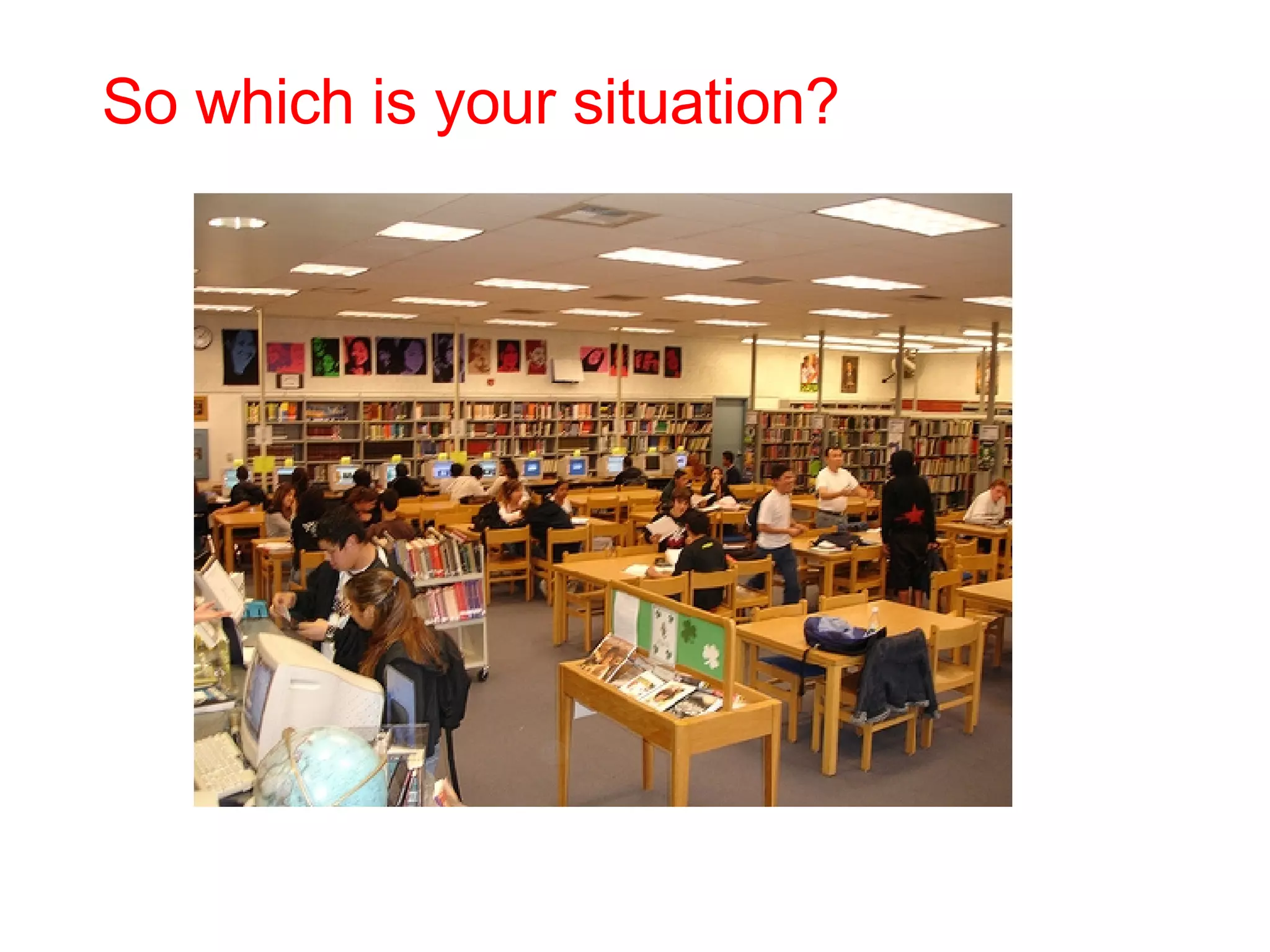
So which is your situation?
 
is at the heart of a school learning community. It can provide a flexible place for learning where project work, individual study and group research can take place. [It] can provide young people with the means to freely pursue subjects which fully engage them, and promote wider reading. Good libraries can also support teachers in adopting a broad range of teaching strategies. Charles Clarke Improve your library: a self-evaluation process for secondary school libraries (DfES 2004) A dynamic school library : ‘ It is important for headteachers, senior managers and librarians to work together to develop library provision that benefits the whole school and it’s pupils’ Miriam Rosen OFSTED’s Director of Education Good School Libraries; Making a Difference to Leaning (Guardian 21/3/2006
In the most effective schools: well trained specialist librarians  had a positive impact on teaching and learning.  librarians were regarded as  key middle managers  and encouraged to work closely with other members of staff.  pupil librarians  were also seen as an essential part of the best library teams. librarians used a wide range of effective strategies to  promote reading ,  planned lessons  alongside subject teachers and used different ways to  evaluate  the impact of the library on pupils’ learning.  libraries were  well funded “ Good school libraries: making a difference to learning ”(Ofsted, March 2006)
Weaknesses  identified: funding  for libraries varied significantly  use by pupils once they entered  key stage 4  declined  too  few opportunities for pupils to carry out research  or work independently - many pupils struggled to locate and make use of information. Good school libraries: making a difference to learning ”(Ofsted, March 2006)
Actions to improve : increase use of the library  by teachers and pupils throughout the day, especially Key Stage 4 pupils develop the quality and coherence of  programmes for teaching information literacy  to provide better continuity, challenge and progression in pupils’ learning promote pupils’ independent study  by more effective use of the library improve  evaluation  of the library Those responsible for advising and supporting schools in developing their libraries (SLS?) need to work with SLT, as well as librarians, in order to  develop provision and integrate developments with other whole-school priorities . “ Good school libraries: making a difference to learning ”(Ofsted, March 2006)
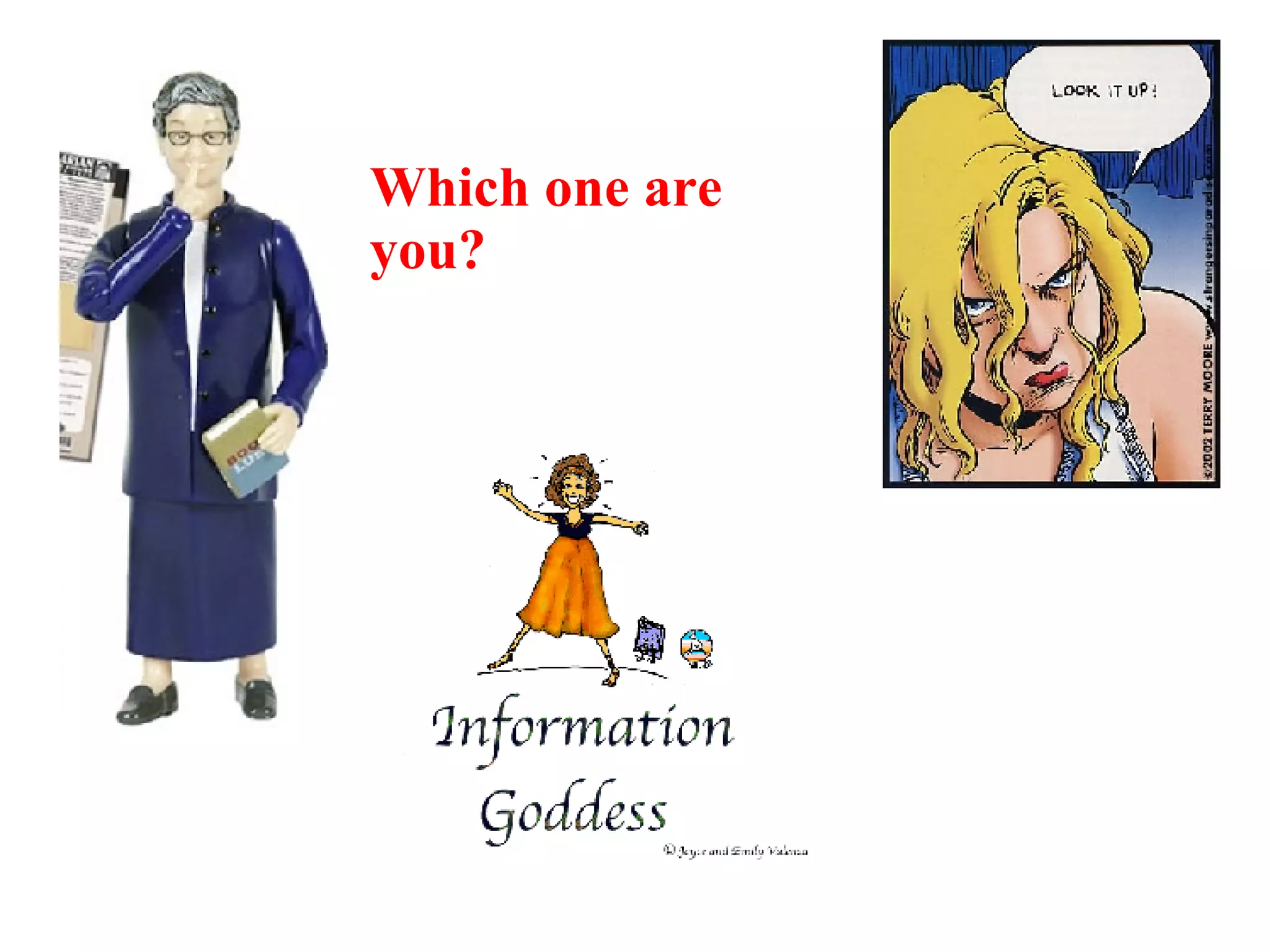
Which one are you?
Inspection teams in all parts of the UK are keen to see: Well  staffed, resourced & used  libraries Clear  curriculum links  between LRC and curriculum staff who work in partnership Effective use of  library ICT Knowledgeable & motivated LRC staff  actively   promoting effective use, information literacy & reading LRC links to  out-of-hours  learning A library portfolio of  evidence  of LRC work: copies of policies, the LRC development plan, data from performance measurement, examples of work done by pupils who used LRC resources and guidance. “ Information Matters: developing information literacy skills through the secondary school LRC”  SLA, 2005
“ The school library is ideally placed to bring reading for pleasure to life” Paul Kropp “The Reading Solution” 1995 Strategies:  Create a Reading Culture
Creating a Reading Culture Why read? Gateway to learning, personal and social skills Develop imagination Stress relief Connects us to others Creative Helps you make sense of yourself and the world around you
Creating a Reading Culture PIRLS - Reading all over the world “  Children who read most frequently for fun were also those with the highest score on PIRLS” PISA 2000 - Reading for change “ Being more enthusiastic about reading and a frequent reader was more of an advantage, on its own, than having well-educated parents in good jobs.” Research shows that reading for enjoyment is “more important for children’s educational success than their family’s socio-economic status” (OECD, 2002) Progression in International Reading and Literacy Programme for International Student Assessment Organisation for Economic Co-operation and Development
Creating a Reading Culture School inspectors in 2006 highlighted the fact that a fifth of 11 year olds could not read properly- 150,000 children.These students are at a disadvantage in accessing the curriculum Although “Reading for Change” placed young people in UK seventh out of 33 countries surveyed in terms of functional literacy skills there was a decline in  attitudes  to reading as children get older and a long record of underachievement for those with reading difficulties
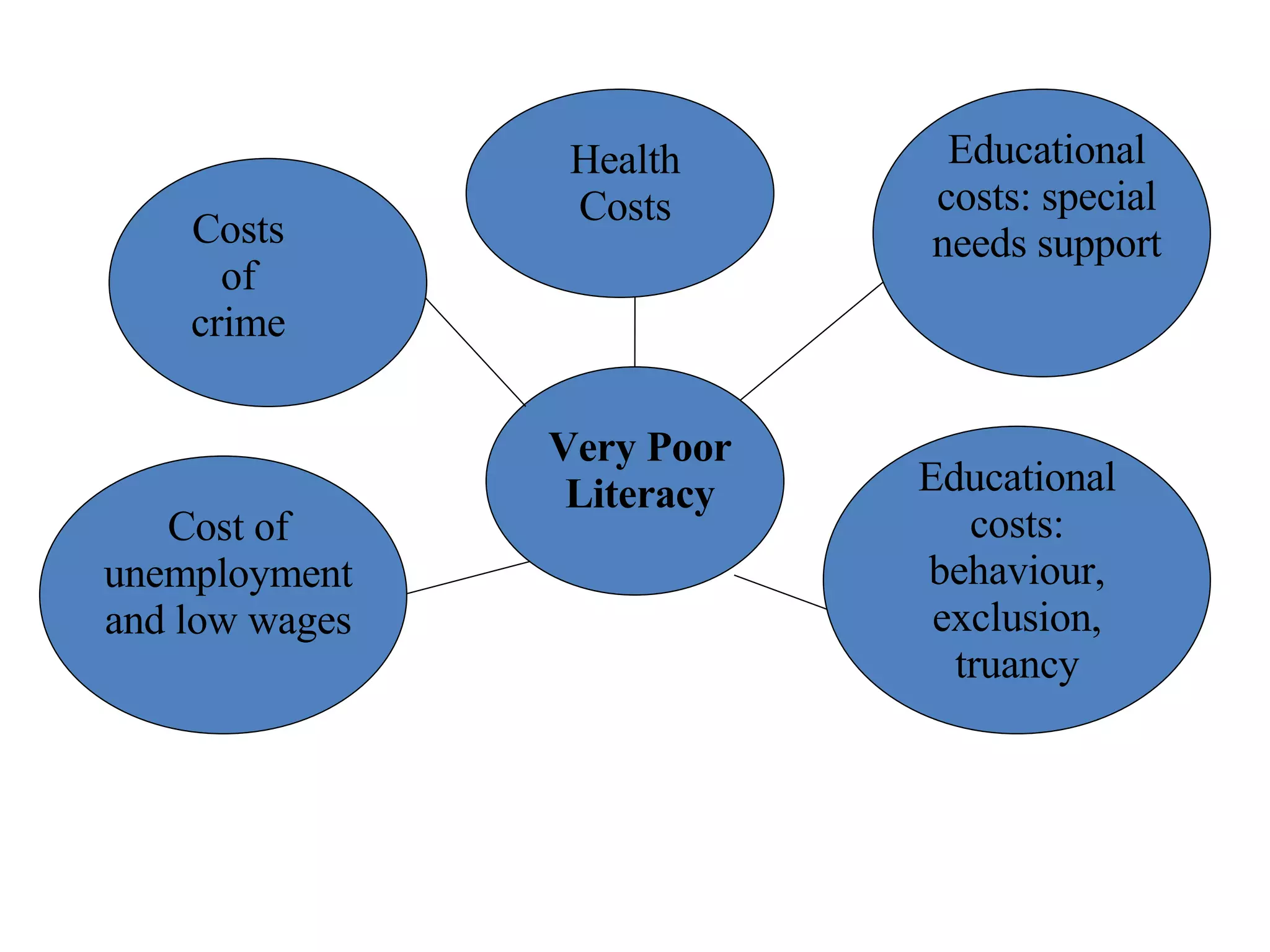
Very Poor Literacy Costs of crime Health Costs Educational costs: special needs support Educational costs: behaviour, exclusion, truancy Cost of unemployment and low wages
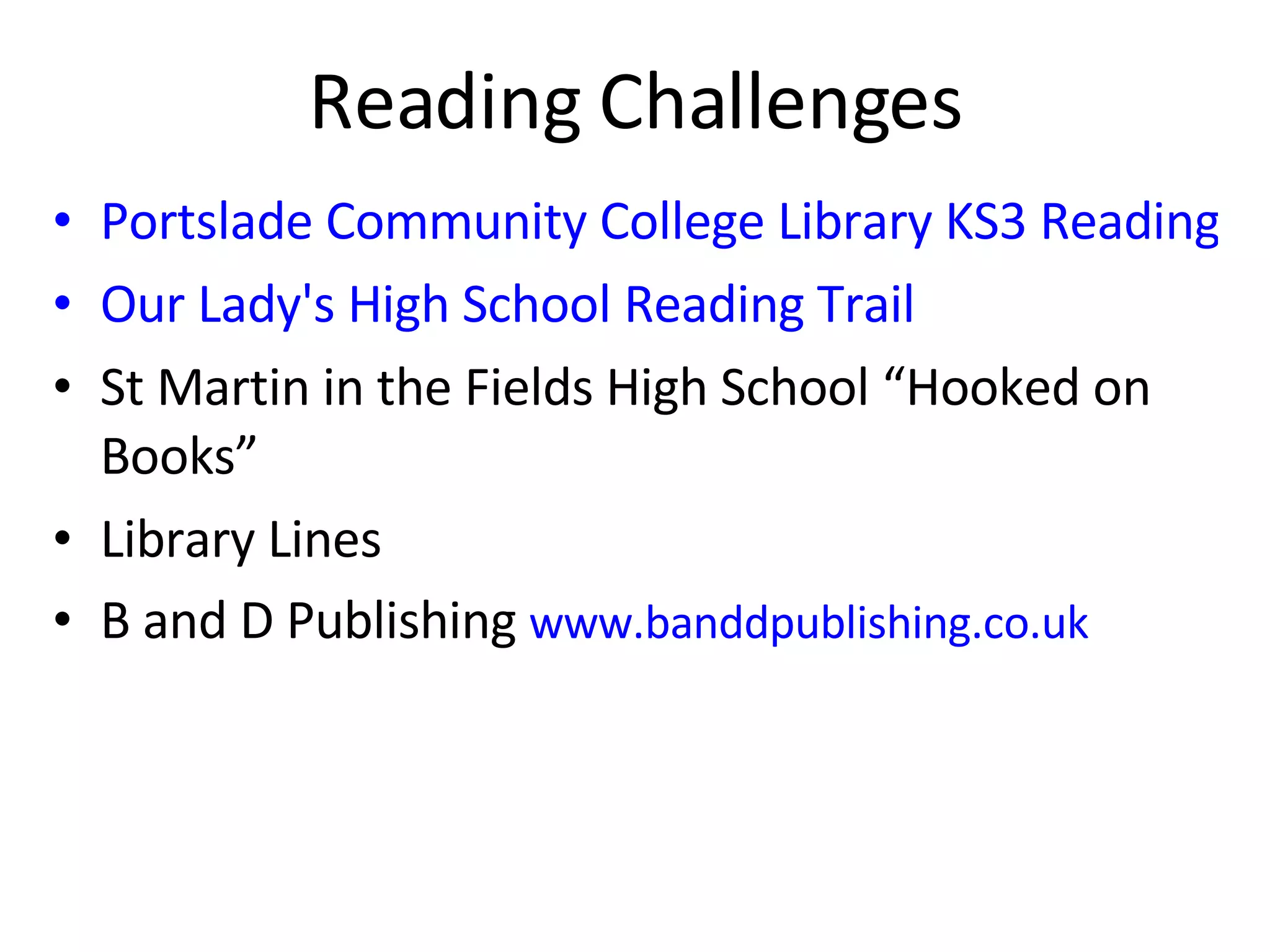
Reading Challenges Carnegie Shadowing and other Book Awards Book Boxes, reading mornings, review magazines, book sales, assemblies, rewards Bookweeks –Big Reads,  World Book Day,  and other national events Reading Clubs/Groups – staff and students, reading Buddies Creating a Reading Culture: How do you go about it?
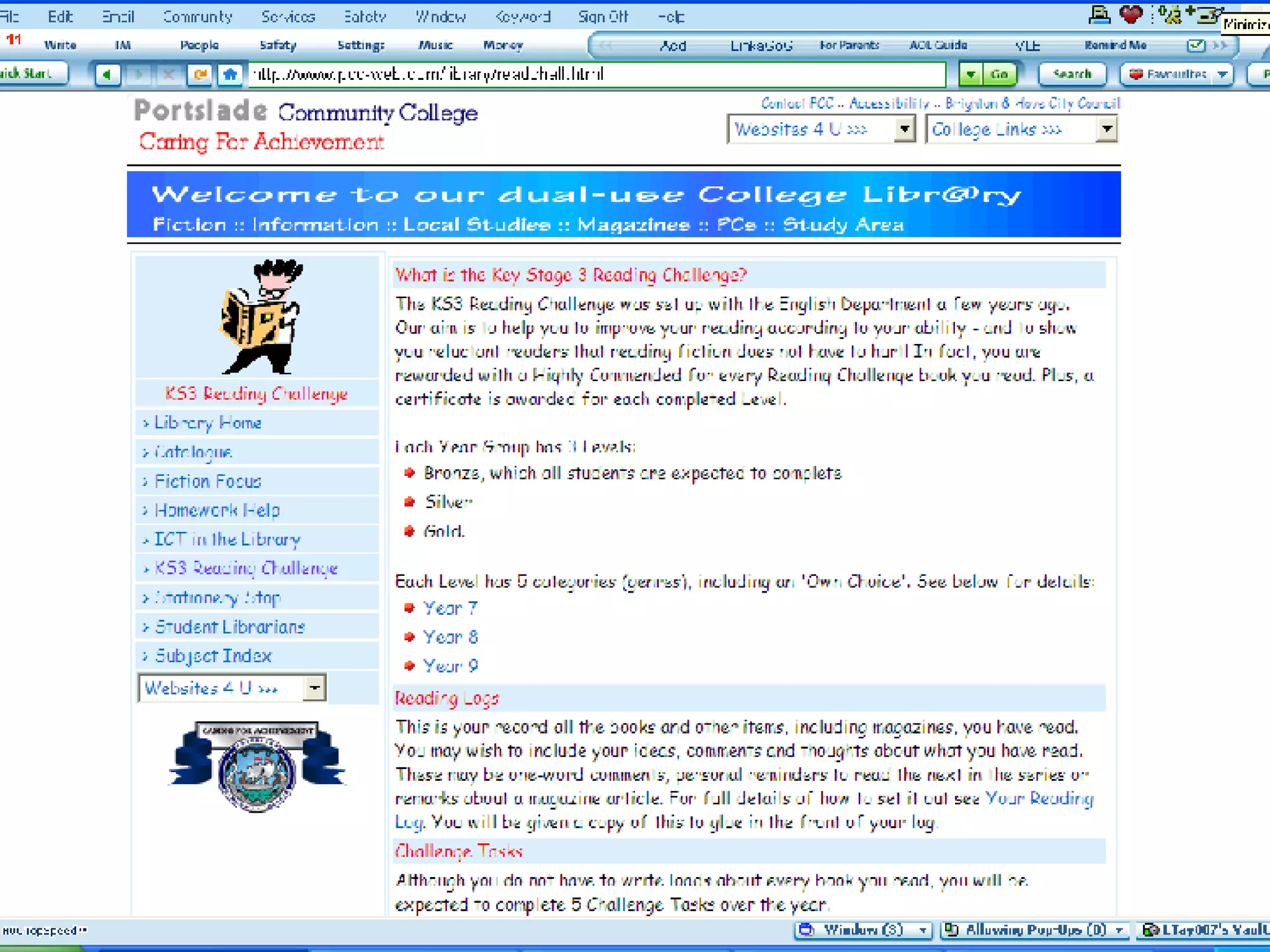
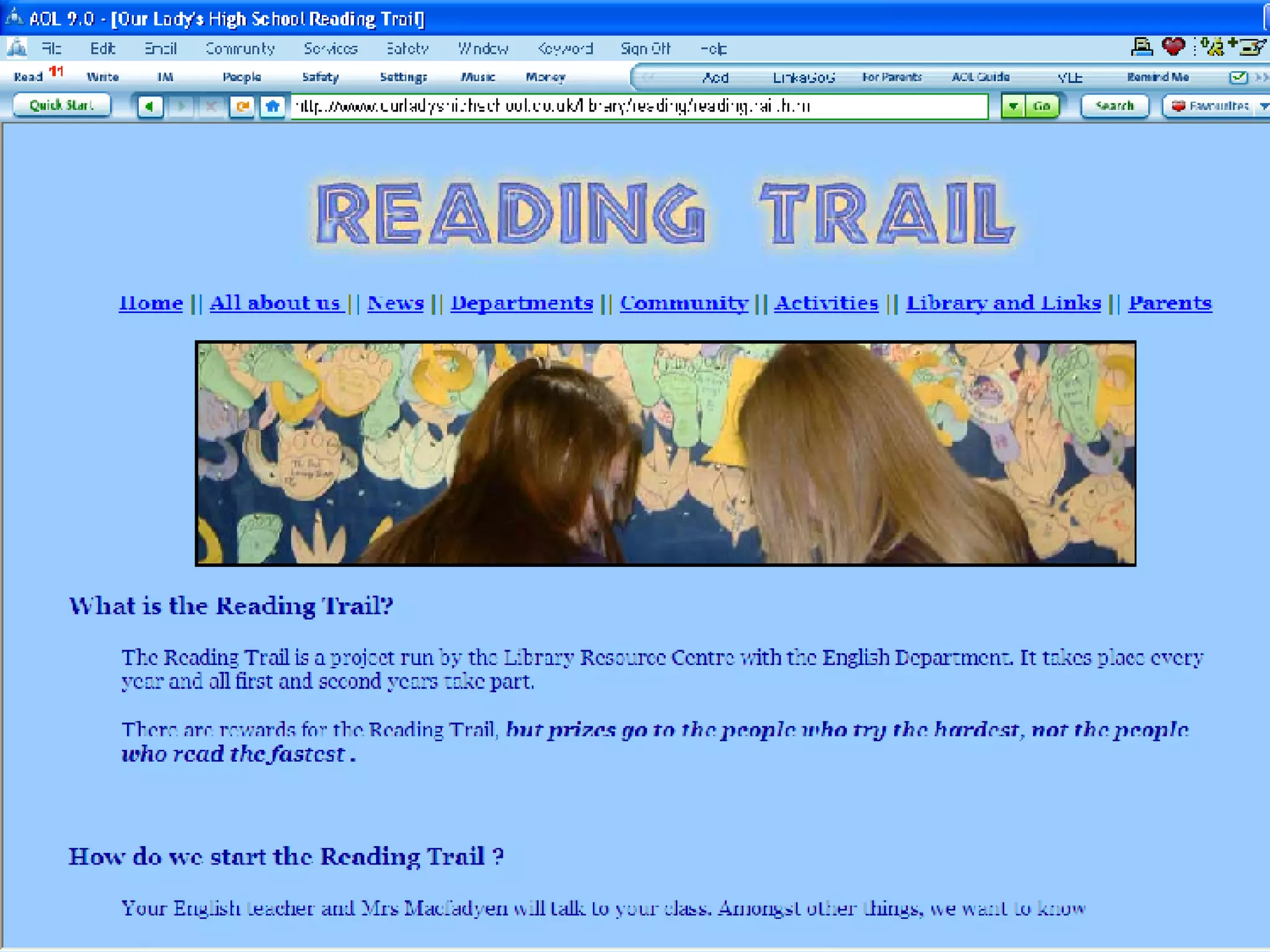
Reading Challenges Portslade Community College Library KS3 Reading Challenge Our Lady's High School Reading Trail St Martin in the Fields High School “Hooked on Books” Library Lines B and D Publishing  www.banddpublishing.co.uk
 
 
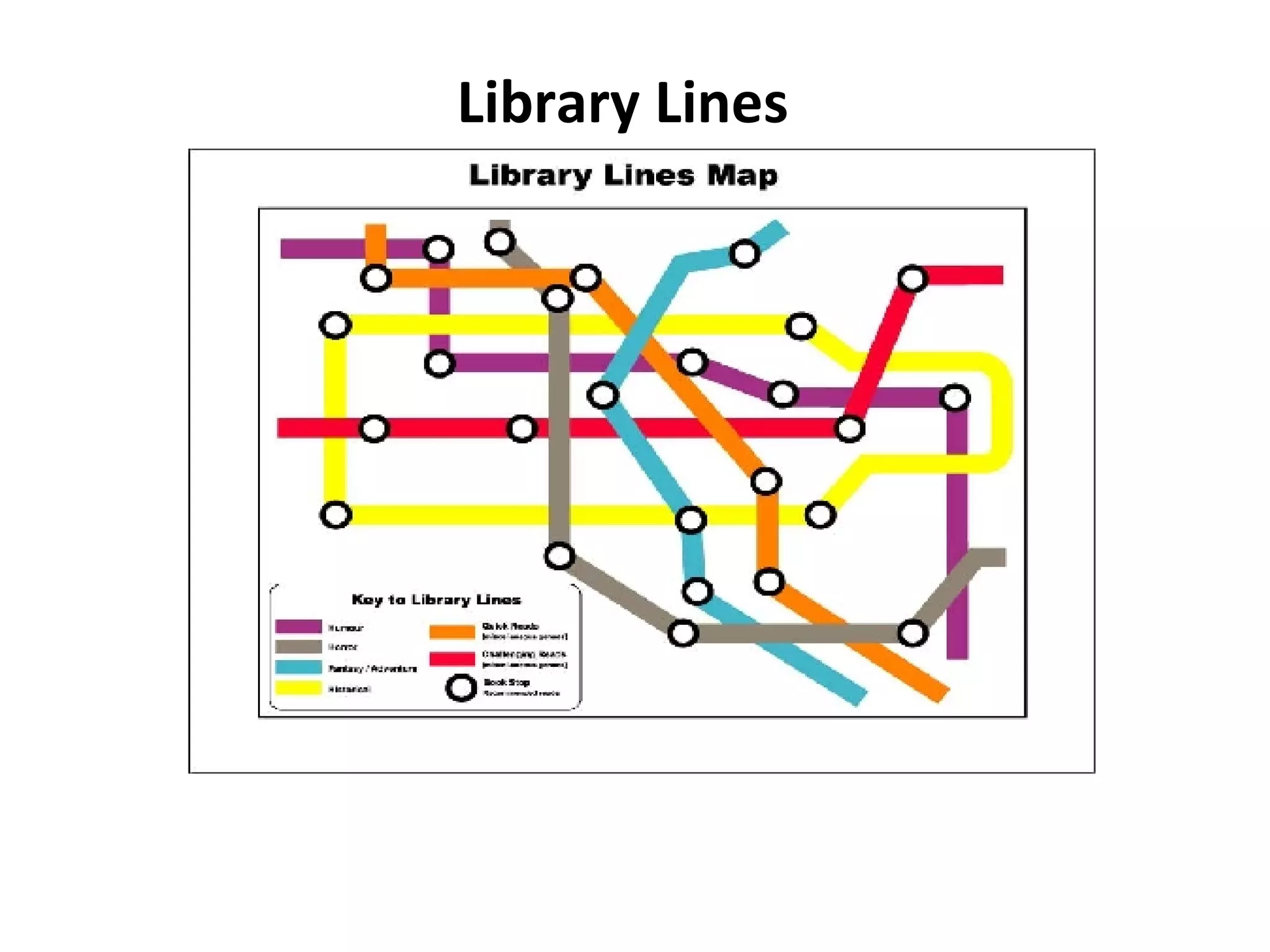
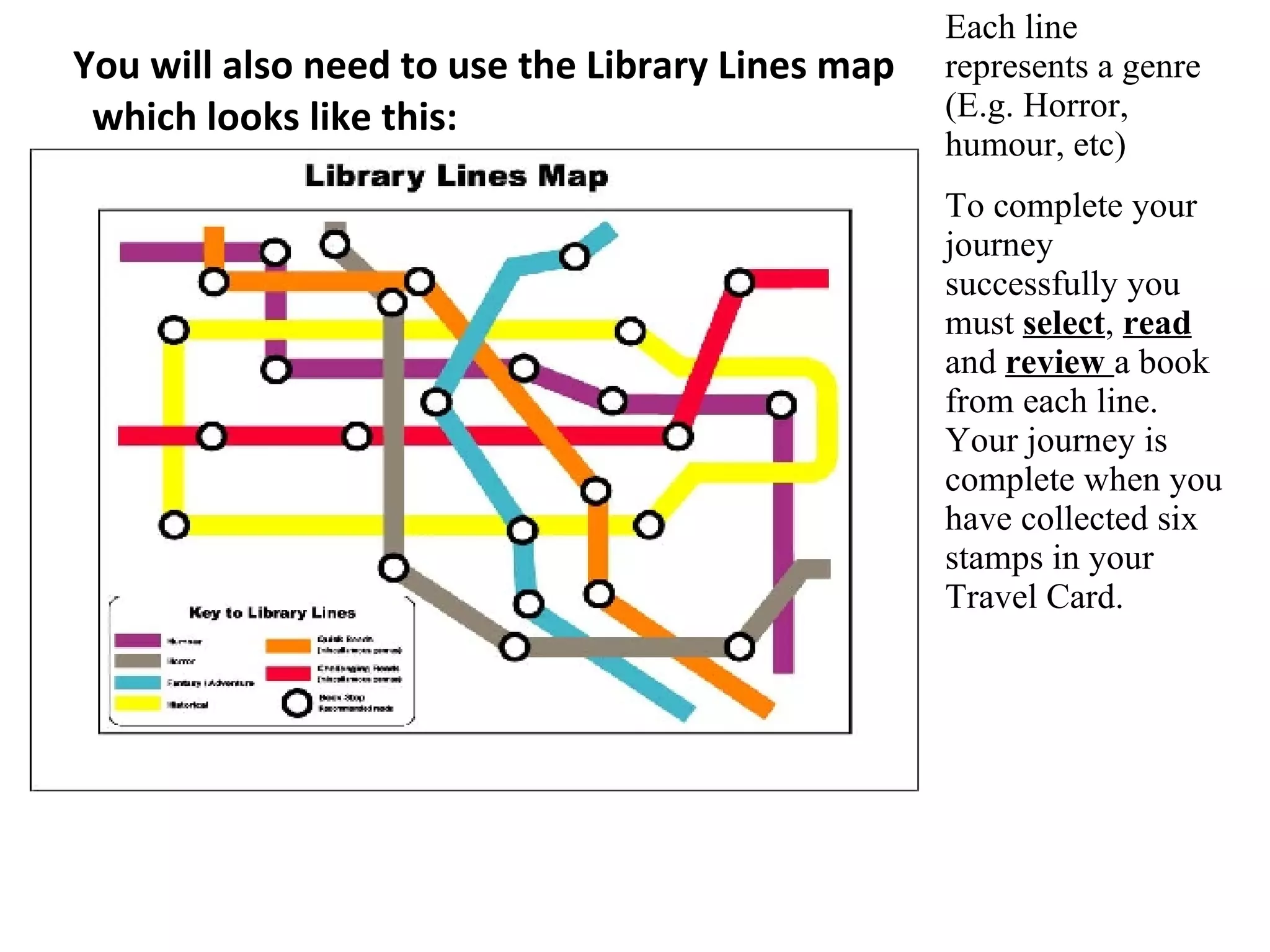
Library Lines
You will also need to use the Library Lines map which looks like this: Each line represents a genre (E.g. Horror, humour, etc) To complete your journey successfully you must  select ,  read  and  review  a book from each line.  Your journey is complete when you have collected six stamps in your Travel Card.
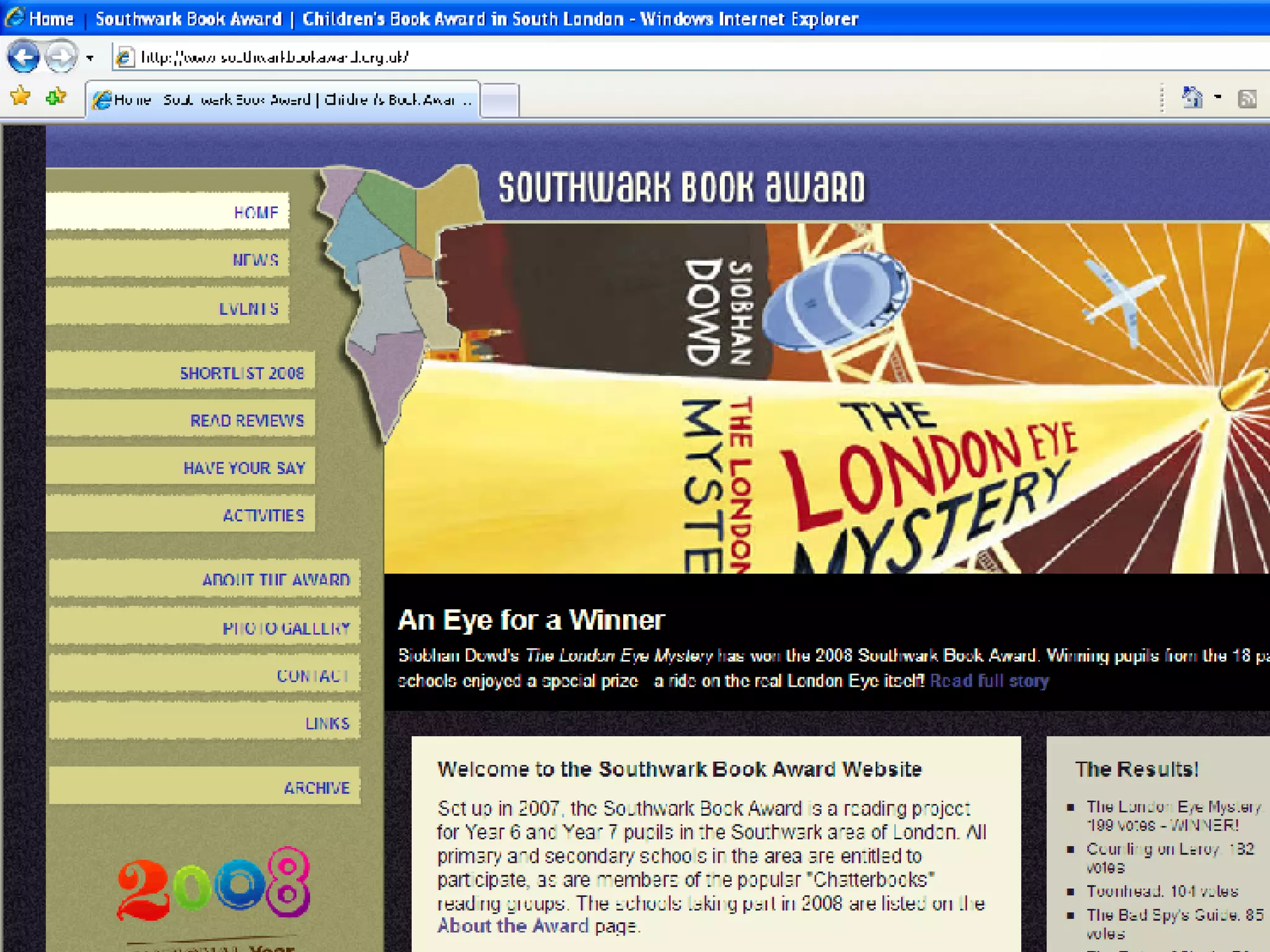
Book Awards Carnegie/Greenaway:  www.ckg.org.uk Red House  www.redhousechildrensbookaward.co.uk Bookheads  www.bookheads.org.uk Smarties/Guardian/Whitbread Blue Peter Local  www.southwarkbookaward.org.uk
 
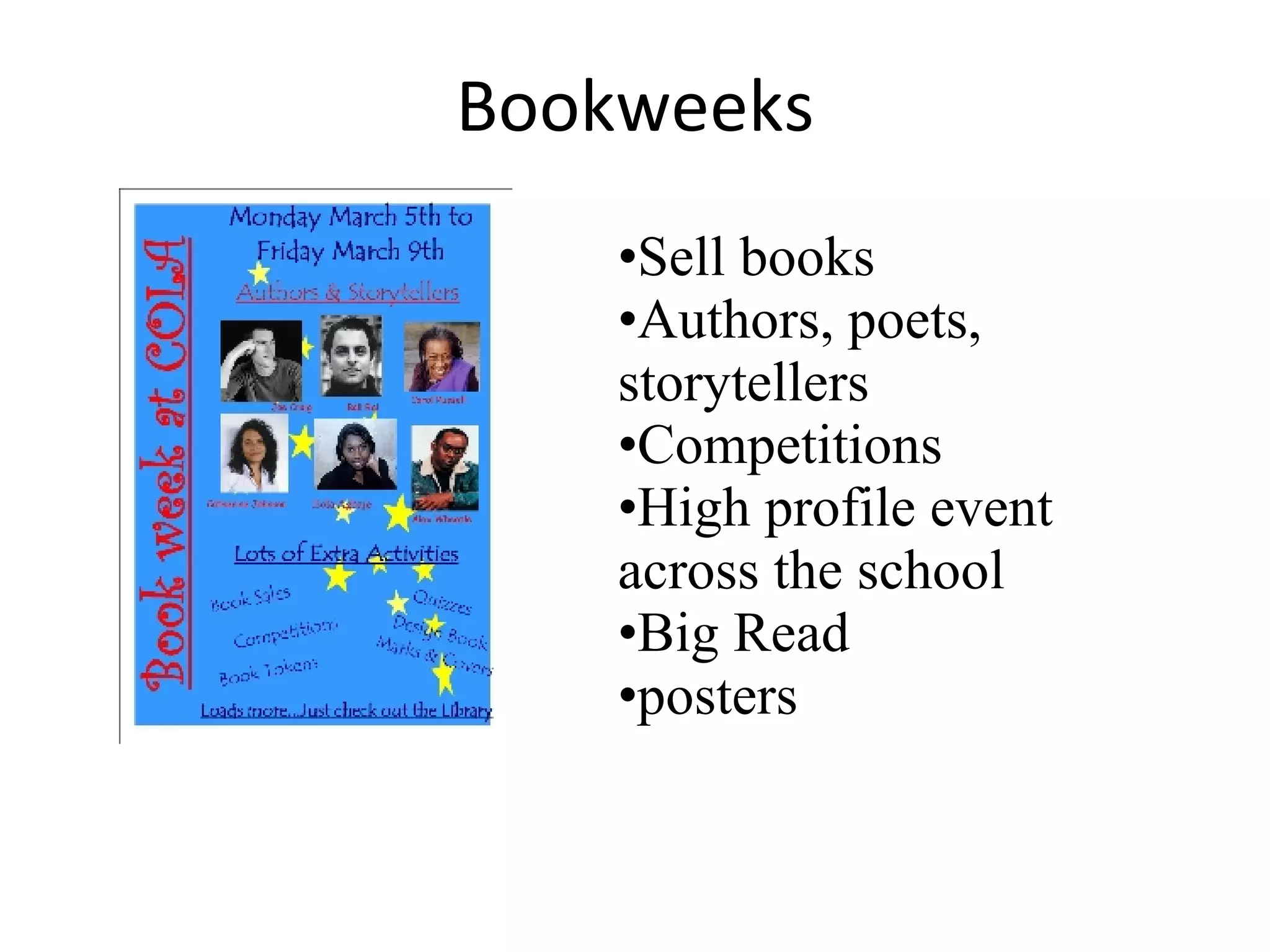
Bookweeks Sell books Authors, poets, storytellers Competitions High profile event across the school Big Read posters
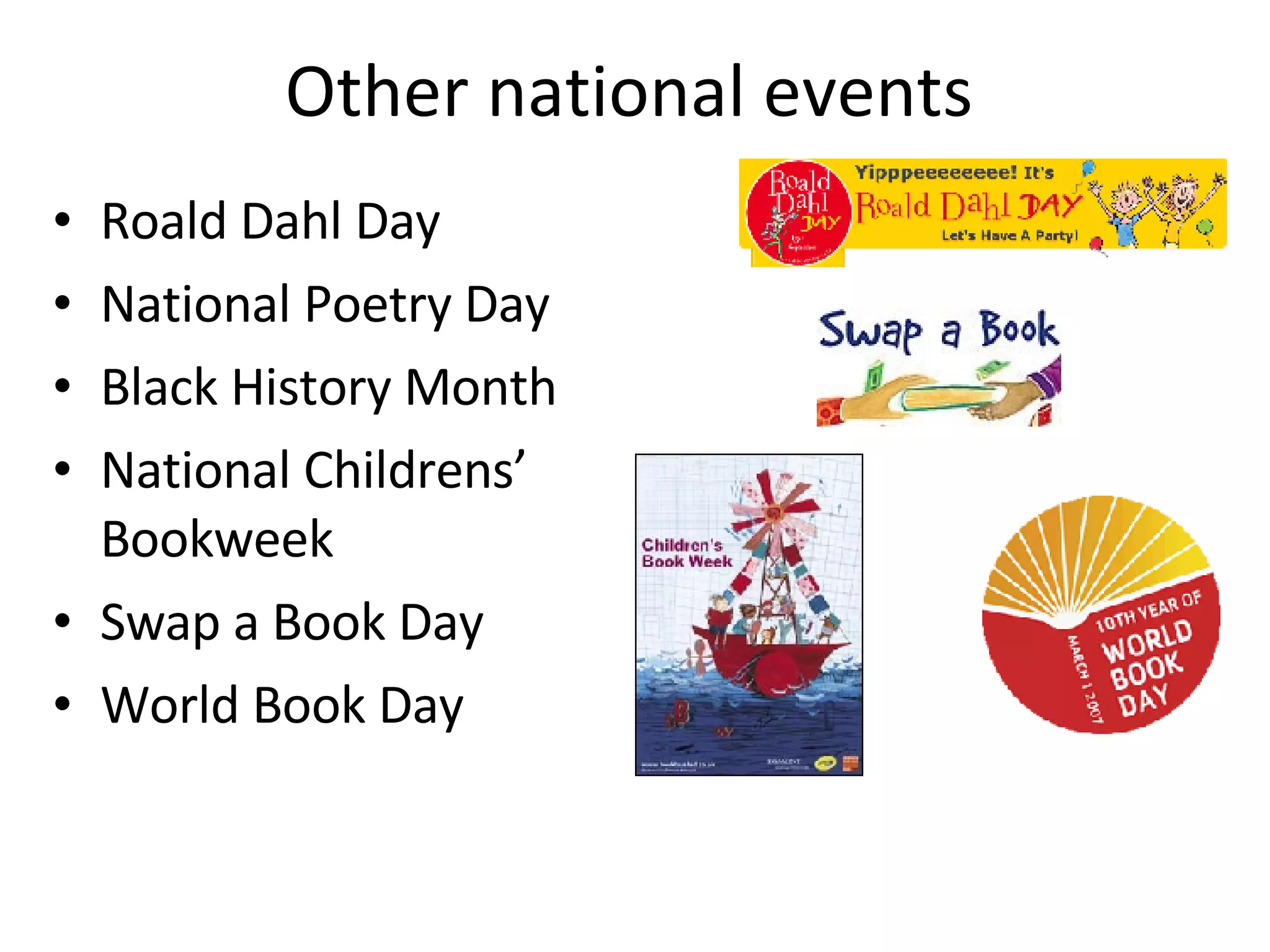
Other national events Roald Dahl Day National Poetry Day Black History Month National Childrens’ Bookweek Swap a Book Day World Book Day
Reading Clubs/Groups www.readingclub.org.uk www.readinggroups.co.uk Joint staff and 6 th  Form group Carnegie G and T Reading Buddies
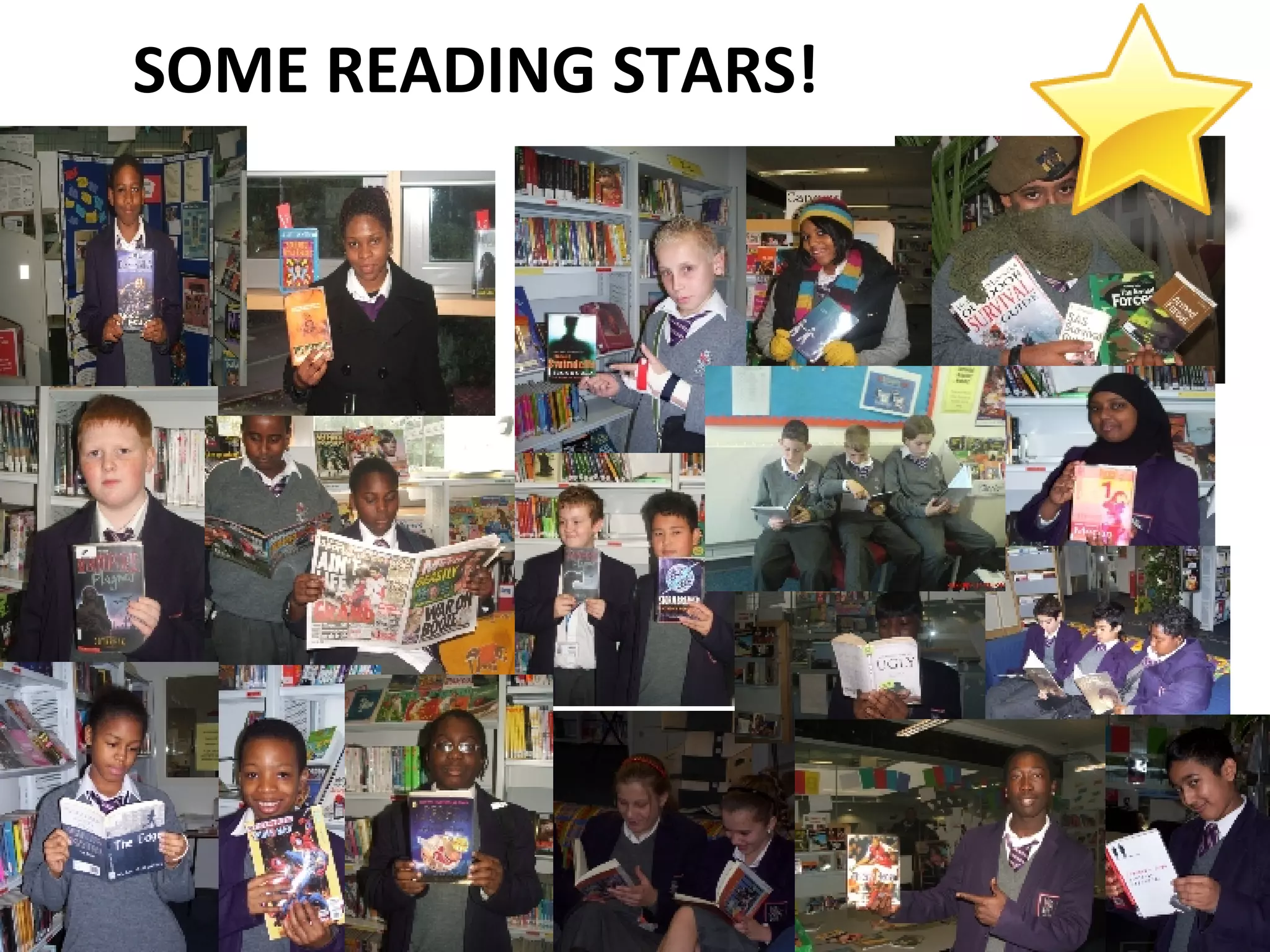
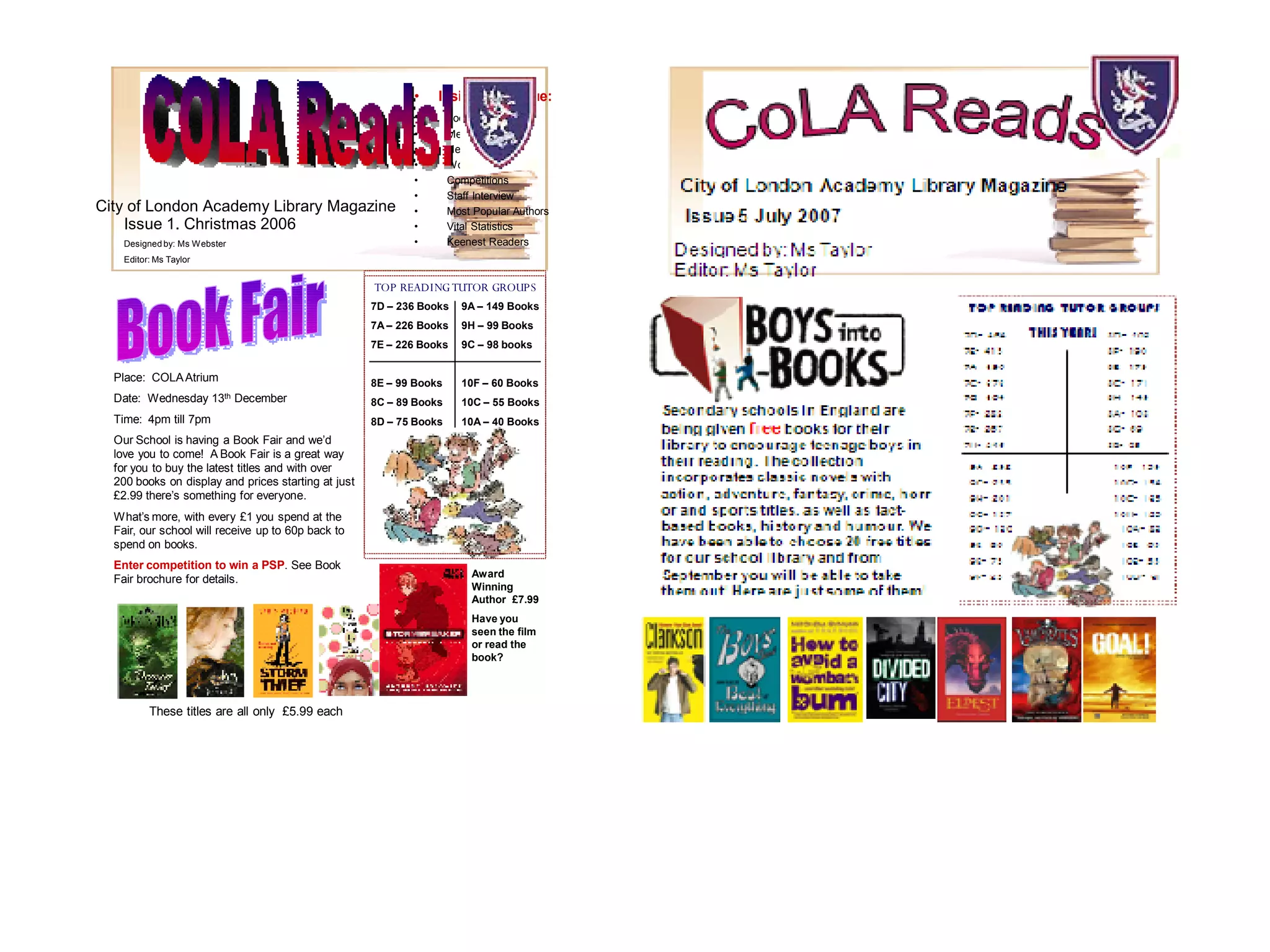
SOME READING STARS!
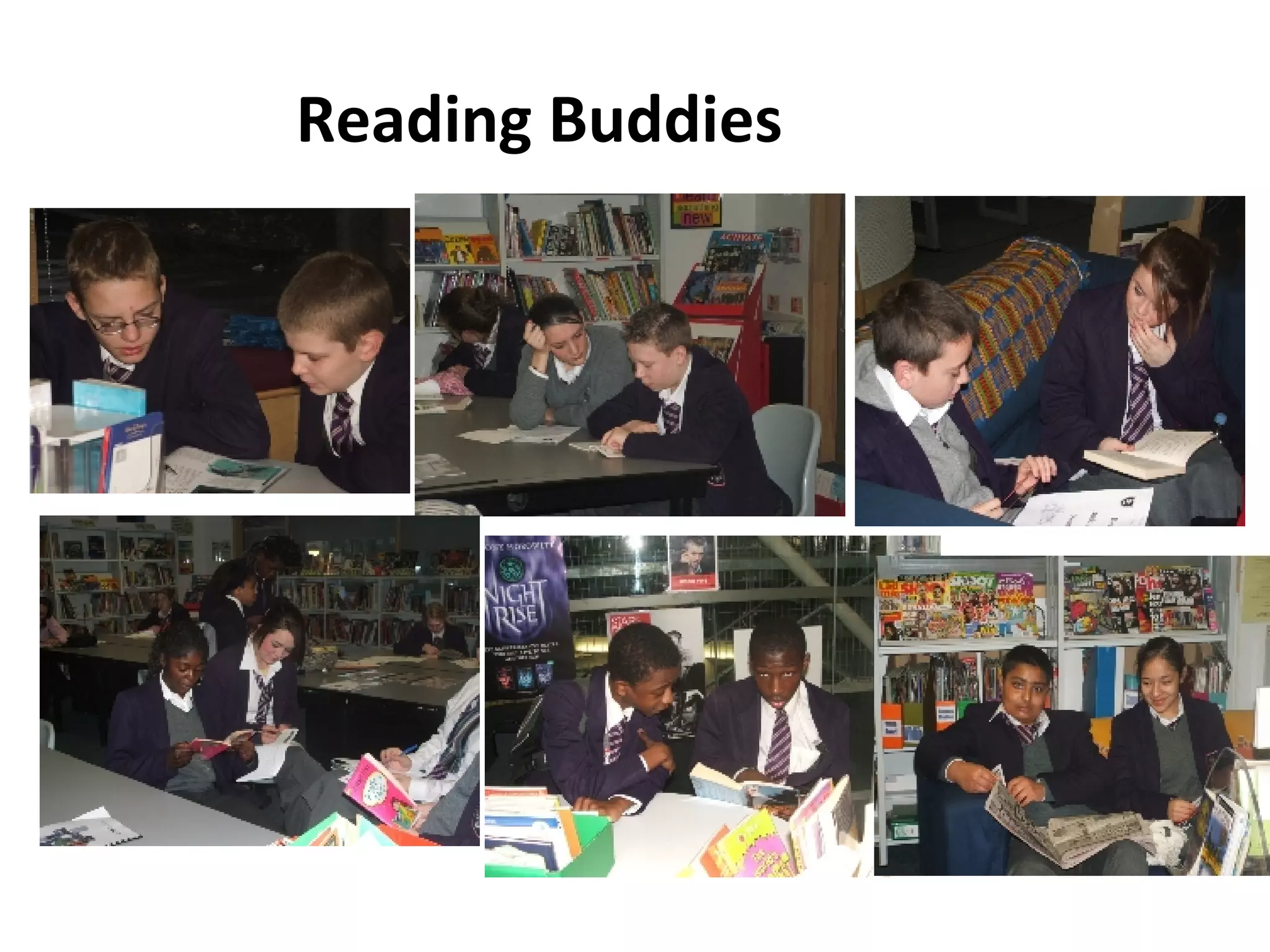
Reading Buddies
 
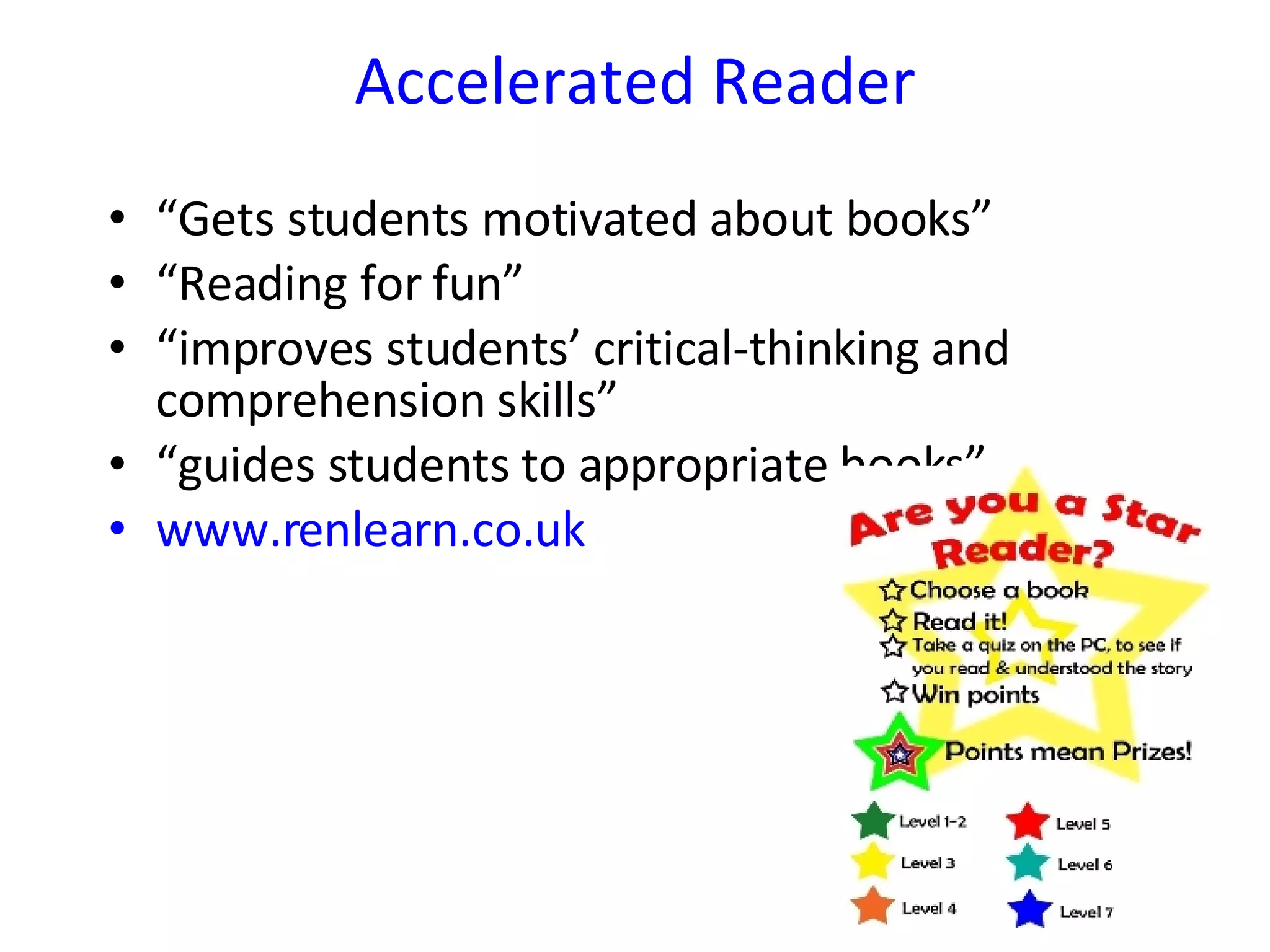
Accelerated Reader “ Gets students motivated about books” “ Reading for fun” “ improves students’ critical-thinking and comprehension skills” “ guides students to appropriate books” www.renlearn.co.uk
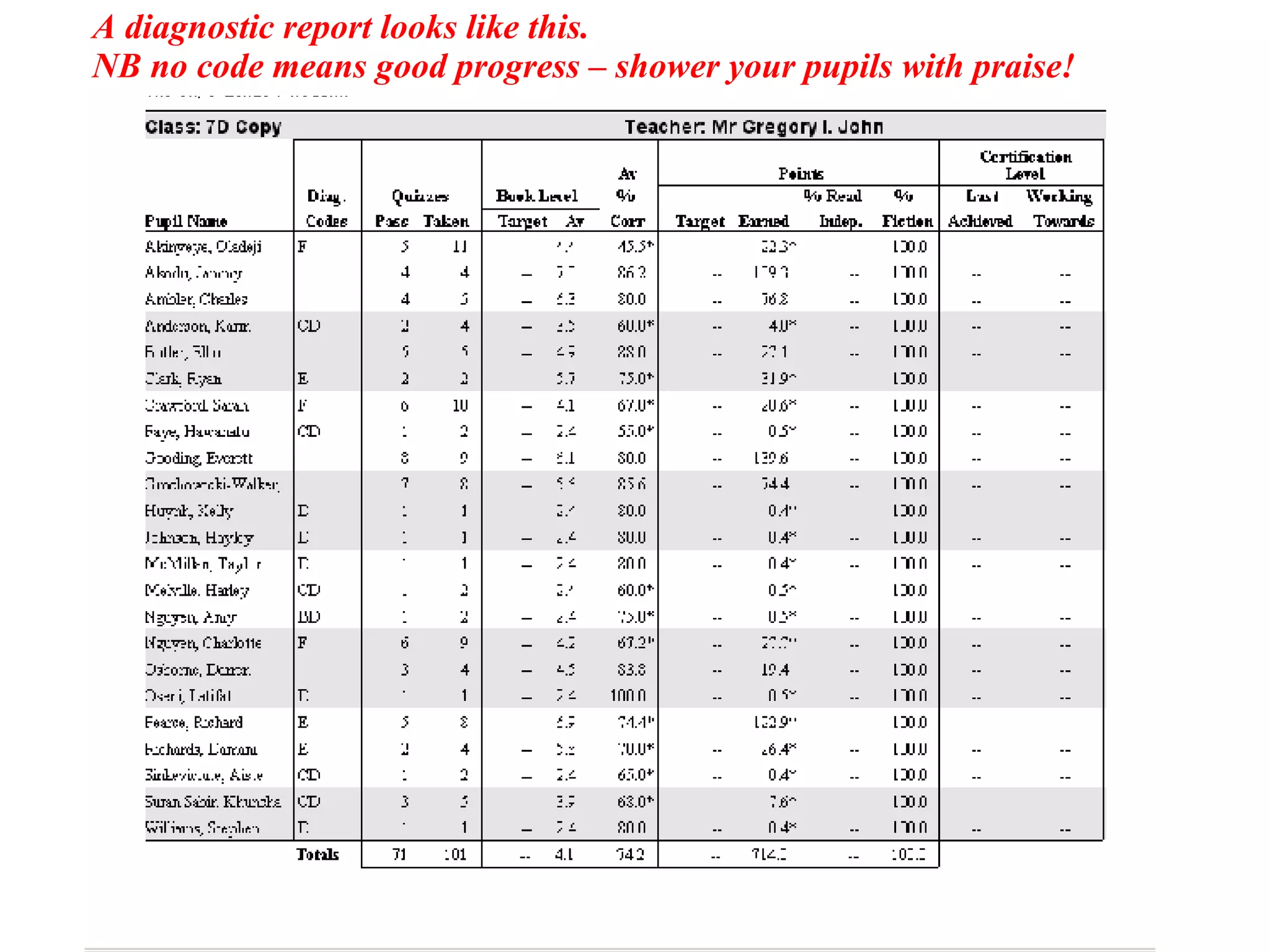
Accelerated Reader Renaissance Learning promises to raise pupils’ reading scores by 2 years within 12 months. Star Reader test. ZPDs. Multiple choice on-line quizzes for which students receive points and a percentage score. Detailed diagnostic reports allow staff to identify which students need extra help, are reading at the wrong level etc. Books allocated levels from 1-12. Introduced to all specialist secondary schools and academies in England. Already used in 67,000 schools worldwide £10 per pupil
A diagnostic report looks like this.  NB no code means good progress – shower your pupils with praise!
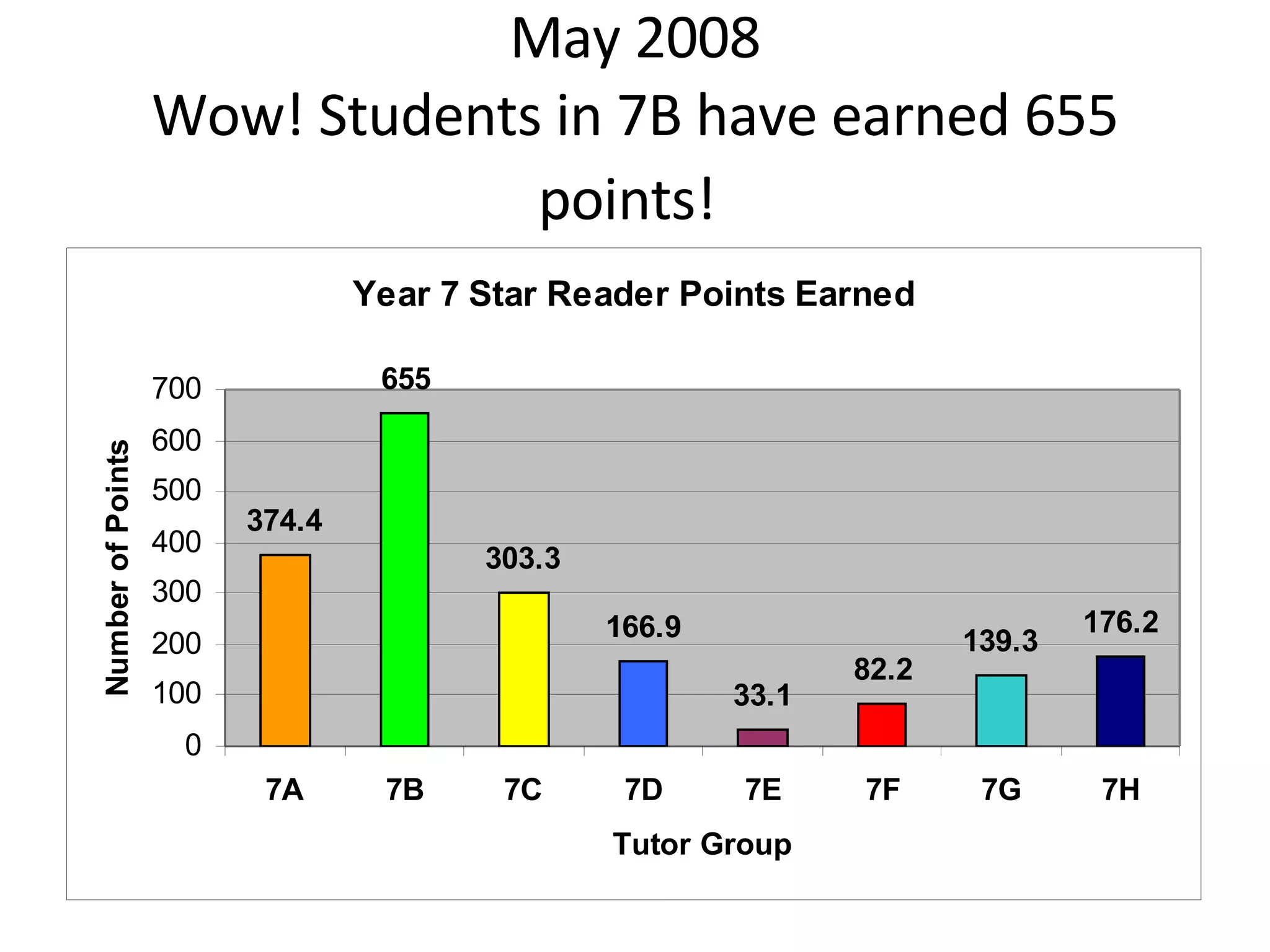
May 2008 Wow! Students in 7B have earned 655 points!
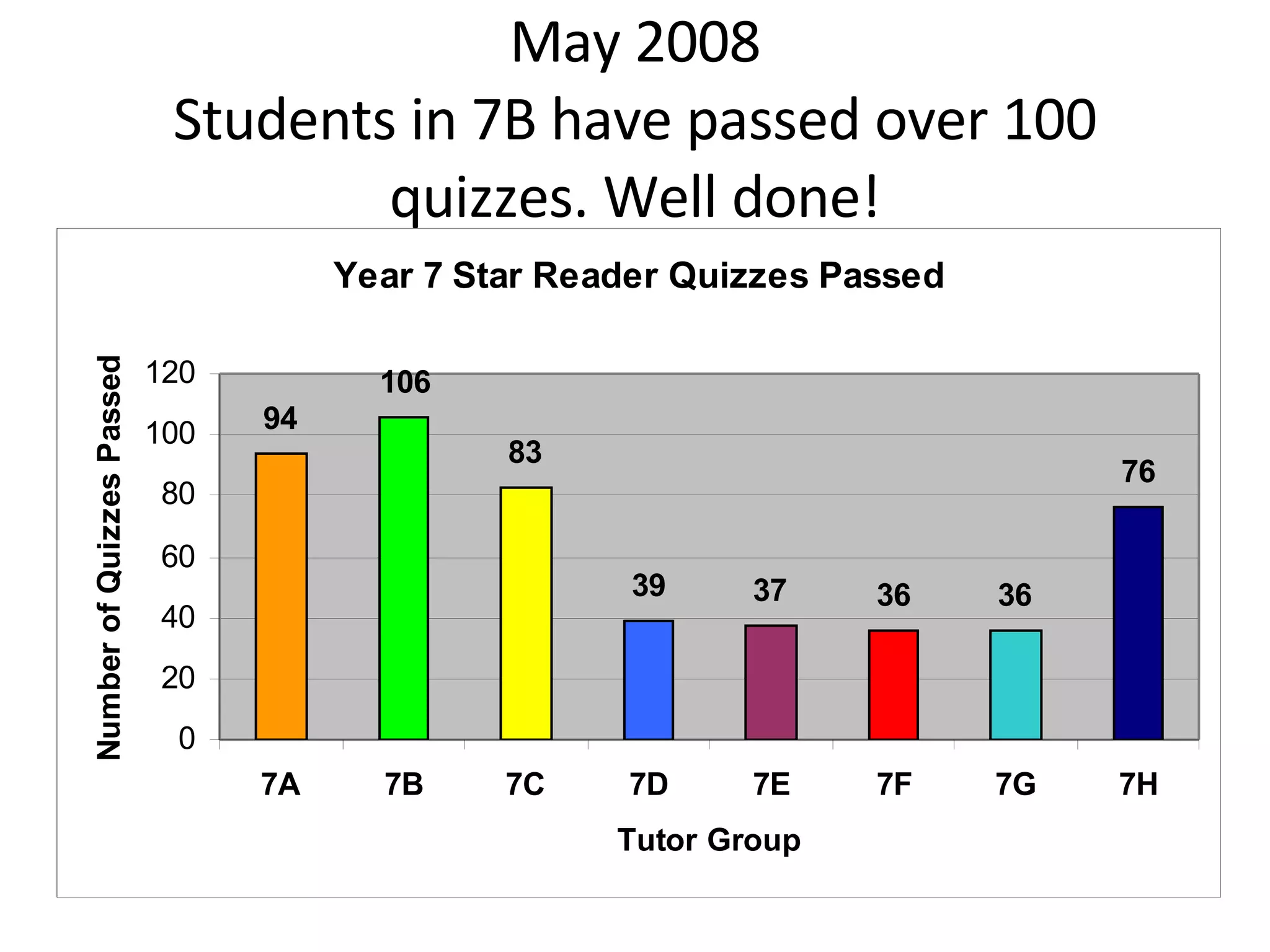
May 2008 Students in 7B have passed over 100 quizzes. Well done!
Advantages? Fiction and non-fiction texts - wide range 8,000 titles Networkable so accessible throughout the school May tie in with Library Management system Helps guide and motivate students to find books they will enjoy. Kids enjoy quizzes and computers. Levels now match NC levels You can write your own quizzes – or get students to do this  Adds to a school’s Reading Culture? Encourages allocated time for reading in the school curriculum. Raises profile of the library.
Disadvantages? Lacking in quizzes for lower secondary years. Delay in writing quizzes for new books. More aimed at primaries Expensive as a package and in resources Need full involvement of English dept, tutors and Learning Support Labels the kids Some of the AR Book levels are questionable. Seems to be a purely mechanical assessment of each book based on words per line/per page rather than content/concepts  Points allocated for different length/level of books seem unfair Short term rewards. Does it really motivate students? Is it just a tick-box exercise which appeals to teachers/educationalists dominated by assessment/levels etc
Issues to consider Time and cost setting up the scheme. Who will pay for it? Introduce in a small way or launch across the whole school? How many quizzes? Need to relaunch each year with new students and new staff? Launch via English dept or tutor system? Does it improve long term reading and critical literacy abilities? Might the money be better spent elsewhere?
Strategies: ICT  “ Young people’s engagement with ICT facilitates and motivates literacy rather than displacing reading” ( Elaine Millard, Differently literate) Email and Video – conferencing Websites Accelerated Reader Blogs and wikis VLEs and intranets- forums, discussions, votes, quizzes,  E-books and audio books podcasts
 
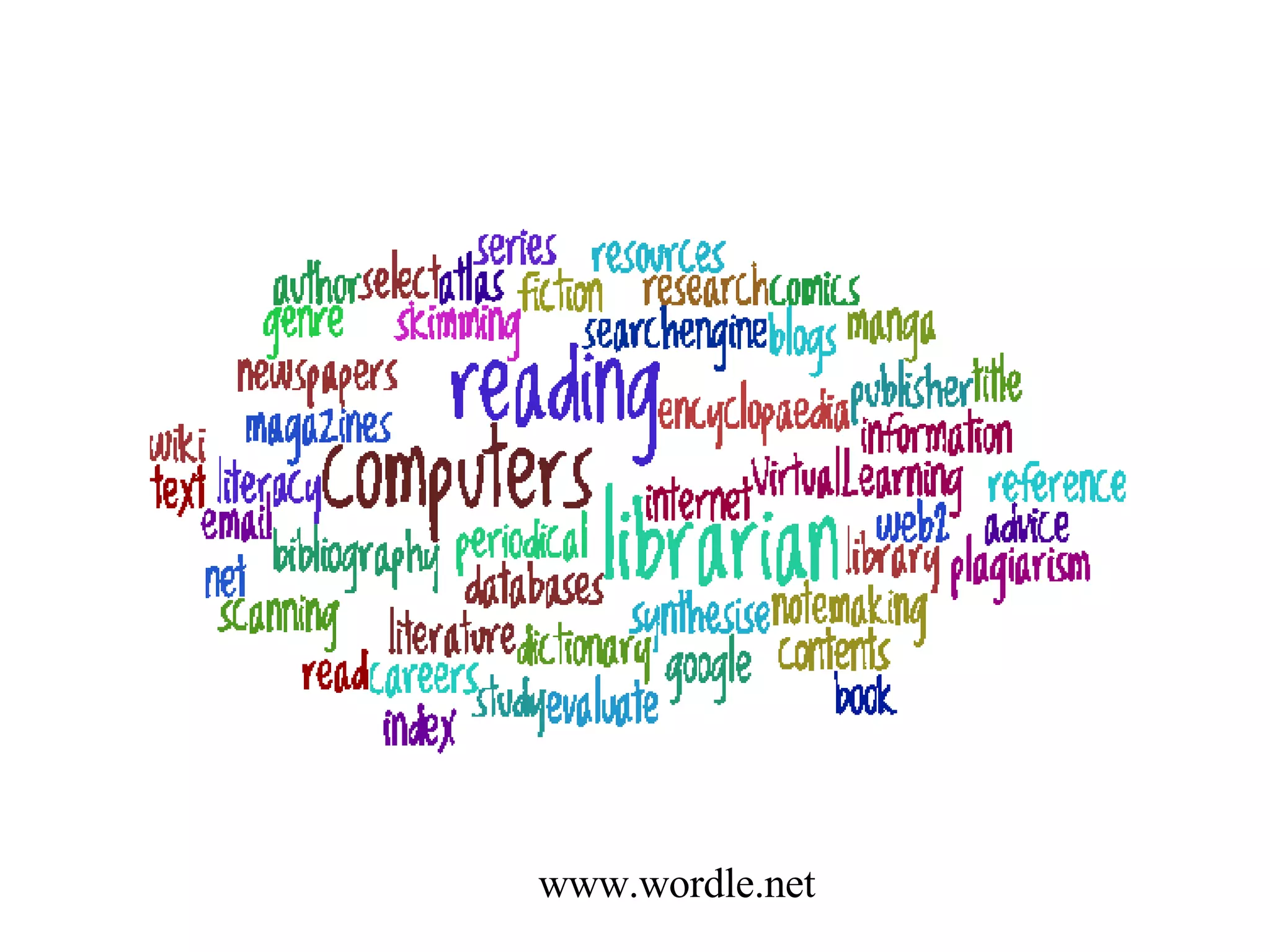
www.wordle.net
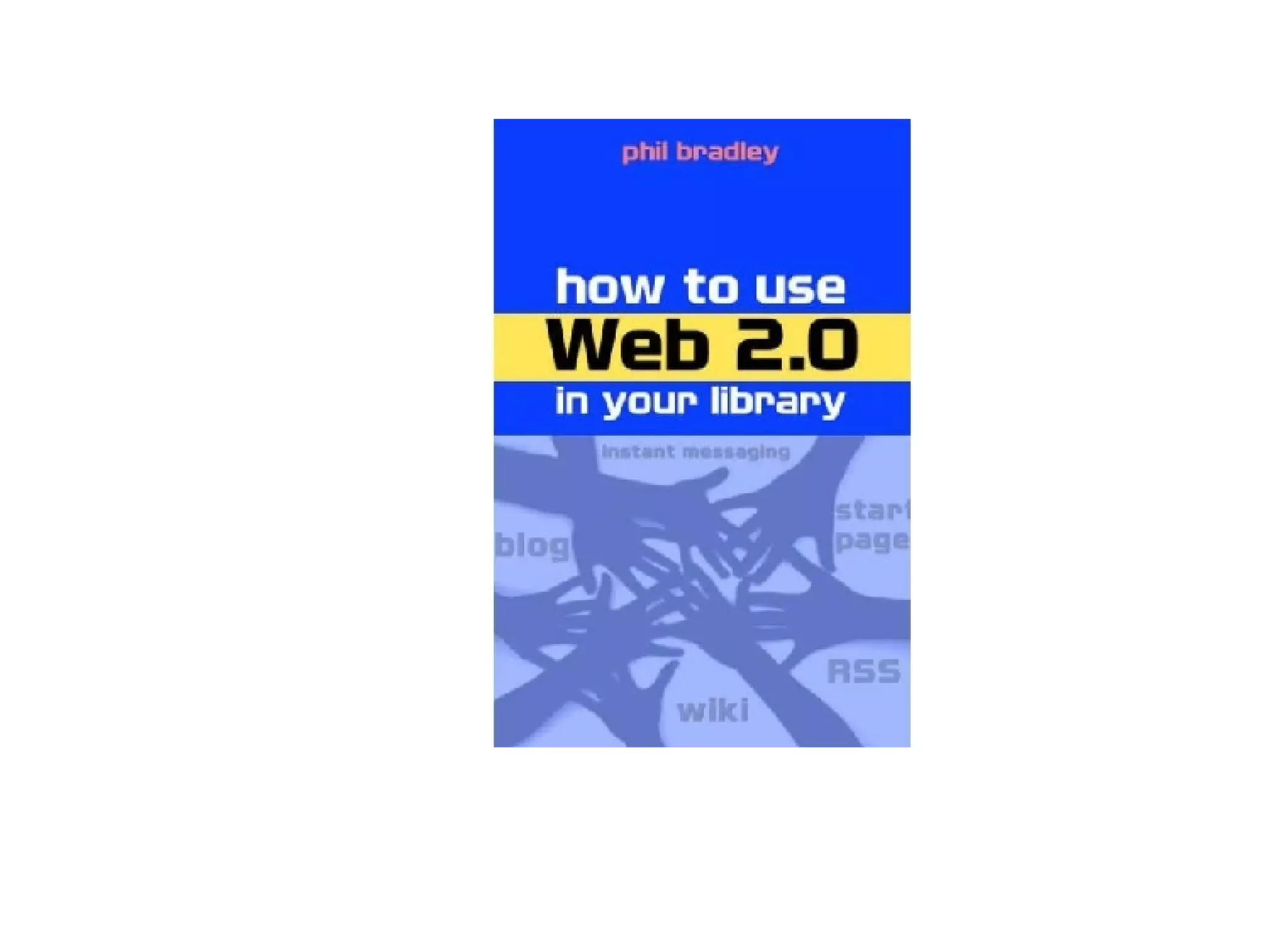
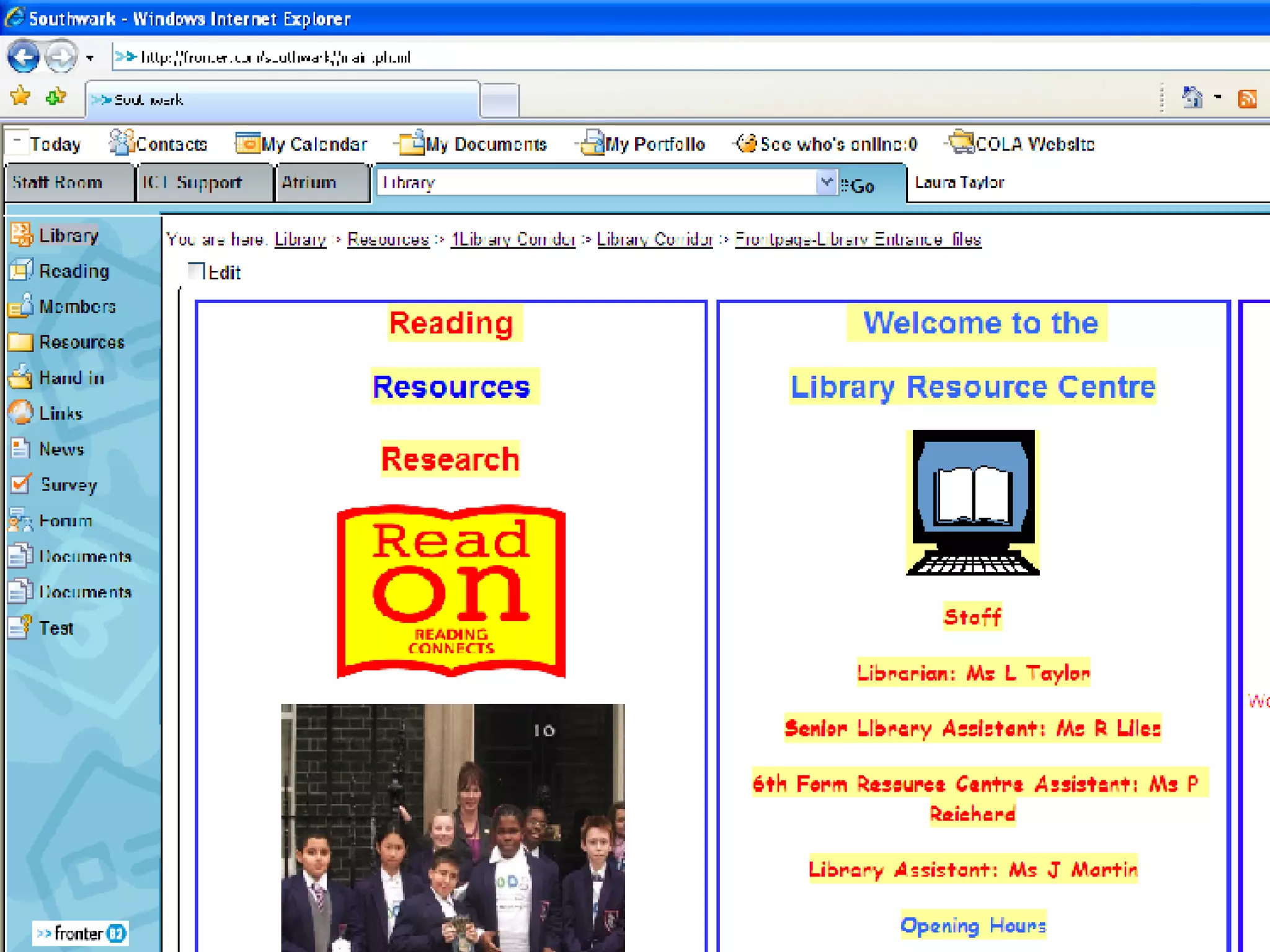
Some Web 2.0 tools to explore? www.philb.com-  Phil Bradley- alias the guru! http://webtools4u2use.wikispaces.com http://schoollibrarylearning2.blogspot.com/-  23 things to try www.pageflakes.com http://delicious.com www.wordle.net www.voicethread.com www.rollyo.com www.slideshare.net www.flickr.com www.youtube.com http://issuu.com https://widgets.amazon.com/ www.kn.pacbell.com/wired/fil/ www.fronter.com/southwark
 
Blogs Stewart's Melville Library Holmesdale Technology College News Cumnock Academy Library Resource Centre Bramcote Hills LRC www.blogwithoutalibrary.net/links/index.php?title=School_libraries
A Hotlist of Book Websites www.kn.att.com/wired/fil/pages/listbookwebla.html A Hotlist of Word Games www.kn.att.com/wired/fil/pages/listwordgamla.html Boox – new website www.readingagency.org.uk/projects/children/boox.html
Strategies:  Links with others: Primary Schools Transition starts before the end of Year 6 Postcards project and visits to feeder primaries by librarian and students. Visits, Reading Groups (Torchlight, Greenaway), reading buddies etc Summer Reading –The Reading Challenge and Reading lists Southwark Schools’ Book Award
Useful websites for Reading Promotion www.achuka.co.uk www.carnegiegreenaway.org.uk www.contactanauthor.co.uk www.applesandsnakes.org www.readathon.org www.4ureaders.net www.bookheads.org.uk www.cool-reads.co.uk www.writeaway.org.uk www.readingclub.org.uk www.readwritethink.org www.readingconnects.org.uk www.storiesfromtheweb.org www.readingmatters.co.uk www.mrsmad.com www.kidsreview.org.uk www.readingzone.com www.encompassculture.com www.teenreads.com www.roalddahlday.com www.worldbookday.com www.poetrysociety.org.uk www.nla.org.uk www.teachit.co.uk
Information literacy is the ability to know when there is a need for information, to be able to identify, locate, evaluate and effectively use that information for the task in hand. National Forum on Information Literacy, USA 2005 The school library offers learning services, book and resources that enable all members of the school community to become critical thinkers and effective users of information in all formats and media. IFLA/UNESCO  School Library Manifesto STRATEGIES: INFORMATION LITERACY
The school library can: provide an  environment  suitable for group and independent research; provide a wide range of  resources  with opportunities  to browse and discover; stimulate and  support independent learning . take a  lead role in teaching information literacy  across the curriculum; collaborate with teaching colleagues to embed information literacy  across the curriculum; provide  targeted teaching  for pupils and  INSET  for staff School libraries – Making a difference  (DfES/www.schoollibrariesadvocacy.org.uk, 2004) INFORMATION LITERACY
Librarians can: Plan and run induction sessions- Yr 7, 10, 12 Work with teaching staff to help students improve research skills Planning research tasks in collaboration with teachers Produce website and resource lists to support teaching Work with individual pupils Encourage students to evaluate sources Lead lessons on plagiarism, referencing, bibliographies, citation methods for staff and students INFORMATION LITERACY
So how do you make the library dynamic and at the heart of your Academy? Work with others and enlist their support Support from SMT.  Ensure the library appears in key school documents SEF, SIP etc Money- look for funding Seize all opportunities and don’t get left out of the loop. Become an expert and indisposable. Use teachers’ techniques - whole school assemblies, presentations Have a lot of energy and commitment! And a self belief!

Creating a Dynamic Library at the heart of your Academy

  • 1.
    Creating a dynamiclibrary at the heart of your academy Laura Taylor and Pauline Guiney Librarians, Academies Lead Practitioners for Librarianship City of London Academy and Capital City Academy
  • 2.
    So which isyour situation?
  • 3.
  • 4.
    is at theheart of a school learning community. It can provide a flexible place for learning where project work, individual study and group research can take place. [It] can provide young people with the means to freely pursue subjects which fully engage them, and promote wider reading. Good libraries can also support teachers in adopting a broad range of teaching strategies. Charles Clarke Improve your library: a self-evaluation process for secondary school libraries (DfES 2004) A dynamic school library : ‘ It is important for headteachers, senior managers and librarians to work together to develop library provision that benefits the whole school and it’s pupils’ Miriam Rosen OFSTED’s Director of Education Good School Libraries; Making a Difference to Leaning (Guardian 21/3/2006
  • 5.
    In the mosteffective schools: well trained specialist librarians had a positive impact on teaching and learning. librarians were regarded as key middle managers and encouraged to work closely with other members of staff. pupil librarians were also seen as an essential part of the best library teams. librarians used a wide range of effective strategies to promote reading , planned lessons alongside subject teachers and used different ways to evaluate the impact of the library on pupils’ learning. libraries were well funded “ Good school libraries: making a difference to learning ”(Ofsted, March 2006)
  • 6.
    Weaknesses identified:funding for libraries varied significantly use by pupils once they entered key stage 4 declined too few opportunities for pupils to carry out research or work independently - many pupils struggled to locate and make use of information. Good school libraries: making a difference to learning ”(Ofsted, March 2006)
  • 7.
    Actions to improve: increase use of the library by teachers and pupils throughout the day, especially Key Stage 4 pupils develop the quality and coherence of programmes for teaching information literacy to provide better continuity, challenge and progression in pupils’ learning promote pupils’ independent study by more effective use of the library improve evaluation of the library Those responsible for advising and supporting schools in developing their libraries (SLS?) need to work with SLT, as well as librarians, in order to develop provision and integrate developments with other whole-school priorities . “ Good school libraries: making a difference to learning ”(Ofsted, March 2006)
  • 8.
  • 9.
    Inspection teams inall parts of the UK are keen to see: Well staffed, resourced & used libraries Clear curriculum links between LRC and curriculum staff who work in partnership Effective use of library ICT Knowledgeable & motivated LRC staff actively promoting effective use, information literacy & reading LRC links to out-of-hours learning A library portfolio of evidence of LRC work: copies of policies, the LRC development plan, data from performance measurement, examples of work done by pupils who used LRC resources and guidance. “ Information Matters: developing information literacy skills through the secondary school LRC” SLA, 2005
  • 10.
    “ The schoollibrary is ideally placed to bring reading for pleasure to life” Paul Kropp “The Reading Solution” 1995 Strategies: Create a Reading Culture
  • 11.
    Creating a ReadingCulture Why read? Gateway to learning, personal and social skills Develop imagination Stress relief Connects us to others Creative Helps you make sense of yourself and the world around you
  • 12.
    Creating a ReadingCulture PIRLS - Reading all over the world “ Children who read most frequently for fun were also those with the highest score on PIRLS” PISA 2000 - Reading for change “ Being more enthusiastic about reading and a frequent reader was more of an advantage, on its own, than having well-educated parents in good jobs.” Research shows that reading for enjoyment is “more important for children’s educational success than their family’s socio-economic status” (OECD, 2002) Progression in International Reading and Literacy Programme for International Student Assessment Organisation for Economic Co-operation and Development
  • 13.
    Creating a ReadingCulture School inspectors in 2006 highlighted the fact that a fifth of 11 year olds could not read properly- 150,000 children.These students are at a disadvantage in accessing the curriculum Although “Reading for Change” placed young people in UK seventh out of 33 countries surveyed in terms of functional literacy skills there was a decline in attitudes to reading as children get older and a long record of underachievement for those with reading difficulties
  • 14.
    Very Poor LiteracyCosts of crime Health Costs Educational costs: special needs support Educational costs: behaviour, exclusion, truancy Cost of unemployment and low wages
  • 15.
    Reading Challenges CarnegieShadowing and other Book Awards Book Boxes, reading mornings, review magazines, book sales, assemblies, rewards Bookweeks –Big Reads, World Book Day, and other national events Reading Clubs/Groups – staff and students, reading Buddies Creating a Reading Culture: How do you go about it?
  • 16.
    Reading Challenges PortsladeCommunity College Library KS3 Reading Challenge Our Lady's High School Reading Trail St Martin in the Fields High School “Hooked on Books” Library Lines B and D Publishing www.banddpublishing.co.uk
  • 17.
  • 18.
  • 19.
  • 20.
    You will alsoneed to use the Library Lines map which looks like this: Each line represents a genre (E.g. Horror, humour, etc) To complete your journey successfully you must select , read and review a book from each line. Your journey is complete when you have collected six stamps in your Travel Card.
  • 21.
    Book Awards Carnegie/Greenaway: www.ckg.org.uk Red House www.redhousechildrensbookaward.co.uk Bookheads www.bookheads.org.uk Smarties/Guardian/Whitbread Blue Peter Local www.southwarkbookaward.org.uk
  • 22.
  • 23.
    Bookweeks Sell booksAuthors, poets, storytellers Competitions High profile event across the school Big Read posters
  • 24.
    Other national eventsRoald Dahl Day National Poetry Day Black History Month National Childrens’ Bookweek Swap a Book Day World Book Day
  • 25.
    Reading Clubs/Groups www.readingclub.org.ukwww.readinggroups.co.uk Joint staff and 6 th Form group Carnegie G and T Reading Buddies
  • 26.
  • 27.
  • 28.
  • 29.
    Accelerated Reader “Gets students motivated about books” “ Reading for fun” “ improves students’ critical-thinking and comprehension skills” “ guides students to appropriate books” www.renlearn.co.uk
  • 30.
    Accelerated Reader RenaissanceLearning promises to raise pupils’ reading scores by 2 years within 12 months. Star Reader test. ZPDs. Multiple choice on-line quizzes for which students receive points and a percentage score. Detailed diagnostic reports allow staff to identify which students need extra help, are reading at the wrong level etc. Books allocated levels from 1-12. Introduced to all specialist secondary schools and academies in England. Already used in 67,000 schools worldwide £10 per pupil
  • 31.
    A diagnostic reportlooks like this. NB no code means good progress – shower your pupils with praise!
  • 32.
    May 2008 Wow!Students in 7B have earned 655 points!
  • 33.
    May 2008 Studentsin 7B have passed over 100 quizzes. Well done!
  • 34.
    Advantages? Fiction andnon-fiction texts - wide range 8,000 titles Networkable so accessible throughout the school May tie in with Library Management system Helps guide and motivate students to find books they will enjoy. Kids enjoy quizzes and computers. Levels now match NC levels You can write your own quizzes – or get students to do this Adds to a school’s Reading Culture? Encourages allocated time for reading in the school curriculum. Raises profile of the library.
  • 35.
    Disadvantages? Lacking inquizzes for lower secondary years. Delay in writing quizzes for new books. More aimed at primaries Expensive as a package and in resources Need full involvement of English dept, tutors and Learning Support Labels the kids Some of the AR Book levels are questionable. Seems to be a purely mechanical assessment of each book based on words per line/per page rather than content/concepts Points allocated for different length/level of books seem unfair Short term rewards. Does it really motivate students? Is it just a tick-box exercise which appeals to teachers/educationalists dominated by assessment/levels etc
  • 36.
    Issues to considerTime and cost setting up the scheme. Who will pay for it? Introduce in a small way or launch across the whole school? How many quizzes? Need to relaunch each year with new students and new staff? Launch via English dept or tutor system? Does it improve long term reading and critical literacy abilities? Might the money be better spent elsewhere?
  • 37.
    Strategies: ICT “ Young people’s engagement with ICT facilitates and motivates literacy rather than displacing reading” ( Elaine Millard, Differently literate) Email and Video – conferencing Websites Accelerated Reader Blogs and wikis VLEs and intranets- forums, discussions, votes, quizzes, E-books and audio books podcasts
  • 38.
  • 39.
  • 40.
    Some Web 2.0tools to explore? www.philb.com- Phil Bradley- alias the guru! http://webtools4u2use.wikispaces.com http://schoollibrarylearning2.blogspot.com/- 23 things to try www.pageflakes.com http://delicious.com www.wordle.net www.voicethread.com www.rollyo.com www.slideshare.net www.flickr.com www.youtube.com http://issuu.com https://widgets.amazon.com/ www.kn.pacbell.com/wired/fil/ www.fronter.com/southwark
  • 41.
  • 42.
    Blogs Stewart's MelvilleLibrary Holmesdale Technology College News Cumnock Academy Library Resource Centre Bramcote Hills LRC www.blogwithoutalibrary.net/links/index.php?title=School_libraries
  • 43.
    A Hotlist ofBook Websites www.kn.att.com/wired/fil/pages/listbookwebla.html A Hotlist of Word Games www.kn.att.com/wired/fil/pages/listwordgamla.html Boox – new website www.readingagency.org.uk/projects/children/boox.html
  • 44.
    Strategies: Linkswith others: Primary Schools Transition starts before the end of Year 6 Postcards project and visits to feeder primaries by librarian and students. Visits, Reading Groups (Torchlight, Greenaway), reading buddies etc Summer Reading –The Reading Challenge and Reading lists Southwark Schools’ Book Award
  • 45.
    Useful websites forReading Promotion www.achuka.co.uk www.carnegiegreenaway.org.uk www.contactanauthor.co.uk www.applesandsnakes.org www.readathon.org www.4ureaders.net www.bookheads.org.uk www.cool-reads.co.uk www.writeaway.org.uk www.readingclub.org.uk www.readwritethink.org www.readingconnects.org.uk www.storiesfromtheweb.org www.readingmatters.co.uk www.mrsmad.com www.kidsreview.org.uk www.readingzone.com www.encompassculture.com www.teenreads.com www.roalddahlday.com www.worldbookday.com www.poetrysociety.org.uk www.nla.org.uk www.teachit.co.uk
  • 46.
    Information literacy isthe ability to know when there is a need for information, to be able to identify, locate, evaluate and effectively use that information for the task in hand. National Forum on Information Literacy, USA 2005 The school library offers learning services, book and resources that enable all members of the school community to become critical thinkers and effective users of information in all formats and media. IFLA/UNESCO School Library Manifesto STRATEGIES: INFORMATION LITERACY
  • 47.
    The school librarycan: provide an environment suitable for group and independent research; provide a wide range of resources with opportunities to browse and discover; stimulate and support independent learning . take a lead role in teaching information literacy across the curriculum; collaborate with teaching colleagues to embed information literacy across the curriculum; provide targeted teaching for pupils and INSET for staff School libraries – Making a difference (DfES/www.schoollibrariesadvocacy.org.uk, 2004) INFORMATION LITERACY
  • 48.
    Librarians can: Planand run induction sessions- Yr 7, 10, 12 Work with teaching staff to help students improve research skills Planning research tasks in collaboration with teachers Produce website and resource lists to support teaching Work with individual pupils Encourage students to evaluate sources Lead lessons on plagiarism, referencing, bibliographies, citation methods for staff and students INFORMATION LITERACY
  • 49.
    So how doyou make the library dynamic and at the heart of your Academy? Work with others and enlist their support Support from SMT. Ensure the library appears in key school documents SEF, SIP etc Money- look for funding Seize all opportunities and don’t get left out of the loop. Become an expert and indisposable. Use teachers’ techniques - whole school assemblies, presentations Have a lot of energy and commitment! And a self belief!

Editor's Notes

  • #2 Introductions- qualifications, experience, credentials Aware I am talking to a cross-section of school library colleagues with a range of experience and knowledge. Perhaps we could all briefly introduce ourselves:- where we are from, how long we have been working in school libraries and one thing we have done to promote reading . How many from public libraries? How many in first year of working in a school? So These are some things I have tried in my 3 schools. Share ideas – SLA, sln, , etc etc conferences I have attended over the 30 years I have worked in libraries Aim of this session is to give you some practical ideas to take back with you, and I ‘d like you all to think of maybe 1 thing you will think about implementing or investiagting on your return to school